On The War Memorial Trail….. Tragedy On The Ems Part 2: The WWII Soldier From Halifax Who Drowned During Operation Duck

March 11, 2025. In 2021, in a period when we were all at home due to Covid, we translated, into English, ‘Holtense Canadezen’, Jan Braakman’s book about some of the soldiers buried in the Canadian War Cemetery in Holten, The Netherlands.  In October 2023, this was published in English as ‘Holten Heroes: Stories from a Canadian Field of Honour’.  (See https://onthewarmemorialtrail.com/2023/11/01/new-book-about-soldiers-buried-in-the-canadian-war-cemetery-in-holten-the-netherlands/)

One story in the Chapter ‘Drama On The Ems’ was about a tragic incident during the Battle of Leer in Germany on April 28, 1945, one of the final actions to end WWII in Europe. Operation Duck, which involved the crossing of the Ems and Leda rivers in northern Germany in order to take the port of Leer, turned out very badly for 19 men of the Stormont, Dundas and Glengarry Highlanders. 

Two Maritime soldiers mentioned in the chapter, one from Nova Scotia, and one from New Brunswick, were on the photo wish list from the Canadian War Cemetery in Holten, The Netherlands.  Pieter was successful in finding family and a photo of these men, who were both with the Stormont, Dundas and Glengarry Highlanders.

James Edward SULLIVAN, from Rexton, New Brunswick, was one of the Maritimers.  (See https://onthewarmemorialtrail.com/2025/03/05/on-the-war-memorial-trail-tragedy-on-the-ems-part-1-the-wwii-soldier-from-rexton-who-drowned-during-operation-duck/) Frank Eugene MUNROE, of Halifax, Nova Scotia, was the other Maritimer.

…Frank enlisted in December 1943…

Born February 1, 1923 in Halifax, Nova Scotia, FrancisFrank’ Eugene MUNROE was the son of Francis ‘Frank’ Harold and Mary Gertrude Munroe. He had 3 brothers, two of whom also served during WWII, and 3 sisters. 

When he enlisted at the No. 6 District Depot in Halifax, Nova Scotia on December 13, 1943, he stated that he’d been employed for 3 years as an iron worker at the Halifax Ship Yards.  His father had died in September 1943, just a few months before his enlistment.

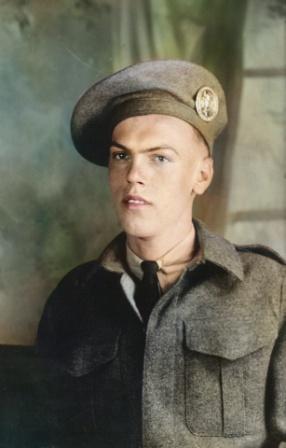
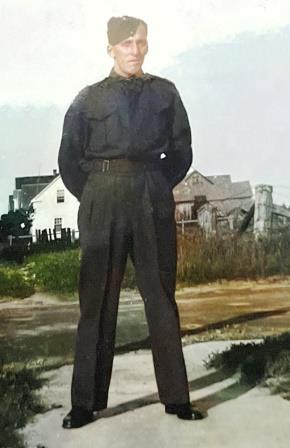
Frank’s niece, Sharon Carvery, the daughter of his sister Margaret Frances Jeffery, sent Pieter a photo, saying “…this is the only picture I could find with Uncle Frank with his sister Aunt Dot…”  Aunt Dot was Frank’s sister Dorothy Donnelly.

After completing his basic training at No. 60 Canadian Army (Basic) Training Centre (CABTC) in Yarmouth, Nova Scotia, Frank was sent to the A14 Canadian Infantry Training Centre (CITC) in Aldershot, Nova Scotia on February 27, 1944 for additional training on various rifles and mortar.
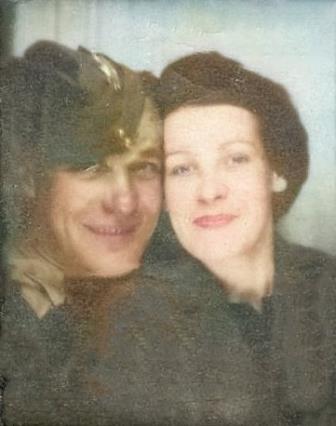
Frank Munroe with his sister Dorothy.  (Photo courtesy of Sharon Carvery. Photo colourization by Pieter Valkenburg)

Upon completion of the courses at A14, he was attached to S-5 Canadian Driving and Maintenance School (CD & M School) in Woodstock, Ontario on May 5, 1944, for a Driver i/c course.  On June 14, 1944, he qualified as a Driver i/c Class III (Wheeled).  (The term ‘Driver i/c’ refers to ‘Driver, internal combustion’.  Class III meant he was qualified to drive heavy trucks and armoured cars, but not tanks.)

He was reassigned back to A14 CITC in Aldershot in preparation for overseas service, before being granted embarkation leave from June 23, 1944 until July 6, 1944, the last chance he would have to see his family before going overseas.

….Frank left Canada for overseas service….

On July 21, 1944, Frank left Canada for the United Kingdom.  Upon arriving on July 27, 1944, he was assigned to No. 4 Canadian Infantry Reinforcement Unit (CIRU). 

Unfortunately, on August 4, 1944, while in England, he failed to requalify as a Driver i/c Class III (Wheeled), and was “…remustered for general duty…” according to his service file.

On August 16, 1944 he was assigned to the X-4 reinforcement list of No. 2 Canadian Base Reinforcement Group (CBRG) and shipped to France, arriving the following day. 

Frank joined the Stormont, Dundas & Glengarry Highlanders in Trun, France.  (Map source: DuckDuckGo)

On August 22, 1944, he was transferred to the Stormont, Dundas & Glengarry Highlanders Regiment, joining them in Normandy, France, where they were based in Trun, following a heavy day of fighting by the Regiment, which had resulted in a number of casualties.  The next day the Regiment moved north of Trun. 

Frank remained with the Regiment as it fought across France, and into The Netherlands.  It was in Nijmegen to relieve the airborne troops, and helped guard the bridge while the Rhine crossing was prepared. The Regiment then fought through the Hochwald in Germany, and continued north as it prepared to cross the Ems River and take the city of Leer on April 28, 1945, in what became known as Operation Duck.

…Operation Duck…
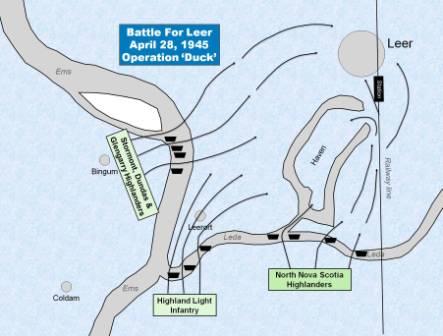
Map showing the Ems and Leda Rivers, and position of Regiments during the Battle for Leer.  (Map courtesy of and ©Jan Braakman)

In the plan for Operation Duck, the North Nova Scotia Highlanders would cross the Leda River in assault boats and secure the northern bank of the river in preparation for the attack to capture Leer. The Highland Light Infantry of Canada would cross the Leda River at the point where the Ems and Leda rivers meet. The Stormont, Dundas and Glengarry Highlanders would go across the Ems River towards the western edge of Leer.

These three Regiments were part of the 9th Canadian Infantry Brigade.  (See https://www.canadiansoldiers.com/history/battlehonours/northwesteurope/leer.htm)

While the men from the Highland Light Infantry all crossed safely, the North Nova Scotia Highlanders lost 5 men, and the Stormont, Dundas & Glengarry Highlanders lost 19.  It was a terrible tragedy, so close to the end of the war. 

To see what an assault boat looks like, take a look at this short YouTube video, which shows troops preparing to cross the Ems: 

…Why Operation Duck Was Important…

A translated excerpt from Jan Braakman’s ‘Holtense Canadezen’ explained why Operation Duck was important. “…At the end of April 1945, Canadian troops stood just across the Dutch-German border in Ostfriesland (East Frisia) in front of the river Ems….” (See https://en.wikipedia.org/wiki/East_Frisia)

Leer was a challenge to capture. “…The town of Leer was on the other side of the river on the route to Emden. Surrounded by inaccessible lowlands in the north and with rivers (Ems and Leda) in the west and south, Leer was a well defensible and therefore difficult to capture port city. All access bridges over the Ems and Leda were blown up by the Germans. For the Canadians there was no other option than to reach the city by water….

River crossings can be tricky due to currents and tides, and in wartime, there is always the risk of enemy fire.  “….The Ems River has an open connection with the Wadden Sea, which means that tides influence water levels and currents in the river. Tides made the currents unpredictable, and the Canadian Army didn’t have accurate information about the tides. What was clear: high tide was the best time to make the crossing. Aerial photographs showed that German troops had fortified themselves well behind the dikes that surrounded the city…. 

A decision was made on how to cross the two rivers – the Leda and the Ems.. “ Only under the protection of a smoke screen and solid artillery support would it be possible to successfully complete the attack on Leer, using boats … General Simonds ordered that on April 28, 1945, before darkness fell, there had to be a solid bridgehead, from which the capture of Leer could be initiated. That meant that the attack had to be launched during the middle of the day, around three o’clock, when the water level was at its highest…” 

The Highland Light Infantry crossed safely “ at the point where the Leda flows into the Ems, about three kilometres south of the city centre…

The other two regiments ran into trouble.  “…The crossing was made at three different places. At the same time, artillery fire and attacks from the air put the German defence line to the test. The North Nova Scotia Highlanders would cross the Leda from the south bank and take the harbour of Leer, which abutted the city on a peninsula…

…The Stormont, Dundas & Glengarry Regiment ran into trouble…

The Stormont, Dundas & Glengarry Highlanders Regiment was to cross the Ems River “…from the west bank of the Ems at Bingum to attack the city from the west.…

All three Regiments launched their attacks at the same time.  “….It began at half past two with fierce shelling, during which the positions of the German defence forces were fired upon. The attack from the south was spectacular and successful, with relatively few losses….

This wasn’t the case for the attack from the west. “….A number of boats….” from the Stormont, Dundas & Glengarry Highlanders Regiment “…showed motor defects or capsized. Some of the drowning men were rescued, but at the end of the day at least nineteen men from the Regiment were dead, drowned, or missing….

….Why did the men drown?….

After WWII ended “a team from the Stormont, Dundas & Glengarry Highlanders returned to the Ems. They dragged the river, looking for the bodies of the missing men. Some of them were found with their full kit still attached to their bodies….

Why did the men drown?  In ‘River Assault – Operation Duck: The 3rd Canadian Infantry Division’s Attack On Leer 28th April 1945’, author John Sliz noted that “…These men sank, never to rise again, even though life belts were worn.  The reason for this was the heavy equipment worn by the men was too much for the life belt that was used….

Sliz quotes from a report by Brigadier John M. Rockingham.  “…The equipment was worn….. in such a way that the waist belt alone had to be unbuckled to permit the soldier to shake it free. There was, however, a tendency for this equipment to slide down the arms, pressing them into the side, preventing any swimming motion, until it was finally clear….”  It would have been like trying to swim while wearing a straightjacket!

….Frank was one of the fatalities….

Major J.A. Forman and Lance Corporal V. C. Abrams, who survived the crossing, had recorded in their witness statements that at “….approximately 15:15 hours on April 28, 1945….” They were in an assault boat “…crossing the Ems River in the assault on Leer.  Enemy fire sunk the craft….” and 10 men were “…thrown into the river…

In the ‘Drama on the Ems’ chapter, a third survivor listed was Private Whitcombe. The three survivors “…explained what had happened to the boat in which they tried to get across. They were in an assault boat with fourteen men. Their boat ran into problems because the gunner in the front of the boat (the bow man) almost fell overboard, possibly because he was hit. The man was hanging over the bow.  Perhaps because of that, but at least practically at the same time, the prow of the storm boat dipped after being sucked into the bow wave of the boat ahead. In a matter of seconds their boat disappeared under water and the crew was in the cold river water.….

Frank was one of the 10 men who drowned, losing his life at the age of 22.

….Frank is buried in the Canadian War Cemetery in Holten….

Frank was originally buried in Bingum, Germany, before being reburied on March 26, 1946 in the Canadian War Cemetery in Holten, The Netherlands.
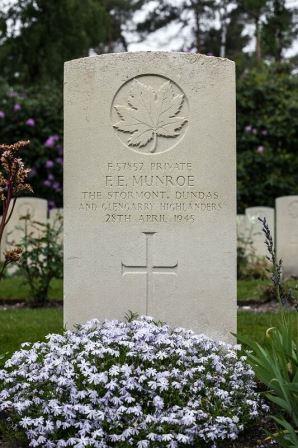
Grave of Frank Eugene Munroe in the Canadian War Cemetery in Holten, The Netherlands.  (Photo courtesy of Canadian Virtual War Memorial)

In November 1947, Frank’s grave was adopted by Mr. Arend Jan Markerink from Almelo, The Netherlands. He sent a letter, plus an international postage reply coupon, to the Department of National Defence, asking for Frank’s next of kin to be notified.  A note in the file stated that the letter and postage reply coupon were sent to the family on December 9, 1947.

….Other soldiers from the Stormont Dundas Glengarry Highlanders who lost their lives that day…

In addition to Frank Eugene Munroe, 18 more soldiers from the Stormont, Dundas and Glengarry Highlanders lost their lives on April 28, 1945, and are listed below.  If there are asterisks beside the name (****) it means there is a brief anecdote in the ‘Drama On the Ems’ chapter in ‘Holten Heroes: Stories from a Canadian Field of Honour’. 

  • A/Cpl John SAWATSKY of Petaigan, Saskatchewan, aged 20
  • L/Cpl Merle Coleman MOORE of Breckenridge Station, Quebec
  • L/Cpl James Edward SULLIVAN of Rexton, New Brunswick, aged 28 ****
  • Pte Frank Joseph BIERNASKI of Barry’s Bay, Ontario, aged 32 ****
  • Pte Walter James BROOKS of Toronto, Ontario, aged 28
  • Pte Leonard Gordon BROUGH of Sudbury, Ontario, aged 21**** 
  • Pte Steven John GRAVELLE of Peterborough, Ontario, aged 23
  • Pte Joseph Gerard HINDS of Orillia, Ontario, aged 20
  • Pte Earl Harcourt JOSLIN of Kingston, Ontario ****
  • Pte Ira Charles LANGILLE of Milton, Nova Scotia, aged 32 ****
  • Pte Cecil Albert LAWES of Frankford Ontario, aged 28
  • Pte Sidney Alexander OSLUND of Haileybury, Ontario, aged 29 ****
  • Pte Samuel Donald POWELL of Newcastle, Ontario, aged 22
  • Pte Edgar Douglas SMITH of Parrsboro, Nova Scotia, aged 28 ****
  • Pte Francis Wilber SPENCER of Stonecliffe, Ontario, aged 35 ****
  • Pte Jack Allan STEWARD of Belleville, Ontario, aged 24 ****
  • Pte Roy Ivenson THACKERAY of Peterborough, Ontario, aged 20 ****
  • Pte George Sidney WAKELY of Port Hope, Ontario, aged 31****

….A Tragic Drowning On The Leda River….

As mentioned in the ‘Holten Heroes’ excerpt, the crossing of the rivers to reach Leer involved three Regiments – Stormont Dundas and Glengarry Highlanders, North Nova Scotia Highlanders, and the Highland Light Infantry. 

The North Nova Scotia Highlanders were tasked with crossing the Leda River from the south bank and then take the harbour of Leer.  5 soldiers from this Regiment lost their lives when the storm boat they were in capsized, and their stories were told in previous blog postings as a 4 part series:

….Blog posting about another soldier mentioned in the book Holten Heroes…

Thank you to Jan Braakman for permission to quote from his book and use of the map showing the position of the Regiments, and to Sharon Carvery for a providing a photo of her uncle.  If you have a story or photo to share, please contact Pieter at memorialtrail@gmail.com or comment on the blog. 

© Daria Valkenburg

….Want to follow our research?….

If you are reading this posting, but aren’t following our research, you are welcome to do so.  Our blog address: https://onthewarmemorialtrail.com/
4 countries, 6 weeks, 7,000 km – an unforgettable war memorial journey in Europe…. Daria’s book ‘No Soldier Buried Overseas Should Ever Be Forgotten‘ is available in print and e-book formats.  Net proceeds of book sales help support research costs and the cost of maintaining this blog. For more information see https://nosoldierforgotten.com/

You are also invited to subscribe to our YouTube Channel: On The War Memorial Trail With Pieter Valkenburg: https://www.youtube.com/channel/UCJ591TyjSheOR-Cb_Gs_5Kw

Never miss a posting!  Subscribe below to have each new story from the war memorial trail delivered to your inbox.
On The War Memorial Trail…..Tragedy On The Ems Part 1: The WWII Soldier From Rexton Who Drowned During Operation Duck

March 5, 2025. In 2021, during a period when we were all at home due to Covid, we translated, into English, ‘Holtense Canadezen’, Jan Braakman’s book about some of the soldiers buried in the Canadian War Cemetery in Holten, The Netherlands.  In October 2023, this was published in English as ‘Holten Heroes: Stories from a Canadian Field of Honour’.  (See https://onthewarmemorialtrail.com/2023/11/01/new-book-about-soldiers-buried-in-the-canadian-war-cemetery-in-holten-the-netherlands/)

The chapter ‘Drama On The Ems’ was about a tragic incident during the Battle of Leer in Germany on April 28, 1945, one of the final actions to end WWII in Europe. Operation Duck, which involved the crossing of the Ems and Leda rivers in northern Germany in order to take the port of Leer, turned out very badly for 19 men of the Stormont, Dundas and Glengarry Highlanders Regiment. 

Two Maritime soldiers mentioned in the chapter, one from Nova Scotia, and one from New Brunswick, were on the photo wish list from the Canadian War Cemetery in Holten, The Netherlands.  Pieter was successful in finding family and a photo of these men, who were both with the Stormont, Dundas and Glengarry Highlanders. 

…..James is remembered on a plaque in the United Church in Rexton….

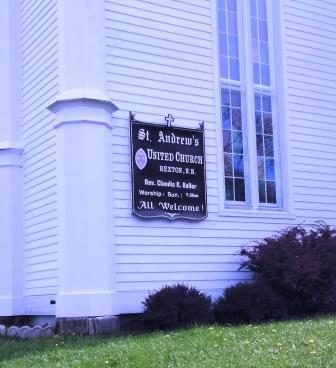
St. Andrew’s United Church in Rexton, New Brunswick.  (Photo credit: Daria Valkenburg)

James Edward SULLIVAN, from Rexton, New Brunswick, was one of the Maritimers. In a serendipitous coincidence, we’d visited Rexton to meet the family of another soldier – Janice Little and Gayle McBeath, nieces of WWII trooper Stanley Leigh MCBEATH. They took us to St. Andrew’s United Church, where Stanley’s name was listed on a plaque on the church organ. Then we noticed that James was also listed on the plaque! (See https://onthewarmemorialtrail.com/2024/02/03/on-the-war-memorial-trail-the-wwii-trooper-from-rexton-who-lost-his-life-three-days-before-his-birthday/)

James Sullivan and Stanley McBeath are listed on a memorial plaque on the organ in St Andrew’s United Church in Rexton.  (Photo credit: Daria Valkenburg)

….James’s niece had a photo!….

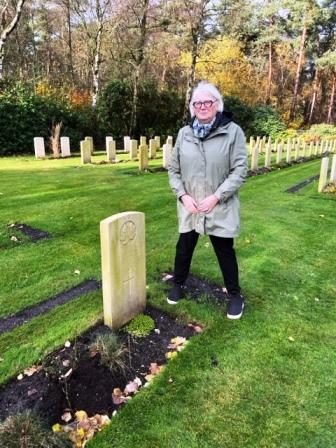
Barbara Sullivan at the grave of her uncle, James Sullivan, buried in the Canadian War Cemetery in Holten, The Netherlands.   (Photo courtesy of Barbara Sullivan)

Born July 7, 1919 in Main River, New Brunswick, James was the son of Edward and Augusta Sullivan. James had a younger brother, Kenneth, and it was through Kenneth’s daughter, Barbara Sullivan, that a photo was found, after she’d been contacted by Janice Little.  “I’m the niece of L/Corporal James Edward Sullivan of The Stormont, Dundas and Glengarry Highlanders.  I never knew him, he died a long while before I was born. His brother Kenneth is my dad.  Both of my parents passed away in 2001….”  Barbara wrote.

…..James enlisted under the NRMA in 1941….

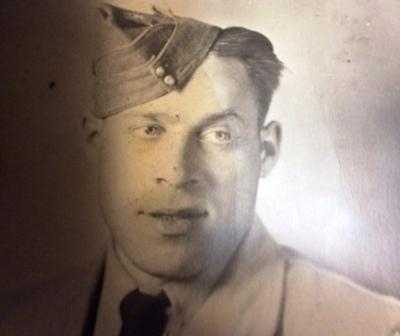
James Edward Sullivan. (Photo courtesy of the Sullivan Family.  Photo colourization by Pieter Valkenburg)

James originally enlisted under the National Resources Mobilization Act (NRMA) at the No. 7 NRMA Clearing Depot in Fredericton, New Brunswick on March 20, 1941 and began basic training at No. 70 Canadian Army Basic Training Centre in Fredericton. At the time, he stated he was employed as a truck driver and sawyer for a lumber company. (See https://en.wikipedia.org/wiki/National_Resources_Mobilization_Act)

On May 20, 1941, he was transferred to A1 Canadian Artillery Training Centre (CATC) at Camp Petawawa, Ontario for further training.  On July 26, 1941, he was sent to A23 Coast Defence and Anti-Aircraft Artillery Advanced Training Centre (C&AAATC) in Halifax, Nova Scotia for a few weeks.  The centre trained coast and anti-aircraft gunners. 

Next, James was attached to 1st (Halifax) Coast Brigade of the Royal Canadian Artillery in Halifax on August 21, 1941, which was responsible for providing coastal artillery support as part of the defences of Halifax, Nova Scotia.  

Devil’s Battery.  (Photo source: https://hmhps.ca)

On September 26, 1941, he was attached as a gunner to the 53rd Coast Battery of the 1st (Halifax) Coast Brigade, part of the defence of Devil’s Battery, and remaining there even after joining the active army in Halifax on February 1, 1942. 

James was sent back to A23 Coast Defence and Anti-Aircraft Artillery Advanced Training Centre (C&AAATC) in Halifax on August 31, 1942 for further training. After completing Range Takers Course No. 5 on October 10, 1942, he returned to the 53rd Coast Battery.

….James served in Newfoundland….

Cape Spear Battery.  (Photo source: https://www.hiddennewfoundland.ca)

On February 12, 1943, James was transferred to the 103rd Coast Battery of the Royal Canadian Artillery and sent to St. John’s, Newfoundland. Based at Cape Spear, the most eastern point in North America, the Battery was responsible for maintaining the 10″ guns.

Cape Spear’s close proximity to convoy routes and the entrance to St. Johns Harbour was an essential place to have a coastal defense battery, post-war signal station, and searchlight emplacement during World War II. (NOTE: Newfoundland and Labrador joined Canada on March 31, 1949.)

On November 18, 1943, James left Newfoundland for Shelburne, Nova Scotia and was transferred to the 104th Coast Battery of the Royal Canadian Artillery (RCA).

….James was transferred to the infantry….

On January 14, 1944, James was assigned to No. 1 Transit Camp in Windsor, Nova Scotia for preparation before being sent overseas.  However, instead of going overseas immediately, he was transferred to No. 60 Canadian Infantry (Basic) Training Centre (CIBTC) in Yarmouth, Nova Scotia for additional training.

Then, on April 9, 1944, he was sent to A14 Canadian Infantry Training Centre at Camp Aldershot, Nova Scotia for final preparations before going overseas. 

James was granted embarkation leave from June 2 to June 15, 1944, the last chance he had to see his family again.

….James left Canada for overseas service….

On June 25, 1944, James left Canada for the United Kingdom. Upon arriving on July 3, 1944 he was assigned to No. 4 Canadian Infantry Reinforcement Unit (CIRU). 

He continued his training for a few weeks before being transferred to the X-4 reinforcement list of the Canadian Infantry Corps (CIC), on July 26, 1944.  Three days later he was on his way to France, disembarking on July 30, 1944.

On July 31, 1944 he was assigned to the Stormont, Dundas and Glengarry Highlanders, part of the 21st Army Group, joining the Regiment in the vicinity of Le Vey, France, 23 km (14 miles) northwest of Falaise.  The Regiment needed downtime to get reorganized and to give the men a chance to train and have a rest following heavy fighting since landing in Normandy on D-Day.

He received a promotion to Lance Corporal a few weeks later, on August 19, 1944.  James remained with the Regiment as it fought across France, and into The Netherlands.  It was in Nijmegen to relieve the airborne troops, and helped guard the bridge while the Rhine crossing was prepared. The Regiment then fought through the Hochwald in Germany, and then north as it prepared to cross the Ems River and take the city of Leer on April 28, 1945, in what became known as Operation Duck.

… Operation Duck…

In the plan for Operation Duck, the Stormont, Dundas and Glengarry Highlanders would go across the Ems River towards the western edge of Leer. At the same time, the North Nova Scotia Highlanders would cross the Leda River in assault boats and secure the northern bank of the river in preparation for the attack to capture Leer. The Highland Light Infantry of Canada would cross the Leda River, where the Ems and Leda rivers meet.

These three Regiments were part of the 9th Canadian Infantry Brigade.  (See https://www.canadiansoldiers.com/history/battlehonours/northwesteurope/leer.htm)

While the men from the Highland Light Infantry all crossed safely, the North Nova Scotia Highlanders lost 5 men, and the Stormont, Dundas & Glengarry Highlanders lost 19.

Map showing the Ems and Leda Rivers, and position of Regiments during the Battle for Leer.  (Map courtesy of and ©Jan Braakman)

…Why Operation Duck Was Important…

A Storm boat is moved into the water during Operation Duck on April 28, 1945. (Photo source: Library and Archives Canada)

A translated excerpt from Jan Braakman’s ‘Holten Heroes: Stories from a Canadian Field of Honour’ explained why Operation Duck was important. “…At the end of April 1945, Canadian troops stood just across the Dutch-German border in Ostfriesland (East Frisia) in front of the river Ems….” (See https://en.wikipedia.org/wiki/East_Frisia)

Leer was a challenge to capture. “…The town of Leer was on the other side of the river on the route to Emden. Surrounded by inaccessible lowlands in the north and with rivers (Ems and Leda) in the west and south, Leer was a well defensible and therefore difficult to capture port city. All access bridges over the Ems and Leda were blown up by the Germans. For the Canadians there was no other option than to reach the city by water….

River crossings can be tricky due to currents and tides, and in wartime, there is always the risk of enemy fire.  “….The Ems River has an open connection with the Wadden Sea, which means that tides influence water levels and currents in the river. Tides made the currents unpredictable, and the Canadian Army didn’t have accurate information about the tides. What was clear: high tide was the best time to make the crossing. Aerial photographs showed that German troops had fortified themselves well behind the dikes that surrounded the city…. 

A decision was made on how to cross the two rivers – the Leda and the Ems.. “ Only under the protection of a smoke screen and solid artillery support would it be possible to successfully complete the attack on Leer, using boats … General Simonds ordered that on April 28, 1945, before darkness fell, there had to be a solid bridgehead, from which the capture of Leer could be initiated. That meant that the attack had to be launched during the middle of the day, around three o’clock, when the water level was at its highest…” 

The Highland Light Infantry crossed safely “ at the point where the Leda flows into the Ems, about three kilometres south of the city centre…

The other two regiments ran into trouble.  “…The crossing was made at three different places. At the same time, artillery fire and attacks from the air put the German defence line to the test. The North Nova Scotia Highlanders would cross the Leda from the south bank and take the harbour of Leer, which abutted the city on a peninsula…

…The Stormont, Dundas & Glengarry Highlanders Regiment ran into trouble…

The Stormont, Dundas & Glengarry Highlanders Regiment was to cross the Ems River “…from the west bank of the Ems at Bingum to attack the city from the west.…” 

All three Regiments launched their attacks at the same time.  “….It began at half past two with fierce shelling, during which the positions of the German defence forces were fired upon. The attack from the south was spectacular and successful, with relatively few losses…. 

This wasn’t the case for the attack from the west. “….A number of boats….” from the Stormont, Dundas & Glengarry Highlanders Regiment “…showed motor defects or capsized. Some of the drowning men were rescued, but at the end of the day at least nineteen men from the Regiment were dead, drowned, or missing….

….James was one of the fatalities….

After WWII ended “a team from the Stormont, Dundas & Glengarry Highlanders returned to the Ems. They dragged the river, looking for the bodies of the missing men. Some of them were found with their full kit still attached to their bodies….

Sergeant G.W. McGill, who survived the crossing, had reported that at “….approximately 15:30 hours, 28-April-1945, I was crossing the river Ems in an assault craft during the attack on Leer. Suddenly, the nose of our craft dipped and the craft overturned and we were all thrown into the water. I came to the surface and was picked up by another assault craft, along with Cpl W.M.J. Wood. We cruised around for approximately ten minutes, but we could not see Sullivan anywhere. A check on the shore by the platoon commander indicated that Sullivan, Brough, and Oslund were missing….

James was not found until almost the end of May 1945.  “….25 year-old James E. Sullivan was …. initially reported missing. On May 28, his family was informed by telegram that ….” his body had been found.

….James is buried in the Canadian War Cemetery in Holten….

James was originally buried in Oldenburg, Germany, before being reburied in 1946 in the Canadian War Cemetery in Holten, The Netherlands.

Grave of James Edward Sullivan in the Canadian War Cemetery in Holten, The Netherlands.  (Photo courtesy of Canadian Virtual War Memorial)

….Other soldiers from the Stormont Dundas Glengarry Highlanders who lost their lives that day…

In addition to James Edward Sullivan, 18 more soldiers from the Stormont, Dundas and Glengarry Highlanders lost their lives on April 28, 1945, and are listed below.  If there are asterisks beside the name (****) it means there is a brief anecdote in the ‘Drama On the Ems’ chapter in ‘Holten Heroes: Stories from a Canadian Field of Honour’. 

  • A/Cpl John SAWATSKY of Petaigan, Saskatchewan, aged 20
  • L/Cpl Merle Coleman MOORE of Breckenridge Station, Quebec, aged 22
  • Pte Frank Joseph BIERNASKI of Barry’s Bay, Ontario, aged 32 ****
  • Pte Walter James BROOKS of Toronto, Ontario, aged 28
  • Pte Leonard Gordon BROUGH of Sudbury, Ontario, aged 21**** 
  • Pte Steven John GRAVELLE of Peterborough, Ontario, aged 23
  • Pte Joseph Gerard HINDS of Orillia, Ontario, aged 20
  • Pte Earl Harcourt JOSLIN of Kingston, Ontario, aged 34****
  • Pte Ira Charles LANGILLE of Milton, Nova Scotia, aged 32 ****
  • Pte Cecil Albert LAWES of Frankford, Ontario, aged 28
  • Pte Frank Eugene MUNROE of Halifax, Nova Scotia, aged 22  
  • Pte Sidney Alexander OSLUND of Haileybury, Ontario, aged 29 ****
  • Pte Samuel Donald POWELL of Newcastle, Ontario, aged 22
  • Pte Edgar Douglas SMITH of Parrsboro, Nova Scotia, aged 28 ****
  • Pte Francis Wilber SPENCER of Stonecliffe, Ontario, aged 35 ****
  • Pte Jack Allan STEWARD of Belleville, Ontario, aged 24 ****
  • Pte Roy Ivenson THACKERAY of Peterborough, Ontario, aged 20 ****
  • Pte George Sidney WAKELY of Port Hope, Ontario, aged 31****

….A Tragic Drowning On The Leda River….

As mentioned in the ‘Holten Heroes’ excerpt, the crossing of the rivers to reach Leer involved three Regiments – Stormont Dundas and Glengarry Highlanders, North Nova Scotia Highlanders, and the Highland Light Infantry. 

The North Nova Scotia Highlanders were tasked with crossing the Leda River from the south bank and to then take the harbour of Leer.  5 soldiers from this Regiment lost their lives when the storm boat they were in capsized. Their stories were told in previous blog postings as a 4 part series:

….Blog posting about another soldier mentioned in the book Holten Heroes…

Tragedy On The Ems Part 2 will be about the other Maritimer on the photo wish list:  Frank Eugene MUNROE of Halifax, Nova Scotia.

Thank you to Jan Braakman for permission to quote from his book and use of the map showing the position of the Regiments, with translation into English by Pieter and Daria Valkenburg, and to Barbara Sullivan for sharing a photo of her uncle. If you have a story or photo to share, please contact Pieter at memorialtrail@gmail.com or comment on the blog. 

© Daria Valkenburg

….Want to follow our research?….

If you are reading this posting, but aren’t following our research, you are welcome to do so.  Our blog address: https://onthewarmemorialtrail.com/

4 countries, 6 weeks, 7,000 km – an unforgettable war memorial journey in Europe…. Daria’s book ‘No Soldier Buried Overseas Should Ever Be Forgotten‘ is available in print and e-book formats.  Net proceeds of book sales help support research costs and the cost of maintaining this blog. For more information see https://nosoldierforgotten.com/

You are also invited to subscribe to our YouTube Channel: On The War Memorial Trail With Pieter Valkenburg: https://www.youtube.com/channel/UCJ591TyjSheOR-Cb_Gs_5Kw

Never miss a posting!  Subscribe below to have each new story from the war memorial trail delivered to your inbox.

On The War Memorial Trail….. The WWII Signaller From Oxford Who Was Fatally Wounded in Sögel

January 25, 2025. When Pieter begins research into a soldier’s file to find family members who might have a photo, he never knows what to expect. Sometimes, serendipity smiles, as he explained to colleagues in The Netherlands about what happened last fall in researching a WWII soldier from Nova Scotia.

 “…A few days ago I started trying to find a photo of George Allan Buchanan of Nova Scotia…” Pieter wrote.  “… When I looked at his estate form, my heart sank a little. He was married but had no children. Both parents died early. He had a half-sister, Jean Anderson, and that was all. However, I found her obituary from 2012. She was married to Gerald Allen and they had 3 sons and 3 daughters. I chose one of the daughters, Ramona Emslie, and called her in Nova Scotia and – you won’t believe it – but she had a picture!…” (Translation from the original Dutch.) 

Not long after Pieter received a photo, we were in Nova Scotia, and visited with Ramona and her husband Roger. Not only did we learn more about George, we were also treated to the most delicious apple pie!

Pieter (left) with Ramona and Roger Emslie.  (Photo credit: Daria Valkenburg)

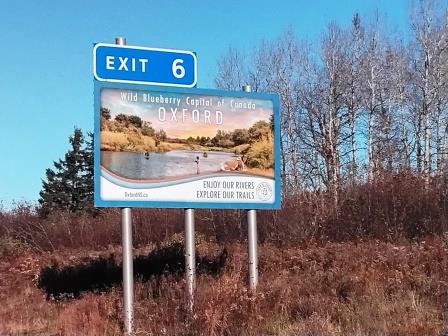
.….George was born in Oxford – the wild blueberry capital of Canada….

Sign for the turn-off to Oxford, Nova Scotia.  (Photo credit: Daria Valkenburg)

Born in Oxford, Nova Scotia on September 9, 1914, George Allan BUCHANAN was the son of George Allen and Margaret Jennie (nee Redmond) Buchanan.  George’s father died while he was a child, and his mother remarried in 1926 to Orval ‘Orlo’ Anderson.   

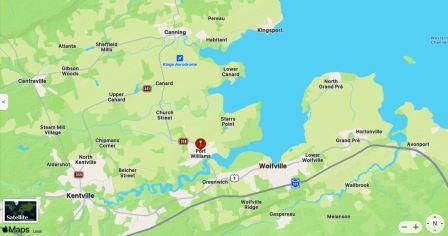
At the time of his enlistment with the 1st Anti-Aircraft Battery in Dartmouth, Nova Scotia, on August 8, 1940, George was working as a farmer for Geo Chase of Port Williams, and was also a carpenter.  He and his wife, Nancy Eva, who he’d married on December 18, 1939, were living in Lower Canard, Nova Scotia.

George Allan Buchanan lived in Lower Canada and worked for a farmer from Port Williams at the time of his enlistment in August 1940.  (Map source: DuckDuckGo)

….George served on the West Coast as part of Pacific Command….

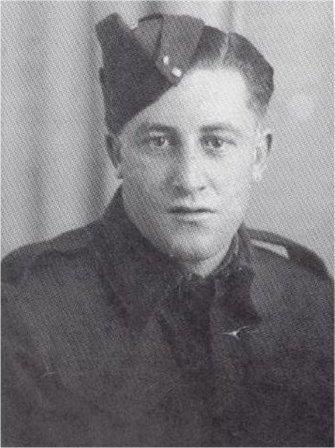
George Allan Buchanan.  (Photo courtesy of Ramona Emslie.  Photo colourization Pieter Valkenburg)

On January 11, 1942, George was attached to the 5th (BC) Coast Brigade of the Royal Canadian Artillery (RCA) and the No. 11 District Depot in Vancouver, British Columbia, remaining there until May 1, 1942, when he was posted to the 9th Anti-Aircraft Battery of the RCA in Sidney, British Columbia.  On October 9, 1942 he was assigned to the 27th Anti-Aircraft Regiment in Esquimalt, British Columbia.  

George’s West Coast posting was part of Pacific Command, which had two key functions.  The major function was to strengthen and administer home defence facilities on Canada’s Pacific Coast against possible Japanese attack. A second function was to train reinforcements to be sent to the Canadian divisions in Europe. 

On November 1, 1942 George was sent to the Coast Artillery School of Instruction in Esquimalt, for a Heavy Anti-Aircraft Artillery course, which he completed on December 12, 1942.  

George was transferred to the No. 1 Transit Camp in Windsor, Nova Scotia on August 8, 1943 for further training. 

….George was sent for a driver operator course ….

On October 29, 1943, George was transferred to A2 Canadian Army Training Centre (CATC) in Petawawa, Ontario.  As of December 17, 1943 he was attached to A7 Canadian Signal Training Centre (CSTC) at Camp Barriefield, Ontario for a Driver Operator Course, after having qualified as a Driver Class III on December 10, 1943.  Class III meant he was qualified to drive heavy trucks and armoured cars, but not tanks. 

On March 25, 1944, he had qualified as a Driver Operator Class ‘C’. He then returned to A2 Canadian Army Training Centre (CATC) in Petawawa on March 31, 1944.

On April 29, 1944, George was given embarkation leave until May 12, 1944, the last chance he had to see his family. 

….George left Canada for overseas service….

After returning from his embarkation leave, George was sent to the No. 1 Training Brigade in Debert, Nova Scotia on June 14, 1944 for final training in preparation for overseas service. 

George left Canada on June 26, 1944, arriving in the United Kingdom on July 4, 1944, and assigned to No. 1 Canadian Army Reinforcement Unit (CARU). He continued to take courses, to upgrade his skills as a Driver Operator.

On October 16, 1944, George was assigned to the X-4 Reinforcement list of the Royal Canadian Artillery, and left the United Kingdom the following day, arriving in Belgium on October 18, 1944.   

….George was transferred to the 23rd Field Regiment….

On November 18, 1944, George was transferred to the 23rd Field Regiment of the Royal Canadian Artillery, joining them in Boxtel, The Netherlands.

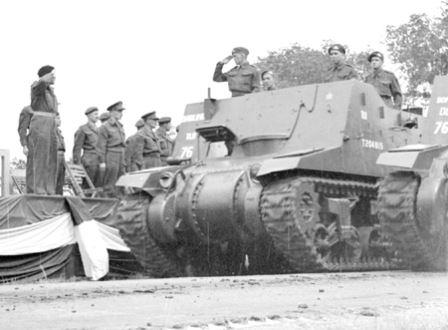
In ‘The History of the 23rd Canadian Field Regiment (SP) RCA’, the Regiment was on a rest period following heavy fighting, and making “….a frantic attempt to get the guns calibrated despite horrible weather conditions….”  (Note: SP refers to self-propelled)

A self-propelled gun.  (Photo source: Kevin T of WW2Talk)

On December 6, 1944, the Regiment “…moved back into the line….” near ‘s-Hertogenbosch.  “…We were now living once more in a veritable “buzz-bomb alley” as the Germans intensified their efforts to knock out the port of Antwerp and render it useless to the Allies….

An excerpt from a compilation booklet from ‘The 23rd Field Regiment (SP) Royal Canadian Artillery Official SP Weekly’ included a brief description of George.  “…He was attached to the 36th Battery, as a Signaller, and was soon rated as an efficient, conscientious soldier, who did his assigned job quietly and well. It was not long before the boys were calling him ‘Buck’….

.….The 23rd Field Regiment moved into Germany in February 1945….

In February 1945, the History recorded that “about the middle of February the news arrived that we were to have a part in the next operation which would bring the forces of 21 Army Group to the banks of the Rhine – and possibly win the war then and there…

By February 22, 1945, the Regiment was in the Reichswald Forest in Germany, in place for Operation Blockbuster.  (See https://en.wikipedia.org/wiki/Operation_Blockbuster) “….In preparation for the attack the Regiment left the concentration area on the night of the 24th and moved south to deploy near Louisendorf. The roads were in terrible condition, and the heavy volume of traffic which had to roll over them ceaselessly only made matters worse. On the first deployment most of the soft vehicles were left in concentration areas back along the road, partly due to bad traffic conditions and partly due to enemy shelling in the more forward areas….

Then, “….on the 27th the Regiment made another move, going into action just east of Keppeln….”  The Regiment fought their way through Germany in March and into April. 

.….George was fatally wounded in Sögel….

The History explained that “…at the crack of dawn on April 9th the Regiment was on the road again, but had to spend two hours sitting on the road before crossing the canal into Meppen and striking north along the canal to Lathen. Then the axis of the advance swung east until we reached Sögel…

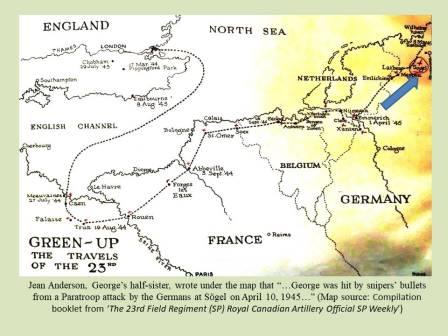
The Regiment was successful in taking the town of Sögel in Niedersachsen on April 9, 1945, but the following day the Germans made an unexpected counterattack.  “….The Regiment was getting packed in anticipation of another move when small arms fired began to whistle around the area….. Then mortars started dropping in to the area…. It was a counter-attack and there didn’t appear to be any infantry in front of us…

Just after 9:30 am, George was seriously injured in the fighting that had ensued, receiving shrapnel wounds in his left thigh and lower abdomen. “….Every man in the battery did an excellent job in beating off this first major counter-attack ever suffered by the unit. But although it was successfully repelled, three men paid the supreme sacrifice. They were Lieut. Doug Denton who was wounded as he lifted a casualty into a half-track and died next day, Gnr. George Buchanan who died later that day, and Gnr. Vic Hubacheck who was instantly killed by a ricochet bullet. Four or five other lads were wounded….

George was initially treated at a Field Dressing Station, before being transported to the Canadian military hospital in Almelo, The Netherlands.  Unfortunately, the medical report stated that he was dead on arrival at 9:40 pm that evening.  He was 31 years old.

.….George is buried in Holten….

George was temporarily buried in Almelo, before being reburied in the Canadian War Cemetery in Holten, The Netherlands on February 4, 1946.

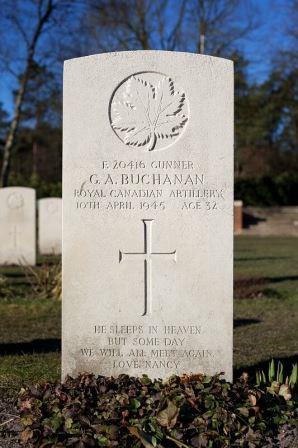
Grave of George Allan Buchanan in the Canadian War Cemetery in Holten, The Netherlands.  (Photo courtesy of Canadian Virtual War Memorial)

….George’s grave was adopted by Jo Visschers of Bathmen ….

After his reburial in the Canadian War Cemetery in Holten, George’s grave was adopted by Jo Visschers of Bathmen, The Netherlands.  Jo’s letter advising of the grave adoption was forwarded to George’s widow in March 1948 by the Department of Veterans Affairs.

Thank you to Ramona and Roger Emslie for providing photos and information, to Kevin T of WW2Talk, and to Edwin van der Wolf, a volunteer at the Canadian War Cemetery in Holten, for sending us an account of what happened in Sögel in No. 156-April 2016 ‘Informatieblad Over Verdedigingswerken En Militaire Geschiedenis – De Opmars Van De Canadezen In Noordwest Duitsland’ (Information Sheet On Defensive Works And Military History – The Rise Of The Canadians In Northwest Germany).

If you have a story or photo to share, please contact Pieter at memorialtrail@gmail.com or comment on the blog. 

© Daria Valkenburg

….Want to follow our research?….

If you are reading this posting, but aren’t following our research, you are welcome to do so.  Our blog address: https://onthewarmemorialtrail.com/

4 countries, 6 weeks, 7,000 km – an unforgettable war memorial journey in Europe…. Daria’s book ‘No Soldier Buried Overseas Should Ever Be Forgotten‘ is available in print and e-book formats.  Net proceeds of book sales help support research costs and the cost of maintaining this blog. For more information see https://nosoldierforgotten.com/

You are also invited to subscribe to our YouTube Channel: On The War Memorial Trail With Pieter Valkenburg: https://www.youtube.com/channel/UCJ591TyjSheOR-Cb_Gs_5Kw

Never miss a posting!  Subscribe below to have each new story from the war memorial trail delivered to your inbox.
On The War Memorial Trail….The WWII Soldier From St.-Georges Who Lost His Life On His Birthday

January 20, 2025.  When we were in Manitoba last year, we visited the Winnipeg River Heritage Museum, in the village of St.-Georges, in order thank Diane Dube in person for helping us with the photo searches of Edmond COULOMBE and Philip LAFORTE.  (See https://onthewarmemorialtrail.com/2021/12/24/on-the-war-memorial-trail-the-successful-search-for-a-photo-of-ww2-soldier-edmond-coulombe/ and https://onthewarmemorialtrail.com/2022/03/22/on-the-war-memorial-trail-remembering-ww2-soldier-philip-laforte/)

Daria and Pieter with Diane Dube (centre) at the Winnipeg River Heritage Museum in St.-Georges, Manitoba. (Photo courtesy of Valkenburg family)

During our visit, Diane mentioned that she had a relative from the area who was buried in the Canadian War Cemetery in Holten, The Netherlands – Omer VINCENT.  “…His father and my grandfather were brothers. He was first cousin to my father….

Diane wondered if the cemetery had a photo of him, and we assured her it did, as the researchers did not include him on their photo wish list for Manitoba soldiers.  She sent us an excerpt about Omer from a book about the Vincent family, ‘Et la rivière coule toujours 1892-1992’ (‘And the river is still flowing 1892-1992’), published by Hector H. Vincent.

Born April 13, 1920 in St.-Georges, Manitoba, Omer was the son of Fortunat and Marie-Louise Vincent. He came from a large family, with 5 brothers and 5 sisters alive at the time of his death.  Two brothers, Philippe and Wilfred, also served during WWII.

….Omer worked with his father and brothers prior to enlistment….

Omer’s brief biography in ‘Et la rivière coule toujours 1892-1992’ explained that he helped his father and older brothers “…with the farm work.  He soon joined them cutting pulp wood during the winter and would also haul the wood by sleigh and horse team to Pine Falls…”  There was a pulp and paper mill in nearby Pine Falls, Manitoba.

Omer with his horses. (Photo source: ‘Et la rivière coule toujours 1892-1992’)

The entry went on to say that Omer’s “…favourite pastime was hunting with his brothers.  They kept the bush cutting camps well supplied with fresh meat during the winter…

Omer had worked with his father for several years when he enlisted on October 29, 1941 in Winnipeg, Manitoba with the No. 10 District Depot Anti-Aircraft Artillery, Royal Canadian Artillery (RCA). Omer’s fluency in both English and French was noted on his Occupational History Form.  It was also recorded that he could drive a vehicle, a motorcycle, and a tractor, and liked to play baseball.

Omer Vincent.  (Photo source: ‘Et la rivière coule toujours 1892-1992’)

On November 13, 1941, he was sent for basic training at No. 12 Canadian Army (Basic) Training Centre (CABTC) in Chatham, Ontario.  After completing the course on February 3, 1942, he was transferred to A1 Canadian Artillery Training Centre (CATC) at Camp Petawawa in Ontario for advanced training as a gunner. 

Omer was in Petawawa until April 4, 1942. While there, he received embarkation leave, the last time he would see his family.  He returned briefly to Petawawa until April 29, 1942, when he travelled to Halifax, Nova Scotia, the port of embarkation to the United Kingdom.

….Omer left Canada for overseas service….

On May 4, 1942, Omer left Canada for the United Kingdom.  Upon arriving on May 12, 1942 he was assigned to No. 2 Canadian Artillery Reinforcement Unit (CARU).  He continued his training and then was transferred to the 7th Anti-Tank Regiment of the Royal Canadian Artillery on July 31, 1942. 

Omer was reassigned to No. 2 Canadian Artillery Reinforcement Unit (CARU) on August 26, 1943 and sent for specialized training at the Canadian Military Headquarters in London, and then for a series of gun fitter courses at Stoke-On-Trent, where the Artillery Equipment section of the Royal College of Military Science was based during the war.

Upon completion of the courses, Omer was transferred to the X-4 reinforcement list of No. 2 Canadian Base Reinforcement Group (CBRG), part of the 21st Army Group, on August 16, 1944.  The next day he was on his way to Normandy, France, disembarking on August 18, 1944.

A few days later, on August 23, 1944, he was assigned to the 3rd Anti-Tank Regiment of the Royal Canadian Artillery. The Regiment was responsible for coordinating anti-tank defences, with troops supporting the infantry as they fought their way across Boulogne and Calais in September 1944.

In October 1944, the Regiment moved into Belgium, under the command of the 10th Canadian Infantry Brigade. On November 10, 1944, the Regiment began moving from Ghent, Belgium towards Nijmegen, The Netherlands.  On November 17, 1944, Omer was admitted to No. 12 Canadian General Hospital and remained there for a week before returning to his Regiment, now based in ‘s-Hertogenbosch, The Netherlands.

.….Omer’s Battery was tasked with holding the east bank of the IJssel River….

Map showing locations where Omer Vincent was in April 1945.  (Map source: DuckDuck Go)

The April 5, 1945 war diary for the 3rd Anti-Tank Regiment reported that “…Lt JR Cameron of the 4th Battery contacted the QOR this morning and 4 Battery is to aid in holding the east bank of the IJssel between Zutphen and Doesburg…”  QOR referred to Queen’s Own Rifles.  Omer was part of the 4th Battery.

On April 8, 1945, the war diary for the Regiment recorded that 4 Battery was involved in “was under command 8th Brigade for their part in the holding role from Zutphen to Doesburg….” as part of the “….defence system they are holding along the IJssel…..

The following day, the war diary for the Regiment noted that 4 Battery’s new position was “taken up in Steenderen….

.….Omer lost his life on his 25th birthday….

On April 13, 1945, the municipality of Bronkhorst was liberated. However, Germans were still across the IJssel River by Brummen. The war diary for the 3rd Anti-Tank Regiment for that day recorded that “….4 Battery – had skirmish with enemy in barn. Battery suffered two men killed and shot up and burnt down buildings with a Valentine SP.….”  A Valentine Self Propelled (SP) was a tank destroyer.  For more information see https://en.wikipedia.org/wiki/Archer_(tank_destroyer)

Edwin van der Wolf, a volunteer at the Canadian War Cemetery in Holten, explained that “…On the ‘t Hammink farm,  Mr. Buil, a farmhand, saw that night, through the basement window, that German soldiers were coming back and going in the back side of the farm. Farmhand Bruil went to a farm that was 1.5 km further, as he knew that Canadians were billeted there, and informed them about what he had seen….

…Then four Canadian soldiers with a tank went on patrol to ‘t Hammink. Two of them went to explore the farm, but were met by a barrage of bullets. Both were slain. The men were Gunners Omer Vincent and Leslie Temple. The ‘t Hammink farm was then set on fire….Leslie Phillip Carl TEMPLE, from Regina, Saskatchewan, was 23 years old at the time of his death. Sadly, April 13, 1945 was Omer’s 25th birthday.

Edwin went on to write that “…Mr. Breukink, the owner of ‘t Hammink, had fled because he was a member of the NSB…” NSB was the acronym for Nationaal Socialistische Beweging (National Socialist Movement), whose members were Nazi collaborators. (See https://en.wikipedia.org/wiki/National_Socialist_Movement_(Netherlands))

.….Omer is buried in Holten….

Edwin’s account noted that “…the two Canadians killed were temporarily buried in the yard of the Half Welle…” Per Omer’s service file, this was in the vicinity of Baak, south of Zutphen and near Steenderen.  On April 1, 1946, Omer was reburied in the Canadian War Cemetery in Holten, The Netherlands.

Grave of Omer Vincent in the Canadian War Cemetery in Holten, The Netherlands.  (Photo courtesy of the Information Centre Canadian Cemetery Holten)

….Omer’s grave was adopted by a doctor from Gorssel ….

After his reburial in the Canadian War Cemetery in Holten, Omer’s grave was adopted by a Dr. B. H. Upmeijer of Gorssel.  On April 6, 1947, he wrote to Omer’s family, saying that “…today we remember in our village the day of our liberation….” 

He went on to explain that he and others from the village had gone to the Canadian War Cemetery in Holten, “…15 miles from the village of Gorssel and placed flowers on the graves of those who are fallen in the neighbourhood of Zutphen, Eefde, and Gorssel…” 

Dr. Upmeijer noted that he had adopted Omer’s grave, and went on to share his own personal loss.  “…The grave of my brother is in Burma… and for me it would have been reassuring, when I knew where and how he is laying exactly…”  (Burma is now called Myanmar.)

….Vincent Island in northern Manitoba is named in Omer’s honour…..

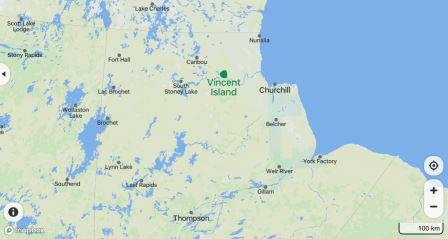
Vincent Island in Mullin Lake was named after Omer Vincent. (Map source: Mapcarta)

Vincent Island, located in Mullin Lake in northern Manitoba, west of Churchill, was named after Omer in 1995. 

Thank you to Diane Dube for providing information on Omer Vincent, to Edwin van der Wolf for the account of what happened at the ‘t Hammink farm, and to Sheldrake of WW2Talk for information about the gun fitter course.  If you have a story or photo to share, please contact Pieter at memorialtrail@gmail.com or comment on the blog. 

© Daria Valkenburg

….Want to follow our research?….

If you are reading this posting, but aren’t following our research, you are welcome to do so.  Our blog address: https://onthewarmemorialtrail.com/

4 countries, 6 weeks, 7,000 km – an unforgettable war memorial journey in Europe…. Daria’s book ‘No Soldier Buried Overseas Should Ever Be Forgotten‘ is available in print and e-book formats.  Net proceeds of book sales help support research costs and the cost of maintaining this blog. For more information see https://nosoldierforgotten.com/

You are also invited to subscribe to our YouTube Channel: On The War Memorial Trail With Pieter Valkenburg: https://www.youtube.com/channel/UCJ591TyjSheOR-Cb_Gs_5Kw

Never miss a posting!  Subscribe below to have each new story from the war memorial trail delivered to your inbox.
Happy Holidays From The Valkenburgs – And Our Year In Review!

christmas-holiday-balls-stars-ribbon-cherries-decorations-header-background-image-hd-1920x720

December 24, 2024.  2024 was another busy year for us, and we remain committed to the On The War Memorial Trail research project.  As of today, since this project began, Pieter has been able to cross 312 photo search requests from the three Canadian War Cemeteries in The Netherlands off of their photo search lists.  In addition, he has found photos for an additional 101 soldiers, with some WWII soldiers buried in Belgium, France, Italy, and the United Kingdom, airmen buried in municipal cemeteries, several soldiers from WWI, and soldiers from Prince Edward Island that survived WWI or WWII. I have written stories for many of these soldiers, with many more stories still to come.

While a few long-standing searches for photos were successful, allowing Pieter to complete his files for those soldiers, many files still remain open.  In most cases, family members were found, but no photo was available for one reason or another. 

The files in which Pieter has had zero luck in finding photos have been placed on the Cold Case Files page on the On The War Memorial Trail website.  We started this page last year and have been lucky to have a few names were cleared off of the list. Perhaps 2025 will see more names taken off of this list!  (See https://onthewarmemorialtrail.com/our-cold-cases/)

New research files were added, and Pieter was able to finish his research for many files from 2023.  As always, there is a lag between him completing his work and me documenting his research, but that is on my very optimistic ‘to do’ list for this winter.

Pieter’s new project, to upload photos to the Canadian Virtual War Memorial website, which began in the fall of 2023, was continued into 2024.  He advises that he plans to continue this project into 2025.

This year, we were able to meet several families, which we very much appreciated – this year in Manitoba, New Brunswick, Nova Scotia, and Prince Edward Island.  We are grateful that so many families have come forward to share photos and information, and are thankful for help from the media in helping to find photos.  What follows in the rest of this posting is a summary of what happened in 2024 with this research project.

Pieter awarded the Minister of Veterans Affairs Commendation….

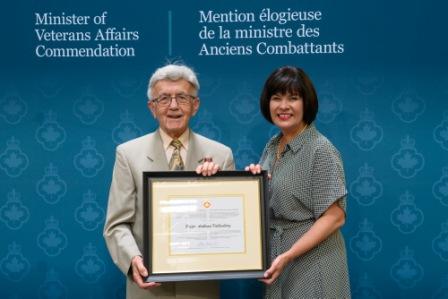
On August 19, 2024, Pieter was presented with the Minister of Veterans Affairs Commendation from The Honourable Ginette Petitpas Taylor, Minister of Veterans Affairs, in a ceremony held in Charlottetown, Prince Edward Island. The Commendation had been awarded on January 24, 2024, with the presentation ceremony held in August. (See https://veterans.gc.ca/en/about-vac/who-we-are/department-officials/minister-veterans-affairs/minister-veterans-affairs-commendation/valkenburg-pieter-anthonie and https://onthewarmemorialtrail.com/2024/08/25/on-the-war-memorial-trail-pieter-awarded-the-minister-of-veterans-affairs-commendation/)

_095 Aug 19 2024 Min of VA Commendation ceremony

Pieter with the Minister of Veteran Affairs Commendation, presented to him by The Honourable Ginette Petitpas Taylor, Minister of Veterans Affairs. (Photo courtesy of Veterans Affairs Canada)

 Presentation for 75th NATO Anniversary Commemoration At Seacow Head Lighthouse….

CIMG6887 Jul 10 2024 John Pieter Clare Seacow Head Lighthouse Ceremony

Left to right:  John Yeo, Pieter Valkenburg, Clare Hutchinson.  (Photo credit: Daria Valkenburg)

On July 10, 2024, Pieter was one of the guest speakers at the 75th NATO Anniversary Commemoration at Seacow Head Lighthouse in Fernwood, Prince Edward Island. Pieter briefly spoke about his deployment at a NATO Nike Missile Base in Rheine, Germany during the Cold War. (See https://onthewarmemorialtrail.com/2024/07/15/on-the-war-memorial-trail75th-nato-anniversary-commemoration-at-seacow-head-lighthouse/)

Among the NATO representatives were John Yeo, Atlantic Regional Director for NATO Veterans of Canada; guest speaker Pieter Valkenburg, Public Relations Officer for Borden-Carleton Legion; and keynote speaker Clare Hutchinson, former NATO Secretary General’s Special Representative for Women, Peace, and Security.

Presentation At The 105th Annual  Remembrance Service At The Cornwall Cenotaph….

CIMG7059 Sep 22 2024 Cornwall Cenotaph speech Pieter

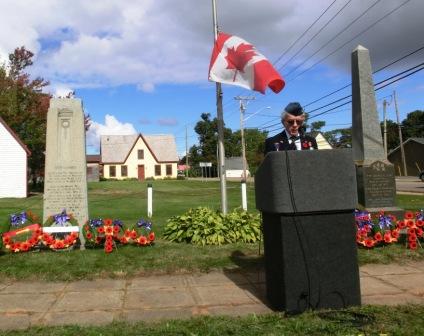
Pieter at the podium in Cornwall, with the WWII Cenotaph on the left, and the WWI Cenotaph on the right. (Photo credit: Daria Valkenburg)

On September 22, 2024, Pieter was the keynote speaker at the 105th Annual Remembrance Service at the Cornwall Cenotaph in Cornwall, Prince Edward Island.  Pieter briefly spoke about why he researches Canadian soldiers, gave a brief description of how the 4 names listed on the WWII Cenotaph lost their lives, and mentioned the importance of preserving photos and the individual stories of those who served.  (See https://onthewarmemorialtrail.com/2024/09/26/on-the-war-memorial-trail105th-annual-remembrance-service-at-cornwall-cenotaph/)

…. Uploading photos to the Canadian Virtual War Memorial website ……

Pieter began a new project last fall, to upload photos to the Canadian Virtual War Memorial website, and earmarked this as his winter 2024 project.  For more information on this excellent resource, see https://www.veterans.gc.ca/eng/remembrance/memorials/canadian-virtual-war-memorial/

Pieter did a test run last fall, uploading photos of three WWII soldiers. This year, he uploaded photos of:

  • 20 WWI soldiers
  • 195 WWII soldiers and airmen

This resulted in a total contribution of 218 soldiers.

 … WWI Related Stories….

  • We prepared a 5 part-series based on letters written by WWI soldier Lawrence Ivy MARSHALL from Prince Edward Island, who returned home with a war bride, Evelyn Martha Williams.

 … WWII Related Stories….

  • We shared a story about the 2023 candle lighting at graves of Canadian soldiers in The Netherlands.
  • We provided an update to the 2021 story about WWII soldier Percy ‘Dexter’ HIGGINS, from Nova Scotia, who lost his life in The Netherlands on April 4, 1945, during the Battle of Warnsveld, while serving with the North Nova Scotia Highlanders. On April 4, 2024, Higginsstraat was named in his honour near where he lost his life.

…Indigenous Soldiers….

We were able to tell the story of the service by one WWII Indigenous soldier:

  • WWII Indigenous soldier James ‘Jimmy’ Oliver THOMAS from Manitoba, who died in Germany on May 2, 1945, a few days after being liberated from the Stalag VII-A POW Camp in Moosburg, Germany.

…. Stories About Servicemen From The Maritimes…

We also featured stories about servicemen from The Maritimes:

  • WWII soldier Harold ‘Hal’ Gabriel BULGER from Prince Edward Island, who was killed during the Battle of Moerbrugge in Belgium on September 10, 1944.
  • WWII soldier Lawrence William BULGER from Prince Edward Island, who was killed during the Battle of Bienen in Germany on March 25, 1945.
  • WWII soldier John ‘Weston’ CAMPBELL from Prince Edward Island, who was killed during Operation Veritable in Germany on February 14, 1945.
  • WWII soldier Donald Roy CARTER from New Brunswick, who was killed in action during the Attack on the Goch-Calcar Road in Germany on February 20, 1945.
  • WWII soldier Edward ‘Ed’ Dalton CHISHOLM from Nova Scotia, who was killed in action during the Battle for the North Shore of the Scheldt in Belgium on October 20, 1944.
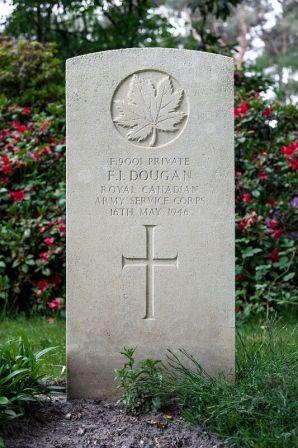
  • WWII soldier Francis ‘Frank’ Ivan DOUGAN from Prince Edward Island, who was killed in a road accident in The Netherlands on May 16, 1946.
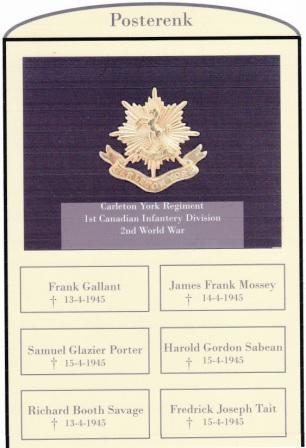
  • WWII soldier François ‘Frank’ GALLANT from Prince Edward Island, who was killed during the Liberation of Posterenk in The Netherlands on April 13, 1945.
  • WWII soldier François ‘Frank’ GUIMOND from New Brunswick, who was killed in action during the Attack on Weener in Germany on April 24, 1945.
  • WWII soldier Edgar M. GUITARD from New Brunswick, who was killed by German mortar fire in The Netherlands on January 15, 1945.
  • WWII soldier Maurice James HUGHES from Prince Edward Island, who was killed when the jeep he was riding in hit a mine in Germany on May 2, 1945.
  • WWII soldier Ange Aimé LECLAIR from New Brunswick, who was killed by artillery fire in Germany during the Battle of Hochwald Gap on March 2, 1945.
  • WWII soldier Joseph Taylor MACLEOD from Nova Scotia, who was killed in action during the Battle of Groningen on April 13, 1945.
  • WWII soldier Stanley Leigh MCBEATH from New Brunswick, who was killed in action in Germany on April 21, 1945.
  • WWII soldier Sydney Guy MOSHER from Nova Scotia, who was killed in action during the Attack on Weener in Germany on April 24, 1945.
  • WWII soldier Edward Gabriel PERRY from Prince Edward Island, who lost his life after being fatally wounded during the Battle of Hochwald Gap in Germany on March 2, 1945.
  • WWII soldier Lawrence Arthur RUDOLPH from Nova Scotia, who was killed in action during Operation Blockbuster in Germany on February 27, 1945.
  • WWII soldier Ronald ‘Ronnie’ Eugene SMITH from Nova Scotia, who was killed in action during Operation Cannonshot in The Netherlands on April 14, 1945.
  • WWII soldier Ralph Kenneth SILLIKER from Prince Edward Island, who was killed in action during Operation Churchill in Germany on March 2, 1945.
  • WWII soldier William Ernest STONE from Prince Edward Island, who was killed in action during the Attack On Hoogerheide in The Netherlands on October 10, 1944.

…. Stories About Servicemen From Outside The Maritimes…

  • WWII soldier Thomas ‘Tom’ Alfred BROWN from Alberta, who was killed in action during the Battle of Moyland Wood in Germany on February 17, 1945.

…In Conversation And More….

  • In an 80th Anniversary of D-Day blog, we shared some anecdotes about the Normandy landings and highlighted previously told stories of 11 servicemen who were present in Normandy on June 6, 1944. All survived D-Day, but only 1 survived WWII and returned home.
  • We wrote about the 80th Anniversary of D-Day wreath laying ceremony that we attended by the Cenotaph outside the Borden-Carleton Legion on June 6, 2024.
  • We wrote about the 75th NATO Anniversary Commemoration at Seacow Head Lighthouse in Fernwood, Prince Edward Island on June 10, 2024. Pieter was one of the guest speakers at this event.
  • We wrote about meeting WWII veteran Lois Maud BROWN of Kensington, Prince Edward Island, after being asked by Scott Masters, a history teacher at Crestwood Preparatory College in Toronto, Ontario, for help in finding WWII veterans to interview for the Crestwood Oral History Project.
  • We wrote about the 105th Annual Remembrance Service at the Cornwall Cenotaph in Cornwall, Prince Edward Island on September 22, 2024. Pieter was the keynote speaker at this event.
  • We reported on how volunteers (including Pieter) at the Borden-Carleton Legion in Prince Edward Island honour deceased veterans by placing flags at the graves and monuments in the area served by the Legion.
  • As part of our Remembrance Week 2024 feature, we shared updates on previous stories of WWII airmen who served in the Royal Canadian Air Force (RCAF) and about our visit to the Air Force Heritage Park in Summerside, Prince Edward Island.
  • As part of our Remembrance Week 2024 feature, we shared updates on previous stories of WWII soldiers, a visit with families of two airmen from Halifax DT630, a visit to the Sagkeeng War Memorial in Manitoba, and we featured a unique Remembrance Plaque project in Sarnia, Ontario.
  • As part of our Remembrance Week 2024 feature, we wrote about the visits that members of the Borden-Carleton Branch of the Royal Canadian Legion made to three schools on Prince Edward Island for Remembrance Services.
  • As part of our Remembrance Week 2024 feature, we wrote about the Remembrance Day ceremonies we attended at the South Shore Villa in Crapaud and at the Legion in Borden-Carleton, two Prince Edward Island communities.
  • As part of our Remembrance Week 2024 feature, we wrote about our visit to six Acadian memorials in New Brunswick.

…. Interviews To Highlight Search For Photos….

Pieter did the following interviews:

  • Kevin Rollason of the Winnipeg Free Press wrote about Pieter’s search for a photo of WWII soldier William James ‘Jimmy’ Sutherland HOLE, born in Carman, Manitoba, who died during in The Netherlands on April 22, 1945, and is buried in the Canadian War Cemetery in Holten, The Netherlands. The article, ‘A Name Without A Face’, ran online on Friday, November 8, 2024 and in the print edition on Saturday, November 9, 2024.  See https://www.winnipegfreepress.com/breakingnews/2024/11/08/a-name-without-a-face-2 Up to now, this search is unsuccessful.
  • Charlotte MacAulay of the Eastern Graphic wrote about the successful photo search for WWII soldier Kevin Joseph DELORIE, who is buried in the Moro River Canadian War Cemetery in Italy. The article, ‘Remembering Kevin Delorie’, ran in the newspaper on November 6, 2024.
  • Pieter was interviewed by Charlotte MacAulay of the Eastern Graphic about the photo search for WWII soldier Kevin Joseph DELORIE, who was killed in Italy on December 20, 1943, while serving with the 48th Highlanders of Canada. The article, ‘Searching for photo of fallen soldier Kevin Delorie’, ran in the newspaper on October 23, 2024. This search was successful.

… Successful Search For Photos …..

Many WWII soldiers are buried in cemeteries in Europe.  Pieter continues to work with photo wish lists from Canadian War Cemeteries for WWII soldiers buried in The Netherlands.  This year we also received photos and information on soldiers buried in Belgium, Italy, France, and the United Kingdom. 

Photos of soldiers buried in Dutch cemeteries were forwarded to researchers there for their digital archive. Whenever possible, stories are featured on the blog but there is a backlog due to the success of Pieter’s research.  I can’t keep up! This year, photos were found for:

Buried in Holten Canadian War Cemetery in The Netherlands:

  1. George Alan BUCHANAN
  2. John Woodrow COLBURN
  3. Louis ‘Philippe’ COUTLEE
  4. Lorenzo Joseph DUBE
  5. Claude Pearley HUBLEY
  6. Howard Arnold JONES
  7. Lloyd Edward KITCHING
  8. James ‘Jim’ John George KOSOWAN
  9. Wilfred ‘Frank’ LEBLANC
  10. Philip Arthur MARZOFF
  11. William Hector MATHESON
  12. Norman Wesley ROBINSON
  13. Arthur SINFIELD
  14. Roger SIROIS
  15. Joseph Millerand WHITE
  16. Lionel VALLEY

Buried in Groesbeek Canadian War Cemetery in The Netherlands:

  1. John Leonard ANDERSON
  2. John Frederick BARTLETT
  3. Martin Seymour CARROLL
  4. Donald Roy CARTER
  5. Gene Boyd CLEROUX
  6. John Edward COLEMAN
  7. Leo Joseph DUPUIS
  8. Harold Francis GOLDSMITH
  9. Arnold John HICKS
  10. Ronald Stuart KERMAN
  11. Harold LAVIGNE
  12. Raymond Joseph LEBLANC
  13. Ange Aimé LECLAIR
  14. Robert Joseph MARKEY
  15. Dougal Kennedy MATHESON
  16. Roderick William MCQUEEN
  17. Wilfred Joseph MELANSON
  18. Ernest ‘Ermos’ Giuseppe MONACO
  19. Aloysius Theophile MORELL
  20. Ervin Cline MYERS
  21. Sam PROKOPCHUK
  22. Henri ROY
  23. Walter Paul SAMPSON
  24. William Owen SELDON
  25. Charles Allan TOLSON
  26. Doran VENEAU (VIENNEAU)
  27. Frank ‘Frankie’ William VICKERS
  28. Frederick Leslie VOLLETT
  29. Everett Edward YOUNG

 Buried in Bergen Op Zoom Canadian War Cemetery in The Netherlands:

  1. Lawrence Herbert ANNIS
  2. Robert Earl BAKER
  3. Norman Leslie BROWN
  4. Joseph Wilfred CAMPBELL
  5. Edward Dalton CHISHOLM (missed in 2023)
  6. Frank William CHRISTOPHER
  7. Winton Bruce COOK
  8. Omer Zoel DONELLE
  9. Arthur Francis DOUCETTE
  10. James Benjamin ENGLEHART
  11. George Raymond FLINT
  12. Gilbert FOURNIER
  13. Calixte GAUVIN
  14. Ernest Cornelius GIBBS
  15. Edward Patrick HALEY
  16. Albert Leslie HARRIS
  17. Reginald Ratchford HARRISON
  18. Arthur James HICKMORE
  19. John James HIGNEY
  20. Verdun HONSBERGER
  21. Albert Hayton HUNT
  22. Lloyd Warren HUTCHINGS
  23. Harold Stanley INGRAHAM
  24. William Charles IONSON
  25. Albert James LOUNSBURY
  26. Lorne Henry KINCADE
  27. Gordon Henry Earl KITCHEN
  28. Allan James LEFURGEY
  29. Alexander Chisholm LOGIE
  30. Adam Joseph MACDONALD
  31. James MACFARLANE
  32. Douglas Earl MACLEAN
  33. Victor John MANN
  34. John Neill MARSHALL
  35. Earl Henry MCALLISTER
  36. Raymond George MCGIVNEY
  37. Leo John MELANSON
  38. George B. MERRICK
  39. Clive Austin MILLS
  40. Herbert William NORRIS
  41. John Charles PIRIE
  42. Harold RENTON
  43. Joseph Wilfred ‘Arthur’ RIOUX
  44. William Ernest STONE
  45. Sylvestre THOMAS
  46. Leo Joseph Ferdinand TOURVILLE
  47. Douglas Laurt VAN BUSKIRK (missed in 2023)
  48. Douglas Walker VOLLETT
  49. Ronald Sidney WATERHOUSE (missed in 2021)

 Buried in Adegem Canadian War Cemetery in Belgium:

  • Azade BOUDREAU
  • Eugene Frederick MCBRIDE

 Buried in Ostend New Communal Cemetery in Belgium:

  • Donald David Mackenzie TAYLOR

Buried in Brettville-Sur-Laize Canadian War Cemetery in France:

  • Ernest TOURVILLE

Buried in Dunfermline (Douglas Bank) Cemetery in the United Kingdom:

  • Duncan Alexander MACDONALD

Buried in Moro River Canadian War Cemetery in Italy:

  • Kevin Joseph DELORIE

Buried in Cesena War Cemetery in Italy:

  • Roy REYNOLDS

 Photo Search For Airmen For Air Research Drenthe Foundation in The Netherlands:

One of the projects of the Air Research Drenthe Foundation in The Netherlands is to install information panels near WWII air crash sites. While many of the airmen lost their lives and are buried in The Netherlands or just across the border in Germany, other airmen survived the crash and were in prisoner of war camps until the war ended.  It can be difficult to find photos and families of airmen that survived, but Pieter took up the challenge.  A photo was found for:

  • Arthur Alexander Jaffray LOW, of Hamilton, Ontario, bomb aimer on Halifax NP945, which crashed December 6, 1944.

The Cold Case Files …..

Not all searches have been successful, for one reason or another.  Below is a list of outstanding files for which research has been done, but no photo has been found. If you can help with a photo, please let us know.  (See https://onthewarmemorialtrail.com/our-cold-cases/ for the complete list)

  1. Douglas Gordon BLACK of Amherst, Nova Scotia, son of Sherman and Alice Black, died March 3, 1945, while serving with the Algonquin Regiment.
  2. Clifford Alexander BLAKE of Toronto, Ontario, son of William C. and Sarah L. Blake, husband of Ferne E. Blake, died February 16, 1945, aged 23, while serving with the Royal Winnipeg Rifles.
  3. John BROWN of London, Ontario, son of Mary T. Brown, died April 14, 1945, aged 26, while serving with the Argyll & Sutherland Highlanders. 
  4. James Lyman CAMERON, born in Victoria-By-The-Sea, Prince Edward Island, son of Edward H. and Susan (Harrington) Cameron, died July 24, 1916, aged 23, while serving with the 7th Canadian Infantry Battalion (1st British Columbia). (Listed on the Borden-Carleton Cenotaph)
  5. Leigh Hunt CAMERON, born in Albany, Prince Edward Island, son of Anna Cameron, died May 5, 1916, aged 17, shortly after enlisting with the 105th Battalion, C Company. (Listed on the Borden-Carleton Cenotaph)
  6. William Galen CAMPBELL, born in Wellington, Prince Edward Island, son of John G. and Grace Emma Campbell, died April 24, 1953, aged 55, many years after being discharged from the 8th Siege Battery of the 3rd Brigade Canadian Garrison Artillery. (Listed on the Borden-Carleton Cenotaph)
  7. Karl CHRISTENSEN, from Alberta, but born in Starheim, Nordfjord, Norway, son of Kristian Kristiansen Hafsas and Marie K. Hafsas, died April 10, 1945, aged 41, while serving with the 8th Field Squadron, Royal Canadian Engineers.
  8. Bramwell Ernest CHURCHILL, of London, Ontario, son of David and Agnes C. Churchill, husband of Eva Blanche Churchill, died May 1, 1945, aged 40, while serving with the 5th Anti-Tank Regiment of the Royal Canadian Artillery. 
  9. Lorne Mart COLFORD of Dartmouth, Nova Scotia, but born in Chezzetcook, Nova Scotia, son of Howard and Jeanette Colford, died April 14, 1945, aged 22, while serving with the Royal Hamilton Light Infantry.
  10. Bazil CORMIER, born in Tignish, Prince Edward Island, son of Joseph Cormier and Mary Arsenault, died August 12, 1918, aged 20, while serving with the 26th (New Brunswick) Battalion. (Listed on the Borden-Carleton Cenotaph)
  11. Leslie Alban CROSS, of Newcastle, New Brunswick, son of Archibald and Laura Cross, died April 19, 1945, aged 30, while serving with the Royal Canadian Army Service Corps.
  12. Eric John CRUE of Moncton, New Brunswick, son of John and Margaret Crue, died April 6, 1945, aged 23, while serving with the Algonquin Regiment.
  13. James Frank DOLMAN of Flatlands, New Brunswick, son of Frank Dolman and Lydia Thompson, husband of Henriette Gertrude Lyons, died April 14, 1945, aged 32, while serving with the New Brunswick Rangers -10th Independent Machine Gun Company.
  14. Samuel George ENGEN of The Pas, Manitoba, died April 23, 1945, aged 27, while serving with the Lake Superior Regiment.
  15. Douglas Bernard FARROW of Amherst, Nova Scotia, died April 26, 1945, aged 27, while serving with the Algonquin Regiment.
  16. Clifford Glen FORSYTH born in Brandon, Manitoba, son of Alexander ‘Sandy’ Forsyth and Margaret McDougall, died April 11, 1945, aged 20, while serving with the Lake Superior Regiment.
  17. Ernest Ramey GALLANT, born in Borden (now Borden-Carleton), Prince Edward Island, son of John P. and Mary Blanche Gallant, died May 20, 1943, aged 27, while with the North Nova Scotia Highlanders Regiment. (Listed on the Borden-Carleton Cenotaph)
  18. John Arthur GALLERY of Saint John, New Brunswick, son of William and Grace Gallery, died October 13, 1944, aged 22, while serving with the Black Watch (Royal Highland Regiment) of Canada. 
  19. Robert Cecil HARVEY of Centre Burlington, Nova Scotia, son of Douglas and Myrtle B. Harvey, died April 22, 1945, aged 23, while serving with the British Columbia Regiment – 28th Armoured Regiment. 
  20. William James ‘Jimmy’ Sutherland HOLE born in Carman, Manitoba, grandson of William and Eva Alise Hole, son of Daisy Hole, died April 22, 1945, aged 20, while serving with the Royal Winnipeg Rifles.
  21. Gordon John HOPPER of London, Ontario, son of Gordon and Vera Mae Hopper, died April 16, 1945, aged 19, while serving with the Lincoln and Welland Regiment.
  22. John Lewis HUGHES, born in Eriksdale, Manitoba, son of Ebenezer George and Ellen (nee Rogan) Hughes, husband of Irene (nee Goodwin) Hughes of Winnipeg, Manitoba, died November 2, 1944, aged 28, while serving with the Royal Canadian Army Medical Corp – 10th Field Dressing Station.
  23. Peter HYDICHUK of Theodore, Saskatchewan, son of Alex and Ann Hydichuk, died March 31, 1945, aged 27, while serving with the South Saskatchewan Regiment. 
  24. George Mcdonald JOHNSTON of Toronto, Ontario, son of William and Annie Johnston, died April 2, 1945, aged 27, while serving with the Lake Superior Regiment.
  25. Wallace Herbert LARLEE of Perth, New Brunswick, died April 24, 1945, aged 19, while serving with the North Shore (New Brunswick) Regiment.
  26. Albert George LE RUE of Halifax, Nova Scotia, son of William and Catherine Le Rue, died March 7, 1945, aged 24, while serving with the Algonquin Regiment. 
  27. Logan Elwood LESLIE, born in Oxford, Nova Scotia, died April 9, 1945, son of John J. and Georgie Mary Leslie of Moncton, New Brunswick, while serving with the Royal Hamilton Light Infantry. (added in 2023)
  28. Charles W. LOWTHER, born in North Carleton, Prince Edward Island, son of Bessie Lowther, died September 25, 1918, aged 21, while serving with the 25th Battalion, Canadian Infantry. (Listed on the Borden-Carleton Cenotaph)
  29. Harry Donald MACPHERSON, from Vancouver, British Columbia, son of Alex Mann Macpherson and Jane Bell Macpherson, husband of Gwendolyn Eva Macpherson, died April 29, 1945, aged 33, while serving with the Canadian Scottish Regiment.
  30. John Redmond MAHONEY, born in Port Elgin, New Brunswick, son of John J. and Gertrude C. Mahoney, died April 12, 1945, aged 30, while serving with the New Brunswick Rangers-10th Independent Machine Gun Company.
  31. Wilbert Harold MOORE, born in Fredericton, New Brunswick, son of Jessie Louise and Hugh Irving Moore, died June 16, 1945, aged 28, while serving with the 3rd Division Works Transport Company, Royal Canadian Army Service Corps. 
  32. Francis Leslie MULCAHY of Halifax, Nova Scotia, son of Daniel and Mary Mulcahy, died April 24, 1945, aged 21, while serving with the North Shore (New Brunswick) Regiment.
  33. Archibald Henry NELSON, born in Charlottetown, Prince Edward Island, son of William Henry and Winnifred Frances Nelson, died April 18, 1945, aged 34, while serving with the North Nova Scotia Highlanders Regiment.
  34. George Austin NORDVALL of Birch River, Manitoba, died February 21, 1945, while serving with the Royal Winnipeg Rifles. 
  35. Arthur Clinton ROBINSON, born in Tryon, Prince Edward Island, son of Albert J. and Flora P. Scruton Robinson, died March 27, 1916, aged 19, while serving with the 26th (New Brunswick) Battalion. (Listed on the Borden-Carleton Cenotaph)
  36. Harry ROBINSON, born in Augustine Cove, Prince Edward Island, son of Thomas and Sarah Robinson, husband of Clara J. Robinson, died June 27, 1916, aged 34, while serving with the 105th Battalion, C Company. (Listed on the Borden-Carleton Cenotaph)
  37. Wilfred ROY, of Robertville, Gloucester County, New Brunswick, son of Camille and Catherine Roy, died October 28, 1945, aged 38, while serving with the Royal Canadian Army Service Corps.
  38. Charles Patrick SHEFFIELD of Sundridge, Ontario, son of Charles and Mrs Sheffield, husband of Bessie Alice Butler from Botwood, Newfoundland, and father of Patrick William Wallace Sheffield, died May 4, 1945, aged 24, while serving with the Algonquin Regiment.
  39. Charles Bernard STAFFORD of Halifax, Nova Scotia, son of Charles Bernard and Blanche Stafford, husband of Winifred Leitha Stafford of Intake, Sheffield, England, died April 18, 1945, aged 28, while serving with the Royal Canadian Army Medical Corps – 9th Field Ambulance.
  40. Frank Peter VARDIG of St. John, New Brunswick, son of Charles and Lily Vardig, died June 12, 1945, aged 23, while serving with the Carleton & York Regiment.
  41. Harry WHITE of Halifax, Nova Scotia, son of Wilfred and Mary White, died May 19, 1945, aged 27, while serving with the West Nova Scotia Regiment.

….Case Closed!….

The following files were completed and removed from the Cold Case List:

  1. John Frederick BARTLETT of Moreton’s Harbour, Newfoundland, son of Alfred and Jessie Bartlett, died February 27, 1945, aged 47, while serving with the South Alberta Regiment. Action: Photo identified by great-nephew Gerald Bartlett from a South Alberta Regiment Squadron group photo, taken in England in February 1943, that the family had in its possession. Thank you Gerald!
  2. John Edward COLEMAN of Moncton, New Brunswick, son of Edward J. and Florence Coleman, husband of Della Coleman, died June 17, 1945, aged 32, while serving with the Royal Canadian Electrical and Mechanical Engineers. Action: Newspaper photo found by Etienne Gaudet. Thank you Etienne!
  3. Arnold John HICKS of Midgic Station, New Brunswick, son of John A. and Minnie Hicks, died March 8, 1945, aged 21, while serving with the Lincoln and Welland Regiment. Action: A day after this soldier’s name was placed on the Cold Case List, his photo was submitted by Marcia Giller!  Thank you Marcia.
  4. Claude Pearley HUBLEY of Chipman, New Brunswick, son of Joshua and Adelia Hubley, husband of Agnes Myrtle Hubley, died April 25, 1945, aged 29, while serving with the Royal Hamilton Light Infantry. – Action: Newspaper photo and obituary from the Saint John Telegraph Journal of May 24, 1945 was submitted by David Archer from Operation Picture Me, saying “I saw your cold case wish list and I have this clipping that may interest you…Thank you David.
  5. Lloyd Edward KITCHING of Winnipeg, Manitoba, son of Robert Burns Lloyd Kitching, and stepson of Eva L. Kitching, died May 1, 1945, aged 25, while serving with the Royal Canadian Artillery – 6th Field Regiment. – Action: Newspaper photo found.

Thank you for your support and encouragement of this research project!

As 2024 comes to an end, we would like to thank all who helped with researching these stories and contributed photos. We also thank readers of this blog, and the On The War Memorial Trail column in the County Line Courier newspaper, who suggested some of the stories you’ve read.  A big thank you goes to Mike and Isabel Smith, owners of the County Line Courier

Thank you to all the families that contributed photos and stories. Thank you to Judie Klassen and Shawn Rainville who volunteered their time to help find families of soldiers through newspaper and online searches. Thank you to Etienne Gaudet for helping to find photos of New Brunswick soldiers on our behalf, and for translating letters from French into English. 

Thank you to the media who helped publicize the search for photos and information – Eastern Graphic, and the Winnipeg Free Press.

Last, but not least, the YouTube channel and videos would not be possible without the invaluable support of post-production editor Wendy Nattress.  Wendy also designed and manages the book website: https://nosoldierforgotten.com/

….Happy Holidays

Pieter and I wish you all the best for the holidays and in 2025. May we never forget those who gave their lives for our freedom.

2024 Christmas photo Pieter and Daria

Pieter’s research work continues. If you have photos or information to share, please email Pieter at memorialtrail@gmail.com or comment on the blog.  

© Daria Valkenburg

…Want to follow our research?…

If you are reading this posting, but aren’t following our research, you are welcome to do so.  Our blog address: https://onthewarmemorialtrail.com/

Front cover OnTheWarMememorialTrailinEurope4 countries, 6 weeks, 7,000 km – an unforgettable war memorial journey in Europe…. Daria’s book ‘No Soldier Buried Overseas Should Ever Be Forgotten‘ is available in print and e-book formats.  Net proceeds of book sales help support research costs and the cost of maintaining this blog. For more information see https://nosoldierforgotten.com/

Subscribe to our YouTube Channel: On The War Memorial Trail With Pieter Valkenburg: https://www.youtube.com/channel/UCJ591TyjSheOR-Cb_Gs_5Kw

Never miss a posting!  Subscribe below to have each new story from the war memorial trail delivered to your inbox.

On The War Memorial Trail…. Remembrance Week 2024 – Reflections and Updates

1200x600-remembrance-day-1-1024x512

November 10, 2024.  When we write a story on the blog, we often receive additional information, sometimes about the soldiers we’ve written about, sometimes about other soldiers buried in the same cemetery or who served in the same unit. Occasionally we have a chance to meet families who’ve contributed photos and information on soldiers.  Each year we also try to visit a war memorial featuring a soldier. In this posting we feature a visit to the Sagkeeng War Memorial in Fort Alexander, Manitoba.

…Richard Reeves visited the grave of WWII soldier Everett Samuel Francis….

gravestone Everett Francis photo taken by Richard Reeves

Grave of Everett Samuel Francis in St. Matthew’s Presbyterian Cemetery in Grand Falls, Newfoundland.  (Photo credit: Richard Reeves)

One of the very first stories that Pieter researched of the names listed on the Cenotaph outside the Borden-Carleton Legion was that of WWII soldier Everett Samuel FRANCIS of Albany, Prince Edward Island.

On September 13, 1942, Everett was sent from Gander, Newfoundland, where his unit was based, to Long Branch, Ontario for a small arms training course.  He was on his way back to Gander aboard the railway ferry S.S. Caribou when it was torpedoed by German U-Boat 69 off the coast of Newfoundland on Wednesday, October 14, 1942.  101 survivors were rescued, but the captain, 30 crew, 57 service personnel, and 48 passengers were lost, including Everett. 

Everett and his wife, Janie Louise Mercer of Grand Falls, Newfoundland, were the parents of Greta, who had been born a few weeks earlier.  He was on his way home to meet his new-born daughter, who was to be christened in church on the Sunday after he was scheduled to return home, but never made it. He’s buried in St. Matthew’s Presbyterian Cemetery in Grand Falls, Newfoundland. 

In one of those interesting twists of fates, when Pieter was searching for a photo of Orville ‘Skip’ James REEVES, who was born in North Bay, Ontario, but was married to Mamie Thomas of Grand Falls, his nephew Richard Reeves not only provided a photo, but visited Everett’s grave on our behalf!  Watch for Skip’s story in a future posting.

You can read Everett’s story at:

….Nephew of WWII soldier Lt Arthur Affleck shared a memory of his last Sunday at church on Prince Edward Island…

Percy Affleck shared the following story about his uncle, Lt JamesArthur’ AFFLECK of Bedeque, Prince Edward Island:  “….The Affleck families of the Bedeque area were adherents of the United Church at Bedeque. (With a history dating back to the Methodist Church when part of the Affleck clan moved to Searletown from the Mt. Stewart area around 1858.)

According to Eldon Wright of Middleton, on his last Sunday at Church before shipping out for England, Arthur stood in full uniform on the church steps after the service and shook hands with everyone as they departed. At that era the Congregation would number in excess of 150 people and one can visualize the enthusiasm of the occasion, complete with good wishes. Arthur would have been fifth generation on the family tree dating to a marriage in Scotland in 1810…

Arthur was killed in action by artillery shells on September 17, 1944, during the first day of the Battle of Boulogne (Operation Wellhit), a 5 day battle to take the port of Boulogne from German control. He’s buried in the Calais Canadian War Cemetery in Leubringhen, France, 14 km from Calais.

You can read Arthur’s story at:

….Family of WWII Pilot Elmer Bagnall Muttart donated medals to the Borden-Carleton Legion…

20241022_185910 medals for Elmer Muttart at Borden-Carleton Legion

Shadow box with a photo of WWII Pilot Elmer Bagnall Muttart and his medals.  (Photo credit: Kathy Henry)

Don Coutts, nephew of WWII Pilot Elmer Bagnall MUTTART of Cape Traverse, Prince Edward Island wrote us, saying that his brother Peter  “has come across some of Elmer’s War Medals….” while going through their late mother’s boxes.  “…Do you think the Borden-Carleton Royal Canadian Legion would like them to display?…” 

The answer was yes, and a shadow box with a photo of Elmer and his medals is now on display on the Wall of Remembrance at the Borden-Carleton Legion.

Elmer was the pilot aboard Halifax L9561 when it was shot twice by German night fighters on October 12, 1941, while the plane was on its way to a bombing raid on Bremen, Germany.  After ordering the crew to bail out, Elmer managed to steer the burning plane away from the Dutch village of Wons, in the province of Friesland, before it crashed in a farmer’s field, just outside the village.  He was the only casualty and is buried in Harlingen General Cemetery in The Netherlands.

You can read Elmer’s story at:

….We visited the Sagkeeng War Memorial in Fort Alexander, Manitoba…

CIMG6783 May 9 2024 Pieter at Sagkeeng War Memorial re P Laforte

Pieter by the Sagkeeng War Memorial in Fort Alexander, Manitoba.  (Photo credit: Daria Valkenburg)

This past May we were in Winnipeg, and took a drive to the village of Fort Alexander on the Sagkeeng First Nation to visit the Sagkeeng War Memorial.  WWII Métis soldier Philip LAFORTE, who was born in Lac du Bonnet, Manitoba, is listed on this memorial.  

CIMG6785 May 9 2024 Sagkeeng War Memorial re P Laforte

WWII soldier Philip Laforte is listed on the Sagkeeng War Memorial in Fort Alexander, Manitoba.  (Photo credit: Daria Valkenburg)

While serving with the Royal Winnipeg Rifles, Philip lost his life on April 7, 1945 during the crossing of the Schipbeek Canal in The Netherlands.  He’s buried in the Canadian War Cemetery in Holten, The Netherlands.

You can read Philip’s story at:

…. A Remembrance Plaque for WWII soldier Gerald Reginald Kelly was placed outside his former home in Sarnia …

Within a few hours one day we received two emails, both with a Sarnia, Ontario connection.  First, Don Coutts let us know about a memorial project in Sarnia, where Remembrance Plaques of soldiers would be placed outside their former homes during Remembrance Week. 

Then, Patrick Michiels of Belgium wrote to let us know that his family had adopted the grave of Private Gerald Reginald KELLY, who was from Sarnia, and is buried in the Canadian War Cemetery in Adegem, Belgium.  

What were the odds that this was a coincidence?  Since our friend Sandra Wallis lives in Sarnia, an email immediately went out to her, asking if she could find out if Gerald was one of the soldiers who had a Remembrance Plaque. 

IMG_8744 Gerald Kelly remembrance plaque in front of his house from Sandra

Remembrance Plaque honouring Gerald Kelly outside his former home in Sarnia. (Photo credit: Sandra Wallis)

IMG_8743 Nov 4 2024 Kellys house in Sarnia from Sandra

Gerald Kelly’s former home in Sarnia. You can see the Remembrance Plaque on the right.  (Photo credit: Sandra Wallis)

Sandra got in contact with Tom Slater and Tom St. Amand, two retired teachers, who spearheaded the Remembrance Plaque project, and learned that a plaque had been made for Gerald. Once it was in place at his former residence, she took photos of the house and the plaque.  These photos were shared with Patrick, and the two retired teachers are now in contact with him.

Gerald was serving with the Algonquin Regiment when he lost his life on September 14, 1944 during the Battle of the Leopold Canal.  He was killed as he tried to re-cross the Leopold Canal while trying to rescue a wounded sergeant.

Here are two articles about Sarnia’s Remembrance Plaque project:

…. Meeting families of two airmen from Halifax DT630 …

CIMG6764 May 8 2024 May 8 2024 Jamie Don Craig Pieter Sue Daria at Courtyard Marriott Winnipeg

Left to right: Jamie Nelson-Dixon, Don Dixon, Craig MacKenzie, Pieter, Sue MacKenzie, Daria. (Photo courtesy of Valkenburg Family)

After we wrote the story about Jack ‘Douglas’ MACKENZIE, of Winnipeg, Manitoba, the pilot of Halifax DT630 that was shot down by a night fighter over the province of Drenthe in The Netherlands on February 3, 1943, we were contacted by Yannic Wethly of Stichting Luchtoorlog Onderzoek Drenthe (Air Research Drenthe Foundation) in The Netherlands. “….We are still searching for the pictures of Warrant Officer Second Class Raymond Hepton ‘Ray’ Hill and Sergeant Eric ‘Raymond’ Marquand, both crew members of Halifax DT630….” he wrote.

Four men died when the plane went down, including Douglas and Ray, and all are buried in Sleen General Cemetery in The Netherlands. 

We were successful in finding a photo of Raymond Hepton ‘Ray’ HILL, who was from Montreal, Quebec, but did not find any surviving family. Both Ray and his brother died during WWII, there were no other siblings, and neither man was married. 

Like Douglas MacKenzie, Eric ‘Raymond’ MARQUAND, the bomb aimer on that flight, was from Winnipeg.  He had survived the crash and spent the remaining war years in prisoner of war camps before being liberated.  We were very happy when his niece, Jamie Nelson-Dixon, got in contact and provided a photo. 

When we were in Winnipeg this past May, we asked if Jamie, and Doug MacKenzie’s nephew, Craig MacKenzie, would like to meet us and each other.  They did, and we spent a wonderful afternoon together with Jamie’s husband Don and Craig’s wife Sue.

Raymond’s story will be coming up in a future posting, but you can read Douglas’ story at:

Thank you to Percy Affleck, Don Coutts, Don Dixon, Craig and Sue MacKenzie, Jamie Nelson-Dixon, Patrick Michiels, Richard Reeves, Tom Slater, and Sandra Wallis.  The work of remembrance of those who served continues. 

If you have a story to tell, please let Pieter know. You can email him at memorialtrail@gmail.com, or comment on the blog.  

© Daria Valkenburg

….Want to follow our research?….

If you are reading this posting, but aren’t following our research, you are welcome to do so.  Our blog address: https://onthewarmemorialtrail.com/

Front cover OnTheWarMememorialTrailinEurope4 countries, 6 weeks, 7,000 km – an unforgettable war memorial journey in Europe…. Daria’s book ‘No Soldier Buried Overseas Should Ever Be Forgotten‘ is available in print and e-book formats.  Net proceeds of book sales help support research costs and the cost of maintaining this blog. For more information see https://nosoldierforgotten.com/ 

You are also invited to subscribe to our YouTube Channel: On The War Memorial Trail With Pieter Valkenburg: https://www.youtube.com/channel/UCJ591TyjSheOR-Cb_Gs_5Kw

Never miss a posting!  Subscribe below to have each new story from the war memorial trail delivered to your inbox.
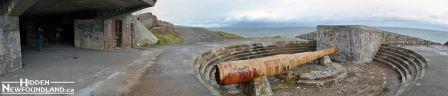
On The War Memorial Trail….. The WWII Soldier From Clarence Who Lost His Life During Operation Cannonshot

September 7, 2024. When Pieter has to choose which name on a photo wish list to research, we never know what to expect. Sometimes a name is chosen because of the location where the soldier came from, sometimes it’s because of a particular battle in which he died, or because the surname seems to be rare enough that any information found would be relevant….and might lead to a family member who has a photo.

..…A lion featured in an old TV program led to one successful photo search …..

Sometimes, word association helps us decide on a name to search.  That’s what happened when scanning the list of names of Nova Scotia soldiers, and I noticed that one soldier, Ronald ‘Ronnie’ Eugene SMITH, came from Clarence.  That reminded me of Clarence, the cross-eyed lion, from a TV program I watched as a child. 

Daktari was a children’s program that followed the work of Dr. Tracy, a veterinarian at the fictional Wameru Study Centre for Animal Behaviour in East Africa, his daughter Paula, his staff, and a cross-eyed lion named Clarence.

…That’s the soldier whose photo you need to look for next….” I told Pieter.  The look on his face when I told him why was priceless!  But, Pieter began his research and quickly found a great-niece, Jennifer Wallis, the granddaughter of Ronnie’s only sibling – his brother Allison, who confirmed that yes, the family had a photo of the soldier.  A few months later, Jennifer wrote to let us know that photos were “… found after searching many boxes at my father’s home….

Before telling the story of the Canadian soldier from Clarence, Nova Scotia, take a look at the opening sequence from Daktari…

..…Ronnie enlisted in January 1944 …..

Screenshot 2024-09-02 at 12-28-34 Clarence · Annapolis County NS B0S 1C0

Ronald ‘Ronnie’ Eugene Smith was born in Clarence, Annapolis County, Nova Scotia.  (Map source: Google)

Ronald ‘Ronnie’ Eugene SMITH was born in Clarence, Nova Scotia on August 28, 1925, the son of Floyd Murdock and Ruby Gertrude (nee Palmer) Smith.  When he enlisted with the No. 6 District Depot in Yarmouth, Nova Scotia on January 3, 1944, he stated that he had left school after 2 years of high school and was working on his parents’ farm in Bridgetown, Nova Scotia as a farm hand.

Ronnie Smith colourized improved_photo(44)

Ronald ‘Ronnie’ Eugene Smith. (Photo courtesy of Donnie Smith. Photo colourization by Pieter Valkenburg)

On January 4, 1944, he was sent to the No. 6 Depot in Halifax, Nova Scotia for basic training, and then on January 14, 1944 to No. 60 Canadian Infantry (Basic) Training Centre (CIBTC) in Yarmouth, Nova Scotia, where his father, Captain Floyd Smith, was a trainer at this centre.

From February 11, 1944 until April 17, 1944, Ronnie was in and out of Yarmouth Military Hospital.  While he was recuperating he worked as a clerk in the Quartermaster stores between March and May 1944, after which he returned to general duties.

On July 30, 1944, Ronnie was transferred to A14 Canadian Infantry Training Centre (CITC) in Aldershot, Nova Scotia for further training.  He received embarkation leave, from September 23 to October 6, 1944, the last chance he had to see his family.

….Ronnie left Canada for overseas service….

On November 25, 1944, Ronnie left for Great Britain, part of a group to provide reinforcements to the Canadian Army in the field.  Upon arrival on December 6, 1944, he was assigned to No. 3 Canadian Infantry Training Regiment (CITR). 

Ronnie continued receiving further training until January 23, 1945, when he left the United Kingdom for Italy, as part of the X-4 Reinforcements of the 1st Infantry Battalion, arriving on February 7, 1945.

As he arrived at No. 3 CITR a few days after Frank GALLANT of Prince Edward Island, perhaps the two Maritime soldiers had a chance to meet. The two men also left the United Kingdom for Italy on the same day. Once in Italy, although they were in the same location, their paths diverged as they were assigned to different regiments. (See https://onthewarmemorialtrail.com/2024/06/30/on-the-war-memorial-trail-the-wwii-soldier-from-mount-carmel-killed-during-the-liberation-of-posterenk/)

Screenshot 2024-09-07 at 11-06-35 Project '44

The West Nova Scotia Regiment was near Rossi, indicated by the soldier in the centre of the map, on February 20, 1945.  (Map source: Project ‘44)

On February 20, 1945, Ronnie was transferred to the West Nova Scotia Regiment, joining them north of Rossi (Russi), part of a group of reinforcements, at the tail end of the Italian Campaign. (See https://en.m.wikipedia.org/wiki/Italian_campaign_(World_War_II))

Ronnie Smith colourized improved_photo(43)

Ronald ‘Ronnie’ Eugene Smith joined the West Nova Scotia Regiment in February 1945. (Photo courtesy of Donnie Smith. Photo colourization by Pieter Valkenburg)

On March 20, 1945, he left Italy at the port in Livorno as part of Operation Goldflake, arriving in Marseilles, France two days later.  Operation Goldflake was the codename for moving troops from Italy to North-West Europe.  (See https://en.wikipedia.org/wiki/Operation_Goldflake)

After one night of rest, the Battalion left Marseilles for Belgium, arriving in Berlaer on March 28, 1945. 

….Ronnie was part of Operation Cannonshot….

On April 4, 1945, the Battalion arrived at a concentration area in the Reichswald Forest in Germany, where they stayed briefly for training in preparation for Operation Cannonshot.  The 49th British Division was to clear Arnhem in The Netherlands, and launch the 5th Canadian Armoured Division on a drive northwards. The 1st Canadian Division would bridgehead the IJssel River and head west to meet them.

On April 10, 1945, they moved to Hummelo, The Netherlands. Operation Cannonshot began on April 11, 1945, with Allied troops preparing to cross the IJssel River the following night and then advance towards Apeldoorn, The Netherlands. (See https://www.liberationroute.com/stories/190/operation-cannonshot)

The Battalion moved to the Royal Canadian Regiment area at Zutphen, just across the IJssel River on the night of April 12 into 13, 1945, crossing it at 2:30 am and establishing its Tactical Headquarters.

On April 13, 1945 the Regiment was committed to a breakout of a bridgehead on the IJssel River. According to the war diary for that day, the attack was expected to begin at 8:30 am “…but the attack did not begin until approximately 1100 hours, at which time ‘A’ Company, supported by tanks, started for their first objective.  They were barely on their way when, due to an artillery concentration called down by Carleton & York Regiment, it was necessary to hold up until 1130 hours….

By noon, ‘A’ Company was making good progress allowing both ‘A’ and ‘C’ Companies to advance on a two-company front. Progress slowed as resistance increased and ended at 7:45 pm.

….Ronnie lost his life near Zutphen….

On April 14, 1945, Tactical Headquarters was established in Zutphen area early in the morning. Companies sent out reconnaissance patrols during the rest of the night and into the early morning hours. The battalion was now in brigade reserve with the Royal 22nd Regiment on the left and the Carleton & York Regiment on the right. The Battalion attacked at 3:30 pm through the Royal 22nd Regiment to clear the woods on both sides of the highway leading to Apeldoorn but was held up by enemy fire and the attack was postponed.

At some point on April 14, 1945, Ronnie lost his life.  He was only 19 years old.  He was killed near a house beside a wooded area, and was initially buried in a field behind a house on the crossroads near Wilp/Achterhoek, The Netherlands. 

Henk Vincent, a volunteer at the Canadian War Cemetery in Holten, explained that “only from December 1945, when the construction of the cemetery in Holten was completed, did the final burial take place….

Ten zuid oosten van Apeldoorn(1)

Red marker shows temporary burial in Wilp/Achterhoek area southeast of Appeldoorn. (Map source: Google maps)

….Ronnie is buried in Holten…

After being exhumed from the temporary cemetery in Wilp/Achterhoek, Ronnie was reburied in the Canadian War Cemetery in Holten, The Netherlands on January 26, 1946.  When the cemetery was first opened, metal crosses were used to mark each grave.

Ronald E Smith - Marker in Holten

The original metal grave marker at the Canadian War Cemetery in Holten for Ronald ‘Ronnie’ Eugene Smith.  (Photo courtesy of Donnie Smith)


smith, ronald eugene gravestone photo from Holten Info Centre

Grave of Ronald ‘Ronnie’ Eugene Smith in the Canadian War Cemetery in Holten, The Netherlands.  (Photo courtesy of the Information Centre Canadian Cemetery Holten)

..…We met with Ronnie’s family …..

We love meeting family members, and were delighted when we had a chance to meet Jennifer Wallis and her husband Kevin at a restaurant in Enfield, Nova Scotia.

CIMG6571 Oct 25 2023 Kevin & Jennifer with Pieter in Enfield

Kevin and Jennifer Wallis with Pieter in Enfield, Nova Scotia.  (Photo credit: Daria Valkenburg)

Thank you to Jennifer and Kevin Wallis and Jennifer’s father Donnie Smith.  Do you have photos or information to share? Email Pieter at memorialtrail@gmail.com, comment on the blog, or tweet to @researchmemori1.

© Daria Valkenburg

….Want to follow our research?….

If you are reading this posting, but aren’t following our research, you are welcome to do so.  Our blog address: https://onthewarmemorialtrail.com/

Front cover OnTheWarMememorialTrailinEurope4 countries, 6 weeks, 7,000 km – an unforgettable war memorial journey in Europe…. Daria’s book ‘No Soldier Buried Overseas Should Ever Be Forgotten‘ is available in print and e-book formats.  Net proceeds of book sales help support research costs and the cost of maintaining this blog. For more information see https://nosoldierforgotten.com/ 

You are also invited to subscribe to our YouTube Channel: On The War Memorial Trail With Pieter Valkenburg: https://www.youtube.com/channel/UCJ591TyjSheOR-Cb_Gs_5Kw

Never miss a posting!  Subscribe below to have each new story from the war memorial trail delivered to your inbox.
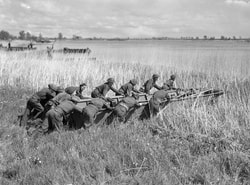
On The War Memorial Trail…… The WWII Soldier From Donaldston Who Died In A Vehicle Accident In The Netherlands

July 13, 2024.  In the 11 part Atlantic Canada Remembers series that ran in 2021, photos submitted about Atlantic Canadian soldiers buried overseas were featured. Pieter ensured that photos of soldiers who are buried in The Netherlands were forwarded to the appropriate cemetery for their digital archives. 

In Part 2 of the Atlantic Canada Remembers series, Helen O’Connell submitted a photo of her uncle, Francis ‘Frank’ Ivan DOUGAN.  She wrote that he “….was born in November 12, 1919 to Florence and John Dougan from Donaldston, Prince Edward Island.  He was the 2nd of 12 boys born in that family – no girls.  Frank left school at age of 15 and went to work to help his family.  He worked in Debert, Nova Scotia as a labourer and mechanic.  In 1941, he and 3 of his brothers enlisted….”  (See https://onthewarmemorialtrail.com/2021/01/13/on-the-war-memorial-trail-atlantic-canada-remembers-part-2/)

Screenshot 2024-07-03 at 11-24-35 Donaldston · Prince Edward Island C0A 1T0

Donaldston is located in central Prince Edward Island. (Map source: Google maps)

…..Frank enlisted under the NRMA in 1941….

Frank originally enlisted under the National Resources Mobilization Act (NRMA) in Charlottetown, Prince Edward Island on October 2, 1941 and underwent basic training at No. 62 Canadian Army Basic Training Centre (CABTC). (See https://en.wikipedia.org/wiki/National_Resources_Mobilization_Act)

After completing his basic training, Frank was sent for 62 days of advanced training at No. A19 Canadian Army Service Corps Training Centre (CASCTC) at Camp Borden in Borden, Ontario.  

From there, he was transferred to the 6th Division Ammunition Company of the Royal Canadian Army Service Corps (RCASC) in Valcartier, Quebec on April 7, 1942.

Frank would remain with the Royal Canadian Army Service Corps (RCASC), an administrative and transport corps of the Canadian Army.  Their role was to provide support to Canadian soldiers wherever they went, moving supplies from the rear areas to the front-lines. They delivered all rations, ammunition, petroleum products, and all other essentials, using vehicles ranging from three- to ten-ton trucks, and forty-ton tank transporters. (For more information, see https://en.wikipedia.org/wiki/Royal_Canadian_Army_Service_Corps)

….Frank enlisted for active service…..

Francis Ivan Dougan

Francis ‘Frank’ Ivan Dougan. (Photo courtesy of Helen O’Connell)

On June 1, 1942, Frank transferred from the non-active militia to active service in the Canadian Army, remaining with the 6th Division Ammunition Company in Valcartier.   

On July 7, 1942, Frank was sent to the Canadian Army Trades School in Hamilton, Ontario for a Motor Mechanics Course, which lasted 6 months. On January 20, 1943, Frank was attached to the Headquarters of the 6th Division Ammunition Company at Hastings Military Park in Vancouver, British Columbia.

On March 9, 1943, he was sent to the Headquarters of the 6th Division Company in Victoria, British Columbia.  Then, on September 2, 1943, he was transferred to the 28th Transport Company in Duncan, British Columbia, but sent on assignment with the Royal Rifles of Canada to Wainwright, Alberta, where he remained until October 19, 1943, when he returned to Duncan. 

Frank next was transferred to No. XI District Depot in Vancouver, British Columbia on February 4, 1944 for a short period before being sent, on February 16, 1944, to No. 1 Training Brigade in Debert, Nova Scotia, in preparation for overseas service. 

….Frank left Canada for overseas service….

On April 11, 1944, Frank left Canada, arriving in the United Kingdom on April 19, 1944, where he was assigned to the Canadian Army Service Corps Reinforcement Unit (CASCRU).

Frank was transferred to the 12th Battalion of the Royal Canadian Army Service Corps (RCASC), part of the 10th Canadian Infantry Brigade (CIB) on May 1, 1944, qualifying as a Driver i/c on May 8, 1944.  (The term ‘Driver i/c’ refers to ‘Driver, internal combustion’.) 

Helen had written that while overseas Frank “… worked as a driver in the war, mainly in the UK….”  This turned out to be incorrect, as Frank was in the United Kingdom for only a few short months – until July 25, 1944, when he, and the 10th Canadian Infantry Brigade (CIB), arrived in France as part of the 21st Army Group.  He was with the Brigade until after WWII officially ended.

….Frank remained in Europe after the war ended….

On July 6, 1945, as a driver, Frank was assigned to the 4th Armoured Division Transport Company of the Royal Canadian Army Service Corps (RCASC), joining them in Almelo, The Netherlands.  He remained with the 4th Armoured Division until November 10, 1945, when he was reassigned to the 2/9 Canadian Infantry Brigade (CIB).

On April 7, 1946, Frank was transferred to the 48th Canadian General Transport Company of the Royal Canadian Army Service Corps (RCASC), part of the Canadian Army Occupation Force (CAOF) in Germany. 

….Frank lost his life in a vehicle accident….

Helen wrote that “….after the war Frank decided to work in peacekeeping as a Canadian soldier in Oldenburg, Germany.  On May 16, 1946, he was involved in road accident and was killed.  He was buried in Holland and was awarded the France and Germany Star 1939-1945….

According to his service file, Frank died in a hospital in Nijmegen following a road accident during very bad weather in Nijmegen, while he was on his way from Grave, The Netherlands to Oldenburg, Germany. Mechanical failure in the steering mechanism led to the accident.  Frank was a passenger in the rear of the vehicle along with 2 others, plus the driver. 

There were two fatalities: Frank Dougan and another soldier who was also in the rear, Charles Ernest Edwin CRIDLAND, who had been born in England, but was from Vancouver, British Columbia.

….Frank is buried in Holten….

2227155_1 Grave of Frank Ivan Dougan CVWM

Grave of Francis ‘Frank’ Ivan Dougan in the Canadian War Cemetery in Holten, The Netherlands. (Photo courtesy of Canadian Virtual War Memorial)

Frank was initially buried in the Canadian Cemetery in Groesbeek, near Nijmegen, before being reburied, on July 16 1946, in the Canadian War Cemetery in Holten, The Netherlands.

Helen was able to visit The Netherlands and the Canadian War Cemetery in Holten.  “…My husband and I were very fortunate to visit his grave in 2016.  I was so proud and honoured to be there.  I will not forget.  This graveyard seemed almost like a sacred place for these solders who gave their life for us and since my visit I really appreciate that….

In 1948, Frank’s grave was adopted by a family from Delden – jeweller Jan A. Zengerink and his wife Ria.  An English translation of the letter that they wrote to Frank’s family informing them of the grave adoption was forwarded to Frank’s mother by the Department of Defence.

Thank you to Helen O’Connell for submitting a photo and information on her uncle. Do you have photos or information to share? Email Pieter at memorialtrail@gmail.com, or comment on the blog.

© Daria Valkenburg

…..The Atlantic Canada Remembers series….

Missed the Atlantic Canada Remembers series? See:

….Want to follow our research?….

If you are reading this posting, but aren’t following our research, you are welcome to do so.  Our blog address: https://onthewarmemorialtrail.com/

Front cover OnTheWarMememorialTrailinEurope4 countries, 6 weeks, 7,000 km – an unforgettable war memorial journey in Europe…. Daria’s book ‘No Soldier Buried Overseas Should Ever Be Forgotten‘ is available in print and e-book formats.  Net proceeds of book sales help support research costs and the cost of maintaining this blog. For more information see https://nosoldierforgotten.com/ 

You are also invited to subscribe to our YouTube Channel: On The War Memorial Trail With Pieter Valkenburg: https://www.youtube.com/channel/UCJ591TyjSheOR-Cb_Gs_5Kw

Never miss a posting!  Subscribe below to have each new story from the war memorial trail delivered to your inbox.
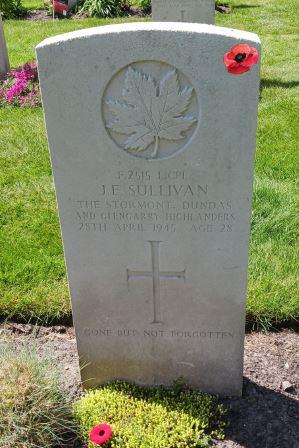
On The War Memorial Trail…..The WWII Soldier From Mount Carmel Killed During The Liberation Of Posterenk

June 30, 2024.  In 2017, Pieter and I visited the village of Posterenk in The Netherlands with Edwin van der Wolf, one of the research volunteers at the Canadian War Cemetery in Holten.

CIMG9302 Sep 25 2017 Posterenk Windmill

Windmill in Posterenk, which has a memorial stone inscribed on the wall.  (Photo credit: Daria Valkenburg)

CIMG9300 Sep 25 2017 Sign Posterenk freed by CYR Apr 13 1945

Translation of memorial stone on the windmill: Posterenk freed by the Carleton & York Regiment of Canada on April 13, 1945. (Photo credit: Daria Valkenburg)

….The Island connection to Posterenk…..

Edwin wanted us to visit the village because it had an Island connection.  François ‘Frank’ GALLANT, son of Antoine and Eleanor (nee Poirier) Gallant of Mount Carmel, Prince Edward Island,  died there on April 13, 1945, while serving with the Carleton & York Regiment.

CIMG9296 Sep 25 2017 Edwin and Pieter by Posterenk windmill

Edwin van der Wolf (left) and Pieter in Posterenk.  (Photo credit: Daria Valkenburg)

The village had a list of 6 soldiers to commemorate from the Carleton & York Regiment, who had all been buried in the area.  Unfortunately, not all soldiers who died are included on this list, but Edwin worked towards including two more, who were not buried near Posterenk, but “were temporarily buried in Lochem because they had previously died in a Canadian hospital there…” 

In total, out of the 8 soldiers, three were from Prince Edward Island!  The stories of Daniel Peter MACKENZIE and James ‘Frank’ MOSSEY were previously told.  In this posting, we feature the story of Frank GALLANT, the reason we were in Posterenk back in 2017!

Gallant Frank

François ‘Frank’ Gallant.  (Photo courtesy of the Information Centre Canadian Cemetery Holten)

….Three Gallant brothers served…..

Born November 24, 1914, Frank originally enlisted under the National Resources Mobilization Act (NRMA) in Charlottetown, Prince Edward Island on August 13, 1942 and underwent basic training at No. 62 Canadian Army Basic Training Centre (CABTC), which he completed on October 12, 1942. (See https://en.wikipedia.org/wiki/National_Resources_Mobilization_Act)

His Personnel Information Record noted that he could speak both French and English, and came from a rural farming background, which likely accounted for him having only a Grade 4 education.  In addition to farming, Frank had experience in carpentry work, and had worked in a lumber mill.  He could drive a vehicle, and played baseball and hockey. Two of his brothers, Georges and Simon, were also in the army. 

With his basic training successfully completed, Frank was transferred to A5 Canadian Engineer Training Camp (CETC) in Petawawa, Ontario for advanced training on October 13, 1942.  Upon completion of that training, he remained in Petawawa for an additional two months, doing general repair work. 

On January 28, 1943, Frank was transferred to No. 2 Engineer Services and Works Company (ES&W Company) of the Royal Canadian Engineers, where his task was to fire and repair boilers at No. 2 District Depot in Toronto, Ontario. He was with ‘D’ Wing, a ‘supernumerary to establishment’ reserve unit, while a decision about the direction his army career was to take was made.

Frank had expressed interest in being considered in the Tradesman category as a fireman or maintenance man, but it was determined that since his occupation background was “… erratic….” with no “…special training…” and he was considered very fit, in the “…A-1 category…”, he should be reallocated to “…Infantry (Non-Tradesman)” and receive infantry training. 

Frank received special leave to return home to Prince Edward Island to help with the family’s farm operation on August 29, 1943, after which he returned to Toronto on November 1, 1943.

….Frank transferred to the Infantry…..

As a result of the assessment that he be assigned to an Infantry Unit, Frank was transferred to the 1st Battalion Victoria Rifles of Canada on November 10, 1943 and sent the following day to Stratford, Ontario to be re-mustered as a rifleman.

Frank remained in Stratford for training until February 18, 1944, when he was sent to Niagara-on-the-Lake, Ontario. 

On August 24, 1944, Frank transferred from the non-active militia to active service in the Canadian Army, remaining with the 1st Battalion Victoria Rifles of Canada in Niagara-on-the-Lake.

….Frank left Canada for overseas service…..

On November 21, 1944, Frank left for Great Britain with the 1st Battalion, to provide reinforcements to the Canadian Army in the field.  Upon arrival on November 28, 1944, he was assigned to No. 3 Canadian Infantry Training Regiment (CITR).

He continued receiving further training until January 23, 1945, when he left the United Kingdom for Italy, as part of the X-4 Reinforcements, arriving on February 7, 1945.  On February 13, 1945 he was transferred to the Carleton & York Regiment, joining them north of Rossi (Russi), part of a group of reinforcements, at the tail end of the Italian Campaign. (See https://en.m.wikipedia.org/wiki/Italian_campaign_(World_War_II))

He joined the Carleton & York Regiment at the same time as Archibald Phillip ‘Archie’ MCLEAN of Edmundston, New Brunswick.  Archie’s story was previously told on this blog.  (See https://onthewarmemorialtrail.com/2023/09/13/on-the-war-memorial-trail-archie-was-a-good-guy/)

Screenshot 2023-09-04 at 16-28-14 Map of Russi Italy

The Carleton & York Regiment was north of Russi on February 13, 1945.  (Map source: http://www.gosur.com)

On March 17, 1945, he left Italy as part of Operation Goldflake, arriving in Marseilles, France three days later.  Operation Goldflake was the codename for moving troops from Italy to North-West Europe.  (See https://en.wikipedia.org/wiki/Operation_Goldflake)

The Carleton & York Regiment was now part of the 21st Army Group. From France, troops were moved up to the Belgian front, into The Netherlands, through the Reichswald Forest in Germany, and then back into The Netherlands.

The Liberation of Posterenk…

On April 12, 1945 the Regiment was part of Operation Cannonshot, which led to the crossing of the IJssel River between the villages of Gorssel and Wilp in the eastern part of The Netherlands. (See https://www.liberationroute.com/stories/190/operation-cannonshot)

Map western holland showing Posterenk

According to the April 12, 1945 war diary entry of the Carleton & York Regiment, they “…moved across the Ijssel River at 14:30 hours….” to relieve the Seaforth Highlanders of Canada.

On April 13, 1945, the war diary entry noted that “…‘D’ Company’s objective is Posterenk…The Regiment didn’t expect much opposition, but they “met with stiff resistance just after starting at 11:25 hrs…

In ‘Invicta – The Carleton and York Regiment in the Second World War’ author Robert Tooley explained that “…on the CYR front D Company was to lead off towards its first objective, the village of Posterenk: the opposition was expected to be light, and the company was instructed to continue to move forward until strong opposition was encountered.  The battalion now had in support a troop of M10 SP anti-tank guns, a troop of tanks, a platoon of medium machine guns, and a platoon of 4.2 inch mortars. D Company pushed off at 10:50 am….. Contrary to expectations, D Company met stiff resistance and suffered several casualties from small arms fire….”   

At some point during that day, Frank lost his life. 

…Frank is buried in Holten…

Frank was one of 6 soldiers initially buried along the main road to Posterenk, a village near Zutphen, before being reburied in the Canadian War Cemetery in Holten.

Posterenk list of 6 CYR members

The 6 soldiers buried near Posterenk.

CIMG3198 Oct 3 2019 Holten Frank Gallant

Grave of François ‘Frank’ Gallant at the Canadian War Cemetery in Holten.  (Photo credit: Daria Valkenburg)

…Frank is remembered on the war memorial in Wellington…

In May 2024, we visited the war memorial in Wellington, Prince Edward Island, where Frank’s name is listed.

CIMG6840 May 27 2024 Wellington Monument - Francis Gallant - photo by Pieter

François ‘Frank’ Gallant is remembered on the war memorial in Wellington, Prince Edward Island.  (Photo credit: Pieter Valkenburg)

…Previous stories about soldiers commemorated in Posterenk….

Do you have photos or information to share? Email Pieter at memorialtrail@gmail.com, comment on the blog, or tweet to @researchmemori1.

© Daria Valkenburg

….Want to follow our research?….

If you are reading this posting, but aren’t following our research, you are welcome to do so.  Our blog address: https://onthewarmemorialtrail.com/

Front cover OnTheWarMememorialTrailinEurope4 countries, 6 weeks, 7,000 km – an unforgettable war memorial journey in Europe…. Daria’s book ‘No Soldier Buried Overseas Should Ever Be Forgotten‘ is available in print and e-book formats.  Net proceeds of book sales help support research costs and the cost of maintaining this blog. For more information see https://nosoldierforgotten.com/ 

You are also invited to subscribe to our YouTube Channel: On The War Memorial Trail With Pieter Valkenburg: https://www.youtube.com/channel/UCJ591TyjSheOR-Cb_Gs_5Kw

Never miss a posting!  Subscribe below to have each new story from the war memorial trail delivered to your inbox.
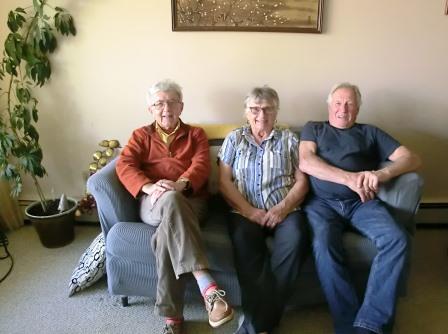
On The War Memorial Trail….. Commemorating The 80th Anniversary Of D-Day

Screenshot 2024-05-28 at 10-34-30 D-Day 80th Anniversary Banner Decoration - 1.2m

June 1, 2024.  June 6, 2024 marks the 80th anniversary of Operation Overlord (the larger Normandy invasion) and Operation Neptune (the English Channel-crossing portion of Operation Overlord) – what we refer to as D-Day.

….What does D-Day mean?….

Did you know that the ‘D’ in D-Day was a military codeword referring to ‘Departure Day’?  U.S. General Dwight D. Eisenhower, Supreme Commander of the Allied Expeditionary Force in Europe,  noted, through his executive assistant, Brigadier General Robert Schultz: “Be advised that any amphibious operation has a ‘departed date;’ therefore the shortened term ‘D-Day’ is used….

While there were several other D-Days during the war, the invasion of Normandy was the biggest and most well-known. 

…..D-Day was an international effort….

Most people consider D-Day to have been solely a joint British, Canadian, and American effort.  However, it’s important to recognize that over 2 million troops from over 12 countries were in Britain in preparation for the invasion. While Allied forces consisted mainly of American, British, and Canadian troops, smaller contingents included Australian, Belgian, Czech, Dutch, French, Greek, New Zealand, Norwegian, Rhodesian, and Polish naval, air, or ground support!
Dday Invasion-map

D-Day invasion map. The Canadians landed on Juno Beach in Normandy, France. (Map source: https://www.ddaylepe.org.uk/index.php/overlord-neptune/)

On the morning of D-Day, ground troops landed across five assault beaches –Juno, Sword, Gold, Utah, and Omaha.  Canadian soldiers landed at Juno on the outskirts of Bernières.  British forces landed at Sword and Gold, while the Americans landed at Utah and Omaha.

Want to know a bit more about D-Day?  See https://news.sky.com/story/eleven-things-you-might-not-know-about-d-day-13132330  My favourite tidbit is how Hitler slept through the D-Day landings.  Even after he woke up in the late morning he believed it was just a diversionary tactic – and so no reserve troops were immediately sent to Normandy!

….11 servicemen who survived D-Day have been featured on this blog….

Over the past years, we have featured stories of 11 servicemen who were present in Normandy on June 6, 1944. All survived D-Day, but only 1 survived WWII and returned home – Airman Lorne MACFARLANE flew a night mission that coincided with the early morning hours of D-Day and realized afterwards what a lucky escape he and his crew had.  “Our mission was completed.   As we crossed the Channel on the way back, we could see through breaks in the cloud, the wakes of hundreds of ships…” heading towards the French coast.  You can read Lorne’s story here:  https://onthewarmemorialtrail.com/2021/10/20/on-the-war-memorial-trail-the-ww2-pilot-from-pei-who-flew-40-missions-overseas-and-returned-home/

The other 10 are buried in a Canadian War Cemetery in France, The Netherlands, or Belgium.  These men are:

….The actions of D-Day helped shorten WWII….

For a very brief overview of the significance of D-Day, watch this 3 minute CTV video prepared for the 75th anniversary:

….Upcoming Event at the Borden-Carleton Legion….

To commemorate the 80th anniversary of D-Day, the Borden-Carleton Legion will have a wreath laying ceremony by the Cenotaph at 3:00 pm on June 6, 2024.  Pieter and I will be there. All are welcome to attend in honour of those who fought on that day.  The wreath laying ceremony will be followed by a light lunch of hamburgers and hot dogs.

Do you have photos or information to share? Email Pieter at memorialtrail@gmail.com, comment on the blog, or tweet to @researchmemori1.

© Daria Valkenburg

….Want to follow our research?….

If you are reading this posting, but aren’t following our research, you are welcome to do so.  Our blog address: https://onthewarmemorialtrail.com/

Front cover OnTheWarMememorialTrailinEurope4 countries, 6 weeks, 7,000 km – an unforgettable war memorial journey in Europe…. Daria’s book ‘No Soldier Buried Overseas Should Ever Be Forgotten‘ is available in print and e-book formats.  Net proceeds of book sales help support research costs and the cost of maintaining this blog. For more information see https://nosoldierforgotten.com/ 

You are also invited to subscribe to our YouTube Channel: On The War Memorial Trail With Pieter Valkenburg: https://www.youtube.com/channel/UCJ591TyjSheOR-Cb_Gs_5Kw

Never miss a posting!  Subscribe below to have each new story from the war memorial trail delivered to your inbox.