On The War Memorial Trail….The WWII Signalman From Charlottetown Buried In Tryon People’s Cemetery

July 1, 2026.  In 2025, Pieter became a volunteer under the Commonwealth War Graves Commission (CWGC)’s National Volunteer Program, and was assigned 4 cemeteries in the South Shore area on Prince Edward Island.  (See https://onthewarmemorialtrail.com/2025/08/08/on-the-war-memorial-trail-cwgc-volunteer-at-cape-traverse-community-cemetery/)

 The 4 cemeteries are:

  • Cape Traverse Community Cemetery (3 CWGC graves)
  • Tryon People’s Cemetery (2 CWGC graves)
  • Kelly’s Cross (St Joseph) Parish Cemetery (1 CWGC grave)
  • Seven Mile Bay (St Peter’s) Cemetery  (4 CWGC graves)

….There are 2 CWGC graves at Tryon People’s Cemetery…
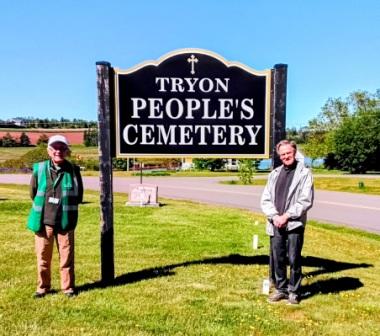
Pieter at the entrance to Tryon People’s Cemetery with Jack Sorensen, President of Tryon People’s Cemetery Board of Directors. (Photo credit: Daria Valkenburg)

There are 2 CWGC graves in Tryon People’s Cemetery, with the story of one soldier previously told on this blog:

WWI soldier Harry ROBINSON, of Augustine Cove, Prince Edward Island, contracted blood poisoning from a cellulitis infection while in Valcartier, Quebec for training, and died on June 27, 1916, aged 34.  You can read his story at https://onthewarmemorialtrail.com/2025/03/30/on-the-war-memorial-trail-a-photo-for-wwi-soldier-harry-robinson/ and https://onthewarmemorialtrail.com/2019/04/29/the-ww1-soldiers-who-never-left-canada/

The other grave is of WWII soldier William Thomas HENNESSEY, son of WWI veteran George Stanley HENNESSEY, whose story was told several years ago on this blog.  (See https://onthewarmemorialtrail.com/2022/02/14/on-the-war-memorial-trail-the-ww1-soldier-who-served-in-the-1st-canadian-engineers-battalion/)
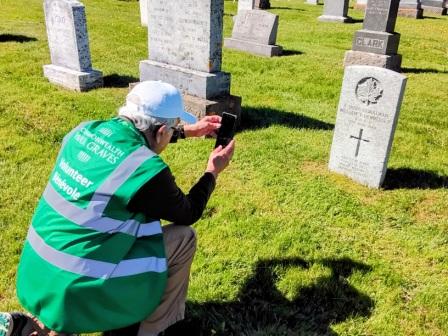
As part of his duties as a CWGC volunteer, Pieter snaps a photo of the grave of William Thomas Hennessey.  (Photo credit: Daria Valkenburg)

….William enlisted with the No. 6 District Signals…

Born September 28, 1921 in Charlottetown, Prince Edward Island, William was the son of George Stanley and Eleza May (nee Thomas) Hennessey. When he enlisted with the No. 6 District Signals of the Royal Canadian Corps of Signals in Charlottetown on October 27, 1939, he was only 18 years old and stated that he’d served as a member of the militia of that unit since May 1937.  No. 6 District Signals was the regional home-defense and administrative unit for Military District 6, which had its headquarters in Halifax, Nova Scotia, and covered the Maritimes, including Prince Edward Island.

Prior to enlistment, William had worked for a short period for Chief Justice John Alexander Mathieson of the Court of Appeal of Prince Edward Island, a former Premier of the province.  (See https://en.wikipedia.org/wiki/John_Alexander_Mathieson)
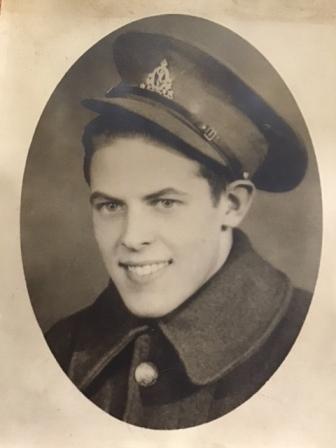
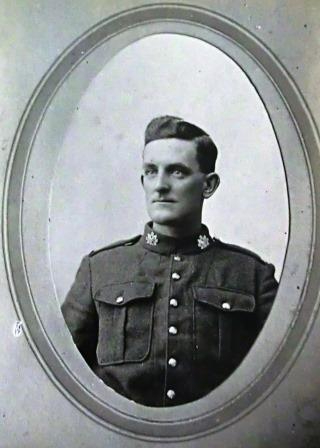
William Thomas Hennessey. (Photo courtesy of Pam Ing)

When we were first in contact with Pam Ing about her grandfather, we asked if she had a photo of her Uncle William.  “….I found the picture of William Hennessey – son of George Hennessey and brother of Harry Raymond ‘Ray’ Hennessey (my father)….” she wrote. “… He was quite the handsome guy for sure!...”  Ray had also joined the Royal Canadian Corps of Signals in 1939, and served until 1945.

After completing his basic training, William was sent to the A14 Canadian Infantry Training Centre (CITC) at Camp Aldershot, Nova Scotia on January 13, 1940 for more intensive combat training in tactical firearm use and field exercises.

….William never fully recovered following surgery…

William’s time at Camp Aldershot was very short, as on January 24, 1940 he was admitted to Halifax Military Hospital with acute appendicitis.  He was on sick leave until February 20, 1940, but a month later, on March 27, 1940, he was admitted to hospital with nephritis (a kidney infection).  He remained in hospital until May 6, only to be readmitted a few weeks later, on May 29, with the same diagnosis.  When he was discharged on July 22, 1940, his condition was assessed as ‘unimproved’.

On September 5, 1940, William was discharged from the army for reasons of being ‘physically unfit’ due to asthenia (a general weakness of the body).  At the time of his discharge, he declared in writing that “…I was never sick until I joined the C.A.S.F. I was operated on for appendicitis in January. I have never been well since…” (C.A.S.F. refers to Canadian Active Service Force)

It could be that William’s appendix had burst prior to or during his operation, resulting in peritonitis, an inflammation in the peritoneum —the thin membrane that lines the inner abdominal wall and covers the organs. It most commonly occurs due to bacterial infections caused by a ruptured organ (like a burst appendix).  If the infection never fully cleared up, it may be why he never completely recovered, but developed nephritis.

After his discharge, William worked on a temporary basis at a freight shed, but contracted pulmonary tuberculosis, and was admitted to the Provincial Sanatorium in Charlottetown. He died on June 7, 1944, aged 22, with the cause of death listed as pulmonary tuberculosis due to asthenia.

….William is buried next to his parents…
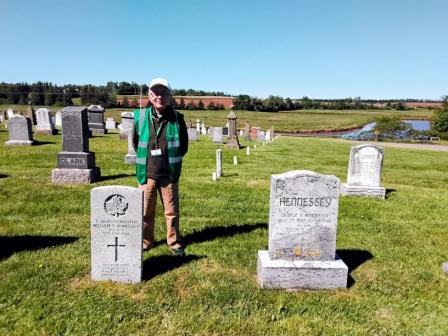
Pieter stands behind the grave of William Thomas Hennessey at Tryon People’s Cemetery.  (Photo credit: Daria Valkenburg)

William was buried in Tryon People’s Cemetery in Tryon, Prince Edward Island, with his parents later buried next to him.  In addition to his own separate gravestone, he is commemorated on his parents’ gravestone, a testament to a young life cut short, and who was never forgotten by his family.

Pam Ing, centre, with husband David on left, and Pieter on the right. (Photo credit: Daria Valkenburg)

Thank you to Pam Ing for providing a photo of her uncle.  Pieter’s research efforts to find photos and families of soldiers continue. Do you have a story to tell? Email Pieter at memorialtrail@gmail.com, or comment on the blog.

© Daria Valkenburg

….Want to follow our research?…

If you are reading this posting, but aren’t following our research, you are welcome to do so.  Our blog address: https://onthewarmemorialtrail.com/
4 countries, 6 weeks, 7,000 km – an unforgettable war memorial journey in Europe…. Daria’s book ‘No Soldier Buried Overseas Should Ever Be Forgotten‘ is available in print and e-book formats.  Net proceeds of book sales help support research costs and the cost of maintaining this blog. For more information see https://nosoldierforgotten.com/

Subscribe to our YouTube Channel: On The War Memorial Trail With Pieter Valkenburg: https://www.youtube.com/channel/UCJ591TyjSheOR-Cb_Gs_5Kw.

Never miss a posting!  Subscribe below to have each new story from the war memorial trail delivered to your inbox.
On The War Memorial Trail….. The WWI Soldier Who Served In The 1st Canadian Engineers Battalion

February 14, 2022.  Every fall, veterans from the Borden-Carleton Legion volunteer to place flags at the graves of veterans buried in cemeteries in the area covered by this Legion Branch on Prince Edward Island.  (See https://onthewarmemorialtrail.com/2021/11/04/borden-carleton-legion-honours-veterans-by-placing-flags-at-their-graves/)

One of the graves for which a flag is placed annually at the Tryon People’s Cemetery is for WWI veteran George Stanley HENNESSEY.

CIMG4008 George Hennessey

George Stanley Hennessey.  (Photo courtesy of South Shore United Church in Tryon.)

George was born July 20, 1887 in Cape Traverse, Prince Edward Island, the son of Lawrence and Margaret (nee Muttart) Hennessey.  On November 4, 1910 he moved to Boston, Massachusetts, where he married Eliza May Thomas, a fellow Islander, on April 15, 1912.  At the time of his marriage he was employed as a machinist and Eliza as a housekeeper.

When WWI broke out, George and Eliza were back in Prince Edward Island and living in North Tryon.  George enlisted with the 105th Battalion in Charlottetown on November 17, 1915.  His attestation paper recorded that he had been in the Militia, a member of the 82nd Regiment.

On July 15, 1916, he sailed from Halifax, Nova Scotia aboard the SS Empress of Britain, arriving in England on July 25, 1916.  On January 26, 1917, he was transferred to the 104th Battalion.

On February 26, 1918, he was transferred to the 124th Pioneer Battalion, which became known as the 124 Pioneer Battalion Canadian Engineers in March 1918. He was sent to continental Europe and on March 3, 1918 was despatched to a Canadian Corps Reinforcement Camp (CCRC).

….George joined the 1st Canadian Engineers Battalion…

On April 19, 1918, he was transferred to the Canadian Engineers Reinforcement Pool (CERP).  On May 31, 1918, he was transferred to the 1st Canadian Engineers Battalion.  This corps built bridges, railway depots, camps, bases, and other military installations used during the war.

George joined them while the Battalion was undergoing training in Gauchin-Légal, France, a commune in the Pas-de-Calais department in the Hauts-de-France region of France.

On July 12, 1918, the Battalion moved to Arras, France.  The war diary for that day reported that “…No enemy shelling in Arras; our guns active.  Enemy low flying planes came over Arras twice and were heavily shelled by ‘Archies’…” ‘Archies’ refers to anti-aircraft guns.   (Source: Library and Archives Canada. War diary 1st Battalion, Canadian Engineers, 1918/05/01-1919/04/25, Reference: RG9-III-D-3. Volume/box number: 4993)

…What did the Canadian Engineers do?….

Screenshot 2022-02-13 at 18-26-27 ViaMichelin Route planner, Maps, Traffic info, Hotels

A modern day map, showing the location of Gauchin-Légal, France, identified as A, and Seilles, Belgium, identified as B.  (Map source: https://www.viamichelin.com)

Under attack or not, work for the Battalion included …pontoon bridging and trestle framings, sandbagging, patrolling water supply systems…

The war diary for August 1, 1918 recorded the Battalion in Dainville, France.  “…Many enemy aeroplanes up and a great deal of bombing during night…”  The Battalion moved on to Gouy-en-Ternois, France, some marching by foot, others travelling by train.

On August 7, 1918, they received orders to “…fill shell holes…in the area around Gentelles Wood, France.  Work stopped a few days later due to heavy bombing, but was soon resumed.  The Battalion moved towards working on roads “…forward of Cayeux…” which is still in France.

By mid-August 1918 they were tasked with “…salvaging tools from old ‘No Man’s Land’ and old front lines….” and “…burying enemy dead…

At the beginning of September 1918 the Battalion moved on to Villers-les-Cagnicourt, France, repairing roads and railway tracks.  The end of September found them in Inchy-en-Artois, repairing the access to the Canal du Nord bridge.

In October 1918 they moved to Ecourt St. Quentin, France tasked with constructing bridges over La Sensee River.  The end of the month found them in Écaillon, France, doing roadwork and constructing a bathhouse.

In November 1918 they moved to La Sentinelle, France and worked on “…roads, bridges, and investigation of traps…”  The end of the month found them in Seilles, Belgium.

On December 31, 1918, George was admitted to the 7th Canadian General Hospital in Etaples, France, with an ear infection that caused pain and deafness.  The ear infection was preceded by influenza, and he ended up being invalided back to England on January 25, 1919.  Luckily the condition was cleared up and his hearing restored.

George was discharged from hospital on February 19, 1919, but remained in England, where he was transferred to the Canadian Engineer Reinforcement Depot (CERD) in Seaford, a Canadian military training base in Sussex, England. On February 25, 1919 he was transferred to the Canadian Engineer Railway Battalion (CERB).

On April 3, 1919 he left Liverpool, England aboard the SS Lapland, bound for Canada.  On April 18, 1919 he was officially discharged in Charlottetown.

On July 3, 1919, he was awarded the “…Military Medal for bravery in the field” by King George V.  (Source: Canada Gazette, 1867-1946 (Dominion of Canada), vol. 53, Supplement, August 30, 1919, Volume: 53, Issue type: Supplement)

…Back to civilian life….

CIMG5355 Oct 4 2021 Pieter with David & Pam Ing at Tim Hortons in Charlottetown

Pam Ing, centre, with husband David on left, and Pieter on the right. (Photo credit: Daria Valkenburg)

His granddaughter, Pam Ing, whose father Harry Raymond ‘Ray’ was a WWII veteran, told us that her grandfather “…moved to Charlottetown after being discharged and worked for the railway.  He died three months before I was born, so I never knew him….

George worked as a brakeman on CNR (Canadian National Railway) and later was a conductor for a number of years before retirement.  He and Eliza had 4 sons, one of whom, William Thomas, died of illness shortly after enlistment in WWII.

George died at his home in Charlottetown on October 17, 1946 following a long illness, and is buried in the Tryon People’s Cemetery in Tryon, Prince Edward Island.

CIMG5341 Sep 27 2021 Pieter & George by George Hennessey grave Tryon Peoples Cemetery

Pieter with George Palmer by the grave of WW1 veteran George Hennessey at the Tryon People’s Cemetery in Tryon. (Photo credit: Daria Valkenburg)

Thank you to Pam and David Ing for sharing recollections with us.  If you have photos or information to share, please let Pieter know. Email him at memorialtrail@gmail.com, or comment on the blog.

© Daria Valkenburg

…Want to follow our research?….

If you are reading this posting, but aren’t following our research, you are welcome to do so.  Our blog address: https://onthewarmemorialtrail.com/

Front cover OnTheWarMememorialTrailinEurope4 countries, 6 weeks, 7,000 km – an unforgettable war memorial journey in Europe…. Daria’s book ‘No Soldier Buried Overseas Should Ever Be Forgotten‘ is available in print and e-book formats.  Net proceeds of book sales help support research costs and the cost of maintaining this blog. For more information see https://nosoldierforgotten.com/ 

You are also invited to subscribe to our YouTube Channel: On The War Memorial Trail With Pieter Valkenburg: https://www.youtube.com/channel/UCJ591TyjSheOR-Cb_Gs_5Kw

Screenshot_2021-02-27 On The War Memorial Trail With Pieter Valkenburg

Never miss a posting!  Subscribe below to have each new story from the war memorial trail delivered to your inbox.