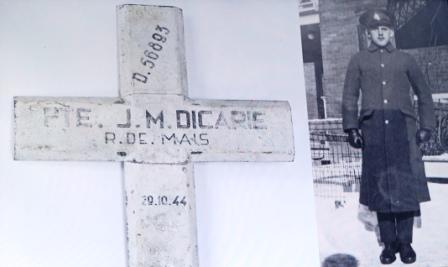
August 23, 2026. When Pieter begins the search for a photo of a soldier, he never knows what to expect. His day is made when a photo is found, and if there is anything more, such as letters or postcards, it’s a welcome addition. Such was the case when Dr. Ian Grant sent him an article written several years ago by his mother, Dorothy Grant, about her Uncle Joe, WWII soldier Joseph ‘Joe’ Julius Augustus LAWRENCE, who is buried in the Canadian War Cemetery in Bergen op Zoom, The Netherlands.
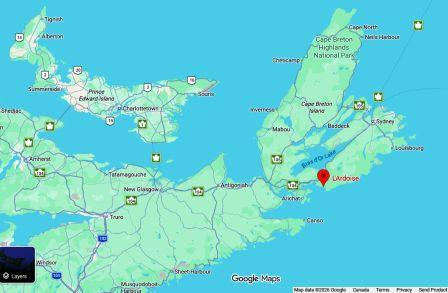
L’Ardoise, pronounced locally as ‘Lord-Ways’, is located along Highway 247 on Cape Breton Island, Nova Scotia. (Map source: Google Maps)
Born December 21, 1918 (the attestation form when he enlisted incorrectly recorded his birth date as December 22, 1919) in L’Ardoise, located on the southeastern shore of Cape Breton Island, Nova Scotia, Joe was the son of Augustus and Mary ‘Jane’ (nee Johnston) Lawrence. One of 5 children who lived to adulthood, he had two younger brothers, John ‘Albert’ (who also served in WWII) and Francis, and two older sisters, Florence and Mary Elizabeth. The family moved to Halifax, Nova Scotia shortly after Joe was born and was living there when Joe’s father died on January 24, 1925.
Dorothy Grant was the daughter of Joe’s sister Florence. In a November 2011 article in Bedford Magazine, she wrote that she remembered her uncle “…even though I had been only a little girl when I last was with him….” in 1939. “…At that time, he was a strong young man who would toss me high in the air over his head, while to my great delight, I would loudly proclaim, ‘Put me down, Uncle Joe! Put me down!’…”
….Joe enlisted with the 1st Anti-Aircraft Battery….
Joe left school after completing Grade 8, and worked as a bell hop and night clerk at The Halifax Hotel on Hollis St in Halifax from 1935 to 1937 (the hotel closed in 1943). In 1937, he became an apprentice furrier at George Hay Tailoring Company in Halifax, and continued working there until he enlisted in the active army in 1939.
He had joined the 1st Anti-Aircraft Battery, Royal Canadian Artillery (RCA), a Non-Permanent Active Militia, in Halifax on April 13, 1938. After Canada entered WWII on September 10, 1939, the Battery became part of Canada’s eastern coastal and air defense preparations, and had transitioned into an active army unit.
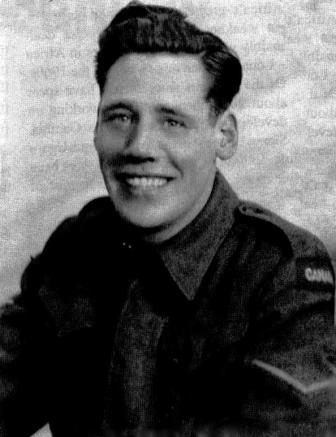
Joseph ‘Joe’ Julius Augustus Lawrence. (Photo courtesy of Dr Ian Grant)
On September 30, 1939, Joe quit his job as an apprentice furrier and enlisted with the 1st Heavy Anti-Aircraft Battery’s Active Service Force. The Personnel Selection Record noted his interest in sports: swimming, skating, hunting and fishing, basketball, and softball. He also had an interest in model planes and could play the harmonica.
Training as a bombardier began. As well, based on his extensive sports experience, Joe became one of the physical training instructors within the unit.
….Joe almost was posted to Iceland….
On June 28, 1940, Joe was assigned to the 1st Heavy Anti-Aircraft Battery’s ‘Z’ Force, a special deployment to provide artillery support for Canada’s secret garrison mission to Iceland in June 1940. Why Iceland? The British had invaded Iceland in an attempt to prevent Nazi occupation, and Canada was to supply troops to relieve British garrisons. This specialized deployment became known as ‘Z’ Force.
As an infantry force required artillery cover to protect ports and airspace from Luftwaffe attack, anti-aircraft and coast defence gunners were in Halifax transit camps, packed and prepared for immediate overseas embarkation. However, the Battery never left Halifax because its deployment was abruptly cancelled just as the ship was about to be boarded, leading to the artillery force being disbanded and absorbed into home defence units.
On August 1, 1940, the unit amalgamated to form the 4th Light Anti-Aircraft Battery of the Royal Canadian Artillery (RCA).
….Joe left Canada for overseas service….
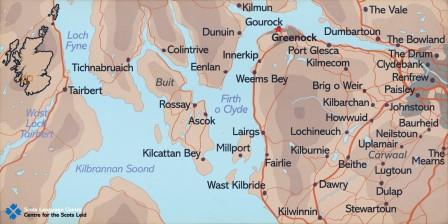
Map shows location of Gourock, Scotland in the Firth of Clyde. (Map source: scotslanguage.com)
On December 16, 1940, Joe boarded a ship in Halifax, and with other members of 4th Light Anti-Aircraft Battery, now part of the 2nd Light Anti-Aircraft Regiment, Royal Canadian Artillery (RCA), in support of the 3rd Canadian Infantry Division, left Canada for the United Kingdom, disembarking in Gourock, Scotland on December 26, 1940.
Joe continued training, and on April 12, 1941 was sent to Royal Naval Air Station Ford, 4.8 km (3 miles) west of Littlehampton, for a Predictor course, to learn how to operate an anti-aircraft predictor – an early mechanical analog computer that measured the speed, altitude, and trajectory of enemy aircraft. It then calculated the ‘future position’ of the target so that the gunners could aim ahead of the plane, accounting for shell travel time and wind speeds.
Joe was sent for a number of training courses, and was promoted to Acting Sergeant on February 11, 1943, just ahead of a transfer to the 11th Light Anti-Aircraft Regiment, Royal Canadian Artillery (RCA), on February 24, 1943.
On May 14, 1943, Joe received a promotion to Sergeant. Then, from June 22 until August 21, 1943, he was sent to a 42 day Canadian Military Headquarters (CMHQ) Conversion Course at the Canadian Army Battle Drill School in Stansted Park in Rowland’s Castle, Hampshire, England. The physically and exhausting course trained officers and NCOs to standardize infantry and joint-force tactics before deployment, and to be able to train their own units in simulated combat conditions.
From January 9 to 16, 1944, Joe was sent to Ripon, Yorkshire for a Clearing of Mines and Booby Traps course, run by the British Army Royal Engineers to prepare troops for the upcoming invasion of Europe, which began with D-Day on June 6, 1944.
….Joe was impatient for front line action….
On March 21, 1944, Joe was transferred to the 2nd Canadian Artillery Reinforcement Unit (CARU), a specialized depot unit that provided final preparation before sending soldiers on to active Royal Canadian Artillery (RCA) units in the war zones.
Joe was impatient to see action, but instead of being dispatched to the front as he expected, he remained in the United Kingdom. In an interview on June 13, 1944, it was noted that he was “…very anxious to get to a field unit. He is getting rather fed-up being chased around in RCA and has even thought about transferring to Infantry….” The interviewer went on to recommend that as his “…intelligence is high…” he should be “…given training in anti-tank and despatched to field as soon as possible…”
As an outcome following his interview, Joe was sent to a Non-Commissioned Officers (NCO) Light Anti-Aircraft Course, from July 9 to August 5, 1944. The course focused on tactical leadership, unit gunnery, site deployment, how to camouflage a gun position, and training to command a 6-to-8-man gun crew under intense combat pressure.
On August 12, 1944, a week after completing his course, Joe was temporarily transferred to the Canadian Fusiliers, and a few days later given 9 days of leave. On September 28, 1944, he was assigned to the X-4 Reinforcement List of the Canadian Infantry Corps (CIC), part of the 13th Battalion. The following day he left for France, arriving a day later and sent to the 2nd Canadian Base Reinforcement Group (CBRG), positioned behind the advancing front lines in France and Belgium. Joe was about to be part of advance into Belgium toward the Scheldt Estuary and the Battle of the Scheldt.
… Joe was transferred to the Black Watch of Canada…
On what became known as ‘Black Friday’, the Black Watch of Canada had suffered 183 casualties – killed, wounded, missing, taken as prisoners of war – during Operation Angus on October 13, 1944. In the Battle of the Scheldt’s ongoing goal of securing the port of Antwerp for Allied shipping supplies, Operation Angus was to clear German forces near Woensdrecht and cut off the South Beveland isthmus in The Netherlands.
Needing to replace their casualties, the Black Watch’s War Diary entry for October 14, 1944 recorded that “…today we received 151 reinforcements, bringing the total, since the 11th, to 3 officers and 279 other ranks…” Joe was one of those reinforcements, joining the Regiment in Ossendrecht, The Netherlands. Over the next week, intensive training sessions were held as most of the reinforcements were inexperienced, and the Regiment was about to be involved in another battle as part of the 5th Canadian Brigade, along with the Calgary Highlanders and Le Régiment de Maisonneuve.
In The History Of The Black Watch (Royal Highland Regiment) Of Canada Volume II: 1939-1945, author Roman Johann Jarymowycz wrote that on the evening of October 29, 1944, the Regiment was “…ordered to attack the last bastion of the Scheldt defences – Walcheren Island….”
The war diary entry for October 30, 1944 noted that the Regiment proceeded “…via the main road towards the Walcheren Causeway, to a concentration area in the centre of the Calgary Highlanders position…..” They left at 2:00 pm and arrived at their designated area by 3:30 pm.
… The Regiment was involved in the Battle of Walcheren Causeway…

Map showing troops at the beginning of the Battle of Walcheren Causeway. (Map source: Wikipedia)
On Tuesday, October 31, 1944, the war diary entry stated that a morning briefing determined that “…this Brigade shall form a bridgehead across the causeway, on Walcheren Island, 1000 to 1500 yards deep. A recce made this morning shows that the causeway is intact to beyond the centre…”
In what became known as the Battle of Walcheren Causeway, part of the larger Battle of the Scheldt, the struggle to cross the Causeway was hampered. A deep crater on the causeway had been blown by German engineers as an anti-tank obstacle and the surrounding landscape was severely damaged by bombing.
Jarymowycz gave a clearer picture. “…Reconnaissance showed the Germans had cratered the centre of the approach and the surrounding area was a slough with marshland impassable to infantry, let alone armour. The ditches and gaps were filled with water that reached the chests of most men: anyone shorter or weighed down by grenades and other gear would be swamped….”
Nevertheless, noted the war diary, the men began their advance, “…with ‘C’ Company leading, followed by ‘A’, ‘B’, and ‘D’…” However, “…as soon as the leading Company approached the causeway, the enemy went into action and started dropping shells and mortar on our end of it….”
It got worse. “…The enemy had his guns sited to give cross fire on the causeway, with one tank dug in, and an anti-tank gun firing down the centre of the road. Enemy snipers had positioned themselves in the marsh bordering the causeway and were very accurate….”
(For more information, see https://en.m.wikipedia.org/wiki/Battle_of_Walcheren_Causeway and https://www.canadiansoldiers.com/history/battlehonours/northwesteurope/walcherencauseway.htm)
… Joe lost his life in the Battle of Walcheren Causeway…
Joe was among those killed on October 31, 1944, one of 86 casualties – “…10 dead, 67 wounded, 9 missing…” – per the war diary for the Black Watch of Canada between October 14 and November 1, 1944, with most casualties occurring directly during the Battle of Walcheren Causeway. He was 25 years old.
Dorothy wrote that months after Joe’s death, her grandmother received a letter from “…Pte Fred Joliff….” giving an account of Joe’s death. “…I was with him in the attack and a shell fell at his feet. For some reason, I was not killed. I know your mind will be at rest if you know your son felt no pain and that I can only say I was five feet from him and did what was at all possible under shell fire, but he had passed away in a matter of seconds.
I am only one of few left that was under your son’s orders and we have yet to find a man to replace him. I will never forget how at night he would sing a song to us and tell us that we would all be home soon. He was always thinking of us fellows and never of himself.
I know how sad you are but, please remember, your son was one of the bravest men to fight for the Black Watch and he died that we may live in peace…”
After the Black Watch of Canada suffered so many losses during the crossing on October 31, 1944, when Joe was killed, the Calgary Highlanders sent two companies over in succession, one close to midnight on the 31st and the other just before dawn on November 1. Leonard William PORTER of Moncton, New Brunswick, was one of 64 Calgary Highlanders killed or wounded. You can read his story at https://onthewarmemorialtrail.com/2023/11/20/on-the-war-memorial-trail-the-wwii-soldier-from-moncton-who-lost-his-life-during-the-battle-of-walcheren-causeway/
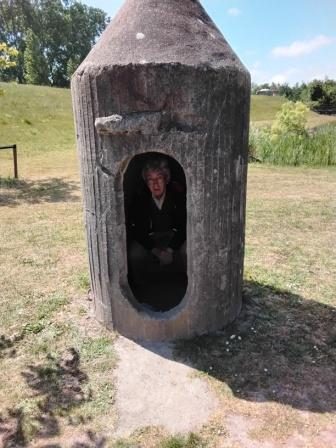
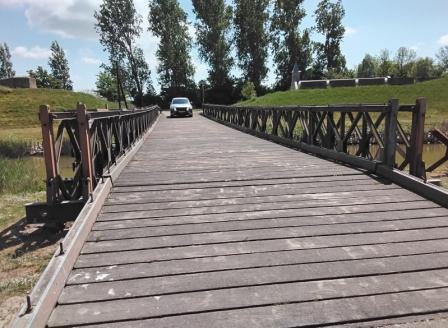
The Germans surrendered the area on November 5, 1944. Today, the Causeway that caused so many casualties no longer exists. Land on both sides of the dyke has been reclaimed and the Sloe Channel is now farmland. However, remnants of German concrete fortifications still exist both on Walcheren Island and South Beveland.
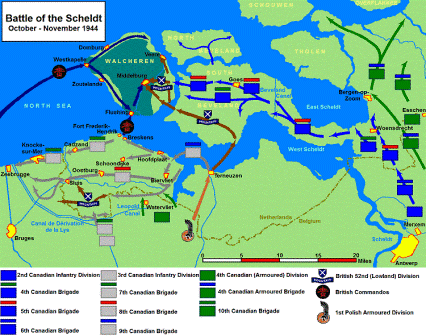
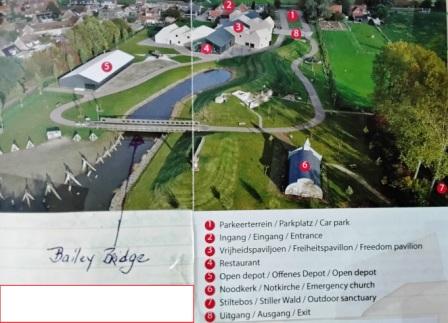
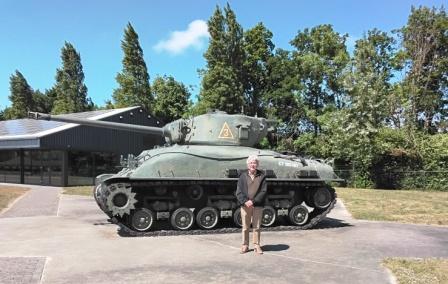
NOTE: For an idea of the scope of the Battle of The Scheldt, read about the visit we made during our 2025 European War Memorial Tour to the Freedom Museum Zeeland (Bevrijdingsmuseum Zeeland in Dutch) in Nieuwdorp, a privately run museum that focuses on the Battle of the Scheldt. See https://onthewarmemorialtrail.com/2026/01/31/on-the-war-memorial-trail-our-2025-visit-to-freedom-museum-zeeland/
….Joe is buried in Bergen Op Zoom…

Leonard was initially buried in Lewedorp. (Map source: Google maps)
Joe was initially buried on November 5, 1944 on Walcheren Island, behind the Roman Catholic Church in Lewedorp, before being reburied in the Canadian War Cemetery in Bergen Op Zoom on July 11, 1945.

The Roman Catholic Church in Lewedorp. (Photo source: Wikipedia)

Grave of Joseph Julius Augustus Lawrence. (Photo courtesy of Bergen Op Zoom Cemetery)

Dorothy Grant, niece of Joseph Lawrence. (Photo courtesy of Dr. Ian Grant)
Thank you to Dr. Ian Grant for providing a photo and the article written by his mother, Dorothy Grant. Pieter’s research efforts to find photos and families of soldiers continue. Do you have a story to tell? Email Pieter at memorialtrail@gmail.com, or comment on the blog.
© Daria Valkenburg
….Want to follow our research?…
If you are reading this posting, but aren’t following our research, you are welcome to do so. Our blog address: https://onthewarmemorialtrail.com/
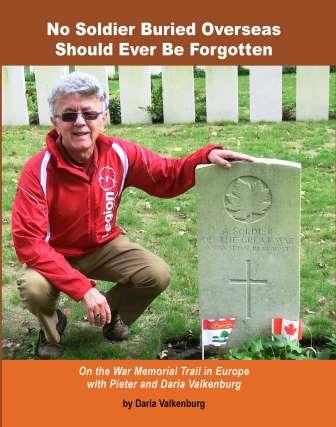 4 countries, 6 weeks, 7,000 km – an unforgettable war memorial journey in Europe…. Daria’s book ‘No Soldier Buried Overseas Should Ever Be Forgotten‘ is available in print and e-book formats. Net proceeds of book sales help support research costs and the cost of maintaining this blog. For more information see https://nosoldierforgotten.com/
Subscribe to our YouTube Channel: On The War Memorial Trail With Pieter Valkenburg: https://www.youtube.com/channel/UCJ591TyjSheOR-Cb_Gs_5Kw.
Never miss a posting! Subscribe below to have each new story from the war memorial trail delivered to your inbox.