May 24, 2026. Since Pieter began the On The War Memorial Trail research project in 2014, we’ve often had a chance to meet families of those who served. While much of the focus is on those who served our country and lost their lives while in service, most military service personnel in WWI and WWII returned home. We don’t often know much about their time in service, or what happened afterwards. As families come forward with information, we are trying to tell these stories.
Brenda Graves of North Tryon, Prince Edward Island shared that both of her husband Stuart’s grandfathers served in WWI and returned home with major injuries. “…Stuart’s paternal grandfather lost a leg in 1917 and his maternal grandfather was grievously injured in the nose, shoulder, and throat by an exploding grenade in 1918…”
Both men had immigrated to Canada from the United Kingdom, overcame difficult challenges as a result of their war injuries, and went on to marry and live productive lives in Winnipeg, Manitoba.
We decided to tell the story of both grandfathers. Part 1 of this series began with Stuart’s paternal grandfather, Francis Edmund GRAVES. (See https://onthewarmemorialtrail.com/2026/05/18/on-the-war-memorial-trail-duty-sacrifice-resilience-part-1-the-wwi-soldier-whose-war-injuries-didnt-stop-him-from-living-his-life/) Now, in Part 2, this series concludes with Stuart’s maternal grandfather, Charles STUART.
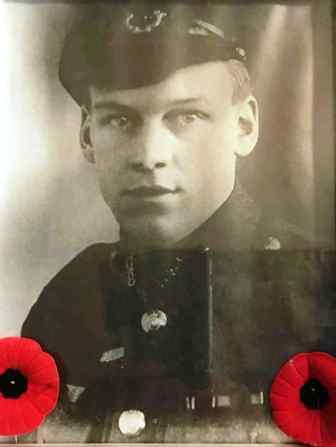
Charles Stuart. (Photo courtesy of Michael Figsby)
….Charles immigrated to Canada as a young child…
Born January 28, 1897 in Sheffield Notts, England, Charles was the son of Charles and Kate Ellen (nee Hulley) Stuart. He arrived in Montreal, Quebec from Liverpool, England aboard the SS Canada on September 30, 1904, accompanied by his mother and siblings. (See https://en.wikipedia.org/wiki/SS_Canada)
When he enlisted with the 144th Battalion (Winnipeg Rifles), Canadian Expeditionary Force (CEF) in Winnipeg, Manitoba on January 7, 1916, he stated that he had served in the 90th Winnipeg Rifles as a drummer, and was a plumber and steamfitter by trade. He also was a bugler, with his bugle in the possession of grandson Michael Figsby. (See https://en.wikipedia.org/wiki/8th_Battalion_(90th_Winnipeg_Rifles),_CEF)
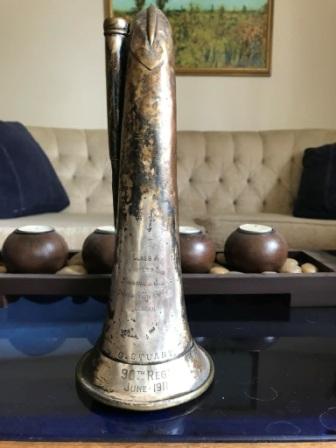
Charles Stuart’s bugle is from June 1911 and his time with the 90th Winnipeg Rifles. (Photo courtesy of Michael Figsby)
Charles continued being a drummer in the 144th Battalion (Winnipeg Rifles).
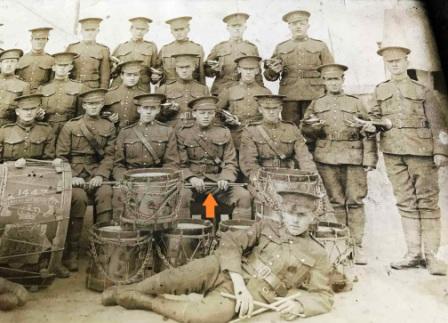
The 144th Battalion band. Charles Stuart identified by orange arrow. (Photo courtesy of Brenda and Stuart Graves)
…..Charles left Canada for overseas service…..
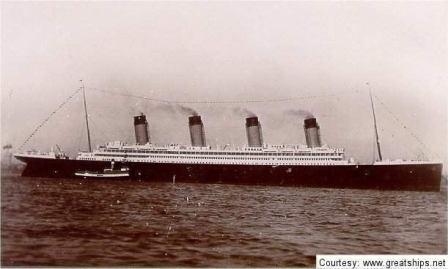
SS Olympic. (Photo source: http://www.greatships.net)
Charles and his battalion sailed from Halifax aboard SS Olympic on September 18, 1916, arriving in England. The battalion was absorbed into the 18th Reserve Battalion on January 12, 1917.
…..Charles sent to France AFTER the Battle of Vimy Ridge….
On April 20, 1917, Charles was drafted to the 8th Battalion, the active army of the Winnipeg Rifles, a key unit in the 2nd Infantry Brigade, 1st Canadian Division. Charles was one of the many reinforcements needed to replace the casualties suffered during the Battle of Vimy Ridge earlier in the month. The following day he arrived at the Canadian Base Depot (CBD) in France.
On May 7, 1917, he was sent from the CBD to the 8th Battalion, which was still in the trenches in the Vimy Ridge area, responsible for holding and consolidating front-line positions in the Vimy sector, training, and performing trench raids to harass the enemy and gather intelligence.
June 1917 found Charles and the 8th Battalion still in France, holding lines near the Lens-Loos area. By July 1917 they had moved up to the border between France and Belgium, engaged in intense, ongoing trench warfare.
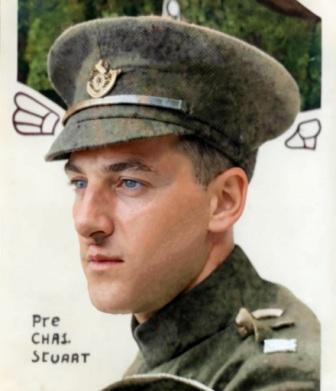
August 17, 1917 Winnipeg Tribune photo of Charles Stuart, restored and colourized by Pieter Valkenburg
As July ended and August began, the 8th Battalion prepared for the offensive against Hill 70, which aimed to draw German reserves away from the Allied offensive in Belgium. The Battle of Hill 70 began on August 15, 1917, but Charles missed this battle, as he’d received a gunshot wound to his right arm on August 5, 1917.
He was taken to No. 1 Casualty Clearing Station, and then sent on August 9, 1917 to No. 22 General Hospital in Camiens. On August 12, 1917, he was transferred to No. 6 General Hospital in Camiens for a few days before going on August 14, 1917 to No. 2 Convalescent Depot in Rouen.
On September 10, 1917, Charles was discharged and returned to the 8th Battalion as they prepared for the Battle of Passchendaele, enduring harsh conditions as they held their line during late summer.
Early in October 1917, as part of the 2nd Canadian Brigade, they moved from France to the Ypres salient in Belgium to relieve exhausted and battered ANZAC (Australia and New Zealand) forces and take part in the final push to capture Passchendaele during the months of October and November 1917.
Charles survived the Battle of Passchendaele, and, along with the rest of the battalion, returned to the trenches in France for the winter. They were tasked with holding their sectors, as well as training, trench maintenance, and defensive preparations for the German Spring Offensive a series of German attacks along the Western Front that began on March 21, 1918.
…..Charles was seriously wounded during the Battle of Amiens….
WWI on the battlefield ended for Charles on August 10, 1918 during the Battle of Amiens (also known as the Third Battle of Picardy), the opening phase of the Allied offensive which began on August 8, 1918 and lasted 10 days. (For more information, see https://en.wikipedia.org/wiki/Battle_of_Amiens_(1918) and a short video clip at https://finance.yahoo.com/video/battle-amiens-started-century-ago-173913821.html)
During the fighting, Charles received multiple shrapnel wounds in scalp, jaw, larynx, neck, hand, and chest. He suffered a compound fracture of his lower right jaw as well as a compound fracture of the left clavicle and 1st and 2nd ribs with bone loss.
Brenda explained that Michael Figsby, one of Charles’ grandsons, told her that when Charles “… was grievously injured by an exploding grenade in August 1918 (a terrible repeat), he was ‘left for dead’. Both Stuart’s mother and Michael confirmed that he grabbed at the pant leg or sleeve of one of the guys on death/grave detail. His nose was half blown off and his shoulder and throat were badly torn apart so he was unable to talk and they assumed him to be dead….”
Charles was taken to No. 5 Casualty Clearing Station at Crouy-sur-Somme, where a tracheotomy was done.
…..Charles’ next battle was one of recovery….
Charles was removed from the battlefield, but he now faced a long period of rehabilitation and recovery. On August 21, 1918 he was taken to No. 10 General Hospital in Rouen, where the tracheotomy tube was removed.
Then, on September 6, 1918, he was evacuated to Queens Sidcup Hospital in Kent, England, where another tracheotomy was done, as well as plastic surgery on his nose. Charles remained in Kent until May 10, 1919, when he was sent to No. 16 Canadian General Hospital in Orpington, in preparation for returning to Canada.
On May 21, 1919, he was invalided to Canada aboard HMHT Araguaya and arrived in Portland, Maine. He was admitted to Ste Anne de Bellevue Hospital in Montreal, Quebec on June 1, 1919, where it was noted that he had limited movement of left arm, and the tracheotomy tube from August 1918 was still in position.
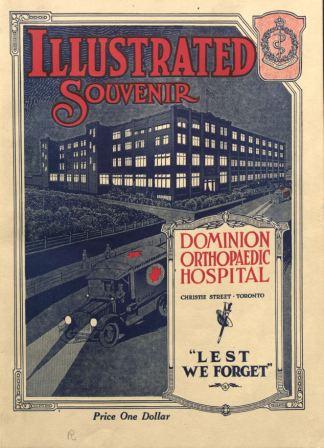
Cover of a souvenir booklet for the Dominion Orthopedic Hospital in Toronto.
Charles remained at the hospital until December 1, 1919 when he was transferred to the Facial Section of Dominion Orthopedic Hospital in Toronto, Ontario (known as Christie Street Hospital), where he underwent reconstructive surgery, and the tracheotomy tube placed in Kent was finally removed.
Brenda recalled that “…Stuart’s mother advised that he marry his sweetheart in hospital because it was uncertain of his survival of his critical injury…” Charles had been writing to his girlfriend Williamina ‘Nina’ Hood Menzies, a tele-operator, all during his military service. On April 21, 1920, they were married at the Christie Street Hospital. The marriage record noted that the witnesses were Robert R. Brown (likely a soldier) and Alice Davis (likely a nurse).
….Charles returned to Winnipeg after being discharged…
After being discharged from the hospital on June 12, 1920, Charles returned to Winnipeg, where he and Nina raised two daughters – Rae and June – and a son Charles. He worked at the CNR (Canadian National Railway) until his retirement at the age of 60.
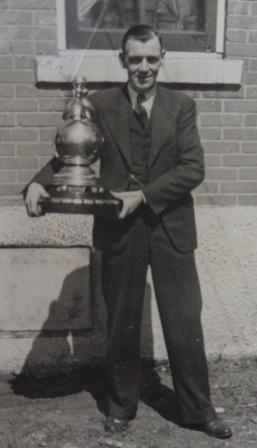
Charles Stuart with a bowling trophy, circa 1940s. (Photo courtesy of Brenda and Stuart Graves)
Charles lived a full life, even serving with the Armoured Corps Reserve during WWII. In addition, he was one of the founders of the Winnipeg Sports Club, and a member of the Ten-Pin Bowling Congress.
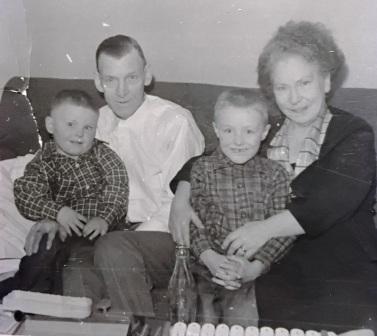
1954 photo of Charles and Nina with grandsons Bill (left) and Stuart (right). (Photo courtesy of Brenda and Stuart Graves)
….Charles is buried in Elmwood Cemetery in Winnipeg…
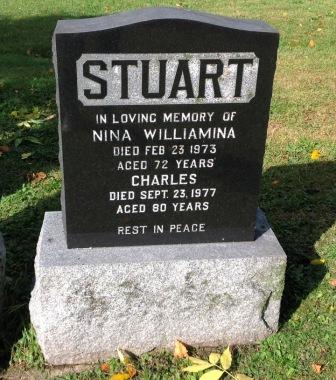
Grave of Charles Stuart and his wife Nina at Elmwood Cemetery in Winnipeg. (Photo source: Find A Grave)
Charles died on September 23, 1977 in Winnipeg, aged 80, and was buried in Elmwood Cemetery on September 27, 1977.
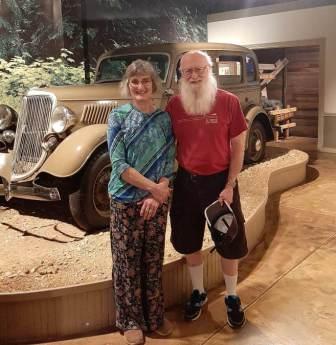
Brenda and Stuart Graves. (Photo courtesy of Brenda Graves)
Thank you to Brenda and Stuart Graves and Michael Figsby for providing information and photos, to Shawn Rainville for newspaper searches, and to Judie Klassen and Kristen den Hartog for help with the post WWI research.
Pieter’s research efforts to find photos and families of soldiers continue. Do you have a story to tell? Email Pieter at memorialtrail@gmail.com, or comment on the blog.
© Daria Valkenburg
….Stories about WWI soldiers who were in the Battle of Amiens…
Over the years, we’ve told several stories of WWI soldiers who were in the Battle of Amiens. Of the listing below, only Maynard Foy survived the battle and returned home to Canada.
- Theodore (Ted) Francis ARSENAULT: https://onthewarmemorialtrail.com/2022/03/06/on-the-war-memorial-trail-the-ww1-soldier-from-abrams-village-buried-in-manitoba-cemetery-in-france/
- James CAIRNS: https://onthewarmemorialtrail.com/2022/12/04/on-the-war-memorial-trail-a-photo-for-wwi-soldier-james-cairns/ and https://onthewarmemorialtrail.com/2017/09/30/the-search-for-manitoba-cemetery/
- Bazil CORMIER: https://onthewarmemorialtrail.com/2017/10/01/on-the-road-to-rouen/
- Maynard FOY: https://onthewarmemorialtrail.com/2021/04/24/on-the-war-memorial-trail-the-ww1-soldier-who-returned-to-tryon/
- John Goodwill HOWATT: https://onthewarmemorialtrail.com/2019/03/15/the-archive-photo-that-put-a-face-to-a-name/
….Want to follow our research?…
If you are reading this posting, but aren’t following our research, you are welcome to do so. Our blog address: https://onthewarmemorialtrail.com/
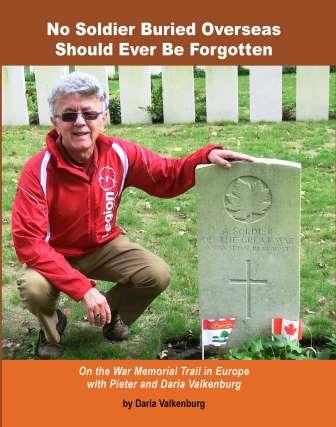 4 countries, 6 weeks, 7,000 km – an unforgettable war memorial journey in Europe…. Daria’s book ‘No Soldier Buried Overseas Should Ever Be Forgotten‘ is available in print and e-book formats. Net proceeds of book sales help support research costs and the cost of maintaining this blog. For more information see https://nosoldierforgotten.com/
Subscribe to our YouTube Channel: On The War Memorial Trail With Pieter Valkenburg: https://www.youtube.com/channel/UCJ591TyjSheOR-Cb_Gs_5Kw.
Never miss a posting! Subscribe below to have each new story from the war memorial trail delivered to your inbox.

