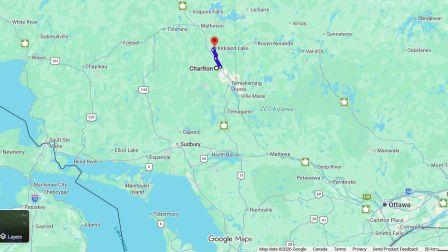
November 25, 2026. Last year, after Judie Klassen wrote us about a book she’d read, ‘Untold: Northeastern Ontario’s Military Past Volume 2 WWII to Peacekeeping’ by Dieter K. Buse and Graeme S. Mount, and sent us an index, Pieter found 5 names on one of his photo wish lists.
Once we learned that the book was in the library in North Bay, Ontario, we asked North Bay resident Don Coutts if he would take a look. Don did and found that the references to the 5 soldiers were all succinct summaries from their service files.
One of these five soldiers was Peter John JEFFREY, who is buried in the Canadian War Cemetery in Holten, The Netherlands.
….Peter’s brother Jim had a photo…
Born December 9, 1921 in Timmins, Ontario, Peter was the son of Peter and Cecily (nee Morgan) Jeffrey. One of 7 children, he had 5 brothers and 1 sister. When Pieter began his research, he discovered that the soldier’s youngest brother Jim was still alive, aged 88, and living in St. Catherines, Ontario.
Thinking that an initial contact with a local resident might be best, we asked Karen MacKay, who lives in St. Catherines, if she would give Jim a call. She did and had a lovely conversation with him. However, when Pieter called a few hours later, as a follow-up to ask about a photo, Jim didn’t recall any phone call or a brother named Peter. It was a confusing moment, but the decision was made to send a written letter to him. A few weeks later, we got a phone call from Erin Judd, who explained that Jim had dementia, but there were photo albums, and the family would see if a photo could be found.
A few months later, Pieter received a photo! Jim initially couldn’t recognize his brother in any of the photo albums. His niece, Maria Elliotson, gently persisted and by a miracle he had a very clear moment and pointed to a man in a photo of 3 soldiers and said ‘that’s him’.
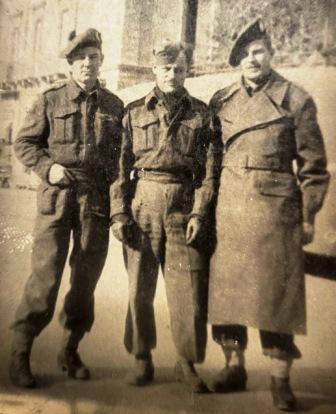
Peter John Jeffrey in the middle, with two unknown soldiers. (Photo courtesy of James ‘Jim’ Jeffrey)
“…I hope you received the email with the picture from my niece, Erin Judd….” Maria wrote. “… I also mailed the picture yesterday. It is small but it is the only one that I could find. I hope this will be of some help. It is very nice what you and your committee are doing and happy Jim’s brother is included, it is just too bad he is too confused to appreciate the whole thing…. Thanks for getting in touch with us….”
….Peter enlisted in 1941…
At the age of 19, Peter enlisted at the Number 2 District Depot, Royal Canadian Army Service Corps (RCASC) B Wing in Timmins, Ontario on July 8, 1941. He was interested in being a mechanic, and had taken a night school course at Timmins High Vocational School towards that goal. When asked if he’d been a member of a militia, he said he’d taken annual camp training from August 1940 to 1941.
When asked about any hobbies and sports he participated in, he listed reading, plus sports activities that included hiking, hockey, baseball, skating, and swimming.
On August 1, 1941, Peter was sent to No. 10 Canadian Army (Basic) Training Centre (CABTC) in Kitchener, Ontario. After completing basic training, he next went to A20 Royal Canadian Army Service Corps Training Centre (RCASC) in Red Deer, Alberta on September 1, 1941. He took specialized training, and by November 18, 1941 had qualified as a Driver Class III. (This meant he had passed the tests to drive standard military trucks and soft-skin wheeled vehicles at a beginner-to-intermediate trade proficiency level.)
After receiving his Class III certification, he was granted Christmas leave from December 17, until December 28, 1941, in what turned out to be the last chance he would have to see his family before going overseas.
He returned back to Red Deer for a few weeks before being assigned to the Royal Canadian Army Service Corps Reinforcement Unit and transferred to the A14 Canadian Infantry Training Centre (CITC) in Camp Aldershot, Nova Scotia. Here he would have been given for more intensive combat training in tactical firearm use and field exercises.
….Peter left Canada for overseas service….
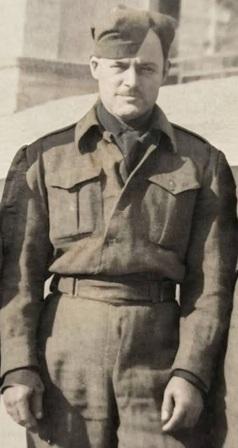
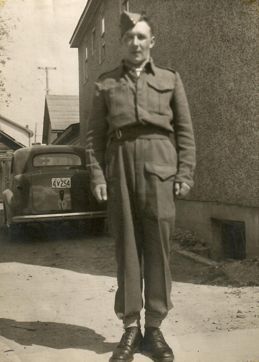
Peter John Jeffrey, on his own from the original photo. (Photo courtesy of James ‘Jim’ Jeffrey. Photo restoration by Pieter Valkenburg )
Peter remained at Camp Aldershot until February 28, 1942, when he boarded a ship in Halifax, Nova Scotia, leaving Canada and arriving in the United Kingdom on March 11, 1942. Upon arrival, he was assigned to No. 1 Canadian Army Service Corps Reinforcement Unit (CASC RU), effective the following day. This logistical training and staging unit was based in Aldershot in Hampshire, and administered by Canadian Military Headquarters (CMHQ) in London.
All newly arrived soldiers from the Royal Canadian Army Service Corps (RCASC) received additional operational and combat training. Whenever active field units in the First Canadian Army needed reinforcements due to casualties, No. 1 Reinforcement Unit could deploy combat-ready replacements directly to the front lines.
In May 1942, Peter was one of the participants in ‘Exercise Wolf’, a British-led military training exercise. The 1st Canadian Corps – including its RCASC transport, supply, and ambulance companies – participated in this exercise that simulated large-scale anti-invasion and mobility manoeuvres across southern England.
On June 5, 1942, Peter was sent to a Driving and Maintenance School for additional training in how to operate, recover, and repair military vehicles, including motorcycles, 15-cwt trucks to tracked Bren-gun (Universal) carriers, artillery tractors, and heavy tanks. On July 4, 1942, he fully qualified as a Royal Canadian Army Service Corps (RCASC) Driver.
For the next several months, beginning on July 24, 1942, Peter was assigned to various units, beginning with RCASC’s No. 62 Canadian General Transport Company, and then 5th Canadian Armoured Divisional Support Group 16 Company.
On January 26, 1943, he was transferred to RCASC’s No. 65 Tank Transporter Company, a logistics unit that used specialized tank transporters (such as 40-ton tank transporters) to haul armoured vehicles and support line-of-communications transport…. all in preparation for the Italian Campaign – the upcoming Allied invasion of Italy. (See https://www.veterans.gc.ca/en/military-history/second-world-war/italian-campaign)
Peter was assigned to the 5th Canadian Armoured Divisional Transport Company, 17 Company on April 14, 1943. The Company’s role would be to transport rations, ammunition, fuel, and essential supplies from rear areas to front-line units using trucks and heavy transport vehicles in the Italian Campaign.
….Peter served in Italy….

The Italian Campaign followed Operation Husky in Sicily. (Map source: Juno Beach Centre)
On October 23, 1943, Peter boarded a ship that left the United Kingdom and arrived in Italy on November 10, 1943, where his unit joined the 1st Canadian Infantry Division as part of I Canadian Corps, under command of the British Eighth Army.
Unfortunately, they had arrived without their tanks and vehicles, instead inheriting heavily used equipment from the veteran British 7th Armoured Division (The Desert Rats) who they relieved on the Italian Front. Most of these vehicles were completely worn out, having first been used in North Africa, or were two-wheel drive vehicles that were useless in Italy. It took several months before they were equipped with new vehicles.
Over the following months, vehicles would be driven under severe conditions, with heavy reliance on relay drivers and field maintenance during the upcoming battles as troops moved up through mainland Italy, including Ortona and the breakthroughs of the Hitler and Gothic Lines.
In August 1944, the unit was in central Italy, positioned just south of the Gothic Line, and had begun staging logistics for Operation Olive, an offensive aimed at breaking through the German Gothic Line fortifications. This meant moving large quantities of ammunition, rations, and fuel up mountainous terrain to sustain front line infantry units. The main assault on the Gothic Line began 3 days later, on August 26, 1944.
Shortly after this offensive, Peter took additional training, qualifying as a Driver i/c Class III on November 18, 1944. (The term ‘Driver i/c’ refers to ‘Driver, internal combustion’. Class III meant he was qualified to drive heavy trucks and armoured cars, but not tanks.)
….Peter left Italy for northwest Europe…
On February 24, 1945, Peter and his unit left Italy from Leghorn, the port in Livorno, as part of Operation Goldflake, arriving in Marseilles, France two days later. Operation Goldflake was the codename for moving troops from Italy to North-West Europe. (See https://en.wikipedia.org/wiki/Operation_Goldflake)
Once in France, the unit travelled north by road and train to re-equip before joining the 1st Canadian Army in Belgium and The Netherlands, again providing crucial logistical and transport support for the advance into Germany.
An exhausted Peter was sent to the United Kingdom for 9 days of leave on March 30, 1945, returning on April 7, 1945, for the final month before hostilities ended in Europe on May 9, 1945 when Germany surrendered.
….Peter was in Germany with the CAOF…
On June 16, 1945, Peter was transferred to No. 43 General Transport Company of the newly formed 2nd Line 9th Canadian Infantry Brigade Company (Canadian Army Occupation Force), RCASC. This new unit was sent to Germany to support the 3rd Canadian Infantry Division (Occupation Force), as part of the Canadian Army Occupation Force (CAOF), which was involved in policing, rebuilding, and securing the British Zone of occupied Germany.
Peter’s unit was responsible for transporting bulk supplies using 3-ton to 10-ton trucks, and accounting for the supplies and rations, and maintaining fuel depots.
Edward Alexander MUNRO, whose story was previously told, was also in this unit. (See https://onthewarmemorialtrail.com/2026/08/17/on-the-war-memorial-trail-the-soldier-from-birch-river-who-served-in-italy-and-north-west-europe-but-lost-his-life-5-months-after-wwii-ended/)
Peter was given another leave to the United Kingdom, this time for two weeks, from August 25 until September 7, 1945. On February 18, 1946, he was granted another 12 days leave to the United Kingdom, returning to duty on March 4, 1946. A few days later, on March 9, 1946, he was transferred to the RCASC 48 General Transport Company.
On May 26, 1946, he was informed he would receive a promotion to Lance Corporal.
….Peter died in a vehicle accident in August 1946…
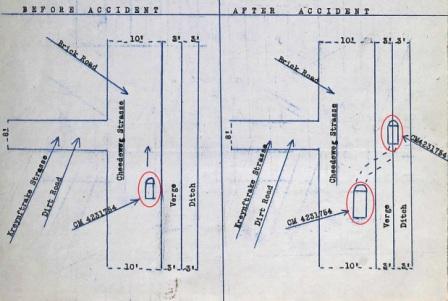
Accident reconstruction diagram shows position of jeep before and after the accident. (Diagram source: Service file of soldier)
Around 7:15 pm on August 3, 1946, Peter was assigned to travel to Oldenburg, Germany from ‘Alexandra Airport’ (Flughafen Oldenburg/Alexanderheide) located 5 km (3 miles) from Oldenburg.
Unfortunately, while driving a Willy 5-CWT Jeep, he was involved in an accident at the Alexanderstrasse Diversion and was taken to No. 39 British General Hospital (RAMC) in Oldenburg. The hospital record noted that the “…jeep skidded and left the road. Steering wheel hit him in the abdomen. Was not knocked out but was dazed…”
The night was clear, the road was in good condition, Peter wasn’t speeding, and no other vehicles appeared to be involved. It’s unknown why the vehicle veered off of the road, but it’s not surprising that Peter was seriously injured in a vehicle like the jeep. Chillingly, Edward Alexander MUNRO had lost his life in a vehicle accident, in which he had been a passenger, on the same road several months earlier, on October 5, 1945.
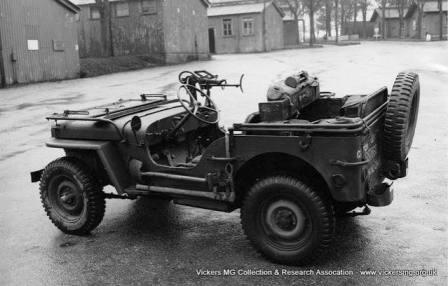
Example of a Willy 5-CWT Jeep. (Photo source: Vickers MG Collection & Research Association)
Despite receiving treatment in hospital, Peter died at 1:40 am on August 7, 1946, aged 24, as a result of a fractured pelvis and abdominal injuries received in the accident.
….Peter is buried in Holten….
Peter’s death in a road accident was a poignant reminder that not everyone who had survived WWII returned home. Instead, his final resting place is in the Canadian War Cemetery in Holten, The Netherlands, where he was buried on August 9, 1946, two days after his death.
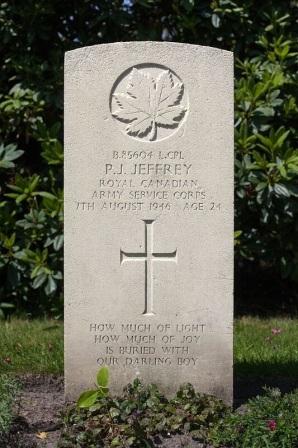
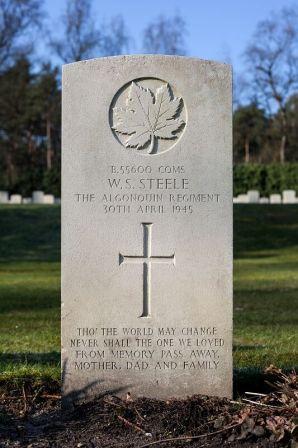
Grave of Peter John Jeffrey in the Canadian War Cemetery in Holten, The Netherlands. (Photo source: Canadian Virtual War Memorial)
Thank you to Maria Elliotson, Erin Judd, and James ‘Jim’ Jeffrey for finding a photo of the soldier, to Karen MacKay for help in contacting family, to Judie Klassen for letting us know about a book that mentioned soldiers from Northeastern Ontario, and to Don Coutts for visiting the North Bay Library and finding the references to Peter Jeffrey in the book Untold: Northeastern Ontario’s Military Past Volume 2 WWII to Peacekeeping by Dieter K. Buse and Graeme S. Mount.
Pieter’s research efforts to find photos and families of soldiers continue. If you can identify the two soldiers in the group photo that includes Peter John Jeffrey, or have a story to tell, please email Pieter at memorialtrail@gmail.com, or comment on the blog.
© Daria Valkenburg
….Want to follow our research?…
If you are reading this posting, but aren’t following our research, you are welcome to do so. Our blog address: https://onthewarmemorialtrail.com/
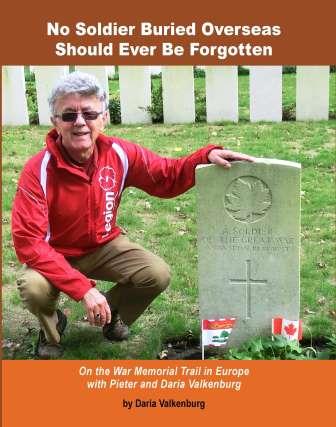 4 countries, 6 weeks, 7,000 km – an unforgettable war memorial journey in Europe…. Daria’s book ‘No Soldier Buried Overseas Should Ever Be Forgotten‘ is available in print and e-book formats. Net proceeds of book sales help support research costs and the cost of maintaining this blog. For more information see https://nosoldierforgotten.com/
Subscribe to our YouTube Channel: On The War Memorial Trail With Pieter Valkenburg: https://www.youtube.com/channel/UCJ591TyjSheOR-Cb_Gs_5Kw.
Never miss a posting! Subscribe below to have each new story from the war memorial trail delivered to your inbox.