On The War Memorial Trail….. Part 2: The WWII Letters Of Edison Reynolds Smith

20220903_190017 Wayne and Angela Leighton in Annapolis Valley

Angela Leighton and her husband Wayne at the Lookoff (Blomidon) in Nova Scotia’s Annapolis Valley. (Photo submitted by Angela Leighton)

December 12, 2023. In Part 1 of the WWII letters of Edison Reynolds SMITH, which had been shared by his niece, Angela Leighton, Edison had enlisted and was in France.  Meanwhile, his family was dealing with the death of Edison’s younger brother Wesley – which Edison was as yet unaware of – and had received a telegram stating that Edison had been wounded.  (See https://onthewarmemorialtrail.com/2023/12/07/on-the-war-memorial-trail-part-1-the-wwii-letters-of-edison-reynolds-smith/)

The telegram had been sent to Edison’s brother, Wesley Smith in Cooks Cove, Nova Scotia, stating that Edison had been wounded on June 9, 1944, but remained on duty with his unit.  However, Wesley did not receive the telegram – he had drowned on May 27, 1944.

Now, Edison’s story continues in Part 2…..
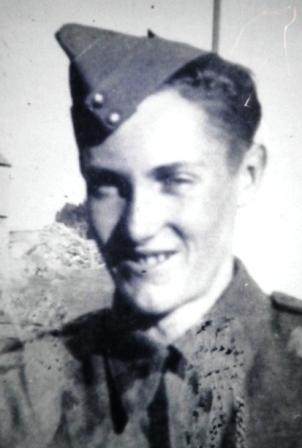
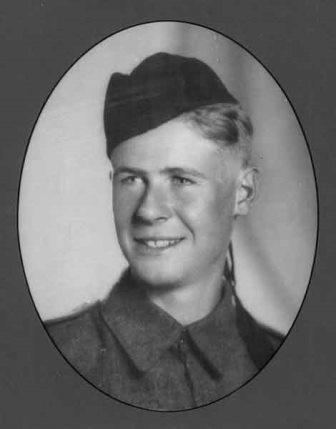
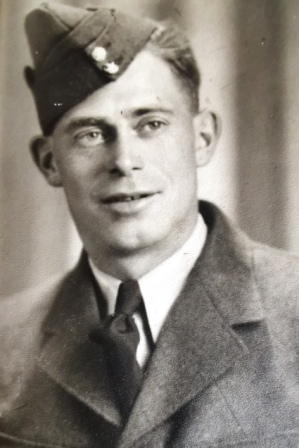
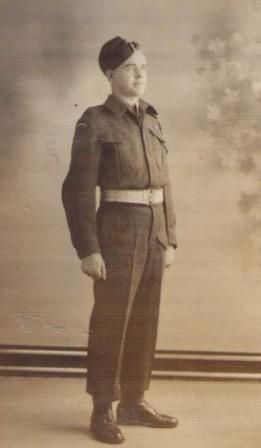
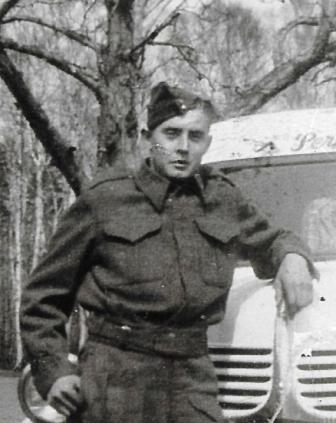
Edison Reynolds Smith

Edison Reynolds Smith.  (Photo courtesy of Angela Leighton)

… Edison was transferred to the Canadian Scottish Regiment…

According to his service file, Edison was in the hospital until June 11, 1944, after which he was transferred to the 1st Battalion, Canadian Scottish Regiment, British Western European Forces (BWEF)In his letters, Edison didn’t mention being wounded.

His first letter from France, dated June 14, 1944 letter to his aunt, Elsie Myers, confirmed he was in the 1st Battalion, Cdn Scottish Regiment, ‘A’ Company. …I am in France now.  I’ve been here a few days.  The last letter I wrote was before I left the docks in England…. The French people are very nice to us… I am with the Canadian Scottish Regiment and with a pretty good bunch of men.  George is over here too somewhere, I suppose, but he’d be with the North Nova Scotia Highlanders...”  Sgt George MYERS was a nephew of Edison’s uncle, Roland Myers.

On June 26, 1944, Edison wrote to his brother Wesley, still unaware that his brother had died on May 27, 1944.  “…Just a line or two to let you know I am still kicking….It’s pretty noisy here at times. Most of the fellows I’m with are from British Columbia….The days seem pretty long over here longer than they did in England.  I never got any leave or anything when I was in England… There are quite a few cattle over here. They are around our trenches every day….I might be able to get in the North Nova Scotia Highlanders, the same as George is in.  My name is gone in for them anyway…” 

On July 1, 1944, Edison got his wish and was transferred back to the North Nova Scotia Highlanders. 

… Edison was heartbroken to learn that his brother Wesley had died…

In a July 2, 1944 letter to his Aunt Elsie, Edison mentions he was now in ‘C’ Company of the North Nova Scotia Highlanders.  He was shocked to learn about his brother’s death. “…I was just over to see George and Percy.  I just arrived at this unit yesterday and I went to look George up this afternoon and found him, and I also saw Percy….”  Angela believes that Percy referred to Percy LUMSDEN.

 …I was shocked when George told me about Wes.  Cold chills came over me when he handed me a piece that was cut out of the newspaper telling about the terrible thing that that happened to him. How did it happen?  I can hardly believe it.  I just trembled when I read it. I suppose you sent me the news but I haven’t received it yet because I have been moved around so much. I bet there was a large funeral. I suppose the reserve army was there too….It’s going to be hard on me for a while and all of us…Wes was a friend of everybody’s and was a smart boy too. He died a good soldier….

Edison then wrote to his sister Dorothy on July 4, 1944. “…It’s hard for me to believe that Wes has been drowned. Charlie MacKenzie was drowned too…”  

… Edison related some of what he was experiencing …

In a July 12, 1944 to his Aunt Elsie, Edison carefully mentioned troop losses. “…We are moving deeper into France all the time.  We have lost a lot of the fellows I came overseas with.…I’ll be glad when we get to Paris…

On July 15, 1944, he wrote to his cousin Abbie. “…I was down to the beach yesterday for a bath and I saw Percy there…. We are back of the lines now, having a rest after being in the front lines for over a month.  It’s a lot quieter back here and we can have a night’s sleep in peace.  My nerves were getting kind of shook up and a good rest will do a fellow good…

It was Percy Lumsden who told him that the family had been informed that he was wounded, which he addressed in the letter to Abbie. “…Percy said he got a letter from Ruth and she said it was in the paper that that I was wounded.  I haven’t got a scratch on me.  It must be a mistake I guess…I hope you can make my writing out.  My hand is shakier than it was….

It’s unclear whether Edison was simply sparing his family, as his service file clearly notes that he had been wounded and briefly hospitalized.

… Edison longed for the war to end …

Edison wondered if he’d made the right decision to enlist in his July 24, 1944 letter to his sister Dorothy. “…War is awful…and you don’t realize it until you get in the thick of it… I wish I had of stayed home and helped Uncle Rollie.  I might have been able to if I had of put in for farming leave early enough, but I was so anxious to get over here and get a crack at Jerry.  I’m not quite so anxious now though…

Around the same date, he wrote more frankly to his cousin Abbie. “…I’m right in the front line.  I’ve been in the front line since D-Day, the day I landed in Normandy….The only pleasure we get here is getting letters.  We have it pretty tough of course, you can expect that in a place like this.….

… Edison delighted in getting a care package from home …

Mail and care packages were morale boosters.  Edison’s August 2, 1944 letter to his sister Dorothy reflects this.  “…I got the box you sent me for my birthday. The oranges were rotten, but I found a couple that were fit to eat. The chocolates were in good shape though and so was the cake.  I enjoyed it very much. I gave some of the boys some chocolates and some of the cake…It was a treat for me to get those chocolates because it’s something you don’t see very often over here…

 … Edison felt the tide of war was turning …

On September 2, 1944, in a letter to his sister Dorothy, Edison noted that France was nearly liberated.  “…We have been moving so fast that I don’t get much time to write.  The weather over here is terrible, wet, raining every day, but I imagine there will be a dry spell after a while… The war looks pretty good now.  Paris has fallen and we are nearing the borders of Germany and Belgium. It makes you feel good when we go into a town and see the streets lined with cheering Frenchmen.  They are certainly glad to see us coming….

Edison related a close call in a September 7, 1944 letter to his cousin Abbie. “…I’ve had some close calls, but I’m still on the go.  I had a bullet go through my pant leg and a piece of shrapnel hit my steel helmet, so I think that’s close enough .

The last letter written by Edison was on October 6, 1944 to his uncle, Roland Myers. “…I am in Belgium now and we are having pretty good weather these last few days, nice and warm.….”   

What Edison was unable to explain was that he was in the midst of the Battle of the Scheldt, which had begun on October 2, 1944. (See https://en.wikipedia.org/wiki/Battle_of_the_Scheldt and https://www.thecanadianencyclopedia.ca/en/article/canada-and-the-battle-of-the-scheldt)

On October 6, 1944, Operation Switchback, the second main operation of the Battle of the Scheldt began, with the goal of clearing the ‘Breskens Pocket’ – the German defences around Breskens in The Netherlands. (See https://www.canadiansoldiers.com/history/battlehonours/northwesteurope/breskenspocket.htm)

….How Edison Lost His Life….
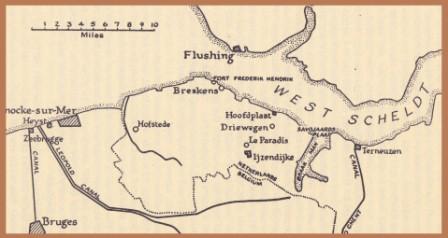
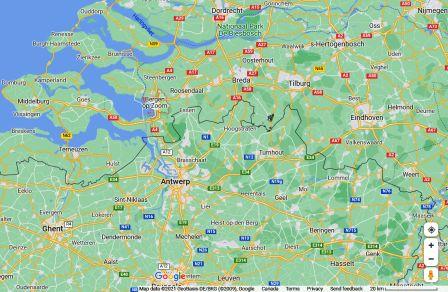
Map showing where Edison lost his life

Edison was initially buried between Hoofdplaat and Terneuzen, The Netherlands.  (Map source: ‘No Retreating Footsteps’ by Will R. Bird)

On October 16, 1944, the North Nova Scotia Regiment was in The Netherlands, tasked with attacking a heavily defended dyke.  Sadly, it was the day that Edison lost his life, as was related in a November 17, 1944 letter to his aunt from Captain L.C. Niuhold, ‘C’ Company, North Nova Scotia Highlanders:  “…As second-in-command of the company in which your nephew served, I was present on the 16th of October in the battle in which he was killed. …

It was part of the campaign in the Scheldt in Holland which eventually opened the great port of Antwerp.  On the 16th of October the company was leading the battalion in an attack along a stubbornly defended dyke.  The going was slow and difficult but owing to the courage and determination of your nephew and his pals, the position was eventually taken. 

It was after we had reached our first objective and your nephew was bringing in some prisoners, that a burst of machine-gun fire from another direction hit him and instantly killed him.  The same burst of fire killed his platoon officer and another one of his pals who were with him.

Your nephew was buried, along with the other boys who died that day, in a pretty orchard in Southern Holland, with a funeral service held by our battalion padre.

I wish to extend my heartfelt sympathy to you in the loss of your nephew.  He is missed by everyone in the company as he was one of our best soldiers…

… Edison is buried in the Canadian War Cemetery in Adegem…

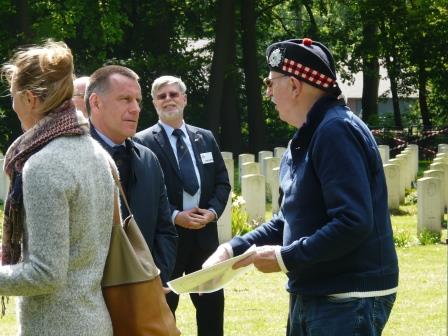
Edison was initially buried between the towns of Hoofdplaat and Terneuzen, The Netherlands. After the war ended, Edison was reburied in the Canadian War Cemetery in Adegem, Belgium.  Pieter’s cousin, François Breugelmans visited Edison’s grave with his wife, Mieke de Bie, and ensured a Canadian flag was placed by his headstone.
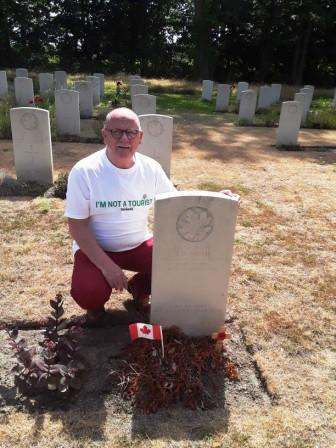
SMITH and Francois from Mieke

François Breugelmans by the grave of Edison Reynolds Smith at the Canadian War Cemetery in Adegem.  (Photo credit: Mieke de Bie)

Thank you to Angela Leighton for providing photos, Edison’s letters, and information.  Thank you also to François Breugelmans and Mieke de Bie for visiting Edison’s grave at the cemetery in Adegem. Do you have a story to tell? Email Pieter at memorialtrail@gmail.com, or comment on the blog.  

© Daria Valkenburg

….Want to follow our research?….

If you are reading this posting, but aren’t following our research, you are welcome to do so.  Our blog address: https://onthewarmemorialtrail.com/
Front cover OnTheWarMememorialTrailinEurope4 countries, 6 weeks, 7,000 km – an unforgettable war memorial journey in Europe…. Daria’s book ‘No Soldier Buried Overseas Should Ever Be Forgotten‘ is available in print and e-book formats.  Net proceeds of book sales help support research costs and the cost of maintaining this blog. For more information see https://nosoldierforgotten.com/ 

You are also invited to subscribe to our YouTube Channel: On The War Memorial Trail With Pieter Valkenburg: https://www.youtube.com/channel/UCJ591TyjSheOR-Cb_Gs_5Kw

Never miss a posting!  Subscribe below to have each new story from the war memorial trail delivered to your inbox.
On The War Memorial Trail….. Part 1: The WWII Letters Of Edison Reynolds Smith

December 7, 2023. Whenever Pieter researches someone who has served in the military, we ask if there is any correspondence that the families might have. Sometimes a letter or postcard survives, which is wonderful.

In 2021, in the Atlantic Canada Remembers series, Angela Leighton submitted a photo of her uncle, Edison Reynolds SMITH, who was killed in action in The Netherlands on October 16, 1944, during the Battle of the Scheldt, while serving with the North Nova Scotia Highlanders.  He’s buried in the Canadian War Cemetery in Adegem, Belgium.  (See https://onthewarmemorialtrail.com/2021/01/07/on-the-war-memorial-trail-atlantic-canada-remembers-part-1/)

Edison Reynolds Smith

Edison Reynolds Smith.  (Photo courtesy of Angela Leighton)

After the article was posted, Angela wrote us with more information.  “Edison Reynolds Smith was born May 11, 1924 on Port Hood Island, Cape Breton, Nova Scotia to parents Guy and Grace (nee Watts) Smith.  After his parents passed, Edison and his siblings were taken in by their aunt and uncle, Elsie and Roland Myers, and lived in Cooks Cove, Guysborough County, Nova Scotia from 1929 until 1944….

Edison’s sense of duty was strong, and he enrolled in the 2nd (Reserve) Battalion of the Pictou Highlanders on August 24, 1942.  “…Edison joined the Militia in August 1942 and worked as a lumberman for his uncle until he enrolled in the Canadian Army on August 30, 1943….”  He enlisted at the No. 6 District Depot in Halifax, Nova Scotia.

20230616_085605_resized Angela Leighton

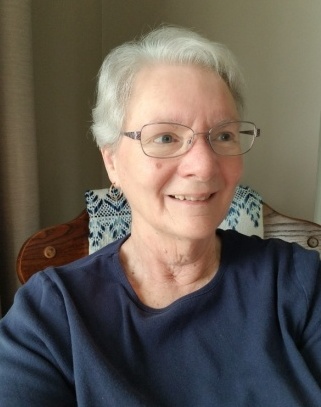
Angela Leighton, whose mother Dorothy was the younger sister of Edison Reynolds Smith, kept the letters he wrote to family.  (Photo submitted by Angela Leighton)

Angela then mentioned that she had letters that Edison had written during the time of his military service!  The letters reveal an engaging man who had suffered much tragedy in his young life, but never lost his optimistic spirit, even when he encountered more loss.  He was deeply interested in his family and friends, and kept up an active correspondence.  As time went on, he yearned to be back in Nova Scotia, surrounded by those he loved.

This was confirmed by Angela, whose mother Dorothy (Dot) was Edison’s sister.  “…His mother (my grandmother) died on January 11, 1928.  Her husband (my grandfather) died January 30, 1929. …It is no wonder Edison had such a love of family after such tragedy in those years before and really wanted to come back home….

1943 Edison Smith with Dot and Wesley

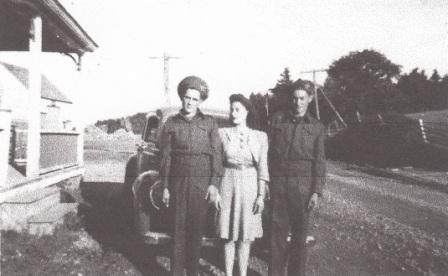
Edison (left) with his sister Dorothy and younger brother Wesley in 1943.  (Photo courtesy of Angela Leighton)

… Edison began his army training in September 1943…

After enlisting, Edison was sent to No. 60 Canadian Army Basic Training Centre (CABTC) in Yarmouth, Nova Scotia on September 17, 1943.

On November 19, 1943, he was sent to A14 Canadian Infantry Training Centre (CITC) in Aldershot, Nova Scotia for further training.  He received embarkation leave, from January 22 to February 4, 1944, the last chance he had to see his family.

After returning from leave, Edison remained in Aldershot until February 20, 1944, when he was transferred to the No.1 Training Brigade in Debert, Nova Scotia for final training and preparation for overseas service.

In a March 15, 1944 letter to his sister Dorothy, written from No 2 Temporary Transit Camp in Debert, Edison related one of the experiences and mentioned a friend from back home: “…We just got back off of our three day scheme.  We slept out in the woods two nights and we marched about 26 miles altogether.  I didn’t mind it though. It was a change from sleeping in the barracks…I saw Victor Shea up here the other day, he just came here about three or four days ago….It was terrible cold here right after I came back off of my weekend.  It was about 20 below zero one night.  But it’s a lot warmer now.  We moved today to a different part of the camp…

An April 1, 1944 letter to Dorothy, also written from Debert, noted that: “…my eyes have been paining me a little lately….I went on sick parade, but they only gave me a few tablets.…

… Edison left Canada for overseas service in April 1944…

Not mentioned in the letter was that Edison was on his way to the United Kingdom.  On April 6, 1944 he left Canada, arriving in the United Kingdom on April 12, 1944, where he was assigned to No 4 Canadian Infantry Reinforcement Unit (CIRU).

Edison’s initial impression of England was positive, as he related in an April 14, 1944 letter to his sister Dorothy, written from No 4 CIRU: “…It’s lovely weather over here except it rains once in a while…I spent Easter in the middle of the Atlantic.  It was a nice place to spend Easter, wasn’t it?….I had a good trip coming across but it was a little crowded….

Not long afterwards, Edison was sent to No 10 Battalion, Canadian Base Reinforcement Group (CBRG), but was still in England.  A poignant May 11, 1944 letter to his aunt, Elsie Myers, reflected that “…Today is my birthday. I hope I will be home my next birthday…

… Edison loved getting mail from back home…

In a May 25, 1944 letter, written from No 10 Battalion CBRG in England, Edison answered his sister Dorothy’s query about Victor Shea. “…I got two letters today and both from you. There’s nothing cheers me up any more than getting letters…..I haven’t seen Vic for a while.  He is not with me at all now.  He was with me all the time coming across on the ship from Canada and he ate and slept right where I did all the way coming across… 

Victor SHEA had joined the Canadian Parachute Battalion in 1942.  When more soldiers were needed for battle on the beaches of Normandy after D-Day, he transferred to infantry and was on the front lines, joining the North Nova Scotia Highlanders.   He received France’s Croix de Guerre (Medal of Valour) for his bravery in the liberation of France.

Before ending his letter, Edison assured his sister that he appreciated a parcel she’d sent. “…Thank you so much for the box you sent me.  We get lots to eat but it’s nice to have a change from army grub…

Dorothy wasn’t the only one to inquire about Victor Shea and other soldiers from their area.  In a May 25, 1944 letter to his cousin Abbie, daughter of his uncle Roland and aunt Elsie Myers, Edison explained that “…Vic Shea isn’t where I am at all now so there isn’t any one from home with me now….They are about the only ones anyways handy from home.  But I know a lot of the boys here by now because I went through all my training in Canada with them….If they send me a box from home, tell them to send me a few apples because I never tasted a bit of fruit of any kind since I came over here…

… Edison leaves for France and the D-Day invasion with the North Nova Scotia Highlanders…

On June 2, 1944, Edison was assigned to the North Nova Scotia Highlanders, as they prepared to leave the United Kingdom for France as part of the 21st Army Group.

The war diary for the North Nova Scotia Highlanders for June 3, 1944 noted that they … embarked from G1 Hard, Stokes Bay…..” and were “…lying out in the Southampton waters just outside Netley…” while awaiting clearance to cross the English Channel.

There was a delay in leaving due to heavy winds on June 4, so it wasn’t until June 5, 1944 that the crossing began.  “…At 1400 hours the flotilla moved out to the open sea and formed up with the other craft taking part in the invasion…”  This, of course, was to be what we know as D-Day.

On June 6, 1944, the war diary recorded that “…by 1400 hours all our troops were ashore, but as the Eighth Canadian Infantry Brigade had not found the going as easy as expected, we were unable to get through the town and were unable to assemble at ‘ELDER’, near Beny-Sur-Mer, as planned, and the Commanding Officer decided to assemble in a field….

D-Day was Edison’s first experience of fighting, but he survived.

… Tragedy strikes but Edison was not yet aware of another loss…

In early June, 1944, a telegram was sent to Edison’s brother, Wesley Smith in Cooks Cove, Nova Scotia, stating that Edison had been wounded on June 9, 1944, but remained on duty with his unit.  A notice of his being wounded is also recorded in Edison’s service file.  However, Edison later stated to his family that he was not wounded.

Edison and Wesley Smith better res

Edison (left) and Wesley Smith. (Photo courtesy of Angela Leighton)

What Edison didn’t know – and apparently neither did the military who sent the telegram – was that his younger brother Wesley, who was in the Reserves, had drowned on May 27, 1944.  He was only 16 years old.

….Coming up in Part 2…

In Part 2, Edison sees active service in France, Belgium, and The Netherlands and learns about the loss of his younger brother.   

Thank you to Angela Leighton for sharing photos and letters written by her uncle.  Do you have information to share about Canadian soldiers, please email us at memorialtrail@gmail.com, or comment on the blog.  

© Daria Valkenburg

….Want to follow our research?….

If you are reading this posting, but aren’t following our research, you are welcome to do so.  Our blog address: https://onthewarmemorialtrail.com/

Front cover OnTheWarMememorialTrailinEurope4 countries, 6 weeks, 7,000 km – an unforgettable war memorial journey in Europe…. Daria’s book ‘No Soldier Buried Overseas Should Ever Be Forgotten‘ is available in print and e-book formats.  Net proceeds of book sales help support research costs and the cost of maintaining this blog. For more information see https://nosoldierforgotten.com/ 

You are also invited to subscribe to our YouTube Channel: On The War Memorial Trail With Pieter Valkenburg: https://www.youtube.com/channel/UCJ591TyjSheOR-Cb_Gs_5Kw

Never miss a posting!  Subscribe below to have each new story from the war memorial trail delivered to your inbox.
On The War Memorial Trail….. The WWII Soldier From Moncton Who Lost His Life During The Battle of Walcheren Causeway

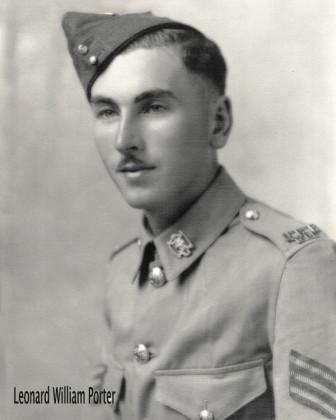
November 20, 2023. When Pieter began his research into WWII soldier Leonard William PORTER of Moncton, New Brunswick, he discovered they had something in common, as he wrote to Leonard’s son, Peter Porter.  “…I noticed that he was born on the same day as myself but 26 years earlier, on the 25th of March 1918….” 

This was a promising start to the research, which continued after he quickly received a photo of Leonard after reaching out to Peter, and then we were able to meet Peter and his son Shane.  Asked how he felt about being approached for a photo, Peter said “…I think this is wonderful…

CIMG6567 Oct 23 2023 Shane Peter Pieter

Shane and Peter Porter with Pieter.  (Photo credit: Daria Valkenburg)

Born March 25, 1918 in Moncton, New Brunswick, Leonard was the son of Andrew and Ella Elizabeth (nee Beers) Porter. 

At the time of his marriage to Kathryn Doris Meaghan on December 6, 1941 in Moncton, Leonard listed his occupation as Sergeant in the New Brunswick Regiment (Tanks), a non-Permanent Active Militia unit.  He didn’t mention that he was also employed by the T. Eaton Company.

….Leonard was in the militia for several years….

Leonard had joined the militia on March 12, 1939, and qualified as a Sergeant on June 20, 1940.  He served in Borden, Ontario, St John, New Brunswick, and Shediac, New Brunswick. As of August 11, 1940 he had been appointed as an Instructor with A & T Staff 19th (Reserve) Army  Tank Regiment.

Leonard William Porter from Peter Porter

Leonard William Porter while serving with the New Brunswick Regiment (Tank) militia.  (Photo courtesy of Peter Porter)

He qualified as a Driver i/c Class III on June 4, 1942, after successfully completing a 6 week driving course at the S-5 Canadian Driving and Maintenance School (CD & M School) in Woodstock, Ontario. This meant he was qualified to drive heavy trucks and armoured cars. 

On June 10, 1942, Leonard was promoted to Squadron Sgt-Major Warrant Officer II (SSM (WOII)). 

On October 3, 1942, he was sent to the A-30 Canadian Infantry Training Centre at Camp Utopia, located northeast of St. George, New Brunswick to attend a Mortar and Grenade course.

On January 13, 1943, he was sent to Buctouche, New Brunswick.  While posted there he took a Browning Machine Gun course. 

Leonard and Kathryn’s son Peter James was born on February 19, 1943 in Moncton, New Brunswick.

From March to August 1943 Leonard served in Richibucto and Sussex, then from September until November 15, 1943 he was in Tracadie and Fredericton, all in New Brunswick. 

While he was in the Militia, with the New Brunswick Regiment (Tanks), Leonard also held a full time position for 5 years as a grocery clerk with the T. Eaton Company, a department store, in Moncton.

….Leonard enlisted for active service in the Canadian Army….

On November 16, 1943, he enlisted in the active service force at the No. 7 District Depot in Fredericton, New Brunswick.  In the interview for his Personnel Selection Record, it was noted that Leonard was “...fond of bowling. Does some hunting and fishing. Reads Esquire, Readers Digest, and fiction….”  Peter Porter mentioned that his father also “….played a piano-accordion...

Although Leonard had spent several years in the Militia, he was still sent for basic training, like any new recruit.  On December 7, 1943, he reported to No. 70 Canadian Army Basic Training Centre (CA(B)TC) in Fredericton. But, he was given a 5 day pass for Christmas leave, from December 23 to 28, the last Christmas he would spend with his family.

On February 15, 1944, Leonard returned to the A-30 Canadian Infantry Training Centre at Camp Utopia, located northeast of St. George, New Brunswick.  After his 5th week of training, his Personnel Selection Record was updated.  “….Leadership ability is apparent, exerts influence over his fellows. Quiet, steady, confident… Interested and ambitious…..Watch for promotions….

Leonard was selected for the 3 inch mortar training course, which ran from April 10 to April 29, 1944.  After receiving his qualification in this course, on May 4, 1944 he was sent to Woodstock, Ontario for a Carrier Driver Course at the S-5 Canadian Driving and Maintenance School (CD & M School).  He had been there in 1942 while with the militia.

On June 14, 1944, he received his qualification as a Driver i/c Class III (Wheeled) (3 inch Mortarman). The term ‘Driver i/c’ refers to ‘Driver, internal combustion’.  Class III meant he was qualified to drive heavy trucks and armoured cars. Wheeled refers to wheeled vehicles.  As a mortarman,  Leonard could not only drive vehicles containing bombs, but also be part of the mortar crew firing them. (See https://www.canadiansoldiers.com/weapons/lightweapons/mortars/3inchmortar.htm)

On June 24, 1944, Leonard returned to the A-30 Canadian Infantry Training Centre at Camp Utopia in preparation for overseas service.  He received two weeks of embarkation leave, from June 29 to July 12, 1944, the last time he would see his family.

… Leonard left Canada for overseas service in July 1944…

On July 20, 1944, Leonard left Canada for the United Kingdom.  Upon arriving on July 27, 1944 he was assigned to No 4 Canadian Infantry Reinforcement Unit (CIRU). 

His stay in the United Kingdom was short, as on September 1, 1944 he was sent to France with the X-L infantry reinforcement troops of the 21st Army Group.

Screenshot 2023-11-19 at 12-54-37 Loon-Plage · 59279 France

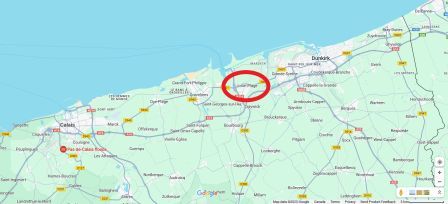
Leonard joined the Calgary Highlanders in Loon Plage, France.  (Map source: Google maps)

On September 12, 1944, he was transferred to the Calgary Highlanders, joining them in Loon Plage, France, not that far from the Belgian border.   The Regiment, part of the Canadian 5th Infantry Brigade, was engaged in patrolling operations and needed to be constantly on the alert from the heavily fortified Dunkirk (Dunkerque in French).

The War Diary entry for September 12, 1944 for the Calgary Highlanders reported that “…. during the evening, heavy bombers were heard roaring out toward German territory and heavy shelling and mortaring were heard coming from the direction of Dunkerque….” The situation intensified in the days that followed.  On September 14, 1944, the War Diary entry recorded that “…forty-four other ranks arrived as reinforcements to the Battalion...”  Leonard would have been one of these men.

… The Regiment was in the Battle of the Scheldt…

By September 18, 1944 the Calgary Highlanders had crossed into Belgium and were temporarily based in Wommelgem, just outside Antwerp, while the Regiment was engaged in the preparations for and participation in the Battle of the Scheldt, which began officially on October 2 and lasted until November 8, 1944.

The Battle of the Scheldt’s objective was to free up the way to the Port of Antwerp in Belgium for supply purposes. Canadians suffered almost 8,000 casualties (wounded and dead) in what turned out to be the battle with the most Canadian casualties in The Netherlands. (See https://www.veterans.gc.ca/eng/remembrance/history/second-world-war/scheldt)

During their stay in the Wommelgem area, several members of the Calgary Highlanders lost their lives, and were temporarily buried there, before being reburied in the Canadian War Cemetery in Bergen Op Zoom.  (See https://onthewarmemorialtrail.com/2021/02/13/on-the-war-memorial-trail-the-search-for-soldiers-who-died-in-wommelgem-belgium-in-fall-1944/)

On October 7, 1944, the Regiment left Belgium and arrived in The Netherlands in the early morning, with the War Diary recording that “…at 05:50 hours the group crossed the border into Holland…” and was based at Jansen Farm.

On October 11, 1944, the Regiment moved again, to De Geest, then on October 15, 1944 to Hinkelenrood and based at Van De Maegdenburg’s Farm.  Their task was mainly recce patrol.  On October 22, 1944 the Regiment arrived in Ossendrecht.   Then, on October 26, 1944, the Regiment arrived in Woensdrecht.

… The Regiment was involved in the Battle of Walcheren Causeway…

The stay in Woensdrecht was short, as on October 28, 1944 the Regiment made its way across the isthmus towards South Beveland.  By October 31, 1944, the Calgary Highlanders were to cross the Sloe Channel in assault boats towards the German-held Walcheren Island. 

The original plan to cross the Sloe Channel failed, as the Black Watch of Canada, the troops of the 5th Canadian Brigade that were in the lead, found that assault boats were useless in the deep mud of the channel.

The only route open was the Walcheren Causeway (known as Sloedam in Dutch), a land bridge from South Beveland to the Island. The Causeway was a dyke – 1,600 metres (1 mile) long and just 45 metres (40 yards) in width.

Walcheren2

Map showing troops at the beginning of the Battle of Walcheren Causeway.  (Map source: Wikipedia)

In what became known as the Battle of Walcheren Causeway, part of the larger Battle of the Scheldt, the struggle to cross the Causeway was hampered.  A deep crater on the causeway had been blown by German engineers as an anti-tank obstacle and the surrounding landscape was severely damaged by bombing.

After the Black Watch of Canada suffered heavy losses during the crossing on the evening of October 31, 1944, the Calgary Highlanders sent two companies over in succession, one close to midnight on the 31st and the other just before dawn on November 1. The first attack, on October 31, stalled just past the bomb crater on the Causeway.

In the November 1 early morning attack, carried out under artillery fire, Canadian troops reached the other side of the dam and opened up a bridgehead on the island. The Germans continued to fire upon troops, and it wasn’t until that evening that Canadian survivors succeeded in getting back to the Beveland side.

The November 1, 1944 War Diary entry for the Calgary Highlanders starkly summed up what happened. “…Fighting along the Causeway had been terrific for the last 40 hours and words are inadequate to express all the difficulties that had to be surmounted to make an advance along the ….narrow Causeway.  The memory of it will live long in the minds of the Calgary Highlanders….

(For more information, see https://en.m.wikipedia.org/wiki/Battle_of_Walcheren_Causeway and https://www.canadiansoldiers.com/history/battlehonours/northwesteurope/walcherencauseway.htm)

… Leonard lost his life in the Battle of Walcheren Causeway…

Location Lewedorp on google maps

Leonard was initially buried in Lewedorp.  (Map source: Google maps)

64 members of the Calgary Highlanders were either killed or wounded in this battle.  One of them was Leonard, who died on November 1, 1944, aged 26.  He was initially buried on Walcheren Island in Lewedorp, behind the Roman Catholic Church.

Lewedorp,_de_Rooms_Katholieke_kerk_in_straatzicht_foto4_2015-09-29_17.19 from Wikimedia

The Roman Catholic Church in Lewedorp.  (Photo source: Wikipedia)

The Germans surrendered the area on November 5, 1944.  Today, the Causeway that caused so many casualties no longer exists. Land on both sides of the dyke has been reclaimed and the Sloe Channel is now farmland. However, remnants of German concrete fortifications still exist both on Walcheren Island and South Beveland.

… Leonard is buried in the Canadian War Cemetery in Bergen Op Zoom…

Leonard was reburied in the Canadian War Cemetery in Bergen Op Zoom, The Netherlands in 1946.

Grave of Leonard Porter from Findagrave

Grave of Leonard William Porter at the Canadian War Cemetery in Bergen Op Zoom. (Photo source: Find A Grave)

Leonard’s widow never remarried.  Her son Peter explained that “….my mother was a hairdresser, and owned her own business.  She became president of the Ladies Auxiliary of the Royal Canadian Legion and was involved in the Poppy Campaign.  She also used to send money to people in The Netherlands who were adopting graves…

Peter reflected that being involved in the Legion was his mother’s “…way to commemorate.  Every September until November 11, she was busy….” 

Thank you to Peter Porter for providing a photo and information about his parents. Do you have a story to tell? Email Pieter at memorialtrail@gmail.com, or comment on the blog.  

© Daria Valkenburg

….Want to follow our research?….

If you are reading this posting, but aren’t following our research, you are welcome to do so.  Our blog address: https://onthewarmemorialtrail.com/

Front cover OnTheWarMememorialTrailinEurope4 countries, 6 weeks, 7,000 km – an unforgettable war memorial journey in Europe…. Daria’s book ‘No Soldier Buried Overseas Should Ever Be Forgotten‘ is available in print and e-book formats.  Net proceeds of book sales help support research costs and the cost of maintaining this blog. For more information see https://nosoldierforgotten.com/ 

You are also invited to subscribe to our YouTube Channel: On The War Memorial Trail With Pieter Valkenburg: https://www.youtube.com/channel/UCJ591TyjSheOR-Cb_Gs_5Kw

Never miss a posting!  Subscribe below to have each new story from the war memorial trail delivered to your inbox.
On The War Memorial Trail….. The WWII Soldier Remembered By His Daughter’s Friend

February 11, 2023.  Burnie Reynaert’s uncle, Lewis Wilkieson MARSH, of Sydney Mines, Nova Scotia, was one of 5 soldiers from the North Nova Scotia Highlanders Regiment who drowned in a tragic accident on the Leda River during the Battle of Leer in Germany on April 28, 1945. (See https://onthewarmemorialtrail.com/2021/05/18/on-the-war-memorial-trail-a-tragic-drowning-on-the-leda-river-in-germany-part-4/)

Recently, Burnie wrote to let us know that “my best friend’s father, Pte. Harold Edward Martin, served in the army with the Essex Scottish Regiment, and is buried in The Netherlands…

Burnie explained further, saying “I have known June Anne Martin most of my life – in public school, high school. I was her maid of honour when she married Jack Andrews. She was my confidant and best friend. June Anne died November 25, 2002. She was so young….

June Anne and Jack had three sons.  ….Harold’s grandchildren do not have any information on his service…” Burnie said.  Would Pieter add Harold to his research list?

Pieter’s initial investigation determined that Harold died on October 14, 1944 and is buried in the Canadian War Cemetery in Bergen op Zoom, The Netherlands.  The search was on!

The son of Herbert Edward and Harriet Jane (nee Leavesley) Martin, Harold Edward Roy MARTIN was born November 13, 1912 in Caradoc, Ontario, a rural area about 35 kms (21.75 miles) west of London, Ontario.

On April 15, 1939 he married Tilly Frances Dolney in Leamington, Ontario.  Tilly had been born in Yorkton, Saskatchewan.

…Harold enlisted in 1940….

When he enlisted on July 28, 1940 with the No. 1 District Depot in London, Ontario, he stated in his Soldiers Qualification Card that he had been employed as a truck driver with Longfield Lumber Company in Mount Bridges, Ontario, and that his family owned the Martin’s Fruit Company in Leamington, Ontario.  He expected to have his own fruit business after his military service.  He also noted that he played hockey, in the position of goalie.

On August 21, 1940 he was transferred from No. 1 District Depot to join his unit of the Royal Canadian Engineers at the Thames Valley Camp in London, Ontario.  At the beginning of 1941 he was assigned to the 9th Field Company.

On April 30, 1941 he was entitled to draw additional Trades Pay as a Carpenter Class ‘B’, and then on May 2, 1941 was transferred to #1 Canadian Base Units Construction Company (CBUCC) of the Royal Canadian Engineers in Petawawa, Ontario.

…Harold and Tilly welcome the birth of their daughter in 1941….

Tilly and Harold’s daughter June Anne was born July 3, 1941.  Burnie submitted a photo of the new family unit, explaining that June Anne’s “son Brad and his brother Jack found this amazing picture of her and her parents….

IMG-0945 Harold and Tillie with baby

Harold and Tilly Martin with new born daughter June Anne.  (Photo courtesy of the Andrews family)

 …Harold was sent overseas shortly after his daughter’s birth….

Harold didn’t have much time with his daughter, as he was on his way overseas with the No. 1 Canadian Base Units Construction Company, Royal Canadian Engineers, arriving in the United Kingdom on July 19, 1941.  He was stationed in Bramshott, as a Carpenter and Joiner Class ‘B’.

On May 1, 1942 the name of his unit was changed to 5 CCC (Canadian Construction Company), Royal Canadian Engineers.  Important work was done by units such as 5 CCC, such as building defences that included beach obstacles, pill-boxes, anti-tank ditches, and minefields. They also improved British roadways to improve the movement of military traffic, constructed military and air bases, and even built the Canadian wing of the Queen Elizabeth Hospital in East Grinstead.

On July 28, 1942, Harold was awarded a Good Conduct Badge, and then on August 21, 1942, he received a permanent grade of Sapper.

On May 1, 1944, Harold was transferred to #1 Canadian Engineer Reinforcement Unit (CERU).  Then on August 25, 1944 he was assigned to the Winnipeg Grenadiers for a few weeks, before leaving for France on September 28, 1944, and being reassigned to the Canadian Infantry Corps the next day.

…Harold’s Regiment fought in the Battle of the Scheldt….

On October 10, 1944 Harold was transferred to the Essex Scottish Regiment, which had moved steadily from Antwerp, Belgium at the beginning of October into The Netherlands.  The Regiment had positions on both sides of the border for the Battle of the Scheldt. (See https://www.thecanadianencyclopedia.ca/en/article/canada-and-the-battle-of-the-scheldt and https://www.holland.com/global/tourism/holland-stories/liberation-route/the-battle-of-the-scheldt.htm)

To have an idea of what was faced by Canadian troops, you can watch a short, but excellent, YouTube video explaining about the Battle of the Scheldt (just under 13 minutes):

According to the war diary for the Essex Scottish Regiment for October 14, 1944, the Battalion was in position at Hoogerheide. “…The enemy continued to be fairly aggressive and some of the positions reported heavy mortaring…”  At some point during the day, Harold Martin lost his life.

Harold Martin Scheldt Estuary

…Harold is buried in the Canadian War Cemetery in Bergen Op Zoom….

Harold was initially buried at the Ossendrecht Roman Catholic Civil Cemetery in Ossendrecht, before being reburied in the Canadian War Cemetery in Bergen Op Zoom in March 1946.

12724585_137285083670 Grave of Harold Martin

Grave of Harold Edward Martin at the Canadian War Cemetery in Bergen Op Zoom, The Netherlands. (Photo source http://www.findagrave.com)

Thank you to Burnie Reynaert for telling us about Harold Edward Martin and to the sons of June Anne Andrews for sharing a family photo.  If you have a story to tell, please let Pieter know. Email him at memorialtrail@gmail.com, or comment on the blog.

© Daria Valkenburg

…Want to follow our research?….

If you are reading this posting, but aren’t following the blog, you are welcome to do so. Our blog address: https://onthewarmemorialtrail.com/

Front cover OnTheWarMememorialTrailinEurope4 countries, 6 weeks, 7,000 km – an unforgettable war memorial journey in Europe…. Daria’s book ‘No Soldier Buried Overseas Should Ever Be Forgotten‘ is available in print and e-book formats.  For more information see https://nosoldierforgotten.com/

You are also invited to subscribe to our YouTube Channel: On The War Memorial Trail With Pieter Valkenburg: https://www.youtube.com/channel/UCJ591TyjSheOR-Cb_Gs_5Kw.

Never miss a posting!  Subscribe below to have each new story from the war memorial trail delivered to your inbox.

On The War Memorial Trail…..Honouring Two CanScots Buried In Adegem By Adopting Their Graves

January 17, 2023.  Edwin van der Wolf, a volunteer researcher at the Canadian War Cemetery in Holten, The Netherlands, has a particular area of interest into soldiers from the Canadian Scottish Regiment, and since 2020 has a website on the Regiment. (See https://bordencarletonresearchproject.wordpress.com/2020/05/04/new-website-on-canadian-scottish-regiment-during-ww2/)

He informed us that 38 soldiers from the Canadian Scottish Regiment are buried in the Canadian War Cemetery in Adegem, Belgium. In 2021 the Van der Wolf family participated in a grave adoption program for two of these soldiers.  “…If you adopt a grave at the Adegem Canadian War Cemetery you receive a certificate of this adoption during a yearly ceremony in May…  (See https://onthewarmemorialtrail.com/2021/08/29/on-the-war-memorial-trail-adopting-a-grave-in-adegem/)

P1370320(1) Edwin

Edwin van der Wolf, far right, received grave adoption certificates from the Canadian War Cemetery in Adegem. (Photo courtesy Edwin van der Wolf)

In 2022, the family adopted the graves of Ronald ‘Ronnie’ Stuart Walter HOOLE and David ‘Dave’ Stinson HENDERSON, both from the Canadian Scottish Regiment.  He then asked if we could possibly find families and photos of these two men. Of course, we agreed to investigate.

….Ronnie Hoole lost his life trying to save a friend…

Ronald ‘Ronnie’ Stuart Walter HOOLE was born October 22, 1923 in Ganges on Salt Spring Island, British Columbia, the son of Sidney Walter and Gertrude Agnes (nee Snow) Hoole.

2008001010 Ronald Hoole

Ronald Hoole.  (Photo found at https://saltspringarchives.com/Legion_Branch_92/)

A labourer before enlisting, at the age of 16, on June 26, 1940 in Victoria, British Columbia, he was sent overseas to the United Kingdom on August 23 1941. With his Regiment he arrived in Normandy for the D-Day landings on June 6, 1944 and was one of the survivors.

Battle of Scheldt map showing Eede

Map showing the Breskens Pocket. (Map source: http://www.canadiansoldiers.com)

By October 1944, the Regiment was in The Netherlands, along the Belgium border, involved in the Battle of the Breskens Pocket, an action fought south of the Scheldt Estuary as part of the Battle of the Scheldt.  The Scheldt Estuary, the waterway leading from the sea into the port of Antwerp, Belgium, was not available to Allied shipping because German coastal batteries on Walcheren Island defended the approaches.

As part of the 7th Canadian Infantry Brigade, along with the Royal Winnipeg Rifles and the Regina Rifles, the Canadian Scottish worked to clear the Breskens Pocket. (See https://www.canadiansoldiers.com/history/battlehonours/northwesteurope/breskenspocket.htm and https://en.wikipedia.org/wiki/Battle_of_the_Scheldt)

On October 27, 1944, the entry in the War Diary for the Canadian Scottish noted that this was not an easy task.  “…Plans were laid during the early morning for ‘A’ and ‘D’ Companies to move forward…. and to go after enemy positions…. The companies began what was to prove to be a very difficult day…. ‘A’ Company…were enduring painfully heavy shelling….

‘A’ Company “…launched its final assault of the day with 9 Platoon leading…. All went well until suddenly 9 Platoon found itself fired on by machine guns at point-blank range.  They were travelling along a road at the foot of a dyke and were met by a hail of fire from all sides. The enemy had allowed them to pass through and had then closed in….

It was a bloody battle that ‘A’ Company could not win.  “…Their ammunition was soon exhausted and their position in the open below the muzzles of the German machine guns was untenable.  Only 12 men of ‘A’ Company escaped being overwhelmed in the action…

Ronnie Hoole was one of the casualties on that day, losing his life while trying to save a friend’s life. He was temporarily buried in Hoofdplaat, The Netherlands, before being reburied in the Canadian War Cemetery in Adegem, Belgium on June 12, 1945.

Edwin explained that Ronnie Hoole’s “…grave was adopted on May 14, 2022 by my son, Keje van der Wolf…

Unfortunately, up to now, while we have not been able to find family of Ronnie Hoole, we were fortunate to find a photo of him online.

….Dave Henderson lost his life when a German luger accidentally went off …

The search for family of David ‘Dave’ Stinson HENDERSON was successful when his great-niece, Bonnie Wilson, contacted Pieter.  “I so appreciate you reaching out.  I think it is so important to keep memories of the fallen alive. What a cool thing that you and your wife are doing.  Very impressive!…

Bonnie had a photo and an account of her great-uncle from a book ‘So Young They Were – Armstrong’s Fallen Of The Second World War’ by Leonard J. Gamble.

IMG_2266 David Henderson

David ‘Dave’ Stinson Henderson.  (Photo courtesy of Bonnie Wilson)

Dave was born on August 30, 1919 in Belfast, Northern Ireland, the son of William and Rachel (nee Stinson) Henderson. In 1926, the family immigrated to Canada and settled near Armstrong, British Columbia.

Prior to being called up in March 1941 under the National Resources Mobilization Act, he worked in the Armstrong Sawmill. After completing basic training in Vernon, British Columbia, Dave served in various positions in the province before actively enlisting on December 16, 1943 in Prince Rupert, British Columbia.

He remained in Prince Rupert until April 1944 when he took a demotion to private so that he could serve overseas.  He left Canada, arriving in the United Kingdom on June 2, 1944. At the end of July he was sent to France as part of a reinforcement draft for the Regina Rifles, but transferred to the Canadian Scottish Regiment on August 5, 1944.  He wanted to be in the same Regiment as his brother Alf.

Battle of Leopold Canal map

Map showing the movement of troops as they crossed the Leopold Canal.  (Map source: http://www.canadiansoldiers.com)

Dave survived the crossing of the Leopold Canal in Belgium on October 6, 1944.  In ‘So Young They Were – Armstrong’s Fallen Of The Second World War’, the author explained that “…On October 16, the CanScots launched a further attack that captured the small town of Eede in Holland….. During the bitter fighting, Dave picked up a discarded German luger. The gun discharged, severing an artery in his groin and he bled to death before help could reach him….” His death was officially recorded as October 17, 1944.

Eede is in the Dutch province of Zeeland, near the Belgian border. He was temporarily buried in Maldegem, Belgium before being reburied in the Canadian War Cemetery in Adegem on July 17, 1945.

Edwin noted that Dave Henderson’s “grave was adopted on May 14 by my daughter-in-law Manon van der Wolf nee Bruggeman…

Edwin van der Wolf and Bonnie Wilson were put in contact with each other after Bonnie asked Pieter if “there is any way to get any info on the Dutch person who has adopted his grave? My family would love any information.  My Grandmother Muriel, David’s sister, did go over and see his grave with my Grandfather Henry on their travels to Europe in the 1970’.  They have since passed away.  I do hope to one day go and visit it myself….

Thank you to Edwin van der Wolf for letting us know of the two additional graves at the Canadian War Cemetery in Adegem that his family adopted, and to Bonnie Wilson for sharing photos and information about her great-uncle David Henderson.

Do you have a story to tell? Email Pieter at memorialtrail@gmail.com, comment on the blog, or tweet to @researchmemori1.

© Daria Valkenburg

…Want to follow our research?….

If you are reading this posting, but aren’t following the blog, you are welcome to do so. Our blog address: https://onthewarmemorialtrail.com/.

Front cover OnTheWarMememorialTrailinEurope4 countries, 6 weeks, 7,000 km – an unforgettable war memorial journey in Europe…. Daria’s book ‘No Soldier Buried Overseas Should Ever Be Forgotten‘ is available in print and e-book formats.  For more information see https://nosoldierforgotten.com/

You are also invited to subscribe to our YouTube Channel: On The War Memorial Trail With Pieter Valkenburg: https://www.youtube.com/channel/UCJ591TyjSheOR-Cb_Gs_5Kw.

Never miss a posting!  Subscribe below to have each new story from the war memorial trail delivered to your inbox.
On The War Memorial Trail….. Remembering WWII Soldier Ronald Sidney Waterhouse

November 3, 2021.  Recently, Cheryl Topping of Nova Scotia wrote to Pieter about a WWII soldier on the photo wish list from the Canadian War Cemetery in Bergen Op Zoom, saying that she was “…a descendant of Ronald Sidney Waterhouse. He was my grandmother’s brother….”  Cheryl followed up with photos and contacted Ronald Sidney’s daughter, Merrilyn O’Brien.

Ronald Sidney Waterhouse frame

Ronald Sidney Waterhouse.  (Photo courtesy Cheryl Topping Family Collection)

Ronald Sidney WATERHOUSE was born March 21, 1913 in Toronto, Ontario, the son of Harold Victor and Ellen Elizabeth (nee Payne) Waterhouse.

…A young father enlists….

When he enlisted with the No. 6 District on August 24, 1942 in Sydney, Nova Scotia, he was already married, to Nina Meredith MacLeod, and the father of Merrilyn Ronalda, who was born July 18, 1942 in Sydney.

Nina and baby Merrilyn Waterhouse-1

Nina Waterhouse with daughter Merrilyn. (Photo courtesy Cheryl Topping Family Collection)

His enlistment record indicated that he played softball and rugby, and had been a travelling salesman.  Both his father and brother Harold Henry were in the police force in Toronto, with his father identified as a detective.

In September 1942 Ronald was sent to #61 Canadian Army Basic Training Centre in New Glasgow, Nova Scotia, and then in November 1942 to the Canadian Armoured Corps Advanced Training Centre (CACATC) in Borden, Ontario.

In a January 29, 1943 interview, it was noted that Ronald had completed Basic and Advanced CAC training and that he wished to apply to the Canadian Provost Corps. He was described as having a “...good appearance, straight forward manner...” It noted that he was a “…strong, healthy normal man in all respects...” with a “…sound practical education…” and a “…good position in civilian life…

In March 1943 he was transferred to #3 CACRU (Canadian Armoured Corps Reinforcement Unit) to go overseas, arriving in the United Kingdom on March 17. Over a year later, on August 11, 1944, he was transferred to the Canadian Fusiliers Regiment.  On September 18, 1944, he was in France with the Regiment, part of the Canadian Infantry Corps.

…The Lincoln and Welland Regiment was in the Battle of the Scheldt….

On September 29, 1944, Ronald was transferred to the Lincoln and Welland Regiment.  Unfortunately, on November 2, 1944 he was killed in action during the Battle of the Scheldt. This was a series of military operations that took place between October 2 and November 8, 1944, to open up the port of Antwerp, Belgium and fought in northern Belgium and southwestern Netherlands. (See https://www.veterans.gc.ca/eng/remembrance/history/second-world-war/scheldt)

Map Bergen op Zoom · Netherlands

Map showing location of Antwerp, Bergen Op Zoom, and Steenbergen.  (Map source: Google)

The war diary for the Lincoln and Welland Regiment for November 2, 1944 indicates the Regiment was in Bergen Op Zoom, The Netherlands, and that it was a bright and warm day….

… 17:00 …final orders were issued.  The general plan being that the Lincoln & Welland Regiment on the left and the Algonquin Regiment on the right would attack and hold positions along the road…”  This was to provide protective cover for troops advancing towards Steenbergen.

…20:05… A Company reached their objective… and were under semi-automatic and shell fire. They suffered heavy casualties...” One of the casualties was Ronald Sidney Waterhouse.

A short video featuring old newsreel coverage of the Battle of the Scheldt can be seen here:

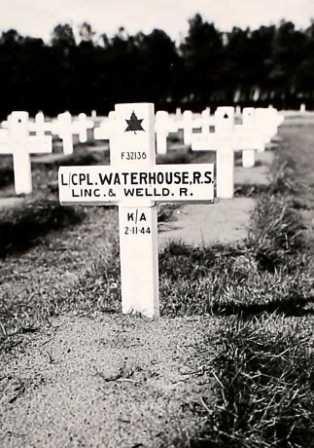
Ronald Sidney was initially buried in Bergen Op Zoom, and later received a permanent headstone at the Canadian War Cemetery there.

temporary grave marker from service file

Initial grave marker in Bergen Op Zoom for Ronald Sidney Waterhouse.  (Photo source:  military service file)

…A daughter’s reflections….

His daughter Merrilyn wrote to explain that “…I was only 2 years old when my Dad died so I never really knew him….  My Mother said that my Dad was a great guy and he seemed to be happy (always smiling) in a lot of old pictures that I have.  He worked for Lever Brothers….

Merrilyn went on to explain what happened after her father left to go overseas.  “…My Mother and I lived for the first 8 years of my life with my maternal grandparents in Sydney.  When I was 8 years old my Mother married Herman F. Slade. My half-brother, Barry James, was born in 1955.  We moved to Yarmouth, Nova Scotia in 1955.  Barry presently lives in Guelph, Ontario.  My Mother and Barry moved to Guelph to be closer to her brother, Rev. Merrill MacLeod….”  

Nina died in 1982.  Merrilyn now lives in Massachusetts, USA.   

Thank you to Merrilyn O’Brien and Cheryl Topping for sharing photos of Ronald Sidney Waterhouse.  If you have photos and information to share about Canadian soldiers buried in The Netherlands, please contact Pieter at memorialtrail@gmail.com, or comment on the blog. 

© Daria Valkenburg

…Want to follow our research?….

If you are reading this posting, but aren’t following our research, you are welcome to do so.  Our blog address: https://onthewarmemorialtrail.com/

4 countries, 6 weeks, 7,000 km – an unforgettable war memorial journey in Europe…. Daria’s book ‘No Soldier Buried Overseas Should Ever Be Forgotten‘ is available in print and e-book formats.  Net proceeds of book sales help support research costs and the cost of maintaining this blog. For more information see https://nosoldierforgotten.com/

Screenshot_2021-02-27 On The War Memorial Trail With Pieter Valkenburg

Subscribe to our YouTube Channel: On The War Memorial Trail With Pieter Valkenburg: https://www.youtube.com/channel/UCJ591TyjSheOR-Cb_Gs_5Kw

Never miss a posting!  Subscribe below to have each new story from the war memorial trail delivered to your inbox.
On The War Memorial Trail….. The Search For Soldiers Who Died In Wommelgem, Belgium In Fall 1944

February 13, 2021. After WWII soldier Arnold Ernest “Ernie” THORNTON was featured in a recent Atlantic Canada Remembers posting, we were contacted by Niko Van Kerckhoven, of Antwerp, Belgium.  (See https://onthewarmemorialtrail.com/2021/01/16/on-the-war-memorial-trail-atlantic-canada-remembers-part-3/)

Niko wrote that “…I am a member of the local historical society and I am doing some research about our Canadian liberators here in my hometown of Wommelgem, Belgium, in 1944.

Fort2, one of the Antwerp forts located here, housed the 9th Canadian Field Dressing Station, and as a consequence, about 40 Canadian casualties were buried in our civilian cemetery, but after the war reburied in Bergen Op Zoom Canadian Cemetery, just across the border in Holland. I visit them regularly with my son.

One of the soldiers buried here in Wommelgem was Arnold Ernest Thornton from Yarmouth. This Calgary Highlander died during the building of a bridgehead over the Albert Canal at Wijnegem. His body, together with several others, was transferred to Wommelgem to be buried, just 500m from where I live nowadays.

 I have been searching for a picture of this soldier for several years, but this week, thanks to the Yarmouth Library, they gave me the link to your site. Another search ended with a face to a name carved in stone. Every time very moving!….

Niko submitted a photoof the field grave of 11 Calgary Highlanders buried here in Wommelgem before their transfer to Bergen-Op-Zoom Cemetery. My research started in fact by seeing this picture, and it became a bit like an avalanche with new names and information….

molenbeekstraat

Field grave in Wommelgem, where 11 members of the Calgary Highlanders were initially buried after losing their lives on September 22, 1944.  (Photo credit: Heemkundige Kring De Kaeck Wommelgem)

The events in Wommelgem occurred in the fall of 1944 during the Battle of the Scheldt.  (See https://www.veterans.gc.ca/eng/remembrance/history/second-world-war/scheldt)

Niko noted that his goal is to find a photo of each soldier initially buried in Wommelgem, but is “…still struggling with the last 5 names on my list…

We know how Niko feels!  In the spirit of remembrance, let’s hope that this posting will help him in his quest! Here are the five names on his wish list…

  • George Scott Fraser COULSON, K/2209, Calgary Highlanders from Oak Bay, British Columbia, but born July 21, 1916 in Victoria, British Columbia. Died September 22, 1944.
  • Simon HOULE, M/101291, Royal Canadian Artillery, born June 18, 1922 in Saddle Lake, Alberta. Died October 1, 1944.
  • Michael SHERBANUIK, M/105737, Calgary Highlanders from Vegreville, Alberta, but born December 12, 1920 in Winnipeg, Manitoba. Died September 22, 1944.
  • Paul Alan SKLUT, K/51951, Calgary Highlanders, born April 15, 1924 in Vancouver, British Columbia. Died October 8, 1944.
  • Donald Charles SUTHERLAND, F/16788, Calgary Highlanders, born January 7, 1923 in Halifax, Nova Scotia. Died September 22, 1944.

If you can help with a photo or information on any of these 5 soldiers or the 9th Canadian Field Dressing Station, please let Pieter know.  You can email him at memorialtrail@gmail.com, or comment on the blog.

© Daria Valkenburg

….Want to follow our research?….

If you are reading this posting, but aren’t following our research, you are welcome to do so.  Our blog address: https://onthewarmemorialtrail.com/

Front cover OnTheWarMememorialTrailinEurope4 countries, 6 weeks, 7,000 km – an unforgettable war memorial journey in Europe…. Daria’s book ‘No Soldier Buried Overseas Should Ever Be Forgotten‘ is available in print and e-book formats.  Net proceeds of book sales help support research costs and the cost of maintaining this blog. For more information see https://nosoldierforgotten.com/ 

You are also invited to subscribe to our YouTube Channel: On The War Memorial Trail With Pieter Valkenburg: https://www.youtube.com/channel/UCJ591TyjSheOR-Cb_Gs_5Kw

Never miss a posting!  Subscribe below to have each new story from the war memorial trail delivered to your inbox.

On The War Memorial Trail….. Atlantic Canada Remembers – Part 6

February 9, 2021. We continue to feature more of the photos submitted by Atlantic Canadians of soldiers buried overseas. Pieter is ensuring that every email is acknowledged, and that the photos of soldiers buried in The Netherlands will be forwarded to the appropriate cemetery for their digital archives. 

Currently, only the volunteers at the Canadian War Cemeteries in Holten and Groesbeek are active.  Submissions for Bergen Op Zoom and for any soldiers buried in municipal cemeteries are being held until Pieter gets the go-ahead that volunteers are active again.

Soldiers buried at the Canadian War Cemetery in Holten, The Netherlands

Howard Armstong

Howard W. Armstrong. (Photo submitted by Marion Fryday-Cook)

Marion Fryday-Cook, President of The Royal Canadian Legion, Nova Scotia/Nunavat Command, submitted a photo of Howard W. ARMSTRONG of Chester, Lunenburg County, Nova Scotia, explaining that “…This is the information gathered by Branch 44 in Chester, NS for our Command’s Veterans Recognition Service Book. Howard’s family still reside in Chester…” 

Howard was with the Fort Garry Horse – 10th Armoured Regiment, and lost his life on September 5, 1945 due to an accidental death after a misstep on a dark and unlit street in Amsterdam led to him falling into a canal and drowning.

Douglas Jury1

Douglas Jury. (Photo courtesy of the Jury Family)

On behalf of the Jury family, Dara Legere of Branch 4 of The Royal Canadian Legion in Joggins, Nova Scotia, submitted a photo of Douglas JURY, writing “…I have attached a photo of Sapper Douglas Jury of Joggins, NS who is buried in Holten Cemetery, Holland. Douglas Jury was related to my family. My mom’s sister Mary was married to Douglas’s brother Roy. There were three Jury brothers who served in WW2, Douglas, Roy, and William. William was taken prisoner by the Germans shortly after D-Day and was forced to work in the coal mines in Germany…

Douglas was with the Royal Canadian Engineers, 18th Field Company, and lost his life on August 17, 1945. Dara explained that “…Douglas remained in Holland after the war ended, repairing dykes and bridges, etc with the Canadian Engineers. The vehicle he was travelling in rolled off one of the dykes and he was trapped under it and drowned. Such a sad story….

Soldiers buried at the Canadian War Cemetery in Groesbeek, The Netherlands

Harry William Doucette

Harry William Doucette.  (Photo courtesy of the Doucette Family)

On behalf of the Doucette family, Cyrille LeBlanc and Andre Boudreau of Legion Branch 155 in Wedgeport, Nova Scotia submitted a photo of Harry William DOUCETTE. Cyrille wrote that he “….was a private in the North Nova Scotia Highlanders, Royal Canadian Infantry Corps. He was born May 25, 1925 in Bell Neck, Sainte-Anne Catholic Parish, Yarmouth County, Nova Scotia.

Private Doucette was the son of John and Celina Mary Doucette. He had eight brothers and one sister. Two brothers served in the RCAF during World War II.  He completed Grade 8 at the age of fourteen and left school to work as a lumber-man in the woods. He enjoyed reading western and veteran stories.  

 He enlisted in Halifax at age 18 October 6, 1943, and served in Canada from October 4, 1943 to October 13, 1944; in the United Kingdom from October 14, 1944 to November 23, 1944 and in France, Belgium, Netherlands, and Germany from November 24, 1944 to March 25, 1945.  He was killed in action against the enemy in Germany March 25, 1945 at age 19….

Harry William lost his life during the Battle of Bienen in Germany, in which  44 members of the North Nova Scotia Highlanders lost their lives and 68 were wounded.  In 2000 a memorial plaque was placed in Bienen to honour those who lost their lives in this battle.  (See http://wikimapia.org/17003812/Commemorative-plaque-of-Battle-of-Bienen)

Cyrille went on to explain that “…Private Doucette was remembered and honoured May 5, 2020, September 12, 2020 and November 11, 2020 – the 75th anniversary year of the liberation of The Netherlands….”  He also was kind enough to include a link to a YouTube video: https://www.youtube.com/watch?v=GR3SowfKA_E

Arnold Hupman

Arnold F Hupman.  (Photo submitted by Marilyn Hupman)

Marilyn Hupman sent a photo and information on her grandfather, Flying Officer Arnold F. HUPMAN, writing that “… He was the only boy of 7 children, born and raised in East Side of Ragged Island, Shelburne County, Nova Scotia. 

Margaret Nickerson and he married and had 3 sons, Arnold, Robert and Arthur.  Arthur is the only surviving child.  My father, Arthur, was 7 years old when he last saw his father, just before he went overseas. 

From the stories I heard as a child he was asked to stay in Canada and teach pilots, but being a true Canadian he said no that he signed up to fight and he was going over.

Our family is very proud of our Grandfather and the rest of the family that fought. The only loss was F.O. A.F. Hupman….

Arnold lost his life when the Lancaster bomber he was in crashed on the outskirts of Arnhem on the night of June 16 to 17, 1944, after being shot down by a German nightfighter. All 7 members of the crew of Lancaster VR-V lost their lives.  They were temporarily buried in the Netherlands Reformed Church Cemetery in Huissensedijk on June 29, and later reburied in the Canadian War Cemetery in Groesbeek.   

In addition to Arnold Hupman, the other crew members were: Donald MORISSEN, Gerald QUINN, Harold FLETCHER, Clifford JOHNSTON, Philip MCMANUS, and Edward FAHY. (More information can be found in this English translation of an article by the late Willem Tiemans: https://airbornearnhem.nl/WillemTiemens/Elden%20bomber%20crash.htm)

Soldiers buried at the Canadian War Cemetery in Bergen Op Zoom, The Netherlands

Austin Boutilier photo from Judy MacKenzie

Austin Ephraim Boutilier. (Photo submitted by Judy MacKenzie)

Judy MacKenzie submitted a photo of her great-uncle, Austin Ephraim BOUTILIER, who was killed in action in Belgium during the Battle of the Scheldt on September 29, 1944, aged 26, while serving with the Black Watch Regiment.  (See https://www.veterans.gc.ca/eng/remembrance/history/second-world-war/scheldt)

Judy MacKenzie explained that “…He was gone long before I was born. His father was Ansil Boutilier. He was married to Hannah Hershman. They lived in Tantallon, Nova Scotia. They would have been my great grandparents. I remember stories that he joined the military before he was old enough.  However, if he was 26 when he died, that would appear to be untrue. All of Austin’s siblings are gone. Several of Austin’s siblings fought in the war, including my grandfather, who married Austin’s sister. Everyone else made it home, some with shrapnel in them….

Judy’s uncle, Ernest ‘Ernie’ MacKenzie, wrote that “…our Uncle Austin is buried at Bergen op Zoom Canadian War Cemetery. We did visit Austin’s grave in 2011….” 

According to the Field Service record, Austin was initially buried in Belgium on September 30, 1944 “…on the south side of the road between Ryckevorsel towards St. Leonard...” before being reburied in Bergen Op Zoom in The Netherlands.

Thank you to André Boudreau, Marion Fryday-Cook, the Doucette family, Marilym Hupman, Cyrille LeBlanc, Dara Legere, Ernie MacKenzie, and Judy MacKenzie for sharing photos and anecdotes.  Atlantic Canadians remember their loved ones who are buried overseas.

More photos and stories in Atlantic Canada Remembers – Part 7! If you have photos or information to share, please email Pieter at memorialtrail@gmail.com, comment on the blog, or tweet to @researchmemori1

© Daria Valkenburg

…..Previous postings in the Atlantic Canada Remembers series….

Missed the previous postings in this series? See:

…..Want to follow our research?….

If you are reading this posting, but aren’t following the blog, you are welcome to do so.  Our blog address: https://onthewarmemorialtrail.com/

Front cover OnTheWarMememorialTrailinEurope4 countries, 6 weeks, 7,000 km – an unforgettable war memorial journey in Europe…. Daria’s book ‘No Soldier Buried Overseas Should Ever Be Forgotten‘ is available in print and e-book formats.  Net proceeds of book sales help support research costs and the cost of maintaining this blog. For more information see https://nosoldierforgotten.com/ 

You are also invited to subscribe to our YouTube Channel: On The War Memorial Trail With Pieter Valkenburg: https://www.youtube.com/channel/UCJ591TyjSheOR-Cb_Gs_5Kw

Never miss a posting!  Subscribe below to have each new story from the war memorial trail delivered to your inbox.

On The War Memorial Trail….. Atlantic Canada Remembers – Part 5

January 27, 2021. Responses to the news clips on CTV’s Atlantic Live At 5 on January 4 and 13 continue to come in.  As mentioned in the previous 4 parts, Pieter is ensuring that every email is acknowledged, and that the photos of soldiers buried in The Netherlands are forwarded to the appropriate cemetery for their digital archives.

This posting features more of the photos submitted…..

Soldiers buried at the Canadian War Cemetery in Holten, The Netherlands

William Herbert Bellamy

William Herbert Bellamy.  (Photo courtesy of the Bellamy Family)

On behalf of the Bellamy Family, Linda Fury submitted a photo of her uncle, William Herbert “Billy’ BELLAMY, explaining that ….There are about 150 members of our family now.  We hold reunions often and all know the story of our Uncle Bill.  He belonged to the North Nova Scotia Highlanders and died in January 1945 while a prisoner in Germany.  Thanks so much for all you have done and are continuing to do.  Your work is very much appreciated by all of us….

William Herbert ‘Billy’ was born on May 2, 1921 in Hereford, England, the son of Percy and Frances Bellamy.  In 1927 he immigrated to Canada with his family and settled in Midgic Station (now Midgic), New Brunswick.  Following his 18th birthday, he enlisted with the West Nova Scotia Highlanders on August 2, 1940 in Aldershot, Nova Scotia. On April 30, 1941 he transferred to the North Nova Scotia Highlanders, and was on his way to England in July 1941.

The North Nova Scotia Highlanders were among the troops to land in Normandy on D-Day on June 6, 1944.  Unfortunately, on June 7, 1944 he was captured by the Germans in Normandy and became a prisoner of war (POW).  On August 13, 1944 he arrived at Stalag XII A [Limburg an der Lahn, Hessen, a POW transit camp] and then, on August 26, 1944 was transferred to Stalag Camp VIII B [Lamsdorf, Oberschlesien] near the German-Polish border.  On November 2, 1944 he was sent to the work camp E 902 Delbrückschächte Hindenburg where, along with other POWs, he worked in a nearby coal mine.

According to an account that a former POW sent after the war to Billy’s father, Billy was seriously injured on January 1, 1945 when the mine ceiling collapsed.  He was taken to hospital in Hindenburg (now Zabrze and part of Poland).  However, according to the POW record kept by his captors, he was seriously injured on November 23, 1944 and sent to a military hospital in Knurow (now Knurów, Poland). Curiously, the same injuries described as happening on January 1, 1945 were reported on the POW record as having occurred on November 23, 1944.

In January 1945 he died of his injuries. Records of the exact circumstances have not been found, likely due to advancing Russian troops.  His military service file lists his official date of death as January 28, 1945. On February 6, 1945, Billy was buried in the Municipal Cemetery of Teupitz (in the state of Brandenburg, Germany).  After the war ended he was reburied in the Heerstrasse British Cemetery in Berlin, and then in 1949 reburied for the final time in Holten.

Robert Cole

Robert Theodore Cole. (Photo courtesy of Emily Gilbert)

Ervin Ellis submitted a photo of Robert Theodore COLE, explaining that “I was told by Kent Caldwell that you were looking for a picture of Robert Cole, WWII Veteran from Coles Island. A woman that I knew had close ties to that area.  She said the whole family was deceased but her first husband was part of that family, if anyone had any pictures it would be her.  She looked through her old pictures and by some sort of miracle she had pictures…”  This was Emily Gilbert.  Robert Cole was the nephew of her husband.

Born in Coles Island, New Brunswick, the son of Fred and Maria Cole, Robert enlisted in March 1940 and served in Canada and Labrador before going overseas in September 1943. He was in France by 1944, and also was with his regiment in Belgium, The Netherlands, and Germany.  He lost his life on April 21, 1945 during the Battle of Friesoythe in Germany while serving with the Lorne Scots – Ground Defence Platoon.

Ervin’s assistance was invaluable in putting a face to this soldier’s name! He went on to write Pieter that “….This is a great project you are working on, saw you on TV a couple of times. I am the Zone Commander for the legions in this area so I know them pretty good and their Cenotaphs. If I can help you any let me know…”  Needless to say, Pieter has taken Ervin up on his offer and is grateful for the help that he and Kent Caldwell have provided.

Joseph Gerald Fougere

Joseph Gerald Fougere. (Photo submitted by Doug Landry)

Gerald Douglas ‘Doug’ Landry submitted a photo of his uncle, Joseph ‘Gerald’ FOUGERE, explaining that he was “….born in Poulamon, Nova Scotia, the only son of Felix and Josephine (Marchand) Fougere. Gerald had three sisters: Evelyn, married to Thomas Sampson; Anita, married to Val Poirier; and Theresa, married to James W. Landry….

Doug went on to write that “…Gerald was with the Perth Regiment.  He was dangerously wounded in action on April 24th, 1945 and died of wounds on April 26th, 1945 at the age of 28 years, 11 months….” He lost his life during the Battle of the Delfzijl Pocket.

Soldiers Buried In Adegem Canadian War Cemetery in Belgium

Arthur Jack Taylor

Arthur ‘Jack’ Taylor.  (Photo courtesy of the Taylor Family)

On behalf of the Taylor family, Art Taylor submitted a photo of his uncle, Arthur Brambel ‘Jack’ TAYLOR, explaining that “…My father and his four brothers, from the small town of Woodstock, New Brunswick, all served in WWII.  Three saw action.  My father (John Taylor) was in the Royal Canadian Navy and escorted convoys to Europe.  His two brothers were in the army.  Russell Taylor fought into Holland and survived.  His other brother Arthur ‘Jack’ Taylor was with the Winnipeg Rifles.  He was killed at the Leopold Canal on October 12, 1944.  He is buried at the Adegem Canadian War Cemetery in Belgium.  He was 26 years old…

Jack was a rifleman, killed during Operation Switchback, part of the Battle of the Scheldt.  A Wikipedia article explains that “….October 10, 11, and 12 were days of intense struggle while the men of the 7th Brigade with the Royal Winnipeg Rifles took, lost and then retook a group of houses known as Graaf Jan and the Regina Rifles found themselves pinned down by a group of well dug-in pillboxes that seemed to be resilient to artillery…(For more information see https://en.wikipedia.org/wiki/Battle_of_the_Scheldt#Operation_Switchback) Jack was initially buried in Madelgem before being reburied in Adegem.

Thank you to Ervin Ellis, Emily Gilbert, Doug Landy, Linda Fury, and Art Taylor for sharing photos and anecdotes.  Kudos to CTV’s Atlantic Live At 5 for helping to get the word out on this quest of remembrance. Atlantic Canadians remember their loved ones who are buried overseas.  Pieter and I extend our condolences to Ervin Ellis, who sadly lost his wife on January 20.

More photos and stories in Atlantic Canada Remembers – Part 6! If you have photos or information to share, please email Pieter at memorialtrail@gmail.com, or comment on the blog.

© Daria Valkenburg

…..Previous postings in the Atlantic Canada Remembers series….

Missed the previous postings in this series? See:

…Want to follow our research?…

If you are reading this posting, but aren’t following our research, you are welcome to do so.  Our blog address: https://onthewarmemorialtrail.com/

Front cover OnTheWarMememorialTrailinEurope4 countries, 6 weeks, 7,000 km – an unforgettable war memorial journey in Europe…. Daria’s book ‘No Soldier Buried Overseas Should Ever Be Forgotten‘ is available in print and e-book formats.  Net proceeds of book sales help support research costs and the cost of maintaining this blog. For more information see https://nosoldierforgotten.com/

You are also invited to subscribe to our YouTube Channel: On The War Memorial Trail With Pieter Valkenburg: https://www.youtube.com/channel/UCJ591TyjSheOR-Cb_Gs_5Kw.

Never miss a posting!  Subscribe below to have each new story from the war memorial trail delivered to your inbox.

On The War Memorial Trail….. Atlantic Canada Remembers – Part 4
January 20, 2021. Responses to the news clips on CTV’s Atlantic Live At 5 on January 4 and 13 continue to come in.  As mentioned in Parts 1, 2, and 3, Pieter is ensuring that every email is acknowledged, and that the photos of soldiers buried in The Netherlands are forwarded to the appropriate cemetery for their digital archives. 

This posting features more of the photos submitted…..      

Soldiers buried at the Canadian War Cemetery in Holten, The Netherlands

Nelson DesRoches Army

Nelson Desroches. (Photo courtesy of The Desroches Family)

Leo Gaudet submitted a photo of Nelson DESROCHES, on behalf of the Desroches family, and wrote that “We have a vet buried at Holten from Tignish, whom my wife and I visited in 2014…

Born May 23, 1915 in Tignish, Prince Edward Island, the son of John Desroches and Elizabeth Doucette, Nelson followed his older brother Merrick into military service.  He was serving with the Royal Hamilton Light Infantry when he was killed in action on April 14, 1945.

Ernest Robert Haynes

Ernest Robert Haynes.  (Photo courtesy of the Haynes Family)

On behalf of the Haynes family, Teri Haynes submitted a photo of her father-in-law, Ernest Robert HAYNES, and explained that “…my Ernie visited the grave many years ago when he was in his teens with his Mother…

Ernest Robert, born March 17, 1919 in St. John, New Brunswick, was the son of James Edward and Alice Beatrice Haynes.  A dyer in a laundromat before enlisting in 1939, he was married to Opal Bailey and the father of Teri’s late husband, Ernest David.

While serving with the North Shore (New Brunswick) Regiment, he was sent overseas to the United Kingdom in July 1944, and on June 1, 1945 to North West Europe. Unfortunately, due to a fatal accident with a passing Canadian Army truck near Soestdijk, he lost his life on July 5, 1945, age 26.  He was temporarily buried in the town of Hilversum before being reburied on March 29, 1946 in Holten.

Daniel Pearo

Daniel Pearo.  (Photo courtesy of the Pearo Family)

On behalf of the Pearo family, Colleen Hartling submitted a photo of her uncle, Daniel PEARO, and wrote that “Daniel was my mother’s brother. She looked up to him as a child and loved him dearly. She said that he was full of fun and you can see the twinkle in his kind eyes. I was born in the 60s so I did not know Daniel…

Daniel Pearo, son of Samuel and Dasie Pearo, served with the Cape Breton Highlanders and lost his life on May 1, 1945.  (A tribute to him can be found here: http://faculty.uccb.ca/highlanders/DANIEL%20PEARO.htm?fbclid=IwAR1ijEE5uz9tppYwN4dPcHA24DAGhDSAtVfQJUtRAEa21ZIY-zqRZwiUG9I)

Soldiers buried at the Canadian War Cemetery in Bergen Op Zoom, The Netherlands

Gordon Brewer 2

Gordon Thomas Brewer.  (Photo submitted by Stephen and Hazel Albert)

Stephen Albert submitted a photo of Gordon Thomas BREWER on behalf of himself and his mother Hazel, explaining that his uncle “… was 17 when he enlisted to serve his country.  Killed in action on his 21st birthday on October 25, 1944.  School children at that time adopted a grave. Willamina Proost, a young girl, adopted Gordon’s grave, corresponded with his parents for many years until she married, then stopped writing, so lost contact with her. Gordon’s medals and all letters to his parents were burned in a house fire several years ago, only few photos taken before going overseas still remain. Thank you for taking time to honour the men and women who gave their lives to protect others…

Hazel Albert, Gordon’s sister, wrote that she was the “…last remaining member of Gordon’s family….”  Gordon was born in Halifax on October 25, 1923, the son of Alonzo Wallace and Mary Ellen (nee Dean) Brewer.  

Gordon served with the Essex Scottish Regiment and lost his life during the Battle of the Scheldt.  (See https://www.veterans.gc.ca/eng/remembrance/history/second-world-war/scheldt)

Soldiers buried at the Montecchio War Cemetery in Italy

Felix Gaudet

Felix Gaudet.  (Photo submitted by Leo Gaudet)

Leo Gaudet submitted a photo of his uncle, Felix GAUDET, born May 30, 1923, son of Joseph J. and Mary Gaudet of Tignish, Prince Edward Island. After enlistment, he left Halifax for the United Kingdom in July 1943 and was transferred to the Canadian Infantry Reserve Unit a few days after his arrival.  On March 26, 1944 he was sent to Italy, and on May 13 transferred to the Cape Breton Highlanders.

On August 30, 1944 he lost his life during the battle to take a knoll on the Gothic Defence Line.  Another soldier from PEI, Albert Eugene Arsenault, also with the Cape Breton Highlanders, lost his life the same day.  (See https://bordencarletonresearchproject.wordpress.com/2020/10/09/the-ww2-soldier-killed-in-action-while-crossing-the-foglia-river-in-italy/)

The Allies began the day of August 30th with an air bombardment against German positions at dawn. At 5.30 p.m., the Perth Regiment attacked the end of a ridge northeast of Montecchio, while a knoll at the west end of the town and the high ground beyond were the objectives of the Cape Breton Highlanders. Both units faced incessant fire from the heights as well as minefields along the flat lands. The Perths managed to break through the line first, reaching and passing their objective. The Cape Breton troops had the support of tanks from the 8th Princess Louise’s (New Brunswick) Hussars, which helped three of their companies make it to the base of the knoll. After each attempt, however, they were driven back to the Foglia, with casualties totalling 19 members killed and 46 wounded. The Irish Regiment, which had been in reserve, was moved through the path of the Perths. Tanks and artillery guns were not yet available here and as a result the regiment lost 19 killed and 31 wounded.” (Source: https://www.veterans.gc.ca/eng/remembrance/memorials/overseas/second-world-war/italy/montecchio)

The Gaudet family made a tribute to Felix last year, on what would have been his 97th birthday.  It was so special that it’s shared here:

Felix Gaudet tribute by Aunt Cathy

Tribute to Felix Gaudet submitted by Leo Gaudet.

Thank you to Hazel Albert, Stephen Albert, Kent Caldwell, Colleen Hartling, Teri Haynes, and Leo Gaudet for sharing photos and anecdotes.  Kudos to CTV’s Atlantic Live At 5 for helping to get the word out on this quest of remembrance. Atlantic Canadians remember their loved ones who are buried overseas.

More photos and stories in Atlantic Canada Remembers – Part 5! If you have photos or information to share, please email Pieter at memorialtrail@gmail.com, or comment on the blog. 

Missed the previous postings in this series? See:

© Daria Valkenburg

….Want to follow our research?…

If you are reading this posting, but aren’t following our research, you are welcome to do so.  Our blog address: https://onthewarmemorialtrail.com/

4 countries, 6 weeks, 7,000 km – an unforgettable war memorial journey in Europe…. Daria’s book ‘No Soldier Buried Overseas Should Ever Be Forgotten‘ is available in print and e-book formats.  Net proceeds of book sales help support research costs and the cost of maintaining this blog. For more information see https://nosoldierforgotten.com/

Subscribe to our YouTube Channel: On The War Memorial Trail With Pieter Valkenburg: https://www.youtube.com/channel/UCJ591TyjSheOR-Cb_Gs_5Kw

Never miss a posting!  Subscribe below to have each new story from the war memorial trail delivered to your inbox.