On The War Memorial Trail….The WWII Soldier From Toronto Who Lost His Life In France When Battalion Head Quarters Was Hit By Shell Fire

Mike Johnston, left, with Pieter after the 2025 Remembrance Day service in Kinkora.  (Photo credit: Daria Valkenburg)

November 4, 2026.  Following the 2025 Remembrance Day Service held outdoors on a chilly afternoon in Kinkora, Prince Edward Island, everyone was invited inside the community hall for a bowl of chile or chicken corn chowder, and a much needed cup of coffee or tea.

We were joined by our North Tryon neighbour Mike Johnston, who asked about doing a story on his great-uncle, Albert Joseph LAROSE, who lost his life on September 13, 1944, while serving with the Black Watch (Royal Highland Regiment) of Canada.

It seems fitting, as we near another Remembrance Day, to honour Albert’s memory.

Born December 27, 1916 in Toronto, Ontario, the son of Ernest and Catherine (nee Campbell) LaRose, Albert was one of 10 children, having 5 brothers and 4 sisters.  After leaving school, he worked 6 years as a knitting machine mechanic at a textile plant, and then joined Ontario Hydro Electric Commission as a plant operator.

….Albert enlisted in 1942 under NRMA…
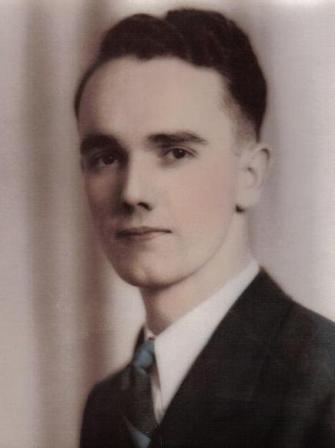
Albert Joseph LaRose. (Photo source: Canadian Virtual War Memorial)

On June 11, 1942, Albert enlisted under the National Resources Mobilization Act (NRMA) at No. 2 NRMA Clearing Depot in Newmarket, Ontario. (See https://en.wikipedia.org/wiki/National_Resources_Mobilization_Act)

At the time of his enlistment, Albert had been working for 2 years at Ontario Hydro Electric Commission.  An interviewer described him as “…a good looking, attractive, bright lad – is definitely interested in radio and electricity and wants to get into Signal Platoon. Single hobby is singing – belongs to choir – healthy – should do well….”

He took his basic training at No. 23 Canadian Army (Basic) Training Centre in Newmarket, and then was sent to the A11 Canadian Infantry Training Centre at Camp Borden, Ontario on May 14, 1942.

On June 15, 1942, Albert was transferred to the Prince of Wales Rangers and sent to the Temporary Basic Training Centre (TBTC) ‘B’ Company at Camp Niagara, located in Niagara-on-the-Lake, Ontario.  Albert would have undergone two months of rigorous physical conditioning, small arms training, tactical manoeuvres, and drills.

Soldiers stationed at Camp Niagara were on guard duty to protect local infrastructure, such as the nearby Welland Canal and regional hydro-electric plants, against potential enemy sabotage.

….Albert was transferred to Prince George as a member of the Prince of Wales Rangers…

With his basic training completed, Albert was sent to Prince George, British Columbia on September 23, 1942.  Still with the Prince of Wales Rangers, he was now part of Canada’s Home Defence.  The Prince of Wales Rangers were part of the 16th Infantry Brigade, which in turn was under the 8th Canadian Division, tasked with Pacific coastal defence and protecting Canada’s West Coast from potential enemy threats.

On December 15, 1942, Albert married Loretta Marie Bowyer, and received leave to do so.

Albert continued to receive additional training, and after completing a signallers course, received the qualification of Classified Regimental Signallers on June 20, 1943. This qualification meant he’d received training in military communications for the purpose of maintaining links between front-line units and headquarters.  He was next sent to Wainwright, Alberta for additional training in manoeuvres and battle courses.

….Albert was sent for a mountaineering course…

On July 8, 1943, Albert was sent on another training course – to the Little Yoho Mountaineering School run by the Alpine Club of Canada, located in Little Yoho Valley in Yoho National Park near Field, British Columbia.  He took an intensive course in climbing with equipment, rescue work in ice and snow, and using ropes under a simulated night attack.  He did so well in the course, which he completed on July 29, 1943, that he was selected to be an Assistant Instructor for the next course.  Albert was described as “…capable and conscientious…”

As Assistant Instructor for the course that ran August 8 to 30, 1943, he was assessed as “…very helpful at all times. Has capable working knowledge of basic principles involved and able to impart instruction…”

On August 1, 1943, Albert had received a promotion to Lance Corporal, but on September 14, 1943, he asked to revert to the rank of Private.  In the meantime, he had returned to the Prince of Wales Rangers as of August 31, 1943.

….Albert was an instructor at the Winter Training School in Jasper…

By November 9, 1943, he was in Port Alberni, British Columbia, and requested to attend a Mountaineering Instructors Course.  This was approved and he successfully completed the course in Terrace, British Columbia.  As of November 16, 1943, he was attached to the Winter Training School in Jasper National Park, Alberta where he was to be an instructor in a course that began in January 1944. On January 15, 1944, he was promoted to Acting Corporal.

Jasper National Park in the Canadian Rocky Mountains became a high-altitude winter and mountain warfare training centre for the British Army’s Lovat Scouts (Scottish Highlanders) and Canadian Army personnel, who trained in preparation for an Allied-led invasion of Nazi-occupied Norway and to combat Axis mountain specialist units.

In a course that ran from January 9, 1944 until the final group left on April 22, 1944, they were instructed in military skiing, snowshoeing, ice climbing, glacier travel, crevasse rescue, survival camping in temperatures down to -45°C (-49oF), and carrying full gear with rifles.

A short film by the National Film Board of Canada, ‘Ordeal By Ice’ (10:44 minutes) documents the extreme winter conditions faced by members of the Canadian Army and British Army’s Lovat Scouts who trained at the Winter Training School…..


….Albert joined the Active Army…

On April 8, 1944, Albert’s assignment at the Winter Training School ended. He returned to the Prince of Wales Rangers in Terrace, British Columbia….and reverted back to the rank of private.  A week later, on April 15, 1944, he enlisted in the Active Army with the Prince of Wales Rangers.

Then, on April 19, 1944, he was transferred to the 1st Battalion of the Canadian Fusiliers, which was under Pacific Command as part of the 6th Canadian Infantry Division’s Home Defence.  However, the Battalion was preparing to go the United Kingdom and become a training battalion.

Albert received 10 days of embarkation leave starting on May 5, 1944, in what turned out to be the last chance he had to see his family.  Upon returning from leave, he was transferred to No. 1 Transit Camp in Windsor, Nova Scotia.  This was a final staging, preparation, and administrative processing area before being sent overseas.

….Albert left Canada for overseas service ……

With others in the 1st Battalion, Canadian Fusiliers, Albert boarded a ship on May 25, 1944 that left the following day from Halifax, Nova Scotia, arriving in the United Kingdom on June 2, 1944.

Then, in a strange twist, instead of remaining with the Canadian Fusiliers and continuing as an Instructor, Albert was transferred to the X-4 Reinforcement List of the Black Watch of Canada (Royal Highland Regiment), part of the 21st Army Group, joining the unit in Folkestone, England.

On July 13, 1944, Albert left England for France, arriving the following day, where, due to his Classified Regimental Signallers qualification, he was assigned to the Signal Platoon, Headquarters Company of the Black Watch, joining the Regiment in Franqueville in the midst of the Battle of Caen, part of the ongoing Battle of Normandy. (See https://en.wikipedia.org/wiki/Battle_for_Caen)

From July 18 to 21, 1944, the Regiment was involved in Operation Atlantic, with the goal of clearing German forces from the southern and eastern sectors of Caen, cross the Orne River, and seize Verrières Ridge in an attempt to block enemy reinforcements.  (See https://en.wikipedia.org/wiki/Operation_Atlantic)

This was immediately followed by a disaster on July 25, 1944, with Operation Spring, when the Regiment launched an assault on Verrières Ridge to capture Fontenay-le-Marmion. Out of 325 soldiers who launched the attack, there were 307 casualties, with 118 killed in just under four hours—a near 94% casualty rate. (See https://en.wikipedia.org/wiki/Operation_Spring)

In a July 29, 1944 letter to his sister Grace, Albert wrote that he was not at the front, but at Battalion Head Quarters.  “…About me being in France….I can’t say much about things here, except that I am still in the best of health and I haven’t been in action up to now and I don’t expect to be going up to the front for some time yet. It wouldn’t hurt my feelings at all if I never got up there, but I guess the war won’t end that soon….”

The letter was written over a few days. “…Incidentally, I started this letter a few days ago, but never got it finished. Right now I am on duty at the Telephone Exchange and I get a chance to write here…”

….Albert lost his life on September 13, 1944 ……

Over the next 6 weeks, the Black Watch, as part of the 5th Canadian Infantry Brigade, 2nd Canadian Infantry Division, advanced along the French coast, participating in operations to clear coastal areas, cross canals, and secure vital infrastructure against retreating German forces.

On Wednesday, September 13, 1944, the Regiment was positioned at Spycker in northern France near the coastal town of Bourbourg, securing the village and bridgeheads around Bourbourgville and Grand Millebrugge, and very close to the Belgian border. (See https://www.europeremembers.com/en/pois/2436/the-black-watch-at-grand-millebrugge)

Albert lost his life on that day, but the war diary entry for that day gave no information on what happened.  “…Heavy shelling on Grand Millebrugge commenced at Reveille this morning.  Battalion Head Quarters received five direct hits and the Regimental Aid Post one direct hit and two near misses. During the morning the shelling did not let up and by noon, when it began to slacken off, eight vehicles had been destroyed and six motor cycles burned….”

The war diary went on to report that there were no fatalities, and none missing or taken as prisoners of war, but this wasn’t true.  Six men were missing, and had died that day… one of them Albert, who likely was in Battalion Head Quarters when it was hit by German shellfire.

In addition to Albert, the following soldiers from the Black Watch were killed on September 13, 1944:

  • A/Cpl Alfred Alexander ANDERSON, born in Innisfeil, Alberta, aged 32
  • L/Sgt Robert BURNSIDE, from Montreal, Quebec, but born in Glasgow, Scotland, aged 33
  • Pte Michael DOBRENSKY, of Toronto, Ontario, aged 21
  • A/Cpl Gordon Edward GORMAN, of Ottawa, Ontario, aged 20
  • A/Cpl Vernon Andrew JOHNSTON, of Pine Creek, Manitoba, aged 21

Several families of the soldiers were aware that 6 of them were missing. The family of Gordon Edward GORMAN persisted in asking what happened to him, and eventually a letter in the service file indicated what may have happened to him. “…He was making his way across open field after very heavy shelling and a counter attack by the Germans. A German machine gun fired from the house on the left flank and he fell to the ground. Two German soldiers came out of the house, picked him up and took him into the house….” where he died of his wounds. “… This action took place in the small town of Spycker, east of Dunkirk, France…”

All 6 men were eventually buried in November, almost two months after their deaths. At the age of 27, Albert left his wife, parents, 5 brothers and 4 sisters to mourn his loss.

….Albert is buried in Calais Canadian War Cemetery…
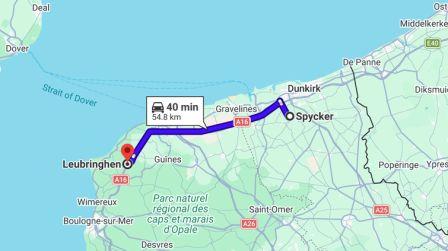
Albert LaRose was initially buried in Spycker before being reburied in the Calais Canadian War Cemetery in Leubringhen. (Map source: Google Maps)

On November 6, 1944, Albert was initially buried in a church cemetery in nearby Spycker, before being reburied in the Calais Canadian War Cemetery in Leubringhen on August 5, 1945.
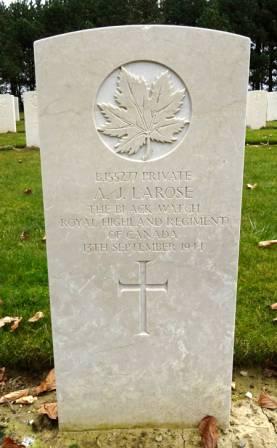
Grave of Albert Joseph LaRose in the Calais Canadian War Cemetery in Leubringhen, France.  (Photo source: Find A Grave)

Leubringhen is a village in the Department of the Pas-de-Calais, halfway between Calais and Boulogne. The Calais Canadian War Cemetery is in Leubringhen, 14 kms (8.7 miles) from Calais.

Sign off of the highway exit directing us to Calais Canadian War Cemetery. (Photo credit: Daria Valkenburg)
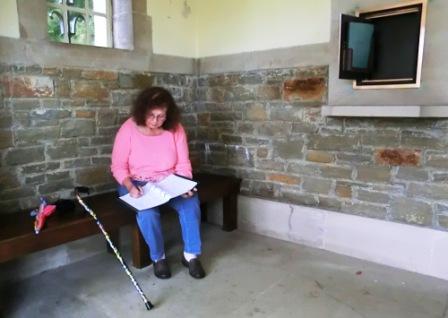
Daria writing in the Visitors Book at Calais Canadian War Cemetery during our 2017 visit. (Photo credit: Pieter Valkenburg)

We’d visited this cemetery in September 2017, where we had placed flags down at the grave of James Arthur AFFLECK from Bedeque, Prince Edward Island, who died a few days after Albert.  (See https://onthewarmemorialtrail.com/2017/10/08/the-calais-canadian-war-cemetery/)

Thank you to Mike Johnston for sharing the letter written by his great-uncle, and to Shawn Rainville for newspaper research.

Pieter’s research efforts to find photos and families of soldiers continue. Do you have a story to tell? Email Pieter at memorialtrail@gmail.com, or comment on the blog.

© Daria Valkenburg

….Want to follow our research?…

If you are reading this posting, but aren’t following our research, you are welcome to do so.  Our blog address: https://onthewarmemorialtrail.com/
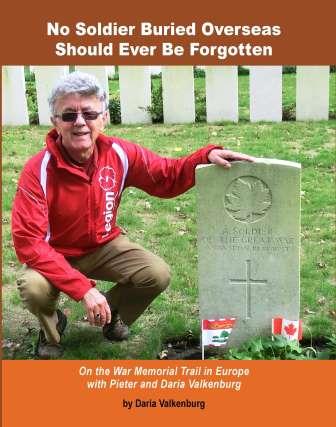
4 countries, 6 weeks, 7,000 km – an unforgettable war memorial journey in Europe…. Daria’s book ‘No Soldier Buried Overseas Should Ever Be Forgotten‘ is available in print and e-book formats.  Net proceeds of book sales help support research costs and the cost of maintaining this blog. For more information see https://nosoldierforgotten.com/

Subscribe to our YouTube Channel: On The War Memorial Trail With Pieter Valkenburg: https://www.youtube.com/channel/UCJ591TyjSheOR-Cb_Gs_5Kw.

Never miss a posting!  Subscribe below to have each new story from the war memorial trail delivered to your inbox.
On The War Memorial Trail…..Remembrance Week 2025 – The WWII Nursing Orderly Killed When 3 Tracked Vehicles Exploded Near A Field Dressing Station On Walcheren Island

December 4, 2025.  One of the hardest searches for a photo took several years, and, in spite of dedicated help in looking for family members to contact, newspaper and archive searches, and even a November 10, 2023 article in the Winnipeg Free Press (see a Picture of compassion Winnipeg Free Press Article re John Lewis Hughes Nov 10 2023), we struck out each time.

It was difficult to understand as the soldier in question came from a large family, was married, and had worked for 12 years in a hospital in his hometown. Only one niece responded, saying she remembered that her mother, the soldier’s sister, had a photo, but after she passed away, her effects were put in the basement and were later destroyed in a flood.  We had zero luck with the family of the soldier’s wife, who had remarried.  There was also no response from the local Legion branch, nor from the hospital where he had worked.

Eventually we ran out of leads to contact, and so, although we never gave up the search, we reluctantly put John Lewis HUGHES on our Cold Case List.  (See https://onthewarmemorialtrail.com/our-cold-cases/) 

…. The Winnipeg Free Press article caught the interest of a local historian…...

Shortly after the Winnipeg Free Press article was published, we had been contacted by local historian Judy Gleich.   “…This project is of great interest to me...” she wrote. Her husband is from Eriksdale and “…I was born at E.M. Crowe Memorial Hospital and lived most of my life in the Lundar MB area…”  She explained that, unlike many small communities, “…there was no local paper in Eriksdale at that time….” and so there was no local coverage of soldiers from the area.  Like us, she also contacted someone she knew at the local Legion but no photo was found. 

Judy also told us that “…E.M. Crowe hospital is no longer run locally – but is under the umbrella of the Interlake Eastern Regional Health Authority…which covers about 1/5 of the province….” 

Judy explained why she was interested to help find a photo.  “…When I read the first article by Kevin Rollason and saw that one of the photos Pieter was looking for was of a veteran from Eriksdale– I was interested although I was not familiar with the Hughes family. I made a couple of phone calls and asked a couple of friends and came up with nothing.….”  (NOTE: A short photo appeal had initially been made in the Winnipeg Free Press in November 2022.)

“….After the second article by Kevin Rollason appeared in the Winnipeg Free Press with more information about the Hughes family it piqued my interest again. I figured if someone like Pieter was putting that much effort into this project that I would try to help him….”

…. The photo search led to a hockey photo 2 years after the Winnipeg Free Press article was published…...

Like us, Judy found that “…most of the older Hughes family members had passed on and we were getting nowhere with their families….” 

Then, two years later, Judy learned about a 1936 hockey photo.  “… Knowing several of the men on the team I was sure that some of their family members might have the photo…. A few more phone calls and BINGO – success at last….”  It was nothing short of a miracle! 

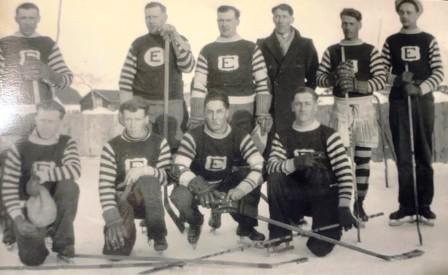
The man with the photo of the 1936 Eriksdale Hockey Team was John Forsyth, whose father Jim was a member of the team. 

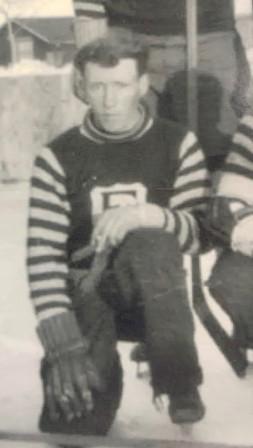
Back Row L-R: Johnnie Mills, Bill Smith, Gordon Smith, Stan Mills, Johnnie Forsyth, Lawrence Whitney. Front Row L-R: Don Goodridge(?), Johnnie Hughes, Murray Cox, Jim Forsyth. (Photo courtesy of the Collection of Jim and Kay Forsyth)


We now knew what John Lewis Hughes looked like! (Photo courtesy of the Collection of Jim and Kay Forsyth)

….John was from Eriksdale in Manitoba…

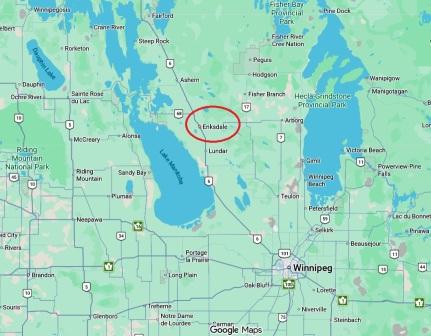
Eriksdale is in the Interlake Region of central Manitoba, near the eastern shore of Lake Manitoba. (Map source: Google maps)

Born January 17, 1916 in Eriksdale, Manitoba, John was the son of Ebenezer George and Ellen (nee Rogan, previously married name Johanson) Hughes.  Both parents came from the United Kingdom – his father in 1911 and his mother in 1914 with two daughters who had been born in Wales.  6 more children were added to the Hughes family, in addition to John – 3 daughters and 3 sons. 

Before enlisting with the No. 3 Field Ambulance of the Royal Canadian Army Medical Corps (RCAMC) on July 5, 1940, John had worked for 12 years as a medical orderly in the E.M. Crowe memorial hospital in Eriksdale.  On June 22, 1940, a few weeks before enlistment, he married Irene Goodwin. 

On October 5, 1940, John was transferred to No. 100 Canadian Militia Training Centre (CMTC) in Portage La Prairie, Manitoba.  He was then assigned to No. 100 Non-Permanent Active Militia (NPAM) Training Centre on November 15, 1940, while still attached to No. 100 CMTC.  (No. 100 CMTC and No. 100 NPAM were re-designated as No. 100 Canadian Army (Basic) Training Centre in February 1941.)

John remained in Portage La Prairie until April 30, 1941, when he was transferred to what the service file termed Fort Osborne Military Hospital, RCAMC, in Winnipeg, Manitoba. This was likely Deer Lodge Military Hospital, as during WWII, Winnipeg’s military hospital function was not at Fort Osborne Barracks, which had moved in 1920. Deer Lodge Military Hospital took over the former hospital facilities from Fort Osborne at that time.

….John left Canada for overseas service….

On June 8, 1941, John was transferred to No. 1 Motor Ambulance Convoy, RCAMC, Active Force, and sent to Camp Shilo, Manitoba for final training before going overseas. 

With other members of his unit, John left Canada for the United Kingdom on June 19, 1941, sailing from Halifax, Nova Scotia, disembarking in Greenock, Scotland on July 2, 1941, before moving on to Sussex, England. 

Per the ‘Official History Of The Canadian Medical Services 1939-1945’, edited by Lt Col Dr W. R. Feasby,  the RCAMC “…..order of battle included not only the medical units of the 1st, 2nd, and 3rd Divisions, and the 1st Army Tank Brigade, but also the following Corps Troops medical units: No. 18 Field Ambulance, No. 5 Field Hygiene Section, Nos. 4 and 5 Casualty Clearing Stations, No. 1 Motor Ambulance Convoy, and No. 1 Advanced Depot Medical Stores….”

The function of No. 1 Motor Ambulance Convoy was to transport wounded from main dressing stations to casualty clearing stations. Transport was by vehicles of the Motor Ambulance Convoy, supplemented by trucks for walking wounded or by railroad when available. 

John and his unit were kept busy with training and in transporting wounded soldiers who arrived in the United Kingdom for treatment. 

One of the largest operations came following the Dieppe Raid, known as Operation Jubilee, on August 19, 1942, a disastrous Allied amphibious attack on the German-occupied port of Dieppe in northern France, in which 505 Canadian soldiers were wounded and 916 lost their lives. (See https://www.veterans.gc.ca/en/remembrance/military-history/second-world-war/dieppe-raid and https://thecanadianencyclopedia.ca/en/article/dieppe-raid)

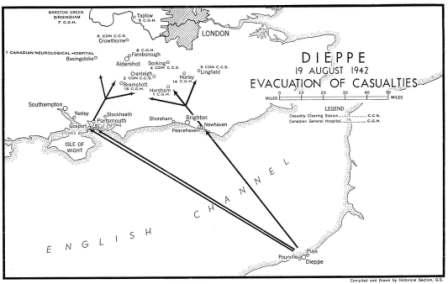
Evacuation of casualties from Dieppe to England on August 19, 1942.  (Map source: ‘Official History Of The Canadian Medical Services 1939-1945’)

On the morning of August 19, 1942, the medical units under the 2nd Canadian Division were “… responsible for the reception and evacuation of casualties disembarked in the Portsmouth area, where the bulk of them was expected. Two sections of No. 1 Motor Ambulance Convoy were made available … for the transport of casualties from the Portsmouth area to No. 15 General Hospital at Bramshott, and from the Newhaven-Shoreham area to No. 1 at Horsham and No. 14 at Horley…”

On January 14, 1943, No. 1 Motor Ambulance Convoy, RCAMC, became a unit of the Royal Canadian Army Service Corps (RCASC).

….John was transferred to No. 10 Canadian Field Dressing Station….

On January 21, 1944, John was transferred to No. 10 Canadian Field Dressing Station, and later sent to France, arriving on July 10, 1944, a month after D-Day. As noted in the ‘Official History Of The Canadian Medical Services 1939-1945’ “…with the formation of the 2nd Canadian Corps in France, the medical services were greatly increased. For the coming attack it was decided to constitute a massed medical centre at the Secqueville-en-Bessin area. In addition, No. 6 Canadian Casualty Clearing Station was located at Cazelle, under command of 2nd Canadian Corps, with No. 10 Canadian Field Dressing Station sited alongside….”

The ‘coming attack’ referred to the Battle of the Falaise Pocket (also called Battle of the Falaise Gap), part of the Battle of Normandy, and which was fought between August 12 and 21, 1944. (see https://en.wikipedia.org/wiki/Falaise_pocket)

In addition to a large number of battle casualties from engagement with German troops, a bombing error on August 14, 1944 resulted in more casualties when “… the Royal Air Force and the Royal Canadian Air Force bombed behind our own lines, causing 200 casualties…” placing enormous strain on Casualty Clearing Stations.  “…The bombing casualties arrived in a sudden rush about four o’clock….” making it impossible to find “…shelter for all the wounded…”

In addition to 537 admitted to the Casualty Clearing Stations, “….Nos. 9 and 10 Canadian Field Dressing Stations in the same area admitted 569 and were so rushed that it was necessary to open both No. 6 Canadian Casualty Clearing Station and No. 33 British Casualty Clearing Station at Cazelle where a further 694 casualties were taken for treatment….”

No. 10 Canadian Field Dressing Station, along with other medical units, moved just behind troops as they advanced through France, into Belgium, and then into The Netherlands.  John was very experienced by now and on September 11, 1944, he qualified as a Nursing Orderly ‘C’, which meant he was responsible for initial treatment in the most forward battlefield areas and stretcher-bearing, while working under the direction of medical officers.

…. John’s unit was assigned to British Commandos for an attack on Walcheren Island during the Battle of the Scheldt…...

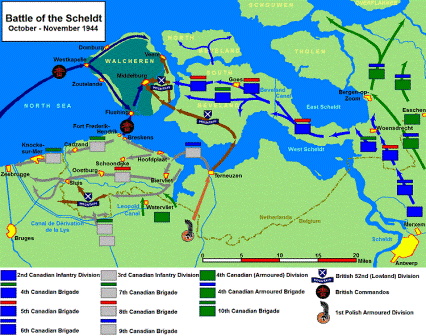
John Lewis Hughes was killed on Walcheren Island (top left), near Westkappelle, on November 2, 1944.  (Map source: ‘Official History Of The Canadian Medical Services 1939-1945’)

On October 21, 1944, a number of Canadian medical units were “…put under command of the 4th Special Service Brigade….” of the Royal Marines (United Kingdom) “…for training to support the amphibious operation of the brigade….” No. 17 Light Field Ambulance Company, Nos. 8 and 9 Canadian Field Surgical Units, No. 5 Canadian Field Transfusion Unit, and No. 10 Canadian Field Dressing Station were involved.

Operation Infatuate, part of the Battle of the Scheldt, was the codename for the attack on German batteries on Walcheren Island in The Netherlands, located at the mouth of the Scheldt River. German fortification of the island blocked Allied access to the captured port of Antwerp, Belgium. The Belgian port was crucial in order to supply advancing Allied armies as they moved towards Berlin.

“…Training for the operation against Walcheren continued until the end of October when units embarked at Ostend and began to move towards their objective. At three o’clock on the morning of 1 November the flotilla of landing craft sailed out of Ostend harbour….” Ostend is in Belgium.

“…Just before dawn, they met their supporting warships, turned and bore down on Westkapelle. The assault was to be made in daylight on either side of a gap blown in the Westkapelle dyke, and just before “H” hour (9.45 a.m.) the guns of Warspite, Roberts, and Erebus opened up and flights of rocket-firing Typhoon aircraft went to work on the shore batteries….”

In ‘Towards Victory In Europe: The Battle For Walcheren’, J. O. Forfar, Medical Officer, 47 Marine Commando,  explained that “…Commander Pugsley and Brigadier Leicester had been informed on leaving Ostend that due to fog in England the Lancaster bombers which were to carry out a preliminary bombardment of the Walcheren defences while the assaulting craft moved in were grounded…” 

The two men decided to go ahead with the operation, which resulted in high casualties, but the Battle for Walcheren was ultimately successful.  “…The Germans had sown sea mines in the approaches to the island; the beaches were laced with barbed wire, landmines, and covered by machine guns firing from cement pill boxes. Five minutes before they were due to touch down the two landing craft which had been prepared as hospital ships were sunk by mines.  Immediately after this the assault began…” with shelling from cannons at the battery in Dishoek.

“…One section of No. 17 Canadian Light Field Ambulance landed with No. 41 Commando on the left of Westkapelle gap and another section with No. 48 Commando on the right of Westkapelle gap. Of the 25 close support naval craft engaged in the operation only six were left by mid-afternoon, and 172 of those on board had been killed and 210 wounded. Casualties among those who got ashore in the face of stiff enemy resistance were heavy….”  The medical teams had to work in close proximity of the fighting.

…. No. 10 Field Dressing Station set up on the beach on the afternoon of November 1, 1944…...

Beach dressing station of No. 10 Field Dressing Station being set up by personnel of No. 10 Field Dressing Station at Westkapelle. (Photo source: Provincial Archives of Alberta, Donald Carson fonds, PR2011.0001/14)

“…Casualties on the left of the gap were given first aid and collected into a shell hole on the edge of the dyke until Westkapelle was clear, when they were moved into a house in the village. On the other side of the gap the casualty collecting post was set up on the inside of the sea wall, and casualties were held until No. 10 Canadian Field Dressing Station came ashore at 2 pm and set up a beach dressing station….”

Most of those wounded on November 1, 1944 were taken off the Island during the night and returned to No. 6 Canadian Field Dressing Station at Ostend. Meanwhile the medical teams prepared for the next day.

…. John was killed in the afternoon of November 2, 1944 …...

No. 8 Canadian Field Surgical Unit, a medical operation team of around 10 people, was attached to No. 10 Field Dressing Station, and was the field hospital located behind the No. 10 Field Dressing Station. 

The November 2, 1944 War Diary entry for No. 8 Canadian Field Surgical Unit relates what happened when they came ashore with landing tracked vehicles, which the diary writer referred to as Alligators. (See https://en.wikipedia.org/wiki/Landing_Vehicle,_Tracked)  “…The morning of November 2nd dawned bright and clear….About 0900 the Alligators moved to the beach and there we met the rest of our unit.  I was relieved to find in spite of many harrowing experiences they were all quite safe. We off loaded the vehicles onto the beach….The beach head was under intermittent fire but the greatest worry we had was mines…”

Tragedy struck in the early afternoon.  “…A salvo of shells hit 3 Alligators in front of the dugout and the Alligators caught on fire.  Each Alligator had 7 tons of ammunition on board and this all exploded during the next ¾ of an hour. About 20 men were killed, including the Quartermaster and one Other Rank of No. 10 FDS….”  The ‘Other Rank of No. 10 FDS’ was John Lewis Hughes.

Caroline Raaijmakers, Chair of the Faces To Graves Bergen Op Zoom Committee, told us that  “….on the same spot….” where John was killed, “…Doctor Captain Frank Sidney Manktelow was Wounded In Action on 2-11-1944 and he died on 3-11-1944…..” 

Dr. Frank Sidney MANKTELOW, of Pointe aux Trembles, Quebec, son of Frederick Sidney and Mary Jane (nee MacKay) Manktelow, and husband of Laura Francise (nee Quinn) Manktelow, was serving with the Royal Canadian Army Medical Corps when he died, at the age of 30.

Both men were initially buried in a temporary cemetery in Zoutelande on Walcheren Island.

 …. John is buried in the Canadian War Cemetery in Holten…...

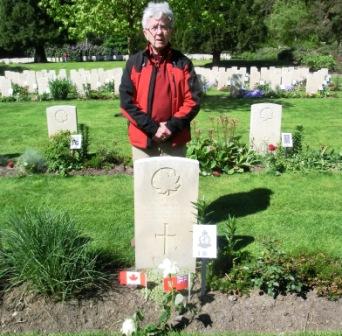
Pieter stands behind the grave of John Lewis Hughes in Holten, The Netherlands.  (Photo credit: Daria Valkenburg)

On September 9, 1946, John was reburied in the Canadian War Cemetery in Holten, The Netherlands.  We visited his grave this spring when we were in The Netherlands for our 2025 European Memorial Tour, and Pieter placed flags of Canada and Manitoba by his grave. His was one of 383 graves in 14 cemeteries that we visited on this trip.

….Hughes Hill in northern Manitoba named in John’s honour…..

Hughes Hill in northern Manitoba was named after John ‘Jack’ Lewis Hughes.  (Map source: Mapcarta)

Hughes Hill in northern Manitoba, northeast of Wither Lake, was named after him in 1995.

….A great deal of research happened before a photo was found…

Many people assume that it’s easy to find family and photos of soldiers who are buried overseas.  Unless you are lucky enough to stumble across someone else’s research, or a media appeal is seen by the right person with a photo, it can be an onerous and long drawn out process.  

The search for a photo of John Lewis Hughes took several years.  Thank you to Judie Klassen for going above and beyond to find family and reference material, to Shawn Rainville for newspaper searches, and to Judy Gleich for continually contacting people from Eriksdale.  Thank you to Robert Catsburg for sending the war diary entry for November 2, 1944 and to both Robert Catsburg and Caroline Raaijmakers for excerpts from Dutch accounts.

Thank you to John Forsyth for the hockey photo that included a photo of John.  And a big thank you to Kevin Rollason of the Winnipeg Free Press for writing the article about the photo search. 

The flags placed at John’s grave were donated.  Our thanks go to: 

  • Alan Waddell, Constituent Assistant, on behalf of Heath MacDonald, MP for Malpeque, for the Canadian flag.
  • Brad Robertson, Chief of Protocol, Government of Manitoba, on behalf of Wab Kinew, Premier of Manitoba, for the Manitoba flag. 

The work of remembrance of those who served continues as do our adventures on the next leg of our 2025 European War Memorial Tour.

If you have a story or photo to share, please contact Pieter at memorialtrail@gmail.com or comment on the blog. 

© Daria Valkenburg

….Want to follow our research?…

If you are reading this posting, but aren’t following our research, you are welcome to do so.  Our blog address: https://onthewarmemorialtrail.com/

4 countries, 6 weeks, 7,000 km – an unforgettable war memorial journey in Europe…. Daria’s book ‘No Soldier Buried Overseas Should Ever Be Forgotten‘ is available in print and e-book formats.  Net proceeds of book sales help support research costs and the cost of maintaining this blog. For more information see https://nosoldierforgotten.com/

Subscribe to our YouTube Channel: On The War Memorial Trail With Pieter Valkenburg: https://www.youtube.com/channel/UCJ591TyjSheOR-Cb_Gs_5Kw. 

Never miss a posting!  Subscribe below to have each new story from the war memorial trail delivered to your inbox.
On The War Memorial Trail….. The WWII Soldier From Central Blissville Killed Along The Goch-Calcar Road

June 9, 2024. Most of the time, Pieter has good success in finding photos of soldiers named on photo wish lists from the three Canadian War Cemeteries in The Netherlands.  This past winter, however, he ran into one frustration after another.  In most cases, while family of soldiers were found, no one had photos. A few times, family members were found, but did not respond to inquiries. 

..…An old TV program inspired one photo search …..

Pieter was getting a bit discouraged.  It didn’t help that I was not well for much of the winter and spent most of the time reading and watching comedies on TV.  Since we’d been doing research on airmen who had been POWs I began watching Hogan’s Heroes, a comedy about POWs assigned to form a special operations unit in a POW camp run by the Luftwaffe to help prisoners escape and to perform acts of sabotage against the German war effort. A very funny satire and I’m sure that laughing over the antics these men got up to helped me recover more quickly. 

So, when Pieter began looking at his photo wish lists again, he asked if I had any thoughts on which soldier to research.  I didn’t until I noticed a soldier named Carter, who came from a place named Central Blissville.  That’s the guy, I told Pieter.  When he asked why, I told him there was a character on the show named Sgt Carter and who could resist a place named Blissville? Pieter shook his head, but went with my suggestion and within a day had a photo!

Before telling the story of the Canadian soldier named Carter, take a look at this excerpt from Hogan’s Heroes, featuring the fictional American soldier named Carter, portrayed by Larry Hovis, impersonating the German commandant of the POW camp… 

..…The non-fictional Private Carter enlisted in 1941…..

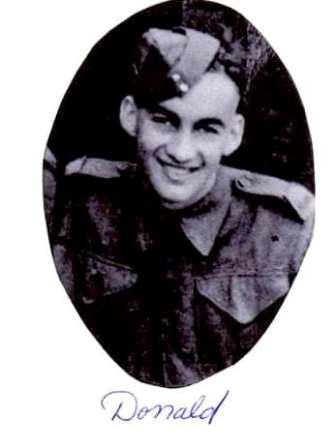
Donald Roy Carter from facebook page Jeremy Carter

Donald Roy Carter.  (Source: Jeremy Carter)

The non-fictional Donald Roy CARTER was born August 4, 1923 in Central Blissville, Sunbury County, New Brunswick, son of Roy William and Josephine ‘Ina’ Helen Carter.  However, when he enlisted at the No. 7 District Depot in Fredericton, New Brunswick, on May 3, 1941, he stated that his birthdate was May 27, 1922.  Since a soldier in active service needed to be 19 years old, Donald fudged his date of birth.

On May 22, 1941, Donald was sent to No. 70 Canadian Army (Basic) Training Camp (CABTC) in Fredericton, New Brunswick for basic training. After completing his basic training, he was transferred to the A22 Canadian Army Medical Corps Training Centre at Camp Borden in Ontario.  Here Donald received advanced training to prepare him as a stretcher bearer, with three key responsibilities when dealing with the wounded in a war zone: stop the bleeding, treat for shock, and evacuate. 

….Donald left Canada for overseas service….

On September 6, 1941, Donald was given embarkation leave of just over a week, and then he found himself on his way to the United Kingdom on October 9, 1941. Upon arrival in Greenock, Scotland on October 19, 1941, he was assigned to No. 1 General Holding Unit.

A Holding Unit was a reinforcement pool where soldiers brought over from Canada received additional training.

On December 13, 1941, Donald was transferred to the 11th Field Ambulance, Royal Canadian Army Medical Corps (RCAMC). A field ambulance was a mobile medical unit which was usually found serving with an infantry division during WWII.

….Donald survived Operation Jubilee – the Dieppe Raid….

Allied Forces had plans for an amphibious attack on the German-controlled port of Dieppe in Normandy, France in 1942, in what would become known as Operation Jubilee, also called the Dieppe Raid.  (See https://en.wikipedia.org/wiki/Dieppe_Raid)

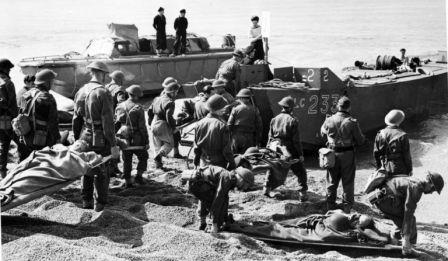
Loading-wounded-on-landing-craft.-Source-Global-News-768x447

Royal Canadian Army Medical Corps personnel treating casualties during rehearsal in England for raid on Dieppe. (Photo Source: Global News)

As part of the preparations, the 11th Field Ambulance underwent training on the Isle of Wight. An exercise on June 4, 1942 included practice in moving casualties from an assault landing craft to an advanced dressing station. They also practiced opposed and unopposed beach landings. Two final, large, exercises took place along the Dorset Coast on June 11-12, 1942 and June 22-24, 1942.

On August 18, 1942, Donald was among the members of the 11th Field Ambulance that assembled at Newhaven, with one bearer section (1 Medical Officer and 18 other ranks) detached to the Royal Regiment of Canada at Portsmouth. They all sailed toward Dieppe at about 9:30 pm. 

Unfortunately, Operation Jubilee was a disaster, particularly for the Canadian soldiers, and the medical unit attached to the Royal Regiment of Canada. 3,623 of the 6,086 Allied forces who landed were killed, wounded, or taken prisoner of war. This included 5,000 Canadians, who suffered a 68 percent casualty rate, with 3,367 killed, wounded, or taken prisoner.

Donald, however, survived and safely returned to the United Kingdom on August 19, 1942, where he remained until shortly after D-Day.

….Donald returned to Normandy in July 1944….

On July 3, 1944, Donald and the 11th Field Ambulance, now part of the 21st Army Group, returned to Normandy, France as the Battle of Normandy continued following the advances made on D-Day on June 6, 1944. 

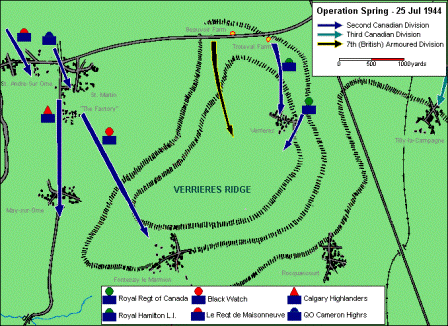
As the 2nd Canadian Corps advanced in July, the 11th Field Ambulance moved along with them, as part of the 2nd Canadian Infantry Division (along with other medical units).  11th Field Ambulance was tasked with providing support to the 4th Canadian Brigade. During battle on July 18-19, 1944 they treated casualties, before making preparations to move forward on July 20, 1944 for Operation Spring at Verrieres Ridge on July 25, 1944.

normandymapspring

Map shows troop locations for Operation Spring.  (Map source: http://www.canadiansoldiers.com)

Donald survived the fight along the Verrieres Ridge, most likely because the 11th Field Ambulance was not at the front, but was held in reserve in Caen for the 2nd Canadian Motor Ambulance Convoy. (See https://www.canadiansoldiers.com/history/battlehonours/northwesteurope/verrieresridge.htm)

Then, during Operation Totalize on August 7-11, 1944, an offensive designed to break through the German defences south of Caen and toward Falaise, the 11th Field Ambulance was under command of the 2nd Canadian Armoured Brigade.  (See https://en.wikipedia.org/wiki/Operation_Totalize)

….Donald had limited participation in the Battle of the Scheldt….

scheldt2

Map shows location of South Beveland, The Netherlands.  (Map source: http://www.canadiansoldiers.com)

As the Allied forces moved from Normandy into Belgium, and then into The Netherlands for the Battle of the Scheldt,  three Field Ambulances of the 2nd Canadian Division were used in Operation Vitality, the battles for South Beveland for a month from October 2, 1944. 

Each Field Ambulance unit operated an advanced dressing station and a casualty collection post. 11th Field Ambulance evacuated casualties directly to No. 6 Canadian General Hospital in Antwerp, Belgium. (See https://en.wikipedia.org/wiki/Battle_of_the_Scheldt and https://www.oorlogzeeland.nl/index.php/slag-om-de-schelde/scheldeslag-information-in-english)

However, Donald missed much of the action as he was not on active service between October 16 and November 12, 1944.  This effectively ended his time with the 11th Field Ambulance.

….Donald was transferred into the Infantry….

On November 24, 1944 Donald was transferred to the Canadian Infantry Corps, as part of the X4 Reinforcement for the 13th Battalion.  Then, on December 4, 1944 he was assigned to the Essex Scottish Regiment, joining them in Mook, The Netherlands.

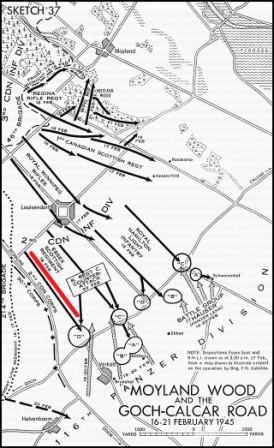
On February 16, 1945, the Essex Scottish Regiment left The Netherlands and crossed the border into Germany, at Kleve.  The following day, the war diary reported that the battalion “…moved off to an assembly area between Kleve and Calcar….” in preparation for an attack on the Goch-Calcar Road, which was subsequently delayed until February 19, 1945.

….Heavy fighting along the Goch-Calcar Road proved deadly….

Victory-37 Map Moyland Wood and the Goch Calcar Rd

Moyland Wood and the Goch-Calcar Road, 16-21 February 1945 (Map source: HyperWar: The Victory Campaign [Chapter 18] ibiblio.org)

The war diary for February 19, 1945 noted that the attack on the Goch-Calcar Road resulted in the Regiment fighting “….under a heavy hail of shrapnel and small arms fire. Casualties were fairly heavy….Communications were difficult. Vehicles became bogged in the soft mud, casualties were difficult to evacuate, and guns and ammunition could not get up where they were required….”

The battle raged on into the night and then after midnight communications were lost.  The war diary entry for February 20, 1945 continued with an account of the battle.  “… The early hours of the morning were grim ones. Isolated company groups fought on, short of ammunition, burdened with casualties which could not be easily evacuated, and lacking the support of the anti-tank weapons with which to deal with the Mark IV tanks the enemy had marshalled for his counter-attack….”

The casualties for the battle numbered “…13 officers and 235 other ranks…” of which about 50 were fatalities.  Among those killed on February 20, 1945 was Private Donald Roy Carter, who lost his life at the age of 21.

 ..…Donald is buried in Groesbeek …..

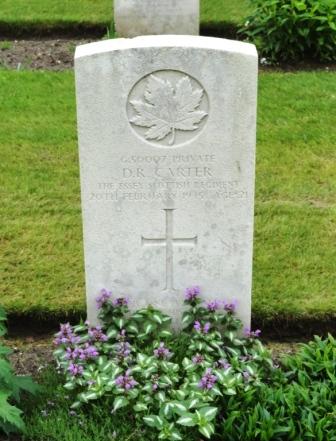
Donald was temporarily buried near Calcar, Germany, before being reburied the following year in the Canadian War Cemetery in Groesbeek, The Netherlands.

grave stone donald carter from find a grave

Grave of Donald Roy Carter in the Canadian War Cemetery in Groesbeek, The Netherlands.  (Photo source: http://www.findagrave.com)

Do you have photos or information to share? Email Pieter at memorialtrail@gmail.com, or comment on the blog.

© Daria Valkenburg

….Want to follow our research?….

If you are reading this posting, but aren’t following our research, you are welcome to do so.  Our blog address: https://onthewarmemorialtrail.com/

Front cover OnTheWarMememorialTrailinEurope4 countries, 6 weeks, 7,000 km – an unforgettable war memorial journey in Europe…. Daria’s book ‘No Soldier Buried Overseas Should Ever Be Forgotten‘ is available in print and e-book formats.  Net proceeds of book sales help support research costs and the cost of maintaining this blog. For more information see https://nosoldierforgotten.com/ 

You are also invited to subscribe to our YouTube Channel: On The War Memorial Trail With Pieter Valkenburg: https://www.youtube.com/channel/UCJ591TyjSheOR-Cb_Gs_5Kw. 

Never miss a posting!  Subscribe below to have each new story from the war memorial trail delivered to your inbox.