Pieter Valkenburg (left) and Mario Henry at Bedeque Cemetery. (Photo credit: Laurie Henry)
July 26, 2026. Every November, just before Remembrance Day, members of Borden-Carleton Legion Branch #10, in Prince Edward Island, place Canadian flags at the graves of veterans buried in 9 cemeteries, and at 4 cenotaphs. While flags are placed to honour the veterans, their stories and details of service are often unknown.
One of the cemeteries is Bedeque Cemetery (also known as Lower Bedeque Cemetery) in Lower Bedeque, Prince Edward Island. One of the veterans buried here, George ‘Stanley’ Clarence JACK, came to Pieter’s attention from Phillip MacDonald. “…My maternal grandfather, Stanley C Jack, was a veteran of WWI and WWII….” he wrote. “… He was the youngest boy of John S Jack and Elizabeth MacKinstry of Bedeque, and is buried at the Lower Bedeque Cemetery, just down the road from where I live…”
Born July 17, 1897 in Summerside, Prince Edward Island, Stanley was the youngest son of John Slifton and Elizabeth (nee MacKinstry) Jack. Phillip explained that his great-grandparents raised “…6 boys who all served in WWI & WWII. They were all born on PEI but my grandfather was the only one to remain on the Island to raise his family….”
Stanley worked as a mail driver until he was conscripted, aged 20, under the Military Service Act and sent for a medical exam in Summerside, Prince Edward Island, on December 5, 1917. However, he wasn’t drafted until months later.
After relying exclusively on volunteers for the first few years of WWI, the Canadian government passed the Military Service Act in August 1917 to make military service compulsory for male citizens aged 20 to 45. (See https://www.warmuseum.ca/firstworldwar/history/life-at-home-during-the-war/recruitment-and-conscription/conscription-1917/)
…..Stanley enlisted in the 1st Depot Battalion…..
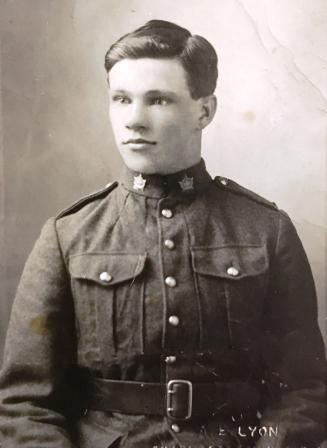
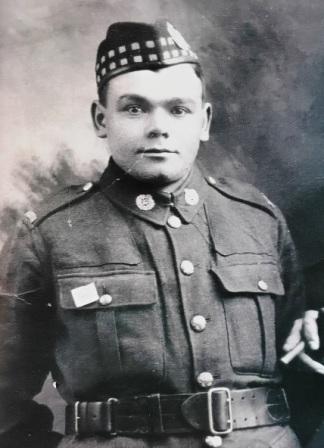
George ‘Stanley’ Clarence Jack in WWI. (Photo courtesy of the Jack Family. Photo restoration by Pieter Valkenburg)
In 1917-1918, when it was difficult to recruit enough men for infantry battalions, depot battalions were organized in Canada to obtain personnel who would then be sent to various Canadian Reserve Battalions in England.
Stanley wasn’t drafted until March 11, 1918, when he enlisted with ‘H’ Company, 1st Depot Battalion, Nova Scotia Regiment, in Charlottetown, Prince Edward Island, and began his basic training.
Per Nova Scotia’s Part In The Great War, compiled and edited by M. S. Hunt, the 1st Depot Battalion had been organized “….on September 25, 1917, for the purpose of looking after the draftees under the Military Service Act…”
However, due to “…destruction of property caused by the Halifax Explosion in December 1917….” quarters for military personnel were in short supply, which is likely the reason why Stanley didn’t have to enlist until months after passing his medical exam. (See https://en.wikipedia.org/wiki/Halifax_Explosion)
…..Stanley left Canada for England…..
On August 2, 1918, Stanley was transferred to the 102nd Draft Battalion Nova Scotia, one of 1,700 men to be sent overseas.
An account in Nova Scotia’s Part In The Great War noted that the men “…paraded at 8 PM on August 3, 1918; the roll was called, documents checked, etc. The men were then dismissed and ordered to parade and entrain at 4:30 AM on August 4th…”
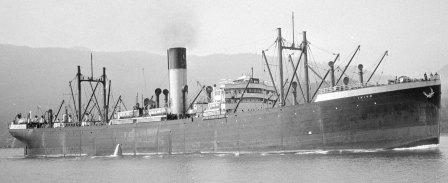
SS Ixion. (Photo source: http://www.shipspotting.com)
After leaving Halifax, Nova Scotia aboard SS Ixion, the ship arrived safely in Liverpool, England on August 15, 1918, with the men disembarking the following day. Among the men aboard the ship was Cyrus Joseph GALLANT of Piusville, Prince Edward Island, whose story has previously been told. (See https://onthewarmemorialtrail.com/2026/06/20/on-the-war-memorial-trail-the-wwi-soldier-from-piusville-who-enlisted-in-the-veterans-guard-of-canada-in-wwii/)

Map showing routing from Liverpool to Bramshott. (Map source: Google Maps)
From Liverpool, the men travelled 396 km (246 miles) towards Bramshott, where they were transferred to the 17th Reserve Battalion of the Canadian Infantry on August 22, 1918. Bramshott Camp was a massive training facility for the Canadian Army, with thousands of soldiers living there. The camp included hospitals, an open-air theatre, and an extensive network of corrugated iron and wooden huts.
The 17th Reserve Battalion was a training and reinforcement depot based in England. Its primary role was to train newly arriving soldiers, and dispatch them to combat battalions.
By the time Stanley arrived in England, just a few months before WWI ended on November 11, 1918, his time with the 17th Reserve Battalion never went beyond training. Instead of being sent to a frontline unit he stayed in England until returning home.
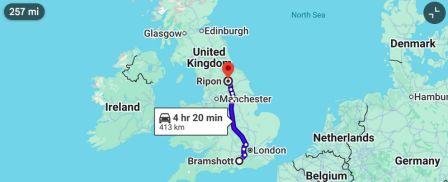
Map showing routing from Bramshott to South Ripon. (Map source: Google Maps)
The Battalion remained in Bramshott until January 12, 1919, when it moved to South Ripon, a distance of 413 km (257 miles), from where soldiers would be demobilized and started returning back home to Canada.
…..Stanley returned back to Canada in 1919…..
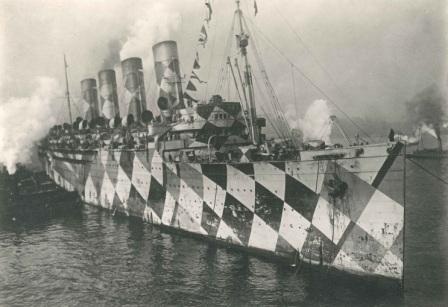
HMT Mauretania with geometric dazzle camouflage scheme designed by Norman Wilkinson (Photo source: New-York Tribune December 8, 1918, Public Domain, https://commons.wikimedia.org/w/index.php?curid=84709365)
On June 28, 1919, Stanley was on his way back to Canada aboard HMT (Hired Military Transport) Mauretania. He was officially discharged on July 13, 1919 in Charlottetown.
…..Stanley enlisted in the Veterans Guard of Canada in WWII…..
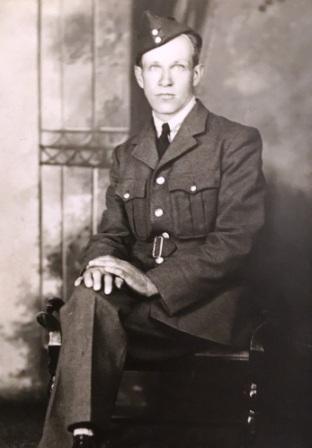
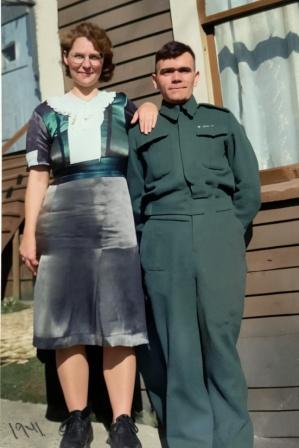
George ‘Stanley’ Clarence Jack in WWII. (Photo courtesy of the Jack Family)
During the inter-war years, Stanley married Stella Beryl Craig, and they had three daughters. During WWII, Stanley enlisted as a volunteer with the Veterans Guard of Canada.
Volunteers for the Veterans Guard were WWI veterans that had served in Canadian or British forces, were fit, and had been honourably discharged. They received the same pay ($1.30 a day) and allowances as other soldiers. As a local defence force to guard against enemy attacks, and guard duties at internment and prisoner-of-war camps in Canada, Stanley would not have been sent overseas into a war zone. (See https://en.wikipedia.org/wiki/Veterans_Guard_of_Canada)
Stanley’s brother-in-law, Harrison William CRAIG, the younger brother of his wife Stella, also served in Canada during WWII, but died of an allergic reaction in 1942. Harrison is listed on the Cenotaph outside the Borden-Carleton Legion, and his story was told several years ago. (See https://onthewarmemorialtrail.com/2019/09/22/the-ww2-soldier-who-had-an-allergic-reaction/)
Phillip was unsure where his grandfather served during WWII, but wrote that he believed “…he was stationed in Glace Bay, Nova Scotia….” because his mother “…lived there with her mother and sisters in the early 1940s when he was in the war….” Glace Bay, located in Cape Breton, was part of the Homeland Defence duties for the Veterans Guards of Canada. Stanley may have been posted to other locations during WWII as well.
….Stanley is buried in Bedeque Cemetery…
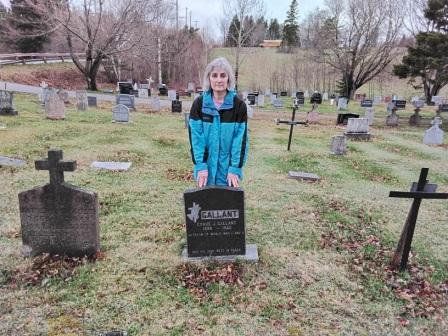
Following the end of WWII, Stanley returned to his life in Bedeque, and worked as a farm labourer and mail courier. Following Stella’s death on December 30, 1969, Stanley remained a widower until his own death on April 6, 1985 in Charlottetown. He was buried in Bedeque Cemetery (also known as Lower Bedeque Cemetery) in Lower Bedeque, Prince Edward Island, where we visited his grave one hot sunny day in July.
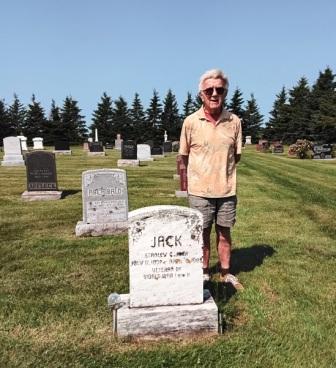
Pieter by the grave of George ‘Stanley’ Clarence Jack. (Photo credit: Daria Valkenburg)
Thank you to Phillip MacDonald for providing photos and information on his grandfather. “… Please keep up the great work…” he wrote.
This November, when a Canadian flag is placed at Stanley’s grave, he’ll be more than just a name on a list. Pieter noted that “…it means so much more when I’m standing at a grave if I know what the soldier looked like and a bit about him…..“
Pieter’s research efforts to find photos and families of soldiers continue. Do you have a story to tell? Email Pieter at memorialtrail@gmail.com, or comment on the blog.
© Daria Valkenburg
….Want to follow our research?…
If you are reading this posting, but aren’t following our research, you are welcome to do so. Our blog address: https://onthewarmemorialtrail.com/
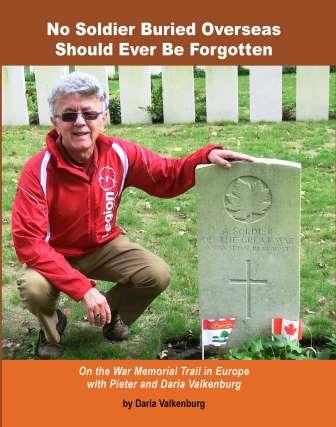 4 countries, 6 weeks, 7,000 km – an unforgettable war memorial journey in Europe…. Daria’s book ‘No Soldier Buried Overseas Should Ever Be Forgotten‘ is available in print and e-book formats. Net proceeds of book sales help support research costs and the cost of maintaining this blog. For more information see https://nosoldierforgotten.com/
Subscribe to our YouTube Channel: On The War Memorial Trail With Pieter Valkenburg: https://www.youtube.com/channel/UCJ591TyjSheOR-Cb_Gs_5Kw.
Never miss a posting! Subscribe below to have each new story from the war memorial trail delivered to your inbox.