On The War Memorial Trail…..Commemorative Coins From West Nova Scotia Regimental Association

May 12, 2020.  Two names on the Cenotaph outside the Borden-Carleton Legion were in the West Nova Scotia Regiment during WWII:  Ernest Murray NORTON and Arnold Dudley TAYLOR.  Both lost their lives in Italy.  Norton’s story has been previously told in this blog (See The Last Valentine From A WWII Soldier), Taylor’s is still being researched.

Left: Ernest Murray Norton (Photo courtesy Harry Norton family collection) Right: Arnold Dudley Taylor (Photo courtesy Barbara Simester family collection)

Recently, Ron Stonier, President of the West Nova Scotia Regimental Association, let us know about a commemorative coin produced “for each of the 359 West Nova soldiers killed overseas. When someone joins the Regimental Association and pays their annual dues, we give one of our coins as a symbol of membership. On the front is our cap badge, and on the back is an image of our monument in Camp Aldershot, NS, flanked by the badges of the two regiments which were amalgamated in 1936 to form the West Nova Scotia Regiment. Below the monument is the name, rank, serial number, date of death, and age at death if available.

Stonier went to note that “We attempt to find the families of the soldiers who died to give them the coin representing their loved one. So far, we have been able to connect 40 coins with family members, and it’s a very satisfying feeling to do so.  We have fewer than 100 coins left, but we do have one for each of for Lt Taylor and Pte Norton.”  He kindly sent images of the coins.

Lt AD Taylor

Commemorative coin for Arnold Dudley Taylor.  (Photo courtesy West Nova Scotia Regimental Association)

Pte EM Norton

Commemorative coin for Ernest Murray Norton.  (Photo courtesy West Nova Scotia Regimental Association)

We have contacted the families of Norton and Taylor to let them know about the coins.  If you have a relative who was in the West Nova Scotia Regiment, and would like more information on the commemorative coin or joining the association, please visit their website at https://www.wnsr.ca/ra.

We’re delighted to hear from various archives and regimental associations, and thank Ron Stonier for letting us know about the commemorative coins. Pieter continues to research Islanders who served in WWI and WWII. If you have photos or information to share on Ernest Murray Norton or Arnold Dudley Taylor, please contact Pieter at memorialtrail@gmail.com, comment on the blog, or tweet to @researchmemori1

© Daria Valkenburg

….Want to follow our research?….

If you are reading this posting, but aren’t following our research, you are welcome to do so.  Our blog address: https://onthewarmemorialtrail.com/
Front cover OnTheWarMememorialTrailinEurope4 countries, 6 weeks, 7,000 km – an unforgettable war memorial journey in Europe…. Daria’s book ‘No Soldier Buried Overseas Should Ever Be Forgotten‘ is available in print and e-book formats.  Net proceeds of book sales help support research costs and the cost of maintaining this blog. For more information see https://nosoldierforgotten.com/ 

You are also invited to subscribe to our YouTube Channel: On The War Memorial Trail With Pieter Valkenburg: https://www.youtube.com/channel/UCJ591TyjSheOR-Cb_Gs_5Kw

Never miss a posting!  Subscribe below to have each new story from the war memorial trail delivered to your inbox.

3 Short Videos About The Liberation Of The Netherlands

speldje bevrijding

May 6, 2020.  In the last blog posting, photos about the tulips that were placed in the Canadian War Cemetery in Groesbeek were featured.  (See Tulips Placed At Each Grave At The Canadian War Cemetery In Groesbeek)

Alice van Bekkum, Chair of Faces To Graves, sent us a short YouTube video “Er zijn duizenden tulpen op de Canadese Erebegraafplaats geplaatst” (“Thousands of tulips have been placed in the Canadian War Cemetery”) that shows tulips being placed on the graves at the Canadian War Cemetery in Groesbeek by volunteers.  You can watch it here:

Historica Canada has produced a short video,  “Liberation of The Netherlands in their Heritage Minutes series.


Think Like A Historian, another Historica Canada production, also has a YouTube video on the Liberation of The Netherlands.


Happy Viewing!  If you have information to share about Canadian soldiers buried in The Netherlands, please contact Pieter at dariadv@yahoo.ca or comment on the blog.

© Daria Valkenburg

Tulips Placed At Each Grave At The Canadian War Cemetery In Groesbeek

speldje bevrijding

May 5, 2020.  While events planned for the 75th Anniversary of the Liberation of The Netherlands were cancelled due to social distancing to prevent further outbreaks of coronavirus, organizations and individuals have found ways to mark the occasion.  One group from BC, the Dutch Canadian Liberation 2020 Society, planned many commemorative events.  (See https://www.dutchcanada2020.com/about-us/ )

When these had to be cancelled, the Society decided to pay for tulips to be placed at the graves at the Canadian War Cemetery in Groesbeek, The Netherlands.  Most of the soldiers buried in this cemetery fell during the fighting on the Lower Rhine between February 8 and March 26, 1945.  In addition, the names of 1,103 soldiers reported missing between August 1944 and May 1945 are listed on the Groesbeek Memorial, with only a few found since the memorial was put up.  The rest are still listed as MIA (Missing In Action).

The Cemetery was closed on the first two days in May while volunteers placed tulips in vases beside each grave.

Tulips arriving at groesbeek on may 1st spanjers

Tulips arrive at the Cemetery on May 1.  (Photo credit: Piet Spanjers)

close up of tulip by grave in groesbeek spanjers

Each grave had a vase of tulips placed by volunteers.  (Photo credit: Piet Spanjers)

Memorial Wall scheepers

Vases of tulips line the bench along the Memorial Wall.  (Photo credit:  Scheepers family)

DCIM100GOPROGOPR0102.JPG

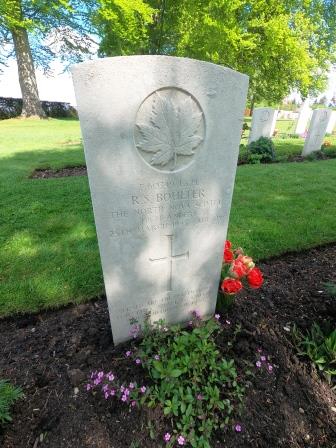
Grave of L/Cpl Ralph Schurman BOULTER, North Nova Scotia Highlanders, from West Point. (Photo credit:  Scheepers family)

heneberry 1 scheepers

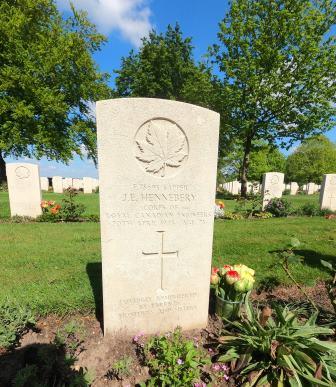
Grave of PEI soldier Sapper Joseph Edmond HENNEBERY, Corps of Royal Canadian Engineers, from Morrell. (Photo credit: Scheepers family)

DCIM100GOPROGOPR0100.JPG

Grave of L/Cpl Frank Edward MCGOVERN, North Shore Regiment, born in Chipman. (Photo credit:  Scheepers family)

Our thanks to Ad and Noor Scheepers for taking photos, including those of the graves of:

  • Ralph Schurman BOULTER, who came from West Point, Prince Edward Island
  • Joseph Edmond HENNEBERY, who came from Morrell, Prince Edward Island
  • Frank Edward MCGOVERN, born in Chipman, New Brunswick

You can read (or re-read!) about our 2019 and 2017 War Memorial tour visits to the cemetery here:

·       https://onthewarmemorialtrail.com/2019/12/04/on-the-war-memorial-trail-our-2019-visit-to-the-canadian-war-cemetery-in-groesbeek/

·     https://onthewarmemorialtrail.com/2017/12/30/on-the-war-memorial-trail-pei-soldiers-buried-in-the-canadian-war-cemetery-in-groesbeek/

·        https://onthewarmemorialtrail.com/2017/12/25/on-the-war-memorial-trail-at-the-canadian-war-cemetery-in-groesbeek/

In an unrelated commemorative gesture, a group of Dutch farmers used tractors to spell out ’75 Jaar Vrijheid’ (75 Years of Freedom) in the shape of a torch. They were given a citation by Dutch authorities for not respecting social distancing rules! (Watch them make this tribute in a 42 second video at https://www.nu.nl/280619/video/boeren-vormen-fakkel-met-trekkers-in-wei-en-ontsteken-vrijheidsvuur.html?jwsource=em)

No photos have yet been found for Joseph Edmond HENNEBERY and Frank Edward MCGOVERN. Can you help? If you have information to share about any Canadian soldiers buried in The Netherlands, please contact Pieter at memorialtrail@gmail.com or comment on the blog.  UPDATE:  A photo of Joseph Edmond Hennebery was subsequently submitted.

© Daria Valkenburg

….Want to follow our research?….

If you are reading this posting, but aren’t following our research, you are welcome to do so.  Our blog address: https://onthewarmemorialtrail.com/

Front cover OnTheWarMememorialTrailinEurope4 countries, 6 weeks, 7,000 km – an unforgettable war memorial journey in Europe…. Daria’s book ‘No Soldier Buried Overseas Should Ever Be Forgotten‘ is available in print and e-book formats.  Net proceeds of book sales help support research costs and the cost of maintaining this blog. For more information see https://nosoldierforgotten.com/ 

You are also invited to subscribe to our YouTube Channel: On The War Memorial Trail With Pieter Valkenburg: https://www.youtube.com/channel/UCJ591TyjSheOR-Cb_Gs_5Kw

Never miss a posting!  Subscribe below to have each new story from the war memorial trail delivered to your inbox.

New Website On Canadian Scottish Regiment During WW2

   speldje bevrijdingMay 4, 2020.  As the Dutch remember the 75th Anniversary of the Liberation of The Netherlands, this year without any public gatherings and events cancelled due to social distancing to prevent further outbreaks of coronavirus, Edwin van der Wolf of Hattem, The Netherlands, notified us about a website he’s begun.  This labour of love is about the 394 fallen soldiers of the Canadian Scottish Regiment during WW 2, a regiment from Victoria, BC.

The website is in Dutch and English, and includes maps, war diaries, a brief history of the regiment, photos, brief biographies of the fallen soldiers, and the cemeteries they are buried in. You can access the website at https://www.csri.nl/.

We first met Edwin on our 2017 War Memorial Tour, when we visited the graves and monuments of most of the names listed on the Cenotaph outside the Borden-Carleton Legion.  In addition to his research into the Canadian Scottish Regiment, Edwin is an active researcher at the Holten Information Centre based at the Canadian War Cemetery in Holten.  (See https://bordencarletonresearchproject.wordpress.com/2018/01/17/on-the-war-memorial-trail-at-the-information-centre-at-holten-canadian-war-cemetery/ for an account of our visit there.)

Back in 2017, we asked him about his interest in Canadian soldiers and he told us that he feels a special bond with Canada.  He explained that his grandfather lived in an area of Deventer that was liberated by Canadians. “My grandfather lived in a house in a corner of the street, and he could see a hospital fence 100 metres away.  Canadian soldiers climbed the iron gate and, in a crouching position, walked past a couple of Germans who were on the roof and firing at the Canadians who’d climbed over the gate.  The Germans withdrew as the Canadians advanced.  Grandfather told this story every Sunday!”  This story captured a young Edwin’s imagination.  “So many Canadians came from thousands of kms away to help liberate the Dutch!

CIMG9320 Edwin van der Wolf and Pieter in Schalkhaar

Edwin van der Wolf (left) with Pieter in Schalkhaar beside a panel commemorating Lt. Clayton Leroy MITCHELL of the Canadian Scottish Regiment, who lost his life on April 10, 1945.  The panel was placed at Edwin’s initiative.  (Photo credit: Daria Valkenburg)

One of the places where the Canadian Scottish Regiment fought was in Schalkhaar, near Deventer.  Edwin took us on a tour of the village and told us one story about what happened there on April 10, 1945…

The Canadians were in a villa in Schalkhaar and saw Germans coming up the road, crawling through ditches.  After the Canadians shot at them from the villa, about 25 Germans came with a white flag and surrendered themselves as prisoners of war.  The Canadians thought that was the end of the incident, but then three tanks of Germans came and shot at them right through the villa.  Corporal Frank Arthur CHERRY was killed in that villa.

You can find more about Lt Mitchell and Cpl Cherry on the website, along with 392 more soldiers.  Both men were killed during the Battle of Deventer and are buried at the Canadian War Cemetery in Holten. Kudos to Edwin for this initiative!

If you have information to share about any Canadian soldiers buried in The Netherlands, please contact Pieter at dariadv@yahoo.ca or comment on the blog.

© Daria Valkenburg

Dutch Kings Day Is A Reminder Of The Upcoming Liberation Of The Netherlands Anniversary

kings day

April 27, 2020.  Today is Kings Day (Koningsdag) in The Netherlands, the national holiday in that country, equivalent to our Canada Day on July 1.  It celebrates the birthday of the Dutch King Willem-Alexander.  Normally there are lots of activities, but with social distancing due to the coronavirus, events have been cancelled, and people have been asked to celebrate at home.

20200427_124326 Apr 27 2020 Pieter with Dutch flag

On a windy Island, Pieter has to hang on to the Dutch flag for dear life! (Photo credit: Daria Valkenburg)

Here on the Island, a proud Dutch-born Pieter put out the Dutch flag by our garage and held on to it long enough to take a photo before the wind whipped it around the pole.  The day is a reminder of next week’s 75th Liberation of The Netherlands on May 5.  Most events have been cancelled or curtailed, but the day will still be marked.

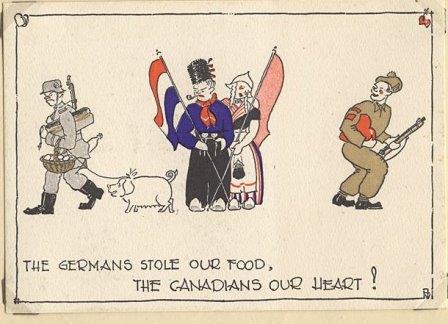
NFA03_dou-201-1_W

Cartoon found on geheugenvannederland.nl

Alice van Bekkum, Chair of the Face To Graves Foundation Groesbeek, has advised that stories and photos collected on those buried at the Canadian War Cemetery in Groesbeek are now online at www.facestograves.nl. She will be interviewed by CBC Calgary reporter Erin Collins on May 5.  (For more information see: Press Release Digital Monument May 2020)

Readers of this blog are aware of Pieter’s efforts to help the Foundation and other researchers with photos and stories about Prince Edward Island soldiers buried in The Netherlands. (See Photos and Info Requested For WW2 Soldiers From PEI Buried In The Netherlands)

Of the Islanders buried in Groesbeek, photos for all but two have been found.  Still missing photos are two who lost their lives in 1945:

  1. Joseph Edmond HENNEBERY, born in Morell, was with the Royal Canadian Engineers -33rd Field Company. He died on April 20, 1945, aged 25.  UPDATE: Photo found!
  2. Barney Ruben MCGUIGAN, born in St. Peter’s, son of Thomas and Sadie McGuigan, was with the North Shore (New Brunswick) Regiment. He died on February 26, 1945, aged 17.  UPDATE: Photo found!

If you have photos or information to share about Henneberry, McGuigan, or other Canadian soldiers buried in The Netherlands, please contact Pieter at memorialtrail@gmail.com or comment on the blog.

© Daria Valkenburg

….Want to follow our research?….

If you are reading this posting, but aren’t following our research, you are welcome to do so.  Our blog address: https://onthewarmemorialtrail.com/

4 countries, 6 weeks, 7,000 km – an unforgettable war memorial journey in Europe…. Daria’s book ‘No Soldier Buried Overseas Should Ever Be Forgotten‘ is available in print and e-book formats.  Net proceeds of book sales help support research costs and the cost of maintaining this blog. For more information see https://nosoldierforgotten.com/

You are also invited to subscribe to our YouTube Channel: On The War Memorial Trail With Pieter Valkenburg: https://www.youtube.com/channel/UCJ591TyjSheOR-Cb_Gs_5Kw

Never miss a posting!  Subscribe below to have each new story from the war memorial trail delivered to your inbox.

On The War Memorial Trail…..The WWII Seaman Who Was Hit By A Tram

April 5, 2020. Sometimes strange mishaps happen.  You’d expect that a seaman serving in Halifax, Nova Scotia would either be safe or, at worst, lose his life at sea.  But that’s not what happened to Singleton Charles JEFFERY!

20191221_154309 Singelton Jeffery newspaper from Mitch MacDonald

Singleton Charles Jeffery.  (Photo courtesy of May 17, 1941 edition of The Charlottetown Guardian, submitted by Mitch MacDonald. )

Jeffery was born on May 13, 1917 in Bayfield, New Brunswick, the son of Stephen and Alice Jeffery, and grew up in Cape Traverse.  After his father died, his mother remarried, to James Campbell.  A fisherman on the Island in pre-war years, he also worked as a seaman for Imperial Oil in Halifax, transporting oil, before enlisting with the Royal Canadian Naval Reserve in Halifax on May 5, 1940, Jeffery was also one of the few servicemen listed on the Cenotaph outside the Borden-Carleton Legion who was married and had children.  He married a few months after enlistment and, with his wife Mildred Catharina, had two children: Betty Patricia and Diane May.

While Jeffery served aboard Navy ships in the Atlantic Ocean, his family lived in Halifax, where he was based.  On the evening of December 1, 1943, while stationed at the H.M.C.S. ‘Stadacona’ navy base as a patrolman, he was fatally hit by a tram in Halifax.  (For more information on H.M.C.S. ‘Stadacona’, see https://en.wikipedia.org/wiki/CFB_Halifax#Stadacona)

A Board of Inquiry on December 27, 1943 found that: “…There was contributory negligence on part of the street car operator and the deceased.  The operator was negligent in that he did not bring the street car to a full stop or slow down to a minimum speed and ring his bell to indicate to the would-be passengers that he was not making the regular stop…

The Board noted that Jeffery was negligent in “…that he crowded so close to the street car tracks at a point twenty to thirty feet south of the regular stop that he was struck…”  The Board found that although Jeffery had “…consumed a considerable quantity of beer (ten glasses)…” he was not found to be drunk, but his “…judgment may have been impaired by effects of the beverage..”  An autopsy showed that he had a full stomach, indicating that he had eaten, and not just been drinking.

On December 29, 1943, during the Board of Inquiry, a witness who had been on the tram at the time of the accident testified that he did NOT hear the conductor sound the bell as the tram approached the stop. According to the customary practice, the tram operator was supposed to ring a bell if he was NOT going to stop and pick up passengers.  In his opinion, he believed that Jeffery “…thought the street car was going to stop and he started to go in front of it in order to cross the street….

Another witness at the December 29, 1943 Board of Inquiry testified that he and another sailor had also been hit by the tram, but were not seriously injured.  He too explained that he was of the opinion that since the tram operator was slowing down “…we had the idea that he was stopping…” When asked if the tram operator had rung his bell to indicate he was not stopping, the answer was no.

A colleague of Jeffery had been with him at the Canteen testified that although both of them had drunk beer, neither was drunk.  He explained that after leaving the Canteen, Jeffery “…intended going to the Nova Scotian to a dance…

In response to the inquiry by the Department of National Defence into the incident, on February 2, 1944, the Nova Scotia Light and Power Company, which operated the tram, wrote that according to the tram operator: “…when approaching the Navy entrance to the Wet Canteen, he noticed a group of sailors out on the streets and about the tracks. He sounded the gong and slowed down; the sailors cleared away for the passing of the tram, and he continued at slow speed.  When approximately 20 feet south of the point where the main group of sailors were standing, a man stumbled forward and struck the side of the right front corner post of the tram.  He was spun around and fell to the pavement on the western side of the tram tracks. Another sailor standing alongside the party who was struck attempted to grab him as he stumbled, but failed to reach him in time….

While the Board of Inquiry had multiple witnesses testify that the tram operator’s actions gave the impression that he was going to stop and pick up the waiting servicemen, the final opinion by the District Pensions Advocate of the Department of Pensions and National Health of the Veterans Bureau concluded that “…I am of the opinion that the injuries sustained by Jeffery were due to his own negligence in either standing too close to the tram track and failing to remove himself when he should have seen the tram proceeding towards him, or in stepping closer to the track after the front of the tram had safely passed him.  I think it is significant that the front of the tram did not hit Jeffery.

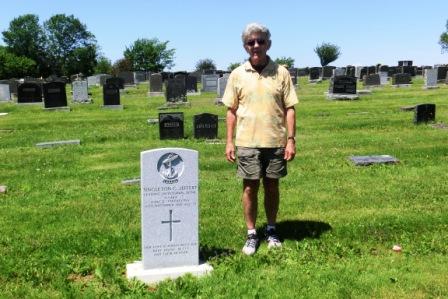
A victim of a tragic accident, Jeffery is buried at the Bedford Gate of Heaven cemetery in Nova Scotia, which we visited.

CIMG7699 Jul 10 2017 Pieter by Jeffery gravestone

Pieter by the grave of Singleton Charles Jeffery at the Bedford Gate Of Heaven Cemetery. (Photo credit: Daria Valkenburg)

Pieter is still looking for a better photo of Singleton Charles Jeffery, as well as photos and information on the names listed on the Cenotaph outside the Borden-Carleton Legion.  If you have an item to share please contact Pieter at memorialtrail@gmail.com or comment on the blog.

© Daria Valkenburg

….Want to follow our research?…

If you are reading this posting, but aren’t following our research, you are welcome to do so.  Our blog address: https://onthewarmemorialtrail.com/

4 countries, 6 weeks, 7,000 km – an unforgettable war memorial journey in Europe…. Daria’s book ‘No Soldier Buried Overseas Should Ever Be Forgotten‘ is available in print and e-book formats.  Net proceeds of book sales help support research costs and the cost of maintaining this blog. For more information see https://nosoldierforgotten.com/

Subscribe to our YouTube Channel: On The War Memorial Trail With Pieter Valkenburg: https://www.youtube.com/channel/UCJ591TyjSheOR-Cb_Gs_5Kw

Never miss a posting!  Subscribe below to have each new story from the war memorial trail delivered to your inbox.

Presentation On ‘He Died That We Might Live’ Documentary

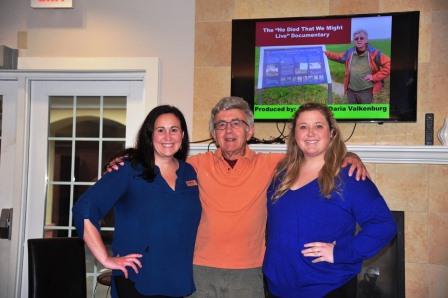
SCW_6868 Feb 20 2020 Pieter with Michel & Kaisha

Pieter with hotel manager Kaisha Talley on the right, and assistant manager Michel Settlemire on the left.  (Photo credit: Sandra Wallis)

March 21, 2020. When our documentary ‘He Died That We Might Live’ was made available on YouTube, we sent the link to people who had donated towards the memorial panel that was placed in Wons, The Netherlands on October 12, 2019.  (See “He Died That We Might Live” Video Is Now On YouTube) Some of the donors were our snowbird friends.  When we were together this winter in Florida, several asked for more information on the events in The Netherlands, and as more snowbirds learned about this event we found ourselves telling the story over and over again.

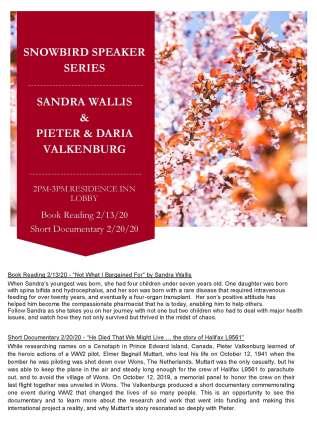
On February 20 we were invited to talk about the story behind the documentary and to show the documentary in our snowbird hotel.

Snowbird Speaker Series

Flyer advertising the presentation.

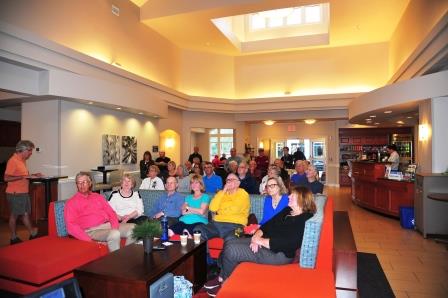
While there were a few Canadian snowbirds from Ontario and BC, the majority of the snowbirds that attended were American.  We were heartened and delighted at the appreciative and supportive response to a Canadian/Dutch story by our American friends.  The story of Halifax L9561 has no boundaries!

SCW_6875 Feb 20 2020 Snowbird Presentation

Pieter, standing at far left, during the Snowbird Speaker presentation on the documentary.  (Photo credit: Sandra Wallis)

Towards the end of the presentation, Pieter told the audience about the Faces To Graves project in The Netherlands, which is looking for photos and stories about all WW2 Canadian war dead buried in Dutch cemeteries. He also mentioned that a similar project was underway at the American War Cemetery in Margraten.

It was a fun afternoon, sharing our story and research.  Afterwards, Mary Ann Greiner was kind enough to email us, saying “Thank you for all the work you did to honor these men! What a wonderful accomplishment! Your presentation was very moving and informative. There are so many stories from the war that we don’t know. Thank you for the research you did to bring this story to life. It was a most memorable afternoon. I look forward to reading more on your work on your blog.

Pieter is still looking for photos and information on the names listed on the Cenotaph outside the Borden-Carleton Legion.  If you have an item to share please contact Pieter at dariadv@yahoo.ca or comment on the blog.

© Daria Valkenburg

The WWII Soldier From Emerald Junction Who Lost His Life In Italy

March 10, 2020. Among the names listed on the Cenotaph outside of the Borden-Carleton Legion are 4 that died in Italy during WWII.  One of these men was Ernest Murray NORTON (see The Last Valentine From A WWII Soldier).  This posting is about a young man who lost his life during the Battle of Moro.

George Alfred DUNN was born February 11, 1915 in Roseville, the son of Joseph J. Dunn and Mary Ellen Jones.  Dunn didn’t have an easy life.  His mother died when he was six.  His father died when Dunn was only 9 years old, and he was brought up by his uncle, William Dunn, of Emerald Junction.

A woodsman before enlisting with the Carleton & York Regiment in St. Stephen, New Brunswick on September 8, 1939, he received training in Woodstock, New Brunswick and then went to Europe with the first Canadian contingent, sailing to England on December 8, 1939 aboard the S.S. ‘Monarch of Bermuda’, and arriving on December 17.

Alfred Dunn

George Alfred Dunn. (Photo source: http://www.ancestry.com. Photo colourization: Pieter Valkenburg)

On May 8, 1941, he was temporarily attached for a month to the Guards Depot while at a Drill Instructors Course. Upon completion, he was sent to No.1 AFW RCOC in Aldershot for a few weeks while he completed a PT No. 32 Course. On October 18, 1941 he was promoted to Acting Lance Corporal. (NOTE: RCOC refers to Royal Canadian Ordnance Corps, a unit provisioning troops with the means to fight, such as uniforms, weapons and equipment.  AFW refers to Army Field Workshop.)

On May 16, 1942, he was promoted to Corporal, then on November 1942 he received another promotion, to Lance Sergeant, and was sent for more training.  On June 16, 1943 he was sent to Italy, and then, on August 25, 1943, he was promoted to Sergeant.

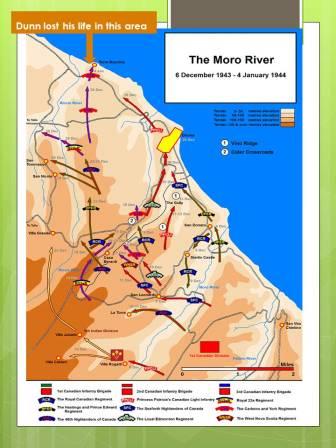
On December 6, 1943, Canadian forces, along with British, Indian, and New Zealand infantry divisions, began a series of large-scale assaults on major crossing points along the Moro River in Eastern Italy, with the objective of securing a large bridgehead along the defensive line. The intention was to breach the German Army’s Winter Line defensive system and advance to Pescara—and eventually Rome. (For more information see https://en.wikipedia.org/wiki/Moro_River_Campaign)

According to the War Diary of the Carleton & York Regiment for January 1944, the unit was in Ortona, Italy on January 1.  The weather was “dull and cloudy all day with rain during the evening” the report read, which went on to summarize what happened on December 31, 1943.  “The transport finds the going pretty heavy on account of the mud.  ‘A’ Company, who suffered the greatest during the Battle of Point 59 was brought back to a rear position where ‘B’ Company was and ‘B’ Company was placed at the front.” One of those wounded on December 31, 1943 was Sgt Dunn.  According to the casualty report, he received “shrapnel wounds to the right leg and multiple wounds to the face” while in action.

On January 2, 1944, Dunn died of injuries received in action during the Battle of Moro (Point 59). He’s buried at Moro River Canadian War Cemetery in Italy.

grave stone Sgt. G.A. Dunn (find a grave)

Grave of George Alfred Dunn at Moro River Canadian War Cemetery.  (Photo source: http://www.findagrave.com)

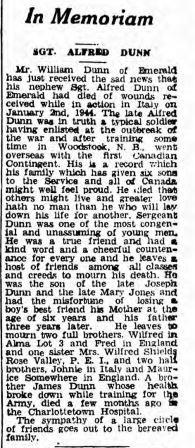
According to his obituary in the ‘Charlottetown Guardian’ of February 3, 1944, page 5, Dunn was part of a family that was in service, with a brother who had died a few months earlier.  “…He was a true friend and had a kind word and a cheerful countenance for every one…” it said.

Obituary G.A. Dunn, Charlottetown Guardian 03 february 1944 page 5

Obituary from the Charlottetown Guardian of February 3, 1944.

No family of George Alfred Dunn has been found as yet, unfortunately.  If you have information or photos to share please contact Pieter at memorialtrail@gmail.com, or comment on the blog. 

© Daria Valkenburg

….Want to follow our research?….

If you are reading this posting, but aren’t following our research, you are welcome to do so.  Our blog address: https://onthewarmemorialtrail.com/

Front cover OnTheWarMememorialTrailinEurope4 countries, 6 weeks, 7,000 km – an unforgettable war memorial journey in Europe…. Daria’s book ‘No Soldier Buried Overseas Should Ever Be Forgotten‘ is available in print and e-book formats.  Net proceeds of book sales help support research costs and the cost of maintaining this blog. For more information see https://nosoldierforgotten.com/ 

You are also invited to subscribe to our YouTube Channel: On The War Memorial Trail With Pieter Valkenburg: https://www.youtube.com/channel/UCJ591TyjSheOR-Cb_Gs_5Kw

Never miss a posting!  Subscribe below to have each new story from the war memorial trail delivered to your inbox.
The WW2 Volunteer Who Perhaps Should Never Have Enlisted

March 7, 2020. While researching the names on the Cenotaph outside the Borden-Carleton Legion Pieter uncovered the sad story of a man who perhaps should never have joined the military during WW2… Ernest Ramey GALLANT.

A labourer living in Borden (now Borden-Carleton) before the war, on January 23, 1940 he enlisted in the Royal Canadian Naval Reserve in Halifax as a stoker.  On his attestation paper he said he was born October 25, 1915 in Summerside, the son of John Peter Gallant and Mary Blanche Geneau. Gallant was assigned to H.M.C.S. Skeena on March 26, 1940.  On April 3, 1940, while the ship was in port in St. John, New Brunswick, he left the ship without leave and was arrested for being drunk and improperly dressed.  He was imprisoned for 60 days in Rockhead Prison in Halifax.

On June 3, 1940 he was removed from the Skeena and then discharged on August 1, 1940 ‘due to misconduct’ following a trial in Halifax on July 15, 1940.  According to the trial record, he was charged with damaging a screen door and resisting arrest by two officers.

That should have been the end of Gallant’s military service story, but on June 27, 1941 he enlisted with the North Nova Scotia Highlanders in Kentville, Nova Scotia, using a birthdate of October 26, 1914 and a birthplace of Borden.  On his attestation paper he denied having previous military service.

He was sent by his unit to England but spent most of the time in hospital or detention.  On January 14, 1942 he was sentenced to 6 months detention for striking an officer.  On February 5, 1942, while in detention, he incurred a self-inflicted gunshot wound in his thigh and spent the next months in hospital.  On August 20, 1942 he was sent to the No.1 Neurological Hospital for assessment. On September 28, 1942, a Medical Board placed him in Category ‘E’ for “chronic alcoholism and mental deficiency”, according to his Hospital Discharge Notification.  The case history report stated that “the patient was admitted with a long history of drunkenness and since enlistment he has failed to adjust to army routine……. His army behaviour has rendered him a liability…” On October 1, 1942 it was determined that he was mentally unfit to stand trial. It was recommended that he be sent back to Canada as it is clear that no action taken will … influence the soldier’s future behaviour as he requires institutional care, and will probably continue to require it.

He was returned to Canada and placed in Ste Anne de Bellevue Hospital in Montreal on April 16, 1943.  On April 29, 1943 he was formally discharged due to being “unable to meet the required military physical standards”. However, Gallant “refused to sign Discharge Proceedings.  On May 20, 1943 he died of toxemia and septic throat while at the hospital and was buried in Notre Dame des Neiges Cemetery, located in the borough of Côte-des-Neiges-Notre-Dame-de-Grâce, in Montreal.

grave stone Ernest Gallant

Grave of Ernest Ramey Gallant in Notre Dame des Neiges Cemetery in Montreal. (Photo source: http://www.findagrave.com)

Although Gallant died after being discharged, the military allowed that his death was “due to service”, meaning that he qualified for service medals and a military burial, giving a compassionate ending for this man’s family.  Unfortunately, no photo or family of Gallant have been found as yet.  If you have information or photos to share please contact Pieter at dariadv@yahoo.ca or comment on the blog.

© Daria Valkenburg

On The War Memorial Trail…..The WWII Able Seaman Who Died Of Peritonitis

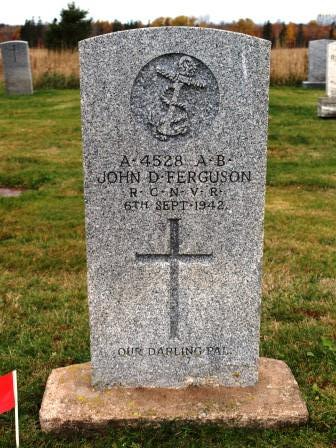
March 4, 2020. On the Cenotaph outside the Borden-Carleton Legion a few men lost their lives during wartime due to illness and are buried on home ground here on Prince Edward Island.  One of these men was John Daniel ‘Jack’ FERGUSON.  He was born October 27, 1922 in Borden (now Borden-Carleton), Prince Edward Island, the son of James Henry Ferguson and Margaret Ann Fraser.

When WWII broke out, Jack was anxious to serve and tried to enlist in Halifax but was refused due to his young age.  Instead he joined the Merchant Marines before successfully enlisting in the Royal Canadian Navy Reserve on May 5, 1941.  He was then placed on patrol duty out of Halifax, Nova Scotia.

Unfortunately, he became ill while serving aboard the patrol ship ‘Ross Norman’, and sent to Camp Hill Hospital in Halifax from the sick bay at H.M.C.S. ‘Stadacona’ on August 19, 1942.  His temperature kept spiking and lowering, with no known diagnosis able to be determined, even after blood tests. According to the medical report “….Each elevation in temperature was accompanied by a severe chill….

On August 30, 1942 he went into shock and at that point a diagnosis of peritonitis was made. (Per Wikipedia, peritonitis is inflammation of the lining of the inner wall of the abdomen and cover of the abdominal organs. Symptoms may include severe pain, swelling of the abdomen, fever, or weight loss.)  An operation was made, with two blood transfusions, and Jack appeared to improve over the next two days before worsening again.  Sadly, he died at 10:30 pm on September 6, 1942, just shy of his 20th birthday.

He was buried, with full naval honours, at St Peter’s Roman Catholic Cemetery in Seven Mile Bay.  A notice in the Summerside Journal, on 14 September 1942, page 2, recorded that “….A detachment from H.M.C.S. Queen Charlotte at Charlottetown attended and acted as pallbearers and guard of honor. Mr. Patrick Martin, president of the Summerside branch of the Canadian Legion, represented the veterans at the service….

OLYMPUS DIGITAL CAMERA

Gravestone for John Daniel “Jack” Ferguson at St. Peter’s Cemetery in Seven Mile Bay.  (Photo credit: Pieter Valkenburg)

Unfortunately, no photo or family of Ferguson has been found as yet.  If you have information or photos to share about John Daniel ‘Jack’ Ferguson please contact Pieter at memorialtrail@gmail.com or comment on the blog.

© Daria Valkenburg

….Want to follow our research?…

If you are reading this posting, but aren’t following our research, you are welcome to do so.  Our blog address: https://onthewarmemorialtrail.com/

4 countries, 6 weeks, 7,000 km – an unforgettable war memorial journey in Europe…. Daria’s book ‘No Soldier Buried Overseas Should Ever Be Forgotten‘ is available in print and e-book formats.  Net proceeds of book sales help support research costs and the cost of maintaining this blog. For more information see https://nosoldierforgotten.com/

Subscribe to our YouTube Channel: On The War Memorial Trail With Pieter Valkenburg: https://www.youtube.com/channel/UCJ591TyjSheOR-Cb_Gs_5Kw

Never miss a posting!  Subscribe below to have each new story from the war memorial trail delivered to your inbox.