On The War Memorial Trail….. The WW2 Pilot Who Lost His Life In The Netherlands On Christmas Eve

April 3, 2021. Sometimes a story is so sad that it’s difficult to write.  That was the case during our Memorial Trail visit in Europe in 2017 when we fulfilled a request by Paul Schurman to visit the grave of a WW2 RCAF serviceman who was a flying instructor at the No. 9 Service Flying Training School RCAF in Summerside, and boarded at the home of Paul’s parents.

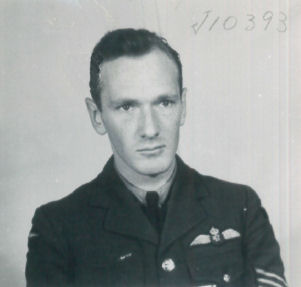
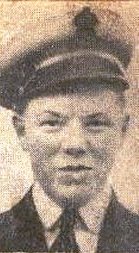
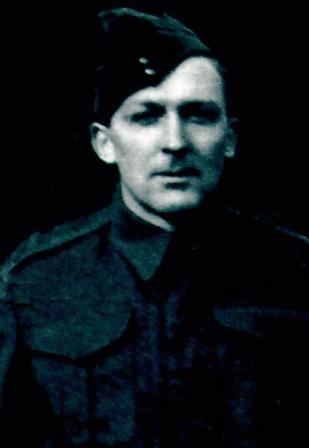
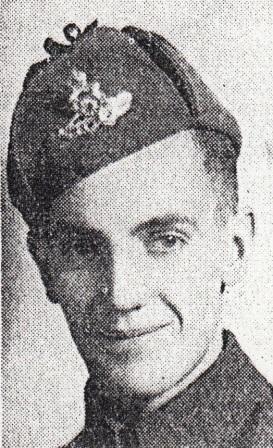
Leonard Arthur Unwin. (Photo source: Canadian Virtual War Memorial)

Flight Lieutenant Leonard Arthur UNWIN, born January 2, 1917 in Sheffield, England, was the son of James Arthur Unwin and Minnie Goswin, who immigrated to Windsor, Ontario, where Leonard grew up. He was married to Evelyn Marie Paris.

Leonard enlisted on June 6, 1940 in Windsor, Ontario and was in the first RCAF class held at Windsor Airport.  In addition to being a flying instructor in Summerside, he was also an instructor in Moncton, New Brunswick, before going overseas in May 1943.  He served in England, France, and Belgium.

On December 24, 1944 he left from his base in Belgium and was shot down in The Netherlands.  According to the British Royal Air Force report, Leonard was one of the pilots in a section of 4 Typhoon planes “….on an armed recce in the Utrecht area. The section sighted and duly attacked three lorries moving along a road south east of Amersfoort….

The first two planes encountered “…little flak...” Leonard was in the third plane.  The pilot of the 4th plane reported that “…by the time F/Lt Unwin and himself attacked, there was quite intense light flak coming from fields on either side of the road.  They dived from approximately 7,000 feet and he observed F/Lt Unwin’s strikes on the way down….” 

Unfortunately, Leonard’s plane “….continued in the dive and blew up either on hitting the ground, or quite close to it….

Leonard is not buried in one of the Canadian War Cemeteries, but in a municipal cemetery in Woudenberg, one of two Commonwealth burials in a huge cemetery …. Leonard Unwin and a pilot from New Zealand.

We were looking for the typical Commonwealth headstone we’d seen in other cemeteries, but were unsuccessful.  Since the cemetery was so big, Pieter and I split up, hoping one of us would be able to spot it.  Nothing.

Pieter had disappeared in another direction, looking for someone to help us.  Just as I was about to give up, the groundskeeper came by on his bicycle.  I asked him if he could speak English and he said yes.  (It’s amazing to me how it’s never Pieter, who speaks the language fluently, who has these encounters!)

Luckily for me, the groundskeeper, who introduced himself as Theo Imminkhuizen, said yes, and I explained that I was looking for a Commonwealth grave.  Theo noticed I was holding a Canadian flag (plus a PEI flag, which he would not have recognized) and asked if I was looking for a Canadian grave.  Yes, I said, and he offered to show me where it was. 

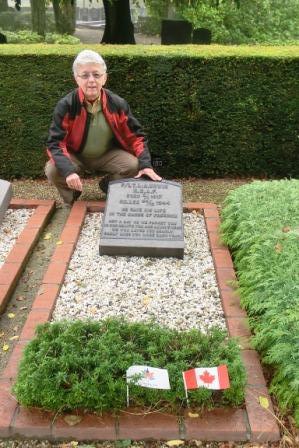
Pieter came by when he saw me talking to someone, so we all went together.  We were very lucky to have encountered Theo as we would not have found the grave.  Instead of a Commonwealth stone, it was a grave in the Dutch tradition.  The only thing different was that the headstone was written in English, instead of Dutch.  This was the same for the pilot from New Zealand buried next to Leonard.

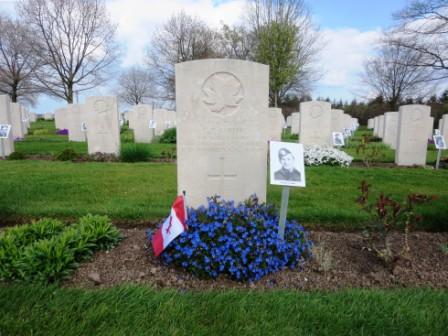
Pieter by the grave of Leonard Arthur Unwin. (Photo credit: Daria Valkenburg)

Paul Schurman had told Pieter that Leonard’s family had heard that when the plane crashed, Leonard’s body lay on the ground for days as the Germans refused to bury him, or to allow the Dutch to do so.  This was a warning of what happens to those who oppose the Germans, people were told. 

Pieter mentioned this horrible story to Theo, who confirmed it was true. He wasn’t buried until December 27.  If we didn’t mind to wait a few minutes, he had something to show us that he had in his office.

Commemorative plaque honouring Leonard Arthur Unwin. (Photo credit: Daria Valkenburg)

While Theo went upstairs to his office, an older man came by and stopped for a chat.  He introduced himself as Wout Blokhuis, and explained that he was a retired funeral director who had been involved in many burials in the cemetery.  Now retired, he likes to walk the cemetery grounds on a daily basis.

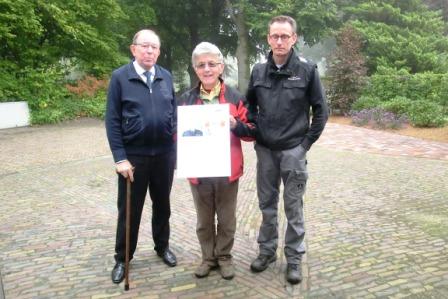
Theo returned with a plaque honouring Leonard, and said it’s put out by his grave every Liberation Day, on May 5.  The plaque is in Dutch, but Pieter was kind enough to provide this translation:

Leonard Arthur Unwin

Canadian Leonard Unwin stopped his education in 1940 to volunteer for the Canadian Air Force.  At the age of 27, he died during an attack on German troops.

On December 24, 1944, during an attack on an enemy target in the province of Utrecht, around 16:00 hours, he attacked a convoy of three German trucks on the Stationweg in Woudenberg.  During the dive, the plane’s tailpiece broke off, the plane destabilized, and crashed. 

In 2012, Leonard’s family visited Woudenberg from Canada.  They visited the site of the plane crash, and his grave.  They brought with them a small bag containing Canadian soil, to be spread on Leonard’s grave.

At the Woudenberg Municipal Cemetery.  Left to right: Wout Blokhuis, Pieter with the plaque, Theo Imminkhuizen. (Photo credit: Daria Valkenburg)

Thank you to Paul Shurman for bringing Leonard’s story to our attention, and a big thank you to Theo Imminkhuizen for his kindness in helping two Canadians find a grave.  If you have information to share about Canadian soldiers buried in The Netherlands, please email us at dariadv@yahoo.ca, comment on the blog, or send a tweet to @researchmemori1.  

You are also invited to subscribe to our YouTube Channel: On The War Memorial Trail With Pieter Valkenburg: https://www.youtube.com/channel/UCJ591TyjSheOR-Cb_Gs_5Kw

© Daria Valkenburg

On The War Memorial Trail….. The WWII Soldier From Indian River

March 29, 2021. In January, our first Atlantic Canada Remembers special feature included a photo of WWII soldier Charles ‘Charlie’ Borden TUPLIN of Indian River, Prince Edward Island, submitted by the Perry family of Nova Scotia. (See https://onthewarmemorialtrail.com/2021/01/07/on-the-war-memorial-trail-atlantic-canada-remembers-part-1/)

Charles Borden Tuplin

Charles Borden Tuplin. (Photo submitted by Gary Richard Perry)

Shortly afterwards we received another submission on Charles Borden Tuplin, this time from June Gillis.  “…Charlie Tuplin was our neighbour in Indian River when I was growing up, and he went overseas with my older brother, Bruce Gordon. Bruce survived the war, but Charlie didn’t...” she told us.  June’s late husband, Dr Wilfred R. ‘Bunny’ Gillis, grew up on a family homestead in Indian River, and also knew the Tuplin family.
CIMG5087 Mar 18 2021 Visit with June Gillis and Murphy

Pieter with June Gillis and her dog Murphy.  (Photo credit: Daria Valkenburg)

Born March 13, 1910 in Indian River, Charlie was the son of William and Minnie Tuplin, and worked as a fisherman and a miller prior to enlistment.  His father, who died in 1944, was a miller.

 “…The Tuplin family members were very musical...” June recalled, “…and Charlie played the violin….

On September 3, 1939, Charlie enlisted with the PEI Highlanders, but was discharged in July 1940 after falling ill with tonsillitis.  In September 1940 he re-enlisted with the PEI Light Horse Regiment, with the rank of Sergeant, and became an instructor at the Canadian Army (Basic) Training Centre #62 in Charlottetown.

In 1943 he was in Aldershot, Nova Scotia, taking advanced infantry training.  His service file notes that in an interview he was “…anxious to proceed overseas…

In June 1944, he requested a demotion to Corporal so that he could serve overseas.  This was granted on June 25, 1944, and he left for the United Kingdom the next day. On August 18, 1944 he was in France with the PEI Light Horse Regiment.  On October 13, 1944 he was transferred to the Black Watch Regiment’s D Company, Platoon 18.

The Perry family had written that…He was shot on December 7, 1944, was taken as a POW but died the next day…” This matches what is in Charlie’s military service file, but an account by the late William McNally of Summerside, who was interviewed by Charlie’s cousin Ann Tuplin Nunes, gave a different version of how Charlie lost his life.

According to William McNally, as per an account by Ann Tuplin Nunes that June Gillis shared with us, on December 7, 1944, he and Charlie “…were stationed by the Maas River in Holland. In order to enable Canadian soldiers to cross the river, a makeshift bridge was made by putting planks over little boats...

While crossing the bridge, the two men were talking to each other, and crossed to the other side safely.   “….They got to the other side and went a quarter mile along the river when they ran into the German army….

The officer in charge, Major E.W. HUDSON, had decided upon a “…hit and run raid to try to get prisoners and find out from them what was going on in the German lines….” The Canadian soldier contingent drove the Germans back “….one-half mile. By then it was the middle of the night.  They came to a village where there were three houses which stood out from the others….

McNally, Tuplin, and two other soldiers “…headed for these houses because there was a lot of shooting coming from that direction…”  The men thought German soldiers were in the houses, and they wanted to “…knock out the machine guns….

Unfortunately, the men were being shelled with mortar bombs.  “…Charlie was to the right of McNally and ten or twelve feet ahead of him. McNally saw Charlie falling.  He hit the ground and never moved...

McNally ran to check on Charlie, but he appeared lifeless.  After turning him over, McNally noticed that “…there was blood on his neck...”  He may have been wounded in more than one place, as McNally believed that “…if he was wounded only in the neck, he should have showed some sign of life….”  There was speculation that he may have been “…shot in the lower stomach and killed instantly….

Stretcher bearers were sent for, while McNally and the other men continued on their mission.  “…The next day, McNally inquired as to what had happened to Charlie and was told that, when the soldier with the stretcher bearers returned, Charlie’s body could not be found….

The Black Watch war diary entry for December 7, 1944 indicates that the unit was just east of Mook, a town along the Maas River.  The following casualties were reported:

Killed: A/Sgt Leonard John KING, Pte Joseph S R PELLAND, Pte James Bissett WATT

Missing: Lt Thomas Wilson MACKENZIE, Pte Robert Albert MARTIN, Cpl Charles Borden TUPLIN, L/Cpl George Frederick ELLIOTT, Pte Joseph Edward WALKER

In addition, 14 men were wounded. According to research by the Groesbeek Airborne Friends, this December 7, 1944 event was named ‘Operation Mickey Finn’.

Pieter decided to look at the service files of the other soldiers reported missing, to see if more clarity about what happened and the exact location could be determined.  He discovered that all of the missing had died, and, with the exception of Charlie Tuplin, had been temporarily buried in the area.

The service file for Lt MacKenzie had an account that differed in some respects from William McNally’s recollections.

On December 14, 1944, a ‘Questionnaire On A Missing Officer Or Soldier’ included testimony by Major Hudson in which he stated that Lt MacKenzie was last seen by “…Pte C A CHARRON and Pte W J STEPHENS…” With them was “… Cpl C B TUPLIN…

MacKenzie was leading his men in an attack when he was “…wounded on the enemy position.  Attempts were made to evacuate him but the men carrying him were also wounded.  One man managed to evacuate himself and told the stretcher bearers that Lt MacKenzie was wounded, but they were unable to find him...

Both Pte Stephens and Charlie Tuplin were wounded.  Pte Charron was the soldier able to escape and go for help.  His statement recorded that “… At approximately 20:15 hours on December 7, 1944, I was with Lt T W MacKenzie about 10 yards from house 25.  I heard Lt MacKenzie call out for help, saying he had been hit...

After learning that MacKenzie had been hit in the back and was paralyzed, “... Cpl C B Tuplin and I tried to drag Lt MacKenzie out as we were too exposed walking.  After going about 15 feet we found we couldn’t manage so called to Pte W J Stephens to help us.  Before he got to us Cpl Tuplin was hit.  Lt MacKenzie and Cpl Tuplin told us to go for a stretcher bearer…

Stephens and Charron left, but “… after going about 15 yards, Pte Stephens was hit, so I kept going and told two of the stretcher bearers where I had left Lt MacKenzie and Cpl Tuplin. They made a search of the ground but were unable to find either of the wounded men….

MacKenzie and Tuplin were missing, but Stephens was found and hospitalized.  Like Charlie Tuplin, Lt MacKenzie was initially recorded as a prisoner of war. MacKenzie’s body was later found buried in a temporary cemetery, near where he lost his life.

According to Charron’s testimony, Charlie Tuplin was alive after being hit.  Perhaps William McNally came across Charlie Tuplin after Pte Charron left to go for help.  In the dark and under mortar fire attack, it’s very likely that he would not have seen Pte Stephens or Lt MacKenzie.  It’s also possible that William McNally found another soldier that he mistook for Charlie.
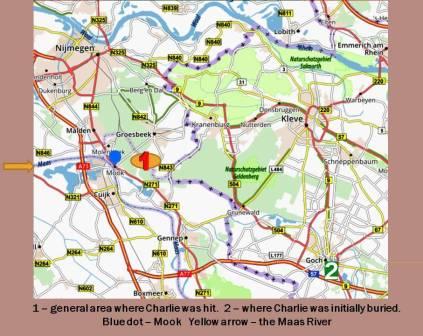
Map Goch to Mook

Map shows area of the action on December 7, 1944, and the location in Goch where Charlie Tuplin’s body was initially buried. (Map source: https://www.viamichelin.com)

Although the official records state that Charlie died while a prisoner of war on December 8, 1944, McNally believed that “…he died the night of December 7th and was never a prisoner….

What happened to Charlie Tuplin?  After the war ended, Charlie was identified, through his dental records, as a soldier buried in a public cemetery near Goch, Germany.  This is not near where he was hit, and he is the only one of the missing men identified in the war diary that was not initially buried near the location where they fell.

Therefore, the information in his service file is likely correct.  He was picked up by German soldiers while still alive, died shortly afterwards, and was buried by the Germans.

Lt MacKenzie was reburied in the Canadian War Cemetery in Groesbeek, as were the other missing men.  Charlie Tuplin was reburied in the Canadian War Cemetery in Holten, The Netherlands.
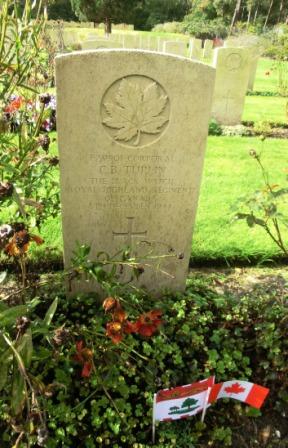
CIMG3207 Oct 3 2019 Holten Charles Tuplin

Grave of Charlie Tuplin in the Canadian War Cemetery in Holten.  (Photo credit: Daria Valkenburg)

Thank you to June Gillis for sharing information about Charles ‘Charlie’ Borden Tuplin.  If you have information to share about Canadian soldiers buried in The Netherlands, or memories to share about Charles Borden Tuplin or the other soldiers mentioned in this posting, please email us at memorialtrail@gmail.com, or comment on the blog.  

© Daria Valkenburg

…Want to follow our research?….

If you are reading this posting, but aren’t following our research, you are welcome to do so.  Our blog address: https://onthewarmemorialtrail.com/
Front cover OnTheWarMememorialTrailinEurope4 countries, 6 weeks, 7,000 km – an unforgettable war memorial journey in Europe…. Daria’s book ‘No Soldier Buried Overseas Should Ever Be Forgotten‘ is available in print and e-book formats.  Net proceeds of book sales help support research costs and the cost of maintaining this blog. For more information see https://nosoldierforgotten.com/ 

Screenshot_2021-02-27 On The War Memorial Trail With Pieter Valkenburg

You are also invited to subscribe to our YouTube Channel: On The War Memorial Trail With Pieter Valkenburg: https://www.youtube.com/channel/UCJ591TyjSheOR-Cb_Gs_5Kw.

Never miss a posting!  Subscribe below to have each new story from the war memorial trail delivered to your inbox.

On The War Memorial Trail….. Atlantic Canada Remembers – Part 8

March 16, 2021. More of the photos submitted by Atlantic Canadians of soldiers buried overseas are featured in this posting. Pieter is ensuring that every email is acknowledged, and that the photos of soldiers buried in The Netherlands are forwarded to the appropriate cemetery for their digital archives.  Thank you to the members of Royal Canadian Legions in Nova Scotia and New Brunswick for their help.

Soldiers buried at the Canadian War Cemetery in Holten, The Netherlands

Fryday published in Toronto Newspaper

George Albert Fryday.  (Photo submitted by Marion Fryday-Cook.)

Marion Fryday-Cook, President of the Royal Canadian Legion’s Nova Scotia/Nunavat Command, submitted a photo of George Albert FRYDAY, explaining that “I am a relative of Rifleman George A. Fryday, Service Number B/136751, who is buried in Holten Canadian War Cemetery, Netherlands.  He was born in Toronto, Ontario. Thank you for honouring our fallen….” 

At the age of 15, George joined the Merchant Marine, and later the Royal Canadian Navy Volunteer Reserve.  However, once it was established that he was under age, he was discharged.  At the age of 17, he enlisted in the Canadian Army and was sent overseas in December 1944.  He was serving in the Queen’s Own Rifles Regiment when he lost his life on May 4, 1945, aged 19. 

Frederick Joseph Tait

Frederick Joseph Tait. (Photo submitted by the Grand Falls branch of the Royal Canadian Legion)

Patrick Côté of the Royal Canadian Legion, Branch 21 in Grand Falls, New Brunswick, submitted a photo of Frederick Joseph TAIT, born April 26, 1921 in Grand Falls, New Brunswick, the son of Herbert Henry Tait and Louise Emeline Leclair.

Patrick referenced a book, ‘Military Heritage – The Greater Grand Falls Region’, by Jean-Guy Plourde, which explained that “…. Prior to the war, he worked in a grocery store…”  Before enlistment on February 1, 1943 in Fredericton, he served in the New Brunswick Cadet Corps, and had been an Instructor in Infantry Training with the 2nd Carleton & York Regiment since 1940.

According to the Personnel Selection Record of his service file, he was fluent in both French and English and was assessed as “…good NCO instructor material…”  (NCO refers to Non-Commissioned Officer.)  He had a “…confident bearing…” and “…stability above average….” Unfortunately, his educational background was “…not high enough for commissioned rank…” 

After being deployed overseas in December 1943 he served in Sicily, where he fell ill and was hospitalized for 8 months.  After being released from hospital, he “…went on leave to England….” Over Christmas 1944 he was able to meet his brother Clair, also with the Canadian Army.

Clair survived WWII but Frederick didn’t.  While serving with the Carleton & York Regiment as the unit advanced to the Apeldoorn Canal in The Netherlands on April 15, 1945, he lost his life and was temporarily buried in Posterenk, near Zutphen.

CIMG9297 Sep 25 2017 Edwin and Pieter with CYR list

Edwin van der Wolf and Pieter in Posterenk in 2017.  Pieter holds up a list of the 6 Carleton & York Regiment soldiers who were temporarily buried in the village.  (Photo credit: Daria Valkenburg)

In September 2017, Pieter and I visited the village of Posterenk with Edwin van der Wolf, one of the research volunteers at the Canadian War Cemetery in Holten.  Edwin explained that “… the Carleton & York Regiment came from Italy to Marseilles, and then into The Netherlands where, on April 13, 1945, the village of Posterenk was liberated.  Six soldiers from the Regiment were buried here temporarily….” 

Edwin gave us a list of the 6 soldiers from the Carleton & York Regiment who were temporarily buried in the village.  Frederick Joseph Tait was one of these men!

Posterenk list of 6 CYR members

List of 6 Carleton & York Regiment soldiers temporarily buried in Posterenk in 1945.

Soldiers buried at the Canadian War Cemetery in Groesbeek, The Netherlands

Photo Burgess Porter

Burgess Allison Porter.  (Photo submitted by Everett Dalton)

Everett Dalton submitted a photo of Burgess Allison PORTER, writing that Burgess was “…the son of Annie ‘Laura’ (nee Porter) McCall…Born October 2, 1922 in Grafton, Nova Scotia, his mother died when he was 2 years old.  Although his biological father, Reg McCall was still alive, it was his mother’s wish that her son be raised by “…Frank Oscar and Lennie Alma (nee Pineo) Porter….”  

While not formally adopted, he was raised by them and was known by the surname Porter. His service file identifies Frank and Lennie Porter as his grandparents. 

Born October 2, 1922, Burgess was from Grafton, Nova Scotia, and a store clerk before he enlisted in Halifax on April 14, 1941.  On January 20, 1942 he arrived in the United Kingdom as part of the Artillery Holding Unit, and in April 1942 was attached to the 4th Field Regiment of the Royal Canadian Artillery as a bombardier. 

On July 7, 1944 his unit landed in France, and unfortunately Burgess was killed on February 21, 1945 in Germany and was temporarily buried in Bedburg, Germany.

Soldiers buried at the Canadian War Cemetery in Bergen Op Zoom, The Netherlands

Clayton Wilfred Shannon virtual war memorial BoZ

Clayton Wilfred Shannon.  (Photo from Canadian Virtual War Memorial)

Patrick Côté of the Royal Canadian Legion, Branch 21 in Grand Falls, New Brunswick sent the link to the Canadian Virtual War Memorial page for Clayton Wilfred SHANNON, who had served with the Calgary Highlanders and lost his life on September 22, 1944.

Patrick referenced a book, ‘Military Heritage – The Greater Grand Falls Region’, by Jean-Guy Plourde, which explained that Clayton, born August 2, 1920 in Grand Falls, the son of Frederick Herman Shannon and Bertha Mulherin, “…was musically inclined… playing guitar and singing.  Before his army service, he had even made a couple of records….

In 1940 “…with his cousin, Adrien Mulherin, he left home to enlist in the Carleton & York Regiment….”   After serving 4 years in Canada, he went overseas “…in July 1944, with the Calgary Highlanders…. While in combat near the border of Holland and Belgium, Clayton was killed, only a few weeks after arriving in Europe…

Clayton lost his life in Belgium during the Battle of the Scheldt, and was initially buried in Wommelgem, on the outskirts of Antwerp, one of 11 members of the Calgary Highlanders buried there before being reburied in Bergen Op Zoom. (For more information on what happened in Wommelgem, see https://onthewarmemorialtrail.com/2021/02/13/on-the-war-memorial-trail-the-search-for-soldiers-who-died-in-wommelgem-belgium-in-fall-1944/)

Gregory P. A. McCarthy (2)

Gregory Philip Anthony McCarthy.  (Photo submitted by the Grand Falls branch of the Royal Canadian Legion)

Patrick Côté of the Royal Canadian Legion, Branch 21 in Grand Falls, New Brunswick, submitted a photo of Gregory Philip Anthony MCCARTHY, born February 28, 1922 on a farm in California Settlement in Grand Falls, son of Thomas and Agnes McCarthy. 

Patrick referenced a book, ‘Military Heritage – The Greater Grand Falls Region’, by Jean-Guy Plourde, which explained that Gregory “…was the youngest of 11 children….He had …. helped on the farm for 8 years and also worked in lumbering prior to his enlistment…. On 26 March 1941 Gregory enlisted in the Canadian Army at Woodstock, NB…

After completing his basic training, he was “… transferred to the 1st Battalion New Brunswick Rangers….on 19 May 1941….”  After a promotion to Lance Corporal on December 1, 1941 he went to Labrador as a Driver Mechanic. 

On September 10, 1943 he left for the United Kingdom “… where he completed a mortar course and remained until his deployment to France with the 10th Independent Machine Gun Company, NB Rangers, arriving on 22 July 1944….

His commanding officers described him as “…dependable, reliable, and well-thought of in his unit….”  While serving in Germany and The Netherlands, he was a member of a mortar detachment responsible for engaging the enemy. On January 19, 1945, near Waalwijk in The Netherlands, their own mortar misfired and exploded, causing 3 members of the team to be seriously wounded, with fatal consequences for Gregory.  He was initially buried in Tilburg.

Thank you to Patrick Côté, Everett Dalton, and Marion Fryday-Cook for sharing photos and anecdotes.  Atlantic Canadians remember their loved ones who are buried overseas.

More photos and stories in Atlantic Canada Remembers – Part 9! To share photos or information, please email Pieter at memorialtrail@gmail.com, or comment on the blog. 

© Daria Valkenburg

…..Previous postings in the Atlantic Canada Remembers series….

Missed the previous postings in this series? See:

…..Want to follow our research?….

If you are reading this posting, but aren’t following the blog, you are welcome to do so.  Our blog address: https://onthewarmemorialtrail.com/

Front cover OnTheWarMememorialTrailinEurope4 countries, 6 weeks, 7,000 km – an unforgettable war memorial journey in Europe…. Daria’s book ‘No Soldier Buried Overseas Should Ever Be Forgotten‘ is available in print and e-book formats.  Net proceeds of book sales help support research costs and the cost of maintaining this blog. For more information see https://nosoldierforgotten.com/

Screenshot_2021-02-27 On The War Memorial Trail With Pieter Valkenburg

You are also invited to subscribe to our YouTube Channel: On The War Memorial Trail With Pieter Valkenburg: https://www.youtube.com/channel/UCJ591TyjSheOR-Cb_Gs_5Kw

Never miss a posting!  Subscribe below to have each new story from the war memorial trail delivered to your inbox.

On The War Memorial Trail….. The WWII Soldier From St Stephen Who Was A Teacher

March 7, 2021.  Last fall, the researchers at the Canadian War Cemetery in Holten, The Netherlands sent Pieter a photo wish list of 6 soldiers from the Cape Breton Highlanders who had died in the Battle of the Delfzijl Pocket.  (For more information on the Battle of the Delfzijl Pocket, see https://www.canadiansoldiers.com/history/battlehonours/northwesteurope/delfzijlpocket.htm)

Len Boudreau of the Cape Breton Highlanders Association was able to provide photos of 3 of the men,  Pieter found one on the Canadian Virtual War Memorial website, leaving 2 to try and find:  Philip Hubert LONG of Nova Scotia, and Norman James NIXON of New Brunswick.

A radio interview with CBC’s Maritime Noon about Philip Long resulted in family contacting Pieter immediately, and a photo was soon provided.  (See https://bordencarletonresearchproject.wordpress.com/2020/11/01/on-the-war-memorial-trail-a-face-for-philip-hubert-long/)

In trying to find family of Norman Nixon, Pieter sent a letter to the editor of the St. Croix Courier newspaper.  (See https://bordencarletonresearchproject.wordpress.com/2020/10/17/on-the-war-memorial-trail-continuing-the-search-for-soldiers-killed-in-action-in-ww1-and-ww2/)  Legion member Kent Caldwell sent a photo and story from the New Brunswick Military Service Recognition booklet.

It was a rare occasion that every photo request on a list could be fulfilled, but it happened! But then, the grandson (and namesake) of Norman Nixon contacted us.  “….We have quite a bit of information…..” he said.  Did we want to meet?

CIMG4775 Oct 25 2020 Pieter sorts through material compiled by the Nixon family

Pieter goes through the information saved by the Nixon family. (Photo credit: Daria Valkenburg)

Normally that would not be a problem, but with Covid-19 restrictions, we had to think twice.  The Atlantic Bubble was still open, so Pieter said a firm YES! and we made the trip to Harvey, New Brunswick to meet Norman Nixon and his wife, Kelley Gowan.

CIMG4560 Lt Norman Nixon

Norman James Nixon. (Photo courtesy of Nixon family)

Norman James Nixon was born in St. Stephen, New Brunswick, the son of Edward A. Nixon and Winnifred Trafton, and lived in nearby Mayfield.  A well-regarded schoolteacher before his enlistment, he married Berla Mae Lowery on July 29, 1940.  In 1941 they welcomed the birth of their son, Vernon James.

20201024_160813 Norman and Berla with son Vernon

Norman and Berla Mae Nixon with their son Vernon, circa 1943.  (Photo courtesy of Nixon family)

On July 20, 1940 Norman had enlisted with the Reserve Unit of the Carleton & York Regiment, but was discharged due to illness.  On February 6, 1942 he re-enlisted, this time with the Active Unit of the New Brunswick Rangers, and served with this unit in Labrador, and Canada from February 6, 1942 to July 12, 1944, and England from July 13 to August 21, 1944.

In 1944 he transferred to the Cape Breton Highlanders, and served in Italy from August 22, 1944 to February 19, 1945, and Northwest Europe in France and The Netherlands from February 20 to April 30, 1945.  He was known as ‘Nick’ by his fellow soldiers.

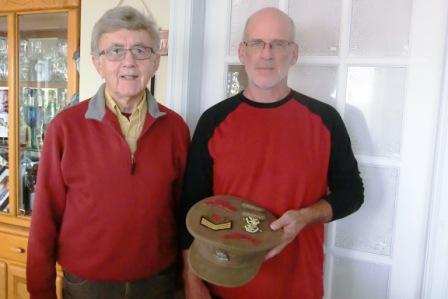
CIMG4767 Oct 25 2020 Pieter and Norman with cap and badges

Pieter and Norman Nixon.  Norman holds his grandfather’s cap and a number of the badges that Lt. Nixon had earned during his service.  (Photo credit: Daria Valkenburg)

After surviving action in Italy and France, Lt Nixon’s luck ran out near the end of WWII, when he was killed by shrapnel on April 30, 1945 during the Battle of the Delfzijl Pocket.

A May 6, 1945 letter to Bella Mae, from Norman’s Commander, Lt Colonel R B Sommerville, explained what happened.  “…Nick was killed in action at night by shell fire during a counter attack on his platoon position.  He died instantly.

At the time he was hit he was encouraging his men who were being hard pressed by fire from the part of Delfzijl on the Ems estuary….

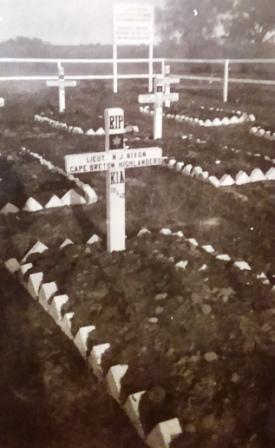
He was initially buried in the village of Wirdum, as Lt Col Sommerville explains further in his letter.  “…his example and devotion to both his troops and duty won for him the affection and respect of officers and men alike….. At a little service in the village of Wirdum near Groningen with a brother officer and 17 of our men he was buried the next afternoon.  We will all miss him….”  The other officer mentioned as being buried was Lt B H NUNN of Halifax.

On May 10, 1945, Major P J Stephen also wrote a letter to Bella Mae, providing more details on how her husband lost his life.  “…On the evening of the 30th of April we were holding a position which we had taken the night before.  Things were quite bad as we were being heavily shelled. The men were getting jittery from loss of sleep and constant hammering.  

After each shelling Nick would jump from his trench and stroll about the platoon area as if he were in his own garden, joking with the men, caring with a smile for all their needs, setting the example to them of a first class soldier and leader.  During one of these tours Nick was fatally wounded by shrapnel from a shell which burst a few yards away. 

It was impossible to save him although we gave him medical aid immediately.  Nick passed away without regaining consciousness…

20201024_194850 Grave of Norman J Nixon in 1945

Initial burial of Norman Nixon in Wirdum. Photo sent by Lt Stackhouse.  (Photo courtesy of Nixon family)

On August 19, 1945, Lt Ron V Stackhouse wrote to Bella Mae. “…I was with ‘Nick’ on the last night about an hour before he was killed as we had both had supper together at Company Headquarters and he and I walked back to our platoons together as our platoons were right alongside of each other….”   In a postscript he mentions enclosing a photo of the grave.

After WWII ended, Lt Nixon was reburied in the Canadian War Cemetery in Holten, The Netherlands.

nixon, norman james from Holten Cemetery sent by Edwin

Grave of Norman Nixon at the Canadian War Cemetery in Holten. (Photo sent by Edwin van der Wolf.)

Visiting with Norman Nixon and Kelley Gowan and learning about Norman’s grandfather was a privilege.  But they had a surprise for us.  Norman’s father Vernon and Vernon’s wife Donna came from Grand Manan Island to meet us.

CIMG4779 Oct 25 2020 Norman and Vernon Nixon

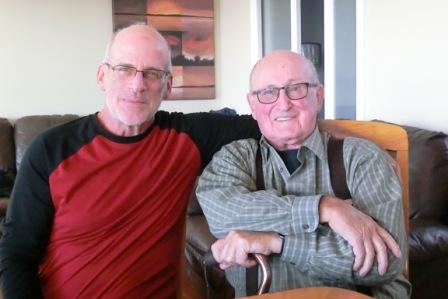
Norman and Vernon Nixon, grandson and son of Lt Nixon. (Photo credit: Daria Valkenburg)

More memories and stories were shared, including that Vernon’s mother, Bella Mae, owned a dress shop, ‘The Hat Box’, in St. Stephen.  She was an independent woman, and never remarried after her husband’s death.

CIMG4781 Oct 25 2020 Pieter & Daria with Vernon & Donna Nixon

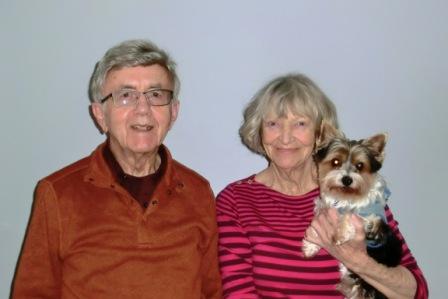
A final photo before we left to go back home.  Pieter and I with Vernon and Donna Nixon.  (Photo credit: Kelly Gowan)

With both the son and grandson of Lt Nixon together in one place, we asked if they wanted to share a few thoughts for a video to be sent to the Info Centre at the cemetery in Holten.  Here is the result, entitled ‘In Remembrance of Lt. Norman J. Nixon’:

It’s always an honour to meet the families of the soldiers that Pieter researches, and we hope to meet more families as travel restrictions get eased.

The 6 soldiers from the Cape Breton Highlanders on the photo wish list were:

  • Philip H. LONG, born Pictou, Nova Scotia, died April 30, 1945.
  • James Bernard MACINNIS, born Sydney, Nova Scotia, died May 1, 1945.
  • Olen B. MARSHALL, born Bridgetown, Nova Scotia, died May 1, 1945.
  • Norman James NIXON, born St. Stephen, New Brunswick, died April 30, 1945.
  • Ford Hilton SPIDLE, born Parkdale, Nova Scotia, died May 1, 1945.
  • Robert B. THOMAS, born Louisburg, Nova Scotia, died May 5, 1945.

The family of Ford Hilton SPIDLE participated in the Atlantic Canada Remembers series of postings, and you can read his story here: https://onthewarmemorialtrail.com/2021/01/07/on-the-war-memorial-trail-atlantic-canada-remembers-part-1/

Thank you to Norman Nixon and Kelley Gowan for their warm hospitality and for sharing information about Lt Nixon, and thank you to Vernon and Donna Nixon for making the trip from their home to meet with us and share memories about Vernon’s father.  It’s very clear that Lt Nixon was deeply loved and respected, and his death, so close to the end of the war, was an immeasurable loss.

Heartfelt thanks go to post-production editor Wendy Nattress, who made the YouTube tribute to Lt Nixon a reality.

20 members of the Cape Breton Highlanders lost their lives in the Battle of the Delfzijl Pocket.  If you have information or photos to share on any of these men, please email us at memorialtrail@gmail.com, or comment on the blog.

© Daria Valkenburg

…Want to follow our research?…

If you are reading this posting, but aren’t following our research, you are welcome to do so.  Our blog address: https://onthewarmemorialtrail.com/

Front cover OnTheWarMememorialTrailinEurope4 countries, 6 weeks, 7,000 km – an unforgettable war memorial journey in Europe…. Daria’s book ‘No Soldier Buried Overseas Should Ever Be Forgotten‘ is available in print and e-book formats.  Net proceeds of book sales help support research costs and the cost of maintaining this blog. For more information see https://nosoldierforgotten.com/

Screenshot_2021-02-27 On The War Memorial Trail With Pieter Valkenburg

Why not subscribe to: On The War Memorial Trail With Pieter Valkenburg: https://www.youtube.com/channel/UCJ591TyjSheOR-Cb_Gs_5Kw

Never miss a posting!  Subscribe below to have each new story from the war memorial trail delivered to your inbox.
On The War Memorial Trail….. Atlantic Canada Remembers – Part 7

February 22, 2021. We continue to feature more of the photos submitted by Atlantic Canadians of soldiers buried overseas. Pieter is ensuring that every email is acknowledged, and that the photos of soldiers buried in The Netherlands will be forwarded to the appropriate cemetery for their digital archives.  Thank you to the various members of Royal Canadian Legions in Nova Scotia and New Brunswick for their help.

The volunteers at all three Canadian War Cemeteries in Holten, Groesbeek, and Bergen Op Zoom are now active, and Pieter has received wish lists for photos from all three cemeteries.  Submissions for soldiers buried in municipal cemeteries are being held until Pieter gets the go-ahead that those volunteers are active again.

Soldiers buried at the Canadian War Cemetery in Holten, The Netherlands

Ken Dennis of Yarmouth let us know about the Wartime Heritage Association website, which features some of the soldiers from the area who served in WW2.  One of the profiles, written by Flip Jonkman, was of a soldier on the photo wish list of the Canadian War Cemetery in Holten…. Brenton Leroy RINGER. (See http://wartimeheritage.com/whaww2ns2/wwii_ringer_brenton_leroy.htm)

Born on March 22, 1925 in Northfield, Nova Scotia, the son of Ralph and Alberta Ringer of Clementsport, he was an electrician’s helper when he enlisted, at age 18, with the North Nova Scotia Highlanders in Halifax on January 17, 1944.  He later transferred to the 10th Armoured Regiment on March 27, 1945, and lost his life on April 12, 1945 during the liberation of Heino, The Netherlands, when the Sherman tank he was in was hit on the road to Zwolle. 

There were 5 men in the tank, with one survivor.  The survivor knocked on the door of a nearby farmhouse to ask for help, the home of Flip Jonkman’s parents.  Flip was not born at the time, but always remembered the story, and in 2020, was instrumental in getting a memorial stone placed near the site of the attack.  (See the article in Dutch for more information: https://www.destentor.nl/raalte/vurige-wens-in-vervulling-voor-flip-jonkman-73-uit-heino-nu-gedenksteen-is-geplaatst~a694b86d/?referrer=https%3A%2F%2Fduckduckgo.com%2F)

Another of the names on the photo wish list for the Canadian War Cemetery in Holten was found on the Wartime Heritage Association website…. that of Louis Graham RICHARD. (See http://wartimeheritage.com/whaww2ns/wwii_richard_louis_graham.htm)

Born February 13, 1918, the son of Raphael Daniel and Mary Ann Richard of Londonderry, Nova Scotia, Louis was a store clerk before enlisting with the No 2 Canadian Armed Corps in Halifax on February 17, 1943 as a trooper.  On October 14, 1944 he was sent to the United Kingdom, and then on March 31, 1945 to Western Europe with the 9th Armoured Regiment (BC Dragoons).  

Louis was killed in action in The Netherlands during the Battle of Delfzijl Pocket on April 26, 1945, at the age of 27, and was temporarily buried in Wirdum in the province of Groningen, The Netherlands before being reburied in the Canadian War Cemetery in Holten. (For more information on this battle, see https://www.canadiansoldiers.com/history/battlehonours/northwesteurope/delfzijlpocket.htm)

Soldiers buried at the Canadian War Cemetery in Groesbeek, The Netherlands

Percy Clayton Cromwell photo only

Percy Clayton Cromwell.  (Photo submitted by Ken Dennis)

Ken Dennis submitted a photo of Percy Clayton CROMWELL, explaining that “…I am a member of the Yarmouth Branch 61 Legion…” After receiving a wish list of photos from Pieter, he noticed one name from Yarmouth, Nova Scotia.  “…Having been shown this email, I decided to trace his local roots…

…He was a labourer, then for CP out of the Halifax area and upon enlisting moved his family to Yarmouth where they grew up….” CP refers to the Canadian Pacific Railway.

Percy was born in Yarmouth on February 12, 1914, the son of James Alfred and Annie May Cromwell.  He enlisted with the West Nova Scotia Regiment in Aldershot, Nova Scotia on May 14, 1940.

Percy was with the Royal Canadian Electrical and Mechanical Engineers when he drowned in The Netherlands on February 8, 1945.  He’d been on guard duty along a canal in the Dutch province of Brabant on a very dark, windy, and rainy night, and it would have been very easy to lose his bearings and accidentally fall into the canal.  His body was not found until March 12, 1945.  He left behind a wife, Lillian Beryl, and four children. 

Frank Lewis Libby photo only

Francis Lewis Libby. (Photo from the New Brunswick Military Recognition Booklet)

Kent Caldwell, a member of the Royal Canadian Legion in New Brunswick, sent an entry on Francis ‘Frank’ Lewis LIBBY from one of the annual issues of the New Brunswick Military Recognition Booklet, explaining that the photo was a copy from a newspaper clipping.  The entry stated that “…Francis served with the Calgary Highlanders in England and Northwest Europe.  He was killed in The Netherlands in 1945…” 

Francis was born February 21, 1918 in Milltown, New Brunswick, the son of Clifford and Mary Christine Libby.  Before enlisting on July 25, 1941, he worked at the Canadian Cottons Plant in Milltown.  On October 4, 1941, he married Dorothy Louise Caswell.  He and Dorothy had a son Francis Brian in 1944 while he was overseas in Europe, and where he transferred to the Calgary Highlanders in September 1944. Francis lost his life on January 5, 1945 after being killed along the Dutch-German border. He was temporarily buried in Nijmegen, before his reburial, on July 30, 1945, in Groesbeek.

Hiram Albion Lord photo only

Hiram Albion Lord. (Photo from the New Brunswick Military Recognition Booklet)

Kent Caldwell, a member of the Royal Canadian Legion in New Brunswick, also sent an entry on Hiram Albion LORD from one of the annual issues of the New Brunswick Military Recognition Booklet, explaining that the photo was a copy from a newspaper clipping.  The entry stated that “…Hiram served with the North Shore (New Brunswick) Regiment during the Second World War and was killed in action in 1945…” 

Born November 7, 1924 in Lords Cove, Deer Island, New Brunswick, the son of Minnie Smith, Hiram was a fisherman before enlisting on November 4, 1943 and served in Canada until his arrival in the United Kingdom on July 21, 1944.   On August 17, 1944 he went with his unit to Western Europe and lost his life on January 8, 1945 near Nijmegen, The Netherlands.

Stanley Spray

Stanley Spray. (Photo submitted by Royal Canadian Legion Branch #20 in Digby)

Donna Flaherty, President of Royal Canadian Legion Branch #20 in Digby, Nova Scotia, submitted a photo of Stanley SPRAY, writing “…This picture hangs on our Memorial Wall….

Born April 24, 1913 in Nottinghamshire, England, the son of Edgar and Edith Spray, Stanley immigrated to Canada, and settled in Digby, Nova Scotia, where he ran a small farm and worked for J. J. Wallis as a printer before his enlistment on July 6, 1940 with the 52nd Anti-Tank Battery.  He was married to Alda May and the father of two daughters, Jean Carolyn and Joan Carol. 

He received several promotions, and was a battery quartermaster sergeant with the Royal Canadian Artillery when WW2 ended.  Stanley lost his life in a tragic vehicle accident near Nijmegen, The Netherlands on July 23, 1945, when he was catapulted out of the back of an army truck that collided with an oncoming military vehicle.

Thank you to Kent Caldwell, Ken Dennis, and Donna Flaherty for sharing photos and anecdotes.  Atlantic Canadians remember their loved ones who are buried overseas. If you have a higher resolution photo of Percy Clayton Cromwell, Frank Lewis Libby, or Hiram Albion Lord, please send it in to us.

More photos and stories in Atlantic Canada Remembers – Part 8! To share photos or information, please email Pieter at memorialtrail@gmail.com, or comment on the blog. 

© Daria Valkenburg

…..Previous postings in the Atlantic Canada Remembers series….

Missed the previous postings in this series? See:

…..Want to follow our research?….

If you are reading this posting, but aren’t following the blog, you are welcome to do so.  Our blog address: https://onthewarmemorialtrail.com/

Front cover OnTheWarMememorialTrailinEurope4 countries, 6 weeks, 7,000 km – an unforgettable war memorial journey in Europe…. Daria’s book ‘No Soldier Buried Overseas Should Ever Be Forgotten‘ is available in print and e-book formats.  Net proceeds of book sales help support research costs and the cost of maintaining this blog. For more information see https://nosoldierforgotten.com/

You are also invited to subscribe to our YouTube Channel: On The War Memorial Trail With Pieter Valkenburg: https://www.youtube.com/channel/UCJ591TyjSheOR-Cb_Gs_5Kw

Never miss a posting!  Subscribe below to have each new story from the war memorial trail delivered to your inbox.

On The War Memorial Trail….. Pieter Thanks Atlantic Canadians For Sending Photos Of WW2 Soldiers

20210220_111030 Feb 20 2021 Pieter with photo wish lists

Pieter surrounded by some of the photo wish lists for Atlantic Canada from the Canadian War Cemeteries in The Netherlands.  (Photo credit: Daria Valkenburg)

February 20, 2021.  On January 4, 2021, Pieter was interviewed on CTV Atlantic’s Live At 5, where he asked viewers in Atlantic Canada for photos of soldiers buried in the Canadian War Cemetery in Holten, The Netherlands. The response was encouraging! (See https://bordencarletonresearchproject.wordpress.com/2021/01/05/on-the-war-memorial-trail-the-search-for-ww2-soldiers-buried-in-the-netherlands-featured-on-ctvs-atlantic-live-at-5/ for more information.) 

Missed the January 4 broadcast? Click here:  https://atlantic.ctvnews.ca/video?clipId=2111996&jwsource=em

Since the broadcast, submissions continue to come in for soldiers buried in Canadian War Cemeteries in The Netherlands, Belgium, and Italy. All submissions of Canadian soldiers buried in other cemeteries are welcome for the Atlantic Canada Remembers postings. 

While the original broadcast discussed a wish list of photos for soldiers from Nova Scotia and New Brunswick from the Canadian War Cemetery in Holten, wish lists soon reached Pieter from the Canadian War Cemeteries in Groesbeek and Bergen Op Zoom.  (A wish list for photos of soldiers from Prince Edward Island has been mostly fulfilled.)

20210220_111052 Feb 20 2021 Photo wish lists from Dutch cemeteries

Wish lists for photos of soldiers from Nova Scotia and New Brunswick who are buried in The Netherlands are slowly being fulfilled.  (Photo credit: Daria Valkenburg)

On January 13, 2021, CTV Atlantic’s Live At 5 ran an update, which included interviews with Edwin van der Wolf, a volunteer at the Canadian War Cemetery in Holten, The Netherlands, and with Darlene and David Roberts, who had submitted a photo of David’s uncle, Bobby Nickerson.  (See https://bordencarletonresearchproject.wordpress.com/2021/01/13/on-the-war-memorial-trail-atlantic-canada-remembers-part-2/)

Missed the January 13 broadcast? Click here: https://atlantic.ctvnews.ca/video?clipId=2118019&jwsource=em

CIMG9119 Sep 18 2017 Holten Cemetery Pieter & Edwin van der Wolf by grave of WD Sherren

Pieter with Edwin van der Wolf at the Canadian War Cemetery in Holten, The Netherlands. (Photo credit: Daria Valkenburg)

On January 14, 2021 CTV posted a web story today to go with the January 13, 2021 broadcast…. See https://atlantic.ctvnews.ca/dutch-canadian-man-on-a-mission-to-tell-stories-of-lost-soldiers-1.5266404

Now Pieter has prepared a ‘Thank You Atlantic Canada’ video for all who have contributed photos and stories of WW2 soldiers who are buried overseas.  You can watch it here:

Thank you to all who have shared photos and anecdotes, and to post-production editor Wendy Nattress, who made this YouTube video a reality, and of course to CTV Atlantic’s Live at 5 for helping to get the word out about the photo wish lists.

We will continue to feature photos and stories in our Atlantic Canada Remembers postings. If you have photos or information to share, please email Pieter at dariadv@yahoo.ca, comment on the blog, or tweet to @researchmemori1

If you are reading this posting, but aren’t following the blog, you are welcome to do so.  See https://bordencarletonresearchproject.wordpress.com or email me at dariadv@yahoo.ca and ask for an invitation to the blog. 

You are also invited to subscribe to our YouTube Channel: On The War Memorial Trail With Pieter Valkenburg: https://www.youtube.com/channel/UCJ591TyjSheOR-Cb_Gs_5Kw

© Daria Valkenburg

On The War Memorial Trail….. The Search For Soldiers Who Died In Wommelgem, Belgium In Fall 1944

February 13, 2021. After WWII soldier Arnold Ernest “Ernie” THORNTON was featured in a recent Atlantic Canada Remembers posting, we were contacted by Niko Van Kerckhoven, of Antwerp, Belgium.  (See https://onthewarmemorialtrail.com/2021/01/16/on-the-war-memorial-trail-atlantic-canada-remembers-part-3/)

Niko wrote that “…I am a member of the local historical society and I am doing some research about our Canadian liberators here in my hometown of Wommelgem, Belgium, in 1944.

Fort2, one of the Antwerp forts located here, housed the 9th Canadian Field Dressing Station, and as a consequence, about 40 Canadian casualties were buried in our civilian cemetery, but after the war reburied in Bergen Op Zoom Canadian Cemetery, just across the border in Holland. I visit them regularly with my son.

One of the soldiers buried here in Wommelgem was Arnold Ernest Thornton from Yarmouth. This Calgary Highlander died during the building of a bridgehead over the Albert Canal at Wijnegem. His body, together with several others, was transferred to Wommelgem to be buried, just 500m from where I live nowadays.

 I have been searching for a picture of this soldier for several years, but this week, thanks to the Yarmouth Library, they gave me the link to your site. Another search ended with a face to a name carved in stone. Every time very moving!….

Niko submitted a photoof the field grave of 11 Calgary Highlanders buried here in Wommelgem before their transfer to Bergen-Op-Zoom Cemetery. My research started in fact by seeing this picture, and it became a bit like an avalanche with new names and information….

molenbeekstraat

Field grave in Wommelgem, where 11 members of the Calgary Highlanders were initially buried after losing their lives on September 22, 1944.  (Photo credit: Heemkundige Kring De Kaeck Wommelgem)

The events in Wommelgem occurred in the fall of 1944 during the Battle of the Scheldt.  (See https://www.veterans.gc.ca/eng/remembrance/history/second-world-war/scheldt)

Niko noted that his goal is to find a photo of each soldier initially buried in Wommelgem, but is “…still struggling with the last 5 names on my list…

We know how Niko feels!  In the spirit of remembrance, let’s hope that this posting will help him in his quest! Here are the five names on his wish list…

  • George Scott Fraser COULSON, K/2209, Calgary Highlanders from Oak Bay, British Columbia, but born July 21, 1916 in Victoria, British Columbia. Died September 22, 1944.
  • Simon HOULE, M/101291, Royal Canadian Artillery, born June 18, 1922 in Saddle Lake, Alberta. Died October 1, 1944.
  • Michael SHERBANUIK, M/105737, Calgary Highlanders from Vegreville, Alberta, but born December 12, 1920 in Winnipeg, Manitoba. Died September 22, 1944.
  • Paul Alan SKLUT, K/51951, Calgary Highlanders, born April 15, 1924 in Vancouver, British Columbia. Died October 8, 1944.
  • Donald Charles SUTHERLAND, F/16788, Calgary Highlanders, born January 7, 1923 in Halifax, Nova Scotia. Died September 22, 1944.

If you can help with a photo or information on any of these 5 soldiers or the 9th Canadian Field Dressing Station, please let Pieter know.  You can email him at memorialtrail@gmail.com, or comment on the blog.

© Daria Valkenburg

….Want to follow our research?….

If you are reading this posting, but aren’t following our research, you are welcome to do so.  Our blog address: https://onthewarmemorialtrail.com/

Front cover OnTheWarMememorialTrailinEurope4 countries, 6 weeks, 7,000 km – an unforgettable war memorial journey in Europe…. Daria’s book ‘No Soldier Buried Overseas Should Ever Be Forgotten‘ is available in print and e-book formats.  Net proceeds of book sales help support research costs and the cost of maintaining this blog. For more information see https://nosoldierforgotten.com/ 

You are also invited to subscribe to our YouTube Channel: On The War Memorial Trail With Pieter Valkenburg: https://www.youtube.com/channel/UCJ591TyjSheOR-Cb_Gs_5Kw

Never miss a posting!  Subscribe below to have each new story from the war memorial trail delivered to your inbox.

On The War Memorial Trail….. Atlantic Canada Remembers – Part 6

February 9, 2021. We continue to feature more of the photos submitted by Atlantic Canadians of soldiers buried overseas. Pieter is ensuring that every email is acknowledged, and that the photos of soldiers buried in The Netherlands will be forwarded to the appropriate cemetery for their digital archives. 

Currently, only the volunteers at the Canadian War Cemeteries in Holten and Groesbeek are active.  Submissions for Bergen Op Zoom and for any soldiers buried in municipal cemeteries are being held until Pieter gets the go-ahead that volunteers are active again.

Soldiers buried at the Canadian War Cemetery in Holten, The Netherlands

Howard Armstong

Howard W. Armstrong. (Photo submitted by Marion Fryday-Cook)

Marion Fryday-Cook, President of The Royal Canadian Legion, Nova Scotia/Nunavat Command, submitted a photo of Howard W. ARMSTRONG of Chester, Lunenburg County, Nova Scotia, explaining that “…This is the information gathered by Branch 44 in Chester, NS for our Command’s Veterans Recognition Service Book. Howard’s family still reside in Chester…” 

Howard was with the Fort Garry Horse – 10th Armoured Regiment, and lost his life on September 5, 1945 due to an accidental death after a misstep on a dark and unlit street in Amsterdam led to him falling into a canal and drowning.

Douglas Jury1

Douglas Jury. (Photo courtesy of the Jury Family)

On behalf of the Jury family, Dara Legere of Branch 4 of The Royal Canadian Legion in Joggins, Nova Scotia, submitted a photo of Douglas JURY, writing “…I have attached a photo of Sapper Douglas Jury of Joggins, NS who is buried in Holten Cemetery, Holland. Douglas Jury was related to my family. My mom’s sister Mary was married to Douglas’s brother Roy. There were three Jury brothers who served in WW2, Douglas, Roy, and William. William was taken prisoner by the Germans shortly after D-Day and was forced to work in the coal mines in Germany…

Douglas was with the Royal Canadian Engineers, 18th Field Company, and lost his life on August 17, 1945. Dara explained that “…Douglas remained in Holland after the war ended, repairing dykes and bridges, etc with the Canadian Engineers. The vehicle he was travelling in rolled off one of the dykes and he was trapped under it and drowned. Such a sad story….

Soldiers buried at the Canadian War Cemetery in Groesbeek, The Netherlands

Harry William Doucette

Harry William Doucette.  (Photo courtesy of the Doucette Family)

On behalf of the Doucette family, Cyrille LeBlanc and Andre Boudreau of Legion Branch 155 in Wedgeport, Nova Scotia submitted a photo of Harry William DOUCETTE. Cyrille wrote that he “….was a private in the North Nova Scotia Highlanders, Royal Canadian Infantry Corps. He was born May 25, 1925 in Bell Neck, Sainte-Anne Catholic Parish, Yarmouth County, Nova Scotia.

Private Doucette was the son of John and Celina Mary Doucette. He had eight brothers and one sister. Two brothers served in the RCAF during World War II.  He completed Grade 8 at the age of fourteen and left school to work as a lumber-man in the woods. He enjoyed reading western and veteran stories.  

 He enlisted in Halifax at age 18 October 6, 1943, and served in Canada from October 4, 1943 to October 13, 1944; in the United Kingdom from October 14, 1944 to November 23, 1944 and in France, Belgium, Netherlands, and Germany from November 24, 1944 to March 25, 1945.  He was killed in action against the enemy in Germany March 25, 1945 at age 19….

Harry William lost his life during the Battle of Bienen in Germany, in which  44 members of the North Nova Scotia Highlanders lost their lives and 68 were wounded.  In 2000 a memorial plaque was placed in Bienen to honour those who lost their lives in this battle.  (See http://wikimapia.org/17003812/Commemorative-plaque-of-Battle-of-Bienen)

Cyrille went on to explain that “…Private Doucette was remembered and honoured May 5, 2020, September 12, 2020 and November 11, 2020 – the 75th anniversary year of the liberation of The Netherlands….”  He also was kind enough to include a link to a YouTube video: https://www.youtube.com/watch?v=GR3SowfKA_E

Arnold Hupman

Arnold F Hupman.  (Photo submitted by Marilyn Hupman)

Marilyn Hupman sent a photo and information on her grandfather, Flying Officer Arnold F. HUPMAN, writing that “… He was the only boy of 7 children, born and raised in East Side of Ragged Island, Shelburne County, Nova Scotia. 

Margaret Nickerson and he married and had 3 sons, Arnold, Robert and Arthur.  Arthur is the only surviving child.  My father, Arthur, was 7 years old when he last saw his father, just before he went overseas. 

From the stories I heard as a child he was asked to stay in Canada and teach pilots, but being a true Canadian he said no that he signed up to fight and he was going over.

Our family is very proud of our Grandfather and the rest of the family that fought. The only loss was F.O. A.F. Hupman….

Arnold lost his life when the Lancaster bomber he was in crashed on the outskirts of Arnhem on the night of June 16 to 17, 1944, after being shot down by a German nightfighter. All 7 members of the crew of Lancaster VR-V lost their lives.  They were temporarily buried in the Netherlands Reformed Church Cemetery in Huissensedijk on June 29, and later reburied in the Canadian War Cemetery in Groesbeek.   

In addition to Arnold Hupman, the other crew members were: Donald MORISSEN, Gerald QUINN, Harold FLETCHER, Clifford JOHNSTON, Philip MCMANUS, and Edward FAHY. (More information can be found in this English translation of an article by the late Willem Tiemans: https://airbornearnhem.nl/WillemTiemens/Elden%20bomber%20crash.htm)

Soldiers buried at the Canadian War Cemetery in Bergen Op Zoom, The Netherlands

Austin Boutilier photo from Judy MacKenzie

Austin Ephraim Boutilier. (Photo submitted by Judy MacKenzie)

Judy MacKenzie submitted a photo of her great-uncle, Austin Ephraim BOUTILIER, who was killed in action in Belgium during the Battle of the Scheldt on September 29, 1944, aged 26, while serving with the Black Watch Regiment.  (See https://www.veterans.gc.ca/eng/remembrance/history/second-world-war/scheldt)

Judy MacKenzie explained that “…He was gone long before I was born. His father was Ansil Boutilier. He was married to Hannah Hershman. They lived in Tantallon, Nova Scotia. They would have been my great grandparents. I remember stories that he joined the military before he was old enough.  However, if he was 26 when he died, that would appear to be untrue. All of Austin’s siblings are gone. Several of Austin’s siblings fought in the war, including my grandfather, who married Austin’s sister. Everyone else made it home, some with shrapnel in them….

Judy’s uncle, Ernest ‘Ernie’ MacKenzie, wrote that “…our Uncle Austin is buried at Bergen op Zoom Canadian War Cemetery. We did visit Austin’s grave in 2011….” 

According to the Field Service record, Austin was initially buried in Belgium on September 30, 1944 “…on the south side of the road between Ryckevorsel towards St. Leonard...” before being reburied in Bergen Op Zoom in The Netherlands.

Thank you to André Boudreau, Marion Fryday-Cook, the Doucette family, Marilym Hupman, Cyrille LeBlanc, Dara Legere, Ernie MacKenzie, and Judy MacKenzie for sharing photos and anecdotes.  Atlantic Canadians remember their loved ones who are buried overseas.

More photos and stories in Atlantic Canada Remembers – Part 7! If you have photos or information to share, please email Pieter at memorialtrail@gmail.com, comment on the blog, or tweet to @researchmemori1

© Daria Valkenburg

…..Previous postings in the Atlantic Canada Remembers series….

Missed the previous postings in this series? See:

…..Want to follow our research?….

If you are reading this posting, but aren’t following the blog, you are welcome to do so.  Our blog address: https://onthewarmemorialtrail.com/

Front cover OnTheWarMememorialTrailinEurope4 countries, 6 weeks, 7,000 km – an unforgettable war memorial journey in Europe…. Daria’s book ‘No Soldier Buried Overseas Should Ever Be Forgotten‘ is available in print and e-book formats.  Net proceeds of book sales help support research costs and the cost of maintaining this blog. For more information see https://nosoldierforgotten.com/ 

You are also invited to subscribe to our YouTube Channel: On The War Memorial Trail With Pieter Valkenburg: https://www.youtube.com/channel/UCJ591TyjSheOR-Cb_Gs_5Kw

Never miss a posting!  Subscribe below to have each new story from the war memorial trail delivered to your inbox.
On The War Memorial Trail…..The WWII Soldier Wounded In Italy Who Came Home

February 1, 2021.  In researching soldiers from the South Shore area of Prince Edward Island, we’ve told many stories about those who didn’t survive, but of course many soldiers did come back home.  One soldier that returned was Gordon James ROGERSON, whose niece Barb Clement brought to our attention.

 “…Uncle Gordon was my mother’s brother….” she told us. “…There were 9 children in the family. My mother was third youngest, then Gordon was next, and Uncle Keith was the youngest…

Born on February 13, 1920 in Tryon, Barb explained that “…his parents, my grandparents, were Maude (nee MacKay) and Reuben Rogerson of Tryon and later Summerside…

Gordon Rogerson

Gordon James Rogerson.  (Photo submitted by Barb Clement)

After leaving school at age 15, Gordon worked as a farm labourer and a machine operator in a wood finishing mill before enlisting with the PEI Highlanders in Summerside on February 23, 1940.  On July 15, 1940, he boarded a ship in Halifax and soon was on his way to the United Kingdom as part of the 2nd Canadian Division Infantry Reinforcement Unit.

In December 1941 he was transferred to the 1st Canadian Division Infantry Reinforcement Unit, and then on January 15, 1942 he was transferred to the West Nova Scotia Regiment.  J. Ron Stonier, President of the West Nova Scotia Regimental Association explained that “…he would have trained with them and performed defensive duties until they left for the Mediterranean in late June ‘43 for the invasion of Sicily on 9 July ‘43…

On August 2, 1943 Gordon was wounded in Sicily.  Ron Stonier wrote that August 2, 1943 was “…..the day the West Novas occupied Mount Criscana which they called “Whistling Hill….

After recovering, he rejoined the Regiment, but was hurt again on December 4, 1944 in Italy, a day “when the West Novas were in action on the Ortona Front….”  Gordon’s daughter, Gloria Rogerson, wrote, in 2000, that her father “…had lost his leg after detecting and digging out a mine and stepping in the hole.  Another mine, planted below the first, had gone off….

A letter sent by Chaplain W.G. Phillips sent to his parents explained that Gordon had arrived at a casualty clearing station and noted that “… This afternoon he was injured by an enemy mine, and I regret to say that as a result, his left foot had to be amputated above the ankle.  He also received a flesh wound in the forearm…..

Chaplain Phillips noted the positive attitude that Gordon displayed, writing that “…He is most cheerful and resigned to the loss of his foot.  As he himself stated ‘I am thankful to be here safely’…. Your son is receiving the best of medical and nursing care….

In February 1945 Gordon was transferred to 19th Canadian General Hospital at Marston Green, near Birmingham, UK. Built as a series of huts, originally as a base for the Royal Canadian Air Force early in WW2, this hospital had beds for about 700 patients. After the war it became a maternity hospital.

Marston Green Maternity Hospital as a Canadian War Hospital

19th Canadian General Hospital, Marston Green, in Birmingham, UK.  (Photo found on http://www.birminghamforum.co.uk)

Gordon was not long at the 19th Canadian General Hospital as in March 1945 he was sent back to Canada and on March 21, 1945 was admitted to Camp Hill Military Hospital in Halifax, Nova Scotia.

Exif_JPEG_420

Barb Clement with her husband Steve.  (Photo credit: Daria Valkenburg)

While at Camp Hill, Barb Clement recalled being told that Gordon “…had gangrene in his leg…”  Likely he had a second amputation as his leg was ….amputated to just below the knee…” and not at the ankle as per the letter written by Chaplain Phillips.

He was officially discharged from the Canadian Army on May 1, 1945.  Over the next decades Gordon married Madeline (Peggy) Fleet and raised his children.  He became a member of the War Amputees Association of Canada and was involved with Alcoholics Anonymous for 21 years, ending with his death on February 10, 1993, at the age of 72 years.

Remembered by his family as a cheerful man who loved to joke around, Gordon Rogerson was a WWII veteran who was able to return home and live his life, surrounded by family and friends.

Thank you to Barb Clement, Gloria Rogerson, and Ron Stonier of the West Nova Scotia Regimental Association for providing information on Gordon Rogerson.  If you have information or photos to share about soldiers from PEI South Shore area, please contact Pieter at memorialtrail@gmail.com or comment on the blog.

© Daria Valkenburg

….Want to follow our research?….

If you are reading this posting, but aren’t following our research, you are welcome to do so.  Our blog address: https://onthewarmemorialtrail.com/

Front cover OnTheWarMememorialTrailinEurope4 countries, 6 weeks, 7,000 km – an unforgettable war memorial journey in Europe…. Daria’s book ‘No Soldier Buried Overseas Should Ever Be Forgotten‘ is available in print and e-book formats.  Net proceeds of book sales help support research costs and the cost of maintaining this blog. For more information see https://nosoldierforgotten.com/ 

You are also invited to subscribe to our YouTube Channel: On The War Memorial Trail With Pieter Valkenburg: https://www.youtube.com/channel/UCJ591TyjSheOR-Cb_Gs_5Kw

Never miss a posting!  Subscribe below to have each new story from the war memorial trail delivered to your inbox.

On The War Memorial Trail….. Atlantic Canada Remembers – Part 5

January 27, 2021. Responses to the news clips on CTV’s Atlantic Live At 5 on January 4 and 13 continue to come in.  As mentioned in the previous 4 parts, Pieter is ensuring that every email is acknowledged, and that the photos of soldiers buried in The Netherlands are forwarded to the appropriate cemetery for their digital archives.

This posting features more of the photos submitted…..

Soldiers buried at the Canadian War Cemetery in Holten, The Netherlands

William Herbert Bellamy

William Herbert Bellamy.  (Photo courtesy of the Bellamy Family)

On behalf of the Bellamy Family, Linda Fury submitted a photo of her uncle, William Herbert “Billy’ BELLAMY, explaining that ….There are about 150 members of our family now.  We hold reunions often and all know the story of our Uncle Bill.  He belonged to the North Nova Scotia Highlanders and died in January 1945 while a prisoner in Germany.  Thanks so much for all you have done and are continuing to do.  Your work is very much appreciated by all of us….

William Herbert ‘Billy’ was born on May 2, 1921 in Hereford, England, the son of Percy and Frances Bellamy.  In 1927 he immigrated to Canada with his family and settled in Midgic Station (now Midgic), New Brunswick.  Following his 18th birthday, he enlisted with the West Nova Scotia Highlanders on August 2, 1940 in Aldershot, Nova Scotia. On April 30, 1941 he transferred to the North Nova Scotia Highlanders, and was on his way to England in July 1941.

The North Nova Scotia Highlanders were among the troops to land in Normandy on D-Day on June 6, 1944.  Unfortunately, on June 7, 1944 he was captured by the Germans in Normandy and became a prisoner of war (POW).  On August 13, 1944 he arrived at Stalag XII A [Limburg an der Lahn, Hessen, a POW transit camp] and then, on August 26, 1944 was transferred to Stalag Camp VIII B [Lamsdorf, Oberschlesien] near the German-Polish border.  On November 2, 1944 he was sent to the work camp E 902 Delbrückschächte Hindenburg where, along with other POWs, he worked in a nearby coal mine.

According to an account that a former POW sent after the war to Billy’s father, Billy was seriously injured on January 1, 1945 when the mine ceiling collapsed.  He was taken to hospital in Hindenburg (now Zabrze and part of Poland).  However, according to the POW record kept by his captors, he was seriously injured on November 23, 1944 and sent to a military hospital in Knurow (now Knurów, Poland). Curiously, the same injuries described as happening on January 1, 1945 were reported on the POW record as having occurred on November 23, 1944.

In January 1945 he died of his injuries. Records of the exact circumstances have not been found, likely due to advancing Russian troops.  His military service file lists his official date of death as January 28, 1945. On February 6, 1945, Billy was buried in the Municipal Cemetery of Teupitz (in the state of Brandenburg, Germany).  After the war ended he was reburied in the Heerstrasse British Cemetery in Berlin, and then in 1949 reburied for the final time in Holten.

Robert Cole

Robert Theodore Cole. (Photo courtesy of Emily Gilbert)

Ervin Ellis submitted a photo of Robert Theodore COLE, explaining that “I was told by Kent Caldwell that you were looking for a picture of Robert Cole, WWII Veteran from Coles Island. A woman that I knew had close ties to that area.  She said the whole family was deceased but her first husband was part of that family, if anyone had any pictures it would be her.  She looked through her old pictures and by some sort of miracle she had pictures…”  This was Emily Gilbert.  Robert Cole was the nephew of her husband.

Born in Coles Island, New Brunswick, the son of Fred and Maria Cole, Robert enlisted in March 1940 and served in Canada and Labrador before going overseas in September 1943. He was in France by 1944, and also was with his regiment in Belgium, The Netherlands, and Germany.  He lost his life on April 21, 1945 during the Battle of Friesoythe in Germany while serving with the Lorne Scots – Ground Defence Platoon.

Ervin’s assistance was invaluable in putting a face to this soldier’s name! He went on to write Pieter that “….This is a great project you are working on, saw you on TV a couple of times. I am the Zone Commander for the legions in this area so I know them pretty good and their Cenotaphs. If I can help you any let me know…”  Needless to say, Pieter has taken Ervin up on his offer and is grateful for the help that he and Kent Caldwell have provided.

Joseph Gerald Fougere

Joseph Gerald Fougere. (Photo submitted by Doug Landry)

Gerald Douglas ‘Doug’ Landry submitted a photo of his uncle, Joseph ‘Gerald’ FOUGERE, explaining that he was “….born in Poulamon, Nova Scotia, the only son of Felix and Josephine (Marchand) Fougere. Gerald had three sisters: Evelyn, married to Thomas Sampson; Anita, married to Val Poirier; and Theresa, married to James W. Landry….

Doug went on to write that “…Gerald was with the Perth Regiment.  He was dangerously wounded in action on April 24th, 1945 and died of wounds on April 26th, 1945 at the age of 28 years, 11 months….” He lost his life during the Battle of the Delfzijl Pocket.

Soldiers Buried In Adegem Canadian War Cemetery in Belgium

Arthur Jack Taylor

Arthur ‘Jack’ Taylor.  (Photo courtesy of the Taylor Family)

On behalf of the Taylor family, Art Taylor submitted a photo of his uncle, Arthur Brambel ‘Jack’ TAYLOR, explaining that “…My father and his four brothers, from the small town of Woodstock, New Brunswick, all served in WWII.  Three saw action.  My father (John Taylor) was in the Royal Canadian Navy and escorted convoys to Europe.  His two brothers were in the army.  Russell Taylor fought into Holland and survived.  His other brother Arthur ‘Jack’ Taylor was with the Winnipeg Rifles.  He was killed at the Leopold Canal on October 12, 1944.  He is buried at the Adegem Canadian War Cemetery in Belgium.  He was 26 years old…

Jack was a rifleman, killed during Operation Switchback, part of the Battle of the Scheldt.  A Wikipedia article explains that “….October 10, 11, and 12 were days of intense struggle while the men of the 7th Brigade with the Royal Winnipeg Rifles took, lost and then retook a group of houses known as Graaf Jan and the Regina Rifles found themselves pinned down by a group of well dug-in pillboxes that seemed to be resilient to artillery…(For more information see https://en.wikipedia.org/wiki/Battle_of_the_Scheldt#Operation_Switchback) Jack was initially buried in Madelgem before being reburied in Adegem.

Thank you to Ervin Ellis, Emily Gilbert, Doug Landy, Linda Fury, and Art Taylor for sharing photos and anecdotes.  Kudos to CTV’s Atlantic Live At 5 for helping to get the word out on this quest of remembrance. Atlantic Canadians remember their loved ones who are buried overseas.  Pieter and I extend our condolences to Ervin Ellis, who sadly lost his wife on January 20.

More photos and stories in Atlantic Canada Remembers – Part 6! If you have photos or information to share, please email Pieter at memorialtrail@gmail.com, or comment on the blog.

© Daria Valkenburg

…..Previous postings in the Atlantic Canada Remembers series….

Missed the previous postings in this series? See:

…Want to follow our research?…

If you are reading this posting, but aren’t following our research, you are welcome to do so.  Our blog address: https://onthewarmemorialtrail.com/

Front cover OnTheWarMememorialTrailinEurope4 countries, 6 weeks, 7,000 km – an unforgettable war memorial journey in Europe…. Daria’s book ‘No Soldier Buried Overseas Should Ever Be Forgotten‘ is available in print and e-book formats.  Net proceeds of book sales help support research costs and the cost of maintaining this blog. For more information see https://nosoldierforgotten.com/

You are also invited to subscribe to our YouTube Channel: On The War Memorial Trail With Pieter Valkenburg: https://www.youtube.com/channel/UCJ591TyjSheOR-Cb_Gs_5Kw.

Never miss a posting!  Subscribe below to have each new story from the war memorial trail delivered to your inbox.