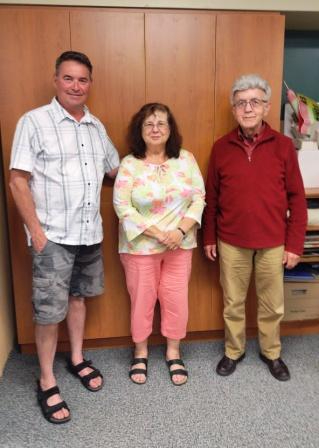
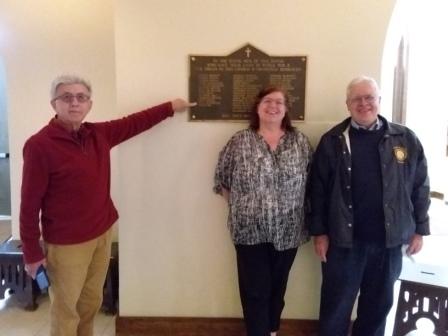
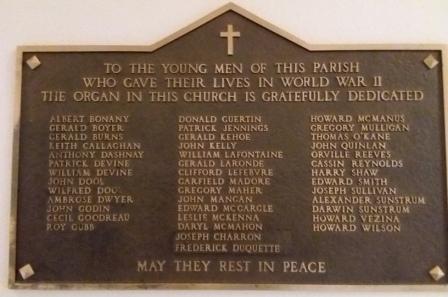
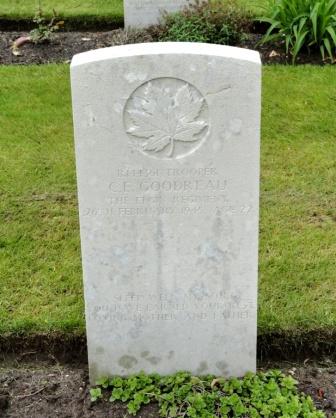
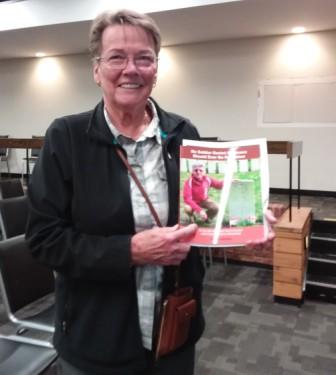
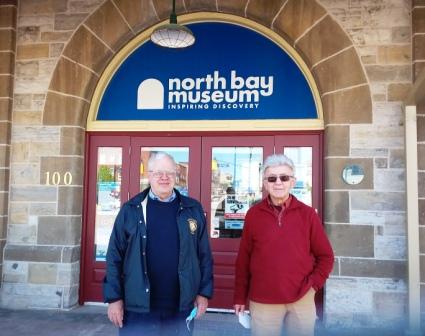
Bloyce McLellan and Daria with book. (Photo credit: Pieter Valkenburg)
May 10, 2022. We very much appreciate the feedback from ‘No Soldier Buried Overseas Overseas Should Ever Be Forgotten’, and love seeing the photos sent in and having the opportunity to meet some of you.
…Some additional feedback we’ve received….
Burnie Reynaert with book. (Photo courtesy of B. Reynaert)
Burnie Reynaert wrote that “… I always feel comforted when I read what you have both accomplished. Wishing you success on your European memorial tour book. I did buy your book, and liked it very much. It sits on my coffee table...”
Bloyce McLellan wrote “...I really have my nose into your book. You both did a real wonderful job and what a gift to all the families of these Veterans. Both of you deserve enormous credit and need to take a bow. Awesome work….”
Susan Choi wrote us to say “…Just finished your book! It was a great read. Thank you both for what you have done to honor and remember the Canadian soldiers and the sacrifices they made for all of us in WWI and WWII. Your book was particularly special to me because of the personal friendship I have with both of you. Daria, you have a gift for writing. You write the way you speak. As I read your book, it was as though you were sitting next to me, telling me about this wonderful war memorial trip. Your wit and humor were intact and offered a much needed relief to a serious and somber subject. Thank you both again for all that you have done and continue to do in the name of the fallen soldiers who gave up everything for all of us…”
Thank you to Susan Choi, Bloyce McLellan, and Burnie Reynaert for taking the time to send in comments and photos in support of this research project. Thank you also to Cody McEachern for the interview in The Guardian.
Photos or information to share? Email Pieter at memorialtrail@gmail.com, comment on the blog, or tweet to @researchmemori1.
If you are reading this posting, but aren’t following our research, you are welcome to do so. Our blog address: https://onthewarmemorialtrail.com/
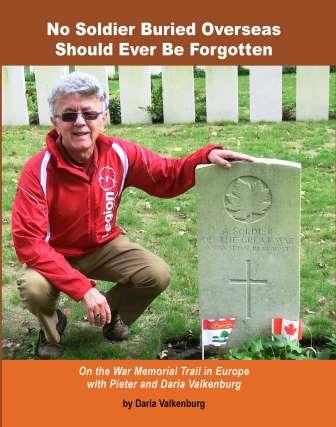
4 countries, 6 weeks, 7,000 km – an unforgettable war memorial journey in Europe….Daria’s book ‘No Soldier Buried Overseas Should Ever Be Forgotten‘ is now available in print and e-book formats. Net proceeds of book sales help support research costs and the cost of maintaining this blog.. For more information seehttps://nosoldierforgotten.com/
Pieter by the Dutch flag which was put out for Liberation Day on May 5, 2022. (Photo credit: Daria Valkenburg)
May 9, 2022. Last year, stories of two WWII soldiers who lost their lives in this area on March 30, 1945, were told. Both Edmond COULOMBE of Manitoba and Alphonse ROBERT of New Brunswick served with Les Fusiliers Montreal and were killed on the same day.
We learned about the Gendringen connection when we were contacted by Maarten Koudijs, a volunteer researcher in this Dutch village along the German border with eyewitness accounts of how Robert and several members of his Regiment, including Coulombe, lost their lives when a shell exploded.
Missed the stories about Edmond COULOMBE and Alphonse ROBERT? See:
The Gendringen Monument was unveiled on May 6, 2022. Translation of the Dutch text: So that we never forget. (Photo submitted by and courtesy of Maarten Koudijs)
On May 6, 2022, a monument was unveiled in Gendringen, The Netherlands. Maarten Koudijs was kind enough to share some photos, and explained that “… Nearly 500 people are commemorated on this memorial.
· 23 Dutch Soldiers (from Genkoppen and Wisch) during the raid in May 1940
· 41 Canadian military personnel and Air Force crew members
· 44 English soldiers and Air Force crew members
· 167 German soldiers who fell in the former municipality of Gendringen en Wisch (now Oude IJsselstreek)
· 1 Irish aircrew member flying for the RAF
· 1 Australian aircrew member flying for the RAF
· 2 New Zealand crew members flying for RAF
· 1 American Spitfire pilot flying for RCAF….”
Note: RAF refers to Royal Air Force. RCAF refers to Royal Canadian Air Force.
Panels by the monument have QR codes which provide information, plus buttons for audio descriptions in Dutch, English, and German. (Photo submitted by and courtesy of Maarten Koudijs)
…Einar Victor Isfeld’s Son Attended the Unveiling…
Dennis Isfeld, son of Einar Victor ISFELD of the Queen’s Own Highlanders, attended the unveiling. In a short video (under 3 minutes in both Dutch and English), he was interviewed with an eyewitness, who was 11 years old in 1945.
… Canadians commemorated on the Gendringen Memorial….
Maarten identified the names of 41 Canadians, including the Regiment they were serving in at the time of death and their final resting place. “…The following Canadian soldiers were killed near the former municipality of Genkoppen. The former municipality of Genkoppen en Wisch is now OUDE IJsselstreek Achterhoek….”
Queen’s Own Cameron Highlanders Of Canada:
Harry Gregory BOZAK, died March 30, 1945, aged 20, buried in Groesbeek Canadian War Cemetery
Francis Walter Andrew GLOSSOP, died March 30, 1945, aged 28, buried in Groesbeek Canadian War Cemetery
Einar Victor ISFELD, died of wounds April 6, 1945, aged 30, buried in Groesbeek Canadian War Cemetery
Anton W. KOHLRUSS, died March 31, 1945, buried in Groesbeek Canadian War Cemetery
Frederick LISSOWAY, died March 30, 1945, aged 37, buried in Groesbeek Canadian War Cemetery
John Graham MACFIE, died March 30, 1945, buried in Groesbeek Canadian War Cemetery
Vincent Albert MOORE, died March 30, 1945, aged 29, buried in Groesbeek Canadian War Cemetery
Edward Oliver OBERG, died March 30, 1945, aged 19, buried in Groesbeek Canadian War Cemetery
William PROW, died March 30, 1945, aged 24, buried in Holten Canadian War Cemetery
Rocco Andrew SPEZIALI, died March 30, 1945, aged 26, buried in Groesbeek Canadian War Cemetery
Bert J. THOMAS, died March 30, 1945, buried in Groesbeek Canadian War Cemetery
Charles Joseph YOUNES, died March 30, 1945, aged 33, buried in Groesbeek Canadian War Cemetery
Les Fusiliers Mont-Royal:
Roland A. BARRY, died March 30, 1945, buried in Groesbeek Canadian War Cemetery
Joseph Paul Roland CARON, died of wounds April 5, 1945, buried in Groesbeek Canadian War Cemetery
Edmond COULOMBE, died March 30, 1945, aged 22, buried in Groesbeek Canadian War Cemetery
Jacques FORTIN, died March 30, 19455, aged 21, buried in Groesbeek Canadian War Cemetery
Bernard Gaston PILON, died March 30, 1945, aged 19, buried in Groesbeek Canadian War Cemetery
Alphonse ROBERT, died March 30, 1945, aged 21, buried in Groesbeek Canadian War Cemetery
South Saskatchewan Regiment:
Peter HYDICHUK, died March 31, 1945, buried in Groesbeek Canadian War Cemetery
James Joseph MALONEY, died March 31, 1945, buried in Holten Canadian War Cemetery
Michael Joseph MCDERMOTT, died of wounds August 5, 1945, buried in Kilgobbin Burial Ground, Ireland
William SERNOWSKI, died March 31, 1945, buried in Groesbeek Canadian War Cemetery
8th Canadian Recce Regiment (14th Canadian Hussars):
Laurenzo DUBE, died March 30, 1945, aged 26, buried in Holten Canadian War Cemetery
Leslie Albert DUCKETT, died March 30, 1945, aged 24, buried in Groesbeek Canadian War Cemetery
William LAWRYSYN, died March 30, 1945, aged 27, buried in Groesbeek Canadian War Cemetery
Wilfred Charters STEWART, died March 29, 1945, aged 22, buried in Groesbeek Canadian War Cemetery
Royal Canadian Artillery:
Ivan RayburnNILSSON, died April 1, 1945, aged 21, buried in Groesbeek Canadian War Cemetery
Black Watch Of Canada:
Ernest George GRAHAM, died April 1, 1945, aged 29, buried in Groesbeek Canadian War Cemetery
Robert WALKER, died of wounds April 1, 1945, aged 19, buried in Groesbeek Canadian War Cemetery
Royal Canadian Air Force:
Duncan Eric CAMPBELL, died June 12, 1943, aged 28, buried in Wisch (Varsseveld) General Cemetery
Ralph Perry DAVIES, died June 12, 1943, aged 24, buried in Wisch (Varsseveld) General Cemetery
James HEATH, died June 17, 1944, aged 35, buried in Wisch (Varsseveld) General Cemetery
Allan Lockwood HOME, died May 13, 1943, aged 26, buried in Gendringen Roman Catholic Cemetery
Albert James MACLACHLAN, died June 12, 1943, aged 21, buried in Wisch (Varsseveld) General Cemetery
Hugh Columba MACNEIL, died May 13, 1943, aged 24, buried in Gendringen Roman Catholic Cemetery
James Edward MCDONALD, died June 2, 1942, aged 26, buried in Gendringen Roman Catholic Cemetery
Henry Augustin SHEEHAN, died May 13, 1943, aged 21, buried in Gendringen Roman Catholic Cemetery
Frederick John SMITH, died October 31, 1942, aged 21, buried in Gendringen Roman Catholic Cemetery
Louis-Phillipe Roma TAILLEFER, died June 12, 1943, aged 24, listed on the Runnymede Memorial in Surrey, England
Milford Glen THOMAS, died May 13, 1943, aged 26, buried in Gendringen Roman Catholic Cemetery
Rudolph ZEIDEL, died June 12, 1943, aged 21, listed on the Runnymede Memorial in Surrey, England
Thank you to Maarten Koudijs for letting us know about this commemoration event. Do you have photos or information to share? Email Pieter at memorialtrail@gmail.com, or comment on the blog.
If you are reading this posting, but aren’t following our research, you are welcome to do so. Our blog address: https://onthewarmemorialtrail.com/
4 countries, 6 weeks, 7,000 km – an unforgettable war memorial journey in Europe…. Daria’s book ‘No Soldier Buried Overseas Should Ever Be Forgotten‘ is available in print and e-book formats. Net proceeds of book sales help support research costs and the cost of maintaining this blog. For more information see https://nosoldierforgotten.com/
Caption in De Telegraaf: Pieter Valkenburg: “No soldier who died abroad during war should be forgotten.” OWN PHOTO (Photo credit: Daria Valkenburg)
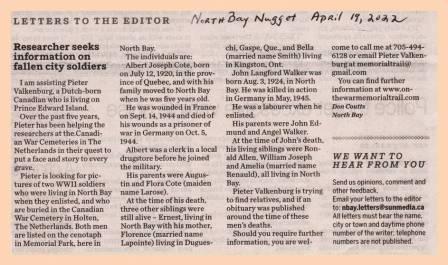
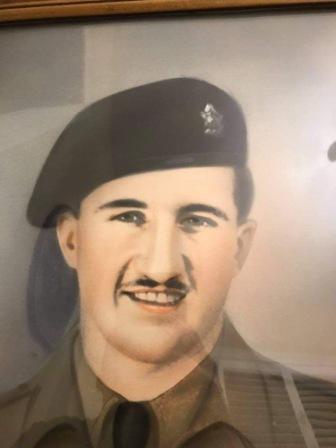
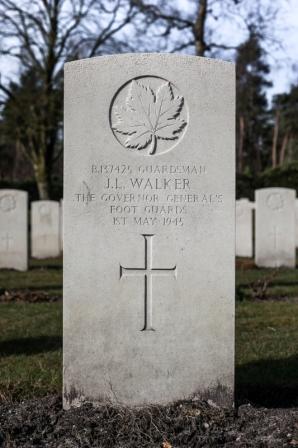
May 4, 2022. Sometimes the unexpected happens. Last month, a search for family and photos of WWII soldiers Albert Joseph COTE and John Langford WALKER, who are buried in the Canadian War Cemetery in Holten, The Netherlands, began.
Shortly afterwards, Pieter was contacted by Marcel Vink of De Telegraaf, a newspaper in The Netherlands. He’d read the letter to the editor. Would Pieter be willing to do an interview? Pieter agreed, and the article was published today, May 4, 2022 – which is Dodenherdenking (Remembrance Day) in The Netherlands. This day commemorates Dutch civilians and military who have died in war since the beginning of WWII. (See https://en.wikipedia.org/wiki/Remembrance_of_the_Dead)
Pieter Valkenburg is fully committed to fallen Canadians
by Marcel Vink
PRINCE EDWARD ISLAND • It started as a helping hand, but grew into a true mission. Pieter Valkenburg has been passionately committed to giving fallen war heroes from Canada a face for years. The 78-year-old Dutchman, who lives in Canada, realizes how important it is emotionally for relatives to get clarity about their deceased loved ones, even 77 years after the Second World War.
Valkenburg worked for the Ministry of Foreign Affairs for many years and was posted to various locations around the world, including in Ottawa.
After his retirement, he decided to continue living in the North American country with his Canadian wife Daria, where he discovered that many families often no longer know in detail what happened to relatives that didn’t come back during the Second World War. About 7600 Canadians are buried in the Netherlands who fought for our freedom.
“At the beginning of 2014 I read an article about the Canadian war cemetery in Holten, one of the military cemeteries in The Netherlands,” says Valkenburg.
“There are 1,355 Canadians lying there, and not much was known about some of them at the time. Therefore, around that time, a project was started that strived to literally find the face for every name. I find that very important myself. No soldier who died abroad in war should be forgotten.” (NOTE: there are 1,394, not 1,355.)
‘Reactions from next of kin are priceless’
Background
The native of Leerdam was captivated by the subject and delved into the matter. First in the background with only a few names, but then more and more.
Over the past five years, I have helped researchers at Canadian war cemeteries in the Netherlands in their quest to give each grave a face, and thus also a story. It is quite a puzzle, but the reactions of relatives when it succeeds are priceless. Those involved really appreciate it when they realize that they have never been forgotten. They gave their lives in the struggle for our freedom, in a country foreign to them. It’s much more meaningful when you stand by a grave to pay your respects if you know what the person looked like.”
Investigative Work
While his search was initially limited to the fallen from Prince Edward Island – the western province where he lives – he now focuses on many more areas in Canada. Valkenburg uses the old-fashioned manual search, but also uses many digital sources. (NOTE: Prince Edward Island is on the east coast of Canada!)
Relatives are often emotional about it, he noticed. After he found the family of Lieutenant Norman James Nixon – killed in the Battle of Delfzijl in April 1945, in which twenty Canadians of his regiment were killed, his son called this ‘a total surprise’. “I am immensely grateful,” said the man, who named his own son after his dead father, in tears. (See https://onthewarmemorialtrail.com/2021/03/07/on-the-war-memorial-trail-the-ww2-soldier-from-st-stephens/)
The work of Pieter and his wife Daria is highly appreciated in the Netherlands as well as in Canada. He has already received several awards. Sometimes he finds new ‘assignments’ in a miraculous way.
“Once we were at a hotel in New Brunswick Province, when a receptionist asked what we were doing. After I told about our searches, he indicated that his great-uncle had also died in the war, and that his grave should be in The Netherlands. Other than that he had no idea. I immediately got to work and found him at the cemetery in Groesbeek. I also found a photo on the Canadian Virtual War Memorial.” (See https://onthewarmemorialtrail.com/2021/08/02/on-the-war-memorial-trail-the-ww2-soldier-killed-while-lining-up-to-attend-church/)
In this way, this man also got his face back. “With these results, I say, Canadian-style: this makes my day. I’m 78 now, but as long as I can keep up with this, I will. Because there is still a lot of work to be done.”
This very proud wife thanks Marcel Vink for writing the article about Pieter and De Telegraaf for publishing it on this day of remembrance and commemoration.
If you have photos or information to share, please let Pieter know. Email him at memorialtrail@gmail.com, comment on the blog, or tweet to @researchmemori1.
If you are reading this posting, but aren’t following our research, you are welcome to do so. Our blog address: https://onthewarmemorialtrail.com/
4 countries, 6 weeks, 7,000 km – an unforgettable war memorial journey in Europe…. Daria’s book ‘No Soldier Buried Overseas Should Ever Be Forgotten‘ is available in print and e-book formats. Net proceeds of book sales help support research costs and the cost of maintaining this blog. For more information see https://nosoldierforgotten.com/
April 17, 2022. In September 2017, Pieter and I visited the village of Posterenk in The Netherlands with Edwin van der Wolf. Edwin told us how the Carleton and York Regiment came from Italy to Marseilles, France, and then made their way to The Netherlands. On April 13, 1945, they liberated Posterenk. In the process several soldiers lost their lives and were temporarily buried in the vicinity.
April 13, 2022. Posterenk windmill. (Photo submitted by Edwin van der Wolf. Photo credit: Anneke Poppenk)
The village never forgot the sacrifices and placed a memorial stone on its windmill.
Translation of memorial stone on the windmill: Posterenk freed by the Carleton & York Regiment of Canada on April 13, 1945. (Photo credit: Daria Valkenburg)
…8 known soldiers who lost their lives in the liberation of Posterenk….
The village also prepared a list of 6 Carleton & York Regiment soldiers, who had been buried in the area, to commemorate. Unfortunately, not all soldiers who died were included.
Pieter holds the list of 6 Carleton & York Regiment soldiers temporarily buried in Posterenk in 1945. (Photo credit: Daria Valkenburg)
Over the past few years, two more soldiers were identified: Goldwin Marven POLLICK of Minto, New Brunswick, and Daniel Peter MACKENZIE of Victoria Cross, Prince Edward Island.
…Sacrifice of Goldwin Pollick and Daniel MacKenzie commemorated in 2022….
On April 13, 2022, the commemoration of the 6 soldiers of the Carleton & York Regiment who had been buried near Posterenk was held. This year, Edwin “….read out for the first time the stories of Pte Goldwin Pollick and Cpl Daniel MacKenzie of this regiment, who were temporarily buried in Lochem because they had previously died in a Canadian hospital there….”
Edwin van der Wolf reads out the stories of Goldwin Pollick and Daniel MacKenzie. Above him, you can see the photos, left to right, of Samuel Glazier Porter, Goldwin Marven Pollick, and Frederick Joseph Tait. (Photo submitted by Edwin van der Wolf. Photo credit: Anneke Poppenk)
Members of the Royal Canadian Legion in The Netherlands and the City of Apeldoorn Pipes and Drums Band joined officials and the public for the commemoration event in Posterenk. (Photo submitted by Edwin van der Wolf. Photo credit: Anneke Poppenk)
The City of Apeldoorn Pipes and Drums Band attended the commemoration event in Posterenk. (Photo submitted by Edwin van der Wolf. Photo credit: Anneke Poppenk)
…Two soldiers commemorated in Posterenk are without photos….
Edwin advised that photos of the soldiers have been hung on the Posterenk windmill, but photos of two soldiers have yet to be found. He has asked for help to “…look for the two missing photos of Pte James Mossey and Sgt Harold Sabean for the working group in Posterenk...” Both men are buried in the Canadian War Cemetery in Holten, The Netherlands.
James Frank MOSSEY was born on April 20, 1919 in Souris, Prince Edward Island, son of William and Mary Mossey. Killed in action on April 14, 1945, aged 25.
Harold Gordon SABEAN was born on March 19 1918 in Port Lorne, Nova Scotia, the son of Saul and Susan Sabean. He was married to Josephine Marie Sabean and lived in St John, New Brunswick. Killed in action on April 13 1945, aged 27.
UPDATE: Photos of these two soldiers have been found….
Thank you to Edwin van der Wolf for sharing photos about the commemoration event in Posterenk. If you have photos or information to share, please let Pieter know. Email him at memorialtrail@gmail.com, comment on the blog, or tweet to @researchmemori1.
If you are reading this posting, but aren’t following our research, you are welcome to do so. Our blog address: https://onthewarmemorialtrail.com/
4 countries, 6 weeks, 7,000 km – an unforgettable war memorial journey in Europe…. Daria’s book ‘No Soldier Buried Overseas Should Ever Be Forgotten‘ is available in print and e-book formats. Net proceeds of book sales help support research costs and the cost of maintaining this blog. For more information see https://nosoldierforgotten.com/
Yikes! Warning sign at Coffeen Nature Preserve in northern Florida! (Photo credit: Pieter Valkenburg)
April 16, 2022. I always joke with my friends that if there is a war memorial or a military cemetery in an area, Pieter will find it. So, I guess I shouldn’t have been surprised this winter when we were in Florida and a fellow snowbird, retired US Army veteran Rick Greiner called and asked if Pieter wanted to visit the nearby site where American replicas of a WWII era German V1 rocket were test-fired! (For information on V1 rockets, see https://en.wikipedia.org/wiki/V-1_flying_bomb or https://en.wikipedia.org/wiki/V-weapons)
Rick explained that he’d been interested in WWII since childhood. “…My father served on 3 US Navy destroyers. He saw action from German 109 planes, submarines, artillery fire at Anzio, and Japanese kamikazes over Okinawa. He was in the Panama Canal heading to Japan when the atomic bombs were dropped….”
This led to Rick’s lifelong interest in the history of rocketry and atomic bombs. “…The areas that I studied were British code breaking with Alan Turing at Bletchley Park (been there), the making of the atomic bomb at Oakridge TN, Hanford WA, and Los Alamos, New Mexico where the gadget was assembled (been there). In 1957 my mother picked me up from school and said the world changed today- the USSR sent a rocket into space. The space race began. Rockets had been around for many years, but the Germans under Werner von Braun perfected them with the V1 and V2 rockets….”
….V for Vengeance…
The V in the German rockets stood for Vergeltung (Vengeance). How did a V1 end up in the USA, we wondered? In June 1944, Germany bombarded England with the V1s. In July 1944, parts salvaged by the Polish underground and recovered from crashed but unexploded bombs in England, were flown to Wright-Patterson Field in Ohio.
The remains were stripped apart and within three weeks copied to produce an American version, the JB-2. This operational guided missile was the predecessor of the modern cruise missile.
Display showing JB-2 on rocket launching sled at bottom of launching ramp. (Photo taken by Pieter Valkenburg)
Explanation of display photo of JB-2.
…Missile launch ramps and bunkers still exist….
Over 600 of the replica bombs were sent to nearby Eglin Air Force Base and then test-fired from a missile launch ramp at the Coffeen Nature Preserve. Two of those missile launch ramps and associated bunkers still exist. (See https://en.wikipedia.org/wiki/Santa_Rosa_Island_Range_Complex)
Rick said that “… Around 4 years ago I read an article in the paper about 4 Mile Village’s rocket test site remains. I called the phone number and received no call backs, the next year we had a lot of rain and every time a date for a tour was made, it was cancelled. The same for the next year. Last year was Covid so we did not go to Florida…” (See https://www.browsedestin.com/blog/four-mile-village-miramar-beach-a-step-back-in-time.html)
This year Rick was determined to visit the site. Pieter was a bit cautious given the prevalence of Covid, but safety precautions were made and a group of veterans visited the site. Joining Rick and Pieter, a Dutch Air Force veteran, were retired US Marine Bob Young, retired US Navy veteran Dick Becker, retired US Army veteran Dr Ed Grayden, and Rick’s wife Mary Ann.
At Coffeen Nature Preserve. Left to right: Bob Young, Pieter Valkenburg, Dick Becker, guide Susan, Rick Greiner, Ed Grayden. (Photo credit: Mary Ann Greiner)
…Fishermen retrieved rockets that had been test-fired….
Their tour guide was Susan, who “… met us in one of the WW2 buildings for a lecture on the rocket and how the US military got some pieces/parts of the rockets and built one from scratch. Lots of errors, explosions, and, finally, takeoff. The rockets were sent down a 100 yard rail ramp, flew into the gulf, and Destin fishermen were hired to retrieve them for reuse…”
The Destin fishermen were especially brave given this cautionary sign at a dock at Lake Fuller in the Preserve!
Alligator warning sign at the Coffeen Nature Preserve. (Photo credit: Pieter Valkenburg)
“…The site became known as Range C64 and it was the start of the US strategic missile program….”
Display showing camp site. (Photo taken by Pieter Valkenburg)
Explanation of camp site.
A short video shows a JB-2 bomb being launched in 1945. Take a look:
Rick summarized the visit by explaining that “…At the site one can walk down one of the ramps and go into a heavy concrete observation bunker. The main part of the 240 acre Preserve has trails to hike and enjoy the wildlife and plants. Our group had a wonderful afternoon of learning and experiencing the nature hidden from the houses, condos, and retail big box stores off Rte 98...”
…Interested to visit Coffeen Nature Preserve?….
If you are in the area and interested to see this piece of military for yourself, Rick advises that “…The tour is free but reservations are needed. Call Susan at 850-622-3700. It is across from Sandestin, and next to Tops’l Resort on Rte 98. She gives tours on Monday, Wednesday and Friday afternoons. A code is needed to get through the gate….”
Thank you to Rick Greiner for organizing this event which brought a piece of WWII history to life. Pieter said that “… it was very thoughtful of Rick to include me in this trip….” Pieter went on to note that during the Nazi occupation of The Netherlands in WWII, “…a lot of V2s were launched from the west coast of The Netherlands towards London….”
Now that our winter holiday is over, research on Canadian soldiers continues. If you have photos or information to share, please let Pieter know. Email him at memorialtrail@gmail.com, comment on the blog, or tweet to @researchmemori1.
If you are reading this posting, but aren’t following our research, you are welcome to do so. Our blog address: https://onthewarmemorialtrail.com/
4 countries, 6 weeks, 7,000 km – an unforgettable war memorial journey in Europe….Daria’s book ‘No Soldier Buried Overseas Should Ever Be Forgotten‘ is available in print and e-book formats. Net proceeds of book sales help support research costs and the cost of maintaining this blog. For more information see https://nosoldierforgotten.com/
One soldier, who came from an area near where Edmond Coloumbe lived, was Philip LAFORTE. With the help Philip’s niece Michelle Wazny, Diane Dube of the Winnipeg River Heritage Museum in St.-Georges, and genealogy researcher Judie Klassen, a photo was found, as was information on his Métis roots.
Philip was born September 12, 1911 in Lac du Bonnet, Manitoba, the son of Napoleon and Rosalie (nee Mainville) LaForte. His mother’s Métis status meant that Philip too was Métis.
A trapper before he enlisted in Winnipeg with the Royal Winnipeg Rifles on July 31, 1941, Philip was married to Eva Jane (nee Johnston) and they had one son, Felix Joseph. Another son, Donald Philip, was born shortly after he enlisted. Philip had previously been married to Sarah Louise Bird, who had died of tuberculosis. Their son Leon was brought up by his grandparents, Mr and Mrs Joseph Daniels, of Sagkeeng First Nation.
Philip Laforte. (Photo courtesy of the Laforte family)
Philip’s service file noted that he was fluent in English, French, and Cree, and had trapped furs for the Hudson’s Bay Company, and worked as a bush labourer for Brown and Rutherford.
As a new recruit, Philip was sent to Fort William (now part of Thunder Bay), Ontario for two months of basic training. Then he was attached to the Infantry Advanced Training Centre (Rifle) in Winnipeg, Manitoba..
On December 12, 1941, he became part of the 3rd Division Infantry Reinforcement Unit (DIRU) as a Rifleman, and was on his way to the United Kingdom, arriving on December 23, 1941.
On May 28, 1942, Philip was transferred to the Royal Winnipeg Rifles. Still in the United Kingdom, he was taken on strength to the #1 Educational Company on November 1, 1942, and stayed in that unit until February 1943, when he was transferred to the #2 Canadian Infantry Reinforcement Unit (CIRU).
…. Philip was involved in the liberation of North-West Europe….
On April 12, 1943, Philip was reassigned to the Royal Winnipeg Rifles. On September 1, 1944 he arrived in France as reinforcement for troops lost during the Battle of Caen and the Battle of Falaise Gap.
He participated in the fight to clear the Scheldt Estuary to allow the re-opening of the Antwerp harbour. (See https://en.wikipedia.org/wiki/Battle_of_the_Scheldt) By January 1945 the Royal Winnipeg Rifles were in The Netherlands, and spent the New Year in ‘s-Hertogenbosch.
On February 1, 1945, the war diary recorded that the Regiment was informed of the part that the men “…would play in Operation Veritable…” This would take them into Germany. (See https://en.wikipedia.org/wiki/Operation_Veritable) The Regiment arrived in Millingen, Germany on February 9, 1945.
By February 16, 1945 the Regiment was based in Essen, Germany, as they cleared German positions in flooded areas of the Rhine flood plain and the Reichswald forest, which is close to the Dutch-German border.
On March 11, 1945 the Regiment began moving back towards ‘s-Hertogenbosch, The Netherlands and the greater battle towards liberating the country.
A short video produced by the Canadian Army gives an idea of what troops faced in this period:
….The battle for Deventer involved crossing the Schipbeek ….
Movement of Canadian troops towards Deventer. Note that all first had to cross the Schipbeek. (Map provided by Edwin van der Wolf)
On April 7, 1945 the Royal Winnipeg Rifles were ordered to cross the Schipbeek and establish a bridgehead as preparation for an assault on the city of Deventer by the 7th Canadian Brigade.
Crossing the Schipbeek was vital to the success of the bridge operation, not an easy feat as the Bridge was strongly defended by the Germans.
Unfortunately, one of the casualties during the events of April 7, 1945 was Philip Laforte, and it seems most likely that he lost his life during the crossing of the Schipbeek.
Along with 45 other soldiers, he was temporarily buried beside an estate in Oxe, which had been the site of the murder of Dutch resistance fighters.
On April 6, 1945, just before the Schipbeek, Royal Winnipeg Rifles troops arrived at an estate in Oxe (Oxerhof). This had been taken over as Gestapo Headquarters, but had been hastily vacated ahead of the Regiment.
In January 1946, all 46 Canadian soldiers were reburied in the Canadian War Cemetery in Holten, The Netherlands.
Grave of Philip Laforte in the Canadian War Cemetery in Holten, The Netherlands. (Photo courtesy of the Information Centre Canadian Cemetery Holten)
…The Colmschate Memorial commemorates 46 Canadians….
On April 8, 2015, a memorial was placed in Colmschate to commemorate the 46 Canadians who had been temporarily buried on the Oxe estate.
Memorial in Colmschate, commemorating 46 Canadians, including Philip Laforte. (Photo courtesy of Edwin van der Wolf)
Text of Memorial in Colmschate, commemorating 46 Canadians, including Philip Laforte. (Photo courtesy of Edwin van der Wolf)
Translation of the Dutch text was prepared by Pieter Valkenburg:
They Gave Their Lives
The liberation of Colmschate
During their advance from the Achterhoek, the Royal Winnipeg Rifles, the Regina Rifle Regiment, and the Canadian Scottish Regiment, led by Brigadier General T G Gibson reached the neighborhood of Oxe on Friday April 6, 1945. Next to the house on the Oxe estate (Oxerhof), the liberators discovered the bodies of ten Dutchmen who had been murdered in cold blood by the occupiers the day before. The Canadians passed the Schipbeek via a quickly struck bailey bridge, which replaced the destroyed Swormertoren Bridge.
Despite heavy German resistance, they continued north. Many farms went up in flames and houses were badly damaged. Many families sought refuge in the already liberated Oxe. Some residents lost their lives.
On April 8, 1945, the liberators captured (a small part of) the Snippeling, Colmschate, and the Bannink. Via the Vijfhoek they reached the Crödden Bridge over the Overijssels Canal. Schalkhaar and Deventer were then liberated and with the help of the Queen’s Own Rifles the remaining part of the Snippeling.
Many Canadians lost their lives in the battle in this area. In April 1945, the bodies of 46 fallen Canadians were buried in a temporary resting place opposite the Oxerhof house. In January 1946 they were transferred to the Canadian Cemetery in Holten (Plot I and II).
…..Philip is listed on the National Métis Veterans Memorial Monument….
Thank you to Philip’s niece Michelle Wazny, Diane Dube of the Winnipeg River Heritage Museum in St.-Georges, and genealogy researcher Judie Klassen. It can be a challenge to find family and photos, and we appreciate the help we receive! If you have photos or information to share, please let Pieter know. Email him at memorialtrail@gmail.com, or comment on the blog.
If you are reading this posting, but aren’t following the blog, you are welcome to do so. Our blog address: https://onthewarmemorialtrail.com/
4 countries, 6 weeks, 7,000 km – an unforgettable war memorial journey in Europe….Daria’s book ‘No Soldier Buried Overseas Should Ever Be Forgotten‘ is available in print and e-book formats. Net proceeds of book sales help support research costs and the cost of maintaining this blog. For more information seehttps://nosoldierforgotten.com/
February 23, 2022. One of the wonderful things about this blog is hearing from readers and receiving additional information on stories that have been previously posted. After a YouTube video in which a photo of Donald Charles MACKENZIE of Springhill, Nova Scotia was included, we received an email from Bruce MacEachern.
The video ‘In Remembrance’ that Bruce referred to was done by Pieter to thank those who contributed photos and stories of WW2 soldiers who are buried overseas in 2021. You can watch it here:
Bruce wrote us that “…Lt Donald MacKenzie is my uncle on my mother’s side. Uncle Donald’s wife, my Aunt Mary, was my Mom’s sister. I was very glad to see the picture of Uncle Donald in your video. I sent a copy of the picture, and video link, to Johan Schansker, who raised a memorial in his town of Loppersum, The Netherlands, to Uncle Donald and 6 other Canadians who fell, fighting to liberate his village….”
….The Loppersum Memorial….
The Loppersum Memorial. (Photo submitted by Bruce MacEachern)
The 7 names listed on the Loppersum Memorial. (Photo submitted by Bruce MacEachern)
The Loppersum memorial, unveiled in May 2020, honours 7 soldiers from the Royal Winnipeg Rifles who were initially buried in the General Cemetery in Loppersum in April 1945. All 7 were subsequently reburied in the Canadian War Cemetery in Holten.
Lt Donald MacKenzie and Rifleman WillieDANIELS, both of whose stories have been told on this blog, are 2 of these 7 men. Both served with the Royal Winnipeg Rifles and lost their lives on April 22, 1945 near Appingedam, The Netherlands at the very beginning of the Battle of the Delfzijl Pocket. (For more information on the Battle of the Delfzijl Pocket, see https://www.canadiansoldiers.com/history/battlehonours/northwesteurope/delfzijlpocket.htm)
….Newspaper article about the Loppersum Memorial…..
Bruce sent us a newspaper article, in Dutch, about the unveiling of the moment in May 2020. The article is included below in Dutch, along with an English translation provided by Pieter.
Article about the Loppersum Memorial. (Article submitted by Bruce MacEachern)
Translation of Dutch newspaper article by Pieter Valkenburg:
“Canadian Monument Unveiled
On Monday a memorial was unveiled for seven Canadian soldiers who were temporarily buried in the General Cemetery in Loppersum.
On behalf of the historical society, Johan Schansker took the initiative for the monument.
These 7 Canadians gave their lives for our freedom. One was killed during the battle to liberate the village, the others were killed in the surrounding area.
With this monument we want to honour their memories, according to Schansker.
The monument is a maple leaf made of weathering steel, on top of which is attached a stainless steel plate with the stylized maple leaf of the Canadian flag, The names of the seven soldiers from the Royal Winnipeg Rifles have been engraved on this plate. (For a description of weathering steel, see https://en.wikipedia.org/wiki/Weathering_steel)
The picture shows the unveiling of the monument by Johan Schansker, assisted by his son Tijs.”
The memorial is a wonderful tribute. Kudos to Johan Schansker for initiating it.
Bruce noted that “….My family and friends very much appreciate the efforts of yourself, Johan and others in remembering our Canadian soldiers. Thank You so much…”
…Missed the postings of two soldiers listed on the Loppersum Memorial?…
Here are the names of the other 5 men from the Royal Winnipeg Rifles that are listed on the Loppersum Memorial….
Rifleman Raymond Arthur HEAMAN, son of Jerry and Ellen E. Heaman, of Hargrave, Manitoba. Died April 22, 1945, age 27.
Rifleman William James ‘Jimmy’ Sutherland HOLE, grandson of William and Eva Alice Hole, of St. James, Manitoba. Died April 22, 1945, age 18.
Rifleman Anton Michael SALMI, son of Jacob and Maria Salmi, of Nolalu, Ontario. Died April 21, 1945, age 31.
Lt Cyril Douglas SHARMAN, son of Henry and Gertrude Sharman, of St. Vital, Manitoba; husband of Ada M. Sharman, of Winnipeg, Manitoba. Died April 23, 1945, age 33.
Rifleman Francis William WELBURN, son of Charles and Winnifred Welburn, of Winnipegosis, Manitoba. Died April 20, 1945, age 20.
Thank you to Bruce MacEachern for letting us know about the Loppersum Memorial. Do you have photos or stories to share? Email Pieter at memorialtrail@gmail.com, comment on the blog, or tweet to @researchmemori1.
If you are reading this posting, but aren’t following the blog, you are welcome to do so. Our blog address: https://onthewarmemorialtrail.com/
4 countries, 6 weeks, 7,000 km – an unforgettable war memorial journey in Europe….Daria’s book ‘No Soldier Buried Overseas Should Ever Be Forgotten‘ is available in print and e-book formats. Net proceeds of book sales help support research costs and the cost of maintaining this blog. For more information see https://nosoldierforgotten.com/
February 20, 2022. In an earlier posting, the story of a fatal 1942 plane crash in North Tryon, Prince Edward Island, recalled the eyewitness account by Vernon Inman, a resident of the area.
Flight student Ralph GordonMCCUTCHEON lost his life in this tragic accident that happened during his training at the No. 9 Service Flying Training School RCAF in Summerside. This flight training school was part of No. 3 Training Command RCAF, carrying out British Commonwealth Air Training Plan training operations. (To read the original posting, see https://onthewarmemorialtrail.com/2020/08/20/on-the-war-memorial-trail-the-1942-plane-crash-in-north-tryon/)
….Ralph’s family gets in touch…
Recently, Tim McCutcheon shared a photo of his uncle in uniform and wrote “…I was quite interested to read your article about the 1942 plane crash in North Tryon. The student in question, Ralph McCutcheon, was my uncle, the oldest brother of my father. You’ve done such a great job of researching the story and writing, especially the account of Vernon Inman….”
Ralph McCutcheon in uniform. (Photo courtesy of Tim McCutcheon)
Tim’s cousin, Nancy McCutcheon, also wrote us. “….I too enjoyed the article about the June 1942 plane crash in North Tryon. Ralph was also my Uncle. Tim and I are first cousins. Our Fathers and Ralph were brothers. There were 3 young men in the family, Ralph, the eldest, Donald (my Father), and then Bruce. Bruce was 10 years younger than Ralph, and Donald was 2 years younger. Thank you again for telling this story. Ralph was an important person to many, but especially to his younger brothers…”
…Excerpt of a letter from Group Captain Fullerton….
Tim also shared a letter sent to Ralph’s father from Group Captain E. G. Fullerton, Commanding Officer at the No. 9 Service Flying Training School.
In the letter, Captain Fullerton wrote that “…A most competent and promising student, your son was well thought of by all and had been chosen by his associates at Elementary Flying Training School and at this school as their class leader. In appreciation of this, and recognizing his ability as a leader, he was appointed acting corporal. What speaks much more of him, however, was the affection with which he was regarded by those who knew him most intimately – his fellow classmates…”
…Dedication to Ralph in ‘The Salmagundi’ yearbook….
Nancy sent us the dedication to Ralph from the Colgate University yearbook, ‘The Salmagundi’. The dedication reads “…To Mac, this sixty-second edition is dedicated. He died so that we may have victory, let us not fail him in the peace to come…”
‘The Salmagundi’ Colgate University Yearbook dedication to Ralph McCutcheon. (Photo courtesy of Nancy McCutcheon)
Thank you to Tim and Nancy McCutcheon for sharing information about their uncle. We also thank the family of the late Vernon Inman, whose recollection about the accident helped Pieter in researching this story.
Do you have photos or stories to share? Email Pieter at memorialtrail@gmail.com, comment on the blog, or tweet to @researchmemori1.
February 19, 2022. As the pandemic and social distancing measures continued into 2021, Pieter and I spent months going through my diary to decide which stories to include for a book about our European war memorial tour in 2017.
…New book is now available…
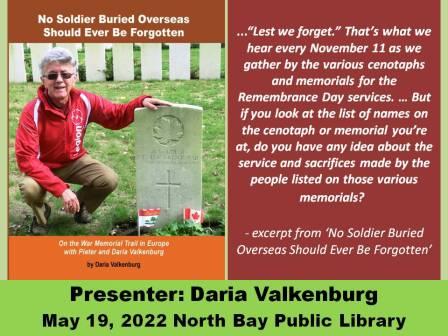
The result? ‘No Soldier Buried Overseas Should Ever Be Forgotten….on the war memorial trail in Europe with Pieter and Daria Valkenburg’
The title was inspired by a comment Pieter has made since this research project first began.
Many of the stories in the book were previously posted on this blog and published in the County Line Courier newspaper, but are now in one book, complete with colour photos. Readers can be armchair travellers as we visit cemeteries and memorials in 4 European countries – France, Belgium, The Netherlands, Germany – on this very personal war memorial tour to commemorate names on the Cenotaph outside the Borden-Carleton Legion in Prince Edward Island, Canada. This was Pieter’s first research project to be documented on our research blog.
With our pandemic project completed, we took a brief moment to celebrate receiving the first copy. (Photo Valkenburg family collection)
…Book trailer and website….
Thanks to the amazing talents of Wendy Nattress, who does the post-production editing for the On The War Memorial Trail YouTube Channel, we have a book website: see https://nosoldierforgotten.com/. The website has a book description, preview pages, and ordering information.
Wendy also prepared a short book trailer….
A print copy is available internationally on a print on demand basis. See https://www.blurb.ca/bookstore/invited/9477349/b624aaedfdfdd9965cb5053d8f15aa341049af59 If you live outside Canada, simply click on the flag at the top right on the webpage, look for a flag that represents your country, and you will see the price in that country’s currency.
We hope to have an e-book available in the near future.
….CBC Radio Interview…
On February 17, 2022, a radio interview with Angela Walker ran on CBC PEI’s Mainstreet PEI program about the book ‘No Soldier Buried Overseas Should Ever Be Forgotten‘.
“A six week tour of war cemeteries in Europe looking for the graves of Island soldiers is chronicled in a new book called “No Soldier Buried overseas should ever be forgotten”. We speak with the author Daria Valkenburg.”
Pieter and I are heartened by the interest in the book, and thank all who have contacted us. Recently, a book was signed for fellow author Sandra Wallis, of Sarnia, Ontario. Sandra’s book ‘Not What I Bargained For’ is a memoir about raising 4 children, 2 of them with medical conditions. (See https://www.amazon.ca/Not-What-Bargained-Incredible-Conditions/dp/1486619347)
Daria with Sandra Wallis, who wanted to have her book signed by the author! (Photo credit: Pieter Valkenburg)
…Thank yous!….
Heartfelt thanks go to Wendy Nattress, who prepared the book trailer and set up the website for the book. Thank you to Angela Walker of CBC Radio for interviewing me about the book.
Thank you to everyone who contacted us about the book, shared photos, and questions. To answer one question about whether the research is finished, I’m happy to let you know that Pieter’s research continues and there are many more stories coming up on this project blog.
Do you have photos or stories to share? Email Pieter at memorialtrail@gmail.com, comment on the blog, or tweet to @researchmemori1.
If you are reading this posting, but aren’t following our research, you are welcome to do so. Our blog address: https://onthewarmemorialtrail.com/
4 countries, 6 weeks, 7,000 km – an unforgettable war memorial journey in Europe…. Daria’s book ‘No Soldier Buried Overseas Should Ever Be Forgotten‘ is available in print and e-book formats. Net proceeds of book sales help support research costs and the cost of maintaining this blog. For more information see https://nosoldierforgotten.com/
One of the graves for which a flag was placed at the Tryon People’s Cemetery was for WWII veteran Richard Lea HOWATT of Tryon, Prince Edward Island, who had been a despatch rider during the war.
Richard was born March 17, 1923 in Tryon, the son of Everett King Kilburn Howatt and Clara, nee Thomas. Before enlisting in Truro, Nova Scotia at No 6 District Depot on February 28, 1942, he was a self-employed truck driver for logging camps, and based in Melrose, New Brunswick.
His attestation form indicated he was a skilled motorcycle rider, and his hobbies included swimming, hunting, fishing, and that he played the position of goalie on a soccer team.
Richard Lea Howatt. (Photo courtesy of Catherine Ann Howatt-Dickson)
Based on his skill set, he was recommended as being “…well qualified for despatch rider and motor transport generally. Has plenty of experience…” The assessment went on to note that Richard was “…very quiet…” and that he “…is still rather young…”
Pieter with Reverend Catherine Ann Howatt-Dickson, and a picture of her father. (Photo credit: Daria Valkenburg)
…A quiet man with a wanderlust and seeker of adventure….
He was only 18 at the time of his enlistment. His daughter, the Reverend Catherine Ann Howatt-Dickson, said that since he signed up before he was of age, “… his mother wanted to report him to the authorities, but his Dad said to let him be as he’ll do it anyways….”
Catherine Ann explained that although her father “…was a quiet man, he was the wild one of the family and no one knew what to do with him. He had a wanderlust and was a seeker of adventure, having left home at age 13 to work in lumber camps and was a truck driver….”
After a month of basic training in Halifax, Nova Scotia, Richard was transferred to 26 Forestry Corps and sent to Valcartier, Quebec. Catherine Ann recalled her father saying that he was “…issued a gray blanket to be wrapped in if he died. What bugged him was that he had to pay for this out of his first pay….”
By May 17, 1942 he was in Halifax and ready to embark to the United Kingdom, arriving on May 26, 1942, and reassigned to 29 Canadian Forestry Corps.
….An unsolved mystery….
While still in the United Kingdom, Richard applied for permission to marry Miss Margaret Ross of Culleave, Ardgay, Ross-shire in Scotland on April 6, 1943. He stated that he had known her for 7 months and her next of kin, likely her father, was John Ross. Permission was granted in May 1943 by the military as long as the ‘…wedding did not take place before July 21, 1943…’
For some reason, the wedding never took place, and the family was mystified to learn about this from his service file, which was applied for after his death, and therefore too late to ask about.
…The dangerous life of a despatch rider begins….
On July 16, 1943, Richard was transferred to the CASCRU (Canadian Army Service Corps Reinforcement Unit) and sent for a motorcycle rider’s course, which he successfully completed.
I was interested to learn what was in the course. If you are too, you can watch this YouTube Canadian Motorcycle Riders Training course (just under 8 minutes):
Richard Lea Howatt as a despatch rider. (Photo courtesy of Catherine Ann Howatt-Dickson)
The role of a despatch rider was to deliver messages, no matter how dangerous the conditions. Although communication by radio or telephone was available in WWII, it wasn’t always practical or available. Shelling by the enemy could cut lines, and signals could be intercepted or not have a long enough range.
On July 8, 1944 he was sent to France with the RCASC and assigned to 7 Medical Regiment as a despatch rider and scout. On October 20, 1944, while on patrol, Richard had an accident that resulted in him being evacuated to England from France on November 2, 1944. Catherine Ann related that “…as he was on patrol, he couldn’t use his headlights. A truck hit him and he had a head injury, resulting in a 3 month hospital stay….”
…Empathy and humanity was never lost by Richard….
On March 4, 1945 he was sent to northwest Europe with RCASC, this time assigned to 82 Canadian Artillery Company and 7 Medical Regiment. Catherine Ann related an anecdote shared by her father: “…3 German soldiers surrendered and Dad was told to take them to a warehouse. He gave them some green apples and a cigarette while waiting for them to be picked up. Dad was reprimanded and told he could be court martialled for sitting and smoking with them….”
On June 18, 1945 Richard was transferred to 45 Army Transport Company, then on October 28, 1945 he was sent to 63 Army Transport Company.
In another anecdote, Catherine Ann recalled her father’s anguish about the treatment of horses in the immediate post-war period. “…One of the hardest things at the end of the war in Germany was seeing wounded horses. Dad wanted to shoot them and put them out of their misery but was told there was not enough ammunition. Dad was very hurt as he was an animal lover and our kitchen table was always used as a makeshift animal clinic…”
…Love at first sight?….
On November 26, 1945 he returned to the United Kingdom in preparation for returning back to Canada. At the beginning of 1946 he arrived in Halifax, Nova Scotia, and was discharged on February 27, 1946.
Richard bought a motorcycle and returned to Prince Edward Island. One day, while in Victoria-By-The-Sea, he pulled up on his bike. Catherine Ann told us what happened next. “ … Mom was walking with her girlfriend. Dad didn’t know her, but asked her if she wanted a ride. She said yes….” It seemed as if it was love at first sight.
On April 17, 1948 he married Marguerite Alexandra MacDonald and they had 5 children, of which Catherine Ann is the youngest. “…Dad did farming, then worked at CN Marine as a deckhand until he retired. His nickname was ‘Mouse’ because he was so quiet….”
…Shocked and surprised to have survived the war…
As a teenager, Catherine Ann interviewed her father about his war experience. “…I asked him what shocked and surprised him the most and he answered ‘that I lived’….” Many veterans would agree with that statement!
Richard died March 17, 2003 in Tryon, and is buried in the Tryon People’s Cemetery, after a life well-lived.
Grave of Richard Lea Howatt at the Tryon People’s Cemetery in Prince Edward Island. (Photo credit: Daria Valkenburg)
Thank you to Reverend Catherine Ann Howatt-Dickson for sharing her father’s story with us. If you have photos or information to share, please let Pieter know. Email him at memorialtrail@gmail.com, comment on the blog, or tweet to @researchmemori1.
If you are reading this posting, but aren’t following our research, you are welcome to do so. Our blog address: https://onthewarmemorialtrail.com/
4 countries, 6 weeks, 7,000 km – an unforgettable war memorial journey in Europe…. Daria’s book ‘No Soldier Buried Overseas Should Ever Be Forgotten‘ is available in print and e-book formats. Net proceeds of book sales help support research costs and the cost of maintaining this blog. For more information see https://nosoldierforgotten.com/