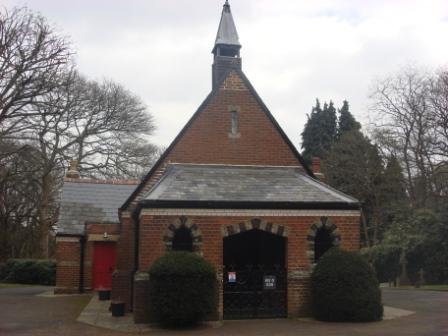
The Importance Of Remembrance

holidays-1-e1460375295631

November 10, 2019. On this Remembrance Sunday, we’d like to pause briefly in telling the story of the Halifax L9561 commemoration events of October 12, 2019 to acknowledge acts of remembrance made this weekend regarding unrelated stories.

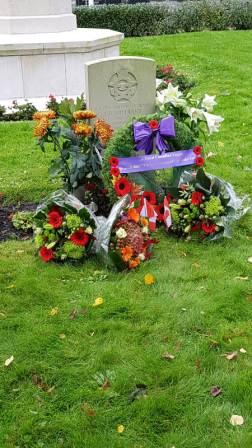
Yesterday, friends Jacqueline and Graham Hocking of England visited Brookwood Military Cemetery in Surrey, England.  They’d read about two names from the Cenotaph outside the Borden-Carleton Legion that are buried there, and knew we had not yet been able to visit this cemetery in England.  In an act of kindness and remembrance, they took photos of the graves of WW1 soldier John Goodwill HOWATT (See The Archive Photo That Put A Face To A Name) and WW2 soldier Austin Harry BOULTER (See The WW2 Soldier Who Drove On The Wrong Side Of The Road).

IMG_4425 Nov 9 2019 Canada House CWGC site

Canada House at Brookwood Military Cemetery. (Photo credit: Jacqueline & Graham Hocking)

IMG_4426 Nov 9 2019 Cemetery exit with row of pine trees on either side of the road

Brookwood Military Cemetery exit, with pine trees on either side of the road. (Photo credit: Jacqueline & Graham Hocking)

Jacqueline Hocking by grave of John Goodwill Howatt.  (Photo credit: Graham Hocking)

Graham Hocking by grave of Austin Harry Boulter.  (Photo credit: Jacqueline Hocking)

Pam Alexander, daughter of Halifax L9561 Navigator Reg ALEXANDER, who had attended the commemoration events in The Netherlands on October 12, 2019, sent the following message:  “Thinking of Elmer Muttart, his family and all the crew and their families today as we watch the Cenotaph ceremony and observe the two minute silence for all who have fallen in wars and conflicts for the UK and our Allies.”  (See On The War Memorial Trail…..The Halifax L9561 Crew)

image1 Oct 12 2019 Muttarts grave

Grave of Elmer Muttart at Harlingen General Cemetery on October 12, 2019. (Photo credit: Pam Alexander)

Robert O’Brien, who also attended the commemorative events for Halifax L9561, wrote a brief summary of the events in the November 8 & 15, 2019 issue of Rotary Voice from the Rotary Club of Toronto.  (To read his article, see voice-nov-8-2019)

Thank you to Jacqueline and Graham Hocking, and to Pam Alexander and Robert O’Brien for these moments of remembrance. If you have stories or photos to share about the names on the Cenotaph outside the Borden-Carleton Legion, please contact Pieter at dariadv@yahoo.ca or comment on the blog.

© Daria Valkenburg


Liberation 75 Commemoration Event At Province House

Logo

September 17, 2019. The Netherlands was fully liberated in 1945 (part was liberated in 1944), and next year marks their 75th year of commemoration.  In recognition of the role Canadians had in their liberation during WW2, the Dutch are donating 1.1 million ‘Liberation 75’ tulips to remember the 1.1 million Canadians who served in WW2. 750 bulbs will go to each Lieutenant Governor, the Governor General, and the Territorial Commissioners.  In addition, 1,100 schools will receive 75 bulbs each, plus an educational program to explain the role Canada played in liberating The Netherlands.

The first stop on this cross-country launch was in Prince Edward Island, when Ambassador of The Kingdom of the Netherlands to Canada, His Excellency Henk van der Zwan, presented Her Honour The Honourable Antoinette Perry, Lieutenant Governor of Prince Edward Island, with a box of tulips at a special event at Province House.  Invitees included WW2 veterans, and members of PEI Command of the Royal Canadian Legion, and Branch #1 Charlottetown Legion.  As a retired member of the Dutch Diplomatic Service and the Dutch Air Force, Pieter was also invited.  He was honoured to be included, given the work he is doing with the Borden-Carleton Cenotaph Research Project.

Invite

One of the WW2 veterans we spoke to before the event began was 95 year old Blanche Bennett, who we had met two years earlier, at the Senate of Canada 150 Medal Ceremony.  (See Recognition)  Mrs. Bennett quickly reminded us of that prior meeting, and told us about her trips to The Netherlands.  She explained that during the war, she had joined the Canadian Army and was stationed in Halifax, working as a switchboard operator.  “I’d do it again if I could” she said.

CIMG3157 Sep 16 2019 Liberation 75 Blanche Bennett Barbara Spence with Pieter

Blanche Bennett, seated, with her daughter Barbara Spence, and Pieter. (Photo credit: Daria Valkenburg)

In his remarks, Ambassador Van der Zwan explained that “the people of The Netherlands wanted to commemorate the role Canada played in liberating The Netherlands and in providing the Dutch Royal Family a safe haven in Ottawa.”  Crown Princess Juliana stayed in Ottawa with her children during the war.   Why Ottawa? Dutch Queen Wilhelmina and the wife of the Governor General of Canada were cousins.  After the war ended in 1945, the Dutch Royal Family donated 100,000 tulip bulbs to Canada as a thank you gift.  Since then, The Netherlands has presented Canada with 20,000 bulbs annually.

CIMG3162 Sep 16 2019 Liberation 75 Ceremonial Planting

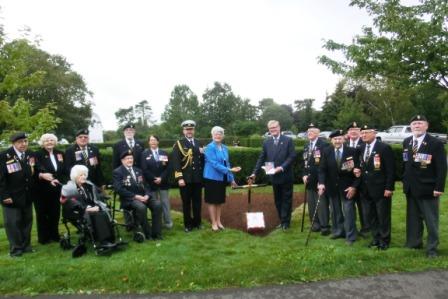
Ceremonial planting at Province House with Lt Gov Antoinette Perry, Ambassador Van der Zwan, WW2 veterans, and Legion members. (Photo credit: Pieter Valkenburg)

After a ceremonial planting at Province House, Lt Governor Perry explained that the new bed for the Liberation 75 tulips was carefully chosen so that it pointed towards The Netherlands!

Ambassador Van der Zwan shared a story about his mother’s experience with Canadian troops on April 15, 1945.  “My mother was born in 1933 in Leeuwarden, and remembered Canadian troops driving through the city.  It’s when she had her first taste of chocolate and chewing gum!”  Leeuwarden, in the province of Friesland, was liberated by the Royal Canadian Dragoons.  (See https://www.intelligencer.ca/news/local-news/royal-canadian-dragoons-celebrate-liberation-of-leeuwarden-with-dutch-ambassador-to-canada/wcm/7dea7e30-e6bd-42c4-9491-ae5552e497ae and http://www.petawawapostlive.ca/stories_site/april2019/april18/leeuwarden.html#)

The official part of the event over, everyone had time to visit and chat with each other.

CIMG3169 Sep 16 2019 Liberation 75 Pieter John Ambassador Duane

Left to right: Pieter, John Yeo Chair of PEI Command Royal Canadian Legion, Dutch Ambassador Henk van der Zwan, Duane MacEwen President of PEI Command Royal Canadian Legion. (Photo credit: Daria Valkenburg)

CIMG3172 Sep 16 2019 Liberation 75 Pieter with Lt Gov Perry

Pieter with Lt Governor Antoinette Perry. (Photo credit: Daria Valkenburg)

If you have a story to share about the Liberation of Holland, please contact Pieter at dariadv@yahoo.ca or comment on the blog.   Please note that we are still looking for photos of 10 names listed on the Cenotaph from WW1.  See Appeal For Relatives Of These WW1 Casualties! for more information.

 © Daria Valkenburg

The Parallel WW1 Experiences of John Lymon Wood & Clifford Almon Wells

September 16, 2019.  Sometimes we learn more about a particular soldier’s experience by reading about a soldier in a similar situation.  This was the case when I read “From Montreal To Vimy Ridge and Beyond: The Correspondence of Lt Clifford Almon Wells”, edited by his step-father, Pastor G.G.S. Wallace of a Baptist Church in Montreal, and published in 1917.  Wells was not an Islander, but he enlisted in the Princess Patricia Canadian Light Infantry 4th University Company, as did John Lymon WOOD, whose story has been told previously in blog postings.  (See WWI Soldier John Lyman Wood’s Connection With Acadia University and Learning About The Two Names On The Vimy Memorial)

Wells enlisted in September 1915, Wood on October 12, 1915.  At the time of enlistment, Wells was doing graduate work towards his PhD in archeology at John Hopkins University in Baltimore, Maryland while Wood was a second year engineering student at Acadia University in Wolfville, Nova Scotia.

Photo Lyman Wood

Photo: John Lyman Wood shortly after enlistment in October 1915. (Photo courtesy of Gene Rogerson collection)

Lt Clifford Almon Wells in 1916

Clifford Almon Wells in summer 1916. (Photo courtesy of “From Montreal To Vimy Ridge and Beyond: The Correspondence of Lt Clifford Almon Wells”)

On October 19, 1915, in a letter to his brother, Wood explained that he was packing his trunk in preparation for leaving Wolfville for Montreal. Like so many university educated men, an officer’s commission had been suggested by the recruitment office. “….I wish I had gone in the heavy artillery at Charlottetown now, but I’ll get a commission as Lieutenant if I can.  A man stands a far better chance of coming back if he goes in the artillery, but I suppose that is not the right way to look at it though.  The men are needed more in the Infantry, so I suppose it is only right to go where you are the most needed and where you can do the most good….I never hated to leave a place so bad as I do Wolfville this time.  But I must be doing what is right for there seems no other way out of it.” (Excerpt of a letter on page 157 of ‘Remember Yesterday: A History of North Tryon Prince Edward Island 1769-1992 Volume 1’, published in 1993)

Both Wells and Wood were in Montreal, preparing for being sent abroad.  In a November 2, 1915 letter, Wells wrote that “… the 4th University Company, bring recruited overstrength already, has received orders to be ready to sail on the 11th. Thousands of troops sail from Montreal every month without anyone being any the wiser.  Trains come in at night, stop on the wharf alongside the transports and by daybreak the men are on the way.  So it will be with us… The city just swarms with soldiers at present, as two full battalions have been sent back from the camp at Valcartier, which is closed for the winter…

There was a delay in leaving Montreal, as in the end they didn’t leave until November 26, 1915, by train enroute to Halifax.  In a November 26, 1915 letter, Wells noted that “… We did not leave Montreal until nearly 11 o’clock, as we waited for several carloads of troops from Winnipeg to join us.”  He explained that sentries were posted at the train doors, and no one except officers and platoon sergeants were allowed to pass from car to car without special permission.

They arrived in Halifax in the afternoon of November 27, 1915, and Wells sent a brief letter to his mother, saying that “...We reached Halifax two hours ago, and came aboard the ‘Lapland’ almost immediately.

On November 28, 1915 the SS Lapland, which had arrived from New York, sailed from Halifax, arriving in Plymouth, England on December 7.  During the voyage, Wells wrote several letters.  On December 3, 1915, he made the observation that “….There are about 2,000 other troops aboard.  The 37th Battalion from the West, the 92nd Highlanders, units of the A.S.C. Cyclists, etc.”  Wells went on to explain that they had to be alert for U-boats.  “Today we are fairly in the danger zone.  Our company’s machine gun is mounted aft, while other guns are mounted forward.  The decks are lined with men armed with rifles.  So we are all ready for submarines.  Tonight every man must sleep on deck by the life-boat or raft to which he has been assigned.  All portholes are darkened at night and every precaution is taken to render the ship invisible.

Upon arrival, they were both sent to the 11th Reserve Battalion, stationed at St. Martin’s Plain in Shorncliffe, near Folkestone, for infantry training for needed reinforcements to the Canadian Corps in the field.  In a December 9, 1915 letter, Wells wrote about the culture shock he’d experienced.  “It has rained steadily, with an intermission yesterday, ever since we reached Plymouth Sunday morning until now.  The camp is one sea of mud – such mud as I never dreamed of before.  I never shine my shoes now, as the first step out of the hut buries them in 3 or 4 inches of slime.  We are quartered in huts which hold about 40 men each….

He then explained that “The streets in Shorncliffe are very dimly lighted by night on account of the danger from Zepps, and every window in every hut is covered with a blanket when the lights are switched on.  Outside it is pitch dark and one wallows in mud and water when compelled to go out at night.

Like Wood, Wells soon found out that while the British were interested in troops as ‘cannon fodder’, a system of discrimination already existed to prevent them from becoming officers, contrary to what they were told when they signed up.  He discussed this in a continuation of his December 9 letter:  “I have bad news in one respect.  An order has been passed by which no more Canadian soldiers are given commissions in the Imperial Army except when a Colonel applies to have a certain man as an officer in his command.  There is consequently a good deal of dissatisfaction in our company, as many of us were practically promised commissions when we enlisted.”  Wells began working his contacts to get a commission.

In a December 29, 1915 letter, Wells wrote that “…It is reported that a carload of Christmas mail for soldiers was accidentally burned….”  He wondered if this could be why he had not received mail.  On January 7, 1916, he wrote that he’d heard that “two carloads of mail from Canada were accidentally burned.”  One can imagine the disappointment that he and his fellow Canadians felt when no letters or parcels arrived for Christmas!

Still trying to figure out how to get a commission, in the same letter, Wells explained that if he wasn’t successful in his quest while in England “…. I may go to the front as a Corporal or even a private, as I understand that NCOs like myself, who have never seen active service, lose one or more of their stripes when they first go to the trenches.  I should expect, of course, to regain them in a short time, but I do not like the idea of making any retrogressive steps...

In January 1916, Wells did become a Lieutenant, and on January 16, wrote to his mother that “I have been wonderfully lucky in being commissioned with the Canadian and not the Imperial Army.  This is how it happened.  A sudden shortage of officers occurred in the division, and the various battalions were asked to recommend for promotion NCOs not below the rank of Sergeant. The 11th Reserve Battalion was asked to recommend four.  I was one of the four.”  Like so many other Canadian soldiers, Wood never got promoted beyond Private.

While Wells stayed healthy and went to the Canadian Military School for a Bombing Course, Wood ended up in hospital as of January 21, 1916 with appendicitis, then gastritis, and measles. In a March 4, 1916 letter, Wells mentioned the measles outbreak.  “There are a number of cases of measles in the camp, and as soon as one hut is released from quarantine, one or two more have to be quarantined.

Wood was discharged on April 15, 1916 to the 39th Battalion, where he was sent for training as a Signaller.  In August 1916, Wells was transferred to the 8th Battalion of the 1st Canadian Division and sent to France.  Wood arrived in France on December 22, 1916, as part of the Second Infantry Battalion.

Both men survived the Battle of Vimy Ridge, with Wells describing the day in an April 20, 1917 letter to his mother: “The Huns were completely surprised, and made little resistance.  Our artillery barrage was wonderful beyond description, lifting forward from objective to objective with clocklike precision, and practically obliterating the German trenches as it passed them.  The men followed the barrage steadily and fearlessly, and prisoners were streaming back five minutes after we went ‘over the top’.  Most of the prisoners were entirely cowed, and thankful to be prisoners….  I came through it without a scratch.”  Unfortunately, before his mother received the letter, she was officially notified of his death on April 28, 1917, at the age of 25.

Wood’s luck ran out on May 3, 1917, when he was killed in action during the Battle of Arras, in the third battle of the Scarpe near Fresnoy, at the age of 19.  In “Hell Upon Earth: A Personal Account of Prince Edward Island Soldiers in the Great War, 1914-1918”, published in 1995, author J. Clinton Morrison, Jr. explained that Wood, a Signaller, “was killed in the Fresnoy darkness while repairing telephone communications during the pre-dawn attack.”  His body was never recovered and his name is engraved on the Vimy Memorial in France.

While it’s not known if Wells and Wood ever met each other, their military lives had many parallels and they died within 5 days of each other in France.  If anyone has more information, please contact Pieter at memorialtrail@gmail.com or comment on the blog.   Please note that we are still looking for photos of 10 names listed on the Cenotaph from WW1.  See Appeal For Relatives Of These WW1 Casualties! for more information.

 © Daria Valkenburg

The Three WWI Soldiers Who Were Buried Together At Passchendaele

September 1, 2019.  The very first story uncovered by Pieter, when he began researching the names on the Cenotaph outside the Borden-Carleton Legion, was that of WWI soldier Vincent Earl CARR, who lost his life on October 30, 1917 during the Battle of Passchendaele in Belgium.  (See The Cenotaph Research Project Begins)  Why Vincent Carr?  His was the first photo provided for the project by Vincent’s nephew, Delbert Carr of Tryon, and his wife Helen.

CIMG3083 Aug 31 2019 Pieter with Helen & Delbert Carr

Pieter with Helen and Delbert (seated) Carr of Tryon. (Photo credit: Daria Valkenburg)

Vincent was born May 3, 1894 in North Tryon, the son of Robert Carr and Catherine McLeod.  On June 2, 1914, he enlisted in the 55th Battalion in Sussex, New Brunswick, and recorded his trade as labourer.  On October 30, 1915 his unit sailed to England aboard the S.S. Corsican, arriving on November 9, 1915.

shorter photo of vincent carr

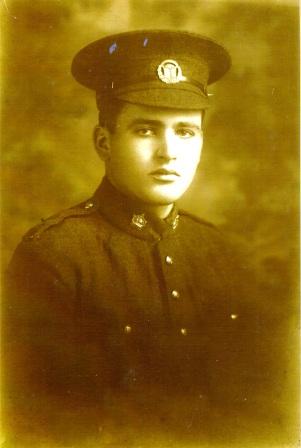
Photo: Vincent Carr in 1915, in the uniform of the 55th Battalion. (Photo courtesy of Delbert Carr collection. Photo colourization: Pieter Valkenburg)

On April 6, 1916 he was transferred to the 36th Battalion, and then 2 months later, on June 23, 1916, he was sent for training at the 86th Machine Gun Battalion, later re-designated as the Canadian Machine Gun Depot.  On July 28, 1916 he became part of the 1st (also called “A”) Canadian Motor Machine Gun Battery and arrived in France with his unit the next day.

In an excerpt from the November 1, 1917 Operation Report for October 28-31, 1917 by Lt C.P. Gilman, Acting Officer in Charge, of the “A” Battery of the First Canadian Motor Machine Gun Brigade wrote:  … “On the evening of the 29th ….were in position to fire on targets given for the Zero hour, which was 5:50 am morning of the 30th.  As soon as we opened fire, we were subjected to an intense bombardment of our positions, and we were forced to retire 6 hours later, after sustaining 28 casualties…..

Vincent was one on those casualties, and is buried in Cement House Cemetery.  When we visited it in 2017, Pieter noticed that the graves on either side of him were Canadians from the same Canadian Motor Machine Gun Brigade unit as Carr, and that they died on the same day.  We took a photo of all three graves: R. Bellas, our Vincent Carr, and J. B. Willson.  (See On The War Memorial Trail of Passchendaele and Surrounding Area)

While we were in Passchendaele, we picked up a brochure ‘Did Your Granddad Fight in Passchendaele 1917?’ from the Memorial Museum Passchendaele 1917, inviting people to submit names and photos. The brochure went on to say that “in return for your cooperation you will receive a copy of a trench map with the approximate place where he was killed.  With this comes a short report based on the war diaries of his unit.”  We already had the war diary report, but a trench map was something unique, so we sent in the information, along with the observation that Bellas and Willson were buried near Carr.  Maybe they were in the same trench?

We waited for the trench map with great anticipation and ….. nothing happened.  Almost two years later, though, long after we’d forgotten about the inquiry we’d made, we received an email from the Memorial Museum Passchendaele 1917, with the long promised trench map and more information on what happened on October 30, 1917.

On that fateful day, researchers discovered that Vincent Carr, Jack Bingham WILLSON, and Robert BELLAS were all killed by the same high explosive shell on Abraham Heights. This is what we had expected after seeing the graves side by side in Cement House Cemetery, but to our surprise we learned that they had been buried in the same grave on Abraham Heights.

CarrVincent

Trench map showing the coordinates where Carr, Willson, and Bellas were originally buried on Abraham Heights. (Map: courtesy of Memorial Museum Passchendaele 1917)

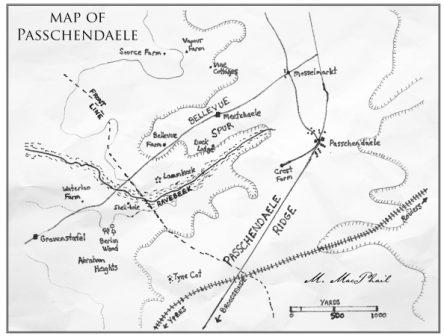
map of passchendaele showing abraham heights

You can see Abraham Heights towards the bottom left corner of the map. (Map: courtesy http://www.darrellduthie.com/maps/)

The Memorial Museum Passchendaele 1917 wrote us that: “According to the War Diary of the 1st Canadian Motor Machine Gun Brigade, three machine gun companies were in the field around October 30. ‘A’-Battery from the 28th till the 31st of October, ‘B’-Battery from the 29th till the 31st of October and the ‘Eaton’-Battery from the 30th October till the 1st of November. Although the positions on Abraham Heights (28.D.15.b.7.4.) were abandoned on the 29th to take up new positions just north of Tyne Cot Cemetery (28.D.16.b.6.9.), many runners were sent to the supply stores behind the front to resupply the machine guns on the front line. It’s likely that the men were killed by shellfire while hauling equipment between the gun positions and the back areas.” (Note: The numbers and letters you see in brackets beside Abraham Heights and Tyne Cot Cemetery are the GPS coordinates.)

Private Jack Bingham Willson was born January 17, 1897 in Plattsville, Ontario.  Sgt Robert Bellas was born August 1, 1886 in Morland, Cumbria, England, but had immigrated to Canada.  Both Willson and Bellas enlisted in Toronto.

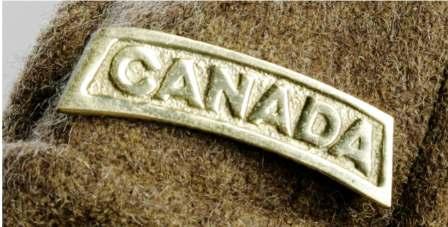
A 1939 report of exhumation and reburial to Cement House Cemetery confirmed that Carr, Willson, and Bellas were recovered from one grave.  Unlike many soldiers who were never identified, they were identified by the ‘titles’ on the shoulder of their uniform identifying them as Canadian, and the identifying discs that they were still wearing.  The report indicates that two unknown British soldiers had been recovered from the same grave at Abraham Heights.

CWM_SupplyLine_CanadaShoulderTitle_EN_FINAL_20140922_Page_1

A metal shoulder title was worn by Canadian soldiers on both shoulder straps of the khaki service dress uniform. (Photo credit: courtesy of https://www.warmuseum.ca)

We thank the Memorial Museum Passchendaele 1917 for the information they sent. If anyone can provide a photo or more information on Vincent Carr, Jack Bingham Willson, or Robert Bellas, please contact Pieter at memorialtrail@gmail.com or comment on the blog.   Please note that we are still looking for photos of 10 names listed on the Cenotaph from WWI.  See Appeal For Relatives Of These WW1 Casualties! for more information.

 © Daria Valkenburg

….Want to follow our research?…

If you are reading this posting, but aren’t following our research, you are welcome to do so.  Our blog address: https://onthewarmemorialtrail.com/

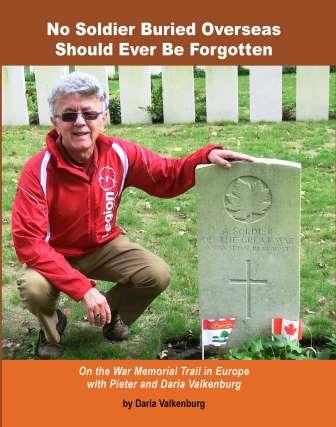
4 countries, 6 weeks, 7,000 km – an unforgettable war memorial journey in Europe…. Daria’s book ‘No Soldier Buried Overseas Should Ever Be Forgotten‘ is available in print and e-book formats.  Net proceeds of book sales help support research costs and the cost of maintaining this blog. For more information see https://nosoldierforgotten.com/

Subscribe to our YouTube Channel: On The War Memorial Trail With Pieter Valkenburg: https://www.youtube.com/channel/UCJ591TyjSheOR-Cb_Gs_5Kw

Never miss a posting!  Subscribe below to have each new story from the war memorial trail delivered to your inbox.

On The War Memorial Trail…..Appeal For Relatives Of These WWI Casualties!

August 18, 2019.  Over the past few years, Pieter has been diligently researching the 48 names on the Cenotaph outside the Borden-Carleton Legion here on Prince Edward Island.  Along the way he’s met many family members of these men, and we’ve visited a number of the graves.  However, in some cases, either no family members have come forward, or the family members themselves have no photos and little information.

In an attempt to achieve the goal of putting a face to each name on the Cenotaph, we’re asking for your help with these WWI casualties for whom no photo has been found as yet.

Please see the attached PDF which provides information on the person’s name, service number, place of birth, unit served in at the time of death, and date of death.  (See Appeal For Relatives of Soldiers)  As well, the names are summarized below.

Can you help with photos????

Names still without faces from WWI

  • James CAIRNS, born in Kinkora  UPDATE: Photo found!
  • Leigh Hunt CAMERON, born in Albany
  • James Lymon CAMERON, born in Victoria
  • William Galen CAMPBELL, born in Wellington
  • Bazil CORMIER, born in Tignish
  • Joseph Arthur DESROCHES, born in Miscouche  UPDATE: Photo found!
  • ames Graham FARROW, born in Argyle Shore
  • Charles LOWTHER, born in North Carleton
  • Arthur Clinton ROBINSON, born in Tryon
  • Harry ROBINSON, born in Augustine Cove  UPDATE: Photo found!

If you have information and photos to share on any of these names listed on the Cenotaph, please contact Pieter at memorialtrail@gmail.com or comment on the blog.

© Daria Valkenburg
….Want to follow our research?…

If you are reading this posting, but aren’t following our research, you are welcome to do so.  Our blog address: https://onthewarmemorialtrail.com/

4 countries, 6 weeks, 7,000 km – an unforgettable war memorial journey in Europe…. Daria’s book ‘No Soldier Buried Overseas Should Ever Be Forgotten‘ is available in print and e-book formats.  Net proceeds of book sales help support research costs and the cost of maintaining this blog. For more information see https://nosoldierforgotten.com/
Subscribe to our YouTube Channel: On The War Memorial Trail With Pieter Valkenburg: https://www.youtube.com/channel/UCJ591TyjSheOR-Cb_Gs_5Kw

Never miss a posting!  Subscribe below to have each new story from the war memorial trail delivered to your inbox.

The WWI Soldiers Who Never Left Canada

April 29, 2019.  Pieter Valkenburg, who is researching the names on the Cenotaph outside the Borden-Carleton Legion, has discovered that out of the 24 soldiers from WWI listed on the Cenotaph, two never left Canada:  Leigh Hunt CAMERON and Harry ROBINSON, both of them from the 105th Battalion, C Company.

….Leigh Hunt Cameron died of measles in Charlottetown….

Leigh Hunt Cameron, born May 6, 1898 in Albany, was the son of Alexander Walter Cameron and Phoebe Ann Murray.  A farmer before being officially enlisted on March 2, 1916, Leigh Hunt contracted measles and passed away at the age of 18 at the Military Hospital in Charlottetown on May 5, 1916.

An obituary in the May 10, 1916 edition of the Summerside Journal noted that “A few weeks ago he took measles and was getting better when complications set in. Pneumonia and a weakened heart finally caused his death. With full military honours the body was conveyed to the 2:20 train Saturday afternoon, the Summerside band leading the cortege, and was sent to Albany. The funeral took place Sunday afternoon from the home of Mr. William Cameron, an uncle with whom Private Cameron had lived.”  He’s buried at the Free Church of Scotland cemetery in Cape Traverse.  (2024 NOTE: The cemetery is now called Cape Traverse Community Cemetery)

OLYMPUS DIGITAL CAMERA

Grave of Leigh Hunt Cameron at Free Church of Scotland cemetery in Cape Traverse. (Photo credit: Pieter Valkenburg)

….Harry Robinson died of blood poisoning in Valcartier….

Harry Robinson was born July 9, 1881 in Augustine Cove, the son of Thomas Robinson and Sarah Campbell.  One of the few soldiers listed on the Cenotaph who had been married, Harry was a widower.  He’d lost his daughter Merilla in 1911, and his wife Clara Wadman in 1912.  A carpenter before his official enlistment on April 28, 1916, Harry was sent to Valcartier, Quebec for training, where he unfortunately contracted blood poisoning from a cellulitis infection.

An obituary in the July 1, 1916 Agriculturalist explained that “The body arrived by the Northumberland on Thursday evening, accompanied by Pte. John Howatt. The deceased became ill last Saturday and died on Tuesday morning. The case is a particularly sad one as the deceased was the only support of a widowed mother, Mrs. Thos. Robinson, of Augustine Cove. He was a widower, without children, and was about thirty-five years old.”  Pte Howatt was John Goodwill HOWATT, also of Augustine Cove, whose story was told in an earlier blog posting.  (See The Archive Photo That Put A Face To A Name)Harry is buried in the Tryon People’s Cemetery in Tryon.

Grave of Harry Robinson and family cairn at Tryon People’s cemetery in Tryon.  (Photo credits: Pieter Valkenburg)

Unfortunately, Pieter has not been able to find photos of either of these two men.  If you have information or photos to share on Leigh Hunt Cameron or Harry Robinson, please send an email to memorialtrail@gmail.com or comment on this blog. UPDATE: A photo of Harry Robinson was received in February 2025.

© Daria Valkenburg

….Want to follow our research?….

If you are reading this posting, but aren’t following our research, you are welcome to do so.  Our blog address: https://onthewarmemorialtrail.com/

4 countries, 6 weeks, 7,000 km – an unforgettable war memorial journey in Europe…. Daria’s book ‘No Soldier Buried Overseas Should Ever Be Forgotten‘ is available in print and e-book formats.  Net proceeds of book sales help support research costs and the cost of maintaining this blog. For more information see https://nosoldierforgotten.com/

You are also invited to subscribe to our YouTube Channel: On The War Memorial Trail With Pieter Valkenburg: https://www.youtube.com/channel/UCJ591TyjSheOR-Cb_Gs_5Kw

Never miss a posting!  Subscribe below to have each new story from the war memorial trail delivered to your inbox.

On The War Memorial Trail…..The WWI Soldier Who Never Made It To The Front

April 22, 2019.  In researching the stories behind the names on the Cenotaph outside the Borden-Carleton Legion, Pieter sometimes discovers that the soldier lost his life BEFORE ever getting a chance to make it into battle.  This is what happened to Private Bruce Sutherland MCKAY (MACKAY) of Albany, the son of David McKay and Almira (Elmira) Harvey.  Born April 16, 1897, according to his attestation papers, Bruce Sutherland, a farmer, enlisted with the 1st Depot Battalion, Nova Scotia Regiment, on March 21, 1918.

Bruce Sutherland McKay 1895-1918 photo from Roma McKay

Bruce Sutherland McKay. (Photo courtesy of Roma McKay collection)

On April 17, 1918 he left Halifax for England, aboard the S.S. Scotian, and arrived in Liverpool, England on April 28, 1918.  That same day, he was transferred to the 17th Reserve Battalion of the Canadian Infantry.  Unfortunately, he must have gotten ill during the voyage as the next day he was admitted to the Military Isolation Hospital in Aldershot, with a diagnosis of scarlet fever.

Things went from bad to worse for this poor soldier.  While in hospital he developed measles, pleurisy, and bronchial pneumonia.  It was too much for his system and he died in hospital on May 22, 1918.

In most cases, this would be nearly the end of the story.  However, Mrs McKay must have written a letter to the hospital, asking for details on what happened to her son. A letter received from his nurse, Ada Jones, was published in The Pioneer on August 10, 1918:

“Dear Mrs. McKay:

Your letter has been passed on to me, as I was in charge of the ward your poor son died in. First, let me express my deepest sympathy in your great sorrow; it must have been a great shock to you, and there are the times when one seems not able to turn to anyone for comfort or help to bear the burden, unless we know and can turn to Our Father above, and we know He understands and He loves. Now I will try to tell you just what I can. How I wish I could just do something to help your lonely heart.

Your poor boy came in here on the 29th April with scarlet fever. I don’t know if he was very strong at home, but we know camp life is not like home, so this may have weakened his chest, for he developed pneumonia and this eventually took him away from us on the 22nd May at two in the afternoon. I can assure you he was very good and patient. It was a pleasure to do anything for him. At first he was a bit reserved, but later used to speak of the farm he was coming back to. When the days were warm and fine he was carried outside in his bed and would say how some parts reminded him of home, and always spoke very tenderly of his dear mother.

The last three days were the worst he had for pain. The morning he went he often asked if we could help. I tried to tell him how there was One above who could. He said he knew his dear mother prayed for him. At one o’clock he said he felt much better. God was helping him through and was quite conscious till about ten minutes before the end, which was one of the most peaceful ends I have seen, so rest assured, dear mother, your dear son is with Jesus and is looking forward to meeting you there one day.

He was buried in a lovely spot just close to the Military Cemetery with full military honours, where there are a good many others who have sacrificed their lives in this terrible war.

It could not have been possible to have brought him home, for being infectious they would not be allowed to take him on a ship, and I am sure the memory of him in health would be far happier to you than when grim death had come on. Now I do hope this may be a little comfort to you. I just wish I could do something more. May our Father in Heaven put His loving arms around you and comfort and keep you.

Believe me yours very sincerely,

Ada Jones

The cemetery mentioned in Nurse Ada Jones’ letter is the Aldershot Military Cemetery in Hampshire, England.  Graham and Jacqueline Hocking, who live near the cemetery, were kind enough to visit the grave and send photos.  Graham noted that the gravestone inscription lists Bruce Sutherland as MacKay not McKay.

Aldershot Military Cemetery Chapel

Chapel at Aldershot Military Cemetery. (Photo credit: Graham Hocking)

ghkneelingbygravestone.jpg

Graham Hocking by the grave of Bruce Sutherland McKay. (Photo credit: Jacqueline Hocking)

Our thanks to Roma McKay for providing a photo of Bruce Sutherland, and to Graham and Jacqueline Hocking for visiting the cemetery and taking photos.  If you have information or photos to share on Bruce Sutherland McKay, please send an email to memorialtrail@gmail.com or comment on this blog.

© Daria Valkenburg

….Want to follow our research?…

If you are reading this posting, but aren’t following our research, you are welcome to do so.  Our blog address: https://onthewarmemorialtrail.com/

4 countries, 6 weeks, 7,000 km – an unforgettable war memorial journey in Europe…. Daria’s book ‘No Soldier Buried Overseas Should Ever Be Forgotten‘ is available in print and e-book formats.  Net proceeds of book sales help support research costs and the cost of maintaining this blog. For more information see https://nosoldierforgotten.com/

Subscribe to our YouTube Channel: On The War Memorial Trail With Pieter Valkenburg: https://www.youtube.com/channel/UCJ591TyjSheOR-Cb_Gs_5Kw

Never miss a posting!  Subscribe below to have each new story from the war memorial trail delivered to your inbox.

On The War Memorial Trail…..The Archive Photo That Put A Face To A Name

March 15, 2019.  One of the biggest challenges in the project to uncover the stories behind the names listed on the Cenotaph outside the Borden-Carleton Legion is finding photos of the men.  Quite often family members can be found, but photos, especially for soldiers who lost their lives in WWI, were not always kept by family.  

Most of the soldiers who lost their lives were young and unmarried, and succeeding generations of nieces and nephews didn’t always want to keep what was left behind by grandparents or their parents.  Photos, particularly unidentified ones, and letters from unknown people were just not a priority for many people.

So it was a very pleasant surprise when, during a visit to the Prince Edward Island Archives in Charlottetown, Pieter struck it lucky while looking through an album of photos donated by Jean MacFayden.  Most photos were not identified, but then, to his astonishment, Pieter found a photo of WWI soldier John Goodwill HOWATT, of Augustine Cove.  Unfortunately, the other two men in the photo were unidentified, with only the remark that they were ‘two Halifax boys’. Up to now, Pieter has not been able to find anyone else who might have the same photo and be able to give more information.

P0006342 copy J.G. Howatt ordered from PEI Public Archives

Photo donated to the PEI Archives by Jean MacFayden, in which she identified John Goodwill Howatt on the left, and noted only that he was with “two Halifax boys”. (Photo credit: courtesy Public Archives and Records Office of Prince Edward Island, Acc4154)”

In this exceptional case, Pieter had a photo, which could put a face to a name, but was unable to find any family, a bit unusual given that Howatt is a well-known Island name!  Who was this mystery man?

John Goodwill HOWATT was born July 27, 1897 in Augustine Cove, the son of Edward G. Howatt and Emma May Wood, and had a younger sister, Cecilia Amanda.  After John’s father died in 1908, his mother remarried, to Don Howatt in 1909, but she herself died on August 25, 1916.

A farmer before he decided to enlist in January 1916 with the 105th Battalion, Company C, John had his medical exam in Summerside, but it wasn’t until March 4, 1916 that he received his medical clearance and was formally enlisted.  After that, things moved quickly, and he was on his way to England in June 1916, sailing from Halifax aboard the S.S. Empress of Britain.  On November 28, 1916 he was transferred to the 25th Battalion of the Canadian Infantry and sent to France, arriving there on November 29, 1916.

On August 8, 1918, the Battle of Amiens began in France, the start of the 100 Days Offensive that led to the end of WWI.  By the end the day, Allied Forces had forced their way through German lines around the Somme. There were 27,000 German casualties, 12,000 of which had surrendered.

The next day, August 9, the war diary of the 25th Battalion recorded that, “At 9:15 am, verbal orders were received for the Battalion to continue the attack in conjunction with other troops.”  After leaving Gaillacourt, where they had spent the night, “The Battalion rapidly moved to the assembly position – the heights southeast of Caix – and crossed the British front line, then held by the 4th Canadian Division, at 1 pm. As the Battalion moved over the ridge in front of Caix, they were met with a light artillery barrage, and strong enemy machine gun fire.

As they pressed on towards Vrely, the Battalion encountered “some hard fighting in a wood on the right”.  Undaunted, the Battalion continued on and the war diary gave an understated report of what happened next.  “On emerging from Vrely, ‘A’, ‘B’, and ‘C’ companies met with some opposition in the nature of an enemy Field Battery, which opened fire from a few hundred yards away.” The Battalion won this skirmish.  “Rifle and machine gun fire caused this Battery to retire, with the loss of its officers and three of its drivers, and the advance continued to Meharicourt, which was captured with little trouble by 5 pm.

It’s not certain exactly when, but at some point on the second day of the battle, John was severely wounded in his back and shoulder from gunshot, leaving him paralyzed from the waist down.  He was carried to a Casualty Clearing Station, then put on a train the next day to a field hospital. 

On August 22, he was transported back to England and operated on, but died in a London hospital on September 7, 1918. He was only 21 years old.  He’s buried at Brookwood Military Cemetery in Surrey, England, which we have not yet been able to visit.

If you have more information or photos on John Goodwill Howatt, or are able to identify the two ‘boys from Halifax’ in the photo shown above, please send an email to  memorialtrail@gmail.com or comment on this blog.

© Daria Valkenburg

….Want to follow our research?…

If you are reading this posting, but aren’t following our research, you are welcome to do so.  Our blog address: https://onthewarmemorialtrail.com/

4 countries, 6 weeks, 7,000 km – an unforgettable war memorial journey in Europe…. Daria’s book ‘No Soldier Buried Overseas Should Ever Be Forgotten‘ is available in print and e-book formats.  Net proceeds of book sales help support research costs and the cost of maintaining this blog. For more information see https://nosoldierforgotten.com/

Subscribe to our YouTube Channel: On The War Memorial Trail With Pieter Valkenburg: https://www.youtube.com/channel/UCJ591TyjSheOR-Cb_Gs_5Kw

Never miss a posting!  Subscribe below to have each new story from the war memorial trail delivered to your inbox.

On The War Memorial Trail….The Mariner Whose Ship Was Torpedoed In The English Channel

January 20, 2019….Researching the names on the Cenotaph outside the Borden-Carleton Legion continually brings some surprises as we unlock the stories behind the names.  It’s well documented that there was a merchant navy in WWII, and there are many stories about the infamous U-boats used by the Nazis during WWII.  But, did you know that there was a merchant navy in WWI?……And did you know that there were German U-boats in WWI?…….

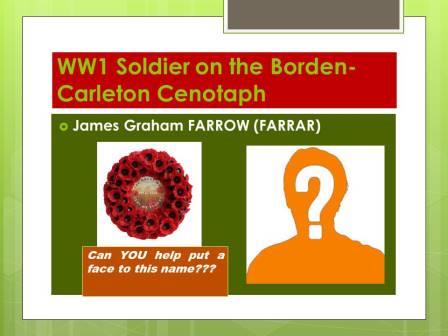
In researching what happened to James Graham FARROW (FARRAR), we learned that he was NOT a soldier, but served as Second Mate in WWI’s Merchant Navy aboard the SS Port Dalhousie, ferrying needed supplies from England to allied soldiers in France.

Farrow was born April 4, 1856 in Argyle Shore, the son of Henry Farrow and Mary Jane Gouldrup.  In 1897, he married Mary Jane Howatt and they had 4 children.  Mary Jane also had a son William from her first husband, John Morrell, and was the sister of Harold Keith HOWATT who served in the same regiment as William Galen CAMPBELL. Campbell is also listed on the Cenotaph outside the Borden-Carleton Legion.  (See Christmas At The Front During WW1)

A mariner, Farrow received his Captain’s papers by 1903.  He owned a schooner named ‘Eva May’, but sold it in 1906 and moved to a homestead in Saskatchewan.  However, by 1912 the family was back on Prince Edward Island, where, according to ‘Seafarers of the Atlantic Provinces, 1789-1935’, he was the owner and operator of a schooner registered on PEI, named ‘Howard L’.  (Source: Ancestry.com. Canada, Seafarers of the Atlantic Provinces, 1789-1935)

In a February 19, 1916 letter to his son Welton, who was living in Portland, Maine with his mother and siblings, Farrow explains that that he gave up the schooner and on December 27, 1915 he accepted a position as second mate aboard a steamer, and was currently sailing between France and England.  “I am here in France.  I had charge of a schooner and when I laid her up in Pictou, I got a job in this steamer as second mate. It is a good job with a little more wages than on the schooner.  I got $50 a month on the schooner and $55 a month here.  (Source: www.islandregister.com/letters/james farrow 1916.html)

Farrow explained that the steamer intended to return to Canada in July, but had decided to stay in Europe.  If he wanted to return to Canada, his way would be paid back after 6 months, but as he was paid promptly each month, he thought he would stay with the steamer.

Unfortunately, by the time that Welton Farrow received that letter, his father was dead.  On March 19, 1916, U-Boat 10 torpedoed the steamer Port Dalhousie, the ship he was on, and it sank in the English Channel.

From the New York Times, page 2, column 6:

U-BOAT ATTACKS FISHERMEN”

“Sinks two trawlers off Northeast Coast of England. London July 13 – Following the attack by a German submarine on the British port of Seaham Harbor on Tuesday night, a submarine raid on fishing near the English coast was reported by Lloyd’s today.   A German submarine attacked a British fishing fleet off the northeastern coast and sank the trawlers Florence and Dalhousie and several smaller vessels.” (Source: www.islandregister.com/letters/james farrow 1916.html )

Fake news isn’t a new phenomenon!  The story about Port Dalhousie being a fishing boat, as reported in a New York Times article, was a cover the boat used. When it sank, the cargo manifest said it was transporting steel billets.  Farrow and 18 other crew members perished, their bodies lost to the sea.

Farrow’s wife, Mary Jane, stayed in Maine.  In 1930 she moved to Waterville, where she lived until her death on May 15, 1956, when she was buried in the Tryon Peoples’ Cemetery in Tryon.

Service and duty were legacies of Farrow as his sons Ralph, Harold, and Welton also served in WWI.  Ralph and Harold enlisted in the Canadian Overseas Expeditionary Force in July 1917.  Welton served in the US Army.  Ralph’s son joined the US Air Force and served in WWII, but after the war he met an untimely death when his plane crashed in Florida during an exercise.  He’s buried in Arlington National Cemetery in Virginia.

With no body to bury, James Farrow is remembered on the memorial stone at the Tryon People’s Cemetery in Tryon and on the Halifax Memorial in Point Pleasant Park in Halifax.

memorial stone tpc pieter valkenbrg

Photo: Memorial stone at Tryon Peoples Cemetery in Tryon, PEI. Photo credit: Pieter Valkenburg

Photos: Halifax Memorial at Point Pleasant Park in Halifax. Photo credits: Pieter Valkenburg

Besides Farrow, two additional names from this Cenotaph Research Project are listed on the Halifax Memorial:

Although we know a lot about James Farrow’s life, we do NOT have a photo of him.  If anyone has photos or information to share, please let us know. You can send an email to memorialtrail@gmail.com or comment on this blog.

© Daria Valkenburg

….Want to follow our research?….

If you are reading this posting, but aren’t following our research, you are welcome to do so.  Our blog address: https://onthewarmemorialtrail.com/

4 countries, 6 weeks, 7,000 km – an unforgettable war memorial journey in Europe…. Daria’s book ‘No Soldier Buried Overseas Should Ever Be Forgotten‘ is available in print and e-book formats.  Net proceeds of book sales help support research costs and the cost of maintaining this blog. For more information see https://nosoldierforgotten.com/

You are also invited to subscribe to our YouTube Channel: On The War Memorial Trail With Pieter Valkenburg: https://www.youtube.com/channel/UCJ591TyjSheOR-Cb_Gs_5Kw

Never miss a posting!  Subscribe below to have each new story from the war memorial trail delivered to your inbox.

On the War Memorial Trail …..Christmas At The Front During WWI

December 13, 2018.  Researching names on the Cenotaph outside the Borden-Carleton Legion at this time of year gets one to think about what it might have been like for the soldiers, especially during WWI.  They were far from home, by this time they would have lost friends and fellow soldiers, and might be wondering if they themselves would survive another hour, let alone another day.  So when we receive some postcards or letters that tell us what they may be experiencing at holiday time, it’s very special.

A few years ago, we received a photo of George Albert CAMPBELL from his nephew, Gerald Tingley, putting a face to that name.  (Campbell’s story was told in a posting last year – see Two Campbell Brothers in WW1)

George Albert Campbell from Gerald Tingley

Private George Albert Campbell. (Photo courtesy of Gerald Tingley family collection)

Known as Albert, Campbell was born on July 8, 1895 in Wellington, PEI, the son of John George Campbell and Grace Emma, nee Barlow.  A fisherman and farmer before enlisting on April 6, 1915 with the 6th Canadian Mounted Rifles, he later transferred to the 5th Canadian Mounted Rifles.

CIMG2669 Oct 9 2018 meet with Gerald Tingley in Salisbury

Gerald Tingley, left, with Pieter. (Photo credit: Daria Valkenburg)

Recently we had a chance to meet Gerald Tingley in person.  He arrived with a binder of WWI letters from his uncle that had been written to Gerald’s mother, and Albert’s sister, Sophie.

One excerpt was really special.  In a December 1915 letter to his sister Sophie, he wrote:  “We got a big box of cake and candy from Bedeque the other day and it was great for a change.  It was meant for Xmas but we ate it all as soon as we got it...

This excerpt about receiving cake and candy from someone in Bedeque really showed how food was always on a soldier’s mind, particularly something delicious from home.  And there was no way a soldier was going to wait for a particular day to have that taste of home.

It was the last Christmas that Campbell experienced.  During the Battle of Mount Sorrel in Belgium, he was killed in action in the vicinity of Maple Copse on June 2, 1916.  He has no known grave, and his name is listed on the Menin Gate Memorial in Ypres.

Xmas card from Harold Howatt

Christmas card with a piece of embroidered handkerchief sent by Harold Howatt, wishing his family a ‘Merry Xmas and a Happy New Year’. (Photo courtesy of H. Howatt collection)

Campbell’s brother, William Galen CAMPBELL, born June 16, 1897 in Wellington, was poisoned by a mustard gas shell in France on May 28, 1918.  He was in the same unit, the 8th Canadian Siege Battery, as Harold Keith HOWATT of Augustine Cove.

Howatt kept an active correspondence and journal, and two Christmas entries survive.  In 1917, he was stationed in Lille, France and recorded the following on December 24:  “Route march this morning, then after we came back we had to carry planks for the hut which is being put up for Christmas dinner.  In the late afternoon Dawson and I went into Lille and had a bath at a convent.  Afterwards we went to a concert in the YMCA hut….

If you ever wondered about the saying that ‘soldiers march on their stomachs’, then you will see why food is important in reading Howatt’s detailed description of the Christmas meal of December 25, 1917.  “Church parade this morning, but I did not go as Mr. Freeman wanted me to help him get ready for the Xmas dinner.  We had a great dinner, duck and chicken, applesauce, vegetables, plum pudding, apples and nuts.  The officers bought everything except the plum pudding, pretty good of them.  After dinner was over we gave ‘three cheers and a tiger’ for them…

By December 1918 the war was over, but troops were still in Europe.  Howatt’s unit was assigned to Germany.  On December 25, he made the following terse entry from Mehlem, on the Rhine: “We had no Christmas dinner as the turkey did not arrive...” 

On January 1, 1919 he gave a happier update in his journal:  “Last evening we had our Xmas dinner, which had been postponed owing to the non-arrival of the turkey.  We sat down at 8 o’clock to a good meal: turkey and vegetables, plum pudding, and nuts and apples.  There was also lots of beer, ginger ale, and also some scotch…

1918 xmas menu

1918 Xmas menu for the 8th Canadian Siege Battery. Notice that each dish had a name that represented where the unit was in France and Belgium! (Photo courtesy of H. Howatt collection)

Unlike George Albert Campbell, both William Galen Campbell and Harold Keith Howatt returned home from WWI.  Surprisingly, no photo of William Galen Campbell has been found.  If you have photos or information to share, please let us know. Send an email to memorialtrail@gmail.com, comment on the blog, or tweet to @researchmemori1.

© Daria Valkenburg

….Want to follow our research?….

If you are reading this posting, but aren’t following our research, you are welcome to do so.  Our blog address: https://onthewarmemorialtrail.com/

Front cover OnTheWarMememorialTrailinEurope4 countries, 6 weeks, 7,000 km – an unforgettable war memorial journey in Europe…. Daria’s book ‘No Soldier Buried Overseas Should Ever Be Forgotten‘ is available in print and e-book formats.  Net proceeds of book sales help support research costs and the cost of maintaining this blog. For more information see https://nosoldierforgotten.com/ 

You are also invited to subscribe to our YouTube Channel: On The War Memorial Trail With Pieter Valkenburg: https://www.youtube.com/channel/UCJ591TyjSheOR-Cb_Gs_5Kw

Never miss a posting! Subscribe below to have each new story from the war memorial trail delivered to your inbox.