On The War Memorial Trail….. In Conversation With Historian Dr. Tim Cook

CIMG5296 Sep 15 2021 Tim Cook & Pieter at Cdn War Museum

Dr Tim Cook (left) with Pieter Valkenburg (right) at the Canadian War Museum in Ottawa.  (Photo credit: Daria Valkenburg)

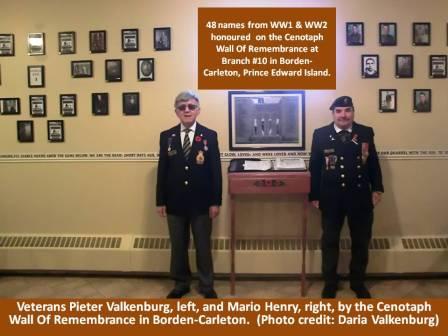
September 20, 2021.  Over the past years, Pieter has researched the stories behind the names on the Cenotaph outside the Borden-Carleton Legion.  As well, he’s researched the stories of other Island soldiers and veterans, and soldiers from across Canada buried in The Netherlands and Belgium. 

…It’s important to tell each individual story” Pieter always says.  “…The sacrifices made and the service in the cause of freedom should not be dismissed or forgotten, particularly if a soldier was not able to return home, but lies buried overseas….

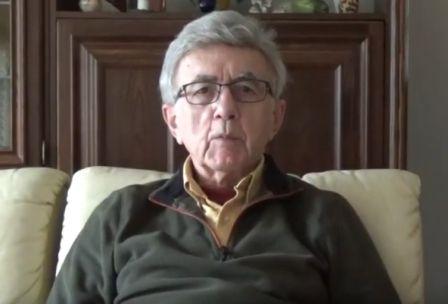
On a recent trip to Ottawa, he met with historian Dr Tim Cook, Director of Research at the Canadian War Museum, and found that Dr Cook shares a similar point of view on the importance of remembrance.  “…In Canada, we have not done a good job in telling the stories of our veterans…” he said.

Dr Cook went on to explain that “….every community in Canada has a memorial for WWI soldiers, but generally, memorials for those who served in WWII were not done.  We didn’t create films and books at the time. We weren’t good at telling the stories….”

…. Canadian veterans at the 50th anniversary events in The Netherlands were treated like heroes…

I thought back to the films, novels, and memoirs that came out of WWII and Dr Cook is correct.  Much of what many of us know about WWII comes from American and British films and books.  Dr Cook agreed. “…It wasn’t until 1995, on the 50th anniversary of WWII, that people woke up after they saw the huge reception our Canadian veterans got in The Netherlands….

Pieter can’t understand why people in Canada didn’t realize how special the veterans were.  “…In The Netherlands, where I was born, they were our liberators, our heroes. Definitely they have never been forgotten….” 

….Many WWII veterans were reluctant to tell their stories when they returned….

Dr Cook thought that reluctance on the part of veterans to tell their stories, particularly in the aftermath of war, contributed to the silence.  Returning veterans simply got on with their lives and rarely spoke about what they experienced.  Pieter has found this to be the case for several of the soldiers he has researched. “…Many times, very little about the actual service of a soldier is known by the family….

20210919_100113 Sep 19 2021 Daria with Cook book

Looking forward to reading ‘The Fight For History’ by Tim Cook. (Photo credit: Pieter Valkenburg)

…There has been a change in sentiment over the past 75 years, helped by the research and participation of ‘champions of history’ like you and ever-increasing interest by the general public…” Dr Cook noted.   His most recent book The Fight For History: 75 Years of Forgetting, Remembering, and Remaking Canada’s Second World Warreflects on the way that WWII has been remembered, forgotten, and remade by Canada over the past 75 years.

Dr Cook told us that his “… newest project is in overseeing an oral history program to interview, record, and archive the stories of veterans, starting with the remaining Second World War veterans and reaching to the present with veterans of the Afghanistan War….

A dedicated and tireless researcher, he is also working on an edited book related to Canada’s involvement in the Korean War.  This war between North and South Korea was fought from June 25, 1950 to July 27, 1953, and has yet to be resolved.

We’re especially looking forward to Dr Cook’s upcoming book on war and medicine in the First World War, which will be published in September 2022. 

We very much enjoyed meeting Dr Tim Cook and thank him for taking the time to share his insights on not forgetting our Canadian military history. 

There are many more stories still to be told! Pieter encourages blog readers to contact him if they have a story to share about Canadians who served. You can email him at memorialtrail@gmail.com, or comment on the blog. 

© Daria Valkenburg

…More about Dr Tim Cook….

To watch a short video from TV Ontario about WWI and reflections 100 years later, see Tim Cook: Canada’s Great War | TVO.org: https://www.tvo.org/video/tim-cook-canadas-great-war

For a brief summary of the many books and articles published by Tim Cook, see https://en.wikipedia.org/wiki/Tim_Cook_(historian)

….Want to follow our research?….

If you are reading this posting, but aren’t following our research, you are welcome to do so.  Our blog address: https://onthewarmemorialtrail.com/

4 countries, 6 weeks, 7,000 km – an unforgettable war memorial journey in Europe…. Daria’s book ‘No Soldier Buried Overseas Should Ever Be Forgotten‘ is available in print and e-book formats.  Net proceeds of book sales help support research costs and the cost of maintaining this blog. For more information see https://nosoldierforgotten.com/

Subscribe to our YouTube Channel: On The War Memorial Trail With Pieter Valkenburg: https://www.youtube.com/channel/UCJ591TyjSheOR-Cb_Gs_5Kw

Never miss a posting!  Subscribe below to have each new story from the war memorial trail delivered to your inbox.

On The War Memorial Trail….. The WW1 Letters Of Arthur Clinton Robinson

July 4, 2021. In 2017 we visited the grave of Arthur Clinton ROBINSON, a WW1 soldier with the 26th (New Brunswick) Battalion, from Tryon, Prince Edward Island, who is buried in Belgium, (See https://bordencarletonresearchproject.wordpress.com/2017/10/16/on-the-war-memorial-trail-in-belgium-and-a-visit-to-la-laiterie-military-cemetery/)  Up to today, we have not found of a photo of him, and neither has his family.

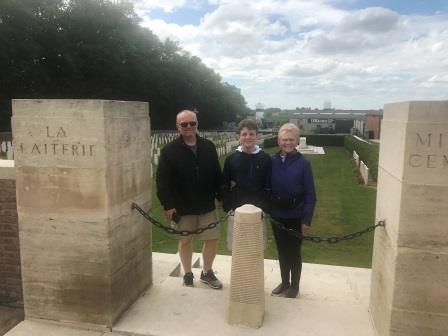
In June 2018, Arthur’s nephew, Arthur ‘John’ Robinson and his wife Hazel visited the grave with their son, dentist Dr. Alan Robinson, and Alan’s son, William Robinson.

2018-06-16 Arthur C Robinson grave (1)

At La Laiterie Military Cemetery in Belgium.  Left to right: Dr Alan Robinson, William Robinson, Hazel Robinson.  (Photo credit: John Robinson)

While no photo has yet been found, the Robinsons were able to find two letters that Arthur wrote to his aunts. 

In an August 30, 1915 letter to his aunt, Robbie Blanchard, written in England just before travelling to France,  he describes the composition of men in his platoon from the 26th (New Brunswick) Battalion: … You should just see the bunch of men … in this 26th alone. They are a magnificent body of fellows….and this Platoon I am in is a corker… there are, I don’t know how many different nationalities in it… Indian, French, Russians, Belgians, English, Irish, Scotch, Americans and Canadians.  Some mob, eh? You can hear nearly any language around here any time of day….” 

While in England, Arthur saw injured troops arriving back from the front and reflected that “…when you see the hundreds of maimed soldiers, some far worse off than if they were dead, and when nearly daily train loads of freshly wounded men pass right before your eyes, it makes you wonder at the ups and downs of this human life…” 

It was a miracle that the August 30 letter arrived in Canada, as the ship the mail had been travelling on, the Hesperian, was torpedoed by a German submarine off the coast of Plymouth, England on September 4, 1915! Luckily it was one of the items salvaged from the wreckage. (See https://www.rmslusitania.info/related-ships/hesperian/ for more information) 

In a September 16, 1915 letter, written in France to his aunt, Carrie Robinson, he outlines life in a trench: …I am quite comfortable here in our cosy little dugout, out of reach of all the Germans in Europe.  I must tell you about the nice dugout and the 4 fellows who are in it with me.  It is a kind of a tunnel running into the side of a loamy hill, with rubber sheets and blankets hung over the mouth of it….” 

There was no electricity in the trench, as Arthur goes on to mention that …We have niches in the back, where we keep our equipment, and we put candles in them at night so we won’t be too lonesome…” 

He then describes how the equipment is turned into a bed for the night. “…On the floor we have straw, stolen from a stack near by, and all over our kits, which make excellent beds, when you know how to arrange them…” 

Although he doesn’t identify them by name, Arthur mentions his 4 trench companions: …1st They are all six footers. 2nd They all wear a seven cap or larger. 3rd They cannot get their feet into smaller boots than nines, and 4th They all weigh over one hundred and seventy pounds each…”  He goes on to say that he weighs over 170 pounds himself and is well fed.  

The saying goes that an army marches on its stomach, and Arthur’s account of his dinner indicates the importance of food.  “…We had potatoes and meat, bread and butter, and tea of course.  We could have had cheese and jam too if we wanted to, but we always try and keep it over for tea.  The bread and butter is great and the cooks of our company seem to have a natural gift of making good tea so we are lucky in that line…” 

One of the challenges in writing letters from the front during wartime is censorship so as not to divulge any information that might be used by the enemy.  Arthur writes about that: …I find it hard to write a letter here for they are so particular about what a person tells that if you write anything you are not supposed to tell they destroy the whole shooting match…

It’s wonderful that these letters survived so that we get a glimpse into Arthur Robinson’s thoughts and experiences.  Sadly, he lost his life on March 27, 1916 when shellfire hit the trenches southeast of Kemmel, Belgium. 

IMG_3466 Hazel and John Robinson

Hazel and John Robinson. (Photo courtesy of the Robinson Family)

Hazel Robinson explained that their 2018 trip was a war memorial tour.  “…Besides visiting Arthur’s grave on this trip, we followed in the footsteps of the Sherbrooke Fusiliers from England to France, Belgium, Germany, ending in the area of Wons. The Sherbrooke Fusiliers was my father’s unit. We also visited Vimy Ridge where my great-uncle is buried….

Hazel’s great-uncle was “William John HILL from Cassius on the Miramichi River in New Brunswick…”  He lost his life on April 9, 1917 and is buried in Canadian Cemetery No 2 in Pas de Calais, France.

During the trip, Hazel noted two coincidences.  “… A member of the Sherbrooke Fusiliers was buried beside Elmer Muttart in 1945….”  Elmer Bagnall MUTTART of Cape Traverse, Prince Edward Island is buried at Harlingen General Cemetery in The Netherlands. (See https://bordencarletonresearchproject.wordpress.com/2017/07/28/the-elmer-bagnall-muttart-story/ and https://bordencarletonresearchproject.wordpress.com/2019/10/15/on-the-war-memorial-trail-the-visit-to-harlingen-general-cemetery/)

Most likely, Hazel is referring to Thomas ‘Tommy’ Clayton REID.  We’d placed flags on his grave when we visited in October 2019.

CIMG3450 Oct 12 2019 Harlingen General Cemetery

Grave of T.C. Reid at Harlingen General Cemetery in The Netherlands.  (Photo credit: Daria Valkenburg)

Hazel found another coincidence in France. “…When we visited the cemetery in Vimy where my great-uncle is buried, the last family to sign the guest book was a family from my home town, Douglastown, in New Brunswick, and whose parents I knew well and who lived a few houses from my parents!…” 

Thank you to Hazel and John Robinson for sharing Arthur’s letters and information about their 2018 trip. If you have photos or information to share, please contact Pieter at dariadv@yahoo.ca, comment on the blog, or send a tweet to @researchmemori1

If you are reading this posting, but aren’t following the blog, you are welcome to do so.  See https://bordencarletonresearchproject.wordpress.com or email me at dariadv@yahoo.ca and ask for an invitation to the blog. 

Screenshot_2021-02-27 On The War Memorial Trail With Pieter Valkenburg

You are invited to subscribe to our YouTube Channel: On The War Memorial Trail With Pieter Valkenburg: https://www.youtube.com/channel/UCJ591TyjSheOR-Cb_Gs_5Kw

© Daria Valkenburg

On The War Memorial Trail….. The WWI Soldier Who Returned To Tryon

April 24, 2021.  One of the joys in doing research for the On The War Memorial Trail research project is the opportunity to learn more about the families of our friends and neighbours.  Much of the focus is on those who served our country and lost their lives while in service.

Pieter with Mary Ferguson, daughter of Maynard Foy.  (Photo credit: Daria Valkenburg)

However, the majority of military service personnel in WWI and WWII returned home.  We don’t often know much about their time in service, or what happened afterwards.  As families come forward with information, Pieter is trying to tell these stories. Recently we met with Mary Ferguson of Crapaud, who shared photos about her father.

Maynard Foy.  (Photo courtesy of Mary Ferguson)

WWI veteran Maynard FOY of Tryon, Prince Edward Island was born December 22, 1886, the son of Theodore Seth Harding Foy and Almira Boulter. By the time he enlisted with the 105th Overseas Battalion on March 2, 1916, he already had served 8 years in the 82nd ‘Abegweit Light Infantry’ Regiment (which later became the PEI Highlanders.  For more information, see https://en.wikipedia.org/wiki/The_Prince_Edward_Island_Highlanders).

On July 25, 1916 he arrived in England aboard the SS Empress of Britain. On March 2, 1918 he was transferred to the 13th Reserve Battalion, then a month later to the 26th Overseas (New Brunswick) Battalion.

The medical case history sheet at Camp Hill Hospital in Halifax, Nova Scotia noted that Maynard was admitted on July 13, 1919 – straight from the hospital ship HMHS Araguaya. (See https://wartimememoriesproject.com/greatwar/ships/view.php?pid=3451) His injuries had occurred during the Battle of Amiens. (See https://www.thecanadianencyclopedia.ca/en/article/battle-of-amiens

According to the medical file, during the battle Maynard “…was carrying a smoke bomb in his left trousers pocket in the attack of August 8, 1918 when a machine gun bullet struck the bomb, causing it to explode, burning his left leg from the trochanter major to ankle, and palms of both hands…”  The trochanter major is a bony prominence toward the near end of the thighbone ie the femur, the point at which the hip and thigh muscles attach.

In a report for the 2004 Foy Reunion, Maynard’s great-granddaughter, Melissa Gauthier wrote that “As a result of the explosion, Maynard’s leg caught fire. In Maynard’s attempt to put it out with his hands, they were burnt so bad he couldn’t straighten them. They greatly resembled claws….

The medical care history report explained that “… The bullet penetrated the thigh in upper third.  Has been in hospital since that time….” Maynard had been taken to England from a hospital in Rouen, France, then returned to Canada once he was stable enough to travel, and remained in hospital quite a while longer.  He wasn’t discharged until January 12, 1920.

Emma Howatt Foy.  (Photo courtesy of Mary Ferguson)

Once back on the Island, he settled in Tryon and ran a mixed farming operation.  “He married the love of his life, Emma Howatt, then proceeded to have 11 children…” said Melissa in her report. They had married in Bedeque on September 13, 1923.

The Foy siblings. Left to right, standing: Ralph, Mary, Cecil (+), Theo (+), Marion, Keith, Percy, Ruth (+), Lorne.  Seated, left to right: Louise, Betty (+) (Photo courtesy of Mary Ferguson)

Maynard’s leg never healed properly. Melissa recounted that “…my grandfather…Ralph Foy… often took Maynard to the doctors to have the bone fragments extracted from Maynard’s leg. As painful as it sounds, Maynard didn’t feel a thing for the explosion had left his leg numb….

Maynard died on April 18, 1957, and is buried at the Tryon People’s Cemetery in Tryon, Prince Edward Island. He’s never been forgotten by his family.  Mary Ferguson recalled that “… he was a very patient guy who never got cross.  Eleven kids and he never got cross!….

Thank you to Mary Ferguson for sharing photos and information about her father.  Maynard Foy was fortunate as he was able to return home from WWI. Three men from the same area were not as lucky in the Battle of Amiens, and are buried overseas:

If you have photos or information to share, please email us at memorialtrail@gmail.com, or comment on the blog. Please note that Pieter is still looking for a photo of James Cairns and Bazil Cormier.  UPDATE:  A photo of James Cairns has been found!

© Daria Valkenburg

….Want to follow our research?….

If you are reading this posting, but aren’t following our research, you are welcome to do so.  Our blog address: https://onthewarmemorialtrail.com/

Front cover OnTheWarMememorialTrailinEurope4 countries, 6 weeks, 7,000 km – an unforgettable war memorial journey in Europe…. Daria’s book ‘No Soldier Buried Overseas Should Ever Be Forgotten‘ is available in print and e-book formats.  Net proceeds of book sales help support research costs and the cost of maintaining this blog. For more information see https://nosoldierforgotten.com/

You are also invited to subscribe to our YouTube Channel: On The War Memorial Trail With Pieter Valkenburg: https://www.youtube.com/channel/UCJ591TyjSheOR-Cb_Gs_5Kw

Never miss a posting!  Subscribe below to have each new story from the war memorial trail delivered to your inbox.

The Search For A Photo Of Leigh Hunt Cameron Moves To YouTube

Pieter during Leigh Hunt Cameron video

Pieter during the filming of the YouTube video ‘Photo Search – WWI Soldier Leigh Hunt Cameron’ (Photo credit: Daria Valkenburg)

March 24, 2021.  When Pieter began his research to find out about the men listed on the Cenotaph outside the Borden-Carleton Legion, his hope was to have a photo of each man, to go with the stories he was able to unfold.

He always thought that finding a photo of a soldier who died without ever leaving the Island wouldn’t be difficult to find.  However, this has not been the case for WWI soldier Leigh Hunt CAMERON.  (See https://bordencarletonresearchproject.wordpress.com/2019/04/29/the-ww1-soldiers-who-never-left-canada/)

Born in Albany, Prince Edward Island on May 6, 1898 to Anna Jane Cameron, Leigh was raised by his grandparents, Alexander Walter Cameron and Phoebe Ann Murray.

In 1907, Anna Jane married Arthur Edwards from Ontario, and they moved to Carman, Manitoba. They had 3 daughters and 1 son.

Leigh enlisted on March 2, 1916 with the 105th Battalion, C Company but shortly afterwards caught measles and developed pneumonia.  He died of these causes on May 5, 1916, and is buried in the cemetery of the Free Church of Scotland in Cape Traverse, Prince Edward Island.  While visiting his grave, Pieter wished he knew what this young man looked like.  (Note: The cemetery is now called Cape Traverse Community Cemetery)

Pieters saying

After several years of an unsuccessful search for family or friends, he’s taken his appeal for a photo to YouTube, in the hope that a viewer might come forward:

Thank you to post-production editor Wendy Nattress, who made this YouTube video a reality. If you have photos or information to share about Leigh Hunt Cameron, please email Pieter at memorialtrail@gmail.com, or comment on the blog.

© Daria Valkenburg

….Want to follow our research?…

If you are reading this posting, but aren’t following our research, you are welcome to do so.  Our blog address: https://onthewarmemorialtrail.com/

4 countries, 6 weeks, 7,000 km – an unforgettable war memorial journey in Europe…. Daria’s book ‘No Soldier Buried Overseas Should Ever Be Forgotten‘ is available in print and e-book formats.  Net proceeds of book sales help support research costs and the cost of maintaining this blog. For more information see https://nosoldierforgotten.com/

Screenshot_2021-02-27 On The War Memorial Trail With Pieter Valkenburg

You can subscribe to: On The War Memorial Trail With Pieter Valkenburg: https://www.youtube.com/channel/UCJ591TyjSheOR-Cb_Gs_5Kw

Never miss a posting!  Subscribe below to have each new story from the war memorial trail delivered to your inbox.

On The War Memorial Trail….. The Fisherman Who Lost His Life In France While A WWI Soldier

March 21, 2021. In researching the stories of the names listed on the Cenotaph outside the Borden-Carleton Legion, it’s become a mystery why some from the local area were NOT included on the Cenotaph.  Over the years, two names have been added to the original 46 names… that of James Ambroise CAIRNS and Joseph Arthur DESROCHES.

In the village of Victoria-By-The-Sea, two men listed on a memorial at the Victoria Community Hall, built in 1915, (which is also the home of the Victoria Playhouse) are on the Cenotaph: Arthur Leigh COLLETT and Percy FARRAR

When Pieter went to see the memorial, he wondered why WWI soldier Heath Ward MACQUARRIE was not.  Brenda Boudreau, of the Victoria Historical Society, explained that Heath Ward MacQuarrie was her grand-uncle, “….my grandfather’s brother...

CIMG4912 Nov 11 2020 Brenda Boudreau & Pieter by Victoria WW1 monument

Brenda Boudreau and Pieter Valkenburg by the memorial at Victoria Community Hall on November 11, 2020.  (Photo credit: Daria Valkenburg)

No soldier buried overseas should be forgotten...” Pieter reminded me, after learning that this WWI soldier had died in France. 

Heath MacQuarrie in uniform

Heath MacQuarrie. (Photo courtesy of Greg Gallant of the PEI Regiment Museum.)

Born in Victoria-By-The-Sea on March 28, 1891, according to his baptismal record, Heath was the son of William Archibald MacQuarrie and Charlotte Mallett.   A fisherman before enlisting with the 105th Overseas Draft Battalion on February 19, 1917, Heath was married.  He and his wife, Bertha May Francis, were the parents of a son, William Richard ‘Dick’ MacQuarrie.

1024px-Arthur_Lismer_-_Olympic_with_Returned_Soldiers

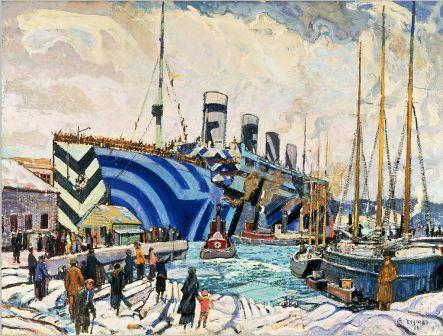
Olympic in dazzle at Pier 2 in Halifax, Nova Scotia painted by Arthur Lismer (Source: https://en.wikipedia.org/wiki/RMS_Olympic#First_World_War)

On June 1, 1917 he left Halifax aboard the ‘Olympic’, one of the ships used to transport troops from Halifax, Nova Scotia to Britain. As of 1917, the ship had 6-inch guns and was painted in a ‘dazzle’ camouflage in brown, dark blue, light blue, and white colours, in an attempt to make it more difficult for observers to estimate her speed and heading. (For more information, see https://en.wikipedia.org/wiki/RMS_Olympic#First_World_War)

The dazzle camouflage worked as Heath safely arrived in England on June 10, where he was transferred to the 13th Reserve Battalion.  Then, on November 23, 1917, he was transferred again, to the 23rd Reserve (New Brunswick) Battalion, and sent to France a day later.

His brother Glen had enlisted in 1914 and was in France as well but it’s unknown if the two brothers ever met up with each other.  Glen survived the war, but Heath did not.

On August 8, 1918 he lost his life, aged 27.  According to the stark account in the Circumstances of Casualty form in his service file, Heath “…was so severely wounded in many parts of his body by enemy fire while taking part in operations at the Sunken road in front of Guillaucourt, that despite the fact he received first aid promptly he succumbed shortly afterwards.

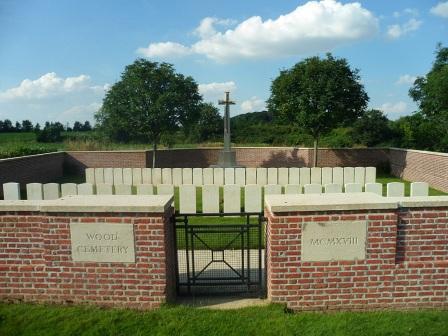
He was buried at Wood Cemetery in the village of Marcelcave, 24 kms east of Amiens in the Department of the Somme in France. He’s one of 50 WWI burials in this cemetery – 41 from Canada and 9 from the United Kingdom. 

Heath’s wife Bertha never remarried. Their son Dick attended Dalhousie University in Halifax, majoring in geology.  His work took him across Canada before he returned back to Victoria-By-The-Sea with his wife Marion Raynor, before passing away in 1975, at the age of 60.

Richard Dick MacQuarrie

Dick MacQuarrie in Victoria-By-The-Sea on May 14,1929. (Photo courtesy of Brenda Boudreau.)

Thank you to Brenda Boudreau for providing information of her grand-uncle.  If you have any further information to share, please let Pieter know.  You can email him at memorialtrail@gmail.com, or comment on the blog. 

© Daria Valkenburg

….Want to follow our research?….

If you are reading this posting, but aren’t following our research, you are welcome to do so.  Our blog address: https://onthewarmemorialtrail.com/

4 countries, 6 weeks, 7,000 km – an unforgettable war memorial journey in Europe…. Daria’s book ‘No Soldier Buried Overseas Should Ever Be Forgotten‘ is available in print and e-book formats.  Net proceeds of book sales help support research costs and the cost of maintaining this blog. For more information see https://nosoldierforgotten.com/

Screenshot_2021-02-27 On The War Memorial Trail With Pieter Valkenburg

You are also invited to subscribe to our YouTube Channel: On The War Memorial Trail With Pieter Valkenburg: https://www.youtube.com/channel/UCJ591TyjSheOR-Cb_Gs_5Kw

Never miss a posting!  Subscribe below to have each new story from the war memorial trail delivered to your inbox.

On The War Memorial Trail….. A WW1 Era Letter From A German Soldier Was An Anti-War Song!

March 4, 2021. Once in a while, when we do a story about a soldier, we find more information than we ever expected.  This was the case when we were contacted by Earle Davison of Kensington, Prince Edward Island, and told the story of his uncle, William Earle DAVISON, a WW1 soldier who lost his life in France while serving with the Sixth Canadian Siege Battery.  (See https://bordencarletonresearchproject.wordpress.com/2020/11/08/on-the-war-memorial-trail-remembering-ww1-soldier-william-earle-davison/)

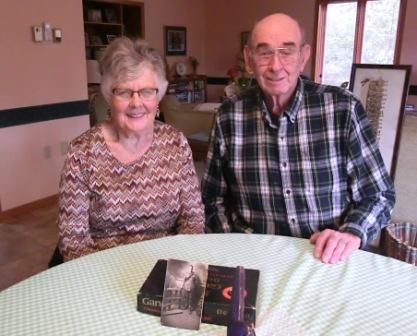
CIMG4858 Oct 28 2020 Irene & Earle Davison

Irene and Earle Davison beside a box that contained Earle’s uncle’s effects, including the German anti-war poem. (Photo credit: Daria Valkenburg)

When Earle contacted us, he mentioned a box containing the last possessions of his uncle.  One of the items he identified was “… a copy of a letter taken from a German soldier…”  We were confused by the word ‘copy’ and wondered what kind of letter it could be.

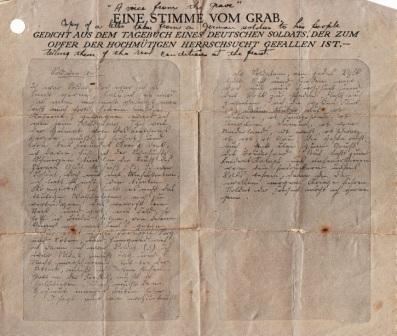
When we saw the actual document, it was clear that it was not an original letter.  It appeared to be a published leaflet, as the heading at the top of the page was typeset, with handwriting reproduced below it.  Someone, perhaps Earle Davison himself, had written a brief translation in English of the title ‘Eine Stimme vom Grab’ (‘A Voice From The Grave’).

Was it a letter or a poem????

Davison German letter full view

The German ‘letter’ found amongst WW1 Soldier Earle Davison’s possessions. (Courtesy of Earle Davison & Family.)

The handwritten portion was in an old German script and appeared to be a poem.  Our only clue was that in English was written “…Copy of a letter taken from a German soldier to his people, telling them of the real conditions at the front…”  However, the first word in German…. ‘gedicht’ …. indicated this was a poem, not a letter.

The full heading was translated as:  “… A Voice From The Grave…. Poem from the diary of a German soldier who was a victim of Imperial domination….

We didn’t know what to make of it, so a copy of the document was sent to Berlin historian Ralf Gräfenstein.  Was he able to read the handwriting and tell us what it was all about?

Ralf replied that “… It is not a letter of a German soldier, but the handwritten text of an old German Anti-War song….”  A song?  That was a surprise twist!  “…The text of the ‘letter’ differs slightly from the ‘official’ version of the song. I think that this document is part of war propaganda to increase the war-weariness of German soldiers. Maybe the Allied troops found the ‘letter’ (the handwritten copy of the song) on a dead German soldier and later they used it for their propaganda? …

Ralf found a YouTube version of the original song, which you can listen to here…

He went on to explain that “…This song was published in 1870 and came from the German Socialist labour movement which was part of the German and international labour movement at that time….

Ralf’s investigation brought up two interesting points.  The poem was based on an actual German song, and his suggestion that it was used for war propaganda seemed valid as it was a published leaflet.  Two key questions remained…. Was it taken from an actual diary of a German soldier?  If it was war propaganda, who distributed it…. the Germans or the Allies?

The German Embassy in Ottawa joins the investigation

At this point, the document was sent to the German Embassy in Ottawa, where Chief Warrant Officer (German Army) Patrick Butzlaff, Assistant to the Defence Attaché, delved into this mystery.

Mr Butzlaff agreed that “…. the version of the poem printed on the letter is not entirely identical to the original.  It seems that the writer once heard it and independently recomposed the parts of the text that he could not remember 100%….

Like Ralf, Mr Butzlaff noted the date of the poem, but had more information about it.  “…The original poem dates from 1870 in the Kingdom of Saxony (an ally of Prussia) and was written at the time of the 2nd Franco-German War…

I’d never heard about this war, so was happy that he went on to explain that “… France declared war on Prussia because of claims to the throne which the Hohenzollern wanted to register in Spain. France felt surrounded by Hohenzollern here, when their claim to power now also reached their own country’s borders in the south.

The Germans successfully repelled a French attack and were able to win the war relatively quickly. Apparently this was not enough for the Prussian king, however, so he ordered an attack on France, thus triggering the 2nd Franco-German War.

The workers’ movement, which was growing stronger and stronger in all parts of Europe back then, protested against this war and tried to influence events by writing protest letters and distributing anti-war poems to soldiers going to the battlefields….

Mr Butzlaff explained that “…the motto of this movement was ‘Proletarians of all countries unite’, which can also be read between the lines of the poem...

What does the poem say?

So what did the poem in the leaflet that WW1 soldier Earle Davison saved actually say?  Identifying all the words in the handwriting was problematic.  While Ralf was able to transcribe most of the text, a few phrases defeated him.

Mr Butzlaff came to the rescue. “…The poem is written in ‘Suetterlin’, the old German handwriting. I asked a friend of my late grandmother, who is now 96 years old, to take a look at the text and solve the riddle of the unclear words.  She replied that the writer seems to have written quickly, which means that the letters do not always look as they should…

By now, I was very eager to know what the poem said.  A translation, prepared by one of his colleagues, was provided by Mr. Butzlaff: Translation of German Anti-War Poem

Who distributed the leaflet?   German or Allied Forces?

We now had a translation of the poem and an explanation of the origin of the poem.  Where did the leaflet come from? Ralf found a reference to the poem in a 1936 book by Hermann Wanderschreck entitled ‘Weltkrieg und Propaganda’ (World War I and Propaganda).

Hermann Wanderschreck (1907-1971) was an editor and lecturer in the National Socialist Reich Ministry of Popular Enlightenment and Propaganda, theatre critic, and a playwright. His dissertation (1934) and book mention that British troops dropped leaflets with the title ‘Eine Stimme vom Grab’ (A Voice From The Grave) from aeroplanes, over the front in Western Europe as propaganda.

I suspect that neither the British propagandists during the First World War (1914-1918) nor Wanderschreck knew that the text under the title ‘A Voice from the Grave’ was originally from a song of the German Socialist labour movement…

A translation Ralf provided from Wanderschreck’s book added more clarity. “The English dropped leaflets in varying sizes. Often, poems taken from the diaries of German soldiers were released. Once, under the title ‘A Voice From The Grave’, the accusation of what was purported to be a dead man from the grave was reproduced…

This likely explains how Earle Davison came into possession of the leaflet.  It dropped from the sky, and perhaps someone explained the context of the leaflet, which he wrote down in English.  It also seems clear that the handwritten portion of the leaflet was taken from a diary of a German soldier.

As a theology student, Earle Davison would most probably have agreed with the anti-war sentiments, as was suggested by Mr. Butzlaff.  “Perhaps the soldier was aware of the meaning of the poem and agreed in his conviction of the senselessness of war.  There were many soldiers on both sides in WW1 who took part in it because they had to, but were inwardly opposed to it….

Thank you to Earle and Irene Davison for sharing the leaflet with us. Uncovering the amazing story about the leaflet’s history and translation of the contents was only possible due to the diligent research and help of Berlin historian Ralf Gräfenstein and Chief Warrant Officer (German Army) Patrick Butzlaff, Assistant to the Defence Attaché at the Germany Embassy in Ottawa.  A huge thank you goes to them for the time and effort they put into this piece of WW1 history.

If you have effects from a WW1 soldier, take a look and see if you have a copy of this leaflet!  If you do, please email us at dariadv@yahoo.ca, comment on the blog, or send a tweet to @researchmemori1.

Screenshot_2021-02-27 On The War Memorial Trail With Pieter Valkenburg

You can subscribe to: On The War Memorial Trail With Pieter Valkenburg: https://www.youtube.com/channel/UCJ591TyjSheOR-Cb_Gs_5Kw

© Daria Valkenburg

The Search For A Photo Of James Lymon Cameron Moves To YouTube

CIMG8667 Sep 9 2017 Chester Farm Military Cemetery Pieter by grave of James Lymon Cameron

Pieter by the grave of James Lymon Cameron at Chester Farm Military Cemetery in Belgium.  (Photo credit: Daria Valkenburg)

February 27, 2021.  When you visit a war cemetery maintained by the Commonwealth War Graves Commission, you are always struck by how peaceful and well-kept the cemetery is.  It doesn’t matter which country the war cemetery is in, the impression is the same…. row upon row of neatly maintained graves.

The sad part is that overwhelmingly the graves are of young men, all buried far from home.  In most of the smaller cemeteries we visited, we were the only ones there.  When Pieter began his research to find out about the men listed on the Cenotaph outside the Borden-Carleton Legion, his hope was to have a photo of each man, to go with the story he was able to unfold.

In the case of WW1 soldier James Lymon CAMERON, a photo has never been uncovered.  Born December 30, 1892 in Victoria-By-The-Sea, Prince Edward Island, he was the son of Edward H. Cameron, a carpenter, and Susan Estelle Harrington of Hampton.

The family moved around due to Edward’s work, and when James Lymon enlisted in 1915, he was living in Vancouver.  Sadly, he was killed by enemy fire on July 24, 1916, and is buried at Chester Farm Military Cemetery, 5 km south Ypres in Belgium.

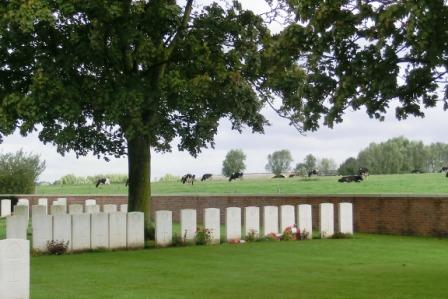
The cemetery is located on a turnoff from a busy town onto a country road, but once inside the gate, you are in a quiet environment, with cows grazing in a field right behind the cemetery wall. It reminded me of the view from our own home here on Prince Edward Island.  Only the colour of the cows differed!

CIMG8674 Sep 9 2017 Chester Farm Military Cemetery surrounded by cows

Cows surround the walls of the Chester Farm Military Cemetery in Belgium.  (Photo credit: Daria Valkenburg)

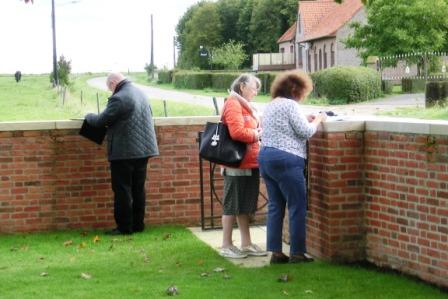
Pieter laid flags down at the grave and we marked the visit by writing in the visitors’ book.

CIMG8675 Sep 9 2017 Chester Farm Military Cemetery Daria writes in the guest book

Writing in the visitors’ book at Chester Field Military Cemetery.  We were accompanied by Pieter’s Belgian cousins on this leg of the war memorial tour.  (Photo credit: Pieter Valkenburg)

If only we had a photo…” Pieter sighed.  Now, after years of an unsuccessful search for family or friends, he’s taken his appeal for a photo to YouTube, in the hope that a viewer might come forward:


Pieters saying

You can read more about James Lymon Cameron and our visit to the Chester Farm Military Cemetery here: https://bordencarletonresearchproject.wordpress.com/2017/10/23/a-visit-to-chester-farm-military-cemetery/

Thank you to post-production editor Wendy Nattress, who made this YouTube video a reality. If you have photos or information to share about James Lymon Cameron, please email Pieter at dariadv@yahoo.ca or comment on the blog or send a tweet to @researchmemori1.

Screenshot_2021-02-27 On The War Memorial Trail With Pieter Valkenburg

You can subscribe to: On The War Memorial Trail With Pieter Valkenburg: https://www.youtube.com/channel/UCJ591TyjSheOR-Cb_Gs_5Kw

© Daria Valkenburg

On The War Memorial Trail….. The WW1 Soldier Who Hoped To Go Home After His Service In Germany Ended

February 12, 2021. In earlier postings, the observations made by Harold Keith HOWATT of Augustine Cove towards the end of WW1 and his time in Mehlem, Germany with the Canadian Army of Occupation were recorded.  

Howatt, who was in the 8th Canadian Siege Battery, noted that on January 28, 1919 the Canadian Army of Occupation was relieved by the British 84th Brigade Royal Garrison Artillery.  Canadian troops moved back to Belgium in eager anticipation of demobilization and return home.

CIMG4001 Harold Howatt

Harold Keith Howatt.  (Photo courtesy of South Shore United Church)

This posting continues his observations in the last months of his military service, beginning with January 28, 1919.  “…Left Mehlem this morning for Bonn, loaded the guns on the railway tracks, and at about five o’clock we pulled out for Belgium, thus ‘winding up’ our ‘Watch on the Rhine’.  We travelled all night, in box cars, and arrived in a town called Andenne about six o’clock the next morning…”  It would have been a very cold ride in an unheated box car on the train in January! Brrrr….

Screenshot_2021-02-08 mehlem to andenne train - Google Search

Google map showing the approximate train route taken by Howatt’s unit.

(Note: Andenne, Belgium is a small town that saw over 200 of its civilian population massacred by the Germans in 1914:  see https://en.wikipedia.org/wiki/Andenne)

The situation regarding comfort didn’t improve, as Howatt recorded on January 29, 1919. “…We unloaded the guns this morning, finishing about one o’clock….. Then we came out to this place, where we were put in an old house with no fires in it.  The language used by the troops was lurid enough to warm the air…” Howatt’s reference to ‘this place’ was Sclayn, just outside Andenne.  (See https://fr.m.wikipedia.org/wiki/Sclayn)

The attempt to get warm continued on January 30, 1919.  “…Woke up this morning to find the windows covered with frost.  Gee! but it was cold, and the stove wouldn’t burn.  We spent nearly all day trying to get a stove fixed up that would burn….

Howatt reported no improvement on January 31, 1919.  “…Weather still cold, and fire sulky….

On February 1, 1919, Howatt writes that “…This is the slowest place I ever struck, not life enough to satisfy a monk….” 

Misery for the unit continued, as noted on February 2, 1919… “…In charge of the guard today.  No fuel for the guard room. We were either freezing or being smothered with smoke all day….

On February 4, 1919, Howatt reported that “…The weather is getting much colder, days of brilliant frosty sunlight, and keen frosty nights….

On February 5, 1919, Howatt met a friend, commenting that “…Still clear and cold.  Perry came to see us this afternoon.  He is in Andenne, expects to leave for La Harve the first of next week.  His unit is going home with the 3rd Division. Lucky beggar!...” (Note: Unfortunately, Perry is unknown.   The only known Perry was George Albert Perry who was killed in 1917.)

By February 6, 1919, Howatt was itching to leave.  “…Fine and cold.  No definite news on how long we will stay here…

After several days of inactivity, except for the odd walk into town, Howatt recorded, on February 7, 1919, that “…This morning we had to carry the Observer’s stories down to Mr. Freeman’s billet, and this afternoon I helped him sort them over.  This evening MacNeil and I walked into Ardenne to see Perry again before he left.  He is living with a private family with ‘beaucoup mademoiselles’ and having a great time….”  (Note: Mr. Freeman is unknown.  MacNeil may be Robert Burns MACNEILL, who was born on PEI, but lived in Sydney, Nova Scotia at the time of enlistment.)

Finally, Howatt’s February 8, 1919 entry noted some activity.  “...Parade this morning for demob. Statistics, dispersal area, length of service, and so forth….”  You can imagine that Howatt was anxious to be included in the first group to be demobilized.

Postcard of Namur Belgium

Postcard from Namur. (Courtesy of the H. Howatt collection)

It was still a waiting game for Howatt, with time for some sightseeing, as he wrote on February 9, 1919.  “…Today a guard platoon consisting of an officer, 2 sergeants, 2 corporals, 2 bombardiers, and 42 men went to Namur to do guard duty. MacNeil and I got a pass and went with them.  First we went to the YMCA and got a book each at the lending library.  Then we climbed up onto the hill where the citadel is situated and walked all over the place.  Came home by train…” 

In 1914, Namur was invaded by the Germans in order to use the Meuse valley as a route into France. On August 21, 1914, they bombarded the town with no warning, killing several people. The citadel mentioned by Howatt fell after three days, and the town was occupied by the Germans until the end of the war. (For more info on Namur, see https://en.wikipedia.org/wiki/Namur)

The next day, his hopes were raised, as he writes on February 10, 1919 about “…rumours that we may leave here before long…

Over the next few days nothing much happened, but on February 14, 1919 he wrote about an altercation in the house they were staying in.  “…On guard duty today. The prisoners in the guardroom had some wine and there was a sort of a row.  The old lady got an idea into her head that someone had smashed up some of her furniture, so she got an officer and he had the prisoners lined up for her to identify the culprits.  I do not think it was the prisoners, though, who did break the window and chairs…”  It’s not clear who the prisoners were, but most likely they were German prisoners of war who had not yet been released.

The first hint that Howatt’s hopes of going home may not be realized occurred on February 15, 1919.  “…Came off guard this morning, was glad to get away…..Heard today that it has come through on orders that I have been promoted ‘corporal’ and posted to the 12th Battery.  Hope I do not have to go….

On February 16, 1919, Howatt recorded that “…This morning the Major held a sort of investigation into the trouble in the guard room the other day, but nothing was found out...” This suggests that Howatt’s guess that the prisoners were not responsible for the damage was likely correct.

Discouragement sets in by February 18, 1919.  “…Nothing doing, no word of moving.  All there is to do is go for a walk, come home, read for a while, and go to bed...”  A year earlier a soldier might have been happy for this type of day, but with the war ended there is an impatience to leave.

On February 19, 1919, his frustration is voiced.  “…The same old thing in the same old way, nothing to do, nowhere to go.  Oh! To be out of this country….

Things took a downward turn as passes for leaves were cancelled.  The Spanish flu had reached the area, resulting in lockdown measures similar to what we have experienced over the past year due to Covid-19. 

On February 22, 1919, Howatt wrote “…No church service today.  The cinemas are closed and all meetings are prohibited unless held in the open.  This is on account of the flu, which is very prevalent around here...

The Regiment did not escape the flu, as on February 25, 1919, Howatt noted that “…This evening I had to go on guard as McCann took sick…” McCann was in charge of the guards.

On Friday, February 28, 1919, Howatt glumly recorded that “…This morning, MacIntosh came up and told me that I had to go to the 12th battery immediately.  Did I want to go – not much.  So I had to fly around, get some new clothes and so forth, and turn over the keys of the store boxes to Mr. Freeman…

He left the next day for Mons, Belgium, along with “…Skirrow, Morrissey, and Goodwin…” Harold Howatt’s wartime service was not over yet! 

Can you help identify the names Freeman, Goodwin, Perry, MacIntosh, MacNeil, McCann, Morrissey, and Skirrow?  If so, please let Pieter know.  You can email him at dariadv@yahoo.ca, comment on the blog, or tweet to @researchmemori1

Missed the previous two postings about the observations of Harold Howatt?  See here:

You are also invited to subscribe to our YouTube Channel: On The War Memorial Trail With Pieter Valkenburg: https://www.youtube.com/channel/UCJ591TyjSheOR-Cb_Gs_5Kw

© Daria Valkenburg

On The War Memorial Trail….. The Continued Search For A Photo Of John Clifford Rogers

January 18, 2021.  Last fall, a posting featured Pieter’s search for 5 soldiers from WW1 and WW2:

  • WW1 soldier Bazil CORMIER
  • WW1 soldier James CAIRNS
  • WW2 soldier John Clifford ROGERS
  • WW2 soldier Vernon James NIXON
  • WW2 soldier Philip Hubert LONG

Family subsequently came forward with photos for Vernon James Nixon and Philip Hubert Long, but the rest are still ‘faceless’.

Numerous attempts have been made to find family of the three others, with no success.  I would have given up, but not Pieter.  On Friday, January 15, 2021, he was interviewed by Angela Walker on CBC Radio’s Mainstreet PEI about WW2 soldier Pte John Clifford Rogers, who is buried in the Canadian War Cemetery in Groesbeek in The Netherlands, after losing his life on March 3, 1945 in Germany. Here are the key facts known about him:

  • He was born 19 August 1925 in Hope River, Prince Edward Island, the son of Andrew Rogers and Phoebe Gallant.
  • He had three other siblings: The oldest, Ferdinand Joseph, was born in 1921 and served with The North Nova Scotia Highlanders. He landed on D-Day in France and was killed in action on July 25, 1944.  His body was never found and he is commemorated on a monument at the Commonwealth War Graves Cemetery in Bayeux, France.
  • The younger siblings were Walter Angus, born around 1930, and Marie Gladys, born around 1934.
  • The family lived at No. 7 Young Street in Charlottetown when John Clifford and Ferdinand Joseph were killed.

You can listen to the radio interview here: https://www.cbc.ca/listen/live-radio/1-130-mainstreet-pei/clip/15819180-pieter-valkenburg-searching-john-clifford-rogers-information

In addition to the radio interview, an appeal has gone out on YouTube, which you can watch here: 

Let’s hope someone will see one of these appeals for a photo and help put a face to the name of John Clifford Rogers! If you can help with a photo or information, please email Pieter at dariadv@yahoo.ca, comment on the blog, or tweet to @researchmemori1.  Photos and stories are still being collected for the Atlantic Canada Remembers series. 

Thank you to Angela Walker and the team at CBC’s Mainstreet PEI and to Wendy Nattress, our post-production editor for the YouTube videos. 

To read the original posting about the 5 soldiers, and a profile on Philip Hubert Long:

You are also invited to subscribe to our YouTube Channel: On The War Memorial Trail With Pieter Valkenburg: https://www.youtube.com/channel/UCJ591TyjSheOR-Cb_Gs_5Kw

© Daria Valkenburg

Happy Holidays From The Valkenburgs – And Our Year In Review!

multicolor-holiday-christmas-decorations-with-blue-silver-ribbon-snowflakes-header-background-hd-1920x720

December 20, 2020.  We’re nearing the end of a challenging and socially distanced 2020, and looking with hope and anticipation to a 2021 with a vaccine to protect us against coronavirus, and a chance to visit and travel again. 

Since returning home from our winter vacation in March, we have been quietly working at home, and this seems a good time to reflect on what has been done with this research project.

…Documentary About Halifax L9561….

We began the year with a short documentary summarizing the amazing day on October 12, 2019 when a memorial panel to honour WW2 pilot Elmer Bagnall MUTTART and the crew of Halifax L9561 was installed in Wons, The Netherlands. 

In February, we were invited to screen the video and give a short presentation to snowbirds in Florida.  This was the last event before pandemic safety measures resulted in the cancellation of all other engagements.

…. WW2 Soldiers Listed On The Cenotaph Outside Borden-Carleton Legion …….

This year we told the stories of 8 WW2 servicemen listed on the Cenotaph outside the Borden-Carleton Legion:

  • Albert Eugene ARSENAULT
  • Joseph ‘Francis’ ARSENAULT
  • George Alfred DUNN
  • John Daniel “Jack” FERGUSON
  • Ernest Ramey GALLANT
  • James Emmet HUGHES
  • Singleton Charles JEFFERY
  • Harold “Lloyd” LEFURGEY

 ….End of WW1 Observations….

We shared some of the observations that WW1 soldier Harold Keith HOWATT made towards the end of the war.  The history books are filled with official accounts from officers and politicians. Howatt’s observations came from the viewpoint of an ordinary soldier caught up in extraordinary circumstances. 

…. Interviews To Highlight Search For Photos….

Pieter did radio interviews and was interviewed by newspaper reporters in his quest for photos for:

  • WW1 soldier Bazil CORMIER, who is buried in France
  • WW1 soldier Joseph Arthur DESROCHES, who is buried in France
  • WW2 soldier Philip Hubert LONG, who is buried in The Netherlands
  • WW2 soldier Barney Reuben MCGUIGAN, who is buried in The Netherlands

A photo for Philip Hubert LONG was found, but not for the other three.

…. Letters To The Editor For Photo Search….

Several letters to the editor in various newspapers were written in the quest for photos for:

  • WW1 soldier James CAIRNS, who is buried in France
  • WW2 soldier John Clifford ROGERS, who is buried in The Netherlands
  • WW2 soldier Norman James NIXON, who is buried in The Netherlands

Family and photos for Norman James NIXON were found, but not for the other two.

… Successful Search For Photos …..

Many WW2 soldiers from the Atlantic provinces are buried in cemeteries in The Netherlands, and as requests by Dutch researchers for photos are uncovered, a few of those stories were told.  Photos were found for:

  • James Walter AULD
  • Robert W. ATKINSON
  • Arthur DOIRON
  • Gunnar DALMAN
  • Joseph Edmund HENNEBERY
  • Philip Hubert LONG
  • James B. MACINNIS
  • David MAGUIRE
  • Olen Byron MARSHALL
  • Norman James NIXON
  • Donald O. ROBERTSON
  • B. R. RODGERS
  • Ford H. SPIDLE
  • Robert B. THOMAS

…. Stories About Servicemen NOT on the Cenotaph

We also featured stories about servicemen in the South Shore area who weren’t listed on the Cenotaph:

  • WW1 soldier William Earle DAVISON, who was killed in France
  • WW2 soldier Joseph Robert GAUTHIER, who was in the Devil’s Brigade
  • WW1 soldier Herbert ‘Herb’ S. MACEWEN, who was in the 2nd Siege Battery
  • WW2 serviceman Robert ‘Scott’ MACQUARRIE, who was a mechanic with the RCAF
  • WW2 serviceman Ralph Gordon MCCUTCHEON, who died in an accident during pilot training
  • WW2 soldier Frank Edward MCGOVERN, who was in the North Shore (New Brunswick) Regiment
  • WW2 soldier Earl Francis Phinney SMITH, who was in the 1st Canadian Armoured Carrier Regiment

… The Search For Photos Also Moves To YouTube….

2020 began with a documentary that was posted on YouTube, and ends with a dedicated YouTube Channel: On The War Memorial Trail With Pieter Valkenburg: https://www.youtube.com/channel/UCJ591TyjSheOR-Cb_Gs_5Kw

The new YouTube videos focus on the search for photos of WW1 and WW2 soldiers.  Each video is very short and briefly tells the story of an individual soldier, with a request for a photo.  So far, no one has come forward with a photo.  The more these videos are shared, the more chance of reaching someone with a photo.  You can help us by sharing the links as widely as you can.

Thank you for your support and encouragement of this research project!

As 2020 comes to an end, we would like to thank everyone who helped with researching these stories.  To give one example, Leonard Boudreau of the Cape Breton Highlanders Regimental Association helped to find many of the photos. We also thank readers of this blog and the On The War Memorial Trail column in The County Line Courier who suggested some of stories you’ve read.  A big thank you goes to Mike and Isabel Smith, owners of The County Line Courier.  Last, but not least, the YouTube videos and channel would not be possible without the invaluable support of post-production editor Wendy Nattress.

Christmas2020 Photo Daria & Pieter

If you have photos or information to share, please email Pieter at memorialtrail@gmail.com, comment on the blog, or tweet to @researchmemori1.    

© Daria Valkenburg
…Want to follow our research?…

If you are reading this posting, but aren’t following our research, you are welcome to do so.  Our blog address: https://onthewarmemorialtrail.com/
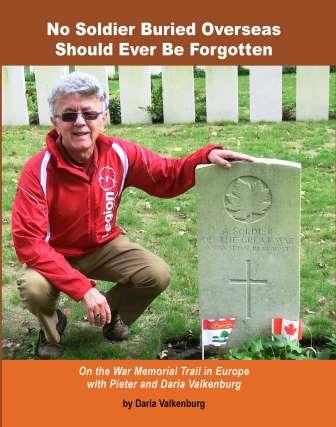
Front cover OnTheWarMememorialTrailinEurope4 countries, 6 weeks, 7,000 km – an unforgettable war memorial journey in Europe…. Daria’s book ‘No Soldier Buried Overseas Should Ever Be Forgotten‘ is available in print and e-book formats.  Net proceeds of book sales help support research costs and the cost of maintaining this blog. For more information see https://nosoldierforgotten.com/

Subscribe to our YouTube Channel: On The War Memorial Trail With Pieter Valkenburg: https://www.youtube.com/channel/UCJ591TyjSheOR-Cb_Gs_5Kw

Never miss a posting!  Subscribe below to have each new story from the war memorial trail delivered to your inbox.