On The War Memorial Trail….The Last Post Ceremony At The Menin Gate Memorial In Ypres

November 23, 2017.  In the morning we’d visited the Menin Gate Memorial in Ypres and found the listings for two men whose names are on the Cenotaph outside the Borden-Carleton Legion: Charles Benjamin BUXTON and George ‘Albert’ CAMPBELL (See A Daytime Visit To Menin Gate Memorial in Ypres).

We returned in the evening for The Last Post Ceremony, which occurs at 8 pm every day at Menin Gate Memorial, rain or shine.  It began on July 2, 1928, after the Memorial opened in 1927, as a way for the citizens of Ypres to express their gratitude towards those who had died in defence of Belgium’s freedom.

The only time the ceremony was not held in Ypres was during the German occupation during World War II.  Instead, a daily ceremony was held at Brookwood Military Cemetery, in Surrey, England.  On September 6, 1944, the evening that Polish forces liberated Ypres in the Second World War, the ceremony at Menin Gate resumed, even though heavy fighting was still taking place in other parts of Ypres.

Bands and choirs from around the world apply to participate in the ceremonies. On the evening we attended the ceremony, the St. Cecilia Helden band from The Netherlands was there.  It was very apt since Pieter is from The Netherlands, and that was going to be the next country on our war memorial trail.

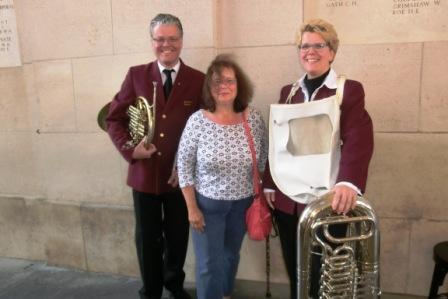
CIMG8802 Sep 9 2017 Daria with two members of St Cecilia Helden band before Last Post Ceremony at Menin Gate

Daria with two members of the St. Cecilia Helden band from The Netherlands. (Photo credit: Mieke de Bie)

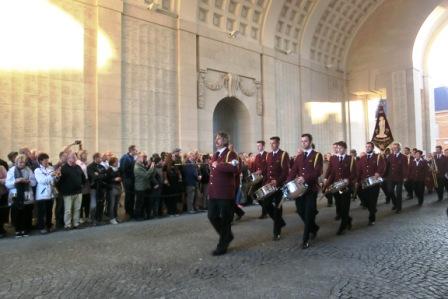
We quickly saw that if we wanted to get a spot with easy visibility of the ceremony that we would have to line up at least 1 ½ hours early!  We did and so were lucky to have a front line view, and watched the band march through Menin Gate Memorial to stand on the outside of the Memorial.

CIMG8804 Sep 9 2017 Last Post Ceremony Menin Gate st Ceclia Helden Band

St. Cecilia Helden band marched through Menin Gate before the ceremony began. (Photo credit: Daria Valkenburg)

Police cars soon barricaded the road on either side of the Menin Gate Memorial so no traffic could get by.

Just before 8 pm three buglers from the local fire brigade arrived and played ‘The Last Post’. 

CIMG8815 Sep 9 2017 Last Post Ceremony Menin Gate buglers from local fire brigade play The Last Post

Buglers from the local fire brigade in Ypres play ‘The Last Post’ at 8 pm. (Photo credit: Daria Valkenburg)

‘The Last Post’ was followed by the Exhortation, where a dignitary said the words we are all familiar with from Remembrance Day ceremonies in Canada.  Taken from the 4th verse of Laurence Binyon’s poem ‘For The Fallen’, first published on September 21, 1914, he recited, in English:

“They shall grow not old, as we that are left grow old:
Age shall not weary them, nor the years condemn.
At the going down of the sun and in the morning,
We will remember them.”

This was followed by a minute of silence, and then wreaths were laid by various groups while the St. Cecelia Helden band played.  We were sorry we hadn’t thought of asking to lay a wreath as a way to further commemorate Campbell and Buxton.  Following the wreath laying the final bugle call, ‘Réveille’, was played and the ceremony was over.

We were lucky to be right at the spot where the fire brigade walked past, and they graciously posed for a photo.  Of course, we gave them Canadian flag pins, and to our surprise we received a Menin Gate Memorial pin in exchange.

CIMG8833 Sep 9 2017 Last Post Ceremony Menin Gate

Buglers from the local Fire Brigade in Ypres. (Photo credit: Daria Valkenburg)

This was a beautiful ceremony, with respectful visitors from many countries.  Behind us was a family from Poland, a poignant reminder of the Polish allies who liberated Ypres during WWII.

We returned to our hotel in a thoughtful mood, after the day of visiting memorials and cemeteries.  We still had a few places in Flanders to visit before going on to The Netherlands, but that would have to wait for another day.

Comments or stories?  You can share them by emailing us at memorialtrail@gmail.com or by commenting on this blog.

© Daria Valkenburg

….Want to follow our research?….

If you are reading this posting, but aren’t following our research, you are welcome to do so.  Our blog address: https://onthewarmemorialtrail.com/

Front cover OnTheWarMememorialTrailinEurope4 countries, 6 weeks, 7,000 km – an unforgettable war memorial journey in Europe…. Daria’s book ‘No Soldier Buried Overseas Should Ever Be Forgotten‘ is available in print and e-book formats.  Net proceeds of book sales help support research costs and the cost of maintaining this blog. For more information see https://nosoldierforgotten.com/ 

You are also invited to subscribe to our YouTube Channel: On The War Memorial Trail With Pieter Valkenburg: https://www.youtube.com/channel/UCJ591TyjSheOR-Cb_Gs_5Kw

Never miss a posting!  Subscribe below to have each new story from the war memorial trail delivered to your inbox.

On The War Memorial Trail….A Visit To Sanctuary Wood

November 19, 2017.  After visiting the Princess Patricia’s Light Infantry Memorial in Zonnebeke, Belgium, we went to Sanctuary Wood in Zillebeke to the Hill 62 Monument overlooking Mount Sorrel.  This memorial commemorates Canadian forces who served in Ypres Salient, especially during the Battle of Mount Sorrel in June 1916.

CIMG8771 Sep 9 2017 Sign to Sanctuary Wood

Sign at the entrance to Hill 62 (Sanctuary Wood) Memorial. (Photo credit: Daria Valkenburg)

The road leading to the memorial, Canadalaan (literally Canada Avenue, but also known colloquially as Maple Avenue), once formed part of the Canadian front line.  After the war, the avenue was planted with maple trees as a mark of respect for the Canadian sacrifice.

Two of the men listed on the Cenotaph outside the Borden-Carleton Legion lost their lives here, during the Battle of Mount Sorrel: Charles ‘Charlie’ Benjamin BUXTON of the Princess Patricia’s Light Infantry, and George ‘Albert’ CAMPBELL of the 5th Canadian Mounted Rifles.  Both men have no known grave and are listed on the Menin Gate Memorial in Ypres. (See A Daytime Visit To Menin Gate Memorial in Ypres )

Before going to Sanctuary Wood Cemetery and Maple Copse Cemetery, places where perhaps our two soldiers are lying in an unmarked grave, we wanted to know more about what exactly happened here during the defence of Ypres in 1916.  The first thing that struck is was how close Ypres was.  We could see it clearly from the memorial!

CIMG8775 Sep 9 2017 Sanctuary Wood Ypres can be seen from Hill 62

The spires of buildings in Ypres can be clearly seen from Sanctuary Wood. (Photo credit: Daria Valkenburg)

Sanctuary Wood, also known as Hill 62, was the place where Canadian troops fought as a national unit for the first time.  During the battle, which was fought between June 2 and June 4, 1916, 8,430 soldiers were killed, wounded, or missing.

We were curious why it was called Hill 62, and a bit bemused to realize it was called that because the hill was 62 metres above sea level!

Hill 62 and nearby Mount Sorrel were the only places of a higher elevation that were not controlled by the Germans….and they wanted it.  Canadian troops were almost alone in defending this territory, having only the support of British artillery.  The rest of the British troops were preparing for the Battle on the Somme in July 1916.

So what happened?  On June 2, 1916, the Germans attacked the Canadian positions with artillery and the detonation of 4 large mines under Mount Sorrel.  You can imagine the deadly effect this had in the trenches.

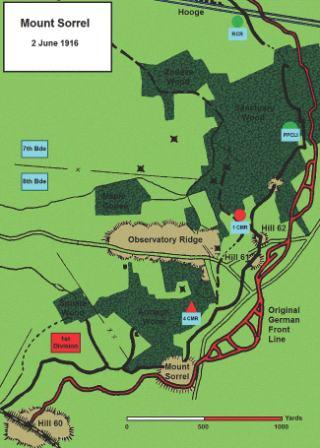
As per the map of the battle, Buxton’s unit (PPCLI) was at Sanctuary Wood, and suffered 400 losses.  Campbell’s unit was a support brigade at Maple Copse, and by the end of the day 59 were killed, 272 wounded, and 50 missing. Buxton and Campbell were among the casualties.

battle of mount sorrel map

Map of Battle of Mount Sorrel on June 2, 1916. (Credit: http://www.canadiansoldiers.com)

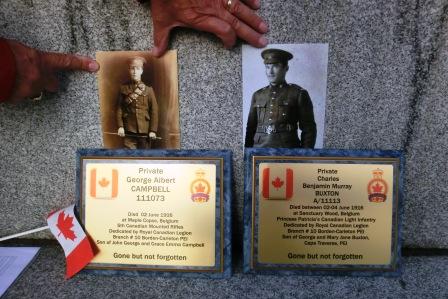
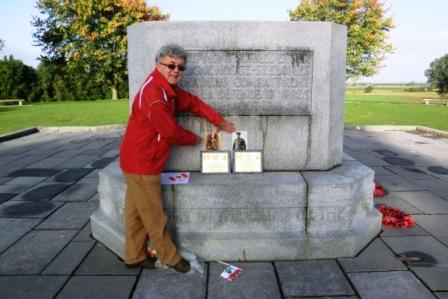
It only seemed right to place the photos and plaques we had of these men, which we’d taken to Menin Gate earlier in the day, here at Sanctuary Wood Memorial.

CIMG8897 Sep 11 2017 Photos & Plaques of Buxton & Campbell at Sanctuary Wood

Plaques and photos for George Albert Campbell and Charles Benjamin Buxton. (Photo credit: Daria Valkenburg)

CIMG8894 Sep 11 2017 Pieter at Sanctuary Wood with photos and plaques of Buxton & Campbell

Pieter holds the photos and plaques of Buxton and Campbell at the Sanctuary Wood Memorial. (Photo credit: Daria Valkenburg)

We decided we had to visit both Sanctuary Wood Cemetery and Maple Copse Cemetery and learn exactly what happened to each man, but that would have to wait for another day.  It was getting late, and we wanted to get to Ypres for the Last Post ceremony at Menin Gate.

Comments or stories?  You can share them by emailing us at memorialtrail@gmail.com or by commenting on this blog.

© Daria Valkenburg

….Want to follow our research?….

If you are reading this posting, but aren’t following our research, you are welcome to do so.  Our blog address: https://onthewarmemorialtrail.com/

Front cover OnTheWarMememorialTrailinEurope4 countries, 6 weeks, 7,000 km – an unforgettable war memorial journey in Europe…. Daria’s book ‘No Soldier Buried Overseas Should Ever Be Forgotten‘ is available in print and e-book formats.  Net proceeds of book sales help support research costs and the cost of maintaining this blog. For more information see https://nosoldierforgotten.com/ 

You are also invited to subscribe to our YouTube Channel: On The War Memorial Trail With Pieter Valkenburg: https://www.youtube.com/channel/UCJ591TyjSheOR-Cb_Gs_5Kw

Never miss a posting!  Subscribe below to have each new story from the war memorial trail delivered to your inbox.

On The War Memorial Trail….The Princess Patricia’s Light Infantry Memorial

November 18, 2017.  On July 30 of this year we posted a blog entry on WWI soldier Charles Benjamin Murray BUXTON, known as Charlie, and asked for a photo and information on him. (See Who Can Put A Face To Charles Benjamin Murray Buxton?)  As well, the request was included in an article in the County Line Courier that was published on August 9.  (See CLC p30 Aug 9 2017 Face for Arsenault)

We included an excerpt from an August 13, 1915 letter written to Charlie Buxton’s aunt, Minnie Marchbank of Alma, letting her know that her son George was all right.  It was through the Marchbank connection that we were able to find a photo, actually two!

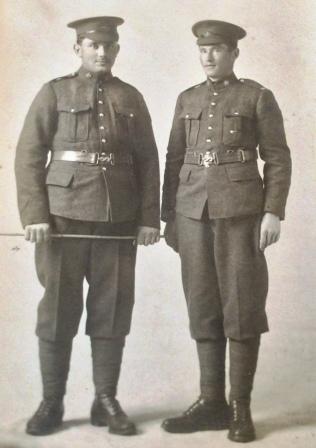
George Marchbank survived the war, and his son John of Nanton, Alberta, a veteran of the Korean War, had a photo of his father and Buxton, which he shared.

IMG_0185 photo of george marchbank and charles buxton

George Marchbank on the left, and Charles Buxton on the right. (Photo courtesy of John Marchbank family collection)

John Marchbank

Royal Canadian Legion member John Marchbank, son of George Marchbank, the cousin of Charles Buxton. (Photo courtesy of John Marchbank family collection)

The second photo of Charlie came from a period just before the war interrupted his career as a school inspector in West Prince.  Through the newspaper archives, Pieter found a 1954 reference to a display of hockey photos found at Myricks store in Alberton.  One of the photos was of the 1915 Alberton Regal Hockey Team… and one of the players in the photo was C. B. Buxton!

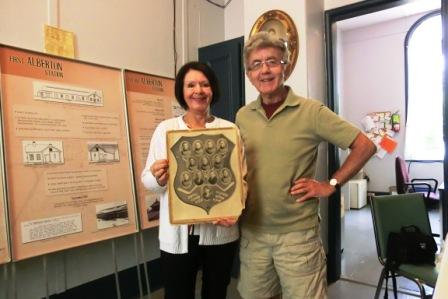
It appeared that while inspecting schools, Charlie stayed with his aunt Minnie, and found time to play on the Alberton Regal Hockey Team.  A call to the Alberton Museum verified that they had the team photo.  We immediately made a trip to Alberton and met with Arlene Morrison, Museum Manager, who explained that the 1915 photo was donated by Eileen Oulton.

CIMG7941 Aug 11 2017 Arlene Morrison and Pieter with 1915 hockey photo

Arlene Morrison and Pieter Valkenburg at Alberton Museum with the 1915 Alberton Regal Hockey Team Photo. (Photo courtesy of Eileen Oulton Collection)

OLYMPUS DIGITAL CAMERA

Inset from the team photo of Charles Benjamin Buxton, who played centre for the 1915 Alberton Regal Hockey Team. (Photo courtesy of Eileen Oulton Collection)

As Charlie was with the Princess Patricia’s Light Infantry, our next stop on the war memorial trail in Belgium was the Princess Patricia’s Light Infantry Memorial in Zonnebeke. The Princess Pats were the first Canadian troops to arrive in Belgium, and fought in most of the battles in Belgium between 1915 and 1918.

The memorial is right beside a corn field, on land donated by Jules van Ackere in 1958, right at the edge of the road.

CIMG8789 Sep 9 2017 Pieter at PPLI memorial in Zonnebeke

Pieter at the Princess Patricia’s Light Infantry Memorial in Zonnebeke. You can see the maple tree behind the memorial. (Photo credit: Daria Valkenburg)

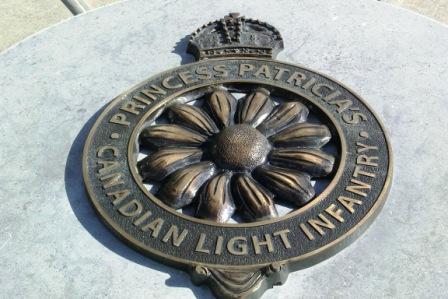
The memorial was redone in 2015 and has a centennial plaque plus a bronze Marguerite daisy insignia, indicative of the cap badge worn by the troop during 1915.  As well, a Canadian Sugar maple tree was planted.

CIMG8784 Sep 9 2017 insignia of PPLI with bronze marguerite flower

Bronze Marguerite daisy insignia on the memorial. (Photo credit: Daria Valkenburg)

The memorial, which is much smaller than Pieter expected, commemorates the Battle of Frezenberg on May 8, 1915, marking the area they successfully defended, the Bellewaarde Ridge.  By the end of the battle, out of a complement of 546, only 4 officers and 150 men had survived.

Charlie Buxton was not in this battle. He enlisted on April 10, 1915 in the 1st University Company, which was formed to reinforce the Patricia Patricia’s Light Infantry, and sailed to England, then travelled on to France.  On July 17, 1915 he was taken on strength by the Patricia Patricia’s Light Infantry in France.

Charlie died in June 1916 in Sanctuary Wood, during the Battle of Mount Sorrel, our next stop on the war memorial trail.

Comments or stories?  You can share them by emailing us at memorialtrail@gmail.com or by commenting on this blog.

© Daria Valkenburg

….Want to follow our research?….

If you are reading this posting, but aren’t following our research, you are welcome to do so.  Our blog address: https://onthewarmemorialtrail.com/

Front cover OnTheWarMememorialTrailinEurope4 countries, 6 weeks, 7,000 km – an unforgettable war memorial journey in Europe…. Daria’s book ‘No Soldier Buried Overseas Should Ever Be Forgotten‘ is available in print and e-book formats.  Net proceeds of book sales help support research costs and the cost of maintaining this blog. For more information see https://nosoldierforgotten.com/ 

You are also invited to subscribe to our YouTube Channel: On The War Memorial Trail With Pieter Valkenburg: https://www.youtube.com/channel/UCJ591TyjSheOR-Cb_Gs_5Kw

Never miss a posting!  Subscribe below to have each new story from the war memorial trail delivered to your inbox.

On The War Memorial Trail…We Visit Passchendaele and Surrounding Area

November 2, 2017.  After hearing so much about Passchendaele and the terrible 100 days of fighting over a mere 8 km of territory in 1917, we had to go and see the area for ourselves.  245,000 allied soldiers alone were casualties, not to mention Belgian citizens and German soldiers. We kept thinking, “How could it be worth such a heavy sacrifice?”

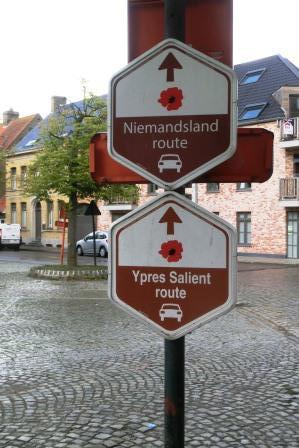
We followed two routes in this area, the Ypres Salient Route, and No Man’s Land Route (Niemandsland Route in Flemish).

CIMG8738 Sep 9 2017 sign saying Ypres Salient Route

Signs along the road marked the routes you could follow on the war memorial trail in Belgium. (Photo credit: Pieter Valkenburg)

One soldier on the Cenotaph outside the Borden-Carleton Legion, Vincent CARR, died on October 30, 1917 during the Battle of Passchendaele.  His story was told earlier in this blog.  (See links to The Cenotaph Research Project Begins and The WWI Names On The Cenotaph).  He’s buried at Cement House Cemetery in Langemark, and our first stop on the war memorial trail in the Passchendaele area was there.

CIMG8723 Sep 9 2017 Pieter at Cement House Cemetery with flags

Pieter at the entrance to Cement House Cemetery. (Photo credit: Daria Valkenburg)

Cement House was the military name given to a fortified farm building on the Langemark-Boesinghe (now called Boezinghe) road.  There are 3,952 WWI Commonwealth graves, 2,225 of them unidentified.  There are an additional 22 WWII graves, 5 of which are unidentified.

After placing the flags on Carr’s grave, we saw that the graves on either side of him were Canadians from the same Canadian Motor Machine Gun Brigade unit as Carr, and that they died on the same day.  It seemed only right to take a photo of all three graves and pay tribute to R. BELLAS, our Vincent CARR, and J. B. WILLSON.

IMG_20170909_131617502 Graves of Bellas Carr Willson in Cement House Cemetery

The graves of R. Bellas, V. Carr, and J. B. Willson in Cement House Cemetery. (Photo credit: Pieter Valkenburg)

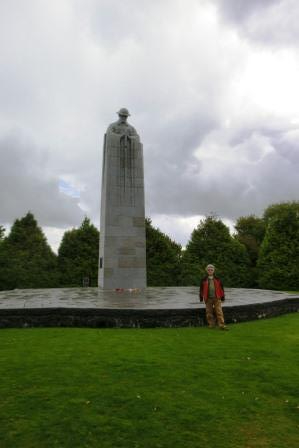
After leaving Cement House Cemetery, we stopped at the St. Julien Memorial (Sint Juliaan in Flemish), a Canadian War Memorial commemorating the Canadian First Division’s participation in the Second Battle of Ypres in World War I.  This was a nasty battle where the troops faced the first poison gas attacks along the Western Front on April 22, 1915.  The memorial is commonly known as the Brooding Soldier, the name given to the statue sculpted by Frederick Chapman Clemesha, an architect from Regina who was also a WWI veteran.

Unfortunately, the heavens opened as we arrived in the parking lot.  We waited a few minutes in the hope that the rain would stop, but no luck.  There was a big tour bus beside us and no one got out of it either.  After ten minutes the bus left (guess they had to stay on schedule).  At that point Pieter said, rain or not, he was going to the memorial.  Only his cousin François was willing to join him!  Mieke and I stayed in the car.

cimg8733-sep-9-2017-pieter-by-brooding-soldier-monument-st-juliaan-memorial-in-langemark.jpg

St. Julien Memorial in Langemark. (Photo credit: François Breugelmans)

The sculpture is a stone tower, topped by the head and shoulders of a soldier, whose head is bowed.  The soldier is in the pose of a serviceman standing with ‘reversed arms’ – resting his hands on the rifle butt and the rifle pointing with its barrel to the ground. This pose is a gesture of mourning and respect for the fallen.

The memorial is inscribed as follows: THIS COLUMN MARKS THE BATTLEFIELD WHERE 18,000 CANADIANS ON THE BRITISH LEFT WITHSTOOD THE FIRST GERMAN GAS ATTACKS THE 22ND-24TH OF APRIL 1915. 2,000 FELL AND HERE LIE BURIED.

The location of the statue is where the Canadian position was when they were attacked by gas.  None of the troops had gas masks.  They tried to protect themselves as best they good, and some pressed handkerchiefs soaked with urine around their mouths.  As we now know, this did little good.

A few minutes after the Pieter and François came back into the car and we pulled away from the parking lot, it stopped raining and the sun came out.  It was like a message had been received!

Although it was after 2 pm, and three of us were hungry and tired, we had a few more stops before Pieter would allow us to have a rest and lunch!  We grumbled that he had forgotten we were volunteers on this journey, not military recruits!  Our war memorial route continues in the next blog entry.

As yet, we have not been able to find any information on Vincent Carr’s wife, Bessie Carr, who came from Summerside, and died in 1918, a year after her husband.  Can you help?  If you are related to R. Bellas or J. B. Willson, we’d like to hear from you as well.  Comments or stories?  You can share them by emailing us at memorialtrail@gmail.com or by commenting on this blog.

© Daria Valkenburg

….Want to follow our research?….

If you are reading this posting, but aren’t following our research, you are welcome to do so.  Our blog address: https://onthewarmemorialtrail.com/

Front cover OnTheWarMememorialTrailinEurope4 countries, 6 weeks, 7,000 km – an unforgettable war memorial journey in Europe…. Daria’s book ‘No Soldier Buried Overseas Should Ever Be Forgotten‘ is available in print and e-book formats.  Net proceeds of book sales help support research costs and the cost of maintaining this blog. For more information see https://nosoldierforgotten.com/ 

You are also invited to subscribe to our YouTube Channel: On The War Memorial Trail With Pieter Valkenburg: https://www.youtube.com/channel/UCJ591TyjSheOR-Cb_Gs_5Kw

Never miss a posting!  Subscribe below to have each new story from the war memorial trail delivered to your inbox.

On The War Memorial Trail….A Visit To Chester Farm Military Cemetery

October 22, 2017.  After we paid our respects to Arthur Robinson at La Laiterie Military Cemetery in Belgium, we made our way to Chester Farm Military Cemetery, 5 km south of Ypres, where another WWI soldier, James Lymon CAMERON, is buried.  The cemetery, one of three in the area, is in a farming area.

CIMG8660 Sep 9 2017 Directional sign to Chester Farm Military Cemetery

Directional sign to Chester Farm Cemetery. Note the John Deere dealership. We are in a farming area, only 5 km south of Ypres. (Photo credit: Pieter Valkenburg)

Chester Farm was the name given to a farm about 1 km south of Blauwepoort Farm, on the road from Zillebeke to Voormezeele.  The names of these two places may be almost unpronounceable, but we encountered them over and over again as scenes of many fierce battles.

CIMG8662 Sep 9 2017 Chester Farm Military Cemetery stone marker

Stone marker on gate of Chester Farm Military Cemetery. (Photo credit: Daria Valkenburg)

The cemetery opened in March 1915 and has 420 Commonwealth burials, 7 of them unidentified.  It’s in a beautiful location, surrounded by cows.  It seems fitting for an Islander to be in such a rural location.

CIMG8671 Sep 9 2017 Chester Farm Military Cemetery with cows in backgroung flags by Camerons grave

Chester Farm Military Cemetery, surrounded by cows. Pieter had already placed flags on the grave of James Lymon Cameron. (Photo credit: Daria Valkenburg)

Private James Lymon Cameron was born December 30, 1892 in Victoria, Prince Edward Island, the son of Edward H. Cameron, a carpenter, and Susan Estelle Harrington of Hampton.  The family was Roman Catholic and worshipped at the church in Kelly’s Cross.

With such a background on the island, it was a mystery to us why no one seemed to know the family, until Pieter’s research revealed that the family must have moved around quite a bit for Edward’s work.  In a 1900 US census, the family was living in South Bend City, in the state of Washington, and James Lymon’s sister Ethel was recorded as having been born in New Hampshire in 1889.  He had an older sister Lucy who was born on Prince Edward Island, but was not listed in the 1900 census, suggesting that she was no longer alive, and a younger brother Otto, who was born on Prince Edward Island.

In a 1921 census from Vancouver, another younger brother, Edward, is recorded as having been born in the USA around 1906.  Ethel is living with her parents and brother.  She is recorded as married with the last name Gilbert, but her husband is not with her.

At the time that James Lymon enlisted on March 18, 1915 with the 47th Battalion (BC) CEF, the family was living in Vancouver, and he was employed as a marine oiler.  By October 1915 he was on his way to Europe, and transferred twice, first to the 30th Reserve Battalion, and then to the 7th Canadian Infantry Battalion (1st British Columbia).

On July 24, 1916, he was killed by enemy shell fire at ‘The Bluff’ at Ypres Salient during The Battle of The Bluff near St. Eloi.  The Bluff is a mound near St Eloi, south-east of Ypres, which was created from a spoil heap during the digging of the Ypres–Comines Canal before the war.

CIMG8666 Sep 9 2017 Chester Farm Military Cemetery Pieter by grave of James Lymon Cameron

Pieter by the grave of James Lymon Cameron at Chester Farm Military Cemetery. (Photo credit: Daria Valkenburg)

The war diary of the 7th Canadian Infantry Battalion for July 2, 1916, explained what happened in three terse lines:  “Bombardment of Front Line. Headquarters Shelled. Our retaliation effective.

Unfortunately, this is all we know about James Lymon Cameron.  We don’t even know what he looked like.  If you can add any further information or provide a photo, please let us know.

In the next blog entry we visit Menin Gate in Ypres. Comments or stories?  You can share them by emailing us at memorialtrail@gmail.com or by commenting on this blog.

© Daria Valkenburg

….Want to follow our research?….

If you are reading this posting, but aren’t following our research, you are welcome to do so.  Our blog address: https://onthewarmemorialtrail.com/

Front cover OnTheWarMememorialTrailinEurope4 countries, 6 weeks, 7,000 km – an unforgettable war memorial journey in Europe…. Daria’s book ‘No Soldier Buried Overseas Should Ever Be Forgotten‘ is available in print and e-book formats.  Net proceeds of book sales help support research costs and the cost of maintaining this blog. For more information see https://nosoldierforgotten.com/ 

You are also invited to subscribe to our YouTube Channel: On The War Memorial Trail With Pieter Valkenburg: https://www.youtube.com/channel/UCJ591TyjSheOR-Cb_Gs_5Kw

Never miss a posting!  Subscribe below to have each new story from the war memorial trail delivered to your inbox.

On the War Memorial Trail in Belgium and a Visit to La Laiterie Military Cemetery

October 16, 2017.  After leaving France and arriving in De Panne, Belgium, on the North Sea coast, we were joined by Pieter’s cousin François Breugelmans and his wife Mieke de Bie, who live in Antwerp.  It gave us a chance to visit as well as continue the war memorial trail.

For most of our time in Belgium we had a break from driving, as François took over that task.  This was great as many of the roads in the area are very narrow, more suited to one way traffic, not two way traffic.

CIMG8641 sep 9 2017 Francois on a narrow road

A typical road in Belgium! (Photo credit: Pieter Valkenburg)

The thing that struck us the most was that all of the cemeteries and memorials we had to visit in Belgium were not far from Ypres.  Our first cemetery in Belgium was La Laiterie Military Cemetery, where Arthur Clinton ROBINSON is buried.  Named after a dairy farm, the cemetery is right on a busy road, next to a cement business.  It’s very well kept and has 751 Commonwealth WW1 graves, 180 of them unidentified.

CIMG8659 Sep 9 2017 Daria and Mieke outside La Laiterie Military Cemetery

Daria Valkenburg and Mieke de Bie outside La Laiterie Military Cemetery. (Photo credit: François Breugelmans)

CIMG8647 Sep 9 2017 At Robinsons grave in La Laiterie Cemetery see cement factory

Placing the flags at the grave of Arthur Clinton Robinson in La Laiterie Military Cemetery. Note the cement factory beside the cemetery. (Photo credit: Daria Valkenburg)

When we began this project, we thought it would be easy to get a photo and information on Private Robinson as we knew his nephew John Robinson and John’s wife Hazel had done extensive genealogical research.  Unfortunately, John and Hazel had been unable to find any photos and very little information.  Arthur Clinton Robinson was born July 20, 1896 in Tryon, the son of Albert James Robinson and Flora P. Scruton, a nurse from New Hampshire who died on June 23, 1901 from tuberculosis.

A farmer before the war, Arthur Clinton Robinson enlisted in the 26th (New Brunswick) Battalion on November 20, 1914, and was in Europe by spring of the following year.  On March 27, 1916 he was killed in action when shell fire hit the trenches southeast of Kemmel, which itself is only10 km south west of Ypres.

CIMG8649 Sep 9 2017 grave of Arthur Clinton Robinson in La Laiterie cemetery

Grave of Arthur Clinton Robinson at La Laiterie Military Cemetery. (Photo credit: Pieter Valkenburg)

In 1917, after Arthur Clinton’s death, his father Albert remarried, to Mary Mooney, and they had a family of their own.  John Robinson is descended from this second marriage and thought that it was likely that no one kept anything from the previous family, since no one was alive by the time of the remarriage.

Pieter wrote in the guest register this time, and then we left to find Chester Farm Cemetery, our next destination.

CIMG8656 Sep 9 2017 Pieter writes in guest register at La Laiterie Cemetery Francois and Mieke in back

Pieter writes in the Guest Register at La Laiterie Military Cemetery while his cousins examine the cemetery register. (Photo credit: Daria Valkenburg)

In the next blog entry we continue our war memorial tour in the area around Ypres, Belgium. If you have a photo or info on Arthur Clinton Robinson, please let us know.  Comments or stories?  You can share them by emailing us at memorialtrail@gmail.com, comment on the blog, or tweet to @researchmemori1.

© Daria Valkenburg

…Want to follow our research?…

If you are reading this posting, but aren’t following our research, you are welcome to do so.  Our blog address: https://onthewarmemorialtrail.com/

Front cover OnTheWarMememorialTrailinEurope4 countries, 6 weeks, 7,000 km – an unforgettable war memorial journey in Europe…. Daria’s book ‘No Soldier Buried Overseas Should Ever Be Forgotten‘ is available in print and e-book formats.  Net proceeds of book sales help support research costs and the cost of maintaining this blog. For more information see https://nosoldierforgotten.com/

Subscribe to our YouTube Channel: On The War Memorial Trail With Pieter Valkenburg: https://www.youtube.com/channel/UCJ591TyjSheOR-Cb_Gs_5Kw

Never miss a posting!  Subscribe below to have each new story from the war memorial trail delivered to your inbox.

On The War Memorial Trail….A Trip To The Bayeux War Cemetery

October 6, 2017.  I was very much looking forward to the trip to Bayeux, but not for the cemetery.  Located 30 km northwest of Caen, where we were staying overnight, Bayeux is the home of the Bayeux Tapestry.  This is an embroidered cloth, dating from sometime in the 1070s, nearly 70 metres (230 ft) long and 50 centimetres (20 in) tall, which depicts the events leading up to the Norman conquest of England concerning William, Duke of Normandy (William The Conqueror), and Harold, Earl of Wessex, later King of England, and culminating in the Battle of Hastings in 1066.  This tapestry is hanging in the Musée de la Tapisserie de Bayeux (Bayeux Museum of Tapestry) in Bayeux.

Pieter’s ancestry goes back to Hamon de Masci, a cousin of William the Conqueror, and whose sons made the journey to England with him from Normandy as part of the conquest.  In the late 1500s, a descendant settled in The Netherlands and started a brick factory, and the rest is part of Valkenburg history.

….In Bayeux I wanted to see a tapestry, Pieter a war cemetery….

Of course, when I excitedly mentioned what a great coincidence it was that we were going to Bayeux, a place I wanted to go anyway, Pieter looked at me in horror.  Why would we waste time looking at an old tapestry when we were here to visit a cemetery and had not much time after the trip to Rouen, that same day? No way! He reminded me that we still had to find our lodging in Caen and that I had been in a great deal of ‘distress’ (he was too polite to say ‘in a panic’) when we were driving in very busy Rouen.

So, with no chance at examining genealogical history, we went to Bayeux, paying an additional 5.50 euros in toll charges, followed shortly afterwards by another 3.50 euro toll, and stopped at the Bayeux War Cemetery in Bayeux, where George Ashley BARTLETT, another of the men on the Cenotaph outside the Borden-Carleton Legion is buried.

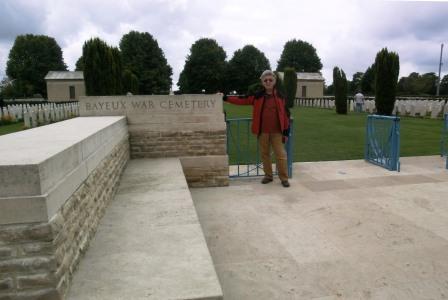
CIMG8610 Sep 7 2017 Pieter at Bayeux War Cemetery entrance

Pieter at the entrance to Bayeux War Cemetery in Bayeux. (Photo credit: Daria Valkenburg)

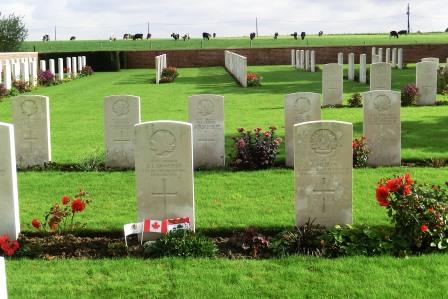
The Bayeux War Cemetery was the first one that had visitors at the same time we were there.  We weren’t alone!  We wondered if this was because it was a WWII cemetery.  All of our other visits had been to WW1 cemeteries and memorials.  It’s also the largest we’ve been to up to now, with 4,144 Commonwealth burials from WWII, 338 unidentified.  There are an additional 500 graves of other nationalities, most of them German.

The cemetery is in an urban setting, and across the street from the Bayeux Memorial, which honours the men of the British and Commonwealth land forces who fell in the early stages of the campaign in northwest Europe of 1945 and have no known grave.  Next to the Bayeux Memorial is the Battle of Normandy Memorial Museum (Musée Mémorial Bataille de Normandie) in Bayeux.  If you are interested in learning more about the D-Day Landing / Operation Overlord operations, plan a visit to Bayeux!  There were a lot of tour buses – from several European countries – and a lot of people walking around.

….George Ashley Bartlett survived D-Day but lost his life during Operation Tractable….

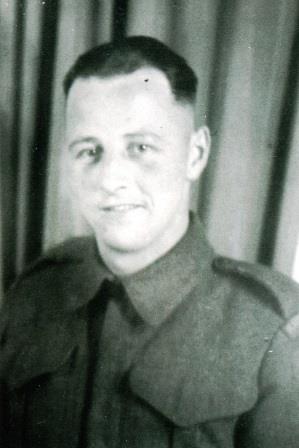
Sergeant George Ashley Bartlett was born in the Gaspé Peninsula, Quebec, on June 3, 1917, the son of Walter Philip Bartlett and Annie Alice Wright.  He enlisted with the North Nova Scotia Highlanders in Amherst in June 1940. In 1941, he married Leah Jean Campbell in Amherst, Nova Scotia, and they had a son John Ashley.

Photo George Ashley Bartlett

Photo: George Ashley Bartlett. (Photo courtesy of North Nova Scotia Highlanders Regimental Museum in Amherst, Nova Scotia)

Bartlett survived the D-Day Landing, but then, on August 14, 1944 he was wounded in action during Operation Tractable to capture Falaise Ridge, and died the following day.  Operation Tractable, fought between August 14 and 21, 1944, was the final offensive conducted by Canadian and Polish troops, supported by one brigade of British tanks, as part of the Battle of Normandy during World War II.

CIMG8603 Sep 7 2017 Pieter by grave of G A Bartlett in Bayeux War Cemetery

Pieter at the grave of George Ashley Bartlett in Bayeux War Cemetery after laying down the flags of Canada, PEI, and Canada 150. (Photo credit: Daria Valkenburg)

….Bartlett’s young son drowned a few years later in Crapaud….

At the time of his death, his wife and son were living in Crapaud.  Mrs. Bartlett remarried, to Ellsworth Wilson, a barber, but then she suffered a second tragedy.  Her young son drowned in March 1948 while she was at the hairdresser shop owned by the mother of Crapaud resident Gene Rogerson.  Gene recalled that young Ashley Bartlett had taken a toboggan to the nearby pond.

….A replica of the Bayeux Tapestry was on a museum wall….

As for me and my dream of seeing the Bayeux Tapestry, I had the last word on this trip to the Bayeux War Cemetery.  As we walked to the car, which was parked at the Battle of Normandy Memorial Museum, I spotted a poster of the Bayeux Tapestry on the Museum wall and managed to convince Pieter to stand beside it.

CIMG8612 Sep 7 2017 Pieter by poster of Bayeux Tapestry at British Military Museum in Bayeux

Pieter by a poster of the Bayeux Tapestry outside the Battle of Normandy Memorial Museum in Bayeux. (Photo credit: Daria Valkenburg)

In the next blog entry we make our way to our last cemetery in France, to Leubringhen, just before the Belgian border. Do you have photo or info on George Bartlett?  Comments or stories?  Email us at memorialtrail@gmail.com, comment on the blog, or tweet to @researchmemori1.

© Daria Valkenburg

….Want to follow our research?….

If you are reading this posting, but aren’t following our research, you are welcome to do so.  Our blog address: https://onthewarmemorialtrail.com/

Front cover OnTheWarMememorialTrailinEurope4 countries, 6 weeks, 7,000 km – an unforgettable war memorial journey in Europe…. Daria’s book ‘No Soldier Buried Overseas Should Ever Be Forgotten‘ is available in print and e-book formats.  Net proceeds of book sales help support research costs and the cost of maintaining this blog. For more information see https://nosoldierforgotten.com/ 

You are also invited to subscribe to our YouTube Channel: On The War Memorial Trail With Pieter Valkenburg: https://www.youtube.com/channel/UCJ591TyjSheOR-Cb_Gs_5Kw

Never miss a posting!  Subscribe below to have each new story from the war memorial trail delivered to your inbox.

On The War Memorial Trail….On The Road To Rouen

October 1, 2017.  Leaving the Arras area, which we had thought was busy enough, was an experience, as now we encountered toll roads.  We soon learned to dread the words ‘gare de péage’.  While all the toll booths have iconic names, like the first one we pulled up at, named ‘Jules Verne’, they are now mostly automated, and you need cash or a debit or credit card.

…. ‘Gare de péage’ meant frustration in trying to pay a toll in Normandy….

If you are one of the modern people thinking ‘Dinosaur’, let me describe the experience.  First off, the box where you have to pay is designed to accommodate truckers, not people in dinky toy cars like the majority of cars used in Europe.  Most people do not have the rubber arms needed to reach up to drop the money in, so each toll booth encounter takes longer than it would if you paid an attendant, as car doors open and people try to squeeze out in the available space to drop their money in manually, or pay by card.  And of course, you need first to figure out WHERE you place your money as there is more than one slot.

If you use cash, as we did, you soon also learned that it’s best to have exact change, as otherwise you have to WAIT for change and then reach up to another slot to get your money.  Anyone in a hurry sometimes leaves their change behind!

PEI is not alone in charging heavy tolls.  We left 7.70 euros at Jules Verne, only to encounter another toll booth 6 minutes later!  At this one we picked up a ticket which cost us another 5.70 euros half an hour later.  The count so far … 13.40 euros.  In Canadian dollars it comes to about $19.75, and the day was just beginning.

…. We were on the right street but in the wrong community!….

It took us just over 2 ½ hours to get to Rouen from Mont St. Eloi, and, following the GPS instructions to the St. Sever Cemetery, arrived at Boulevard Stanislas Girardin, only to find it was in downtown Rouen.  No cemetery in sight!  The streets are extremely narrow, jam packed with cars and pedestrians and most of the streets one way traffic only.  We finally gave up trying to figure out what had gone wrong and stopped in front of a short driveway into a huge government building behind a walled gate, and asked a passerby for help.

The poor man looked at our sheet from the Commonwealth War Graves Commission and finally said, very kindly, that we were on the right street, but not in Rouen.  The cemetery was in a nearby community.  Sure enough, when we looked at the cemetery location instructions, it said it was “situated on the eastern edge of the southern Rouen suburbs of Le Grand Quevilly and Le Petit Quevilly.”  But what we didn’t understand was why we’d been directed downtown when we had the right street.

The man explained that it was in either Le Grand Quevilly or Le Petit Quevilly, he wasn’t sure which.  So, the GPS got reprogrammed for Le Grand Quevilly.  The word “suburb” was a misnomer.

While this discussion had been going on, traffic was backing up as people wanting to get into or out of the government driveway were held up as we were blocking the road.  Not one person honked or showed any impatience!  We thanked the man for his help, and then slowly backed up onto the traffic, and made our way out of town.

…. A car salesman steered us in the right direction to the cemetery….

Le Grand Quevilly was a short distance away, but it was not the location of the cemetery.  We pulled into a car dealership to ask directions, only to find out that France shuts down for lunch break.  Everything was locked up, but we found a salesman in a tent on the lot, reading his emails.

I’m from a different country,” he said, when we asked about the cemetery.  Then he made us laugh when he went on to say, “I’m from Paris.”  But he was very effective at finding someone who could help us and that’s when we learned that we wanted to be in Le Petit Quevilly, and how to get there.

In Le Petit Quevilly, on a street by the same name as in Rouen (what are the odds?), we were able to find St. Sever Cemetery Extension, the location where Bazil Cormier is buried.

CIMG8598 Sep 7 2017 sign directing us to St Sever Cemetery Extension

Sign to the St. Sever Cemetery in Le Petit Quevilly. (Photo credit: Daria Valkenburg)

According to the information provided by the Canadian War Graves Commission, during WWI, Commonwealth camps and hospitals were stationed on the southern outskirts of Rouen.  Most hospitals remained there during the war.  A number of those who died in the hospitals were buried in other cemeteries, but the majority were buried at St. Sever Cemetery.  In September 1916, the Extension, where Bazil Cormier is buried, began.

In WWII, Rouen was again a hospital centre, and several Commonwealth soldiers who were prisoners of war during the German occupation are buried in the Extension.

…. St. Sever Cemetery Extension was huge….

St. Sever Cemetery Extension is the largest cemetery we’ve been to so far, with 8,348 WWI Commonwealth burials, 10 of them unidentified, 328 WWII Commonwealth burials, 18 of them unidentified, and 8 foreign nationals.

With such a large cemetery, it was not easy to find Cormier’s grave.  Luckily, in this cemetery, several gardeners from the Commonwealth War Graves Commission were on site.  While Pieter went to look in the Grave Register, I looked at the graves, trying to find the row in which Cormier was buried.  One gardener asked if I needed help.  When I explained who we were looking for, he asked if I had the paper with the burial information.  I explained it was on the other side of the cemetery with Pieter, who was comparing it to the information in the Grave Register.

Just to let you know how great these workers are, the gardener immediately went over to the other side of the cemetery and then spent the next few minutes looking for the grave, which of course was as far away as possible from where we were!
CIMG8587 Sep 7 2017 Pieter at the grave of Bazil Cormier at St Sever Cemetery Extension

Pieter at the grave of Bazil Cormier in St. Sever Cemetery Extension in Le Petit Quevilly. (Photo credit: Daria Valkenburg)

…. Bazil Cormier lost his life during the Battle of Amiens….

According to his Attestation papers, Private Bazil CORMIER was born January 6, 1898 in Tignish, the son of Joseph Cormier and Marie Arsenault.  A farmer before enlisting with the 105th Draft Regiment on December 4, 1916, he died of wounds received in the Battle of Amiens near Cachy on August 12, 1918, at the age of 21.  At the time of his death he was with the 26th New Brunswick Battalion.

The War Graves Register Circumstances of Death notes that “During operations east of Amiens, on the morning of August 8th 1918, he was hit in the head by a machine gun bullet. He was immediately dressed by a comrade and carried out, but succumbed to his wounds at No. 4 General Hospital, Rouen, four days later...”  According to the active/casualty document in his file, however, he was transported to the No. 5 General Hospital, not the No. 4 General Hospital, where he died.

The Battle of Amiens, also known as the Third Battle of Picardy, was the opening phase of the Allied offensive which began on August 8, 1918, later known as the Hundred Days Offensive, that ultimately led to the end of the First World War.  This is the same battle in which James CAIRNS lost his life on August 9, 1918.
CIMG8592 Sep 7 2017 Pieter at grave of B Cormier in St Sever Cemetery Extension

Pieter by the grave of Bazil Cormier. (Photo credit: Daria Valkenburg)

As with too many of the WWI soldiers, we have no photo or further information about Bazil Cormier.

The cemeteries we’d been to in the past days had all been in the countryside.  St. Sever Cemetery Extension was in an urban setting, and bordered the Rouen Soccer Club, which caught the interest of soccer fan Pieter.

CIMG8590 Sep 7 2017 next to St Sever Cemetery Extension is the soccer club of Rouen

The Rouen Soccer Club was on the other side of the fence of the St. Sever Cemetery Extension. (Photo credit: Daria Valkenburg)

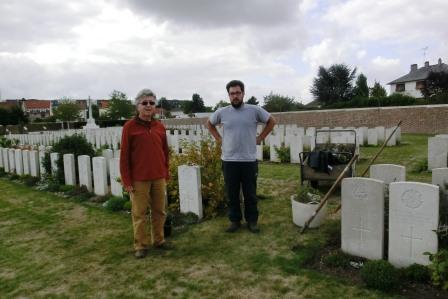
We couldn’t leave the cemetery without giving flag pins to the gardeners, one of whom spoke English and told Pieter that he had just graduated from horticultural college and loved his job.  The head gardener, who had helped us in the beginning, was unfortunately out on an errand, so we were not able to say goodbye to him.
CIMG8596 Sep 7 2017 Pieter with a CWGC gardener at St Sever Cemetery Extension

Pieter with a young CWGC gardener at St. Sever Cemetery Extension. (Photo credit: Daria Valkenburg)

In the next blog entry we make our way to Bayeux, which has a connection with Pieter’s genealogical research as well as the Cenotaph research project. Do you have photo or info on Bazil Cormier?  Comments or stories?  You can share them by emailing us at memorialtrail@gmail.com or by commenting on this blog.

© Daria Valkenburg

….Want to follow our research?….

If you are reading this posting, but aren’t following our research, you are welcome to do so.  Our blog address: https://onthewarmemorialtrail.com/
Front cover OnTheWarMememorialTrailinEurope4 countries, 6 weeks, 7,000 km – an unforgettable war memorial journey in Europe…. Daria’s book ‘No Soldier Buried Overseas Should Ever Be Forgotten‘ is available in print and e-book formats.  Net proceeds of book sales help support research costs and the cost of maintaining this blog. For more information see https://nosoldierforgotten.com/ 

You are also invited to subscribe to our YouTube Channel: On The War Memorial Trail With Pieter Valkenburg: https://www.youtube.com/channel/UCJ591TyjSheOR-Cb_Gs_5Kw

Never miss a posting!  Subscribe below to have each new story from the war memorial trail delivered to your inbox.
On The War Memorial Trail….Reflections on the Cemetery Visits in the Arras Area

October 1, 2017.  After visiting the cemeteries and Vimy Memorial to honour the memories of the soldiers on the Cenotaph outside the Borden-Carleton Legion who perished in the area around Arras, we went to our “local” café for the past few days, L’Eurostar Café Brasserie, for a well-deserved rest and final meal before leaving the area.

IMG_20170904_185344129 Sep 4 2017 Pieter at LEurostar Cafe in Arras enjoying a Leffe beer

Pieter enjoying Leffe blond beer at L’Eurostar Café Brasserie in Arras. (Photo credit: Daria Valkenburg)

In France, dinner is not served before 7 pm.  Normally that wasn’t a problem for us as we would arrive at a restaurant completely exhausted long after 7 pm, but after the success in finally finding Manitoba Cemetery we arrived back in Arras in the late afternoon, and decided to have an early dinner before packing up to leave the area in the morning.

We arrived at the café at 5:45 pm only to be told the kitchen didn’t open before 7 pm.  We were too tired to go back to the hotel and come back later, so we ordered an appetizer, camembert cheese of course in honour of our host country, and a drink and relaxed until the chef appeared, right on the dot of 7 pm.

Since we had all this time to relax and reflect on our journey so far, I asked Pieter how he felt.  He said that, for him, “visiting the graves made things come full circle.  You start off with a name on the Cenotaph.  Then you begin the research and read up on what happened.  Hopefully you get a photo and personal stories.  Now we’ve ended up where the person died after a very short life….

Pieter thought a bit before he continued, “….on the one side, I feel sorry they died so young.  On the other hand I feel honoured to be there to pay respects to them.  It makes me want to know more about them, now that I’ve visited their grave or memorial….

We both agreed that for the soldiers without a photo the picture is not complete.  “When I stand by a grave at the cemetery and have a photo so I know how the person looked, then I can feel a connection…” Pieter explained.

…It’s especially sad for soldiers like Arthur Collett, buried in Grandcourt Road Cemetery, and James Cairns, buried in Manitoba Cemetery, that they are buried in cemeteries that get very few visitors. They are just a number…. Each identified grave lists the soldier’s name, unit, rank, and identification number.

We both also agreed that the gardeners and maintenance staff at the Commonwealth War Graves Commission do a fantastic job of keeping up the cemeteries.  Over the past days, we’ve handed out Canadian flag pins to anyone we’ve seen driving around in the white vans with CWGC written on them and they have been enthusiastically received.  Up to now, we hadn’t seen anyone in a cemetery itself, but the work they do in sometimes very difficult locations, such as Grandcourt Road Cemetery, is to be commended.

When Pieter began this project, World War I was just history to us, no different than the various dates and historical facts we learned in school over the years.  Now it’s become a story with real people, and along the way, we are meeting wonderful people who work hard to preserve the history that we have largely forgotten.

In the next blog entry we visit the ruins of Mount St. Eloi church before going on to Rouen to St. Sever Cemetery Extension. Do you have photos or information about James Cairns?  Does anyone know the family members who visited the grave of Ted Arsenault of Abrams Village? Comments or stories?  You can share them by emailing us at memorialtrail@gmail.com or by commenting on this blog.

© Daria Valkenburg

….Want to follow our research?….

If you are reading this posting, but aren’t following our research, you are welcome to do so.  Our blog address: https://onthewarmemorialtrail.com/

Front cover OnTheWarMememorialTrailinEurope4 countries, 6 weeks, 7,000 km – an unforgettable war memorial journey in Europe…. Daria’s book ‘No Soldier Buried Overseas Should Ever Be Forgotten‘ is available in print and e-book formats.  Net proceeds of book sales help support research costs and the cost of maintaining this blog. For more information see https://nosoldierforgotten.com/ 

You are also invited to subscribe to our YouTube Channel: On The War Memorial Trail With Pieter Valkenburg: https://www.youtube.com/channel/UCJ591TyjSheOR-Cb_Gs_5Kw

Never miss a posting!  Subscribe below to have each new story from the war memorial trail delivered to your inbox.
On The War Memorial Trail….The Search For Manitoba Cemetery

September 30, 2017.  After the visit to Beaumont-Hamel, we had only one cemetery left to visit in the area around Arras.  Our previous attempt to find Manitoba Cemetery in Caix had been fruitless and frustrating.  We’d asked in the village and were willingly directed to the only ‘English’ cemetery known in the area – the British Cemetery!  There also was a German cemetery.  Manitoba Cemetery?  No one heard of it.  We’d tried the neighbouring village of Beaufort, and got directed to the same British Cemetery.

…Where is that cemetery?…

Pieter spent a long time online looking at Google maps to try and find out why we’d had so much trouble, and eventually realized that the Commonwealth War Graves Commission direction to the cemetery was incorrect!  The directions stated that the cemetery was “situated between the village of Caix and Beaufort.”  According to Google maps, there was a small road between the two villages where the cemetery appeared to be located.  However, there was NO Commonwealth War Grave Cemetery sign anywhere along the road between the villages, and no one we had asked had heard of it.

Back we went for a second try and arrived, again, in Caix.  Pieter was determined to find the grave of James CAIRNS, if he had to search every road in the area.
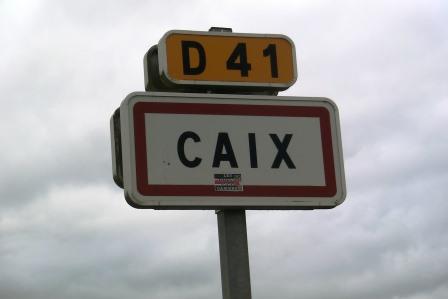
CIMG8363 Sep 5 2017 sign for Caix the location of the Manitoba Cemetery

We reach the village of Caix, location of Manitoba Cemetery. (Photo credit: Daria Valkenburg)

…A farm path led to the cemetery…

Following the information Pieter learned from studying Google maps, we actually found the cemetery, down a farm path.  We’d actually been on the path the day before, but hadn’t gone down far enough as we thought it was a private road, not a public one, and there were no signs indicating that a cemetery was down the road.

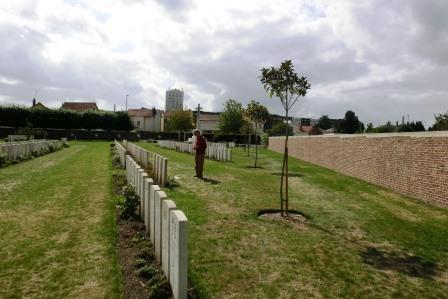
CIMG8555 Sep 6 2017 Pieter at entrance to Manitoba Cemetery

Pieter at the entrance to Manitoba Cemetery just outside Caix. (Photo credit: Daria Valkenburg)

According to the information panel at the cemetery, the village of Caix was captured from the Germans in February 1917, lost in March 1918, and recaptured by the Canadian Corps four months later.  Named after the Manitoba Regiment of the 8th Canadian Battalion (known as Winnipeg Rifles), the cemetery has the graves of 2 British and 117 Canadians who fell in the recapture.  Seven of the burials are unidentified.

…James was born in Prince Edward Island but moved to Manitoba…

This was the second James Cairns on the Cenotaph outside the Borden-Carleton Legion, one identified as James Ambrose Cairns, and the one buried in Manitoba Cemetery known as James Cairns.  Born on February 22, 1897 in Kinkora, he was the son of Thomas Cairns and Mary Jane MacDonald.

The family moved to Manitoba from the island, and Cairns enlisted with the 190th Battalion Manitoba Regiment on July 8, 1916.  He was killed in action during the Battle of Amiens on August 9, 1918.  The Battle of Amiens, also known as the Third Battle of Picardy, was the opening phase of the Allied offensive which began on 8 August 1918, later known as the Hundred Days Offensive, that ultimately led to the end of the First World War.

…James was killed by machine gun fire…

According to the Canadian War Graves Register circumstances of death, James …was instantly killed on the afternoon of August 9th 1918, while advancing with his battalion, in the face of stout opposition from the enemy, who placed a heavy barrage at the ‘jumping off’ place, and from hidden nests poured machine gun fire in the ranks of the troops who pushed forward.  Location of the unit at the time of the casualty: West of the Meharicourt-Rouvroy road…

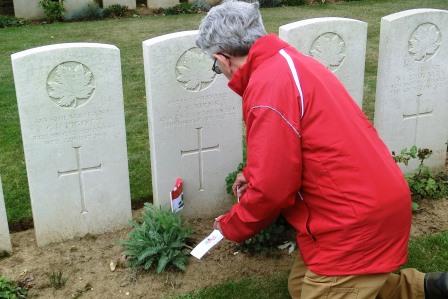
CIMG8557 Sep 6 2017 Pieter places flags by grave of James Cairns at Manitoba Cemetery

Pieter placing flags by the grave of James Cairns at Manitoba Cemetery. (Photo credit: Daria Valkenburg)

While we don’t have a photo of James Cairns, we are lucky to have a glimpse into his personality, through a letter that the sister of James Cairns received on September 18, 1918 from the 83rd Canadian Battalion British Expeditionary Forces:

My Dear Miss Cairns:

I regret that the conditions of war made it impossible for me to write you sooner regarding the death of your brother Pte. James Cairns. He died in the afternoon of Aug 9th during the second day of our advance in front of Amiens. Death was instantaneous, the result of a machine gun bullet. I buried the body in a cemetery on the battlefield where many of his comrades lie. The grave is marked and will be permanent.

I knew your brother. He was doing well and was liked by everybody. His life has been given for human freedom and it will not be in vain. God will be pleased to accept the sacrifice and to make through it a better world. I pray God will bless you abundantly and sustain you all in this trial.

Believe me to be yours in deepest sympathy.

J. W. Whillans – Capt. and Chaplain

…James is not the only Islander buried in the cemetery!…

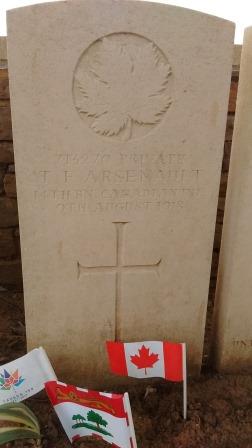
We thought this was it for our trip to the cemetery.  All that was left was to write in the Guest Register.  While doing so, we had a little surprise.  The previous visitors from July 13 had come to honour their great-uncle and great-great uncle Theodore (Ted) ARSENAULT from Abrams Village! Who would believe that the last visitors to Manitoba Cemetery visited a soldier from Prince Edward Island?

Entries from the Guest Register at Manitoba Cemetery in Caix.  (Photo credit: Daria Valkenburg)

We couldn’t leave without placing flags by another soldier from PEI!

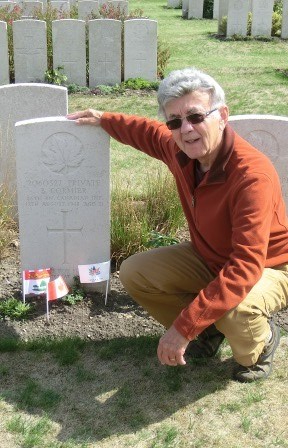
IMG_20170906_152615630 Sep 6 2017 grave of Ted Arsenault in Manitoba Cemetery in Caix

Grave of T. E. Arsenault of Abrams Village. (Photo credit: Pieter Valkenburg)

With that, we left Manitoba Cemetery and drove a way down the farm road to see if there may be a sign we missed.  There wasn’t, but we came across a reminder that this part of France saw suffering in WWII, as well as WW1.

CIMG8569 Sep 6 2017 WWII memorial on a farm path outside Caix

Memorial down the road from the Manitoba Cemetery outside Caix which roughly reads “On June 7, 1940 31 French soldiers from the 41st Infantry Regiment and 10th Army of Rennes were massacred by the Nazis. Remember. Colonel Loichet, commander of the 41st Infantry Regiment” (Photo credit: Daria Valkenburg)

We drove around in the area, looking for a Commonwealth War Graves sign and found a very battered sign on the farm road, not on the main road, that you would see, not from Caix, but from Beaufort en Santerre. If you are planning to visit Manitoba Cemetery, the only other sign you will see is in Quesnel, from the D41. This town, however, is not mentioned in the cemetery info provided by the Commonwealth War Graves Commission!  From Quesnel, you would head towards Beaufort en Santerre via D161 and take an unnumbered road, called Rue du Bois, to reach the cemetery.  Where is Caix in all this?  If you continue past the cemetery then you will reach Caix, which has several military cemeteries which are clearly marked, but not the one for Manitoba Cemetery.

In the next blog entries we reflect on the cemeteries we’ve seen so far and visit the ruins of Mount St. Eloi church before going on to Rouen to St. Sever Cemetery Extension. Do you have photos or information about James Cairns?  Does anyone know the family members who visited the grave of Ted Arsenault of Abrams Village? Comments or stories?  You can share them by emailing us at memorialtrail@gmail.com, comment on the blog, or tweet to @researchmemori1.    

© Daria Valkenburg

…Want to follow our research?…

If you are reading this posting, but aren’t following our research, you are welcome to do so.  Our blog address: https://onthewarmemorialtrail.com/

4 countries, 6 weeks, 7,000 km – an unforgettable war memorial journey in Europe…. Daria’s book ‘No Soldier Buried Overseas Should Ever Be Forgotten‘ is available in print and e-book formats.  Net proceeds of book sales help support research costs and the cost of maintaining this blog. For more information see https://nosoldierforgotten.com/

Subscribe to our YouTube Channel: On The War Memorial Trail With Pieter Valkenburg: https://www.youtube.com/channel/UCJ591TyjSheOR-Cb_Gs_5Kw

Never miss a posting!  Subscribe below to have each new story from the war memorial trail delivered to your inbox.