On The War Memorial Trail….Visiting the Tunnels at Vimy Ridge

September 14, 2017.  After the tour of the Vimy Memorial Visitors’ Centre, Pieter and site manager Johanne Gagné went to explore the tunnels.  Pieter was in second heaven!  They saw two of the many tunnel systems, one used by the Black Watch, and one used by the Princess Patricia Light Infantry.

IMG_20170905_103810241 Entrance to a Vimy Tunnel used by Princess Pats

Photo: Entrance to a tunnel used by the Princess Patricia Light Infantry. (Photo credit: Pieter Valkenburg)

Some of the main tunnels at Vimy Ridge have been restored to make them safer and reinforced with concrete floors, as well as some of the walls.  All of the tunnels were named by the WWI soldiers so that they would know where they were.

Tunnels were used for two main purposes: to safeguard troops from enemy fire, and for transportation of materials such as bombs and mines that could be used to blow up German tunnels.  A narrow gauge railway system was installed as whatever materials were dug out to make the tunnels had to be transported out and then covered so that enemy observation planes couldn’t spot mounds of earth and be aware of where digging was going on.

Using the material transported into the tunnels, Allied forces tried to undermine the trenches of the Germans by blowing them up from inside the tunnels.  This had the advantage of allowing Allied forces to safely advance without being exposed to enemy fire.

IMG_20170905_105716402

Pieter by the as yet unrestored tunnel used by the Black Watch. Note the wagon in the background. (Photo credit: Johanne Gagné)
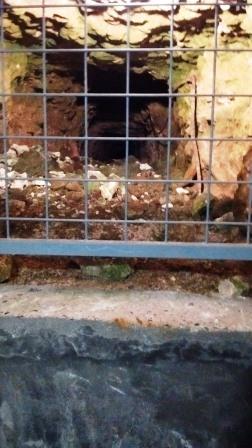
IMG_20170905_104523941 Tunnel used by Black Watch

An as yet unrestored portion of the Grange tunnel. (Photo credit: Pieter Valkenburg)
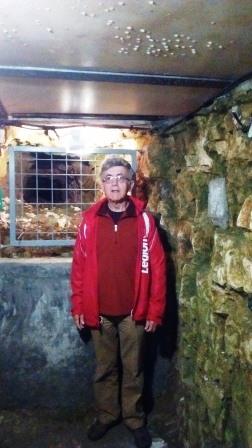
IMG_20170905_104540988 Pieter in a reinforced part of the tunnel

Pieter in a reinforced part of the Grange tunnel. (Photo credit: Johanne Gagné)

Some tunnels were designed for living quarters and as command centres.  Messages were passed along from the command centre by runners to the troops.  There were ways out of the tunnels into the trenches.

An interesting and surprising fact Pieter learned was that electricity was in the tunnels.  They had electric lights in the Vimy tunnels! As Johanne Gagné noted, “…So modern!..

Near Vimy was a tunnel called the Maison Blanche (“The White House”), so named because the outside building was white in colour.  That tunnel used candles for lighting.

In Pieter’s opinion, the unrestored tunnels gave a better picture of what had gone on at the time.  The restored tunnels give you a safer impression of what happened, but doesn’t have the impact of the dire conditions the men worked in. “…I was amazed by how many tunnels there were, going in all directions…” Pieter explained.  “It was a real maze…

From the observation post, you can still see a big crater where Allied troops blew up a trench.
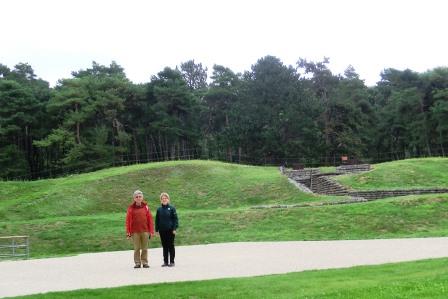
CIMG8287 Sep 5 2017 Pieter & Johanne by observation post at Vimy Ridge

Pieter and Johanne Gagné by the observation post overlooking ‘no man’s land’ – territory that was not held by either the Germans or the Allies. (Photo credit: Daria Valkenburg)

We were very interested in the observation post as Gunner Harold Keith HOWATT of the 8th Siege Battery spent a lot of World War I in an observation post, and we had wondered what one looked like.  So Pieter went into one and took a look.
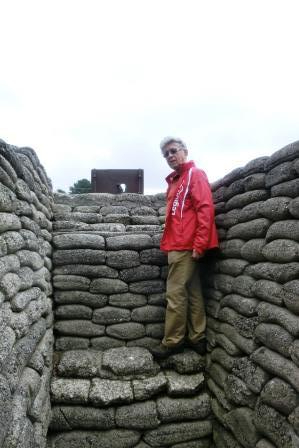
CIMG8289 Sep 5 2017 Pieter in observation post at Vimy Ridge

Pieter in an observation post at Vimy Ridge. (Photo credit: Daria Valkenburg)

Howatt participated in the Battle of Vimy Ridge in April 2017, and survived.  In fact, he survived the war and came back home to Augustine Cove and had a career as a teacher.

But back in February 1918, his unit was back at Vimy Ridge.   In his diary entry of Saturday, February 16, 1918, he recorded the following observations:

….In the afternoon I took a walk up to the top of Vimy Ridge.  It is some place, never yet have I seen a place so battle scarred.  There are shell holes everywhere, hardly two square yards of level ground on the ridge.  And the mine craters, they are tremendous.  Some must be from 40 to 50 feet deep and from 40 to 50 yards across. 

There is a large monument on the top to the 44th Battalion, with the names of all the officers and men, who were killed during the attack on the ridge on April 9, inscribed on it.  There is also a monument to the 78th Battalion, and one to a sergeant of the Winnipeg Grenadiers who set off an enemy mine and lost his life in the act.  The crater is called the ‘Winnipeg Grenadier’.  There is also a monument to a major and to Lieutenant Gass of the 5th Canadian Siege Battery, who was killed in an O. P. (note:  Observation Post) the day before Vimy was taken.

There was a party of English labour tourists on the top of the ridge while I was up there.  Was talking to one fellow for a few minutes, pointing out Lens, Avion, and place within our own lines, to him….

We weren’t sure if the crater referred to by Howatt is the same one to be seen from the observation post outside the Visitors Centre.  We did not see the monuments described by Howatt and guess they are no longer there.  And Vimy Ridge is now filled with trees, a barren landscape no more.
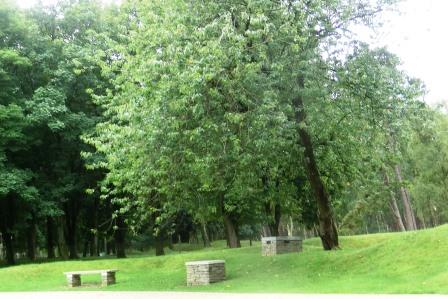
CIMG8286 Sep 5 2017 Vimy Ridge today is tree lined again

Vimy Ridge is now filled with trees. (Photo credit: Daria Valkenburg)

Johanne Gagné had given us a fantastic tour so far, but there was more.  In the next blog entry we visit the Canadian National Vimy Memorial, and bring along the photos of John Lymon Wood and Patrick Raymond Arsenault, whose names are inscribed on the memorial.

Comments or stories?  You can share them by emailing us at memorialtrail@gmail.com or by commenting on this blog.

© Daria Valkenburg

….Want to follow our research?….

If you are reading this posting, but aren’t following our research, you are welcome to do so.  Our blog address: https://onthewarmemorialtrail.com/
Front cover OnTheWarMememorialTrailinEurope4 countries, 6 weeks, 7,000 km – an unforgettable war memorial journey in Europe…. Daria’s book ‘No Soldier Buried Overseas Should Ever Be Forgotten‘ is available in print and e-book formats.  Net proceeds of book sales help support research costs and the cost of maintaining this blog. For more information see https://nosoldierforgotten.com/ 

You are also invited to subscribe to our YouTube Channel: On The War Memorial Trail With Pieter Valkenburg: https://www.youtube.com/channel/UCJ591TyjSheOR-Cb_Gs_5Kw

Never miss a posting!  Subscribe below to have each new story from the war memorial trail delivered to your inbox.

On The War Memorial Trail….A Visit To Vimy Ridge

September 12, 2017.  After a few hectic days when there was no time to do any writing as we were on the go from early morning until quite late in the evening, we now are settled for a few days in a quiet cottage in a forested area, and hopefully can catch up with all of the memorable days we’ve just experienced.

The most anticipated stop on our memorial trail of honouring the men listed on the Borden-Carleton Cenotaph was Vimy Ridge.  Two WWI soldiers are listed on the Canadian National Vimy Memorial, John ‘Lymon’ WOOD and Patrick Raymond ARSENAULT.

Our hotel was in Arras, and Vimy Ridge was a 20 minute drive from there.  Just before the turn-off to Vimy Ridge we passed through the town of Thélus.  There is one stop light in town.  To the left are signs directing you to cemeteries and memorials.  To the right are signs directing you to more memorials.

Right by the stop light is the Canadian Artillery Memorial, built to remember the sacrifice of Canadians from Artillery battalions who died in the battle for Vimy Ridge and the surrounding area.

CIMG8309 Sep 5 2017 Cdn Artillery Memorial in Thelus with sign posts

The Canadian Artillery Memorial in Thélus was built during WW1 by the Canadian Corps. (Photo credit: Daria Valkenburg)

It’s daunting to see how many reminders of war there are in France.  Everywhere you go, you see memorials and cemeteries – both civilian and military.  It’s a grim reminder of how many people lost their lives.  It’s impossible to ignore or forget.  And it’s a very big reminder of how many countries came to help in the Allied cause during World War I.  It truly became an international war.  Every one of them has at least one memorial and the war cemeteries are filled with Allied and German lives lost.

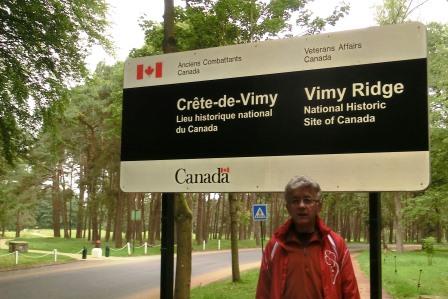
CIMG8270 Sep 2017 Pieter at entrance to Vimy Memorial Park

Pieter at the entrance to Vimy Ridge in France. (Photo credit: Daria Valkenburg)

The turn-off to the Vimy Ridge memorial and visitors centre is a tree-lined road, with jogging and walking paths, well used by citizens of the area.  It’s a public road that goes to the nearby villages of Givenchy and Vimy.

We were very lucky to have been given a guided tour of the Vimy Ridge Visitors Centre, which opened in April 2017, by site manager Johanne Gagné.

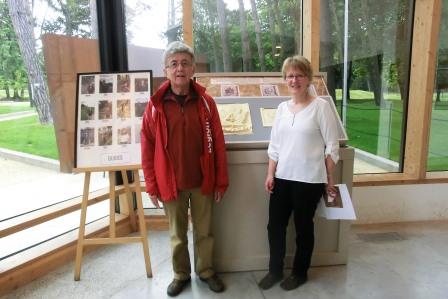
CIMG8275 Sep 5 2017 Pieter with site manager Johanne Gagne

Pieter with Johanne Gagné, Senior Manager, European Operations at the Canadian National Vimy Memorial, who gave us a guided tour. (Photo credit: Daria Valkenburg)

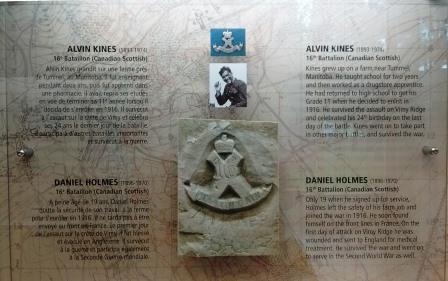
Among the many exhibits in the Visitors Centre is one that replicates the graffiti found in the tunnels of Vimy Ridge.  Using 3-D technology, exact replicas of the graffiti have been made, and researchers have tried, where possible, to provide a face and story to the men who made the graffiti.

Ms. Gagné noted that this graffiti display will be on tour in various places in Canada after leaving Vimy Ridge.  If it comes to your area, you won’t want to miss it!

We certainly had the right person to give us a tour, as Ms. Gagné worked for two years in Canada in developing the visitors centre before coming to France for two years as part of an interchange agreement with Parks Canada.  Hailing from Coteau-du-Lac, Quebec, she has a background in museology, exhibit design, and developing visitors programming.  Our interest was certainly caught, and this was from one exhibit only.

IMG_20170905_093513986 Sep 5 2017 Graffiti at Vimy Ridge by Kines & Holmes

Graffiti replicas of the 15th Battalion and a photo and short bio of two names inscribed below the insignia, that of Alvin Kines and Daniel Holmes. (Photo credit: Pieter Valkenburg)

The Visitors Centre has many interactive displays, in three languages (English, French, German), and one of the displays is very personal.  It tells the story of World War I from the perspectives of a young girl, a soldier, a nurse, etc, and all the stories are based on letters and diaries of real life people.

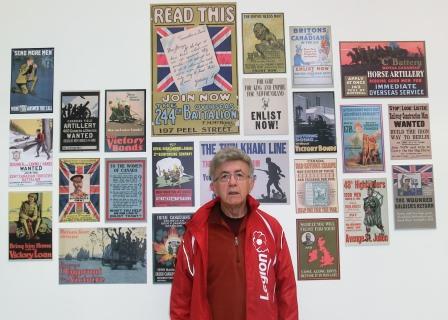
We were fascinated by a wall of patriotic signs, urging support for the war.

CIMG8277 Sep 5 2017 Vimy Ridge Visitors Centre Pieter by patriotic signs

Pieter by one of the displays of patriotic signs. (Photo credit: Daria Valkenburg)

An interactive display explained the troop movements during the Battle of Vimy Ridge on April 8, 1917.  Another interactive display gave a tour of the tunnels below Vimy Ridge. This was a marvellous solution to see the tunnels, especially if you were not physically capable of entering the tunnels yourself.

CIMG8283 Sep 5 2017 Daria by interactive displays in Vimy Ridge Visitors Centre

Daria by the interactive display of the Vimy Ridge tunnels. Behind are the displays of stories of WW1 by individuals. (Photo credit: Johanne Gagné)

We asked Ms. Gagné her perspective of the Vimy Ridge Visitors Centre and Memorial.  “Most of the time, people come and say that they came to honour the sacrifices made.  I asked myself, what does it mean to me?  Why have I spent three years on this project?  I’m giving the soldiers a voice.  I hope that through the exhibits, that we can show the public how the soldiers lived, what they saw, what they did, and close the loop by telling their stories”  The exhibits certainly do that.  They are interesting and well done.

The tour of the Visitors Centre over, it was time to see the rest of Vimy Ridge.  On Pieter’s bucket list was a tour of the tunnels, a wish that was granted, and discussed in the next blog.  While he and Ms. Gagné prepared themselves for the tunnels, I took a look at the tunnels from the comfort and safety of the Visitors Centre.

Comments or stories?  You can share them by emailing us at memorialtrail@gmail.com or by commenting on this blog.

© Daria Valkenburg

….Want to follow our research?….

If you are reading this posting, but aren’t following our research, you are welcome to do so.  Our blog address: https://onthewarmemorialtrail.com/

Front cover OnTheWarMememorialTrailinEurope4 countries, 6 weeks, 7,000 km – an unforgettable war memorial journey in Europe…. Daria’s book ‘No Soldier Buried Overseas Should Ever Be Forgotten‘ is available in print and e-book formats.  Net proceeds of book sales help support research costs and the cost of maintaining this blog. For more information see https://nosoldierforgotten.com/ 

You are also invited to subscribe to our YouTube Channel: On The War Memorial Trail With Pieter Valkenburg: https://www.youtube.com/channel/UCJ591TyjSheOR-Cb_Gs_5Kw

Never miss a posting!  Subscribe below to have each new story from the war memorial trail delivered to your inbox.
WWI Soldier Private Patrick Raymond Arsenault Uncovered

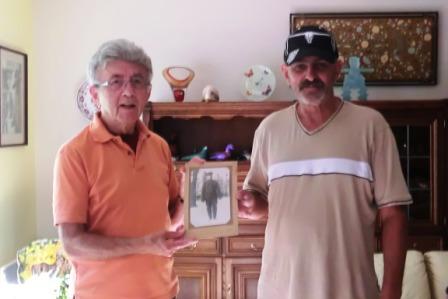
CIMG7870 Pieter Valkenburg and Paul Arsenault Great Nephew of P.R. Arsenault.JPG

Photo: Pieter with Paul Arsenault and a photo of Patrick Raymond Arsenault.  (Photo credit: Daria Valkenburg)

August 7, 2017. With the 100th anniversary of the end of WWI coming up in 2018, Pieter has been actively searching for photos of the men listed on the Cenotaph who died during WW1 as he would like to have a Wall of Remembrance in the Legion.

Private Patrick Raymond ARSENAULT, who was born in Bedeque on October 14, 1896 to Joseph Arsenault and Isabella nee Richard, is one of the two men on the Cenotaph whose names are on the Vimy Memorial in France.

In the lead-up to the centenary of the Battle of Vimy Ridge in April, his story was told in newspapers, and in a French language interview on CBC Radio-Canada given by Don Arsenault.  More coverage was given in the Journal Pioneer (see http://www.journalpioneer.com/news/local/2017/4/9/special-day-of-remembrance-for-bedeque-soldier.html ) and La Voix Acadienne following the commemoration ceremonies at the Legion in April. (See http://www.lavoixacadienne.com/index.php/patrimoine/1756-des-soldats-a-vimy-sont-honores.)  Unfortunately, up to that time, no family had been found, and no photo was available.

On Saturday, August 5, Paul Arsenault of Borden-Carleton, great-great-nephew of Arsenault, contacted Pieter to say he had a photo of his great-great-uncle after his aunt, Eileen Perry, showed him an article about Arsenault in the County Line Courier (See CLC Apr 5 2017 p9 Two Unsung Heroes of Vimy Ridge).  …I found the photo in a chest that my mother Noreen had saved from her mother…” he said.  Noreen and Eileen are the granddaughters of Private Arsenault’s sister Mary Ethel Gaudet.

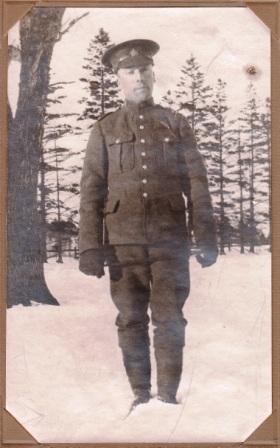
Patrick Raymond Arsenault from Paul Arsenault.jpg

Photo: Patrick Raymond Arsenault in 1916 in Summerside.  (Photo courtesy of Paul Arsenault collection)

It’s wonderful when family members are willing to help in the Cenotaph Research Project! Thank you Paul!  Readers, do you have more information on Patrick Raymond Arsenault?  Let us know by commenting on this blog, or email Pieter at memorialtrail@gmail.com.

See related article published on August 9, 2017  CLC p30 Aug 9 2017 Face for Arsenault

© Daria Valkenburg

….Want to follow our research?….

If you are reading this posting, but aren’t following our research, you are welcome to do so.  Our blog address: https://onthewarmemorialtrail.com/

Front cover OnTheWarMememorialTrailinEurope4 countries, 6 weeks, 7,000 km – an unforgettable war memorial journey in Europe…. Daria’s book ‘No Soldier Buried Overseas Should Ever Be Forgotten‘ is available in print and e-book formats.  Net proceeds of book sales help support research costs and the cost of maintaining this blog. For more information see https://nosoldierforgotten.com/ 

You are also invited to subscribe to our YouTube Channel: On The War Memorial Trail With Pieter Valkenburg: https://www.youtube.com/channel/UCJ591TyjSheOR-Cb_Gs_5Kw

Never miss a posting!  Subscribe below to have each new story from the war memorial trail delivered to your inbox.
Learning About The Two Names On The Vimy Memorial

Pieter Valkenburg

Photo: Borden-Carleton Branch Service Officer Pieter Valkenburg doing research (Credit: Daria Valkenburg)

July 28, 2017.  After the first article about the Borden-Carleton Cenotaph Research Project ran in October 2016, Pieter decided to focus on the WWI soldiers listed on the cenotaph, and began intensive research over the winter.

In the meantime the first article ran in the PEI Genealogical Society Newsletter and a shorter version ran in Charlottetown’s Guardian.  The Carr descendants of Vincent CARR had said that he was single, and the military attestation paper when he signed up agreed with this.  However, we found out that sometime between enlisting on June 5, 1915 and his death on October 30, 2017, he married Bessie H. Carr of Summerside.  Sadly she died a year after her husband.  Unfortunately, we have no photo of Bessie Carr, nor were we able to find a marriage record.  Can anyone help?

In his research, Pieter found two soldiers on the monument whose names are inscribed on the Canadian National Vimy Memorial in France.  One was in the wrong place at the wrong time due to a name mix-up and died, the other survived the battle, only to perish a month later.  Their tales became the subject of the second article about the project.

Patrick Raymond ARSENAULT was the soldier who was transferred by error and ended up in the Battle of Vimy Ridge, died on April 11, 1917.

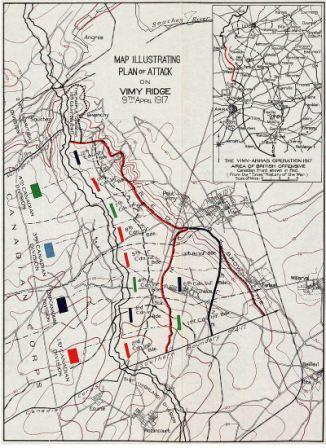
Plan_of_Attack_Vimy_Ridge where Arsenault died

Plan of Attack for Vimy Ridge where Patrick Raymond Arsenault died. The 2nd Canadian Brigade, part of the 1st Canadian Division, is in red. (Source: Library and Archives Canada/First World War map collection/e000000519_a4)

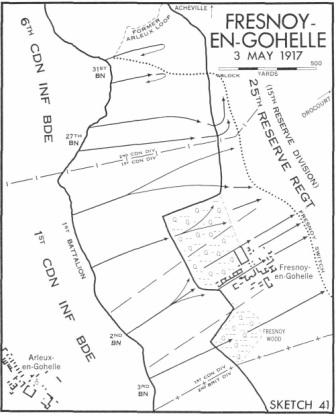
John Lyman WOOD survived the battle, but died on May 3, 1917 during the Battle of Arras.

Map of Battle of Arras near Fresnoy where Lymon Wood died

Battle of Arras near Fresnoy where John Lyman Wood died (Photo credit: Official History of the Canadian Army in the First World War: Canadian Expeditionary Force 1914-1919, G.W.I. Nicholson)

We have not been able to find any photo of Patrick Raymond Arsenault. Can you help? UPDATE: PHOTO FOUND

John Lyman Wood is well cherished in the memories of his family, and his nephew Gene Rogerson provided a photo and background information to bring his story to life.

We hope you enjoy this second article that ran in April 2017, “Two Unsung Heroes Of Vimy Ridge” in the County Line Courier.   CLC Apr 5 2017 p9 Two Unsung Heroes of Vimy Ridge A shorter version of this article also ran in Charlottetown’s Guardian.

If you have photos or documents you’d like to share, please email them to memorialtrail@gmail.com.  Comments or stories?  You can share them by email or by commenting on this blog.

© Daria Valkenburg

….Want to follow our research?….

If you are reading this posting, but aren’t following our research, you are welcome to do so.  Our blog address: https://onthewarmemorialtrail.com/

Front cover OnTheWarMememorialTrailinEurope4 countries, 6 weeks, 7,000 km – an unforgettable war memorial journey in Europe…. Daria’s book ‘No Soldier Buried Overseas Should Ever Be Forgotten‘ is available in print and e-book formats.  Net proceeds of book sales help support research costs and the cost of maintaining this blog. For more information see https://nosoldierforgotten.com/ 

You are also invited to subscribe to our YouTube Channel: On The War Memorial Trail With Pieter Valkenburg: https://www.youtube.com/channel/UCJ591TyjSheOR-Cb_Gs_5Kw

Never miss a posting!  Subscribe below to have each new story from the war memorial trail delivered to your inbox.