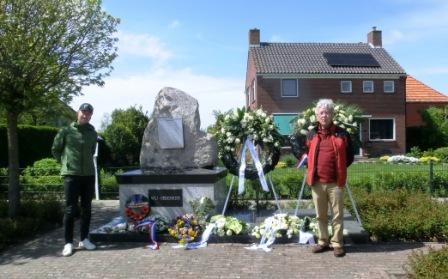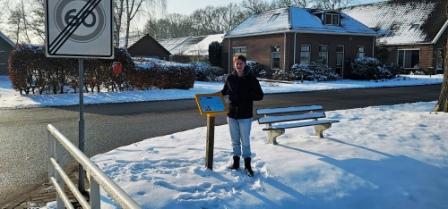
On The War Memorial Trail…. The WWII Soldier From Kingsclear Who Lost His Life During Operation Suitcase

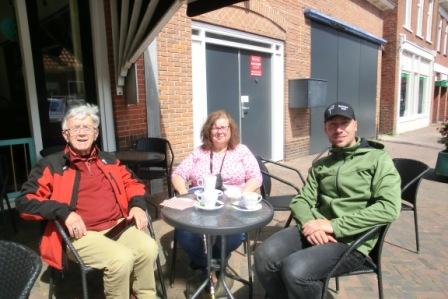
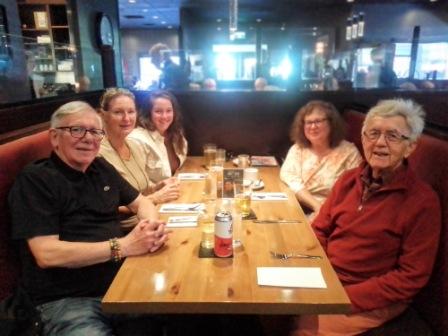
Pieter and Daria (right) with Larry Stewart, Uta Stewart, and Manuelle Bibeau.  (Photo courtesy of Valkenburg Family)

March 8, 2026. Sometimes we learn about a soldier in the most unexpected ways.  A few months ago I was at dinner with two audiologists who would be giving an information session on cochlear implants, part of the outreach we do at Hear PEI. Pieter came along with me for dinner, and Larry Stewart came with his wife, audiologist Uta Stewart.  The two men got along like a house on fire, and when Larry mentioned that his friend, psychotherapist Robert Leek, had an uncle who is buried in the Canadian War Cemetery in Bergen Op Zoom, the discussion turned serious about the sacrifices of so many families during WWII.

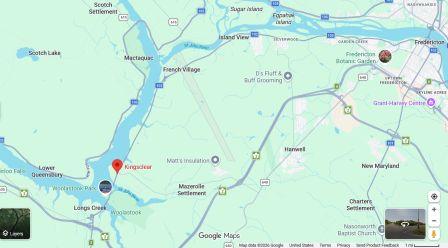
Kingsclear is near Fredericton, New Brunswick.  (Map source: Google maps)

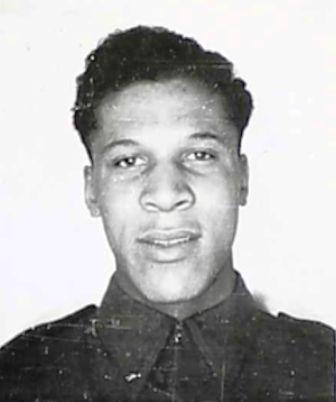
Larry emailed Robert while we were at the restaurant, and within minutes we saw a photo of his uncle, Albert John LEEK, who was born on April 21, 1925 in Kingsclear, New Brunswick, the son of WWI and WWII veteran Earle McCarthy Leek and his wife Mary Gertrude (nee Howe).   

Albert John Leek.  (Photo source: Identification card in the service file)

Robert said that his 90 year old aunt, Albert’s youngest sister Gertrude, lives in Fredericton, and that Albert’s father Earle served in both WWI and WWII.  Albert was the oldest in the family, with 3 brothers and 4 sisters.  “…My father Mauncell, who served in the RCAF, was the next oldest boy…

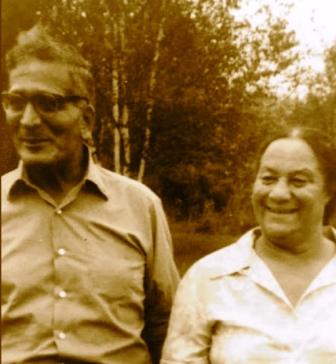
Albert’s parents Earle and Mary Gertrude (nee Howe) Leek.  (Photo courtesy of Robert Leek)

 …The Leeks were Loyalists who came to Canada, most likely from the Carolinas…” after the American War of Independence, Robert explained. “…Most of my relatives live in Bangor, Maine, and my father was born there…” He thought that Albert’s mother had “…Indigenous roots through the Maliseet…” (Maliseet are now referred to as the Wolastoqey Nation.) 

Albert’s father “…re-enlisted during WWII at the same time as Albert so he could protect his son, but they ended up in different units…

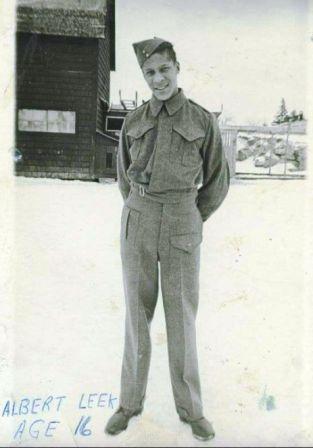
….Albert first enlisted in December 1940…

Albert John Leek during his first enlistment.  (Photo source: Canadian Virtual War Memorial)

When he enlisted at the No. 7 District Depot in Fredericton, New Brunswick on April 22, 1942, Albert stated he had been born in 1924 (a year earlier than his actual birth year) and had worked as a carpenter for the Department of National Defence.

This was his second time enlisting at the No. 7 District Depot.  He had first enlisted on December 30, 1940, at the age of 15.  After completing his basic training and a 3 month Motor Mechanics Course in Kingston, Ontario, he had finished taking advanced army training when his mother found his name on an overseas draft listing….and notified the authorities that he was underage.  Albert’s initial military career ended when he was discharged on September 8, 1941 due to being underage. 

Albert was tall, at 6 feet 1 inch, so it wasn’t a surprise that he had been able to pass as older.  When his nephew Robert was asked why his uncle would have enlisted so young, he explained that his uncle “…was desperate to leave his home situation and make something of himself…

….Albert was sent for artillery training…

When he enlisted for the second time, Albert stated that he had worked on his parents’ farm after leaving school, and listed his interests as boxing, skating, ice hockey, and softball.

On May 16, 1942, he was sent to No. 70 Canadian Army Basic Training Centre (CABTC) in Fredericton, where he had to undergo basic training again.  After completing this training, he was transferred to the X-A-1 Canadian Artillery Training Centre (CATC) in Petawawa, Ontario.  This was a major training facility for the Royal Canadian Artillery (RCA), where artillery soldiers were trained in gunnery, routines, and military customs.  

A subsequent interview while in Petawawa recommended that he be trained as a Driver i/c but that never happened. (The term ‘Driver i/c’ refers to ‘Driver, internal combustion’.)  Instead, Albert was promoted to Lance Bombardier on May 1, 1943 and received final training in preparation for overseas service.

….Albert left Canada for overseas service ….

On July 24, 1943, Albert left Canada, arriving in the United Kingdom on July 28, 1943, where he was placed with No. 2 Canadian Artillery Reinforcement Unit (CARU).

In an interview with a Captain McCormick on August 9, 1943, he was described as “…a tall, husky, active lad…” with “…pleasant features and a pleasant personality…” The interviewer quoted Albert as saying that he “…used to pick up some extra money boxing in civilian life…” and that he had expressed a wish to “…transfer to the Black Watch Regiment to join a younger adopted brother of his father whom he practically grew up with…” 

Albert stated that he “…likes Infantry Service…” and the interviewer thought that he “…should make a good commando…”  

Training continued. On October 14, 1943, Albert reverted to the rank of Gunner at his own request.  As part of his ongoing training, he was sent to an Army Physical Training Corps (APTC) course from December 3, 1943 until December 24, 1943. Training would have been focused on fitness for specific purposes, and would have included unarmed hand-to-hand combat, bayonet fighting, and specialized assault courses, strength exercises using ammunition boxes, and combat-oriented activities.

On January 9, 1944, Albert was sent on for a Commando Physical Training course.  Unfortunately, while at the Jasper Whitley Centre in Surrey, he fell on January 27, 1944 during physical training, and injured his feet.   In the accident report, he stated that he had “…climbed up a rope and was crossing a beam.  The beam slipped and I fell, landing on my feet….” 

Although he seemed all right initially, he had difficulty walking and was taken to hospital on February 2, 1944, due to suspected fractures of his feet.  He remained in hospital until March 2, 1944, after which he was sent to a convalescent hospital until July 29, 1944. 

On August 12, 1944, Albert was transferred to the Canadian Infantry Corps, exchanging the rank of Gunner for the equivalent rank of Private.  He left England on September 6, 1944 for France, arriving the following day and assigned to the X-4 Reinforcement List of the 11th Battalion, part of the 21st Army Group. Once in northwest Europe, he was with 58 Company, 13th Battalion, 2nd Canadian Base Reinforcement Group (CBRG). 2nd CBRG was responsible for receiving, training, and holding personnel to reinforce combat units in the field.

….Albert lost his life during Operation Suitcase…

Albert was subsequently transferred to the Lincoln & Welland Regiment on September 22, 1944, joining them in Maldegem, Belgium, where he was assigned to ‘A’ Company.  He was one of a large number of reinforcements sent to the Regiment.

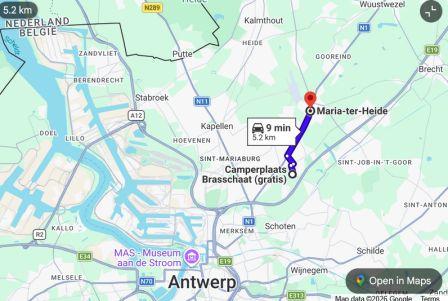
Map showing Camp De Brasschaat and Maria-ter-Heide in Belgium.  (Map source: Google maps)

The Regiment moved towards Camp De Brasschaat, just north of Antwerp and near the Dutch border, arriving on October 19, 1944. The war diary entry for October 19, 1944 recorded that the Commanding Officer “…issued information and orders regarding the Lincoln & Welland Regiment’s next attack.  The Battalion objective was to clear the wood north of Camp De Brasschaat and to gain control of the main road leading northwest of the town. Typhoons were to cover the roads and harass enemy defences in the area….” (Typhoons were single-seat fighter-bomber aircraft, heavily used by the RCAF during WWII.)

On October 20, 1944, Operation Suitcase, a Canadian offensive to isolate German forces on Walcheren Island in The Netherlands began. The Lincoln & Welland Regiment was part of this operation, advancing from Maria-ter-Heide and the Brasschaat airfield. (See https://canadianbattlefieldtours.ca/operation-suitcase/)

According to the war diary entry for October 20, 1944, it was “….overcast with heavy rain…” that day.  “…As the troops crossed the start line the Typhoons appeared on the scene.  The carrier recce, which had patrolled the main road, reported it clear, but heavy minefields lined the east side of the road.  The troops advanced in the following order: ‘A’, ‘C’, and ‘B’ Companies, ‘D’ Company remaining in reserve. 

 ‘A’ Company was pinned down by small arms and mortar fire 500 yards from their objective. The tanks supported them across the open stretch to their objective in the area of Groote Heide…

Close to midnight, the war diary recorded that “…our casualties for the day were four killed and twenty-four wounded….”  One of the fatalities was 19 year old Albert.

….Albert is buried in Bergen Op Zoom…

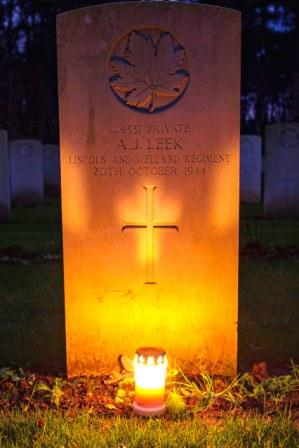
Grave of Albert John Leek in the Canadian War Cemetery in Bergen Op Zoom, The Netherlands with a Christmas Eve candle.  (Photo courtesy of Caroline Raaijmakers)

Albert was temporarily buried on October 31, 1944 in Maria-ter-Heide Civil Cemetery in the municipality of Brasschaat, before being reburied in the Canadian War Cemetery in Bergen Op Zoom, The Netherlands on May 1, 1945. 

….Albert is commemorated on the Fredericton War Memorial…

Fredericton War Memorial. (Photo courtesy of John S. Brehaut)

Albert’s name is listed on a panel on the Fredericton War Memorial in Fredericton, New Brunswick. The Leek family has served Canada – Albert’s father Earle served in WWI and WWII, Albert gave his life during WWII, and his younger brother Mauncell served in the RCAF.  “…I broke the mold…”  Robert said, “…as I became a psychotherapist, rather than a soldier….

Left to right: Robert Leek, Larry Stewart, and Pieter.  (Photo credit: Uta Stewart)

We are always happy to meet family of the soldiers that Pieter researched, and were especially pleased when we met with both Robert Leek and his friends Larry and Uta Stewart. Thank you to Robert Leek for providing photos and information on his uncle, and to Larry and Uta Stewart for telling us about Robert and his uncle Albert.

If you have photos or information to share about soldiers buried in The Netherlands or Belgium, please email him at memorialtrail@gmail.com, or comment on the blog.    

© Daria Valkenburg

….Want to follow our research?…

If you are reading this posting, but aren’t following our research, you are welcome to do so.  Our blog address: https://onthewarmemorialtrail.com/
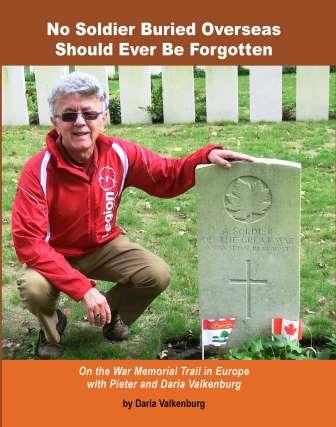
4 countries, 6 weeks, 7,000 km – an unforgettable war memorial journey in Europe…. Daria’s book ‘No Soldier Buried Overseas Should Ever Be Forgotten‘ is available in print and e-book formats.  Net proceeds of book sales help support research costs and the cost of maintaining this blog. For more information see https://nosoldierforgotten.com/

Subscribe to our YouTube Channel: On The War Memorial Trail With Pieter Valkenburg: https://www.youtube.com/channel/UCJ591TyjSheOR-Cb_Gs_5Kw

Never miss a posting!  Subscribe below to have each new story from the war memorial trail delivered to your inbox.
On The War Memorial Trail…..We Follow The Route Taken Into Germany By Canadian Troops In 1945

February 6, 2026. Last spring we were in The Netherlands and Belgium for the 80th Anniversary of Liberation Commemoration events. We placed flags at the graves of 383 soldiers in 14 cemeteries, plus visited a number of memorials, museums related to WWII, and even did a battlefield tour. 

We had one last adventure on our 2025 European War Memorial Tour – a trip to Germany to follow the route taken by Canadian troops during the winter of 1945.

We had been in Mook, near Groesbeek, in The Netherlands, as we’d been invited to attend a Faces To Graves Groesbeek meeting, at which we had been surprised with a Faces To Graves Groesbeek ‘coin’ and a certificate for the work done in researching soldiers, finding families, and sharing photos.  (See https://onthewarmemorialtrail.com/2025/05/30/on-the-war-memorial-trail-pieter-and-daria-honoured-by-faces-to-graves-groesbeek-foundation/

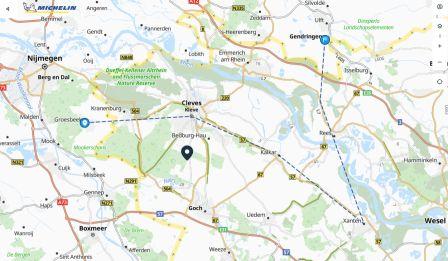
Route taken into Germany from Groesbeek to Kleve, Kalkar, Xanten, Bienen (now part of Rees), and Gendringen. (Map source: Michelin Maps)

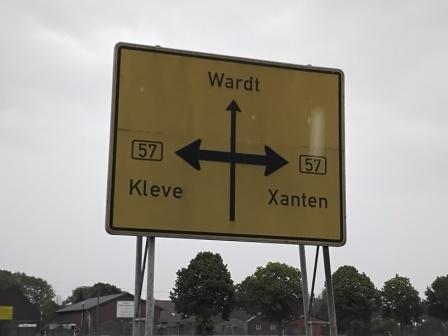
Instead of returning to Zaltbommel, where we were staying, Pieter decided to drive into Germany and follow the route taken by Canadian troops in the winter of 1945.  We first travelled to Kleve, then went on to Kalkar, from there to Xanten, and then to Bienen, which is now part of Rees.  From Bienen we returned to The Netherlands and made a very brief stop in Gendringen. 

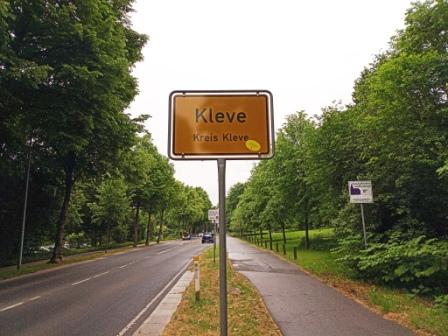
.…Our first stop was Kleve…

Canadian troops would have travelled along this route into Kleve.  (Photo credit: Daria Valkenburg)

Kleve was bombed heavily before being captured by Allied troops on February 11, 1945 during Operation Veritable, as the 21st Canadian Army Group and British troops fought their way through the difficult terrain of the Reichswald Forest.  The goal of Operation Veritable was to reach the Rhine, part of a pincer movement to allow Allied troops to advance towards Berlin. (See https://en.wikipedia.org/wiki/Operation_Veritable)

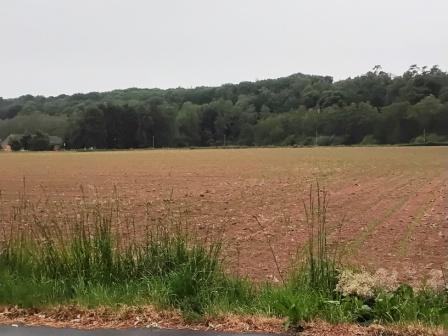
The dense wooded area of the Reichswald Forest. (Photo credit: Daria Valkenburg)

When the Allies crossed the border into Germany they entered the Reichswald Forest, a densely wooded area, as we saw from the road. It wasn’t hard to understand how the Germans had turned the forest into a death trap during WWII. The already natural obstacles of a forested area were heavily reinforced by German troops and rigged with trenches, mortar pits, barbed wire, mines, and anti-tank ditches.

Two major roads provided the only means of an Allied approach, while inside the forest there were no surfaced roads. Zig-zagged paths snaked through the woods, making it ideal for preparing ambushes to trap Allied troops.

Canadian and British troops were forced to advance on a narrow front, with their movements further restricted by bad weather and mud….as well as German ambushes.

On this journey through Kleve and the road bordering the Reichswald, we remembered:

…..Kalkar was the scene of brutal battles in February 1945….

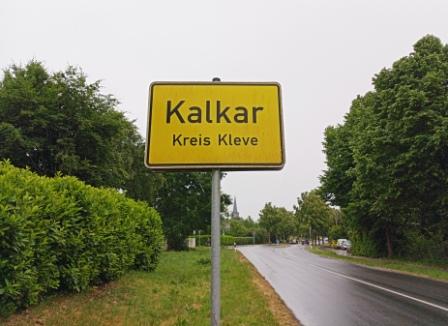
Canadian troops continued from Kleve towards Kalkar.  (Photo credit: Daria Valkenburg)

About 10 km (6 miles) south-east of Kleve is Kalkar, scene of two terrible battles that Canadian troops participated in during Operation Veritable

First came the Battle of Moyland Wood, which lasted a brutal six days, from February 16–21, 1945, in which several Canadian Regiments, such as the Regina Rifle Regiment, Canadian Scottish Regiment, and Royal Winnipeg Rifles fought to clear German paratroopers from a key position near Kalkar.  (See https://legionmagazine.com/clearing-moyland-wood/

The goal of the Battle of Keppeln, fought on February 26, 1945, was to break the German Siegfried Line during Operation Blockbuster, the last part of Operation Veritable. (See https://en.wikipedia.org/wiki/Operation_Blockbuster) Troops encountered heavy artillery and mortar fire in intense fighting from German paratroopers, and had to make their way through heavy mud and minefields.

The battle finally ended when Canadian troops used flame-throwing Wasp carriers to clear German-held houses in Keppeln. The village needed to be secured as part of a push towards Uedem. The capture of Keppeln allowed Canadian forces to clear the Kalkar Ridge and proceed towards the Hochwald Forest gap, and later to break through to the Rhine.

As we passed Kalkar on our way towards the Hochwald Forest, we remembered:

….The Hochwald Forest was where the Battle of Hochwald Gap was fought….

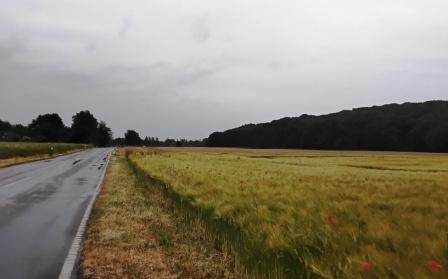
The road bordering the Hochwald Forest was bleak and lonely on the rainy day we drove on it.  (Photo credit: Daria Valkenburg)

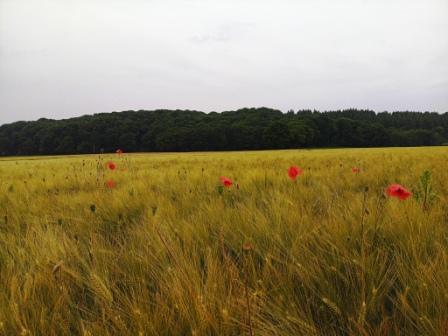
From Kalkar we turned off the road to go along the Hochwald Forest.  It was perhaps fitting that by this time it was raining, with bleak, grey skies, as so many tears would have been shed here during the winter of 1945.   We were alone on this road, with the Hochwald off in the distance, and the only colour coming from the red poppies growing in the field by the road.

Red poppies grew along the road bordering the Hochwald Forest.  (Photo credit: Pieter Valkenburg)

The Hochwald Forest was a second, separate defensive line located about 10 km (six miles) east/southeast of the Reichswald, stretching toward the Rhine.  It was where the Battle of Hochwald Gap, part of Operation Blockbuster, was fought between February 28 and March 1, 1945, the final push by Canadian troops towards the Rhine River. (For more information, see https://canadianbattlefieldtours.ca/operation-blockbuster/ and https://civilianmilitaryintelligencegroup.com/10742/the-battle-of-hochwald-gap-one-of-the-largest-armor-engagements-you-probably-have-never-heard-of)

On this bleak and lonely road bordering the Hochwald Forest, we remembered:

….Xanten is now the home of an archeological park…

We followed the road from Kleve to Xanten. (Photo credit: Daria Valkenburg)

After detouring onto the road along the Hochwald, we returned to the highway and travelled to Xanten, 26 km (16 miles) from Kleve.  The battle to capture Xanten, near the end of Operation Blockbuster, was the responsibility of Canadian troops of 2nd Canadian Infantry Division, in early March 1945.  (See https://legionmagazine.com/the-taking-of-xanten/)

Beginning on March 8, each brigade was accompanied by two squadrons of flame-throwing tanks, with enemy artillery positions attacked by air support. German troops were desperate to win against the Allies, and fought fiercely, but in the end they evacuated Xanten in the middle of the night on March 10 into March 11.

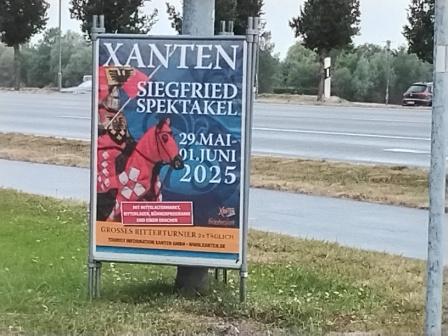
Poster advertising the upcoming Siegfried Spectacle in Xanten. (Photo credit: Pieter Valkenburg)

Much of Xanten had been destroyed during WWII, but today it’s the site an archeological park, with no reminders of WWII – at least none that we saw. When we drove through the town, we noticed a large poster advertising a medieval festival to honour Siegfried, a hero of Xanten, billed as a reunion with knights, jugglers, and dragons! It was an odd note on this solemn journey we were taking, in which we remembered:

….In Bienen we looked for the memorial plaque honouring North Novies who died during the Battle of Bienen….

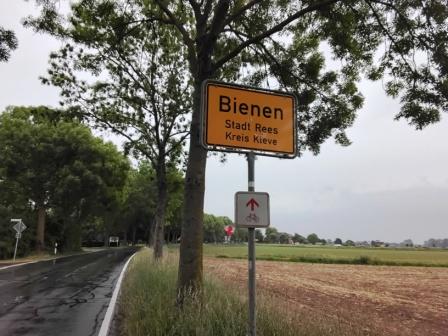
We travelled to Bienen from Xanten. (Photo credit: Daria Valkenburg)

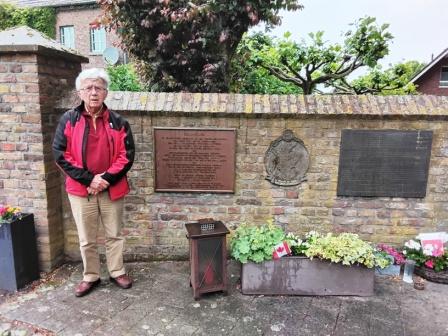
From Xanten, we began the journey back into The Netherlands, with a slight detour along the way to Bienen, the scene of the Battle of Bienen on March 25, 1945. In 2023 we’d done a multi-part series on several soldiers from the North Nova Scotia Highlanders Regiment who had died in this battle. We wanted to see a memorial plaque, which was on a wall behind a church in Bienen.

Pieter beside the memorial plaque behind a church in Bienen. (Photo credit: Daria Valkenburg)

Alice van Bekkum, Chair Faces To Graves Foundation Groesbeek, had told us that the memorial plaque by the church in Bienen, Germany, commemorating the lives lost by the North Nova Scotia Highlanders during the Battle of Bienen on March 25, 1945, was the …first German/Canadian (Commonwealth) monument in Germany….

It might have been raining while we were by the memorial plaque, but we made sure to remember:

….The final stop on our journey of remembrance was in Gendringen….

Pieter by the memorial in the cemetery in Gendringen.  (Photo credit: Daria Valkenburg)

From Bienen, we returned to The Netherlands, stopping for a few moments in Gendringen, where 3 soldiers who had been researched by Pieter had lost their lives. Although it was still raining, we wanted to see the memorial, located in a cemetery in Gendringen. 

The text on the memorial means ‘so that we don’t forget’, or, as said more commonly during Remembrance Services in Canada, ‘lest we forget’.  While at the memorial, we remembered:

By now, it was well after 4 pm, with the rain making the skies very grey.  We were tired and still had a long drive back through heavy traffic to our hotel in Zaltbommel.  Luckily, Pieter is a genius at staying calm in traffic, and we arrived safely, in time to enjoy a quiet and relaxing dinner. 

This concludes the stories of the highlights of our 2025 European War Memorial Tour to commemorate the 80th Anniversary of the Liberation of Europe.

Our trip is now long over, but the research work continues for Pieter.  If you have photos or information to share about soldiers buried in The Netherlands or Belgium, please email him at memorialtrail@gmail.com, or comment on the blog.    

© Daria Valkenburg

….Want to follow our research?…

If you are reading this posting, but aren’t following our research, you are welcome to do so.  Our blog address: https://onthewarmemorialtrail.com/

4 countries, 6 weeks, 7,000 km – an unforgettable war memorial journey in Europe…. Daria’s book ‘No Soldier Buried Overseas Should Ever Be Forgotten‘ is available in print and e-book formats.  Net proceeds of book sales help support research costs and the cost of maintaining this blog. For more information see https://nosoldierforgotten.com/

Subscribe to our YouTube Channel: On The War Memorial Trail With Pieter Valkenburg: https://www.youtube.com/channel/UCJ591TyjSheOR-Cb_Gs_5Kw

Never miss a posting!  Subscribe below to have each new story from the war memorial trail delivered to your inbox.
On The War Memorial Trail….Remembrance Week 2025 – Remembrance Day Services At Borden-Carleton Legion And In Kinkora

November 17, 2025. A cool but dry day on Tuesday, November 11, 2025 here on Prince Edward Island was very welcome for those standing outside during Remembrance Day services at Borden-Carleton Legion in Borden-Carleton and in Kinkora.  It seemed as though more people were in attendance than in previous years.

 ….Remembrance Day Service At Borden-Carleton Legion….

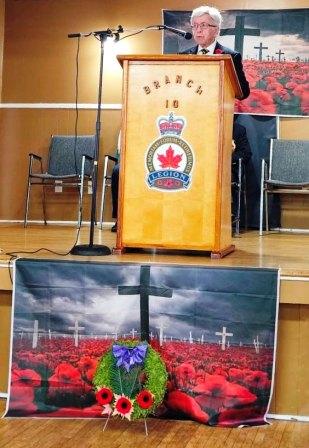
Pieter was the guest speaker during the Remembrance Day service at Borden-Carleton Legion. (Photo credit: Matt MacFarlane)

Remembrance Day at the Borden-Carleton Legion began with an inter-faith service, with Reverend Barbara Cairns of the United Church in Bedeque, and Father Babu A. Jesuraj of St. Malachy’s Roman Catholic Church in Kinkora.  Father Jesuraj, who is from the Tamil Nadu province in India, explained that he had only been assigned to the parish in Kinkora for a month.  Trish Taylor spoke about the 80th anniversary of the end of WWII and invited dignitaries from the area to say a few words about remembrance. 

Pieter was the guest speaker, and gave the same presentation he’d given a few days earlier at the Remembrance Service in Crapaud Community Hall.  (See https://onthewarmemorialtrail.com/2025/11/12/on-the-war-memorial-trail-remembrance-week-2025-remembrance-service-at-crapaud-community-hall/)

Flag lowered by Arthur Ranahan during the playing of ‘The Last Post’ by the Cenotaph at the Legion in Borden-Carleton. (Photo credit: Daria Valkenburg)

Wreath laid on behalf of the Government of Canada by the Cenotaph at the Legion in Borden-Carleton was placed by Pieter and carried by Danny Bernard. (Photo credit: Daria Valkenburg)

Following the Remembrance Day Service, everyone was invited inside the Legion for a light lunch and a much needed cup of coffee or tea.  We also had a chance to look at the posters prepared by members of the local 4-H club, which were on display in the Legion hall.

Posters for Remembrance Day from the 4-H club were displayed in the Borden-Carleton Legion.  (Photo credit: Daria Valkenburg)

….Remembrance Day Service by the Memorial in Kinkora….

The Remembrance Day service was over in Borden-Carleton by the end of the morning, but Legion members made their way to the memorial in Kinkora in the afternoon for a service there.

Wreath carried by Pieter Valkenburg and placed by Cenotaph in Kinkora by The Honourable Heath MacDonald, MP for Malpeque, Minister of Agriculture and Agri-Food. (Photo credit: Daria Valkenburg)

Wreath carried by Brian O’Connor and placed by Cenotaph in Kinkora by Matt MacFarlane, MLA for District 19, Borden-Kinkora Leader of the Green Party of PEI. (Photo credit: Daria Valkenburg)

Following the service in Kinkora, Pieter (centre) posed for a photo with Matt MacFarlane (left) and Heath MacDonald (right).  (Photo credit: Daria Valkenburg

Following the Remembrance Day Service, everyone was invited inside the community hall for a bowl of chile or chicken corn chowder and a much needed cup of coffee or tea.

….Statement by Matt MacFarlane in the PEI Legislature….

Matt MacFarlane, MLA for District 19, Borden-Kinkora, Leader of the Green Party of Prince Edward Island, informed us that he’d given a brief statement about us in the legislature on November 4, 2025.  We had no idea he’d done this until he sent us the link! (https://www.facebook.com/share/v/1Ame5ppZio/)

Thank you to the Legion members who participated in the various Remembrance Week events, and to the volunteers at the Borden-Carleton Legion and Kinkora Community Hall for preparing the snacks and hot drinks.

May we never forget all those who served, and continue to serve!  The work of remembrance of those who served continues.  More Remembrance Week stories to come.

If you have a story to tell, please let Pieter know. You can email him at memorialtrail@gmail.com, or comment on the blog.

© Daria Valkenburg

….Want to follow our research?….

If you are reading this posting, but aren’t following our research, you are welcome to do so.  Our blog address: https://onthewarmemorialtrail.com/

4 countries, 6 weeks, 7,000 km – an unforgettable war memorial journey in Europe…. Daria’s book ‘No Soldier Buried Overseas Should Ever Be Forgotten‘ is available in print and e-book formats.  Net proceeds of book sales help support research costs and the cost of maintaining this blog. For more information see https://nosoldierforgotten.com/ 

You are also invited to subscribe to our YouTube Channel: On The War Memorial Trail With Pieter Valkenburg: https://www.youtube.com/channel/UCJ591TyjSheOR-Cb_Gs_5Kw

Never miss a posting!  Subscribe below to have each new story from the war memorial trail delivered to your inbox.
On The War Memorial Trail…..Remembrance Week 2025 – The WWII Soldier Who Was Never Forgotten By His Girlfriend And Her Family

November 15, 2025.  Sometimes Pieter helps the Canadian War Cemetery in Groesbeek, The Netherlands to find photos of a few soldiers for which research had already been done, but no photo could be found.  He’s found that it’s almost as much work as it is do a complete research project on a soldier, as there is a reason photos aren’t readily available – they can be very difficult to find!

My father was from Ukraine, so the search for soldiers with a Ukrainian heritage is a priority when Pieter gets a photo wish list, which is why one of the soldiers whose photo search he undertook was that of Peter HYDICHUK of Theodore, Saskatchewan.  Born April 12, 1917, Peter was the son of Alexander and Annie (nee Procupuik) Hydichuk, who had immigrated to Canada in 1903 from what today is part of Western Ukraine. (You can read Jim Little’s story about Peter here: https://www.facestograves.nl/LifeStories/HYDICHUK%20Peter-JLE-bio-EN.pdf )

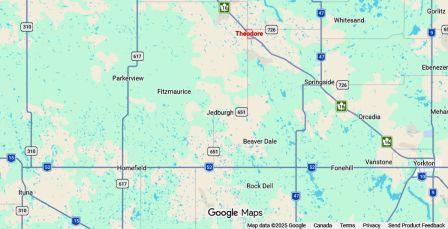
Theodore is a village located on the Yellowhead Highway, in southeastern Saskatchewan. (Map source: Google maps)

….The search for a photo of Peter Hydichuk seemed doomed for failure….

At first, it seemed as though the search for a photo of Peter would not take long, as he had many siblings.  Besides himself, three of his brothers also served during WWII: Nick, John, and Matt. 

Matt, who was married and the father of two daughters, was killed in France on August 23, 1944, aged 29, while serving with the South Saskatchewan Regiment, and is buried in Bretteville-Sur-Laize Canadian War Cemetery in France, 14 km south of Caen.

Peter also served in the South Saskatchewan Regiment, and died the following year, on March 31, 1945, in Germany.  Nick and John survived the war.

At the end of January 2024, Pieter was in contact with one of Matt’s daughters, Pam Neilson, who lives near Birmingham, Alabama. Pam did her best, getting in touch with various family members in Canada, but with no success.  She sadly reported to Pieter that the family threw away the photos.      

When no other avenues of research turned up a photo, we reluctantly placed his name on the Cold Case List. Sometimes, that has resulted in a photo being found by someone who saw the name and could help with a photo or information. (See https://onthewarmemorialtrail.com/our-cold-cases/)

….The Cold Case List led to a photo….

Just as Remembrance Day 2025 came around the corner, we received an email from Garry Bodnaryk, who had seen Peter’s name on the Cold Case List!  “…I came across your site today while searching for Peter Hydichuk from Theodore, Saskatchewan, Canada. The Hydichuks were neighbours of my grandparents, and my mother dated Peter until he was killed. … I’m glad that people like you are working to put faces to names, and helping to keep the memory of these soldiers alive….

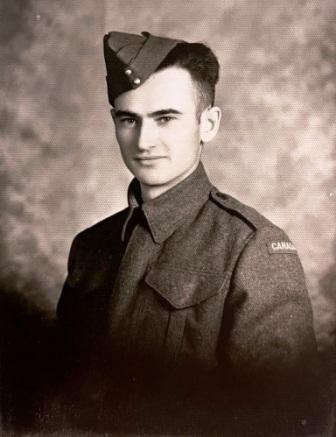
Peter Hydichuk. (Photo courtesy of Garry Bodnaryk)

Wow!  Garry not only made our week, he shared how much Peter’s memory meant to his mother, and therefore to her family, even long after she passed away.  “Her maiden name was Anne Polowick. The Polowicks were friends and neighbours of the Hydichuks, and attended the same church and school in the area.  My mother died almost 50 yrs ago, but she had always had Peter’s picture in her purse. My late father always thought it was sweet that she did. I kept the photos as they meant a lot to her….

Anne (nee Polowick) Bodnaryk with one of her cousins.  (Photo courtesy of Garry Bodnaryk)

….Anne and her family never forgot Peter….

Garry noted that his mother “was the key figure in saving the photo, and in me even knowing who Peter was…

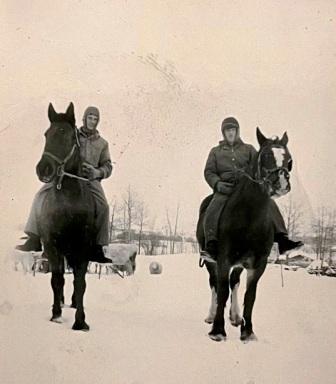
Peter (left) with a neighbour on horseback. (Photo courtesy of Garry Bodnaryk)

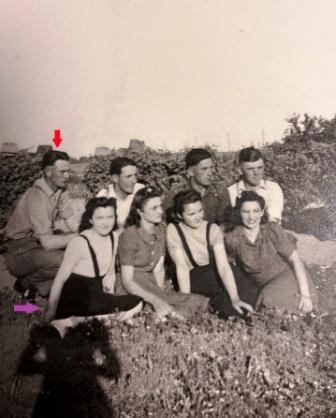
Happier days before WWII.  Peter Hydichuk (red arrow) and Anne (nee Polowick) Bodnaryk (purple arrow). (Photo courtesy of Garry Bodnaryk)

Garry included a photo that included both Peter and Anne.  “….My cousin confirmed that the man on the left is Peter Hydichuk. My mother is on the left, in front of him. I believe all the men served in the army during the war (my uncle next to Peter did). Other family members, and neighbours, are in the photo…

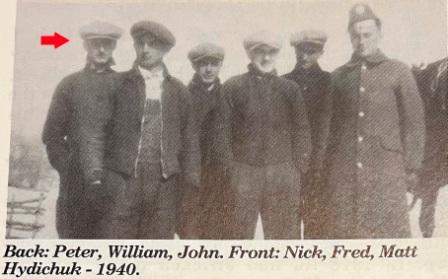
A photo of the Hydichuk brothers, which Garry was kind enough to send, was in the ‘Theodore and District History’ book, which had a limited printing in the 1980s. 

Photo of the Hydichuk brothers in 1940 from the ‘Theodore and District History’ book.  Peter identified by red arrow.

…. Peter was killed near the German border….

On March 29, 1945 the South Saskatchewan Regiment arrived in Bienen, Germany, taking over from the Highland Light Infantry following the Battle of Bienen on March 25. The following day, the Regiment moved towards Gendringen, located in The Netherlands near the German border. 

Per the March 30, 1945 war diary entry of the South Saskatchewan Regiment, a three Phase attack for the 6th Canadian Infantry Brigade was set in place to “….capture the line from Terborg to Etten to Ziek…”  Phase I was to be carried out by “….(1) Les Fusiliers Mont-Royal attacking Wieken, (2) 8 Canadian Recce Regiment…” to take over the position currently held by the “….Camerons of Canada in Netterden….” and then “…(3) on consolidation of Les Fusiliers Mont-Royal, Camerons of Canada to take out Veldhunten. This completes Phase I….”   

The South Saskatchewan Regiment was held in reserve until Phase II, when it was ordered to capture Etten. Phase III called for the 6th Canadian Infantry Brigade to “….cross the Oude IJssel River for the purpose of taking the town of Terborg….

However, the plan for carrying out Phase III of the 6th Canadian Infantry Brigade was initially cancelled that evening.  “…At 2115 hours the plan was cancelled owing to the Camerons of Canada failing to take Veldhunten…” 

A new plan was made an hour later.  “… ‘A’ Company to move to Gendringen…” and take up a position.  “… ‘B’ Company to move at 2315 hours….and send fighting patrol….passing through ‘A’ Company. ‘C’ Company to move at 2345 hours…. ‘D’ Company to move at 2400 hours…4 Platoon to send 1 section of Wasps under command of ‘A’ Company and 1 section to ‘B’ Company….

Fighting continued throughout the night of March 30/March 31. Gendringen was liberated by mid-afternoon of March 31, 1945, in spite of heavy enemy shelling. 

The war diary for March 31, 1945 recorded that “…at 1430 hours the casualty reports from the Companys were turned in to Command Post.  They were 1 officer and 14 other ranks wounded and 3 other ranks killed….” 

Peter Hydichuk was one of the fatal casualties that day, killed in action at the age of 27.  Per Maarten Koudijs, an amateur researcher in the Gendringen area, and author of ‘Tussen Grens En Hoop’, he was “killed near Alofs’s house on the Tappenweg in Etten….”  (Translated from the original Dutch) 

In addition to Peter, Maarten wrote that the other casualties were James Joseph MALONEY and William SERNOWSKI.

One of the severely wounded, Michael Joseph MACDERMOTT, was transferred to the Canadian General Hospital in England, where he died on August 5, 1945.

….Peter was temporarily buried in Megchelen….

Peter was temporarily buried on the farmland of A. Friesen in Megchelen, at the end of a row of 18 burials.

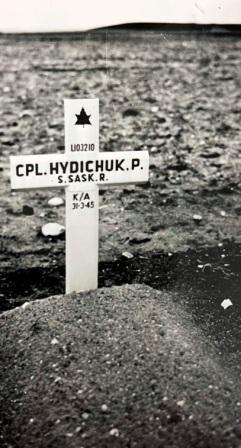
Temporary gravemarker for Peter Hydichuk in Groesbeek after reburial from Megchelen. (Photo courtesy of Garry Bodnaryk)

Garry had one more story to relate.  “…In talking to one of my cousins, I found out that my mother’s father was at the train station (which had the telegraph office) when the news of Peter’s death came. My grandfather is the one that took the telegram and, stopping at home to get his bible, proceeded to the Hydichuk farm to break the news to the family….

….We were in Gendringen this past May….

On a rainy Saturday in May 2025, we were in the Achterhoek area, and stopped in Gendringen.  (Photo credit: Daria Valkenburg)

This past May we followed the route taken by Canadian forces into Germany, as far as Bienen, and on the way back into The Netherlands, we stopped in the Achterhoek, in the province of Gelderland, the area where Peter died. 

There is a memorial in the cemetery in Gendringen, which we visited. No soldiers’ names are mentioned on the memorial, though.  (See https://onthewarmemorialtrail.com/2022/05/09/on-the-war-memorial-trail-monument-unveiled-in-gendringen/)

The text on the panel of the memorial means ‘so that we don’t forget’, or, as said more commonly during Remembrance services, ‘lest we forget’.  It was a solemn moment, with rain falling steadily, a fitting tribute that perhaps reflected the tears shed by families who lost their loved ones. 

Pieter by the memorial in the cemetery in Gendringen.  (Photo credit: Daria Valkenburg)

 ….Peter was reburied in the Canadian War Cemetery in Groesbeek….

Pieter stands behind the grave of Peter Hydichuk in the Canadian War Cemetery in Groesbeek.  (Photo credit: Daria Valkenburg)

At the end of January 1946, Peter was reburied in the Canadian War Cemetery in Groesbeek.  We visited his grave this spring when we were in The Netherlands for our 2025 European Memorial Tour, and Pieter placed a Canadian flag by his grave. For most soldiers (383 in 14 cemeteries) we placed provincial flags as well, but as we had never received flags for Saskatchewan, we could only place a Canadian flag.

….Stories about 2 soldiers from Les Fusiliers Mont-Royal who were also originally buried in Megchelen….

Edmond Coloumbe, born in Fannystelle, Manitoba, and Alphonse Robert, of Caraquet, New Brunswick, were among 5 members of Les Fusiliers Mont-Royal who died during an attack on Gendringen, The Netherlands on March 30, 1945. Both were initially buried in Megchelen, and their stories were previously told on this blog.

The flag placed at Peter’s grave was donated.  Our thanks go to Alan Waddell, Constituent Assistant, on behalf of Heath MacDonald, MP for Malpeque.

Thank you to Garry Bodnaryk for providing photos and information about Peter Hydichuk, and for saving his mother’s photos.  A big thank you is due to his mother Anne for never forgetting a friend and neighbour who never had the chance to return home and live out his life during peacetime.

Thank you also to Maarten Koudijs for information on Peter’s death and the names of the other South Saskatchewan Regiment casualties. (Information on his book, available in Dutch, can be found at https://www.tussengrensenhoop.nl/)

The work of remembrance of those who served continues.  More Remembrance Week stories to come.

If you have a story or photo to share, please contact Pieter at memorialtrail@gmail.com or comment on the blog. 

© Daria Valkenburg

….Want to follow our research?…

If you are reading this posting, but aren’t following our research, you are welcome to do so.  Our blog address: https://onthewarmemorialtrail.com/

4 countries, 6 weeks, 7,000 km – an unforgettable war memorial journey in Europe…. Daria’s book ‘No Soldier Buried Overseas Should Ever Be Forgotten‘ is available in print and e-book formats.  Net proceeds of book sales help support research costs and the cost of maintaining this blog. For more information see https://nosoldierforgotten.com/

Subscribe to our YouTube Channel: On The War Memorial Trail With Pieter Valkenburg: https://www.youtube.com/channel/UCJ591TyjSheOR-Cb_Gs_5Kw

Never miss a posting!  Subscribe below to have each new story from the war memorial trail delivered to your inbox.
On The War Memorial Trail….Remembrance Week 2025 – Reflections and Updates

November 9, 2025.  When we write a story on the blog, we often receive additional information about the soldiers we’ve written about, about other soldiers buried in the same cemetery, or who served in the same unit. This Remembrance Week 2025 posting gives an update on three soldiers whose stories were previously told, one whose story is coming up in a future posting, and about our visit to the Commonwealth War Graves Commission office in Ottawa, Ontario.

Each year we also try to visit one or more war memorials in Canada. In this posting we feature a visit to the Memramcook Veterans Park in Memramcook, New Brunswick, and Beach Grove Memorial Forest in Charlottetown, Prince Edward Island.

…A banner for WWII soldier Joseph ‘Ambroise’ Comeau….

Banner for WWII soldier Joseph ‘Ambroise’ Comeau. (Photo credit: Simone Comeau)

One of the WWII soldiers buried in the Canadian War Cemetery in Holten, The Netherlands, is Joseph ‘Ambroise’ COMEAU, from Lower Saulnierville, Nova Scotia. Ambroise was one of 5 soldiers from the North Nova Scotia Highlanders Regiment who drowned in a tragic accident in the Battle of Leer in Germany on April 28, 1945, aged 21.  His was one of the 383 graves we visited this spring during our 2025 European War Memorial Tour, and Pieter had placed flags of Canada and Nova Scotia, as well as an Acadian flag, by his grave.

When Simone Comeau recently sent us a photo of her uncle’s banner, she explained why it included both a Canadian and Acadian flag.  “…We had a choice as to which flag we wanted along with the flag of Canada so since you honoured the Acadian veterans this year in Holland and we are Acadians I figured it was only appropriate to do so….

You can read Ambroise’s story at https://onthewarmemorialtrail.com/2021/05/17/on-the-war-memorial-trail-a-tragic-drowning-on-the-leda-river-in-germany-part-3/  and about our visit to his grave at https://onthewarmemorialtrail.com/2025/09/04/on-the-war-memorial-trail-2025-faces-of-holten-exhibition-part-4-soldiers-who-drowned-during-operation-duck/

 ….The family of WWII soldier James ‘Jimmy’ Oliver Thomas framed the photo we sent…

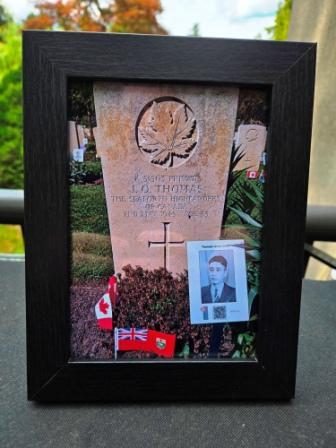
Framed photo taken at the grave of James ‘Jimmy’ Oliver Thomas.  (Photo courtesy of Rodd Cooper)

During our visit to the various cemeteries during the 2025 European War Memorial Tour, we took photos of each grave at which Pieter placed flags, and later sent photos to the families of these soldiers.  Rodd Cooper, nephew of WWII soldier James ‘Jimmy’ Oliver THOMAS framed the photo we had emailed him, and emailed us back a photo of the framed picture with the family’s thanks.  We were deeply touched by this!

Born in St. Peters, Manitoba, Jimmy died in Germany on May 2, 1945, aged 33, a few days after being liberated from the Stalag VII-A POW Camp in Moosburg, Germany. He had been taken prisoner of war on May 22, 1943, while serving with the Seaforth Highlanders of Canada, during the breaking of the Hitler Line.

You can read Jimmy’s story at https://onthewarmemorialtrail.com/2024/02/18/on-the-war-memorial-trail-the-wwii-soldier-from-manitoba-who-died-shortly-after-being-liberated-from-stalag-vii-a/  and about our visit to his grave at https://onthewarmemorialtrail.com/2025/09/10/on-the-war-memorial-trail-2025-faces-of-holten-exhibition-part-5-indigenous-soldiers/

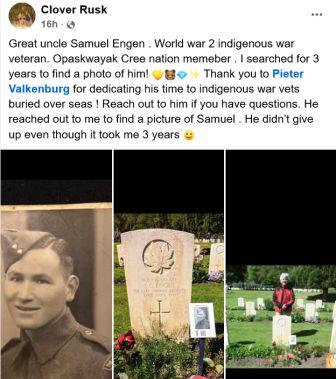
….WWII soldier Samuel George Engen was remembered by his great-niece Clover Rusk on National Indigenous Veterans Day…

In a November 8, 2025 Facebook posting, Clover Rusk remembered her great-uncle, Samuel George ENGEN of The Pas, Manitoba on National Indigenous Veterans Day….and thanked Pieter “…for dedicating his time to Indigenous war vets buried overseas…

After a 3 year search by various family members, a photo was found by Clover earlier this year, in an album that had belonged to her great-grandfather Aaron, the older brother of Samuel.

The son of Louis Julius Engen and Mary Helen (nee Buck) Engen, and husband of Miriam Susan Pranteau, Samuel died April 23, 1945 in Germany, during the Battle for the Kusten Canal, aged 27, while serving with the Lake Superior Regiment.  

Samuel is buried in the Canadian War Cemetery in Holten, The Netherlands, which we visited this past May, and where Pieter placed flags of Canada and Manitoba by his grave.  His story will be told in an upcoming posting.

….Flags were placed at the grave of WWII airman William Andrew Hood on our behalf…

Grave of William Andrew Hood.  (Photo credit: Robert van der Ende)

One of the cemeteries to visit on our 2025 European War Memorial Tour was Eindhoven General Cemetery in Eindhoven, The Netherlands, where WWII airman William Andrew HOOD, of Little Bras D’or, Cape Breton Island, Nova Scotia, is buried. 

Eindhoven was near where we were for a family visit, and we had planned to go to the cemetery before we left for Belgium the following day.  But….by this time we were totally exhausted, and didn’t see how we could manage it.  Thankfully, Robert van der Ende volunteered to take flags of Canada and Nova Scotia and place them at William’s grave on our behalf.  We were very grateful for that act of kindness!  This was the only cemetery on our list that we didn’t personally visit.

William was the mid-upper gunner aboard Halifax JD215 when it was shot down over The Netherlands on June 29, 1943.  None of the crew survived.  You can read his story at https://onthewarmemorialtrail.com/2023/09/19/on-the-war-memorial-trail-the-wwii-airman-from-bras-dor-who-was-aboard-the-last-flight-of-halifax-jd215/

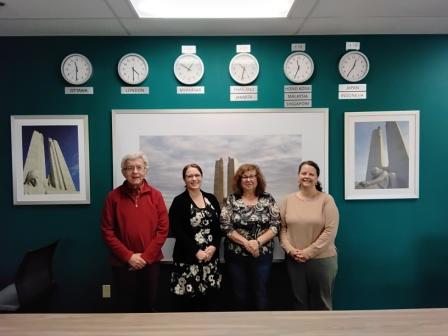
….We visited the CWGC office in Ottawa…

This year, Pieter became one of the volunteers across Canada participate in the National Volunteer Program.  He was assigned 4 cemeteries on Prince Edward Island to visit and gather information about the condition of Commonwealth War Graves Commission (CWGC) war graves, and to clean the grave stones as needed. (See https://onthewarmemorialtrail.com/2025/08/08/on-the-war-memorial-trail-cwgc-volunteer-at-cape-traverse-community-cemetery/ and https://onthewarmemorialtrail.com/2025/09/28/on-the-war-memorial-trailthe-wwii-carpenter-buried-in-seven-mile-bay-who-does-not-have-a-cwgc-headstone/ for stories about two of the soldiers buried in a CWGC grave)

Left to right: Pieter Valkenburg, Julene Warren, Daria Valkenburg, Elizabeth Hale.  (Photo courtesy of Valkenburg Family Collection)

During a trip to Ottawa in October, we visited the CWGC office and met with two of the coordinators overseeing the volunteers:  Elizabeth Hale and Julene Warren.  It was a chance to put faces to names, and to learn more about the important work being done to look after war graves here in Canada.

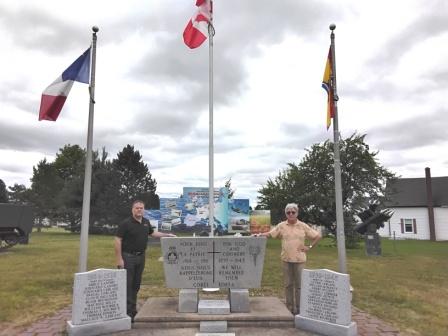
….We visited the Memramcook Veterans Park in Memramcook, New Brunswick…

Our friend and fellow researcher, Etienne Gaudet, had invited us several times to visit his hometown of Memramcook, New Brunswick, and one Saturday in June we were able to do so.  Etienne proudly took us around the Memramcook Veterans Park, which commemorates those who served and are from the Memramcook area. 

Etienne Gaudet (left) with Pieter at Memramcook Veterans Park. (Photo credit: Daria Valkenburg)

A unique billboard highlighted the ships on which troops travelled to Great Britain, and the countries in Europe in which they fought. 

Etienne Gaudet (left) with Pieter at Memramcook Veterans Park. (Photo credit: Daria Valkenburg)

Etienne also wanted us to meet 102 year old WWII veteran, Romeo LEBLANC, and we were delighted to have the opportunity to do so. 

Etienne Gaudet (left) and Pieter (right) with WWII veteran Romeo LeBlanc. (Photo credit: Daria Valkenburg)

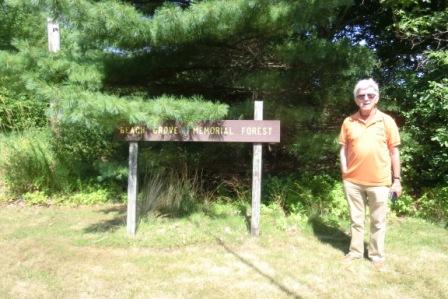
….We visited the Beach Grove Memorial Forest in Charlottetown, Prince Edward Island…

Pieter at the entrance to Beach Grove Memorial Forest in Charlottetown. (Photo credit: Daria Valkenburg)

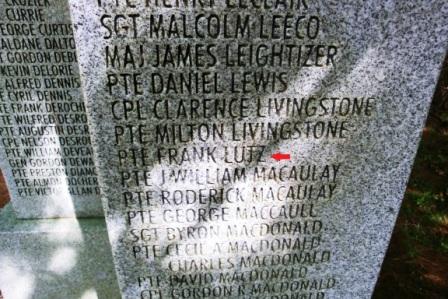
This spring we received an email from Jim Little, saying he was writing a story about Private Frank LUTZ, an orphan from Prince Edward Island, who was badly wounded on February 20, 1945 during the Battle of Moyland Wood, while serving with the Canadian Scottish Regiment. He died on March 2, 1945, aged 19, and is buried in the Canadian War Cemetery in Groesbeek, The Netherlands. (See https://www.facestograves.nl/LifeStories/LUTZ%20Frank-JLE-bio-EN.pdf)

Jim wanted to know if Frank was listed on a cenotaph on the Island.  Yes, was the answer….he is listed on a Canadian Army memorial stone at Beach Grove Memorial Forest in Charlottetown.  The memorial forest honours WWII veterans from Prince Edward Island with granite stones that list their names and includes a tree for each person that is honoured.

Pieter walks along the path in Beach Grove Memorial Forest.  (Photo credit: Daria Valkenburg)

The memorial stones are located along a path in the forest, which, during the war, had been used as a training facility for various regiments and units.  The stones honour those who died during the war while serving in the Royal Canadian Navy, Merchant Navy, Canadian Army, and Royal Canadian Air Force.  We found Frank’s name listed on the stone for the Canadian Army.

Frank Lutz was listed on one of the memorial stones for the Canadian Army. (Photo credit: Daria Valkenburg)

We ended up spending a long time in the forest, looking at each stone, as Pieter had researched so many of the names listed on each stone!

Thank you to Simone Comeau, Rodd Cooper, Etienne Gaudet, Clover Rusk, and Robert van der Ende. The work of remembrance of those who served continues.

The flags placed at William Andrew Hood’s grave were donated.  Our thanks go to: 

  • Alan Waddell, Constituent Assistant, on behalf of Heath MacDonald, MP for Malpeque, for the Canadian flag.
  • Kyle Graham, Research Officer, Military Relations, Nova Scotia Intergovernmental Affairs, on behalf of Premier Tim Houston, Province of Nova Scotia, for the Nova Scotia flag.

If you have a story to tell, please let Pieter know. You can email him at memorialtrail@gmail.com, or comment on the blog.  

© Daria Valkenburg

….Want to follow our research?….

If you are reading this posting, but aren’t following our research, you are welcome to do so.  Our blog address: https://onthewarmemorialtrail.com/

4 countries, 6 weeks, 7,000 km – an unforgettable war memorial journey in Europe…. Daria’s book ‘No Soldier Buried Overseas Should Ever Be Forgotten‘ is available in print and e-book formats.  Net proceeds of book sales help support research costs and the cost of maintaining this blog. For more information see https://nosoldierforgotten.com/ 

You are also invited to subscribe to our YouTube Channel: On The War Memorial Trail With Pieter Valkenburg: https://www.youtube.com/channel/UCJ591TyjSheOR-Cb_Gs_5Kw

Never miss a posting!  Subscribe below to have each new story from the war memorial trail delivered to your inbox.
On The War Memorial Trail…. Visit To Bathmen And The Schipbeek Canal

October 26, 2025. While in Europe this spring for the 80th Anniversary of Liberation Commemoration events, we visited 14 cemeteries to place flags at the graves of 383 soldiers that Pieter has researched since 2014, with the stories of many of these soldiers previously told on this blog. 

On our ‘wish list’ of places to see was the Schipbeek Canal, the location where several soldiers whose stories we told lost their lives.  The Schipbeek is a tributary of the IJssel River.

When I mentioned Schipbeek Canal to a few Dutch colleagues, I was kindly told that Schipbeek was a canal, that to add the word Canal was an oxymoron.  But, who outside of the Dutch would know that?  So, I continue to say Schipbeek Canal, which is located outside of the town of Bathmen, not too far from where we were staying near Holten.  We had been so busy that we never got there, and I’d regretfully crossed it off the list.

After the exhausting day on the Battlefield Tour with Joël Stoppels, all that was planned for the following day was rest, packing our suitcases for the move further south towards Belgium, and laundry.  Pieter had other ideas, however, just as I settled on the couch to read a book. “…Let’s go to Bathmen…” he said in mid-morning. 

…No!..” I said. Anyone who has met Pieter knows he doesn’t give up easily. 

...C’mon, let’s get it over with….”  I didn’t have the energy to argue, so just got dressed and, just like that, we were back on the war memorial trail!  Luckily, Bathmen was only a few exits down the highway from where we were staying.

….We arrived in Bathmen…

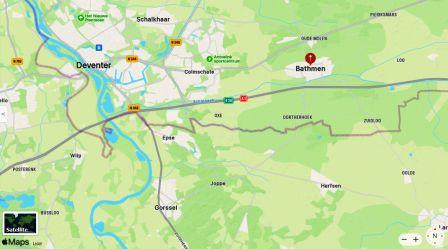
Map shows location of Bathmen and Gorssel. (Map source: DuckDuckGo)

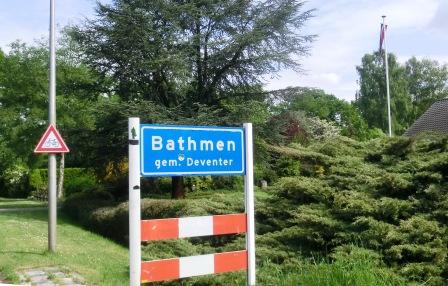
The village sign for Bathmen.  (Photo credit: Daria Valkenburg)

Once we arrived in Bathmen, it was to find that the Schipbeek Canal went through the village.  The challenge became to find where exactly the Canadians were as they fought to establish a bridgehead over the canal.  It wasn’t long before Pieter figured out that we needed to follow a road called Gorsselseweg!

…. Gorsselseweg was where the bridgehead over the Schipbeek was established…

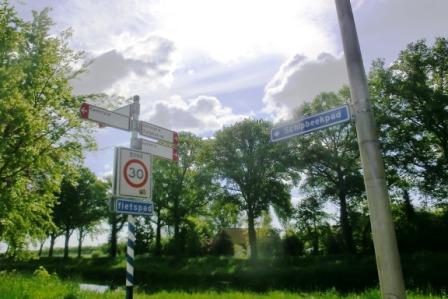
The South Saskatchewan Regiment marched 8 km from Gorssel towards Bathmen.  (Photo credit: Daria Valkenburg)

Troops from the South Saskatchewan Regiment, the Regiment in which Leo Francis TONEY was in, marched 8 km (5 miles) from Gorssel towards Bathmen on April 7, 1945, but had to cross the Schipbeek Canal before reaching the village. 

The bridge over the canal located on the Gorsselseweg was the scene of so much fighting, before a bridgehead was established by the North Nova Scotia Highlanders, who then went on to liberate Bathmen on April 8, 1945.

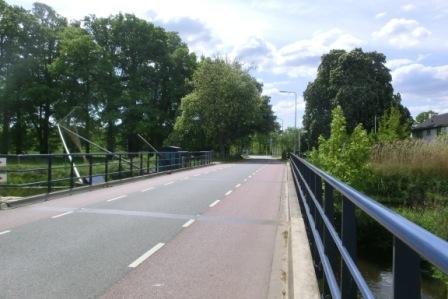
How the bridge over the Schipbeek Canal looks today on the Gorsselseweg.  (Photo credit: Daria Valkenburg)

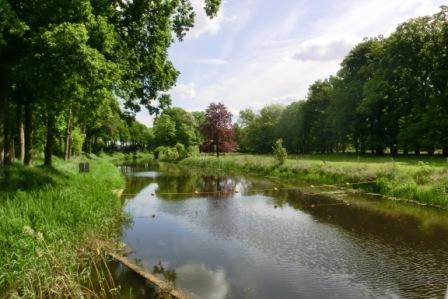
Today, the bridge and the canal are peaceful and beautiful spots, and it’s difficult to imagine how hard troops had to fight back in April 1945.  Crossing the Schipbeek was difficult as the area was strongly defended by German troops.

The Schipbeek Canal, as seen from the bridge on the Gorsselseweg.  (Photo credit: Daria Valkenburg)

The Schipbeek Canal, as seen from the bridge on the Gorsselseweg.  (Photo credit: Daria Valkenburg)

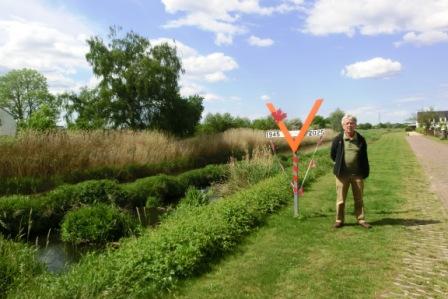
The maple leaf and V for Victory were present on the Gorsselseweg! (Photo credit: Daria Valkenburg)

….4 soldiers whose stories were previously told were at the Schipbeek…

Four soldiers, whose stories were previously told on this blog, were involved in the crossing of the Schipbeek and liberation of Bathmen…..

  • Philip LAFORTE, born in Lac du Bonnet, Manitoba, was serving with the Royal Winnipeg Rifles when he was killed on April 7, 1945 in The Netherlands, aged 33, as the Regiment crossed the Schipbeek, in order to establish a bridgehead as preparation for an assault on the city of Deventer by the 7th Canadian Brigade. You can read his story at https://onthewarmemorialtrail.com/2022/03/22/on-the-war-memorial-trail-remembering-ww2-soldier-philip-laforte/
  • Donald Charles MACKENZIE of Springhill, Nova Scotia, was serving with the Royal Winnipeg Rifles when they were ordered to cross the Schipbeek Canal on April 7, 1945, and establish a bridgehead as preparation for an assault on the city of Deventer by the 7th Canadian Brigade. He was in command of the unit Pioneers attached to ‘D’ Company, which had the responsibility of bridging the canal. In spite of heavy fire, he managed to crawl out onto the Bridge, dragging a couple of planks, which he placed in position, allowing the company to cross quickly and secure a solid bridgehead. He received a Military Medal for his actions.  Sadly, a few weeks later, he lost his life on April 22, 1945. He had been wounded during heavy fighting at the railway bridge near Appingedam, and placed in a house temporarily to rest. However, he was fatally hit by shrapnel by German shelling of the house.  You can read his story at https://onthewarmemorialtrail.com/2022/01/23/on-the-war-memorial-trail-the-ww2-soldier-from-springhill-who-received-a-memorial-cross/
  •  Richard Joseph RANEY, born in Point Michaud, Richmond County, Nova Scotia, was serving with the North Nova Scotia Highlanders, when he was killed on April 8, 1945, aged 18, during the fight to secure the bridge over the Schipbeek and enter the village of Bathmen. You can read his story at https://onthewarmemorialtrail.com/2021/01/16/on-the-war-memorial-trail-atlantic-canada-remembers-part-3/
  • Leo Francis TONEY, born in Wolfville, Nova Scotia, was serving with the South Saskatchewan Regiment, when he was killed on Saturday, April 7, 1945, aged 21, while trying to cross the Schipbeek in The Netherlands at  a bridgehead that had been formed at a weir on the border of the municipalities of Bathmen and Holten. You can read his story at https://onthewarmemorialtrail.com/2021/05/22/on-the-war-memorial-trail-remembering-ww2-soldier-leo-francis-toney/

….We learned that a solider from Prince Edward Island received a posthumous Dutch medal…

Pieter at an information panel beside the Schipbeek along the Gorsselseweg.  (Photo credit: Daria Valkenburg)

While we were taking photos of the Schipbeek Canal, we saw an information panel, and to our surprise, learned of a Prince Edward Island connection to what happened during the crossing of the Canal and the liberation of Bathmen!

Joseph William CAMPBELL, of Newport, Prince Edward Island, was serving with the North Nova Scotia Highlanders, was killed on April 8, 1945, aged 22, during the securing of the bridge over the Schipbeek. (See https://www.veterans.gc.ca/en/remembrance/memorials/canadian-virtual-war-memorial/detail/2226998?Joseph%20William%20Campbell)

On December 8, 1945, he was posthumously awarded the Knight of the Fourth Class, Military Willems Order by Queen Wilhelmina of The Netherlands. This honour is the oldest and highest honour of the Kingdom of The Netherlands. (See https://en.wikipedia.org/wiki/Military_Order_of_William)

….Two monuments in Bathmen…

From the Gorsselseweg we made our way into Bathmen itself, to a small area dedicated to honouring those who lost their lives in April 1945. 

There was a memorial stone honouring Joseph William Campbell, and Pieter made sure he placed flags of Canada and Prince Edward Island beside this marker.

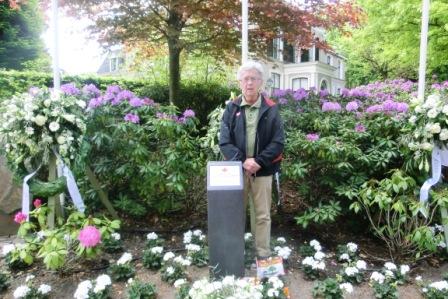
Pieter by the memorial stone honouring Joseph William Campbell from Newport, Prince Edward Island, after he’d placed flags of Canada and Prince Edward Island. (Photo credit: Daria Valkenburg)

Memorial stone honouring Joseph William Campbell from Newport, Prince Edward Island. (Photo credit: Daria Valkenburg)

Beside the memorial stone honouring Joseph William Campbell is a monument in memory of Bathmen’s liberation by the Canadians in April 1945. A plaque on a large stone says ‘In grateful memory of our Canadian liberators’ and was placed here in 1995, 50 years after Bathmen was liberated.

Pieter by the monument honouring the Canadians who liberated Bathmen. (Photo credit: Daria Valkenburg)

This ended our visit to Bathmen and Schipbeek.  Although it had been an effort to leave our cosy cottage, I’m glad that Pieter persisted, as we now had seen with our own eyes the Schipbeek Canal, which we had read so much about in war diaries. 

The flags placed at the memorial stone were donated.  Our thanks go to: 

  • Alan Waddell, Constituent Assistant, on behalf of Heath MacDonald, MP for Malpeque, for the Canadian flag.
  • Matt MacFarlane, MLA for District 19, Borden-Kinkora, for the Prince Edward Island flag. 

Our adventures continue as we share the highlights of our adventures on the 2025 European War Memorial Tour.  Coming up on our journey of remembrance is a visit to Uden War Cemetery.

If you have a story or photos to share, please contact Pieter at memorialtrail@gmail.com or comment on the blog. 

© Daria Valkenburg

….Want to follow our research?…

If you are reading this posting, but aren’t following our research, you are welcome to do so.  Our blog address: https://onthewarmemorialtrail.com/

4 countries, 6 weeks, 7,000 km – an unforgettable war memorial journey in Europe…. Daria’s book ‘No Soldier Buried Overseas Should Ever Be Forgotten‘ is available in print and e-book formats.  Net proceeds of book sales help support research costs and the cost of maintaining this blog. For more information see https://nosoldierforgotten.com/

Subscribe to our YouTube Channel: On The War Memorial Trail With Pieter Valkenburg: https://www.youtube.com/channel/UCJ591TyjSheOR-Cb_Gs_5Kw

Never miss a posting!  Subscribe below to have each new story from the war memorial trail delivered to your inbox.
On The War Memorial Trail…. Battlefields Tour With Joël Stoppels Part 3: Visit To Stefanuskerk in Holwierde

A life’s ambition realized! Daria in the driver’s seat of a jeep! Spoiler alert – our battlefield tour was in an SUV, not the jeep! (Photo credit: Joël Stoppels)

October 10, 2025.  While in Europe this spring for the 80th Anniversary of Liberation Commemoration events, we visited 14 cemeteries to place flags at the graves of 383 soldiers that Pieter has researched since 2014, with the stories of many of these soldiers previously told on this blog. 

On the wish list for our 2025 European War Memorial Tour was to tour some of the battlefields in which these soldiers lost their lives in order to have a better appreciation of what they had faced. 

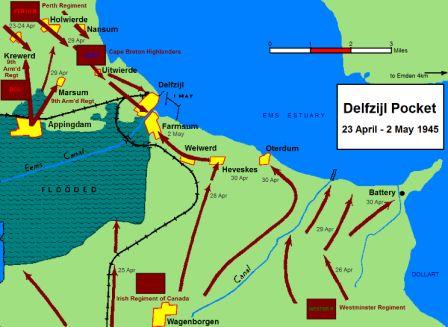
Battlefields guide Joël Stoppels, of Groningen, The Netherlands, offered to spend a day showing us locations where the various battles that comprised the Battle of the Delfzijl Pocket took place.  Over the years, we’ve featured stories of many soldiers who lost their lives in the last weeks of the North-West Europe campaign during WWII, and we eagerly anticipated learning more. (See https://www.canadiansoldiers.com/history/battlehonours/northwesteurope/delfzijlpocket.htm)

Map showing the locations during the Battle of the Delfzijl Pocket. (Map source: http://www.canadiansoldiers.com)

In Part 1, our battlefield tour began at a field where 19 Canadians lost their lives during the Battle for Wagenborgen, the preliminary battle before the Battle of the Delfzijl Pocket. (See https://onthewarmemorialtrail.com/2025/10/01/on-the-war-memorial-trail-battlefields-tour-with-joel-stoppels-part-1-battle-for-wagenborgen/)

In Part 2, we travelled to Appingedam, the town where the Battle of the Delfzijl Pocket began. (See https://onthewarmemorialtrail.com/2025/10/05/on-the-war-memorial-trail-battlefields-tour-with-joel-stoppels-part-2-the-battle-of-the-delfzijl-pocket-began-in-appingedam/)

Now, in Part 3, we left Appingedam and travelled to Holwierde, where our first stop was at the Canada Memorial.

…. The Canada Memorial in Holwierde…

Pieter and Joël at the Canada Memorial in Holwierde. (Photo credit: Daria Valkenburg)

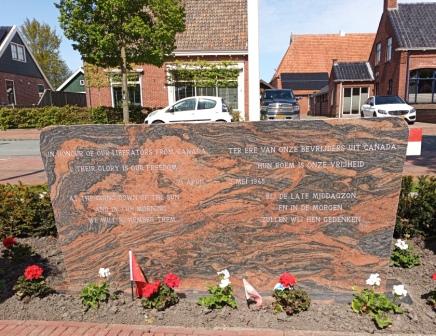
Front view of the Canada Memorial in Holwierde.  (Photo credit: Daria Valkenburg)

We knew that there was a plaque at the church in Holwierde that commemorated the Canadians who lost their lives during the Battle of Delfzijl Pocket, but had no idea there was also a monument in the town itself…. with houses on either side of the main road where it’s located.

Called the Canada Memorial, with red and white flowering plants around it, the stone plaque simply states ‘In honour of our liberators from Canada. Their glory is our freedom. 21 April – 2 May 1945

Closeup of stone plaque at the Canada Memorial in Holwierde.  (Photo credit: Pieter Valkenburg)

…. Canadian soldiers called Holwierde ‘a killing ground’…

Battlefields Tour poster describing Howierde as a ‘Killing ground’.

As we walked through this quiet and picturesque town towards the Stefanuskerk, we asked Joël about his poster describing Holwierde as a ‘Killing ground’.  He explained that ….Holwierde was one of the most heavily contested villages during the Battle of the Delfzijl Pocket in April 1945. The Perth Regiment fought intense house-to-house combat here, as German paratroopers and naval infantry had fortified nearly every building.  Many Canadian soldiers referred to the village as ‘a killing ground’ due to the high casualties on both sides…..

Holwierde in April 1945, with a temporary bailey bridge, leading towards the Stefanuskerk. (Photo Courtesy of Joël Stoppels / Battlefield Tours)

Holwierde in April 1945.  A temporary bailey bridge allowed residents and troops to cross the canal.  The Stefanuskerk is on the right. (Photo Courtesy of Joël Stoppels / Battlefield Tours)

…The Stefanuskerk, although spared from destruction, stood right in the middle of the battlefield and witnessed days of shelling and close-quarters fighting….  

Holwierde in 2025, 80 years after its liberation.  The bailey bridge from 1945 is now a permanent bridge over the canal! (Photo credit: Daria Valkenburg)

 …. We found a banner for one soldier whose story was previously told…

Banner for Joseph ‘Gerald’ Fougere in Holwierde. (Photo credit: Pieter Valkenburg)

As we walked down the street towards the Stefanuskerk, the main reason for our visit to Holwierde, we saw a banner for Joseph ‘Gerald’ FOUGERE, who was serving with the Perth Regiment. He was wounded on April 24, 1945, during the Battle of the Delfzijl Pocket, and died on April 26, 1945, one month before his 29th birthday. (See https://onthewarmemorialtrail.com/2021/01/27/on-the-war-memorial-trail-atlantic-canada-remembers-part-5/)

Joseph ‘Gerald’ Fougere’s banner was by the canal in Holwierde, but this wasn’t where he died.  (Photo credit: Daria Valkenburg)

The banner was by the canal, and while I was busy snapping photos, thinking this is where he died, Joël said “…no, he actually died in nearby Nansum.  Since Nansum is such a small village, his banner was placed in Holwierde for greater visibility...” He then kindly pointed out that “…the bridge over the canal had been blown up by the Germans on April 25, 1945.

Never mind…Nansum was quickly added as our next stop after Holwierde!

…. A solemn few moments at Stefanuskerk…

Entrance to Stefanuskerk in Holwierde. (Photo credit: Pieter Valkenburg)

We continued walking down the road until we got to the Stefanuskerk.  A plaque near the door noted that the church dates to the 11th century!  In the 13th century the church was enlarged.  It was severely damaged in April 1945, but restored by 1950, to give the appearance as to how the church would have looked before 1830.

Pieter by the plaque in Stefanuskerk that commemorates Canadian soldiers who died during the Battle of the Delfzijl Pocket.  (Photo credit:  Joël Stoppels)

We wanted to visit the church in order to see the plaque that commemorates many of the Canadian soldiers who died during the Battle of the Delfzijl Pocket.  It was a very solemn few moments for us, as we looked over the names, many of them of soldiers that Pieter had researched over the past years.

From the Royal Winnipeg Rifles:

From the Perth Regiment:

From the Cape Breton Highlanders:

Not mentioned on the plaque:

From the 9th Armoured Regiment (BC Dragoons), who is commemorated on a plaque in Appingedam:

…. We couldn’t miss seeing Nansum…

We left Stefanuskerk in a reflective mood after looking at the names on the plaque, and quietly got back in the car for the short drive to Nansum, which is indeed a tiny place, near the coast.   Joël didn’t know exactly where Joseph ‘Gerald’ FOUGERE was killed, unfortunately.  What remained of a German bunker was still visible, so he likely died of shrapnel wounds. 

Yellow arrow indicates the remains of a German bunker in Nansum.  (Photo credit: Daria Valkenburg)

Joël noted that 177 Kriegsmarine were captured here. The Kriegsmarine was Nazi Germany’s Navy from 1939-1945.  By 1945, as the war progressed, the Kriegsmarine formed infantry units from its personnel, who were re-trained as infantry to fight on land, all in an attempt to alleviate the strain on the German Army.

From Nansum we continued on the last leg of our battlefields tour, as we followed the route taken by the Cape Breton Highlanders to Delfzijl. Coming up in Battlefields Tour With Joël Stoppels Part 4: From Nansum To Delfzijl And Wirdum.

Thank you to Joël Stoppels, guide and founder of Battlefield Tours, for a wonderful and informative tour. (See www.battlefieldtours.nu)  If you have a story or photo to share, please contact Pieter at memorialtrail@gmail.com or comment on the blog. 

© Daria Valkenburg

….Want to follow our research?…

If you are reading this posting, but aren’t following our research, you are welcome to do so.  Our blog address: https://onthewarmemorialtrail.com/

4 countries, 6 weeks, 7,000 km – an unforgettable war memorial journey in Europe…. Daria’s book ‘No Soldier Buried Overseas Should Ever Be Forgotten‘ is available in print and e-book formats.  Net proceeds of book sales help support research costs and the cost of maintaining this blog. For more information see https://nosoldierforgotten.com/

Subscribe to our YouTube Channel: On The War Memorial Trail With Pieter Valkenburg: https://www.youtube.com/channel/UCJ591TyjSheOR-Cb_Gs_5Kw

Never miss a posting!  Subscribe below to have each new story from the war memorial trail delivered to your inbox.
On The War Memorial Trail…. Battlefields Tour With Joël Stoppels Part 2: The Battle of the Delfzijl Pocket Began In Appingedam

A life’s ambition realized! Daria in the driver’s seat of a jeep! Spoiler alert – our battlefield tour was in an SUV, not the jeep! (Photo credit: Joël Stoppels)

October 5, 2025.  While in Europe this spring for the 80th Anniversary of Liberation Commemoration events, we visited 14 cemeteries to place flags at the graves of 383 soldiers that Pieter has researched since 2014.  The stories of many soldiers have been told on this blog. 

On our wish list for this trip was to tour some of the battlefields in which these soldiers lost their lives in order to have a better appreciation of what they had faced. 

Battlefields guide Joël Stoppels, of Groningen, The Netherlands, offered to spend a day showing us locations where the various battles that comprised the Battle of the Delfzijl Pocket took place.  Over the years, we’ve featured stories of many soldiers who lost their lives in the last weeks of the North-West Europe campaign during WWII, and we eagerly anticipated learning more. (See https://www.canadiansoldiers.com/history/battlehonours/northwesteurope/delfzijlpocket.htm)

Map showing the locations during the Battle of the Delfzijl Pocket. (Map source: http://www.canadiansoldiers.com)

In Part 1, our battlefield tour began at a field where 19 Canadians lost their lives during the Battle for Wagenborgen, the preliminary battle before the Battle of the Delfzijl Pocket. (See https://onthewarmemorialtrail.com/2025/10/01/on-the-war-memorial-trail-battlefields-tour-with-joel-stoppels-part-1-battle-for-wagenborgen/)

Now, in Part 2, we travelled to Appingedam, the town where the Battle of the Delfzijl Pocket began…. 

From Wagenborgen, we made our way towards Appingedam, the location of the beginning of the Battle of the Delfzijl PocketWilliam ‘Willie’ DANIELS, Donald Charles MACKENZIE, whose stories were previously told on this blog, along with William James ‘Jimmy’ Sutherland HOLE, who Pieter also researched, lost their lives here.

…. We found banners for two soldiers whose stories were previously told…

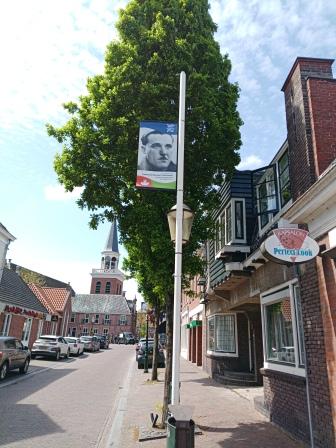
We found the banners for Daniels and MacKenzie, but no banner was made for Hole as up to now no photo has been found of him. 

Banner for William ‘Willie’ Daniels in Appingedam. (Photo credit: Daria Valkenburg)

The banner for William ‘Willie’ Daniels was quite high up and it was hard for me to get a good angle, but thankfully Joël was kind enough to send us a better photo of the banner. 

Banner for William ‘Willie’ Daniels. (Photo courtesy of Joël Stoppels/ Battlefield Tours)

William ‘Willie’ DANIELS, from the Big River Reserve in Depton, Saskatchewan, was serving with the Royal Winnipeg Rifles when he was killed, aged 20, on April 22, 1945 as troops moved through Appingedam in The Netherlands at the very beginning of the Battle of the Delfzijl Pocket. You can read his story at https://onthewarmemorialtrail.com/2021/07/23/on-the-war-memorial-trail-remembering-ww2-soldier-william-willie-daniels/

Banner for Donald Charles MacKenzie in Appingedam. (Photo credit: Pieter Valkenburg)

Donald Charles MACKENZIE of Springhill, Nova Scotia, was serving with the Royal Winnipeg Rifles when he was killed, aged 30, on Sunday, April 22, 1945. He had been wounded during heavy fighting at the railway bridge near Appingedam, and placed in a house temporarily to rest. However, he was fatally hit by shrapnel by German shelling of the house.  You can read his story at https://onthewarmemorialtrail.com/2022/01/23/on-the-war-memorial-trail-the-ww2-soldier-from-springhill-who-received-a-memorial-cross/

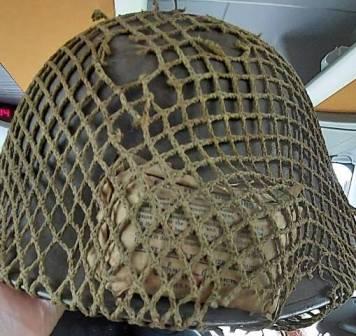
Helmet that had belonged to Donald Charles MacKenzie. (Photo Courtesy of Joël Stoppels / Battlefield Tours)

Joël told us that he has Donald Charles MacKenzie’s helmet in his private collection, and was kind enough to share a photo…a link of the past with the present! 

…. The Royal Winnipeg Rifles were in Appingedam as of April 21, 1945…

Map helped explain what happened in Appingedam in 1945.  (Photo credit: Daria Valkenburg)

In setting the scene on what unfolded in Appingedam back in 1945, Joël referred to a map that he had brought along for the battlefields tour.  “….Two roads led into Appingedam in 1945, both heavily mined by the defending Kriegsmarine…” he explained. The Kriegsmarine was Nazi Germany’s Navy from 1939-1945.  By 1945, as the war progressed, the Kriegsmarine formed infantry units from its personnel, who were re-trained as infantry to fight on land, all in an attempt to alleviate the strain on the German Army.

…The Canadians were aware of the mines…” Joël noted, and on “…April 21, 1945, the Royal Winnipeg Rifles attacked.  Heavy fighting ensued but the town was partially liberated on April 23, 1945….” allowing “….the Royal Winnipeg Rifles to move back into Wirdum….

The Regimental history, ‘Little Black Devils: a history of the Royal Winnipeg Rifles’, by Bruce Tascona and Eric Wells, describes what happened at Appingedam. “…..Beginning on April 21….the Rifles attacked with the 7th Reconnaissance Regiment, and several of the armoured cars were knocked out by anti-tank guns.  The Germans then blew up the bridge which the Rifles intended to cross…

In trying to find another plan of attack, patrols had discovered a small bridge.  …The bridge, deemed too feeble to carry motor transport, was still intact and patrols affirmed that it would carry the weight of jeeps.  With that information, the Rifles shifted position on a new start line during the night…

The plan in place, “…in the early hours of April 22, A Company….went over the bridge, followed closely by C Company.  They were met by heavy machine gun fire but the worst problem they faced were the minefields….

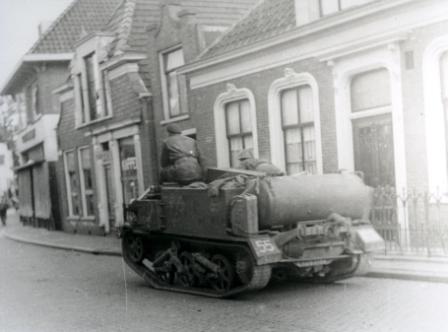
A WASP carrier with 2 soldiers from the Royal Winnipeg Rifles on a street in Appingedam in April 1945.  (Photo Courtesy of Joël Stoppels / Battlefield Tours)

In spite of the challenges, during the day “… the Battalion consolidated its position in front of the town…”  Then, a surprise attack during the night meant that…by dawn the Rifles were inside Appingedam and by mid-morning of April 23, they were mopping up. On April 24, the Rifles were replaced by the Perth Regiment….

The 9th Armoured Regiment (British Columbia Dragoons) were assigned to support the Perth Regiment.  The war diary for the BC Dragoons for April 22, 1945 explained the orders. …Lt Col Angle liaised with Commander Perth Regiment as BCD will form one portion of the 5 CAB Battle Group…” (CAB referred to Canadian Armoured Brigade)

The Situation Report for ‘A’ Squadron of the BC Dragoons noted that “…troops moved forward and positions taken over from Winnipeg Rifles before last light.  Approach to town heavily shelled by enemy heavy calibre guns…

…. Appingedam was evacuated on the night of April 23, 1945…

Per the war diary for the BC Dragoons for April 23, 1945, it was overcast and orders had been received at 2 am from HQ CAB that the Regiment was to relieve the Royal Winnipeg Rifles at 12:30 pm, and that troops from ‘A’ and ‘B’ squadrons were to be temporarily reorganized into one infantry squadron.  The tanks were parked in an area away from the town, with ….one crew member per tank to remain in the tanks and perform necessary maintenance and act as guards….”….all in preparation for the upcoming battle.

Appingedam had a population of 7,000, who were about to be in the midst of a heavy fight.  Joël told us that after “…a Dutch resistance fighter named Leugs went to Battalion HQ and offered to help, he was tasked with evacuating the town.  With the aid of Canadian trucks, this was done on the night of April 23, 1945…

On April 24, 1945, the Situation Report for ‘A’ Squadron of the BC Dragoons recorded that …the troop of tanks under Lt Gamlin, ‘C’ Squadron, took up positions at first light, spasmodic shelling throughout the day.  Underground contacted and reliable information was received concerning enemy positions….Enemy continued heavy shelling…. 

The Germans surrendered on May 2, 1945, and residents were able to return home and assess the damage to their properties.

…. Plaques to commemorate the RWR and BC Dragoons are in Appingedam…

Daria and Joël in Appingedam’s town square. The commemorative plaques are on a wall in the passageway to the right. (Photo credit: Pieter Valkenburg)

We learned about all that happened in Appingedam while standing in the town square, and next went to see two plaques placed nearby – one for the Royal Winnipeg Rifles, and the other for the British Columbia Dragoons.  We could still see shrapnel in the bricks of the buildings!

Commemorative plaque for the Royal Winnipeg Rifles.  (Photo credit: Daria Valkenburg)

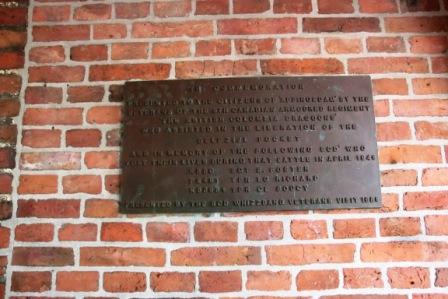
Commemorative plaque for the BC Dragoons.  (Photo credit: Daria Valkenburg)

Three soldiers from the BC Dragoons are remembered on the plaque:

  • Sgt Stanley FOSTER, aged 24, died April 30, 1945
  • Trooper Louis Graham RICHARD, aged 27, died April 26, 1945
  • Trooper Charles Ernest SOUCY, aged 30, died April 30, 1945

Sgt Foster is buried in the Canadian War Cemetery in Groesbeek.  Troopers Richard and Soucy are buried in the Canadian War Cemetery in Holten.  You can read Richard’s story at https://onthewarmemorialtrail.com/2021/02/22/on-the-war-memorial-trail-atlantic-canada-remembers-part-7/

…. ‘The best stroopwafel I ever ate!’…

Pieter, Daria, and Joél having a much needed break in Appingedam.  (Photo courtesy of Valkenburg Family)

After digesting all the history from Wagenborgen and Appingedam, we desperately needed a break, so were very receptive to Joël’s suggestion that we go for coffee at ‘Stroopwoafeltje, Koffie & Meer’, a café in the town square.

Joël recommended the homemade stroopwafels made by the lady running the café, and both he and Pieter ordered one.  After Pieter told me “…this is the best stroopwafel I ever ate!!!!..” I tried a piece of his, and he was right.  It was much nicer than the syrupy, overly chewy ones you get commercially! 

In case you’ve never tried this treat, a stroopwafel is a traditional Dutch cookie made from two thin waffle layers sandwiched around a warm caramel filling.  I’m only sorry that I didn’t think to take a photo of Pieter’s stroopwafel before he ate it all up!

Our stay in Appingedam ended once we finished our coffee break.  It was time to move on and continue our battlefields tour as part of our 2025 European War Memorial Tour. Coming up in Battlefields Tour With Joël Stoppels Part 3: Visit To Stefanuskerk In Holwierde.

Thank you to Joël Stoppels, guide and founder of Battlefield Tours, for a wonderful and informative tour. (See www.battlefieldtours.nu)  If you have a story or photo to share, please contact Pieter at memorialtrail@gmail.com or comment on the blog. 

© Daria Valkenburg

….Want to follow our research?…

If you are reading this posting, but aren’t following our research, you are welcome to do so.  Our blog address: https://onthewarmemorialtrail.com/

4 countries, 6 weeks, 7,000 km – an unforgettable war memorial journey in Europe…. Daria’s book ‘No Soldier Buried Overseas Should Ever Be Forgotten‘ is available in print and e-book formats.  Net proceeds of book sales help support research costs and the cost of maintaining this blog. For more information see https://nosoldierforgotten.com/

Subscribe to our YouTube Channel: On The War Memorial Trail With Pieter Valkenburg: https://www.youtube.com/channel/UCJ591TyjSheOR-Cb_Gs_5Kw

Never miss a posting!  Subscribe below to have each new story from the war memorial trail delivered to your inbox.
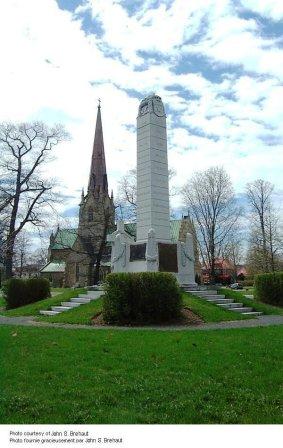
On The War Memorial Trail…. Battlefields Tour With Joël Stoppels Part 1: Battle For Wagenborgen

A life’s ambition realized! Daria in the driver’s seat of a jeep! Spoiler alert – our battlefield tour was in an SUV, not the jeep! (Photo credit: Joël Stoppels)

October 1, 2025.  Pieter has been involved in finding photos of Canadians who are buried in all three Canadian War Cemeteries in The Netherlands since 2014, with stories of many soldiers told on this blog. 

While in Europe on our 2025 European War Memorial Tour this spring, for the 80th Anniversary of Liberation Commemoration events, he not only placed flags at the graves of 383 soldiers in 14 cemeteries, but we wanted to tour some of the battlefields in order to have a better appreciation of what soldiers faced. 

Battlefields Tours guide Joël Stoppels, of Groningen, The Netherlands, offered to spend a day showing us locations where the various battles that comprised the Battle of the Delfzijl Pocket took place. The term ‘Delfzijl Pocket’ refers “….to the entire area around Delfzijl that was held by German forces and cleared by the Canadians in late April and early May 1945…”Joël explained.

Over the years, we’ve featured stories of many soldiers who lost their lives in the last weeks of the North-West Europe campaign during WWII, and we eagerly anticipated learning more. (See https://www.canadiansoldiers.com/history/battlehonours/northwesteurope/delfzijlpocket.htm)

Map showing the locations during the Battle of the Delfzijl Pocket. (Map source: http://www.canadiansoldiers.com)

…. 19 Canadians lost their lives on a field just outside Wagenborgen…

Our day touring battlefields began very early, with a two hour drive from our cottage near Holten to Groningen, where we’d arranged to meet Joël. 

Our first stop on the battlefield tour was at a field outside Wagenborgen, where 19 Canadians lost their lives during the Battle for Wagenborgen.  This was the preliminary battle before the Battle of the Delfzijl Pocket. (See  https://www.canadiansoldiers.com/history/battlehonours/northwesteurope/wagenborgen.htm)

Joël Stoppels and Pieter stand across the road from the field outside Wagenborgen.  (Photo credit: Daria Valkenburg)

Joël began by saying that “….‘D’ Company of the Canadian Scottish Regiment, under the command of Major Anthony Compton-Lundie, were ordered by Battalion Command based in Groningen to undergo a dangerous mission across open fields with no rises or trees for cover…..” 

Patrols from the 7th Canadian Reconnaissance Regiment had determined that Wagenborgen, a short distance from the centre of the battalion’s line, was held by an unknown number of Germans.

‘D’ Company received orders to take the village of Wagenborgen in a one-company attack in the early hours of April 21, 1945.  “….Compton-Lundie was based at the Schmidt farm at the end of the field.  When the phone rang with orders to attack, he protested.  ‘Are you crazy?’ he said.  Orders were orders, however, and Compton-Lundie was not one to disobey…

The attack began on April 21, 1945.  By the time it was over, Anthony COMPTON-LUNDIE was dead, as was his lieutenant, Dennis George HUSCROFT, and 17 more men.

…. How did the battle go so badly for the Canadian Scottish?…

How did it go so wrong?  ... A Polish division had been in the area before the Canadian Scottish arrived and told Compton-Lundie that they believed only 100 Germans remained.  This was faulty intelligence as there were over 1500 Germans, just waiting to pick off soldiers in the open field of very flat land….”  Joël reflected that “…perhaps if Battalion Command had listened to Compton-Lundie, who had a view of the landscape, that there would have been fewer casualties….

Field outside Wagenborgen where 19 men lost their lives.  Yellow arrow indicates Schmidt Farm, where Major Compton-Lundie of the Canadian Scottish Regiment had been based. At the far right is a monument commemorating those who died. (Photo credit: Daria Valkenburg)

…. A monument by the field honours the 19 men who died…

Monument by the open field where 19 men lost their lives on April 19, 1945. (Photo credit: Daria Valkenburg)

A small monument sits beside the open field where 19 men fought and lost their lives.  A translation of the Dutch text reads as follows:  Stand still for a moment at the maple leaf. On April 21, 1945, 19 Canadian men died for our freedom here at ‘Stolderij’. Stolderij refers to the hamlet where the open field is located.

The men were temporarily buried in Siddeburen before being reburied in 1946 in the Canadian War Cemetery in Holten, The Netherlands.

…. Banners were placed in Wagenborgen to commemorate fallen soldiers…

Once we finished taking photos of the field where so many men lost their lives, we drove into the town of Wagenborgen itself, where banners of the deceased soldiers had been placed, as close as possible to the location where they fell. 

Two soldiers from the Canadian Scottish Regiment who had fought in Wagenborgen have had their stories previously told on this blog.  One survived the battle, but one died, and we looked for his banner.

Banner for Theodor ‘Ted’ Henschel in Wagenborgen.  (Photo credit: Daria Valkenburg)

Joël by the banner for Anthony Compton-Lundie, who was from Oakbank, Manitoba. (Photo credit: Daria Valkenburg)

After being told about the impossible situation that Major Anthony Compton-Lundie faced, we wanted to see his banner, and took a photo of Joël beside it.

…. Canadian soldiers who lost their lives during the Battle for Wagenborgen…

Joël and Pieter at the War Memorial in Wagenborgen.  ‘Wij gedenken’ translates to ‘We commemorate’. (Photo credit: Daria Valkenburg)

The War Memorial in Wagenborgen commemorates the residents of Wagenborgen who died in WWII, and 27 fallen Canadian soldiers – 23 of them from the Canadian Scottish Regiment, 1 from the Royal Winnipeg Rifles, and 3 from the Royal Canadian Artillery. 

From the Canadian Scottish Regiment:

  • Pte Albert George BOUMA, aged 21, died April 23, 1945
  • Pte John BRANSCOMB, aged 32, died April 23, 1945
  • Pte Robert Stewart BULLOCK, aged 39, died April 23, 1945
  • Pte Leslie Keith BUTTERICK, aged 19, died April 21, 1945
  • L/Cpl Carmen Christie CAPONERO, aged 30, died April 21, 1945
  • Sgt Allen CLEMENTS, aged 32, died April 21, 1945
  • Major Anthony COMPTON-LUNDIE, aged 30, died April 21, 1945
  • Pte Louis Silverius DAUTREMONT, aged 25, died April 21, 1945
  • Pte Edwin Levi EMERY, aged 22, died April 21, 1945
  • Pte Peter HARASYMCHUK, aged 24, died April 23, 1945
  • Pte Theodor ‘Ted’ HENSCHEL, aged 28, died April 223, 1945
  • Pte John Charles HUGHES, aged 28, died April 23, 1945
  • Lt Denis George HUSCROFT, aged 24, died April 21, 1945
  • L/Cpl John Albert MASLIN, aged 24, died April 21, 1945
  • Pte John Raymond PATRICK, aged 29, died April 21, 1945
  • Pte James Robert POWER, aged 21, died April 21, 1945
  • Pte Robert John Wilson REID, aged 38, died April 21, 1945
  • Pte Henry Oscar RENNER, aged 24, died April 21, 1945
  • Martin George VAN SANDVOORD, aged 28, died April 22, 1945
  • Pte Emile Joseph SOENS, aged 24, April 21, 1945
  • Pte John William WILSON, aged 37, died April 23, 1945
  • Pte Fred WIRTH, aged 38 , died April 23, 1945
  • A/Cpl Gordon Scarth WOOD, aged 21, died April 21, 1945

From the Royal Winnipeg Rifles:

  • Rifleman Theodore OLENICK, aged 19, died April 21, 1945

From the Royal Canadian Artillery:

  • Captain Donald George INNES, aged 23, died April 21, 1945
  • Gunner Joseph Paul MOULINS, aged 23, died April 21, 1945
  • Gunner Arthur John MUELLER, aged 20, died April 21, 1945

From Wagenborgen, we continued our tour, with our next stop in Appingedam, coming up in Battlefields Tour With Joël Stoppels Part 2: The Battle of the Delfzijl Pocket Began In Appingedam.

Thank you to Joël Stoppels, guide and founder of Battlefield Tours, for a wonderful and informative tour. (See www.battlefieldtours.nu)  If you have a story or photo to share, please contact Pieter at memorialtrail@gmail.com or comment on the blog. 

© Daria Valkenburg

….Want to follow our research?…

If you are reading this posting, but aren’t following our research, you are welcome to do so.  Our blog address: https://onthewarmemorialtrail.com/

4 countries, 6 weeks, 7,000 km – an unforgettable war memorial journey in Europe…. Daria’s bookNo Soldier Buried Overseas Should Ever Be Forgotten is available in print and e-book formats.  Net proceeds of book sales help support research costs and the cost of maintaining this blog. For more information see https://nosoldierforgotten.com/

Subscribe to our YouTube Channel: On The War Memorial Trail With Pieter Valkenburg: https://www.youtube.com/channel/UCJ591TyjSheOR-Cb_Gs_5Kw

Never miss a posting!  Subscribe below to have each new story from the war memorial trail delivered to your inbox.
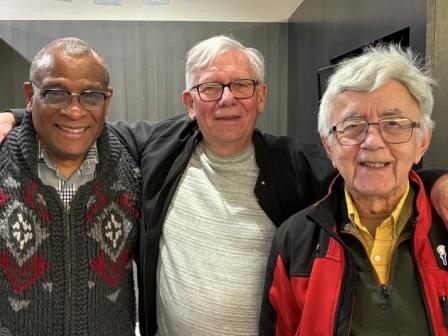
On The War Memorial Trail….2025 Faces of Holten Exhibition Part 2: The Soldiers Listed On The Cenotaph In Borden-Carleton

Directional sign to the Canadian War Cemetery in Holten, The Netherlands. (Photo credit: Daria Valkenburg)

August 29, 2025.  Pieter has been involved in finding photos of Canadians who are buried in all three Canadian War Cemeteries in The Netherlands since 2014.  He first started with finding photos of soldiers from Prince Edward Island buried in The Netherlands. 

In 2015, he began researching the names of 48 soldiers listed on the Cenotaph outside the Borden-Carleton Legion on Prince Edward Island.  Over the years, all 48 names were identified, each of their stories researched and told on this blog.  For most of the names, families and photos were found, and the Wall of Remembrance is in place at the Legion. 

Cenotaph outside the Borden-Carleton Legion. (Photo credit: Daria Valkenburg)

While in The Netherlands and Belgium for the 80th Anniversary of Liberation Commemoration events, he placed flags at the graves of 383 soldiers in 14 cemeteries. At the Canadian War Cemetery in Holten, The Netherlands, flags were placed at 156 graves.
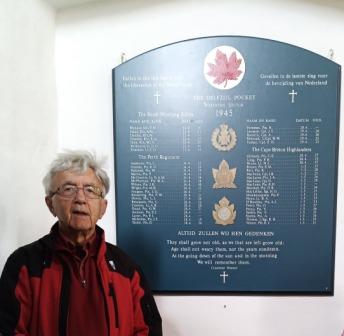
Our visit coincided with The 2025 Faces Of Holten Exhibition, which ran for three weeks in May. Photos were printed onto an aluminum backing, making them impervious to rain, and reusable. Each placard also had a QR code, allowing visitors with cell phones to scan the code and read a brief biography of the soldier.

In Part 1, soldiers who were killed near Posterenk in April 1945 and are buried in the Canadian War Cemetery in Holten, were featured. (See https://onthewarmemorialtrail.com/2025/08/24/on-the-war-memorial-trail-2025-faces-of-holten-exhibition-part-1-soldiers-killed-near-posterenk/)

…2 soldiers listed on the Cenotaph in Borden-Carleton are commemorated…

Now, in Part 2, the graves and photos of William Douglas SHERREN and George Martin MCMAHON, whose stories have previously been told, are featured. Both are listed on the Cenotaph outside the Borden-Carleton Legion. You can read their stories at https://onthewarmemorialtrail.com/2018/01/20/on-the-war-memorial-trail-at-holten-canadian-war-cemetery/
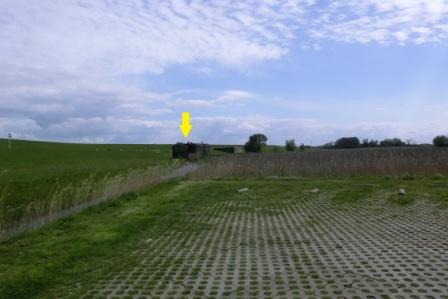
Grave of William Douglas Sherren. (Photo credit: Pieter Valkenburg)

William Douglas SHERREN, from Crapaud, Prince Edward Island, was serving with the Royal Canadian Artillery and was severely injured when the vehicle he was travelling in drove over a land mine in Germany on April 25, 1945, just a few days before the end of WWII.  He died of his wounds on April 28, 1945, aged 30.  A month earlier, he had been recognized by King George VI as a Member of the Military Division of the Most Excellent Order of the British Empire, in recognition of gallant and distinguished service in North West Europe.

Grave of George Martin McMahon. (Photo credit: Pieter Valkenburg)

George Martin McMAHON, born in Emerald Junction, Prince Edward Island, and the father of 5 children, was serving with the Royal Canadian Artillery, and accidentally drowned when he fell into a canal in Amsterdam, The Netherlands on the night of August 11, 1945.  He was 32 years old.

….All of the flags placed at graves were donated…
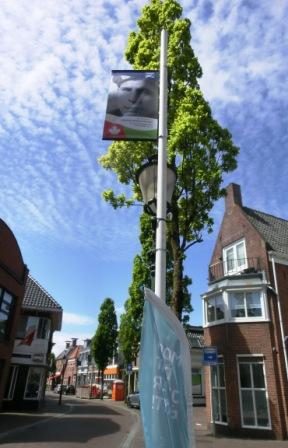
All of the flags placed at graves were donated.  For the flags placed at the graves of Islanders, our thanks go to:  Alan Waddell, Constituent Assistant, on behalf of Heath MacDonald, MP for Malpeque, for the Canadian flags. Prince Edward Island flags were provided by Matt MacFarlane, MLA for District 19, Borden-Kinkora. 
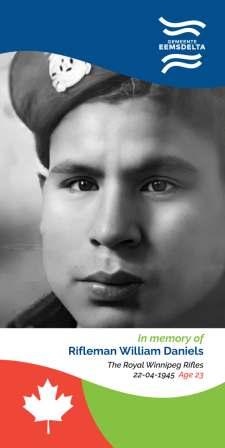
In Part 3, the graves of soldiers killed in vehicle accidents will be featured as we continue with our 2025 European War Memorial Tour. Pieter encourages readers with photos to come forward so that eventually all the known graves of Canadians buried in Holten will have a photo displayed by their grave. Email him at memorialtrail@gmail.com

© Daria Valkenburg

….Want to follow our research?…

If you are reading this posting, but aren’t following our research, you are welcome to do so.  Our blog address: https://onthewarmemorialtrail.com/

4 countries, 6 weeks, 7,000 km – an unforgettable war memorial journey in Europe…. Daria’s book ‘No Soldier Buried Overseas Should Ever Be Forgotten‘ is available in print and e-book formats.  Net proceeds of book sales help support research costs and the cost of maintaining this blog. For more information see https://nosoldierforgotten.com/

Subscribe to our YouTube Channel: On The War Memorial Trail With Pieter Valkenburg: https://www.youtube.com/channel/UCJ591TyjSheOR-Cb_Gs_5Kw

Never miss a posting!  Subscribe below to have each new story from the war memorial trail delivered to your inbox.