On The War Memorial Trail…..The Knights of Columbus Auxiliary Services Supervisor Who Drowned In A Belgian Canal

December 21, 2025. Pieter’s research results are faster than I can keep up with, and so several of the graves we visited during our 2025 European War Memorial Tour were for soldiers whose stories have yet to be told. One of the cemeteries we visited was the Canadian War Cemetery in Adegem, Belgium. (See https://onthewarmemorialtrail.com/2025/12/08/on-the-war-memorial-trail-a-visit-to-the-canadian-war-cemetery-in-adegem/

Before we left for Europe this past spring, we looked at the names of 12 soldiers from Prince Edward Island are buried in this cemetery. One surname was familiar as we had researched a soldier who was born in the same village and had the same surname,  Michael Joseph ‘Joe’ MACKENNA. (See https://onthewarmemorialtrail.com/2022/09/22/on-the-war-memorial-trail-the-wwii-soldier-from-prince-edward-island-killed-during-the-battle-of-rha/) We contacted Joe MacKenna’s niece, Teresa Hennebery, and asked if there was a family connection.

 ….The search for a photo of Joseph began…

Teresa was certain the families were distantly related and began a search into family records.  In the meantime, Pieter began his own research.    

Joseph Augustine MACKENNA, born June 28, 1903 in Newton Cross, Prince Edward Island, was the son of James and Georgina (nee MacMillan) MacKenna of Newtown, Prince Edward Island, and the husband of Mary (nee Hanrahan) MacKenna, of Antigonish, Nova Scotia.

When he enlisted with the 13th Company of the Canadian Army Forestry Corps (CAFC) in Halifax, Nova Scotia on September 2, 1940, he had been a bank manager with the Royal Bank of Canada, and had over 20 years of banking experience.  It was also noted that he had graduated from high school, was married, and was the father of three daughters:  Mary Eileen, Alice Clare, and Enid Gertrude.

His daughter Mary Eileen later married Cliff Gorman, and it was their son Mike Gorman who first provided a photo of his grandfather. Not long afterwards, Mary McPherson, daughter of Joseph’s brother Francis, also provided photos of her uncle.

Joseph Augustine MacKenna, likely taken in the United Kingdom.  (Photo courtesy of Mike Gorman)

 ….Joseph underwent basic training in Valcartier…

Joseph was sent to A13 Canadian Infantry Training Centre in Valcartier, Quebec for basic training, as were all members of the Canadian Army Forestry Corps, whose role was to cut down and process trees for wood and lumber in the United Kingdom. 

As stated in an article on http://www.canadiansoldiers.com/corpsbranches/forestrycorps.htm  “…wood was needed for living quarters, messes, and recreation facilities, as well as crates for vital supplies such as food, ammunition and even vehicles, and for the creation of explosives, stocks for weapons, the construction of ships, aircraft and factory facilities….

Although members of the CAFC were not expected to be in combat, very rudimentary basic training in using firearms was considered essential due to the threat to the United Kingdom of invasion by German forces.  As a result, members of CAFC “…received five to seven months of training…” at Valcartier.

On January 15, 1941, while still in Valcartier, Joseph was promoted to Acting Lance Corporal.  A few months later, on April 10, 1941, he was confirmed as Lance Corporal, and at the same time transferred to a Royal Canadian Army Medical Corps (RCAMC) unit that was attached to the Canadian Forestry Corps Headquarters.  He was a few months short of his 38th birthday, and while he likely was seen as finding active logging work a challenge, his extensive banking and administrative experience was considered a valuable asset.  

Joseph remained in Valcartier, assigned temporarily to No. 12, No. 14, and No. 19 Companies as needed. 

He was granted embarkation leave from May 23 to June 5, 1941, the last chance he had to see his family again.

….Joseph left Canada for overseas service….

Joseph left Canada for the United Kingdom on June 18, 1941, sailing from Halifax, Nova Scotia, disembarking in Gourock, Scotland on July 2, 1941, before moving on to Canadian Army Forestry Corps Headquarters in Beauly, Scotland. 

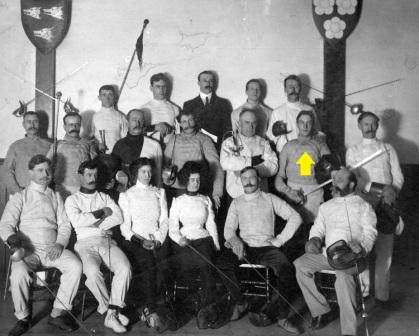
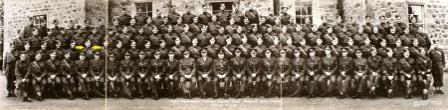
August 1941 photo of staff at CAFC HQ in Beauly, Scotland.  Joseph Augustine MacKenna is identified by yellow arrows.  (Photo courtesy of Mary McPherson)

While in Scotland, Joseph received a number of promotions.  On September 2, 1941 he was made Acting Sergeant, and classified as a Clerk Class III, Group C.  He was confirmed in the rank of Sergeant on December 2, 1941.

On July 1, 1942, Joseph was promoted to Staff Sergeant, and a month later promoted again to Acting Quarter Master Sergeant.  On November 1, 1942 he was confirmed in the rank of Quarter Master Sergeant.

Part of an August 1943 photo of staff at CAFC HQ in Beauly, Scotland.  Joseph Augustine MacKenna is identified by red arrow.  (Photo courtesy of Mary McPherson)

Joseph was transferred to the Canadian Army Forestry Corps Headquarters in London, England on September 28, 1943, and requested a demotion to Sergeant on October 15, 1943.  Over the next months, he was posted back and forth ‘On Command’ between London and Camp Whitley in Surrey, England, as Acting Staff Sergeant.

 ….Joseph was appointed Auxiliary Services Supervisor…

On July 18, 1944, Joseph was officially discharged from the Canadian Army and transferred to the Canadian Army Auxiliary Services (CAAS) upon receiving an appointment as Auxiliary Services Supervisor with the Canadian Military Headquarters in London.

What did Auxiliary Services do?  Members organized sports and dances, provided movies and concerts, reading and writing and recreation rooms, libraries, mobile canteens, and established leave hostels and information bureaus for troops on leave.

The Auxiliary Services section included four national volunteer service organizations: Canadian Legion War Services, Knights of Columbus, Salvation Army Canadian War Services, and Canadian Young Men’s Christian Association (YMCA) Overseas.  Joseph was with the Knights of Columbus.

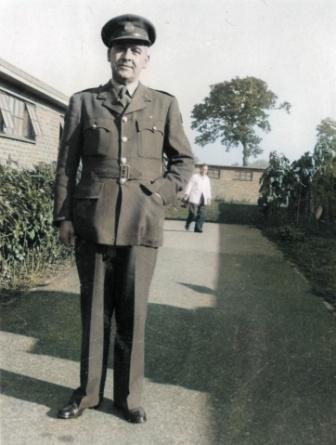
Now a civilian employee of the government, as were all members of Auxiliary Services, Joseph was considered an officer, with equivalent rank of captain, and addressed as Supervisor. As an Auxiliary Services officer he wore a modified service uniform.

 ….Joseph waited for an assignment in Continental Europe…

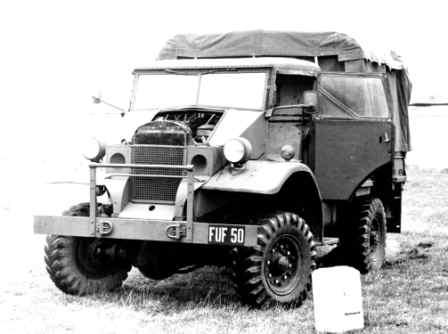
Example of a dual drive truck.  (Photo courtesy of The Royal Canadian Artillery Museum)

As Allied troops moved through France following D-Day on June 6, 1944 and then into Belgium, The Netherlands, and Germany, Auxiliary Services needed to plan for the support services needed as troops advanced. 

Joseph’s first task was to learn how to operate a Dual Drive truck with front wheel drive, an essential vehicle for the services that the Knights of Columbus would provide in France, Belgium, and The Netherlands, receiving his qualification in early August 1944.

On August 8, 1944, as a member of No. 11 Canadian Army Auxiliary Section (CAAS) Joseph was attached to No. 24 Canadian General Hospital in Horley, Surrey. It was a busy environment with wounded soldiers coming for treatment from the French front. He was there almost 8 months before being transferred to No. 1 Canadian General Reinforcement Unit (CGRU) on March 6, 1945, in preparation for a posting in North West Europe.

 ….Joseph was posted to Belgium…

On March 10, 1945, Joseph was transferred to the X4 General Reinforcement List of the 9th Battalion, leaving England and arriving in Belgium the following day. On March 13, 1945, he was assigned to the 14th Canadian Army Auxiliary Section (CAAS), which was attached to the 13th Canadian Base Reinforcement (CBR) Battalion.  This Battalion was part of the 13th Canadian Infantry Training Brigade, whose main role was administration and training for infantry reinforcements rather than a combat role in the field.

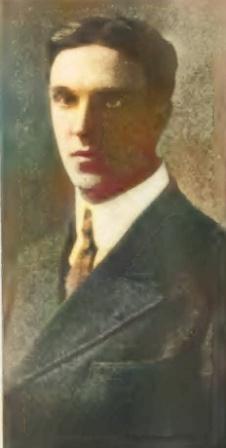
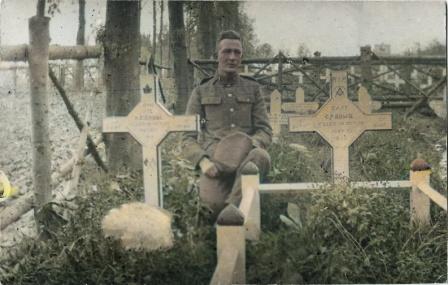
Joseph Augustine MacKenna, likely taken in Belgium. (Photo courtesy of Mary McPherson.  Photo restoration and colourization by Pieter Valkenburg.)

By the time Joseph arrived in Belgium, the country had been liberated since February 4, 1945.  At the time that Joseph arrived, the 14th CAAS, and 13th CBR Battalion, were based in Ghent, which had been liberated months earlier, on September 6, 1944. Among its’ other duties, the 13th CBR Battalion provided 14th CAAS with the supplies it required.

The Knights of Columbus recreation huts stated ‘Everybody Welcome, Everything Free’, providing services to soldiers regardless of race or religion. Travelling by truck to Knights of Columbus huts in Belgium and The Netherlands, Joseph transported supplies such as cigarettes, chocolates, and magazines, as well as equipment such as movie projectors and films. 

One of the many items provided to soldiers was stationery to allow them to write home to their family and friends.

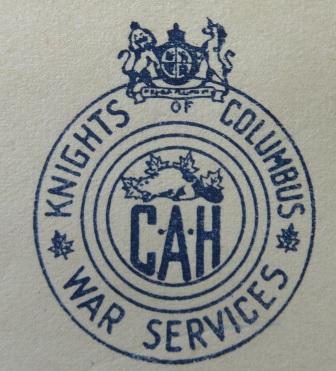
Stationery provided to soldiers by the Knights of Columbus, with the logo showing Canadian symbols of the beaver and the maple leaf and the royal coat of arms at the top. (Photos source: Tales From The Supply Depot)

While Joseph was qualified to drive a truck, as an officer he was entitled to a driver who drove the vehicle in which they travelled to deliver supplies and equipment, before returning to Ghent for more supplies before the next journey.

 ….Mystery of what happened on June 12, 1945…

All went well with Joseph’s assignment with 14th CAAS until the evening of June 12, 1945, when he disappeared after arriving back in Ghent from a trip.  According to testimony by his driver, Private A. J. FONTAINE, after arriving at 14th CAAS in Ghent, “…we unloaded a movie projector and cigarettes and turned them in there.…” Joseph told him that he …had other business to do here.  He told me to go and park the vehicle and to meet him at the Marguerite Café later.  On the way to Marguerite Café I stopped in at the American Café for a drink….

Joseph met him at the American Café and they had a drink before going on to Marguerite Café, located at 230 Groendreef, at 7:30 pm. 

At the Marguerite Café Pte Fontaine stated that Joseph told the proprietor, Marguerite Cador, that “…I would occupy his room for the night there for that night and he would occupy another room across the canal he had already arranged for….

They left the café together at 8 pm and crossed to the other side of the canal. Joseph then “…told me to return to the Marguerite Café to my room and to meet him the next morning at 14 Canadian Auxiliary Services Section at 1000 hours. I returned to the Marguerite Café, bought myself another drink and went to my room….”  It was the last time he saw Joseph.

Marguerite Cador, proprietor of Marguerite Café, testified that Pte Fontaine returned to the café “…15 or 20 minutes…” after they had left.  When she asked where Joseph was, he replied that “…I took him over the bridge to the other side of the canal and left him.  I gave him his bag before I left…

When Joseph didn’t report for work the following day, Pte Fontaine returned to Marguerite Café “….at different times during the day and the same for the next two days. He always asked if I had seen Mr. MacKenna…” Where had Joseph gone?

 ….A body was found in a canal in Ghent…

On the morning of June 21, 1945, Sgt Alexander MATTHEW, special investigator for the Canadian Provost Corps (Military Police), 3rd Canadian Base Reinforcement Group, was informed by the Ghent Civil Police that “….the body of a soldier was in the canal at Ketelplein Bridge….” Sgt Matthew proceeded to the bridge.  “…I looked down from the bank of the canal and saw the body.  I could see that the uniform on it bore ‘Canada’ flashes

The local fire department retrieved the body and transported it to No. 2 Canadian General Hospital’s morgue, and the body was turned over to Quartermaster Sgt G. H. MACMILLAN, chief ward master at the hospital.  With Quartermaster Sgt MacMillan, Sgt Matthew stated that they “… searched his battle dress and obtained a wallet enclosing the identity card of Joseph Augustine MacKenna. There was also a sum of Dutch money…”   

Quartermaster Sgt MacMillan noted that the body was “…badly decomposed…

Major J. D. DUFFIN, Royal Canadian Army Medical Corps, Pathologist at No. 2 Canadian General Hospital, performed an autopsy. His report noted that “…There were no marks of injury either on the clothes or on the skin….” The lungs “…were heavy, voluminous, and filled with dirty water…” leading Major Duffin to surmise that “…death was apparently due to drowning….” The only oddity was that the drowning appeared to have occurred “…an estimated 5 to 7 weeks previously…” and not the 9 days since Joseph had last been seen.

On June 29, 1945, a Court of Inquiry concluded that Joseph died an accidental death by drowning in a canal in Ghent, Belgium.  Although Joseph was last seen on the evening of June 12, 1945, his death was ‘arbitrarily determined’ to be June 20, 1945, and his death ‘confirmed’ on June 21, 1945.

 ….Joseph is buried in the Canadian War Cemetery in Adegem…

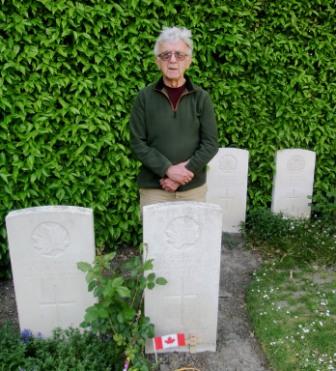
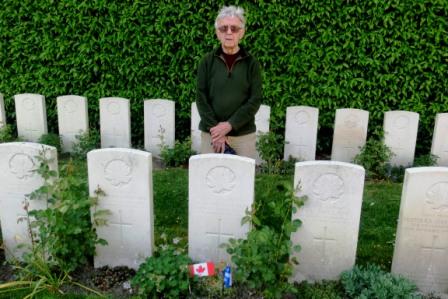
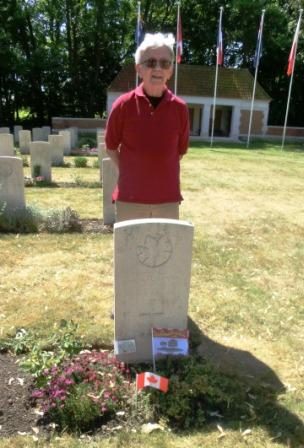
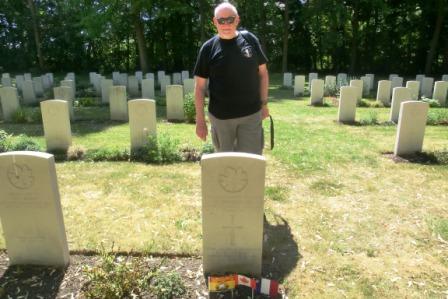
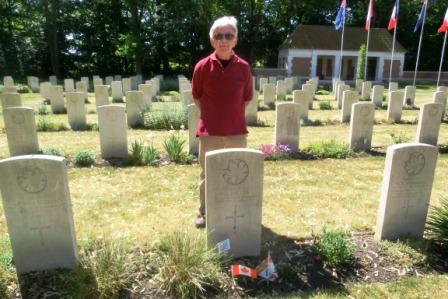
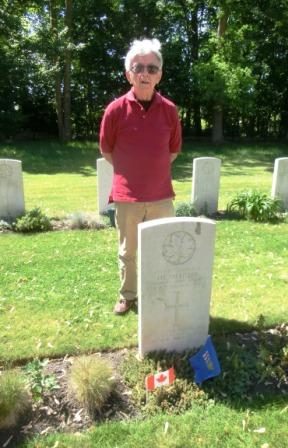
Pieter stands behind the grave of Joseph Augustine MacKenna.  (Photo credit: Daria Valkenburg)

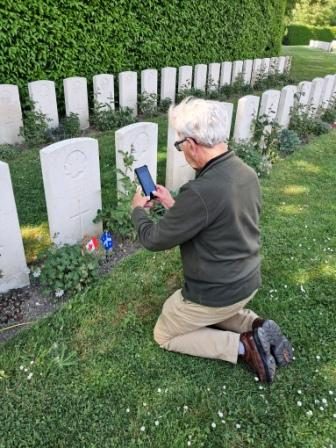
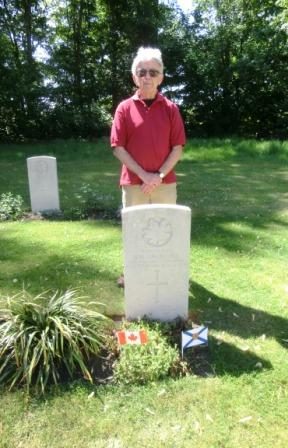
Joseph was buried at the Canadian War Cemetery in Adegem, Belgium on June 24, 1945.  We visited his grave during our 2025 European War Memorial Tour, and Pieter placed flags of Canada and Prince Edward Island at his grave. 

This was the second story written about a canal drowning in Ghent!  New Brunswick soldier Azade BOUDREAU also drowned in a canal in Ghent in 1945. See https://onthewarmemorialtrail.com/2025/12/15/on-the-war-memorial-trail-the-wwii-soldier-from-petit-rocher-nord-who-accidentally-drowned-in-a-belgian-canal/

….A surprise encounter in the Canadian War Cemetery in Holten….

Amy Meunier (left) with Daria and Pieter at the Canadian War Cemetery in Holten.  (Photo credit: Ben Miller)

When Mike Gorman had learned that we would be in Europe for the 80th Anniversary of Liberation Commemoration events, he mentioned that we might meet up with Amy Meunier, who works for Veterans Affairs.  “Amy is my 1st cousin’s (Duane Gorman) ex…

We didn’t think anything about it, but then, when we were at the Canadian War Cemetery in Holten, The Netherlands for the grave re-dedication ceremony for WWII soldier Arthur VANANCE of Kenora, Ontario, Paul Ledwell, Deputy Minister of Veterans Affairs, was in attendance with several people from Veterans Affairs.  One of them was Amy!  (See https://onthewarmemorialtrail.com/2025/08/22/on-the-war-memorial-trail-the-wwii-soldier-from-kenora-who-lay-in-an-unknown-grave-for-80-years-part-2-the-grave-re-dedication-ceremony/)

Paul called Amy over and once she realized that we were the people that Mike had told her about, she said “…OMG, my son Levi will love this…”  This surprise encounter helped bridge the past with the present, helping to ensure that those buried overseas will not be forgotten.

The flags placed at Joseph’s grave were donated.  Our thanks go to: 

  • Alan Waddell, Constituent Assistant, on behalf of Heath MacDonald, MP for Malpeque, for the Canadian flag.
  • Matt MacFarlane, MLA for District 19, Borden-Kinkora, for the flag from Prince Edward Island.

Thank you to Joseph’s grandson Mike Gorman and Joseph’s niece Mary McKenna MacPherson for sharing photos and information. Thank you also to Teresa Hennebery. We’ll continue to share the highlights of our adventures on the 2025 European War Memorial Tour. 

The research work continues for Pieter.  If you have photos or information to share about soldiers buried in The Netherlands or Belgium, please email him at memorialtrail@gmail.com, or comment on the blog.    

© Daria Valkenburg

….Another Canadian Army Forestry Corps story….

This was the second story written on this blog about the CAFC.  Edgar M. GUITARD of New Brunswick also served in the Canadian Army Forestry Corps.  You can read his story at https://onthewarmemorialtrail.com/2024/06/24/on-the-war-memorial-trail-the-wwii-lumberjack-from-belledune-killed-by-stray-mortar-fire-in-the-nijmegen-salient/

….Want to follow our research?…

If you are reading this posting, but aren’t following our research, you are welcome to do so.  Our blog address: https://onthewarmemorialtrail.com/
4 countries, 6 weeks, 7,000 km – an unforgettable war memorial journey in Europe…. Daria’s book ‘No Soldier Buried Overseas Should Ever Be Forgotten‘ is available in print and e-book formats.  Net proceeds of book sales help support research costs and the cost of maintaining this blog. For more information see https://nosoldierforgotten.com/

Subscribe to our YouTube Channel: On The War Memorial Trail With Pieter Valkenburg: https://www.youtube.com/channel/UCJ591TyjSheOR-Cb_Gs_5Kw

Never miss a posting!  Subscribe below to have each new story from the war memorial trail delivered to your inbox.
On The War Memorial Trail….. The WWII Soldier From Petit Rocher Nord Who Accidentally Drowned In A Belgian Canal

Pieter beside the sign welcoming us to Petit Rocher, New Brunswick. (Photo credit: Daria Valkenburg)

December 15, 2025. Pieter’s research results are faster than I can keep up with, and so several of the graves we visited during our 2025 European War Memorial Tour were for soldiers whose stories have yet to be told. One of the cemeteries we visited was the Canadian War Cemetery in Adegem, Belgium. (See https://onthewarmemorialtrail.com/2025/12/08/on-the-war-memorial-trail-a-visit-to-the-canadian-war-cemetery-in-adegem/

Azade BOUDREAU, a soldier from New Brunswick, who is buried in this cemetery, became the focus of Pieter’s research after receiving a request from Belgian researcher Patrick Michiels.  The son of a former colleague of his had adopted the grave and wanted to know what he looked like.

….The search for a photo of Azade was successful….

The search for a photo of Azade led us to my hometown of Winnipeg, where Pauline Theriault, the daughter of his sister Alice May, lives. “….Here is a photo of my uncle Azade Boudreau….”  Pauline explained. “…I had reached out to my cousin in Montreal and she had the same photo. She also confirmed that her mother had always told her that Azade had drowned at war….

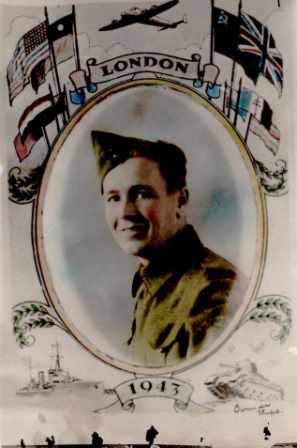
Azade Boudreau, taken in 1943 in the United Kingdom.  (Photo Courtesy of the Boudreau Family)

….Azade was born in Petit Rocher Nord…

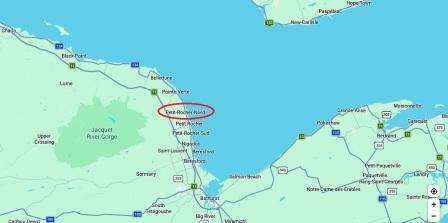
Petit Rocher Nord is located along the shore of Chaleur Bay.  (Map source: Google maps)

Born January 31, 1923 in Petit Rocher Nord, New Brunswick, Azade was the son of Frank J. and Marguerite (nee Doucet) Boudreau.  He was one of 9 children, with 4 brothers and 4 sisters.  We’d visited this beautiful part of New Brunswick in 2024. 

….Azade enlisted shortly after his 19th birthday…

At the time of his enlistment on March 9, 1942 with the 58th Field Battery, Royal Canadian Artillery, in Quebec City, Quebec, Azade, now aged 19, had worked a number of odd jobs as a store clerk and cook’s helper.  He was noted he was fluent in both French and English, and enjoyed skating, as well as playing hockey and baseball. When asked by an interviewer why he joined the army, he stated his reason was ‘adventure’….not an uncommon answer by so many young men.

Working as a waiter in the Officers Mess, he was attached to No. 5 District Depot in Quebec City until May 14, 1942, when he was sent to the No. 53 Canadian Army (Basic) Training Centre (CABTC) in Lauzon, Quebec. 

After successfully completing his basic training, Azade returned to No. 5 District Depot in Quebec City on June 20, 1942.  He was there for a few weeks before being transferred to the 4th Medium Regiment, Royal Canadian Artillery, in Petawawa, Ontario on July 14, 1942 for final training before going overseas. 

….Azade left Canada for overseas service….

On August 8, 1942, Azade left Canada with the 4th Medium Regiment.  Upon arriving in the United Kingdom, the Regiment came under the command of HQ Canadian Corps Medium Artillery.  

Azade, who was identified as being very deft mechanically, was a gun layer, responsible for aiming and firing large guns, using either manual controls or emerging radar/fire-control systems, and working with optical rangefinders.  It was a responsibility that required high skill and tactical awareness.

An October 1942 army interviewer noted that he was neat in appearance, had a cheerful disposition, and liked the army and what he was doing.

The Regiment transferred to 2nd Canadian Army Group Royal Artillery (AGRA) on October 15, 1943.

….The Regiment arrived in France in July 1944….

Azade and the 4th Medium Regiment continued training while in the United Kingdom, but on July 5, 1944, a month after D-Day, they left for Normandy, as part of the 21st Army Group, arriving in Normandy 2 days later. 

Over the next months, they made their way through France and into Belgium as part of the North-West Europe Campaign.  On September 5, 1944, Azade received a promotion to Lance Bombadier. 

 ….Azade accidentally drowned in Belgium…

On December 15, 1944, while the Regiment was in Belgium, Azade, accompanied by Private W. T. SHORTT, was in Ghent.  According to an account by Pte Shortt, they “…went visiting the various cafes in Ghent.  On our way home we dropped into the ice cream parlour near the bridge. After eating our ice cream….” Azade “…said he was going to the toilet.  We went out the door, which presumably led to the toilet, but it was the balcony along the canal. He went to the rail….” and the next thing that Pte Shortt knew was that Azade had fallen into the canal of the Lower Scheldt River.

…I shone my torch on him and yelled ‘man in the canal’.  A light on the bridge seemed to pick him up and I put my torch out and went through the ice cream parlour to the bridge. When I arrived there, there was no sign of anyone with a torch…”  Azade “…had also disappeared… 

 ….Azade’s body was found 5 months later…

5 months after he fell into the canal, Azade’s body was found on May 18, 1945 in a sluice in the Lower Scheldt, near Laurent Place in Ghent. His body was taken to the morgue at No. 2 Canadian General Hospital. An examination to verify his identity determined it was the body of a Canadian soldier.  A letter and photograph in one of the pockets of his clothing had disintegrated from being in the water for so long, leaving no clues to follow up.   However, the location of where the body was found, and with the height of the body, and a dental plate matching Azade, it was determined that it was him.

 ….Azade is buried in the Canadian War Cemetery in Adegem…

Azade was temporarily buried on May 21, 1945 at the Ghent West Cemetery in Belgium before being reburied on August 28, 1945 at the Canadian War Cemetery in Adegem, Belgium.

Pieter stands behind the grave of Azade Boudreau.  (Photo credit: Daria Valkenburg)

We visited his grave during our 2025 European War Memorial Tour, and Pieter placed Acadian, Canadian, and New Brunswick flags at his grave. 

Patrick Michiels at the grave of Azade Boudreau.  (Photo credit: Daria Valkenburg)

Patrick Michiels, who had requested the photo search on behalf of his former colleague’s son, was with us in the cemetery to pay his respects to a young man who drowned, just one month before his 22nd birthday.

The flags placed at Azade’s grave were donated.  Our thanks go to: 

  • Alan Waddell, Constituent Assistant, on behalf of Heath MacDonald, MP for Malpeque, for the Canadian flag.
  • Jean-Claude D’Amours, MLA for Edmundston-Madawaska Centre, Minister responsible for Military Affairs, with the help of Cécile LePage, Province of New Brunswick, for the New Brunswick flag.
  • La Société acadienne de Clare at the request of Simone Comeau for the Acadian flags.

Thank you to Pauline Theriault for sharing a photo of her uncle. Thank you also to Patrick Michiels for joining us during our visit to Adegem. We’ll continue to share the highlights of our adventures on the 2025 European War Memorial Tour. 

The research work continues for Pieter.  If you have photos or information to share about soldiers buried in The Netherlands or Belgium, please email him at memorialtrail@gmail.com, or comment on the blog.    

© Daria Valkenburg

….Want to follow our research?…

If you are reading this posting, but aren’t following our research, you are welcome to do so.  Our blog address: https://onthewarmemorialtrail.com/

4 countries, 6 weeks, 7,000 km – an unforgettable war memorial journey in Europe…. Daria’s book ‘No Soldier Buried Overseas Should Ever Be Forgotten‘ is available in print and e-book formats.  Net proceeds of book sales help support research costs and the cost of maintaining this blog. For more information see https://nosoldierforgotten.com/

Subscribe to our YouTube Channel: On The War Memorial Trail With Pieter Valkenburg: https://www.youtube.com/channel/UCJ591TyjSheOR-Cb_Gs_5Kw

Never miss a posting!  Subscribe below to have each new story from the war memorial trail delivered to your inbox.

On The War Memorial Trail….The WWII Soldier From Piusville Killed During The Battle Of The Leopold Canal

December 10, 2025. In the course of his research into WWII soldiers buried in The Netherlands, Pieter soon learned that many Canadians who lost their lives during the Battle of the Scheldt are not only buried in the Canadian War Cemetery in Bergen Op Zoom in The Netherlands, but are also buried at the Canadian War Cemetery in Adegem, Belgium.

While most of the men buried in Adegem died during the operations for the clearance of the south bank of the Scheldt, many Canadians who lost their lives elsewhere in Belgium were also brought here for burial. Out of 848 Canadians buried here, 12 are from Prince Edward Island, and this spring an appeal went out in the local media for photos and information on the soldiers.

Pieter’s research results are faster than I can keep up with, and so several of the graves we visited during our 2025 European War Memorial Tour were for soldiers whose stories have yet to be told.  One of these is the subject of this posting….

….Steve Gallant’s niece had a photo of her uncle….

After reading about the appeal for photos in the County Line Courier newspaper, Pauline Stewart of New Annan, Prince Edward Island contacted us, writing that “we follow your memorial trail column.  In the last edition my uncle was mentioned….  Her uncle was Joseph Stephen ‘Steve’ GALLANT, of Piusville, who was serving with the Royal Winnipeg Rifles when he lost his life on October 11, 1944 at the age of 29.

At the time of Pauline’s email, we were still in Europe.  We sent her a photo taken of her uncle’s grave, and explained that Pieter would give her a call once we were home again.  She replied with a surprise. By the way the Two Bulger Boys from Foxley River are my husband’s uncles…” 

Last year, a two-part series on Harold ‘Hal’ Gabriel BULGER, who is buried in Adegem, and his brother Lawrence William BULGER, who is buried in the Canadian War Cemetery in Groesbeek, was published. (You can read Lawrence’s story at https://onthewarmemorialtrail.com/2024/08/19/on-the-war-memorial-trail-the-bulger-brothers-part-2-the-wwii-stretcher-bearer-from-foxley-river-killed-during-the-battle-of-bienen/ and Hal’s at https://onthewarmemorialtrail.com/2024/08/05/on-the-war-memorial-trail-the-bulger-brothers-part-i-the-wwii-soldier-from-foxley-river-killed-during-the-battle-of-moerbrugge/)

Pauline and Charles Stewart with Pieter. (Photo credit: Daria Valkenburg)

A few months later, we had a chance to meet with Pauline and her husband Charles.  Pauline explained that her father, John P. Gallant, was Steve’s brother. Another brother, Vincent, also served during WWII, but survived. “…Steve was the groomsman at the marriage of my parents….

She recalled that “….Steve was on leave right after I was born in August 1944, and he died a few months later….

Born in Piusville, Prince Edward Island on July 31, 1915, Joseph Stephen ‘Steve’ GALLANT was the son of Archie and Jannie Gallant.  He had 5 brothers and 1 sister.

….Steve enlisted in 1942…

Joseph Stephen ‘Steve’ Gallant.  (Photo Courtesy of Pauline and Charles Stewart On Behalf Of The Gallant Family)

Steve originally enlisted under the National Resources Mobilization Act (NRMA) at the No. 6a NRMA Clearing Depot in Charlottetown, Prince Edward Island on May 15, 1942 and began basic training at No. 62 Canadian Army Basic Training Centre in Charlottetown. At the time, he stated that he’d left school at the age of 12 after completing Grade 5, that he was working on his father’s farm in Piusville, and that he was fluent in both French and English.   (See https://en.wikipedia.org/wiki/National_Resources_Mobilization_Act)

….Steve transferred to the 5th SMAA S/L Troop…

After completing basic training on July 11, 1942, Steve was transferred to the 5th Special Mobile Anti-Aircraft Search Light Troop (5th SMAA S/L Troop) and was stationed at various airports, beginning with Ives Point, Nova Scotia, near Halifax. As explained in a Government of Canada history of the Royal Canadian Air Force during WWII, the main task of this unit was “…to provide realistic training to aircrews – the terrifying experience of being ‘coned’ by enemy anti-Aircraft battery searchlights….” (See https://www.canada.ca/en/air-force/corporate/wings/14-wing/history.html)

On October 5, 1942, Steve enlisted in the Active Army in Halifax, Nova Scotia, and remained with the 5th SMAA S/L Troop.  A few days later, on October 8, 1942, he was attached to No. 6 Detachment, Royal Canadian Ordnance Corps (RCOC) in Debert, Nova Scotia, for a month.

He was next attached to No. 34 Operational Training Unit (OTU) of the Royal Air Force in Pennfield, New Brunswick.  An airport had been built in 1940 to train Air Observers as part of the British Commonwealth Air Training Plan (BCATP). The Operational Training Unit at the airport was used to train four crew members for World War II action: Pilot, Navigator, Wireless Air Gunner and Air Gunner. (See https://en.wikipedia.org/wiki/British_Commonwealth_Air_Training_Plan)

A month later, Steve was attached to No. 36 Operational Training Unit (OTU) of the Royal Air Force in Greenwood, Nova Scotia.  The site for RAF Station Greenwood, which opened in 1942, had been chosen by the Royal Canadian Air Force (RCAF) and Royal Air Force for an airfield as part of the British Commonwealth Air Training Plan (BCATP) due to the area having a relatively fog-free climate.

On February 2, 1943, Steve was again attached to No. 6 Detachment, Royal Canadian Ordnance Corps (RCOC) in Debert, Nova Scotia, for a few months.  Then, on May 8, 1943, he was again attached to No. 36 Operational Training Unit (OTU) in Greenwood, Nova Scotia.

A month later, he was attached again to No. 34 Operational Training Unit (OTU) in Pennfield, New Brunswick for 2 months before returning to No. 36 Operational Training Unit (OTU) in Greenwood, Nova Scotia. While in Greenwood, Steve was sent ‘On Command’ to Winnipeg, Manitoba, on October 10, 1943.

….Steve left Canada for overseas service….

On March 27, 1944, Steve was transferred to the 21st Anti-Aircraft Regiment of the Royal Canadian Artillery, and posted to 1st Anti-Aircraft Searchlight (AA S/L) Battery in Halifax, Nova Scotia, for additional training as a gunner. A few weeks later, on April 22, 1944, he was sent to No. 1 Transit Camp in Windsor, Nova Scotia in preparation for overseas duty.

Steve was granted embarkation leave from May 5 to 9, 1944. It must have been a bittersweet time as he didn’t return back until May 12, 1944, resulting in the forfeiture of 3 days pay and allowance and being confined to barracks for 4 days. 

On May 20, 1944, Steve was sent to the No. 1 Training Battalion of the Canadian Infantry Corps in Debert, Nova Scotia for final training and preparation for overseas service.  On July 21, 1944, he was transferred to the Training Brigade Group in Debert.  He was granted another leave from August 3 to 15, 1944, in what turned out to be the last time he would ever see his family again.

On August 29, 1944, Steve left Canada for the United Kingdom.  Upon arriving on September 4, 1944 he was assigned to No. 4 Canadian Infantry Reinforcement Unit (CIRU). 

He wasn’t in the United Kingdom even a month when he was transferred to the X4 Reinforcement List for the Canadian Base Reinforcement Group (CBRG), part of the 13th Battalion, 21st Army Group, on October 1, 1944 and sent to Northwest Europe, arriving a day later.

….Steve lost his life during the Battle of the Leopold Canal….

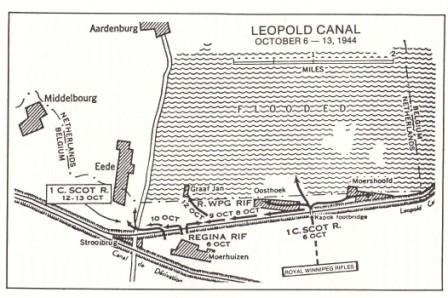
Map showing the Battle for the Leopold Canal.  (Map source: Little Black Devils: A History of the Royal Winnipeg Rifles)

On October 10, 1944, Steve was transferred to the Royal Winnipeg Rifles, joining the Regiment in the vicinity of the dike by Graaf Jan, The Netherlands, where they were engaged in fierce fighting during the Battle of the Leopold Canal on the border between The Netherlands and Belgium.   

The War Diary for October 10, 1944 for the Royal Winnipeg Rifles stated that the Commanding Officer had “… received orders to occupy the Southern approaches to the village of GRAAF JAN. With A Company giving covering fire, B Company succeeded in reaching the objectives at 1500 hrs. Superior enemy forces in the village forced the company to withdraw when ammunition was getting low….

The War Diary for October 11, 1944 noted numerous casualties.  “…Cloudy and cool with slight rain in the afternoon. Visibility poor. During the morning A Company assisted the Regina Rifles in destroying an enemy held pill box. Another C Company patrol to GRAAF JAN failed to contact the enemy…. Enemy shelling was slightly less intense than during the first three days. Small Arms fire continued to make it extremely difficult and dangerous to move about. Supplies and casualties were still ferried across the Canal. Capt H.C. Chadderton of C Company and Lt L. Mendels of B Company were among the numerous casualties for the day….” 

Unfortunately, Steve was one of the ‘numerous casualties’ referred to in the war diary.  He was 29 years old.

….Steve is buried in the Canadian War Cemetery in Adegem….

Steve is buried in the Canadian War Cemetery in Adegem, Belgium. We visited his grave on a very hot Sunday this past May, where Pieter placed Acadian, Prince Edward Island, and Canadian flags in remembrance.

Pieter by the grave of Joseph Stephen ‘Steve’ Gallant. (Photo credit: Daria Valkenburg)

….Steve’s mother wanted answers….

On November 13, 1944, a distraught and upset Jannie Gallant – Steve’s mother – wrote to the Department of National Defence, asking questions that so many mothers of soldiers must have had.  “….I received a telegram on October 20 stating that …” Steve had been killed on October 11. “…We haven’t received any more news since.  It makes a very sad house. My husband has been in ill health since 1933. It was a great shock to him and also to me...

She explained that they had received two letters from him once he left Canada.  “…We received a letter from him on the 29th of September and he was still in England, and we received one that was written on October the 7th and he was already in Belgium…” 

Then came the hard question and a query as to whether he was really dead.  “…I want to know how much training that boy had to be sent that soon to Belgium as a rifleman with no training as a rifleman.  I hope that the boy is still living as he was a great help to his father and also to myself….” 

She ended by saying that “…I want to know the particulars of him if he is dead or living….

Mrs Gallant did receive a reply from Lt Cameron, Military Secretary, on November 18, 1944, offering sympathies and explaining that Steve had “…received careful training during the period he was in England and that he would not have been permitted to proceed until he was declared trained…

The reality was that training couldn’t fully prepare a soldier for actual combat. To make things worse, Steve had been sent to the Royal Winnipeg Rifles in the midst of a battle, with not even the chance to get to know the men in the Company he was assigned to.

Thank you to Pauline and Charles Stewart for providing photos and information on Pauline’s uncle. If you have a story to tell, or can provide a photo of one of the soldiers from Prince Edward Island buried in Adegem, please email Pieter at memorialtrail@gmail.com or comment on the blog. 

© Daria Valkenburg

….The 12 soldiers from Prince Edward Island who are buried in Adegem….

  1. Harold ‘Hal’ Gabriel BULGER of Foxley River was serving with the Algonquin Regiment when he was killed during the Battle of Moerbrugge in Belgium on September 10, 1944, at the age of 26.  
  2. Charles John ACORN of Peters Road was serving with the North Nova Scotia Highlanders when he lost his life on October 15, 1944 at the age of 22. A poor quality newspaper photo was found.
  3. William Henry DEVEAUX of Dundee was serving with the North Nova Scotia Highlanders when he lost his life on October 16, 1944 at the age of 23.
  4. Joseph Stephen GALLANT of Piusville was serving with the Royal Winnipeg Rifles when he lost his life on October 11, 1944 at the age of 29.
  5. Cecil Aneas MACDONALD of Glencoe was serving with the North Shore (New Brunswick) Regiment when he lost his life on October 15, 1944 at the age of 23. NOTE: The Belgian family that adopted his grave would like to be in contact with a family member.
  6. Joseph ‘Joe’ Augustine MACKENNA of Newton Cross was serving with Auxiliary Service as a member of the Knights of Columbus when he drowned in Belgium on June 21, 1945 at the age of 41. 
  7. Adolphus Peter MCCORMACK of New Zealand was serving with the Regina Rifle Regiment when he lost his life on October 30, 1944 at the age of 25.
  8. James Hector MUNN of New Zealand was serving with the Regina Rifle Regiment, 1st Battalion, when he lost his life on October 30, 1944 at the age of 28.
  9. Valmont PERRY of St. Louis was serving with the Stormont, Dundas and Glengarry Highlanders when he lost his life on October 21, 1944 at the age of 26. No photo has been found of him to date.
  10. Allan Rattenbury READ of Read’s Corner was serving with the Regina Rifle Regiment when he lost his life on October 27, 1944 at the age of 21. A poor quality newspaper photo was found.
  11. John James SAUNDERS of Bloomfield was serving with the South Saskatchewan Regiment when he lost his life on September 22, 1944 at the age of 27. No photo has been found of him to date.
  12. Joseph Roy SILLIPHANT of Summerside was serving with the North Nova Scotia Highlanders when he lost his life on October 27, 1944 at the age of 28. A poor quality newspaper photo was found.

….Want to follow our research?…

If you are reading this posting, but aren’t following our research, you are welcome to do so.  Our blog address: https://onthewarmemorialtrail.com/

4 countries, 6 weeks, 7,000 km – an unforgettable war memorial journey in Europe…. Daria’s book ‘No Soldier Buried Overseas Should Ever Be Forgotten‘ is available in print and e-book formats.  Net proceeds of book sales help support research costs and the cost of maintaining this blog. For more information see https://nosoldierforgotten.com/

Subscribe to our YouTube Channel: On The War Memorial Trail With Pieter Valkenburg: https://www.youtube.com/channel/UCJ591TyjSheOR-Cb_Gs_5Kw

Never miss a posting!  Subscribe below to have each new story from the war memorial trail delivered to your inbox.
On The War Memorial Trail….A Visit To The Canadian War Cemetery In Adegem

Pieter (left) with Patrick Michiels at the Canadian War Cemetery in Adegem.  The bags by Pieter’s feet contain flags!  (Photo credit: Daria Valkenburg)

December 8, 2025.  Readers of this blog are aware that Pieter has been involved in finding photos of Canadians who are buried in The Netherlands since 2014.  This past spring we were in The Netherlands and Belgium for the 80th Anniversary of Liberation Commemoration events, and placed flags at the graves of 383 soldiers in 14 cemeteries. 

….Flags placed at the graves of soldiers from 8 provinces…

After visiting a number of cemeteries in The Netherlands during our 2025 European War Memorial Tour, we made our way into Belgium. The first cemetery there that we visited was the Canadian War Cemetery in Adegem.  Many Canadians who lost their lives during the Battle of the Scheldt are not only buried in the Canadian War Cemetery in Bergen Op Zoom in The Netherlands, but are also buried at the Canadian War Cemetery in Adegem, Belgium.

While most of those buried in Adegem died during the operations for the clearance of the south bank of the Scheldt, many Canadians who lost their lives elsewhere in Belgium were also brought here for burial.  

There are 1,119 WWII Commonwealth burials, 848 of them Canadian, and one unidentified burial from WWI. There are also 33 Polish and two French burials.  Flags were placed by Pieter at 29 graves at this cemetery:

  • 3 were from Nova Scotia
  • 2 from New Brunswick
  • 12 from Prince Edward Island
  • 2 from British Columbia
  • 2 from Saskatchewan
  • 3 from Manitoba
  • 1 from Alberta
  • 4 from Ontario

4 of the graves also received an Acadian flag.  All of the graves received a Canadian flag.  Provincial flags were placed at all graves, with the exception of the soldiers from British Columbia and Saskatchewan, for which, unfortunately, we did not receive flags.

….This was our first visit to Adegem…

Our journey to the cemetery in Adegem had a few hiccups.  It started with a mistake on my part, when I left my tablet behind at the hotel in Zaltbommel, and didn’t realize it was missing until we were half an hour into our journey to Adegem and had to turn around and go back.  Luckily, it was still in the hotel room, and we were on our way again. 

Then the GPS couldn’t find the cemetery and we got lost before Pieter’s good sense of direction got us to the cemetery….1 ½ hours later than planned.

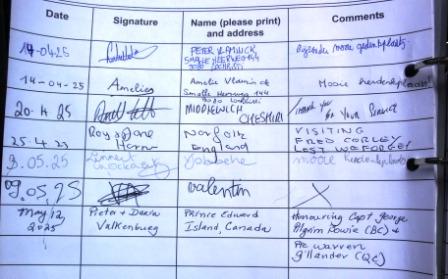
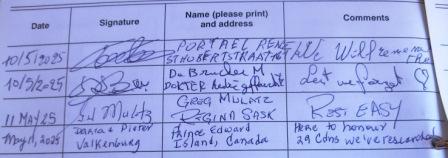
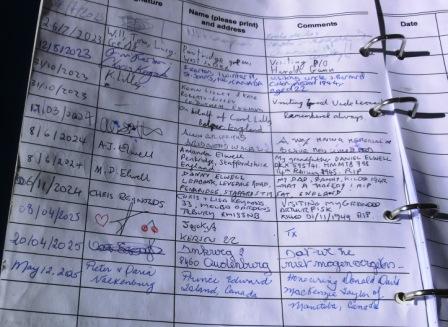
As always, when we are in a war cemetery, we write an entry in the visitors’ book.  (Photo credit: Daria Valkenburg)

We were joined by Patrick Michiels, a Belgian researcher, who had been so helpful to us over the past few years in taking photos of graves of soldiers that Pieter had researched, even going on Christmas Day last year to take photos of the Christmas Eve candles at their graves.  (See https://onthewarmemorialtrail.com/2024/12/31/2024-christmas-eve-candle-lighting-at-the-canadian-war-cemetery-in-adegem/)

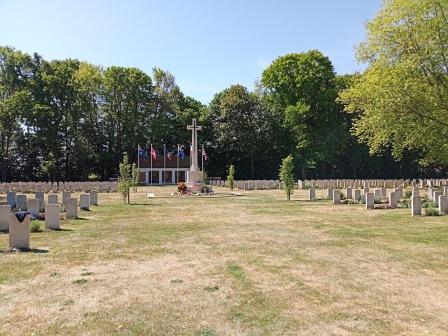
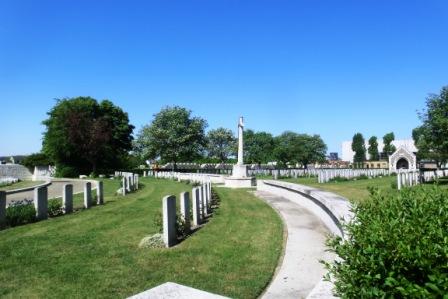
Overview of the Canadian War Cemetery in Adegem with the Cross of Sacrifice.  (Photo credit: Daria Valkenburg)

It took over 2 hours for Pieter to place the flags and to photograph each of the 29 graves, with a slight delay caused when Pieter cut his hand on a sharp knife that Patrick had lent him so he could poke a hole into the very dry soil in order to get the flags placed.  There was no real damage to his hand, but lots of blood!  It didn’t help that it was over 30oC (86oF) and the hot sun was beating down on us, making it feel hotter.

…4 soldiers whose stories were previously told are commemorated…

The graves and photos of 4 soldiers, whose stories have previously been told on this blog, are featured.

Pieter stands behind the grave of Harold ‘Hal’ Gabriel Bulger.  (Photo credit: Daria Valkenburg)

Harold ‘Hal’ Gabriel BULGER of Foxley River, Prince Edward Island, was serving with the Algonquin Regiment when he was killed during the Battle of Moerbrugge in Belgium on September 10, 1944, at the age of 26. You can read his story at https://onthewarmemorialtrail.com/2024/08/05/on-the-war-memorial-trail-the-bulger-brothers-part-i-the-wwii-soldier-from-foxley-river-killed-during-the-battle-of-moerbrugge/

Pieter stands behind the grave of Bruce Wilbur Churchill.  (Photo credit: Daria Valkenburg)

Bruce Wilbur CHURCHILL, born in Sandford, Yarmouth County, Nova Scotia, was serving with the Algonquin Regiment when was accidentally killed at the age of 23 on September 29, 1944 in The Netherlands when a bullet from a Bren Gun ricocheted and hit him.  You can read his story at https://onthewarmemorialtrail.com/2022/06/05/on-the-war-memorial-trail-the-ww2-soldier-who-lost-his-life-in-a-monastery-garden/

Pieter stands behind the grave of Joseph ‘Joe’ Hudson Pallister.  (Photo credit: Daria Valkenburg)

Joseph ‘Joe’ Hudson PALLISTER, born in Calgary, Alberta, was serving with the Canadian Scottish Regiment when he was killed during the Battle of the Leopold Canal in Belgium on October 6, 1944, aged 21.  You can read his story at https://onthewarmemorialtrail.com/2023/06/18/on-the-war-memorial-trail-1-wwii-soldier-2-families-3-countries/

After we sent photos of our visit to Joseph’s grave to his great-nephew, Thomas Mouser, he not only thanked us, but shared a letter written by Captain John ‘Jack’ Lawrence GALLAGHER to Joseph’s mother about her son…. 

….I wish to express my deepest sympathies to you on the loss of your son, Joe.  He was with the battalion for a long time, and was with me in ‘C’ Company from D-Day until the severe action in which he was killed.

During that time he became liked by everyone for his easy-going good humour and respected for his coolness in action and resourcefulness as our NCO. 

I can only say that he was killed instantly while carrying out his job, and that his conduct in that battle and all others that he participated in was an example to us all….”  

What a heartfelt letter of sympathy to a grieving mother! Captain Gallagher survived WWII, with the rank of Major and a Croix de Guerre (Bel) with Palm, and passed away in 2012. (See https://www.legacy.com/us/obituaries/legacyremembers/john-gallagher-obituary?id=44106495)

Pieter stands behind the grave of Edison Reynolds Smith.  (Photo credit: Daria Valkenburg)

Edison Reynolds SMITH, born on Port Hood Island, Cape Breton, Nova Scotia, was serving with the North Nova Scotia Highlanders when he lost his life in The Netherlands on October 16, 1944 during the Battle of the Scheldt, at the age of 20.  You can read his story at https://onthewarmemorialtrail.com/2023/12/07/on-the-war-memorial-trail-part-1-the-wwii-letters-of-edison-reynolds-smith/ and https://onthewarmemorialtrail.com/2023/12/12/on-the-war-memorial-trail-part-2-the-wwii-letters-of-edison-reynolds-smith/

….Photos of 3 soldiers from Prince Edward Island are sought…

Photos are still being sought for three soldiers from Prince Edward Island who are buried in Adegem:

  • Valmont PERRY of St. Louis was serving with the Stormont, Dundas and Glengarry Highlanders when he lost his life on October 21, 1944 at the age of 26.
  • Allan Rattenbury READ of Read’s Corner was serving with the Regina Rifle Regiment when he lost his life on October 27, 1944 at the age of 21.
  • John James SAUNDERS of Bloomfield was serving with the South Saskatchewan Regiment when he lost his life on September 22, 1944 at the age of 27.  

If you have photos or information to share about these men, please let Pieter know.

….All of the flags placed at graves were donated…

All of the flags placed at graves were donated.  Our thanks go to:

  • Alan Waddell, Constituent Assistant, on behalf of Heath MacDonald, MP for Malpeque, for the Canadian flags.
  • Matt MacFarlane, MLA for District 19, Borden-Kinkora, for the flags from Prince Edward Island.
  • Kyle Graham, Research Officer, Military Relations, Nova Scotia Intergovernmental Affairs, on behalf of Premier Tim Houston, Province of Nova Scotia, for the Nova Scotia flags.
  • Wayne Ewasko, MLA for Lac Du Bonnet, Manitoba, Interim Leader of the Official Opposition, Province of Manitoba, who donated the Manitoba flags.
  • Don Coutts on behalf of the Muttart and Coutts families in memory of Flight Sergeant Elmer Bagnall Muttart for the Ontario flags.
  • Jean-Claude D’Amours, MLA for Edmundston-Madawaska Centre, Minister responsible for Military Affairs, with the help of Cécile LePage, Province of New Brunswick, for the New Brunswick flags.
  • Marie Renaud, MLA St Albert, Alberta at the request of Roman Berezowsky, for the Alberta flag.
  • La Société acadienne de Clare at the request of Simone Comeau for the Acadian flags.

Thank you to Patrick Michiels for joining us during our visit to Adegem.  Thank you also to Thomas Mouser for sharing the letter of sympathy written by Captain Gallagher.  We’ll continue to share the highlights of our adventures on the 2025 European War Memorial Tour. 

The research work continues for Pieter.  If you have photos or information to share about soldiers buried in The Netherlands or Belgium, please email him at memorialtrail@gmail.com, or comment on the blog.    

© Daria Valkenburg

….Want to follow our research?…

If you are reading this posting, but aren’t following our research, you are welcome to do so.  Our blog address: https://onthewarmemorialtrail.com/

4 countries, 6 weeks, 7,000 km – an unforgettable war memorial journey in Europe…. Daria’s book ‘No Soldier Buried Overseas Should Ever Be Forgotten‘ is available in print and e-book formats.  Net proceeds of book sales help support research costs and the cost of maintaining this blog. For more information see https://nosoldierforgotten.com/

Subscribe to our YouTube Channel: On The War Memorial Trail With Pieter Valkenburg: https://www.youtube.com/channel/UCJ591TyjSheOR-Cb_Gs_5Kw

Never miss a posting!  Subscribe below to have each new story from the war memorial trail delivered to your inbox.
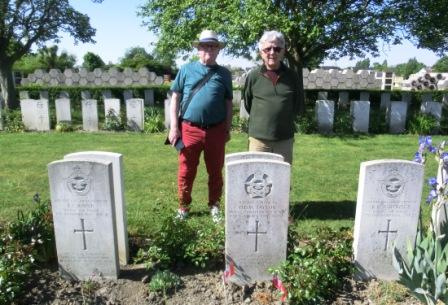
On The War Memorial Trail….Flags and Pins Received For Our 2025 European War Memorial Tour

June 4, 2025.  When Pieter decided he wanted to go to Europe for the 80th Anniversary of the Liberation of Europe in May 2025, planning began over a year in advance.  This would be our most ambitious war memorial tour, and Pieter wanted to ensure that the graves in The Netherlands and Belgium of as many of the soldiers and airmen that he’d researched over the past 11 years would be visited. He had a vision of being able to place, not only Canadian flags by the graves, but also provincial, and, where appropriate, Acadian flags.

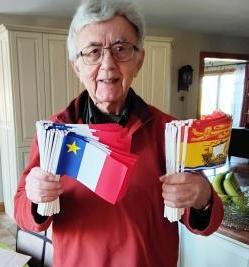
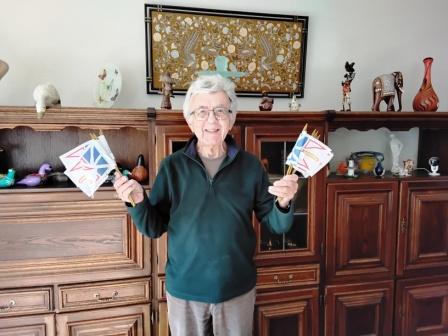
A project like this didn’t happen overnight, and we needed help with donations of flags in order to meet Pieter’s goal.  Requests for flags began in the summer of 2024, and in the end we received donations of flags from most provinces.  Some came from provincial governments, others from politicians, and quite a few were donated by families of soldiers that had been researched, or readers of this blog. 

….Flags placed at 383 graves visited at 14 cemeteries.…

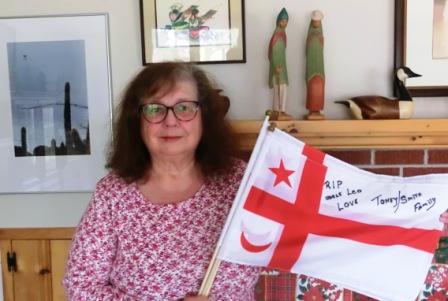
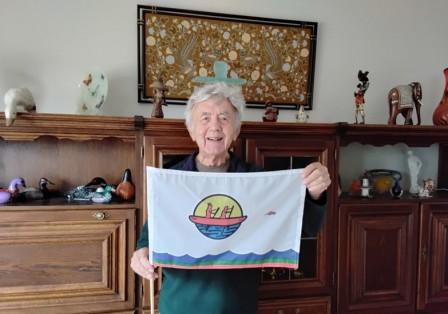
In addition, we received flags to place at the graves of two Indigenous soldiers, a very special tribute that we were honoured to be involved in.

We also received donations of Canadian flag pins and 80th anniversary pins to hand out, which were very popular with everyone we met along what turned out to be a 5 week journey along the war memorial trail.

By the time we returned back to Canada, Pieter had placed flags at 383 graves in 14 cemeteries in The Netherlands and Belgium!  We very much appreciate and want to recognize all who helped to provide flags and pins.

….Donations received of flags and pins…

We were blown away by the response to requests for flags, and the messages of support and encouragement we received.  The large Canadian flags were donated to small organizations in The Netherlands and Belgium who honour soldiers and airmen buried in smaller war cemeteries and in municipal or church cemeteries.  They also received small Canadian flags and flag pins. 

Some groups were involved with children in The Netherlands who are taught about the sacrifices made by Allied soldiers during WWII. We provided small Canadian flags, flag pins, and Frisbees for them to hand out.

Here below are the generous donors of flags and pins:

Pieter with Alan Waddell (right) from the office of Heath MacDonald with Canadian flags.  (Photo credit: Daria Valkenburg)

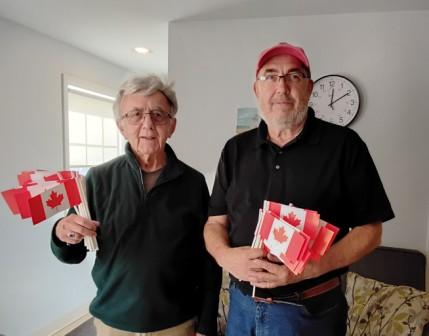
  • Alan Waddell, Constituent Assistant, on behalf of Heath MacDonald, MP (Member of Parliament) for Malpeque, Prince Edward Island and recently appointed as the Minister of Agriculture for the Government of Canada – small Canadian flags, flag pins, Frisbees
  • Mary Robinson, Senator for Prince Edward Island – large Canadian flags, flag pins
  • Jane MacAdam, Senator for Prince Edward Island – large Canadian flags

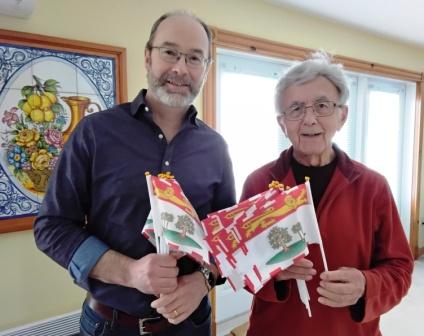
Matt MacFarlane (left) and Pieter hold flags from Prince Edward Island. (Photo credit: Daria Valkenburg)

  • Matt MacFarlane, MLA (Member of the Legislative Assembly) for District 19, Borden-Kinkora, Prince Edward Island – small PEI flags

After providing the flags from Prince Edward Island, Matt commented that “…I am happy to help with such important work…

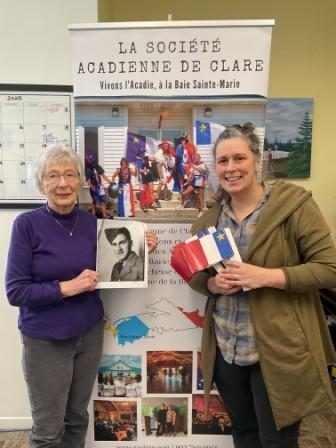
Simone Comeau (left) with Nathalie Robicheau. (Photo courtesy of Simone Comeau)

  • La Société acadienne de Clare at the request of Simone Comeau – small Acadian flags

For Simone, providing Acadian flags was very personal, to honour her uncle, Pte Joseph ‘Ambroise’ COMEAU. (See https://onthewarmemorialtrail.com/2021/05/17/on-the-war-memorial-trail-a-tragic-drowning-on-the-leda-river-in-germany-part-3/)  “…I picked up the flags yesterday. They are donated by ‘La Société acadienne de Clare.  Clare is the name of our municipality. In this picture we are standing in front of the banner of “La Société acadienne de Clare”. The lady presenting me the flags is the general director of the organization. Her name is Nathalie Robicheau and by coincidence she is the grand niece of J. Ambroise Comeau. Her father, my cousin, is the son of Ambroise’s other sister….” 

Pieter holds a selection of Acadian (left) and New Brunswick flags (right).  (Photo credit: Daria Valkenburg)

  • Jean-Claude D’Amours, MLA (Member of the Legislative Assembly) for Edmundston-Madawaska Centre, Minister responsible for Military Affairs, with the help of Cécile LePage, Province of New Brunswick – small New Brunswick and Acadian flags

For Cécile, helping to provide the flags was in honour of her uncle, Pte Ange Aimé LECLAIR. (See https://onthewarmemorialtrail.com/2024/11/27/on-the-war-memorial-trail-the-wwii-acadian-soldier-serving-with-le-regiment-de-maisonneuve-who-made-the-ultimate-sacrifice-in-the-hochwald-forest/)

  • Armel ‘Mel’ Lanteigne, President of the Caraquet Legion in New Brunswick – small New Brunswick flags, small Acadian flags, small Canadian flags

Pieter with flags of Newfoundland sent by Gerald Bartlett.  (Photo credit: Daria Valkenburg)

  • Gerald Bartlett in memory of Trooper John Frederick BARTLETT (whose story is yet to be written) – small Newfoundland flags
  • Mario Henry and his brother Etienne Henry – small Quebec flags
  • Kyle Graham, Research Officer, Military Relations, Nova Scotia Intergovernmental Affairs, on behalf of Premier Tim Houston, Province of Nova Scotia – small Nova Scotia flags

Kyle emailed us, saying “…as part of the Military Relations team for the Province, I am responding on behalf of …..” Premier Tim Houston.  “…Absolutely, our pleasure to support this…

Wayne enclosed a lovely note with the flags sent by his office. “…Thank you ….for the meaningful work you are doing to honour Canadian soldiers who made the ultimate sacrifice.  We are please to support your efforts.

We have enclosed ….Manitoba flags for your upcoming trip to The Netherlands for the 80th anniversary of the liberation.  We hope these flags will help commemorate the brave Manitoban soldiers and provide a special tribute at their gravesites….

  • Brad Robertson, Chief of Protocol, Government of Manitoba, on behalf of Wab Kinew, Premier of Manitoba

The flags were accompanied by a note from Brad, saying “…with thanks, on behalf of the Premier of Manitoba…

  • Peggy Menard – small Ontario flags
  • Don Coutts on behalf of the Muttart and Coutts families in memory of Flight Sergeant Elmer Bagnall MUTTART – small Ontario flags

Elmer Muttart was the first airman researched by Pieter, and his story has been extensively told on this blog.  You can read his story here:

  • Marie Renaud, MLA St Albert, Alberta at the request of Roman Berezowsky – small Alberta flags

….Two Indigenous flags received…

Daria with the very personalized Lnu flag to be placed at the grave of Leo Toney.  (Photo credit: Pieter Valkenburg)

Della explained that the term ‘Lnu’  means “the people, it’s what the Mi’kmaw people call themselves.  We are part of the Wabanaki Confederacy. People of the Dawnland, or People of the First Light. This area includes areas of NS, NB, PEI, eastern Quebec, and Maine. Made up of these nations Abenaki, Mi’kmaw, Penobscot, Passamaquoddy, and Wolastoqiyik …

Pieter holds the Wolasatoqey Nation flag to be placed at the grave of Sanford Steven Saulis. (Photo credit: Daria Valkenburg)

After I’d contacted Conrad to ask if the Wolastoqey used the same flag as the Mi’Kmaq, he replied that “….the Wolastoqey (we no longer recognize the term Maliseet) Nation is a distinct Nation of Peoples from the Mi’Kmaq much like the Portuguese are distinct from the Spanish yet have similar linguistic aspects. My Nation, along with the Mi’Kmaq, are two of the many First Nations that make up the Wabanaki Confederacy along with other Nations such as the Penobscot, Passamaquoddy, Abenaki, and other First Nation of the northeast seaboard as far as Manhattan.

Our Wolastoq Ancestors named our peoples after the Wolastoq river since it was a primary provider of water, fish and other foods including fiddleheads (mahsos) that grow along the river banks.  Our Ancestral lands intersect with the Mi’Kmaq through the central portions of NB covering the entirety of the Wolastoq River (St John River) from St. John to Rivere du Loup (St Lawrence) west towards Quebec City.…

Conrad then arranged to send a flag for his uncle’s grave, saying that  “…the flag is courtesy of Grand Chief Ron Tremblay – a fellow Wolastoqey Nation citizen and designer of the flag….” and represents “…a muskrat swimming in front of the two in the canoe which was our primary means of transportation during Ancestral times…..”  

….80th Anniversary pins received…

  • Wendy Sewell, Assistant Defence Attaché, Embassy of the Kingdom of the Netherlands in Canada – 80th Anniversary of the Liberation of The Netherlands pins
  • Gerry Blom, Owner/Operator of the Dutch Truck – 80th Anniversary of the Liberation of The Netherlands pins

Thank you to everyone who provided flags and pins.  Over the next several postings, we’ll share the highlights of our adventures on the 2025 European War Memorial Trail….and how the flags were placed at the various cemeteries along our journey of remembrance.

Meanwhile, now that we’re back home, the research work continues for Pieter.  If you have photos or information to share about soldiers buried in The Netherlands or Belgium, please email him at memorialtrail@gmail.com, or comment on the blog.    

© Daria Valkenburg

….Want to follow our research?…

If you are reading this posting, but aren’t following our research, you are welcome to do so.  Our blog address: https://onthewarmemorialtrail.com/

4 countries, 6 weeks, 7,000 km – an unforgettable war memorial journey in Europe…. Daria’s book ‘No Soldier Buried Overseas Should Ever Be Forgotten‘ is available in print and e-book formats.  Net proceeds of book sales help support research costs and the cost of maintaining this blog. For more information see https://nosoldierforgotten.com/

Subscribe to our YouTube Channel: On The War Memorial Trail With Pieter Valkenburg: https://www.youtube.com/channel/UCJ591TyjSheOR-Cb_Gs_5Kw

Never miss a posting!  Subscribe below to have each new story from the war memorial trail delivered to your inbox.
On The War Memorial Trail….. The WWII Soldier Who Lost His Life In A Monastery Garden

June 5, 2022. After seeing Pieter on the news during Remembrance Week 2021, Sylvia Churchill of Nova Scotia contacted us.  “My husband’s father, Bruce W. Churchill, was killed in Hulst, The Netherlands, buried there, and later exhumed after the war was over and buried in the Adegem Canadian War Cemetery.  He was killed in a garden near a Monastery while their Regiment was cleaning their Bren guns. He died instantly, on September 29, 1944.  My husband was born January 1945 and named after his father, Bruce W. Churchill (Jr). …”  (See https://onthewarmemorialtrail.com/2021/11/15/on-the-war-memorial-trail-ctvs-atlantic-live-at-5-update-on-the-photo-search-for-soldiers-buried-in-the-netherlands/)

Bruce W Churchill Sr Sep 21 1942

Bruce Wilbur Churchill in a September 21, 1942 photo.  (Photo courtesy of Bruce (Jr) and Sylvia Churchill)

Bruce Wilbur CHURCHILL was born April 17, 1921 in Sandford, Yarmouth County, Nova Scotia, the son of Ralph Lloyd and Ethel Mae Churchill.  He had 5 brothers and 6 sisters, and worked as a farm labourer and fisherman after leaving school at the age of 16.

…Bruce was not the only family member who served in the military…

When he enlisted in Yarmouth, Nova Scotia on October 10, 1939 with the 6th Anti-Aircraft Battery,  not only were 4 of his brothers in the Army, but also his father, who was a gunner.

Bruce’s service file noted that he played volleyball and swam, and liked to read popular magazines and novels.

On November 1, 1941, Bruce was transferred to the 1st Anti-Aircraft Search Light Battery as a member of the search light crew, all the time remaining in Canada, understandable given that 5 members of his family were already serving.  He had been a cook since April 11, 1940 and held the rank of Gunner.

He married Dora Mae Goodwin on February 14, 1942, and they became the parents of a daughter, Donna Fay, born in Argyle Sound, Nova Scotia on September 3, 1942.

…Bruce was anxious to serve overseas…

In an August 4, 1943 interview with the Personnel Selection Board of the Army, it was noted that Bruce was “…anxious to see action in an active theatre of war.  For this purpose he has volunteered for the parachute battalion…

Bruce didn’t meet the requirements for the parachute battalion, but was considered suitable for the artillery.

On February 14, 1944, Bruce and Dora Mae’s son Eric Bruce was born in Argyle Sound, but sadly he passed away on May 28, 1944.  May 28 is the same day that Bruce’s desire for overseas service was about to be granted, as he was transferred to the Canadian Infantry Training Centre (CITC) in Aldershot, Nova Scotia.

He was on his way to England as of August 3, 1944, arriving on August 10, and at his request, he changed from cook to general duty as of August 21, 1944.  He became part of the Canadian Infantry Reinforcement Unit (CIRU) and sent to France on September 4, 1944.

…Bruce lost his life when a gun ricocheted…

On September 15, 1944 he was transferred to the Algonquin Regiment. On September 29, 1944, he lost his life in Hulst, The Netherlands, accidentally killed when a Bren gun ricocheted.

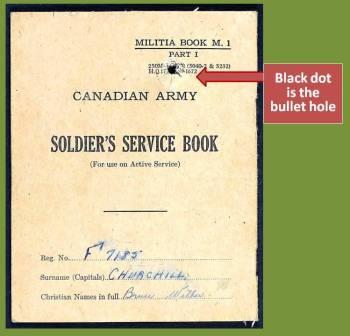
Soldiers Service Book with bullet hole

Soldier’s Service Book showing the bullet hole.  (Image courtesy of Bruce (Jr) and Sylvia Churchill)

Among the documents that Sylvia shared was “…the first page of Bruce Churchill Sr.’s Soldier’s Service Book. I want to point out the bullet hole in that book (which is on all the other pages) ….he obviously was wearing that when he died. How sad to see that….

When Bruce died, his wife Dora Mae was pregnant with their son Bruce, who was born in January 1945.

…Account of the accident by George Spittael…

cms_visual_1335496.jpg_1582646467000_600x858An account of the incident was recorded by George E. Spittael of Belgium in his book ‘Librera Me’, published in 1989 in Flemish.  By September 27, 1944, several companies were given a rest period in Hulst while others patrolled the shoreline of the Scheldt.

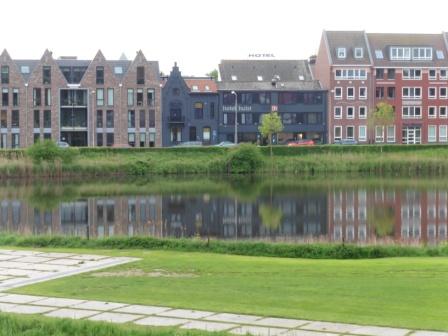
A translated excerpt from September 29, 1944 explained what happened to Bruce.  “Although there was no enemy activity in Hulst, there were two casualties when a Bren gun ricocheted. Pte. Poole was wounded and Pte. Bruce Wilbur Churchill, F/7185, killed. The 27-year-old Canadian from Yarmouth, Nova Scotia, was temporarily buried in Hulst General Cemetery, but after the hostilities his remains were transferred to Adegem…

According to the Graves Registration Card, however, Bruce was buried on the Monastery grounds, not in the Hulst General Cemetery.  A letter from the Protestant Chaplain to Bruce’s family noted that Bruce had been buried on the Monastery grounds.

…. A letter from the Chaplain….

In a November 19, 1944 letter from Canadian Army Chaplain, Honorary Captain A. Phillips Silcox to Bruce’s parents, he described what happened on the day Bruce lost his life:

…a small group of soldiers were sitting in a garden, cleaning weapons, or taking them apart and reassembling them, when in some way a single shot was most unexpectedly fired from a Bren Gun close to Bruce.  He was instantly killed as the bullet passed through his body.  It then continued through a hedge and lodged in another soldier’s leg – though fortunately he was not seriously wounded…..

Our location at the time was in a small town in Holland not far from the border of Belgium, but well away from the enemy and we felt fairly secure for a few days rest.  The garden was the most unlikely place to expect death – a lovely spot, across from a Roman Catholic monastery….

The Father Superior of the Monastery (where I was staying) offered a pleasant corner of their garden for the grave, so there we laid him to rest while his Company stood ground, a few of the priests and a civilian woman looking on, for the brief military service.  Afterward the soldiers who completed the grave laid a lovely spray of flowers and I know that the priests will care for it until the day that our government agents transfer all graves to certain central cemeteries….

…Sylvia and Bruce Churchill visited the grave of his father…

Sylvia explained that “…in 2019, Bruce and I were fortunate to have visited Belgium and The Netherlands for two weeks, and we were able to visit his father’s gravesite for the first time….

P1040467 Bruce Churchill at his fathers grave in Adegem

Bruce Churchill at his father’s grave in the Canadian War Cemetery in Adegem in 2019.  (Photo courtesy of Bruce (Jr) and Sylvia Churchill)

…Sylvia and Bruce Churchill also visited Hulst…

In addition to the visit to the Canadian War Cemetery in Adegem, Belgium, Sylvia explained that “…when we went to Belgium/Netherlands, in particular to the town of Hulst, we went to the Town Hall and spoke to a historian. Prior to our visit to Europe, we had mailed him everything we had as far as finding the grounds where Bruce’s father had originally been buried, and they gave us a location where an old Monastery used to be. It is a school now. …

P1040331 Tree in Hulst taken by Sylvia

The former Monastery in Hulst, The Netherlands, and the tree that jogged a memory.  (Photo courtesy of Bruce (Jr) and Sylvia Churchill)

The visit to Hulst brought back a memory of an old photo Bruce remembered seeing.  “…There was a huge tree that jogged Bruce’s memory of his Mother showing him a picture of his dad sitting on a tree (which was small then but low lying).  That particular photo is lost. I’ve attached a picture I took of that tree when we were in Hulst….

P1040431 Hulst taken by Sylvia

A view of Hulst. (Photo courtesy of Bruce (Jr) and Sylvia Churchill)

Sylvia noted that “…Bruce felt a connection with Hulst, perhaps because he knew that is where his Father died. It was so peaceful and beautiful. …

Thank you to Sylvia and Bruce Churchill for sharing photos and information on Bruce’s father, and their own memorial journey. Do you have more information to share? Email Pieter at memorialtrail@gmail.com, or comment on the blog.

© Daria Valkenburg

…Want to follow our research?….

If you are reading this posting, but aren’t following our research, you are welcome to do so.  Our blog address: https://onthewarmemorialtrail.com/

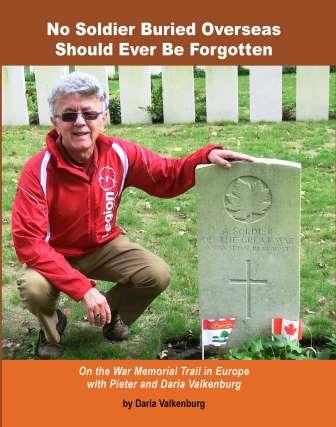
Front cover OnTheWarMememorialTrailinEurope4 countries, 6 weeks, 7,000 km – an unforgettable war memorial journey in Europe…. Daria’s book ‘No Soldier Buried Overseas Should Ever Be Forgotten‘ is available in print and e-book formats.  Net proceeds of book sales help support research costs and the cost of maintaining this blog. For more information see https://nosoldierforgotten.com/

Subscribe to our YouTube Channel: On The War Memorial Trail With Pieter Valkenburg: https://www.youtube.com/channel/UCJ591TyjSheOR-Cb_Gs_5Kw

Never miss a posting!  Subscribe below to have each new story from the war memorial trail delivered to your inbox.