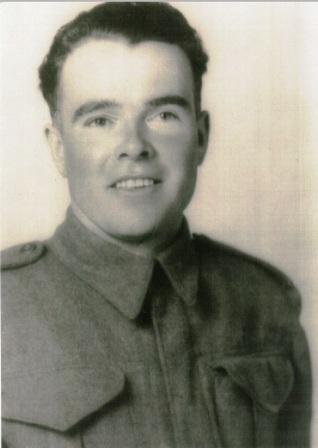
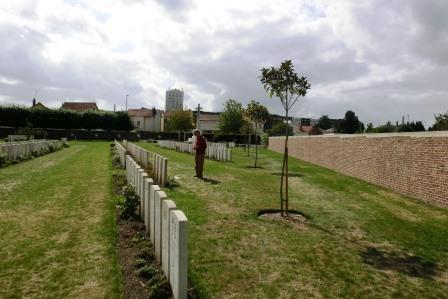
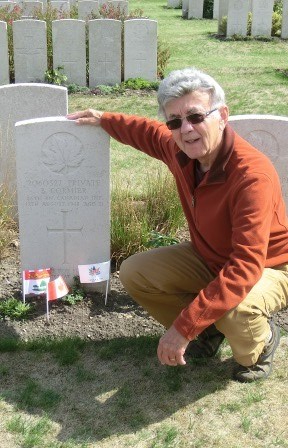
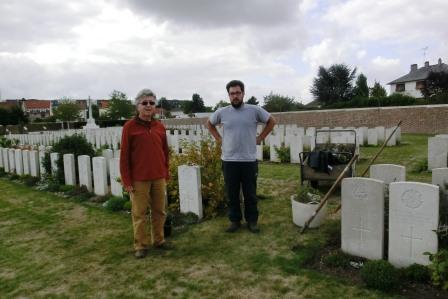
On The War Memorial Trail….. Atlantic Canada Remembers – Part 7

February 22, 2021. We continue to feature more of the photos submitted by Atlantic Canadians of soldiers buried overseas. Pieter is ensuring that every email is acknowledged, and that the photos of soldiers buried in The Netherlands will be forwarded to the appropriate cemetery for their digital archives.  Thank you to the various members of Royal Canadian Legions in Nova Scotia and New Brunswick for their help.

The volunteers at all three Canadian War Cemeteries in Holten, Groesbeek, and Bergen Op Zoom are now active, and Pieter has received wish lists for photos from all three cemeteries.  Submissions for soldiers buried in municipal cemeteries are being held until Pieter gets the go-ahead that those volunteers are active again.

Soldiers buried at the Canadian War Cemetery in Holten, The Netherlands
Ken Dennis of Yarmouth let us know about the Wartime Heritage Association website, which features some of the soldiers from the area who served in WW2.  One of the profiles, written by Flip Jonkman, was of a soldier on the photo wish list of the Canadian War Cemetery in Holten…. Brenton Leroy RINGER. (See http://wartimeheritage.com/whaww2ns2/wwii_ringer_brenton_leroy.htm)

Born on March 22, 1925 in Northfield, Nova Scotia, the son of Ralph and Alberta Ringer of Clementsport, he was an electrician’s helper when he enlisted, at age 18, with the North Nova Scotia Highlanders in Halifax on January 17, 1944.  He later transferred to the 10th Armoured Regiment on March 27, 1945, and lost his life on April 12, 1945 during the liberation of Heino, The Netherlands, when the Sherman tank he was in was hit on the road to Zwolle. 

There were 5 men in the tank, with one survivor.  The survivor knocked on the door of a nearby farmhouse to ask for help, the home of Flip Jonkman’s parents.  Flip was not born at the time, but always remembered the story, and in 2020, was instrumental in getting a memorial stone placed near the site of the attack.  (See the article in Dutch for more information: https://www.destentor.nl/raalte/vurige-wens-in-vervulling-voor-flip-jonkman-73-uit-heino-nu-gedenksteen-is-geplaatst~a694b86d/?referrer=https%3A%2F%2Fduckduckgo.com%2F)

Another of the names on the photo wish list for the Canadian War Cemetery in Holten was found on the Wartime Heritage Association website…. that of Louis Graham RICHARD. (See http://wartimeheritage.com/whaww2ns/wwii_richard_louis_graham.htm)

Born February 13, 1918, the son of Raphael Daniel and Mary Ann Richard of Londonderry, Nova Scotia, Louis was a store clerk before enlisting with the No 2 Canadian Armed Corps in Halifax on February 17, 1943 as a trooper.  On October 14, 1944 he was sent to the United Kingdom, and then on March 31, 1945 to Western Europe with the 9th Armoured Regiment (BC Dragoons).  

Louis was killed in action in The Netherlands during the Battle of Delfzijl Pocket on April 26, 1945, at the age of 27, and was temporarily buried in Wirdum in the province of Groningen, The Netherlands before being reburied in the Canadian War Cemetery in Holten. (For more information on this battle, see https://www.canadiansoldiers.com/history/battlehonours/northwesteurope/delfzijlpocket.htm)

Soldiers buried at the Canadian War Cemetery in Groesbeek, The Netherlands
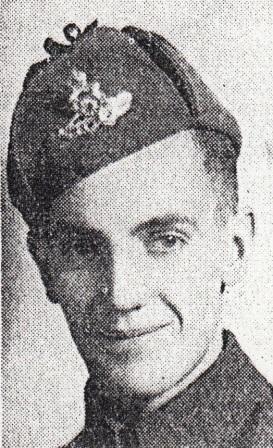
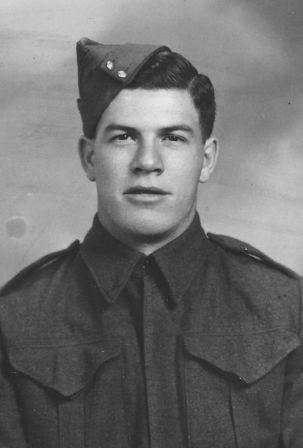
Percy Clayton Cromwell photo only

Percy Clayton Cromwell.  (Photo submitted by Ken Dennis)

Ken Dennis submitted a photo of Percy Clayton CROMWELL, explaining that “…I am a member of the Yarmouth Branch 61 Legion…” After receiving a wish list of photos from Pieter, he noticed one name from Yarmouth, Nova Scotia.  “…Having been shown this email, I decided to trace his local roots…

…He was a labourer, then for CP out of the Halifax area and upon enlisting moved his family to Yarmouth where they grew up….” CP refers to the Canadian Pacific Railway.

Percy was born in Yarmouth on February 12, 1914, the son of James Alfred and Annie May Cromwell.  He enlisted with the West Nova Scotia Regiment in Aldershot, Nova Scotia on May 14, 1940.

Percy was with the Royal Canadian Electrical and Mechanical Engineers when he drowned in The Netherlands on February 8, 1945.  He’d been on guard duty along a canal in the Dutch province of Brabant on a very dark, windy, and rainy night, and it would have been very easy to lose his bearings and accidentally fall into the canal.  His body was not found until March 12, 1945.  He left behind a wife, Lillian Beryl, and four children. 

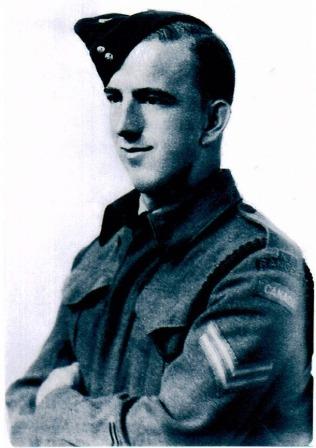
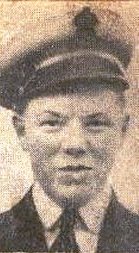
Frank Lewis Libby photo only

Francis Lewis Libby. (Photo from the New Brunswick Military Recognition Booklet)

Kent Caldwell, a member of the Royal Canadian Legion in New Brunswick, sent an entry on Francis ‘Frank’ Lewis LIBBY from one of the annual issues of the New Brunswick Military Recognition Booklet, explaining that the photo was a copy from a newspaper clipping.  The entry stated that “…Francis served with the Calgary Highlanders in England and Northwest Europe.  He was killed in The Netherlands in 1945…” 

Francis was born February 21, 1918 in Milltown, New Brunswick, the son of Clifford and Mary Christine Libby.  Before enlisting on July 25, 1941, he worked at the Canadian Cottons Plant in Milltown.  On October 4, 1941, he married Dorothy Louise Caswell.  He and Dorothy had a son Francis Brian in 1944 while he was overseas in Europe, and where he transferred to the Calgary Highlanders in September 1944. Francis lost his life on January 5, 1945 after being killed along the Dutch-German border. He was temporarily buried in Nijmegen, before his reburial, on July 30, 1945, in Groesbeek.

Hiram Albion Lord photo only

Hiram Albion Lord. (Photo from the New Brunswick Military Recognition Booklet)

Kent Caldwell, a member of the Royal Canadian Legion in New Brunswick, also sent an entry on Hiram Albion LORD from one of the annual issues of the New Brunswick Military Recognition Booklet, explaining that the photo was a copy from a newspaper clipping.  The entry stated that “…Hiram served with the North Shore (New Brunswick) Regiment during the Second World War and was killed in action in 1945…” 

Born November 7, 1924 in Lords Cove, Deer Island, New Brunswick, the son of Minnie Smith, Hiram was a fisherman before enlisting on November 4, 1943 and served in Canada until his arrival in the United Kingdom on July 21, 1944.   On August 17, 1944 he went with his unit to Western Europe and lost his life on January 8, 1945 near Nijmegen, The Netherlands.

Stanley Spray

Stanley Spray. (Photo submitted by Royal Canadian Legion Branch #20 in Digby)

Donna Flaherty, President of Royal Canadian Legion Branch #20 in Digby, Nova Scotia, submitted a photo of Stanley SPRAY, writing “…This picture hangs on our Memorial Wall….

Born April 24, 1913 in Nottinghamshire, England, the son of Edgar and Edith Spray, Stanley immigrated to Canada, and settled in Digby, Nova Scotia, where he ran a small farm and worked for J. J. Wallis as a printer before his enlistment on July 6, 1940 with the 52nd Anti-Tank Battery.  He was married to Alda May and the father of two daughters, Jean Carolyn and Joan Carol. 

He received several promotions, and was a battery quartermaster sergeant with the Royal Canadian Artillery when WW2 ended.  Stanley lost his life in a tragic vehicle accident near Nijmegen, The Netherlands on July 23, 1945, when he was catapulted out of the back of an army truck that collided with an oncoming military vehicle.

Thank you to Kent Caldwell, Ken Dennis, and Donna Flaherty for sharing photos and anecdotes.  Atlantic Canadians remember their loved ones who are buried overseas. If you have a higher resolution photo of Percy Clayton Cromwell, Frank Lewis Libby, or Hiram Albion Lord, please send it in to us.

More photos and stories in Atlantic Canada Remembers – Part 8! To share photos or information, please email Pieter at memorialtrail@gmail.com, or comment on the blog. 

© Daria Valkenburg

…..Previous postings in the Atlantic Canada Remembers series….

Missed the previous postings in this series? See:

…..Want to follow our research?….

If you are reading this posting, but aren’t following the blog, you are welcome to do so.  Our blog address: https://onthewarmemorialtrail.com/
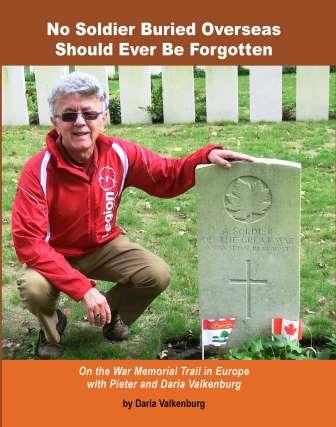
Front cover OnTheWarMememorialTrailinEurope4 countries, 6 weeks, 7,000 km – an unforgettable war memorial journey in Europe…. Daria’s book ‘No Soldier Buried Overseas Should Ever Be Forgotten‘ is available in print and e-book formats.  Net proceeds of book sales help support research costs and the cost of maintaining this blog. For more information see https://nosoldierforgotten.com/

You are also invited to subscribe to our YouTube Channel: On The War Memorial Trail With Pieter Valkenburg: https://www.youtube.com/channel/UCJ591TyjSheOR-Cb_Gs_5Kw

Never miss a posting!  Subscribe below to have each new story from the war memorial trail delivered to your inbox.

On The War Memorial Trail….. Atlantic Canada Remembers – Part 5

January 27, 2021. Responses to the news clips on CTV’s Atlantic Live At 5 on January 4 and 13 continue to come in.  As mentioned in the previous 4 parts, Pieter is ensuring that every email is acknowledged, and that the photos of soldiers buried in The Netherlands are forwarded to the appropriate cemetery for their digital archives.

This posting features more of the photos submitted…..

Soldiers buried at the Canadian War Cemetery in Holten, The Netherlands

William Herbert Bellamy

William Herbert Bellamy.  (Photo courtesy of the Bellamy Family)

On behalf of the Bellamy Family, Linda Fury submitted a photo of her uncle, William Herbert “Billy’ BELLAMY, explaining that ….There are about 150 members of our family now.  We hold reunions often and all know the story of our Uncle Bill.  He belonged to the North Nova Scotia Highlanders and died in January 1945 while a prisoner in Germany.  Thanks so much for all you have done and are continuing to do.  Your work is very much appreciated by all of us….

William Herbert ‘Billy’ was born on May 2, 1921 in Hereford, England, the son of Percy and Frances Bellamy.  In 1927 he immigrated to Canada with his family and settled in Midgic Station (now Midgic), New Brunswick.  Following his 18th birthday, he enlisted with the West Nova Scotia Highlanders on August 2, 1940 in Aldershot, Nova Scotia. On April 30, 1941 he transferred to the North Nova Scotia Highlanders, and was on his way to England in July 1941.

The North Nova Scotia Highlanders were among the troops to land in Normandy on D-Day on June 6, 1944.  Unfortunately, on June 7, 1944 he was captured by the Germans in Normandy and became a prisoner of war (POW).  On August 13, 1944 he arrived at Stalag XII A [Limburg an der Lahn, Hessen, a POW transit camp] and then, on August 26, 1944 was transferred to Stalag Camp VIII B [Lamsdorf, Oberschlesien] near the German-Polish border.  On November 2, 1944 he was sent to the work camp E 902 Delbrückschächte Hindenburg where, along with other POWs, he worked in a nearby coal mine.

According to an account that a former POW sent after the war to Billy’s father, Billy was seriously injured on January 1, 1945 when the mine ceiling collapsed.  He was taken to hospital in Hindenburg (now Zabrze and part of Poland).  However, according to the POW record kept by his captors, he was seriously injured on November 23, 1944 and sent to a military hospital in Knurow (now Knurów, Poland). Curiously, the same injuries described as happening on January 1, 1945 were reported on the POW record as having occurred on November 23, 1944.

In January 1945 he died of his injuries. Records of the exact circumstances have not been found, likely due to advancing Russian troops.  His military service file lists his official date of death as January 28, 1945. On February 6, 1945, Billy was buried in the Municipal Cemetery of Teupitz (in the state of Brandenburg, Germany).  After the war ended he was reburied in the Heerstrasse British Cemetery in Berlin, and then in 1949 reburied for the final time in Holten.

Robert Cole

Robert Theodore Cole. (Photo courtesy of Emily Gilbert)

Ervin Ellis submitted a photo of Robert Theodore COLE, explaining that “I was told by Kent Caldwell that you were looking for a picture of Robert Cole, WWII Veteran from Coles Island. A woman that I knew had close ties to that area.  She said the whole family was deceased but her first husband was part of that family, if anyone had any pictures it would be her.  She looked through her old pictures and by some sort of miracle she had pictures…”  This was Emily Gilbert.  Robert Cole was the nephew of her husband.

Born in Coles Island, New Brunswick, the son of Fred and Maria Cole, Robert enlisted in March 1940 and served in Canada and Labrador before going overseas in September 1943. He was in France by 1944, and also was with his regiment in Belgium, The Netherlands, and Germany.  He lost his life on April 21, 1945 during the Battle of Friesoythe in Germany while serving with the Lorne Scots – Ground Defence Platoon.

Ervin’s assistance was invaluable in putting a face to this soldier’s name! He went on to write Pieter that “….This is a great project you are working on, saw you on TV a couple of times. I am the Zone Commander for the legions in this area so I know them pretty good and their Cenotaphs. If I can help you any let me know…”  Needless to say, Pieter has taken Ervin up on his offer and is grateful for the help that he and Kent Caldwell have provided.

Joseph Gerald Fougere

Joseph Gerald Fougere. (Photo submitted by Doug Landry)

Gerald Douglas ‘Doug’ Landry submitted a photo of his uncle, Joseph ‘Gerald’ FOUGERE, explaining that he was “….born in Poulamon, Nova Scotia, the only son of Felix and Josephine (Marchand) Fougere. Gerald had three sisters: Evelyn, married to Thomas Sampson; Anita, married to Val Poirier; and Theresa, married to James W. Landry….

Doug went on to write that “…Gerald was with the Perth Regiment.  He was dangerously wounded in action on April 24th, 1945 and died of wounds on April 26th, 1945 at the age of 28 years, 11 months….” He lost his life during the Battle of the Delfzijl Pocket.

Soldiers Buried In Adegem Canadian War Cemetery in Belgium

Arthur Jack Taylor

Arthur ‘Jack’ Taylor.  (Photo courtesy of the Taylor Family)

On behalf of the Taylor family, Art Taylor submitted a photo of his uncle, Arthur Brambel ‘Jack’ TAYLOR, explaining that “…My father and his four brothers, from the small town of Woodstock, New Brunswick, all served in WWII.  Three saw action.  My father (John Taylor) was in the Royal Canadian Navy and escorted convoys to Europe.  His two brothers were in the army.  Russell Taylor fought into Holland and survived.  His other brother Arthur ‘Jack’ Taylor was with the Winnipeg Rifles.  He was killed at the Leopold Canal on October 12, 1944.  He is buried at the Adegem Canadian War Cemetery in Belgium.  He was 26 years old…

Jack was a rifleman, killed during Operation Switchback, part of the Battle of the Scheldt.  A Wikipedia article explains that “….October 10, 11, and 12 were days of intense struggle while the men of the 7th Brigade with the Royal Winnipeg Rifles took, lost and then retook a group of houses known as Graaf Jan and the Regina Rifles found themselves pinned down by a group of well dug-in pillboxes that seemed to be resilient to artillery…(For more information see https://en.wikipedia.org/wiki/Battle_of_the_Scheldt#Operation_Switchback) Jack was initially buried in Madelgem before being reburied in Adegem.

Thank you to Ervin Ellis, Emily Gilbert, Doug Landy, Linda Fury, and Art Taylor for sharing photos and anecdotes.  Kudos to CTV’s Atlantic Live At 5 for helping to get the word out on this quest of remembrance. Atlantic Canadians remember their loved ones who are buried overseas.  Pieter and I extend our condolences to Ervin Ellis, who sadly lost his wife on January 20.

More photos and stories in Atlantic Canada Remembers – Part 6! If you have photos or information to share, please email Pieter at memorialtrail@gmail.com, or comment on the blog.

© Daria Valkenburg

…..Previous postings in the Atlantic Canada Remembers series….

Missed the previous postings in this series? See:

…Want to follow our research?…

If you are reading this posting, but aren’t following our research, you are welcome to do so.  Our blog address: https://onthewarmemorialtrail.com/

Front cover OnTheWarMememorialTrailinEurope4 countries, 6 weeks, 7,000 km – an unforgettable war memorial journey in Europe…. Daria’s book ‘No Soldier Buried Overseas Should Ever Be Forgotten‘ is available in print and e-book formats.  Net proceeds of book sales help support research costs and the cost of maintaining this blog. For more information see https://nosoldierforgotten.com/

You are also invited to subscribe to our YouTube Channel: On The War Memorial Trail With Pieter Valkenburg: https://www.youtube.com/channel/UCJ591TyjSheOR-Cb_Gs_5Kw.

Never miss a posting!  Subscribe below to have each new story from the war memorial trail delivered to your inbox.

On The War Memorial Trail….. A Face For WWII Soldier Alderic Basque

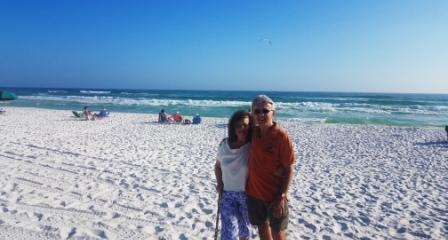
20180222_153507 Feb 22 2018 Daria & Pieter on beach by Whales Tail

A beach in Florida is just a distant memory this winter! More time for research! (Photo taken by Brien Robertston)

December 31, 2020.  One of the pluses of being socially distanced and not going away for a winter holiday is that Pieter can concentrate on his research rather than basking in the Florida sunshine.  Instead of snowbird get-togethers and running on a beach by the Gulf of Mexico, he has been digging into a list of WWII soldiers from New Brunswick and Nova Scotia that researchers at the Canadian War Cemetery in Holten, The Netherlands sent him.  The goal?  To find photos of 40 soldiers from New Brunswick and 26 from Nova Scotia who are buried in The Netherlands. 

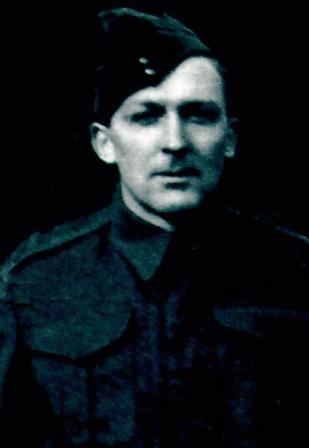
Recently, with the help of Marc Comeau, President of the Royal Canadian Legion in Tracadie, New Brunswick and Marielle Arsenault, Executive Secretary at the Municipalité Régionale de Tracadie, the family of one soldier was found: Alderic BASQUE.

IMG_20201218_151124 cropped picture of Alderic Basque

Alderic Basque.  (Photo courtesy of Hermenegilde Basque and Dorina Basque-St-Coeur)

Alderic was born in St. Pons, New Brunswick on May 23, 1915, the son of Olivier and Tharzile Basque. A woodsman and farmer before enlistment in Fredericton, New Brunswick on January 15, 1945, he spoke both French and English. 

A few days after enlistment, he was on his way to the United Kingdom.  By March 31, 1945 he was in North West Europe with Le Régiment de Chaudière, which was part of the 8th Canadian Infantry Brigade.  (For more information, see https://www.canadiansoldiers.com/regiments/infantry/chaudiereregiment.htm)

….Alderic was killed during the Attack on Weener….

Screenshot_2020-12-31 Weener Map Germany Google Satellite Maps

Map showing The Netherlands on the left and Germany on the right.  Weener is indicated by the red mark.  (Map source: http://www.maplandia.com/germany/niedersachsen/weser-ems/leer/weener/)

On April 26, 1945, he was killed in action during a battle near the town of Weener, Germany, not far from the Dutch border.  He was temporarily buried near Heide, Germany, before reburial in the Canadian War Cemetery in Holten, The Netherlands on March 27, 1946.

grave of Alderic Basque

Grave of Alderic Basque at the Canadian War Cemetery in Holten.  (Photo courtesy of Canadian Virtual War Memorial https://www.veterans.gc.ca/eng/remembrance/memorials/canadian-virtual-war-memorial)

….Memories of Alderic were shared by his niece ….

Alderic’s sister, Dorina Basque-St-Coeur, shared a few memories of her brother with her daughter, Exodia Austin. 

Exodia was kind enough to share these with Pieter, giving us a picture of the man behind the uniform. “… My mother often told me that when her brother Alderic came for a visit he had a war medal on him. He was godfather to my oldest brother Denis who was just 1 or 2 years old. Denis liked to play with the medal and decoration when he sat on his knee. My Mother was so afraid that Alderic would be punished because nobody should touch the medal, but Alderic let my brother play with the medal….”  This would likely have been the Canadian Volunteer Service Medal and Clasp. 

Exodia explained that her mother talked about some of the skills and interests that her brother had.  “…Alderic was a good person. He made himself a pair of wooden skates. Imagine!  He also wanted to learn how to step dance. He practiced often in his room but never learned.  Probably he would have learned if he had survived the army…” 

An all too familiar tale of heartache that many soldiers experienced was also recalled.  “…. My mother also told me that Alderic had a girlfriend. But she saw another solder during that time. So when Alderic found out, he didn’t want to come back. And it was that year that he was killed….” 

Thank you to Exodia Austin, her mother Dorina Basque-St-Couer, and her cousin Hermenegilde Basque, for sharing a photo and memories of Alderic Basque.  And thank you to Marc Comeau and Marielle Arsenault for caring enough about the memory of a soldier to help find his family. 

….Photos sought….

While work continues on the list of New Brunswick and Nova Scotia soldiers, a reminder that photos of two soldiers from Prince Edward Island buried in The Netherlands have yet to be found:

UPDATE:  Photos for these two soldiers have been found since this posting was published!

If anyone has a story or photo to share about any Canadian military personnel buried in The Netherlands, please contact Pieter at memorialtrail@gmail.com, or comment on the blog. 

© Daria Valkenburg

….Want to follow our research?….

If you are reading this posting, but aren’t following our research, you are welcome to do so.  Our blog address: https://onthewarmemorialtrail.com/

Front cover OnTheWarMememorialTrailinEurope4 countries, 6 weeks, 7,000 km – an unforgettable war memorial journey in Europe…. Daria’s book ‘No Soldier Buried Overseas Should Ever Be Forgotten‘ is available in print and e-book formats.  Net proceeds of book sales help support research costs and the cost of maintaining this blog. For more information see https://nosoldierforgotten.com/ 

You are also invited to subscribe to our YouTube Channel: On The War Memorial Trail With Pieter Valkenburg: https://www.youtube.com/channel/UCJ591TyjSheOR-Cb_Gs_5Kw

Never miss a posting!  Subscribe below to have each new story from the war memorial trail delivered to your inbox.

On The War Memorial Trail….On The Road To Rouen

October 1, 2017.  Leaving the Arras area, which we had thought was busy enough, was an experience, as now we encountered toll roads.  We soon learned to dread the words ‘gare de péage’.  While all the toll booths have iconic names, like the first one we pulled up at, named ‘Jules Verne’, they are now mostly automated, and you need cash or a debit or credit card.

…. ‘Gare de péage’ meant frustration in trying to pay a toll in Normandy….

If you are one of the modern people thinking ‘Dinosaur’, let me describe the experience.  First off, the box where you have to pay is designed to accommodate truckers, not people in dinky toy cars like the majority of cars used in Europe.  Most people do not have the rubber arms needed to reach up to drop the money in, so each toll booth encounter takes longer than it would if you paid an attendant, as car doors open and people try to squeeze out in the available space to drop their money in manually, or pay by card.  And of course, you need first to figure out WHERE you place your money as there is more than one slot.

If you use cash, as we did, you soon also learned that it’s best to have exact change, as otherwise you have to WAIT for change and then reach up to another slot to get your money.  Anyone in a hurry sometimes leaves their change behind!

PEI is not alone in charging heavy tolls.  We left 7.70 euros at Jules Verne, only to encounter another toll booth 6 minutes later!  At this one we picked up a ticket which cost us another 5.70 euros half an hour later.  The count so far … 13.40 euros.  In Canadian dollars it comes to about $19.75, and the day was just beginning.

…. We were on the right street but in the wrong community!….

It took us just over 2 ½ hours to get to Rouen from Mont St. Eloi, and, following the GPS instructions to the St. Sever Cemetery, arrived at Boulevard Stanislas Girardin, only to find it was in downtown Rouen.  No cemetery in sight!  The streets are extremely narrow, jam packed with cars and pedestrians and most of the streets one way traffic only.  We finally gave up trying to figure out what had gone wrong and stopped in front of a short driveway into a huge government building behind a walled gate, and asked a passerby for help.

The poor man looked at our sheet from the Commonwealth War Graves Commission and finally said, very kindly, that we were on the right street, but not in Rouen.  The cemetery was in a nearby community.  Sure enough, when we looked at the cemetery location instructions, it said it was “situated on the eastern edge of the southern Rouen suburbs of Le Grand Quevilly and Le Petit Quevilly.”  But what we didn’t understand was why we’d been directed downtown when we had the right street.

The man explained that it was in either Le Grand Quevilly or Le Petit Quevilly, he wasn’t sure which.  So, the GPS got reprogrammed for Le Grand Quevilly.  The word “suburb” was a misnomer.

While this discussion had been going on, traffic was backing up as people wanting to get into or out of the government driveway were held up as we were blocking the road.  Not one person honked or showed any impatience!  We thanked the man for his help, and then slowly backed up onto the traffic, and made our way out of town.

…. A car salesman steered us in the right direction to the cemetery….

Le Grand Quevilly was a short distance away, but it was not the location of the cemetery.  We pulled into a car dealership to ask directions, only to find out that France shuts down for lunch break.  Everything was locked up, but we found a salesman in a tent on the lot, reading his emails.

I’m from a different country,” he said, when we asked about the cemetery.  Then he made us laugh when he went on to say, “I’m from Paris.”  But he was very effective at finding someone who could help us and that’s when we learned that we wanted to be in Le Petit Quevilly, and how to get there.

In Le Petit Quevilly, on a street by the same name as in Rouen (what are the odds?), we were able to find St. Sever Cemetery Extension, the location where Bazil Cormier is buried.

CIMG8598 Sep 7 2017 sign directing us to St Sever Cemetery Extension

Sign to the St. Sever Cemetery in Le Petit Quevilly. (Photo credit: Daria Valkenburg)

According to the information provided by the Canadian War Graves Commission, during WWI, Commonwealth camps and hospitals were stationed on the southern outskirts of Rouen.  Most hospitals remained there during the war.  A number of those who died in the hospitals were buried in other cemeteries, but the majority were buried at St. Sever Cemetery.  In September 1916, the Extension, where Bazil Cormier is buried, began.

In WWII, Rouen was again a hospital centre, and several Commonwealth soldiers who were prisoners of war during the German occupation are buried in the Extension.

…. St. Sever Cemetery Extension was huge….

St. Sever Cemetery Extension is the largest cemetery we’ve been to so far, with 8,348 WWI Commonwealth burials, 10 of them unidentified, 328 WWII Commonwealth burials, 18 of them unidentified, and 8 foreign nationals.

With such a large cemetery, it was not easy to find Cormier’s grave.  Luckily, in this cemetery, several gardeners from the Commonwealth War Graves Commission were on site.  While Pieter went to look in the Grave Register, I looked at the graves, trying to find the row in which Cormier was buried.  One gardener asked if I needed help.  When I explained who we were looking for, he asked if I had the paper with the burial information.  I explained it was on the other side of the cemetery with Pieter, who was comparing it to the information in the Grave Register.

Just to let you know how great these workers are, the gardener immediately went over to the other side of the cemetery and then spent the next few minutes looking for the grave, which of course was as far away as possible from where we were!

CIMG8587 Sep 7 2017 Pieter at the grave of Bazil Cormier at St Sever Cemetery Extension

Pieter at the grave of Bazil Cormier in St. Sever Cemetery Extension in Le Petit Quevilly. (Photo credit: Daria Valkenburg)

…. Bazil Cormier lost his life during the Battle of Amiens….

According to his Attestation papers, Private Bazil CORMIER was born January 6, 1898 in Tignish, the son of Joseph Cormier and Marie Arsenault.  A farmer before enlisting with the 105th Draft Regiment on December 4, 1916, he died of wounds received in the Battle of Amiens near Cachy on August 12, 1918, at the age of 21.  At the time of his death he was with the 26th New Brunswick Battalion.

The War Graves Register Circumstances of Death notes that “During operations east of Amiens, on the morning of August 8th 1918, he was hit in the head by a machine gun bullet. He was immediately dressed by a comrade and carried out, but succumbed to his wounds at No. 4 General Hospital, Rouen, four days later...”  According to the active/casualty document in his file, however, he was transported to the No. 5 General Hospital, not the No. 4 General Hospital, where he died.

The Battle of Amiens, also known as the Third Battle of Picardy, was the opening phase of the Allied offensive which began on August 8, 1918, later known as the Hundred Days Offensive, that ultimately led to the end of the First World War.  This is the same battle in which James CAIRNS lost his life on August 9, 1918.

CIMG8592 Sep 7 2017 Pieter at grave of B Cormier in St Sever Cemetery Extension

Pieter by the grave of Bazil Cormier. (Photo credit: Daria Valkenburg)

As with too many of the WWI soldiers, we have no photo or further information about Bazil Cormier.

The cemeteries we’d been to in the past days had all been in the countryside.  St. Sever Cemetery Extension was in an urban setting, and bordered the Rouen Soccer Club, which caught the interest of soccer fan Pieter.

CIMG8590 Sep 7 2017 next to St Sever Cemetery Extension is the soccer club of Rouen

The Rouen Soccer Club was on the other side of the fence of the St. Sever Cemetery Extension. (Photo credit: Daria Valkenburg)

We couldn’t leave the cemetery without giving flag pins to the gardeners, one of whom spoke English and told Pieter that he had just graduated from horticultural college and loved his job.  The head gardener, who had helped us in the beginning, was unfortunately out on an errand, so we were not able to say goodbye to him.

CIMG8596 Sep 7 2017 Pieter with a CWGC gardener at St Sever Cemetery Extension

Pieter with a young CWGC gardener at St. Sever Cemetery Extension. (Photo credit: Daria Valkenburg)

In the next blog entry we make our way to Bayeux, which has a connection with Pieter’s genealogical research as well as the Cenotaph research project. Do you have photo or info on Bazil Cormier?  Comments or stories?  You can share them by emailing us at memorialtrail@gmail.com or by commenting on this blog.

© Daria Valkenburg

….Want to follow our research?….

If you are reading this posting, but aren’t following our research, you are welcome to do so.  Our blog address: https://onthewarmemorialtrail.com/

Front cover OnTheWarMememorialTrailinEurope4 countries, 6 weeks, 7,000 km – an unforgettable war memorial journey in Europe…. Daria’s book ‘No Soldier Buried Overseas Should Ever Be Forgotten‘ is available in print and e-book formats.  Net proceeds of book sales help support research costs and the cost of maintaining this blog. For more information see https://nosoldierforgotten.com/ 

You are also invited to subscribe to our YouTube Channel: On The War Memorial Trail With Pieter Valkenburg: https://www.youtube.com/channel/UCJ591TyjSheOR-Cb_Gs_5Kw

Never miss a posting!  Subscribe below to have each new story from the war memorial trail delivered to your inbox.

On The War Memorial Trail….Monuments In and Around Thélus

September 20, 2017.  When we first entered the town of Thélus on our way to Vimy Ridge, we passed by the Canadian Artillery Memorial, built to remember the sacrifice of Canadians from Artillery battalions who died in the battle for Vimy Ridge and the surrounding area.

When we were at the Vimy Ridge Visitors Centre, we saw a large photograph of this monument, taken when it was actually dedicated during the war.  The monument was built on top of a dugout.  The steps leading up to the monument marks the original entrance to the dugout.  The monument was unveiled by General Currie on April 9, 1918, a year after the Battle of Vimy Ridge.

IMG_20170905_112407215 Sep 5 2017 Photo of Cdn Artillery Memorial in Thelus at Vimy Visitors Centre

Photo of the Canadian Artillery Memorial as it was unveiled in Thélus on April 9, 1918. (Photo taken by Pieter Valkenburg of a panel at Vimy Ridge Visitors Centre)

After learning about the monument at the Visitors Centre, we made a stop to see the real one.

CIMG8308 Sep 5 2017 Pieter at Cdn Artillery Memorial in Thelus

Pieter at the Canadian Artillery Memorial in Thélus. The shell shaped columns surrounding the monument have actual fuses from shells attached to their tops! (Photo credit: Daria Valkenburg)

IMG_20170905_121853669 Sep 5 2017 Inscription on Cdn Artillery Memorial in Thelus

The inscription reads “Erected in memory of officers, non-commissioned officers and men of the Canadian Corps Artillery who fell during the Vimy operations April 1917.” This is followed by the units: Canadian Field Artillery, Canadian Garrison Artillery, Royal Field Artillery, Royal Garrison Artillery and the South African Heavy Artillery. (Photo credit: Pieter Valkenburg)

CIMG8303 Sep 5 2017 Rue des Artilleurs Canadiens in Thelus

The road leading out of Thélus towards Bailleul Sir Berhoult is called Rue des Artilleurs Canadiens (Street of the Canadian Artillery). (Photo credit: Daria Valkenburg)

CIMG8304 Sep 5 2017 Sign directions across from Cdn Artillery Memorial in Thelus

Across from the Canadian Artillery Monument is a sign leading to Bailleul Sir Berthoult. (Photo credit: Daria Valkenburg)

We then followed the road between Thélus and Bailleul Sir Berthoult.  Only 4 km separate these two towns, but it was the scene of much fighting on April 9, 1917 during the Battle of Vimy Ridge.

Not far down the road was a monument to the people of Thélus who perished during two world wars, a vivid reminder that not only soldiers are war casualties.

cimg8310-sep-5-2017-monument-to-thelus-war-dead-in-two-world-wars.jpg

Thélus memorial to its war dead in two world wars. (Photo credit: Daria Valkenburg)

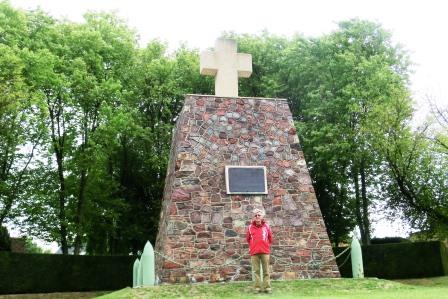
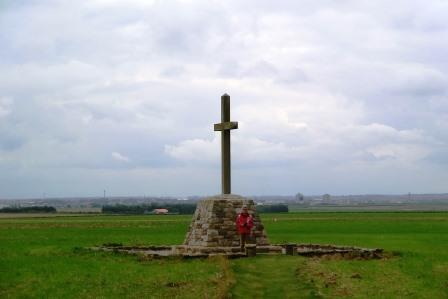
Halfway between the two towns, in a farmer’s field, is a memorial to the First Canadian Division, on the spot where they were opposite the First Bavarian Reserve Division.  By April 9, 1917 there wasn’t much left of the villages!

CIMG8314 Sep 5 2017 Pieter by sign directing you to Memorial to 1st Cdn Division

Pieter by the sign leading across a farmer’s field to the 1st Canadian Division Monument, about halfway between Thélus and Bailleul Sir Berthoult. (Photo credit: Daria Valkenburg)

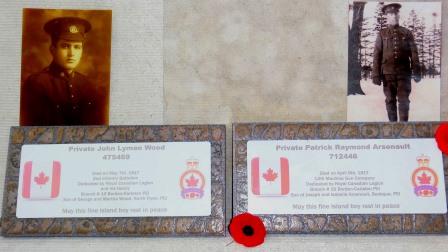
We stopped at this monument to honour John ‘Lymon’ WOOD and Patrick Raymond ARSENAULT, both of whom were in the 1st Canadian Division during the Battle of Vimy Ridge, and whose names are inscribed on the Vimy Memorial.

After an article about these two men was published in the County Line Courier in April 2017, we heard from a Ernesto Brucker of Buenos Aires, Argentina, who noted that his father, Georg BRUCKER, had been part of the First Bavarian Reserve Division and had been captured as a prisoner of war on April 9, 1917, likely at or very near this exact spot.

CIMG8318 Sep 5 2017 Memorial to 1st Cdn Division halfway betwen Thelus & Bailleul

Pieter at the 1st Canadian Division Monument, about halfway between Thélus and Bailleul Sir Berthoult. (Photo credit: Daria Valkenburg)

IMG_20170905_123258340 Sep 5 2017 inscription on memorial to 1st Cdn Division

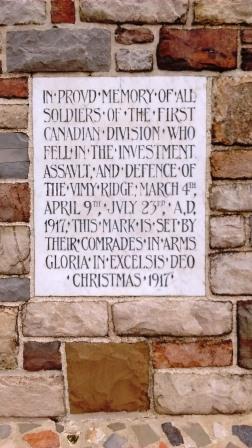
Inscription on the 1st Canadian Division Monument, about halfway between Thélus and Bailleul Sir Berthoult. (Photo credit: Pieter Valkenburg)

CIMG8316 Sep 5 2017 lone poppy along path leading to memorial to 1st Cdn Division outside Thelus

A lone poppy was growing on the path towards the 1st Canadian Division Monument, about halfway between Thélus and Bailleul Sir Berthoult. (Photo credit: Daria Valkenburg)

In the next blog entry we continue to visit the cemeteries in France where soldiers on the Borden-Carleton Cenotaph are buried.  Comments or stories?  You can share them by emailing us at memorialtrail@gmail.com or by commenting on this blog.

© Daria Valkenburg

….Want to follow our research?….

If you are reading this posting, but aren’t following our research, you are welcome to do so.  Our blog address: https://onthewarmemorialtrail.com/

4 countries, 6 weeks, 7,000 km – an unforgettable war memorial journey in Europe…. Daria’s book ‘No Soldier Buried Overseas Should Ever Be Forgotten‘ is available in print and e-book formats.  Net proceeds of book sales help support research costs and the cost of maintaining this blog. For more information see https://nosoldierforgotten.com/ 

You are also invited to subscribe to our YouTube Channel: On The War Memorial Trail With Pieter Valkenburg: https://www.youtube.com/channel/UCJ591TyjSheOR-Cb_Gs_5Kw

Never miss a posting!  Subscribe below to have each new story from the war memorial trail delivered to your inbox.

On The War Memorial Trail….Visiting The Canadian National Vimy Memorial

September 18, 2017.  After the tour of the Vimy Memorial Visitors’ Centre and the tunnels, we went to visit the Canadian National Vimy Memorial. Although familiar to us from seeing it on TV, the memorial is much larger and majestic in person.

CIMG8468 Sep 6 2017 Mother Canada memorial at Vimy Ridge

Canadian National Vimy Memorial from a distance. (Photo credit: Daria Valkenburg)

CIMG8295 Sep 5 2017 Canadian National Vimy Memorial closer up with twin white pylons

Canadian National Vimy Memorial showing the twin white pylons, one bearing the maple leaves of Canada, the other the fleurs-de-lys of France, to symbolize the sacrifices of both countries. Beside one of the pylons is the statue Canada Bereft. Below the pylons is The Tomb. (Photo credit: Daria Valkenburg)

Site manager Johanne Gagné noted that “this monument is special because it focuses on values the soldiers shared and ultimately gave their lives for.”  11,285 names are inscribed on the memorial, two of them who also are on the Cenotaph outside the Borden-Carleton Legion:  John Lymon Wood and Patrick Raymond Arsenault.  Pieter immediately went to search out these two names.

IMG_20170905_114855242 Sep 5 2017 Vimy Memorial Inscription Arsenault

Patrick Raymond Arsenault inscribed on Vimy Memorial. (Photo credit: Pieter Valkenburg)

IMG_20170905_115420984 Sep 5 2017 Vimy Memorial Inscription Wood

John Lymon Wood inscribed on Vimy Memorial. (Photo credit: Pieter Valkenburg)

After finding the inscriptions, Pieter next looked for two plaques brought to the memorial in April by the students of Kinkora Regional High School and teacher Kevin Bustard.  Kevin had the plaques made after reading about Wood and Arsenault in an April 2017 article in the County Line Courier. (See CLC Apr 5 2017 p9 Two Unsung Heroes of Vimy Ridge)

To everyone’s surprise, the plaques were still at the Memorial. Arsenault’s was on The Tomb, and Wood’s was by his inscription.

CIMG8294 Sep 5 2017 tributes on The Tomb

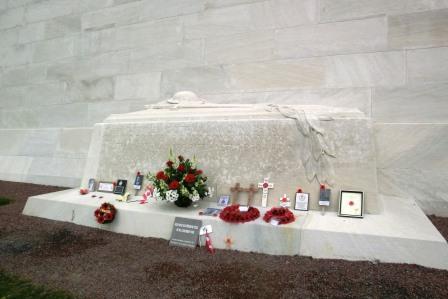
Tributes left on The Tomb at the Vimy Canadian National Memorial. You can see the plaque for Patrick Raymond Arsenault on the far left. (Photo credit: Daria Valkenburg)

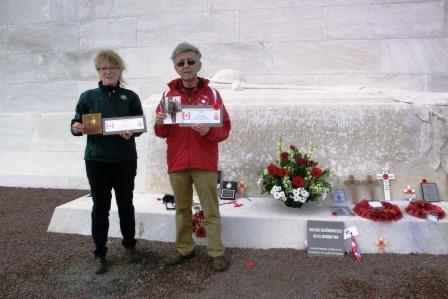
Pieter reunited both plaques with photos of the two soldiers.

CIMG8299 Sep 5 2017 Wood & Arsenault Plaques

Plaques and photos of John Lymon Wood and Patrick Raymond Arsenault. (Photo credit: Daria Valkenburg)

While the plaques were left at the Memorial, the photos and information about Wood and Arsenault were given to Johanne Gagné, who told us that “the French are still welcoming and grateful for the sacrifices made by Canadians and say thank you.  They are grateful to Canada for keeping the memory alive after 100 years.  It’s humbling.”

CIMG8301 Sep 5 2017 Sep 5 2017 Johanne Gagne with Wood and Pieter with Arsenault

Johanne Gagné with plaque and photo of John Lymon Wood while Pieter holds plaque and photo of Patrick Raymond Arsenault. (Photo credit: Daria Valkenburg)

This was the end of our tour of Vimy Ridge and the Memorial.  It had been a special day and we salute Johanne Gagné for the time she spent giving us a wonderful tour and patiently answering our many questions.  Merci beaucoup Johanne!

In the next blog entry we explore two of the memorials in the Thélus area.  Comments or stories?  You can share them by emailing us at memorialtrail@gmail.com or by commenting on this blog.

© Daria Valkenburg

….Want to follow our research?….

If you are reading this posting, but aren’t following our research, you are welcome to do so.  Our blog address: https://onthewarmemorialtrail.com/

Front cover OnTheWarMememorialTrailinEurope4 countries, 6 weeks, 7,000 km – an unforgettable war memorial journey in Europe…. Daria’s book ‘No Soldier Buried Overseas Should Ever Be Forgotten‘ is available in print and e-book formats.  Net proceeds of book sales help support research costs and the cost of maintaining this blog. For more information see https://nosoldierforgotten.com/ 

You are also invited to subscribe to our YouTube Channel: On The War Memorial Trail With Pieter Valkenburg: https://www.youtube.com/channel/UCJ591TyjSheOR-Cb_Gs_5Kw

Never miss a posting!  Subscribe below to have each new story from the war memorial trail delivered to your inbox.