On The War Memorial Trail…..A PEI Soldier In The Devil’s Brigade

1st_Special_Service_Force.patch

First Special Services Force patch.  (Image courtesy of  https://en.wikipedia.org/wiki/First_Special_Service_Force)

October 26, 2020.  The spark to inspire research into a Canadian soldier tends to happen in the most innocuous of circumstances.  For Pieter, it was while standing at the Cenotaph outside the Borden-Carleton Legion on a blustery November 11 several years ago.  Unlike many of us, he looked at the names and wondered who they were.  Had any of them been in The Netherlands, the country of his birth, and helped liberate it?   That moment sent him on a quest that has involved lots of research, many visits to archives, cemeteries, and monuments in several provinces and four European countries.  And he’s not finished.

For North Rustico resident Paul Keleher, that moment happened at Michael’s picture framing counter in Charlottetown.  “… A clerk brought out a Devils Brigade poster and I noticed a name from North Rustico… Keleher said.  “…Until then, I had no idea there were Canadians in the Devils Brigade, let alone any from Prince Edward Island!…”  The name he noticed on the poster was Joseph Robert GAUTHIER.

That was the spark that initially piqued Paul’s interest, and then  “…I bumped into a relative who mentioned where he was buried and said that his widow was still alive and living in Drummondville, Quebec….

Paul found the grave in the St Augustine Cemetery in South Rustico and decided he wanted to learn more.  Like Pieter, who served in the Dutch Air Force, Paul Keleher is also a veteran, having served in the British Army. “I was in the Royal Green Jackets and served in Malaya and then Borneo on active service 1963 to 66.  I was later posted to Berlin.  This was shortly after the wall went up...

IMG_1680 Cemetery photo from Paul Keleher

Grave of Joseph Robert Gauthier. (Photo credit: Paul Keleher)

After speaking to Gauthier’s widow Dorothy, a British war bride from the southern part of England, he contacted us for a bit of advice from Pieter on how to proceed with further research.  “I enjoy your articles on local Canadian Soldiers so when I heard about Joey I thought of you...

CIMG4448 Sep 20 2020 meeting with Paul Keleher

Pieter (standing) with Paul Keleher and his wife Hasmah. (Photo credit: Daria Valkenburg)

….Origins Of The First Special Service Force aka The Devil’s Brigade….

So, what was the Devil’s Brigade?  Officially known as First Special Service Force (FSSF), this was an American-Canadian commando unit, formed in 1942, and commanded by the US Army’s Fifth Army. The unit trained in Helena, Montana and served in the Aleutian Islands, then fought in Italy and France before being disbanded in December 1944.  (See https://en.wikipedia.org/wiki/First_Special_Service_Force)

In Canada, the Minister of Defence approved sending soldiers to the unit, but decided to say they were forming the 1st Canadian Parachute Battalion.  Volunteers were recruited under that name, and were also known as the ‘2nd Canadian Parachute Battalion’.  No mention was made of ‘First Special Service Force’ or that it was to be an international unit at the time.  However, in April–May 1943 they received the designation 1st Canadian Special Service Battalion.

Peter Layton Cottingham, author of ‘Once Upon A Wartime: A Canadian Who Survived the Devil’s Brigade’ noted that all the men wore the same uniform.  “…we were issued American Army clothing which was ‘space age’ compared to the ‘King’s Burlap’ we had all worn in the Canadian Army…

The name ‘Devil’s Brigade’ came after a diary was found on the body of a German lieutenant in Italy, according to an account in ‘The Devil’s Brigade’ by Robert H. Adelman and George Walton:  “…In it was written ‘The Black Devils are all around us every time we come into the line, and we never hear them come’….” 

Adelman and Walton go on to explain that the reference to Black Devils came from an initiative by the unit’s commander.  “...He had ordered a printed supply of paper stickers upon which was reproduced the insignia of his Brigade and, underneath, was a statement in German to the effect that ‘The Worst Is Yet To Come’.  The Forcemen, after killing a German, would paste one of these stickers on the German’s forehead or helmet, and then go on.  This tactic, executed by a band of blackfaced guerrillas moving soundlessly through the night, not only frightened the enemy, it also produced a mighty effect on the other beachhead soldiers and war correspondents…

….Joseph Robert Gauthier Was In The Devil’s Brigade….

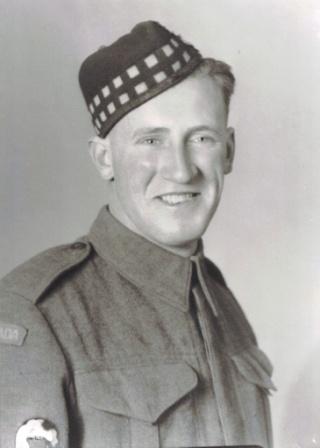
cfl_1876 Joseph Robert Gauthier

Joseph Robert Gauthier in his First Special Service Force uniform.  (Photo courtesy of Linda Craig Family Collection)

Born on February 24, 1924 in Rusticoville, Prince Edward Island, Joseph Robert Gauthier enlisted with the Carleton & York Regiment, before going into the FSSF.  He was a T4, a technical ranking which paid the same as a sergeant, but without the authority of a sergeant.  As seen on the sleeve of his uniform, a T4 wore 3 stripes with a T under the stripes. 

….The Devil’s Brigade Was Disbanded On December 5, 1944….

The unit was disbanded on December 5, 1944 near the village of Villeneuve-Loubet, France. In Cottingham’s memoir, he explained that they then travelled by boat from Marseille to Naples.   “…At Avellino we were divested of our American uniforms, being allowed to keep only our treasured and distinctive parachute boots.  We spent a few hours every day being reintroduced to Canadian Army commands and drill.  We also needed to have our new Canadian uniforms adjusted and decked out with our various insignia and chevrons of rank.  It was quite a transition. One small compensation was that we were issued the cherry berets of the Airborne regiments….

After spending Christmas in Avellino, Italy, the Canadians returned to England in January 1945.  Cottingham noted that “…Those of us who were not sent to officers training were absorbed into the First Canadian Parachute Battalion and, following a brief course in Canadian weaponry and parachute drill, were dispatched to join the regiment already in contact with the enemy near the Rhine River…”  Family members told Paul Keleher that Gauthier joined the Black Watch after the FSSF disbanded.

In his research, Paul learned that Gauthier met his wife Dorothy Howard at a dance in Aldershot, England in 1945, and they married on December 12, 1945 in Cathedral Church of St. Michael and St. George, a Catholic church in Aldershot.

improved_photo-1 Gauthier and wife

Dorothy and Joseph Gauthier.  (Photo courtesy of Linda Craig Family Collection.  Photo restoration and colourization by Pieter Valkenburg)

In January 1946 Gauthier was discharged and returned to Canada.   War Bride Dorothy was able to follow him to Canada in July 1946. Gauthier became a fisherman, but after a few years he rejoined the Armed Forces, and served for an additional 32 years.  As part of a peacekeeping force he was in Korea in 1951 and later in Egypt.  He and Dorothy had 6 children:  3 daughters, 1 son Raymond, and 2 who have passed away.

Gauthier passed away on February 27, 1987 in Montreal and was returned back to the Island for burial. 

….Other Islanders Who Served In The Devil’s Brigade….

In addition to Joseph Robert Gauthier, Paul wrote down the names of other Islanders who served in this special unit that had been identified on the poster he saw in Michael’s.  They are:

  • Lieutenant Colonel R. W. (Bill) BECKETT of  Charlottetown
  • Private L. E. (Lawrence ‘Junior’) DURANT of  Charlottetown
  • Warrant Officer Class 2 Wilfred MACDONALD of Glenwilliam
  • Sergeant E. L. (‘Tiny’) MACLEAN of Ocean View
  • Private J. H. MCINNIS of Morrel
  • Private C. W. (Charlie) DEIGHAN of Summerside
  • Private J. F. CHAPPEL of Charlottetown
  • Private A. J. BURDETTE of Charlottetown
  • Private F. C. MCCORMICK of Ebbsfleet
  • Private C. W. (Clarence)THOMPSON of Summerside
  • Private J. (Joe) JAMIESON of North Rustico
  • Private R. E. TRAINOR of Charlottetown
  • Private W.F. (William) DOUGLAS of Mount Stewart
  • Private E. J. (‘Ping Pong’) GALLANT of Summerside
  • Private W. P. (Wilfred) DOWLING of Charlottetown
  • Private R. J. (Ray) DURANT of Summerside

William Douglas of Mount Stewart was the only Islander killed in action while serving with the First Special Service Force.

Rememberance-Day-2020-Canada-5

Thank you to Paul Keleher for letting us know about the Island connection to the Devil’s Brigade, and the service of Joseph Robert Gauthier.  This Remembrance Day, if you find yourself in St Augustine Cemetery in South Rustico, lay a flag down by his grave as a thank you for his service.

If you have information to share about Joseph Robert Gauthier, or any of the other Islanders who were in the Devil’s Brigade, please contact Pieter at memorialtrail@gmail.com or comment on the blog. 

© Daria Valkenburg

….Want to follow our research?….

If you are reading this posting, but aren’t following our research, you are welcome to do so.  Our blog address: https://onthewarmemorialtrail.com/
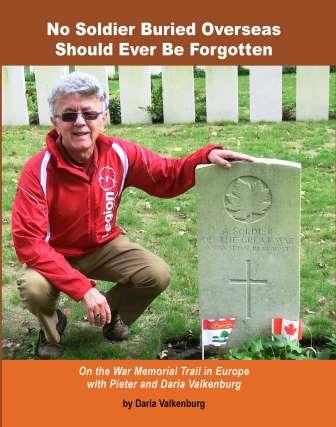
Front cover OnTheWarMememorialTrailinEurope4 countries, 6 weeks, 7,000 km – an unforgettable war memorial journey in Europe…. Daria’s book ‘No Soldier Buried Overseas Should Ever Be Forgotten‘ is available in print and e-book formats.  Net proceeds of book sales help support research costs and the cost of maintaining this blog. For more information see https://nosoldierforgotten.com/ 

You are also invited to subscribe to our YouTube Channel: On The War Memorial Trail With Pieter Valkenburg: https://www.youtube.com/channel/UCJ591TyjSheOR-Cb_Gs_5Kw

Never miss a posting!  Subscribe below to have each new story from the war memorial trail delivered to your inbox.

On The War Memorial Trail….. Continuing The Search For Soldiers Killed In Action In WWI and WWII

October 17, 2020.  One of the many characteristics I admire about Pieter is his commitment to find a photo and family for every WWI and WWII soldier he researches.  He refuses to believe that there is a Canadian soldier lying in an overseas cemetery who has been completely forgotten. 

When he exhausts his research leads, he asks for help from the media.  Today’s posting will mention some of the searches through the media and provide an update on what he’s learned as of today.

pieter recherche photo de militaire

Pieter during an interview about WW1 soldier Basil Cormier.  (Photo credit: Jacinthe LaForest, courtesy of La Voix Acadienne)

WWI Soldier Bazil Cormier

The story of WWI soldier Bazil CORMIER, whose name is listed on the Cenotaph outside the Borden-Carleton Legion, was told when we visited his grave in Rouen, France in 2017. (See https://bordencarletonresearchproject.wordpress.com/2017/10/01/on-the-road-to-rouen/)

In addition to the blog posting, an article was published in the Country Line Courier newspaper. (See CLC Dec 6 2017 p17 Bazil Cormier Rouen France)

Up to now, no family or photo has been found, so we wondered if we would have any success if an appeal was made in the French language media.  Jacinthe LaForest interviewed Pieter for the La Voix Acadienne newspaper.  (You can read the article here, which is in French: LaVoix14oct2020_06_10 Bazil Cormier ) So far, no one has come forward.

WWI soldier James Cairns

Another WWI soldier whose name is listed on the Cenotaph outside the Borden-Carleton Legion is James CAIRNS.  He’s buried in Caix, France, which we visited in 2017. (For his story, see https://onthewarmemorialtrail.com/2017/09/30/the-search-for-manitoba-cemetery/

In addition to the blog posting, an article was published in the Country Line Courier newspaper. (See CLC Oct 18 2017 p23 Manitoba Cemetery in France

Before war broke out, he had moved to Manitoba and lived in the community of Cartwright.  With no luck on the Island to find family or a photo, Pieter contacted the Southern Manitoba Review newspaper and his letter was published earlier this month. The editor, Vicki Wallace, is a history buff and dug into the story, giving Pieter more information about the family.  However, up to now, no one has responded and a photo has not yet been found.  UPDATE: A photo was received in 2022.

James Cairns

WWII soldier John Clifford Rogers

For the Faces To Grave project, which is trying to find photos of WWII soldiers in The Netherlands, Pieter was unsuccessful in finding a photo for John Clifford ROGERS, whose grave at the Canadian War Cemetery in Groesbeek, The Netherlands we’d visited in 2019. (See https://onthewarmemorialtrail.com/2019/12/04/on-the-war-memorial-trail-our-2019-visit-to-the-canadian-war-cemetery-in-groesbeek/)

In addition to the blog posting, an article was published in the Country Line Courier newspaper. (See CLC Jan 29 2020 p26 2019 Visit To Groesbeek)

In an attempt to find family and a photo, Pieter contacted The Guardian newspaper, and his letter was published last week. (See https://www.theguardian.pe.ca/opinion/local-perspectives/letter-seeking-photo-of-soldier-from-second-world-war-508864/) Although he received some inquiries about his letter, to date no family or photo has been found. UPDATE: A photo was received in 2021.

John Clifford Rogers

WWII soldier Vernon James Nixon

In another Faces To Grave project search, Pieter contacted The Saint Croix Courier in St. Stephen, New Brunswick about WWII soldier Vernon James NIXON, who is buried in the Canadian War Cemetery in Holten, The Netherlands.   We didn’t receive a copy of this letter from editor Kristi Marples, but a few people did contact Pieter. 

Kent Caldwell of the local Legion branch mentioned that an old scrapbook had been found several years ago, and an old newspaper photo submitted for the New Brunswick Military Recognition Booklet.  The Royal Canadian Legion’s New Brunswick Command subsequently mailed Pieter the entry from the booklet.

Nixon writeup

Excerpt from the New Brunswick Military Recognition Booklet.

Then Pieter was contacted by a family member, who had visited the grave.  Hopefully, a photo will be provided.  UPDATE: A photo was received in 2021.

WWII soldier Philip Hubert Long

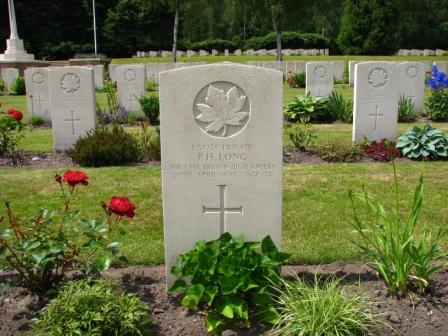
In another Faces To Graves project search, Pieter was interviewed by David Pate of CBC Radio’s Maritime Noon about Philip Hubert LONG of New Brunswick, who is also buried at the Canadian War Cemetery in Holten, The Netherlands.  (You can listen to the interview here: https://drive.google.com/file/d/1R07RkSjTeshJA_-UO_W68fsY3FHCSLPB/view?usp=sharing

Within two hours of the broadcast, Pieter received a call from a family member, and hopefully a photo will be provided. UPDATE: A photo was received in 2020, shortly after the radio interview.

More photos of soldiers are still to be found

For a list of more soldiers from PEI that Pieter is hoping to find photos of, see here: List of photos needed

Our thanks go to the media for helping us to tell these stories:  CBC Radio’s Maritime Noon, County Line Courier, La Voix Acadienne, Southern Manitoba Review, The Guardian, and The Saint Croix Courier.  If you can help with providing information on James Cairns, Bazil Cormier, Philip Hubert Long, Vernon James Nixon, or John Clifford Rogers, please email Pieter at memorialtrail@gmail.com, comment on the blog, or tweet to @researchmemori1.    

© Daria Valkenburg

…Want to follow our research?…

If you are reading this posting, but aren’t following our research, you are welcome to do so.  Our blog address: https://onthewarmemorialtrail.com/

Front cover OnTheWarMememorialTrailinEurope4 countries, 6 weeks, 7,000 km – an unforgettable war memorial journey in Europe…. Daria’s book ‘No Soldier Buried Overseas Should Ever Be Forgotten‘ is available in print and e-book formats.  Net proceeds of book sales help support research costs and the cost of maintaining this blog. For more information see https://nosoldierforgotten.com/

Subscribe to our YouTube Channel: On The War Memorial Trail With Pieter Valkenburg: https://www.youtube.com/channel/UCJ591TyjSheOR-Cb_Gs_5Kw

Never miss a posting!  Subscribe below to have each new story from the war memorial trail delivered to your inbox.

The WW2 Soldier Killed In Action While Crossing The Foglia River In Italy

October 9, 2020.  Four WW2 soldiers on the Cenotaph outside the Borden-Carleton Legion lost their lives in Italy…. George Alfred DUNN of the Carleton & York Regiment, Ernest Murray NORTON of the West Nova Scotia Regiment, Arnold Dudley TAYLOR, also of the West Nova Scotia Regiment, and the subject of this posting, Albert Eugene ARSENAULT of the Cape Breton Highlanders.

Albert Eugene Arsenault

Albert Eugene Arsenault. (Photo courtesy of Borden-Carleton Legion Branch #10)

Albert was born on May 5, 1916 in Palmer Road, the son of Joseph and Philoman (Minnie) Arsenault, whose family later moved to Albany.  A farm labourer before the war, at the time of his enlistment he was working as a lumberman with the Canadian Lumber Company in Stewiacke, Nova Scotia.   On April 30, 1940 he enlisted with the PEI Highlanders in Dartmouth, Nova Scotia. The enlistment record indicated he spoke both English and French fluently.

Like so many soldiers, he served in several units.  One of the first was the North Nova Scotia Highlanders.  On September 25, 1942 he left for England, where he served as a military guard.  He left for Italy on February 19, 1944, arriving on March 3, 1944.  In May 1944 he was transferred to the Cape Breton Highlanders.

The Allies began the day of August 30th with an air bombardment against German positions at dawn. At 5.30 p.m., the Perth Regiment attacked the end of a ridge northeast of Montecchio, while a knoll at the west end of the town and the high ground beyond were the objectives of the Cape Breton Highlanders. Both units faced incessant fire from the heights as well as minefields along the flat lands. The Perths managed to break through the line first, reaching and passing their objective. The Cape Breton troops had the support of tanks from the 8th Princess Louise’s (New Brunswick) Hussars, which helped three of their companies make it to the base of the knoll. After each attempt, however, they were driven back to the Foglia, with casualties totalling 19 members killed and 46 wounded. The Irish Regiment, which had been in reserve, was moved through the path of the Perths. Tanks and artillery guns were not yet available here and as a result the regiment lost 19 killed and 31 wounded.” (Source: https://www.veterans.gc.ca/eng/remembrance/memorials/overseas/second-world-war/italy/montecchio)

One of those killed in action while crossing the Foglia River near Montecchio, during the battle to take a knoll on the Gothic defence line on August 30, 1944 was Albert Arsenault.  He was buried in the Montecchio War Cemetery in Italy. 582 Commonwealth soldiers, including 289 Canadians, who died in late August and September 1944 in the battle to break The Gothic Line, are buried here.

MONTECCHIO-WAR-CEMETERY~838-06_06_2019-13_23 CWGC

Montecchio War Cemetery, in the locality of Montecchio in the Commune of Montelabbate (Province of Pesaro).  (Photo source: https://www.cwgc.org)

To read the previous postings on George Alfred Dunn and Ernest Murray Norton, see:

Dunn:

Norton:

Pieter has not found family members who might have more information on Albert Eugene Arsenault.  If you can help, please email Pieter at dariadv@yahoo.ca or comment on the blog.

© Daria Valkenburg

On The War Memorial Trail…..Family Memories

September 7, 2020.  It’s a great honour for Pieter to meet the families of the WW1 and WW2 soldiers that he is researching.  When he met Edith McMahon at a presentation given in 2018, Pieter learned that she was the sister of one of the men listed on the Cenotaph outside the Borden-Carleton Legion, and the sister-in-law of another. 

While the stories of her brother, George ‘Preston’ SMITH, and her brother-in-law, George Martin MCMAHON, have already been told, Pieter was delighted to learn that Edith and her family have never forgotten these men.

CIMG1229 Jul 26 2018 Edith McMahon and Pieter

Pieter Valkenburg and Edith McMahon in 2018.  (Photo credit:  Daria Valkenburg)

Edith meets her future husband….

McMahon’s brother, Joseph Pope McMahon, served in the Royal Canadian Air Force.  Edith explained that she met her future husband on the train to Borden (now Borden-Carleton) as he was coming back home from the war in 1945.  Edith’s sister Noreen married in Kinkora in 1945 and Edith was the bridesmaid, the reason for her being on the train.

CIMG1200 Pope McMahon

Joseph ‘Pope’ McMahon.  (Photo: E. McMahon family collection)

George and Pope McMahon have a reunion in England ….

A few months before George McMahon drowned in a canal in Amsterdam in August 1945, he had met with his brother Pope in England. The Charlottetown Guardian reported on this meeting in their May 26, 1945 edition:

Newspaper article with frame

Article about the reunion of George and Pope McMahon in England in 1945. (Source: The Charlottetown Guardian, May 25, 1945 edition, page 11)

Unlike his younger brother, George McMahon was married, to Margaret Kathleen Greenan, and was a father.  His youngest child, Georgie, was born in November 1945, after his death.  His wife never remarried and returned to the Island with her children.

CIMG1210 George McMahon and wife

George and Margaret Kathleen McMahon.  (Photo: E. McMahon family collection)

Preston Smith was never forgotten by his family ….

Edith’s brother, George ‘Preston’ Smith, was the batman for Major Otty CORBETT, his commanding officer in the North Shore (New Brunswick) Regiment, and died in a tragic mishap.

George Preston Smith (2)

George ‘Preston’ Smith. (Photo courtesy of Canadian Virtual War Memorial)

Shortly before he died in Belgium in 1944, he’d sent a photo of a Belgian girl, Marie, that he’d met while on leave in Ghent.  On the back of the photo, he’d written: “This is Marie.  What do you think of her, 19 years old and full of sunshine.  She would be nice to take back to Canada, eh?  I can see you and her trying to talk to one another. Preston” For all these years the family has wondered who Marie was and if she ever learned that Preston had died.

Marie

Photo of ‘Marie’ sent to Preston Smith’s mother shortly before his death. (Photo: E. McMahon family collection)

In 1969, the Smith siblings had a reunion and decided to ‘photoshop’ Preston into the photo. 

CIMG1213 Smith siblings with George Preston photoshopped in

1969 Smith family reunion photo. Preston was ‘photoshopped’ into the photo and is standing at the far left.  (Photo: E. McMahon family collection)

Thank you to Edith McMahon for sharing these stories. To read the previous postings on George Martin McMahon and George ‘Preston’ Smith, see:

If anyone can provide more information on George Martin McMahon, George ‘Preston Smith’, or any of the other Canadian soldiers from WW2 who are buried in The Netherlands, please email Pieter at dariadv@yahoo.ca or comment on the blog. 

© Daria Valkenburg

On The War Memorial Trail…..The 1942 Plane Crash In North Tryon

August 20, 2020.  Not all wartime deaths happen overseas, or in other parts of Canada.  Occasionally one happens right in your neighbourhood.  That was the case on June 11, 1942 when North Tryon was the scene of a fatal plane crash.  Aboard were flight student Ralph Gordon MCCUTCHEON and his instructor, Flight Sgt H. L. SPINNEY, from the No. 9 Service Flying Training School RCAF in Summerside.  This flight training school was part of No. 3 Training Command RCAF, carrying out British Commonwealth Air Training Plan training operations.

43134_b193387-00026 Ralph McCutcheon picture from schoolbook

Ralph McCutcheon.  (Photo courtesy of http://www.ancestry.com)

North Tryon resident Vernon Inman was a witness to the crash and recollected that “… I was walking to the North Tryon School with my sisters and Ralph Edwards and saw the plane coming down.  I was 12 years old at the time.  I saw a parachute come down by the old mill and saw another parachute on the wings…”  The instructor safely landed by the old mill, but the student’s parachute caught on the wings and he lost his life.

CIMG4284 Jul 20 2020 Vernon at 1942 crash site

Vernon Inman indicates scene of the plane crash in June 1942 in North Tryon.  (Photo credit: Daria Valkenburg)

Vernon was keen to see what was happening, and noticed that beside the local store “… there were two men with a horse and buggy.  I jumped on and we went to the crash site.  The road wasn’t paved and the Trans Canada Highway wasn’t built yet.  There was a road, but it was only a dirt road, not even gravel…

What was the weather like that day?” Pieter asked.

Vernon replied that “… it was a nice sunny morning…” and explained that the cause of the crash was never publicly reported.  It was big news on the Island, particularly in the small community of North Tryon and surrounding area.

….Everyone went to the crash site as they knew the plane had come down.  The wing of the plane hit a pumphouse and there was a small fire, but no explosion.  The plane was broken in many places.  The instructor’s parachute went across the pond, but the student didn’t make it. His body was taken from the wreckage and a blanket covered him.  He was lying near where a birch tree is growing now.  I’ll never forget that his legs weren’t covered and I could see them….” 78 years later, that image has still left an indelible impression on him.

While the crash was widely reported, not much was known about the student who died.  Ralph Gordon McCutcheon was only 21 years old, born February 6, 1920 in Buffalo, New York, and the son of Sydney Joseph McCutcheon and Mabel Martha Billica, who lived in Toronto.  He enlisted in the Royal Canadian Air Force (RCAF) in Toronto, Ontario in September 1941, interrupting his education at Colgate University in Hamilton, New York.

Although he had no flying experience, he’d expressed a desire to become a bomber pilot or an observer.  He was initially posted to various bases for training in Ontario and New Brunswick, receiving high marks for training courses, and recommendations to train him as a pilot.  On April 10, 1942 he arrived at No. 9 Service Flying Training School RCAF in Summerside towards that goal.

1-AJ-583-IMG_0568_2-720x393-600x328Harvard pic from harvards.com website

Harvard plane, similar to the one used on June 11, 1942.  (Photo: http://www.harvards.com)

At the time of the crash he had been training in a Harvard MK2 plane. The official report of the crash deemed it an accident while doing “…aerobatics...”, and stated it occurred at 9:15 am.  Eyewitness accounts in the report mirrored Vernon Inman’s recollection.  It noted that “... eyewitnesses state that parachute seemed to be caught on plane which dragged the airman down to his death…”  A handwritten entry added that “…aircraft flicked to the right at the top of the loop then parachute caught on plane…” McCutcheon died instantly of “…multiple fractures and a cracked skull...

Vernon explained that the plane crashed on the border line between the Dawson property and what is now a blueberry farm.  “… Myron Dawson’s sister Martha did guard duty at the crash site as people were trying to take pieces of the plane as souvenirs.  She was in the military and had been sent there from Summerside… 

Vernon didn’t leave the site without a memento of his own… a piece of the wheel, which still retains the original yellow colour.

CIMG4286 Jul 20 2020 Vernon at 1942 crash site

Vernon Inman holds a piece of the wheel from the Harvard plane that crashed in 1942.  (Photo credit: Daria Valkenburg)

…I may be the only witness still alive, except for my sister Aletha, who lives in Michigan.  She’s two years older than me…” Vernon reflected.

In researching this story, Pieter learned that McCutcheon’s body was transported by train to Toronto.  His classmates from the air school in Summerside accompanied his coffin to the train station.  McCutcheon is buried in Prospect Cemetery in Toronto, Ontario.

Thank you to Vernon Inman for his eyewitness recollection of this tragic accident.  Other eyewitness accounts from adults at the time of the crash can be found in ‘Remember Yesterday; a history of North Tryon, PEI 1769-1992, Volume I’. (See https://islandlives.ca/islandora/object/ilives%3A166275v1#page/4/mode/2up) If anyone has more information or photos about this event, please contact Pieter at dariadv@yahoo.ca or comment on the blog.

© Daria Valkenburg

On The War Memorial Trail…..The Search For Barney Reuben McGuigan

August 7, 2020.  In many cases it is very difficult to find a photo of a soldier from WWI or WWII.  Last year, a request was made for photos and information on PEI soldiers from WWII who were buried in The Netherlands.  (See Photos and Info Requested For WW2 Soldiers From PEI Buried In The Netherlands)  One of these soldiers, buried in the Canadian War Cemetery in Groesbeek, was Bernard ‘Barney’ Reuben MCGUIGAN.

Over the past months, Pieter was lucky in finding photos from family members for:

One last soldier from PEI who is buried in one of the three Canadian War Cemeteries in The Netherlands is still without a photo: Bernard ‘Barney’ Reuben MCGUIGAN, who is buried in the Canadian War Cemetery in GroesbeekAt 16 years of age when he lost his life, he is the youngest soldier in the cemetery.

Barney Reuben was born on May 14, 1928, the son of Thomas McGuigan and Sarah ‘Sadie’ Bisson, and baptized on June 17, 1928 at St. Paul’s Church in Sturgeon. Unfortunately his mother died in 1936 and he was brought up by his grandparents, Bernard McGuigan and Rose McGee.

On July 9, 1943 he enlisted in Charlottetown and claimed to be 18 years old, not his actual 15 years of age.  He went on to say that he “…attended rural school in PEI, completing grade 7 at age 16 in 1941, but left school because no teacher was available in the district…” He stated that he was a fisherman at the time of enlistment.  His grandmother Rose is listed as his foster-mother on his enlistment documents.

Under military rules, no one under 19 was to be sent overseas.  As a supposed 18 year old, Barney was sent for training, first to a training camp in Aldershot, Nova Scotia.  In January 1944, he was sent for infantry training in Vernon, BC.  In November 1944, he was sent overseas, arriving in the United Kingdom on November 28, 1944.

On January 8, 1945 he left the United Kingdom for continental Europe, as part of reinforcement troops.  On February 12, 1945 he joined the North Shore (New Brunswick) Regiment.  Then, on February 26, 1945 he lost his life in Germany, just over the Dutch border, during Operation Blockbuster, the last part of Operation Veritable. (See https://en.wikipedia.org/wiki/Operation_Blockbuster)  He was only 16, not 19, years old.

He was initially buried in the Bedburg Military Cemetery, and then later reburied in the Canadian War Cemetery in Groesbeek.

Screenshot_2020-08-06 Google Maps Bedburg Germany

Black X marks the location of Bedburg, Germany, where Barney McGuigan lost his life.  (Map courtesy of Google maps.)

After Barney’s death, his father wrote to the Canadian Military, asking why his son had been sent overseas when he was underage.  At the time of enlistment Barney was 5 feet 7 inches tall and weighed 133 pounds.  The military replied to his father, explaining that since Barney had said he was born in May 29, 1925, he was sent overseas based on that information.  Until his father wrote, unfortunately after Barney’s death, no correction to acknowledge his actual date of birth had been made.

In October 2019 we visited the Canadian War Cemetery in Groesbeek and Pieter laid down flags at graves of Islanders, including Barney McGuigan.  (See On The War Memorial Trail…..Our 2019 Visit To The Canadian War Cemetery In Groesbeek)

CIMG3336 Oct 5 2019 Groesbeek Barney McGuigan cropped

Grave of Barney McGuigan in the Canadian War Cemetery in Groesbeek.  (Photo credit: Daria Valkenburg)

With no luck finding a photo, Pieter was recently interviewed by Angela Walker for CBC Radio’s Mainstreet PEI about his quest…  Link to interview:

 https://drive.google.com/file/d/1VMIbebs8kn2zQv9Al4Ndoy3gezMcWHPK/view?usp=sharing

Following the interview, he was contacted by Regina Faithfull, Barney’s cousin.  She had a photo of her father, in which Barney could be seen behind a door in the background.

Photo of McGuigans from Jeanie Faithfull

Also listening to the CBC broadcast was Charlotte MacAuley, reporter for the ‘Eastern Graphic’ newspaper.  As Barney was from the area the newspaper covered, she was interested in doing a story.  Perhaps that might generate a photo in which Barney could be seen more clearly?

CIMG4292 Jul 22 2020 Charlotte & Pieter at Eastern Graphic

Pieter with Charlotte MacAuley at the Eastern Graphic office in Montague.  (Photo credit: Daria Valkenburg)

Pieter agreed to an interview, which you can read here: (EAG-A12-080520.K War researcher looking to connect with family of Barney McGuigan).

Pieter by Charlotte MacAuley

Pieter with a copy of the telegram sent to Barney McGuigan’s family, advising of his death. (Photo credit: Charlotte MacAuley)

So…. the search for a photo continues…will Pieter be able to fulfill his quest? If anyone has more information or a photo for Barney Reuben McGuigan, please contact Pieter at memorialtrail@gmail.com, or comment on the blog.    

Thank you to Angela Walker of CBC PEI Radio and Charlotte MacAuley of the ‘Eastern Graphic‘ for helping to publicize this search. Thank you also to Regina Faithfull for submitting a photo of the McGuigan family, Jane Scott for the link to the radio interview, and to Father Art O’Shea, diocese archivist at the Roman Catholic Diocese of Charlottetown, for confirmation of the date of birth and baptism for Barney McGuigan.

© Daria Valkenburg

…Want to follow our research?…

If you are reading this posting, but aren’t following our research, you are welcome to do so.  Our blog address: https://onthewarmemorialtrail.com/

Front cover OnTheWarMememorialTrailinEurope4 countries, 6 weeks, 7,000 km – an unforgettable war memorial journey in Europe…. Daria’s book ‘No Soldier Buried Overseas Should Ever Be Forgotten‘ is available in print and e-book formats.  Net proceeds of book sales help support research costs and the cost of maintaining this blog. For more information see https://nosoldierforgotten.com/

Subscribe to our YouTube Channel: On The War Memorial Trail With Pieter Valkenburg: https://www.youtube.com/channel/UCJ591TyjSheOR-Cb_Gs_5Kw

Never miss a posting!  Subscribe below to have each new story from the war memorial trail delivered to your inbox.
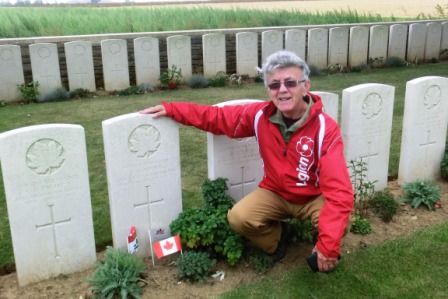
On The War Memorial Trail…..A Mariner Named Arsenault Who Drowned In South America

Cenotaph outside Borden Carleton Legion by Pieter Valkenburg

Cenotaph outside the Borden-Carleton Legion. (Photo credit: Pieter Valkenburg)

July 18, 2020.  When Pieter first began researching the names on the Cenotaph outside the Borden-Carleton Legion, he had a lot of slogging to do to figure out who these names represented.  There were no records, Legion minutes that might have shed light on how the names were selected were missing, and no newspaper accounts could be found that identified the names.

With a lot of hard work digging through war diaries, and reading of soldier records found at Library and Archives Canada, and the cooperation of the families of several  of these men in providing photos and letters written by them, 45 of the 46 names originally listed on the Cenotaph were identified.  Along the way, 2 more names that were inadvertently missed were added.

The one missing name, an F. Arsenault, remained a question mark.  No soldier could be identified as a possibility, so Pieter turned to records from the Canadian Merchant Navy.  There was one likely possibility…. Joseph ‘Francis’ ARSENAULT, born May 15, 1928 in Tignish.  At the time of his application for a Merchant Seaman’s Identity Certificate in Halifax on November 19, 1945, both he and his father Basil were listed as living in Albany.  His mother, Angeline Pire, had died in 1929 in Palmer Road.

image of francis arsenault_Page_1

Image of Francis Arsenault from his Application For Merchant Seaman’s Identity Certificate

With the help of Donna Matthews of Veterans Affairs, the story was pieced together.  Francis Arsenault’s first voyage was on the ‘Asbjorn’, as a U/Boy (Utility boy), serving between November 27 and December 7, 1945.

He then was sent to the ‘Argyle Park’ as a mess boy on December 7, 1945, sailing to St John, for two voyages and leaving the ship in St John on January 17, 1946.

On January 23, 1946 he transferred to the ‘Hampstead Park’ as an m/boy (mess boy), and was discharged on May 18, 1946.

His next voyage was aboard ‘Noranda Park’, as a galley boy, sailing on May 20, 1946, arriving on July 29, 1946 in Port Alfred, South Africa.  The ship was then renamed ‘Oceanside’ and he signed on for another voyage from Port Alfred to Georgetown, Guyana.  While on ‘Oceanside’ he was promoted to second cook.

According to the website Fort Ships of WW2, “…the ‘Park’ ships were run by the Park Steamship Company and were named after well-known national, provincial or municipal parks in Canada.  The Company became a Canadian Government Crown Corporation in 1942 to own, manage and operate the ships allocated to it for the purposes of the war…. The appointed Canadian managers were responsible for the hiring of crew and officers as well as supplying the ships with fuel and supplies.  They had little control over the routing of the vessel, or the cargo as war materials took precedence… After the war the fleet was gradually disposed of…” (See http://fortships.tripod.com/Parks%20A-N.htm)

map of guyana from Pinterest

Unfortunately, ‘Oceanside’ was his last ship.  On August 12, 1946, while the ship was in Mackenzie City (now part of Linden) on the Demerara River in Guyana (in South America), he drowned after he fell out of a small boat while returning to the ship ‘under the influence of drink’, according to the Department of Transport Central Register of Seamen.

A large mining camp established by the Aluminum Company of Canada (later nationalized as the Guyana Bauxite Company) was in this area. Bauxite mined here would have been brought to Mackenzie City for processing and then loaded onto oceangoing vessels.  Most likely, this was why ‘Oceanside’ was in Guyana.

According to the Official Log of ‘Oceanside’ for August 12, 1946, the Captain wrote that “…This is to certify that the Chief Steward reported to me that at 00:30 this morning that F. Arsenault 2nd Cook, had fallen out of a boat when returning to the ship, very much under the influence of drink, and was drowned. He was not seen after he left the boat, he sank like a stone. J. Hilliard, who was with him, jumped after him to attempt to rescue him, but after swimming around for some time without finding any trace of him he gave up the attempt, but with others from the ship who saw the accident continued the search with flashlights along the beach in both up and down stream from the spot he fell in, hoping they may find him clinging to something. This search went on until 01:45, when the men returned to the ship, and the 3rd mate reported with regret that they were unsuccessful….

It was a mystery why Arsenault was considered a veteran when he died more than a year after WW2 ended.  Donna Mathews explained that “…Per the Canada Remembers Section of Veterans Affairs, Arsenault was added to the Merchant Navy Book of Remembrance and Canadian Virtual War Memorial.  The cut-off date to include those that died during the Second World War was December 30, 1947…

Thank you to Donna Mathews for her assistance in researching this merchant mariner’s story.  If anyone has more information or a photo for Francis Arsenault, please contact Pieter at dariadv@yahoo.ca or comment on the blog.

© Daria Valkenburg

On The War Memorial Trail…..A Face For WWII Soldier James Walter Auld

July 7, 2020.  Last year, a request was made for photos and information on PEI soldiers from WWII who were buried in The Netherlands.  (See Photos and Info Requested For WW2 Soldiers From PEI Buried In The Netherlands)

It’s been a slow and difficult quest, but in the past few months two photos have been found, one for Joseph Edmund HENNEBERY (See On The War Memorial Trail…..A Face For Joseph Hennebery!) and now one for James ‘Walter’ AULD.

The story of how Walter’s photo was found has several twists and turns.  Pieter had zero luck in finding anyone related to this WWII soldier, who is buried in the Canadian War Cemetery in Bergen Op Zoom in The Netherlands, until we met Helen MacEwen, who had invited us to see a WWI era map her father-in-law had sent to the Island in 1918.  (See The WW1 Era ‘Course Of The Rhine’ Map of Germany)

We brought along a ‘wish list’ of photos and after looking at the list, Helen suggested that Pieter contact Allison Ellis, as his wife Melba came from the same area as Walter.  “…Allison is a retired politician…” Helen explained, “...and knows a lot of people…”  (See http://www.peildo.ca/fedora/repository/leg:27520)

It was a long shot. Lots of people over the years have suggested names, which turned out to be a fruitless exercise, but this time Pieter found a kindred spirit.  Allison remembered a Walter Auld and it was soon determined that this was the same person.  “…. I’ve been to his grave in The Netherlands….” Pieter was told. Allison didn’t have a photo, but thought he knew who to ask.  “…Leave it with me…” he said. A week later, we were sitting in the home of Allison and Melba, and Pieter had a photo that Walter’s niece, Judy Bartlett, had provided.

CIMG4156 Jun 23 2020 Pieter with Melba & Allison Ellis

Left to right: Melba Ellis, Pieter, Allison Ellis.  (Photo credit: Daria Valkenburg)

James Walter Auld

Walter Auld. (Photo courtesy of Judy Bartlett Family Collection)

James ‘Walter’ AULD was born October 21, 1923 in Glenwood, the son of James and Margaret Auld of O’Leary Station, and was a garage mechanic with Corney Brothers in Summerside.  After enlisting in Charlottetown on February 20, 1942, he was sent for basic training as a rifleman.

A note in his service file indicates he was unhappy with this placement and noted he had been promised a position as a driver or mechanic when he enlisted.  His mechanical knowledge was assessed as ‘superior’ and the recommendation was made that he be transferred to a position where his skills could be used.

In May 1942 he was transferred to the Princess Louise Fusiliers (Motor Division), and by October 1942 he was on his way to England. In August 1943 he was transferred to the Algonquin Regiment.  In July 1944 he was with his unit, first in France and then as they moved into The Netherlands.

According to the War Diary for the Algonquin Regiment, on November 1, 1944 they were under the command of the 10th Canadian Infantry Brigade, 4th Canadian Armoured Division, and in action to try and take the town of Welberg, The Netherlands.   This was part of Operation Suitcase, which began on October 20, 1944, and as part of the bigger Battle of the Scheldt operation.  (See https://canadianbattlefieldtours.ca/operation-suitcase/)

self propelled tank p49

The war diary entry for November 1, 1944 recorded that “… Zero hour was at 19:00 hours…. We had 17 SP (self-propelled) tanks in support to deal with the enemy SP tanks…. Shortly after the kick-off, ‘A’ Company reported that one SP had bogged down and was holding the Company up  and before they got going again ‘D’ Company reported they were 300 yards from Welberg.  At 20:45 hours ‘A’ Company reported that one of the SPs had been hit and was burning.  At 21:00 hours ‘A’ Company reported another SP burning and that the situation was very confused due to heavy shelling of their positions by enemy SPs….

At some point in this battle on November 1, 1944, Walter lost his life, aged 21. On November 6, 1944, he was buried in a cemetery in Steenbergen, not far from where he died.

Map where Auld died with arrow

Map with a black arrow showing the approximate location where Auld lost his life near Welberg. The unit had come from the area of Moerstaten. He was initially buried in Steenbergen, then later in Bergen Op Zoom. (Map courtesy of Michelin)

In October 1946 Walter was reburied in the Canadian War Cemetery in Bergen Op Zoom.  We were there in October 2019 and Pieter placed Canadian and PEI flags by his grave.  (See On The War Memorial Trail…..Our 2019 Visit To The Canadian War Cemetery In Bergen Op Zoom for an account of our visit.)

CIMG3388 Oct 7 2019 Bergen Op Zoom James Auld

Pieter by the grave of Walter Auld at the Canadian War Cemetery in Bergen Op Zoom.  (Photo credit: Daria Valkenburg)

Thanks to the combined efforts of Allison and Melba Ellis, Judy Bartlett, and Helen MacEwen, a photo of James ‘Walter’ Auld is on its way to the researchers at the Canadian War Cemetery in Bergen Op Zoom. If you have information to share about Canadian soldiers buried in The Netherlands, please contact Pieter at memorialtrail@gmail.com or comment on the blog.

© Daria Valkenburg

….Want to follow our research?….

If you are reading this posting, but aren’t following our research, you are welcome to do so.  Our blog address: https://onthewarmemorialtrail.com/

4 countries, 6 weeks, 7,000 km – an unforgettable war memorial journey in Europe…. Daria’s book ‘No Soldier Buried Overseas Should Ever Be Forgotten‘ is available in print and e-book formats.  Net proceeds of book sales help support research costs and the cost of maintaining this blog. For more information see https://nosoldierforgotten.com/

You are also invited to subscribe to our YouTube Channel: On The War Memorial Trail With Pieter Valkenburg: https://www.youtube.com/channel/UCJ591TyjSheOR-Cb_Gs_5Kw

Never miss a posting!  Subscribe below to have each new story from the war memorial trail delivered to your inbox.

On The War Memorial Trail…..The WWI Era ‘Course Of The Rhine’ Map of Germany

July 3, 2020.  It’s always a pleasure to hear from readers.  After reading about Harold Keith Howatt’s travels to WWI Germany as part of the post-occupation forces, Helen MacEwen contacted us about a map that her father-in-law sent to his future wife in 1918.  “I have been reading with interest your reports about the WWI Veterans and wondered if I could bring further information about my father-in-law’s last tour after the German surrender. His name was Sgt. Herbert ‘Herb’ S. MACEWEN from Stanley Bridge…

Helen went on to describe the map.  “…I have a copy of the ‘COURSE OF THE RHINE: From Mayence to Cologne’. It is a fold-out map of the Rhine River within a hard-cover. It is very fragile but does mention the different towns that you mentioned in your stories…” (You can read Howatt’s account at The WW1 Soldier Who Went To Post WW1 Germany)  Today we know Mayence as Mainz.

CIMG4111 Jun 14 2020 Herbert MacEwan in uniform

Herbert MacEwen.  (Photo courtesy of Helen MacEwen collection)

Howatt was in the 8th Canadian Siege Battery during WWI, while MacEwen was in the 2nd Canadian Siege Battery.  Both batteries were later attached to the 2nd Brigade, the only Canadian Heavy Artillery Brigade that went to Germany.

We were intrigued and made arrangements to meet Helen and see the map.  It turned out to be a surprise, as it was a foldable, panoramic map in full colour, showing the area along the Rhine River between Mainz and Cologne.  To complete the surprise, the map was written in English, but published in Germany.  It was clear that this had to be a map that pre-dated WWI and was designed for tourists!

20200614_144359 Jun 14 2020 Pieter & Helen MacEwan with panoramic map of Rhine River

Pieter and Helen MacEwen with the foldable, panoramic map. (Photo credit: Daria Valkenburg)

Ralf Gräfenstein, a historian in Berlin, found a document that might explain why a map published in Germany over 100 years ago would be in English. “These maps were made in English for tourists from Britain and Overseas, who came before the beginning of WWI and after the war to the German Rhine area…” he explained.

Ralf referred me to a 2006 dissertation written by Thilo Nowack of the University of Bonn, entitled ‘Rhein, Romantik, Reisen. Der Ausflugs- und Erholungsreiseverkehr im Mittelrheintal im Kontext gesellschaftlichen Wandels (1890 bis 1970)’ and gave a reference to the chapters that would be of interest. (Translation of the dissertation: ‘Rhine, romance, travel. Excursion and recreational travel in the Middle Rhine Valley in the context of social change (1890 to 1970)’).

In the dissertation, it was explained that “… the Tourism Society of the Rhine Area was founded in 1904… with the goal “to promote and make traveling and the stay on the Rhine and its side valleys pleasant’…” in response to the view that “… the Rhineland had lost its attraction as a travel destination since the late 19th century…”  As part of the tourism promotion effort, “… posters, brochures and other booklets were used to advertise in German, English, French and Dutch…” and placed “…in train stations at home and abroad…”  Tourist promotion was economically important as “… the invention and expansion of steam shipping and railroads enabled an enormous increase in travel on the Rhine…

It seems likely that Herbert MacEwen could have found the map in a shop or train station someplace in Germany, most likely Cologne.  It’s clearly a tourist map, with key destinations identified along the Rhine, with brief explanations and diagrams.

20200614_144505 EXCERPT Jun 14 2020 Portion of map between Cologne & Mehlem - Copy

An excerpt from the map, showing illustrations and descriptions.  (Photo credit: Daria Valkenburg)

Helen noted that “…Herb had sent this map to his girlfriend in Stanley Bridge. They married in 1921.  He states that they stayed near Mehlem-on-Rhine…

At the top of the map Herb had written “… Arrived at the Rhine on December 12th, 1918.  I have marked the bridge on which we expect to pass over. We are at present guarding the bridgehead from this site…”  This confirms the entry in Harold Howatt’s account, which stated that they had arrived in Cologne on December 12.

20200614_143410 Jun 14 2020 note on map saying unit was guarding bridge head

Herb MacEwen’s note at the top of the map.  (Photo credit: Pieter Valkenburg)

A bridgehead is the strategically important area of ground around the end of a bridge over a body of water.  (For more information, see https://en.wikipedia.org/wiki/Bridgehead)

On December 13, Harold Howatt had noted that “….the Canadian troops marched across the Rhine, reviewed as they crossed the bridge by General Plumer and General Currie…” The bridge crossed was the Hohenzollern Bridge in Cologne. (See https://en.wikipedia.org/wiki/Hohenzollern_Bridge)

To our amazement, Pieter found a video from the Imperial War Museum of this march across the Hohenzollern Bridge: https://www.iwm.org.uk/collections/item/object/1060008233.

Herb MacEwen was discharged on May 18, 1919.   His daughter-in-law Helen told us that “…he would be 21 years old.  He apparently, ‘conveniently,’ put his birthdate down as older than fact when he joined the Army…

The individual stories of our soldiers enrich the sometimes dry facts of history, and it was wonderful to learn of the shared history of Herb MacEwen and Harold Howatt.

For more information on the post WWI occupation of the Rhineland, see https://en.wikipedia.org/wiki/Occupation_of_the_Rhineland

For more information on General Sir Herbert Plumer, who commanded the Army of Occupation, see https://en.wikipedia.org/wiki/Herbert_Plumer,_1st_Viscount_Plumer

For more information on General Sir Arthur Currie, see https://en.wikipedia.org/wiki/Arthur_Currie

Thank you to Helen MacEwen for sharing the story of Herb MacEwen and Course Of The Rhine Map from the early 20th Century.  If you have a story to share, please contact Pieter at memorialtrail@gmail.com or comment on the blog.

© Daria Valkenburg

….Want to follow our research?….

If you are reading this posting, but aren’t following our research, you are welcome to do so.  Our blog address: https://onthewarmemorialtrail.com/

4 countries, 6 weeks, 7,000 km – an unforgettable war memorial journey in Europe…. Daria’s book ‘No Soldier Buried Overseas Should Ever Be Forgotten‘ is available in print and e-book formats.  Net proceeds of book sales help support research costs and the cost of maintaining this blog. For more information see https://nosoldierforgotten.com/

You are also invited to subscribe to our YouTube Channel: On The War Memorial Trail With Pieter Valkenburg: https://www.youtube.com/channel/UCJ591TyjSheOR-Cb_Gs_5Kw

Never miss a posting!  Subscribe below to have each new story from the war memorial trail delivered to your inbox.
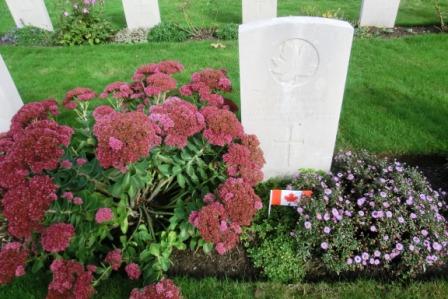
 

Canada Day In Tryon

20200630_200525 Jul 1 2020 Happy Canada Day

The Canadian flag flies proudly! (Photo credit: Daria Valkenburg)

July 1, 2020.  Happy Canada Day! On July 1, a Canada Day ceremony to inaugurate a new flagpole and bench at the Tryon Cenotaph at the Tryon People’s Cemetery was attended by several members of the community, including Pieter and myself.  This event was coordinated by the Tryon Women’s Institute, Tryon People’s Cemetery, and Merry Pop-Ins Childcare Centre, with funding for the flagpole and bench provided by Heritage Canada.

Exif_JPEG_420

Pieter by the Tryon Cenotaph. (Photo credit: Daria Valkenburg)

Three names from WW1 that are listed on the portion of the Tryon Cenotaph shown in the photo above are also listed on the Cenotaph outside the Borden-Carleton Legion.  Over the years, their stories have been told in this blog:

Dignitaries attending today’s event included:

  • The Honourable Wayne Easter, Member of Parliament for Malpeque
  • The Honourable Jamie Fox, Minister of Fisheries and Communities and MLA for District 19
  • The Honourable Peter Bevan-Baker, Leader of the Official Opposition and MLA for District 17
  • Reverend Doctor Karen MacLeod-Wilkie, Minister of South Shore United Church

Exif_JPEG_420

Peter Bevan-Baker plays ‘O Canada’ as the flag is raised. (Photo credit: Daria Valkenburg)

Exif_JPEG_420

Tom Albrecht raises the flag on new flagpole.  (Photo credit: Daria Valkenburg)

Exif_JPEG_420

Of course there were Canada Day cupcakes!  Left to right: Jamie Fox, Fran Albrecht, Helen Green, Jack Sorensen.  (Photo credit: Daria Valkenburg)

Exif_JPEG_420

Standing by the Tryon Cenotaph, left to right: Wayne Easter, Peter Bevan-Baker, Jamie Fox. (Photo credit: Daria Valkenburg)

Barb Clement was kind enough to send a short video made while ‘O Canada’ was played. See https://drive.google.com/file/d/1vLQOBYtgnnOET7gAdi88C-9Z4HHf3BQr/view?usp=sharing

Thank you to the organizers of this Canada Day event, and to Barb Clement for sharing the video. If you have a story to share about any of the names on the Tryon Cenotaph, please contact Pieter at dariadv@yahoo.ca or comment on the blog.

© Daria Valkenburg