On The War Memorial Trail….. Pieter Awarded Sovereign’s Medal For Volunteers

Pieter’s Sovereign’s Medal For Volunteers. (Photo credit: Daria Valkenburg)

May 4, 2021. On February 18, 2020, while we were in Florida for our winter vacation, I went to the movies with a few friends.  We went to see a ‘chick flick’, a film not of interest to any of our husbands, including Pieter.  While I was away, Pieter got a phone call from the Office of the Secretary to the Governor General, advising that he had been nominated for the Sovereign’s Medal for Volunteers and this was approved by the Governor General.  Would he be willing to accept it?  (See  https://en.wikipedia.org/wiki/Sovereign%27s_Medal_for_Volunteers)

A very surprised Pieter said it would be an honour.  We all know what happened next….  Covid put a stop to any events, and the ceremony was postponed.  Almost 14 months later, Pieter got a call from the Events Coordinator at the Office of the Secretary to the Governor General.  Would he be willing to have a virtual presentation ceremony?  The answer was yes.

Pieter wears the Governor General’s Sovereign’s Medal for Volunteers.  (Photo credit: Daria Valkenburg)

On April 30, 2021, Pieter Valkenburg was presented with the Governor General’s Sovereign’s Medal For Volunteers, for his ongoing research to uncover the stories and photos of those who served in WWI and WWII, and sharing his research findings with the public.   (See https://www.gg.ca/en/honours/recipients/342-116665)

The insignia was presented to him by the Hon. Catherine Callbeck, CM, OPEI, LLD, on behalf of His Excellency the Right Honourable Richard Wagner, P.C., Administrator of the Government of Canada, via a virtual private ceremony.   

Pieter with Catherine Callbeck.  (Photo credit: Daria Valkenburg)

Pieter thanks those who helped with this research project….

Given the shortness of the ceremony, Pieter was unable to thank everyone who has helped with the On The War Memorial Trail research project.  So here is what Pieter asked to be included in this posting:

I am deeply humbled by this honour. Thank you to those who nominated me and supported this nomination.

I started this project to offer my gratitude to Canada for liberating country of my birth. As a Canadian, I wanted to honour those soldiers that made the ultimate sacrifice and the families that lost their loved ones.

My volunteerism would have never been possible without the support of many people and I would like to mention some of them. First and foremost, my wife Daria, who makes sure that a blog about my research is written, YouTube videos are posted, a Twitter account is maintained, and articles are written and published.

I would also like to thank Mike and Isabel Smith of The County Line Courier who have given us enormous support and published all the articles that my wife wrote.

Thank you to Angela Walker of CBC radio in Charlottetown, as well as CBC radio in Moncton and Halifax, CBC Radio-Canada in Moncton, and CTV Atlantic’s Live At Five.  Their support provided platforms to ask for the public’s help in researching soldiers.

This project initially began with 48 names on a Cenotaph and has expanded to cover soldiers in Atlantic provinces.  I thank the many Legion members in the Atlantic provinces who have helped fulfill photo requests. 

Royal Canadian Legion Branch 10 in Borden-Carleton is commended for its willingness to create a wall of honour with pictures of the WWI and WWII soldiers that we have researched and that are mentioned on their Cenotaph.

One of the names on this Cenotaph was that of a 23 year old WWII pilot from PEI.  He died but saved his crew and the village of Wons in The Netherlands by choosing to stay with his plane after it was shot down.

With the help and cooperation of the Tryon and Area Historical Society on Prince Edward Island, and the Missing Airmen Memorial Foundation in The Netherlands, a memorial panel for this pilot and his crew was installed in 2019 near the crash site.

I would like to thank the many families that donated pictures and stories about relatives who served. These contacts have been heartwarming and have enriched our lives. We were able to meet a number of them, and are honoured by the gratitude they’ve shown that their relatives are not forgotten.

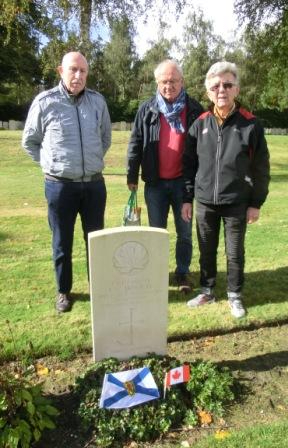
Over the years, we have visited Vimy Ridge, Menin Gate, and many cemeteries in France, Belgium, Germany, and The Netherlands to pay our respects to the soldiers that we have researched and written about and to honour them by placing small Canadian and provincial flags at their graves.

These flags were provided by the offices of Senator Mike Duffy, our federal Member of Parliament, Wayne Easter, and our provincial Member of the Legislative Assembly, Jamie Fox. 

During these visits we met many other volunteers, who devote their time to make sure that the sacrifice made by the soldiers will never be forgotten, such as research volunteers for the three Canadian War Cemeteries in The Netherlands.  Presently I’m assisting them in finding photos and non-military information for soldiers from the Maritimes.

Remembrance of those who gave their lives for our continued freedom is important, and no soldier buried overseas should ever be forgotten.  My research work will continue. Thank you….

The ceremony was very emotional and touching, and as a very proud wife, I was delighted that Pieter received this award.  I’m extremely proud of him for his incredible work in bringing history to life by telling the stories of individuals who served in WWI and WWII.

Comments on Pieter receiving the Sovereign’s Medal for Volunteers….

As people have learned of this award, several took the time to contact Pieter.  Here are a few of the comments:

Mike and Isabel Smith, Publishers of the County Line Courier:  “Congratulations on receiving the Sovereigns Medal For Volunteers. What an accomplishment.

The award appropriately reflects your passion and the endless hours you have spent making phone calls, researching and following leads to recover and secure information and photographs of veterans whose stories might have been forgotten and lost.

Your dedication honours the service and sacrifices of these veterans who served their country.

On behalf of The County Line Courier Community Newspaper, congratulations and keep up the good work.

Susan and Charlie Choi: “Congratulations Pieter!!!!!!!  Very exciting news and very well deserved!” 

Mieke de Bie: “It is a great honour for him. He may be proud of it because he deserves it! It happens not everyday… I am excited too, and also proud of our cousin.

Marjorie Inman:  “Thank you Pieter for your many years of devotion to this worthwhile project.

Rheal Leger and Simone Belliveau: “Congratulations to Pieter. That’s a major honour for a great continuation of his project. Outstanding work Pieter!

Alexander Tuinhout, Missing Airmen Memorial Foundation: “Congratulations Pieter! Receiving this medal is not only an honour, but also a public recognition of the important work that the both of you do and have done already. Commemorating the fallen during both World Wars is not only about history, but also about connecting people and keeping the memories alive.

Brien and Moira Robertson: “Congratulations for your award. It is such an honor. Everyone is proud of you. It is a wonderful achievement and the fallen dead were very honored through your achievements.” 

Remco and Barbara de Jong: “Woooow, congratulations on this extraordinary award and recognition. And in my opinion no more than is deserved. Not that you are doing this great job to get a medal but for the gratitude of the next of kin. That their loved ones didn’t sacrifice for nothing in the end. Pieter and Daria stay healthy and especially continue with this great work. With congratulations from Fryske Makkum.

Lina and Sergio Canonico: “Congratulations Pieter for your dedication and perseverance to this project.  It was a true labour of love and one that has meant so much to those families that have lost their loved ones.  Lest they never be forgotten.  May the good Lord bless you.

Thank you to the Events Coordination and IT team for the Chancellery of Honours, part of the Office of the Secretary to the Governor General, for arranging the ceremony.  The Canadian and PEI provincial flags were provided by Annie Lee and Elmer MacDonald, who were able to temporarily borrow them from their church.  Thank you to Catherine Callbeck for presenting the insignia on behalf of the Administrator of the Government of Canada. And a huge thank you to those who nominated and supported Pieter for this award.

The On The War Memorial Trail project continues. If you have photos or information to share, please email us at memorialtrail@gmail.com, or comment on the blog. 

© Daria Valkenburg

…Want to follow our research?….

If you are reading this posting, but aren’t following our research, you are welcome to do so.  Our blog address: https://onthewarmemorialtrail.com/
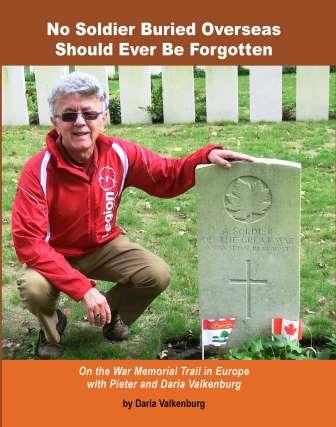
4 countries, 6 weeks, 7,000 km – an unforgettable war memorial journey in Europe…. Daria’s book ‘No Soldier Buried Overseas Should Ever Be Forgotten‘ is available in print and e-book formats.  Net proceeds of book sales help support research costs and the cost of maintaining this blog. For more information on the book, please see https://nosoldierforgotten.com/

Subscribe to our YouTube Channel: On The War Memorial Trail With Pieter Valkenburg: https://www.youtube.com/channel/UCJ591TyjSheOR-Cb_Gs_5Kw

Never miss a posting!  Subscribe below to have each new story from the war memorial trail delivered to your inbox.

On The War Memorial Trail….. The WWI Soldier Who Returned To Tryon

April 24, 2021.  One of the joys in doing research for the On The War Memorial Trail research project is the opportunity to learn more about the families of our friends and neighbours.  Much of the focus is on those who served our country and lost their lives while in service.

Pieter with Mary Ferguson, daughter of Maynard Foy.  (Photo credit: Daria Valkenburg)

However, the majority of military service personnel in WWI and WWII returned home.  We don’t often know much about their time in service, or what happened afterwards.  As families come forward with information, Pieter is trying to tell these stories. Recently we met with Mary Ferguson of Crapaud, who shared photos about her father.

Maynard Foy.  (Photo courtesy of Mary Ferguson)

WWI veteran Maynard FOY of Tryon, Prince Edward Island was born December 22, 1886, the son of Theodore Seth Harding Foy and Almira Boulter. By the time he enlisted with the 105th Overseas Battalion on March 2, 1916, he already had served 8 years in the 82nd ‘Abegweit Light Infantry’ Regiment (which later became the PEI Highlanders.  For more information, see https://en.wikipedia.org/wiki/The_Prince_Edward_Island_Highlanders).

On July 25, 1916 he arrived in England aboard the SS Empress of Britain. On March 2, 1918 he was transferred to the 13th Reserve Battalion, then a month later to the 26th Overseas (New Brunswick) Battalion.

The medical case history sheet at Camp Hill Hospital in Halifax, Nova Scotia noted that Maynard was admitted on July 13, 1919 – straight from the hospital ship HMHS Araguaya. (See https://wartimememoriesproject.com/greatwar/ships/view.php?pid=3451) His injuries had occurred during the Battle of Amiens. (See https://www.thecanadianencyclopedia.ca/en/article/battle-of-amiens

According to the medical file, during the battle Maynard “…was carrying a smoke bomb in his left trousers pocket in the attack of August 8, 1918 when a machine gun bullet struck the bomb, causing it to explode, burning his left leg from the trochanter major to ankle, and palms of both hands…”  The trochanter major is a bony prominence toward the near end of the thighbone ie the femur, the point at which the hip and thigh muscles attach.

In a report for the 2004 Foy Reunion, Maynard’s great-granddaughter, Melissa Gauthier wrote that “As a result of the explosion, Maynard’s leg caught fire. In Maynard’s attempt to put it out with his hands, they were burnt so bad he couldn’t straighten them. They greatly resembled claws….

The medical care history report explained that “… The bullet penetrated the thigh in upper third.  Has been in hospital since that time….” Maynard had been taken to England from a hospital in Rouen, France, then returned to Canada once he was stable enough to travel, and remained in hospital quite a while longer.  He wasn’t discharged until January 12, 1920.

Emma Howatt Foy.  (Photo courtesy of Mary Ferguson)

Once back on the Island, he settled in Tryon and ran a mixed farming operation.  “He married the love of his life, Emma Howatt, then proceeded to have 11 children…” said Melissa in her report. They had married in Bedeque on September 13, 1923.

The Foy siblings. Left to right, standing: Ralph, Mary, Cecil (+), Theo (+), Marion, Keith, Percy, Ruth (+), Lorne.  Seated, left to right: Louise, Betty (+) (Photo courtesy of Mary Ferguson)

Maynard’s leg never healed properly. Melissa recounted that “…my grandfather…Ralph Foy… often took Maynard to the doctors to have the bone fragments extracted from Maynard’s leg. As painful as it sounds, Maynard didn’t feel a thing for the explosion had left his leg numb….

Maynard died on April 18, 1957, and is buried at the Tryon People’s Cemetery in Tryon, Prince Edward Island. He’s never been forgotten by his family.  Mary Ferguson recalled that “… he was a very patient guy who never got cross.  Eleven kids and he never got cross!….

Thank you to Mary Ferguson for sharing photos and information about her father.  Maynard Foy was fortunate as he was able to return home from WWI. Three men from the same area were not as lucky in the Battle of Amiens, and are buried overseas:

If you have photos or information to share, please email us at memorialtrail@gmail.com, or comment on the blog. Please note that Pieter is still looking for a photo of James Cairns and Bazil Cormier.  UPDATE:  A photo of James Cairns has been found!

© Daria Valkenburg

….Want to follow our research?….

If you are reading this posting, but aren’t following our research, you are welcome to do so.  Our blog address: https://onthewarmemorialtrail.com/

Front cover OnTheWarMememorialTrailinEurope4 countries, 6 weeks, 7,000 km – an unforgettable war memorial journey in Europe…. Daria’s book ‘No Soldier Buried Overseas Should Ever Be Forgotten‘ is available in print and e-book formats.  Net proceeds of book sales help support research costs and the cost of maintaining this blog. For more information see https://nosoldierforgotten.com/

You are also invited to subscribe to our YouTube Channel: On The War Memorial Trail With Pieter Valkenburg: https://www.youtube.com/channel/UCJ591TyjSheOR-Cb_Gs_5Kw

Never miss a posting!  Subscribe below to have each new story from the war memorial trail delivered to your inbox.

On The War Memorial Trail….. The Search For A Photo Of Gordon Frederick Johnson

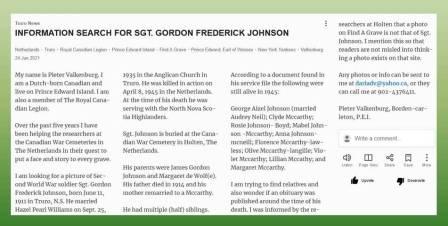
April 16, 2021.  Sometimes a soldier’s story is one that Pieter feels a personal connection to.  This was the case when he was asked by the researchers at the Canadian War Cemetery in Holten, The Netherlands for help in finding a photo of WW2 soldier Gordon Frederick JOHNSON.

That was back in 2017 when help was requested to find photos of 6 soldiers from the North Nova Scotia Highlanders Regiment.  After going through Gordon’s service file, Pieter was determined to find a photo.  “….This was a responsible man, who took care of his men….” he said.

Gordon was born June 11, 1911 in Windsor, Nova Scotia, the son of James Gordon Johnson and Margaret Elizabeth de Wolfe. Later the family moved to Truro, Nova Scotia.  Sadly, he lost his father when he was only 3 years old. He had 6 brothers and sisters, and after his mother remarried to John McCarthy, had 6 half-brothers and sisters.

In 1935, Gordon married Hazel Pearl Williams and was employed as a machinist. On October 13, 1939, with WW2 underway, he enlisted with the North Nova Scotia Highlanders.

During the spring of 1945, it was clear to both sides that the war in Europe was nearing its end, but extreme resistance from the German army still resulted in many casualties during the liberation of The Netherlands.  By now a sergeant, Gordon was killed in action near Zutphen on April 8, 1945 while trying to retrieve an anti-tank weapon that one of the members in his platoon had left behind.  Going back to retrieve a weapon is exactly what Pieter would have done!

In ‘No Retreating Footsteps… the story of the North Novas’, Will Bird wrote that “A PIAT was left by the canal by someone in D Company and Sgt Gordie Johnson went back to get it.  He was killed by a sniper as he reached the spot. His passing was a sad loss…”  A PIAT is an anti-tank weapon.  (For more information, see https://en.wikipedia.org/wiki/PIAT)

Grave of Gordon Frederick Johnson at the Canadian War Cemetery in Holten, The Netherlands. (Photo credit: Daria Valkenburg)

Gordon is buried in the Canadian War Cemetery in Holten.  Pieter had no luck finding family members, so in 2018 when we were in Nova Scotia, he made a stop in Truro and went to the Anglican Church that Gordon had belonged to.  Perhaps someone from the church office could help find family members, he thought.   He was told that no Johnsons were left in Truro, but that there were McCarthys and someone from the church would try to find someone who might have a photo.

Unfortunately, finding a photo has so far been surprisingly unsuccessful, given that he had 6 siblings and 6 half-siblings, plus a wife.

Now an appeal for a photo of Gordon Frederick Johnson has gone out on YouTube, which you can watch here:

A huge thank you goes to post-production editor Wendy Nattress, who made this YouTube video a reality.

Of the 6 soldiers for which photos were sought, family members and photos of three were found, but three remain outstanding.  In addition to Gordon Frederick Johnson, the other two members of the North Nova Scotia Highlanders for which a photo is on the wish list are:

  • Allan G. COUTTS of Alberta
  • Archibald Henry NELSON of Prince Edward Island

Can you help put a face to any of these men! If you have photos or information, please email Pieter at dariadv@yahoo.ca, comment on the blog, or tweet to @researchmemori1.  As well, photos and stories are still being collected for the Atlantic Canada Remembers series, and for Canadian soldiers buried in The Netherlands.

You are also invited to subscribe to our YouTube Channel: On The War Memorial Trail With Pieter Valkenburg: https://www.youtube.com/channel/UCJ591TyjSheOR-Cb_Gs_5Kw.

© Daria Valkenburg

On The War Memorial Trail….. Atlantic Canada Remembers – Part 9

April 15, 2021. More of the photos submitted by Atlantic Canadians of soldiers buried overseas are featured in Part 9. Pieter is ensuring that every email is acknowledged, and that the photos of soldiers buried in The Netherlands are forwarded to the appropriate cemetery for their digital archives.

Soldiers buried at the Canadian War Cemetery in Holten, The Netherlands

Alexis Daigle (Photo submitted by Gilberte Manuel)

After being contacted by Marc Comeau, President of Royal Canadian Legion Branch 45 in Tracadie, New Brunswick, Gilberte Manuel submitted a photo of Alexis D.  DAIGLE on behalf of “…Alfrida Richard, the niece of Alexis Daigle of Pointe-Sapin….

Born March 2, 1920 in Lower Spain, New Brunswick, the son of Dominique Daigle and Exelda Mazerolle, Alexis was a fisherman before enlisting in Fredericton on August 28, 1941.  After completing basic training, he was attached to the Canadian Army (Basic) Training Centre in Montmagny, Quebec on a Home War Established (HWE) basis as an engineer’s helper.

His service file noted that he was a “jack of all trades…” and could speak both French and English.  He was described as a “…quiet and non-talkative single young man of above average intelligence...”

In January 1945 he arrived in the United Kingdom and assigned to the Canadian Infantry Training Regiment (CITR).  A month later, on February 24, 1945, he was sent to continental Europe, and on March 1, 1945 transferred to Le Régiment de la Chaudière.

On April 6, 1945, while serving with Le Régiment de la Chaudière in The Netherlands, Alexis was killed in action (‘mort au champ d’honneur‘) near Zutphen, during the Battle of Zutphen.  (For more information on this battle, see https://www.canadiansoldiers.com/history/battlehonours/northwesteurope/zutphen.htm)

According to the Regiment’s war diary for April 1945, the Battalion had “…proceeded on foot to a concentrated area just past Almen, approximately 3 miles short of Zutphen…..”  where they rested until the start of an operation which began “…on the night 5-6 April…

The attack started at 4:30 am. “… Only slight opposition was encountered up to the outskirts of the town of Zutphen. The objective was C and D companies to seize the ground in between the main highway leading to town and the first row of houses….

Alexis was in D Company and it’s likely that he lost his life in what happened next.  “…. Between the starting line and the objective there was a canal on which both leading companies were stopped for almost two hours.  First opposition was then encountered from well-sited snipers, machine gun nests, and bazookas...

Alexis was one of 4 soldiers in the Regiment killed in that operation.  The others were:

  • V. PARE (D Company)
  • S. BOUCHARD (D Company)
  • E. PARADIS (C Company)

Alexis was temporarily buried in Almen, and later reburied in in the Canadian War Cemetery in Holten.

Mathieu Michaud. (Photo submitted by the Grand Falls branch of the Royal Canadian Legion)

Patrick Côté of the Royal Canadian Legion, Branch 21 in Grand Falls, New Brunswick, submitted a photo of Mathieu MICHAUD. Born November 11, 1921 in Drummond, New Brunswick, he was the son of Achille Michaud and Fébronie Laforest.

Patrick provided a translated excerpt from a book, ‘Military Heritage – The Greater Grand Falls Region’, by Jean-Guy Plourde, which explained that “….wanting to emulate his older brother Laurent, he enrolled in the army on December 3, 1942, and received training in Fredericton. From March 10 to July 24, 1943, he was in Valcartier, Quebec before becoming a gunner. The authorities assigned him to Goose Bay, Labrador from August 1, 1943 to June 30, 1944. From November 30, 1944, he made a two week stay in Sorel, Quebec before embarking for the great adventure. On January 10, 1945, he made the crossing to the United Kingdom where he was stationed until March 1, 1945….

In the UK he was assigned to the Canadian Infantry Training Regiment (CITR).  On March 2, 1945 he left for Northwest Europe, and then transferred to Le Régiment De La Chaudière on March 21, 1945.

He was killed in action (‘mort au champ d’honneur‘) in The Netherlands while part of the Regiment’s Company C and died on April 8, 1945.  According to the Regiment’s war diary, the Battle of Zutphen had ended on April 7 but continued to encounter sniper fire.  Mathieu was one of two soldiers from Company C that died that day.  The other soldier was H. A. MARCHAND.

Like Alexis Daigle, Mathieu was temporarily buried in Almen, before being reburied in the Canadian War Cemetery in Holten.

Soldiers buried at the Canadian War Cemetery in Groesbeek, The Netherlands

Elbridge Wellington Miller. (Photo courtesy of Elbridge Wellington Miller Family)

Wilmot Tompkins submitted a photo, explaining that “…This is Elbridge Wellington Miller, my great-uncle, buried in Groesbeek. My wife found your interview and your blog while searching for the place my great-uncle lost his life…” Wilmot had seen a list of 28 men listed as having lost their lives in Keppeln, in a posting about a video plea for a photo of Frank MCGOVERN.  (See https://bordencarletonresearchproject.wordpress.com/2020/12/09/the-search-for-a-photo-of-frank-edward-mcgovern-moves-to-youtube/)

Elbridge Wellington MILLER was born in Deerville, New Brunswick, the son of David W and Elizabeth Miller, and was a labourer before enlisting on December 3, 1942 in Fredericton.  By April 4, 1943 he was in the United Kingdom. On August 19, 1943 he was transferred to the North Shore (New Brunswick) Regiment.

Serving with the North Shore (New Brunswick) Regiment, he landed in France on D-Day (June 6, 1944) and was wounded by shrapnel in the left thigh and right ankle during the Battle of the Scheldt on October 13, 1944, resulting in a recovery period in England before rejoining his unit a month later.

He lost his life on February 26, 1945 in Germany during the Battle of Keppeln, during Operation Blockbuster, the last part of Operation Veritable. (For more information, see https://en.wikipedia.org/wiki/Operation_Blockbuster and https://en.wikipedia.org/wiki/Operation_Veritable)

Eldridge was one of 28 men killed in action that day, as was explained in the posting about Frank McGovern. Another of these soldiers was Barney MCGUIGAN. (For his story, please see https://onthewarmemorialtrail.com/2020/08/07/on-the-war-memorial-trail-the-search-for-barney-reuben-mcguigan/)

Like Frank McGovern and Barney McGuigan, Eldridge was temporarily buried in the Bedburg Military Cemetery, and then later reburied in the Canadian War Cemetery in Groesbeek.

Alphonse Robert.  (Photo courtesy of the Robert Family)

Armel ‘Mel’ Lanteigne, President of the Caraquet branch of the Royal Canadian Legion, submitted a photo of Alphonse ROBERT on behalf of the Robert family.  Alphonse came from a family of “…9 children…” Mel wrote, “…one died at an early age.  His father Amédée was a veteran of WW1 and after returning to Caraquet, his job was lighthouse keeper on Caraquet’s island, where he lived with his family….

Born October 23, 1923 in Caraquet, Alphonse was the son of Amédée and Alma Robert, and was a fisherman before enlisting on August 23, 1943.

In January 1945 he was in the United Kingdom, assigned to the Canadian Infantry Training Regiment (CITR).  On March 28, 1945 he was transferred to North West Europe and was serving with Les Fusiliers Mont-Royal when he lost his life on March 30, 1945 in Germany.

Alphonse was temporarily buried in Germany, and later reburied in the Canadian War Cemetery in Groesbeek.  NOTE:  For an update to this story, please see: https://onthewarmemorialtrail.com/2021/10/12/on-the-war-memorial-trail-an-update-on-the-story-of-ww2-soldier-alphonse-robert/

Thank you to Marc Comeau, Patrick Côté, Armel ‘Mel’ Lanteigne, Gilberte Manuel, Alfrida Richard, and Wilmot Tompkins for sharing photos and anecdotes.  Atlantic Canadians remember their loved ones who are buried overseas.

More photos and stories in Atlantic Canada Remembers – Part 10! To share photos or information, please email Pieter at memorialtrail@gmail.com, comment on the blog, or tweet to @researchmemori1.

© Daria Valkenburg

…..Previous postings in the Atlantic Canada Remembers series….

Missed the previous postings in this series? See:

…..Want to follow our research?….

If you are reading this posting, but aren’t following the blog, you are welcome to do so. Our blog address: https://onthewarmemorialtrail.com/

Front cover OnTheWarMememorialTrailinEurope4 countries, 6 weeks, 7,000 km – an unforgettable war memorial journey in Europe…. Daria’s book ‘No Soldier Buried Overseas Should Ever Be Forgotten‘ is available in print and e-book formats.  Net proceeds of book sales help support research costs and the cost of maintaining this blog. For more information see https://nosoldierforgotten.com/

You are also invited to subscribe to our YouTube Channel: On The War Memorial Trail With Pieter Valkenburg: https://www.youtube.com/channel/UCJ591TyjSheOR-Cb_Gs_5Kw.

Never miss a posting!  Subscribe below to have each new story from the war memorial trail delivered to your inbox.
On The War Memorial Trail….. The WW2 Pilot Who Lost His Life In The Netherlands On Christmas Eve

April 3, 2021. Sometimes a story is so sad that it’s difficult to write.  That was the case during our Memorial Trail visit in Europe in 2017 when we fulfilled a request by Paul Schurman to visit the grave of a WW2 RCAF serviceman who was a flying instructor at the No. 9 Service Flying Training School RCAF in Summerside, and boarded at the home of Paul’s parents.

Leonard Arthur Unwin. (Photo source: Canadian Virtual War Memorial)

Flight Lieutenant Leonard Arthur UNWIN, born January 2, 1917 in Sheffield, England, was the son of James Arthur Unwin and Minnie Goswin, who immigrated to Windsor, Ontario, where Leonard grew up. He was married to Evelyn Marie Paris.

Leonard enlisted on June 6, 1940 in Windsor, Ontario and was in the first RCAF class held at Windsor Airport.  In addition to being a flying instructor in Summerside, he was also an instructor in Moncton, New Brunswick, before going overseas in May 1943.  He served in England, France, and Belgium.

On December 24, 1944 he left from his base in Belgium and was shot down in The Netherlands.  According to the British Royal Air Force report, Leonard was one of the pilots in a section of 4 Typhoon planes “….on an armed recce in the Utrecht area. The section sighted and duly attacked three lorries moving along a road south east of Amersfoort….

The first two planes encountered “…little flak...” Leonard was in the third plane.  The pilot of the 4th plane reported that “…by the time F/Lt Unwin and himself attacked, there was quite intense light flak coming from fields on either side of the road.  They dived from approximately 7,000 feet and he observed F/Lt Unwin’s strikes on the way down….” 

Unfortunately, Leonard’s plane “….continued in the dive and blew up either on hitting the ground, or quite close to it….

Leonard is not buried in one of the Canadian War Cemeteries, but in a municipal cemetery in Woudenberg, one of two Commonwealth burials in a huge cemetery …. Leonard Unwin and a pilot from New Zealand.

We were looking for the typical Commonwealth headstone we’d seen in other cemeteries, but were unsuccessful.  Since the cemetery was so big, Pieter and I split up, hoping one of us would be able to spot it.  Nothing.

Pieter had disappeared in another direction, looking for someone to help us.  Just as I was about to give up, the groundskeeper came by on his bicycle.  I asked him if he could speak English and he said yes.  (It’s amazing to me how it’s never Pieter, who speaks the language fluently, who has these encounters!)

Luckily for me, the groundskeeper, who introduced himself as Theo Imminkhuizen, said yes, and I explained that I was looking for a Commonwealth grave.  Theo noticed I was holding a Canadian flag (plus a PEI flag, which he would not have recognized) and asked if I was looking for a Canadian grave.  Yes, I said, and he offered to show me where it was. 

Pieter came by when he saw me talking to someone, so we all went together.  We were very lucky to have encountered Theo as we would not have found the grave.  Instead of a Commonwealth stone, it was a grave in the Dutch tradition.  The only thing different was that the headstone was written in English, instead of Dutch.  This was the same for the pilot from New Zealand buried next to Leonard.

Pieter by the grave of Leonard Arthur Unwin. (Photo credit: Daria Valkenburg)

Paul Schurman had told Pieter that Leonard’s family had heard that when the plane crashed, Leonard’s body lay on the ground for days as the Germans refused to bury him, or to allow the Dutch to do so.  This was a warning of what happens to those who oppose the Germans, people were told. 

Pieter mentioned this horrible story to Theo, who confirmed it was true. He wasn’t buried until December 27.  If we didn’t mind to wait a few minutes, he had something to show us that he had in his office.

Commemorative plaque honouring Leonard Arthur Unwin. (Photo credit: Daria Valkenburg)

While Theo went upstairs to his office, an older man came by and stopped for a chat.  He introduced himself as Wout Blokhuis, and explained that he was a retired funeral director who had been involved in many burials in the cemetery.  Now retired, he likes to walk the cemetery grounds on a daily basis.

Theo returned with a plaque honouring Leonard, and said it’s put out by his grave every Liberation Day, on May 5.  The plaque is in Dutch, but Pieter was kind enough to provide this translation:

Leonard Arthur Unwin

Canadian Leonard Unwin stopped his education in 1940 to volunteer for the Canadian Air Force.  At the age of 27, he died during an attack on German troops.

On December 24, 1944, during an attack on an enemy target in the province of Utrecht, around 16:00 hours, he attacked a convoy of three German trucks on the Stationweg in Woudenberg.  During the dive, the plane’s tailpiece broke off, the plane destabilized, and crashed. 

In 2012, Leonard’s family visited Woudenberg from Canada.  They visited the site of the plane crash, and his grave.  They brought with them a small bag containing Canadian soil, to be spread on Leonard’s grave.

At the Woudenberg Municipal Cemetery.  Left to right: Wout Blokhuis, Pieter with the plaque, Theo Imminkhuizen. (Photo credit: Daria Valkenburg)

Thank you to Paul Shurman for bringing Leonard’s story to our attention, and a big thank you to Theo Imminkhuizen for his kindness in helping two Canadians find a grave.  If you have information to share about Canadian soldiers buried in The Netherlands, please email us at dariadv@yahoo.ca, comment on the blog, or send a tweet to @researchmemori1.  

You are also invited to subscribe to our YouTube Channel: On The War Memorial Trail With Pieter Valkenburg: https://www.youtube.com/channel/UCJ591TyjSheOR-Cb_Gs_5Kw

© Daria Valkenburg

On The War Memorial Trail….. The WWII Soldier From Indian River

March 29, 2021. In January, our first Atlantic Canada Remembers special feature included a photo of WWII soldier Charles ‘Charlie’ Borden TUPLIN of Indian River, Prince Edward Island, submitted by the Perry family of Nova Scotia. (See https://onthewarmemorialtrail.com/2021/01/07/on-the-war-memorial-trail-atlantic-canada-remembers-part-1/)

Charles Borden Tuplin

Charles Borden Tuplin. (Photo submitted by Gary Richard Perry)

Shortly afterwards we received another submission on Charles Borden Tuplin, this time from June Gillis.  “…Charlie Tuplin was our neighbour in Indian River when I was growing up, and he went overseas with my older brother, Bruce Gordon. Bruce survived the war, but Charlie didn’t...” she told us.  June’s late husband, Dr Wilfred R. ‘Bunny’ Gillis, grew up on a family homestead in Indian River, and also knew the Tuplin family.

CIMG5087 Mar 18 2021 Visit with June Gillis and Murphy

Pieter with June Gillis and her dog Murphy.  (Photo credit: Daria Valkenburg)

Born March 13, 1910 in Indian River, Charlie was the son of William and Minnie Tuplin, and worked as a fisherman and a miller prior to enlistment.  His father, who died in 1944, was a miller.

 “…The Tuplin family members were very musical...” June recalled, “…and Charlie played the violin….

On September 3, 1939, Charlie enlisted with the PEI Highlanders, but was discharged in July 1940 after falling ill with tonsillitis.  In September 1940 he re-enlisted with the PEI Light Horse Regiment, with the rank of Sergeant, and became an instructor at the Canadian Army (Basic) Training Centre #62 in Charlottetown.

In 1943 he was in Aldershot, Nova Scotia, taking advanced infantry training.  His service file notes that in an interview he was “…anxious to proceed overseas…

In June 1944, he requested a demotion to Corporal so that he could serve overseas.  This was granted on June 25, 1944, and he left for the United Kingdom the next day. On August 18, 1944 he was in France with the PEI Light Horse Regiment.  On October 13, 1944 he was transferred to the Black Watch Regiment’s D Company, Platoon 18.

The Perry family had written that…He was shot on December 7, 1944, was taken as a POW but died the next day…” This matches what is in Charlie’s military service file, but an account by the late William McNally of Summerside, who was interviewed by Charlie’s cousin Ann Tuplin Nunes, gave a different version of how Charlie lost his life.

According to William McNally, as per an account by Ann Tuplin Nunes that June Gillis shared with us, on December 7, 1944, he and Charlie “…were stationed by the Maas River in Holland. In order to enable Canadian soldiers to cross the river, a makeshift bridge was made by putting planks over little boats...

While crossing the bridge, the two men were talking to each other, and crossed to the other side safely.   “….They got to the other side and went a quarter mile along the river when they ran into the German army….

The officer in charge, Major E.W. HUDSON, had decided upon a “…hit and run raid to try to get prisoners and find out from them what was going on in the German lines….” The Canadian soldier contingent drove the Germans back “….one-half mile. By then it was the middle of the night.  They came to a village where there were three houses which stood out from the others….

McNally, Tuplin, and two other soldiers “…headed for these houses because there was a lot of shooting coming from that direction…”  The men thought German soldiers were in the houses, and they wanted to “…knock out the machine guns….

Unfortunately, the men were being shelled with mortar bombs.  “…Charlie was to the right of McNally and ten or twelve feet ahead of him. McNally saw Charlie falling.  He hit the ground and never moved...

McNally ran to check on Charlie, but he appeared lifeless.  After turning him over, McNally noticed that “…there was blood on his neck...”  He may have been wounded in more than one place, as McNally believed that “…if he was wounded only in the neck, he should have showed some sign of life….”  There was speculation that he may have been “…shot in the lower stomach and killed instantly….

Stretcher bearers were sent for, while McNally and the other men continued on their mission.  “…The next day, McNally inquired as to what had happened to Charlie and was told that, when the soldier with the stretcher bearers returned, Charlie’s body could not be found….

The Black Watch war diary entry for December 7, 1944 indicates that the unit was just east of Mook, a town along the Maas River.  The following casualties were reported:

Killed: A/Sgt Leonard John KING, Pte Joseph S R PELLAND, Pte James Bissett WATT

Missing: Lt Thomas Wilson MACKENZIE, Pte Robert Albert MARTIN, Cpl Charles Borden TUPLIN, L/Cpl George Frederick ELLIOTT, Pte Joseph Edward WALKER

In addition, 14 men were wounded. According to research by the Groesbeek Airborne Friends, this December 7, 1944 event was named ‘Operation Mickey Finn’.

Pieter decided to look at the service files of the other soldiers reported missing, to see if more clarity about what happened and the exact location could be determined.  He discovered that all of the missing had died, and, with the exception of Charlie Tuplin, had been temporarily buried in the area.

The service file for Lt MacKenzie had an account that differed in some respects from William McNally’s recollections.

On December 14, 1944, a ‘Questionnaire On A Missing Officer Or Soldier’ included testimony by Major Hudson in which he stated that Lt MacKenzie was last seen by “…Pte C A CHARRON and Pte W J STEPHENS…” With them was “… Cpl C B TUPLIN…

MacKenzie was leading his men in an attack when he was “…wounded on the enemy position.  Attempts were made to evacuate him but the men carrying him were also wounded.  One man managed to evacuate himself and told the stretcher bearers that Lt MacKenzie was wounded, but they were unable to find him...

Both Pte Stephens and Charlie Tuplin were wounded.  Pte Charron was the soldier able to escape and go for help.  His statement recorded that “… At approximately 20:15 hours on December 7, 1944, I was with Lt T W MacKenzie about 10 yards from house 25.  I heard Lt MacKenzie call out for help, saying he had been hit...

After learning that MacKenzie had been hit in the back and was paralyzed, “... Cpl C B Tuplin and I tried to drag Lt MacKenzie out as we were too exposed walking.  After going about 15 feet we found we couldn’t manage so called to Pte W J Stephens to help us.  Before he got to us Cpl Tuplin was hit.  Lt MacKenzie and Cpl Tuplin told us to go for a stretcher bearer…

Stephens and Charron left, but “… after going about 15 yards, Pte Stephens was hit, so I kept going and told two of the stretcher bearers where I had left Lt MacKenzie and Cpl Tuplin. They made a search of the ground but were unable to find either of the wounded men….

MacKenzie and Tuplin were missing, but Stephens was found and hospitalized.  Like Charlie Tuplin, Lt MacKenzie was initially recorded as a prisoner of war. MacKenzie’s body was later found buried in a temporary cemetery, near where he lost his life.

According to Charron’s testimony, Charlie Tuplin was alive after being hit.  Perhaps William McNally came across Charlie Tuplin after Pte Charron left to go for help.  In the dark and under mortar fire attack, it’s very likely that he would not have seen Pte Stephens or Lt MacKenzie.  It’s also possible that William McNally found another soldier that he mistook for Charlie.

Map Goch to Mook

Map shows area of the action on December 7, 1944, and the location in Goch where Charlie Tuplin’s body was initially buried. (Map source: https://www.viamichelin.com)

Although the official records state that Charlie died while a prisoner of war on December 8, 1944, McNally believed that “…he died the night of December 7th and was never a prisoner….

What happened to Charlie Tuplin?  After the war ended, Charlie was identified, through his dental records, as a soldier buried in a public cemetery near Goch, Germany.  This is not near where he was hit, and he is the only one of the missing men identified in the war diary that was not initially buried near the location where they fell.

Therefore, the information in his service file is likely correct.  He was picked up by German soldiers while still alive, died shortly afterwards, and was buried by the Germans.

Lt MacKenzie was reburied in the Canadian War Cemetery in Groesbeek, as were the other missing men.  Charlie Tuplin was reburied in the Canadian War Cemetery in Holten, The Netherlands.

CIMG3207 Oct 3 2019 Holten Charles Tuplin

Grave of Charlie Tuplin in the Canadian War Cemetery in Holten.  (Photo credit: Daria Valkenburg)

Thank you to June Gillis for sharing information about Charles ‘Charlie’ Borden Tuplin.  If you have information to share about Canadian soldiers buried in The Netherlands, or memories to share about Charles Borden Tuplin or the other soldiers mentioned in this posting, please email us at memorialtrail@gmail.com, or comment on the blog.  

© Daria Valkenburg

…Want to follow our research?….

If you are reading this posting, but aren’t following our research, you are welcome to do so.  Our blog address: https://onthewarmemorialtrail.com/

Front cover OnTheWarMememorialTrailinEurope4 countries, 6 weeks, 7,000 km – an unforgettable war memorial journey in Europe…. Daria’s book ‘No Soldier Buried Overseas Should Ever Be Forgotten‘ is available in print and e-book formats.  Net proceeds of book sales help support research costs and the cost of maintaining this blog. For more information see https://nosoldierforgotten.com/ 

Screenshot_2021-02-27 On The War Memorial Trail With Pieter Valkenburg

You are also invited to subscribe to our YouTube Channel: On The War Memorial Trail With Pieter Valkenburg: https://www.youtube.com/channel/UCJ591TyjSheOR-Cb_Gs_5Kw.

Never miss a posting!  Subscribe below to have each new story from the war memorial trail delivered to your inbox.
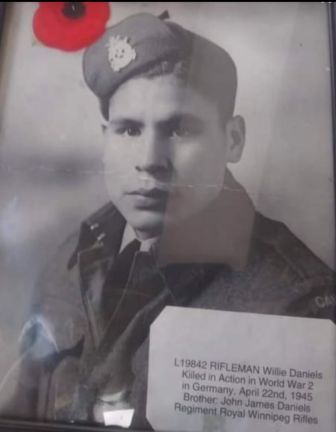
The Search For A Photo Of Leigh Hunt Cameron Moves To YouTube

Pieter during Leigh Hunt Cameron video

Pieter during the filming of the YouTube video ‘Photo Search – WWI Soldier Leigh Hunt Cameron’ (Photo credit: Daria Valkenburg)

March 24, 2021.  When Pieter began his research to find out about the men listed on the Cenotaph outside the Borden-Carleton Legion, his hope was to have a photo of each man, to go with the stories he was able to unfold.

He always thought that finding a photo of a soldier who died without ever leaving the Island wouldn’t be difficult to find.  However, this has not been the case for WWI soldier Leigh Hunt CAMERON.  (See https://bordencarletonresearchproject.wordpress.com/2019/04/29/the-ww1-soldiers-who-never-left-canada/)

Born in Albany, Prince Edward Island on May 6, 1898 to Anna Jane Cameron, Leigh was raised by his grandparents, Alexander Walter Cameron and Phoebe Ann Murray.

In 1907, Anna Jane married Arthur Edwards from Ontario, and they moved to Carman, Manitoba. They had 3 daughters and 1 son.

Leigh enlisted on March 2, 1916 with the 105th Battalion, C Company but shortly afterwards caught measles and developed pneumonia.  He died of these causes on May 5, 1916, and is buried in the cemetery of the Free Church of Scotland in Cape Traverse, Prince Edward Island.  While visiting his grave, Pieter wished he knew what this young man looked like.  (Note: The cemetery is now called Cape Traverse Community Cemetery)

Pieters saying

After several years of an unsuccessful search for family or friends, he’s taken his appeal for a photo to YouTube, in the hope that a viewer might come forward:

Thank you to post-production editor Wendy Nattress, who made this YouTube video a reality. If you have photos or information to share about Leigh Hunt Cameron, please email Pieter at memorialtrail@gmail.com, or comment on the blog.

© Daria Valkenburg

….Want to follow our research?…

If you are reading this posting, but aren’t following our research, you are welcome to do so.  Our blog address: https://onthewarmemorialtrail.com/

4 countries, 6 weeks, 7,000 km – an unforgettable war memorial journey in Europe…. Daria’s book ‘No Soldier Buried Overseas Should Ever Be Forgotten‘ is available in print and e-book formats.  Net proceeds of book sales help support research costs and the cost of maintaining this blog. For more information see https://nosoldierforgotten.com/

Screenshot_2021-02-27 On The War Memorial Trail With Pieter Valkenburg

You can subscribe to: On The War Memorial Trail With Pieter Valkenburg: https://www.youtube.com/channel/UCJ591TyjSheOR-Cb_Gs_5Kw

Never miss a posting!  Subscribe below to have each new story from the war memorial trail delivered to your inbox.

On The War Memorial Trail….. The Fisherman Who Lost His Life In France While A WWI Soldier

March 21, 2021. In researching the stories of the names listed on the Cenotaph outside the Borden-Carleton Legion, it’s become a mystery why some from the local area were NOT included on the Cenotaph.  Over the years, two names have been added to the original 46 names… that of James Ambroise CAIRNS and Joseph Arthur DESROCHES.

In the village of Victoria-By-The-Sea, two men listed on a memorial at the Victoria Community Hall, built in 1915, (which is also the home of the Victoria Playhouse) are on the Cenotaph: Arthur Leigh COLLETT and Percy FARRAR

When Pieter went to see the memorial, he wondered why WWI soldier Heath Ward MACQUARRIE was not.  Brenda Boudreau, of the Victoria Historical Society, explained that Heath Ward MacQuarrie was her grand-uncle, “….my grandfather’s brother...

CIMG4912 Nov 11 2020 Brenda Boudreau & Pieter by Victoria WW1 monument

Brenda Boudreau and Pieter Valkenburg by the memorial at Victoria Community Hall on November 11, 2020.  (Photo credit: Daria Valkenburg)

No soldier buried overseas should be forgotten...” Pieter reminded me, after learning that this WWI soldier had died in France. 

Heath MacQuarrie in uniform

Heath MacQuarrie. (Photo courtesy of Greg Gallant of the PEI Regiment Museum.)

Born in Victoria-By-The-Sea on March 28, 1891, according to his baptismal record, Heath was the son of William Archibald MacQuarrie and Charlotte Mallett.   A fisherman before enlisting with the 105th Overseas Draft Battalion on February 19, 1917, Heath was married.  He and his wife, Bertha May Francis, were the parents of a son, William Richard ‘Dick’ MacQuarrie.

1024px-Arthur_Lismer_-_Olympic_with_Returned_Soldiers

Olympic in dazzle at Pier 2 in Halifax, Nova Scotia painted by Arthur Lismer (Source: https://en.wikipedia.org/wiki/RMS_Olympic#First_World_War)

On June 1, 1917 he left Halifax aboard the ‘Olympic’, one of the ships used to transport troops from Halifax, Nova Scotia to Britain. As of 1917, the ship had 6-inch guns and was painted in a ‘dazzle’ camouflage in brown, dark blue, light blue, and white colours, in an attempt to make it more difficult for observers to estimate her speed and heading. (For more information, see https://en.wikipedia.org/wiki/RMS_Olympic#First_World_War)

The dazzle camouflage worked as Heath safely arrived in England on June 10, where he was transferred to the 13th Reserve Battalion.  Then, on November 23, 1917, he was transferred again, to the 23rd Reserve (New Brunswick) Battalion, and sent to France a day later.

His brother Glen had enlisted in 1914 and was in France as well but it’s unknown if the two brothers ever met up with each other.  Glen survived the war, but Heath did not.

On August 8, 1918 he lost his life, aged 27.  According to the stark account in the Circumstances of Casualty form in his service file, Heath “…was so severely wounded in many parts of his body by enemy fire while taking part in operations at the Sunken road in front of Guillaucourt, that despite the fact he received first aid promptly he succumbed shortly afterwards.

He was buried at Wood Cemetery in the village of Marcelcave, 24 kms east of Amiens in the Department of the Somme in France. He’s one of 50 WWI burials in this cemetery – 41 from Canada and 9 from the United Kingdom. 

Heath’s wife Bertha never remarried. Their son Dick attended Dalhousie University in Halifax, majoring in geology.  His work took him across Canada before he returned back to Victoria-By-The-Sea with his wife Marion Raynor, before passing away in 1975, at the age of 60.

Richard Dick MacQuarrie

Dick MacQuarrie in Victoria-By-The-Sea on May 14,1929. (Photo courtesy of Brenda Boudreau.)

Thank you to Brenda Boudreau for providing information of her grand-uncle.  If you have any further information to share, please let Pieter know.  You can email him at memorialtrail@gmail.com, or comment on the blog. 

© Daria Valkenburg

….Want to follow our research?….

If you are reading this posting, but aren’t following our research, you are welcome to do so.  Our blog address: https://onthewarmemorialtrail.com/

4 countries, 6 weeks, 7,000 km – an unforgettable war memorial journey in Europe…. Daria’s book ‘No Soldier Buried Overseas Should Ever Be Forgotten‘ is available in print and e-book formats.  Net proceeds of book sales help support research costs and the cost of maintaining this blog. For more information see https://nosoldierforgotten.com/

Screenshot_2021-02-27 On The War Memorial Trail With Pieter Valkenburg

You are also invited to subscribe to our YouTube Channel: On The War Memorial Trail With Pieter Valkenburg: https://www.youtube.com/channel/UCJ591TyjSheOR-Cb_Gs_5Kw

Never miss a posting!  Subscribe below to have each new story from the war memorial trail delivered to your inbox.
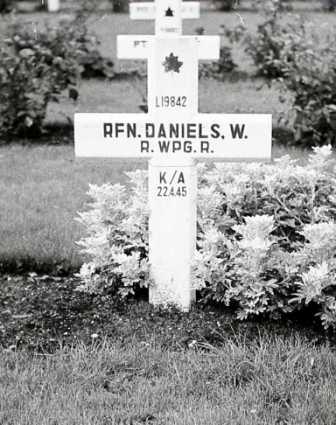
On The War Memorial Trail….. Atlantic Canada Remembers – Part 8

March 16, 2021. More of the photos submitted by Atlantic Canadians of soldiers buried overseas are featured in this posting. Pieter is ensuring that every email is acknowledged, and that the photos of soldiers buried in The Netherlands are forwarded to the appropriate cemetery for their digital archives.  Thank you to the members of Royal Canadian Legions in Nova Scotia and New Brunswick for their help.

Soldiers buried at the Canadian War Cemetery in Holten, The Netherlands

Fryday published in Toronto Newspaper

George Albert Fryday.  (Photo submitted by Marion Fryday-Cook.)

Marion Fryday-Cook, President of the Royal Canadian Legion’s Nova Scotia/Nunavat Command, submitted a photo of George Albert FRYDAY, explaining that “I am a relative of Rifleman George A. Fryday, Service Number B/136751, who is buried in Holten Canadian War Cemetery, Netherlands.  He was born in Toronto, Ontario. Thank you for honouring our fallen….” 

At the age of 15, George joined the Merchant Marine, and later the Royal Canadian Navy Volunteer Reserve.  However, once it was established that he was under age, he was discharged.  At the age of 17, he enlisted in the Canadian Army and was sent overseas in December 1944.  He was serving in the Queen’s Own Rifles Regiment when he lost his life on May 4, 1945, aged 19. 

Frederick Joseph Tait

Frederick Joseph Tait. (Photo submitted by the Grand Falls branch of the Royal Canadian Legion)

Patrick Côté of the Royal Canadian Legion, Branch 21 in Grand Falls, New Brunswick, submitted a photo of Frederick Joseph TAIT, born April 26, 1921 in Grand Falls, New Brunswick, the son of Herbert Henry Tait and Louise Emeline Leclair.

Patrick referenced a book, ‘Military Heritage – The Greater Grand Falls Region’, by Jean-Guy Plourde, which explained that “…. Prior to the war, he worked in a grocery store…”  Before enlistment on February 1, 1943 in Fredericton, he served in the New Brunswick Cadet Corps, and had been an Instructor in Infantry Training with the 2nd Carleton & York Regiment since 1940.

According to the Personnel Selection Record of his service file, he was fluent in both French and English and was assessed as “…good NCO instructor material…”  (NCO refers to Non-Commissioned Officer.)  He had a “…confident bearing…” and “…stability above average….” Unfortunately, his educational background was “…not high enough for commissioned rank…” 

After being deployed overseas in December 1943 he served in Sicily, where he fell ill and was hospitalized for 8 months.  After being released from hospital, he “…went on leave to England….” Over Christmas 1944 he was able to meet his brother Clair, also with the Canadian Army.

Clair survived WWII but Frederick didn’t.  While serving with the Carleton & York Regiment as the unit advanced to the Apeldoorn Canal in The Netherlands on April 15, 1945, he lost his life and was temporarily buried in Posterenk, near Zutphen.

CIMG9297 Sep 25 2017 Edwin and Pieter with CYR list

Edwin van der Wolf and Pieter in Posterenk in 2017.  Pieter holds up a list of the 6 Carleton & York Regiment soldiers who were temporarily buried in the village.  (Photo credit: Daria Valkenburg)

In September 2017, Pieter and I visited the village of Posterenk with Edwin van der Wolf, one of the research volunteers at the Canadian War Cemetery in Holten.  Edwin explained that “… the Carleton & York Regiment came from Italy to Marseilles, and then into The Netherlands where, on April 13, 1945, the village of Posterenk was liberated.  Six soldiers from the Regiment were buried here temporarily….” 

Edwin gave us a list of the 6 soldiers from the Carleton & York Regiment who were temporarily buried in the village.  Frederick Joseph Tait was one of these men!

Posterenk list of 6 CYR members

List of 6 Carleton & York Regiment soldiers temporarily buried in Posterenk in 1945.

Soldiers buried at the Canadian War Cemetery in Groesbeek, The Netherlands

Photo Burgess Porter

Burgess Allison Porter.  (Photo submitted by Everett Dalton)

Everett Dalton submitted a photo of Burgess Allison PORTER, writing that Burgess was “…the son of Annie ‘Laura’ (nee Porter) McCall…Born October 2, 1922 in Grafton, Nova Scotia, his mother died when he was 2 years old.  Although his biological father, Reg McCall was still alive, it was his mother’s wish that her son be raised by “…Frank Oscar and Lennie Alma (nee Pineo) Porter….”  

While not formally adopted, he was raised by them and was known by the surname Porter. His service file identifies Frank and Lennie Porter as his grandparents. 

Born October 2, 1922, Burgess was from Grafton, Nova Scotia, and a store clerk before he enlisted in Halifax on April 14, 1941.  On January 20, 1942 he arrived in the United Kingdom as part of the Artillery Holding Unit, and in April 1942 was attached to the 4th Field Regiment of the Royal Canadian Artillery as a bombardier. 

On July 7, 1944 his unit landed in France, and unfortunately Burgess was killed on February 21, 1945 in Germany and was temporarily buried in Bedburg, Germany.

Soldiers buried at the Canadian War Cemetery in Bergen Op Zoom, The Netherlands

Clayton Wilfred Shannon virtual war memorial BoZ

Clayton Wilfred Shannon.  (Photo from Canadian Virtual War Memorial)

Patrick Côté of the Royal Canadian Legion, Branch 21 in Grand Falls, New Brunswick sent the link to the Canadian Virtual War Memorial page for Clayton Wilfred SHANNON, who had served with the Calgary Highlanders and lost his life on September 22, 1944.

Patrick referenced a book, ‘Military Heritage – The Greater Grand Falls Region’, by Jean-Guy Plourde, which explained that Clayton, born August 2, 1920 in Grand Falls, the son of Frederick Herman Shannon and Bertha Mulherin, “…was musically inclined… playing guitar and singing.  Before his army service, he had even made a couple of records….

In 1940 “…with his cousin, Adrien Mulherin, he left home to enlist in the Carleton & York Regiment….”   After serving 4 years in Canada, he went overseas “…in July 1944, with the Calgary Highlanders…. While in combat near the border of Holland and Belgium, Clayton was killed, only a few weeks after arriving in Europe…

Clayton lost his life in Belgium during the Battle of the Scheldt, and was initially buried in Wommelgem, on the outskirts of Antwerp, one of 11 members of the Calgary Highlanders buried there before being reburied in Bergen Op Zoom. (For more information on what happened in Wommelgem, see https://onthewarmemorialtrail.com/2021/02/13/on-the-war-memorial-trail-the-search-for-soldiers-who-died-in-wommelgem-belgium-in-fall-1944/)

Gregory P. A. McCarthy (2)

Gregory Philip Anthony McCarthy.  (Photo submitted by the Grand Falls branch of the Royal Canadian Legion)

Patrick Côté of the Royal Canadian Legion, Branch 21 in Grand Falls, New Brunswick, submitted a photo of Gregory Philip Anthony MCCARTHY, born February 28, 1922 on a farm in California Settlement in Grand Falls, son of Thomas and Agnes McCarthy. 

Patrick referenced a book, ‘Military Heritage – The Greater Grand Falls Region’, by Jean-Guy Plourde, which explained that Gregory “…was the youngest of 11 children….He had …. helped on the farm for 8 years and also worked in lumbering prior to his enlistment…. On 26 March 1941 Gregory enlisted in the Canadian Army at Woodstock, NB…

After completing his basic training, he was “… transferred to the 1st Battalion New Brunswick Rangers….on 19 May 1941….”  After a promotion to Lance Corporal on December 1, 1941 he went to Labrador as a Driver Mechanic. 

On September 10, 1943 he left for the United Kingdom “… where he completed a mortar course and remained until his deployment to France with the 10th Independent Machine Gun Company, NB Rangers, arriving on 22 July 1944….

His commanding officers described him as “…dependable, reliable, and well-thought of in his unit….”  While serving in Germany and The Netherlands, he was a member of a mortar detachment responsible for engaging the enemy. On January 19, 1945, near Waalwijk in The Netherlands, their own mortar misfired and exploded, causing 3 members of the team to be seriously wounded, with fatal consequences for Gregory.  He was initially buried in Tilburg.

Thank you to Patrick Côté, Everett Dalton, and Marion Fryday-Cook for sharing photos and anecdotes.  Atlantic Canadians remember their loved ones who are buried overseas.

More photos and stories in Atlantic Canada Remembers – Part 9! To share photos or information, please email Pieter at memorialtrail@gmail.com, or comment on the blog. 

© Daria Valkenburg

…..Previous postings in the Atlantic Canada Remembers series….

Missed the previous postings in this series? See:

…..Want to follow our research?….

If you are reading this posting, but aren’t following the blog, you are welcome to do so.  Our blog address: https://onthewarmemorialtrail.com/

Front cover OnTheWarMememorialTrailinEurope4 countries, 6 weeks, 7,000 km – an unforgettable war memorial journey in Europe…. Daria’s book ‘No Soldier Buried Overseas Should Ever Be Forgotten‘ is available in print and e-book formats.  Net proceeds of book sales help support research costs and the cost of maintaining this blog. For more information see https://nosoldierforgotten.com/

Screenshot_2021-02-27 On The War Memorial Trail With Pieter Valkenburg

You are also invited to subscribe to our YouTube Channel: On The War Memorial Trail With Pieter Valkenburg: https://www.youtube.com/channel/UCJ591TyjSheOR-Cb_Gs_5Kw

Never miss a posting!  Subscribe below to have each new story from the war memorial trail delivered to your inbox.

On The War Memorial Trail….. The WWII Soldier From St Stephen Who Was A Teacher

March 7, 2021.  Last fall, the researchers at the Canadian War Cemetery in Holten, The Netherlands sent Pieter a photo wish list of 6 soldiers from the Cape Breton Highlanders who had died in the Battle of the Delfzijl Pocket.  (For more information on the Battle of the Delfzijl Pocket, see https://www.canadiansoldiers.com/history/battlehonours/northwesteurope/delfzijlpocket.htm)

Len Boudreau of the Cape Breton Highlanders Association was able to provide photos of 3 of the men,  Pieter found one on the Canadian Virtual War Memorial website, leaving 2 to try and find:  Philip Hubert LONG of Nova Scotia, and Norman James NIXON of New Brunswick.

A radio interview with CBC’s Maritime Noon about Philip Long resulted in family contacting Pieter immediately, and a photo was soon provided.  (See https://bordencarletonresearchproject.wordpress.com/2020/11/01/on-the-war-memorial-trail-a-face-for-philip-hubert-long/)

In trying to find family of Norman Nixon, Pieter sent a letter to the editor of the St. Croix Courier newspaper.  (See https://bordencarletonresearchproject.wordpress.com/2020/10/17/on-the-war-memorial-trail-continuing-the-search-for-soldiers-killed-in-action-in-ww1-and-ww2/)  Legion member Kent Caldwell sent a photo and story from the New Brunswick Military Service Recognition booklet.

It was a rare occasion that every photo request on a list could be fulfilled, but it happened! But then, the grandson (and namesake) of Norman Nixon contacted us.  “….We have quite a bit of information…..” he said.  Did we want to meet?

CIMG4775 Oct 25 2020 Pieter sorts through material compiled by the Nixon family

Pieter goes through the information saved by the Nixon family. (Photo credit: Daria Valkenburg)

Normally that would not be a problem, but with Covid-19 restrictions, we had to think twice.  The Atlantic Bubble was still open, so Pieter said a firm YES! and we made the trip to Harvey, New Brunswick to meet Norman Nixon and his wife, Kelley Gowan.

CIMG4560 Lt Norman Nixon

Norman James Nixon. (Photo courtesy of Nixon family)

Norman James Nixon was born in St. Stephen, New Brunswick, the son of Edward A. Nixon and Winnifred Trafton, and lived in nearby Mayfield.  A well-regarded schoolteacher before his enlistment, he married Berla Mae Lowery on July 29, 1940.  In 1941 they welcomed the birth of their son, Vernon James.

20201024_160813 Norman and Berla with son Vernon

Norman and Berla Mae Nixon with their son Vernon, circa 1943.  (Photo courtesy of Nixon family)

On July 20, 1940 Norman had enlisted with the Reserve Unit of the Carleton & York Regiment, but was discharged due to illness.  On February 6, 1942 he re-enlisted, this time with the Active Unit of the New Brunswick Rangers, and served with this unit in Labrador, and Canada from February 6, 1942 to July 12, 1944, and England from July 13 to August 21, 1944.

In 1944 he transferred to the Cape Breton Highlanders, and served in Italy from August 22, 1944 to February 19, 1945, and Northwest Europe in France and The Netherlands from February 20 to April 30, 1945.  He was known as ‘Nick’ by his fellow soldiers.

CIMG4767 Oct 25 2020 Pieter and Norman with cap and badges

Pieter and Norman Nixon.  Norman holds his grandfather’s cap and a number of the badges that Lt. Nixon had earned during his service.  (Photo credit: Daria Valkenburg)

After surviving action in Italy and France, Lt Nixon’s luck ran out near the end of WWII, when he was killed by shrapnel on April 30, 1945 during the Battle of the Delfzijl Pocket.

A May 6, 1945 letter to Bella Mae, from Norman’s Commander, Lt Colonel R B Sommerville, explained what happened.  “…Nick was killed in action at night by shell fire during a counter attack on his platoon position.  He died instantly.

At the time he was hit he was encouraging his men who were being hard pressed by fire from the part of Delfzijl on the Ems estuary….

He was initially buried in the village of Wirdum, as Lt Col Sommerville explains further in his letter.  “…his example and devotion to both his troops and duty won for him the affection and respect of officers and men alike….. At a little service in the village of Wirdum near Groningen with a brother officer and 17 of our men he was buried the next afternoon.  We will all miss him….”  The other officer mentioned as being buried was Lt B H NUNN of Halifax.
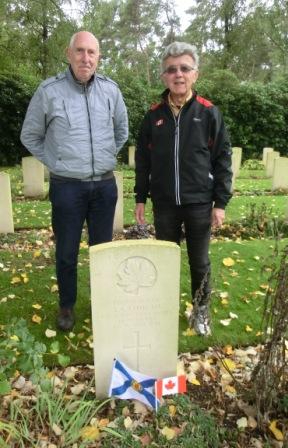
On May 10, 1945, Major P J Stephen also wrote a letter to Bella Mae, providing more details on how her husband lost his life.  “…On the evening of the 30th of April we were holding a position which we had taken the night before.  Things were quite bad as we were being heavily shelled. The men were getting jittery from loss of sleep and constant hammering.  

After each shelling Nick would jump from his trench and stroll about the platoon area as if he were in his own garden, joking with the men, caring with a smile for all their needs, setting the example to them of a first class soldier and leader.  During one of these tours Nick was fatally wounded by shrapnel from a shell which burst a few yards away. 

It was impossible to save him although we gave him medical aid immediately.  Nick passed away without regaining consciousness…

20201024_194850 Grave of Norman J Nixon in 1945

Initial burial of Norman Nixon in Wirdum. Photo sent by Lt Stackhouse.  (Photo courtesy of Nixon family)

On August 19, 1945, Lt Ron V Stackhouse wrote to Bella Mae. “…I was with ‘Nick’ on the last night about an hour before he was killed as we had both had supper together at Company Headquarters and he and I walked back to our platoons together as our platoons were right alongside of each other….”   In a postscript he mentions enclosing a photo of the grave.

After WWII ended, Lt Nixon was reburied in the Canadian War Cemetery in Holten, The Netherlands.

nixon, norman james from Holten Cemetery sent by Edwin

Grave of Norman Nixon at the Canadian War Cemetery in Holten. (Photo sent by Edwin van der Wolf.)

Visiting with Norman Nixon and Kelley Gowan and learning about Norman’s grandfather was a privilege.  But they had a surprise for us.  Norman’s father Vernon and Vernon’s wife Donna came from Grand Manan Island to meet us.

CIMG4779 Oct 25 2020 Norman and Vernon Nixon

Norman and Vernon Nixon, grandson and son of Lt Nixon. (Photo credit: Daria Valkenburg)

More memories and stories were shared, including that Vernon’s mother, Bella Mae, owned a dress shop, ‘The Hat Box’, in St. Stephen.  She was an independent woman, and never remarried after her husband’s death.

CIMG4781 Oct 25 2020 Pieter & Daria with Vernon & Donna Nixon

A final photo before we left to go back home.  Pieter and I with Vernon and Donna Nixon.  (Photo credit: Kelly Gowan)

With both the son and grandson of Lt Nixon together in one place, we asked if they wanted to share a few thoughts for a video to be sent to the Info Centre at the cemetery in Holten.  Here is the result, entitled ‘In Remembrance of Lt. Norman J. Nixon’:

It’s always an honour to meet the families of the soldiers that Pieter researches, and we hope to meet more families as travel restrictions get eased.

The 6 soldiers from the Cape Breton Highlanders on the photo wish list were:

  • Philip H. LONG, born Pictou, Nova Scotia, died April 30, 1945.
  • James Bernard MACINNIS, born Sydney, Nova Scotia, died May 1, 1945.
  • Olen B. MARSHALL, born Bridgetown, Nova Scotia, died May 1, 1945.
  • Norman James NIXON, born St. Stephen, New Brunswick, died April 30, 1945.
  • Ford Hilton SPIDLE, born Parkdale, Nova Scotia, died May 1, 1945.
  • Robert B. THOMAS, born Louisburg, Nova Scotia, died May 5, 1945.

The family of Ford Hilton SPIDLE participated in the Atlantic Canada Remembers series of postings, and you can read his story here: https://onthewarmemorialtrail.com/2021/01/07/on-the-war-memorial-trail-atlantic-canada-remembers-part-1/

Thank you to Norman Nixon and Kelley Gowan for their warm hospitality and for sharing information about Lt Nixon, and thank you to Vernon and Donna Nixon for making the trip from their home to meet with us and share memories about Vernon’s father.  It’s very clear that Lt Nixon was deeply loved and respected, and his death, so close to the end of the war, was an immeasurable loss.

Heartfelt thanks go to post-production editor Wendy Nattress, who made the YouTube tribute to Lt Nixon a reality.

20 members of the Cape Breton Highlanders lost their lives in the Battle of the Delfzijl Pocket.  If you have information or photos to share on any of these men, please email us at memorialtrail@gmail.com, or comment on the blog.

© Daria Valkenburg

…Want to follow our research?…

If you are reading this posting, but aren’t following our research, you are welcome to do so.  Our blog address: https://onthewarmemorialtrail.com/

Front cover OnTheWarMememorialTrailinEurope4 countries, 6 weeks, 7,000 km – an unforgettable war memorial journey in Europe…. Daria’s book ‘No Soldier Buried Overseas Should Ever Be Forgotten‘ is available in print and e-book formats.  Net proceeds of book sales help support research costs and the cost of maintaining this blog. For more information see https://nosoldierforgotten.com/

Screenshot_2021-02-27 On The War Memorial Trail With Pieter Valkenburg

Why not subscribe to: On The War Memorial Trail With Pieter Valkenburg: https://www.youtube.com/channel/UCJ591TyjSheOR-Cb_Gs_5Kw

Never miss a posting!  Subscribe below to have each new story from the war memorial trail delivered to your inbox.