August 10, 2023. The search for a photo of a soldier often involves many people. When Pieter begins an investigation, he looks for family members or organizations that might be able to help. This can take him on a journey in which we are reminded of just how many people care about remembering those who’ve served.
The search for a photo of George TAYLOR of the Curve Lake First Nation began with an inquiry to Chief Keith Knott and Councillor Arnold Taylor. Pieter’s request was sent to Mae Whetung-Derrick, who explained that she had been given Pieter’s name “.…by the Curve Lake First Nation, as I have done some research on Curve Lake veterans and created a slide show for the Remembrance Day luncheon that is held every year after the services (other than COVID years)….”
After contacting Pieter, Mae spoke to Jocelyn Taylor Watson, “…the daughter of Benjamin Taylor, and the niece of Gunner Taylor. Benjamin also served in World War 2….”
Pieter then spoke with Jocelyn who explained that her father, Benjamin, “…was the baby of the family, born two years after George. He served during WWII but did not go overseas, and died in 2001 at the age of 78….”
Shortly afterwards, Jocelyn’s daughter Autumn Watson got in contact. “…First, I would like to say Chi-Miigwetch (Thank-You) for reaching out to our Chief Keith Knott and Councillor Arnold Taylor, with respect to my great-uncle George Taylor. My mother (Jocelyn Taylor) had mentioned that you spoke with her. As a family we appreciate your dedication to breathing life and respect to our fallen soldiers!…”

George Taylor. (Photo submitted by Mae Whetung-Derrick, originally published in the Peterborough Examiner. Photo restoration by Duane MacEwen. Photo colourization by Pieter Valkenburg)
…George was a member of the Curve Lake First Nation…
 Born April 28, 1920, George TAYLOR was the son of Lorenzo ‘Dow’ and Eva Taylor, members of the Curve Lake First Nation, a Mississauga Ojibway First Nation located in Peterborough County, Ontario. (See https://curvelakefirstnation.ca/history/ and https://en.wikipedia.org/wiki/Curve_Lake_First_Nation)
When George enlisted in Peterborough, Ontario on July 9, 1941 with the No. 3 ‘A’ District Depot, it was noted that he could speak Chippewa (Anishinaabemowin), as well as being fluent in English. (See http://www.native-languages.org/ojibwe.htm)
He had worked as a trapper and hunter since 1935, and also worked for a mixed farming operation. His sports interests included swimming, fishing, and playing softball.
…George trained as a gunner…
George began his basic training on July 12, 1941, at No. 32 Canadian Army Basic Training Centre (CABTC) in Peterborough. He was then sent to No. 3 ‘A’ District Depot’s home base in Kingston, Ontario for additional training.
On August 27, 1941, he was transferred to the 3rd Field Battery, Royal Canadian Artillery for further training as a gunner in Gananoque, Ontario.
George was on the move again on December 1, 1941, this time to Sussex, New Brunswick, when he was attached to the 18th Field Regiment, Royal Canadian Artillery. A few months later, on February 17, 1942, George was transferred to the 2nd Medium Regiment and sent to Petawawa, Ontario, in preparation for going overseas.
During his training as a gunner, George would have learned to use equipment such as 18/25 Pounders, 25 Pounders, and self-propelled 25 Pounder Sextons. Gunners in a Medium Artillery Regiment would be trained in weapons such as 6-Inch Howitzers, 4.5-Inch Howitzers, or 5.5-Inch Howitzers.
…George left Canada for overseas service…
On March 20, 1942, George left Canada for the United Kingdom aboard the SS Aorangi, sailing from Halifax, Nova Scotia and arriving in Glasgow, Scotland 9 days later.
The Regiment was assigned to No. 3 Canadian Army Reinforcement Unit (CARU) for a month, while awaiting the arrival of their equipment.
From August 28 to 30, 1943, 2 Medium Regiment participated in Exercise Handspike, as training for the upcoming battles in Italy.
…George was in the Italian Campaign….

Artist drawing of SS Argentina. (Photo source: By Boston Public Library Fred J Hoertz & Harry H Baumann – The Good Neighbor liners Argentina and Brazil, operated by Moore-McCormack Lines, sailing from New York to the East Coast of South America, CC BY 2.0, https://commons.wikimedia.org/w/index.php?curid=26243707)
On October 24, 1943, George was with his Regiment when they left Liverpool, England aboard USAT Argentina for Sicily, arriving on November 8, 1943, several months after Sicily had been deemed Allied territory in August 1943. (See https://en.wikipedia.org/wiki/SS_Argentina_(1929)) Their first camp was based in Ionia.
For an idea of what weaponry George used and the conditions encountered, a short YouTube video about Royal Canadian Artillery members travelling to Italy to commemorate their time in Sicily may be of interest:
In March 1944, the Regiment was in Ortona, Italy, as part of the Allied Armies in Italy (AAI) for what became known as the Italian Campaign. (See https://en.m.wikipedia.org/wiki/Italian_campaign_(World_War_II)). May 1944 found the Regiment in Cassino, Italy. Over the next months the Regiment participated in fighting the Gustav, Hitler, and Gothic Line battles.
On June 21, 1944, George was hospitalized near Rome, Italy with prepatellar bursitis (inflammation of the bursa in front the kneecap), but discharged from hospital on July 4, 1944, when he returned to his Regiment. (See https://en.wikipedia.org/wiki/Prepatellar_bursitis)
…George and his Regiment left Italy for northern Europe…
On March 11, 1945, the Regiment left Italy as part of Operation Goldflake, arriving in Marseilles, France two days later. Operation Goldflake was the codename for moving troops from Italy to North-West Europe. (See https://en.wikipedia.org/wiki/Operation_Goldflake)
Now part of the 21st Army Group, troops were moved from France up to the Belgian front, into The Netherlands, through the Reichswald Forest in Germany, and then back into The Netherlands.
The war ended in Europe on May 8, 1945, and the Regiment was in the Den Helder area of The Netherlands. The war diary for the Regiment noted that “…we were occupying our last gun position when hostilities ceased and almost immediately swung into a new role, that of disarming and despatching Germans back to their own country….”
…George died accidentally while in The Netherlands…
In June 1945, the Regiment was based at Arnhem, The Netherlands. The war diary entry for June 17, 1945 recorded that “…Gunner Taylor…” of ‘Q’ Battery “… had taken sick and died of suffocation…” A medical report noted that while asleep in his army tent, he had fallen ill and vomited. Unfortunately, this had caused him to suffocate. A military court of inquiry ruled his death accidental.

Jocelyn Taylor Watson at the entrance to the Canadian War Cemetery in Groesbeek. (Photo courtesy of the Taylor family)
George was buried at the Nijmegen Canadian Military Temporary Cemetery the following morning, on June 18, 1945. He was 25 years old. Later he was reburied in the Canadian War Cemetery in Groesbeek, The Netherlands.

Jocelyn Taylor Watson at George Taylor’s grave. (Photo courtesy of the Taylor family)
Jocelyn visited the cemetery in 2021 with her daughter Autumn and son-in-law. “…I sang at his grave and my daughter drummed…” Jocelyn explained during a phone call with Pieter. What a wonderful tribute to George!
Autumn wrote that they found the cemetery a “…beautiful resting place, but emotional to say the least…” Autumn also included a link to the Lakefield War Veterans, in which George is featured: https://lakefieldwarvets.ca/taylor-george/
…George’s father planted a pine tree…
Jocelyn told us that George is always remembered as her grandfather – George’s father Dow – planted a pine tree when George left to serve in the Canadian Army. Over 80 years later it is still standing, a living remembrance of this well-loved soldier.

Pine tree planted by George’s father Dow. (Photo courtesy of the Taylor family)
Thank you to Jocelyn Taylor and Autumn Watson for sharing photos and information about George Taylor, and to Mae Whetung-Derrick for helping to find family.
If you have a story to tell, please let Pieter know. Email him at memorialtrail@gmail.com or comment on the blog.
© Daria Valkenburg
…Want to follow our research?….
If you are reading this posting, but aren’t following our research, you are welcome to do so. Our blog address: https://onthewarmemorialtrail.com/
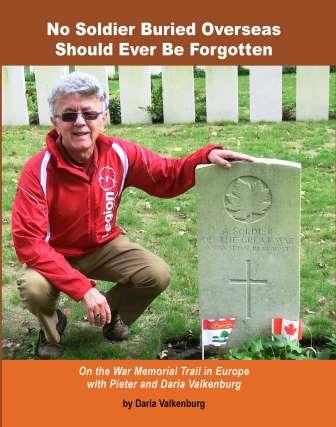 4 countries, 6 weeks, 7,000 km – an unforgettable war memorial journey in Europe…. Daria’s book ‘No Soldier Buried Overseas Should Ever Be Forgotten‘ is available in print and e-book formats. For more information see https://nosoldierforgotten.com/
Subscribe to our YouTube Channel: On The War Memorial Trail With Pieter Valkenburg: https://www.youtube.com/channel/UCJ591TyjSheOR-Cb_Gs_5Kw.
Never miss a posting! Subscribe below to have each new story from the war memorial trail delivered to your inbox.


I am so pleased that the search yielded such good results and that you were able to contact the family with the results. I’ve long been a visitor to Battlefield sites and war graves in many countries and the stories never fail to move me. An inspiring post.
LikeLike
Thank you for your comment Mari. It was an honour to tell George Taylor’s story and to share how well-remembered he was by his family. Pieter and Daria
LikeLike