On The War Memorial Trail…. Struck By Shellfire Part 3 The WWII Gunner From Olds Who Lost His Life As He Was Being Moved To Safety

July 22, 2026. On February 26, 1945, the lives of three WWII soldiers intersected during the Battle of Keppeln in Germany. Private Harry BIZNAR, Lt Robert Joseph MARKEY, and Gunner Albert Donald AHLWARDT, all lost their lives when a shell burst near them as Private Biznar and Lt Markey were trying to get a wounded Gunner Ahlwardt to safety in a nearby house.

In Part 1 of Struck By Shellfire, the story of WWII soldier Harry BIZNAR was told.  (See https://onthewarmemorialtrail.com/2026/07/03/on-the-war-memorial-trail-struck-by-shellfire-part-1-the-wwii-soldier-born-to-ukrainian-immigrants-who-lost-his-life-trying-to-get-a-wounded-gunner-to-safety/)

In Part 2 of Struck By Shellfire, the story of WWII soldier Robert Joseph MARKEY was told.  (See https://onthewarmemorialtrail.com/2026/07/16/on-the-war-memorial-trail-struck-by-shellfire-part-2-the-wwii-lieutenant-from-saint-john-who-lost-his-life-trying-to-get-a-wounded-gunner-to-safety/)

Now, in Part 3, the Struck By Shellfire series concludes with Albert Donald AHLWARDT.  The report on the circumstances of death for Harry Biznar and Robert Joseph Markey did not identify the gunner from the Ram carrier from a regiment other than Lincoln & Welland, but detective work on Pieter’s part resulted in identifying the gunner as Albert Donald Ahlwardt.

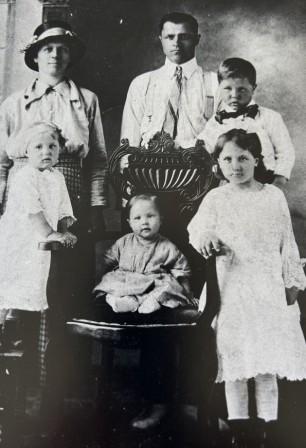
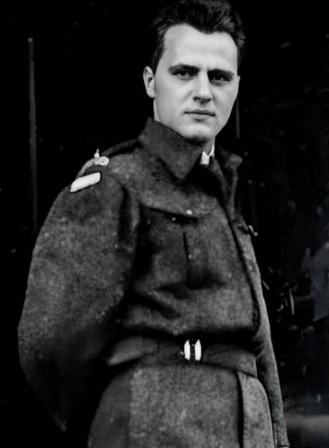
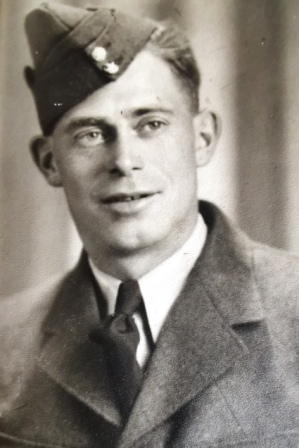
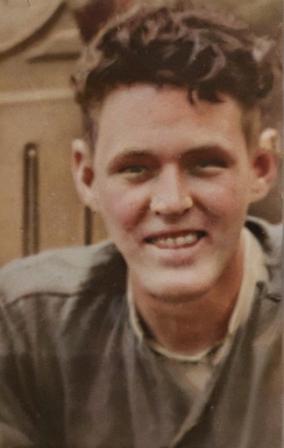
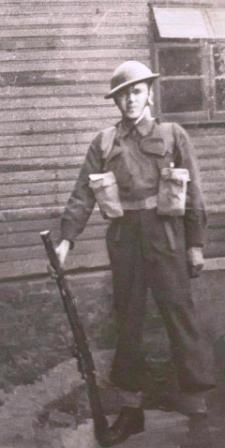
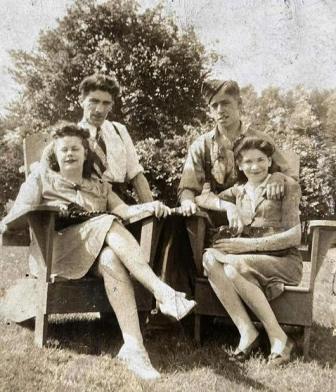
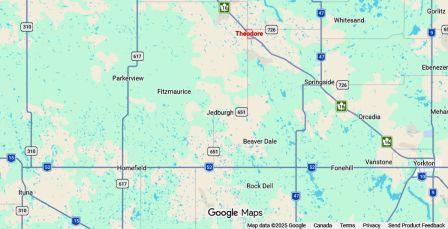
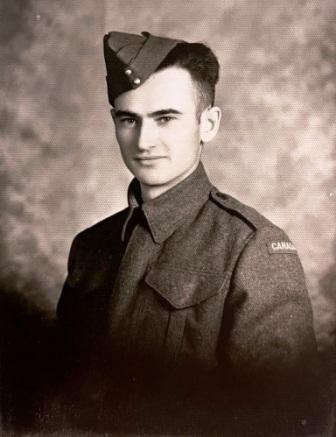
Born June 2, 1923 in Olds, Alberta, Albert was the son of Herman August and Edith May Ahlwardt.  The youngest of 5 children, Albert had a brother and three sisters. Pieter was able to connect with Diane McLeaghn, daughter of Albert’s sister Stella McLean, who submitted a photo.

….Albert enlisted in 1943…

When he enlisted at Military District No. 13 in Calgary, Alberta on July 26, 1943, Albert was employed as a truck driver for Cliff Sturgeon, a wholesale gas company for Imperial Oil in Olds. His Personnel Selection Record noted that he had left school at age 17 in order to assist his family financially, as his 72 year old father was “…frequently confined to hospital…” with an “…old age pension…” as his sole income.  Albert had been driving 3 ton gasoline trucks since he left school.  It was recommended that he be trained to drive military trucks.

On August 3, 1943, he was sent for basic training to the A1 Canadian Artillery Training Centre (CATC) in Petawawa, Ontario.  After 6 weeks, he was interviewed, and recorded as being “….happy in the army….

Albert remained at A1 CATC for training as a Driver i/c Class III (Wheeled), and received his qualification on November 16, 1943. With this qualification, Albert was deemed “…suitable for operational service overseas…” (The term ‘Driver i/c’ refers to ‘Driver, internal combustion’.  Class III meant he was qualified to drive heavy trucks and armoured cars, but not tanks. Wheeled refers to wheeled vehicles.)

….Albert left Canada for overseas service…

From December 1 to December 8, 1943, Albert was granted special leave, for what turned out to be the last time he saw his family. While on leave, he had been transferred to No. 2 Transit Company, and then, on December 10, 1943, Albert reported to No. 1 Training Brigade in Debert, Nova Scotia, for final training and preparation before going overseas.  The Brigade provided refresher courses and was a final staging point for troops waiting to cross the Atlantic Ocean.

On March 3, 1944, Albert was transferred to Serial 292 – the No. 1 Canadian Artillery Reinforcement Unit (CARU). This unit was stationed in the United Kingdom to train and supply replacements for overseas artillery regiments.

Albert boarded a ship on March 5, 1944 that left the following day from Halifax, Nova Scotia, arriving in the United Kingdom on March 15, 1944, and reported the next day to No. 1 Canadian Artillery Reinforcement Unit (CARU).

In an interview shortly after his arrival at No. 1 CARU, he was described as having an “…attractive personality, although a bit reserved…” and that he “…wishes to continue as Driver i/c and seems best suited for such work…

Albert’s training continued, beginning with a 2 week basic refresher course, which he completed on April 5, 1944.  On June 3, 1944, he qualified as a Driver i/c Wheeled Class ‘A’. Class ‘A’ referred to armoured and fighting vehicles, such as tanks and Universal Carriers.

A few weeks later, on June 24, 1944, he qualified as a Driver i/c (Tank) Class ‘B’. With this qualification, Albert would be responsible for steering, manoeuvring, and performing basic maintenance on the tracks and engine of a tank. Class ‘B’ meant that he had above-average mechanical aptitude, and would be tasked with both driving vehicles and executing minor field repairs, even under battle conditions.

….Albert left the UK for France in July 1944….

On July 7, 1944, Albert was transferred to ‘E’ Squadron of the 25th Canadian Armoured Delivery Regiment (CADR), which was preparing to go into France, attached to II Canadian Corps.  He joined them in Seabrook, one of 3 reinforcements that arrived that day, along with 2 Staghounds (an armoured vehicle that could also be used as a scout car).

Over the next two days, personnel and vehicles began leaving by train towards a marshalling area, where they gathered until ready to move to their embarkation point.

On the evening of July 10, 1944, they boarded LST-414. (Note: LST refers to Landing Ship, Tanks). The following morning, the ship left England across the English Channel towards France, and, per the war diary for July 11, 1944, “…sighted land about 1900 hours, vehicles warmed up in preparation to land, large numbers of various types of craft in vicinity, all personnel in high spirits, dropped anchor 2000 hours…

Map showing Courselles-sur-Mer on the coast of France, near Caen.  ‘La Manche’ in French is what we call the ‘English Channel’.  (Map source: https://www.viamichelin.fr)

After disembarking the following day, the Regiment slowly made it’s way to their temporary base on July 23, 1944 at an “…area situated in an apple orchard close to crossroads at Villons-les-Buissons…” which had been the site of intense fighting on June 7, 1944, a day after D-Day, until July 11, 1944.

‘E’ Squadron’s role was to serve as a vehicle pool attached for II Canadian Corps, responsible for maintaining, forwarding, and distributing replacement tanks, self-propelled guns, and modified armoured personnel carriers to front-line fighting units, as well as recovering them. As the Allies moved through France, so did ‘E’ Squadron.

As just one example, during Operation Totalize, an offensive designed to break through the German defences south of Caen and toward Falaise, fought between August 7-11, 1944, ‘E’ Squadron provided and issued specialized vehicles like the M7 Priest Kangaroos to infantry brigades to safely transport soldiers under heavy fire.  (See https://en.wikipedia.org/wiki/Operation_Totalize)

….Albert was transferred to the 6th Anti-Tank Regiment….
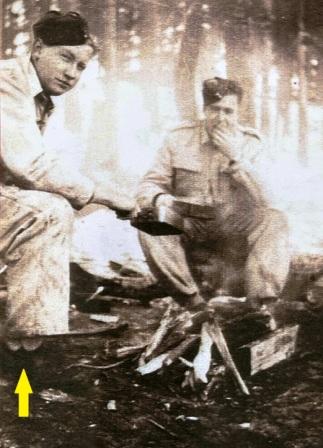
Albert Donald Ahlwardt (identified by yellow arrow) and an unidentified soldier warming up a meal by a campfire. (Photo courtesy of the McLean family on behalf of his sister Stella (Ahlwardt) McLean)

On August 28, 1944, Albert was transferred to the 6th Anti-Tank Regiment, Royal Canadian Artillery, joining them in the area of Le Gros-Theil (now part of Le Bosc-du-Theil) in northern France. Equipped with towed 6-pounders and 17-pounder guns, this Regiment, part of II Canadian Corps, was in continuous frontline combat to supplement the anti-tank defenses of both the 2nd and 3rd Canadian Infantry Divisions.
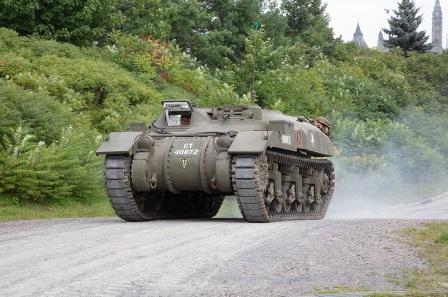
Ram Mk II Kangaroo could carry 2 crew and up to 8 passengers, and was armed with a .30 calibre machine gun. (Photo source: Canadian War Museum)

The Regiment used turretless Ram tanks as gun tractors to tow their heavy 17-pounder anti-tank guns, as well as Armoured Personnel Carriers (Kangaroos). These converted vehicles, which Albert would be familiar with, provided essential mobility and armour.

Albert joined the Regiment during the advance in late August and early September 1944 to secure and clear the heavily fortified French coastal ports before pushing forward into Belgium and The Netherlands.

From September to November 1944, the Regiment provided crucial anti-tank and direct fire support to clear the vital shipping routes into Antwerp in northern Belgium and the southwest Netherlands during the Battle of the Scheldt.  (See https://www.veterans.gc.ca/eng/remembrance/history/second-world-war/scheldt)
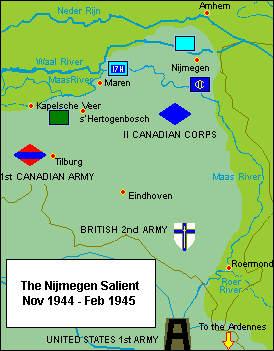
6th Anti-Tank Regiment, as part of II Canadian Corps, held defensive lines in the Nijmegen Salient.  (Map source: http://www.canadiansoldiers.com)

The Regiment spent the winter of 1944 and early 1945 holding defensive lines in the Nijmegen Salient area, while preparing for the upcoming fight in the Rhineland in February 1945, and supporting offensive thrusts along the German frontier.

….Albert lost his life during the Battle of Keppeln…

The 6th Anti-Tank Regiment’s War Diary entry for February 22, 1945 noted that “message received today ordering us to have 24 Ram towers ready to move without further notice to the Reichswald to undertake a task for 2 Canadian Corps. Exact nature to the job not yet known. The Rams will be ready but the Batterys are hard put to it to find drivers and co-drivers with 72 or the 103 men still on guard….

The Regiment was about to be involved in the upcoming Battle of Keppeln, with the objective of breaking the German Siegfried Line during Operation Blockbuster, the last part of Operation Veritable. (See https://en.wikipedia.org/wiki/Operation_Blockbuster)
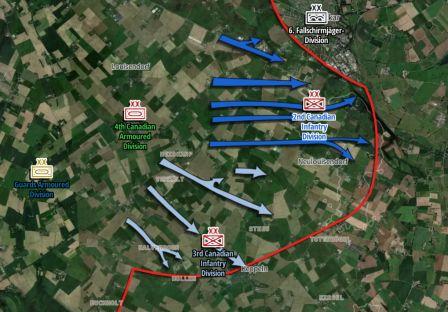
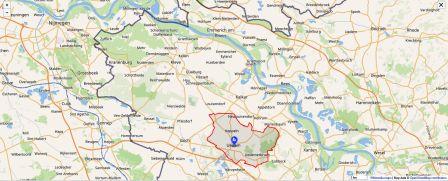
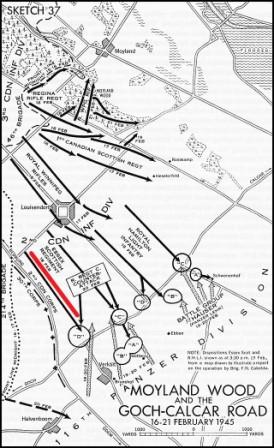
Map shows the location of the 4th Canadian Armoured Division, which the 6th Anti-Tank Regiment and the Lincoln and Welland Regiment supported, during the Battle of Keppeln  on February 26, 1945. (Map source:  Project 44)

The February 25, 1945 war diary entry stated that “all is in readiness for the offensive and both Batterys will move to concentration areas this evening….The Rams will carry the infantry of the Lincs and Wellands in the attack on the Hochswald by the 4th Canadian Armoured Regiment….

On February 26, 1945, the war diary entry recorded that “the great Operation got under way today at 0430 hrs in wet and windy weather.”  Troops encountered heavy artillery and mortar fire in intense fighting from German paratroopers, and had to make their way through heavy mud and minefields. During the battle, “…one Ram was struck by shell fire and burnt up and Gunner Ahlwardt was slightly wounded and evacuated….

The battle finally ended when Canadian troops used flame-throwing Wasp carriers to clear German-held houses in Keppeln. The village needed to be secured as part of a push towards Uedem. The capture of Keppeln allowed Canadian forces to clear the Kalkar Ridge and proceed towards the Hochwald Forest gap, and later to break through to the Rhine.  Unfortunately, Albert didn’t live to see the end of this battle….

….What happened?….

Lance Corporal John SYMCHYCH of the Lincoln and Welland Regiment stated in an official report that on February 26, 1945, one of the Regiment’s platoons, commanded by Lt Robert Joseph MARKEY and which Pte Harry BIZNAR was in, had been tasked with defending a house located 9.1 metres (30 feet) from a slit trench.  Visibility was poor due to smoke from machine gun and rifle fire.  One Ram carrier had been struck by shell fire and burned, and a gunner, later identified as Albert Donald AHLWARDT of the 6th Anti-Tank Regiment, Royal Canadian Artillery, had been slightly wounded and evacuated to the slit trench that L/Cpl Symchych was in.

Around 2 pm, “…Pte Biznar and Lt Markey pulled the driver of the Ram carrier out of L/Cpl Symchych’s slit trench and were taking him to the house 15 yards away.  A shell lit four or five feet away from the three of them while L/Cpl Symchych was still in his slit trench.  L/Cpl Symchych crawled to the house and remained in the house until relieved by RHLI Regiment between the hours of three or four o’clock of the morning of February 27th. The bodies of the three men were still there when L/Cpl Symchych returned to his slit trench for his equipment…” NOTE: RHLI refers to Royal Hamilton Light Infantry Regiment.

Albert, aged 22, lost his life on that afternoon of February 26, 1945, as Pte Biznar and Lt Markey tried to move him to safety.

NOTE: For an idea of some of the places that the Regiment travelled through in Germany, see https://onthewarmemorialtrail.com/2026/02/06/on-the-war-memorial-trail-we-follow-the-route-taken-into-germany-by-canadian-troops-in-1945/

….Albert is buried in Groesbeek…
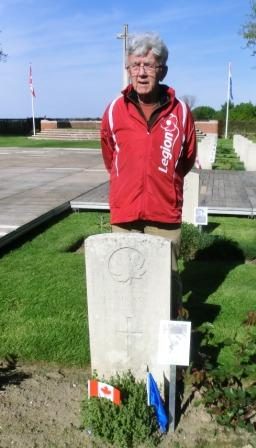
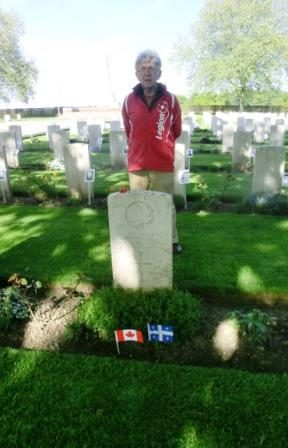
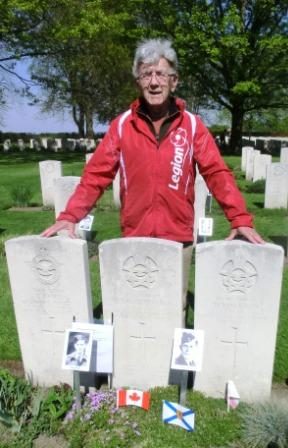
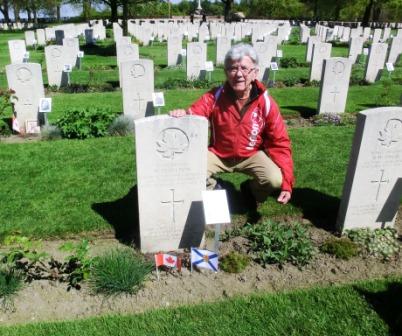
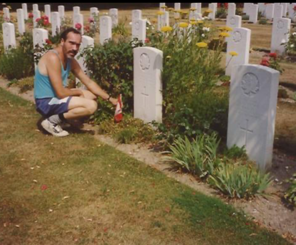
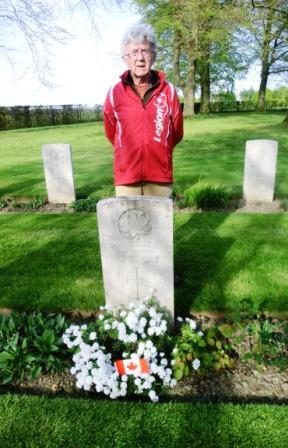
Pieter at the grave of Albert Donald Ahlwardt after placing Canadian and Alberta flags. (Photo credit: Daria Valkenburg)

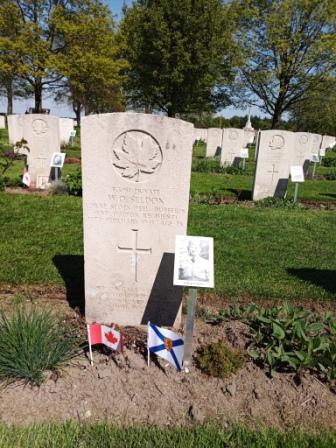
Albert was initially buried in Keppeln, Germany before being reburied on February 25, 1946 in the Canadian War Cemetery in Groesbeek, The Netherlands. During our 2025 European War Memorial Tour, Pieter placed Canadian and Alberta flags by his grave.

Thank you to Diane McLeaghn for finding a photo, and to Shawn Rainville for newspaper research.

The flags placed at Albert’s grave during our 2025 European War Memorial Tour were donated.  Our thanks go to:

  • Alan Waddell, Constituent Assistant, on behalf of Heath MacDonald, MP for Malpeque, for the Canadian flag.
  • Marie Renaud, MLA St Albert, Alberta at the request of Roman Berezowsky, for the Alberta flag.

This concludes the 3 part Struck By Shellfire series.  However, Pieter’s research efforts to find photos and families of soldiers continue. Do you have a story to tell? Can you identify the soldier in the photo with Albert? Email Pieter at memorialtrail@gmail.com, or comment on the blog.

© Daria Valkenburg

….Want to follow our research?…

If you are reading this posting, but aren’t following our research, you are welcome to do so.  Our blog address: https://onthewarmemorialtrail.com/
4 countries, 6 weeks, 7,000 km – an unforgettable war memorial journey in Europe…. Daria’s book ‘No Soldier Buried Overseas Should Ever Be Forgotten‘ is available in print and e-book formats.  Net proceeds of book sales help support research costs and the cost of maintaining this blog. For more information see https://nosoldierforgotten.com/

Subscribe to our YouTube Channel: On The War Memorial Trail With Pieter Valkenburg: https://www.youtube.com/channel/UCJ591TyjSheOR-Cb_Gs_5Kw.

Never miss a posting!  Subscribe below to have each new story from the war memorial trail delivered to your inbox.

On The War Memorial Trail…. Struck By Shellfire Part 2 The WWII Lieutenant From Saint John Who Lost His Life Trying To Get A Wounded Gunner To Safety

July 16, 2026.  On February 26, 1945, the lives of three WWII soldiers intersected during the Battle of Keppeln in Germany.   Private Harry BIZNAR, Lt Robert Joseph MARKEY, and Gunner Albert Donald AHLWARDT, all lost their lives when a shell burst near them as Private Biznar and Lt Markey were trying to get a wounded Gunner Ahlwardt to safety in a nearby house.

In Part 1 of Struck By Shellfire, the story of WWII soldier Harry BIZNAR was told.  (See https://onthewarmemorialtrail.com/2026/07/03/on-the-war-memorial-trail-struck-by-shellfire-part-1-the-wwii-soldier-born-to-ukrainian-immigrants-who-lost-his-life-trying-to-get-a-wounded-gunner-to-safety/)

Now, in Part 2, the Struck By Shellfire series continues with Robert ‘Bob’ Joseph MARKEY.

Born November 15, 1919 in Saint John, New Brunswick, Robert was the son of Ernest Thomas and Marion Marguerite ‘Marie’ (nee Nugent) Markey.  He graduated from Grade 11 at St. Vincent Boys’ High School in Saint John, continued on to Saint John High School for Grade 12, and then enrolled in the Nova Scotia Agricultural College in Truro, Nova Scotia in 1939. Winner of the Governor’s Award, 1941, Nova Scotia Agricultural College, he graduated in 1941 with a specialization in bacteriology.

Although Robert had a brother and two sisters, Pieter was unsuccessful in attempts to contact family members.  However, archivists Creighton Barrett and Jennifer MacIsaac of Dalhousie University Libraries uncovered photos and information from the time he was at Nova Scotia Agricultural College, providing a picture of the man behind the soldier’s uniform.

….Robert was involved in student activities…

Robert Markey as a 1941 graduate.  (Photo credit: Agricola Archives, Dalhousie University Archives)

A brief biography in the 1941 graduation issue of the student publication Agricola noted that over the past two years he had “…proven his ability as an all-around student, especially in public speaking and in basketball…

Robert Markey was on the school’s basketball team, pictured here 4th from the left (red arrow) in the 1941 graduation booklet.  (Photo credit: Agricola Archives, Dalhousie University Archives)

Robert, known as ‘Bob’ while a student, was involved in social activities of the College.  “…Being very popular with his classmates, due to his wit and personality, he was elected chairman of the Social Committee for the first term of the year ’41.  Bob also had the honour of being President of the Students’ Council while in his senior year

Robert was also known for being “…quite musical and full of jazz which was proven when he played the ‘Traps’ for the Sawfilers Orchestra at a few of the Saturday night dances…” Traps referred to drums, accompanied with other percussion instruments such as cymbals.

The account on Robert ended by stating that “… his main ambition is to specialize in Animal Husbandry but this coming summer he is joining the RCAF…

….Robert enlisted on Boxing Day 1941 …

Robert never joined the RCAF.  When he enlisted at the No. 7 District Depot’s recruiting office in Saint John, New Brunswick on December 26, 1941, it was noted that he had worked 3 summers at Atlantic Sugar Refinery in Saint John, New Brunswick. Just before enlistment, in the fall of 1941, he worked as an oiler and fireman, as well as a powerhouse technician in the plant where his father was employed as a superintendent.  As a technician, he was responsible for testing the chemical content of water and keeping a log of engine efficiency, among other duties.

He began his basic training at No. 70 Canadian Army (Basic) Training Centre (CABTC) in Fredericton, New Brunswick, but was hospitalized with a bad cold from January 4 until January 20, 1942.  He didn’t return back to No. 70 CA(B)TC until February  6, 1942, at which time he also received a promotion to Lance Corporal.

After completing his training, he was put on staff as an instructor at No. 70 CA(B)TC on May 16, 1942.

….Robert attended No. 30 Officers Training Centre in Brockville …

On September 2, 1942, an interviewer in Fredericton gave his assessment on Robert’s suitability as an Officer Candidate.  He was described as a “….tall, lean, athletic type…” with a “….. pleasant, well-balanced personality...” and “…good leadership qualities, conscientious…”  He had a “…history of commendable personal enterprise...” coupled with an “…above average level of learning ability…” and “…superior knowledge of tools and mechanical principles…”  He was recommended for officer training and to remain in the Infantry as that was what Robert himself preferred.

On October 10, 1942, Robert was sent to No. 30 Officers’ Training Centre in Brockville, Ontario for 12 weeks of intensive training in preparation for going overseas.  His time there would have overlapped with that of John ‘Weston’ CAMPBELL, from Prince Edward Island, who had arrived there in August for his 12 week course. (See https://onthewarmemorialtrail.com/2024/09/30/on-the-war-memorial-trail-the-wwii-soldier-from-clermont-killed-during-operation-veritable/)

After successfully completing his 12 week course, Robert was promoted to Provisional 2nd Lieutenant on January 16, 1943, and then sent for further training to A-17 Machine Gun Training Centre in Trois-Rivières, Quebec, a course that began on January 25, 1943 and ended on March 18, 1943….along with a promotion to Lieutenant.

….Robert was in Kiska as part of Operation Cottage …

On March 20, 1943, Robert was transferred to the 1st Battalion, Saint John Fusiliers (Machine Gun) and sent to Nanaimo, British Columbia. The battalion served in Canada in a home defense role as a part of the 18th Canadian Infantry Brigade which was first part of Pacific Command and then the 6th Canadian Infantry Division.

Summary of Canadian support for Operation Cottage in Kiska, Alaska. (Source: National Defence, National Defense University Press. Seen on the A Canadian Outlook FaceBook page)

On June 16, 1943, Robert was assigned to ‘C’ Company of the Saint John Fusiliers.  On July 12, 1943, he was on ‘special duty’ as part of a planned Canadian support to Kiska, Alaska for the American led Operation Cottage. (See https://en.wikipedia.org/wiki/Operation_Cottage and http://www.canadiansoldiers.com/history/operations/operationcottage.htm)

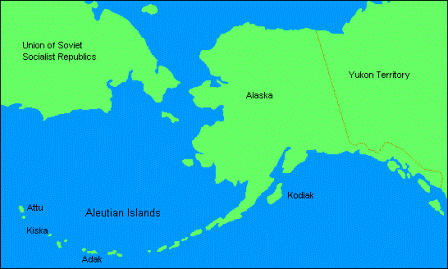
Map showing location of Kiska, part of the Aleutian Islands.  (Map source: http://www.canadiansoldiers.com)

Map source: By of SVG: Kuara – Aleutian Islands, United States Army Center of Military History, CC BY-SA 3.0, https://commons.wikimedia.org/w/index.php?curid=5209745

The intention was to liberate Kiska Island from Japanese forces, which had occupied it since June 7, 1942, after Japan seized Kiska and Attu in Alaska’s Aleutian Islands. However, no one seemed to be aware that the Japanese had left the Island on July 28, 1943, using fog as cover for their escape.

Kiska was unoccupied by the time Allied troops arrived on August 15, 1943, of which ‘C’ Company was a component of the 13th Canadian Infantry Brigade Group.  They were sent into fog, surf, volcanic rock, confusion, and uncertainty. Expecting a brutal fight, the soldiers found the island empty of Japanese troops, but they had left behind reminders of their presence in the form of mines and booby traps.

As noted in Project 44’s Operation Cottage: Invasion of Kiska Island: “…Despite the lack of Japanese soldiers, there still were American and Canadian casualties. Some were wounded and killed in friendly fire as nervous soldiers fired into the fog amongst the confusion. Others were wounded and killed by enemy mines, booby-traps, and explosive ordinance left on the island. The Canadians sustained eight casualties, four dead and four wounded…” (See https://www.project44.ca/kiska)

While the Americans left Kiska by September 1, 1943, the Canadians remained for over 3 months longer.

C.P. Stacey’s ‘Official History of the Canadian Army in the Second World War: Volume I: Six Years of War: Canada, Britain and the Pacific’ recorded that troops lived “in ‘winterized’ tents, and engaged in road and pier construction, transport fatigues, building and manning defences, and carrying on such training as conditions permitted. Fog, rain and wind made the island an acutely unpleasant residence, and the troops were heartily glad when the withdrawal to British Columbia began in November 1943. The last shipload of Canadians left Kiska on 12 January 1944…. 

Robert returned to Canada on January 3, 1944, and given 30 days leave, from January 6 until February 4, 1944.  ‘C’ Company disbanded on January 31, 1944, and when Robert returned to duty, he was assigned back to the 1st Battalion, Saint John Fusiliers (Machine Gun).

….Two soldiers whose stories have been told were also in Kiska …

…Robert was sent for more training…

On February 11, 1944, Robert was sent for two courses at the S-17 Canadian School Of Infantry in Vernon, British Columbia.  He began with a Junior Battle Wing Course. 10 days later, however, he was admitted to Vernon Military Hospital for 16 days with pneumonitis, an inflammation of lung tissue, typically caused by inhaling airborne irritants. (See https://my.clevelandclinic.org/health/diseases/24810-pneumonitis)

After completing the Junior Battle Wing Course, Robert next undertook a 4.2 Mortar Battle Wing course at S-11 Canadian Chemical Warfare School (CCWS) in Suffield, Alberta, which ran from April 16 to April 29, 1944.

….Robert qualified as a Driver for a flamethrower…

While in Suffield Robert took specialized carrier-driver training for a flamethrower-equipped variant of a Universal Carrier, qualifying as Driver i/c Class III (MC) on June 23, 1944.  (The term ‘Driver i/c’ refers to ‘Driver, internal combustion’.  Class III meant he was qualified to drive heavy trucks and armoured cars, but not tanks. MC meant he was also a qualified Motorcycle Despatch Rider.)

A June 16, 1944 Officers’ Survey report described Robert as …a very good officer.  A good leader. Has the confidence of all…” and noted that he “…speaks clearly and concisely….” with a   “…self-composed manner and confident approach. Has a strong personality.  Makes friends easily…

Robert was keen to go overseas, and the report stated that he had “…volunteered for the British Army.  Passed but not taken…”  It went on to say that he “…now has special authority to go overseas with some forty or fifty men including his own Platoon who have volunteered to go active on the understanding he will go with them.  This is a fulfillment of his wishes….” (NOTE: No mention was ever made if this happened when Robert ultimately left Canada for overseas service.)

On June 29, 1944, Robert returned to the S-17 Canadian School Of Infantry in Vernon, British Columbia for an Officers Refresher course, taken between July 1 and August 18, 1944.

The August 19, 1944 course assessment for the Junior Battle Wing Course noted that “…his knowledge and application of tactics was good. He has ability as a leader. His knowledge and handling of weapons were quite good….” but that “…at times he appeared disinterested and did not always put as much into the work as he could give…” The final comment was that with more experience, Robert would be “…a capable platoon commander…

The August 19, 1944 assessment for the Mortar Battle Wing course was positive. “…This officer was interested and enthusiastic.  He has quite a sound knowledge of the weapon and its tactical employment…” The final comment was that with further field experience, Robert “…should make a good mortar platoon commander…

….Robert left Canada for overseas service…

Robert Joseph Markey. (Photo source: Canadian Virtual War Memorial. Photo restoration by Pieter Valkenburg)

From August 20 until August 26, 1944, Robert was granted embarkation leave, for what turned out to be the last time he saw his family.

On August 27, 1944, Robert reported to No. 1 Training Brigade in Debert, Nova Scotia, for final training and preparation before going overseas.  The Brigade was a final staging point for troops waiting to cross the Atlantic Ocean.

On September 7, 1944, Robert boarded a ship that left the following day from Halifax, Nova Scotia, arriving in the United Kingdom on September 20, 1944. He was placed with No. 4 Canadian Infantry Reinforcement Unit (CIRU).

A few weeks later, on October 23, 1944, Robert was sent to No. 3 Wing (Weapons) Canadian Training School (CTS) for a Canadian Military Headquarters (CMHQ) Conversion Course at the Canadian Army Battle Drill School in Stansted Park in Rowland’s Castle, Hampshire, England. The 42 day course trained officers and NCOs to standardize infantry and joint-force tactics before deployment.  After successfully completing the course, he returned to No. 4 CIRU, which had been re-designated at No. 3 CIRU, on December 2, 1944.

….Robert joined the Lincoln & Welland Regiment……

On January 11, 1945, Robert was transferred to the 13th Battalion’s X-4 Reinforcement List of the Canadian Infantry Corps (CIC).  The following day he left for North West Europe, arriving on January 12, 1945.

On January 29, 1945, Robert was transferred to the Lincoln & Welland Regiment as a Platoon Officer in ‘C’ Company, joining them in the midst of Operation Elephant, also known as the Battle of Kapelsche Veer, a brutal and freezing battle to clear German paratroopers from Kapelsche Veer, a low-lying, water-logged island north of the Maas River in The Netherlands.

NOTE: Eli Ambrose SNAKE, whose story was previously told, had lost his life in the battle. (See https://onthewarmemorialtrail.com/2021/12/13/on-the-war-memorial-trail-remembering-ww2-soldier-eli-ambrose-snake/)

Robert had survived his first active battle, and continued with the Regiment as they moved into Germany.

….Robert lost his life during the Battle of Keppeln…

Map shows location (green circle) where the Lincoln & Welland Regiment was in support of the 4th Canadian Armoured Division during the Battle of Keppeln  on February 26, 1945. (Map source:  Project 44)

On February 26, 1945, the Regiment was involved in the Battle of Keppeln, with the objective of breaking the German Siegfried Line during Operation Blockbuster, the last part of Operation Veritable. (See https://en.wikipedia.org/wiki/Operation_Blockbuster) Troops encountered heavy artillery and mortar fire in intense fighting from German paratroopers, and had to make their way through heavy mud and minefields.

The war diary for February 26, 1945 noted the orders given for the battle.  The 4th Canadian Armoured Brigade, which the Lincoln & Welland Regiment was part of, “….was divided into five forces….”  ‘A’ and ‘C’ Companies of the Regiment were part of ‘JERRY FORCE’.

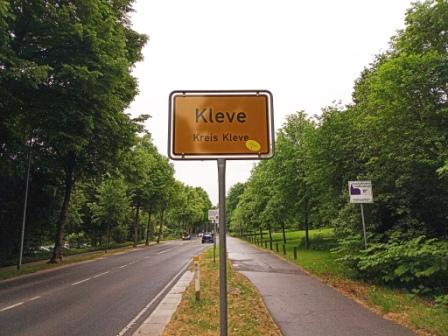
Movement began at 6 am, but “…the route from the area at KLEVE to the concentration area was through mud fields and was extremely heavy going for all vehicles. Heavy vehicles bogged down in the mud….

By 9 am, “… JERRY FORCE moved into the attack passing through 2 Canadian Infantry Division….

The battle finally ended when Canadian troops used flame-throwing Wasp carriers to clear German-held houses in Keppeln. The village needed to be secured as part of a push towards Uedem. The capture of Keppeln allowed Canadian forces to clear the Kalkar Ridge and proceed towards the Hochwald Forest gap, and later to break through to the Rhine.  Unfortunately, Robert did not live to see the end of this battle….

….What happened?…

Lance Corporal John SYMCHYCH stated in an official report that on February 26, 1945, the platoon that Robert commanded was tasked with defending a house located 9.1 metres (30 feet) from a slit trench.  Visibility was poor due to smoke from machine gun and rifle fire.  One Ram carrier had been struck by shell fire and burned, and a gunner, later identified as Albert Donald AHLWARDT of the 6th Anti-Tank Regiment, Royal Canadian Artillery, had been slightly wounded and evacuated to the slit trench that L/Cpl Symchych was in.

Around 2 pm, “…Pte Biznar and Lt Markey pulled the driver of the Ram carrier out of L/Cpl Symchych’s slit trench and were taking him to the house 15 yards away.  A shell lit four or five feet away from the three of them while L/Cpl Symchych was still in his slit trench.  L/Cpl Symchych crawled to the house and remained in the house until relieved by RHLI Regiment between the hours of three or four o’clock of the morning of February 27th. The bodies of the three men were still there when L/Cpl Symchych returned to his slit trench for his equipment…” NOTE: RHLI refers to Royal Hamilton Light Infantry Regiment.

Robert, aged 26, lost his life on that afternoon of February 26, 1945, as he and Pte Harry Biznar tried to move Gunner Alwardt to safety.

NOTE: For an idea of some of the places that the Regiment travelled through in Germany, see https://onthewarmemorialtrail.com/2026/02/06/on-the-war-memorial-trail-we-follow-the-route-taken-into-germany-by-canadian-troops-in-1945/

….Robert is buried in Groesbeek…

Pieter placed Canadian and New Brunswick flags at the grave of Robert Joseph Markey. (Photo credit: Daria Valkenburg)

Robert was initially buried in Keppeln, Germany before being reburied on February 25, 1946 in the Canadian War Cemetery in Groesbeek, The Netherlands. During our 2025 European War Memorial Tour, Pieter placed Canadian and New Brunswick flags by his grave.

Thank you to Jennifer MacIsaac and Creighton Barrett of Dalhousie University Libraries for finding photos of Lt Markey while he was at Nova Scotia Agricultural College.

The flags placed at Robert’s grave during our 2025 European War Memorial Tour were donated.  Our thanks go to:

  • Alan Waddell, Constituent Assistant, on behalf of Heath MacDonald, MP for Malpeque, for the Canadian flag.
  • Jean-Claude D’Amours, MLA for Edmundston-Madawaska Centre, Minister responsible for Military Affairs, with the help of Cécile LePage, Province of New Brunswick, for the New Brunswick flag.

…. to be continued…..

Coming up in Struck By Shellfire Part 3 will be about Albert Donald AHLWARDT of Olds, Alberta.

Pieter’s research efforts to find photos and families of soldiers continue. Do you have a story to tell? Email Pieter at memorialtrail@gmail.com, or comment on the blog.

© Daria Valkenburg

….Want to follow our research?…

If you are reading this posting, but aren’t following our research, you are welcome to do so.  Our blog address: https://onthewarmemorialtrail.com/

4 countries, 6 weeks, 7,000 km – an unforgettable war memorial journey in Europe…. Daria’s book ‘No Soldier Buried Overseas Should Ever Be Forgotten‘ is available in print and e-book formats.  Net proceeds of book sales help support research costs and the cost of maintaining this blog. For more information see https://nosoldierforgotten.com/

Subscribe to our YouTube Channel: On The War Memorial Trail With Pieter Valkenburg: https://www.youtube.com/channel/UCJ591TyjSheOR-Cb_Gs_5Kw.

Never miss a posting!  Subscribe below to have each new story from the war memorial trail delivered to your inbox.

On The War Memorial Trail….Struck By Shellfire Part 1 The WWII Soldier Born To Ukrainian Immigrants Who Lost His Life Trying To Get A Wounded Gunner To Safety

July 3, 2026.  It seems as though every time we go away for a short holiday, Pieter receives good news about a soldier he’s researching and in the search to find a photo and family.  Last year, we were delayed by a week for our annual wedding anniversary getaway, but while in Moncton, New Brunswick on the first day of our trip, we found out that the Windsor Star had published Pieter’s Letter To The Editor, asking for help in finding family and a photo of WWII soldier Harry BIZNAR.  (See Reader asks: Anyone in Windsor know family of WW2 vet Harry Biznar? | Windsor Star https://windsorstar.com/opinion/letters/reader-letter-dutch-veteran-asks-anyone-in-windsor-area-know-family-of-ww2-veteran-harry-biznar)

Harry’s story intersected with two other soldiers: Lt Robert Joseph MARKEY and Gunner Albert Donald AHLWARDT, as all three lost their lives when a shell burst near them as Harry and Lt Markey were trying to get a wounded Gunner Ahlwardt to safety in a nearby house.

….The Letter To The Editor was successful…

On our way to Moncton, we had spent much of the day in Memramcook (see https://onthewarmemorialtrail.com/2025/11/09/on-the-war-memorial-trail-remembrance-week-2025-reflections-and-updates/), so it wasn’t until we were settled in our hotel room and had a brief time to rest before dinner with two other couples that we noticed emails in reply to the Windsor Star letter.

One email from Carol Cox made Pieter’s heart beat faster! She wrote that “…a friend of mine who reads the Windsor Star faithfully sent me the letter this morning that you had printed in the newspaper regarding Harry Biznar.

It was very emotional for me to read the letter as I seem to have some kind of connection to him although I never met him. I did some research back in 2017 and found a great deal of information on Uncle Harry… It was like piecing together the life of a very young man who gave up his life for our freedom. I have 3 grown sons of my own so I suppose my gratitude is three fold as my sons did not have to leave home and go to war at such a young age.

My mother was Florence Ducharme, Harry’s sister. My mom was the last of the family to pass at the age of 94 in 2018….

I am truly touched and grateful for the effort that you and the Canadian War Cemeteries in the Netherlands are continuing to put into this important endeavour. May God Bless you….

….Harry’s parents were Ukrainian…

Harry Biznar.  (Photo courtesy of the Biznar Family)

Born February 8, 1917 in Montreal, Quebec, Harry was the son of Frederick ‘Fred’ (born Toader Dmitrievich Bezhenariu) and Katherine (nee Benec aka Binuk) Biznar.  In addition to Harry, “… his sisters Lena, Dora, Mary and brother Mike were all born in Montreal. Sisters Florence and Irene were born in Windsor, Ontario….” Carol wrote.  Mike also served during WWII, and survived the war.

Harry with his parents and sisters Dora (left), Mary (sitting), and Lena (right) in Montreal in 1921.   (Photo courtesy of the Biznar Family)

Carol shared a number of photos, and explained that her grandparents – Harry’s parents – had met in Montreal, Quebec, but both were Ukrainian immigrants.  Frederick had been born in Velykyi Kuchuriv (See https://en.wikipedia.org/wiki/Velykyi_Kuchuriv) and Katherine in Chernivtsi (See https://www.britannica.com/place/Chernivtsi-Ukraine).

After completing Grade 8 at Gordon MacGregor School in Windsor, Ontario, Harry took a 2 year auto mechanics course at the Windsor Vocational School. He worked as a seasonal farm hand, and a machine operator for the printing press at a bag manufacturing company.

….Harry enlisted in 1942…

On January 10, 1941, Harry enrolled in the Essex Scottish Reserve Force militia.  Then, on October 8, 1942, he enlisted under the National Resources Mobilization Act (NRMA) at the No. 1 NRMA Clearing Depot in London, Ontario. (See https://en.wikipedia.org/wiki/National_Resources_Mobilization_Act)

At the time of his enlistment, Harry was employed as a machine operator by Bendix-Eclipse of Canada Ltd., a manufacturing facility and division of the Bendix Corporation that operated in Windsor, Ontario. During World War II, the Windsor plant was a vital part of the Canadian motor vehicle parts industry, manufacturing essential components for military vehicles and aircraft.

On October 31, 1942, Harry was sent to the No. 12 Canadian Army (Basic) Training Centre (CABTC) in Chatham, Ontario.  His Personnel Selection Record noted that he spoke both English and Ukrainian, and that he enjoyed sports – boxing, baseball, rugby, soccer, and swimming.  He was described by an interviewer as someone who “…makes friends easily…

After completing his basic training, on January 6, 1943 he was sent for advanced training at A29 Canadian Infantry Training Centre at Camp Ipperwash, Ontario. A few weeks later, he was transferred to the Kent Regiment on January 25, 1943, and sent on a 6 Pounder Anti-Tank Gun course in Terrace, British Columbia.

He next was sent for a month to the Canadian Small Arms School (Western Canada) in Nanaimo, British Columbia, before returning to the Kent Regiment in Terrace on June 8, 1943.

Harry Biznar in December 1943.  (Photo courtesy of the Biznar Family. Photo restoration by Pieter Valkenburg)

On June 17, 1944, he enlisted in the Active Army in Courtney, British Columbia, remaining with the Kent Regiment.  His Personnel Selection Record was updated with an interviewer noting that Harry had “…trained as an anti-tank gunner…” and was “…presently in rifle company… 

The interviewer’s appraisal went on to say that Harry was “…keen on getting overseas.  Impresses as the ‘strong and silent type’.  Rather uncommunicative but gets along with his fellow soldiers. Well motivated and well adjusted to army life…”  Harry was recommended for overseas service with the Canadian Infantry Corps.

….Harry wanted to join the paratroops…

Harry, however, was interested in joining the paratroops, and after being re-interviewed in July 1944, he was sent to the A35 Canadian Paratrooper Training Centre at Camp Shilo, Manitoba. He quickly realized he’d made a mistake.  Shortly after arriving, he learned he’d have to retake the basic infantry training he’d already taken, and told an interviewer on August 9, 1944 that “…the nature and duration of training at A35 were misrepresented to him…”  He asked to be transferred to A15 Canadian Infantry Training Centre (CITC) at Camp Shilo, a request which was granted.

….Harry returned to the infantry before leaving Canada for overseas service…

Harry’s final infantry training course in Canada took place at No. 1 Training Brigade in Debert, Nova Scotia from October 16 to October 30, 1944. The Brigade provided refresher courses and was a final staging point for troops waiting to cross the Atlantic Ocean.  Harry’s training evaluation recorded him as being “…well trained and efficient…” with a “…knowledge of work and good judgment…

On November 20, 1944, he left Canada for the United Kingdom, arriving on November 28, 1944, where he was assigned to No. 3 Canadian Infantry Training Regiment (CITR), and underwent more intensive training that included battle drills, tactical field exercises, and physical conditioning.

After being rated as fully qualified and operational, he was transferred to the X-4 Reinforcement List Infantry General Unit (IGU) of the Canadian Infantry Corps (CIC) on January 6, 1945.  The following day he left for North West Europe, arriving on January 8, 1945.

….Harry joined the Lincoln & Welland Regiment…

On January 28, 1945 Harry was transferred to ‘C’ Company of the Lincoln & Welland Regiment, joining them in the midst of Operation Elephant, also known as the Battle of Kapelsche Veer, a brutal and freezing battle to clear German paratroopers from Kapelsche Veer, a low-lying, water-logged island north of the Maas River in The Netherlands.

NOTE: Eli SNAKE, whose story was previously told, had lost his life that same day in the battle.  (See https://onthewarmemorialtrail.com/2021/12/13/on-the-war-memorial-trail-remembering-ww2-soldier-eli-ambrose-snake/)

Harry had survived his first battle, and continued with the Regiment as they moved into Germany.

….Harry lost his life during the Battle of Keppeln…

Map shows area where the Lincoln & Welland Regiment was in support of the 4th Canadian Armoured Division during the Battle of Keppeln  on February 26, 1945. (Map source:  Wikipedia)

On February 26, 1945, the Regiment was involved in the Battle of Keppeln, with the objective of breaking the German Siegfried Line during Operation Blockbuster, the last part of Operation Veritable. (See https://en.wikipedia.org/wiki/Operation_Blockbuster) Troops encountered heavy artillery and mortar fire in intense fighting from German paratroopers, and had to make their way through heavy mud and minefields.

The war diary for February 26, 1945 noted the orders given for the battle.  The 4th Canadian Armoured Brigade, which the Lincoln & Welland Regiment was part of, “….was divided into five forces….”  ‘A’ and ‘C’ Companies of the Regiment were part of ‘JERRY FORCE’.

Movement began at 6 am, but “…the route from the area at KLEVE to the concentration area was through mud fields and was extremely heavy going for all vehicles. Heavy vehicles bogged down in the mud….

By 9 am, “… JERRY FORCE moved into the attack passing through 2 Canadian Infantry Division….

The battle finally ended when Canadian troops used flame-throwing Wasp carriers to clear German-held houses in Keppeln. The village needed to be secured as part of a push towards Uedem. The capture of Keppeln allowed Canadian forces to clear the Kalkar Ridge and proceed towards the Hochwald Forest gap, and later to break through to the Rhine.  Unfortunately, Harry did not live to see the end of this battle….

….What happened?….

Lance Corporal John SYMCHYCH stated in an official report that on February 26, 1945, Lt Robert Joseph MARKEY’s platoon, which Harry was in, was tasked with defending a house located 9.1 metres (30 feet) from a slit trench.  Visibility was poor due to smoke from machine gun and rifle fire.  One Ram carrier had been struck by shell fire and burned, and a gunner, later identified as Albert Donald AHLWARDT of the 6th Anti-Tank Regiment, Royal Canadian Artillery, had been slightly wounded and evacuated to the slit trench that  L/Cpl Symchych was in.

Around 2 pm, “…Pte Biznar and Lt Markey pulled the driver of the Ram carrier out of L/Cpl Symchych’s slit trench and were taking him to the house 15 yards away.  A shell lit four or five feet away from the three of them while L/Cpl Symchych was still in his slit trench.  L/Cpl Symchych crawled to the house and remained in the house until relieved by RHLI Regiment between the hours of three or four o’clock of the morning of February 27th. The bodies of the three men were still there when L/Cpl Symchych returned to his slit trench for his equipment…” NOTE: RHLI refers to Royal Hamilton Light Infantry Regiment.

Harry, aged 28, lost his life on that afternoon of February 26, 1945, as he and Lt Markey tried to move Gunner Ahlwardt to safety.

NOTE: For an idea of some of the places that the Regiment travelled through in Germany, see https://onthewarmemorialtrail.com/2026/02/06/on-the-war-memorial-trail-we-follow-the-route-taken-into-germany-by-canadian-troops-in-1945/

….Harry is buried in Groesbeek…

Harry was initially buried in Keppeln, Germany before being reburied on February 25, 1946 in the Canadian War Cemetery in Groesbeek, The Netherlands. During our 2025 European War Memorial Tour, Pieter placed Canadian and Quebec flags by his grave.

Pieter at the grave of Harry Biznar after placing Canadian and Quebec flags. (Photo credit: Daria Valkenburg)

Thank you to the Windsor Star for publishing the Letter To The Editor asking for a photo of Harry Biznar, to Debbie McGivney for sending us the published letter to the editor, to Harry Biznar’s niece Carol Cox for photos and information, plus niece Shelly French.  This Letter To The Editor resonated with those who read it, and we thank all who took the time to get in touch with both us and Harry’s family.

Carol Cox, niece of Harry Biznar. (Photo courtesy of Carol Cox)

As the information and photos about Harry were being compiled, Carol Cox told Pieter that “….you have resurrected emotions and gratitude for our freedom that is too easy to take for granted….

Another niece, Shelly French, also contacted us, writing to say “thank you for your hard work in locating all this information and caring deeply about our lost souls….” Shelly explained that her mother, Irene Peleshok, was “…Harry’s sister….” and reflected that her grandmother “never got over the loss of her son Harry. She cried many tears over his passing….

The flags placed at Harry’s grave during our 2025 European War Memorial Tour were donated.  Our thanks go to:

  • Alan Waddell, Constituent Assistant, on behalf of Heath MacDonald, MP for Malpeque, for the Canadian flag.
  • Mario Henry and his brother Etienne Henry, who donated the Quebec flag.

…. to be continued…..

Struck By Shellfire Part 2 will be about Robert Joseph MARKEY of Saint John, New Brunswick.

Pieter’s research efforts to find photos and families of soldiers continue. Do you have a story to tell? Email Pieter at memorialtrail@gmail.com, or comment on the blog.

© Daria Valkenburg

….Want to follow our research?…

If you are reading this posting, but aren’t following our research, you are welcome to do so.  Our blog address: https://onthewarmemorialtrail.com/

4 countries, 6 weeks, 7,000 km – an unforgettable war memorial journey in Europe…. Daria’s book ‘No Soldier Buried Overseas Should Ever Be Forgotten‘ is available in print and e-book formats.  Net proceeds of book sales help support research costs and the cost of maintaining this blog. For more information see https://nosoldierforgotten.com/

Subscribe to our YouTube Channel: On The War Memorial Trail With Pieter Valkenburg: https://www.youtube.com/channel/UCJ591TyjSheOR-Cb_Gs_5Kw.

Never miss a posting!  Subscribe below to have each new story from the war memorial trail delivered to your inbox.

On The War Memorial Trail….. A Photo Found For A WWII Soldier From Moreton’s Harbour Killed By A Mortar Fragment While Transporting Wounded In An Ambulance

The Dutch flag was displayed on May 5 for Dutch Liberation Day. (Photo credit: Daria Valkenburg)

May 8, 2026. The first week of May is a time of reflection for Pieter, as it’s a bittersweet week in which The Netherlands remembers those who died during WWII and celebrates liberation from Nazi occupation during WWII. During last year’s 2025 European War Memorial Tour he placed flags at 383 graves of Canadian soldiers that he’d researched over the years. This posting is the story of the search for a photo of one of those soldiers.

Occasionally, Pieter helps the Canadian War Cemetery in Groesbeek, The Netherlands to find photos of soldiers for which research had already been done, but no photo could be found. He’s found that it’s almost as much work as it is do a complete research project on a soldier, as there is a reason photos aren’t readily available – they can be very difficult to find!

Since he’s always had a wonderful response when looking for soldiers from Newfoundland, when he saw a soldier from that province on a photo wish list, he thought it would be a slam dunk. Pieter had no idea of the twists and turns encountered when he began to look for a photo of John Frederick BARTLETT.

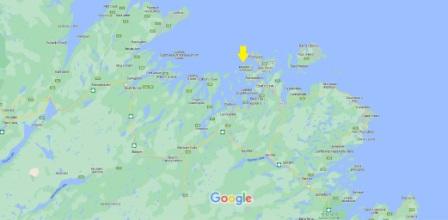
Yellow arrow identifies Moreton’s Harbour, Newfoundland. (Map source: Google Maps)

Born January 27, 1898 in Moreton’s Harbour, the son of Alfred and Jessie Lavinian (nee Taylor) Bartlett, John was serving with the South Alberta Regiment (29th Canadian Armoured Reconnaissance Regiment). As he was 47 years old, his normal duties included serving in the officers mess and being the batman (driver) for one of the officers.

He lost his life on February 27, 1945, aged 47, when fragments from a German mortar bomb hit the ambulance in which he was travelling. According to a casualty report, he had been “…riding in the half-track ambulance between stretchers. Mortar landed in field near road. Fragment entered back of canvas cover, passed clean through Bartlett’s head and out through the top of cover.  Killed outright…”  (You can read Jim Little’s story about John here: https://www.facestograves.nl/LifeStories/BARTLETT%20John%20Frederick-JLE-bio-EN.pdf)

….A great-nephew was contacted in Newfoundland…

Pieter was very quickly in contact with Gerald Bartlett, John’s great-nephew, grandson of John’s brother William Chesley Bartlett.  But his hope of receiving a photo was dashed when Gerald explained that the family no longer had a photo.  “My dad, Morgan John Bartlett, did have a photo of Uncle John but in 1983 a first cousin from Mississauga, Ontario borrowed the photo but never received the photo back, although we tried for years to get it returned…

Gerald’s father couldn’t get the photo back, the cousin died, and her daughter refused to have contact with the family.  Pieter then tried contacting her and her family, with zero response.

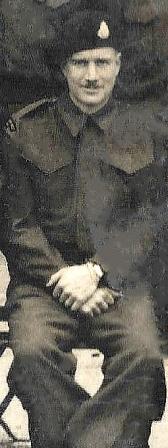
Gerald went on to say that he did have “….Uncle John’s entire squadron photo. The 29th South Alberta Recc Regiment, taken in February 1943 in England….”  No one was named in the photo, however.  Perhaps the next step was a Regimental Association or Regimental History?

….We struck out with the Regimental history book and museum…

Donald E. Graves, author of ‘South Albertas – A Canadian Regiment At War’, about the South Alberta Regiment, mentioned Bartlett in the book. He was a 47 year old batman who had volunteered to accompany ambulance driver Eric Nichols.

An excerpt in the book explained that “…Nichols lost one of his helpers on 27 February when fragments from a German mortar bomb which landed near his halftrack killed Trooper John Bartlett, who was riding with him. This was a particularly tragic loss because Bartlett, a farm labourer from Edmonton, was, at 47 years of age, too old for combat and had only been retained in the Regiment because he served as a batman to the officers and a waiter in their mess. John Bartlett had nothing else to do that day so he volunteered to go out in the ambulance….

There was a group photo on the inside cover – similar to the one that Gerald Bartlett had – and each man was numbered, suggesting that somewhere is a list identifying these men. We wrote the author and asked if there was an identification listing for the photo.

He said no, that he’d tried to get one himself, and suggested contacting the South Alberta Light Horse Museum in Medicine Hat, Alberta.  We did. The curator was aware of the photo, but had no identification key. He said he would investigate further, but we never heard from him again.

….Did the ambulance driver have a photo?…

We then looked at the ambulance driver, wondering if perhaps he might have photos that could include John.  We asked Judie Klassen, who has helped with really tough cases in the past, if she could find any information.   Judie learned that “…the soldier who was with Bartlett when he died was Eric Nichols.  He died in 2018….”  She also found “….Rob McCue, who knew him since he was a boy, is a retired sergeant with the South Alberta Light Horse Regiment….

It was a long shot, but Pieter contacted Rob McCue. He didn’t have a photo, but wrote that “…the driver of that Halftrack Ambulance was a Trooper by the name of Eric Nichols. He was my father’s best friend. Eric was still feeling guilt for the loss of the batman years after it happened…. My father’s friend Eric was accosted by the Officer who Tpr Bartlett worked as the Batman for.  Before Eric was even able to wash the blood off of his hands the officer was screaming at him for taking Bartlett with him. Eric told me that he had asked for volunteers to help him clear casualties from a tank and Bartlett volunteered to assist him, even though his age should have prevented him from front line service…. I talked with Eric about this incident many times, and it was still a raw wound even 75 years later….

….Did the medic whose place John took have a photo?…

Although he was well-known in the Regiment, he wasn’t a medic, so never should have been in that ambulance.  One of the medics, Glenn Burgess, was ill which was why John had volunteered to take his place.  (See https://calgaryherald.remembering.ca/obituary/glenn-burgess-1066026252)

Jim Little’s story noted that “…Trooper Glenn Burgess of C Squadron, 4 Troop, was Left Out of Battle (LOB) that day. It was a regular practice of the SAR to keep one Troop from each of its three fighting Squadrons LOB in the event of disaster, preserving a cadre of experienced personnel to rebuild with. Those who were LOB were assigned other duties, and Glenn was tasked with assisting the Regiment’s ambulance service in recovering their casualties from the field. However, Trooper Burgess had a bad case of strep throat so was excused from that duty, and John Bartlett went in his place…”  (SAR refers to South Alberta Regiment)

Maybe Glenn Burgess had a photo? During our ongoing search, Judie came across an interview with poetess Vivian Hansen.  “Vivian Hansen was close to Glenn Burgess and wrote about him, calling him ‘the old man’. She talks about looking through pictures/papers he had in an interview….” (See https://freefallmagazine.ca/interview-with-vivian-hansen/)

Although Vivian didn’t have a photo that included John Bartlett, she replied to our inquiry.  “…  Sadly, I have no photo of Bartlett.  In fact, since Glenn told me the story, I only just linked the mystery man who replaced him as John Bartlett….He never knew the name of the man who replaced him that fateful day….

Vivian let us know that she had written “…a book of poetry entitled ‘A Tincture of Sunlight’, which chronicles some of Glenn’s stories during the war. Glenn’s great-grandmother was a Cree woman from the Swampy Cree nation in northern Ontario.  He was fourth generation Cree, not eligible for treaty status. ….

…What if we went backwards in time?…

With no luck in finding a photo during John’s military years, maybe we needed to look further back in time?  Before enlisting in the South Alberta Regiment in 1940, John had worked as a farm labourer on the farm of W.B. Herder (William and Iva) in Ankerton, Alberta in the 1930s.

Judie’s research into the Herder family led us to Deborah Laidler, granddaughter of Will Herder.  “…I am very excited to correspond with you, as I am the family historian…” she wrote in 2024.

Deborah did her best to find a photo and information, even going through a local history book. “….I have spoken to half a dozen local farm families. No one has knowledge of this soldier but that is not unexpected. My 95 year old Aunt Connie does not remember him, specifically. The family never had a hired man who stayed with them or worked full time for 12 years, as his attestation papers indicate.  But, he may have worked May- September…

Unfortunately, while Deborah, her family, and a neighbor, Angeline Brausen, had a number of unidentified photos of men, none could be identified as John Bartlett.  “…My aunt thinks that the Brausens owned the threshing machine that my grandfather used in the 1930s.….

….Success when John was identified in Gerald’s Squadron photo!…

John Frederick Bartlett identified in the 29th South Alberta Reconnaissance Regiment photo from 1943.  (Photo courtesy of the Bartlett Family)

The trail had run cold. However, Gerald Bartlett and his family were able to identify John in the 29th South Alberta Reconnaissance Regiment photo he’d first told Pieter about, which had been taken in February 1943 in England.  “…I went through the regiment photo and enlarged each man to see if there were any similarities.  When I came to the photo I sent you it made me stop.  I could see so many similarities to myself and my brothers and Uncle Elijah. The resemblance to us is quite remarkable….

The photo search had come full circle and a heroic soldier was now identified!

….John is buried in Groesbeek…

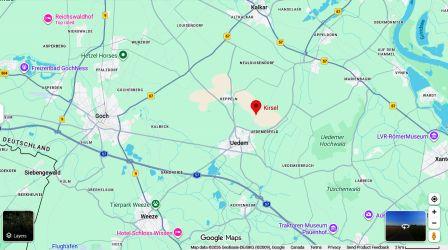
John was initially buried in Kirsel, near Uedem in Germany. (Map source: Google Maps)

John was initially buried in a temporary burial ground in Kirsel near Uedem, Germany, before being reburied on February 25, 1945 in the Canadian War Cemetery in Groesbeek, The Netherlands.   During our 2025 European War Memorial Tour, Pieter placed flags of Canada and Newfoundland by his grave.

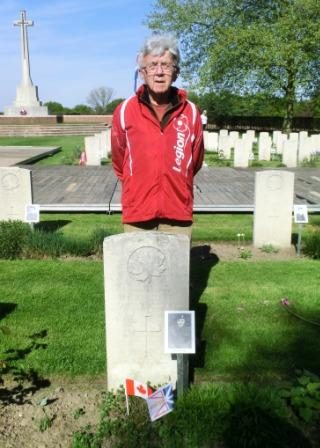
Pieter stands behind the grave of John Frederick Bartlett after placing flags of Canada and Newfoundland.  (Photo credit: Daria Valkenburg)

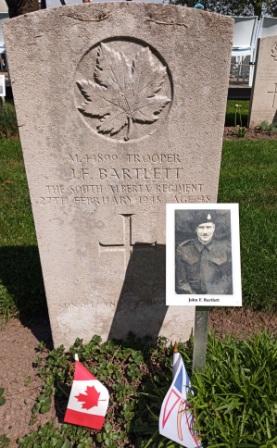
Grave of John Frederick Bartlett in Groesbeek, with the flags of Canada and Newfoundland that he placed.  (Photo credit: Pieter Valkenburg)

…. ‘You have honoured my great-uncle greatly’…

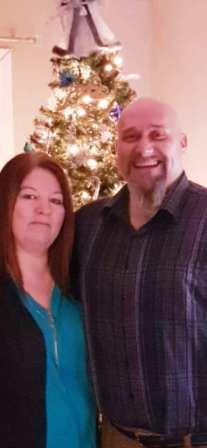
Gerald Bartlett and his wife Gail.  (Photo courtesy of Gerald Bartlett)

After John was identified by his great-nephew Gerald Bartlett, successfully completing the photo search, Gerald shared his reflections with Pieter.  “… I am so very impressed with the story of my great-uncle John. As a child, I always heard stories of his military time and how he died, but this story finally brings to life his life and heroism as a man who volunteered as he felt was his duty. Wow! I love this story and will share this with my children, my brothers, and sisters. When I saw his picture, I actually saw my grandfather. I have no doubt that this is John Frederick Bartlett… Many thanks to you, your wife, and Jim Little. You have honoured my great-uncle greatly….

….Many to thank for this search …

The long but ultimately successful search for a photo of John Frederick Bartlett was like an unfolding detective story, with a number of people helping to find clues and leads.

Thank you to Gerald Bartlett for identifying his great-uncle in the squadron photo. Thank you to Judie Klassen for going above and beyond to find reference materials, and to Shawn Rainville for newspaper searches.

Thank you also to Vivian Hansen and Rob McCue for enriching our inquiries by providing input on the two medics whose lives were impacted by John’s death: Glenn Burgess and Eric Nichols. Thank you as well to Deborah Laidler for looking into John’s time as a farm worker on the Will Herder farm.

The flags placed at John’s grave during our 2025 visit were donated.  Our thanks go to:

  • Alan Waddell, Constituent Assistant, on behalf of Heath MacDonald, MP for Malpeque, for the Canadian flag.
  • Gerald Bartlett in memory of Trooper John Frederick BARTLETT, who donated the Newfoundland flag.

Pieter’s research efforts to find photos and families of soldiers continue. Do you have a story to tell? Email Pieter at memorialtrail@gmail.com, or comment on the blog.

© Daria Valkenburg

….Want to follow our research?…

If you are reading this posting, but aren’t following our research, you are welcome to do so.  Our blog address: https://onthewarmemorialtrail.com/

4 countries, 6 weeks, 7,000 km – an unforgettable war memorial journey in Europe…. Daria’s book ‘No Soldier Buried Overseas Should Ever Be Forgotten‘ is available in print and e-book formats.  Net proceeds of book sales help support research costs and the cost of maintaining this blog. For more information see https://nosoldierforgotten.com/

Subscribe to our YouTube Channel: On The War Memorial Trail With Pieter Valkenburg: https://www.youtube.com/channel/UCJ591TyjSheOR-Cb_Gs_5Kw

Never miss a posting!  Subscribe below to have each new story from the war memorial trail delivered to your inbox.
On The War Memorial Trail….The Mystery Of Who Placed Flowers At One Airman’s Grave Was Solved In A Story Spanning Two Continents

April 18, 2026.  When we were in The Netherlands last year on our 2025 European War Memorial Tour, we visited the Canadian War Cemetery in Groesbeek, where Pieter placed 120 flags at the graves of soldiers he’d done research on over the years. (See https://onthewarmemorialtrail.com/2025/06/23/on-the-war-memorial-trail-2025-faces-of-groesbeek-exhibition-part-1-flags-placed-at-120-graves/)

….There was a surprise when we visited the grave of WWII airman Arnold Freeman Hupman…

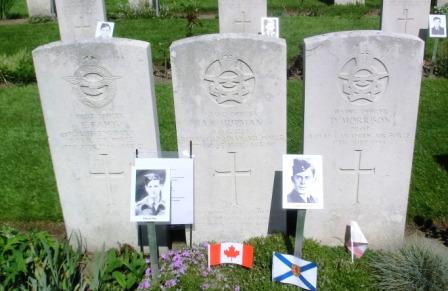
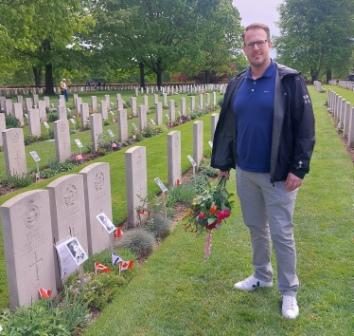
After placing flags of Canada and Nova Scotia, Pieter stands behind the grave of Arnold Freeman Hupman.  (Photo credit: Daria Valkenburg)

One of the graves visited, and where Pieter placed flags of Canada and Nova Scotia, was that of WWII airman Arnold Freeman HUPMAN, of East Side of Ragged Island, Nova Scotia.

Arnold Freeman Hupman.  (Photo submitted by Marilyn Hupman)

Arnold was serving with 419 Squadron of the Royal Canadian Air Force (RCAF), and lost his lost his life, at the age of 30, when the Lancaster bomber he was in crashed on the outskirts of Arnhem on the night of June 16 to 17, 1944, after being shot down by a German nightfighter. (You can read his story at https://onthewarmemorialtrail.com/2021/02/09/on-the-war-memorial-trail-atlantic-canada-remembers-part-6/)

Arnold Hupman’s grave is between two of his crewmates: Donald Morissen and Edward Fahy. (Photo credit: Daria Valkenburg)

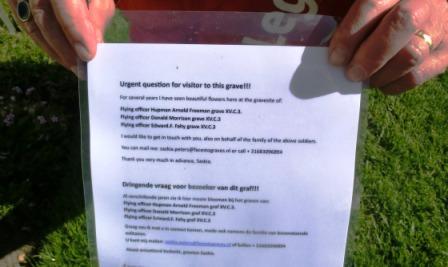
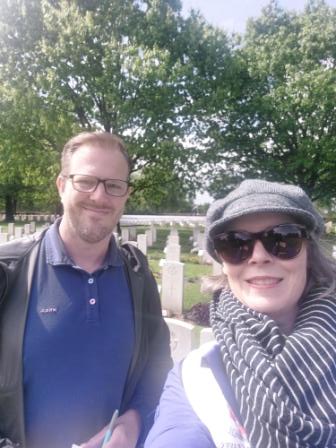
There was a surprise at his grave as we found a note from Saskia Peters, a member of the Faces To Graves Groesbeek Foundation Board, asking if whoever had been annually placing flowers at the grave to get in contact with her.   

Note left by Saskia Peters beside the graves of Hupman, Morissen, and Fahy.  (Photo credit: Daria Valkenburg)

 ….The last flight of Lancaster X KB728

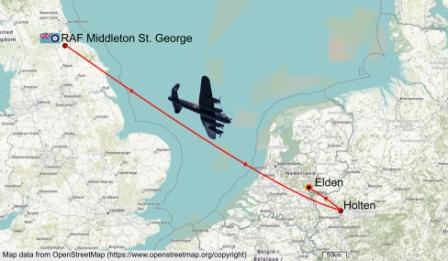
Map shows the plane’s path from Middleton St. George to Holten, Germany and then to where it crashed in Elden, The Netherlands.  (Map prepared by Wendy Nattress)

On the night of June 16, 1944, at 11:08 pm, Lancaster X KB728 took off from RAF Middleton St. George, England for a bombing operation against the synthetic oil plant at Sterkrade/Holten in Germany.  

On its return back to England in the early hours of June 17, 1944, the plane was attacked by a nightfighter and exploded following combat with nightfighter pilot Hans Schadowski of the 3./NJG 3 based at Vechta airfield in Germany, who was flying a Messerschmitt Bf 110 G-4.

The Lancaster crashed close to the Dutch Reformed Church at Elden in the province of Gelderland, 4 km (2.5 miles) southwest of Arnhem.

All seven crew members lost their lives. In addition to Flying Officer Arnold Hupman, the navigator on that flight, the other crew members were:

  • Pilot : RCAF Pilot Officer Donald MORISSEN of Winnipeg, Manitoba
  • Bomb Aimer: RCAF Pilot Officer Gerald Edgar QUINN of Montreal, Quebec
  • Wireless Operator/Air Gunner: RAF Pilot Officer Harold FLETCHER of Bolton, Lancashire, England
  • Air Gunner: RCAF Pilot Officer Clifford JOHNSTON of North Bay, Ontario
  • Air Gunner: RAF Pilot Officer Philip Joseph MCMANUS of Herne Hill, London, England
  • Flight Engineer: RAF Pilot Officer Edward FAHY of Rhyl, Flintshire, Wales

They were temporarily buried in the Netherlands Reformed Church Cemetery in Huissensedijk on June 29, and later reburied in the Canadian War Cemetery in Groesbeek.  (More information can be found in this English translation of an article by the late Willem Tiemans: https://airbornearnhem.nl/WillemTiemens/Elden%20bomber%20crash.htm)

….The mystery of who placed the flowers was solved by Saskia…

Almost a month later, we met Saskia when we were honoured by the Faces To Graves Groesbeek Foundation at one of their meetings, and asked if she had received any response. (See https://onthewarmemorialtrail.com/2025/05/30/on-the-war-memorial-trail-pieter-and-daria-honoured-by-faces-to-graves-groesbeek-foundation/)

…Yes!…” she replied and said she would follow up with a few photos and emails, which she did.  “….As I told you at our Research meeting, I have indeed found the person on May 4, who put the flowers at Arnold Hupman’s place for the past few years….

She said she’d placed the sign at Arnold’s grave in mid-April. “…I had also asked the gardeners for permission and they were eager to help me keep an eye out if they saw anyone walking by his grave….

To Saskia’s disappointment, however, “….before we had the opening ceremony of The Faces of Groesbeek, there were still no flowers….”  We attended the Opening Ceremony on May 2, 2025 and Saskia was correct – the sign was still there, but no flowers.  (For our story on the Opening Ceremony, see  https://onthewarmemorialtrail.com/2025/07/19/on-the-war-memorial-trailwe-attended-the-ceremony-at-the-canadian-war-cemetery-in-groesbeek/)

 Then, on May 4, 2025, “….it was our National Remembrance Day.   I wasn’t on duty to host The Faces of Groesbeek, but I saw that no one was scheduled so I went anyway. Around noon, my colleagues came to ‘relieve me’ as they were scheduled for the afternoon....” 

Saskia should have gone home to rest at this point as she was scheduled to lay a wreath at the cemetery that evening with Alice van Bekkum, Chair of the Faces To Graves Groesbeek Foundation.  “…. But my heart said, ‘Go to Hupman’s grave one more time and ask for his help’….

Saskia explained that as she “… walked back across the wide grassy area in the middle that runs from the Stone of Remembrance to the Sacrificial Cross.” she noticed “…a man walking into the cemetery with a bouquet of flowers in his hands….

After asking if the man had come to visit a particular grave, he said yes, but couldn’t remember where it was located, but explained that the grave was  “…. different from the others, the stones are closer together….” 

Saskia immediately knew he was looking for Arnold Hupman’s grave from this description.  The headstones of 3 graves were closer together than with other graves as, according to the crash reports, only 5 bodies were ever found – not the 7 that were known to be in the plane. It was surmised that the remains of 2 had burned beyond recognition in the crash.

….Tears sprang to my eyes ….  Saskia wrote.  “… I tell him that I think he is looking for the grave of the flying officer I stood by about a minute ago before, asking for help to find the person who has been putting flowers at his grave for years.  We walk together up the side to Hupman’s grave, the man enthusiastically confirming that this is indeed the grave he was looking for…..

Frans Nijsen with Saskia Peters.  (Photo courtesy of Saskia Peters)

The mystery was solved! The man who had brought the brought the bouquet was Frans Nijsen, a resident of Berg en Dal, which is very close to the cemetery. 

Frans Nijsen beside the grave of Arnold Hupman. The flags of Canada and Nova Scotia had been placed several days earlier by Pieter. (Photo courtesy of Saskia Peters)

….The story of why the flowers were placed spanned two continents…

We were curious to know why a Dutch guy chose Arnold Hupman’s grave to place an annual bouquet. Perhaps Frans had been in the Royal Netherlands Air Force, as Pieter had been?  We wrote to him and asked. To our surprise, the answer circled back to a neighbouring Maritime province, not that far from where we live.

….I work with a company called QPS, in the Netherlands and we have a Canadian office in Fredericton, New Brunswick…..”  Frans wrote.  “…. I’m a hydrographer, and I work for a software company that produces software to map the seabed and to produce maritime charts.  

I used to have a colleague, Graham Nickerson, who lives in Freddy. At some point he came over to our office in the Netherlands for training in our software, and when the weekend was almost there, I asked him what his plans were. He told me that he has a relative who was killed in action, shot down over Arnhem and that he was visiting his grave in Oosterbeek…. I learned that the cemetery in Oosterbeek is a British one and that there is a Canadian cemetery close to where I live now. I started looking on internet and found his grave at the cemetery in Groesbeek, which is 5 minutes from my home town, Berg en Dal.  

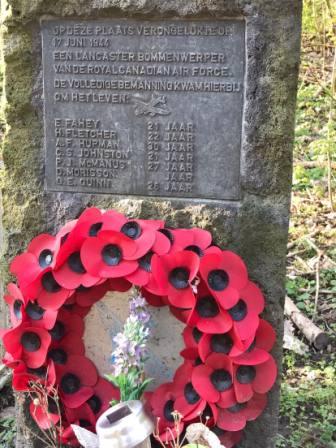
I invited him to come over, so I could bring him to the cemetery. In the meantime I did some more digging around and found that there is a small monument at the crash site….

Memorial plaque for the crew of Lancaster X KB728 in Elden, The Netherlands. (Photo source: Facebook RAF Bomber Command Memorials, photo taken by Chris de Vries)

…So, he came over, we visited the cemetery, which meant a lot to him, it was emotional for him to not have his relative buried close to home, but he was very happy how the cemetery…” cared for the graves.  “...After that I told him about the monument of the crash site and that I’m going to take him there. He was very surprised and interested in it…. He was very glad that the sacrifice was not unnoticed….” 

…Since his visit I made it my personal goal to visit this grave every year around the 4th of May to bring flowers. I have two young kids that I bring with me as well, and we try to explain what happened and why it’s important to honour the men and women who are buried at the cemetery. Every year I send a picture to Graham with fresh flowers at the grave…..This year I was there as well, and I bumped into Saskia. The rest is history….” 

Quite a story, in which serendipity certainly played a big part! As we near the 81st Anniversary of the Liberation of Europe, it’s a poignant reminder that those who gave their lives in war should never be forgotten.

Thank you to Saskia Peters and Frans Nijsen for unlocking the mystery behind the note, and for sharing the story about the flowers placed each May at the grave of Arnold Freeman Hupman.  Thank you to Wendy Nattress, who prepared the map showing the flight path for Lancaster X KB728.

Pieter’s research efforts to find photos and families of soldiers continue. Do you have a story to tell? Email Pieter at memorialtrail@gmail.com, or comment on the blog.    

© Daria Valkenburg

….Want to follow our research?…

If you are reading this posting, but aren’t following our research, you are welcome to do so.  Our blog address: https://onthewarmemorialtrail.com/

4 countries, 6 weeks, 7,000 km – an unforgettable war memorial journey in Europe…. Daria’s book ‘No Soldier Buried Overseas Should Ever Be Forgotten‘ is available in print and e-book formats.  Net proceeds of book sales help support research costs and the cost of maintaining this blog. For more information see https://nosoldierforgotten.com/

Subscribe to our YouTube Channel: On The War Memorial Trail With Pieter Valkenburg: https://www.youtube.com/channel/UCJ591TyjSheOR-Cb_Gs_5Kw

Never miss a posting!  Subscribe below to have each new story from the war memorial trail delivered to your inbox.

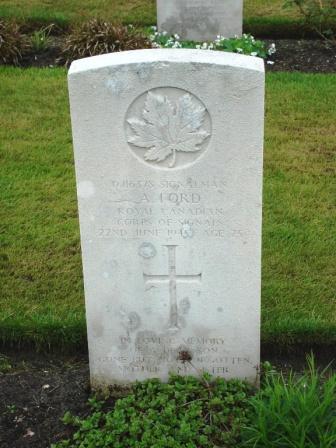
On The War Memorial Trail…..The WWII Signalman From Charlottetown Who Died In A Vehicle Accident In The Netherlands 6 Weeks After WWII Ended In Europe

March 15, 2026.  In going through the last few names on a photo wish list for soldiers from New Brunswick who are buried in the Canadian War Cemetery in Groesbeek, Pieter’s initial research found that one of the names was of a soldier from Prince Edward Island.

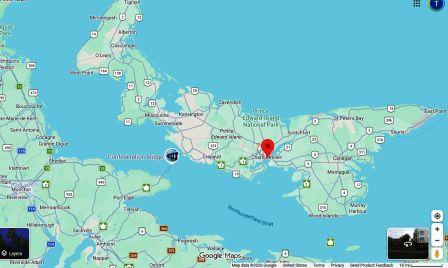
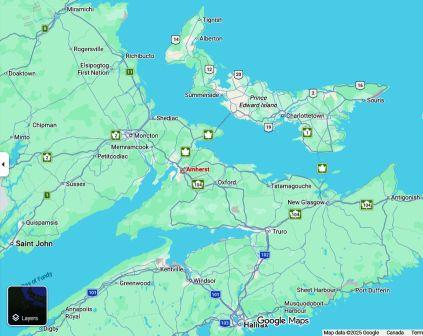
Charlottetown, the capital of Prince Edward Island, is on the east coast of Canada. (Map source: Google)

Alfred Edward Stanley FORD was born February 12, 1918 in Charlottetown, Prince Edward Island, son of Alvin Chester and Ethel Maud (nee Roebuck) Ford.  He was one of two children in the family and Pieter at first thought it would be a challenge to find a photo.

However, an obituary for Alfred’s sister Marjorie led him to the Cummins family, and he was soon in contact with Marjorie’s son Dave, who wrote to Pieter, saying “….I greatly appreciate all the work you and your wife are doing on the memories of our fallen soldiers…” And yes, he did have a photo of his uncle.

….Alfred worked as a waiter and butler…

Alfred Edward Stanley Ford. (Photo courtesy of Cummins/Ford archives.  Photo restoration and colourization by Pieter Valkenburg)

When Alfred enlisted at the No. 4 District Depot in Montreal, Quebec on December 3, 1941, he stated that he had served in the Reserve Formation of the Royal Canadian Corps of Signals (RCCS) in Prince Edward Island for 2 years, from July 1936 until July 1938. 

After leaving school at aged 16, he’d worked as a waiter at various hotels between 1933 and 1936, and then was a butler for the Polish Consul-General, Dr. Sylwester Gruszka, in New York City between 1936 and 1939. (A career diplomat, Dr. Gruszka was the Consul-General from 1935–1940. For more information, see https://pl.wikipedia.org/wiki/Sylwester_Gruszka)

Alfred’s time working for the Consul-General resonated with us, as decades later Pieter worked in the Consulate in New York and later in the Embassy in Warsaw, Poland, during his career in the Dutch Foreign Service.

While working for Dr. Gruszka, Alfred took a short order-barman course and received a diploma for successfully completing a course at the Fanny Farmer School of Cooking in 1937. 

From 1939 to 1941, Alfred worked as a barman and later as a waiter in New York. 

….Alfred was drafted one country and enlisted in another….

On October 16, 1940, he was required to fill out a US Draft Card Registration. At the time, he was between jobs in New York City, and living with a friend. Although the USA didn’t officially enter World War II until December 8, 1941, after the attack on Pearl Harbor, Hawaii, US President Franklin Delano Roosevelt had signed into law in October 1940 the first peacetime selective service draft in US history because of rising world conflicts.

Since he was living in the USA, Alfred was required to register for the US Draft, but never joined the US Army as he subsequently moved to Montreal, Quebec and enlisted in the Canadian Army.

During his interview, Alfred expressed an interest in becoming a lineman with the Royal Canadian Corps of Signals, and it was noted that he played hockey as a sport.  The interviewer described Alfred as “…respectful, cheerful, and neat in appearance...” and noted that 23 year old Alfred had “…done well in civilian life…

….Alfred was trained as a Signalman….

Alfred Edward Stanley Ford during basic training. (Photo courtesy of Cummins/Ford archives.  Photo restoration by Pieter Valkenburg)

Alfred’s military career began when he was sent for basic training to No. 41 Canadian Army (Basic) Training Centre (CABTC) in Huntingdon, Quebec on December 8, 1941. 

After completing his basic training, he was transferred to A7 Canadian Signal Corps Training Centre at Camp Barriefield, Ontario on March 12, 1942 for advanced training.  He remained there until May 5, 1942 when he was posted to the 6th Light Anti-Aircraft (LAA) Regiment Signals Section, Royal Canadian Artillery, in Petawawa, Ontario as a Signalman.

As a Signalman, Alfred would have been trained to manage radio (wireless), telephone, and visual signaling, and to ensure that his Regiment received air raid warnings and to relay gun target information.

On November 2, 1942, Alfred was given embarkation leave until November 15, 1942, the last chance he had to see his family. 

….Alfred left Canada for overseas service….

Shortly after returning from his embarkation leave, Alfred was on his way overseas, leaving Canada on December 12, 1942.  Upon arriving in the United Kingdom on December 18, 1942, he was assigned to No. 1 Canadian Base Staging Camp (CBSC) in Colchester.

On March 6, 1943, Alfred was sent on an Operators Course at No. 1 Canadian Signals Reinforcement Unit (CSRU), located at the Blandford Camp in Cove, Farnborough, Hampshire.

Alfred was transferred to the Canadian Signals Reinforcement Unit (CSRU) on April 2, 1943.  His training continued and on July 29, 1943, he qualified as a Lineman Group ‘C’ Class 3.  A Lineman would be involved in constructing and repairing overhead telephone and telegraph lines to support military communications.

A month later, on August 26, 1943, he was transferred to the 1st Canadian Line of Communications Signals (L of C Sigs), a key unit within the Royal Canadian Corps of Signals (RC Sigs) during WWII.  Formed in England, this unit was responsible for maintaining communications along the supply and transport routes (lines of communication) supporting the Canadian Army’s overseas operations in Europe. 

As training and preparations began for Operation Overlord (the invasion of Normandy), which began on what we know as D-Day (June 6, 1944), Alfred was transferred to the 16th Canadian Anti-Aircraft (CAA) Operations Room Signal Section in Womenswold in Kent on May 2, 1944, along with another linesmanThe war diary for May 2, 1944 noted that “…2 Line Detachments arrived today from L of C Signals….” 

This unit provided communication and signaling support for anti-aircraft operations, and training and exercises continued ahead of being sent to France after D-Day. They would be part of the signals composition of the Canadian Army Overseas.

….Alfred and his unit were sent to France in August 1944…

Liberty ship ‘Samarina’. (Photo source: Ships Nostalgia)

On August 1, 1944, Alfred and other members of the 16th Canadian Anti-Aircraft (CAA) Operations Room Signal Section travelled to London, for the move into France as part of the 21st Army Group.  The following day they boarded the Liberty ship ‘Samarina’, along with their vehicles and equipment. They set sail for France on August 3, 1944. 

Map showing Courselles-sur-Mer on the coast of France, near Caen.  ‘La Manche’ in French is what we call the ‘English Channel’.  (Map source: https://www.viamichelin.fr)

Per the August 5, 1944 war diary, they arrived at 9:10 pm “…at the anchorage off Courcelles…” but had to wait until August 7 to disembark.  On August 8, 1944, “…the unit arrived Bény-sur-Mer….” and “…established communications with Brigade HQ…” The unit arrived in the midst of Operation Totalize, fought between August 7-11, 1944, in an offensive designed to break through the German defences south of Caen and toward Falaise.  (See https://en.wikipedia.org/wiki/Operation_Totalize)

They had their work cut out for them once they reached Caen and took over from 51 Anti-Aircraft Operations Room (AAOR).  As recorded in the war diary for August 12, 1944, the unit “…controlled 16 AA guns in defence of Caen from 1800 hours today.  Line communications are difficult as some of the line has been badly laid and not maintained.  All broadcasts must go down to guns by line and upward intelligence must go up the same way.  This is not satisfactory….”  

On August 28, 1944, they were ordered to leave Caen and move to Lisieux. The war diary entry for August 29, 1944 recorded that at 8 am “…AAOR handed over to 152 and moved to concentration area at Lisieux….”  However, by 6 pm that same day, there was a change.  “… Unit was ordered to deploy from concentration area Lisieux for the defence of Brienne….

Map shows location of Esquelbecq (purple circle) in France, near the Belgian border. (Map source: Google maps)

By September they had moved up through France near the Belgian border, and were based in Esquelbecq, responsible for the Gun Operations Room (GOR) in the Dunkirk area.  Linesmen like Alfred worked in difficult and dangerous conditions, as evidenced in just one line from the September 21, 1944 war diary. “…Linemen found that laying lines in the forward area became a bit tricky with snipers and machine gun fire near vicinity….

An unidentified lineman laying a telephone line in France in September 1944 gives an idea of what Alfred Ford did as a lineman. (Photo Credit: Lieut. Donald I. Grant / Canada. Dept. of National Defence / Library and Archives Canada / PA-174411)

Alfred was twice admitted to hospital, first from November 17 until December 18, 1944 at No. 16 Canadian General Hospital in Saint Omer, France, and then from January 6 to 18, 1945 at No. 2 Canadian General Hospital in Bruges, Belgium. The war diary reported that several men had been ill with colds and flu, and perhaps this is what happened to Alfred, as there was no report of an accident or being wounded by enemy action.  He returned back to his unit, which was still in France, but now in Wormhout, just a short distance from Esquelbecq, on January 28, 1945.

On February 9, 1945, the unit moved to Desselgem, Belgium, located between Ypres and Ghent.  They remained there until February 28, 1945 when they moved to Hallaar, not that far from the Dutch border, where the Operations Room for the unit would be temporarily based, during Operation Blockbuster.  (See https://en.wikipedia.org/wiki/Operation_Blockbuster). 

On March 12, 1945, the unit moved again, to Linden, The Netherlands, 10 kms (6 miles) south of Nijmegen, and near the German border. On March 13, 1945, the war diary recorded that “…as the Ops Room Section…is going to be deployed in the defence of Kleve, a Recce party went to that almost completed ruined city and found a site for the Ops Room, and billets in partially demolished houses nearby…”  The unit moved to Kleve, Germany 10 days later.

On April 14, 1945, the war diary reported that “…line party across Rhine to lay line to Units under this Unit from proposed new location of AAOR…” Two days later, they moved to Oldenzaal, The Netherlands, near the German border.

On May 7, 1945, a day before the official end of WWII hostilities in Europe, the unit moved to Oldenburg, Germany, before being redirected to Wilhelmshaven on May 10, 1945, and placed on temporary guard duty.  The war diary for May 24, 1945 noted another upcoming move. “…Guard commitments to be turned over by midnight of the 25 May 1945.  This unit will move to Arnhem area where it will come under command 2 Canadian Heavy Anti-Aircraft Regiment…

The move was delayed a few days.  On May 26, 1945, the war diary recorded that …we are to move at 0700 hours tomorrow to Otterlo in Holland where we come under Command of I-Corps and are attached to 2 Canadian Heavy Anti-Aircraft Regiment…”  In Otterlo they camped in an old Dutch barracks in the woods.

The war diary summarized May 1945 by stating that “…except for four days the entire month has been spent in Germany with the unit personnel doing guard duties for a greater portion of that period….

On June 7, 1945, Alfred was given 11 days leave to the United Kingdom, returning on June 18, 1945, just in time to learn, on June 19, 1945, that the 16th Canadian Anti-Aircraft (CAA) Operations Room Signal Section was to be disbanded immediately. The next few days were spent packing up all the equipment and vehicles. 

On June 22, 1945, most of the unit moved to the Artillery Reallocation Centre 13 Canadian Base Reinforcement, located south of Nijmegen. However, the Signals detachment, which Alfred was part of, remained at Otterloo for the night, as they had been assigned to HQ 1st Canadian Army Signals for cross postings, and were scheduled to report there on June 23, 1945. 

….Alfred died of injuries from a vehicle accident…

Alfred and the Signals Detachment were camped in a barracks in the woods outside Otterlo (green circle). The vehicle he was in was going in the direction of Apeldoorn (purple arrow).  (Map source: Google maps)

However, Alfred never arrived at his next posting as he died in a vehicle accident on June 22, 1945. The circumstances of what happened are unclear.  According to a witness, Lance Corporal R. A. MacDonald of the Canadian Provost Corps, who was on traffic patrol duty at the Arnhem-Apeldoorn Highway, around 9:15 pm a vehicle travelling in the direction of Apeldoorn approached him “…at a fast rate of speed. The vehicle was unsteady in its course, weaving as if out of control….” 

As it neared the witness, the vehicle veered to the right, likely because the driver suddenly noticed him and lost control of the vehicle in trying to avoid an accident.  Unfortunately, it crashed into a tree beside the road. The driver was 27 year old Alfred, who died from head injuries sustained in the crash. He was alone in the vehicle, and no one knew why he was driving a vehicle from another unit, as he was not assigned to be on duty at the time. A Court of Inquiry ruled it as an accidental death. 

….Alfred is buried in Groesbeek….

Grave of Alfred Edward Stanley Ford in the Canadian War Cemetery in Groesbeek, The Netherlands.  (Photo source: Find A Grave)

Alfred was temporarily buried in Jonkerbos Cemetery in Nijmegen, The Netherlands, before being reburied in the Canadian War Cemetery in Groesbeek on August 2, 1945.

Dave Cummins provided photos of his uncle Alfred.  (Photo courtesy of Dave Cummins)

Thank you to Dave Cummins for providing photos and information on his uncle, and to Chris Cummins for notifying Dave of the photo search request. “…Thank you Pieter, my family appreciates all you have done for Alfred…” Dave wrote.  “…Keep up the good work….

Pieter’s research efforts to find photos and families of soldiers continue, doing his part to ensure that each individual soldier is remembered. If you have photos or information to share about soldiers buried in The Netherlands or Belgium, please email him at memorialtrail@gmail.com, or comment on the blog.    

© Daria Valkenburg

….Want to follow our research?…

If you are reading this posting, but aren’t following our research, you are welcome to do so.  Our blog address: https://onthewarmemorialtrail.com/

4 countries, 6 weeks, 7,000 km – an unforgettable war memorial journey in Europe…. Daria’s book ‘No Soldier Buried Overseas Should Ever Be Forgotten‘ is available in print and e-book formats.  Net proceeds of book sales help support research costs and the cost of maintaining this blog. For more information see https://nosoldierforgotten.com/

Subscribe to our YouTube Channel: On The War Memorial Trail With Pieter Valkenburg: https://www.youtube.com/channel/UCJ591TyjSheOR-Cb_Gs_5Kw

Never miss a posting!  Subscribe below to have each new story from the war memorial trail delivered to your inbox.

On The War Memorial Trail…..The WWII Soldier From Caledonia Who Lost His Life During The Struggle To Capture The Goch-Calcar Road

Sign for the community of Caledonia, Queen’s County, Nova Scotia. (Photo credit: Daria Valkenburg)

February 19, 2026. As Pieter works his way through the various photo wish lists he receives from the Canadian War Cemeteries in The Netherlands, he tends to be methodical.  Occasionally, however, he decides to throw a ‘wild card’ and asks me to choose a soldier to research. 

My process is definitely not methodical – I pick a soldier based on something that triggers a memory – either through a surname or place of residence or even because Pieter previously researched a soldier from the same Regiment who lost his life on the same day. This time around, I chose a soldier who came from Caledonia, Nova Scotia. Why? I remembered that when I was in school and we studied British history that Scotland was often referred to as Caledonia, its Latin name during the Roman period. Caledonia made me think of my late mother, who loved anything Scottish.  (See https://www.britannica.com/place/Caledonia-ancient-region-Britain)

….The search for family of William Owen Seldon was successful…

Caledonia, located in Queens County, Nova Scotia is 151 kms (94 miles) from Halifax. (Map source: Google maps)

Pieter just shook his head, but dutifully began his research into William Owen SELDON, born January 2, 1917 in Caledonia, Nova Scotia, son of Roland Chivers and Effie Bond (nee Doggett) Seldon.  William had lost his life in Germany on February 19, 1945 while serving with the Lorne Scots (Peel, Dufferin and Halton Regiment).

It wasn’t long before Pieter was in contact with retired schoolteacher, Wilma Shupe, the daughter of William’s sister Rhoda Irene Forrest….and received a photo from her. Wilma explained that …My mother always called him William.  They were very close.  They went to dances together as he could drive, and he used a truck with a flat bed, like was used for hauling logs, etc.  They would pick up people along the way and go to dances in a neighbouring community...

William Owen Seldon.  (Photo courtesy of the Seldon Family)

In addition to his sister Rhoda, William had a brother, George Roland, and another sister, Roseanna May.  “…Two nephews were named for him.  Rose and George, his younger siblings, named their sons after him…” Wilma noted.  “….The farm where William grew up was purchased by Dutch immigrants in the 1950s and are well known to this day as Van Dyk blueberries…” (See https://vandykblueberries.ca/)

….William enlisted in 1942…

William originally enlisted under the National Resources Mobilization Act (NRMA) at the No. 6 NRMA Clearing Depot in Halifax, Nova Scotia on July 24, 1942 and joined the 54th Heavy Anti-Aircraft Battery of the Royal Canadian Artillery (RCA) in Bedford, Nova Scotia. At the time, he stated that he’d left school at the age of 17 after completing Grade 9, and had been working ever since.   (See https://en.wikipedia.org/wiki/National_Resources_Mobilization_Act)

Wilma had mentioned that “…William worked in the woods and on the family farm before he enlisted…

His personnel file for his occupational background noted that he had been “…driving horses for 6 months. Truck driver for 3 months.  Gold miner for 1 ½ years and coal mining for 3 or 4 years. …Can operate car and truck and effect minor repairs….

His interests included “…playing softball, dancing, movies, fishing, playing cards, and recitation and dialogue…

On November 5, 1942, William enlisted in the Active Army with the 54th Heavy Anti-Aircraft Battery of the Royal Canadian Artillery (RCA). 

….William served in Newfoundland…

After completing his basic training, William was transferred on August 6, 1943 to the 25th Anti-Aircraft Regiment, based in St. John’s-Torbay, Newfoundland as part of Atlantic Command, and tasked with strengthening and administering home defence facilities on Canada’s Atlantic Coast and Newfoundland.  (See https://en.wikipedia.org/wiki/Atlantic_Command_(Canadian_Army))

Before travelling to Newfoundland, however, he received a furlough from August 6 to 23, 1943. (NOTE: Newfoundland and Labrador became part of Canada on March 31, 1949.)

….William briefly returned to Canada before travelling overseas…

William remained in Newfoundland until April 26, 1944, when he was transferred to No. 1 Transit Camp in Windsor, Nova Scotia. Then, on May 20, 1944, he was reallocated to the No. 1 Training Battalion of the Canadian Infantry Corps (CIC) in Debert, Nova Scotia, and received further training before being transferred to the Training Brigade Group in preparation for overseas service.

….William left Canada for overseas service …

On July 19, 1944, William left Canada, arriving in the United Kingdom on July 27, 1944, where he was placed with No. 3 Canadian Infantry Reinforcement Unit (CIRU).

The following day after arrival he was interviewed and recommended for training as a Driver I/C for the Infantry.  (The term ‘Driver i/c’ refers to ‘Driver, internal combustion’.) However, that training never happened, as a few weeks later he was transferred to the X4 Reinforcement List for the Royal Regiment of Canada, part of 21st Army Group, on August 10, 1944 and sent to France the following day, arriving on August 12, 1944.

In France he was transferred to the Black Watch (Royal Highland Regiment) of Canada on August 15, 1944, joining them as preparations were made for the upcoming Battle of Falaise Gap.  On August 18, 1944, he was sent to HQ No. 5 Canadian Infantry Brigade (CIB).

William was wounded in his right leg by mortar fire on August 22, 1944, and taken to No. 102 Field Dressing Station (FDS).   After being discharged on September 11, 1944, he was put on the X4 Reinforcement List of the 13th Battalion, where he remained until November 28, 1944, when he was transferred to No. 5 Canadian Infantry Brigade (CIB) Ground Defence Platoon (Lorne Scots Regiment), joining them in The Netherlands. (See https://en.wikipedia.org/wiki/5th_Canadian_Infantry_Brigade

Then, on January 19, 1945, he was transferred to the 4th Infantry Brigade Ground Defence Platoon (Lorne Scots Regiment). The Lorne Scots role was to mobilize units to fulfill defence and employment requirements for the Canadian Army. This included various support roles, focusing on logistical and defensive operations rather than front-line combat.

….William was attached to the Essex Scottish Regiment for an attack on the Goch-Calcar Road …

Although officially with the Lorne Scots (Peel, Dufferin and Halton Regiment), William was attached, for all purposes, to the Essex Scottish Regiment on February 8, 1945.  On February 16, 1945, the Essex Scottish Regiment left The Netherlands and crossed the border into Germany, at Kleve.  The following day, the war diary reported that the battalion “…moved off to an assembly area between Kleve and Calcar….” in preparation for an attack on the Goch-Calcar Road, which was subsequently delayed until February 19, 1945. (Calcar in English is Kalkar in German)

….Heavy fighting along the Goch-Calcar Road proved deadly….

Moyland Wood and the Goch-Calcar Road, 16-21 February 1945 (Map source: HyperWar: The Victory Campaign [Chapter 18] ibiblio.org)

An account of the role played by No. 4 Canadian Infantry Brigade during the struggle for the Goch-Calcar Road on February 19-20, 1945 was provided by Brigadier Frederick Norman CABELDU on February 28, 1945.  (See https://matthewkbarrett.com/2024/07/17/brig-f-n-cabeldu/)

His report began by stating that “…prior to the attack made by 4 Cdn Inf Bde on 19 Feb 1945, the enemy controlled the main Goch-Calcar road, southwest of Calcar…The enemy held a line on the outskirts of Calcar that included Moyland,…” a wooded area, “…and that continued to the southwest.  The latter portion of this line ran parallel to, and about a mile north-west of, the main Goch-Calcar road…

A description of the attack, which began just after noon, followed.  …The attack involved an advance over open country, and sufficient ‘Kangaroos’…were used….”  Kangaroos are turret-less tanks with a platform for carrying troops.

Things didn’t go according to plan, as “…movement over the soft ground was difficult and ….several ‘Kangaroos’ and tanks became bogged down…”  They were sitting ducks. “…It soon became evident that the enemy had a screen of anti-tank defences, including many 88 mm guns…”  German positions were held by “…fresh troops of 12 Parachute Recce Regiment…” and in the rear of these positions were “…elements of Panzer Lehr Division….

The Essex Scottish Regiment’s war diary for February 19, 1945 noted that the attack on the Goch-Calcar Road resulted in the Regiment fighting “….under a heavy hail of shrapnel and small arms fire. Casualties were fairly heavy….Communications were difficult. Vehicles became bogged in the soft mud, casualties were difficult to evacuate, and guns and ammunition could not get up where they were required. Battalion HQ moved into a group of buildings which were later surrounded and demolished by tanks…” 

William, who was attached to the Essex Scottish Regiment, was one of the fatal casualties that day.  Also killed in the attack on the Goch-Calcar Road, but on the following day, was Donald Roy CARTER.  (See https://onthewarmemorialtrail.com/2024/06/09/on-the-war-memorial-trail-the-wwii-soldier-from-central-blissville-killed-along-the-goch-calcar-road/)

….William is buried in Groesbeek…

Grave of William Owen Seldon with Canadian and Nova Scotia flags placed by Pieter. (Photo credit: Pieter Valkenburg)

William was initially buried in the Canadian Military Cemetery in Bedburg, Germany, before being reburied on September 11, 1945 in the Canadian War Cemetery in Groesbeek, The Netherlands.   During our 2025 European War Memorial Tour, Pieter placed flags of Canada and Nova Scotia by his grave.

Pieter at the grave of William Owen Seldon after placing flags of Canada and Nova Scotia. (Photo credit: Daria Valkenburg)

….We met William’s family when we visited Caledonia…

We are always happy to meet family members of the soldiers that Pieter researches, and so we were delighted to have the chance to visit Caledonia and meet Wilma Shupe and her husband Tom.

Pieter with Wilma and Tom Shupe.  (Photo credit: Daria Valkenburg)

Tom and Wilma showed us the Cenotaph in Caledonia, on which William is listed on the Roll of Honour.

Tom and Wilma Shupe (left), with Pieter pointing to William Seldon’s name on the Roll of Honour on the Cenotaph in Caledonia.  (Photo credit: Daria Valkenburg)

Thank you to Wilma and Tom Shupe for providing photos and information, and a warm welcome during our visit.

The flags that were placed by Pieter at William’s grave were donated.  Our thanks go to: 

  • Alan Waddell, Constituent Assistant, on behalf of Heath MacDonald, MP for Malpeque, for the Canadian flag.
  • Kyle Graham, Research Officer, Military Relations, Nova Scotia Intergovernmental Affairs, on behalf of Premier Tim Houston, Province of Nova Scotia, for the Nova Scotia flag.

Pieter encourages readers with photos or stories of Canadian soldiers buried in The Netherlands or Belgium to email him at memorialtrail@gmail.com or comment on the blog. 

© Daria Valkenburg

….Want to follow our research?…

If you are reading this posting, but aren’t following our research, you are welcome to do so.  Our blog address: https://onthewarmemorialtrail.com/

4 countries, 6 weeks, 7,000 km – an unforgettable war memorial journey in Europe…. Daria’s book ‘No Soldier Buried Overseas Should Ever Be Forgotten‘ is available in print and e-book formats.  Net proceeds of book sales help support research costs and the cost of maintaining this blog. For more information see https://nosoldierforgotten.com/

Subscribe to our YouTube Channel: On The War Memorial Trail With Pieter Valkenburg: https://www.youtube.com/channel/UCJ591TyjSheOR-Cb_Gs_5Kw

Never miss a posting!  Subscribe below to have each new story from the war memorial trail delivered to your inbox.

On The War Memorial Trail…..Remembrance Week 2025 – The WWII Soldier From Amherst Whose Photo Was Sent A Few Days Before What Would Have Been His 103rd Birthday

November 21, 2025.  Once in a while, serendipity smiles on Pieter in his quest to find photos of soldiers.  During Remembrance Week he twice received photos of soldiers as a result of him trying to help the Canadian War Cemetery in Groesbeek, The Netherlands to find photos of a few soldiers for which research had already been done, but no photo could be found.  The first photo was for Peter HYDICHUK of Theodore, Saskatchewan.  (See https://onthewarmemorialtrail.com/2025/11/15/on-the-war-memorial-trail-remembrance-week-2025-the-wwii-soldier-who-was-never-forgotten-by-his-girlfriend-and-her-family/)

On Remembrance Day, Pieter received a photo of Garnet Joseph GALLANT of Amherst, Nova Scotia….just a few days before what would have been Garnet’s 103rd birthday! (You can read Jim Little’s story about Garnet here: https://www.facestograves.nl/LifeStories/GALLANT%20Garnet%20Joseph-JLE-bio-EN.pdf)

Born November 15, 1922, Garnet was the son of Charles and Mary (nee Gothreau) Gallant, of Amherst, Nova Scotia.  While serving with the Regina Rifle Regiment, he lost his life on February 18, 1945, aged 22, during the Battle of Moyland Wood in Germany.  (See https://legionmagazine.com/clearing-moyland-wood/

Map shows location of Amherst, Nova Scotia. (Map source: Google maps)

Pieter had decided to look for a photo of Garnet after seeing that he was from Amherst, Nova Scotia, which is just over the Northumberland Strait from us, about a 45 minute drive from our house. 

….The photo search led to a nephew who loved horses….

He quickly found a nephew, Daniel ‘Garnet’ Gallant, the son of Garnet’s brother Clifford, who had an interest in genealogy.  Unfortunately, he’d passed away in August 2024 – just a few weeks before Pieter began his investigation. 

Daniel ‘Garnet’ Gallant visited his uncle’s grave in 1994. (Photo courtesy of the Janet Lowerison)

A keen horseman, the soldier’s nephew Garnet had represented Canada at the World Equestrian Games in The Netherlands in 1994, and had visited his uncle’s grave during that trip.

In Garnet’s obituary, Pieter read that a memorial trail ride to honour Garnet’s life was planned at Waugh River Stables in Tatamagouche, Nova Scotia on October 27, 2024.  Surely one of the family members in attendance would know of a photo, he thought, and contacted the owner of the stable, asking if a message could be left for family members.  The owner agreed.

A few days later, Pieter received a phone call from Garnet’s sister, Janet Lowerison, who explained that she was “….trying to track the pic down of Uncle Garnet….  She confirmed that her “….brother Garnet had it…” but she wasn’t sure what happened to his albums.   She explained that she lives in Alberta, and “…. unfortunately we did not get home for the celebration of life as my husband was sick….

Not long afterwards, Janet informed Pieter that Garnet’s son threw out all of his father’s albums after he died, but other family members were looking for a photo. 

We heard nothing more and so, as a last resort, Garnet Joseph Gallant went on our Cold Case List.  (See https://onthewarmemorialtrail.com/our-cold-cases/)

….A Remembrance Day surprise….

Garnet Joseph Gallant.  (Photo courtesy of the Gallant Family.  Photo colourization by Pieter Valkenburg)

Then, on Remembrance Day 2025, Janet sent a photo! “….I was so happy when my nephew found this.   And the work you do is amazing.  But thank you again for all you do !!!

Janet included a copy of the original photo, in which Garnet was one of 4 people. Unfortunately, no one could identify who the other man and the two women were.

Group photo. Garnet Joseph Gallant is on the top right. (Photo courtesy of the Gallant Family)

….Captain Sunstrum wrote a letter to Garnet’s parents….

The Regina Rifle Regiment had left The Netherlands for Germany on February 8, 1945, as part of Operation Veritable, part of a pincer movement to cut into Germany in order for Allied troops to advance towards Berlin. (See https://en.wikipedia.org/wiki/Operation_Veritable)

The Regiment had moved into Kleve, Germany on armoured personnel carriers.  As of February 16, 1945, they began clearing the Moyland Wood of German troops, encountering fierce resistance. 

On February 18, 1945, Garnet lost his life.  Captain Kenneth A. J. SUNSTRUM of the Regina Rifle Regiment wrote to Garnet’s parents, explaining the circumstances of his death….

….You will by now have received the sad news of Garnet’s death.  He was evacuated after an action on 18th February in which the carrier of which he was a crew member struck a German mine.  Garnet was severely wounded and considerably shaken up as the blast had instantly killed the other members of his crew. 

He was immediately evacuated out of our unit area to where facilities were available for better medical attention under quieter conditions.  We knew his condition was critical, but the news of his death came as no less a shock to every member of our platoon….

Captain Sunstrum wrote that Garnet had been buried “…with full rites of the Roman Catholic Church…” and then went on to say that “… as an efficient soldier and comrade he is and will continue to be greatly missed. 

Though only in his very early twenties he was in many respects one of our most experienced veterans, as since joining our unit on 11 June he has been in on every action of which our carrier platoon took part.  He never failed to acquit himself in every way as a good and true soldier….

….Garnet was originally buried in Kleve, Germany…..

We travelled through Kleve, Germany during our 2025 European War Memorial Tour.  (Photo credit: Pieter Valkenburg)

Garnet was originally buried “….by the side of the road…” in Kleve, according to his service file.  We were in Kleve this spring as part of our 2025 European War Memorial Tour, following the route so many Canadian soldiers had taken in 1945. 

….Garnet was reburied in the Canadian War Cemetery in Groesbeek….

Pieter stands behind the grave of Garnet Joseph Gallant in the Canadian War Cemetery in Groesbeek.  (Photo credit: Daria Valkenburg)

On February 21, 1946, Garnet was reburied in the Canadian War Cemetery in Groesbeek.  We visited his grave this spring when we were in The Netherlands for our 2025 European Memorial Tour, and Pieter placed flags of Canada and Nova Scotia, plus an Acadian flag, by his grave. His was one of 383 graves in 14 cemeteries that we visited on this trip.

…..Stories of soldiers who lost their lives during the Battle of Moyland Wood….

Thank you to Janet Lowerison for finding a photo of her uncle, Garnet Joseph Gallant.  If anyone recognizes the other people in the group photo that includes Garnet, please let us know.

The flags placed at Garnet’s grave were donated.  Our thanks go to: 

  • Alan Waddell, Constituent Assistant, on behalf of Heath MacDonald, MP for Malpeque, for the Canadian flag.
  • Kyle Graham, Research Officer, Military Relations, Nova Scotia Intergovernmental Affairs, on behalf of Premier Tim Houston, Province of Nova Scotia, for the Nova Scotia flag.

The work of remembrance of those who served continues.  One more Remembrance Week story to come…

If you have a story or photo to share, please contact Pieter at memorialtrail@gmail.com or comment on the blog. 

© Daria Valkenburg

….Want to follow our research?…

If you are reading this posting, but aren’t following our research, you are welcome to do so.  Our blog address: https://onthewarmemorialtrail.com/

4 countries, 6 weeks, 7,000 km – an unforgettable war memorial journey in Europe…. Daria’s book ‘No Soldier Buried Overseas Should Ever Be Forgotten‘ is available in print and e-book formats.  Net proceeds of book sales help support research costs and the cost of maintaining this blog. For more information see https://nosoldierforgotten.com/

Subscribe to our YouTube Channel: On The War Memorial Trail With Pieter Valkenburg: https://www.youtube.com/channel/UCJ591TyjSheOR-Cb_Gs_5Kw

Never miss a posting!  Subscribe below to have each new story from the war memorial trail delivered to your inbox.

On The War Memorial Trail…..Remembrance Week 2025 – The WWII Soldier Who Was Never Forgotten By His Girlfriend And Her Family

November 15, 2025.  Sometimes Pieter helps the Canadian War Cemetery in Groesbeek, The Netherlands to find photos of a few soldiers for which research had already been done, but no photo could be found.  He’s found that it’s almost as much work as it is do a complete research project on a soldier, as there is a reason photos aren’t readily available – they can be very difficult to find!

My father was from Ukraine, so the search for soldiers with a Ukrainian heritage is a priority when Pieter gets a photo wish list, which is why one of the soldiers whose photo search he undertook was that of Peter HYDICHUK of Theodore, Saskatchewan.  Born April 12, 1917, Peter was the son of Alexander and Annie (nee Procupuik) Hydichuk, who had immigrated to Canada in 1903 from what today is part of Western Ukraine. (You can read Jim Little’s story about Peter here: https://www.facestograves.nl/LifeStories/HYDICHUK%20Peter-JLE-bio-EN.pdf )

Theodore is a village located on the Yellowhead Highway, in southeastern Saskatchewan. (Map source: Google maps)

….The search for a photo of Peter Hydichuk seemed doomed for failure….

At first, it seemed as though the search for a photo of Peter would not take long, as he had many siblings.  Besides himself, three of his brothers also served during WWII: Nick, John, and Matt. 

Matt, who was married and the father of two daughters, was killed in France on August 23, 1944, aged 29, while serving with the South Saskatchewan Regiment, and is buried in Bretteville-Sur-Laize Canadian War Cemetery in France, 14 km south of Caen.

Peter also served in the South Saskatchewan Regiment, and died the following year, on March 31, 1945, in Germany.  Nick and John survived the war.

At the end of January 2024, Pieter was in contact with one of Matt’s daughters, Pam Neilson, who lives near Birmingham, Alabama. Pam did her best, getting in touch with various family members in Canada, but with no success.  She sadly reported to Pieter that the family threw away the photos.      

When no other avenues of research turned up a photo, we reluctantly placed his name on the Cold Case List. Sometimes, that has resulted in a photo being found by someone who saw the name and could help with a photo or information. (See https://onthewarmemorialtrail.com/our-cold-cases/)

….The Cold Case List led to a photo….

Just as Remembrance Day 2025 came around the corner, we received an email from Garry Bodnaryk, who had seen Peter’s name on the Cold Case List!  “…I came across your site today while searching for Peter Hydichuk from Theodore, Saskatchewan, Canada. The Hydichuks were neighbours of my grandparents, and my mother dated Peter until he was killed. … I’m glad that people like you are working to put faces to names, and helping to keep the memory of these soldiers alive….

Peter Hydichuk. (Photo courtesy of Garry Bodnaryk)

Wow!  Garry not only made our week, he shared how much Peter’s memory meant to his mother, and therefore to her family, even long after she passed away.  “Her maiden name was Anne Polowick. The Polowicks were friends and neighbours of the Hydichuks, and attended the same church and school in the area.  My mother died almost 50 yrs ago, but she had always had Peter’s picture in her purse. My late father always thought it was sweet that she did. I kept the photos as they meant a lot to her….

Anne (nee Polowick) Bodnaryk with one of her cousins.  (Photo courtesy of Garry Bodnaryk)

….Anne and her family never forgot Peter….

Garry noted that his mother “was the key figure in saving the photo, and in me even knowing who Peter was…

Peter (left) with a neighbour on horseback. (Photo courtesy of Garry Bodnaryk)

Happier days before WWII.  Peter Hydichuk (red arrow) and Anne (nee Polowick) Bodnaryk (purple arrow). (Photo courtesy of Garry Bodnaryk)

Garry included a photo that included both Peter and Anne.  “….My cousin confirmed that the man on the left is Peter Hydichuk. My mother is on the left, in front of him. I believe all the men served in the army during the war (my uncle next to Peter did). Other family members, and neighbours, are in the photo…

A photo of the Hydichuk brothers, which Garry was kind enough to send, was in the ‘Theodore and District History’ book, which had a limited printing in the 1980s. 

Photo of the Hydichuk brothers in 1940 from the ‘Theodore and District History’ book.  Peter identified by red arrow.

…. Peter was killed near the German border….

On March 29, 1945 the South Saskatchewan Regiment arrived in Bienen, Germany, taking over from the Highland Light Infantry following the Battle of Bienen on March 25. The following day, the Regiment moved towards Gendringen, located in The Netherlands near the German border. 

Per the March 30, 1945 war diary entry of the South Saskatchewan Regiment, a three Phase attack for the 6th Canadian Infantry Brigade was set in place to “….capture the line from Terborg to Etten to Ziek…”  Phase I was to be carried out by “….(1) Les Fusiliers Mont-Royal attacking Wieken, (2) 8 Canadian Recce Regiment…” to take over the position currently held by the “….Camerons of Canada in Netterden….” and then “…(3) on consolidation of Les Fusiliers Mont-Royal, Camerons of Canada to take out Veldhunten. This completes Phase I….”   

The South Saskatchewan Regiment was held in reserve until Phase II, when it was ordered to capture Etten. Phase III called for the 6th Canadian Infantry Brigade to “….cross the Oude IJssel River for the purpose of taking the town of Terborg….

However, the plan for carrying out Phase III of the 6th Canadian Infantry Brigade was initially cancelled that evening.  “…At 2115 hours the plan was cancelled owing to the Camerons of Canada failing to take Veldhunten…” 

A new plan was made an hour later.  “… ‘A’ Company to move to Gendringen…” and take up a position.  “… ‘B’ Company to move at 2315 hours….and send fighting patrol….passing through ‘A’ Company. ‘C’ Company to move at 2345 hours…. ‘D’ Company to move at 2400 hours…4 Platoon to send 1 section of Wasps under command of ‘A’ Company and 1 section to ‘B’ Company….

Fighting continued throughout the night of March 30/March 31. Gendringen was liberated by mid-afternoon of March 31, 1945, in spite of heavy enemy shelling. 

The war diary for March 31, 1945 recorded that “…at 1430 hours the casualty reports from the Companys were turned in to Command Post.  They were 1 officer and 14 other ranks wounded and 3 other ranks killed….” 

Peter Hydichuk was one of the fatal casualties that day, killed in action at the age of 27.  Per Maarten Koudijs, an amateur researcher in the Gendringen area, and author of ‘Tussen Grens En Hoop’, he was “killed near Alofs’s house on the Tappenweg in Etten….”  (Translated from the original Dutch) 

In addition to Peter, Maarten wrote that the other casualties were James Joseph MALONEY and William SERNOWSKI.

One of the severely wounded, Michael Joseph MACDERMOTT, was transferred to the Canadian General Hospital in England, where he died on August 5, 1945.

….Peter was temporarily buried in Megchelen….

Peter was temporarily buried on the farmland of A. Friesen in Megchelen, at the end of a row of 18 burials.

Temporary gravemarker for Peter Hydichuk in Groesbeek after reburial from Megchelen. (Photo courtesy of Garry Bodnaryk)

Garry had one more story to relate.  “…In talking to one of my cousins, I found out that my mother’s father was at the train station (which had the telegraph office) when the news of Peter’s death came. My grandfather is the one that took the telegram and, stopping at home to get his bible, proceeded to the Hydichuk farm to break the news to the family….

….We were in Gendringen this past May….

On a rainy Saturday in May 2025, we were in the Achterhoek area, and stopped in Gendringen.  (Photo credit: Daria Valkenburg)

This past May we followed the route taken by Canadian forces into Germany, as far as Bienen, and on the way back into The Netherlands, we stopped in the Achterhoek, in the province of Gelderland, the area where Peter died. 

There is a memorial in the cemetery in Gendringen, which we visited. No soldiers’ names are mentioned on the memorial, though.  (See https://onthewarmemorialtrail.com/2022/05/09/on-the-war-memorial-trail-monument-unveiled-in-gendringen/)

The text on the panel of the memorial means ‘so that we don’t forget’, or, as said more commonly during Remembrance services, ‘lest we forget’.  It was a solemn moment, with rain falling steadily, a fitting tribute that perhaps reflected the tears shed by families who lost their loved ones. 

Pieter by the memorial in the cemetery in Gendringen.  (Photo credit: Daria Valkenburg)

 ….Peter was reburied in the Canadian War Cemetery in Groesbeek….

Pieter stands behind the grave of Peter Hydichuk in the Canadian War Cemetery in Groesbeek.  (Photo credit: Daria Valkenburg)

At the end of January 1946, Peter was reburied in the Canadian War Cemetery in Groesbeek.  We visited his grave this spring when we were in The Netherlands for our 2025 European Memorial Tour, and Pieter placed a Canadian flag by his grave. For most soldiers (383 in 14 cemeteries) we placed provincial flags as well, but as we had never received flags for Saskatchewan, we could only place a Canadian flag.

….Stories about 2 soldiers from Les Fusiliers Mont-Royal who were also originally buried in Megchelen….

Edmond Coloumbe, born in Fannystelle, Manitoba, and Alphonse Robert, of Caraquet, New Brunswick, were among 5 members of Les Fusiliers Mont-Royal who died during an attack on Gendringen, The Netherlands on March 30, 1945. Both were initially buried in Megchelen, and their stories were previously told on this blog.

The flag placed at Peter’s grave was donated.  Our thanks go to Alan Waddell, Constituent Assistant, on behalf of Heath MacDonald, MP for Malpeque.

Thank you to Garry Bodnaryk for providing photos and information about Peter Hydichuk, and for saving his mother’s photos.  A big thank you is due to his mother Anne for never forgetting a friend and neighbour who never had the chance to return home and live out his life during peacetime.

Thank you also to Maarten Koudijs for information on Peter’s death and the names of the other South Saskatchewan Regiment casualties. (Information on his book, available in Dutch, can be found at https://www.tussengrensenhoop.nl/)

The work of remembrance of those who served continues.  More Remembrance Week stories to come.

If you have a story or photo to share, please contact Pieter at memorialtrail@gmail.com or comment on the blog. 

© Daria Valkenburg

….Want to follow our research?…

If you are reading this posting, but aren’t following our research, you are welcome to do so.  Our blog address: https://onthewarmemorialtrail.com/

4 countries, 6 weeks, 7,000 km – an unforgettable war memorial journey in Europe…. Daria’s book ‘No Soldier Buried Overseas Should Ever Be Forgotten‘ is available in print and e-book formats.  Net proceeds of book sales help support research costs and the cost of maintaining this blog. For more information see https://nosoldierforgotten.com/

Subscribe to our YouTube Channel: On The War Memorial Trail With Pieter Valkenburg: https://www.youtube.com/channel/UCJ591TyjSheOR-Cb_Gs_5Kw

Never miss a posting!  Subscribe below to have each new story from the war memorial trail delivered to your inbox.
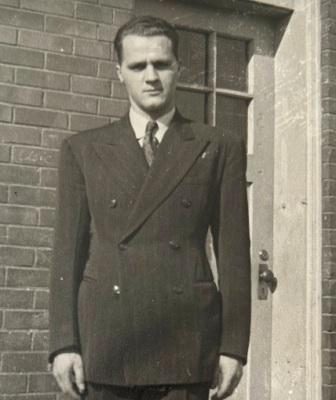
On The War Memorial Trail….Remembrance Week 2025 – Reflections and Updates

November 9, 2025.  When we write a story on the blog, we often receive additional information about the soldiers we’ve written about, about other soldiers buried in the same cemetery, or who served in the same unit. This Remembrance Week 2025 posting gives an update on three soldiers whose stories were previously told, one whose story is coming up in a future posting, and about our visit to the Commonwealth War Graves Commission office in Ottawa, Ontario.

Each year we also try to visit one or more war memorials in Canada. In this posting we feature a visit to the Memramcook Veterans Park in Memramcook, New Brunswick, and Beach Grove Memorial Forest in Charlottetown, Prince Edward Island.

…A banner for WWII soldier Joseph ‘Ambroise’ Comeau….

Banner for WWII soldier Joseph ‘Ambroise’ Comeau. (Photo credit: Simone Comeau)

One of the WWII soldiers buried in the Canadian War Cemetery in Holten, The Netherlands, is Joseph ‘Ambroise’ COMEAU, from Lower Saulnierville, Nova Scotia. Ambroise was one of 5 soldiers from the North Nova Scotia Highlanders Regiment who drowned in a tragic accident in the Battle of Leer in Germany on April 28, 1945, aged 21.  His was one of the 383 graves we visited this spring during our 2025 European War Memorial Tour, and Pieter had placed flags of Canada and Nova Scotia, as well as an Acadian flag, by his grave.

When Simone Comeau recently sent us a photo of her uncle’s banner, she explained why it included both a Canadian and Acadian flag.  “…We had a choice as to which flag we wanted along with the flag of Canada so since you honoured the Acadian veterans this year in Holland and we are Acadians I figured it was only appropriate to do so….

You can read Ambroise’s story at https://onthewarmemorialtrail.com/2021/05/17/on-the-war-memorial-trail-a-tragic-drowning-on-the-leda-river-in-germany-part-3/  and about our visit to his grave at https://onthewarmemorialtrail.com/2025/09/04/on-the-war-memorial-trail-2025-faces-of-holten-exhibition-part-4-soldiers-who-drowned-during-operation-duck/

 ….The family of WWII soldier James ‘Jimmy’ Oliver Thomas framed the photo we sent…

Framed photo taken at the grave of James ‘Jimmy’ Oliver Thomas.  (Photo courtesy of Rodd Cooper)

During our visit to the various cemeteries during the 2025 European War Memorial Tour, we took photos of each grave at which Pieter placed flags, and later sent photos to the families of these soldiers.  Rodd Cooper, nephew of WWII soldier James ‘Jimmy’ Oliver THOMAS framed the photo we had emailed him, and emailed us back a photo of the framed picture with the family’s thanks.  We were deeply touched by this!

Born in St. Peters, Manitoba, Jimmy died in Germany on May 2, 1945, aged 33, a few days after being liberated from the Stalag VII-A POW Camp in Moosburg, Germany. He had been taken prisoner of war on May 22, 1943, while serving with the Seaforth Highlanders of Canada, during the breaking of the Hitler Line.

You can read Jimmy’s story at https://onthewarmemorialtrail.com/2024/02/18/on-the-war-memorial-trail-the-wwii-soldier-from-manitoba-who-died-shortly-after-being-liberated-from-stalag-vii-a/  and about our visit to his grave at https://onthewarmemorialtrail.com/2025/09/10/on-the-war-memorial-trail-2025-faces-of-holten-exhibition-part-5-indigenous-soldiers/

….WWII soldier Samuel George Engen was remembered by his great-niece Clover Rusk on National Indigenous Veterans Day…

In a November 8, 2025 Facebook posting, Clover Rusk remembered her great-uncle, Samuel George ENGEN of The Pas, Manitoba on National Indigenous Veterans Day….and thanked Pieter “…for dedicating his time to Indigenous war vets buried overseas…

After a 3 year search by various family members, a photo was found by Clover earlier this year, in an album that had belonged to her great-grandfather Aaron, the older brother of Samuel.

The son of Louis Julius Engen and Mary Helen (nee Buck) Engen, and husband of Miriam Susan Pranteau, Samuel died April 23, 1945 in Germany, during the Battle for the Kusten Canal, aged 27, while serving with the Lake Superior Regiment.  

Samuel is buried in the Canadian War Cemetery in Holten, The Netherlands, which we visited this past May, and where Pieter placed flags of Canada and Manitoba by his grave.  His story will be told in an upcoming posting.

….Flags were placed at the grave of WWII airman William Andrew Hood on our behalf…

Grave of William Andrew Hood.  (Photo credit: Robert van der Ende)

One of the cemeteries to visit on our 2025 European War Memorial Tour was Eindhoven General Cemetery in Eindhoven, The Netherlands, where WWII airman William Andrew HOOD, of Little Bras D’or, Cape Breton Island, Nova Scotia, is buried. 

Eindhoven was near where we were for a family visit, and we had planned to go to the cemetery before we left for Belgium the following day.  But….by this time we were totally exhausted, and didn’t see how we could manage it.  Thankfully, Robert van der Ende volunteered to take flags of Canada and Nova Scotia and place them at William’s grave on our behalf.  We were very grateful for that act of kindness!  This was the only cemetery on our list that we didn’t personally visit.

William was the mid-upper gunner aboard Halifax JD215 when it was shot down over The Netherlands on June 29, 1943.  None of the crew survived.  You can read his story at https://onthewarmemorialtrail.com/2023/09/19/on-the-war-memorial-trail-the-wwii-airman-from-bras-dor-who-was-aboard-the-last-flight-of-halifax-jd215/

….We visited the CWGC office in Ottawa…

This year, Pieter became one of the volunteers across Canada participate in the National Volunteer Program.  He was assigned 4 cemeteries on Prince Edward Island to visit and gather information about the condition of Commonwealth War Graves Commission (CWGC) war graves, and to clean the grave stones as needed. (See https://onthewarmemorialtrail.com/2025/08/08/on-the-war-memorial-trail-cwgc-volunteer-at-cape-traverse-community-cemetery/ and https://onthewarmemorialtrail.com/2025/09/28/on-the-war-memorial-trailthe-wwii-carpenter-buried-in-seven-mile-bay-who-does-not-have-a-cwgc-headstone/ for stories about two of the soldiers buried in a CWGC grave)

Left to right: Pieter Valkenburg, Julene Warren, Daria Valkenburg, Elizabeth Hale.  (Photo courtesy of Valkenburg Family Collection)

During a trip to Ottawa in October, we visited the CWGC office and met with two of the coordinators overseeing the volunteers:  Elizabeth Hale and Julene Warren.  It was a chance to put faces to names, and to learn more about the important work being done to look after war graves here in Canada.

….We visited the Memramcook Veterans Park in Memramcook, New Brunswick…

Our friend and fellow researcher, Etienne Gaudet, had invited us several times to visit his hometown of Memramcook, New Brunswick, and one Saturday in June we were able to do so.  Etienne proudly took us around the Memramcook Veterans Park, which commemorates those who served and are from the Memramcook area. 

Etienne Gaudet (left) with Pieter at Memramcook Veterans Park. (Photo credit: Daria Valkenburg)

A unique billboard highlighted the ships on which troops travelled to Great Britain, and the countries in Europe in which they fought. 

Etienne Gaudet (left) with Pieter at Memramcook Veterans Park. (Photo credit: Daria Valkenburg)

Etienne also wanted us to meet 102 year old WWII veteran, Romeo LEBLANC, and we were delighted to have the opportunity to do so. 

Etienne Gaudet (left) and Pieter (right) with WWII veteran Romeo LeBlanc. (Photo credit: Daria Valkenburg)

….We visited the Beach Grove Memorial Forest in Charlottetown, Prince Edward Island…

Pieter at the entrance to Beach Grove Memorial Forest in Charlottetown. (Photo credit: Daria Valkenburg)

This spring we received an email from Jim Little, saying he was writing a story about Private Frank LUTZ, an orphan from Prince Edward Island, who was badly wounded on February 20, 1945 during the Battle of Moyland Wood, while serving with the Canadian Scottish Regiment. He died on March 2, 1945, aged 19, and is buried in the Canadian War Cemetery in Groesbeek, The Netherlands. (See https://www.facestograves.nl/LifeStories/LUTZ%20Frank-JLE-bio-EN.pdf)

Jim wanted to know if Frank was listed on a cenotaph on the Island.  Yes, was the answer….he is listed on a Canadian Army memorial stone at Beach Grove Memorial Forest in Charlottetown.  The memorial forest honours WWII veterans from Prince Edward Island with granite stones that list their names and includes a tree for each person that is honoured.

Pieter walks along the path in Beach Grove Memorial Forest.  (Photo credit: Daria Valkenburg)

The memorial stones are located along a path in the forest, which, during the war, had been used as a training facility for various regiments and units.  The stones honour those who died during the war while serving in the Royal Canadian Navy, Merchant Navy, Canadian Army, and Royal Canadian Air Force.  We found Frank’s name listed on the stone for the Canadian Army.

Frank Lutz was listed on one of the memorial stones for the Canadian Army. (Photo credit: Daria Valkenburg)

We ended up spending a long time in the forest, looking at each stone, as Pieter had researched so many of the names listed on each stone!

Thank you to Simone Comeau, Rodd Cooper, Etienne Gaudet, Clover Rusk, and Robert van der Ende. The work of remembrance of those who served continues.

The flags placed at William Andrew Hood’s grave were donated.  Our thanks go to: 

  • Alan Waddell, Constituent Assistant, on behalf of Heath MacDonald, MP for Malpeque, for the Canadian flag.
  • Kyle Graham, Research Officer, Military Relations, Nova Scotia Intergovernmental Affairs, on behalf of Premier Tim Houston, Province of Nova Scotia, for the Nova Scotia flag.

If you have a story to tell, please let Pieter know. You can email him at memorialtrail@gmail.com, or comment on the blog.  

© Daria Valkenburg

….Want to follow our research?….

If you are reading this posting, but aren’t following our research, you are welcome to do so.  Our blog address: https://onthewarmemorialtrail.com/

4 countries, 6 weeks, 7,000 km – an unforgettable war memorial journey in Europe…. Daria’s book ‘No Soldier Buried Overseas Should Ever Be Forgotten‘ is available in print and e-book formats.  Net proceeds of book sales help support research costs and the cost of maintaining this blog. For more information see https://nosoldierforgotten.com/ 

You are also invited to subscribe to our YouTube Channel: On The War Memorial Trail With Pieter Valkenburg: https://www.youtube.com/channel/UCJ591TyjSheOR-Cb_Gs_5Kw

Never miss a posting!  Subscribe below to have each new story from the war memorial trail delivered to your inbox.