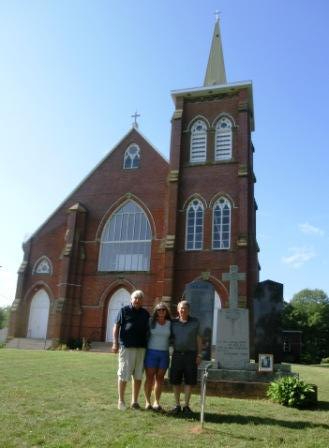
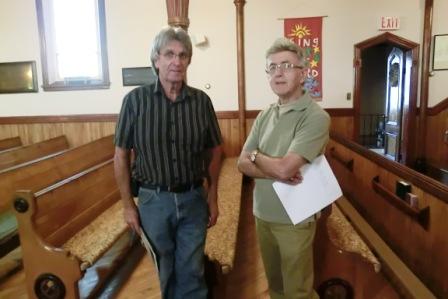
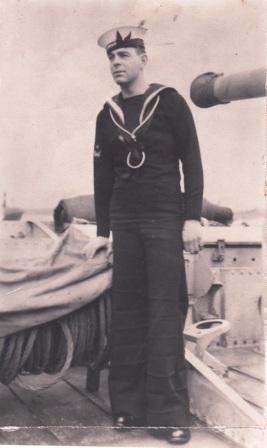
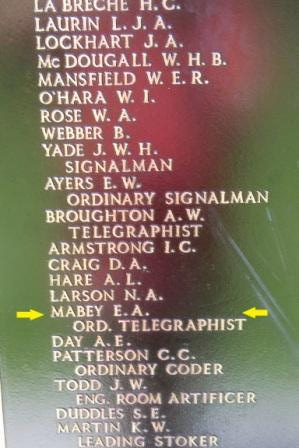
On The War Memorial Trail….. Luck and Humanity During the Battle of Vimy Ridge

September 29, 2018.  Over the past few years, as the stories of the men on the Cenotaph outside the Borden-Carleton Legion are researched by Pieter, the level of death, destruction, and hatred from war is incomprehensible.  If you travel through any of the WWI and WWII sites in Europe, you see memorials and cemeteries.  In Normandy, France it seems as though there is a reminder of the war dead around every corner.

In a kill or be killed environment of war, survival was a luck of the draw.  In April 2017, the County Line Courier published ‘Two Unsung Heroes of Vimy Ridge’, a story about two soldiers on the Cenotaph whose names are listed on the Vimy National Memorial in France, Patrick Raymond ARSENAULT and John ‘Lymon’ WOOD. (See Learning About The Two Names On The Vimy Memorial) After this article was published, we were contacted by Ralf Gräfenstein of Berlin, Germany, who is helping the son of a WWI German soldier determine what happened at Vimy Ridge.
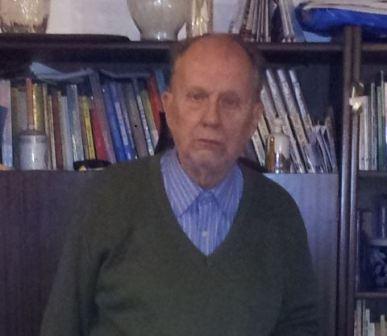
photo of Ernesto

Ernesto Brucker of Buenos Aires, Argentina.

Ernesto Ricardo Brucker, now in his 80s, who lives in Buenos Aires, Argentina, is hoping to find the Canadians who took his father prisoner during the Battle of Vimy Ridge, so he could thank them for saving his father’s life and not killing him when he surrendered.

Because of the actions of two unknown ‘tall’ Canadians, Brucker survived the Battle of Vimy Ridge and spent the remainder of the war in a Prisoner of War camp in Skipton, England.  According to the Skipton documents, he was taken prisoner between Thélus and Bailleul-Sir –Berthoult, 4.4 km south-east of Thelus.

Jorge Brucker Skipton

Georg (Jorge) Brucker at Skipton POW Camp in England. (Photo courtesy of E. Brucker)

Not only were 3,400 Germans were taken prisoner on April 9, 1917, but there were 4 Canadian Divisions involved in the battle. Could we find out how Brucker became a prisoner of war?

Georg (later known as Jorge) BRUCKER was born November 2, 1896 in Erlangen, Germany, and 18 years old when WWI started.  He joined the army and was sent to Poland, then to France.  During the Battle of Vimy Ridge, he was the Lieutenant in charge of a platoon in Machine Gun Company 1 of the Royal Bavarian Reserve Infantry Regiment I in Thélus.  They had been in the Arras area since October 1914 and held the villages of Thélus, Bailleul and the southern slope of the ridge.

On April 9, 1917, the 1st Canadian Division, under the command of Major General Arthur Currie, faced the 1st Bavarian Reserve Division, under the command of General of the Infantry Karl von Fassbender, halfway between the villages of Thélus and Bailleul-Sir –Berthoult. The 1st Canadian Division was stretched along a front of about two kilometres, with six battalions. The furthest from Vimy Ridge, they had some four kilometres of battlefield to cross in order to reach it!

Initial attack by 1st Cdn Division

Initial attack by the 1st Canadian Division (Source: http://www.webmatters.net/txtpat/index.php?id=1497)

The 13th Machine Gun Company was attached to the 1st Canadian Division in order to support the Infantry Brigades.  This is the unit that Patrick Raymond ARSENAULT was in. Was it a twist of irony that both Arsenault and Brucker were in Machine Gun Companies – on opposing sides?  Unlike Brucker, Arsenault lost his life in a shell attack on April 9, sometime around 7 am.  His body was never recovered.  Either he was buried in an unknown grave, or the shell attack scattered his body parts, making identification impossible.

John ‘Lymon’ WOOD was also in the 1st Canadian Division, as a member of the 2nd Canadian Battalion (Eastern Ontario Regiment), which was part of the 1st Canadian Infantry Brigade during the Battle of Vimy Ridge.  Wood survived the Battle of Vimy Ridge, but his luck ran out on May 3, 1917, when he was killed in action during the Battle of Arras.

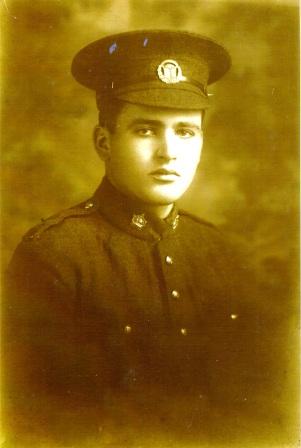
Left: Patrick Raymond Arsenault in 1916 in Summerside.  (Photo courtesy of Paul Arsenault collection)  Right: John Lyman Wood shortly after enlistment in October 1915.  (Photo courtesy of Gene Rogerson collection)

Dr. Jack Sheldon researched and translated German reports from the battle.  In his 2008 book “The German Army on Vimy Ridge 1914-1917”, he recorded a description made by Brucker’s Commanding Officer, Major Meyer of the 1st Battalion Reserve Infantry Regiment:

“…At 5:30 am on 9 April enemy drum fire, supplemented by machine gun fire, came down.  It was impossible to make out the position and in fact it was almost impossible to make out signal flares amidst the clouds of smoke and dirt thrown up by the shells.  At 6:30 am heavy small arms fire could be heard and, at that moment, a message was sent by light signal to the rear.  ‘Heavy enemy attack.’  About half an hour later the wounded Muketier Hangemann happened to pass Battalion Headquarters, reporting that the British (meaning the Canadians) had overrun the right flank of 1st Bavarian Reserve Division and had then attacked our battalion in great strength from the left and rear….

In the final attack, the 1st Brigade, which John ‘Lymon’ Wood was part of, passed through the other two Brigades while the artillery dropped thousands of rounds.  As the attack began again, the wind started to turn, blowing snow and smoke from the burning village of Thélus into the faces of the Bavarians. This helped to hide the approaching Canadians, who encountered little resistance. By 1 pm the battle was over.

It’s not clear at which point Brucker was taken prisoner, but most likely it happened by 11:30 am at the latest, based on reports by Major Meyer, as recorded in Dr. Jack Sheldon’s book “The German Army on Vimy Ridge 1914-1917”:  “…Not until 11:30 am, when all the grenades had been thrown and there was no longer any prospect of timely relief, did the remainder of the garrison decide, reluctantly, to surrender...

In the book, ‘The History of the 2nd Canadian Battalion (East. Ontario Regiment) Canadian Expeditionary Force in the Great War 1914-1919’ by Colonel W. W. Murray, he records an account of the capture of German machine gunners in the morning.  “The Scouts found considerable work.  Ptes I. F. Wismer and J.F. Harrison performed a particularly daring feat near the Loen Weg.  Working in advance of No. 1 Company, they observed an enemy machine gun coming into action against the Fourth.  Pushing forward, they secured the gunner, an officer.  The pair then descended into an adjacent dug-out and forced the surrender of three more officers and four men, together with the gun…”  Were these the two Canadians who captured Georg Brucker?  It’s unlikely we’ll ever know.

At the end of the day, the 1st Division had crossed four kms of battlefield, captured 2,500 prisoners, 40 machine guns and 27 cannons at a cost of 2,500 of their own men killed or injured.  Wood survived, Arsenault died, and Brucker was taken prisoner.

Many people today may be wondering why so many German prisoners of war were allowed to surrender during the battle, and not simply killed.  In his 1986 book ‘Vimy’, author Pierre Berton gives a reason why not every Canadian soldier saw the German army as ‘the enemy’:  “…Letters and wartime reminiscences suggest that the Canadians often resented their own brass more than they disliked the grey-clad German.  You shot at him because he was shooting at you, but it wasn’t a personal matter.  He too was walling in the mud, only a few yards away….

Today, a memorial to the 1st Canadian Division sits in a farmer’s field, marking the Canadian and German front lines on April 9, 1917, on the road between Thélus and Bailleul-Sir –Berthoult.  Somewhere along this line is the spot where Brucker’s last moments of WWI before becoming a prisoner of war played out.
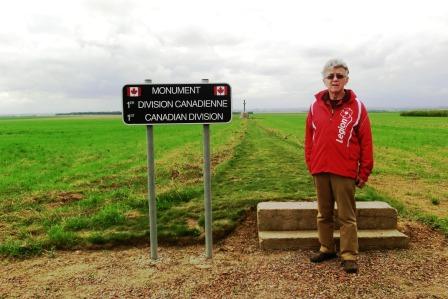
CIMG8314 Sep 5 2017 Pieter by sign directing you to Memorial to 1st Cdn Division

Line in farmer’s field, halfway between Thélus and Bailleul-Sir –Berthoul, marks the front line where German and Canadian troops faced each other on April 9, 1917. (Photo credit: Daria Valkenburg)
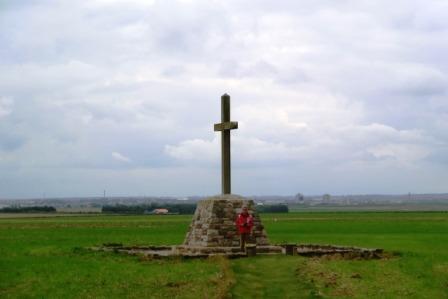
CIMG8318 Sep 5 2017 Memorial to 1st Cdn Division halfway betwen Thelus & Bailleul

Memorial honouring the 1st Canadian Division in farmer’s field, halfway between Thélus and Bailleul-Sir –Berthoul, along the line where German and Canadian troops faced each other on April 9, 1917. (Photo credit: Daria Valkenburg)

After two years in Skipton, Brucker was sent to a Military Camp in Lockstedt, Germany in October 1919, and went on to work in a bank in Bavaria. He was sent on a secondment for one year to Argentina, where he met his wife.  They married in 1923 and he stayed in Argentina until his death on December 26, 1984.

Although we were unable to give Ernesto a complete answer of who to thank for saving his father’s life, we did find out the approximate area where he became a prisoner of war, surrendering to a regiment of the 1st Canadian Division (For a list of the regiments in the 1st Canadian Division see https://en.wikipedia.org/wiki/Battle_of_Vimy_Ridge_order_of_battle.) Georg Brucker was very lucky to have surrendered to soldiers who showed humanity, not revenge.

If you can add to this story, have photos or information to share on soldiers from the Cenotaph outside the Borden-Carleton Legion, or soldiers buried in The Netherlands, please let us know. You can share them by sending an email to memorialtrail@gmail.com or by commenting on this blog.

© Daria Valkenburg

….Want to follow our research?….

If you are reading this posting, but aren’t following our research, you are welcome to do so.  Our blog address: https://onthewarmemorialtrail.com/
Front cover OnTheWarMememorialTrailinEurope4 countries, 6 weeks, 7,000 km – an unforgettable war memorial journey in Europe…. Daria’s book ‘No Soldier Buried Overseas Should Ever Be Forgotten‘ is available in print and e-book formats.  Net proceeds of book sales help support research costs and the cost of maintaining this blog. For more information see https://nosoldierforgotten.com/ 

You are also invited to subscribe to our YouTube Channel: On The War Memorial Trail With Pieter Valkenburg: https://www.youtube.com/channel/UCJ591TyjSheOR-Cb_Gs_5Kw

Never miss a posting!  Subscribe below to have each new story from the war memorial trail delivered to your inbox.

On the War Memorial Trail…..In Prince County, Prince Edward Island

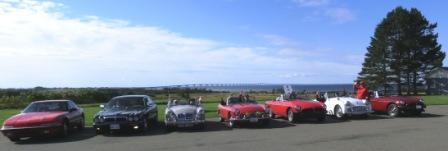
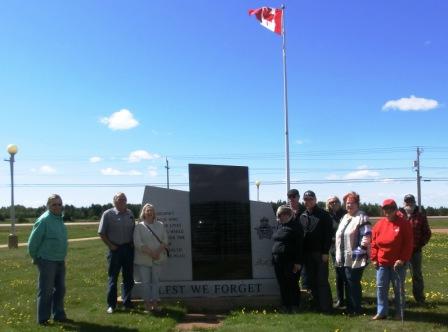
September 11, 2018.  Not all war memorials are located overseas.  In researching the names on the Cenotaph outside the Borden-Carleton Legion, we’ve visited memorials and cemeteries in Europe and Canada, and met with family members of these soldiers.  Recently, with a group of friends from the British Motoring Association of PEI (BMAPEI), we did a special war memorial driving tour, in our iconic British vehicles, in Prince County, right here on Prince Edward Island.

The driving tour began, naturally, at the Cenotaph that Pieter is researching.

CIMG2574 Sep 8 2018 BMAPEI memorial runcenotaph outside Borden Carleton Legion

Members of the British Motoring Association of PEI by the Cenotaph outside Borden-Carleton Legion. (Photo credit: Daria Valkenburg)

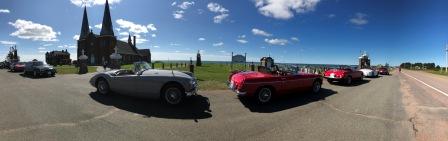
First stop was a photo op at St. Peter’s Roman Catholic Church in Seven Mile Bay, which has a great view of the Confederation Bridge.

CIMG2575 Sep 8 2018 BMAPEI memorial run 7 Mile Bay

At Seven Mile Bay, with the Confederation Bridge in the background. (Photo credit: Pieter Valkenburg)

From Seven Mile Bay our convoy of cars travelled to Notre Dame du Mont-Carmel (Our Lady of Mount Carmel) Roman Catholic Church in Mont Carmel. Volunteer guide Antoine Richard explained that this beautiful church was built in 1898 for $75,000 and consists of 450,000 bricks, which were paid for by parishioners at 5 cents a brick!  The land for the church, rectory, and cemetery had been donated by Mr. Richard’s great-grandparents Thomas Richard and Susan Aucoin in 1820.

IMG_8575 Sep 8 2018 BMAPEI memorial run Mont Carmel - Heidi

Convoy arrives in Mont Carmel. (Photo credit: Heidi Litke)

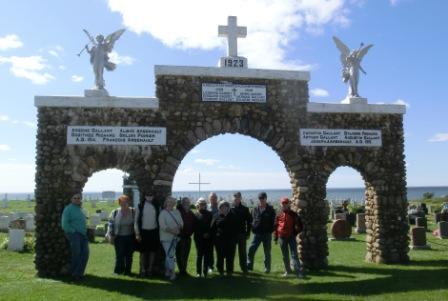
A group photo was taken at the memorial to honour WWI and WWII soldiers at the entrance to the cemetery.

CIMG2585 Sep 8 2018 BMAPEI memorial run Mont Carmel

Mont Carmel memorial to WW1 and WW2 soldiers. (Photo credit: Daria Valkenburg)

Next on the list was the Bottle Houses at Cap Egmont, which is a memorial to one man’s ingenuity and talent.

Bottle Houses - Heidi Litke

Inside one of the Bottle Houses. (Photo credit: Heidi Litke)

CIMG2590 Sep 8 2018 BMAPEI memorial run Bottle Houses Heidi & Rob in chapel

Heidi and Rob Litke in the Bottle Houses chapel. (Photo credit: Daria Valkenburg)

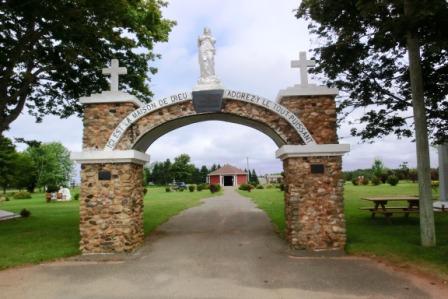
From the Bottle Houses, we travelled to the Memorial Park in Cap Egmont that honours WWI and WWII Acadian and other Canadian soldiers.  The park is built on the spot of a former church, and has several memorials, as well as benches in a park-like setting.

CIMG2605 Sep 8 2018 BMAPEI memorial run Memorial Park Cap Egmont

At the Memorial Park in Cap Egmont. (Photo credit: Daria Valkenburg)

CIMG2456 Aug 22 2018 prep for car tour Memorial Park in Cap Egmont

Entrance to the Memorial Park in Cap Egmont. (Photo credit: Daria Valkenburg)

Just before lunch, we stopped at the #10 Bombing and Gunnery School Monument, located at the Visitor Information Centre in Mount Pleasant.  During WWII, this area was used to train pilots slated for bombing and gunnery runs.  During the period of operation, 22 lost their lives in various accidents, and a monument sits on the spot of the former airport used for the school.

CIMG2608 Sep 8 2018 BMAPEI memorial run #10 Bombing Gunnery School Monument in Mt Pleasant

At #10 Bombing & Gunnery School Monument in Mount Pleasant. (Photo credit: Pieter Valkenburg)

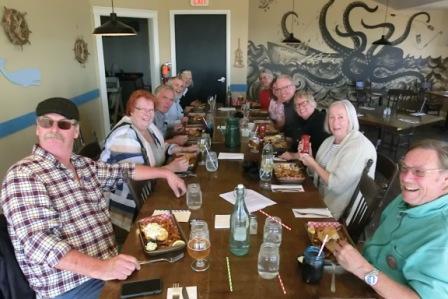
Our last stop was for a very late, but well deserved lunch at The Catch in West Point, where a brief reflection on the day was made. Bill Glen was struck by the arches we’d seen at Mont Carmel and the Memorial Park in Cap Egmont.  “You never think of arches for a monument…” he said.  Sandy Bentley noted how young the soldiers were and how so many had lied about their age in order to serve, especially in WWI.

Heidi Litke wondered if there were any memorials to animals that served in the war.  She explained that her grandfather, Harold Fryer, served with a German shepherd, Sgt Rex, in the 1st Battalion Dufferin and Haldimand Rifles.  Fryer survived, Rex was killed on duty on September 7, 1943.  “I always think about the animals…,” Heidi said.  Good point.  None of us were aware of any memorials to serving animals on the island.

CIMG2611 Sep 8 2018 BMAPEI memorial run

Lunch at The Catch in West Point.

One more memorial reminder occurred when Stewart Gillcash of O’Leary came to the restaurant to meet Pieter.  Last fall, Pieter had placed flags on the grave of Stewart’s uncle, Carman GILLCASH, who is buried at the Canadian War Cemetery in Holten.  The Gillcash family had provided photos and a brief story about Stewart’s uncle for the Faces To Graves Project in The Netherlands.  Everyone was delighted to meet him.

CIMG2610 Sep 8 2018 Pieter with Stewart Gillcash at The Catch

Pieter Valkenburg with Stewart Gillcash. (Photo credit: Daria Valkenburg)

Rob Litke summed up the day.  “…You don’t have to go far.  Every community has a monument of the people they lost in war….

If you have photos or information to share on soldiers from the Cenotaph outside the Borden-Carleton Legion, or soldiers buried in The Netherlands, please email him at memorialtrail@gmail.com. Comments or stories?  You can share them by email or by commenting on this blog.

© Daria Valkenburg

….Want to follow our research?….

If you are reading this posting, but aren’t following our research, you are welcome to do so.  Our blog address: https://onthewarmemorialtrail.com/

Front cover OnTheWarMememorialTrailinEurope4 countries, 6 weeks, 7,000 km – an unforgettable war memorial journey in Europe…. Daria’s book ‘No Soldier Buried Overseas Should Ever Be Forgotten‘ is available in print and e-book formats.  Net proceeds of book sales help support research costs and the cost of maintaining this blog. For more information see https://nosoldierforgotten.com/ 

You are also invited to subscribe to our YouTube Channel: On The War Memorial Trail With Pieter Valkenburg: https://www.youtube.com/channel/UCJ591TyjSheOR-Cb_Gs_5Kw

Never miss a posting!  Subscribe below to have each new story from the war memorial trail delivered to your inbox.

Canadian War Graves Netherlands Foundation Project

August 4, 2018.  This blog concentrates on the names listed on the Cenotaph Research Project.  We provide a summary of the research results, talk about our trips to monuments and cemeteries, and the families that we meet.  We occasionally mention interaction with other archives, and the information on the names listed on our Cenotaph that we’ve shared.

For example, when we were in France, we left information and photos on WWI soldiers John Lymon WOOD and Patrick Raymond ARSENAULT with the site manager at Vimy Ridge (See  Visiting The Canadian National Vimy Memorial)  In Belgium, we left information and photos on WWI soldiers Charles Benjamin Murray BUXTON and George Albert CAMPBELL at In Flanders Field Museum in Ypres. (See Sharing Information at In Flanders Field Museum in Ypres) Information on WWI soldier Vincent CARR was sent to the Memorial Museum Passchendaele 1917 in Passchendaele.  (See On The War Memorial Trail of Passchendaele and Surrounding Area) 

In The Netherlands, we did the same for WWII soldiers William Douglas SHERREN and George Martin MCMAHON, buried in the Canadian War Cemetery in Holten (See On the War Memorial Trail ….. At Holten Canadian War Cemetery) and George Preston SMITH, buried in the Canadian War Cemetery in Groesbeek. (See On the War Memorial Trail ….. PEI Soldiers Buried In The Canadian War Cemetery in Groesbeek) In addition, we’ve shared information with various university archives and regimental archives.

In this blog entry we’d like to feature a project in The Netherlands, the Canadian War Graves Netherlands Foundation. In this project, which is of special interest to Pieter because of his Dutch roots, the foundations for the three Canadian War Cemeteries in The Netherlands have banded together to create a digital monument for ALL Canadian war graves in their country.   Almost 7,600 Canadian WWII soldiers are buried there! When Pieter was asked to help find families, stories, and photos, he didn’t hesitate.

Over the past few years, he’s put out a call for help through the various PEI legions.  Several families submitted information directly to The Netherlands, others sent information and photos to Pieter for forwarding.  The families of Carman GILLCASH and Daniel Peter MACKENZIE chose to go through Pieter, and recently the Comeau family in Nova Scotia shared information about Joseph Ambrose COMEAU.  All three are buried in Holten Canadian War Cemetery.  We’ve not met any of these family members, perhaps one day.

A few weeks ago, however, Pieter received a request from Alice van Bekkum, a member of the Royal Canadian Legion in The Netherlands, and a tireless advocate for remembering the sacrifice of Canadian soldiers in liberating The Netherlands.  Her request was to track down an article entitled ‘A Journey of the Heart’, about a pilgrimage made by the family of William ‘Willie’ Alfred CANNON of Mt. Mellick, who was killed in 1945 in Germany (the article incorrectly says The Netherlands) and is buried at Groesbeek Canadian War Cemetery.  Pieter had placed flags at his grave last fall, so the name was not unfamiliar.

CIMG9021 Sep 16 2017 Groesbeek Cemetery Pieter by grave of WA Cannon

Pieter at the grave of William Cannon at Groesbeek Canadian War Cemetery. (Photo credit: Daria Valkenburg)

IMG_20170916_125248934 Sep 16 2017 Groesbeek Cemetery grave of WA Cannon

Grave of William Cannon at Groesbeek Canadian War Cemetery. (Photo credit: Pieter Valkenburg)

With the help of Jocelyne Lloyd, news editor at The Guardian, the article, written by Mary MacKay and published on November 8, 2008, was found and a digital copy was soon on its way to The Netherlands.  (See article: Journey From The Heart Cannon article from 2008)

The real story came when Pieter got in touch with Cannon’s nephews Carl and Alfred Cannon, and niece Irene Doyle to inquire about the possibility of them donating photos for the Dutch Project.  “Did we want to come to the place where ‘Uncle Willie’ grew up and meet them?” he was asked. This soon became a story of remembrance……

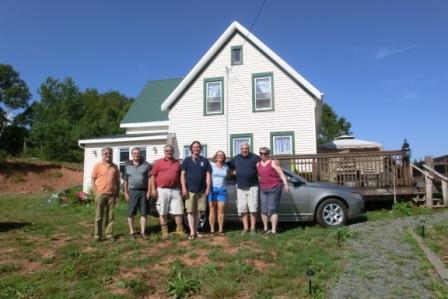
Carl Cannon now owns the homestead, and we expected to meet him and his brother Alfred. But we were in for a surprise! They invited their sister, Paulette Duffy, and their brother Anthony.  Cousin Bill Cannon came over from Nova Scotia.  Cousin Irene Doyle, who was featured in The Guardian story, also arrived.  It was a full house, and a happy occasion, filled with stories of Uncle Willie that they had heard from their parents and grandparents.

CIMG1276

At the Cannon homestead. Left to right: Pieter Valkenburg, Alfred Cannon, Anthony Cannon, Carl Cannon, Paulette Duffy, Bill Cannon, Irene Doyle. (Photo credit: Daria Valkenburg)

All of the Cannon nieces and nephews had been born after his death, which made this visit remarkable.  Paulette explained that “memory was kept alive as the family always talked about Willie.”  Bill said that his father Harry, who served in the Navy during WWI, was the closest to Willie.  “They were hellions as children, so the stories were so interesting!” laughed Pauline.

Andy Cannon, Willie’s cousin who was in the North Nova Scotia Highlanders, was with Willie the night before he died” said Bill.  “Did you want to talk to his son Garry in Sarnia?”  So another Cannon shared some memories, over a cell phone.

The Cannon family shared photos, letters, and many stories, which are making their way to the digital archive set up in The Netherlands.  Our last stop before heading home was to visit the Cenotaph by St. Joachim’s Roman Catholic Church in Vernon River, where Willie Cannon is mentioned.  “Every Remembrance Day I bring a photo of Uncle Willie” Alfred explained.  And sure enough, Uncle Willie’s photo came along on this visit too.

CIMG1286

At the Cenotaph by St. Joachim’s Roman Catholic Church in Vernon River. Left to right: Bill Cannon, Paulette Duffy, Alfred Cannon. Note photo of Uncle Willie on the Cenotaph. (Photo credit: Daria Valkenburg)

If you have photos or stories to share about other WWII soldiers buried in The Netherlands, and haven’t already sent them to one of the cemeteries there, please help them build up their digital archive so that these soldiers will always be remembered.

If you would like Pieter to come and speak about the Cenotaph Research Project, or how Islanders can help with the Canadian War Graves Netherlands Foundation Project, he is open to receiving invitations.  Email him at memorialtrail@gmail.com.

Photos are still needed for many of the names on the Cenotaph outside the Borden-Carleton Legion.  Please dig out those old albums and take a look.  You can share your photos, comments, or stories by emailing us at memorialtrail@gmail.com or by commenting on this blog.

© Daria Valkenburg

…Want to follow our research?….

If you are reading this posting, but aren’t following our research, you are welcome to do so.  Our blog address: https://onthewarmemorialtrail.com/

Front cover OnTheWarMememorialTrailinEurope4 countries, 6 weeks, 7,000 km – an unforgettable war memorial journey in Europe…. Daria’s book ‘No Soldier Buried Overseas Should Ever Be Forgotten‘ is available in print and e-book formats.  Net proceeds of book sales help support research costs and the cost of maintaining this blog. For more information see https://nosoldierforgotten.com/ 

You are also invited to subscribe to our YouTube Channel: On The War Memorial Trail With Pieter Valkenburg: https://www.youtube.com/channel/UCJ591TyjSheOR-Cb_Gs_5Kw

Never miss a posting!  Subscribe below to have each new story from the war memorial trail delivered to your inbox.

On The War Memorial Trail….Honouring The Lives Of Soldiers From the Anglican Church in Crapaud

July 15, 2018.  On July 12, Pieter was invited to give a presentation about the Cenotaph Research Project at St. John the Evangelist Church in Crapaud.  As the families of a number of the names on the Cenotaph outside the Borden-Carleton Legion had been members of this church, we made sure that they were featured in the presentation.

These included:

  • Arthur Leigh COLLETT (WWI)
  • Henry Warburton STEWART (WWI)
  • Ernest Murray NORTON (WWII)
  • William Douglas SHERREN (WWII)

Reverend Margaret Collins introduced Pieter, tying in Pieter’s research to remembrance. Among the audience members were several families of the names on the Cenotaph, which made the event very special. Many brought photos and letters, which will increase our knowledge of the lives of these men.  Families in attendance represented the following men:

  • Arthur Leigh COLLETT  (WWI)
  • Elmer Allister MABEY (WWII)
  • Joseph Charles MCIVER (WWII)
  • Ernest Murray NORTON (WWII)
  • Arthur Clinton ROBINSON  (WWI)
  • William Douglas SHERREN (WWII)
  • George Preston SMITH (WWII)
  • John Lyman WOOD  (WWI)
CIMG1010 Jul 12 2018 Pieter at podium Presentation at Anglican Church in Crapaud

Pieter at the podium at St John the Evangelist Anglican Church in Crapaud. (Photo credit: Daria Valkenburg)

The presentation was well received, with refreshments provided by the Church afterwards, where people could speak with Pieter and each other. Hazel Robinson of the Tryon & Area Historical Society accepted donations to the “Muttart Memorial Fund”.

One person who attended commented afterwards that “I was there to hear more info on Lyman Wood, an ancestor. So pleased to see an interest, amazing to me to see someone speak of him 100 years on. Wood family is very proud of him. I did get to Vimy Ridge in 2007 for 90th, and found his name as well, pretty awesome.  I love Canadian military history, just love the stories, good and bad. Really enjoyed your presentation.  Thanks for all the amazing work that you have done!

CIMG1016 Jul 12 2018 With George Preston Smith family Presentation at Anglican Church in Crapaud

Pieter with the family of WW2 soldier George Preston Smith. (Photo credit: Daria Valkenburg)

CIMG1022 Jul 12 2018 With Reid & Bruce Norton Presentation at Anglican Church in Crapaud

Pieter with Reid (left) and Bruce (right) Norton, nephews of WW2 soldier Ernest Murray Norton. (Photo credit: Daria Valkenburg)

CIMG1023 Jul 12 2018 With Charlie Sherren Presentation at Anglican Church in Crapaud

Pieter with Charlie Sherren, nephew of WW2 soldier William Douglas Sherren. (Photo credit: Daria Valkenburg)

Our thanks to Reverend Margaret Collins and Connie MacKinnon of St. John the Evangelist Anglican Church for inviting Pieter to speak, and for their warm hospitality in making this event the success it was.

If you would like Pieter to come and speak about his research, he is open to receiving invitations.  Email him at memorialtrail@gmail.com.

Photos are still needed for many of the names on the Cenotaph outside the Borden-Carleton Legion, so please dig out those old albums and take a look.  You can share your photos, comments, or stories by emailing us at memorialtrail@gmail.com, comment on the blog, or send a tweet to @researchmemori1.

UPDATE:  This project was completed in October 2019!

Donations are still being collected towards the ‘Muttart Memorial Fund’ for a memorial panel in Wons, The Netherlands.  If you would like to donate, cheques may be written out to TAHS and mailed to Tryon & Area Historical Society (TAHS), PO Box 38, Crapaud PE C0A 1J0.  In the subject line, identify your cheque as being for the “Muttart Memorial Fund”.  A charitable donation receipt will be sent to all donors. 

If you wish to donate and you live in Europe:  Bank transfers may be made to Stichting Missing Airmen Memorial Foundation, Bank Account # (IBAN) NL35ABNA0569579856, and state in the subject line “Attn D.S. Drijver for Halifax L9561”.

© Daria Valkenburg

…Want to follow our research?….

If you are reading this posting, but aren’t following our research, you are welcome to do so.  Our blog address: https://onthewarmemorialtrail.com/

Front cover OnTheWarMememorialTrailinEurope4 countries, 6 weeks, 7,000 km – an unforgettable war memorial journey in Europe…. Daria’s book ‘No Soldier Buried Overseas Should Ever Be Forgotten‘ is available in print and e-book formats.  Net proceeds of book sales help support research costs and the cost of maintaining this blog. For more information see https://nosoldierforgotten.com/ 

You are also invited to subscribe to our YouTube Channel: On The War Memorial Trail With Pieter Valkenburg: https://www.youtube.com/channel/UCJ591TyjSheOR-Cb_Gs_5Kw

Never miss a posting!  Subscribe below to have each new story from the war memorial trail delivered to your inbox.

On the War Memorial Trail …..Good News Bad News

July 12, 2018.  When doing research on something that happened a long time ago, one expects setbacks and successes.  Sometimes the setbacks are greater than the successes, and sometimes the other way around.

On July 30, this blog will be a year old, and the Cenotaph Research Project two years old.   A lot has happened since it began.  Many families have participated in this project, as have universities where some of the soldiers studied.  We thank them for their help in remembering their heroes.

We’re still missing a number of photos, as per the list provided in the previous blog entry.  (See Upcoming Presentation in Crapaud).  In some cases, we have not been able to find family members of the soldiers on the Cenotaph.  Occasionally we found family, only to be told they never heard of the person.  One woman was quite interested to hear about her WWI soldier relative, but after talking to her mother to see if any photo survived, reported back that the response was “it happened too long ago.”  That was the end of that story!

Most of the time, however, the family was aware of the person, but no photo survived, let alone other documents such as letters or postcards.  This happened to the family of another WWI soldier, who searched diligently for information and a photo, with no success.  We’ve now placed an ad in ‘Legion‘ magazine, in the hope that someone outside the island will be able to help.

In another instance, we were able to get a photo of one WWI soldier who died in Belgium, but a photo of his brother, who fought in France, has yet to be found.

So those are some of the setbacks regarding photos and personal stories.  Another recent setback was that we have learned from the Missing Airmen Memorial Foundation in The Netherlands that the memorial plaque in Wons, The Netherlands to honour WWII pilot Elmer Muttart and the crew of Halifax L9561, which was planned to be unveiled in October 2018 has been postponed to 2019.  While the postponement of this important ceremony is a disappointment, it’s an opportunity to continue raising funds for this project.

CIMG0984 Jul 9 2018 Pieter and Angela Walker of CBC Mainstreet

Pieter with Angela Walker of CBC’s Mainstreet in the CBC studio in Charlottetown. (Photo credit: Daria Valkenburg)

Ok, now for some positive news.  Angela Walker of CBC Mainstreet interviewed Pieter earlier this week.  If you missed the radio interview, here is the link:  https://www.cbc.ca/listen/shows/mainstreet-pei/segment/15556040 and the brief write-up on the CBC website:  Finding the heroic stories behind the names on a local cenotaph. Pieter Valkenburg is a Dutch Canadian who wanted to learn more about the names on the Borden-Carleton Cenotaph. So he started a research project to find the stories behind these fallen soldiers.’

Shane Ross posted a story on the CBC website based on what was discussed in the interview, and you can read that article here:  http://www.cbc.ca/news/canada/prince-edward-island/pei-pieter-valkenburg-soldiers-holland-netherlands-1.4740888

We are grateful to CBC PEI for taking an interest in the Cenotaph Research Project, and also to the County Line Courier newspaper, which has been publishing our stories since the project began.

A reminder that if you have a relative who was a WWII soldier and is buried in The Netherlands, please consider participating in a project to collect photos and stories for each soldier.  You can email your photos and info to Pieter at memorialtrail@gmail.com and he will forward the information on your behalf to the project team in The Netherlands.

© Daria Valkenburg

…Want to follow our research?….

If you are reading this posting, but aren’t following our research, you are welcome to do so.  Our blog address: https://onthewarmemorialtrail.com/

Front cover OnTheWarMememorialTrailinEurope4 countries, 6 weeks, 7,000 km – an unforgettable war memorial journey in Europe…. Daria’s book ‘No Soldier Buried Overseas Should Ever Be Forgotten‘ is available in print and e-book formats.  Net proceeds of book sales help support research costs and the cost of maintaining this blog. For more information see https://nosoldierforgotten.com/ 

You are also invited to subscribe to our YouTube Channel: On The War Memorial Trail With Pieter Valkenburg: https://www.youtube.com/channel/UCJ591TyjSheOR-Cb_Gs_5Kw

Never miss a posting! Subscribe below to have each new story from the war memorial trail delivered to your inbox.
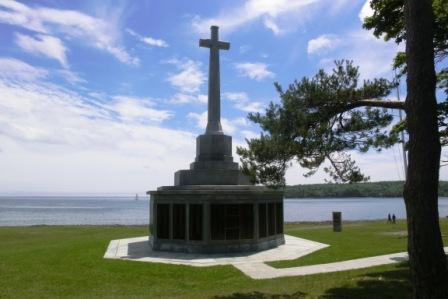
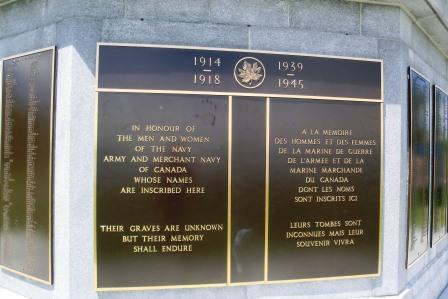
Upcoming Presentation in Crapaud

July 9, 2018.  Everyone is invited to attend the upcoming presentation about the Cenotaph Research Project at St. John the Evangelist Anglican Church in Crapaud on Thursday, July 12, 2018.  Below, please see poster and a list of photos of soldiers we are still looking for.  Can you help???

Poster Cenotaph Research Project presentation

Names still without faces from WWI

  • James CAIRNS, born in Kinkora – UPDATE: PHOTO FOUND
  • Leigh Hunt CAMERON, born in Albany
  • James Lymon CAMERON, born in Victoria
  • William Galen CAMPBELL, born in Wellington
  • Bazil CORMIER, born in Tignish
  • Joseph Arthur DESROCHES, born in Miscouche – UPDATE: PHOTO FOUND
  • James Graham FARROW, born in Argyle Shore
  • Charles LOWTHER, born in North Carleton
  • Arthur Clinton ROBINSON, born in Tryon
  • Harry ROBINSON, born in Augustine Cove

Names still without faces from WWII

  • Leonard Stephen AVERY, born in Bedeque – UPDATE: PHOTO FOUND
  • John Daniel FERGUSON, born in Borden – UPDATE: PHOTO FOUND 
  • Ernest Ramey GALLANT, born in Borden
  • Singleton Charles JEFFERY, born in Bayfield, New Brunswick – UPDATE: PHOTO FOUND 

The Cenotaph also lists an F. ARSENAULT.  No information at all has been found for someone of this name from this area.

As a separate project, Pieter is helping researchers in The Netherlands who are looking for photos and information on Canadian soldiers buried in The Netherlands If you have a relative with a grave in The Netherlands and would like to participate, you can email your photos and info to Pieter at memorialtrail@gmail.com and he will forward the information on your behalf.  Or you can drop off your photos on Thursday and after being scanned they will be returned to you.

© Daria Valkenburg

…Want to follow our research?….

If you are reading this posting, but aren’t following our research, you are welcome to do so.  Our blog address: https://onthewarmemorialtrail.com/

Front cover OnTheWarMememorialTrailinEurope4 countries, 6 weeks, 7,000 km – an unforgettable war memorial journey in Europe…. Daria’s book ‘No Soldier Buried Overseas Should Ever Be Forgotten‘ is available in print and e-book formats.  Net proceeds of book sales help support research costs and the cost of maintaining this blog. For more information see https://nosoldierforgotten.com/ 

You are also invited to subscribe to our YouTube Channel: On The War Memorial Trail With Pieter Valkenburg: https://www.youtube.com/channel/UCJ591TyjSheOR-Cb_Gs_5Kw

Never miss a posting!  Subscribe below to have each new story from the war memorial trail delivered to your inbox.
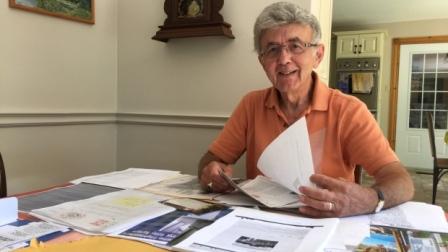
On The War Memorial Trail….The WWII Sailor Who Died In An Accidental Explosion and Fire

June 27, 2018.  In wartime, losing your life in battle is a terrible, but not unexpected event.  When someone loses their life in an accident, the tragedy is compounded.  The story of WWII sailor Elmer Allister MABEY, born June 2, 1918 in Tryon, son of Albert Mabey and Ellen McNeill, is about a promising young man who was very unfortunate.

Prior to enlistment, he worked with Wood and Company in Crapaud, R.T. Holman’s in Summerside, and lastly at Eastern Hay and Feed in Charlottetown.

Photo Elmer Allister Mabey Jun 2 1918 to Mar 12 1941

Elmer Allister Mabey. (Photo courtesy of Allister Mabey Family Collection.)

In September 1939 Mabey enlisted with the Royal Canadian Navy Volunteer Reserve in Charlottetown and was soon transferred to Halifax to complete a wireless course at the HMCS Stadacona base.  In November 1939 he was assigned to the HMCS Otter.

Formerly a private yacht known as the Conseco, it was renamed the Otter and turned over to the Royal Canadian Navy for war service as a coastal patrol vessel.  A wooden boat, reinforced with a steel hull, it normally spent its days sailing back and forth across Halifax Harbour, watching for floating mines and German U-boats (submarines).

On the morning of March 26, 1941, as the Otter sailed only 24 nautical miles from Halifax, an explosion and a fire ripped through the vessel, in what was later determined to be an accident. In a newspaper account, a crew member on a merchant ship who witnessed the event said that “the Otter sank like a stone, stern first, just after her blazing bow reared high in the air”. Once the captain recognized that the fire was too much, he gave the order to abandon ship.

When the order was given to abandon ship, the Otter’s crew barely fit into the two lifeboats and one inflatable raft. Although a Polish freighter and a Royal Navy submarine were nearby, rescue proved to be very difficult due to heavy seas.

One of the lifeboats was flipped by an unusually large wave when the Polish freighter came alongside. Sailors on the lifeboat were flung into the icy water, with some never seen again. Many of those rescued didn’t survive the trip to Halifax, despite the efforts of the Polish merchantmen who took turns applying artificial respiration and trying to warm the men.

The British Submarine found the inflatable raft.  15 men were on it, but by the time they could be rescued only four were still alive.

22 men survived, but two officers and 17 enlisted men died, among them Mabey.  To make this tragedy even worse, Mabey’s body was never recovered. The Halifax Memorial in Point Pleasant Park in Halifax, which we visited, honours those who lost their lives at sea in wartime, including those aboard the Otter.

Halifax Memorial in Point Pleasant Park

Halifax Memorial at Point Pleasant Park in Halifax. (Photo credit: Pieter Valkenburg)

cimg7671-jul-9-2017-halifax-memorial-mabey.jpg

Mabey’s name listed on the Halifax Memorial at Point Pleasant Park in Halifax. (Photo credit: Pieter Valkenburg)

A big thank you to Allister Mabey for sharing the photo of Mabey.  If you can add more to Mabey’s story, email us at memorialtrail@gmail.com, comment on the blog, or send a tweet to @researchmemori1. Comments or stories?  You can share them by email or by commenting on this blog.

UPCOMING PRESENTATION: Pieter has been invited to speak about the Cenotaph Research Project at St John The Evangelist Anglican Church in Crapaud at 7 pm on Thursday, July 12, 2018.  Location: 391 Nelson St, Trans Canada Hwy Rte, Crapaud, PE C0A 1J0.  Photos and information about soldiers welcome.

© Daria Valkenburg

…Want to follow our research?….

If you are reading this posting, but aren’t following our research, you are welcome to do so.  Our blog address: https://onthewarmemorialtrail.com/

Front cover OnTheWarMememorialTrailinEurope4 countries, 6 weeks, 7,000 km – an unforgettable war memorial journey in Europe…. Daria’s book ‘No Soldier Buried Overseas Should Ever Be Forgotten‘ is available in print and e-book formats.  Net proceeds of book sales help support research costs and the cost of maintaining this blog. For more information see https://nosoldierforgotten.com/ 

You are also invited to subscribe to our YouTube Channel: On The War Memorial Trail With Pieter Valkenburg: https://www.youtube.com/channel/UCJ591TyjSheOR-Cb_Gs_5Kw

Never miss a posting!  Subscribe below to have each new story from the war memorial trail delivered to your inbox.

On the War Memorial Trail …..WWI Soldier John Lyman Wood’s Connection With Acadia University

June 1, 2018.  In previous blog postings, we wrote about John Lyman WOOD, whose name is not only on the Cenotaph outside the Borden-Carleton Legion, but also is listed on the Vimy Memorial in France. (See Learning About The Two Names On The Vimy Memorial and Visiting The Canadian National Vimy Memorial)

Photo Lyman Wood

Photo: John Lyman Wood shortly after enlistment in October 1915. (Photo courtesy of Gene Rogerson collection)

Born in North Tryon on July 8, 1897, the son of George William Wood and Martha Heatly, he was raised on a farm, and was in second year engineering at Acadia University in Wolfville, Nova Scotia before enlisting in the Princess Patricia Canadian Light Infantry 4th University Company on October 12, 1915.  On November 28, 1915 he sailed from Halifax on the SS Lapland, arriving in Plymouth, England on December 7.

Upon arrival, he was sent to the 11th Reserve Battalion, stationed at St. Martin’s Plain near Folkestone, for infantry training for needed reinforcements to the Canadian Corps in the field.

Before WW1 began, Wood attended Horton Academy and Acadia University in Wolfville, Nova Scotia.   As part of his research, Pieter contacted Acadia University.  Wendy Robicheau, archivist at Acadia University, is researching WW1 soldiers who attended Acadia and posts information on a blog.  (See Acadia and the War: commemoration and dissemination blog: http://aboutacadiawar.blogspot.com/.)  Wendy explained that at Acadia University, Wood was known as ‘Lyman’, not ‘John’.

Wendy shared information from Acadia’s student newspaper, ‘The Acadia Athenaeum’, December 1915 issue. “The following men enlisted with the 4th Universities Company of the P.P.C.L.I.:–Lieut. Frank Higgins, ’14; Sergeant Murray Millet, ’16; Corporal Burton DeWolfe, ’16; Lance Corporal Don Chase Eng. ’16; Max Saunders, ’16; Charlie Fitch Eng, ’16; Harold Bishop, ex ’17; John MacNeill, ex ’18; Leyman Wood, ex ’18; John Mosher, ex ’18.”  P.P.C.L.I. refers to Princess Patricia Canadian Light Infantry. The dates after the men’s names refer to either the year of graduation or the year they should have graduated, if WW1 had not interrupted their education.

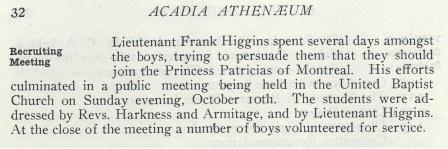
In her blog posting of June 23, 1917, (http://aboutacadiawar.blogspot.com/search?q=Higgins) , Wendy wrote that “It should be noted that Higgins played a role in recruiting several Acadia men to the P.P.C.L.I. His signature appears on the attestation papers of several students who enlisted in Wolfville.”  The following entry is from the November 1915 issue of the Acadia Athenaeum.

Recruit_Mtng_Ath_1915

Excerpt from November 1915 issue of Acadia Athenaeum of Acadia University.

Indeed, Higgins did sign the attestation papers for Wood as well, as Wendy explains in her blog posting of May 3, 2017 (http://aboutacadiawar.blogspot.com/2017/05/remembering-john-lyman-wood-died-100.html?q=Higgins): Private Wood attested in October 1915. He was a student with one year in Acadia’s O.T.C. The witness on his papers–Lieut. F.C. Higgins. Incidentally, Dr. C.E.A. deWitt, Class of ’04, signed his medical papers. DeWitt was the doctor at Camp Aldershot.

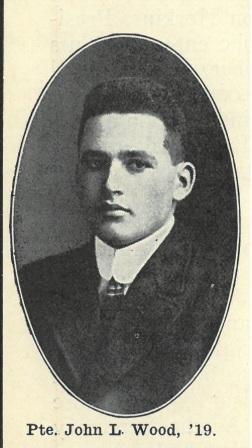
Wood_JL

Student photo from Acadia University, published in the June 1917 Acadia Athenaeum. This may have been his matriculation photo.

Wendy went on to explain that of the group of ten men mentioned in the December 1915 issue:  “Five will not survive. DeWolfe, Saunders, Fitch, and Wood all die in Europe. Bishop, severely wounded, is brought back to Nova Scotia, and dies in Halifax. Chase is taken POW at Mount Sorrell with other P.P.C.L.I. who are Acadia students, but not of the group listed above.

Wendy let us know about a book ‘As Ever’, written by John Grant, containing letters from his great-uncle Harold Fletcher Bishop, who signed up with John Lyman Wood, and was also a war casualty. (See  http://www.kingscountynews.ca/living/letters-from-auburn-soldier-in-first-world-war-inspire-book-71960/).  After contacting John Grant and asking about John Lyman Wood, he wrote back that he’d found a reference to Wood attending a dinner in Folkestone, England: “On or about January 16, 1916 the Acadia men organized a dinner at the Metropole Hotel where perhaps two dozen gathered for a meal, toasts, and to sing the Acadia songs around the piano.  I have included in my book two reports of evening that were published in the Acadia Atheneaum.  Pte. J.L. Wood, Class of ‘18” was mentioned. 

In an excerpt of one report of that evening, by Sgt F. Gregg, he explains that: “On the night in question the Acadians made their way, by bus and train, toward the Metropole hotel. Here the interior presented a happy contrast to the bleak, darkened, town without. Upon being ushered into the sanctum reserved for us we were surprised to see fellows, many of whom we thought still to be in the Blue Nose province.

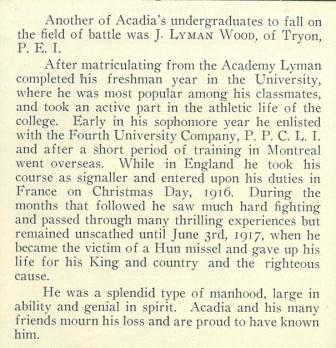
This was the only reunion dinner that Wood attended. On January 21, 1916 he was in hospital with appendicitis, then gastritis, and measles.  He was discharged on April 15, 1916, to the 39th Battalion. On December 22, 1916, he arrived in France as part of the Second Infantry Battalion, which was part of the 1st Canadian Infantry Brigade during the Battle of Vimy Ridge.   He survived that battle, but his luck ran out on May 3, 1917, when he was killed in action during the Battle of Arras, in the third battle of the Scarpe near Fresnoy.  Wood’s body was never recovered, his only memorial in Europe being his name inscribed on the Vimy Ridge Memorial, which we visited last fall.  Wood’s obituary was published in the June 1917 issue of the Acadia Athenaeum, with an unfortunate typo for the month of his death.

wood obituary

Excerpt from June 1917 issue of Acadia Athenaeum of Acadia University. Note that the date of death is incorrect. Wood died on May 3, 1917.

A big thank you to Wendy Robicheau for sharing the information about Wood from Acadia University, to Gene Rogerson for providing a photo of Wood, and to John Grant for letting us know about the Acadia reunion dinner.  Can you add anything more to Wood’s story?  Email us at memorialtrail@gmail.com, comment on the blog, or send a tweet to @researchmemori1. Comments or stories?  You can share them by email or by commenting on this blog.

UPCOMING PRESENTATION: Pieter has been invited to speak about the Cenotaph Research Project at St John The Evangelist Anglican Church in Crapaud at 7 pm on Thursday, July 12, 2018.  Location: 391 Nelson St, Trans Canada Hwy Rte, Crapaud, PE C0A 1J0.  Photos and information about soldiers welcome.

© Daria Valkenburg

…Want to follow our research?….

If you are reading this posting, but aren’t following our research, you are welcome to do so.  Our blog address: https://onthewarmemorialtrail.com/

Front cover OnTheWarMememorialTrailinEurope4 countries, 6 weeks, 7,000 km – an unforgettable war memorial journey in Europe…. Daria’s book ‘No Soldier Buried Overseas Should Ever Be Forgotten‘ is available in print and e-book formats.  Net proceeds of book sales help support research costs and the cost of maintaining this blog. For more information see https://nosoldierforgotten.com/ 

You are also invited to subscribe to our YouTube Channel: On The War Memorial Trail With Pieter Valkenburg: https://www.youtube.com/channel/UCJ591TyjSheOR-Cb_Gs_5Kw

Never miss a posting!  Subscribe below to have each new story from the war memorial trail delivered to your inbox.

Halifax L9561 Flight Mentioned In ‘The Night Hunter’s Prey’

April 26, 2018.  In 2016, a book entitled ‘The Night Hunter’s Prey’, by Iain Gordon was published.  Cover nighthunters preyIt tells the story of two airmen – RAF (Royal Air Force) Rear Gunner Alex OLLAR of Scotland, and Luftwaffe Pilot Helmut LENT of Germany. In July 1942, just as both men reach the apex of their careers, they meet for the first time in the night skies over Hamburg.  Ollar didn’t survive the encounter.  Lent didn’t survive the war either.  He died when the left engine of his plane failed, struck high voltage cables, and crashed on October 5, 1944.  Lent died of his injuries on October 7, 1944.

404px-Bundesarchiv_Bild_146-1987-137-10,_Helmut_Lent

Helmut Lent in 1943. (Image from https://en.wikipedia.org/wiki/Helmut_Lent)

This book was interesting because Major Helmut Lent was the commander of 4./NJG 1 squadron, stationed at the airfield in  Leeuwarden. A member of Lent’s squadron, Lt. Leopold FELLERER was responsible for shooting down the Halifax L9561 flight on October 12, 1941 in which Elmer Bagnall MUTTART lost his life.

In a previous blog posting, Sgt John William DUFFIELD, a member of the crew, who had hospitalized following the crash, wrote about Lent in his 1946 letter to Muttart’s father.  (See On the War Memorial Trail ….. At Harlingen General Cemetery)

On page 127 of ‘The Night Hunter’s Prey’, an account of what happened following the fateful crash on October 12, 1941 is recorded: “In the early hours of 13th October, a member of Helmut’s staffel, Leutnant Leopold Fellerer, shot down a Halifax of No. 76 Squadron based at Middleton St. George. The Canadian pilot, Flight Sergeant Elmer Muttart RCAF, was killed in trying to save his crew in a crash landing on the Dutch coast south-west of Leeuwarden, but the other seven members of the crew got out of the crash and were captured.  The rear gunner, Sergeant John Duffield, sustained some injuries and was taken into the sickbay at Leeuwarden,

The rest of the crew were entertained royally for the evening in the Luftwaffe Officer’s Mess at Leeuwarden.  In a letter to his parents, Helmut told of the good evening they had enjoyed and mentioned that some of the English prisoners had made a very good impression.  He added:  ‘It really is a cause for regret that we have to fight against such men.’

The following day he visited Sergeant Duffield in the sickbay and introduced himself, and then visited him until he was transferred some six days later.  Duffield later related how Lent asked him if there was anything he could do for him.  The room was very hot and stuffy as the window had been sealed and Duffield asked if it might be opened for some fresh air.  Lent laughed and told him the medical staff were afraid he might escape.  Nevertheless, he arranged for the window to be opened.”

That was an extraordinary account of the events following the crash in Wons, and we thank Berlin historian Ralf Gräfenstein for bringing it to our attention.  If only we could tell such a complete story for every person listed on the Cenotaph as we have been able to tell for Elmer Muttart over this past year!   

If you have photos and stories to share for the names on the Cenotaph outside the Borden-Carleton Legion, please email us at memorialtrail@gmail.com, comment on the blog, or send a tweet to @researchmemori1.  

UPDATE:  This project was completed in October 2019!

Donations are still being collected towards the ‘Muttart Memorial Fund’ for a memorial panel in Wons, The Netherlands.  If you would like to donate, cheques may be written out to TAHS and mailed to Tryon & Area Historical Society (TAHS), PO Box 38, Crapaud PE C0A 1J0.  In the subject line, identify your cheque as being for the “Muttart Memorial Fund”.  A charitable donation receipt will be sent to all donors. 

If you wish to donate and you live in Europe:  Bank transfers may be made to Stichting Missing Airmen Memorial Foundation, Bank Account # (IBAN) NL35ABNA0569579856, and state in the subject line “Attn D.S. Drijver for Halifax L9561”.

© Daria Valkenburg

…Want to follow our research?….

If you are reading this posting, but aren’t following our research, you are welcome to do so.  Our blog address: https://onthewarmemorialtrail.com/

Front cover OnTheWarMememorialTrailinEurope4 countries, 6 weeks, 7,000 km – an unforgettable war memorial journey in Europe…. Daria’s book ‘No Soldier Buried Overseas Should Ever Be Forgotten‘ is available in print and e-book formats.  Net proceeds of book sales help support research costs and the cost of maintaining this blog. For more information see https://nosoldierforgotten.com/ 

You are also invited to subscribe to our YouTube Channel: On The War Memorial Trail With Pieter Valkenburg: https://www.youtube.com/channel/UCJ591TyjSheOR-Cb_Gs_5Kw

Never miss a posting!  Subscribe below to have each new story from the war memorial trail delivered to your inbox.
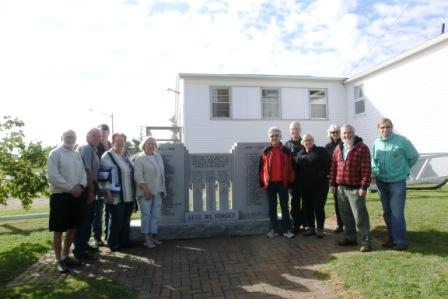
On the War Memorial Trail …..Family of Crew Member of WWII Pilot Elmer Muttart’s Final Flight Found

April 25, 2018.  The story of WWII pilot Elmer Bagnall MUTTART, from Cape Traverse, is unusual in that information keeps coming in, almost 77 years after his death on October 12, 1941.  Over several blog entries, you’ve learned about the events of the plane crash just past the village of Wons, The Netherlands, and read an account offered by Sgt John William DUFFIELD, who was the gunner on the flight.  We’ve also told you about a visit made to Muttart’s grave in Harlingen by his navigator, Sgt Reg ALEXANDER, and his daughter Pam Alexander.

On October 12, 1941, with his regular navigator Reg Alexander and six other crew members, Muttart began his 21st mission into enemy territory, a bombing raid on Bremen, Germany. 

…The air crew aboard the last flight of Halifax L9561….

The crew members of Halifax L9561 were:

  • Pilot – F/S Elmer Bagnall MUTTART (age 23)
  • Co-Pilot – P/O Norman Frank TRAYLER (age 21)
  • Flight Engineer – Sgt David COTSELL (age 21)
  • Flight Engineer – Sgt Leslie Albert ROBERTS (age 25) (previously recorded as bomb aimer)
  • Navigator – Sgt Reginald ‘Reg’ William Purchase ALEXANDER (age 22)
  • Wireless Operator – Sgt William Herbert HUNT (age 22)
  • Gunner – Sgt George Henry PATTERSON (age 28)
  • Gunner – Sgt John William DUFFIELD (age 20)

The plane was shot down and crashed just past the village of Wons, but not before all of the crew members, except for Muttart, had parachuted out.  The crew members, all British, spent the rest of the war in various prisoner of war camps.  The only casualty of that night was Elmer Muttart.

Elmer Bagnall Muttart (2)

Elmer Bagnall Muttart (Photo from Canadian Virtual War Memorial at http://www.veterans.gc.ca)

…The son of Norman Frank Trayler has been in contact ….

Over the past year, preparations have been underway for a planned Memorial Panel in Wons to honour the entire crew.  Outreach efforts to locate family members of the crew have met with some success, as the family of Reg Alexander and John William Duffield have been in contact.  Now, most recently, Robert Trayler, who lives in France, has been in contact regarding his father, Pilot Officer Norman Frank TRAYLER, who was the co-pilot on the flight. Trayler had gotten married on September 20, 1941, just a few weeks before the ill-fated flight that would separate him from his bride for the rest of the war.

Trayler wedding photo

Centre couple: Norman Trayler with his wife Daphne Jefferd on their wedding day in Basingstoke, England. (Photo: courtesy Robert Trayer family collection)

… Norman Frank Trayler was a POW in Stalag Luft III ….

After the plane crash in Wons, Trayler spent 4 years at Stalag Luft III prisoner of war camp in present day Poland, where he was a member of the prison camp orchestra and was able to write his intermediate accountancy exams, with papers sent over from London.  His son Robert recalled that “Dad was elected barrack room cook and centralized all the Red Cross parcels to make something edible every day.

After his return to England, Trayler moved to Bognor, where he began an accountancy practice, and took up cricket.  He passed away on June 19, 2009 at the age of 88.  Son Robert explained that “Although I am obviously very proud of what he did during the war, as a family, we always added a dash of humour. As I said at his funeral, he was at least partly responsible for the destruction of three aircraft: A Tiger Moth which couldn’t be persuaded to come out of a spin, a Whitley which while taxiing went up the back of the one in front, chewing off the (happily unoccupied) tail turret, and finally the Halifax.

Trayler’s obituary noted that his back had been badly injured in a Royal Air Force training accident in a Tiger Moth, and he had taken up cricket to alleviate the pain and keep moving.

We thank Robert Trayler for his recollections about his father, and hope to hear from more family of the crew of the Halifax L9561 flight.

In the next blog entry, we’ll share an excerpt from a 2016 book describing the events of the Halifax L9561 flight.

Photos and stories are still needed for many of the names on the Cenotaph outside the Borden-Carleton Legion. You can email us at memorialtrail@gmail.com, comment on the blog, or send a tweet to @researchmemori1.  

UPDATE:  This project was completed in October 2019!

Donations are still being collected towards the ‘Muttart Memorial Fund’ for a memorial panel in Wons, The Netherlands.  If you would like to donate, cheques may be written out to TAHS and mailed to Tryon & Area Historical Society (TAHS), PO Box 38, Crapaud PE C0A 1J0.  In the subject line, identify your cheque as being for the “Muttart Memorial Fund”.  A charitable donation receipt will be sent to all donors. 

If you wish to donate and you live in Europe:  Bank transfers may be made to Stichting Missing Airmen Memorial Foundation, Bank Account # (IBAN) NL35ABNA0569579856, and state in the subject line “Attn D.S. Drijver for Halifax L9561”.

© Daria Valkenburg

…Want to follow our research?….

If you are reading this posting, but aren’t following the blog, you are welcome to do so.  Our blog address: https://onthewarmemorialtrail.com/

Front cover OnTheWarMememorialTrailinEurope4 countries, 6 weeks, 7,000 km – an unforgettable war memorial journey in Europe…. Daria’s book ‘No Soldier Buried Overseas Should Ever Be Forgotten‘ is available in print and e-book formats.  Net proceeds of book sales help support research costs and the cost of maintaining this blog. For more information on the book, please see https://nosoldierforgotten.com/

You are also invited to subscribe to our YouTube Channel: On The War Memorial Trail With Pieter Valkenburg: https://www.youtube.com/channel/UCJ591TyjSheOR-Cb_Gs_5Kw

Never miss a posting!  Subscribe below to have each new story from the war memorial trail delivered to your inbox.