On The War Memorial Trail….. The WW1 Letters Of Arthur Clinton Robinson

July 4, 2021. In 2017 we visited the grave of Arthur Clinton ROBINSON, a WW1 soldier with the 26th (New Brunswick) Battalion, from Tryon, Prince Edward Island, who is buried in Belgium, (See https://bordencarletonresearchproject.wordpress.com/2017/10/16/on-the-war-memorial-trail-in-belgium-and-a-visit-to-la-laiterie-military-cemetery/)  Up to today, we have not found of a photo of him, and neither has his family.

In June 2018, Arthur’s nephew, Arthur ‘John’ Robinson and his wife Hazel visited the grave with their son, dentist Dr. Alan Robinson, and Alan’s son, William Robinson.

2018-06-16 Arthur C Robinson grave (1)

At La Laiterie Military Cemetery in Belgium.  Left to right: Dr Alan Robinson, William Robinson, Hazel Robinson.  (Photo credit: John Robinson)

While no photo has yet been found, the Robinsons were able to find two letters that Arthur wrote to his aunts. 

In an August 30, 1915 letter to his aunt, Robbie Blanchard, written in England just before travelling to France,  he describes the composition of men in his platoon from the 26th (New Brunswick) Battalion: … You should just see the bunch of men … in this 26th alone. They are a magnificent body of fellows….and this Platoon I am in is a corker… there are, I don’t know how many different nationalities in it… Indian, French, Russians, Belgians, English, Irish, Scotch, Americans and Canadians.  Some mob, eh? You can hear nearly any language around here any time of day….” 

While in England, Arthur saw injured troops arriving back from the front and reflected that “…when you see the hundreds of maimed soldiers, some far worse off than if they were dead, and when nearly daily train loads of freshly wounded men pass right before your eyes, it makes you wonder at the ups and downs of this human life…” 

It was a miracle that the August 30 letter arrived in Canada, as the ship the mail had been travelling on, the Hesperian, was torpedoed by a German submarine off the coast of Plymouth, England on September 4, 1915! Luckily it was one of the items salvaged from the wreckage. (See https://www.rmslusitania.info/related-ships/hesperian/ for more information) 

In a September 16, 1915 letter, written in France to his aunt, Carrie Robinson, he outlines life in a trench: …I am quite comfortable here in our cosy little dugout, out of reach of all the Germans in Europe.  I must tell you about the nice dugout and the 4 fellows who are in it with me.  It is a kind of a tunnel running into the side of a loamy hill, with rubber sheets and blankets hung over the mouth of it….” 

There was no electricity in the trench, as Arthur goes on to mention that …We have niches in the back, where we keep our equipment, and we put candles in them at night so we won’t be too lonesome…” 

He then describes how the equipment is turned into a bed for the night. “…On the floor we have straw, stolen from a stack near by, and all over our kits, which make excellent beds, when you know how to arrange them…” 

Although he doesn’t identify them by name, Arthur mentions his 4 trench companions: …1st They are all six footers. 2nd They all wear a seven cap or larger. 3rd They cannot get their feet into smaller boots than nines, and 4th They all weigh over one hundred and seventy pounds each…”  He goes on to say that he weighs over 170 pounds himself and is well fed.  

The saying goes that an army marches on its stomach, and Arthur’s account of his dinner indicates the importance of food.  “…We had potatoes and meat, bread and butter, and tea of course.  We could have had cheese and jam too if we wanted to, but we always try and keep it over for tea.  The bread and butter is great and the cooks of our company seem to have a natural gift of making good tea so we are lucky in that line…” 

One of the challenges in writing letters from the front during wartime is censorship so as not to divulge any information that might be used by the enemy.  Arthur writes about that: …I find it hard to write a letter here for they are so particular about what a person tells that if you write anything you are not supposed to tell they destroy the whole shooting match…

It’s wonderful that these letters survived so that we get a glimpse into Arthur Robinson’s thoughts and experiences.  Sadly, he lost his life on March 27, 1916 when shellfire hit the trenches southeast of Kemmel, Belgium. 

IMG_3466 Hazel and John Robinson

Hazel and John Robinson. (Photo courtesy of the Robinson Family)

Hazel Robinson explained that their 2018 trip was a war memorial tour.  “…Besides visiting Arthur’s grave on this trip, we followed in the footsteps of the Sherbrooke Fusiliers from England to France, Belgium, Germany, ending in the area of Wons. The Sherbrooke Fusiliers was my father’s unit. We also visited Vimy Ridge where my great-uncle is buried….

Hazel’s great-uncle was “William John HILL from Cassius on the Miramichi River in New Brunswick…”  He lost his life on April 9, 1917 and is buried in Canadian Cemetery No 2 in Pas de Calais, France.

During the trip, Hazel noted two coincidences.  “… A member of the Sherbrooke Fusiliers was buried beside Elmer Muttart in 1945….”  Elmer Bagnall MUTTART of Cape Traverse, Prince Edward Island is buried at Harlingen General Cemetery in The Netherlands. (See https://bordencarletonresearchproject.wordpress.com/2017/07/28/the-elmer-bagnall-muttart-story/ and https://bordencarletonresearchproject.wordpress.com/2019/10/15/on-the-war-memorial-trail-the-visit-to-harlingen-general-cemetery/)

Most likely, Hazel is referring to Thomas ‘Tommy’ Clayton REID.  We’d placed flags on his grave when we visited in October 2019.

CIMG3450 Oct 12 2019 Harlingen General Cemetery

Grave of T.C. Reid at Harlingen General Cemetery in The Netherlands.  (Photo credit: Daria Valkenburg)

Hazel found another coincidence in France. “…When we visited the cemetery in Vimy where my great-uncle is buried, the last family to sign the guest book was a family from my home town, Douglastown, in New Brunswick, and whose parents I knew well and who lived a few houses from my parents!…” 

Thank you to Hazel and John Robinson for sharing Arthur’s letters and information about their 2018 trip. If you have photos or information to share, please contact Pieter at dariadv@yahoo.ca, comment on the blog, or send a tweet to @researchmemori1

If you are reading this posting, but aren’t following the blog, you are welcome to do so.  See https://bordencarletonresearchproject.wordpress.com or email me at dariadv@yahoo.ca and ask for an invitation to the blog. 

Screenshot_2021-02-27 On The War Memorial Trail With Pieter Valkenburg

You are invited to subscribe to our YouTube Channel: On The War Memorial Trail With Pieter Valkenburg: https://www.youtube.com/channel/UCJ591TyjSheOR-Cb_Gs_5Kw

© Daria Valkenburg

On The War Memorial Trail….. The WWII Chaplain Who Lost His Life In France On His Wedding Anniversary

June 20, 2021. Sometimes information on those who’ve served in WWI and WWII comes in unexpected ways.  This was the case when Edwin van der Wolf emailed us to say that “I accidentally found the story of Chaplain William Seaman from your island, who died in Normandy on July 21, 1944. The names of his relatives are no longer legible due to moisture on the attached document….”  

Edwin is one of the researchers at the Canadian War Cemetery in Holten, The Netherlands, so we were surprised that he sent us information on someone who died in France.  The document he sent was a form filled out by family of the deceased.  It was indeed a water damaged document, but it was clear to see that 3 members of Chaplain Seaman’s family – his mother and two brothers – lived in Breadalbane, Prince Edward Island in 1944. 

A friend, Evelyn Stewart, lives in this community, and I asked her about the Seaman family.  She knew one couple that lived in a nearby community and contacted them.  That’s how we came to meet Lindsay and Norma Seaman.  Lindsay’s father, Cedric, was one of the two brothers who had been living in Breadalbane in 1944.

20210616_162357 Jun 16 2021 Seamans with ALFRED Seaman

Norma and Lindsay Seaman with a photo of Lindsay’s uncle, Chaplain Alfred Seaman. (Photo credit: Daria Valkenburg)

Born June 14, 1910 in Springfield, Prince Edward Island, William ‘Alfred’ SEAMAN was the son of William ‘James’ Seaman and Sophia Elizabeth Brown.  He attended Mount Allison University in Sackville, New Brunswick, graduating with a Bachelor of Arts in 1935.  On July 21, 1936 he married Louise Van Duyn Trueman in Truro, Nova Scotia, and then in 1937 received his Certificate of Theology from Pine Hill Divinity Hall, a United Church of Canada theological school, in Halifax, Nova Scotia.

He spent three years as a minister in Rawdon, Nova Scotia and two years in River John, Nova Scotia.  On August 2, 1940 he joined the militia as the Chaplain for the 2nd Battalion Pictou Highlanders, before being appointed full time with the Canadian Chaplain Service on May 15, 1942.  He was given the rank of Honorary Captain and initially sent to Sydney, Nova Scotia, and later to Aldershot, also in Nova Scotia.

By this time, he and Louise were the parents of two children: Lorna Louise and Andrew Thompson. 

20210616_160547 ALFRED Seaman

Chaplain William ‘Alfred’ Seaman.  (Photo courtesy of The Seaman Family)

On June 25, 1943 he left Canada, arriving in the United Kingdom on July 7 and attached to the Headquarters (HQ) of the 2nd Canadian Infantry Division. A year later, on July 6, 1944 he arrived in France with 5 Canadian Field Regiment of the 6th Division Headquarters (HQ). 

On July 14, 1944, while working to retrieve wounded soldiers during the Battle of Caen, he was struck by an exploding mortar shell. Shrapnel pierced his leg, side, and head, and he died a week later, on July 21, the date of his wedding anniversary.  Norma Seaman recalled that “…he was getting better after being wounded, but infection set in…”  (See https://en.wikipedia.org/wiki/Battle_for_Caen and https://united-church.ca/blogs/round-table/chaplain-among-those-lost-normandy-75-years-ago)

He is buried at the Bény-sur-Mer Canadian War Cemetery in France (See https://en.wikipedia.org/wiki/B%C3%A9ny-sur-Mer_Canadian_War_Cemetery).

20210616_162711 Jun 16 2021 Studying Seaman service file

Norma and Lindsay Seaman going over the documents with Pieter.  (Photo credit: Daria Valkenburg)

Lindsay noted that “… Louise never remarried.  She taught at Mount Allison University...” Until her retirement, Louise was a Professor of Home Economics at the university.  In 1987, she established a fund in memory of her husband, with the fund’s income earmarked for books in Religious Studies.

Thank you to Edwin van der Wolf for letting us know about William ‘Alfred’ Seaman, to Evelyn Stewart for putting us in contact with the Seaman family, and to Lindsay and Norma Seaman for sharing photos and information on William ‘Alfred’ Seaman. If you have photos or information to share, please contact Pieter at memorialtrail@gmail.com or comment on the blog. 

© Daria Valkenburg

….Want to follow our research?….

If you are reading this posting, but aren’t following our research, you are welcome to do so.  Our blog address: https://onthewarmemorialtrail.com/
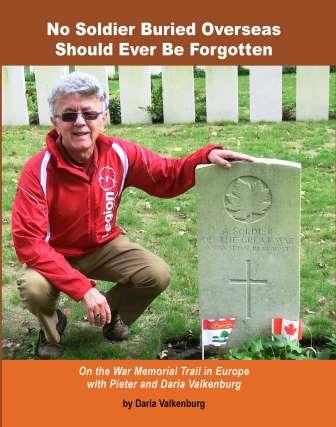
4 countries, 6 weeks, 7,000 km – an unforgettable war memorial journey in Europe…. Daria’s book ‘No Soldier Buried Overseas Should Ever Be Forgotten‘ is available in print and e-book formats.  Net proceeds of book sales help support research costs and the cost of maintaining this blog. For more information see https://nosoldierforgotten.com/

Screenshot_2021-02-27 On The War Memorial Trail With Pieter Valkenburg

You are invited to subscribe to our YouTube Channel: On The War Memorial Trail With Pieter Valkenburg: https://www.youtube.com/channel/UCJ591TyjSheOR-Cb_Gs_5Kw

Never miss a posting!  Subscribe below to have each new story from the war memorial trail delivered to your inbox.
On The War Memorial Trail…..A Tragic Drowning On The Leda River in Germany – Part 4

May 18, 2021.  When we visited the Canadian War Cemetery in Holten in October 2019, we laid flags down at the graves of five soldiers from the North Nova Scotia Highlanders who drowned in a tragic accident in Germany on April 28, 1945.

Recap: In Part 1, the 5 soldiers were identified and the circumstances leading up to the accident were summarized. In Part 2, more information on the accident was discussed, as well as a brief story on Lloyd William Murray, one of the 5 soldiers.  In Part 3, Joseph ‘Ambroise’ Comeau was remembered by his family.

This time, the rest of North Nova Scotia Highlanders who lost their lives that day are remembered.

…. Ruel Kitchener Matheson Remembered….

matheson rk 11-d-12

Ruel Kitchener Matheson.  (Photo courtesy of the Holten Canadian War Cemetery Information Centre.)

Ruel Kitchener MATHESON was born July 6, 1916 in Dundas, Prince Edward Island, Canada, the son of Angus George and Catharina Matheson.   Ruel was a farm labourer before enlisting on January 24, 1944 in Halifax, Nova Scotia.

He began basic training in the Canadian Army Medical Corps (CAMC) at Camp Borden in Ontario, then took parachutist training with the Canadian Parachute Training Centre (CPTC) at Camp Shilo in Manitoba. On September 16, 1944 he was transferred to the Canadian Infantry Training Centre and on November 20, 1944, sent overseas.  Upon arrival in the United Kingdom he was transferred to the Canadian Infantry Training Regiment (CITR).  On March 27, 1945 he was transferred to the North Nova Scotia Highlanders.

He was temporarily buried in Bingum, Germany before being reburied at the Canadian War Cemetery in Holten, The Netherlands.

Matheson Ruel tijdelijk graf te Bingum (D) 11 D 12

Temporary grave of Ruel Kitchener Matheson in Bingum, Germany.  (Photo courtesy of the Holten Canadian War Cemetery Information Centre.)

CIMG3282 Oct 3 2019 Holten Ruel Matheson

Grave of Ruel Kitchener Matheson at the Canadian War Cemetery in Holten.  (Photo credit: Daria Valkenburg)

…. Lewis Wilkieson Marsh Remembered….

Photo Lewis Marsh

Lewis Wilkieson Marsh. (Photo source:  Canadian Virtual War Memorial)

Born on November 14, 1925 in Sydney Mines, Nova Scotia, Lewis Wilkieson MARSH was the son of Edward L. and Millicent M. Marsh.  He was an electrician and worked at the Princess Coal Mine in Sydney Mines before enlistment on May 25, 1944 in Sydney, Nova Scotia.

After receiving basic training in Canada, he arrived in the United Kingdom on December 25, 1944 and was transferred to the Canadian Infantry Training Regiment (CITR).  By February 24, 1945 he was in North West Europe, and transferred to the North Nova Scotia Highlanders on March 27, 1945.

He was temporarily buried on May 12, 1945 in Bingum, Germany, before being reburied at the Canadian War Cemetery in Holten, The Netherlands.

CIMG3278 Oct 3 2019 Holten Lewis Marsh

Grave of Lewis Wilkieson Marsh at the Canadian War Cemetery in Holten.  (Photo credit: Daria Valkenburg)

…. Howard Milo Nicholls Remembered….

Born March 21, 1924 in Mattawa, Ontario, Howard Milo NICHOLLS was the son of Albert and Frances Nicholls.  He was employed by the Dominion Bridge Company in Toronto from January 1941 until his enlistment with the Queen’s Own Rifles on March 31, 1943 in Toronto.  From March to May 1942, he was a member of the Reserve, in the Royal Canadian Ordnance Corps (RCOC).

After training in Canada, Howard was sent overseas in December 1943.  Shortly after D-Day on June 6, 1944 he was transferred to the North Nova Scotia Highlanders.

He was temporarily buried on May 1, 1945 in Bingum, Germany before being reburied at the Canadian War Cemetery in Holten, The Netherlands.

CIMG3279 Oct 3 2019 Holten Howard Nicholls

Grave of Howard Milo Nicholls at the Canadian War Cemetery in Holten.  (Photo credit: Daria Valkenburg)

This concludes the series on the 5 soldiers from the North Nova Scotia Highlanders who tragically drowned on April 28, 1945 when the storm boat they were in capsized while crossing the Leda River in Germany.

Unfortunately, we were unable to find a photo of Howard Milo Nicholls.  If you have photos or information to share about these or any Canadian soldiers buried in The Netherlands, please contact Pieter at memorialtrail@gmail.com, or comment on the blog. 

© Daria Valkenburg

…. Previous postings in this series…..

Missed the previous postings in this series? See:

…Want to follow our research?…

If you are reading this posting, but aren’t following our research, you are welcome to do so.  Our blog address: https://onthewarmemorialtrail.com/

Front cover OnTheWarMememorialTrailinEurope4 countries, 6 weeks, 7,000 km – an unforgettable war memorial journey in Europe…. Daria’s book ‘No Soldier Buried Overseas Should Ever Be Forgotten‘ is available in print and e-book formats.  Net proceeds of book sales help support research costs and the cost of maintaining this blog. For more information see https://nosoldierforgotten.com/

Screenshot_2021-02-27 On The War Memorial Trail With Pieter Valkenburg

You are also invited to subscribe to our YouTube Channel: On The War Memorial Trail With Pieter Valkenburg: https://www.youtube.com/channel/UCJ591TyjSheOR-Cb_Gs_5Kw.

Never miss a posting!  Subscribe below to have each new story from the war memorial trail delivered to your inbox.
On The War Memorial Trail…..A Tragic Drowning On The Leda River in Germany – Part 3

May 17, 2021.  When we visited the Canadian War Cemetery in Holten in October 2019, we laid flags down at the graves of five soldiers from the North Nova Scotia Highlanders who drowned in a tragic accident in Germany on April 28, 1945.

Recap: In Part 1, the 5 soldiers were identified and the circumstances leading up to the accident were summarized. In Part 2, more information on the accident was discussed, as well as a brief story on Lloyd William Murray, one of the 5 soldiers.  The rest of this series features the other North Nova Scotia Highlanders who lost their lives that day.

In October 2018, while we were in Nova Scotia, we were able to meet two nieces of Joseph Ambroise COMEAU, the only family members of the 5 soldiers we were able to meet in person – up to now.

CIMG2715 Oct 11 2018 Simone Comeau Pieter Jacqueline Comeau in Windsor

Pieter with Simone Comeau, left, and Jacqueline Comeau, right.  (Photo credit: Daria Valkenburg)

Simone, Jacqueline, and their two sisters are diligent in remembering their uncle.

IMG-1039 Comeau sisters

The Comeau sisters of Nova Scotia.  Left to right:  Simone Comeau, Jacqueline Comeau, Anna (Comeau) Gammell, and Rose-Marie Comeau. (Photo courtesy of Simone Comeau)

…. Joseph ‘Ambroise’ Comeau Remembered….

Joseph Ambroise Comeau from Simone

Joseph ‘Ambroise’ Comeau.  (Photo courtesy of niece Simone Comeau)

Niece Simone Comeau wrote a brief overview of her ‘oncle Ambroise’.  “… Private Joseph Ambroise Comeau was born on October 1, 1923 in Lower Saulnierville, Nova Scotia, Canada, the fourth of six children to Gustave and Jessie (Saulnier) Comeau.

Ambroise was baptized on October 4, 1923 in Sacred Heart, Saulnierville, the local parish church. He also made his first confession, first Communion, and confirmation, all sacraments of the Roman Catholic faith in this church.

According to records, he had little schooling. Being from a poor family, his farmer/blacksmith father had no financial means to send him to the private local boys’ college. At the time of his draft he was employed as a carpenter for Clare Shipbuilding Company.

One has to wonder as to whether he had a premonition regarding the probability of his not returning to Canada as a veteran, since he was most reluctant to leave, according to the family of his then three old goddaughter, to whom he had brought a gift on his good-bye visit.

Sadly, Private J. Ambroise Comeau (F.602531) of the North Nova Scotia Highlanders was killed on April 28, 1945, a victim of World War II. On June 3, 1945, a memorial was held in Sacred Heart Church where he had practised his faith until his departure for the war. Being ever faithful to his beliefs, at the time of his death he carried a religious medal and a rosary on his person….

Ambroise, who was fluent in both English and French, enlisted on April 28, 1944 in Halifax, Nova Scotia, and lost his life exactly a year later.  As part of the Canadian Infantry Training Regiment (CITR) he arrived in the United Kingdom on January 10, 1945.  He was temporarily assigned to the St John Fusiliers, before being reassigned to the CITR.  On March 28, 1945 he arrived in North West Europe as part of the IGU (Infantry General Unit) before being transferred to the North Nova Scotia Highlanders on April 19, 1945.

According to his service file, on May 19, 1945 Ambroise was buried on top of a dike in Leer, Germany before being reburied in the Canadian War Cemetery in Holten.

Grave of Joseph Ambroise Comeau

Original grave marker in Germany for J.A. Comeau.  (Photo from the service file.)

CIMG3274 Oct 3 2019 Holten Joseph Comeau

By the grave of Joseph ‘Ambroise’ Comeau at the Canadian War Cemetery in Holten in October 2019.  Pieter is standing with Dutch researcher Edwin van der Wolf, left. (Photo credit: Daria Valkenburg)

…. to be continued…..

In Part 4 we learn about more of the North Novies who lost their lives.   Thank you to Simone and Jacqueline Comeau for sharing photos and information about their uncle.

If you have information to share about these or any Canadian soldiers buried in The Netherlands, please contact Pieter at memorialtrail@gmail.com, or comment on the blog.

© Daria Valkenburg

…. Previous postings in this series…..

Missed the previous postings in this series? See:

…Want to follow our research?…

If you are reading this posting, but aren’t following our research, you are welcome to do so.  Our blog address: https://onthewarmemorialtrail.com/

Front cover OnTheWarMememorialTrailinEurope4 countries, 6 weeks, 7,000 km – an unforgettable war memorial journey in Europe…. Daria’s book ‘No Soldier Buried Overseas Should Ever Be Forgotten‘ is available in print and e-book formats.  Net proceeds of book sales help support research costs and the cost of maintaining this blog. For more information see https://nosoldierforgotten.com/

Screenshot_2021-02-27 On The War Memorial Trail With Pieter Valkenburg

You are also invited to subscribe to our YouTube Channel: On The War Memorial Trail With Pieter Valkenburg: https://www.youtube.com/channel/UCJ591TyjSheOR-Cb_Gs_5Kw.

Never miss a posting!  Subscribe below to have each new story from the war memorial trail delivered to your inbox.
On The War Memorial Trail…..A Tragic Drowning On The Leda River in Germany – Part 2

May 16, 2021.  When we visited the Canadian War Cemetery in Holten in October 2019, we laid flags down at the graves of five soldiers from the North Nova Scotia Highlanders who drowned in a tragic accident in Germany on April 28, 1945. 

Recap: In Part 1, the 5 soldiers were identified and the circumstances leading up to the accident were summarized. (See https://onthewarmemorialtrail.com/2021/05/15/on-the-war-memorial-trail-a-tragic-drowning-on-the-leda-river-in-germany-part-1/)

….Another account of what happened….

Part 2 provides more information.  In ‘River Assault – Operation Duck: The 3rd Canadian Infantry Division’s Attack On Leer 28th April 1945’, author John Sliz wrote that “…The Highland Light Infantry cleared the north landing dock of the Leda River ferry in time for ‘C’ Company of the North Novas to be transported over in storm boats….. Unfortunately, ‘C’ Company’s crossing was eventful…

…It started at 1540 when Lt MacLean of the 20th Field Company, RCE, called the boat pool for 12 Storm Boats to go to the Leda River ferry site. The trip was fine, despite the choppy water and wind.  Sgt G. Stewart and 13 Platoon were the first to be ferried over…” RCE refers to Royal Canadian Engineers.

…The next were company headquarters, Lt Laskin with 14 Platoon and Lt R.S. McGlashen with 15 Platoon….”  After crossing the river, all 3 Platoons were to “… swing north towards the town….” of Leer.

… All was fine until a very unfortunate incident occurred when one boat, containing half of 15 Platoon, including Lt McGlashen, set out from the south bank. That is when the shelling started. The young engineer operating the motor became very excited.  The other sapper shouted at him not to turn on full power because when the motor dipped it would upset the boat’s balance. Unfortunately, when they were halfway across, a shell landed very close to the boat and the nervous sapper gunned the engine, shifting the weight and allowing water to flow over the gunwales….

…Lt McGlashen managed to shed his heavy equipment and not only made it to the shore, but managed to help another man ashore. All but 5 men made it to the shore…”  These were the 5 men from the North Nova Scotia Highlanders.

….Why did the men drown?….

Why did the five men drown?  John Sliz noted that “…These men sank, never to rise again, even though life belts were worn.  The reason for this was the heavy equipment worn by the men was too much for the life belt that was used….

Sliz quotes from a report by Brigadier John M. Rockingham.  “…The equipment was worn….. in such a way that the waist belt alone had to be unbuckled to permit the soldier to shake it free. There was, however, a tendency for this equipment to slide down the arms, pressing them into the side, preventing any swimming motion, until it was finally clear….”  It would have been like trying to swim while wearing a straightjacket!

….From the Lloyd William Murray records….

Lloyd W Murray photo

Lloyd William Murray.  (Photo courtesy of Murray Baillie)

The accounts of the accident match the war diary entry for the North Nova Scotia Highlanders Regiment.  In the service file for Lloyd William MURRAY, a ‘Questionnaire On A Missing Officer Or Soldier’ noted that the boat capsized at “…about 1630 hours...”

A description of the event states that “…Boat was moving full throttle across Leda River which was very rough at the time.  Other boats were also making water choppy.  Waves breaking over bow of storm boat capsized the boat.  Pte Murray, LW was in boat when it sank...”

On May 22, 1945, Chaplain Graydon O. Coy wrote to Lloyd Murray’s mother, explaining that “…Lloyd was killed in action near the town of Leer in Germany when the North Novas were crossing the Emms Canal, one of the boats was hit; and your son and several others were killed. On account of the action, the bodies were not recovered until several days ago.

I buried Lloyd in the allied military plot in the Lutheran cemetery in Leer. I understand though that the Graves Commission will see that the bodies of our Canadian boys are brought together in a central cemetery as soon as possible….” 

On June 8, 1945, Lt McGlashen wrote to Lloyd Murray’s mother, to tell her that “…Your son was a loyal and efficient member of my platoon in C Company and in action proved himself a courageous leader…

McGlashen went on to describe the events leading to the boat capsizing, and noted that “…other boats came to our rescue quickly, but 5 boys of my platoon were gone…

…. Lloyd William Murray Remembered….

Lloyd Murray’s nephew, Murray Baillie, explained that “…Lloyd had three brothers and four sisters; they felt immense pain when they heard of his death near the end of the war in 1945…

Born on April 4, 1917, Lloyd was the son of John and Bessie Murray, of Tatamagouche, Nova Scotia.  Before officially enlisting on June 1, 1944 in Halifax, Nova Scotia, he worked for several years in Ontario mines and later in Pictou shipyards. 

CIMG2699 Lloyd Murrary & Murray Baillie 1941 in Corktown

Lloyd Murray with his nephew Murray Baillie in 1941. (Photo courtesy of Murray Baillie)

In 1944 Lloyd was at Camp Ipperwash in Forest, Ontario, and wrote to his sister Emma that “…I am getting along fine and like it here good. It is a very nice camp here. It is only about twenty miles from the border to US. I go over to Detroit quite often. They sure use the servicemen great there. We get leave every two weeks…

On March 29, 1945 he wrote Emma from Europe.  “…I am in Germany now and getting along fine. I am writing this letter in a slit trench and there is sure quite a bit of noise around. We got the Germans on the run. Don’t think war will last much longer.

I hope not anyway. I was in Belgium quite a little while and like it great there. It sure is a nice place.

We are having nice weather here. Hope it stays this way….

CIMG3234 Oct 3 2019 Holten Lloyd Murray

By the grave of Lloyd William Murray at the Canadian War Cemetery in Holten in October 2019.  Pieter is standing with Dutch researchers Edwin van der Wolf, left, and Henk Vincent, centre. (Photo credit: Daria Valkenburg)

…. to be continued…..

In Part 3 we learn more about the North Novies who lost their lives.   Thank you to Murray Baillie for sharing photos and the letters written by Lloyd William Murray. 

If you have information to share about these or any Canadian soldiers buried in The Netherlands, please contact Pieter at memorialtrail@gmail.com, or comment on the blog. 

© Daria Valkenburg

…Want to follow our research?…

If you are reading this posting, but aren’t following our research, you are welcome to do so.  Our blog address: https://onthewarmemorialtrail.com/

Front cover OnTheWarMememorialTrailinEurope4 countries, 6 weeks, 7,000 km – an unforgettable war memorial journey in Europe…. Daria’s book ‘No Soldier Buried Overseas Should Ever Be Forgotten‘ is available in print and e-book formats.  Net proceeds of book sales help support research costs and the cost of maintaining this blog. For more information see https://nosoldierforgotten.com/

Screenshot_2021-02-27 On The War Memorial Trail With Pieter Valkenburg

You are also invited to subscribe to our YouTube Channel: On The War Memorial Trail With Pieter Valkenburg: https://www.youtube.com/channel/UCJ591TyjSheOR-Cb_Gs_5Kw

Never miss a posting!  Subscribe below to have each new story from the war memorial trail delivered to your inbox.

On The War Memorial Trail….. Pieter Awarded Sovereign’s Medal For Volunteers

Pieter’s Sovereign’s Medal For Volunteers. (Photo credit: Daria Valkenburg)

May 4, 2021. On February 18, 2020, while we were in Florida for our winter vacation, I went to the movies with a few friends.  We went to see a ‘chick flick’, a film not of interest to any of our husbands, including Pieter.  While I was away, Pieter got a phone call from the Office of the Secretary to the Governor General, advising that he had been nominated for the Sovereign’s Medal for Volunteers and this was approved by the Governor General.  Would he be willing to accept it?  (See  https://en.wikipedia.org/wiki/Sovereign%27s_Medal_for_Volunteers)

A very surprised Pieter said it would be an honour.  We all know what happened next….  Covid put a stop to any events, and the ceremony was postponed.  Almost 14 months later, Pieter got a call from the Events Coordinator at the Office of the Secretary to the Governor General.  Would he be willing to have a virtual presentation ceremony?  The answer was yes.

Pieter wears the Governor General’s Sovereign’s Medal for Volunteers.  (Photo credit: Daria Valkenburg)

On April 30, 2021, Pieter Valkenburg was presented with the Governor General’s Sovereign’s Medal For Volunteers, for his ongoing research to uncover the stories and photos of those who served in WWI and WWII, and sharing his research findings with the public.   (See https://www.gg.ca/en/honours/recipients/342-116665)

The insignia was presented to him by the Hon. Catherine Callbeck, CM, OPEI, LLD, on behalf of His Excellency the Right Honourable Richard Wagner, P.C., Administrator of the Government of Canada, via a virtual private ceremony.   

Pieter with Catherine Callbeck.  (Photo credit: Daria Valkenburg)

Pieter thanks those who helped with this research project….

Given the shortness of the ceremony, Pieter was unable to thank everyone who has helped with the On The War Memorial Trail research project.  So here is what Pieter asked to be included in this posting:

I am deeply humbled by this honour. Thank you to those who nominated me and supported this nomination.

I started this project to offer my gratitude to Canada for liberating country of my birth. As a Canadian, I wanted to honour those soldiers that made the ultimate sacrifice and the families that lost their loved ones.

My volunteerism would have never been possible without the support of many people and I would like to mention some of them. First and foremost, my wife Daria, who makes sure that a blog about my research is written, YouTube videos are posted, a Twitter account is maintained, and articles are written and published.

I would also like to thank Mike and Isabel Smith of The County Line Courier who have given us enormous support and published all the articles that my wife wrote.

Thank you to Angela Walker of CBC radio in Charlottetown, as well as CBC radio in Moncton and Halifax, CBC Radio-Canada in Moncton, and CTV Atlantic’s Live At Five.  Their support provided platforms to ask for the public’s help in researching soldiers.

This project initially began with 48 names on a Cenotaph and has expanded to cover soldiers in Atlantic provinces.  I thank the many Legion members in the Atlantic provinces who have helped fulfill photo requests. 

Royal Canadian Legion Branch 10 in Borden-Carleton is commended for its willingness to create a wall of honour with pictures of the WWI and WWII soldiers that we have researched and that are mentioned on their Cenotaph.

One of the names on this Cenotaph was that of a 23 year old WWII pilot from PEI.  He died but saved his crew and the village of Wons in The Netherlands by choosing to stay with his plane after it was shot down.

With the help and cooperation of the Tryon and Area Historical Society on Prince Edward Island, and the Missing Airmen Memorial Foundation in The Netherlands, a memorial panel for this pilot and his crew was installed in 2019 near the crash site.

I would like to thank the many families that donated pictures and stories about relatives who served. These contacts have been heartwarming and have enriched our lives. We were able to meet a number of them, and are honoured by the gratitude they’ve shown that their relatives are not forgotten.

Over the years, we have visited Vimy Ridge, Menin Gate, and many cemeteries in France, Belgium, Germany, and The Netherlands to pay our respects to the soldiers that we have researched and written about and to honour them by placing small Canadian and provincial flags at their graves.

These flags were provided by the offices of Senator Mike Duffy, our federal Member of Parliament, Wayne Easter, and our provincial Member of the Legislative Assembly, Jamie Fox. 

During these visits we met many other volunteers, who devote their time to make sure that the sacrifice made by the soldiers will never be forgotten, such as research volunteers for the three Canadian War Cemeteries in The Netherlands.  Presently I’m assisting them in finding photos and non-military information for soldiers from the Maritimes.

Remembrance of those who gave their lives for our continued freedom is important, and no soldier buried overseas should ever be forgotten.  My research work will continue. Thank you….

The ceremony was very emotional and touching, and as a very proud wife, I was delighted that Pieter received this award.  I’m extremely proud of him for his incredible work in bringing history to life by telling the stories of individuals who served in WWI and WWII.

Comments on Pieter receiving the Sovereign’s Medal for Volunteers….

As people have learned of this award, several took the time to contact Pieter.  Here are a few of the comments:

Mike and Isabel Smith, Publishers of the County Line Courier:  “Congratulations on receiving the Sovereigns Medal For Volunteers. What an accomplishment.

The award appropriately reflects your passion and the endless hours you have spent making phone calls, researching and following leads to recover and secure information and photographs of veterans whose stories might have been forgotten and lost.

Your dedication honours the service and sacrifices of these veterans who served their country.

On behalf of The County Line Courier Community Newspaper, congratulations and keep up the good work.

Susan and Charlie Choi: “Congratulations Pieter!!!!!!!  Very exciting news and very well deserved!” 

Mieke de Bie: “It is a great honour for him. He may be proud of it because he deserves it! It happens not everyday… I am excited too, and also proud of our cousin.

Marjorie Inman:  “Thank you Pieter for your many years of devotion to this worthwhile project.

Rheal Leger and Simone Belliveau: “Congratulations to Pieter. That’s a major honour for a great continuation of his project. Outstanding work Pieter!

Alexander Tuinhout, Missing Airmen Memorial Foundation: “Congratulations Pieter! Receiving this medal is not only an honour, but also a public recognition of the important work that the both of you do and have done already. Commemorating the fallen during both World Wars is not only about history, but also about connecting people and keeping the memories alive.

Brien and Moira Robertson: “Congratulations for your award. It is such an honor. Everyone is proud of you. It is a wonderful achievement and the fallen dead were very honored through your achievements.” 

Remco and Barbara de Jong: “Woooow, congratulations on this extraordinary award and recognition. And in my opinion no more than is deserved. Not that you are doing this great job to get a medal but for the gratitude of the next of kin. That their loved ones didn’t sacrifice for nothing in the end. Pieter and Daria stay healthy and especially continue with this great work. With congratulations from Fryske Makkum.

Lina and Sergio Canonico: “Congratulations Pieter for your dedication and perseverance to this project.  It was a true labour of love and one that has meant so much to those families that have lost their loved ones.  Lest they never be forgotten.  May the good Lord bless you.

Thank you to the Events Coordination and IT team for the Chancellery of Honours, part of the Office of the Secretary to the Governor General, for arranging the ceremony.  The Canadian and PEI provincial flags were provided by Annie Lee and Elmer MacDonald, who were able to temporarily borrow them from their church.  Thank you to Catherine Callbeck for presenting the insignia on behalf of the Administrator of the Government of Canada. And a huge thank you to those who nominated and supported Pieter for this award.

The On The War Memorial Trail project continues. If you have photos or information to share, please email us at memorialtrail@gmail.com, or comment on the blog. 

© Daria Valkenburg

…Want to follow our research?….

If you are reading this posting, but aren’t following our research, you are welcome to do so.  Our blog address: https://onthewarmemorialtrail.com/

4 countries, 6 weeks, 7,000 km – an unforgettable war memorial journey in Europe…. Daria’s book ‘No Soldier Buried Overseas Should Ever Be Forgotten‘ is available in print and e-book formats.  Net proceeds of book sales help support research costs and the cost of maintaining this blog. For more information on the book, please see https://nosoldierforgotten.com/

Subscribe to our YouTube Channel: On The War Memorial Trail With Pieter Valkenburg: https://www.youtube.com/channel/UCJ591TyjSheOR-Cb_Gs_5Kw

Never miss a posting!  Subscribe below to have each new story from the war memorial trail delivered to your inbox.

On The War Memorial Trail….. The WWI Soldier Who Returned To Tryon

April 24, 2021.  One of the joys in doing research for the On The War Memorial Trail research project is the opportunity to learn more about the families of our friends and neighbours.  Much of the focus is on those who served our country and lost their lives while in service.

Pieter with Mary Ferguson, daughter of Maynard Foy.  (Photo credit: Daria Valkenburg)

However, the majority of military service personnel in WWI and WWII returned home.  We don’t often know much about their time in service, or what happened afterwards.  As families come forward with information, Pieter is trying to tell these stories. Recently we met with Mary Ferguson of Crapaud, who shared photos about her father.

Maynard Foy.  (Photo courtesy of Mary Ferguson)

WWI veteran Maynard FOY of Tryon, Prince Edward Island was born December 22, 1886, the son of Theodore Seth Harding Foy and Almira Boulter. By the time he enlisted with the 105th Overseas Battalion on March 2, 1916, he already had served 8 years in the 82nd ‘Abegweit Light Infantry’ Regiment (which later became the PEI Highlanders.  For more information, see https://en.wikipedia.org/wiki/The_Prince_Edward_Island_Highlanders).

On July 25, 1916 he arrived in England aboard the SS Empress of Britain. On March 2, 1918 he was transferred to the 13th Reserve Battalion, then a month later to the 26th Overseas (New Brunswick) Battalion.

The medical case history sheet at Camp Hill Hospital in Halifax, Nova Scotia noted that Maynard was admitted on July 13, 1919 – straight from the hospital ship HMHS Araguaya. (See https://wartimememoriesproject.com/greatwar/ships/view.php?pid=3451) His injuries had occurred during the Battle of Amiens. (See https://www.thecanadianencyclopedia.ca/en/article/battle-of-amiens

According to the medical file, during the battle Maynard “…was carrying a smoke bomb in his left trousers pocket in the attack of August 8, 1918 when a machine gun bullet struck the bomb, causing it to explode, burning his left leg from the trochanter major to ankle, and palms of both hands…”  The trochanter major is a bony prominence toward the near end of the thighbone ie the femur, the point at which the hip and thigh muscles attach.

In a report for the 2004 Foy Reunion, Maynard’s great-granddaughter, Melissa Gauthier wrote that “As a result of the explosion, Maynard’s leg caught fire. In Maynard’s attempt to put it out with his hands, they were burnt so bad he couldn’t straighten them. They greatly resembled claws….

The medical care history report explained that “… The bullet penetrated the thigh in upper third.  Has been in hospital since that time….” Maynard had been taken to England from a hospital in Rouen, France, then returned to Canada once he was stable enough to travel, and remained in hospital quite a while longer.  He wasn’t discharged until January 12, 1920.

Emma Howatt Foy.  (Photo courtesy of Mary Ferguson)

Once back on the Island, he settled in Tryon and ran a mixed farming operation.  “He married the love of his life, Emma Howatt, then proceeded to have 11 children…” said Melissa in her report. They had married in Bedeque on September 13, 1923.

The Foy siblings. Left to right, standing: Ralph, Mary, Cecil (+), Theo (+), Marion, Keith, Percy, Ruth (+), Lorne.  Seated, left to right: Louise, Betty (+) (Photo courtesy of Mary Ferguson)

Maynard’s leg never healed properly. Melissa recounted that “…my grandfather…Ralph Foy… often took Maynard to the doctors to have the bone fragments extracted from Maynard’s leg. As painful as it sounds, Maynard didn’t feel a thing for the explosion had left his leg numb….

Maynard died on April 18, 1957, and is buried at the Tryon People’s Cemetery in Tryon, Prince Edward Island. He’s never been forgotten by his family.  Mary Ferguson recalled that “… he was a very patient guy who never got cross.  Eleven kids and he never got cross!….

Thank you to Mary Ferguson for sharing photos and information about her father.  Maynard Foy was fortunate as he was able to return home from WWI. Three men from the same area were not as lucky in the Battle of Amiens, and are buried overseas:

If you have photos or information to share, please email us at memorialtrail@gmail.com, or comment on the blog. Please note that Pieter is still looking for a photo of James Cairns and Bazil Cormier.  UPDATE:  A photo of James Cairns has been found!

© Daria Valkenburg

….Want to follow our research?….

If you are reading this posting, but aren’t following our research, you are welcome to do so.  Our blog address: https://onthewarmemorialtrail.com/

Front cover OnTheWarMememorialTrailinEurope4 countries, 6 weeks, 7,000 km – an unforgettable war memorial journey in Europe…. Daria’s book ‘No Soldier Buried Overseas Should Ever Be Forgotten‘ is available in print and e-book formats.  Net proceeds of book sales help support research costs and the cost of maintaining this blog. For more information see https://nosoldierforgotten.com/

You are also invited to subscribe to our YouTube Channel: On The War Memorial Trail With Pieter Valkenburg: https://www.youtube.com/channel/UCJ591TyjSheOR-Cb_Gs_5Kw

Never miss a posting!  Subscribe below to have each new story from the war memorial trail delivered to your inbox.

On The War Memorial Trail….. Atlantic Canada Remembers – Part 9

April 15, 2021. More of the photos submitted by Atlantic Canadians of soldiers buried overseas are featured in Part 9. Pieter is ensuring that every email is acknowledged, and that the photos of soldiers buried in The Netherlands are forwarded to the appropriate cemetery for their digital archives.

Soldiers buried at the Canadian War Cemetery in Holten, The Netherlands

Alexis Daigle (Photo submitted by Gilberte Manuel)

After being contacted by Marc Comeau, President of Royal Canadian Legion Branch 45 in Tracadie, New Brunswick, Gilberte Manuel submitted a photo of Alexis D.  DAIGLE on behalf of “…Alfrida Richard, the niece of Alexis Daigle of Pointe-Sapin….

Born March 2, 1920 in Lower Spain, New Brunswick, the son of Dominique Daigle and Exelda Mazerolle, Alexis was a fisherman before enlisting in Fredericton on August 28, 1941.  After completing basic training, he was attached to the Canadian Army (Basic) Training Centre in Montmagny, Quebec on a Home War Established (HWE) basis as an engineer’s helper.

His service file noted that he was a “jack of all trades…” and could speak both French and English.  He was described as a “…quiet and non-talkative single young man of above average intelligence...”

In January 1945 he arrived in the United Kingdom and assigned to the Canadian Infantry Training Regiment (CITR).  A month later, on February 24, 1945, he was sent to continental Europe, and on March 1, 1945 transferred to Le Régiment de la Chaudière.

On April 6, 1945, while serving with Le Régiment de la Chaudière in The Netherlands, Alexis was killed in action (‘mort au champ d’honneur‘) near Zutphen, during the Battle of Zutphen.  (For more information on this battle, see https://www.canadiansoldiers.com/history/battlehonours/northwesteurope/zutphen.htm)

According to the Regiment’s war diary for April 1945, the Battalion had “…proceeded on foot to a concentrated area just past Almen, approximately 3 miles short of Zutphen…..”  where they rested until the start of an operation which began “…on the night 5-6 April…

The attack started at 4:30 am. “… Only slight opposition was encountered up to the outskirts of the town of Zutphen. The objective was C and D companies to seize the ground in between the main highway leading to town and the first row of houses….

Alexis was in D Company and it’s likely that he lost his life in what happened next.  “…. Between the starting line and the objective there was a canal on which both leading companies were stopped for almost two hours.  First opposition was then encountered from well-sited snipers, machine gun nests, and bazookas...

Alexis was one of 4 soldiers in the Regiment killed in that operation.  The others were:

  • V. PARE (D Company)
  • S. BOUCHARD (D Company)
  • E. PARADIS (C Company)

Alexis was temporarily buried in Almen, and later reburied in in the Canadian War Cemetery in Holten.

Mathieu Michaud. (Photo submitted by the Grand Falls branch of the Royal Canadian Legion)

Patrick Côté of the Royal Canadian Legion, Branch 21 in Grand Falls, New Brunswick, submitted a photo of Mathieu MICHAUD. Born November 11, 1921 in Drummond, New Brunswick, he was the son of Achille Michaud and Fébronie Laforest.

Patrick provided a translated excerpt from a book, ‘Military Heritage – The Greater Grand Falls Region’, by Jean-Guy Plourde, which explained that “….wanting to emulate his older brother Laurent, he enrolled in the army on December 3, 1942, and received training in Fredericton. From March 10 to July 24, 1943, he was in Valcartier, Quebec before becoming a gunner. The authorities assigned him to Goose Bay, Labrador from August 1, 1943 to June 30, 1944. From November 30, 1944, he made a two week stay in Sorel, Quebec before embarking for the great adventure. On January 10, 1945, he made the crossing to the United Kingdom where he was stationed until March 1, 1945….

In the UK he was assigned to the Canadian Infantry Training Regiment (CITR).  On March 2, 1945 he left for Northwest Europe, and then transferred to Le Régiment De La Chaudière on March 21, 1945.

He was killed in action (‘mort au champ d’honneur‘) in The Netherlands while part of the Regiment’s Company C and died on April 8, 1945.  According to the Regiment’s war diary, the Battle of Zutphen had ended on April 7 but continued to encounter sniper fire.  Mathieu was one of two soldiers from Company C that died that day.  The other soldier was H. A. MARCHAND.

Like Alexis Daigle, Mathieu was temporarily buried in Almen, before being reburied in the Canadian War Cemetery in Holten.

Soldiers buried at the Canadian War Cemetery in Groesbeek, The Netherlands

Elbridge Wellington Miller. (Photo courtesy of Elbridge Wellington Miller Family)

Wilmot Tompkins submitted a photo, explaining that “…This is Elbridge Wellington Miller, my great-uncle, buried in Groesbeek. My wife found your interview and your blog while searching for the place my great-uncle lost his life…” Wilmot had seen a list of 28 men listed as having lost their lives in Keppeln, in a posting about a video plea for a photo of Frank MCGOVERN.  (See https://bordencarletonresearchproject.wordpress.com/2020/12/09/the-search-for-a-photo-of-frank-edward-mcgovern-moves-to-youtube/)

Elbridge Wellington MILLER was born in Deerville, New Brunswick, the son of David W and Elizabeth Miller, and was a labourer before enlisting on December 3, 1942 in Fredericton.  By April 4, 1943 he was in the United Kingdom. On August 19, 1943 he was transferred to the North Shore (New Brunswick) Regiment.

Serving with the North Shore (New Brunswick) Regiment, he landed in France on D-Day (June 6, 1944) and was wounded by shrapnel in the left thigh and right ankle during the Battle of the Scheldt on October 13, 1944, resulting in a recovery period in England before rejoining his unit a month later.

He lost his life on February 26, 1945 in Germany during the Battle of Keppeln, during Operation Blockbuster, the last part of Operation Veritable. (For more information, see https://en.wikipedia.org/wiki/Operation_Blockbuster and https://en.wikipedia.org/wiki/Operation_Veritable)

Eldridge was one of 28 men killed in action that day, as was explained in the posting about Frank McGovern. Another of these soldiers was Barney MCGUIGAN. (For his story, please see https://onthewarmemorialtrail.com/2020/08/07/on-the-war-memorial-trail-the-search-for-barney-reuben-mcguigan/)

Like Frank McGovern and Barney McGuigan, Eldridge was temporarily buried in the Bedburg Military Cemetery, and then later reburied in the Canadian War Cemetery in Groesbeek.

Alphonse Robert.  (Photo courtesy of the Robert Family)

Armel ‘Mel’ Lanteigne, President of the Caraquet branch of the Royal Canadian Legion, submitted a photo of Alphonse ROBERT on behalf of the Robert family.  Alphonse came from a family of “…9 children…” Mel wrote, “…one died at an early age.  His father Amédée was a veteran of WW1 and after returning to Caraquet, his job was lighthouse keeper on Caraquet’s island, where he lived with his family….

Born October 23, 1923 in Caraquet, Alphonse was the son of Amédée and Alma Robert, and was a fisherman before enlisting on August 23, 1943.

In January 1945 he was in the United Kingdom, assigned to the Canadian Infantry Training Regiment (CITR).  On March 28, 1945 he was transferred to North West Europe and was serving with Les Fusiliers Mont-Royal when he lost his life on March 30, 1945 in Germany.

Alphonse was temporarily buried in Germany, and later reburied in the Canadian War Cemetery in Groesbeek.  NOTE:  For an update to this story, please see: https://onthewarmemorialtrail.com/2021/10/12/on-the-war-memorial-trail-an-update-on-the-story-of-ww2-soldier-alphonse-robert/

Thank you to Marc Comeau, Patrick Côté, Armel ‘Mel’ Lanteigne, Gilberte Manuel, Alfrida Richard, and Wilmot Tompkins for sharing photos and anecdotes.  Atlantic Canadians remember their loved ones who are buried overseas.

More photos and stories in Atlantic Canada Remembers – Part 10! To share photos or information, please email Pieter at memorialtrail@gmail.com, comment on the blog, or tweet to @researchmemori1.

© Daria Valkenburg

…..Previous postings in the Atlantic Canada Remembers series….

Missed the previous postings in this series? See:

…..Want to follow our research?….

If you are reading this posting, but aren’t following the blog, you are welcome to do so. Our blog address: https://onthewarmemorialtrail.com/

Front cover OnTheWarMememorialTrailinEurope4 countries, 6 weeks, 7,000 km – an unforgettable war memorial journey in Europe…. Daria’s book ‘No Soldier Buried Overseas Should Ever Be Forgotten‘ is available in print and e-book formats.  Net proceeds of book sales help support research costs and the cost of maintaining this blog. For more information see https://nosoldierforgotten.com/

You are also invited to subscribe to our YouTube Channel: On The War Memorial Trail With Pieter Valkenburg: https://www.youtube.com/channel/UCJ591TyjSheOR-Cb_Gs_5Kw.

Never miss a posting!  Subscribe below to have each new story from the war memorial trail delivered to your inbox.

On The War Memorial Trail….. The WWII Soldier From Indian River

March 29, 2021. In January, our first Atlantic Canada Remembers special feature included a photo of WWII soldier Charles ‘Charlie’ Borden TUPLIN of Indian River, Prince Edward Island, submitted by the Perry family of Nova Scotia. (See https://onthewarmemorialtrail.com/2021/01/07/on-the-war-memorial-trail-atlantic-canada-remembers-part-1/)

Charles Borden Tuplin

Charles Borden Tuplin. (Photo submitted by Gary Richard Perry)

Shortly afterwards we received another submission on Charles Borden Tuplin, this time from June Gillis.  “…Charlie Tuplin was our neighbour in Indian River when I was growing up, and he went overseas with my older brother, Bruce Gordon. Bruce survived the war, but Charlie didn’t...” she told us.  June’s late husband, Dr Wilfred R. ‘Bunny’ Gillis, grew up on a family homestead in Indian River, and also knew the Tuplin family.

CIMG5087 Mar 18 2021 Visit with June Gillis and Murphy

Pieter with June Gillis and her dog Murphy.  (Photo credit: Daria Valkenburg)

Born March 13, 1910 in Indian River, Charlie was the son of William and Minnie Tuplin, and worked as a fisherman and a miller prior to enlistment.  His father, who died in 1944, was a miller.

 “…The Tuplin family members were very musical...” June recalled, “…and Charlie played the violin….

On September 3, 1939, Charlie enlisted with the PEI Highlanders, but was discharged in July 1940 after falling ill with tonsillitis.  In September 1940 he re-enlisted with the PEI Light Horse Regiment, with the rank of Sergeant, and became an instructor at the Canadian Army (Basic) Training Centre #62 in Charlottetown.

In 1943 he was in Aldershot, Nova Scotia, taking advanced infantry training.  His service file notes that in an interview he was “…anxious to proceed overseas…

In June 1944, he requested a demotion to Corporal so that he could serve overseas.  This was granted on June 25, 1944, and he left for the United Kingdom the next day. On August 18, 1944 he was in France with the PEI Light Horse Regiment.  On October 13, 1944 he was transferred to the Black Watch Regiment’s D Company, Platoon 18.

The Perry family had written that…He was shot on December 7, 1944, was taken as a POW but died the next day…” This matches what is in Charlie’s military service file, but an account by the late William McNally of Summerside, who was interviewed by Charlie’s cousin Ann Tuplin Nunes, gave a different version of how Charlie lost his life.

According to William McNally, as per an account by Ann Tuplin Nunes that June Gillis shared with us, on December 7, 1944, he and Charlie “…were stationed by the Maas River in Holland. In order to enable Canadian soldiers to cross the river, a makeshift bridge was made by putting planks over little boats...

While crossing the bridge, the two men were talking to each other, and crossed to the other side safely.   “….They got to the other side and went a quarter mile along the river when they ran into the German army….

The officer in charge, Major E.W. HUDSON, had decided upon a “…hit and run raid to try to get prisoners and find out from them what was going on in the German lines….” The Canadian soldier contingent drove the Germans back “….one-half mile. By then it was the middle of the night.  They came to a village where there were three houses which stood out from the others….

McNally, Tuplin, and two other soldiers “…headed for these houses because there was a lot of shooting coming from that direction…”  The men thought German soldiers were in the houses, and they wanted to “…knock out the machine guns….

Unfortunately, the men were being shelled with mortar bombs.  “…Charlie was to the right of McNally and ten or twelve feet ahead of him. McNally saw Charlie falling.  He hit the ground and never moved...

McNally ran to check on Charlie, but he appeared lifeless.  After turning him over, McNally noticed that “…there was blood on his neck...”  He may have been wounded in more than one place, as McNally believed that “…if he was wounded only in the neck, he should have showed some sign of life….”  There was speculation that he may have been “…shot in the lower stomach and killed instantly….

Stretcher bearers were sent for, while McNally and the other men continued on their mission.  “…The next day, McNally inquired as to what had happened to Charlie and was told that, when the soldier with the stretcher bearers returned, Charlie’s body could not be found….

The Black Watch war diary entry for December 7, 1944 indicates that the unit was just east of Mook, a town along the Maas River.  The following casualties were reported:

Killed: A/Sgt Leonard John KING, Pte Joseph S R PELLAND, Pte James Bissett WATT

Missing: Lt Thomas Wilson MACKENZIE, Pte Robert Albert MARTIN, Cpl Charles Borden TUPLIN, L/Cpl George Frederick ELLIOTT, Pte Joseph Edward WALKER

In addition, 14 men were wounded. According to research by the Groesbeek Airborne Friends, this December 7, 1944 event was named ‘Operation Mickey Finn’.

Pieter decided to look at the service files of the other soldiers reported missing, to see if more clarity about what happened and the exact location could be determined.  He discovered that all of the missing had died, and, with the exception of Charlie Tuplin, had been temporarily buried in the area.

The service file for Lt MacKenzie had an account that differed in some respects from William McNally’s recollections.

On December 14, 1944, a ‘Questionnaire On A Missing Officer Or Soldier’ included testimony by Major Hudson in which he stated that Lt MacKenzie was last seen by “…Pte C A CHARRON and Pte W J STEPHENS…” With them was “… Cpl C B TUPLIN…

MacKenzie was leading his men in an attack when he was “…wounded on the enemy position.  Attempts were made to evacuate him but the men carrying him were also wounded.  One man managed to evacuate himself and told the stretcher bearers that Lt MacKenzie was wounded, but they were unable to find him...

Both Pte Stephens and Charlie Tuplin were wounded.  Pte Charron was the soldier able to escape and go for help.  His statement recorded that “… At approximately 20:15 hours on December 7, 1944, I was with Lt T W MacKenzie about 10 yards from house 25.  I heard Lt MacKenzie call out for help, saying he had been hit...

After learning that MacKenzie had been hit in the back and was paralyzed, “... Cpl C B Tuplin and I tried to drag Lt MacKenzie out as we were too exposed walking.  After going about 15 feet we found we couldn’t manage so called to Pte W J Stephens to help us.  Before he got to us Cpl Tuplin was hit.  Lt MacKenzie and Cpl Tuplin told us to go for a stretcher bearer…

Stephens and Charron left, but “… after going about 15 yards, Pte Stephens was hit, so I kept going and told two of the stretcher bearers where I had left Lt MacKenzie and Cpl Tuplin. They made a search of the ground but were unable to find either of the wounded men….

MacKenzie and Tuplin were missing, but Stephens was found and hospitalized.  Like Charlie Tuplin, Lt MacKenzie was initially recorded as a prisoner of war. MacKenzie’s body was later found buried in a temporary cemetery, near where he lost his life.

According to Charron’s testimony, Charlie Tuplin was alive after being hit.  Perhaps William McNally came across Charlie Tuplin after Pte Charron left to go for help.  In the dark and under mortar fire attack, it’s very likely that he would not have seen Pte Stephens or Lt MacKenzie.  It’s also possible that William McNally found another soldier that he mistook for Charlie.

Map Goch to Mook

Map shows area of the action on December 7, 1944, and the location in Goch where Charlie Tuplin’s body was initially buried. (Map source: https://www.viamichelin.com)

Although the official records state that Charlie died while a prisoner of war on December 8, 1944, McNally believed that “…he died the night of December 7th and was never a prisoner….

What happened to Charlie Tuplin?  After the war ended, Charlie was identified, through his dental records, as a soldier buried in a public cemetery near Goch, Germany.  This is not near where he was hit, and he is the only one of the missing men identified in the war diary that was not initially buried near the location where they fell.

Therefore, the information in his service file is likely correct.  He was picked up by German soldiers while still alive, died shortly afterwards, and was buried by the Germans.

Lt MacKenzie was reburied in the Canadian War Cemetery in Groesbeek, as were the other missing men.  Charlie Tuplin was reburied in the Canadian War Cemetery in Holten, The Netherlands.

CIMG3207 Oct 3 2019 Holten Charles Tuplin

Grave of Charlie Tuplin in the Canadian War Cemetery in Holten.  (Photo credit: Daria Valkenburg)

Thank you to June Gillis for sharing information about Charles ‘Charlie’ Borden Tuplin.  If you have information to share about Canadian soldiers buried in The Netherlands, or memories to share about Charles Borden Tuplin or the other soldiers mentioned in this posting, please email us at memorialtrail@gmail.com, or comment on the blog.  

© Daria Valkenburg

…Want to follow our research?….

If you are reading this posting, but aren’t following our research, you are welcome to do so.  Our blog address: https://onthewarmemorialtrail.com/

Front cover OnTheWarMememorialTrailinEurope4 countries, 6 weeks, 7,000 km – an unforgettable war memorial journey in Europe…. Daria’s book ‘No Soldier Buried Overseas Should Ever Be Forgotten‘ is available in print and e-book formats.  Net proceeds of book sales help support research costs and the cost of maintaining this blog. For more information see https://nosoldierforgotten.com/ 

Screenshot_2021-02-27 On The War Memorial Trail With Pieter Valkenburg

You are also invited to subscribe to our YouTube Channel: On The War Memorial Trail With Pieter Valkenburg: https://www.youtube.com/channel/UCJ591TyjSheOR-Cb_Gs_5Kw.

Never miss a posting!  Subscribe below to have each new story from the war memorial trail delivered to your inbox.
The Search For A Photo Of Leigh Hunt Cameron Moves To YouTube

Pieter during Leigh Hunt Cameron video

Pieter during the filming of the YouTube video ‘Photo Search – WWI Soldier Leigh Hunt Cameron’ (Photo credit: Daria Valkenburg)

March 24, 2021.  When Pieter began his research to find out about the men listed on the Cenotaph outside the Borden-Carleton Legion, his hope was to have a photo of each man, to go with the stories he was able to unfold.

He always thought that finding a photo of a soldier who died without ever leaving the Island wouldn’t be difficult to find.  However, this has not been the case for WWI soldier Leigh Hunt CAMERON.  (See https://bordencarletonresearchproject.wordpress.com/2019/04/29/the-ww1-soldiers-who-never-left-canada/)

Born in Albany, Prince Edward Island on May 6, 1898 to Anna Jane Cameron, Leigh was raised by his grandparents, Alexander Walter Cameron and Phoebe Ann Murray.

In 1907, Anna Jane married Arthur Edwards from Ontario, and they moved to Carman, Manitoba. They had 3 daughters and 1 son.

Leigh enlisted on March 2, 1916 with the 105th Battalion, C Company but shortly afterwards caught measles and developed pneumonia.  He died of these causes on May 5, 1916, and is buried in the cemetery of the Free Church of Scotland in Cape Traverse, Prince Edward Island.  While visiting his grave, Pieter wished he knew what this young man looked like.  (Note: The cemetery is now called Cape Traverse Community Cemetery)

Pieters saying

After several years of an unsuccessful search for family or friends, he’s taken his appeal for a photo to YouTube, in the hope that a viewer might come forward:

Thank you to post-production editor Wendy Nattress, who made this YouTube video a reality. If you have photos or information to share about Leigh Hunt Cameron, please email Pieter at memorialtrail@gmail.com, or comment on the blog.

© Daria Valkenburg

….Want to follow our research?…

If you are reading this posting, but aren’t following our research, you are welcome to do so.  Our blog address: https://onthewarmemorialtrail.com/

4 countries, 6 weeks, 7,000 km – an unforgettable war memorial journey in Europe…. Daria’s book ‘No Soldier Buried Overseas Should Ever Be Forgotten‘ is available in print and e-book formats.  Net proceeds of book sales help support research costs and the cost of maintaining this blog. For more information see https://nosoldierforgotten.com/

Screenshot_2021-02-27 On The War Memorial Trail With Pieter Valkenburg

You can subscribe to: On The War Memorial Trail With Pieter Valkenburg: https://www.youtube.com/channel/UCJ591TyjSheOR-Cb_Gs_5Kw

Never miss a posting!  Subscribe below to have each new story from the war memorial trail delivered to your inbox.