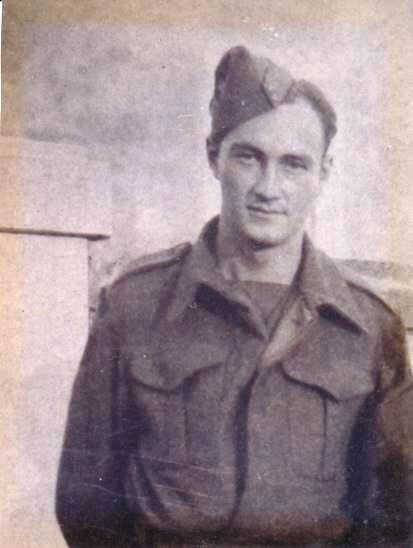
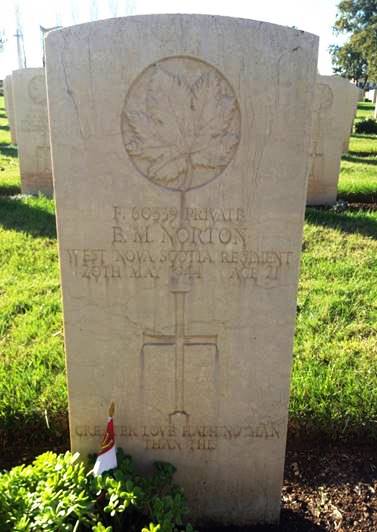
On The War Memorial Trail….. The WWII Soldier From Clarence Who Lost His Life During Operation Cannonshot

September 7, 2024. When Pieter has to choose which name on a photo wish list to research, we never know what to expect. Sometimes a name is chosen because of the location where the soldier came from, sometimes it’s because of a particular battle in which he died, or because the surname seems to be rare enough that any information found would be relevant….and might lead to a family member who has a photo.

..…A lion featured in an old TV program led to one successful photo search …..

Sometimes, word association helps us decide on a name to search.  That’s what happened when scanning the list of names of Nova Scotia soldiers, and I noticed that one soldier, Ronald ‘Ronnie’ Eugene SMITH, came from Clarence.  That reminded me of Clarence, the cross-eyed lion, from a TV program I watched as a child. 

Daktari was a children’s program that followed the work of Dr. Tracy, a veterinarian at the fictional Wameru Study Centre for Animal Behaviour in East Africa, his daughter Paula, his staff, and a cross-eyed lion named Clarence.

…That’s the soldier whose photo you need to look for next….” I told Pieter.  The look on his face when I told him why was priceless!  But, Pieter began his research and quickly found a great-niece, Jennifer Wallis, the granddaughter of Ronnie’s only sibling – his brother Allison, who confirmed that yes, the family had a photo of the soldier.  A few months later, Jennifer wrote to let us know that photos were “… found after searching many boxes at my father’s home….

Before telling the story of the Canadian soldier from Clarence, Nova Scotia, take a look at the opening sequence from Daktari…

..…Ronnie enlisted in January 1944 …..

Screenshot 2024-09-02 at 12-28-34 Clarence · Annapolis County NS B0S 1C0

Ronald ‘Ronnie’ Eugene Smith was born in Clarence, Annapolis County, Nova Scotia.  (Map source: Google)

Ronald ‘Ronnie’ Eugene SMITH was born in Clarence, Nova Scotia on August 28, 1925, the son of Floyd Murdock and Ruby Gertrude (nee Palmer) Smith.  When he enlisted with the No. 6 District Depot in Yarmouth, Nova Scotia on January 3, 1944, he stated that he had left school after 2 years of high school and was working on his parents’ farm in Bridgetown, Nova Scotia as a farm hand.

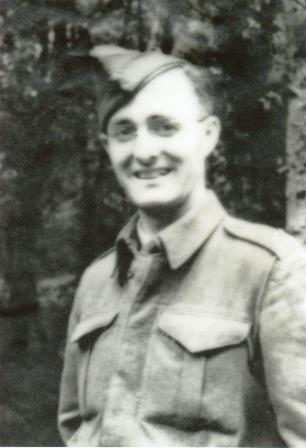
Ronnie Smith colourized improved_photo(44)

Ronald ‘Ronnie’ Eugene Smith. (Photo courtesy of Donnie Smith. Photo colourization by Pieter Valkenburg)

On January 4, 1944, he was sent to the No. 6 Depot in Halifax, Nova Scotia for basic training, and then on January 14, 1944 to No. 60 Canadian Infantry (Basic) Training Centre (CIBTC) in Yarmouth, Nova Scotia, where his father, Captain Floyd Smith, was a trainer at this centre.

From February 11, 1944 until April 17, 1944, Ronnie was in and out of Yarmouth Military Hospital.  While he was recuperating he worked as a clerk in the Quartermaster stores between March and May 1944, after which he returned to general duties.

On July 30, 1944, Ronnie was transferred to A14 Canadian Infantry Training Centre (CITC) in Aldershot, Nova Scotia for further training.  He received embarkation leave, from September 23 to October 6, 1944, the last chance he had to see his family.

….Ronnie left Canada for overseas service….

On November 25, 1944, Ronnie left for Great Britain, part of a group to provide reinforcements to the Canadian Army in the field.  Upon arrival on December 6, 1944, he was assigned to No. 3 Canadian Infantry Training Regiment (CITR). 

Ronnie continued receiving further training until January 23, 1945, when he left the United Kingdom for Italy, as part of the X-4 Reinforcements of the 1st Infantry Battalion, arriving on February 7, 1945.

As he arrived at No. 3 CITR a few days after Frank GALLANT of Prince Edward Island, perhaps the two Maritime soldiers had a chance to meet. The two men also left the United Kingdom for Italy on the same day. Once in Italy, although they were in the same location, their paths diverged as they were assigned to different regiments. (See https://onthewarmemorialtrail.com/2024/06/30/on-the-war-memorial-trail-the-wwii-soldier-from-mount-carmel-killed-during-the-liberation-of-posterenk/)
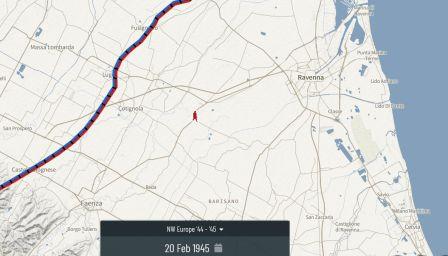
Screenshot 2024-09-07 at 11-06-35 Project '44

The West Nova Scotia Regiment was near Rossi, indicated by the soldier in the centre of the map, on February 20, 1945.  (Map source: Project ‘44)

On February 20, 1945, Ronnie was transferred to the West Nova Scotia Regiment, joining them north of Rossi (Russi), part of a group of reinforcements, at the tail end of the Italian Campaign. (See https://en.m.wikipedia.org/wiki/Italian_campaign_(World_War_II))
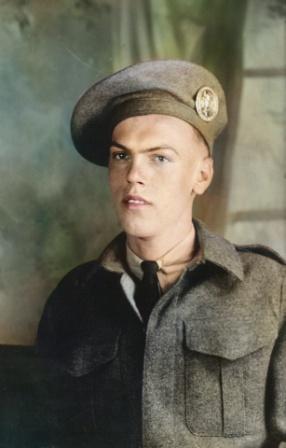
Ronnie Smith colourized improved_photo(43)

Ronald ‘Ronnie’ Eugene Smith joined the West Nova Scotia Regiment in February 1945. (Photo courtesy of Donnie Smith. Photo colourization by Pieter Valkenburg)

On March 20, 1945, he left Italy at the port in Livorno as part of Operation Goldflake, arriving in Marseilles, France two days later.  Operation Goldflake was the codename for moving troops from Italy to North-West Europe.  (See https://en.wikipedia.org/wiki/Operation_Goldflake)

After one night of rest, the Battalion left Marseilles for Belgium, arriving in Berlaer on March 28, 1945. 

….Ronnie was part of Operation Cannonshot….

On April 4, 1945, the Battalion arrived at a concentration area in the Reichswald Forest in Germany, where they stayed briefly for training in preparation for Operation Cannonshot.  The 49th British Division was to clear Arnhem in The Netherlands, and launch the 5th Canadian Armoured Division on a drive northwards. The 1st Canadian Division would bridgehead the IJssel River and head west to meet them.

On April 10, 1945, they moved to Hummelo, The Netherlands. Operation Cannonshot began on April 11, 1945, with Allied troops preparing to cross the IJssel River the following night and then advance towards Apeldoorn, The Netherlands. (See https://www.liberationroute.com/stories/190/operation-cannonshot)

The Battalion moved to the Royal Canadian Regiment area at Zutphen, just across the IJssel River on the night of April 12 into 13, 1945, crossing it at 2:30 am and establishing its Tactical Headquarters.

On April 13, 1945 the Regiment was committed to a breakout of a bridgehead on the IJssel River. According to the war diary for that day, the attack was expected to begin at 8:30 am “…but the attack did not begin until approximately 1100 hours, at which time ‘A’ Company, supported by tanks, started for their first objective.  They were barely on their way when, due to an artillery concentration called down by Carleton & York Regiment, it was necessary to hold up until 1130 hours….

By noon, ‘A’ Company was making good progress allowing both ‘A’ and ‘C’ Companies to advance on a two-company front. Progress slowed as resistance increased and ended at 7:45 pm.

….Ronnie lost his life near Zutphen….

On April 14, 1945, Tactical Headquarters was established in Zutphen area early in the morning. Companies sent out reconnaissance patrols during the rest of the night and into the early morning hours. The battalion was now in brigade reserve with the Royal 22nd Regiment on the left and the Carleton & York Regiment on the right. The Battalion attacked at 3:30 pm through the Royal 22nd Regiment to clear the woods on both sides of the highway leading to Apeldoorn but was held up by enemy fire and the attack was postponed.

At some point on April 14, 1945, Ronnie lost his life.  He was only 19 years old.  He was killed near a house beside a wooded area, and was initially buried in a field behind a house on the crossroads near Wilp/Achterhoek, The Netherlands. 

Henk Vincent, a volunteer at the Canadian War Cemetery in Holten, explained that “only from December 1945, when the construction of the cemetery in Holten was completed, did the final burial take place….

Ten zuid oosten van Apeldoorn(1)

Red marker shows temporary burial in Wilp/Achterhoek area southeast of Appeldoorn. (Map source: Google maps)

….Ronnie is buried in Holten…

After being exhumed from the temporary cemetery in Wilp/Achterhoek, Ronnie was reburied in the Canadian War Cemetery in Holten, The Netherlands on January 26, 1946.  When the cemetery was first opened, metal crosses were used to mark each grave.

Ronald E Smith - Marker in Holten

The original metal grave marker at the Canadian War Cemetery in Holten for Ronald ‘Ronnie’ Eugene Smith.  (Photo courtesy of Donnie Smith)


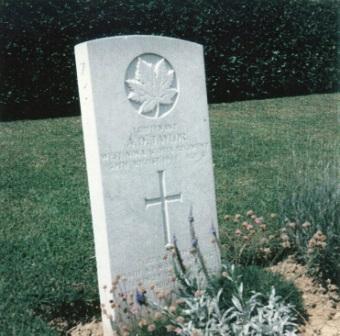
smith, ronald eugene gravestone photo from Holten Info Centre

Grave of Ronald ‘Ronnie’ Eugene Smith in the Canadian War Cemetery in Holten, The Netherlands.  (Photo courtesy of the Information Centre Canadian Cemetery Holten)

..…We met with Ronnie’s family …..

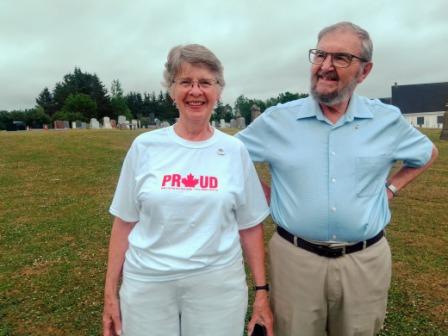
We love meeting family members, and were delighted when we had a chance to meet Jennifer Wallis and her husband Kevin at a restaurant in Enfield, Nova Scotia.

CIMG6571 Oct 25 2023 Kevin & Jennifer with Pieter in Enfield

Kevin and Jennifer Wallis with Pieter in Enfield, Nova Scotia.  (Photo credit: Daria Valkenburg)

Thank you to Jennifer and Kevin Wallis and Jennifer’s father Donnie Smith.  Do you have photos or information to share? Email Pieter at memorialtrail@gmail.com, comment on the blog, or tweet to @researchmemori1.

© Daria Valkenburg

….Want to follow our research?….

If you are reading this posting, but aren’t following our research, you are welcome to do so.  Our blog address: https://onthewarmemorialtrail.com/
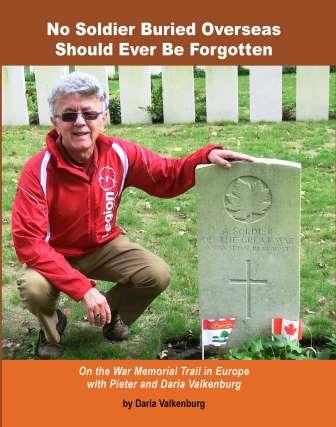
Front cover OnTheWarMememorialTrailinEurope4 countries, 6 weeks, 7,000 km – an unforgettable war memorial journey in Europe…. Daria’s book ‘No Soldier Buried Overseas Should Ever Be Forgotten‘ is available in print and e-book formats.  Net proceeds of book sales help support research costs and the cost of maintaining this blog. For more information see https://nosoldierforgotten.com/ 

You are also invited to subscribe to our YouTube Channel: On The War Memorial Trail With Pieter Valkenburg: https://www.youtube.com/channel/UCJ591TyjSheOR-Cb_Gs_5Kw

Never miss a posting!  Subscribe below to have each new story from the war memorial trail delivered to your inbox.

On The War Memorial Trail….. Atlantic Canada Remembers – Part 7

February 22, 2021. We continue to feature more of the photos submitted by Atlantic Canadians of soldiers buried overseas. Pieter is ensuring that every email is acknowledged, and that the photos of soldiers buried in The Netherlands will be forwarded to the appropriate cemetery for their digital archives.  Thank you to the various members of Royal Canadian Legions in Nova Scotia and New Brunswick for their help.

The volunteers at all three Canadian War Cemeteries in Holten, Groesbeek, and Bergen Op Zoom are now active, and Pieter has received wish lists for photos from all three cemeteries.  Submissions for soldiers buried in municipal cemeteries are being held until Pieter gets the go-ahead that those volunteers are active again.

Soldiers buried at the Canadian War Cemetery in Holten, The Netherlands

Ken Dennis of Yarmouth let us know about the Wartime Heritage Association website, which features some of the soldiers from the area who served in WW2.  One of the profiles, written by Flip Jonkman, was of a soldier on the photo wish list of the Canadian War Cemetery in Holten…. Brenton Leroy RINGER. (See http://wartimeheritage.com/whaww2ns2/wwii_ringer_brenton_leroy.htm)

Born on March 22, 1925 in Northfield, Nova Scotia, the son of Ralph and Alberta Ringer of Clementsport, he was an electrician’s helper when he enlisted, at age 18, with the North Nova Scotia Highlanders in Halifax on January 17, 1944.  He later transferred to the 10th Armoured Regiment on March 27, 1945, and lost his life on April 12, 1945 during the liberation of Heino, The Netherlands, when the Sherman tank he was in was hit on the road to Zwolle. 

There were 5 men in the tank, with one survivor.  The survivor knocked on the door of a nearby farmhouse to ask for help, the home of Flip Jonkman’s parents.  Flip was not born at the time, but always remembered the story, and in 2020, was instrumental in getting a memorial stone placed near the site of the attack.  (See the article in Dutch for more information: https://www.destentor.nl/raalte/vurige-wens-in-vervulling-voor-flip-jonkman-73-uit-heino-nu-gedenksteen-is-geplaatst~a694b86d/?referrer=https%3A%2F%2Fduckduckgo.com%2F)

Another of the names on the photo wish list for the Canadian War Cemetery in Holten was found on the Wartime Heritage Association website…. that of Louis Graham RICHARD. (See http://wartimeheritage.com/whaww2ns/wwii_richard_louis_graham.htm)

Born February 13, 1918, the son of Raphael Daniel and Mary Ann Richard of Londonderry, Nova Scotia, Louis was a store clerk before enlisting with the No 2 Canadian Armed Corps in Halifax on February 17, 1943 as a trooper.  On October 14, 1944 he was sent to the United Kingdom, and then on March 31, 1945 to Western Europe with the 9th Armoured Regiment (BC Dragoons).  

Louis was killed in action in The Netherlands during the Battle of Delfzijl Pocket on April 26, 1945, at the age of 27, and was temporarily buried in Wirdum in the province of Groningen, The Netherlands before being reburied in the Canadian War Cemetery in Holten. (For more information on this battle, see https://www.canadiansoldiers.com/history/battlehonours/northwesteurope/delfzijlpocket.htm)

Soldiers buried at the Canadian War Cemetery in Groesbeek, The Netherlands

Percy Clayton Cromwell photo only

Percy Clayton Cromwell.  (Photo submitted by Ken Dennis)

Ken Dennis submitted a photo of Percy Clayton CROMWELL, explaining that “…I am a member of the Yarmouth Branch 61 Legion…” After receiving a wish list of photos from Pieter, he noticed one name from Yarmouth, Nova Scotia.  “…Having been shown this email, I decided to trace his local roots…

…He was a labourer, then for CP out of the Halifax area and upon enlisting moved his family to Yarmouth where they grew up….” CP refers to the Canadian Pacific Railway.

Percy was born in Yarmouth on February 12, 1914, the son of James Alfred and Annie May Cromwell.  He enlisted with the West Nova Scotia Regiment in Aldershot, Nova Scotia on May 14, 1940.

Percy was with the Royal Canadian Electrical and Mechanical Engineers when he drowned in The Netherlands on February 8, 1945.  He’d been on guard duty along a canal in the Dutch province of Brabant on a very dark, windy, and rainy night, and it would have been very easy to lose his bearings and accidentally fall into the canal.  His body was not found until March 12, 1945.  He left behind a wife, Lillian Beryl, and four children. 

Frank Lewis Libby photo only

Francis Lewis Libby. (Photo from the New Brunswick Military Recognition Booklet)

Kent Caldwell, a member of the Royal Canadian Legion in New Brunswick, sent an entry on Francis ‘Frank’ Lewis LIBBY from one of the annual issues of the New Brunswick Military Recognition Booklet, explaining that the photo was a copy from a newspaper clipping.  The entry stated that “…Francis served with the Calgary Highlanders in England and Northwest Europe.  He was killed in The Netherlands in 1945…” 

Francis was born February 21, 1918 in Milltown, New Brunswick, the son of Clifford and Mary Christine Libby.  Before enlisting on July 25, 1941, he worked at the Canadian Cottons Plant in Milltown.  On October 4, 1941, he married Dorothy Louise Caswell.  He and Dorothy had a son Francis Brian in 1944 while he was overseas in Europe, and where he transferred to the Calgary Highlanders in September 1944. Francis lost his life on January 5, 1945 after being killed along the Dutch-German border. He was temporarily buried in Nijmegen, before his reburial, on July 30, 1945, in Groesbeek.

Hiram Albion Lord photo only

Hiram Albion Lord. (Photo from the New Brunswick Military Recognition Booklet)

Kent Caldwell, a member of the Royal Canadian Legion in New Brunswick, also sent an entry on Hiram Albion LORD from one of the annual issues of the New Brunswick Military Recognition Booklet, explaining that the photo was a copy from a newspaper clipping.  The entry stated that “…Hiram served with the North Shore (New Brunswick) Regiment during the Second World War and was killed in action in 1945…” 

Born November 7, 1924 in Lords Cove, Deer Island, New Brunswick, the son of Minnie Smith, Hiram was a fisherman before enlisting on November 4, 1943 and served in Canada until his arrival in the United Kingdom on July 21, 1944.   On August 17, 1944 he went with his unit to Western Europe and lost his life on January 8, 1945 near Nijmegen, The Netherlands.

Stanley Spray

Stanley Spray. (Photo submitted by Royal Canadian Legion Branch #20 in Digby)

Donna Flaherty, President of Royal Canadian Legion Branch #20 in Digby, Nova Scotia, submitted a photo of Stanley SPRAY, writing “…This picture hangs on our Memorial Wall….

Born April 24, 1913 in Nottinghamshire, England, the son of Edgar and Edith Spray, Stanley immigrated to Canada, and settled in Digby, Nova Scotia, where he ran a small farm and worked for J. J. Wallis as a printer before his enlistment on July 6, 1940 with the 52nd Anti-Tank Battery.  He was married to Alda May and the father of two daughters, Jean Carolyn and Joan Carol. 

He received several promotions, and was a battery quartermaster sergeant with the Royal Canadian Artillery when WW2 ended.  Stanley lost his life in a tragic vehicle accident near Nijmegen, The Netherlands on July 23, 1945, when he was catapulted out of the back of an army truck that collided with an oncoming military vehicle.

Thank you to Kent Caldwell, Ken Dennis, and Donna Flaherty for sharing photos and anecdotes.  Atlantic Canadians remember their loved ones who are buried overseas. If you have a higher resolution photo of Percy Clayton Cromwell, Frank Lewis Libby, or Hiram Albion Lord, please send it in to us.

More photos and stories in Atlantic Canada Remembers – Part 8! To share photos or information, please email Pieter at memorialtrail@gmail.com, or comment on the blog. 

© Daria Valkenburg

…..Previous postings in the Atlantic Canada Remembers series….

Missed the previous postings in this series? See:

…..Want to follow our research?….

If you are reading this posting, but aren’t following the blog, you are welcome to do so.  Our blog address: https://onthewarmemorialtrail.com/

Front cover OnTheWarMememorialTrailinEurope4 countries, 6 weeks, 7,000 km – an unforgettable war memorial journey in Europe…. Daria’s book ‘No Soldier Buried Overseas Should Ever Be Forgotten‘ is available in print and e-book formats.  Net proceeds of book sales help support research costs and the cost of maintaining this blog. For more information see https://nosoldierforgotten.com/

You are also invited to subscribe to our YouTube Channel: On The War Memorial Trail With Pieter Valkenburg: https://www.youtube.com/channel/UCJ591TyjSheOR-Cb_Gs_5Kw

Never miss a posting!  Subscribe below to have each new story from the war memorial trail delivered to your inbox.

On The War Memorial Trail…..The WWII Soldier Wounded In Italy Who Came Home

February 1, 2021.  In researching soldiers from the South Shore area of Prince Edward Island, we’ve told many stories about those who didn’t survive, but of course many soldiers did come back home.  One soldier that returned was Gordon James ROGERSON, whose niece Barb Clement brought to our attention.

 “…Uncle Gordon was my mother’s brother….” she told us. “…There were 9 children in the family. My mother was third youngest, then Gordon was next, and Uncle Keith was the youngest…

Born on February 13, 1920 in Tryon, Barb explained that “…his parents, my grandparents, were Maude (nee MacKay) and Reuben Rogerson of Tryon and later Summerside…

Gordon Rogerson

Gordon James Rogerson.  (Photo submitted by Barb Clement)

After leaving school at age 15, Gordon worked as a farm labourer and a machine operator in a wood finishing mill before enlisting with the PEI Highlanders in Summerside on February 23, 1940.  On July 15, 1940, he boarded a ship in Halifax and soon was on his way to the United Kingdom as part of the 2nd Canadian Division Infantry Reinforcement Unit.

In December 1941 he was transferred to the 1st Canadian Division Infantry Reinforcement Unit, and then on January 15, 1942 he was transferred to the West Nova Scotia Regiment.  J. Ron Stonier, President of the West Nova Scotia Regimental Association explained that “…he would have trained with them and performed defensive duties until they left for the Mediterranean in late June ‘43 for the invasion of Sicily on 9 July ‘43…

On August 2, 1943 Gordon was wounded in Sicily.  Ron Stonier wrote that August 2, 1943 was “…..the day the West Novas occupied Mount Criscana which they called “Whistling Hill….

After recovering, he rejoined the Regiment, but was hurt again on December 4, 1944 in Italy, a day “when the West Novas were in action on the Ortona Front….”  Gordon’s daughter, Gloria Rogerson, wrote, in 2000, that her father “…had lost his leg after detecting and digging out a mine and stepping in the hole.  Another mine, planted below the first, had gone off….

A letter sent by Chaplain W.G. Phillips sent to his parents explained that Gordon had arrived at a casualty clearing station and noted that “… This afternoon he was injured by an enemy mine, and I regret to say that as a result, his left foot had to be amputated above the ankle.  He also received a flesh wound in the forearm…..

Chaplain Phillips noted the positive attitude that Gordon displayed, writing that “…He is most cheerful and resigned to the loss of his foot.  As he himself stated ‘I am thankful to be here safely’…. Your son is receiving the best of medical and nursing care….

In February 1945 Gordon was transferred to 19th Canadian General Hospital at Marston Green, near Birmingham, UK. Built as a series of huts, originally as a base for the Royal Canadian Air Force early in WW2, this hospital had beds for about 700 patients. After the war it became a maternity hospital.

Marston Green Maternity Hospital as a Canadian War Hospital

19th Canadian General Hospital, Marston Green, in Birmingham, UK.  (Photo found on http://www.birminghamforum.co.uk)

Gordon was not long at the 19th Canadian General Hospital as in March 1945 he was sent back to Canada and on March 21, 1945 was admitted to Camp Hill Military Hospital in Halifax, Nova Scotia.

Exif_JPEG_420

Barb Clement with her husband Steve.  (Photo credit: Daria Valkenburg)

While at Camp Hill, Barb Clement recalled being told that Gordon “…had gangrene in his leg…”  Likely he had a second amputation as his leg was ….amputated to just below the knee…” and not at the ankle as per the letter written by Chaplain Phillips.

He was officially discharged from the Canadian Army on May 1, 1945.  Over the next decades Gordon married Madeline (Peggy) Fleet and raised his children.  He became a member of the War Amputees Association of Canada and was involved with Alcoholics Anonymous for 21 years, ending with his death on February 10, 1993, at the age of 72 years.

Remembered by his family as a cheerful man who loved to joke around, Gordon Rogerson was a WWII veteran who was able to return home and live his life, surrounded by family and friends.

Thank you to Barb Clement, Gloria Rogerson, and Ron Stonier of the West Nova Scotia Regimental Association for providing information on Gordon Rogerson.  If you have information or photos to share about soldiers from PEI South Shore area, please contact Pieter at memorialtrail@gmail.com or comment on the blog.

© Daria Valkenburg

….Want to follow our research?….

If you are reading this posting, but aren’t following our research, you are welcome to do so.  Our blog address: https://onthewarmemorialtrail.com/

Front cover OnTheWarMememorialTrailinEurope4 countries, 6 weeks, 7,000 km – an unforgettable war memorial journey in Europe…. Daria’s book ‘No Soldier Buried Overseas Should Ever Be Forgotten‘ is available in print and e-book formats.  Net proceeds of book sales help support research costs and the cost of maintaining this blog. For more information see https://nosoldierforgotten.com/ 

You are also invited to subscribe to our YouTube Channel: On The War Memorial Trail With Pieter Valkenburg: https://www.youtube.com/channel/UCJ591TyjSheOR-Cb_Gs_5Kw

Never miss a posting!  Subscribe below to have each new story from the war memorial trail delivered to your inbox.

On The War Memorial Trail….. The WWII Soldier Killed In Action While Trying To Break The Gothic Line In Italy

4452150 Happy New Year

This first posting for 2021 tells the last of the stories of the WWI and WWII servicemen listed on the Cenotaph outside the Borden-Carleton Legion.  This blog will continue to provide updates on their stories, and will also continue to tell stories of soldiers from the South Shore area of Prince Edward Island who returned home, and those who lost their lives in war but are not on the Cenotaph.  It will also feature more stories of WWII soldiers from Atlantic Canada who are buried in The Netherlands, a research project that Pieter is currently involved in.  Pieter and I thank you for your support as these stories have been researched, and hope that you continue with us on this expanded journey of remembrance along the war memorial trail….

January 2, 2021.  Four WWII soldiers on the Cenotaph outside the Borden-Carleton Legion lost their lives in Italy…. George Alfred DUNN of the Carleton & York Regiment, Albert Eugene ARSENAULT of the Cape Breton Highlanders, Ernest Murray NORTON of the West Nova Scotia Regiment, and Arnold Dudley TAYLOR, also of the West Nova Scotia Regiment, the subject of this posting.

Arnold Taylor photo from Barbara Simester

Arnold Dudley Taylor.  (Photo courtesy of Barbara Simester)

Arnold Dudley Taylor was born on July 13, 1913 in Charlottetown, the son of Wilfred F. Taylor and Beatrice Holbrook.  His father was a pharmacist and owned a pharmacy in Kensington, and Arnold Dudley followed in his footsteps, after graduating from Mount Allison University in New Brunswick. 

He was also an avid golfer, winner of Island Golf Championship at the age of 19. His daughter, Barbara Simester, noted that “… The Taylors were very athletic. Father won a lot of trophies and played at the Belvedere Club in Charlottetown….”  In addition to sports, Barbara explained that he was a member of the church choir. “… Father was a baritone in the United Church …

Beginning July 3, 1928 he was a member of the PEI Light Horse Militia, re-engaging every 3 years until his enlistment in Halifax with the West Nova Scotia Regiment for active duty service on July 13, 1940, with the rank of Lieutenant.  On May 3, 1941, he married Annalea MacDonald, a teacher in the North Tryon school.

In February 1942, daughter Barbara was born, and shortly afterwards Arnold Dudley was sent to the Debert Military Camp in Nova Scotia and transferred to the North Nova Scotia Highlanders.  By May 1942 he was in the United Kingdom.  In January 1943, he was transferred back to the West Nova Scotia Highlanders, while still in the United Kingdom.

Arnold Dudley was sent to Italy on October 27, 1943, part of the contingent of reinforcement troops.  The Regiment had landed in Sicily in June 1943, and had been in mainland Italy since September 3, 1943, as part of the 3rd Infantry Brigade, 1st Canadian Infantry Division. 

Like Albert Eugene ARSENAULT of the Cape Breton Highlanders, he was killed in action on August 30, 1944, during the Battle of the Gothic Line. The Gothic Line was a German defence line in Northern Italy. 

An article by Mark Zuelke in the Canadian Encyclopedia explains what happened that day…. “…on 30 August, two regiments of the 1st Infantry Division — the West Nova Scotias and the Princess Patricia’s Canadian Light Infantry (PPCLI) — attacked on the right, while 5th Division’s Perth Regiment and Cape Breton Highlanders struck to the left. The West Novas were caught in a minefield and suffered heavy casualties…”  (See https://www.thecanadianencyclopedia.ca/en/article/battle-of-the-gothic-line)

Arnold Dudley was buried in the Montecchio War Cemetery in Italy, as was Arsenault.

Grave of Arnold Taylor from Barbara Simester

Grave of Arnold Dudley Taylor in Montecchio War Cemetery.  (Photo courtesy of Barbara Simester)

When we met with Arnold Dudley’s daughter Barbara a few years ago, she explained that after her father’s death, she and her mother moved from Kensington to Crapaud, and later to Hampton. Barbara attended Grade 1 in Hampton and recalled that they lived next to the school with a family named Cameron.

Barbara and her mother later moved to Kingston, Ontario, where Barbara studied to be a nurse, and where she met her husband. 

In 1956 the pharmacy in Kensington had been sold to the Champion family and Arnold Dudley’s parents moved to Calgary. 

CIMG9464 Barbara Taylor with Pieter and Photo Arnold Taylor

Pieter with Barbara Simester in Ottawa. (Photo credit: Daria Valkenburg)

Thank you to Barbara Simester for sharing photos and anecdotes.  If you have recollections of Lt Arnold Dudley Taylor, please email Pieter at memorialtrail@gmail.com, comment on the blog, or tweet to @researchmemori1

© Daria Valkenburg

….Previous postings on Islanders killed in Italy….

To read the previous postings on George Alfred Dunn, Ernest Murray Norton, and Albert Eugene Arsenault, see:

George Alfred DUNN:

Ernest Murray NORTON:

Albert Eugene ARSENAULT:

….Want to follow our research?….

If you are reading this posting, but aren’t following our research, you are welcome to do so.  Our blog address: https://onthewarmemorialtrail.com/

4 countries, 6 weeks, 7,000 km – an unforgettable war memorial journey in Europe…. Daria’s book ‘No Soldier Buried Overseas Should Ever Be Forgotten‘ is available in print and e-book formats.  Net proceeds of book sales help support research costs and the cost of maintaining this blog. For more information see https://nosoldierforgotten.com/ 

You are also invited to subscribe to our YouTube Channel: On The War Memorial Trail With Pieter Valkenburg: https://www.youtube.com/channel/UCJ591TyjSheOR-Cb_Gs_5Kw

Never miss a posting!  Subscribe below to have each new story from the war memorial trail delivered to your inbox.

On The War Memorial Trail…..Commemorative Coins From West Nova Scotia Regimental Association

May 12, 2020.  Two names on the Cenotaph outside the Borden-Carleton Legion were in the West Nova Scotia Regiment during WWII:  Ernest Murray NORTON and Arnold Dudley TAYLOR.  Both lost their lives in Italy.  Norton’s story has been previously told in this blog (See The Last Valentine From A WWII Soldier), Taylor’s is still being researched.

Left: Ernest Murray Norton (Photo courtesy Harry Norton family collection) Right: Arnold Dudley Taylor (Photo courtesy Barbara Simester family collection)

Recently, Ron Stonier, President of the West Nova Scotia Regimental Association, let us know about a commemorative coin produced “for each of the 359 West Nova soldiers killed overseas. When someone joins the Regimental Association and pays their annual dues, we give one of our coins as a symbol of membership. On the front is our cap badge, and on the back is an image of our monument in Camp Aldershot, NS, flanked by the badges of the two regiments which were amalgamated in 1936 to form the West Nova Scotia Regiment. Below the monument is the name, rank, serial number, date of death, and age at death if available.

Stonier went to note that “We attempt to find the families of the soldiers who died to give them the coin representing their loved one. So far, we have been able to connect 40 coins with family members, and it’s a very satisfying feeling to do so.  We have fewer than 100 coins left, but we do have one for each of for Lt Taylor and Pte Norton.”  He kindly sent images of the coins.

Lt AD Taylor

Commemorative coin for Arnold Dudley Taylor.  (Photo courtesy West Nova Scotia Regimental Association)

Pte EM Norton

Commemorative coin for Ernest Murray Norton.  (Photo courtesy West Nova Scotia Regimental Association)

We have contacted the families of Norton and Taylor to let them know about the coins.  If you have a relative who was in the West Nova Scotia Regiment, and would like more information on the commemorative coin or joining the association, please visit their website at https://www.wnsr.ca/ra.

We’re delighted to hear from various archives and regimental associations, and thank Ron Stonier for letting us know about the commemorative coins. Pieter continues to research Islanders who served in WWI and WWII. If you have photos or information to share on Ernest Murray Norton or Arnold Dudley Taylor, please contact Pieter at memorialtrail@gmail.com, comment on the blog, or tweet to @researchmemori1

© Daria Valkenburg

….Want to follow our research?….

If you are reading this posting, but aren’t following our research, you are welcome to do so.  Our blog address: https://onthewarmemorialtrail.com/

Front cover OnTheWarMememorialTrailinEurope4 countries, 6 weeks, 7,000 km – an unforgettable war memorial journey in Europe…. Daria’s book ‘No Soldier Buried Overseas Should Ever Be Forgotten‘ is available in print and e-book formats.  Net proceeds of book sales help support research costs and the cost of maintaining this blog. For more information see https://nosoldierforgotten.com/ 

You are also invited to subscribe to our YouTube Channel: On The War Memorial Trail With Pieter Valkenburg: https://www.youtube.com/channel/UCJ591TyjSheOR-Cb_Gs_5Kw

Never miss a posting!  Subscribe below to have each new story from the war memorial trail delivered to your inbox.

On The War Memorial Trail…..The Last Valentine From A WWII Soldier

February 13, 2019. When family members have saved information about their loved ones who died, and are willing to share, it warms our hearts and makes Pieter’s research into the names on the Cenotaph outside the Borden-Carleton Legion that much more relevant.  So, when Harry Norton invited us to come to his home in Charlottetown to talk about his older brother, WWII soldier Ernest Murray NORTON, we didn’t hesitate.

Harry Norton & Pieter

Harry Norton, left, with Pieter Valkenburg. (Photo credit: Daria Valkenburg)

Ernest was born April 18, 1924 in Crapaud, the son of Harry Vernon Norton and Hazel Reid.  He enlisted on July 4, 1940 with the Prince Edward Highlanders and later was transferred into the West Nova Scotia Regiment.  In 1942 he left Canada for England.

Ernest Murray Norton

Ernest Murray Norton. (Photo credit: Harry Norton family collection)

Among the treasures saved by Harry Norton were letters that give a picture of the man behind the soldier’s uniform.  In a May 3, 1944 letter from Italy, written to his younger brother Fred, Ernest gave a summary of his travels.  Because of censorship he couldn’t give any details, but he explained that from England he had “gone to North Africa, then to Sicily, to Italy, went to hospital in Malta by plane, returned back to North Africa, and then again to Italy.” The reference of going to hospital by plane to Malta was because he’d been wounded.   In the same letter, he also thanks Fred for giving their mother a Valentine’s card from him.


The last Valentine’s card to his mother, lovingly made on Ernest Norton’s behalf by his brother Fred.  (Photo credits: Harry Norton family collection)

Unfortunately, it was the last Valentine’s card from Ernest.  Shortly after the letter was written, Ernest was killed, and is now buried at Cassino War Cemetery in Italy.

On June 2, 1944, Chaplain Herlaut of the West Nova Scotia Regiment wrote to Mrs. Norton about her son’s death.  He explained that Ernest and another signaller were instantly killed on May 20, 1944 while operating their signal set. He wrote: “I was at the scene a few moments afterwards and buried both boys together.  I was able to return a few days ago and erected a white cross to mark their graves.

Original wooden cross Norton

Original wooden cross placed by Chaplain Herlaut in 1944. (Photo credit: Harry Norton family collection.)

Norton gravestone

Current gravestone of Ernest Norton at Cassino War Cemetery in Italy. (Photo Credit: Canadian Virtual War Memorial at http://www.vetarans.gc.ca.)

Ernest Norton was a lucky man never to have been forgotten by his loved ones, with so much family information about him!  Do you have photos or information to share on any of the soldiers discussed in this and previous blog postings?  If so, please let us know. We still are in need of photos.  You can send an email to memorialtrail@gmail.com, comment on the blog, or tweet to @researchmemori1

© Daria Valkenburg

….Want to follow our research?….

If you are reading this posting, but aren’t following our research, you are welcome to do so.  Our blog address: https://onthewarmemorialtrail.com/

Front cover OnTheWarMememorialTrailinEurope4 countries, 6 weeks, 7,000 km – an unforgettable war memorial journey in Europe…. Daria’s book ‘No Soldier Buried Overseas Should Ever Be Forgotten‘ is available in print and e-book formats.  Net proceeds of book sales help support research costs and the cost of maintaining this blog. For more information see https://nosoldierforgotten.com/ 

You are also invited to subscribe to our YouTube Channel: On The War Memorial Trail With Pieter Valkenburg: https://www.youtube.com/channel/UCJ591TyjSheOR-Cb_Gs_5Kw

Never miss a posting!  Subscribe below to have each new story from the war memorial trail delivered to your inbox.