On The War Memorial Trail…..Remembrance Week 2025 – The WWII Soldier Who Was Never Forgotten By His Girlfriend And Her Family

November 15, 2025.  Sometimes Pieter helps the Canadian War Cemetery in Groesbeek, The Netherlands to find photos of a few soldiers for which research had already been done, but no photo could be found.  He’s found that it’s almost as much work as it is do a complete research project on a soldier, as there is a reason photos aren’t readily available – they can be very difficult to find!

My father was from Ukraine, so the search for soldiers with a Ukrainian heritage is a priority when Pieter gets a photo wish list, which is why one of the soldiers whose photo search he undertook was that of Peter HYDICHUK of Theodore, Saskatchewan.  Born April 12, 1917, Peter was the son of Alexander and Annie (nee Procupuik) Hydichuk, who had immigrated to Canada in 1903 from what today is part of Western Ukraine. (You can read Jim Little’s story about Peter here: https://www.facestograves.nl/LifeStories/HYDICHUK%20Peter-JLE-bio-EN.pdf )

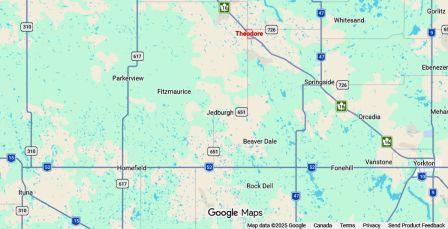
Theodore is a village located on the Yellowhead Highway, in southeastern Saskatchewan. (Map source: Google maps)

….The search for a photo of Peter Hydichuk seemed doomed for failure….

At first, it seemed as though the search for a photo of Peter would not take long, as he had many siblings.  Besides himself, three of his brothers also served during WWII: Nick, John, and Matt. 

Matt, who was married and the father of two daughters, was killed in France on August 23, 1944, aged 29, while serving with the South Saskatchewan Regiment, and is buried in Bretteville-Sur-Laize Canadian War Cemetery in France, 14 km south of Caen.

Peter also served in the South Saskatchewan Regiment, and died the following year, on March 31, 1945, in Germany.  Nick and John survived the war.

At the end of January 2024, Pieter was in contact with one of Matt’s daughters, Pam Neilson, who lives near Birmingham, Alabama. Pam did her best, getting in touch with various family members in Canada, but with no success.  She sadly reported to Pieter that the family threw away the photos.      

When no other avenues of research turned up a photo, we reluctantly placed his name on the Cold Case List. Sometimes, that has resulted in a photo being found by someone who saw the name and could help with a photo or information. (See https://onthewarmemorialtrail.com/our-cold-cases/)

….The Cold Case List led to a photo….

Just as Remembrance Day 2025 came around the corner, we received an email from Garry Bodnaryk, who had seen Peter’s name on the Cold Case List!  “…I came across your site today while searching for Peter Hydichuk from Theodore, Saskatchewan, Canada. The Hydichuks were neighbours of my grandparents, and my mother dated Peter until he was killed. … I’m glad that people like you are working to put faces to names, and helping to keep the memory of these soldiers alive….

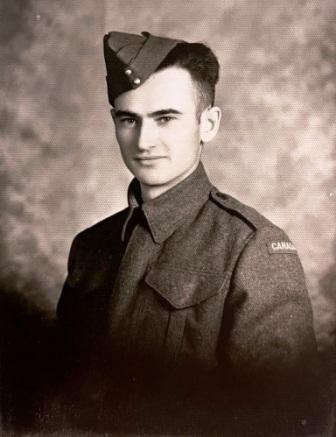
Peter Hydichuk. (Photo courtesy of Garry Bodnaryk)

Wow!  Garry not only made our week, he shared how much Peter’s memory meant to his mother, and therefore to her family, even long after she passed away.  “Her maiden name was Anne Polowick. The Polowicks were friends and neighbours of the Hydichuks, and attended the same church and school in the area.  My mother died almost 50 yrs ago, but she had always had Peter’s picture in her purse. My late father always thought it was sweet that she did. I kept the photos as they meant a lot to her….

Anne (nee Polowick) Bodnaryk with one of her cousins.  (Photo courtesy of Garry Bodnaryk)

….Anne and her family never forgot Peter….

Garry noted that his mother “was the key figure in saving the photo, and in me even knowing who Peter was…

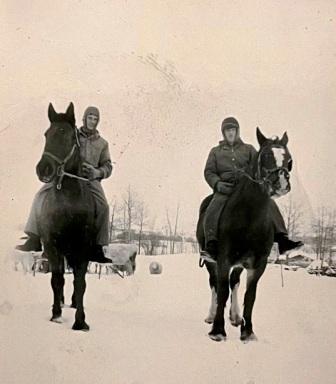
Peter (left) with a neighbour on horseback. (Photo courtesy of Garry Bodnaryk)

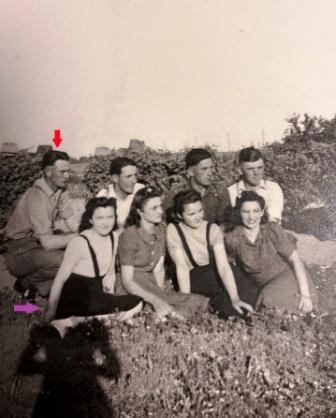
Happier days before WWII.  Peter Hydichuk (red arrow) and Anne (nee Polowick) Bodnaryk (purple arrow). (Photo courtesy of Garry Bodnaryk)

Garry included a photo that included both Peter and Anne.  “….My cousin confirmed that the man on the left is Peter Hydichuk. My mother is on the left, in front of him. I believe all the men served in the army during the war (my uncle next to Peter did). Other family members, and neighbours, are in the photo…

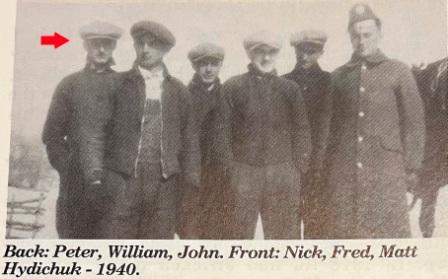
A photo of the Hydichuk brothers, which Garry was kind enough to send, was in the ‘Theodore and District History’ book, which had a limited printing in the 1980s. 

Photo of the Hydichuk brothers in 1940 from the ‘Theodore and District History’ book.  Peter identified by red arrow.

…. Peter was killed near the German border….

On March 29, 1945 the South Saskatchewan Regiment arrived in Bienen, Germany, taking over from the Highland Light Infantry following the Battle of Bienen on March 25. The following day, the Regiment moved towards Gendringen, located in The Netherlands near the German border. 

Per the March 30, 1945 war diary entry of the South Saskatchewan Regiment, a three Phase attack for the 6th Canadian Infantry Brigade was set in place to “….capture the line from Terborg to Etten to Ziek…”  Phase I was to be carried out by “….(1) Les Fusiliers Mont-Royal attacking Wieken, (2) 8 Canadian Recce Regiment…” to take over the position currently held by the “….Camerons of Canada in Netterden….” and then “…(3) on consolidation of Les Fusiliers Mont-Royal, Camerons of Canada to take out Veldhunten. This completes Phase I….”   

The South Saskatchewan Regiment was held in reserve until Phase II, when it was ordered to capture Etten. Phase III called for the 6th Canadian Infantry Brigade to “….cross the Oude IJssel River for the purpose of taking the town of Terborg….

However, the plan for carrying out Phase III of the 6th Canadian Infantry Brigade was initially cancelled that evening.  “…At 2115 hours the plan was cancelled owing to the Camerons of Canada failing to take Veldhunten…” 

A new plan was made an hour later.  “… ‘A’ Company to move to Gendringen…” and take up a position.  “… ‘B’ Company to move at 2315 hours….and send fighting patrol….passing through ‘A’ Company. ‘C’ Company to move at 2345 hours…. ‘D’ Company to move at 2400 hours…4 Platoon to send 1 section of Wasps under command of ‘A’ Company and 1 section to ‘B’ Company….

Fighting continued throughout the night of March 30/March 31. Gendringen was liberated by mid-afternoon of March 31, 1945, in spite of heavy enemy shelling. 

The war diary for March 31, 1945 recorded that “…at 1430 hours the casualty reports from the Companys were turned in to Command Post.  They were 1 officer and 14 other ranks wounded and 3 other ranks killed….” 

Peter Hydichuk was one of the fatal casualties that day, killed in action at the age of 27.  Per Maarten Koudijs, an amateur researcher in the Gendringen area, and author of ‘Tussen Grens En Hoop’, he was “killed near Alofs’s house on the Tappenweg in Etten….”  (Translated from the original Dutch) 

In addition to Peter, Maarten wrote that the other casualties were James Joseph MALONEY and William SERNOWSKI.

One of the severely wounded, Michael Joseph MACDERMOTT, was transferred to the Canadian General Hospital in England, where he died on August 5, 1945.

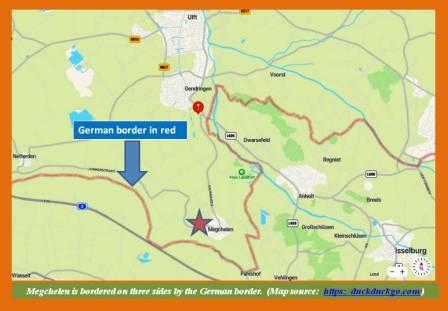
….Peter was temporarily buried in Megchelen….

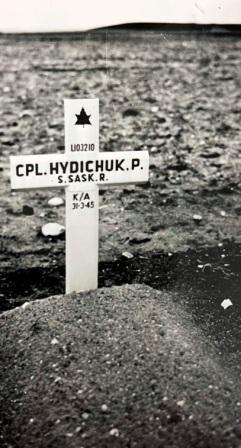
Peter was temporarily buried on the farmland of A. Friesen in Megchelen, at the end of a row of 18 burials.

Temporary grave of Peter Hydichuk in Megchelen. (Photo courtesy of Garry Bodnaryk)

Garry had one more story to relate.  “…In talking to one of my cousins, I found out that my mother’s father was at the train station (which had the telegraph office) when the news of Peter’s death came. My grandfather is the one that took the telegram and, stopping at home to get his bible, proceeded to the Hydichuk farm to break the news to the family….

….We were in Gendringen this past May….

On a rainy Saturday in May 2025, we were in the Achterhoek area, and stopped in Gendringen.  (Photo credit: Daria Valkenburg)

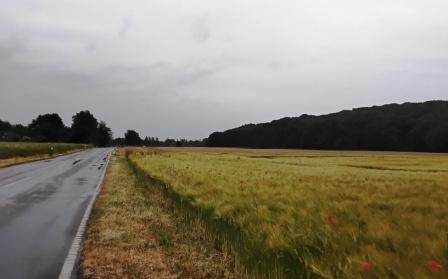
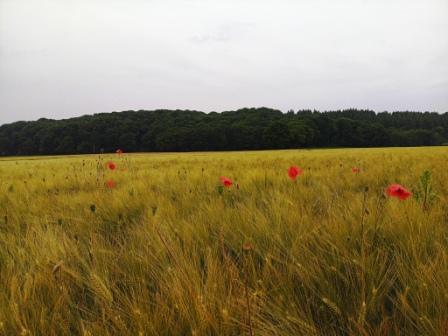
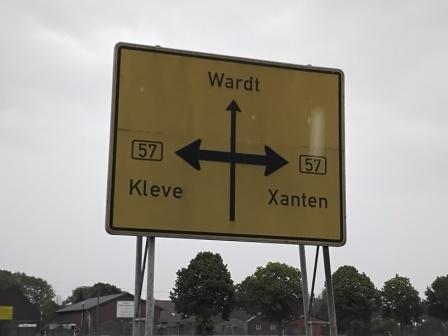
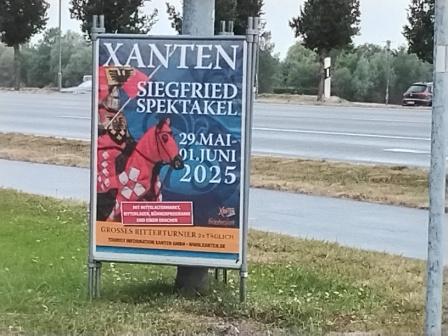
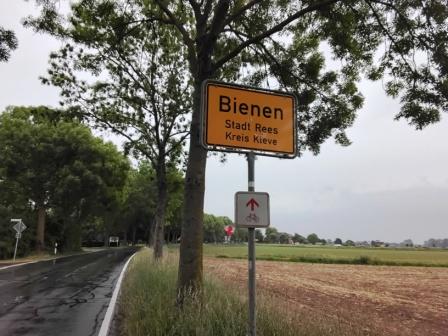
This past May we followed the route taken by Canadian forces into Germany, as far as Bienen, and on the way back into The Netherlands, we stopped in the Achterhoek, in the province of Gelderland, the area where Peter died. 

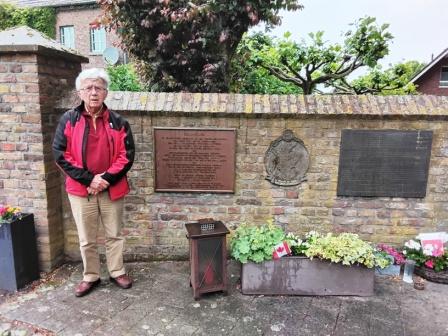
There is a memorial in the cemetery in Gendringen, which we visited. No soldiers’ names are mentioned on the memorial, though.  (See https://onthewarmemorialtrail.com/2022/05/09/on-the-war-memorial-trail-monument-unveiled-in-gendringen/)

The text on the panel of the memorial means ‘so that we don’t forget’, or, as said more commonly during Remembrance services, ‘lest we forget’.  It was a solemn moment, with rain falling steadily, a fitting tribute that perhaps reflected the tears shed by families who lost their loved ones. 

Pieter by the memorial in the cemetery in Gendringen.  (Photo credit: Daria Valkenburg)

 ….Peter was reburied in the Canadian War Cemetery in Groesbeek….

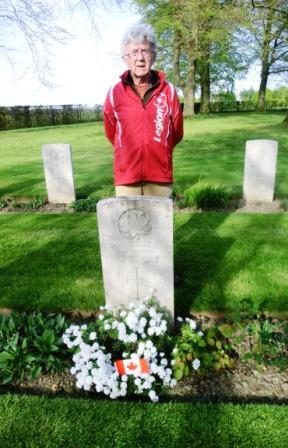
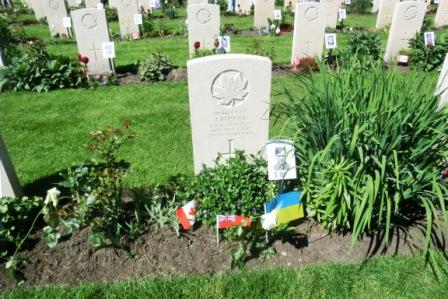
Pieter stands behind the grave of Peter Hydichuk in the Canadian War Cemetery in Groesbeek.  (Photo credit: Daria Valkenburg)

At the end of January 1946, Peter was reburied in the Canadian War Cemetery in Groesbeek.  We visited his grave this spring when we were in The Netherlands for our 2025 European Memorial Tour, and Pieter placed a Canadian flag by his grave. For most soldiers (383 in 14 cemeteries) we placed provincial flags as well, but as we had never received flags for Saskatchewan, we could only place a Canadian flag.

….Stories about 2 soldiers from Les Fusiliers Mont-Royal who were also originally buried in Megchelen….

Edmond Coloumbe, born in Fannystelle, Manitoba, and Alphonse Robert, of Caraquet, New Brunswick, were among 5 members of Les Fusiliers Mont-Royal who died during an attack on Gendringen, The Netherlands on March 30, 1945. Both were initially buried in Megchelen, and their stories were previously told on this blog.

The flag placed at Peter’s grave was donated.  Our thanks go to Alan Waddell, Constituent Assistant, on behalf of Heath MacDonald, MP for Malpeque.

Thank you to Garry Bodnaryk for providing photos and information about Peter Hydichuk, and for saving his mother’s photos.  A big thank you is due to his mother Anne for never forgetting a friend and neighbour who never had the chance to return home and live out his life during peacetime.

Thank you also to Maarten Koudijs for information on Peter’s death and the names of the other South Saskatchewan Regiment casualties. (Information on his book, available in Dutch, can be found at https://www.tussengrensenhoop.nl/)

The work of remembrance of those who served continues.  More Remembrance Week stories to come.

If you have a story or photo to share, please contact Pieter at memorialtrail@gmail.com or comment on the blog. 

© Daria Valkenburg

….Want to follow our research?…

If you are reading this posting, but aren’t following our research, you are welcome to do so.  Our blog address: https://onthewarmemorialtrail.com/
4 countries, 6 weeks, 7,000 km – an unforgettable war memorial journey in Europe…. Daria’s book ‘No Soldier Buried Overseas Should Ever Be Forgotten‘ is available in print and e-book formats.  Net proceeds of book sales help support research costs and the cost of maintaining this blog. For more information see https://nosoldierforgotten.com/

Subscribe to our YouTube Channel: On The War Memorial Trail With Pieter Valkenburg: https://www.youtube.com/channel/UCJ591TyjSheOR-Cb_Gs_5Kw

Never miss a posting!  Subscribe below to have each new story from the war memorial trail delivered to your inbox.
On The War Memorial Trail….2025 Faces of Holten Exhibition Part 3: Soldiers Killed While Travelling In Vehicles

Pieter at the Canadian War Cemetery in Holten, The Netherlands with the Cross of Remembrance in the background. (Photo credit: Daria Valkenburg)

September 1, 2025. Pieter has been involved in finding photos of Canadians who are buried in The Netherlands since 2014, and we’ve tried to tell as many of their stories as we can on this blog. 

While in Europe for the 80th Anniversary of Liberation Commemoration events, he placed flags at the graves of 383 soldiers in 14 cemeteries. At the Canadian War Cemetery in Holten, The Netherlands, flags were placed at 156 graves.

Our visit coincided with The 2025 Faces Of Holten Exhibition, which ran for three weeks in May.  It was slow going to place flags as people continually came up to talk to us, curious about the various flags, and were thrilled when they discovered they didn’t have to practice their English as Pieter could talk to them in Dutch.

In Part 1, the graves and photos of soldiers who were killed near Posterenk in April 1945, and are buried in the Canadian War Cemetery in Holten, were featured.  (See https://onthewarmemorialtrail.com/2025/08/24/on-the-war-memorial-trail-2025-faces-of-holten-exhibition-part-1-soldiers-killed-near-posterenk/)

In Part 2, the graves and photos of two soldiers listed on the Cenotaph outside the Borden-Carleton Legion, were featured. (See https://onthewarmemorialtrail.com/2025/08/29/on-the-war-memorial-trail-2025-faces-of-holten-exhibition-part-2-the-soldiers-listed-on-the-cenotaph-in-borden-carleton/)

Now, in Part 3, the graves and photos of four soldiers who lost their lives while travelling in military vehicles, and whose stories have previously been told, are featured. 

…4 soldiers killed while travelling in military vehicles are commemorated…

Grave of Francis ‘Frank’ Ivan Dougan. (Photo credit: Pieter Valkenburg)

Francis ‘Frank’ Ivan DOUGAN from Donaldston was killed in The Netherlands, at the age of 26,  on May 16, 1946, while serving with the 48th Canadian General Transport Company of the Royal Canadian Army Service Corps (RCASC), part of the Canadian Army Occupation Force (CAOF) in Germany.  He died in a hospital in Nijmegen following a road accident, in which he was a passenger in a military vehicle, during very bad weather in Nijmegen, while he was on his way from Grave, The Netherlands to Oldenburg, Germany, where he was based. Mechanical failure in the steering mechanism led to the accident. You can read his story at https://onthewarmemorialtrail.com/2024/07/13/on-the-war-memorial-trail-the-wwii-soldier-from-donaldston-who-died-in-a-vehicle-accident-in-the-netherlands/

Pieter by the grave of Maurice James Hughes. (Photo credit: Daria Valkenburg)

Maurice ‘Maw’ James HUGHES, from Charlottetown, Prince Edward Island, was serving with the Royal Canadian Corps of Signals (RCCS) when the jeep in which he was riding in hit a mine in Germany on May 2, 1945, killing him, aged 25.  Germany had signed an unconditional surrender, ending the war in Europe, on May 8, 1945, just a few days after Maurice lost his life.  You can read his story at https://onthewarmemorialtrail.com/2024/05/29/on-the-war-memorial-trail-the-wwii-signalman-from-charlottetown-whose-jeep-ran-over-a-mine-6-days-before-the-war-ended/

Grave of James Gordon King. (Photo credit: Daria Valkenburg)

James Gordon KING, from Woodstock, New Brunswick, was serving with the Royal Canadian Artillery when he died in a road accident on August 5, 1945 in Germany, aged 34.  You can read his story at https://onthewarmemorialtrail.com/2021/01/16/on-the-war-memorial-trail-atlantic-canada-remembers-part-3/

Grave of John Rusnak. (Photo credit: Daria Valkenburg)

John RUSNAK, from Portage La Prairie, Manitoba, was attached to No. 4 Canadian Public Relations Group, Canadian Army Occupation Force (CAOF) as a despatch motorcycle rider.  He lost his life, at the age of 21, when his Harley Davidson motorcycle accidentally collided with a horse drawn wagon in Germany on November 22, 1945. You can read his story at https://onthewarmemorialtrail.com/2022/08/28/on-the-war-memorial-trail-the-wwii-despatch-rider-from-portage-la-prairie-who-lost-his-life-in-an-accident-in-germany/

While at the cemetery, we met Jane Kondakova, a Ukrainian refugee from the Kyiv region, currently living in the village of Holten with her two young children.  She was placing flags at the graves of soldiers of Ukrainian descent, including John Rusnak. This was her third year of placing flags, for the soldiers buried in the cemetery and for her husband, who is in the Ukrainian military.

….All of the flags placed at graves were donated…

All of the flags placed at graves were donated.  Our thanks go to: 

  • Alan Waddell, Constituent Assistant, on behalf of Heath MacDonald, MP for Malpeque, for the Canadian flags.
  • Matt MacFarlane, MLA for District 19, Borden-Kinkora, for the Prince Edward Island flags. 
  • Armel ‘Mel’ Lanteigne, President of the Caraquet Legion in New Brunswick for the New Brunswick and Acadian flags.
  • Brad Robertson, Chief of Protocol, Government of Manitoba, on behalf of Wab Kinew, Premier of Manitoba, for the Manitoba flag.

In Part 4, the graves of soldiers killed during Operation Duck will be featured as we continue with our 2025 European War Memorial Tour. Pieter encourages blog readers with photos to come forward so that eventually all the known graves of Canadians buried in Holten will have a photo displayed by their grave. Email him at memorialtrail@gmail.com  or comment on the blog.    

© Daria Valkenburg

….Want to follow our research?…

If you are reading this posting, but aren’t following our research, you are welcome to do so.  Our blog address: https://onthewarmemorialtrail.com/

4 countries, 6 weeks, 7,000 km – an unforgettable war memorial journey in Europe…. Daria’s book ‘No Soldier Buried Overseas Should Ever Be Forgotten‘ is available in print and e-book formats.  Net proceeds of book sales help support research costs and the cost of maintaining this blog. For more information see https://nosoldierforgotten.com/

Subscribe to our YouTube Channel: On The War Memorial Trail With Pieter Valkenburg: https://www.youtube.com/channel/UCJ591TyjSheOR-Cb_Gs_5Kw

Never miss a posting!  Subscribe below to have each new story from the war memorial trail delivered to your inbox.
On The War Memorial Trail….. The Battle of Bienen – Part 5: The WWII Soldier Whose Parents Immigrated To Save Their Family From War

March 18, 2023. Last fall, after Alice van Bekkum, Chair of the Groesbeek Cemetery Faces To Graves Foundation, sent Pieter a list of 39 soldiers from the North Nova Scotia Highlanders Regiment who were killed during the Battle of Bienen in Germany on March 25, 1945 and are buried in the Canadian War Cemetery in Groesbeek, The Netherlands, Pieter saw that photos were missing for 12.  One of these was John Joseph BOHON.

…Bohon?  Isn’t that a Ukrainian name?…” Pieter asked.  “…Maybe, in a shortened form…” I replied.

That short conversation ultimately led to successfully unlocking a search for family. After finding no family named Bohon who could be related, Pieter finally discovered that when he enlisted, this soldier shortened his surname from BOHONKO to BOHON!

Searching for Bohonko led to obituaries of John’s brother and sister-in-law, which finally led Pieter to Debbie Mierau of Prince Rupert, British Columbia.

….John was born in present-day Ukraine….

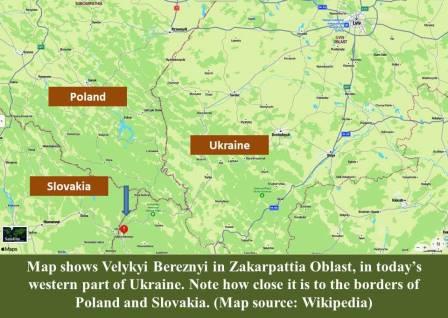
Map Velykyi Bereznyi

Debbie confirmed that the family was of Ukrainian heritage, with roots in the Zakarpattia (Sub-Carpathian) region in Czechoslovakia, but now part of Ukraine. (See https://en.wikipedia.org/wiki/Zakarpattia_Oblast)

 “My grandparents, John Bohonko and Nanca Kohut (who I called Dido and Baba) were from the village of Velykyi Bereznyi in Ukraine where they were born, raised and married….” Debbie explained. A literal translation of the village name is Big Birch. (See https://en.wikipedia.org/wiki/Velykyi_Bereznyi)

Debbie wrote that after the birth of their son Johnny “…Dido made a decision to go to Canada so his son would know a life without wars and rumours of wars….”  John was born February 12, 1925 in Velykyi Berznyi.

….He left in 1927 and spent … long, hard years away from his family trying to make a life for them. He rode the rails from one side of the country to the other looking for a good job (almost freezing to death in Weyburn, Saskatchewan) to make a home for them in Canada. Finally … he sent for Nanca and Johnny. Baba, who had never been out of her village, made the trek with young Johnny in tow … to catch a ship to Canada…. 

PC-NI04 SS Nieuw Amsterdam

S.S. Nieuw Amsterdam.  (Photo source: https://greatships.net/nieuwamsterdam)

John and his mother Nanca sailed from Rotterdam, The Netherlands aboard the S.S. Nieuw Amsterdam, and arrived as landed immigrants in Halifax, Nova Scotia on December 29, 1929.

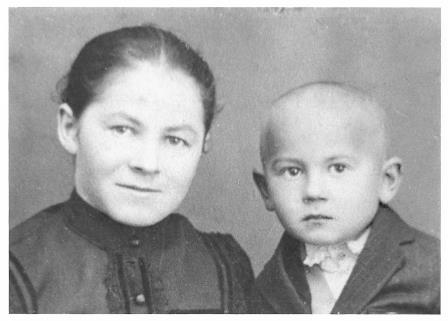
Baba_UncleJohn

John with his mother Nanca in 1929.  (Photo courtesy of Debbie Mierau)

John’s mother, who became known as Ann in Canada, “… did not speak English but managed to make her way by train to Toronto where Dido was waiting for her at the station. He proudly took them to the house he had constructed and where they lived until the 1970s. Baba grew much of her own food and Dido worked hard for CN Rail, supporting his family throughout the Depression.  Five more children joined the brood. Dido never looked back. He loved Canada so much and insisted his children be raised as Canadians. Baba always missed her family and country very much but understood her family was much safer in Canada….

After finishing Grade 9 and a year in high school, John studied art for a year at the Ontario College of Art.   “He … painted murals on his bedroom walls…” but art was not his career at this point.

….John enlisted in Halifax….

He did bush, forestry, and carpentry work for 2 years before enlisting with No. 6 District Depot in Halifax, Nova Scotia on December 13, 1943.  At the time, he had been employed for two years by Foundation Maritime in Bridgewater, Nova Scotia as a carpenter’s helper. (See https://hazegray.org/navhist/canada/fm/)

In an interview for his Personnel Selection Record, John was described as having “…a neat, pleasing appearance…”  An adventurous soul, he “….left home and has done considerable wandering, taking whatever jobs he could find….

His enthusiasm and artistic talent were noted.  “…Enthusiastic and aggressive… Having a natural talent for Art he has made this his hobby…

John made a good impression.  “…As this recruit is keen and willing, has a good physique, and is anxious to see action, he should be suitable for Infantry training….”  However, as John was under 19 years of age – and therefore ineligible to be sent overseas – he was recommended for “…enriched training during basic training…

John Bohonko

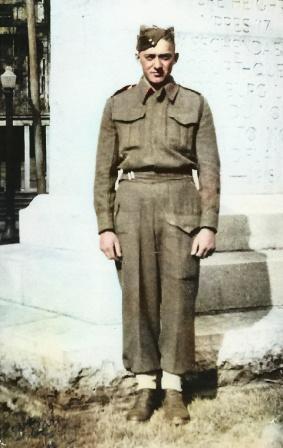
Portrait of John Joseph Bohon.  (Image courtesy of Debbie Mierau)

Just as John turned 19 in February 1944, he was transferred to No. 60 Canadian Infantry Basic Training Centre (CI (B) TC) in Yarmouth, Nova Scotia.

On July 2, 1944, he was sent to A14 Canadian Infantry Training Centre (CITC) in Aldershot, Nova Scotia for further ordnance training in 3 inch mortars. (See https://en.wikipedia.org/wiki/ML_3-inch_mortar)  As he was there at the same time as Clifford BATEMAN, perhaps they trained together.

After passing the mortar course he was attached to S-5 Canadian Driving and Maintenance School (CD & M School) in Woodstock, Ontario on September 8, 1944, for a 3 week carrier driving course for 3 inch mortarmen.

After successfully completing the course, John was rated suitable “…for overseas operational duty in Canadian Infantry Corps as specialist to armoury…

He was reassigned back to A14 CITC in Aldershot in preparation for overseas service, but first allowed special leave of 96 hours before leaving Ontario to travel back to Nova Scotia.  Per Debbie, John “went home to visit his family before being sent to Europe. My mother remembers him walking down the road with his gear and rifle on his back. He turned and waved to his little sister, who adored him, and she watched him walk away….

….John was sent overseas….

John returned to Aldershot, but was not there long.  On November 7, 1944 he was sent to No. 2 Training Camp in Debert, Nova Scotia in preparation for going overseas.  He left Canada for the United Kingdom on November 21, 1944 – from Halifax, the same city in which he arrived in Canada at the end of 1929.

Upon arrival in the United Kingdom on November 28, 1944 he was assigned to No. 3 Canadian Infantry Reinforcement Unit (CIRU).

On January 8, 1945 he was sent to Northwest Europe as part of 21 Army Group, and then on January 26, 1945, was assigned to the North Nova Scotia Highlanders, joining them in Holthurnsche, The Netherlands, located near Berg en Dal, and very close to the German border.

The Regiment reached Kellen, Germany near Kleve, just on the other side of the border with The Netherlands, on February 12, 1945.  On February 14, using amphibious vehicles, the North Novies evacuated Warbergen as they made their way to Emmerich.

Next, the Regiment participated in Operation Blockbuster.  (See https://en.wikipedia.org/wiki/Operation_Blockbuster).

…John lost his life in the Battle of Bienen ….

By March 20, 1945, Allied troops were on the banks of the Rhine River for Operation Plunder, a military operation to cross the Rhine on the night of March 23, 1945. (See https://en.wikipedia.org/wiki/Operation_Plunder) They got as far as Bienen, when troop movement stopped due to blown bridges across the Rhine in that area.

In ‘No Retreating Footsteps’ by Will Bird, he noted that the 7th Argyll and Sutherland Highlanders had made “three attempts …. to capture the village, but they were turned back by very heavy machine gun fire from the front of the village, supported by heavy mortar fire…

On March 25, 1945 the North Nova Scotia Highlanders were tasked with passing through the 7th Argyll and Sutherland Highlanders who had been stopped in front of Bienen during the night.

Mar 24 1945 Position showing Rosau farm

Map shows position of North Novies on March 24, 1945, as they made their way towards Bienen, with the Battalion HQ set up at Rosau Farm just outside the village.  (Map source: Project ’44)

In the article ‘Too Close To The Guns!’ in Canadian Military History, Volume 12, Numbers 1& 2, Winter/Spring 2003, pp.5-28, author Lee Windsor recorded that “At 7:45 am, Lt Colonel Forbes established his tactical headquarters near a great windmill at Rosau Farmon the outskirts of Bienen.

…The battalion’s 3 inch mortar platoon and attached Cameron heavy mortars set up behind the farm while the rifle companies formed up to advance….” A and B Companies moved up to their start line at what became known as Argyll Farm.  Cameron referred to the Cameron Highlanders of Ottawa Regiment.

Rees-Bienen_Zur_Rosau_PM19-01

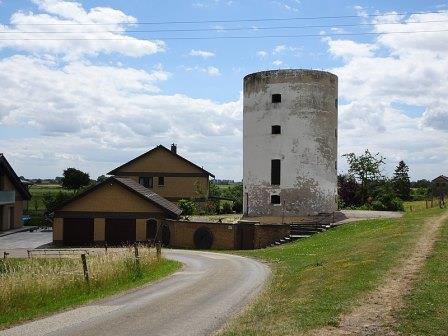
Former windmill at Rosau farm. (Photo source: Pieter Delicaat, CC BY-SA 4.0 , via Wikimedia Commons)

The war diary for the North Nova Scotia Highlanders for March 25, 1945, explained the plan of attack.  The Plan adopted was to use a fire plan of a series of concs and stonks, with one gun per troop firing smoke. Thus the whole open approach was hoped to be shielded from the enemy. As the troops reached initial objectives, the guns were to lift onto further stonks in the rear covering the approaches along the EMMERICH road and MILLINGEN road. The platoon of medium machine guns of the Cameron Highlanders of Ottawa was to take on targets …. of the medium machine gun attack…”  ‘Concs and stonks’ referred to concentrated artillery.

What Debbie wrote mirrored the war diary information. “….Johnny’s platoon was assigned to relieve an exhausted Scottish platoon trapped and under fire in a farmhouse near Bienen, Germany. On the way to the farm, the North Novies came under German machine gun fire. Johnny was killed on March 25th, 1945 – one month away from liberation….” The Scottish platoon she refers to would be the 7th Argyll and Sutherland Highlanders, a Canadian Regiment.

A war casualty never ends with the death of a soldier.  “My mother remembers when the telegram came to the house to tell Baba and Dido of the loss of their first born child.…” Their pain was felt by so many families in similar circumstances.

…John is buried in the Canadian War Cemetery in Groesbeek ….

Like Clifford BATEMAN, Ralph Schurman BOULTER, and Charles ‘Marshall’ CARSON, John was temporarily buried on March 26, 1945 in the military cemetery in Rees, Germany before being reburied the following year in the Canadian War Cemetery in Groesbeek, The Netherlands.

Bohon Gravestone

Grave of John Joseph Bohon (Bohonko) at the Canadian War Cemetery in Groesbeek, The Netherlands.  (Photo source: http://www.findagrave.com)

…Reflections by John’s niece ….

John’s niece Debbie shared her reflections.  “…It has always been a wonder to me how much my grandparents had been through to save my Uncle Johnny from wars only to have a war reach across the ocean to take him anyway. Although I never met him and he died nine years before I was born, I have always felt a connection to him and wish I had met him. I grew up in a family dedicated to sports. I was an artist and creative. War had taken away a mentor to myself and my children, who inherited his talents.

This is only one story of the 104,685 Canadians who died in the 20th century wars. One of them may have cured cancer. One of them might have found a cure for Covid. All of them would probably tell you that war is cruel and destructive. That being said, I am proud that my Uncle John died fighting Nazis, but he is missed by all who knew him and some that didn’t….

Thank you to Debbie Mierau for providing photos and information on her uncle, plus her thoughtful reflections. Thank you to Shawn Rainville for researching the newspaper archives that provided the lead to find living family members.

Pieter has been successfully working his way through the list of soldiers from the North Nova Scotia Highlanders killed in Bienen whose photos were missing. Coming up in Part 6: Kitchener Langille.

If you have a story to tell, please let Pieter know. Email him at memorialtrail@gmail.com, comment on the blog, or tweet to @researchmemori1.

© Daria Valkenburg

….Previous stories about North Novies killed during the Battle of Bienen and buried in Groesbeek….

…Want to follow our research?….

If you are reading this posting, but aren’t following the blog, you are welcome to do so.  Our blog address: https://onthewarmemorialtrail.com/.

Front cover OnTheWarMememorialTrailinEurope4 countries, 6 weeks, 7,000 km – an unforgettable war memorial journey in Europe…. Daria’s book ‘No Soldier Buried Overseas Should Ever Be Forgotten‘ is available in print and e-book formats.  Net proceeds of book sales help support research costs and the cost of maintaining this blog. For more information see https://nosoldierforgotten.com/

You are also invited to subscribe to our YouTube Channel: On The War Memorial Trail With Pieter Valkenburg: https://www.youtube.com/channel/UCJ591TyjSheOR-Cb_Gs_5Kw.

Never miss a posting!  Subscribe below to have each new story from the war memorial trail delivered to your inbox.
On The War Memorial Trail….. The WWII Despatch Rider From Portage La Prairie Who Lost His Life In An Accident In Germany

where-to-blog-header-code-on-a-wordpress-theme-August 28, 2022. In May, researchers at the Information Centre at the Canadian War Cemetery in Holten, The Netherlands honoured 27 soldiers of Ukrainian heritage that are buried in the cemetery.  Photos for 4 were missing and Pieter was asked if he could help.

All four soldiers had a connection to the Canadian prairies. To our delight, families of all four soldiers came forward within a few weeks.

 ….The 4 soldiers of Ukrainian heritage without photos ….

  • Elie ANTONYSZYN, born in Rorketon, Manitoba, died July 15, 1945, aged 22
  • Andrew KERELCHUK, born in Zbaraz, Manitoba, died April 19, 1945, aged 21
  • Sam MATVICHUK, born in Broadacres, Saskatchewan, died April 14, 1945, aged 19
  • John RUSNAK, born in Portage La Prairie, Manitoba, died November 22, 1945, aged 21

This posting is about John RUSNAK, who was born September 3, 1924 in Portage La Prairie, Manitoba, the son of George and Gladys (nee Gorich) Rusnak.  Both his parents had immigrated to Canada from Ukraine.

….Family of John Rusnak contribute photos and family information ….

Mike Rusnak, John’s great-nephew, sent photos and an excerpt from their family history record, as prepared by Mike’s late wife Karen.  “…John grew up on a farm in rural Manitoba (near Curtis) and attended the Curtis school.  He left school in 1939 after completing grade 8 as he was needed to help on the family’s 125 acre farm (100 acres cleared and under cultivation) as well as help on his brothers’ farms.  Tractors and horses were being used on the family farm.  He had considerable experience repairing tractors and trucks.  John liked driving trucks and had purchased a truck before enlisting in the army….

improved_photo(7) Rusnak

John Rusnak.  (Photo courtesy of the Rusnak Family.  Photo colourization by Pieter Valkenburg)

….John enlisted twice in the army ….

John enlisted on November 18, 1943 with the No 10 District Depot in Winnipeg, Manitoba. His Occupational History Form noted that he spoke both English and Ukrainian.

The family history record included excerpts from the Personnel Selection Record, saying that “…John was a quiet person who took a normal interest in the social events of the community.  He liked to play the odd game of pool or snooker with friends.  He also played baseball and liked hunting – especially deer – but was not a good shot…. He wore glasses...

His Medical Examination and Certificate form recorded that John had been previously rejected for active military service on June 30, 1942 in Portage La Prairie, at the 100th Basic Training Camp – due to poor vision.  His eyesight hadn’t improved, but this time he was accepted.

On December 7, 1943, he was transferred to the A21 Canadian Ordnance Corps Training Centre (COCTC) in Barriefield, Ontario, located on what is now called Canadian Forces Base Kingston. Duties related to ordnance included supplying, storing, and distributing a variety of items for the field Army, including ammunition, artillery pieces, and vehicles.

On April 24, 1944 John was reallocated for motorcycle training, receiving a Class III qualification for motorcycles on August 8, 1944. On October 17, 1944 an assessment deemed him unsuitable as a motorcyclist and it was recommended he be reallocated to general ordnance duties.

..John’s family wanted him discharged to help on the farm…

John’s family petitioned the government to have him discharged and returned home to help on the farm.  The family history summarized it as follows:

…During August and October 1944 his sister Mary wrote letter to National Defence (Army), on behalf of her parents, requesting that John be discharged as he was needed on the farm.  Correspondence from the Army states ‘It is the soldier himself who must write the letter to his Commanding Officer if he wishes to apply for discharge from the Service.’ It does not appear that he did so as in October 1945 John wrote to his brother Roger and says ‘he hopes that Roger will be able to see the folks and see what they can do’ (about his discharge). He also says he was in hospital for a while.  John was looking forward to returning home and having a party to celebrate….

No letters are in John’s service file to indicate that he requested a discharge. His army service continued.

….John left Canada in November 1944 ….

On October 28, 1944 he was sent to the Canadian Army Transit Camp in Windsor, Ontario in preparation for overseas service.  John left Canada on November 24, 1944, and arrived in the United Kingdom on December 6, 1944, where he was assigned to the Canadian Ordnance and Mechanical Engineer Reinforcement Unit (COMERU).

On February 28, 1945 John passed another drivers course, and by March 15, 1945 he was transferred to the Royal Canadian Ordnance Corps (RCOC). (See https://www.canadiansoldiers.com/organization/unitlistingbycorps/rcocorbat.htm)

He was sent to northwest Europe on March 12, 1945 and a few days later transferred to HQ2 Canadian Corps Ordnance Field Park (CCOFP), which serviced the needs of infantry battalions.

Once the war in Europe ended in early May 1945, John was transferred to 2 Canadian Corps and Army Troops Sub Park.  On July 13, 1945 he was transferred to the Ordnance Demobilization Depot for a few weeks.

On August 18, 1945 he was attached to No. 4 Canadian Public Relations Group, Canadian Army Occupation Force (CAOF) as a despatch motorcycle rider.

….John died in a motorcycle accident in Germany ….

On November 19, 1945, John was returning from the port at Wilhelmshaven in Germany, carrying ADLS despatches (Air Despatch Letter Service) from HMS Rupert to Augustfehn.  At around 2:30 pm, he was on the road between Zetel and Neuenburg, when his Harley Davidson motorcycle accidentally collided with a horse drawn wagon.

Two eyewitnesses came forward, Sgt Terpetra of the Dutch Army, but who was attached to the CAOF, and German civilian Georg Meyer of Zetel.

Mr Meyer’s report stated that as he was driving from Zetel to Neunburg, “… somebody was driving with a horse drawn wagon loaded with cattle about 150 to 100 metres ahead of me.  He was driving on the right hand side of the road with the right wheels running on the verge.  A despatch rider of the Occupation Troops overtook and passed me, turned to the right of the road, and seemingly heard a rattle in some part of his motorcycle.  This he tried to remedy by banging the side of the motorcycle with his right hand….

The momentary distraction was fatal.  “… As he lifted his eyes again he sighted the wagon which was travelling in front of him. He quickly tried to bypass him on the left, but the distance between him and the wagon was too short so that he hit the wagon with his front wheel on the left hand side of the wagon. He hit the wagon box with his right side of his head….

Mr Meyer stopped and lifted the motorcycle from John’s body, then rushed to a nearby house for help.  John was taken to hospital but died of his injuries on November 22, 1945.

The family history noted what the family learned of this incident: “….24 November 1945 Roger receives telegram advising John was reported dangerously ill on 19 November with head injuries received in a motorcycle accident. 27 November 1945 Roger receives another telegram advising John had been officially reported to have died 22 November 1945….

…John was buried in Germany and then later in The Netherlands….

John was initially buried on November 26, 1945 in the Canadian Temporary Cemetery at Osterscheps, Germany.  The following year, he was reburied in the Canadian War Cemetery in Holten, The Netherlands.

john2

John Rusnak was initially buried in Osterscheps, Germany.  (Photo courtesy of the Rusnak Family)

Rusnak J john H18116

John’s final resting place is in the Canadian War Cemetery in Holten, The Netherlands.  (Photo courtesy of Canadian Virtual War Memorial)

….Rusnak Lake in northern Manitoba named in his honour…..

Screenshot 2022-08-24 at 10-45-57 Rusnak Lake

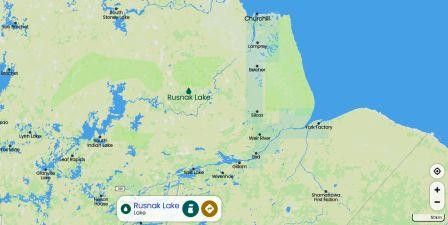
Rusnak Lake in northen Manitoba.  (Map source: https://mapcarta.com)

Rusnak Lake in northern Manitoba was named after John in 1978.

sunflower header

Thank you to Mike Rusnak for providing a photo of his uncle, and to Judie Klassen for finding newspaper articles and the reference to Lake Rusnak.  Our final story about a soldier of Ukrainian descent who is buried in the Canadian War Cemetery in Holten will be in the next posting.

If you have a story to tell, please let Pieter know. Email him at memorialtrail@gmail.com, or comment on the blog.

© Daria Valkenburg

…Missed the previous postings about the soldiers of Ukrainian heritage?…

…Want to follow our research?….

If you are reading this posting, but aren’t following our research, you are welcome to do so.  Our blog address: https://onthewarmemorialtrail.com/

Front cover OnTheWarMememorialTrailinEurope4 countries, 6 weeks, 7,000 km – an unforgettable war memorial journey in Europe…. Daria’s book ‘No Soldier Buried Overseas Should Ever Be Forgotten‘ is available in print and e-book formats.  Net proceeds of book sales help support research costs and the cost of maintaining this blog. For more information see https://nosoldierforgotten.com/

You are also invited to subscribe to our YouTube Channel: On The War Memorial Trail With Pieter Valkenburg: https://www.youtube.com/channel/UCJ591TyjSheOR-Cb_Gs_5Kw.

Never miss a posting!  Subscribe below to have each new story from the war memorial trail delivered to your inbox.

On The War Memorial Trail….. The Canadian War Cemetery in Holten Pays Tribute To Ukrainian-Canadians Buried There

May 31, 2022.  In light of the present day events in Ukraine, the Information Centre at the Canadian War Cemetery in Holten, The Netherlands recently paid tribute to 27 known Ukrainian-Canadians buried in the cemetery.

When they asked for help to find photos of the soldiers for which none were available, or only a poor image was available, we of course said yes.  My father was born in Ukraine and left shortly after his 14th birthday, one of several youths sent on an unheated cattle car in January 1941 to Germany.  He was lucky. He survived the journey and the war and was able to lead a peaceful life in Canada until his death in 2012.

….Translation of Dutch placard…

Attached is a PDF of the Dutch placard (Stoepbord Oekrainse Canadezen A0) and below is a translation of the text, followed by the names of the soldiers mentioned.

…  They fought for our freedom then ~~~

Ukrainian Canadians who died for our freedom, buried in the Canadian War Cemetery in Holten.

A brutal Russian invasion of Ukraine is now sparking a war in Europe. Ukrainians desperately try to defend their freedom but are the easy targets of a ruthless aggressor. Thousands are forced to flee elsewhere to find safe shelter, warmth and food elsewhere, temporarily or perhaps even forever.

Also towards the end of the 19th and the beginning of the 20th century, many thousands of Ukrainians left their country in search of a better life. Some 170,000 of them ended up in Canada where they were offered free land to become farmers. Also around 1930 and immediately after the Second World War, a wave of refugees/expellees from Ukraine came to Canada.

At the outbreak of World War I (August 1914), Canada was on the side of the Allies. Large parts of present-day Ukraine belonged to the territory of Austria-Hungary, Germany and the Ottoman Empire, and these countries were the enemy of the Allied forces.

In Canada, at the time, there was prejudice against Ukrainians regarding their ‘race’, appearance, customs and religion. The simple fact that they came from countries with which Canada was at war meant that tens of thousands were labeled ‘enemy aliens’ and interned in labour camps.

During the Second World War, the Ukrainians were viewed completely differently. There was therefore no question that they were not the enemy, as present-day Ukraine was then part of the Soviet Union and Poland.

More than 35,000 Canadians of Ukrainian descent served in the Canadian Army during World War II. These servicemen constituted the largest group of non-British and non-French conscripts in the Canadian Forces. The soldiers were not only an integral part of the Canadian military during wartime, but also made a significant contribution to the development of Canada’s post-war policy towards displaced persons and refugees.

Many of them fought in the struggle for the liberation of Europe. We assume about 100 Ukrainian Canadians are buried in the three Canadian War Cemeteries in The Netherlands; Bergen op Zoom, Groesbeek, and Holten.

We know that at least 27 Canadian soldiers of Ukrainian descent are buried in Holten.

They fought for us back then and gave their lives….

….Ukrainian-Canadian soldiers buried in Holten…

  • Elie ANTONYSZYN, died July 15, 1945, aged 22 
  • George EWONIUK, died April 10, 1945, aged 19 (very poor photo)
  • Donnie P. GNUTEL, died April 29, 1945, aged 25
  • George FESCHUK, died April 25, 1945, aged 21
  • Nick FORSACHUK, died April 17, 1945, aged 21
  • Peter HARASYMCHUK, died April 23, 1945, aged 24
  • Steve HNATIW, died April 21, 1945, aged 28 (poor photo)
  • Harry ILASEVICH, died April 12, 1945, aged 21
  • John KENDZIERSKI, died January 18, 1945, aged 20
  • Andrew KERELCHUK, died April 19, 1945, aged 21 
  • John KIBZEY, died April 12, 1945, aged 21
  • William J. KOZARICHUK, died April 20, 1945, aged 26
  • William W. LOTOSKY, died April 7, 1945, aged 24
  • Harry MACHURA, died April 23, 1945, aged 22 (poor photo)
  • Sam MATVICHUK, died April 14, 1945, aged 19
  • Steve MICHLOSKY, died April 8, 1945, aged 21
  • Steven J. MOTKALUK, died May 2, 1945, aged 32
  • Joseph PETRAK, died April 26, 1945, aged 19
  • Nestor PROBIZANKSI, died April 11, 1945, aged 22
  • John RUSNAK, died November 22, 1945, aged 21 
  • Alexander SEREDIUK, died April 14, 1945, aged 26
  • Stanley SKULMOSKI, died April 24, 1945, aged 20
  • John SLYZUK, died April 11, 1945, aged 30 (poor photo)
  • Harry H. SMITH, died April 7, 1945, aged 25 (very poor photo)
  • Stanley WERNIUK, died April 12, 1945, aged 23
  • Peter WOZNIAK, died May 1, 1945, aged 21
  • Joseph YURKIW, died April 13, 1945, aged 21 (poor photo)

sunflower header

Can you help with photos or information on these soldiers? Do you know of more Ukrainian-Canadian soldiers buried in Holten? Email Pieter at memorialtrail@gmail.com, or comment on the blog.

© Daria Valkenburg

…Want to follow our research?….

If you are reading this posting, but aren’t following our research, you are welcome to do so.  Our blog address: https://onthewarmemorialtrail.com/

Front cover OnTheWarMememorialTrailinEurope4 countries, 6 weeks, 7,000 km – an unforgettable war memorial journey in Europe…. Daria’s book ‘No Soldier Buried Overseas Should Ever Be Forgotten‘ is available in print and e-book formats.  Net proceeds of book sales help support research costs and the cost of maintaining this blog. For more information see https://nosoldierforgotten.com/

You are also invited to subscribe to our YouTube Channel: On The War Memorial Trail With Pieter Valkenburg: https://www.youtube.com/channel/UCJ591TyjSheOR-Cb_Gs_5Kw.

Never miss a posting!  Subscribe below to have each new story from the war memorial trail delivered to your inbox.