April 13, 2026. We are always grateful to hear about those who served, so when Annie Lee MacDonald told us about a distant relative who served in the RCAF during WWII, and lost his life, we took a look at what happened. “…Boyce McKie is a relative of mine that Helen MacEwen found in her research….” she explained. It was determined that he was related to Annie Lee on her father’s maternal side. (See https://onthewarmemorialtrail.com/2020/07/03/the-ww1-era-course-of-the-rhine-map-of-germany/ for a story about a WWI era Course of the Rhine map that Helen’s father-in-law had saved.)
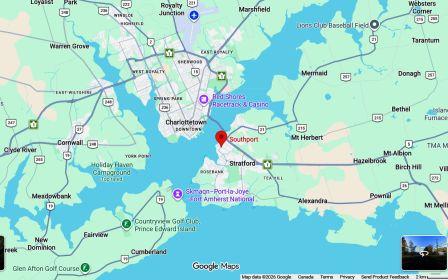
Southport is now part of Stratford, Prince Edward Island. (Map source: Google maps)
Born November 3, 1922 in Southport (now part of Stratford), Queens County, Prince Edward Island, Allison ‘Boyce’ (Buddy) MCKIE was the son of Boyce and Emma (nee McLeod) McKie. When he enlisted with the Royal Canadian Air Force (RCAF) on August 1, 1940, aged 18, he stated that he was interested in pilot training, had been in high school at Prince of Wales College in Charlottetown, and noted that his father was deceased. One of the questions asked if he played sports – a question designed to see if he could be a team player – and he answered yes and listed hockey, baseball, softball, and soccer.
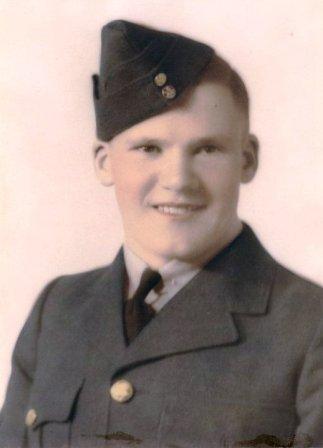
Allison ‘Boyce’ McKie. (Photo source: Canadian Virtual War Memorial)
On November 10, 1940, Boyce was sent to No. 1 Manning Depot in Toronto, Ontario for his basic training. This facility was located in the Coliseum Building on the Canadian National Exhibition grounds, part of the British Commonwealth Air Training Plan (BCATP) in Canada. The BCATP was a major program for training Allied air crews during World War II that was administered by the Government of Canada, and commanded by the Royal Canadian Air Force with the assistance of a board of representatives from the United Kingdom, Australia, New Zealand and Canada.
Manning Depots were reception and training centres for new RCAF recruits, serving as the initial entry point for the British Commonwealth Air Training Plan (BCATP). Recruits received uniforms, 4–5 weeks of basic military training, drills, and aptitude testing. Upon completion, trainees were designated as ‘aircraftsmen 2’ and moved on to further specialized training schools.
On November 28, 1940, an interviewer for the RCAF described Boyce as quick, accurate, pleasant, and confident, and recorded that he had completed Grade 11. In a question about any experience or training that would be useful in the RCAF, the interviewer noted that Boyce “…was very keen…” and “…had done a considerable amount of target shooting and was a member of Dominship team for Keppoch Club. Has done a great deal of duck and partridge shooting…”
….Boyce trained as a pilot …
On January 8, 1941, Boyce was sent to No. 20 Elementary Flying Training School (EFTS) in Oshawa, Ontario for 50 hours of basic flying instruction, over 8 weeks, on the De Havilland Tiger Moth and Fairchild Cornell, two simple training planes.
Having successfully passed his training to date, and now a candidate for pilot training, on March 24, 1941, Boyce was sent to No. 3 Initial Training School (ITS), at Sacred Heart College in Victoriaville, Quebec, for a 4 week course of studies and a variety of tests. His course would include studies in navigation, flight theory, meteorology, duties of an officer, air force administration, algebra, and trigonometry. Tests included a psychiatric interview, a physical examination, a session in a decompression chamber, and a simulated ‘test flight’.
On April 21, 1941, now deemed a Leading Aircraft Man (LAC), Boyce was sent to No. 11 Elementary Flying Training School (EFTS) in Cap-de-la-Madeleine, Quebec for additional basic flying instruction, on the Fleet Finch and Fairchild Cornell.
The next step in Boyce’s training was at No. 6 Service Flying Training School (SFTS) in Dunnville, Ontario on June 10, 1941, where he would have been placed first in an intermediate training squadron, then in an advanced training squadron, and training at a Bombing & Gunnery School. He earned his pilot flying badge on August 20, 1941, and a promotion to Flight Sgt.
….Boyce left Canada for overseas service …
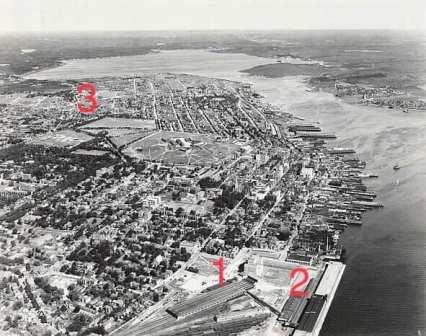
Aerial view of Halifax showing the location of the Canadian National Railroad Station (red # 1) , Pier 21 Ocean Terminals (red # 2) and No. 1 “Y” Embarkation Depot (red # 3). Halifax Harbour is foreground and right with the Bedford Basin in background. (Source: Library and Archives Canada Collections website)
A few days later, on August 22, 1941, he was transferred to No. 1 ‘Y’ Depot in Halifax, Nova Scotia, an embarkation depot for Air Force personnel soon heading overseas. (See https://rcaf.info/rcaf-stations/nova-scotia-rcaf-stations/rcaf-station-halifax/)
Before reporting to No. 1 ‘Y’ Depot, Boyce had been granted embarkation leave from August 21, 1941 until September 1, 1941, in what turned out to be the last time he would see his family again.
A few weeks later, on September 14, 1941, Boyce was placed in the Royal Air Force (RAF) Trainee Pool and arrived at No. 3 Personnel Reception Centre (PRC) in Bournemouth, England on October 15, 1941. This was the arrival point for thousands of Commonwealth aircrew after training in Canada. (See https://www.birtwistlewiki.com.au/wiki/No._3_Personnel_Reception_Centre_RAF)
….Boyce was assigned to No. 58 OTU …
On October 27, 1941, Boyce was assigned to No. 58 Operational Training Unit (OTU) in Grangemouth, Scotland, for training on Spitfire Mk.1s.
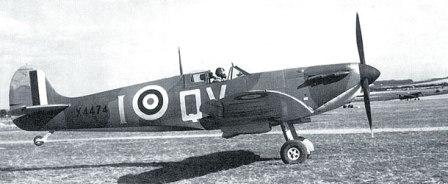
Spitfire Mk.1 (Photo source: Wikipedia)
An OTU was the last stage of training for aircrew before being assigned to an operational unit for active operations. Loss rates in training were high due to inexperience, crowded airspace, often poor weather, and even enemy aircraft operating over the United Kingdom.
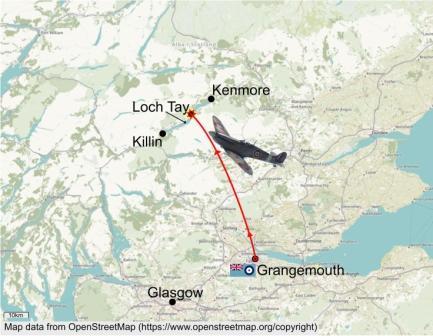
Map shows the plane’s path from Grangemouth to where it crashed near Kenmore by Loch Tay. (Map prepared by Wendy Nattress)
On November 11, 1941, just a week after his 19th birthday, Boyce was one of the training casualties when Spitfire L1083, in which he was the pilot and sole occupant in the plane, was lost in low clouds during a formation exercise flight and went missing around 12:30 pm.
It wasn’t until December 12, 1941 that the crash site was found. The Spitfire had crashed into high ground near Kenmore by Loch Tay in Scotland, and Boyce had died of “…multiple severe injuries….”
….Boyce is buried in Grangemouth (Grandsable) Cemetery …
Boyce was buried on December 19, 1941 in Grangemouth (Grandsable) Cemetery, located south of the town of Grangemouth in Stirlingshire, Scotland. He’s one of 92 casualties from WWI and WWII buried there.
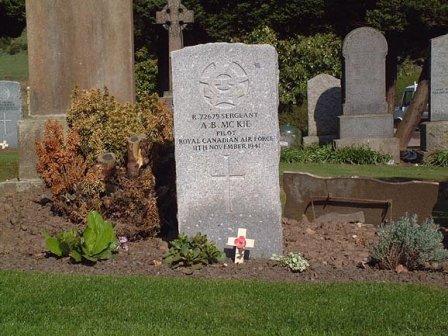
Grave of Allison ‘Boyce’ McKie in Grangemouth (Grandsable) Cemetery in Scotland. (Photo source: Canadian Virtual War Memorial)
….Boyce is commemorated on a memorial wall at the former RAF Grangemouth…
In 2008, a memorial wall was placed at the former RAF Grangemouth site to “…commemorate the trainee Spitfire pilots who had come to RAF Grangemouth from not only Great Britain but also Poland, Czechoslovakia, Holland, Belgium, Canada, the USA, Australia, New Zealand, Ireland, and India, to learn to fly the Spitfire fighter aircraft during the Second World War, and who died at the airfield while serving with 58 Operational Training Unit….”
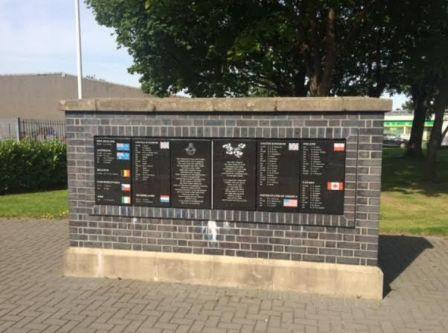
RAF Grangemouth and 58 Operational Training Unit Memorial. (Photo source: https://vintageaviationnews.com image by Urban Ghosts)
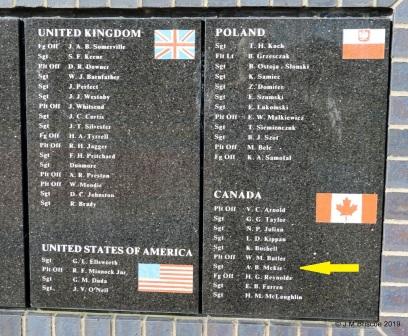
RAF Grangemouth and 58 Operational Training Unit Memorial. Boyce identified by yellow arrow. (Photo source: J. M. Briscoe found on Flickr)

Pieter and Annie Lee MacDonald on their way to a memorial service in The Netherlands. (Photo credit: Daria Valkenburg)
Thank you to Annie Lee MacDonald for letting us know about Allison ‘Boyce’ McKie. Thank you to Wendy Nattress, who prepared the map showing the flight path for Spitfire L1083.
Pieter’s research efforts to find photos and families of soldiers continue. Do you have a story to tell? Email Pieter at memorialtrail@gmail.com, or comment on the blog.
© Daria Valkenburg
….Want to follow our research?…
If you are reading this posting, but aren’t following our research, you are welcome to do so. Our blog address: https://onthewarmemorialtrail.com/
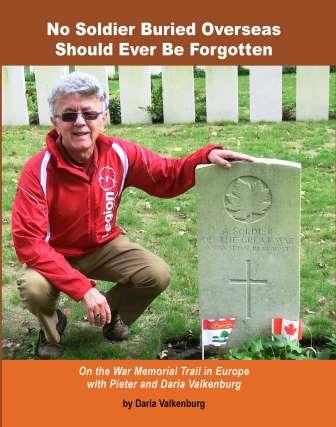 4 countries, 6 weeks, 7,000 km – an unforgettable war memorial journey in Europe…. Daria’s book ‘No Soldier Buried Overseas Should Ever Be Forgotten‘ is available in print and e-book formats. Net proceeds of book sales help support research costs and the cost of maintaining this blog. For more information see https://nosoldierforgotten.com/
Subscribe to our YouTube Channel: On The War Memorial Trail With Pieter Valkenburg: https://www.youtube.com/channel/UCJ591TyjSheOR-Cb_Gs_5Kw.
Never miss a posting! Subscribe below to have each new story from the war memorial trail delivered to your inbox.
 On The War Memorial Trail Research Project........ with Pieter and Daria Valkenburg