On The War Memorial Trail….. The WWII Diary Of Dr. Ross Part 2: Two Years And 20 Trips Aboard HMHS Lady Nelson

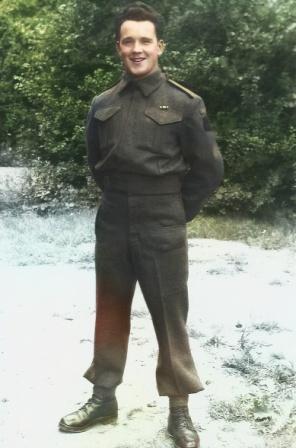
Dr. Alton Ross. (Photo courtesy of Judy Parks.  Photo colourization by Pieter Valkenburg)

March 23, 2025. During WWII, Dr. James ‘Alton’ ROSS, father of Judy Parks, was a doctor aboard the hospital ship HMHS Lady Nelson, Canada’s first hospital ship, which had 515 special hospital beds, special wards for shock cases, contagious diseases and fractures, private cabins, an operating room, a sterilizing room, an inspection room for minor dressings, a dispensary, and a portable x-ray outfit.

HMHS Lady Nelson.  Note the crosses on the side of the ship!  (Photo source: Wikipedia)

In Part 1, the first two of Alton’s twenty voyages aboard the ship were summarized, providing a window into life aboard a military hospital ship, as he found himself treating patients who’d been wounded in Sicily and mainland Italy. (See https://onthewarmemorialtrail.com/2025/03/16/on-the-war-memorial-trail-the-wwii-diary-of-dr-ross-part-1-assigned-to-hmhs-lady-nelson/)

Now, in Part 2, Alton’s story concludes with a return to Italy to pick up wounded servicemen and some of the devastation of war that he saw, and finally, after his 20th voyage he was able to return to the life of a civilian and a rural medical practice….

….Alton recorded Trip No. 3 aboard the HMHS Lady Nelson….

Alton’s third trip aboard the HMHS Lady Nelson began on March 4, 1944, with a round trip of 9,400 miles (15,128 km). 
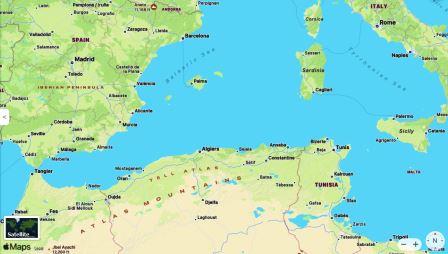
Trip No. 3 went from Halifax to Bizerte to Naples to Algiers.  (Map source: DuckDuckGo)

The route took him from the port of Halifax, Nova Scotia, across the Atlantic Ocean to Gibraltar, to Bizerte, Tunisia, and then on to Naples, Italy, from there to Algiers, Algeria, before sailing to Avonmouth, United Kingdom, and then returning to Halifax.

Alton’s diary recorded that the orchestra aboard ship, in which he played the saxophone, was larger than on his previous voyage. “…Orchestra increased by two trumpets, clarinet, and ….bass… and cymbal.  Put on three concerts across…

After leaving Halifax on March 4, 1944, the ship arrived in Gibraltar at 1:00 pm on March 13, 1944, with a stay of 7 hours before sailing on to Bizerte, Tunisia.  Alton noted that they “…had a dance that night…very successful….enjoyed by everyone.  Orchestra right on good rhythm…

In the morning of March 16, 1944, they …anchored off Bizerte in Tunisia just in bay north of Cape Bon where last of Germans gave up…..Tanker brought water to us….Remained there until 1:00 am 17 March then left for Naples…

On March 18, 1944, the ship …docked at Naples at 9:00 am…..Began loading shortly afterwards…..Left at 4:00 pm for Algiers…

When the ship had been anchored in Bizerte, no one left the ship and Alton finally found out why. “…Heard reason for not going into Bizerte was 27 enemy ships sunk in harbour…

On March 20, 1944, the ship “…docked at Algiers at 3:00 pm and loaded 50 patients…” before leaving port at 7:00 pm for England.

The ship arrived in Avonmouth on March 29, 1944, and after the patients were unloaded, Alton was free until April 1, 1944, when “…502 patients….” were brought onboard. The ship left for Halifax the following day, on a course which went “….far south this time.  Southwest to Azores, directly west on level with New York, then northwest into Halifax.  Trip seemed very long…” The journey ended when the ship arrived in Halifax on April 12, 1944.

Music remained a big part of Alton’s off-duty hours. While in England, the Auxiliary Service provided “…a trumpet and a trombone, which gave us 4 brass.  As all the boys were on day duty, we practiced about 6 to 7 nights coming from England….” 

Judy reflected on the morale boost that was provided by the orchestra.  “…The older I get I realize those crossings on the Lady Nelson were therapy sessions.  Dances and lots of music with a live orchestra…” were instrumental in “…keeping spirits up to the young volunteers anxious for some excitement on the way over, and also to the wounded returning….

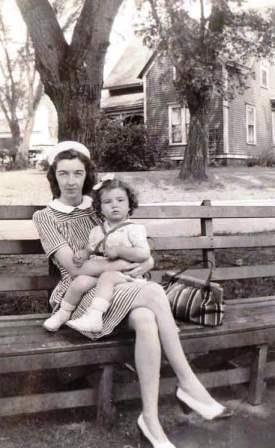
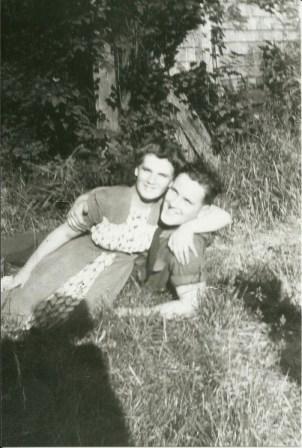
Alton’s wife Betty with their daughter Judy in New Glasgow, Nova Scotia, in a photo taken while Alton was on leave.  (Photo courtesy of Judy Parks)

At the end of Trip No. 3 Alton received 2 weeks leave, which he spent with his wife and daughter.

….Alton’s next few trips aboard the HMHS Lady Nelson were between Halifax and the United Kingdom….
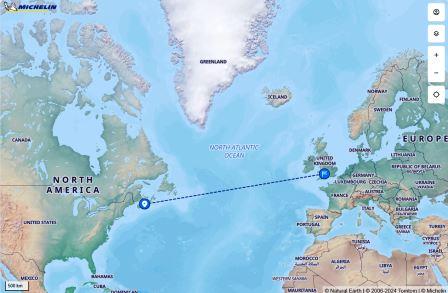
Trip No. 4 went from Halifax to Avonmouth.  (Map source: https://www.viamichelin.com)

There are 2,762 nautical miles between the Port of Halifax in Nova Scotia, and the Port of Avonmouth in the United Kingdom.  Alton’s next trip was between these two ports.

Trip No. 5 was to be the same route, but D-Day on June 6, 1944 resulted in an unexpected route change! “…Embarked 30 May carrying about 50 patients and half of 20 and 22 Canadian General Hospital staffs.  Trip over was started 31 May 44 and was fairly smooth but very foggy.

So far, nothing unusual, but then “…. on June 6th we heard the news of the Allied landings in Normandy. We were all greatly excited. On 7th June received word at 4:00 pm to change our course to the north of Ireland and again had heavy fog. At 2:00 am, 9th June went into Belfast for orders, then continued on past the Isle of Man to Liverpool….

On June 13, 1944, Alton wrote that the return journey to Canada began.  “…Loaded 505 patients…and sailed at 4:30 pm. Went around the north of Ireland…”  He noted that there were “….several cases of Malaria on board…”  Hospital records in Italy had reported since autumn 1943 that there was a severe malaria epidemic.

The next few trips found the ship returning to Liverpool rather than Avonmouth on its round trip journeys.  It wasn’t until Alton’s 14th trip in March 1945 that the Lady Nelson docked again in Avonmouth.

….Alton recorded two burials at sea on Trip No. 7….

On the return voyage back to Canada for Alton’s 7th trip, he recorded that the ship “…left Liverpool midnight 8 August….There were two burials at sea.  11th August MacGuire (sic) and 16th Captain Miller…

Private George Alfred MAGUIRE, born in Windsor, Ontario, had died aboard the Lady Nelson on August 11, 1944 from wounds received in action in France while serving with the Essex Scottish Regiment, at the age of 23, leaving behind his parents, Charles S. and Minnie Maguire, of London, Ontario. His name is inscribed on the Halifax Memorial in Point Pleasant Park in Halifax, Nova Scotia. 

Captain Theodore Albert MILLER, who was born in Halifax, Nova Scotia, had died of cancer on August 15, 1944 aboard the Lady Nelson, at the age of 47, while serving with the Royal Canadian Ordnance Corps, leaving behind his wife, Kathleen Miller of Regina, Saskatchewan, and their son David Graeme Miller. His name is inscribed on the Halifax Memorial in Point Pleasant Park in Halifax, Nova Scotia. 

….Alton looked forward to civilian life….

By June 1945, following his 16th trip aboard the Lady Nelson, Alton “…signed to go back to civilian life…

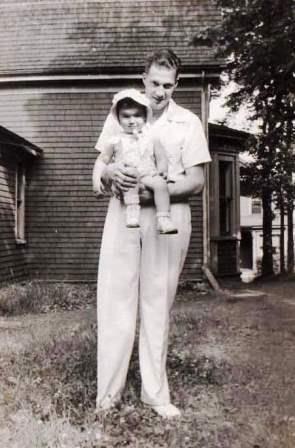
Alton with his daughter Judy in New Glasgow, Nova Scotia.  (Photo courtesy of Judy Parks)

After the conclusion of his 20th trip on October 9, 1945, “….Colonel Stone said I would be taken off the ship this trip. I went home to New Glasgow…

Following his discharge from the Royal Canadian Army Medical Corps (RCAMC), Alton returned to Salisbury, New Brunswick.  Judy explained that “…he started his practice up again, but when I was 4 he was diagnosed with cancer of the bowel and that is the only memory I have of him …in bed …very ill….” 

Sadly, Alton passed away on July 27, 1947, aged 32.  He’s buried at Christ Church Cemetery in Stellarton, Pictou County, Nova Scotia.

Alton recorded 20 trips in his diary, always being fortunate to return home for a few days with his wife and daughter between each voyage.  As he died when Judy was a child, the war diary was a way to get to know him, but she explained that she was “….50 years old” when her mother “…gave me the war diary…

Judy followed her father’s footsteps into a medical career, becoming a nurse. Going over his war diary made her reflect that “….people sometimes ask me if I was upset when my father died and I know I wasn’t.  I was only four.  No one told me he died…children were told nothing about death in those days. I suppose I thought he returned to war…

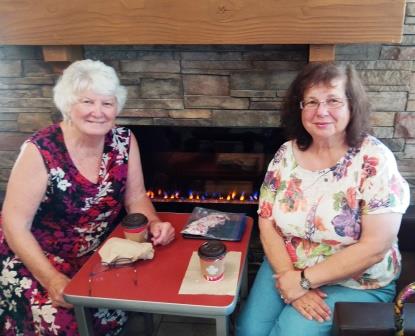
Judy Parks (left) with Daria, discussing the war service of Judy’s father. (Photo credit: Pieter Valkenburg)

Thank you to Judy Parks for sharing photos and her father’s war diary, and to Etienne Gaudet for finding newspaper articles.

© Daria Valkenburg

….Want to follow our research?….

If you are reading this posting, but aren’t following our research, you are welcome to do so.  Our blog address: https://onthewarmemorialtrail.com/
4 countries, 6 weeks, 7,000 km – an unforgettable war memorial journey in Europe…. Daria’s book ‘No Soldier Buried Overseas Should Ever Be Forgotten‘ is available in print and e-book formats.  Net proceeds of book sales help support research costs and the cost of maintaining this blog. For more information see https://nosoldierforgotten.com/

You are also invited to subscribe to our YouTube Channel: On The War Memorial Trail With Pieter Valkenburg: https://www.youtube.com/channel/UCJ591TyjSheOR-Cb_Gs_5Kw

Never miss a posting!  Subscribe below to have each new story from the war memorial trail delivered to your inbox.
On The War Memorial Trail….. The WWII Diary Of Dr. Ross Part 1: Assigned To HMHS Lady Nelson

Judy Parks (left) with Daria, discussing the war service of Judy’s father. (Photo credit: Pieter Valkenburg)

March 16, 2025. It’s a funny coincidence as, a few years ago, Judy Parks, a friend living in Nova Scotia, sent me her father’s WWII war diary.  Her father, Dr. James ‘Alton’ Ross, was a doctor aboard the hospital ship HMHS Lady Nelson.  I kept planning to write his story, but something else always kept coming up. 

Then, a few months ago, Etienne Gaudet sent us an article about 101 year old veteran Romeo LEBLANC of Memramcook, New Brunwick.  In this article it stated that Romeo had travelled on the same hospital ship as Judy’s father!  Talk about a nudge from up above!

Born March 26, 1915 in Stellarton, Pictou County, Nova Scotia, James ‘Alton’ ROSS was the son of James and Lida (nee Cook) Ross, their only child.

….Alton had a medical practice in New Brunswick….

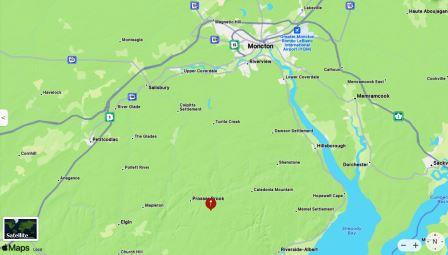
Dr. Alton Ross initially practiced in Albert, New Brunswick (red marker) before opening a practice in Salisbury, New Brunswick, just north of Albert.  (Map source: DuckDuckGo)

After graduating from Dalhousie University’s School of Medicine in Halifax, Nova Scotia in June 1941, Alton married Betty Bauld the same year.  Their daughter Judith ‘Judy’ Ann was born the following year in Moncton, New Brunswick. 

Alton initially practiced in Albert, New Brunswick (now part of the village of Fundy Albert) for a short period before opening a practice in Salisbury, New Brunswick. 

….Alton enlisted in the RCAMC in 1943…

Dr. Alton Ross. (Photo courtesy of Judy Parks.  Photo colourization by Pieter Valkenburg)

Not long after settling into his practice in Salisbury, Alton enlisted with the Royal Canadian Army Medical Corps (RCAMC).  Judy explained that she was “….only 6 months old when my father enlisted… It seems like four years of the war had already taken place but my father only graduated from medical school in June 1941 so he was just starting his practice in Salisbury, New Brunswick when he decided he was needed in the medical corps…

According to his war diary, Alton “…enlisted on 29 December 1942 and was sent to Halifax Military Hospital and put on Ward I Medicine…” A few days later, he was transferred to “…No. 6 District Depot Standing Medical Board…” at Chebucto Barracks in Halifax, Nova Scotia.

With Alton in military service, Judy and her mother …moved back to her parents in New Glasgow, Nova Scotia…

On March 6, 1943, Alton was sent to A22 Canadian Army Medical Corps Training Centre in Camp Borden, Ontario for a “…six weeks qualification course…” 

After returning to Nova Scotia, Alton was “….posted to Halifax Military Hospital again to Ward 2, Eye, Ear, Nose and Throat….” until June 20, 1943, when he left for “…Aldershot Military Hospital…” in Nova Scotia, where he was “….placed on Infectious and Military Wards…

On November 5, 1943, Alton “…received word to go to Suffield, Alberta, on a Chemical Warfare Course…” for 5 days.  After returning to Aldershot, he was informed on November 20, 1943 that he would be posted to a hospital ship.  His orders came through 6 days later, and meant he had to travel to Halifax.

….Alton was assigned to the HMHS Lady Nelson….

Judy confirmed that her father served as a doctor aboard the hospital ship HMHS Lady Nelson, which had first arrived in Halifax on April 22, 1943. “…It was the Lady Nelson my father was on…. There were five lady boats in the war and two were torpedoed by the Germans in spite of the big Red Cross on the sides. The Lady Nelson had been a cruise ship that went between Halifax, New York, and Bermuda…

HMHS Lady Nelson.  Note the crosses on the side of the ship!  (Photo source: Wikipedia)

The Lady Nelson was Canada’s first hospital ship, outfitted with 515 special hospital beds, special wards for shock cases, contagious diseases and fractures, private cabins, a fully equipped operating room, a modern sterilizing room, an inspection room for minor dressings, a dispensary, and a portable x-ray outfit.

The ship’s white hull was painted with 11 large red crosses on the funnel, deck and hull. It was brightly lit up at night for greater visibility so that the enemy would recognize that she was a ‘mercy ship’ and not fire on her in accordance with the Geneva Convention.

….Alton’s first voyage aboard the HMHS Lady Nelson….

Alton’s first trip aboard the HMHS Lady Nelson began on November 30, 1943, and he noted that it was a round trip of 8,093 miles (13,024 km). 

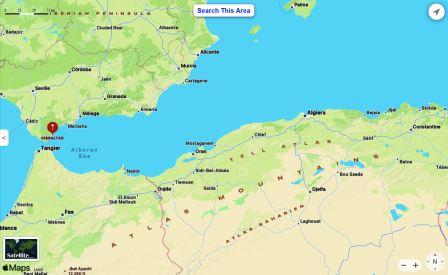
Trip No. 1 went from Halifax to Phillipville and Algiers in Algeria.  (Map source: DuckDuckGo)

The route took him from the port of Halifax, Nova Scotia, across the Atlantic Ocean to Gibraltar, sailing past Tangier, to Phillipville (now Skikda), Algeria, and then on to Algiers before sailing to Avonmouth, United Kingdom, before returning to Halifax.

Alton wrote in his diary that the ship reached Gibraltar at 10:00 am on December 9, 1943 and left an hour later.  He noted that he had a “….grand journey down Mediterranean and landed off coast of Phillipville, where we anchored all day and night.  Docked Sunday am 12 December 1943 and loaded patients….Left at 5 pm…

Why was a Canadian hospital ship in Algeria?  While no formed Canadian units took part in fighting in North Africa, which began in November 1942, a number of Canadian officers and non-commissioned officers had been offered three-month tours of duty attached to forces in Algeria, designated as the 1st British Army.

The objective was to allow them a chance to see combat and take that battle experience back to the Canadian Army in the United Kingdom before Canadians saw active service during the invasion of Sicily in July 1943, followed by the invasion of the Italian mainland in September 1943.

By October 1943, the Canadian Section, including No. 14 Canadian General Hospital, was still near Philippeville. 

From Phillipville, the ship began its long journey to the United Kingdom, picking up more patients along the way.  “…Arrived Algiers 8 am, 13 December. Loaded more patients then waited in stream two days for Nursing Sisters coming by air from Sicily.  Left 6:30 pm, 15 December…

The ship arrived in Avonmouth, United Kingdom on December 22, 1943, unloaded the patients and reloaded patients who were returning back to Canada.  They left for Canada on December 28, and arrived in Halifax on January 5, 1944.

….Alton’s second voyage aboard the HMHS Lady Nelson….

Alton’s second trip aboard the HMHS Lady Nelson began on January 14, 1944, and he noted that it was a round trip of 9,196 miles (14,800 km). 

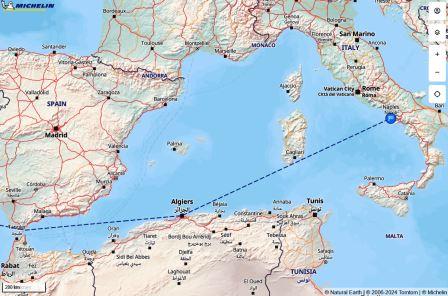
Trip No. 2 went from Halifax to Algiers, Algeria and then to Naples, Italy.  (Map source: https://www.viamichelin.com)

The route took him from the port of Halifax, Nova Scotia, across the Atlantic Ocean to Gibraltar, to Naples, Italy, and then on to Algiers before sailing to Avonmouth, United Kingdom, before returning to Halifax.

Alton wrote in his diary that the ship reached Gibraltar on January 23, 1944 and left the following day at 7:00 pm.  He noted that this time when they reached Algiers on January 26, they didn’t dock but were there for “….orders only… and  left one hour later for Italy…Anchored in Naples harbour just off Mount Vesuvius which was puffing away intermittently….Docked in Naples 29 January and loaded British and Canadian patients…Left at 4 pm…” for Algiers.

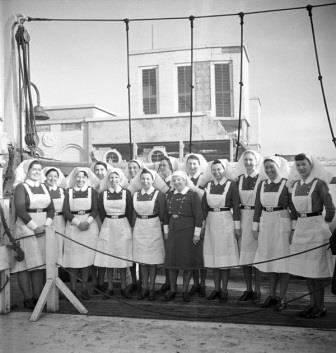
Nursing sisters aboard the HMHS Lady Nelson in Naples, Italy, January 29, 1944. Nursing Sisters R. MacLennan, J. Goodston, Reta Moffat, E. Covey, D.E. MacTier, E. Bateman, Y. Carr, J. Jackson, Captain C.I. Nixon (Matron), M. McLeod, R. Hughes, H.J. Battram, E.K. Sutherland and M.B. Meisner. (Photo Credit: Lt. Frederick G. Whitcombe / Canada. Dept. of National Defence / Library and Archives Canada / PA-163661)

This time the ship docked when it reached Algiers on January 31, 1944, at 3:00 pm, where the “…British disembarked, Canadians embarked. Left February 1, 4:30 pm….Passed Gibraltar 6 am, 3 February…

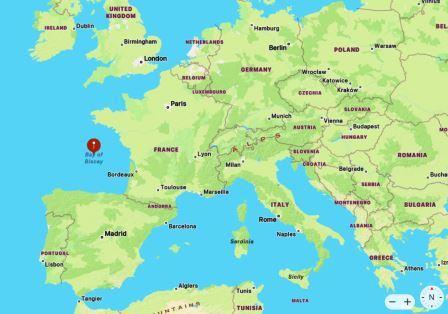
The ship was again enroute to Avonmouth, but Alton recorded that he “…did an appendectomy off Bay of Biscay….” The patient survived.

Bay of Biscay is off of the coast of France.  (Map source: DuckDuckGo)

The ship anchored off Avonmouth on February 7, 1944 and unloaded the patients the following day.  It wasn’t until February 15 that the ship left for Halifax, arriving in port on the afternoon of February 23 in “….a blinding snowstorm – visibility nil….

Alton’s second trip was notable as they “….began an orchestra with three violins, saxophone, piano, accordion, and drums…Put on two concerts…” 

Judy reflected that “…one thing that strikes me from my father’s diary is how much fun they had …music…dances…and orchestra …..” and explained that her father “…. played the saxophone…” The purpose was “…to entertain the troops they were taking to war and those wounded returning….”  She marvelled at this “…ability to switch off the war around them and enjoy the moment…for themselves and for others …

Alton recorded 20 trips in his diary, always being fortunate to return home for a few days with his wife and daughter between each voyage. In Part 2, his story concludes with a return to Italy to pick up wounded servicemen and some of the devastation of war that he saw, and finally, after his 20th voyage he was able to return to the life of a civilian and a rural medical practice.

Thank you to Judy Parks for sharing photos and her father’s war diary, and to Etienne Gaudet for sending newspaper articles about Romeo LeBlanc and Dr. Ross.

© Daria Valkenburg

….Want to follow our research?….

If you are reading this posting, but aren’t following our research, you are welcome to do so.  Our blog address: https://onthewarmemorialtrail.com/

4 countries, 6 weeks, 7,000 km – an unforgettable war memorial journey in Europe…. Daria’s book ‘No Soldier Buried Overseas Should Ever Be Forgotten‘ is available in print and e-book formats.  Net proceeds of book sales help support research costs and the cost of maintaining this blog. For more information see https://nosoldierforgotten.com/

You are also invited to subscribe to our YouTube Channel: On The War Memorial Trail With Pieter Valkenburg: https://www.youtube.com/channel/UCJ591TyjSheOR-Cb_Gs_5Kw

Never miss a posting!  Subscribe below to have each new story from the war memorial trail delivered to your inbox.
On The War Memorial Trail…..The Bulger Brothers – Part 2:  The WWII Stretcher Bearer From Foxley River Killed During The Battle of Bienen

August 19, 2024. During WWII, the Bulger family of Foxley River, Prince Edward Island, suffered a double tragedy, losing two sons:  Harold ‘Hal’ Gabriel BULGER, who is buried in the Canadian War Cemetery in Adegem, Belgium, and Lawrence William BULGER, who is buried in the Canadian War Cemetery in Groesbeek, The Netherlands.

We were aware of Lawrence Bulger from last year’s series on soldiers from the North Nova Scotia Highlanders who lost their lives during the Battle of Bienen on March 25, 1945. Since his name was not on a photo wish list, we didn’t research his story at that time. The date of the Battle of Bienen was significant to Pieter as he was “…exactly one year old when this battle occurred….” and it’s why he made such an effort to research so many of the North Novies that died that day.

….Another story in the Battle of Bienen series….

This year, when we decided to tell the story of one more soldier killed during the Battle of Bienen, we asked Edison Smith for help in contacting a family member for Lawrence Bulger.  Edison’s grandfather, Edison Alexander SMITH, and great-uncle Ralph Schurman BOULTER, both lost their lives in the Battle of Bienen.  Edison put us in contact with Bev Jeffery, niece of the Bulger brothers.

In Part 1 of this two-part series, Hal’s story was told.  (See https://onthewarmemorialtrail.com/2024/08/05/on-the-war-memorial-trail-the-bulger-brothers-part-i-the-wwii-soldier-from-foxley-river-killed-during-the-battle-of-moerbrugge/).  Now, in Part 2, we tell Lawrence’s story.

To learn more about the Bulger brothers, we were delighted to meet with Bev, the family’s historian, who explained that her “mother was Harold and Lawrence’s sister Agatha….

CIMG6828 May 27 2024 Bev Jeffery & Pieter Mill River Resort

Pieter with Bev Jeffery at Mill River Resort in Mill River, Prince Edward Island.  (Photo credit: Daria Valkenburg)

Born May 31, 1924 in Portage, Prince Edward Island, Lawrence was the son of Gabriel and Anne ‘Annie’ Marion (nee Milligan) Bulger of Foxley River, Prince Edward Island.  One of 16 children, Lawrence had two brothers and thirteen sisters. 

Lawrence Bulger with Guitar

Lawrence Bulger with his guitar at home on Prince Edward Island. (Photo courtesy of Bev Jeffery)

…Lawrence enlisted at the age of 17 ….

Before enlisting at the No. 6 District Depot in Charlottetown, Prince Edward Island, on March 10, 1942, Lawrence had worked on his family’s farm. He’d also worked at J.N. Kenny Contractors, a building contracting firm in Halifax, Nova Scotia until December 24, 1941.  He was only 17 when he enlisted, but tried to get around that by adding a year to his birth year, saying he was born in 1923. 

Lawrence Bulger colourized by RU

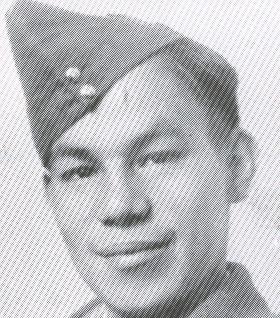
Lawrence Bulger, shortly after enlisting in 1942.  (Photo courtesy of Bev Jeffery.  Photo colourization by Pieter Valkenburg)

After completing his basic training at No. 62 Canadian Army (Basic) Training Centre (CABTC) in Charlottetown, Lawrence was transferred to the Princess Louise Fusiliers (Motor), an infantry regiment, in Halifax, Nova Scotia on July 14, 1942.   

Then, on November 21, 1942, his real age was discovered and he was sent to No. 6 District Depot in Halifax while a decision was made about his future in the army.  Lawrence was described as a “…quiet but friendly man...” who was “…accustomed to hard work…” It was also noted that he “…cannot drive a car….” and “…hasn’t had any trades experience of any kind…”  It was recommended that he be given infantry training.

On November 30, 1942, Lawrence was transferred to the Anti-Aircraft Artillery Formation Camp in Bedford, Nova Scotia.  He remained there until September 1, 1943, when he was sent to No. 61 Canadian Army (Basic) Training Centre (CABTC) in New Glasgow, Nova Scotia.  It was the second time he had to go through basic training.

…Lawrence was transferred from the Infantry to the Medical Corps ….

lawrence bulger Sep 1943 colourized

Lawrence Bulger in the fall of 1943.  (Photo courtesy of Bev Jeffery.  Photo colourization by Pieter Valkenburg)

On September 17, 1943, he was reallocated to the Royal Canadian Army Medical Corps (RCAMC) and, once his basic training was complete, was transferred to A22 Canadian Army Medical Corps Training Centre in Camp Borden, Ontario on October 6, 1943.  While at Camp Borden, Lawrence received advanced training to prepare him as a stretcher bearer, with three key responsibilities when dealing with the wounded in a war zone: stop the bleeding, treat for shock, and evacuate. 

In an interview on October 26, 1943, it was noted that Lawrence was “…very disappointed about reallocation to RCAMC, as he was enthusiastic about the Infantry.  A sturdy active chap….

…Lawrence married Violet May Bedgood ….

Violet(Bedgood) & Lawrence Bulger 1943 001

Violet May Bedgood and Lawrence Bulger in 1943.  (Photo courtesy of Bev Jeffery)

Just before his transfer to Camp Borden, Lawrence married Violet May Bedgood in Halifax, Nova Scotia on October 2, 1943, a few days after receiving permission to do so.  According to his application for permission to marry, they had known each other for a year.

Lawrence completed his advanced training in Camp Borden and was deemed ready for overseas service. He was granted special embarkation leave from December 15 to 23, 1943, the last extended period of time to visit with his wife and family.

On January 19, 1944, he was sent to No. 1 Training Brigade in Debert, Nova Scotia, for further training and in preparation for overseas service. 

….Lawrence left Canada for overseas service….

On March 6, 1944, Lawrence left Canada, arriving in the United Kingdom on March 13, 1944, where he was assigned to 1 Canadian General Reinforcement Unit (CGRU).  He was sent for further training while in the United Kingdom and worked as an orderly at No. 18 Canadian General Hospital.

Bev Jeffery had written that Violet was “…pregnant when Lawrence shipped out….” On May 16, 1944, their son Lawrence ‘Larry’ William was born in Halifax, Nova Scotia – a child that Lawrence would never meet in person.

Lawrence was transferred from RCAMC to No. 1 Canadian Infantry Training Regiment (CITR) on December 14, 1944.  As part of the Canadian Infantry Corps, he would be putting his training as a stretcher bearer to use in an infantry regiment in an active war zone.

….Lawrence was transferred to the North Nova Scotia Highlanders….

Screenshot 2022-11-07 at 10-07-46 Bienen

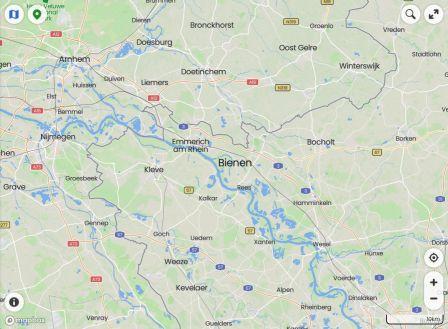
The North Nova Scotia Highlanders made their way from Xanten towards Bienen in Germany in March 1945.  (Map source: Mapcarta)

On February 17, 1945, Lawrence was sent by plane to northwest Europe as part of the CIC-X4 reinforcement troops, and then was assigned to the North Nova Scotia Highlanders on March 11, 1945, joining the Regiment as they left Xanten, Germany for the Reichwald forest.

The Regiment was in the midst of preparations for Operation Plunder, which began March 21, and involved Allied troops crossing the Rhine River to the north of the Ruhr industrial region in western Germany. With aerial and military support, this took place on the night of March 23, 1945 near Rees, a town situated on the right bank of the Rhine River, approximately 20 km (12.4 miles) east of Kleve. (See https://en.wikipedia.org/wiki/Operation_Plunder)

…Lawrence lost his life in the Battle of Bienen ….

On the next afternoon, March 24, 1945, Allied troops encountered fierce German resistance near the village of Bienen. They got as far as Bienen, when troop movement stopped due to blown bridges across the Rhine in that area.

In ‘No Retreating Footsteps’ by Will Bird, he noted that the 7th Argyll and Sutherland Highlanders had made “… three attempts …. to capture the village, but they were turned back by very heavy machine gun fire from the front of the village, supported by heavy mortar fire…

On March 25, 1945, the North Nova Scotia Highlanders reached Bienen, Germany for the climax of 9 Canadian Infantry Brigade’s role in Operation Plunder. The Regiment was tasked with passing through the 7th Argyll and Sutherland Highlanders who had been stopped in front of Bienen during the night. 

Bienen was a difficult challenge as the road through it was the only access point.  In ‘No Retreating Footsteps’ author Will Bird explained that it was “… an isthmus of solid land about half a mile wide with one road, the main Rees-Emmerich highway, which passed through Bienen exactly at the narrowest point…

Aerial Bienen post-war

Post-war aerial of Bienen (view to the southeast towards Rees). The aerial clearly demonstrates the tactical importance of Bienen, laying astride the narrow neck of land. The main road from Rees to Emmerich (nowadays Emmericher Strasse) runs straight through Bienen. (Photo source: http://www.WW2Talk.com and identified as ‘Courtesy Becker’)

March 25, 1945 was Palm Sunday – one week before Easter. The battle began in the morning and didn’t end until late that evening.  Right from the start, troops were pinned down, …suffering heavy casualties…” per the Regiment’s war diary for that day.  Worse, in terms of communications, “….contact between platoons was next to impossible because of the murderous fire and heavy mortaring….” 

The one day battle proved devastating in terms of casualties, both dead and wounded, as they fought in a deadly battle on open ground.  Among the casualties was 20 year old Lawrence William Bulger.  He was one of several stretcher bearers who lost their lives that day, killed by machine gun fire while attending to the wounded on the battlefield.

….Lawrence is buried in Groesbeek….

Like Clifford BATEMAN, John Joseph BOHON, Ralph Schurman BOULTER, Charles ‘Marshall’ CARSON, Harry William DOUCETTE, Marven Glenroy HARVEY, Kitchener ‘Kitty’ LANGILLE, Marvin William MCGREGOR, Austin Havelock MUNROE, Wilfred ‘Willy’ Joseph POWER, Louis Allan SEXTON, and John Lewis WALLACE, Lawrence was temporarily buried in the military cemetery in Rees, Germany. According to his military file, he was buried on April 5, 1945. The following year he was reburied in the Canadian War Cemetery in Groesbeek, The Netherlands.

In October 2019, Pieter and I visited the cemetery and placed Canadian and Prince Edward Island flags by Lawrence’s grave.  (See https://onthewarmemorialtrail.com/2019/12/04/on-the-war-memorial-trail-our-2019-visit-to-the-canadian-war-cemetery-in-groesbeek/)

CIMG3356 Oct 5 2019 Groesbeek Lawrence Bulger from Daria

Grave of Lawrence William Bulger in the Canadian War Cemetery in Groesbeek, The Netherlands.  (Photo credit: Daria Valkenburg)

….Lawrence and his brother Hal are remembered on the Ellerslie Monument….

CIMG6817 May 27 2024 Pieter by Ellerslie Monument - Bulgers

Pieter points to the names of Lawrence and Hal Bulger on the Ellerslie Monument.  (Photo credit: Daria Valkenburg)

In May 2024 we visited the Ellerslie Monument in Ellerslie, Prince Edward Island, just 13.4 km (8.3 miles) from Foxley River, where the names of Lawrence and his brother Hal, who lost his life on September 10, 1944 during the Battle of Moerbrugge in Belgium, are commemorated.  

This concludes the 2 part series on the Bulger Brothers. Thank you to Bev Jeffery for submitting photos and information on her Uncle Lawrence, and to Edison Smith for contacting the Jeffery family.

Do you have photos or information to share? Email Pieter at memorialtrail@gmail.com, comment on the blog, or tweet to @researchmemori1.

© Daria Valkenburg

….Previous stories about North Novies killed during the Battle of Bienen and buried in Groesbeek….

….Want to follow our research?….

If you are reading this posting, but aren’t following our research, you are welcome to do so.  Our blog address: https://onthewarmemorialtrail.com/

Front cover OnTheWarMememorialTrailinEurope4 countries, 6 weeks, 7,000 km – an unforgettable war memorial journey in Europe…. Daria’s book ‘No Soldier Buried Overseas Should Ever Be Forgotten‘ is available in print and e-book formats.  Net proceeds of book sales help support research costs and the cost of maintaining this blog. For more information see https://nosoldierforgotten.com/ 

You are also invited to subscribe to our YouTube Channel: On The War Memorial Trail With Pieter Valkenburg: https://www.youtube.com/channel/UCJ591TyjSheOR-Cb_Gs_5Kw

Never miss a posting!  Subscribe below to have each new story from the war memorial trail delivered to your inbox.
On The War Memorial Trail….. Remembering WWII Soldier Alfred Louis Pitawanakwat (Pitwanakwat)

September 6, 2021. After an interview about the photo quest for soldiers buried in the Canadian War Cemeteries in The Netherlands ran on APTN, Pieter was contacted by Joshua Manitowabi, who explained that Alfred Pitawanakwat’s “…brothers were Thomas Pitawanakwat and Valentine Pitawanakwat and all three fought in WW2. Two returned home, but Alfred is buried overseas in Holland. Alfred was my grandfather’s brother. He was my Great-Uncle on my mom’s side. ..

(To read the APTN article, see https://www.aptnnews.ca/national-news/dutch-born-p-e-i-man-on-a-mission-to-find-photos-of-first-nations-soldiers-killed-overseas-in-wwii/)

2232439_1 Alfred Pitwanakwat from Cdn Virtual War Memorial

Alfred Louis Pitawanakwat (Pitwanakwat) (Photo source: Canadian Virtual War Memorial)

Alfred Louis PITAWANAKWAT (PITWANAKWAT) was born September 12, 1924 in Little Current, Ontario, son of Samuel and Agatha Pitwanakwat, of Wikwemikong, Ontario. Like Clarence Wilfred WAKEGIJIG, he was from the Unceded Territory on Manitoulin Island, Ontario. (For more information on the Wiikwemkoong First Nation, see https://en.wikipedia.org/wiki/Wiikwemkoong_First_Nation. To read the posting on Clarence Wilfred Wakegijig see https://onthewarmemorialtrail.com/2021/08/09/on-the-war-memorial-trail-remembering-ww2-soldier-clarence-wilfred-wakegijig/.) 

….Alfred enlisted in 1943….

Alfred enlisted on August 23, 1943 in Toronto, Ontario.  At the time, he had been working for 2 months as a farmer’s helper for George McCluny of Caledonia, Ontario.  His two older brothers were already serving overseas with the Canadian Army.  Thomas was with the #14 Company of the Canadian Forestry Corps, and William ‘Valentine’ was with the #24 Anti-Tank Battery.

In an interview with the Personnel Selection Board, it was noted that he was “…able to express himself clearly….He gives the impression of being shy, but proved a very interesting character, when encouraged to talk about himself...”  The interviewer also remarked that Alfred was good with his hands as he was “…in the habit of carving miniature boats...

Someone in the recruitment office was paying attention as a note on his attestation form was stamped with the warning that he wouldn’t be 19 years old until September 12.  This was a caution as enlistees were not to be sent overseas before the age of 19.

Alfred’s service file also noted that as he was both underage and underweight at the time of enlistment he was sent to the Royal Canadian Army Medical Corps and took basic and advanced infantry training.

….Alfred left Canada for overseas service….

On June 6, 1944 he was sent to the No 1 Transit Camp in Windsor, Ontario for ‘rations and quarters’, in preparation for going overseas with #24 Canadian General Hospital.  By June 26, 1944 he was on board a ship bound for the United Kingdom, arriving in early July 1944.

He was a runner with the hospital, but in September 1944 Alfred requested a transfer to an anti-tank battery or the infantry, explaining that as he was now fit he wanted more active employment.

The transfer request was granted and Alfred joined the Royal Winnipeg Rifles as a rifleman.  He was wounded on October 23, 1944 by a gunshot wound during the Battle of the Breskens Pocket in Belgium, but returned to his Regiment after being discharged from hospital on November 15, 1944. (See https://www.canadiansoldiers.com/history/battlehonours/northwesteurope/breskenspocket.htm)

On November 2, 1944, the Regiment was sent to Ghent, Belgium for a rest period before the Rhineland Campaign began.  From Ghent they moved into The Netherlands, stopping near the Dutch-German border.

The Regimental history, ‘Little Black Devils: a history of the Royal Winnipeg Rifles’, by Bruce Tascona and Eric Wells, describes the movement of the Regiment as it moved from The Netherlands across the border into Germany, beginning on February 8, 1945.  “… After heavy artillery and bombardment, the tanks moved in, followed by infantry. Their assignment was to push south-east from the salient at Nijmegen, clearing a corridor between the Rhine and Maas Rivers…

A salient is a piece of land or section of fortification that juts out to form an angle. Nijmegen is in The Netherlands, not far from the German border.  This area had been cleared by December 1944.  Canadian troops were kept busy here, clearing the ice on the Waal River to protect bridges further downstream.

….Alfred lost his life during the Battle of Moyland Wood….

The Regimental history account continued as the Regiment moved into Germany, “… approaching the village of Louisendorf in ‘Kangaroos’, armoured personnel carriers converted from Ram tanks. Getting within 50 yards of the enemy, the Rifles charged the remaining distance, and in close combat took 240 prisoners and occupied the village. The next day the Regiment joined the Regina Rifles and the Canadian Scottish in the attack on Moyland Wood….

They advanced into an area “…beset with booby traps, mines, snipers, and machine guns….

Moyland Woods map from Little Black Devils

Map source: ‘Little Black Devils: a history of the Royal Winnipeg Rifles’ by Bruce Tascona and Eric Wells.

An account by Terry Copp in the article ‘Clearing Moyland Wood: Army Part 43’ in the November 2002 issue of Legion Magazine explained that: “…The Royal Winnipeg Rifles left their slit trenches near Louisendorf and moved into position south of Moyland Wood. Brig. E.R. Suttie, who had replaced Brig. Stanley Todd in command of the divisional artillery, prepared an elaborate fire plan involving medium and field artillery plus mortars, anti-tank guns, machine-guns and the tanks of the Fort Garry Horse….

Lt Col Alan Gregory, temporary commander of the Regina Rifles, “….and Lt.-Col. Lockie Fulton, the aggressive young commander of the Royal Winnipeg Rifles or Little Black Devils, devised a plan to clear the eastern end of the wood combining Wasps with tank support and air attacks. …

The plan was successful, but came at a cost. “…The Royal Winnipeg Rifles displayed outstanding skill as well as courage in the day-long battle that cost the battalion more than 100 casualties, 26 of them fatal….” (See https://legionmagazine.com/clearing-moyland-wood/) Alfred was one of the fatalities, losing his life on February 21, 1945.

Map

….Alfred is buried in the Canadian War Cemetery in Groesbeek….

Alfred was initially buried in Bedburg, Germany before being reburied in the Canadian War Cemetery in Groesbeek, The Netherlands.

Grave of Alfred Pitwanakwat

Grave of Alfred Louis Pitwanakat.  (Photo credit: Ad Scheepers)

Thank you to Joshua Manitowabi for contacting us about his great-uncle, and to Ad Scheepers for taking the photo of Alfred’s grave at the cemetery.  If you have information to share about Alfred Louis PITAWANAKWAT (PITWANAKWAT) or other Canadian soldiers, please contact Pieter at memorialtrail@gmail.com, comment on the blog, or send a tweet to @researchmemori1.

© Daria Valkenburg

….Want to follow our research?….

If you are reading this posting, but aren’t following our research, you are welcome to do so.  Our blog address: https://onthewarmemorialtrail.com/

Front cover OnTheWarMememorialTrailinEurope4 countries, 6 weeks, 7,000 km – an unforgettable war memorial journey in Europe…. Daria’s book ‘No Soldier Buried Overseas Should Ever Be Forgotten‘ is available in print and e-book formats.  Net proceeds of book sales help support research costs and the cost of maintaining this blog. For more information see https://nosoldierforgotten.com/ 

Screenshot_2021-02-27 On The War Memorial Trail With Pieter Valkenburg

You are also invited to subscribe to our YouTube Channel: On The War Memorial Trail With Pieter Valkenburg: https://www.youtube.com/channel/UCJ591TyjSheOR-Cb_Gs_5Kw.

Never miss a posting!  Subscribe below to have each new story from the war memorial trail delivered to your inbox.
On The War Memorial Trail…..The WWII Soldier Who Drowned In Quebec

December 14, 2019.  In uncovering the stories of the names on the Cenotaph outside the Borden-Carleton Legion, perhaps one surprise has been how often an accident or illness can take the life of a soldier.  Being based in Canada during wartime was no guarantee of safety!   An accidental drowning in Quebec took the life of one WWII soldier from Prince Edward Island, Frank Lewis ARSENAULT.

OLYMPUS DIGITAL CAMERA

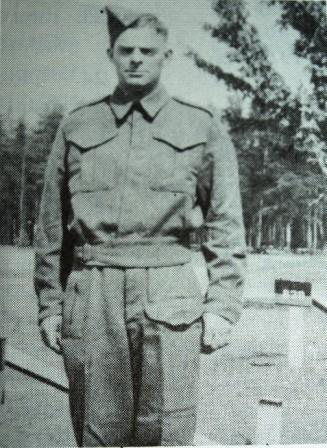
Frank Lewis Arsenault.  (Source: ‘Around Kinkora Area’ by G. K. Farmer)

Born on August 14, 1913 in Kinkora, Frank Lewis (baptized as Francis Louis) was the son of John Hubert Arsenault and Elizabeth Jane, the husband of Grace Elizabeth Gaudet, and the father of four children: George Edmund, Mary Elisabeth, Martha Marie, and Joseph Henry.

A farm labourer before enlisting with the 8th Heavy Anti-Aircraft Battery Artillery Unit on June 13, 1941 in Charlottetown, he was transferred a week later to the 2nd Heavy Anti-Aircraft Battery Artillery Unit and sent to Petawawa, Ontario.  However, two and a half years before he enlisted, Frank Lewis had rheumatic fever, which left him with joint pains that made it difficult to do many activities, such as standing on his feet or carrying a rifle for long periods of time.  This led to him being reclassified within a few weeks of arrival in Petawawa, and transferred to the Royal Canadian Army Medical Corps, Home War Establishment Unit, on September 7, 1941, and based at the Petawawa Military Hospital.

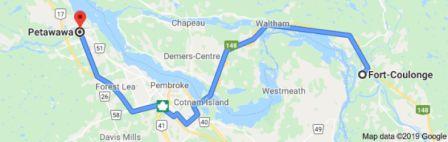
On September 30, 1942, Frank Lewis, along with two other soldiers, R. Marino and E. J. Arsenault, received a pass from the Petawawa Military Camp where they were stationed.  They went by car to Le Passe, and then by ferry to Fort-Coulonge and had dinner at Bascheau’s Restaurant, where they were last seen alive.  Pte Marino’s body was found the next day in the Ottawa River.  Their car was found in the river on October 20 in the area of the dock on the Quebec side of the river.  The bodies of E. J. and Frank Lewis Arsenault were found in the Ottawa River on October 25.  However,  death was determined to have occurred on September 30 and this was the date listed on Frank Lewis’s death certificate.

Screenshot_2019-12-14 fort coulonge to petawawa map - Google Search

The distance between Petawawa and Fort-Coulonge is about 69 km.  Source:  Google maps https://www.google.ca/maps

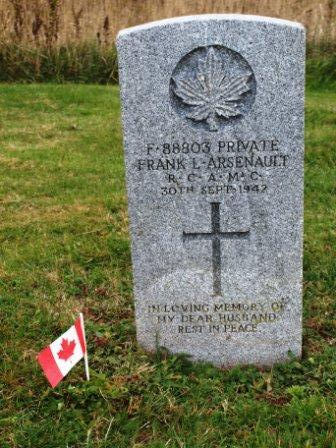
Frank Lewis was buried at St. Peter’s Roman Catholic Cemetery, Seven Mile Bay in Prince Edward Island.  His father was still alive and living in Kinkora, but his mother was deceased.  His wife and children were living in Pembroke, Ontario at the time.

gravestone-frank-l.-arsenault-1.jpg

Gravestone of Frank Lewis Arsenault at St. Peter’s Roman Catholic Cemetery in Seven Mile Bay. (Photo credit: Pieter Valkenburg)

It’s unknown how the accident happened, but most likely the car went off the road in the dark and went into the river.  If anyone has more information or photos to share for Frank Lewis Arsenault, please contact Pieter at memorialtrail@gmail.com or comment on the blog.

© Daria Valkenburg

….Want to follow our research?…

If you are reading this posting, but aren’t following our research, you are welcome to do so.  Our blog address: https://onthewarmemorialtrail.com/

4 countries, 6 weeks, 7,000 km – an unforgettable war memorial journey in Europe…. Daria’s book ‘No Soldier Buried Overseas Should Ever Be Forgotten‘ is available in print and e-book formats.  Net proceeds of book sales help support research costs and the cost of maintaining this blog. For more information see https://nosoldierforgotten.com/

Subscribe to our YouTube Channel: On The War Memorial Trail With Pieter Valkenburg: https://www.youtube.com/channel/UCJ591TyjSheOR-Cb_Gs_5Kw

Never miss a posting!  Subscribe below to have each new story from the war memorial trail delivered to your inbox.