On The War Memorial Trail….. The WWII Despatch Rider Who Was Shocked To Have Survived

February 1, 2022.  Every fall, veterans from the Borden-Carleton Legion volunteer to place flags at the graves of veterans buried in cemeteries in the area covered by this Legion Branch on Prince Edward Island.  (See https://onthewarmemorialtrail.com/2021/11/04/borden-carleton-legion-honours-veterans-by-placing-flags-at-their-graves/)

One of the graves for which a flag was placed at the Tryon People’s Cemetery was for WWII veteran Richard Lea HOWATT of Tryon, Prince Edward Island, who had been a despatch rider during the war.

Richard was born March 17, 1923 in Tryon, the son of Everett King Kilburn Howatt and Clara, nee Thomas.  Before enlisting in Truro, Nova Scotia at No 6 District Depot on February 28, 1942, he was a self-employed truck driver for logging camps, and based in Melrose, New Brunswick.

His attestation form indicated he was a skilled motorcycle rider, and his hobbies included swimming, hunting, fishing, and that he played the position of goalie on a soccer team.

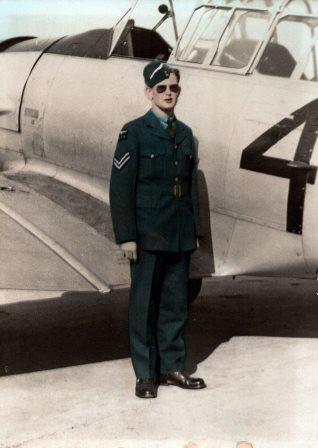
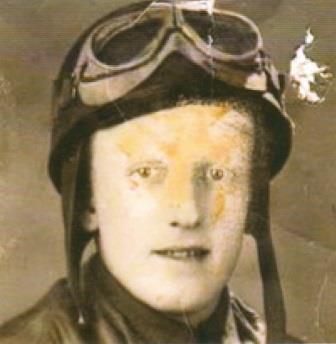
Richard Lea Howatt uniform

Richard Lea Howatt.  (Photo courtesy of Catherine Ann Howatt-Dickson)

Based on his skill set, he was recommended as being “…well qualified for despatch rider and motor transport generally.  Has plenty of experience…” The assessment went on to note that Richard was “…very quiet…” and that he “…is still rather young…

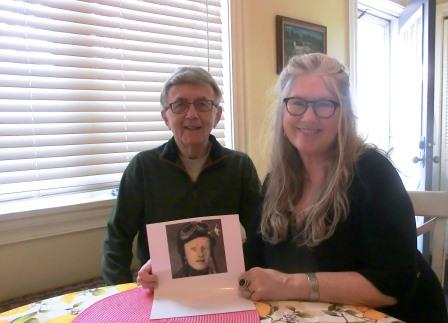
CIMG5352 Pieter and Catherine Ann Howatt Dickson

Pieter with Reverend Catherine Ann Howatt-Dickson, and a picture of her father.  (Photo credit: Daria Valkenburg)

…A quiet man with a wanderlust and seeker of adventure….

He was only 18 at the time of his enlistment.  His daughter, the Reverend Catherine Ann Howatt-Dickson, said that since he signed up before he was of age, “… his mother wanted to report him to the authorities, but his Dad said to let him be as he’ll do it anyways….

Catherine Ann explained that although her father “…was a quiet man, he was the wild one of the family and no one knew what to do with him.  He had a wanderlust and was a seeker of adventure, having left home at age 13 to work in lumber camps and was a truck driver….

After a month of basic training in Halifax, Nova Scotia, Richard was transferred to 26 Forestry Corps and sent to Valcartier, Quebec.  Catherine Ann recalled her father saying that he was “…issued a gray blanket to be wrapped in if he died.  What bugged him was that he had to pay for this out of his first pay….

By May 17, 1942 he was in Halifax and ready to embark to the United Kingdom, arriving on May 26, 1942, and reassigned to 29 Canadian Forestry Corps.

….An unsolved mystery….

While still in the United Kingdom, Richard applied for permission to marry Miss Margaret Ross of Culleave, Ardgay, Ross-shire in Scotland on April 6, 1943.  He stated that he had known her for 7 months and her next of kin, likely her father, was John Ross. Permission was granted in May 1943 by the military as long as the ‘…wedding did not take place before July 21, 1943…

For some reason, the wedding never took place, and the family was mystified to learn about this from his service file, which was applied for after his death, and therefore too late to ask about.

…The dangerous life of a despatch rider begins….

On July 16, 1943, Richard was transferred to the CASCRU (Canadian Army Service Corps Reinforcement Unit) and sent for a motorcycle rider’s course, which he successfully completed.

I was interested to learn what was in the course.  If you are too, you can watch this YouTube Canadian Motorcycle Riders Training course (just under 8 minutes):

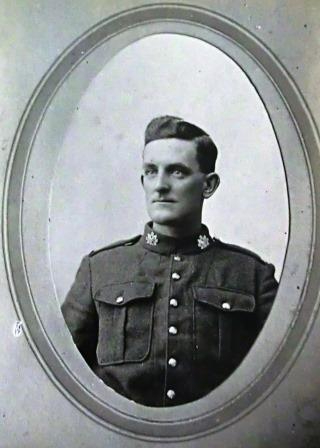
Richard Lea Howatt despatch rider

Richard Lea Howatt as a despatch rider.  (Photo courtesy of Catherine Ann Howatt-Dickson)

The role of a despatch rider was to deliver messages, no matter how dangerous the conditions.  Although communication by radio or telephone was available in WWII, it wasn’t always practical or available. Shelling by the enemy could cut lines, and signals could be intercepted or not have a long enough range.

For more information on despatch riders see:

Richard was attached to the Royal Canadian Army Service Corps (RCASC), assigned to various regiments as needed. (See https://www.junobeach.org/canada-in-wwii/articles/supplying-canadas-field-army-overseas/the-royal-canadian-army-service-corps/)  On February 28, 1944 he was awarded the Good Conduct Badge.

On July 8, 1944 he was sent to France with the RCASC and assigned to 7 Medical Regiment as a despatch rider and scout.  On October 20, 1944, while on patrol, Richard had an accident that resulted in him being evacuated to England from France on November 2, 1944.  Catherine Ann related that “…as he was on patrol, he couldn’t use his headlights.  A truck hit him and he had a head injury, resulting in a 3 month hospital stay….

…Empathy and humanity was never lost by Richard….

On March 4, 1945 he was sent to northwest Europe with RCASC, this time assigned to 82 Canadian Artillery Company and 7 Medical Regiment.  Catherine Ann related an anecdote shared by her father: “…3 German soldiers surrendered and Dad was told to take them to a warehouse.  He gave them some green apples and a cigarette while waiting for them to be picked up.  Dad was reprimanded and told he could be court martialled for sitting and smoking with them….

On June 18, 1945 Richard was transferred to 45 Army Transport Company, then on October 28, 1945 he was sent to 63 Army Transport Company.

In another anecdote, Catherine Ann recalled her father’s anguish about the treatment of horses in the immediate post-war period. “…One of the hardest things at the end of the war in Germany was seeing wounded horses.  Dad wanted to shoot them and put them out of their misery but was told there was not enough ammunition.  Dad was very hurt as he was an animal lover and our kitchen table was always used as a makeshift animal clinic…

…Love at first sight?….

On November 26, 1945 he returned to the United Kingdom in preparation for returning back to Canada.  At the beginning of 1946 he arrived in Halifax, Nova Scotia, and was discharged on February 27, 1946.

Richard bought a motorcycle and returned to Prince Edward Island.  One day, while in Victoria-By-The-Sea, he pulled up on his bike.  Catherine Ann told us what happened next. “ … Mom was walking with her girlfriend.  Dad didn’t know her, but asked her if she wanted a ride.  She said yes….” It seemed as if it was love at first sight.

On April 17, 1948 he married Marguerite Alexandra MacDonald and they had 5 children, of which Catherine Ann is the youngest. “…Dad did farming, then worked at CN Marine as a deckhand until he retired.  His nickname was ‘Mouse’ because he was so quiet….

…Shocked and surprised to have survived the war…

As a teenager, Catherine Ann interviewed her father about his war experience.  “…I asked him what shocked and surprised him the most and he answered ‘that I lived’….”  Many veterans would agree with that statement!

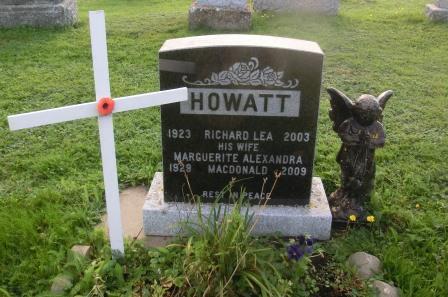
Richard died March 17, 2003 in Tryon, and is buried in the Tryon People’s Cemetery, after a life well-lived.

CIMG5353 Sep 30 2021 Grave of Richard Lea Howatt Tryon Peoples Cemetery

Grave of Richard Lea Howatt at the Tryon People’s Cemetery in Prince Edward Island.  (Photo credit: Daria Valkenburg)

Thank you to Reverend Catherine Ann Howatt-Dickson for sharing her father’s story with us.  If you have photos or information to share, please let Pieter know. Email him at memorialtrail@gmail.com, comment on the blog, or tweet to @researchmemori1.

© Daria Valkenburg

…Want to follow our research?….

If you are reading this posting, but aren’t following our research, you are welcome to do so.  Our blog address: https://onthewarmemorialtrail.com/

Front cover OnTheWarMememorialTrailinEurope4 countries, 6 weeks, 7,000 km – an unforgettable war memorial journey in Europe…. Daria’s book ‘No Soldier Buried Overseas Should Ever Be Forgotten‘ is available in print and e-book formats.  Net proceeds of book sales help support research costs and the cost of maintaining this blog. For more information see https://nosoldierforgotten.com/ 

Screenshot_2021-02-27 On The War Memorial Trail With Pieter Valkenburg

You are also invited to subscribe to our YouTube Channel: On The War Memorial Trail With Pieter Valkenburg: https://www.youtube.com/channel/UCJ591TyjSheOR-Cb_Gs_5Kw.

Never miss a posting!  Subscribe below to have each new story from the war memorial trail delivered to your inbox.

A Headstone For WWII Veteran Alexander Deans

October 8, 2021. When Alexander McGregor DEANS died on April 28, 2010, his estate was able to pay for his burial at the Tryon People’s Cemetery in Tryon, Prince Edward Island.  Unfortunately, there were insufficient funds for a headstone, and no family or friends stepped up to help pay for one. 

The lack of a gravestone bothered Jack Sorensen, Chair of the Tryon Peoples Cemetery Inc.  Jack had met Deans as both attended the same church.  He remembered that Deans had requested that a Canadian flag be draped over his coffin, and then later recalled being told that Deans, who had lived in Crapaud, had been a veteran.

In 2020, Jack contacted Pieter, in his role as Public Relations Officer at the Borden-Carleton Legion, and asked if the Legion would cover the cost of a headstone for a veteran.  Pieter knew that the Last Post Fund, administered by Veterans Affairs, could fund a headstone for eligible veterans in unmarked graves, but it was unknown if Deans was a veteran. Proof of military service was one of the requirements. (See https://www.lastpostfund.ca/unmarked-grave-program/)

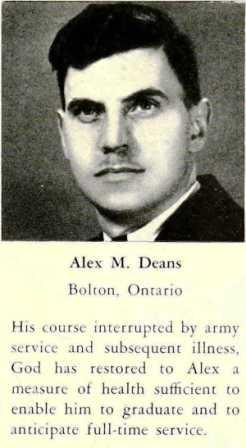
After Pieter started researching Deans, the estate’s lawyer was able to find a Veterans Affairs client number, indicating he had been a veteran.  Pieter also found a 1949 yearbook entry from Tyndale University College and Seminary in Toronto, stating that Deans, from Bolton, Ontario, had graduated after his studies had been interrupted due to war service. Deans was a WWII veteran!

Yearbook_full_record_image 1949 Deans

Entry from 1949 yearbook of Tyndale University College and Seminary.

With these two pieces of information, Pieter turned the file over to Marilyn Letts, Service Officer at PEI Command.  As the Provincial Service Officer, she was able to verify the information with Veterans Affairs and make the application for a headstone.

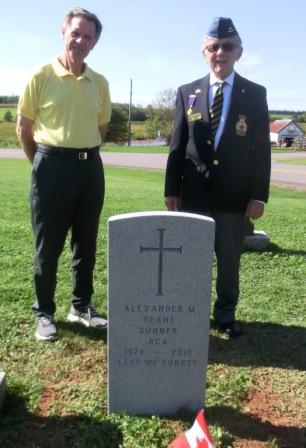
The application was approved, and on September 28, 2021, Paul Cyr of Brunswick Monuments Ltd in Grand Falls, New Brunswick, installed the headstone. 

CIMG5345 Sep 28 2021 Gravestone for Alexander Deans

Jack Sorensen, left, with Pieter Valkenburg, right, by the grave of Alexander M. Deans.  (Photo credit: Daria Valkenburg)

Jack and Pieter commemorated the headstone by placing a Canadian flag at his grave.  11 years after his death, Alexander Deans no longer lies in an unmarked grave.

Jack, Pieter, and Marilyn are to be commended for the effort they made into ensuring that this WWII veteran was not forgotten. 

With Remembrance Week coming up, please take a look through your photo albums and in your attics in case you have a photo or information to share about Canadian soldiers.  You can email us at memorialtrail@gmail.com, or comment on the blog.  

© Daria Valkenburg

holidays-1-e1460375295631

…..Want to follow our research?….

f you are reading this posting, but aren’t following our research, you are welcome to do so.  Our blog address: https://onthewarmemorialtrail.com/

4 countries, 6 weeks, 7,000 km – an unforgettable war memorial journey in Europe…. Daria’s book ‘No Soldier Buried Overseas Should Ever Be Forgotten‘ is available in print and e-book formats.  Net proceeds of book sales help support research costs and the cost of maintaining this blog. For more information see https://nosoldierforgotten.com/

Screenshot_2021-02-27 On The War Memorial Trail With Pieter Valkenburg

You are also invited to subscribe to our YouTube Channel: On The War Memorial Trail With Pieter Valkenburg: https://www.youtube.com/channel/UCJ591TyjSheOR-Cb_Gs_5Kw

Never miss a posting!  Subscribe below to have each new story from the war memorial trail delivered to your inbox.

On The War Memorial Trail….. The WWI Letters Of Arthur Clinton Robinson

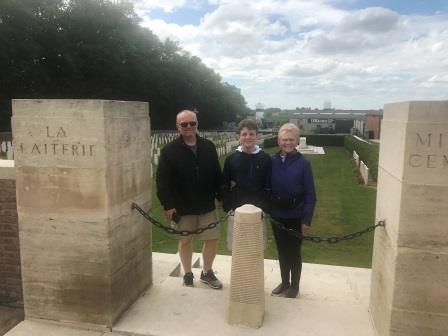
July 4, 2021. In 2017 we visited the grave of Arthur Clinton ROBINSON, a WWI soldier with the 26th (New Brunswick) Battalion, from Tryon, Prince Edward Island, who is buried in Belgium.(See https://onthewarmemorialtrail.com/2017/10/16/on-the-war-memorial-trail-in-belgium-and-a-visit-to-la-laiterie-military-cemetery/) Up to today, we have not found of a photo of him, and neither has his family.

In June 2018, Arthur’s nephew, Arthur ‘John’ Robinson and his wife Hazel visited the grave with their son, dentist Dr. Alan Robinson, and Alan’s son, William Robinson.

2018-06-16 Arthur C Robinson grave (1)

At La Laiterie Military Cemetery in Belgium.  Left to right: Dr Alan Robinson, William Robinson, Hazel Robinson.  (Photo credit: John Robinson)

While no photo has yet been found, the Robinsons were able to find two letters that Arthur wrote to his aunts. 

In an August 30, 1915 letter to his aunt, Robbie Blanchard, written in England just before travelling to France,  he describes the composition of men in his platoon from the 26th (New Brunswick) Battalion: … You should just see the bunch of men … in this 26th alone. They are a magnificent body of fellows….and this Platoon I am in is a corker… there are, I don’t know how many different nationalities in it… Indian, French, Russians, Belgians, English, Irish, Scotch, Americans and Canadians.  Some mob, eh? You can hear nearly any language around here any time of day….” 

While in England, Arthur saw injured troops arriving back from the front and reflected that “…when you see the hundreds of maimed soldiers, some far worse off than if they were dead, and when nearly daily train loads of freshly wounded men pass right before your eyes, it makes you wonder at the ups and downs of this human life…” 

It was a miracle that the August 30 letter arrived in Canada, as the ship the mail had been travelling on, the Hesperian, was torpedoed by a German submarine off the coast of Plymouth, England on September 4, 1915! Luckily it was one of the items salvaged from the wreckage. (See https://www.rmslusitania.info/related-ships/hesperian/ for more information) 

In a September 16, 1915 letter, written in France to his aunt, Carrie Robinson, he outlines life in a trench: …I am quite comfortable here in our cosy little dugout, out of reach of all the Germans in Europe.  I must tell you about the nice dugout and the 4 fellows who are in it with me.  It is a kind of a tunnel running into the side of a loamy hill, with rubber sheets and blankets hung over the mouth of it….” 

There was no electricity in the trench, as Arthur goes on to mention that …We have niches in the back, where we keep our equipment, and we put candles in them at night so we won’t be too lonesome…” 

He then describes how the equipment is turned into a bed for the night. “…On the floor we have straw, stolen from a stack near by, and all over our kits, which make excellent beds, when you know how to arrange them…” 

Although he doesn’t identify them by name, Arthur mentions his 4 trench companions: …1st They are all six footers. 2nd They all wear a seven cap or larger. 3rd They cannot get their feet into smaller boots than nines, and 4th They all weigh over one hundred and seventy pounds each…”  He goes on to say that he weighs over 170 pounds himself and is well fed.  

The saying goes that an army marches on its stomach, and Arthur’s account of his dinner indicates the importance of food.  “…We had potatoes and meat, bread and butter, and tea of course.  We could have had cheese and jam too if we wanted to, but we always try and keep it over for tea.  The bread and butter is great and the cooks of our company seem to have a natural gift of making good tea so we are lucky in that line…” 

One of the challenges in writing letters from the front during wartime is censorship so as not to divulge any information that might be used by the enemy.  Arthur writes about that: …I find it hard to write a letter here for they are so particular about what a person tells that if you write anything you are not supposed to tell they destroy the whole shooting match…

It’s wonderful that these letters survived so that we get a glimpse into Arthur Robinson’s thoughts and experiences.  Sadly, he lost his life on March 27, 1916 when shellfire hit the trenches southeast of Kemmel, Belgium. 

IMG_3466 Hazel and John Robinson

Hazel and John Robinson. (Photo courtesy of the Robinson Family)

Hazel Robinson explained that their 2018 trip was a war memorial tour.  “…Besides visiting Arthur’s grave on this trip, we followed in the footsteps of the Sherbrooke Fusiliers from England to France, Belgium, Germany, ending in the area of Wons. The Sherbrooke Fusiliers was my father’s unit. We also visited Vimy Ridge where my great-uncle is buried….

Hazel’s great-uncle was “William John HILL from Cassius on the Miramichi River in New Brunswick…”  He lost his life on April 9, 1917 and is buried in Canadian Cemetery No 2 in Pas de Calais, France.

During the trip, Hazel noted two coincidences.  “… A member of the Sherbrooke Fusiliers was buried beside Elmer Muttart in 1945….”  Elmer Bagnall MUTTART of Cape Traverse, Prince Edward Island is buried at Harlingen General Cemetery in The Netherlands. (See https://bordencarletonresearchproject.wordpress.com/2017/07/28/the-elmer-bagnall-muttart-story/ and https://bordencarletonresearchproject.wordpress.com/2019/10/15/on-the-war-memorial-trail-the-visit-to-harlingen-general-cemetery/)

Most likely, Hazel is referring to Thomas ‘Tommy’ Clayton REID.  We’d placed flags on his grave when we visited in October 2019.

CIMG3450 Oct 12 2019 Harlingen General Cemetery

Grave of T.C. Reid at Harlingen General Cemetery in The Netherlands.  (Photo credit: Daria Valkenburg)

Hazel found another coincidence in France. “…When we visited the cemetery in Vimy where my great-uncle is buried, the last family to sign the guest book was a family from my home town, Douglastown, in New Brunswick, and whose parents I knew well and who lived a few houses from my parents!…” 

Thank you to Hazel and John Robinson for sharing Arthur’s letters and information about their 2018 trip. If you have photos or information to share, please contact Pieter at memorialtrail@gmail.com, or comment on the blog. 

© Daria Valkenburg

….Want to follow our research?…

If you are reading this posting, but aren’t following our research, you are welcome to do so.  Our blog address: https://onthewarmemorialtrail.com/

4 countries, 6 weeks, 7,000 km – an unforgettable war memorial journey in Europe…. Daria’s book ‘No Soldier Buried Overseas Should Ever Be Forgotten‘ is available in print and e-book formats.  Net proceeds of book sales help support research costs and the cost of maintaining this blog. For more information see https://nosoldierforgotten.com/

Subscribe to our YouTube Channel: On The War Memorial Trail With Pieter Valkenburg: https://www.youtube.com/channel/UCJ591TyjSheOR-Cb_Gs_5Kw

Never miss a posting!  Subscribe below to have each new story from the war memorial trail delivered to your inbox.

On The War Memorial Trail….. Pieter Awarded Sovereign’s Medal For Volunteers

Pieter’s Sovereign’s Medal For Volunteers. (Photo credit: Daria Valkenburg)

May 4, 2021. On February 18, 2020, while we were in Florida for our winter vacation, I went to the movies with a few friends.  We went to see a ‘chick flick’, a film not of interest to any of our husbands, including Pieter.  While I was away, Pieter got a phone call from the Office of the Secretary to the Governor General, advising that he had been nominated for the Sovereign’s Medal for Volunteers and this was approved by the Governor General.  Would he be willing to accept it?  (See  https://en.wikipedia.org/wiki/Sovereign%27s_Medal_for_Volunteers)

A very surprised Pieter said it would be an honour.  We all know what happened next….  Covid put a stop to any events, and the ceremony was postponed.  Almost 14 months later, Pieter got a call from the Events Coordinator at the Office of the Secretary to the Governor General.  Would he be willing to have a virtual presentation ceremony?  The answer was yes.

Pieter wears the Governor General’s Sovereign’s Medal for Volunteers.  (Photo credit: Daria Valkenburg)

On April 30, 2021, Pieter Valkenburg was presented with the Governor General’s Sovereign’s Medal For Volunteers, for his ongoing research to uncover the stories and photos of those who served in WWI and WWII, and sharing his research findings with the public.   (See https://www.gg.ca/en/honours/recipients/342-116665)

The insignia was presented to him by the Hon. Catherine Callbeck, CM, OPEI, LLD, on behalf of His Excellency the Right Honourable Richard Wagner, P.C., Administrator of the Government of Canada, via a virtual private ceremony.   

Pieter with Catherine Callbeck.  (Photo credit: Daria Valkenburg)

Pieter thanks those who helped with this research project….

Given the shortness of the ceremony, Pieter was unable to thank everyone who has helped with the On The War Memorial Trail research project.  So here is what Pieter asked to be included in this posting:

I am deeply humbled by this honour. Thank you to those who nominated me and supported this nomination.

I started this project to offer my gratitude to Canada for liberating country of my birth. As a Canadian, I wanted to honour those soldiers that made the ultimate sacrifice and the families that lost their loved ones.

My volunteerism would have never been possible without the support of many people and I would like to mention some of them. First and foremost, my wife Daria, who makes sure that a blog about my research is written, YouTube videos are posted, a Twitter account is maintained, and articles are written and published.

I would also like to thank Mike and Isabel Smith of The County Line Courier who have given us enormous support and published all the articles that my wife wrote.

Thank you to Angela Walker of CBC radio in Charlottetown, as well as CBC radio in Moncton and Halifax, CBC Radio-Canada in Moncton, and CTV Atlantic’s Live At Five.  Their support provided platforms to ask for the public’s help in researching soldiers.

This project initially began with 48 names on a Cenotaph and has expanded to cover soldiers in Atlantic provinces.  I thank the many Legion members in the Atlantic provinces who have helped fulfill photo requests. 

Royal Canadian Legion Branch 10 in Borden-Carleton is commended for its willingness to create a wall of honour with pictures of the WWI and WWII soldiers that we have researched and that are mentioned on their Cenotaph.

One of the names on this Cenotaph was that of a 23 year old WWII pilot from PEI.  He died but saved his crew and the village of Wons in The Netherlands by choosing to stay with his plane after it was shot down.

With the help and cooperation of the Tryon and Area Historical Society on Prince Edward Island, and the Missing Airmen Memorial Foundation in The Netherlands, a memorial panel for this pilot and his crew was installed in 2019 near the crash site.

I would like to thank the many families that donated pictures and stories about relatives who served. These contacts have been heartwarming and have enriched our lives. We were able to meet a number of them, and are honoured by the gratitude they’ve shown that their relatives are not forgotten.

Over the years, we have visited Vimy Ridge, Menin Gate, and many cemeteries in France, Belgium, Germany, and The Netherlands to pay our respects to the soldiers that we have researched and written about and to honour them by placing small Canadian and provincial flags at their graves.

These flags were provided by the offices of Senator Mike Duffy, our federal Member of Parliament, Wayne Easter, and our provincial Member of the Legislative Assembly, Jamie Fox. 

During these visits we met many other volunteers, who devote their time to make sure that the sacrifice made by the soldiers will never be forgotten, such as research volunteers for the three Canadian War Cemeteries in The Netherlands.  Presently I’m assisting them in finding photos and non-military information for soldiers from the Maritimes.

Remembrance of those who gave their lives for our continued freedom is important, and no soldier buried overseas should ever be forgotten.  My research work will continue. Thank you….

The ceremony was very emotional and touching, and as a very proud wife, I was delighted that Pieter received this award.  I’m extremely proud of him for his incredible work in bringing history to life by telling the stories of individuals who served in WWI and WWII.

Comments on Pieter receiving the Sovereign’s Medal for Volunteers….

As people have learned of this award, several took the time to contact Pieter.  Here are a few of the comments:

Mike and Isabel Smith, Publishers of the County Line Courier:  “Congratulations on receiving the Sovereigns Medal For Volunteers. What an accomplishment.

The award appropriately reflects your passion and the endless hours you have spent making phone calls, researching and following leads to recover and secure information and photographs of veterans whose stories might have been forgotten and lost.

Your dedication honours the service and sacrifices of these veterans who served their country.

On behalf of The County Line Courier Community Newspaper, congratulations and keep up the good work.

Susan and Charlie Choi: “Congratulations Pieter!!!!!!!  Very exciting news and very well deserved!” 

Mieke de Bie: “It is a great honour for him. He may be proud of it because he deserves it! It happens not everyday… I am excited too, and also proud of our cousin.

Marjorie Inman:  “Thank you Pieter for your many years of devotion to this worthwhile project.

Rheal Leger and Simone Belliveau: “Congratulations to Pieter. That’s a major honour for a great continuation of his project. Outstanding work Pieter!

Alexander Tuinhout, Missing Airmen Memorial Foundation: “Congratulations Pieter! Receiving this medal is not only an honour, but also a public recognition of the important work that the both of you do and have done already. Commemorating the fallen during both World Wars is not only about history, but also about connecting people and keeping the memories alive.

Brien and Moira Robertson: “Congratulations for your award. It is such an honor. Everyone is proud of you. It is a wonderful achievement and the fallen dead were very honored through your achievements.” 

Remco and Barbara de Jong: “Woooow, congratulations on this extraordinary award and recognition. And in my opinion no more than is deserved. Not that you are doing this great job to get a medal but for the gratitude of the next of kin. That their loved ones didn’t sacrifice for nothing in the end. Pieter and Daria stay healthy and especially continue with this great work. With congratulations from Fryske Makkum.

Lina and Sergio Canonico: “Congratulations Pieter for your dedication and perseverance to this project.  It was a true labour of love and one that has meant so much to those families that have lost their loved ones.  Lest they never be forgotten.  May the good Lord bless you.

Thank you to the Events Coordination and IT team for the Chancellery of Honours, part of the Office of the Secretary to the Governor General, for arranging the ceremony.  The Canadian and PEI provincial flags were provided by Annie Lee and Elmer MacDonald, who were able to temporarily borrow them from their church.  Thank you to Catherine Callbeck for presenting the insignia on behalf of the Administrator of the Government of Canada. And a huge thank you to those who nominated and supported Pieter for this award.

The On The War Memorial Trail project continues. If you have photos or information to share, please email us at memorialtrail@gmail.com, or comment on the blog. 

© Daria Valkenburg

…Want to follow our research?….

If you are reading this posting, but aren’t following our research, you are welcome to do so.  Our blog address: https://onthewarmemorialtrail.com/
4 countries, 6 weeks, 7,000 km – an unforgettable war memorial journey in Europe…. Daria’s book ‘No Soldier Buried Overseas Should Ever Be Forgotten‘ is available in print and e-book formats.  Net proceeds of book sales help support research costs and the cost of maintaining this blog. For more information on the book, please see https://nosoldierforgotten.com/

Subscribe to our YouTube Channel: On The War Memorial Trail With Pieter Valkenburg: https://www.youtube.com/channel/UCJ591TyjSheOR-Cb_Gs_5Kw

Never miss a posting!  Subscribe below to have each new story from the war memorial trail delivered to your inbox.
On The War Memorial Trail….. The WWI Soldier Who Returned To Tryon

April 24, 2021.  One of the joys in doing research for the On The War Memorial Trail research project is the opportunity to learn more about the families of our friends and neighbours.  Much of the focus is on those who served our country and lost their lives while in service.

Pieter with Mary Ferguson, daughter of Maynard Foy.  (Photo credit: Daria Valkenburg)

However, the majority of military service personnel in WWI and WWII returned home.  We don’t often know much about their time in service, or what happened afterwards.  As families come forward with information, Pieter is trying to tell these stories. Recently we met with Mary Ferguson of Crapaud, who shared photos about her father.

Maynard Foy.  (Photo courtesy of Mary Ferguson)

WWI veteran Maynard FOY of Tryon, Prince Edward Island was born December 22, 1886, the son of Theodore Seth Harding Foy and Almira Boulter. By the time he enlisted with the 105th Overseas Battalion on March 2, 1916, he already had served 8 years in the 82nd ‘Abegweit Light Infantry’ Regiment (which later became the PEI Highlanders.  For more information, see https://en.wikipedia.org/wiki/The_Prince_Edward_Island_Highlanders).

On July 25, 1916 he arrived in England aboard the SS Empress of Britain. On March 2, 1918 he was transferred to the 13th Reserve Battalion, then a month later to the 26th Overseas (New Brunswick) Battalion.

The medical case history sheet at Camp Hill Hospital in Halifax, Nova Scotia noted that Maynard was admitted on July 13, 1919 – straight from the hospital ship HMHS Araguaya. (See https://wartimememoriesproject.com/greatwar/ships/view.php?pid=3451) His injuries had occurred during the Battle of Amiens. (See https://www.thecanadianencyclopedia.ca/en/article/battle-of-amiens

According to the medical file, during the battle Maynard “…was carrying a smoke bomb in his left trousers pocket in the attack of August 8, 1918 when a machine gun bullet struck the bomb, causing it to explode, burning his left leg from the trochanter major to ankle, and palms of both hands…”  The trochanter major is a bony prominence toward the near end of the thighbone ie the femur, the point at which the hip and thigh muscles attach.

In a report for the 2004 Foy Reunion, Maynard’s great-granddaughter, Melissa Gauthier wrote that “As a result of the explosion, Maynard’s leg caught fire. In Maynard’s attempt to put it out with his hands, they were burnt so bad he couldn’t straighten them. They greatly resembled claws….

The medical care history report explained that “… The bullet penetrated the thigh in upper third.  Has been in hospital since that time….” Maynard had been taken to England from a hospital in Rouen, France, then returned to Canada once he was stable enough to travel, and remained in hospital quite a while longer.  He wasn’t discharged until January 12, 1920.

Emma Howatt Foy.  (Photo courtesy of Mary Ferguson)

Once back on the Island, he settled in Tryon and ran a mixed farming operation.  “He married the love of his life, Emma Howatt, then proceeded to have 11 children…” said Melissa in her report. They had married in Bedeque on September 13, 1923.

The Foy siblings. Left to right, standing: Ralph, Mary, Cecil (+), Theo (+), Marion, Keith, Percy, Ruth (+), Lorne.  Seated, left to right: Louise, Betty (+) (Photo courtesy of Mary Ferguson)

Maynard’s leg never healed properly. Melissa recounted that “…my grandfather…Ralph Foy… often took Maynard to the doctors to have the bone fragments extracted from Maynard’s leg. As painful as it sounds, Maynard didn’t feel a thing for the explosion had left his leg numb….

Maynard died on April 18, 1957, and is buried at the Tryon People’s Cemetery in Tryon, Prince Edward Island. He’s never been forgotten by his family.  Mary Ferguson recalled that “… he was a very patient guy who never got cross.  Eleven kids and he never got cross!….

Thank you to Mary Ferguson for sharing photos and information about her father.  Maynard Foy was fortunate as he was able to return home from WWI. Three men from the same area were not as lucky in the Battle of Amiens, and are buried overseas:

If you have photos or information to share, please email us at memorialtrail@gmail.com, or comment on the blog. Please note that Pieter is still looking for a photo of James Cairns and Bazil Cormier.  UPDATE:  A photo of James Cairns has been found!

© Daria Valkenburg

….Want to follow our research?….

If you are reading this posting, but aren’t following our research, you are welcome to do so.  Our blog address: https://onthewarmemorialtrail.com/

Front cover OnTheWarMememorialTrailinEurope4 countries, 6 weeks, 7,000 km – an unforgettable war memorial journey in Europe…. Daria’s book ‘No Soldier Buried Overseas Should Ever Be Forgotten‘ is available in print and e-book formats.  Net proceeds of book sales help support research costs and the cost of maintaining this blog. For more information see https://nosoldierforgotten.com/

You are also invited to subscribe to our YouTube Channel: On The War Memorial Trail With Pieter Valkenburg: https://www.youtube.com/channel/UCJ591TyjSheOR-Cb_Gs_5Kw

Never miss a posting!  Subscribe below to have each new story from the war memorial trail delivered to your inbox.
The Search For A Photo Of Leigh Hunt Cameron Moves To YouTube

Pieter during Leigh Hunt Cameron video

Pieter during the filming of the YouTube video ‘Photo Search – WWI Soldier Leigh Hunt Cameron’ (Photo credit: Daria Valkenburg)

March 24, 2021.  When Pieter began his research to find out about the men listed on the Cenotaph outside the Borden-Carleton Legion, his hope was to have a photo of each man, to go with the stories he was able to unfold.

He always thought that finding a photo of a soldier who died without ever leaving the Island wouldn’t be difficult to find.  However, this has not been the case for WWI soldier Leigh Hunt CAMERON.  (See https://bordencarletonresearchproject.wordpress.com/2019/04/29/the-ww1-soldiers-who-never-left-canada/)

Born in Albany, Prince Edward Island on May 6, 1898 to Anna Jane Cameron, Leigh was raised by his grandparents, Alexander Walter Cameron and Phoebe Ann Murray.

In 1907, Anna Jane married Arthur Edwards from Ontario, and they moved to Carman, Manitoba. They had 3 daughters and 1 son.

Leigh enlisted on March 2, 1916 with the 105th Battalion, C Company but shortly afterwards caught measles and developed pneumonia.  He died of these causes on May 5, 1916, and is buried in the cemetery of the Free Church of Scotland in Cape Traverse, Prince Edward Island.  While visiting his grave, Pieter wished he knew what this young man looked like.  (Note: The cemetery is now called Cape Traverse Community Cemetery)

Pieters saying

After several years of an unsuccessful search for family or friends, he’s taken his appeal for a photo to YouTube, in the hope that a viewer might come forward:

Thank you to post-production editor Wendy Nattress, who made this YouTube video a reality. If you have photos or information to share about Leigh Hunt Cameron, please email Pieter at memorialtrail@gmail.com, or comment on the blog.

© Daria Valkenburg

….Want to follow our research?…

If you are reading this posting, but aren’t following our research, you are welcome to do so.  Our blog address: https://onthewarmemorialtrail.com/

4 countries, 6 weeks, 7,000 km – an unforgettable war memorial journey in Europe…. Daria’s book ‘No Soldier Buried Overseas Should Ever Be Forgotten‘ is available in print and e-book formats.  Net proceeds of book sales help support research costs and the cost of maintaining this blog. For more information see https://nosoldierforgotten.com/

Screenshot_2021-02-27 On The War Memorial Trail With Pieter Valkenburg

You can subscribe to: On The War Memorial Trail With Pieter Valkenburg: https://www.youtube.com/channel/UCJ591TyjSheOR-Cb_Gs_5Kw

Never miss a posting!  Subscribe below to have each new story from the war memorial trail delivered to your inbox.

On The War Memorial Trail….. The WWII Soldier Killed In Action While Trying To Break The Gothic Line In Italy

4452150 Happy New Year

This first posting for 2021 tells the last of the stories of the WWI and WWII servicemen listed on the Cenotaph outside the Borden-Carleton Legion.  This blog will continue to provide updates on their stories, and will also continue to tell stories of soldiers from the South Shore area of Prince Edward Island who returned home, and those who lost their lives in war but are not on the Cenotaph.  It will also feature more stories of WWII soldiers from Atlantic Canada who are buried in The Netherlands, a research project that Pieter is currently involved in.  Pieter and I thank you for your support as these stories have been researched, and hope that you continue with us on this expanded journey of remembrance along the war memorial trail….

January 2, 2021.  Four WWII soldiers on the Cenotaph outside the Borden-Carleton Legion lost their lives in Italy…. George Alfred DUNN of the Carleton & York Regiment, Albert Eugene ARSENAULT of the Cape Breton Highlanders, Ernest Murray NORTON of the West Nova Scotia Regiment, and Arnold Dudley TAYLOR, also of the West Nova Scotia Regiment, the subject of this posting.

Arnold Taylor photo from Barbara Simester

Arnold Dudley Taylor.  (Photo courtesy of Barbara Simester)

Arnold Dudley Taylor was born on July 13, 1913 in Charlottetown, the son of Wilfred F. Taylor and Beatrice Holbrook.  His father was a pharmacist and owned a pharmacy in Kensington, and Arnold Dudley followed in his footsteps, after graduating from Mount Allison University in New Brunswick. 

He was also an avid golfer, winner of Island Golf Championship at the age of 19. His daughter, Barbara Simester, noted that “… The Taylors were very athletic. Father won a lot of trophies and played at the Belvedere Club in Charlottetown….”  In addition to sports, Barbara explained that he was a member of the church choir. “… Father was a baritone in the United Church …

Beginning July 3, 1928 he was a member of the PEI Light Horse Militia, re-engaging every 3 years until his enlistment in Halifax with the West Nova Scotia Regiment for active duty service on July 13, 1940, with the rank of Lieutenant.  On May 3, 1941, he married Annalea MacDonald, a teacher in the North Tryon school.

In February 1942, daughter Barbara was born, and shortly afterwards Arnold Dudley was sent to the Debert Military Camp in Nova Scotia and transferred to the North Nova Scotia Highlanders.  By May 1942 he was in the United Kingdom.  In January 1943, he was transferred back to the West Nova Scotia Highlanders, while still in the United Kingdom.

Arnold Dudley was sent to Italy on October 27, 1943, part of the contingent of reinforcement troops.  The Regiment had landed in Sicily in June 1943, and had been in mainland Italy since September 3, 1943, as part of the 3rd Infantry Brigade, 1st Canadian Infantry Division. 

Like Albert Eugene ARSENAULT of the Cape Breton Highlanders, he was killed in action on August 30, 1944, during the Battle of the Gothic Line. The Gothic Line was a German defence line in Northern Italy. 

An article by Mark Zuelke in the Canadian Encyclopedia explains what happened that day…. “…on 30 August, two regiments of the 1st Infantry Division — the West Nova Scotias and the Princess Patricia’s Canadian Light Infantry (PPCLI) — attacked on the right, while 5th Division’s Perth Regiment and Cape Breton Highlanders struck to the left. The West Novas were caught in a minefield and suffered heavy casualties…”  (See https://www.thecanadianencyclopedia.ca/en/article/battle-of-the-gothic-line)

Arnold Dudley was buried in the Montecchio War Cemetery in Italy, as was Arsenault.

Grave of Arnold Taylor from Barbara Simester

Grave of Arnold Dudley Taylor in Montecchio War Cemetery.  (Photo courtesy of Barbara Simester)

When we met with Arnold Dudley’s daughter Barbara a few years ago, she explained that after her father’s death, she and her mother moved from Kensington to Crapaud, and later to Hampton. Barbara attended Grade 1 in Hampton and recalled that they lived next to the school with a family named Cameron.

Barbara and her mother later moved to Kingston, Ontario, where Barbara studied to be a nurse, and where she met her husband. 

In 1956 the pharmacy in Kensington had been sold to the Champion family and Arnold Dudley’s parents moved to Calgary. 

CIMG9464 Barbara Taylor with Pieter and Photo Arnold Taylor

Pieter with Barbara Simester in Ottawa. (Photo credit: Daria Valkenburg)

Thank you to Barbara Simester for sharing photos and anecdotes.  If you have recollections of Lt Arnold Dudley Taylor, please email Pieter at memorialtrail@gmail.com, or comment on the blog. 

© Daria Valkenburg

….Previous postings on Islanders killed in Italy….

To read the previous postings on George Alfred Dunn, Ernest Murray Norton, and Albert Eugene Arsenault, see:

George Alfred DUNN:

Ernest Murray NORTON:

Albert Eugene ARSENAULT:

….Want to follow our research?….

If you are reading this posting, but aren’t following our research, you are welcome to do so.  Our blog address: https://onthewarmemorialtrail.com/

4 countries, 6 weeks, 7,000 km – an unforgettable war memorial journey in Europe…. Daria’s book ‘No Soldier Buried Overseas Should Ever Be Forgotten‘ is available in print and e-book formats.  Net proceeds of book sales help support research costs and the cost of maintaining this blog. For more information see https://nosoldierforgotten.com/ 

You are also invited to subscribe to our YouTube Channel: On The War Memorial Trail With Pieter Valkenburg: https://www.youtube.com/channel/UCJ591TyjSheOR-Cb_Gs_5Kw

Never miss a posting!  Subscribe below to have each new story from the war memorial trail delivered to your inbox.
On The War Memorial Trail…..The Continuing Search For A Photo of WWI Soldier Joseph Arthur Desroches

CIMG4888 Nov 10 2020 Pieter being interviewed by Radio Canada Acadie

Pieter during a phone interview with CBC Radio-Canada Acadie. (Photo credit: Daria Valkenburg)

November 15, 2020. In the fall of 2017, when we visited the graves of WWI soldiers buried in France, who are listed on the Cenotaph outside the Borden-Carleton Legion, it was always more meaningful for Pieter if he had a photo of the soldier and knew what he looked like.

After returning home, Pieter became more determined than ever to find a photo and family for every WWI and WWII soldier he researches.  “… I do not believe that there are Canadian soldiers buried overseas who are forgotten.  Family is out there somewhere...” he maintains.

….Finding a photo of Arthur Desroches has been a challenge….

One of the WWI soldiers he’s had no luck with finding a photo or family was Joseph ‘Arthur’ DESROCHES, whose story was told over 3 years ago, when we visited the cemetery he is buried in.  (See https://onthewarmemorialtrail.com/2017/09/23/paying-our-respects-to-private-joseph-arthur-desroches/)

Born August 8, 1891 in Miscouche, Prince Edward Island, he was the son of Zephirim Desroches and Priscilla Gaudet.  Unlike many WW1 soldiers, Desroches was married, to Mary Ann Wedge of Fernwood, and had four children: Elizabeth Eileen, Joseph Alfred, Lucy Priscilla, and Charles Arthur. With a wife and four children, it doesn’t seem possible that Desroches would not have sent a photo of himself home.

Many archives and researchers were contacted over the years, particularly those researching Acadian history.  An article was published last year in the County Line Courier. (See CLC Jul 10 2019 p11 WW1 Soldier Incorrectly Recorded on Gravestone)  Still no luck.

Since Desroches was of Acadian descent, maybe we needed to ask the French language media for help?

.CBC Radio-Canada Acadie helped publicize the search for a photo….

CBC’s Radio-Canada Acadie in Moncton was approached, and reporter Anne-Marie Parenteau interviewed Pieter for a Remembrance Day broadcast.  The reporter and the radio station showed a deep commitment to this story as Pieter was interviewed in English, and then his interview was translated into French.  Both Anne-Marie and the translator did an incredible job, resulting in an excellent interview.

If you understand French, you’ll want to listen to it:  “La quête d’un homme de l’Î.-P.-É. pour retrouver des photos d’un soldat acadien” … See http://www.radio-canada.ca/util/postier/suggerer-go.asp?nID=4582099

Unfortunately, up to today, no one has come forward in response to the appeal for a photo or family of Joseph Arthur Desroches. UPDATE: A photo was received in 2023.

UPDATE: In last month’s posting about photos of soldiers that Pieter is searching for, he has been successful with two soldiers:  Vernon James NIXON and Philip Hubert LONG.

You can read the original posting and the follow-up on Philip Hubert Long at:

Thank you to the County Line Courier for featuring the ‘On The War Memorial Trail’ stories, and an enormous Merci Beaucoup to Anne-Marie Parenteau and CBC’s Radio-Canada Acadie.  If you have photos or information to share, please email Pieter at memorialtrail@gmail.com or comment on the blog.

© Daria Valkenburg

….Want to follow our research?….

If you are reading this posting, but aren’t following our research, you are welcome to do so.  Our blog address: https://onthewarmemorialtrail.com/

Front cover OnTheWarMememorialTrailinEurope4 countries, 6 weeks, 7,000 km – an unforgettable war memorial journey in Europe…. Daria’s book ‘No Soldier Buried Overseas Should Ever Be Forgotten‘ is available in print and e-book formats.  Net proceeds of book sales help support research costs and the cost of maintaining this blog. For more information see https://nosoldierforgotten.com/ 

You are also invited to subscribe to our YouTube Channel: On The War Memorial Trail With Pieter Valkenburg: https://www.youtube.com/channel/UCJ591TyjSheOR-Cb_Gs_5Kw

Never miss a posting!  Subscribe below to have each new story from the war memorial trail delivered to your inbox.
On The War Memorial Trail….. Remembering WWI Soldier William Earle Davison

Remembrance-Day-2019-Images-1024x520

November 8, 2020.  If you have a family member who lost his life in war, this is a poignant time of year of remembrance.  Recently Earle Davison of Kensington wrote us that “….As November 11 comes around, I start to think about my uncle, William Earle Davison, who was killed in the First World War.  He was attending Mount Allison University and he enlisted in St John, New Brunswick. He was with the Sixth Canadian Siege Battery in France and Belgium…

Coloured photo Davison

William Earle ‘Davy’ Davison.  (Photo courtesy of Earle Davison & Family. Photo restoration and colourization by Pieter Valkenburg)

Earle explained that “…My father always kept a box about the size of a chocolate box in one of his desk drawers.  It contained the last possessions of Earle, most of it must have been sent back from Europe.  Every fall getting near November 11th he would take it out and we would look through it….

The original box is long gone, but it’s a tradition that Earle and his wife Irene keep up with a replacement box.

CIMG4858 Oct 28 2020 Irene & Earle Davison

Irene and Earle Davison with a chocolate box containing mementos of his uncle, WW1 soldier William Earle Davison. (Photo credit: Daria Valkenburg)

According to his attestation document, William Earle DAVISON was born March 7, 1897 in Kensington, the son of Joseph and Annie Davison. Before enlisting on May 3, 1916 as a gunner with the No. 7 Overseas Siege Battery Artillery in St. John, he was a theology student at Mount Allison.

Earle Davison explained that he had a group photo from the No. 7 Siege Battery and wondered why, as he had only known his uncle to be in the 6th Siege Battery.  This was explained by a series of changes in designation.  ‘No. 7 “Overseas” Battery Siege Artillery, CEF’ was re-designated as ‘167th (Canadian) Siege Battery’ on 10 June 1916, and as ‘No. 6 Canadian Siege Battery, CEF’ on 24 January 1917. (For more information, see https://www.canada.ca/en/department-national-defence/services/military-history/history-heritage/official-military-history-lineages/lineages/artillery-regiments/3rd-field-artillery-regiment.html)

CIMG4792 Oct 28 2020 Pieter & Earl Davison with group photo No 7 Siege Battery

Earle Davison shows Pieter the group photo of the No 7 Siege Battery that was taken May 23, 1916.  (Photo credit: Daria Valkenburg)

From St. John, Davison was sent to Halifax, Nova Scotia.  With his Battery he left for Britain on September 18, 1916, arriving in Bristol on September 26, 1916.  A day later they were in France to provide siege artillery support as part of the 2nd Brigade, CGA, CEF in France and Flanders until the end of the war.  (NOTE: CGA refers to Canadian Garrison Artillery, and CEF refers to Canadian Expeditionary Force.)

On September 18, 1918, he was wounded in an early afternoon bombardment while they were in the area of Villers-lès-Cagnicourt, 24.1 km southeast of Arras.  A letter written by Fred KILLEN of St. John to Davison’s father on September 19, 1918 from France explained what happened to his friend, known as ‘Davy’: … There were five of us went up to the forward section to run the telephone exchange. There was Davy, Fowler, Simpson, Bomb Yeomans, and myself….”  The additional men mentioned in Killen’s letter were H. E. FOWLER of St. John, H. L. SIMPSON of Springhill, and H. L. YEOMANS of St. John.

Killen then explained that “…Davy, Fowler, Simpson, and I all lived together like 4 brothers. We always had a dugout of our own and got along well.  But we all went forward to do our exchange work under Bomb Yeomans. We had been up there for about 6 days and we were going to be relieved the next morning….

While waiting to be relieved they had a bit of time to relax, as Killen wrote “.… on the afternoon of the casualties we were all playing crib at the time….” Crib refers to the game of cribbage.

Then the shelling by the Germans, referred to as Fritz by Killen, began.  “…Fritz started to put a few shells around. The first one went about 100 yards from us.  We did not mind it.  About five minutes later another one came and lit about 20 yards behind us….

At first the men thought they were under a gas attack.  “… It did not make much noise when it exploded and we all thought it was gas. So we started to look for our gas masks.  The place was small and it was pretty well crowded when we all got in there.  Fowler handed me mine and I got outside the door to look at the explosion of the last one…. when all of a sudden I heard an explosion and jumped clear of the dugout…

Killen was the only one outside at the time of the third explosion.  “… The other four were inside at the time, and Davy got a slight wound in the side of the head, Fowler got it in the back, and Yeomans got it in the leg and hand and a bruised shoulder, and Simpson got a few burns about his face. I fell as soon as I jumped and when I got up I saw Davy and Yeomans running….

Killen relates what happened next.  “…We dressed them up and sent them all to a Field Ambulance. They told us then they were all right and need not to worry.  They are all clean cuts and they should all make Blighty on them….”  Blighty referred to being sent back to England.

No 22 General Hopsital Camiers

Glass lantern slide of interior of ward at No. 22 General Hospital, Camiers. (Source: Photographer unknown, “Interior of ward at No. 22 General Hospital” OnView: Digital Collections & Exhibits, https://collections.countway.harvard.edu/onview/items/show/17961)

It seems clear that no one was aware that the injury to Davison would prove fatal, as he was treated for a gunshot wound at a field hospital, No. 22 General Hospital in Camiers, France.  He was not sent to England.  “… Davy was in the best of spirits after he was hit, although it was paining him a bit.  But he stuck it well. I will only be too glad to let you know of any further particulars that we receive here.  But likely you will hear from Davy yourself. But I thought I would drop you these few lines so as you won’t worry too much about him as I know how Mothers and Fathers worry about their boys.  Hoping you have received good news by the time this letter reaches you. And hoping he will recover soon…

On September 23, 1918 Davison’s service record recorded him as being ‘dangerously ill’ and on October 5, 1918 he ‘died of wounds’.  He was buried in Étaples, France. This is located near Boulogne on the north-west coast of France.

Earle Davison noted that of the men in the 6th Siege Battery killed in action, his uncle was the only Islander. The other men who were wounded with him on September 18, 1918 survived the war.

Among the mementos in the chocolate box were photos and a pipe.  One of the photos was of a group of men, likely taken in France. The back of the photo had most of the men thoughtfully identified!

CIMG4821 group photo

Photo of men from the 6th Siege Battery, identified as 1: D. Daley (killed in action), 2: Sgt W. A. McLaggan, 3: Sgt unknown, 4: Gunner E. O. Jennings, 5: Gunner R. A. Redmond, 6: Gunner William Earle Davison. (Photo courtesy of Earle Davison & Family)

Thank you to Earle and Irene Davison for sharing information about Earle’s uncle, William Earle Davison, and how they ensure his memory is never forgotten.  If you have information to share about him, or any of the other men mentioned, please contact Pieter at memorialtrail@gmail.com or comment on the blog.

© Daria Valkenburg

….Want to follow our research?…

If you are reading this posting, but aren’t following our research, you are welcome to do so.  Our blog address: https://onthewarmemorialtrail.com/

4 countries, 6 weeks, 7,000 km – an unforgettable war memorial journey in Europe…. Daria’s book ‘No Soldier Buried Overseas Should Ever Be Forgotten‘ is available in print and e-book formats.  Net proceeds of book sales help support research costs and the cost of maintaining this blog. For more information see https://nosoldierforgotten.com/

Subscribe to our YouTube Channel: On The War Memorial Trail With Pieter Valkenburg: https://www.youtube.com/channel/UCJ591TyjSheOR-Cb_Gs_5Kw

Never miss a posting!  Subscribe below to have each new story from the war memorial trail delivered to your inbox.
On The War Memorial Trail…..A PEI Soldier In The Devil’s Brigade

1st_Special_Service_Force.patch

First Special Services Force patch.  (Image courtesy of  https://en.wikipedia.org/wiki/First_Special_Service_Force)

October 26, 2020.  The spark to inspire research into a Canadian soldier tends to happen in the most innocuous of circumstances.  For Pieter, it was while standing at the Cenotaph outside the Borden-Carleton Legion on a blustery November 11 several years ago.  Unlike many of us, he looked at the names and wondered who they were.  Had any of them been in The Netherlands, the country of his birth, and helped liberate it?   That moment sent him on a quest that has involved lots of research, many visits to archives, cemeteries, and monuments in several provinces and four European countries.  And he’s not finished.

For North Rustico resident Paul Keleher, that moment happened at Michael’s picture framing counter in Charlottetown.  “… A clerk brought out a Devils Brigade poster and I noticed a name from North Rustico… Keleher said.  “…Until then, I had no idea there were Canadians in the Devils Brigade, let alone any from Prince Edward Island!…”  The name he noticed on the poster was Joseph Robert GAUTHIER.

That was the spark that initially piqued Paul’s interest, and then  “…I bumped into a relative who mentioned where he was buried and said that his widow was still alive and living in Drummondville, Quebec….

Paul found the grave in the St Augustine Cemetery in South Rustico and decided he wanted to learn more.  Like Pieter, who served in the Dutch Air Force, Paul Keleher is also a veteran, having served in the British Army. “I was in the Royal Green Jackets and served in Malaya and then Borneo on active service 1963 to 66.  I was later posted to Berlin.  This was shortly after the wall went up...

IMG_1680 Cemetery photo from Paul Keleher

Grave of Joseph Robert Gauthier. (Photo credit: Paul Keleher)

After speaking to Gauthier’s widow Dorothy, a British war bride from the southern part of England, he contacted us for a bit of advice from Pieter on how to proceed with further research.  “I enjoy your articles on local Canadian Soldiers so when I heard about Joey I thought of you...

CIMG4448 Sep 20 2020 meeting with Paul Keleher

Pieter (standing) with Paul Keleher and his wife Hasmah. (Photo credit: Daria Valkenburg)

….Origins Of The First Special Service Force aka The Devil’s Brigade….

So, what was the Devil’s Brigade?  Officially known as First Special Service Force (FSSF), this was an American-Canadian commando unit, formed in 1942, and commanded by the US Army’s Fifth Army. The unit trained in Helena, Montana and served in the Aleutian Islands, then fought in Italy and France before being disbanded in December 1944.  (See https://en.wikipedia.org/wiki/First_Special_Service_Force)

In Canada, the Minister of Defence approved sending soldiers to the unit, but decided to say they were forming the 1st Canadian Parachute Battalion.  Volunteers were recruited under that name, and were also known as the ‘2nd Canadian Parachute Battalion’.  No mention was made of ‘First Special Service Force’ or that it was to be an international unit at the time.  However, in April–May 1943 they received the designation 1st Canadian Special Service Battalion.

Peter Layton Cottingham, author of ‘Once Upon A Wartime: A Canadian Who Survived the Devil’s Brigade’ noted that all the men wore the same uniform.  “…we were issued American Army clothing which was ‘space age’ compared to the ‘King’s Burlap’ we had all worn in the Canadian Army…

The name ‘Devil’s Brigade’ came after a diary was found on the body of a German lieutenant in Italy, according to an account in ‘The Devil’s Brigade’ by Robert H. Adelman and George Walton:  “…In it was written ‘The Black Devils are all around us every time we come into the line, and we never hear them come’….” 

Adelman and Walton go on to explain that the reference to Black Devils came from an initiative by the unit’s commander.  “...He had ordered a printed supply of paper stickers upon which was reproduced the insignia of his Brigade and, underneath, was a statement in German to the effect that ‘The Worst Is Yet To Come’.  The Forcemen, after killing a German, would paste one of these stickers on the German’s forehead or helmet, and then go on.  This tactic, executed by a band of blackfaced guerrillas moving soundlessly through the night, not only frightened the enemy, it also produced a mighty effect on the other beachhead soldiers and war correspondents…

….Joseph Robert Gauthier Was In The Devil’s Brigade….

cfl_1876 Joseph Robert Gauthier

Joseph Robert Gauthier in his First Special Service Force uniform.  (Photo courtesy of Linda Craig Family Collection)

Born on February 24, 1924 in Rusticoville, Prince Edward Island, Joseph Robert Gauthier enlisted with the Carleton & York Regiment, before going into the FSSF.  He was a T4, a technical ranking which paid the same as a sergeant, but without the authority of a sergeant.  As seen on the sleeve of his uniform, a T4 wore 3 stripes with a T under the stripes. 

….The Devil’s Brigade Was Disbanded On December 5, 1944….

The unit was disbanded on December 5, 1944 near the village of Villeneuve-Loubet, France. In Cottingham’s memoir, he explained that they then travelled by boat from Marseille to Naples.   “…At Avellino we were divested of our American uniforms, being allowed to keep only our treasured and distinctive parachute boots.  We spent a few hours every day being reintroduced to Canadian Army commands and drill.  We also needed to have our new Canadian uniforms adjusted and decked out with our various insignia and chevrons of rank.  It was quite a transition. One small compensation was that we were issued the cherry berets of the Airborne regiments….

After spending Christmas in Avellino, Italy, the Canadians returned to England in January 1945.  Cottingham noted that “…Those of us who were not sent to officers training were absorbed into the First Canadian Parachute Battalion and, following a brief course in Canadian weaponry and parachute drill, were dispatched to join the regiment already in contact with the enemy near the Rhine River…”  Family members told Paul Keleher that Gauthier joined the Black Watch after the FSSF disbanded.

In his research, Paul learned that Gauthier met his wife Dorothy Howard at a dance in Aldershot, England in 1945, and they married on December 12, 1945 in Cathedral Church of St. Michael and St. George, a Catholic church in Aldershot.

improved_photo-1 Gauthier and wife

Dorothy and Joseph Gauthier.  (Photo courtesy of Linda Craig Family Collection.  Photo restoration and colourization by Pieter Valkenburg)

In January 1946 Gauthier was discharged and returned to Canada.   War Bride Dorothy was able to follow him to Canada in July 1946. Gauthier became a fisherman, but after a few years he rejoined the Armed Forces, and served for an additional 32 years.  As part of a peacekeeping force he was in Korea in 1951 and later in Egypt.  He and Dorothy had 6 children:  3 daughters, 1 son Raymond, and 2 who have passed away.

Gauthier passed away on February 27, 1987 in Montreal and was returned back to the Island for burial. 

….Other Islanders Who Served In The Devil’s Brigade….

In addition to Joseph Robert Gauthier, Paul wrote down the names of other Islanders who served in this special unit that had been identified on the poster he saw in Michael’s.  They are:

  • Lieutenant Colonel R. W. (Bill) BECKETT of  Charlottetown
  • Private L. E. (Lawrence ‘Junior’) DURANT of  Charlottetown
  • Warrant Officer Class 2 Wilfred MACDONALD of Glenwilliam
  • Sergeant E. L. (‘Tiny’) MACLEAN of Ocean View
  • Private J. H. MCINNIS of Morrel
  • Private C. W. (Charlie) DEIGHAN of Summerside
  • Private J. F. CHAPPEL of Charlottetown
  • Private A. J. BURDETTE of Charlottetown
  • Private F. C. MCCORMICK of Ebbsfleet
  • Private C. W. (Clarence)THOMPSON of Summerside
  • Private J. (Joe) JAMIESON of North Rustico
  • Private R. E. TRAINOR of Charlottetown
  • Private W.F. (William) DOUGLAS of Mount Stewart
  • Private E. J. (‘Ping Pong’) GALLANT of Summerside
  • Private W. P. (Wilfred) DOWLING of Charlottetown
  • Private R. J. (Ray) DURANT of Summerside

William Douglas of Mount Stewart was the only Islander killed in action while serving with the First Special Service Force.

Rememberance-Day-2020-Canada-5

Thank you to Paul Keleher for letting us know about the Island connection to the Devil’s Brigade, and the service of Joseph Robert Gauthier.  This Remembrance Day, if you find yourself in St Augustine Cemetery in South Rustico, lay a flag down by his grave as a thank you for his service.

If you have information to share about Joseph Robert Gauthier, or any of the other Islanders who were in the Devil’s Brigade, please contact Pieter at memorialtrail@gmail.com or comment on the blog. 

© Daria Valkenburg

….Want to follow our research?….

If you are reading this posting, but aren’t following our research, you are welcome to do so.  Our blog address: https://onthewarmemorialtrail.com/

Front cover OnTheWarMememorialTrailinEurope4 countries, 6 weeks, 7,000 km – an unforgettable war memorial journey in Europe…. Daria’s book ‘No Soldier Buried Overseas Should Ever Be Forgotten‘ is available in print and e-book formats.  Net proceeds of book sales help support research costs and the cost of maintaining this blog. For more information see https://nosoldierforgotten.com/ 

You are also invited to subscribe to our YouTube Channel: On The War Memorial Trail With Pieter Valkenburg: https://www.youtube.com/channel/UCJ591TyjSheOR-Cb_Gs_5Kw

Never miss a posting!  Subscribe below to have each new story from the war memorial trail delivered to your inbox.