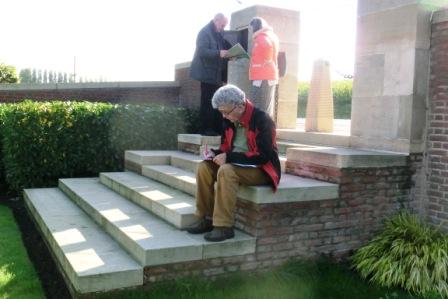
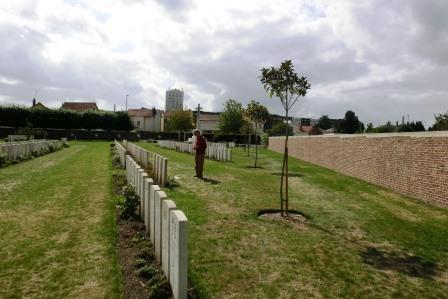
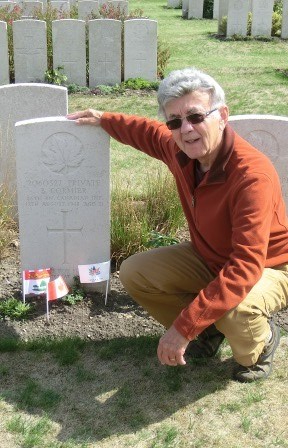
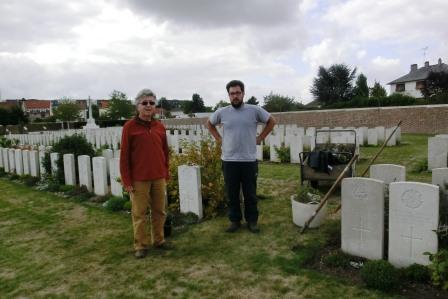
On The War Memorial Trail….On The Road To Rouen

October 1, 2017.  Leaving the Arras area, which we had thought was busy enough, was an experience, as now we encountered toll roads.  We soon learned to dread the words ‘gare de péage’.  While all the toll booths have iconic names, like the first one we pulled up at, named ‘Jules Verne’, they are now mostly automated, and you need cash or a debit or credit card.

…. ‘Gare de péage’ meant frustration in trying to pay a toll in Normandy….

If you are one of the modern people thinking ‘Dinosaur’, let me describe the experience.  First off, the box where you have to pay is designed to accommodate truckers, not people in dinky toy cars like the majority of cars used in Europe.  Most people do not have the rubber arms needed to reach up to drop the money in, so each toll booth encounter takes longer than it would if you paid an attendant, as car doors open and people try to squeeze out in the available space to drop their money in manually, or pay by card.  And of course, you need first to figure out WHERE you place your money as there is more than one slot.

If you use cash, as we did, you soon also learned that it’s best to have exact change, as otherwise you have to WAIT for change and then reach up to another slot to get your money.  Anyone in a hurry sometimes leaves their change behind!

PEI is not alone in charging heavy tolls.  We left 7.70 euros at Jules Verne, only to encounter another toll booth 6 minutes later!  At this one we picked up a ticket which cost us another 5.70 euros half an hour later.  The count so far … 13.40 euros.  In Canadian dollars it comes to about $19.75, and the day was just beginning.

…. We were on the right street but in the wrong community!….

It took us just over 2 ½ hours to get to Rouen from Mont St. Eloi, and, following the GPS instructions to the St. Sever Cemetery, arrived at Boulevard Stanislas Girardin, only to find it was in downtown Rouen.  No cemetery in sight!  The streets are extremely narrow, jam packed with cars and pedestrians and most of the streets one way traffic only.  We finally gave up trying to figure out what had gone wrong and stopped in front of a short driveway into a huge government building behind a walled gate, and asked a passerby for help.

The poor man looked at our sheet from the Commonwealth War Graves Commission and finally said, very kindly, that we were on the right street, but not in Rouen.  The cemetery was in a nearby community.  Sure enough, when we looked at the cemetery location instructions, it said it was “situated on the eastern edge of the southern Rouen suburbs of Le Grand Quevilly and Le Petit Quevilly.”  But what we didn’t understand was why we’d been directed downtown when we had the right street.

The man explained that it was in either Le Grand Quevilly or Le Petit Quevilly, he wasn’t sure which.  So, the GPS got reprogrammed for Le Grand Quevilly.  The word “suburb” was a misnomer.

While this discussion had been going on, traffic was backing up as people wanting to get into or out of the government driveway were held up as we were blocking the road.  Not one person honked or showed any impatience!  We thanked the man for his help, and then slowly backed up onto the traffic, and made our way out of town.

…. A car salesman steered us in the right direction to the cemetery….

Le Grand Quevilly was a short distance away, but it was not the location of the cemetery.  We pulled into a car dealership to ask directions, only to find out that France shuts down for lunch break.  Everything was locked up, but we found a salesman in a tent on the lot, reading his emails.

I’m from a different country,” he said, when we asked about the cemetery.  Then he made us laugh when he went on to say, “I’m from Paris.”  But he was very effective at finding someone who could help us and that’s when we learned that we wanted to be in Le Petit Quevilly, and how to get there.

In Le Petit Quevilly, on a street by the same name as in Rouen (what are the odds?), we were able to find St. Sever Cemetery Extension, the location where Bazil Cormier is buried.

CIMG8598 Sep 7 2017 sign directing us to St Sever Cemetery Extension

Sign to the St. Sever Cemetery in Le Petit Quevilly. (Photo credit: Daria Valkenburg)

According to the information provided by the Canadian War Graves Commission, during WWI, Commonwealth camps and hospitals were stationed on the southern outskirts of Rouen.  Most hospitals remained there during the war.  A number of those who died in the hospitals were buried in other cemeteries, but the majority were buried at St. Sever Cemetery.  In September 1916, the Extension, where Bazil Cormier is buried, began.

In WWII, Rouen was again a hospital centre, and several Commonwealth soldiers who were prisoners of war during the German occupation are buried in the Extension.

…. St. Sever Cemetery Extension was huge….

St. Sever Cemetery Extension is the largest cemetery we’ve been to so far, with 8,348 WWI Commonwealth burials, 10 of them unidentified, 328 WWII Commonwealth burials, 18 of them unidentified, and 8 foreign nationals.

With such a large cemetery, it was not easy to find Cormier’s grave.  Luckily, in this cemetery, several gardeners from the Commonwealth War Graves Commission were on site.  While Pieter went to look in the Grave Register, I looked at the graves, trying to find the row in which Cormier was buried.  One gardener asked if I needed help.  When I explained who we were looking for, he asked if I had the paper with the burial information.  I explained it was on the other side of the cemetery with Pieter, who was comparing it to the information in the Grave Register.

Just to let you know how great these workers are, the gardener immediately went over to the other side of the cemetery and then spent the next few minutes looking for the grave, which of course was as far away as possible from where we were!

CIMG8587 Sep 7 2017 Pieter at the grave of Bazil Cormier at St Sever Cemetery Extension

Pieter at the grave of Bazil Cormier in St. Sever Cemetery Extension in Le Petit Quevilly. (Photo credit: Daria Valkenburg)

…. Bazil Cormier lost his life during the Battle of Amiens….

According to his Attestation papers, Private Bazil CORMIER was born January 6, 1898 in Tignish, the son of Joseph Cormier and Marie Arsenault.  A farmer before enlisting with the 105th Draft Regiment on December 4, 1916, he died of wounds received in the Battle of Amiens near Cachy on August 12, 1918, at the age of 21.  At the time of his death he was with the 26th New Brunswick Battalion.

The War Graves Register Circumstances of Death notes that “During operations east of Amiens, on the morning of August 8th 1918, he was hit in the head by a machine gun bullet. He was immediately dressed by a comrade and carried out, but succumbed to his wounds at No. 4 General Hospital, Rouen, four days later...”  According to the active/casualty document in his file, however, he was transported to the No. 5 General Hospital, not the No. 4 General Hospital, where he died.

The Battle of Amiens, also known as the Third Battle of Picardy, was the opening phase of the Allied offensive which began on August 8, 1918, later known as the Hundred Days Offensive, that ultimately led to the end of the First World War.  This is the same battle in which James CAIRNS lost his life on August 9, 1918.

CIMG8592 Sep 7 2017 Pieter at grave of B Cormier in St Sever Cemetery Extension

Pieter by the grave of Bazil Cormier. (Photo credit: Daria Valkenburg)

As with too many of the WWI soldiers, we have no photo or further information about Bazil Cormier.

The cemeteries we’d been to in the past days had all been in the countryside.  St. Sever Cemetery Extension was in an urban setting, and bordered the Rouen Soccer Club, which caught the interest of soccer fan Pieter.

CIMG8590 Sep 7 2017 next to St Sever Cemetery Extension is the soccer club of Rouen

The Rouen Soccer Club was on the other side of the fence of the St. Sever Cemetery Extension. (Photo credit: Daria Valkenburg)

We couldn’t leave the cemetery without giving flag pins to the gardeners, one of whom spoke English and told Pieter that he had just graduated from horticultural college and loved his job.  The head gardener, who had helped us in the beginning, was unfortunately out on an errand, so we were not able to say goodbye to him.

CIMG8596 Sep 7 2017 Pieter with a CWGC gardener at St Sever Cemetery Extension

Pieter with a young CWGC gardener at St. Sever Cemetery Extension. (Photo credit: Daria Valkenburg)

In the next blog entry we make our way to Bayeux, which has a connection with Pieter’s genealogical research as well as the Cenotaph research project. Do you have photo or info on Bazil Cormier?  Comments or stories?  You can share them by emailing us at memorialtrail@gmail.com or by commenting on this blog.

© Daria Valkenburg

….Want to follow our research?….

If you are reading this posting, but aren’t following our research, you are welcome to do so.  Our blog address: https://onthewarmemorialtrail.com/
Front cover OnTheWarMememorialTrailinEurope4 countries, 6 weeks, 7,000 km – an unforgettable war memorial journey in Europe…. Daria’s book ‘No Soldier Buried Overseas Should Ever Be Forgotten‘ is available in print and e-book formats.  Net proceeds of book sales help support research costs and the cost of maintaining this blog. For more information see https://nosoldierforgotten.com/ 

You are also invited to subscribe to our YouTube Channel: On The War Memorial Trail With Pieter Valkenburg: https://www.youtube.com/channel/UCJ591TyjSheOR-Cb_Gs_5Kw

Never miss a posting!  Subscribe below to have each new story from the war memorial trail delivered to your inbox.

On The War Memorial Trail….A Trip To Bellacourt Military Cemetery

September 27, 2017.  After successfully finding our way to a number of cemeteries in France, we were growing more confident.  Next on our list was to find the Bellacourt Military Cemetery in Riviere, 10 km southwest of Arras, the burial place of two soldiers listed on the Cenotaph outside the Borden-Carleton Legion in Prince Edward Island – Patrick Phillip DEEGAN (aka DEIGHAN) and Percy FARRAR (aka FARROW).  Both men died in the same area, about 5 km south of Arras.

All of the Commonwealth War Graves Cemeteries have a stone fence around them, and inside the cemeteries there is green grass, and the graves all have a white headstone of the same shape and size.  In each cemetery there is a Cross of Remembrance and a memorial stone.  Most of the time there is also a sign on the road directing you to the cemetery.

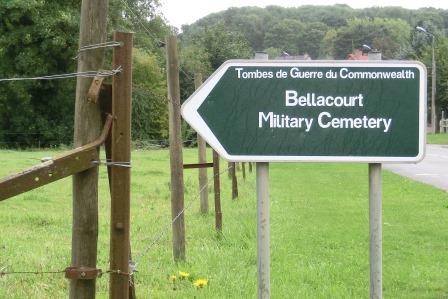
CIMG8501 Sep 6 2017 Sign for Bellacourt Military Cemetery

Sign giving directions to the turnoff to Bellacourt Military Cemetery. (Photo credit: Daria Valkenburg)

In each of the cemeteries we’d been to so far, we’ve been the only visitors, and Bellacourt was no different.  Most of the cemeteries we’d seen had been surrounded by farm fields.  Bellacourt, however, is near a waste collection centre!  Luckily, it’s not visible from the cemetery.

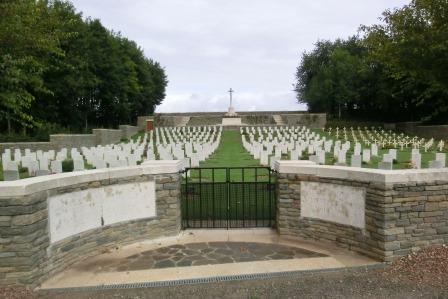
CIMG8502 Sep 6 2017 Bellacourt Military Cemetery

Bellacourt Military Cemetery. The graves marked with crosses only are French burials. (Photo credit: Daria Valkenburg)

According to the information provided by the Commonwealth Graves Commission, the cemetery began by French troops in October 1914, and carried on by various British divisions and later by the Canadian Corps.  There are 432 Commonwealth burials in the cemetery, 1 of which is unidentified, and 117 French burials.

At the time of their deaths, both Percy Farrar and Patrick Deegan were with the 26th New Brunswick Battalion. 

….Patrick Deegan was born in Cape Traverse, Prince Edward Island….

Private Patrick Phillip Deegan was born November 25, 1894 in Cape Traverse, Prince Edward Island, the son of Alexander Deegan and Margaret Anne Tierney.

Deegan, Patrick Phillip

Patrick Phillip Deegan. (Photo from Lest We Forget Project in Credit Union Place in Summerside. )

A clerk employed by Messrs. R. T. Holman, & Co. before the war, Deegan had twice been turned down for enlistment before being accepted as part of a reinforcement draft with the 105th Draft Regiment in 1916.  In his obituary in the May 4, 1918 Agriculturalist publication, “In the 105th he quickly was raised to Corporal and instructor in musketry but in order to get to the front he sacrificed his stripes, and went over about two months ago.

On April 21, 1918, Deegan was instantly killed in action by an explosion of an enemy shell in the trenches in the vicinity of Mercatel, 11 km east of the cemetery.

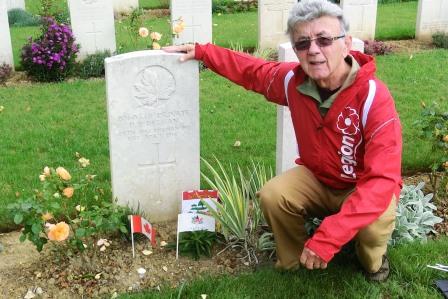
CIMG8507 Sep 6 2017 Pieter by grave of Patrick Deegan at Bellacourt Military Cemetery

Pieter by the grave of Patrick Deegan at Bellacourt Military Cemetery. (Photo credit: Daria Valkenburg)

….Percy Farrar was born in North Tryon, Prince Edward Island….

Percy Farrar (sometimes spelled Farrow) was born July 30, 1895 in North Tryon, Prince Edward Island, the son of William Farrar and Margaret Jane McKinnon, and enlisted in October 1915.

Percy Farrar

Percy Farrar. (Photo courtesy of South Shore United Church in Tryon.)

Like Deegan, he died in the vicinity of Mercatel, two months after Deegan, on June 23, 1918, during German Spring Offensives on the Western Front.

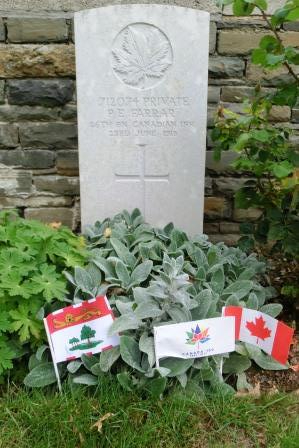
CIMG8512 Sep 6 2017 Grave of Percy Farrar at Bellacourt Military Cemetery

Grave of Percy Farrar at Bellacourt Military Cemetery. (Photo credit: Pieter Valkenburg)

After Farrar’s death, his family moved to California.  The San Diego Union newspaper of March 13, 1921 noted that Farrar had died “while manning a machine gun”.   The newspaper noted that Farrar’s father received “two memorial scrolls from Buckingham Palace, London, in commemoration of the death of his son, Percy Earle Farrar, who was killed in action in the World War on the western front in France, June 23, 1918.”  One of the scrolls was signed by King George of England and stated that “I join with my grateful people in sending you this memorial of a brave life given for others in the great war.”

CIMG8517 Sep 6 2017 Daria writes in the guest register at Bellacourt Military Cemetery

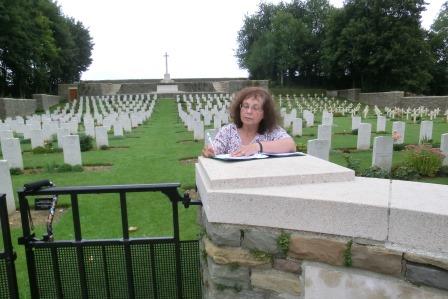
We always write the names of the soldiers we’ve come to pay our respects to in the Guest Register. Daria enters the information at Bellacourt Military Cemetery (Photo credit Pieter Valkenburg)

In the next blog entry we continue our search for the Manitoba and Grandcourt cemeteries. Do you have information or photos for Patrick Phillip Deegan (Deighan) and Percy Farrar (Farrow)? Comments or stories?  You can share them by emailing us at memorialtrail@gmail.com or by commenting on this blog.

© Daria Valkenburg

….Want to follow our research?….

If you are reading this posting, but aren’t following our research, you are welcome to do so.  Our blog address: https://onthewarmemorialtrail.com/

Front cover OnTheWarMememorialTrailinEurope4 countries, 6 weeks, 7,000 km – an unforgettable war memorial journey in Europe…. Daria’s book ‘No Soldier Buried Overseas Should Ever Be Forgotten‘ is available in print and e-book formats.  Net proceeds of book sales help support research costs and the cost of maintaining this blog. For more information see https://nosoldierforgotten.com/ 

You are also invited to subscribe to our YouTube Channel: On The War Memorial Trail With Pieter Valkenburg: https://www.youtube.com/channel/UCJ591TyjSheOR-Cb_Gs_5Kw

Never miss a posting!  Subscribe below to have each new story from the war memorial trail delivered to your inbox.
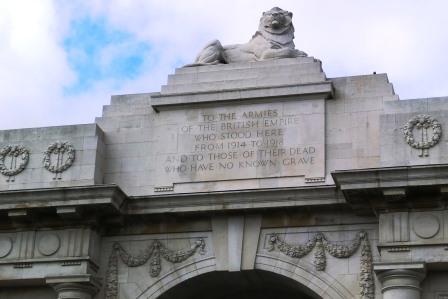
On The War Memorial Trail…..Paying Our Respects To Private Joseph Arthur Desroches

September 23, 2017.  We’re not inexperienced travellers, but even we can sometimes get into situations we simply can’t understand.  Quite often it happens with food and France gave us a real doozie.  Our hotel in Arras offered ‘le petit dejeuner’ (breakfast), served buffet style, so you picked what you wanted.

In the hotel you had a choice of hard-boiled or ‘fresh’ eggs.  I had no idea what ‘fresh eggs’ were so passed by them and chose a hard-boiled egg.  Pieter didn’t notice the hard-boiled eggs, just the ‘fresh’ eggs, and so he chose one, thinking how nice it was of the hotel to guarantee an egg that wasn’t old.

CIMG8466 Sep 6 2017 fresh eggs at Holiday Inn in Arras

‘Fresh’ eggs on offer at the hotel breakfast in Arras. (Photo credit: Daria Valkenburg)

I wish I’d taken a photo of his face when he cracked open his egg and saw……a raw egg.  It was fresh all right, straight from the chicken!

IMG_20170905_075317693 Sep 5 2017 Pieter tries to eat a raw egg

The ‘fresh’ egg was really a raw egg. (Photo credit: Pieter Valkenburg)

It took us two days to realize that the silver box beside the eggs, which we thought was some kind of fancy toaster, contained boiling water so you could cook your egg to your own specification.  Who would have guessed?

Over breakfast, Pieter determined that while he was going back to Caix to find the Manitoba Cemetery, if he had to search for it street by street, we first were getting gas and going to a few cemeteries that might be easier to find.  We got gas in the town of Vimy.  For those interested in the price of gas, it was 1.399 euros per litre (about $2.06 Canadian).

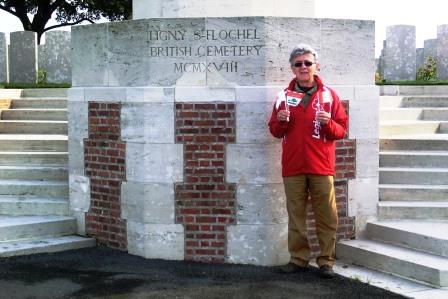
From Vimy we went to Ligny Saint-Flochel British Cemetery, where Joseph Arthur DESROCHES is buried.

CIMG8474 Sep 6 2017 Pieter at base of cross of remembrance at Ligny St Flochel British cemetery where Desroches is buried

Pieter at the base of the Cross of Remembrance in Ligny Saint-Flochel British Cemetery. (Photo credit: Daria Valkenburg)

Joseph Arthur DESROCHES was born August 8, 1891 in Miscouche, the son of Zephirim Desroches and Priscilla Gaudet.  Unlike most of the soldiers on the Borden- Carleton Cenotaph, Desroches was married, to Mary Ann Wedge of Fernwood, and had four children: Elizabeth Eileen, Joseph Alfred, Lucy Priscilla, and Charles Arthur.  A farmer before the war who worked for Howard MacFarlane of Bedeque, he was wounded by a shot to his head at Cagnicourt on September 2, 1918, and died on September 4 at Number 7 Casualty Clearing Station, located in Ligny Saint-Flochel, 7.6 km of Cagnicourt.

We learned that a Casualty Clearing Station was located further back from the front line than Aid Posts and Field Ambulances, and manned by the Royal Army Medical Corps, with attached Royal Engineers and men of the Army Service Corps. Its job was to treat the wounded enough to allow him to return to duty or to keep him stable long enough to be evacuated to a Base Hospital.

According to the war diary of the Headquarters of the 3rd Canadian Infantry Brigade, 1st Canadian Division, in preparation for an attack on the Drocourt-Queant Line, several battalions assembled their positions in the early hours of September 2.  The 13th Battalion was on the left, and the 14th Battalion, which Desroches was part of, was immediately behind.  The 16th Battalion was on the right, with the 15th Battalion immediately behind.

The war diary went on to explain what happened on September 2:  “The 13th and 16th Battalions were to capture the 1st objective, including the Drocourt-Queant and support lines.  The 14th and 15th Battalions were then to leap-frog and capture Cagnicourt, Bois de Bouche, and Bois de Loison and advance up the Buissy Switch where the 13th Battalion were to go through and mop up the switch on the Brigade Frontage. 

Promptly at 5:00 am our barrage opened and the 13th and 16th Battalions advanced.  The German barrage came down very quickly within a minute of ours but was light and caused few casualties. 

The first phase of the attack went according to schedule and the 1st objective was reached on time. The 14th and 15th Battalions went through but after passing Cagnicourt were held up badly by machine gun fire from the flanks which were exposed, as our flanking brigades could not get up…

As with all of the graves of Islanders, Pieter put down the flags of Canada, Prince Edward Island, and Canada 150.  We were grateful to PEI Senator Mike Duffy, PEI MLA Jamie Fox, and MP Wayne Easter for providing us with flags and pins for this venture on the war memorial trail.

CIMG8482Sep 6 2017 grave of Arthur Desroches in Ligny St Flochel British cemetery

Grave of Joseph Arthur Desroches in Ligny Saint-Flochel British Cemetery. Note that the spelling of his surname is without an ‘s’. (Photo credit: Pieter Valkenburg)

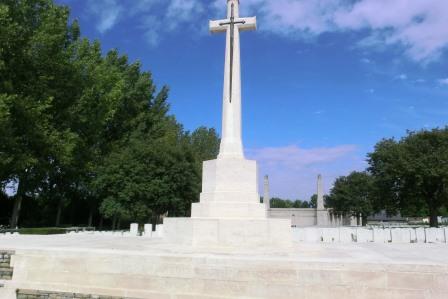
CIMG8483 Sep 6 2017 Ligny St Flochel British cemetery where Desroches is buried farmers field in background

Ligny Saint-Flochel British Cemetery with the Cross of Remembrance and a farmer’s field in the background. (Photo credit: Daria Valkenburg)

The cemetery has 629 burials, of which 347 are Canadian and 46 German.  The German graves are similar to the Commonwealth graves, which was surprising as most German graves have only an iron cross on them. The German graves are set apart from the Commonwealth graves by an indentation in the ground, making an artificial step, like in a sunken living room.

Unfortunately, as with so many of the WW1 soldiers, we have not been able to find a photo or additional information on Joseph Arthur Desroches.

In the next blog entry we visit Bac-Du-Sud and Bellacourt cemeteries before continuing our search for the Manitoba and Grandcourt cemeteries. Do you have information or photos for Arthur Desroches?  Comments or stories?  You can share them by emailing us at memorialtrail@gmail.com or by commenting on this blog.

© Daria Valkenburg

….Want to follow our research?….

If you are reading this posting, but aren’t following our research, you are welcome to do so.  Our blog address: https://onthewarmemorialtrail.com/

Front cover OnTheWarMememorialTrailinEurope4 countries, 6 weeks, 7,000 km – an unforgettable war memorial journey in Europe…. Daria’s book ‘No Soldier Buried Overseas Should Ever Be Forgotten‘ is available in print and e-book formats.  Net proceeds of book sales help support research costs and the cost of maintaining this blog. For more information see https://nosoldierforgotten.com/ 

You are also invited to subscribe to our YouTube Channel: On The War Memorial Trail With Pieter Valkenburg: https://www.youtube.com/channel/UCJ591TyjSheOR-Cb_Gs_5Kw

Never miss a posting!  Subscribe below to have each new story from the war memorial trail delivered to your inbox.

On The War Memorial Trail…..Honouring The Memories of Kenneth John Bell And Charles Lowther

September 21, 2017.  After we left the Monument to the 1st Canadian Division, we began the hard work of trying to find the cemeteries where individual soldiers from the Cenotaph outside the Borden-Carleton Legion were buried.

Although Pieter had printed out detailed instructions from the Commonwealth War Graves Commission on the exact location of each cemetery and the burial locations, we soon found out that actually finding the cemeteries was easier said than done.

Pieter determined that the first cemetery we should go to was Moeuvres Communal Cemetery Extension where Private Charles Lowther is buried.  On the way to Moeuvres on a nerve racking ride, sharing the road with drivers who think they’re kamikaze pilots, we passed through the village of Vis-en-Artois and I demanded we stop for coffee and a badly needed toilet break.

Pieter gallantly tried to stop to accommodate me, to the annoyance of a Belgian truck driver who kept blowing his horn – the only one to do so on the trip.  But, luckily we found a parking spot and made it safely across the road to the café.

After using the facilities, I was able to order us coffee in my best schoolgirl French.  Everyone immediately picked us out as foreigners, and the owner asked if we were here to visit the British cemetery.  Why else would Les Anglaises be in town? And were we interested in the postcards?

….A postcard led to another cemetery we wanted to visit….

Bien sur”, I said.  I had no idea which cemetery he was asking about, but shopping is always fun.  Pieter was a bit annoyed until he realized that he wanted to go to this cemetery as that was where Corporal Kenneth John Bell, another name on the Cenotaph outside the Borden-Carleton Legion, was buried.  It turned out the British cemetery was just down the road from the café in Harcourt.  Now Pieter thought it was very smart of us to have stopped in the right café!

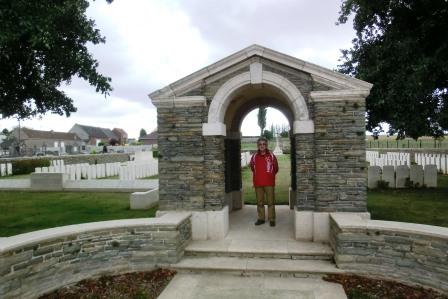
After our break, and postcards in hand, we made our way to the Vis en Artois British Cemetery. According to the information given by the Commonwealth War Graves Commission, the villages of Vis en Artois and Haucourt were taken by the Canadian Corps on August 27, 1918.  The cemetery began right after that date and was used by fighting units and ambulances until mid-October 1918.

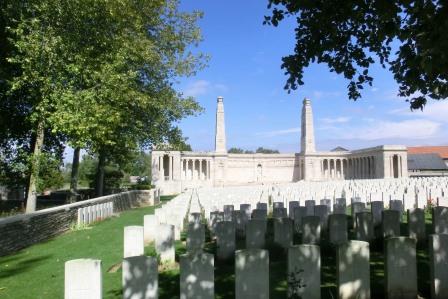
CIMG8325 Sep 5 2017 Vis en Artois British Cemetery Cross of Remembrance

Cross of Remembrance at Vis en Artois British Cemetery, with the Memorial behind the graves. (Photo credit: Daria Valkenburg)

CIMG8337 Sep 5 2017 Vis en Artois British Cemetery

Memorial at Vis en Artois British Cemetery. (Photo credit: Daria Valkenburg)

Originally, the cemetery had 430 graves, of which 297 were Canadian.  After WWI the cemetery grew by adding graves from battlefields and smaller cemeteries in the area, until today it has 2,369 burials from WWI, 1,458 of them unidentified.

….Kenneth Bell shares a grave with another WWI soldier!….

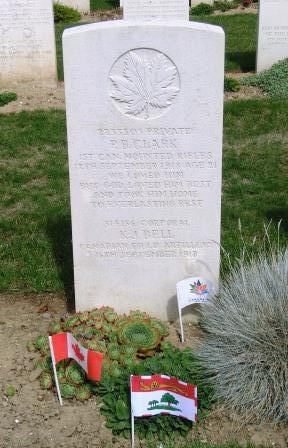
We found the grave of Kenneth Bell, but to our surprise he was not in a single grave.  He was buried with Private P. B. CLARK, who had died four days earlier than Bell.

CIMG8328 Sep 5 2017 grave of Cpl Kenneth Bel in Vis en Artois British Cemetery

Grave of Cpl Kenneth Bell, shared with Private P.B. Clark, at Vis en Artois British Cemetery. (Photo credit: Pieter Valkenburg)

Kenneth John BELL was born March 28, 1896 in Cape Traverse, the son of William Bell and Lucy Rogerson, and nephew of PEI Premier John Howatt Bell.  On September 16, 1918 he was hit by enemy shell fire, and was attended to by the medical officer of the brigade, but he died on the way to the dressing station. The location of the unit at the time of the casualty was Rumaucourt, 10.2 km from Harcourt.

It’s a shame as Bell, per his obituary, “had fought in the battles of the Somme, Vimy Ridge, Lens, Ypres, Passchendaele and many later battles and came out without a scratch”, only to die two months before the war’s end.  Unfortunately, we have not been able to find a photo or additional information on Corporal Bell.

CIMG8335 Sep 5 2017 Pieter by grave of Cpl Kenneth Bell in Vis en Artois British Cemetery

Pieter by the grave of Cpl Kenneth Bell, shared with Private P.B. Clark, at Vis en Artois British Cemetery. (Photo credit: Daria Valkenburg)

….Charles Lowther is buried 14 km from Kenneth Bell….

From Harcourt, we travelled 14 km (8.7 miles) further to Moeuvres Communal Cemetery Extension where Private Charles Lowther is buried.

CIMG8342 Sep 5 2017 Moeuvres Communal Cemetery Extension where Lowther is buried

Moeuvres Communal Cemetery Extension plaque. (Photo credit: Daria Valkenburg)

We soon learned that when we saw the word “Extension” by the name of a cemetery, it meant that the war graves were in a separate area, usually at the back, of a public cemetery.  In Moeuvres, the Extension has 565 Commonwealth burials and commemorations of WWI, with 263 unidentified graves.

CIMG8360 Sep 5 2017 Pieter at entrance to Moeuvres Communal Extension Cemetery

Pieter at the entrance to Moeuvres Communal Cemetery Extension. (Photo credit: Daria Valkenburg)

CIMG8343 Sep 5 2017 Pieter placing flags at Lowther grave at Moeuvres Communal Cemetery Extension

Pieter placing flags at the grave of Charles Lowther at Moeuvres Communal Cemetery Extension. You can see the cemetery extension is next to a farmer’s field. (Photo credit: Daria Valkenburg)

cimg8347-sep-5-2017-lowther-grave-at-moeuvres-communal-cemetery-extension.jpg

Grave of Charles Lowther at Moeuvres Communal Cemetery Extension. (Photo credit: Pieter Valkenburg)

Charles LOWTHER was born in North Carleton on September 27, 1896, the son of Henry and Bessie Lowther.  He died September 25, 1918 after being wounded by enemy shrapnel in a trench at Inchy-en-Artois, 2.1 km from Moeuvres.  He was evacuated by a unit of the 52nd division, who later reported him dead.

According to the war diary of the 25th Battalion, which Lowther was part of, for the 25th of September in Inchy-en-Artois:  “At about 6:00 am the enemy put down a heavy barrage on our lines and started to attack in force. Our S.O.S. was sent up and the field guns opened up immediately. We prevented the enemy from entering our trenches and in many places our men started over the top to meet the enemy, who was completely repulsed after some heavy fighting. The enemy continued to bombard our trenches the whole day, lifting fire towards the evening. At 11:00 pm the battalion was relieved by the 44th Canadian battalion. Casualties 6 O.R killed and 16 O.R. wounded…

O.R. refers to “Other Ranks”, ie not officers.  We looked to see if there were any other graves of men from the 25th Battalion but saw only one, that of an O. DAIGLE, who also died on September 25, 1918.

Unfortunately, as with Kenneth Bell, we have not been able to find a photo or additional information on Charles Lowther.

By this time it was 3:30 pm.  With the success we’d had so far today, Pieter wanted to find two more cemeteries, the Manitoba Cemetery in Caix and Grandcourt Cemetery in Grandcourt.  We should have quit while we were ahead, as by 7 pm we hadn’t found either cemetery and were getting very testy with each other. It was time to admit defeat for the day and go back to Arras for a well-deserved dinner and rest.

In the next blog entry we continue our search for the Manitoba and Grandcourt cemeteries. We need help to put a face to the name on these two graves.  Do you have information or photos for Kenneth Bell or Charles Lowther?  Comments or stories?  You can share them by emailing us at memorialtrail@gmail.com or by commenting on this blog.

© Daria Valkenburg

….Want to follow our research?….

If you are reading this posting, but aren’t following our research, you are welcome to do so.  Our blog address: https://onthewarmemorialtrail.com/

Front cover OnTheWarMememorialTrailinEurope4 countries, 6 weeks, 7,000 km – an unforgettable war memorial journey in Europe…. Daria’s book ‘No Soldier Buried Overseas Should Ever Be Forgotten‘ is available in print and e-book formats.  Net proceeds of book sales help support research costs and the cost of maintaining this blog. For more information see https://nosoldierforgotten.com/ 

You are also invited to subscribe to our YouTube Channel: On The War Memorial Trail With Pieter Valkenburg: https://www.youtube.com/channel/UCJ591TyjSheOR-Cb_Gs_5Kw

Never miss a posting!  Subscribe below to have each new story from the war memorial trail delivered to your inbox.

On The War Memorial Trail…..Paying Our Respects To Private Ellis Hooper

September 4, 2017.  After making the journey from The Netherlands to France, we stopped at our first French cemetery in the village of Aubigny en Artois, 15 km north-west of Arras.  Don’t let anyone tell you that the road between the Dutch border, through Belgium, and into northern France is quiet.  It isn’t!  It’s a madhouse on the highway!
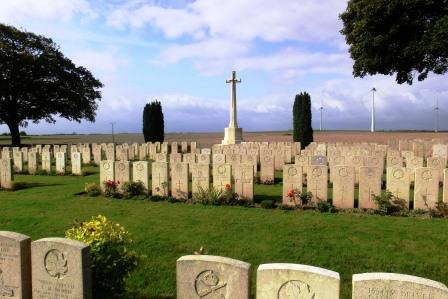
And the names of places can get confusing.  We wondered why the GPS kept telling us to go in the direction of Rijssel – until we saw that the French name for Rijssel was Lille!

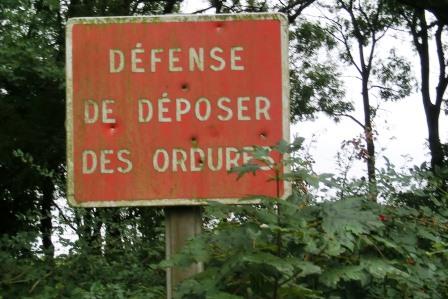
Then, just outside of Aubigny en Artois, we stopped at a parking spot off the highway, sort of like a rest stop but without any conveniences.  Pieter wanted to stretch his legs, but didn’t get very far when I saw a sign saying ‘Défense de déposer des ordures’.

CIMG8232

Memo to self… next time, bring a French-English dictionary! (Photo credit:  Pieter Valkenburg)

I saw the word ‘Défense’ and remembered all the stories about unexploded mines in the area.  While I had no idea what the rest of the sign said, I knew ‘Défense’ was a warning of some kind.  “Don’t go there”, I shouted, “it’s a mine field!”  Of course, Pieter paid no attention to me, and it wasn’t until we got to the hotel and I looked up the translation that we could laugh about it.  It says something along the lines of “Don’t dump your garbage”!

CIMG8234

We reach the village of Aubigny en Artois. (Photo credit:  Daria Valkenburg)

CIMG8258

Directions to the cemetery are clearly marked.  (Photo credit: Pieter Valkenburg)

CIMG8255

Entrance to the Aubigny Communal Cemetery.  The Extension is behind the cemetery, and has 2,771 Commonwealth burials from WWI and 7 from WWII.  There are 227 French burials prior to March 1916, and 64 German war graves. The original cemetery land was given to the commune of Aubigny in 1909 by former mayor Emile Delombre. (Photo credit:  Daria Valkenburg)

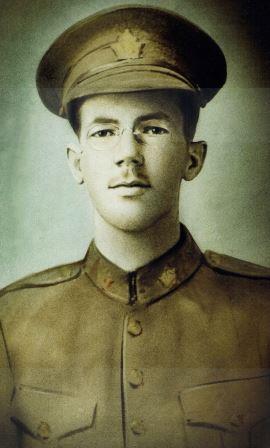
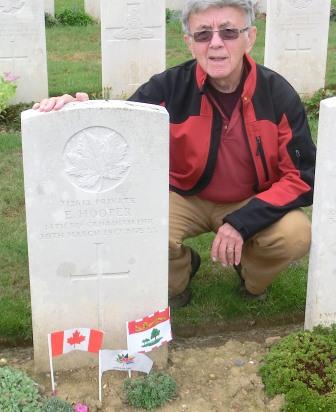
After the excitement of the parking spot sign, we finally reached the Aubigny Communal Cemetery Extension, and left the car to find the grave of Private Ellis Moyse HOOPER.  Hooper was born October 20, 1895 in Central Bedeque, son of Charles Frederick Allison Hooper and Bessie Marie nee Moyse.  Hooper enlisted in the 105th Battalion, C Company on March 4, 1916, and later transferred to the 14th Battalion of the Canadian Infantry. On March 30, 1917, he died at No. 30 Casualty Station of gunshot wounds to his leg and left arm.

Hooper, Ellis Moyse

Private Ellis Moyse Hooper.  (Photo credit:  Lana Churchill family collection)

CIMG8245

Right: Pieter by Hooper’s grave, after placing the flags of Canada, PEI, and Canada 150. (Photo credit:  Daria Valkenburg)

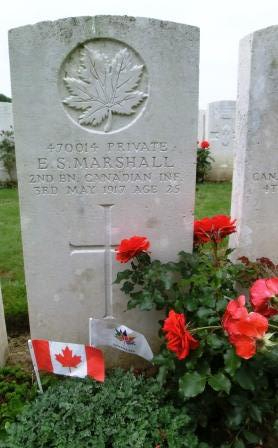
Hooper’s cousin, Ernest Shaw MARSHALL, of Ontario, who died May 3, 1917, is buried nearby.

cimg8246.jpg

Marshall’s grave was a few rows down from his cousin Hooper. (Photo credit:  Pieter Valkenburg)

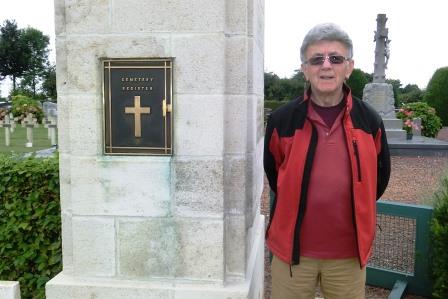
As we left the cemetery, which is very well kept, we signed the guest register book. Each of the Commonwealth cemeteries has a register listing each soldier’s burial location, and there is a guest register.  If you visit, don’t forget to sign the register yourself!

CIMG8254

The register is in a compartment on the pillar by the entrance to the cemetery.  (Photo credit:  Daria Valkenburg)

This special visit was a prelude to our next stop on the memorial trail, the Vimy Memorial.  Comments or stories?  You can share them by emailing us at memorialtrail@gmail.com or by commenting on this blog.

© Daria Valkenburg

….Want to follow our research?….

If you are reading this posting, but aren’t following our research, you are welcome to do so.  Our blog address: https://onthewarmemorialtrail.com/

Front cover OnTheWarMememorialTrailinEurope4 countries, 6 weeks, 7,000 km – an unforgettable war memorial journey in Europe…. Daria’s book ‘No Soldier Buried Overseas Should Ever Be Forgotten‘ is available in print and e-book formats.  Net proceeds of book sales help support research costs and the cost of maintaining this blog. For more information see https://nosoldierforgotten.com/ 

You are also invited to subscribe to our YouTube Channel: On The War Memorial Trail With Pieter Valkenburg: https://www.youtube.com/channel/UCJ591TyjSheOR-Cb_Gs_5Kw

Never miss a posting!  Subscribe below to have each new story from the war memorial trail delivered to your inbox.