On The War Memorial Trail….2025 Faces of Holten Exhibition Part 1:  Soldiers Killed Near Posterenk

August 24, 2025.  Readers of this blog are aware that Pieter has been involved in finding photos of Canadians who are buried in The Netherlands since 2014. 

We were in The Netherlands and Belgium for the 80th Anniversary of Liberation Commemoration events, and placed flags at the graves of 383 soldiers in 14 cemeteries.

Pieter at the entrance to the Canadian War Cemetery in Holten, The Netherlands. (Photo credit: Daria Valkenburg)

….Flags placed at the graves of soldiers from all 10 provinces and 1 Territory…

Over the next few postings, soldiers whose stories were previously told, and who are buried in the Canadian War Cemetery in Holten, the second largest Canadian War Cemetery in The Netherlands, will be featured. There are 1,394 burials here, of which 1,355 are Canadian.  Flags were placed by Pieter at 156 graves at this cemetery.  This was the final tally for the 156 graves:

  • 38 were from Nova Scotia
  • 46 from New Brunswick
  • 21 from Prince Edward Island
  • 3 from British Columbia
  • 5 from Saskatchewan
  • 20 from Manitoba
  • 2 from Alberta
  • 16 from Ontario
  • 3 from Quebec
  • 1 from Newfoundland
  • 1 from Yukon Territory

22 of the graves also received an Acadian flag, and 2 received Indigenous flags – one from the Mi’kmaq Nation, and one from the Wolastoqey Nation.  All of the graves received a Canadian flag.  Provincial flags were placed at all graves, with the exception of the soldiers from British Columbia, Saskatchewan, and Yukon Territory, for which, unfortunately, we did not receive flags.

All of the flags placed on our war memorial tour had been donated, as mentioned in an earlier posting. (See https://onthewarmemorialtrail.com/2025/06/04/on-the-war-memorial-trail-flags-and-pins-received-for-our-2025-european-war-memorial-tour/)

This year, for the 80th Anniversary, with photos having been found for 80% of the soldiers buried there, photos were placed at graves for the first time.  The 2025 Faces Of Holten Exhibition ran for three weeks in May.  Photos were printed onto an aluminum backing, making them impervious to rain, and reusable.  Each placard also had a QR code, allowing visitors with cell phones to scan the code and read a brief biography of the soldier.

…7 soldiers who died near Posterenk are commemorated…

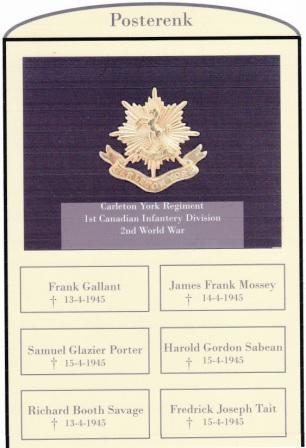
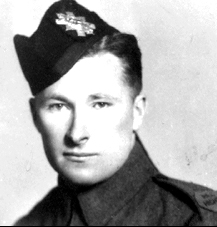
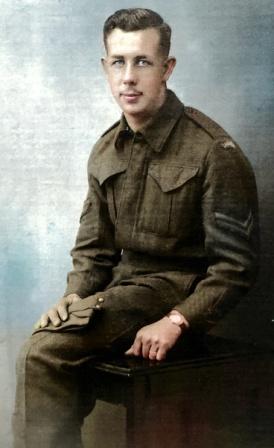
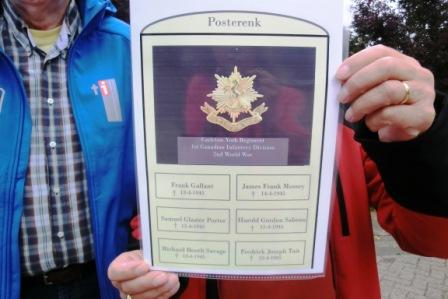
In this posting, the graves and photos of seven WWII soldiers whose stories have previously been told are featured.  All were serving in the Carleton & York Regiment at the time of their death and died near Posterenk, The Netherlands.

Grave of François ‘Frank’ Gallant. (Photo credit: Daria Valkenburg)

François ‘Frank’ GALLANT, from Mount Carmel, Prince Edward Island, was killed during the Liberation of Posterenk in The Netherlands on April 13, 1945, aged 30.  He was one of 6 soldiers initially buried along the main road to Posterenk, a village near Zutphen. You can read his story at https://onthewarmemorialtrail.com/2024/06/30/on-the-war-memorial-trail-the-wwii-soldier-from-mount-carmel-killed-during-the-liberation-of-posterenk/

Pieter at the grave of Daniel ‘Dan’ Peter MacKenzie. (Photo credit: Daria Valkenburg)

Daniel ‘Dan’ Peter MACKENZIE, from Victoria Cross, Prince Edward Island, died from wounds received on April 13, 1945 during the Liberation of Posterenk in The Netherlands, part of Operation Cannonshot. He had been taken to a Canadian hospital in Lochem, where he died that evening, aged 26, despite heroic efforts to save him.  You can read his story at https://onthewarmemorialtrail.com/2023/06/29/on-the-war-memorial-trail-the-wwii-soldier-from-victoria-cross-fatally-wounded-during-the-liberation-of-posterenk/

Grave of James ‘Frank’ Mossey. (Photo credit: Pieter Valkenburg)

James ‘Frank’ MOSSEY, from Souris, Prince Edward Island, was killed in action on April 14, 1945 near Posterenk, The Netherlands, aged 25. He was one of 6 soldiers initially buried along the main road to Posterenk, a village near Zutphen. You can read his story at https://onthewarmemorialtrail.com/2022/08/09/on-the-war-memorial-trail-the-wwii-soldier-from-souris-killed-during-the-liberation-of-posterenk/

Pieter by the grave of Goldwin ‘Goldy’ Marven Pollick. (Photo credit: Daria Valkenburg)

Goldwin ‘Goldy’ Marven POLLICK, from Minto, New Brunswick, lost his life on April 13, 1945 in Wilp-Achterhoek, near Posterenk, aged 24. You can read his story at https://onthewarmemorialtrail.com/2021/01/07/on-the-war-memorial-trail-atlantic-canada-remembers-part-1/
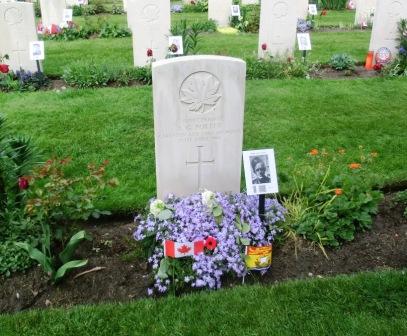
Grave of Samuel Glazier Porter. (Photo credit: Pieter Valkenburg)

Samuel Glazier PORTER, from Dow Flat, Victoria County, New Brunswick, lost his life, at the age of 26, on April 15, 1945 as his Regiment advanced to the Apeldoorn Canal in The Netherlands. He was one of 6 soldiers initially buried along the main road to Posterenk, a village near Zutphen.  You can read his story at https://onthewarmemorialtrail.com/2021/11/28/on-the-war-memorial-trail-atlantic-canada-remembers-part-11/
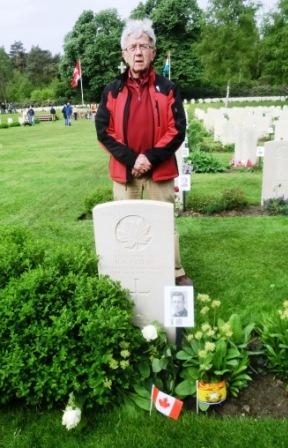
Pieter by the grave of Harold Gordon Sabean. (Photo credit: Daria Valkenburg)

Harold Gordon SABEAN, from Port Lorne, Nova Scotia, was killed on April 15, 1945, as his Regiment advanced to the Apeldoorn Canal in The Netherlands, aged 27.  He was one of 6 soldiers initially buried along the main road to Posterenk, a village near Zutphen. You can read his story at https://onthewarmemorialtrail.com/2022/10/08/on-the-war-memorial-trail-the-wwii-soldier-from-port-lorne-who-lost-his-life-during-the-advance-to-the-apeldoorn-canal/

Grave of Frederick Joseph Tait. (Photo credit: Pieter Valkenburg)

Frederick Joseph TAIT, from Grand Falls, New Brunswick, was killed on April 15, 1945, as his Regiment advanced to the Apeldoorn Canal in The Netherlands, aged 23.  He was one of 6 soldiers initially buried along the main road to Posterenk, a village near Zutphen. You can read his story at https://onthewarmemorialtrail.com/2021/03/16/on-the-war-memorial-trail-atlantic-canada-remembers-part-8/

….All of the flags placed at graves were donated…

All of the flags placed at graves were donated.  Our thanks go to:

  • Alan Waddell, Constituent Assistant, on behalf of Heath MacDonald, MP for Malpeque, for the Canadian flags.
  • Matt MacFarlane, MLA for District 19, Borden-Kinkora, for the flags from Prince Edward Island.
  • Armel ‘Mel’ Lanteigne, President of the Caraquet Legion in New Brunswick for the New Brunswick flags and Acadian flags.
  • Kyle Graham, Research Officer, Military Relations, Nova Scotia Intergovernmental Affairs, on behalf of Premier Tim Houston, Province of Nova Scotia, for the Nova Scotia flags

The Dutch continue to stress the importance of remembrance to the next generation so they can continue to remember those who lost their lives in WWII.  ‘Opdat wij niet vergeten’ (Lest We Forget)

In Part 2, graves of soldiers from Prince Edward Island who are listed on the Cenotaph in Borden-Carleton, Prince Edward Island, and are buried in the Canadian War Cemetery in Holten, will be featured.

Pieter encourages readers with photos to come forward so that eventually all of the known graves of Canadians buried in Holten will have a photo displayed by their grave. Email him at memorialtrail@gmail.com

© Daria Valkenburg

….Want to follow our research?…

If you are reading this posting, but aren’t following our research, you are welcome to do so.  Our blog address: https://onthewarmemorialtrail.com/
4 countries, 6 weeks, 7,000 km – an unforgettable war memorial journey in Europe…. Daria’s book ‘No Soldier Buried Overseas Should Ever Be Forgotten‘ is available in print and e-book formats.  Net proceeds of book sales help support research costs and the cost of maintaining this blog. For more information see https://nosoldierforgotten.com/

Subscribe to our YouTube Channel: On The War Memorial Trail With Pieter Valkenburg: https://www.youtube.com/channel/UCJ591TyjSheOR-Cb_Gs_5Kw

Never miss a posting!  Subscribe below to have each new story from the war memorial trail delivered to your inbox.

On The War Memorial Trail…..The WWII Soldier From Mount Carmel Killed During The Liberation Of Posterenk

June 30, 2024.  In 2017, Pieter and I visited the village of Posterenk in The Netherlands with Edwin van der Wolf, one of the research volunteers at the Canadian War Cemetery in Holten.

CIMG9302 Sep 25 2017 Posterenk Windmill

Windmill in Posterenk, which has a memorial stone inscribed on the wall.  (Photo credit: Daria Valkenburg)

CIMG9300 Sep 25 2017 Sign Posterenk freed by CYR Apr 13 1945

Translation of memorial stone on the windmill: Posterenk freed by the Carleton & York Regiment of Canada on April 13, 1945. (Photo credit: Daria Valkenburg)

….The Island connection to Posterenk…..

Edwin wanted us to visit the village because it had an Island connection.  François ‘Frank’ GALLANT, son of Antoine and Eleanor (nee Poirier) Gallant of Mount Carmel, Prince Edward Island,  died there on April 13, 1945, while serving with the Carleton & York Regiment.

CIMG9296 Sep 25 2017 Edwin and Pieter by Posterenk windmill

Edwin van der Wolf (left) and Pieter in Posterenk.  (Photo credit: Daria Valkenburg)

The village had a list of 6 soldiers to commemorate from the Carleton & York Regiment, who had all been buried in the area.  Unfortunately, not all soldiers who died are included on this list, but Edwin worked towards including two more, who were not buried near Posterenk, but “were temporarily buried in Lochem because they had previously died in a Canadian hospital there…” 

In total, out of the 8 soldiers, three were from Prince Edward Island!  The stories of Daniel Peter MACKENZIE and James ‘Frank’ MOSSEY were previously told.  In this posting, we feature the story of Frank GALLANT, the reason we were in Posterenk back in 2017!

Gallant Frank

François ‘Frank’ Gallant.  (Photo courtesy of the Information Centre Canadian Cemetery Holten)

….Three Gallant brothers served…..

Born November 24, 1914, Frank originally enlisted under the National Resources Mobilization Act (NRMA) in Charlottetown, Prince Edward Island on August 13, 1942 and underwent basic training at No. 62 Canadian Army Basic Training Centre (CABTC), which he completed on October 12, 1942. (See https://en.wikipedia.org/wiki/National_Resources_Mobilization_Act)

His Personnel Information Record noted that he could speak both French and English, and came from a rural farming background, which likely accounted for him having only a Grade 4 education.  In addition to farming, Frank had experience in carpentry work, and had worked in a lumber mill.  He could drive a vehicle, and played baseball and hockey. Two of his brothers, Georges and Simon, were also in the army. 

With his basic training successfully completed, Frank was transferred to A5 Canadian Engineer Training Camp (CETC) in Petawawa, Ontario for advanced training on October 13, 1942.  Upon completion of that training, he remained in Petawawa for an additional two months, doing general repair work. 

On January 28, 1943, Frank was transferred to No. 2 Engineer Services and Works Company (ES&W Company) of the Royal Canadian Engineers, where his task was to fire and repair boilers at No. 2 District Depot in Toronto, Ontario. He was with ‘D’ Wing, a ‘supernumerary to establishment’ reserve unit, while a decision about the direction his army career was to take was made.

Frank had expressed interest in being considered in the Tradesman category as a fireman or maintenance man, but it was determined that since his occupation background was “… erratic….” with no “…special training…” and he was considered very fit, in the “…A-1 category…”, he should be reallocated to “…Infantry (Non-Tradesman)” and receive infantry training. 

Frank received special leave to return home to Prince Edward Island to help with the family’s farm operation on August 29, 1943, after which he returned to Toronto on November 1, 1943.

….Frank transferred to the Infantry…..

As a result of the assessment that he be assigned to an Infantry Unit, Frank was transferred to the 1st Battalion Victoria Rifles of Canada on November 10, 1943 and sent the following day to Stratford, Ontario to be re-mustered as a rifleman.

Frank remained in Stratford for training until February 18, 1944, when he was sent to Niagara-on-the-Lake, Ontario. 

On August 24, 1944, Frank transferred from the non-active militia to active service in the Canadian Army, remaining with the 1st Battalion Victoria Rifles of Canada in Niagara-on-the-Lake.

….Frank left Canada for overseas service…..

On November 21, 1944, Frank left for Great Britain with the 1st Battalion, to provide reinforcements to the Canadian Army in the field.  Upon arrival on November 28, 1944, he was assigned to No. 3 Canadian Infantry Training Regiment (CITR).

He continued receiving further training until January 23, 1945, when he left the United Kingdom for Italy, as part of the X-4 Reinforcements, arriving on February 7, 1945.  On February 13, 1945 he was transferred to the Carleton & York Regiment, joining them north of Rossi (Russi), part of a group of reinforcements, at the tail end of the Italian Campaign. (See https://en.m.wikipedia.org/wiki/Italian_campaign_(World_War_II))

He joined the Carleton & York Regiment at the same time as Archibald Phillip ‘Archie’ MCLEAN of Edmundston, New Brunswick.  Archie’s story was previously told on this blog.  (See https://onthewarmemorialtrail.com/2023/09/13/on-the-war-memorial-trail-archie-was-a-good-guy/)

Screenshot 2023-09-04 at 16-28-14 Map of Russi Italy

The Carleton & York Regiment was north of Russi on February 13, 1945.  (Map source: http://www.gosur.com)

On March 17, 1945, he left Italy as part of Operation Goldflake, arriving in Marseilles, France three days later.  Operation Goldflake was the codename for moving troops from Italy to North-West Europe.  (See https://en.wikipedia.org/wiki/Operation_Goldflake)

The Carleton & York Regiment was now part of the 21st Army Group. From France, troops were moved up to the Belgian front, into The Netherlands, through the Reichswald Forest in Germany, and then back into The Netherlands.

The Liberation of Posterenk…

On April 12, 1945 the Regiment was part of Operation Cannonshot, which led to the crossing of the IJssel River between the villages of Gorssel and Wilp in the eastern part of The Netherlands. (See https://www.liberationroute.com/stories/190/operation-cannonshot)

Map western holland showing Posterenk

According to the April 12, 1945 war diary entry of the Carleton & York Regiment, they “…moved across the Ijssel River at 14:30 hours….” to relieve the Seaforth Highlanders of Canada.

On April 13, 1945, the war diary entry noted that “…‘D’ Company’s objective is Posterenk…The Regiment didn’t expect much opposition, but they “met with stiff resistance just after starting at 11:25 hrs…

In ‘Invicta – The Carleton and York Regiment in the Second World War’ author Robert Tooley explained that “…on the CYR front D Company was to lead off towards its first objective, the village of Posterenk: the opposition was expected to be light, and the company was instructed to continue to move forward until strong opposition was encountered.  The battalion now had in support a troop of M10 SP anti-tank guns, a troop of tanks, a platoon of medium machine guns, and a platoon of 4.2 inch mortars. D Company pushed off at 10:50 am….. Contrary to expectations, D Company met stiff resistance and suffered several casualties from small arms fire….”   

At some point during that day, Frank lost his life. 

…Frank is buried in Holten…

Frank was one of 6 soldiers initially buried along the main road to Posterenk, a village near Zutphen, before being reburied in the Canadian War Cemetery in Holten.

Posterenk list of 6 CYR members

The 6 soldiers buried near Posterenk.

CIMG3198 Oct 3 2019 Holten Frank Gallant

Grave of François ‘Frank’ Gallant at the Canadian War Cemetery in Holten.  (Photo credit: Daria Valkenburg)

…Frank is remembered on the war memorial in Wellington…

In May 2024, we visited the war memorial in Wellington, Prince Edward Island, where Frank’s name is listed.

CIMG6840 May 27 2024 Wellington Monument - Francis Gallant - photo by Pieter

François ‘Frank’ Gallant is remembered on the war memorial in Wellington, Prince Edward Island.  (Photo credit: Pieter Valkenburg)

…Previous stories about soldiers commemorated in Posterenk….

Do you have photos or information to share? Email Pieter at memorialtrail@gmail.com, comment on the blog, or tweet to @researchmemori1.

© Daria Valkenburg

….Want to follow our research?….

If you are reading this posting, but aren’t following our research, you are welcome to do so.  Our blog address: https://onthewarmemorialtrail.com/

Front cover OnTheWarMememorialTrailinEurope4 countries, 6 weeks, 7,000 km – an unforgettable war memorial journey in Europe…. Daria’s book ‘No Soldier Buried Overseas Should Ever Be Forgotten‘ is available in print and e-book formats.  Net proceeds of book sales help support research costs and the cost of maintaining this blog. For more information see https://nosoldierforgotten.com/ 

You are also invited to subscribe to our YouTube Channel: On The War Memorial Trail With Pieter Valkenburg: https://www.youtube.com/channel/UCJ591TyjSheOR-Cb_Gs_5Kw

Never miss a posting!  Subscribe below to have each new story from the war memorial trail delivered to your inbox.

On The War Memorial Trail…..The WWII Soldier From Victoria Cross Fatally Wounded During The Liberation Of Posterenk

June 29, 2023.  In 2017, Pieter and I visited the village of Posterenk in The Netherlands with Edwin van der Wolf, one of the research volunteers at the Canadian War Cemetery in Holten.

CIMG9295 Sep 25 2017 Posterenk windmill

Windmill in Posterenk, which has a memorial stone inscribed on the wall.  (Photo credit: Daria Valkenburg)

….The Island connection to Posterenk…..

Edwin wanted us to visit the village because it had an Island connection.  Frank GALLANT, son of Anthony and Eleanor Gallant of Mount Carmel, Prince Edward Island, who was with the Carleton & York Regiment, died during there on April 13, 1945 at the age of 32.

The village had a list of 6 soldiers to commemorate from the Carleton & York Regiment, who had all been buried in the area.  In addition to Frank Gallant, the list named another Islander, James ‘Frank’ MOSSEY, of Souris.

Unfortunately, not all soldiers who died are included on this list, but Edwin worked towards including two more, who were not buried near Posterenk, but “were temporarily buried in Lochem because they had previously died in a Canadian hospital there….

These two additional soldiers were: Goldwin Marven POLLICK of Minto, New Brunswick, and Daniel Peter MACKENZIE of Victoria Cross, Prince Edward Island. 

Born March 22, 1918 in Victoria Cross, Daniel ‘Dan’ Peter MACKENZIE was the son of John and Rachael MacKenzie.  His niece, Carol Burke, provided more information on his life when she contacted Pieter in 2015:  “Dan MacKenzie grew up on a farm in Victoria Cross, Prince Edward Island, and attended Victoria Cross school.  He had 3 brothers Johnny, Billy, and Angus, all deceased, and 3 sisters: Florence Rodgerson, Mabel MacNeill, and Edna Campbell, all living in Prince Edward Island. Dan enjoyed playing hockey and ball with his siblings and working on the farm with his father…” 

….Dan MacKenzie enlisted in 1940…..

Before enlisting with the PEI Highlanders in Charlottetown, Prince Edward Island on May 15, 1940, Dan had served in the militia with the PEI Light Horse Regiment (17th Reserve Armoured Regiment) since 1937.  He had been working as a farm labourer for Gavin Read of Montague, Prince Edward Island, and hoped to have a dairy farm of his own.

MacKenzie-Daniel-P (2)

Daniel ‘Dan’ Peter MacKenzie. (Photo courtesy of Carol Burke)

He went to Dartmouth, Nova Scotia for basic training, and remained there until June 3, 1941, when he was sent to Valcartier, Quebec in preparation for guard duty in Newfoundland. 

… Dan was sent to Newfoundland….

NFLD Map shows Botwood

Location of Botwood Military Base in Newfoundland. (Map source: http://postalhistorycorner.blogspot.com/2012/12/wwii-canadian-forces-in-newfoundland.html)

After France was occupied by the Germans in 1940, Newfoundland’s defensive position became more precarious. That same year, Canada assumed responsibility for the defence of Newfoundland with the establishment of ‘W Force’, a Canadian garrison force responsible for defending Newfoundland against enemy incursions and providing security for existing and proposed defence facilities during WWII. It included infantry, artillery, and anti-aircraft units. (See https://en.wikipedia.org/wiki/Military_history_of_Newfoundland_during_World_War_II)

On July 23, 1941, as part of ‘W Force’, Dan was sent to Botwood, Newfoundland.  In addition to the PEI Highlanders, troops from the Black Watch of Canada, Royal Rifles of Canada, The Algonguin Regiment, Queens Own Rifles, also served at various times. While an RCAF base in Botwood had aircraft patrolling the east coast of the Atlantic, Canadian Army personnel based at Botwood were charged with protection of military facilities that had been installed there, as well as in Gander. (See https://www.heritage.nf.ca/articles/politics/botwood-base.php)

…..Three other soldiers were in Botwood…..

Dan was in Botwood at the same time as three other soldiers whose stories have been told on this blog:

Dan remained in Newfoundland until March 20, 1943, when he was sent to Sussex, New Brunswick.  On June 2, 1943, Dan was transferred to the No. 1 Transit Camp in Debert, Nova Scotia, for final preparation and training before being sent overseas. 

…Dan was in the Italian Campaign….

He left Canada on June 10, 1943, arriving in the United Kingdom on June 18, 1943 and posted to No. 7 Canadian Infantry Reinforcement Unit (CIRU).  On October 25, 1943 he participated in Hot Dog, an exercise to prepare troops who would be part of the Central Mediterranean Force (CMF) and travelled on to mainland Europe with the CMF and the Allied Army in Italy (AAI).  Not long afterwards, he was transferred to the Carleton & York Regiment on December 23, 1943, fighting in the Italian Campaign. (See https://en.m.wikipedia.org/wiki/Italian_campaign_(World_War_II))

Carol Burke had noted that Dan’s “… regiment fought just north of Ortona, Italy…. and was in the forefront of the assaulting Infantry that bitterly fought Gustav, Hitler and Gothic Line battles....”

On December 31, 1944 Dan was attached to Allied Forces Headquarters (AFHQ), which controlled all Allied operational forces in the Mediterranean Theatre of Operations until the end of the war.  AFHQ was based in Caserta, Italy after the capture of Sicily and invasion of Italy.

On March 19, 1945 he left Italy as part of Operation Goldflake, arriving in Marseilles, France two days later.  Operation Goldflake was the codename for moving troops from Italy to North-West Europe.  (See https://en.wikipedia.org/wiki/Operation_Goldflake)

The Carleton & York Regiment was now part of the 21st Army Group. From France, troops were moved up to the Belgian front, into The Netherlands, through the Reichswald Forest in Germany, and then back into The Netherlands.

…The Liberation of Posterenk…

On April 12, 1945 the Regiment was part of Operation Cannonshot, which led to the crossing of the IJssel River between the villages of Gorssel and Wilp in the eastern part of The Netherlands. (See https://www.liberationroute.com/stories/190/operation-cannonshot)

Map western holland showing Posterenk

According to the April 12, 1945 war diary entry of the Carleton & York Regiment, they “…moved across the Ijssel River at 14:30 hours….” to relieve the Seaforth Highlanders of Canada.

On April 13, 1945, the war diary entry noted that …‘D’ Company’s objective is Posterenk…The Regiment didn’t expect much opposition, but they “met with stiff resistance just after starting at 11:25 hrs…

With the help of a tank troop, they were able to move forward.  According to the war diary entry, “at 13:37 hrs ‘D’ Company reported that POSTERENK was clear of the enemy, having had one officer killed (Lt. R.B. Savage) and two other ranks wounded but a total of 50 POWs. ‘D’ Company were ordered to push on up the road which they did at once and came under enemy fire…

Dan was one of those wounded. The medical file stated he received gunshot wounds to his abdomen and left hip.  He was taken to a Canadian hospital in Lochem, where he died at 7:30 pm, despite heroic efforts to save him.  He was 26 years old.

…Dan is buried in the Canadian War Cemetery in Holten…

Dan was initially buried in the Lochem Civil Cemetery, before being reburied on February 1, 1946 in the Canadian War Cemetery in Holten.

We visited his grave in 2017 and 2019.  See: https://onthewarmemorialtrail.com/2018/01/20/on-the-war-memorial-trail-at-holten-canadian-war-cemetery/

CIMG9112 Sep 18 2017 Holten Cemetery Pieter by grave of D MacKenzie

Pieter by the grave of Daniel ‘Dan’ Peter MacKenzie at the Canadian War Cemetery in Holten.  (Photo credit: Daria Valkenburg)

Thank you to Carol Burke for sharing a photo and information. “The fact that Cpl MacKenzie’s death came so close to the end of the war and after such a long period of action only added to the sorrow of his loved ones…” she wrote.

If you have a story to tell, Pieter encourages you to email him at memorialtrail@gmail.com, comment on the blog, or tweet to @researchmemori1.    

© Daria Valkenburg

…Previous stories about soldiers commemorated in Posterenk….

…Want to follow our research?…

Follow our blog

If you are reading this posting, but aren’t following the blog, you are welcome to do so. Our blog address: https://onthewarmemorialtrail.com/

Front cover OnTheWarMememorialTrailinEurope4 countries, 6 weeks, 7,000 km – an unforgettable war memorial journey in Europe…. Daria’s book ‘No Soldier Buried Overseas Should Ever Be Forgotten‘ is available in print and e-book formats.  Net proceeds of book sales help support research costs and the cost of maintaining this blog. For more information see https://nosoldierforgotten.com/

You are also invited to subscribe to our YouTube Channel: On The War Memorial Trail With Pieter Valkenburg: https://www.youtube.com/channel/UCJ591TyjSheOR-Cb_Gs_5Kw

Never miss a posting!  Subscribe below to have each new story from the war memorial trail delivered to your inbox.

On The War Memorial Trail….. The WWII Soldier From Port Lorne Who Lost His Life During The Advance To The Apeldoorn Canal

IMG_20220913_144658413_HDR Posterenk photo from John Hetherington

Posterenk town sign. (Photo credit: John Hetherington)

October 8, 2022. When Pieter and I visited the village of Posterenk in The Netherlands in 2017, with Edwin van der Wolf, one of the research volunteers at the Canadian War Cemetery in Holten, we never realized that we would be telling stories about soldiers from the Carleton & York Regiment who lost their lives during the liberation of the village in April 1945!

CIMG9296 Sep 25 2017 Edwin and Pieter by Posterenk windmill

Edwin van der Wolf (left) and Pieter in Posterenk.  (Photo credit: Daria Valkenburg)

….The Atlantic Canada connection to Posterenk…..

Edwin wanted us to visit the village because it had an Island connection.  Frank GALLANT, son of Anthony and Eleanor Gallant of Mount Carmel, Prince Edward Island, was one of the Carleton & York soldiers who died during there on April 13, 1945 at the age of 32.

Over the next years, two more Island soldiers were identified: Daniel Peter MACKENZIE, of Victoria Cross, and James Frank MOSSEY of Souris.

In April 2022, 8 names were commemorated in Posterenk. However, photos of two men were missing: James Frank MOSSEY and Harold Gordon SABEAN. (See https://onthewarmemorialtrail.com/2022/04/17/on-the-war-memorial-trail-posterenk-commemorates-its-liberation-by-the-carleton-and-york-regiment/)

…The search for a photo of Harold Gordon Sabean is successful…

Family of James Frank Mossey came forward this summer, leaving one last Carleton & York soldier whose photo was missing.  A wide-reaching effort was made to uncover a photo, which was successful when Harold E. Wright of Saint John, New Brunswick, received a photo from Harold Gordon SABEAN’s niece, Pam Godsoe.

colourized_photo(12) Sabean

Harold Gordon Sabean. (Photo courtesy of Pam Godsoe. Photo colourization by Pieter Valkenburg.)

Harold was born on March 19, 1918 in Port Lorne, Nova Scotia, son of Solomon ‘Saul’ and Susan ‘Susie’ Alice (nee Hibbard) Sabean.

… After enlistment Harold was quickly sent overseas…

Before enlisting in St John, New Brunswick on March 9, 1940 with the Carleton & York Regiment, Harold was a machinist with T. McAvity & Sons (now Clow Canada) a foundry and valve casting company.  (See https://www.clowcanada.com/about-us/company-history/)

He was initially sent to Woodstock, New Brunswick and went for infantry training in Aldershot, Nova Scotia on March 19, 1940.

On May 4, 1940 he married Josephine Marie Gray at the Stella Maris Roman Catholic Church in St. John, New Brunswick.  A month later, on June 8, 1940, he left Halifax, Nova Scotia for the United Kingdom, arriving in Liverpool on June 20, 1940.

He was sent for a number of training courses while in England – Regimental Gas Instructors Course, Gunner Wing, Qualification Level Motor Transport, Camouflage Course, and Spigot Mortar Course.  He became an Instructor.

… Harold was seconded to Canada as an Instructor…

On March 19, 1943, Harold returned to Canada as an Instructor, and was attached to A-12 Canadian Infantry Training Centre (CITC). A report stated he was a good instructor and hard working.

In July 1943 he was sent to the Battle Drill School in Vernon, British Columbia for further training.

In February 1944, he was sent to No. 1 Transit Camp in Windsor, Nova Scotia prior to returning for overseas service.  A report in his Personnel Selection Record, dated February 9, 1944, recorded that Harold was “…Married- no children.  Sabean is an only child whose parents are deceased...”  It went on to note that he was “… interested in all team sports.  His hobby is wood carving. Reads mechanical magazines. Enjoys usual social pastimes….

He was assessed as being “…suitable for overseas service on operational duties…” and that he was “…mature, willing, and cooperative…

… Harold returned overseas…

On February 16, 1944, he embarked for the United Kingdom, arriving on February 25, 1944.  A month later, on March 26, 1944, he was in Italy with the Regiment.

On August 11, 1944 he left Italy and was sent to France to a Special Services unit.  In December 1944, he left France and was back in Italy on December 9, 1944.  A few days later, on December 12, 1944, he was promoted to Sergeant.

…The Carleton & York Regiment left Italy for North-West Europe…

On March 19, 1945, Harold and his Regiment left Italy for North-West Europe as part of Operation Goldflake, arriving in Marseilles, France on March 21, 1945.  Operation Goldflake was the codename for moving troops from Italy to North-West Europe.  (See https://en.wikipedia.org/wiki/Operation_Goldflake)

From France, troops were moved up to the Belgian front, into The Netherlands, through the Reichswald Forest in Germany, and then back into The Netherlands, arriving near Zutphen on April 10, 1945.

According to the April 12, 1945 war diary entry of the Carleton & York Regiment, they “…moved across the Ijssel River at 14:30 hours….” to relieve the Seaforth Highlanders of Canada. The Regiment’s new objective was to liberate the village of Posterenk which was done on April 13, 1945.

Map western holland showing Posterenk

….Harold was originally buried near Posterenk….

Unfortunately, on April 15, 1945, Harold lost his life as the unit advanced to the Apeldoorn Canal in The Netherlands.  He was one of 6 soldiers initially buried along the main road to Posterenk, a village near Zutphen.

Posterenk list of 6 CYR members

The 6 soldiers buried near Posterenk.

On January 24, 1946, Harold was reburied in the Canadian War Cemetery in Holten.

sabean, harold gordon gravestone from ICB

Grave of Harold Gordon Sabean in Holten, The Netherlands.  (Photo courtesy of the Information Centre Canadian Cemetery Holten)

Thank you to Pam Godsoe, Harold E. Wright of Saint John Heritage, and Kent Caldwell of the Royal Canadian Legion in New Brunswick.  If you have a story to tell, please let Pieter know. You can email him at memorialtrail@gmail.com, comment on the blog, or send a tweet to @researchmemori1.

© Daria Valkenburg

…Previous stories about soldiers commemorated in Posterenk….

…Want to follow our research?….

If you are reading this posting, but aren’t following our research, you are welcome to do so.  Our blog address: https://onthewarmemorialtrail.com/

Front cover OnTheWarMememorialTrailinEurope4 countries, 6 weeks, 7,000 km – an unforgettable war memorial journey in Europe…. Daria’s book ‘No Soldier Buried Overseas Should Ever Be Forgotten‘ is available in print and e-book formats.  Net proceeds of book sales help support research costs and the cost of maintaining this blog. For more information see https://nosoldierforgotten.com/ 

You are also invited to subscribe to our YouTube Channel: On The War Memorial Trail With Pieter Valkenburg: https://www.youtube.com/channel/UCJ591TyjSheOR-Cb_Gs_5Kw.

Never miss a posting!  Subscribe below to have each new story from the war memorial trail delivered to your inbox.

On The War Memorial Trail….. The WWII Soldier From Souris Killed During The Liberation Of Posterenk

August 9, 2022. In 2017, Pieter and I visited the village of Posterenk in The Netherlands with Edwin van der Wolf, one of the research volunteers at the Canadian War Cemetery in Holten.  At the time, we never expected that we would be doing several stories about soldiers from the Carleton & York Regiment who lost their lives during the liberation of the village in April 1945.

CIMG9295 Sep 25 2017 Posterenk windmill

Windmill in Posterenk, which has a memorial stone inscribed on the wall.  (Photo credit: Daria Valkenburg)

….The Island connection to Posterenk…..

Edwin wanted us to visit the village because it had an Island connection.  Frank GALLANT, son of Anthony and Eleanor Gallant of Mount Carmel, Prince Edward Island, was one of the Carleton & York soldiers who died during there on April 13, 1945 at the age of 32.

CIMG9299 Sep 25 2017 Pieter with the Posterenk list of 6 soldiers

Pieter holds the list of 6 Carleton & York Regiment soldiers temporarily buried in Posterenk in 1945. (Photo credit: Daria Valkenburg)


CIMG9297 Sep 25 2017 Edwin and Pieter with CYR list

Edwin van der Wolf and Pieter in Posterenk in 2017.  Pieter holds up a list of the 6 Carleton & York Regiment soldiers who were temporarily buried in the village.  (Photo credit: Daria Valkenburg)

The village prepared a list of 6 soldiers to commemorate from the Carleton & York Regiment.  Unfortunately, not all soldiers who died are included on this list, but Edwin worked towards making for a more inclusive list.

One soldier not on the original list of 6, Daniel Peter MACKENZIE, who was born in Victoria Cross, Prince Edward Island, son of John and Rachel MacKenzie, also died on April 13, 1945 during the liberation of Posterenk.  Pieter had been able to find a family member and photo in 2015.

That made two soldiers from Prince Edward Island.  In 2021, a soldier from Minto, New Brunswick, who wasn’t on the original list, was identified: Goldwin Marven POLLICK.

In April 2022, 8 names were commemorated in Posterenk. However, photos of two men were missing.  To our surprise, one was from Prince Edward Island, making for a third Island soldier.   (See https://onthewarmemorialtrail.com/2022/04/17/on-the-war-memorial-trail-posterenk-commemorates-its-liberation-by-the-carleton-and-york-regiment/)

…The search began for a photo of James ‘Frank’ Mossey….

Pieter immediately began researching James ‘Frank’ MOSSEY, born on April 20, 1919 in Souris, Prince Edward Island, son of William and Mary (nee McMillan) Mossey.

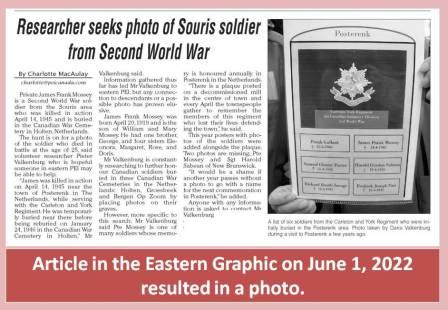
Article in Eastern Graphic re James Frank Mossey Jun 1 2022

… Frank Mossey’s niece contacts Pieter….

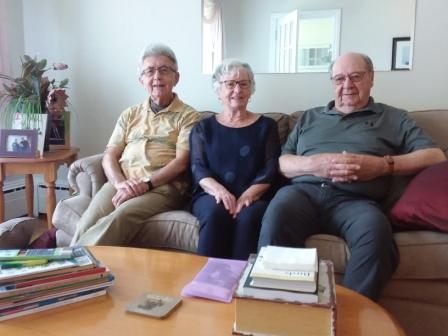
20220616_122329 Jun 16 2022 Pieter with Glynne and Bob Squires

Pieter (left) with Glynne and Bob Squires. (Photo credit: Daria Valkenburg)

A few days after the article was published in the Eastern Graphic, Glynne Squires contacted Pieter, explaining that “My Mother is Margaret (deceased) – a sister of Frank.  The members of Frank’s family are small.  A few cousins, myself, Karen Sereda, and Marilyn Jones – nieces of Frank’s.  Thank you for the work you are doing to keep the memory alive of these brave young men….”  And Glynne had a picture to share…

James Frank Mossey

James ‘Frank’ Mossey.  (Photo courtesy of Glynne Squires and Family)

When he enlisted in Charlottetown on July 10, 1940 with the PEI Highlanders, Frank was working as a meter reader for the Town of Souris.  He had also worked with his father who had been the town electrical inspector.

… Frank was sent to Newfoundland….

NFLD Map shows Botwood

Location of Botwood Military Base in Newfoundland. (Map source: http://postalhistorycorner.blogspot.com/2012/12/wwii-canadian-forces-in-newfoundland.html)

He was sent to Halifax with the PEI Highlanders, and then in 1941 the Regiment went to Newfoundland. An RCAF base in Botwood had aircraft patrolling the east coast of the Atlantic. Canadian Army personnel based at Botwood were charged with protection of military facilities that had been installed there, as well as in Gander. (See https://www.heritage.nf.ca/articles/politics/botwood-base.php)

On November 7, 1941 Frank was attached to the No. 6 District Depot, the default unit for troops in the area that weren’t members of another unit.  Military District 6 comprised Nova Scotia and Prince Edward Island, with headquarters in Halifax.  However, he remained in Newfoundland.

… Frank was anxious to go overseas….

 An April 29, 1943 interviewer recorded in his Personnel Selection Record that Frank was “…now a section commander in ‘A’ company….” and that he “… gets along well with his men…

The report went on to say that Frank “…expresses himself well; has a decisive but attractive manner…”  It also noted that he “… likes the army and is very anxious to get overseas….

Frank was soon to get his wish. He was transferred to the No. 1 Transit Camp in Windsor, Nova Scotia on June 2, 1943, and just over a week later he was on his way to the United Kingdom, arriving there on June 18, 1943, part of the Canadian Infantry Reinforcement Unit (CIRU).

… In December 1943 Frank joined the Carleton & York Regiment in Italy…

On December 12, 1943 he was transferred to the Carleton & York Regiment, joining the Regiment in Ortona, Italy, part of the reinforcement of troops following the battles in Sicily.

On March 19, 1945, he and his Regiment left Italy for North-West Europe as part of Operation Goldflake, arriving in Marseilles, France on March 21, 1945.  Operation Goldflake was the codename for moving troops from Italy to North-West Europe.  (See https://en.wikipedia.org/wiki/Operation_Goldflake)

From France, troops were moved up to the Belgian front, into The Netherlands, through the Reichswald Forest in Germany, and then back into The Netherlands, arriving near Zutphen on April 10, 1945.

…The Liberation of Posterenk…

Map western holland showing Posterenk

According to the April 12, 1945 war diary entry of the Carleton & York Regiment, they “…moved across the Ijssel River at 14:30 hours….” to relieve the Seaforth Highlanders of Canada.

On April 13, 1945, the war diary entry noted that …‘D’ Company’s objective is Posterenk…” The Regiment didn’t expect much opposition, but they “met with stiff resistance just after starting at 11:25 hrs…

With the help of a tank troop, they were able to move forward.  According to the war diary entry, “at 13:37 hrs ‘D’ Company reported that POSTERENK was clear of the enemy, having had one officer killed (Lt. R.B. Savage) and two other ranks wounded but a total of 50 POWs. ‘D’ Company were ordered to push on up the road which they did at once and came under enemy fire…

In the evening ‘B’ Company moved forward and encountered “…considerable enemy resistance…”  Very late into the night and into April 14, 1945, “…during ‘B’ Company’s attack they have eight wounded and one killed, Lt. W.E. Brousseau being one of those wounded…

The war diary entry noted that in the middle of the night – into April 14, 1945 – “‘B’ Company’s patrol met stiff opposition…

It’s not clear exactly what happened to Frank. The service file only notes that he was killed in action on April 14, 1945 near Posterenk.  He was 25 years old.

….Frank was originally buried near Posterenk….

Frank was temporarily buried near the crossing next to the windmill in Posterenk.

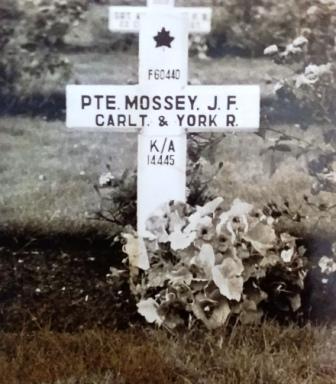
20220616_114707 Original grave burial

Frank was originally buried near the windmill in Posterenk. (Photo courtesy of Glynne Squires and Family)

On January 24, 1946 Frank was reburied in the Canadian War Cemetery in Holten, The Netherlands.

Grave of Frank Mossey in Holten

Grave of Frank Mossey in the Canadian War Cemetery in Holten.  (Photo source: Canadian Virtual War Memorial)

After the war ended, Frank’s family was informed that he was twice mentioned in despatches “…in recognition of gallant and distinguished services…” and they subsequently received a certificate from King George VI.

….Mossey Island in northern Canada named in his honour…..

Mossey Lake in NWT

Mossey Island in the Northwest Territories was named in honour of Frank Mossey.  (Map source: https://www.geodata.us/canada_names_maps/maps.php?featureid=LAQCJ&f=316)

A 2010 email from Blair Neatby in Yellowknife to Greg Gallant of the PEI Regimental Museum noted that Mossey Island, located on Faber Lake in the Northwest Territories, in northern Canada, was named in his honour on October 12, 1952. (Location coordinates: Latitude 63.93374° or 63° 56′ 2″ north, Longitude -117.15295° or 117° 9′ 11″ west, Elevation 213 metres or 699 feet.)

Thank you to Glynne and Bob Squires for sharing photos and information about Frank Mossey, and to Charlotte MacAulay of the Eastern Graphic for writing about the photo search. If you have a story to tell, please let Pieter know. You can email him at memorialtrail@gmail.com, or comment on the blog.

© Daria Valkenburg

…Previous stories about soldiers commemorated in Posterenk….

…Want to follow our research?….

If you are reading this posting, but aren’t following our research, you are welcome to do so.  Our blog address: https://onthewarmemorialtrail.com/

4 countries, 6 weeks, 7,000 km – an unforgettable war memorial journey in Europe…. Daria’s book ‘No Soldier Buried Overseas Should Ever Be Forgotten‘ is available in print and e-book formats.  Net proceeds of book sales help support research costs and the cost of maintaining this blog. For more information see https://nosoldierforgotten.com/ 

Front cover OnTheWarMememorialTrailinEuropeUpcoming Author Talk: Thursday, August 11, 2022 – Victoria-By-The-Sea, Prince Edward Island, part of the ‘Our Island Talks’ series, and hosted by Victoria Playhouse and Victoria Historical Association. Time: 2:00 pm.

You are also invited to subscribe to our YouTube Channel: On The War Memorial Trail With Pieter Valkenburg: https://www.youtube.com/channel/UCJ591TyjSheOR-Cb_Gs_5Kw.

Never miss a posting!  Subscribe below to have each new story from the war memorial trail delivered to your inbox.

On the War Memorial Trail ….. At Holten Canadian War Cemetery

January 20, 2018.  After visiting the Information Centre at the Canadian War Cemetery in Holten, we went into the cemetery itself to lay flags at the graves of five known soldiers from PEI.  Two of them, William Douglas SHERREN and George Martin MCMAHON are listed on the Cenotaph outside the Borden-Carleton Legion.

We had wondered why the cemetery had more landscaping than most Commonwealth War Cemeteries and why it was not on one level, but terraced.  Edwin van der Wolf, our guide, explained that the cemetery originally was on flat ground.  The Canadian government acquired more land than was used in the belief that the war would last longer and go into Denmark, resulting in more casualties. Luckily, that didn’t happen, and meant that the excess land could be used for landscaping.

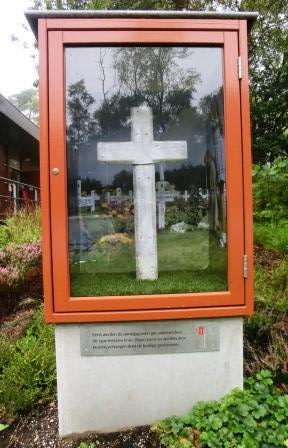
When the cemetery was first opened, metal crosses were used to mark each grave, and there is a display in front of the Information Centre that shows one.

CIMG9100 Sep 18 2017 display of original metal cross used in Holten Cemetery

Metal cross originally used to mark each grave in Holten Canadian War Cemetery. (Photo credit: Daria Valkenburg)

Originally, the Cross of Sacrifice in the cemetery was placed further back than in its present location.  Similar to the story we’d heard about the placement of a Cross of Sacrifice at Groesbeek Canadian War Cemetery, Edwin noted that he had heard that when Holten Cemetery began, Lt. General Guy Granville Simonds, Commander of the 2nd Canadian Army, “wanted the Cross of Sacrifice to be 60 metres high and lit up so that it could be seen across the German border as a reminder of who had conquered them.”  Whether this story is true or not, we don’t know.

CIMG9123 Sep 18 2017 Holten Cemetery Pieter & Edwin van der Wolf by cross of remembrance

Pieter with Edwin van der Wolf by the Cross of Sacrifice at Holten Canadian War Cemetery. (Photo credit: Daria Valkenburg)


IMG_20170918_133147255_HDR Sep 18 2017 landscaping at Holten Cemetery

Landscaped grounds of Holten Canadian War Cemetery. (Photo credit: Pieter Valkenburg)

The first grave where flags were placed was that of Captain William Douglas Sherren, born November 25, 1914 in Crapaud, son of William Douglas Sherren and Florence Amanda nee Carrier.  Married to Florence Mead Strickland, he was the father of two sons, Hubert and Harrison Blair.  An electrician before the war, Sherren enlisted on January 6, 1941 as a Lieutenant with the First Survey Regiment, Royal Canadian Artillery.  On March 29, 1944 he was promoted to Captain.

Wiliam Douglas Sherren

William Douglas Sherren. (Photo courtesy of Holten Canadian War Cemetery Information Centre)

On July 9, 1944, not long after D-Day, he arrived in France from England.  He was recognized by King George VI as a Member of the Military Division of the Most Excellent Order of the British Empire in March 1945, in recognition of gallant and distinguished service in North West Europe.

Unfortunately, on April 25, 1945, while in Germany, the vehicle he was travelling in struck a landmine. He was severely wounded and died on April 28, 1945.  Originally buried in Cloppenburg Hospital Cemetery in Lower Saxony, he was reburied in Holten Canadian War Cemetery in 1947, after the war ended.

IMG_20170918_134108826 Sep 18 2017 grave of WD Sherren Holten cemetery

Grave of Captain William Douglas Sherren at Holten Canadian War Cemetery. (Photo credit: Pieter Valkenburg)

The next set of flags were placed at the grave of Gunner George Martin McMahon, born January 14, 1913 in Emerald Junction, son of  Peter A McMahon and Catherine nee Monaghan.  Married to Margaret Kathleen Greenan, he was the father of 5 children. In addition, one child, Joseph Louis died in 1942 at the age of three months, and another child, Georgie, was born in November 1945 after McMahon’s death.  Prior to enlistment in Montreal with the Royal Canadian Artillery on December 7, 1943, he was a machinist with Canadian Vickers Ltd.  Fluent in both English and French, his army record noted he could play the violin.

OLYMPUS DIGITAL CAMERA

George Martin McMahon. (Photo courtesy “Around Kinkora Area” by G. K. Farmer)

McMahon left Canada for England in March 1945, and was sent to North West Europe in May 1945.  According to a letter to his widow, written by Colonel C. L. Laurin, McMahon was on “a short leave to Amsterdam in company of a comrade with the same regiment.  On the evening of the 10th of August 1945, at approximately 11:50 pm, they parted company…” 

McMahon’s friend returned to the Army leave hotel alone.  The following day, this soldier, made enquiries and was informed that the body of the deceased had been found in a canal….”  It was determined that he had accidentally drowned on August 11, 1945.   He was first buried in Hilversum Community Cemetery, and in 1946 was reburied in Holten Canadian War Cemetery.

IMG_20170918_134412720 Sep 18 2017 G McMahon grave Holten Cemetery

Grave of George Martin McMahon at Holten Canadian War Cemetery. (Photo credit: Pieter Valkenburg)

After visiting McMahon’s grave we went on to place flags at the graves of three more known soldiers from PEI: Carman GILLCASH, Frederick Charles CHEVERIE, and Daniel Peter MacKenzie.

Edwin van der Wolf told us that MacKenzie had been with the Carleton & York Regiment, which liberated the village of Posterenk.  This is where MacKenzie, plus 5 more from his unit, lost his life from sniper fire from Germans using the village’s windmill as a hideout.  For the past two years, on April 13, the people from the village commemorate the event around the old windmill.

Do you have more information or photos on these five soldiers from PEI?  Have you visited Holten Cemetery and its Information Centre?  Do you know of more soldiers from PEI buried in the Cemetery?  You can share your comments and stories by emailing us at memorialtrail@gmail.com or by commenting on this blog.

© Daria Valkenburg

….Want to follow our research?….

If you are reading this posting, but aren’t following our research, you are welcome to do so.  Our blog address: https://onthewarmemorialtrail.com/

Front cover OnTheWarMememorialTrailinEurope4 countries, 6 weeks, 7,000 km – an unforgettable war memorial journey in Europe…. Daria’s book ‘No Soldier Buried Overseas Should Ever Be Forgotten‘ is available in print and e-book formats.  Net proceeds of book sales help support research costs and the cost of maintaining this blog. For more information see https://nosoldierforgotten.com/ 

You are also invited to subscribe to our YouTube Channel: On The War Memorial Trail With Pieter Valkenburg: https://www.youtube.com/channel/UCJ591TyjSheOR-Cb_Gs_5Kw

Never miss a posting!  Subscribe below to have each new story from the war memorial trail delivered to your inbox.