August 5, 2024. Can you imagine how difficult it was for parents to send their children off to conflict zones during WWII, and having to live with the uncertainty of whether they would return safely? For the Bulger family of Foxley River, Prince Edward Island, they suffered a double tragedy, losing two sons: Harold ‘Hal’ Gabriel BULGER, who is buried in the Canadian War Cemetery in Adegem, Belgium, and Lawrence William BULGER, who is buried in the Canadian War Cemetery in Groesbeek, The Netherlands.
We were aware of Lawrence Bulger from last year’s series on soldiers from the North Nova Scotia Highlanders who lost their lives during the Battle of Bienen on March 25, 1945. As his name was not on a photo wish list, we didn’t research his story at that time. (See https://onthewarmemorialtrail.com/2022/11/29/on-the-war-memorial-trail-the-search-for-a-photo-of-austin-havelock-munroe-is-on-youtube/)
This year we decided to tell the story of one more soldier killed during the Battle of Bienen, and asked Edison Smith for help in contacting a family member for Lawrence Bulger. Edison’s grandfather, Edison Alexander SMITH, and great-uncle Ralph Schurman BOULTER, both lost their lives in the Battle of Bienen. As they were from the same area of the Island, the families would have known each other. Sometimes, it’s as simple as that to make contact with the family of a soldier!
We then learned that Lawrence’s brother, Harold ‘Hal’ Gabriel, also served in WWII and was killed in action on September 10, 1944 near the town of Oostkamp in Belgium during the early stages of the Battle of the Scheldt. (See https://www.veterans.gc.ca/eng/remembrance/history/second-world-war/scheldt and https://en.wikipedia.org/wiki/Battle_of_the_Scheldt)
We decided to tell the story of both brothers, and began with Hal, the first of the brothers to lose his life.
….Hal’s family was soon found….
Shortly after the request was made, Edison wrote to say “…I was up to O’Leary this past week and spoke with my father and did some digging around for a relative of the Bulgers you had asked me about. I was able to speak with Bev and Bernard Jeffery….. I briefly explained the work you … do and she was kind enough to email me some info and pictures which I have forwarded to you…”
Bev also contacted us, explaining that her “…mother was Harold and Lawrence’s sister Agatha….” The family historian in the family, Bev was the keeper of the family photos and information. Edison had found the right person!
It wasn’t long before we had a chance to meet Bev, and to learn more about the Bulger brothers.

Pieter with Bev Jeffery at Mill River Resort in Mill River, Prince Edward Island. (Photo credit: Daria Valkenburg)
Born September 9, 1918 in Portage, Prince Edward Island, Hal was the son of Gabriel and Anne ‘Annie’ Marion (nee Milligan) Bulger of Foxley River, Prince Edward Island. One of 16 children, Hal had two brothers and thirteen sisters.
…..Hal enlisted in 1940….
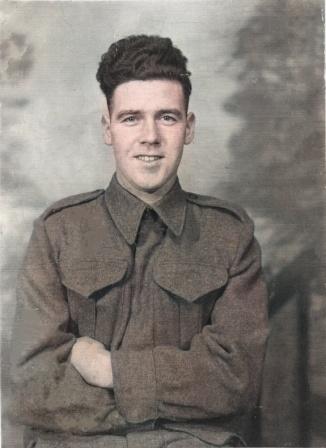
Harold ‘Hal’ Gabriel Bulger. (Photo courtesy of Bev Jeffery. Photo restoration and colourization by Pieter Valkenburg)
After leaving school at the age of 13, Hal worked on the family farm until he enlisted with the PEI Highlanders in Charlottetown, Prince Edward Island on July 31, 1940. After completing his basic training at No. 62 Canadian Army (Basic) Training Centre in Charlottetown, Hal was sent to Dartmouth, Nova Scotia for additional training.
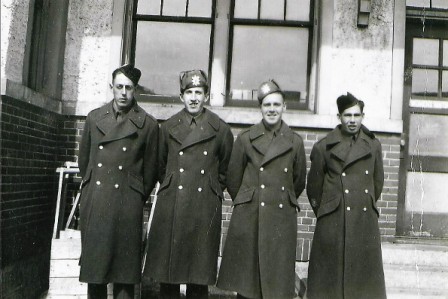
Left to right: Leo Lynch, Leo Moran, Harold ‘Hal’ Bulger, Cecil MacKinnon. (Photo courtesy of Bev Jeffery)
During a furlough in March 1941, a notice in the March 22, 1941 edition of the Summerside Journal noted that “…Pte. Leo Moran, Freeland, Pte. John McFayden, Freeland, Pte. Leo Lynch, Portage, Pte. Harold Bulger, Freeland, all of the P.E.I. Highlanders, returned to their unit in Nova Scotia. They were the guests of the Veterans’ Guard, Summerside….”

Harold ‘Hal’ Gabriel Bulger with his mother, Annie Bulger. (Photo courtesy of Bev Jeffery)
On June 4, 1941, Hal was transferred to A13 Canadian Infantry Training Centre in Camp Valcartier, Quebec, as preparation for guard duty in Newfoundland.
… Hal was sent to Newfoundland….

Location of Botwood Military Base in Newfoundland. (Map source: http://postalhistorycorner.blogspot.com/2012/12/wwii-canadian-forces-in-newfoundland.html)
After France was occupied by the Germans in 1940, Newfoundland’s defensive position became more precarious. A British dominion at the time, Newfoundland did not join Canada until March 31, 1949.
In 1940, Canada assumed responsibility for the defence of Newfoundland with the establishment of ‘W Force’, a Canadian garrison force responsible for defending Newfoundland against enemy incursions and providing security for existing and proposed defence facilities during WWII. It included infantry, artillery, and anti-aircraft units. (See https://en.wikipedia.org/wiki/Military_history_of_Newfoundland_during_World_War_II)
On July 23, 1941, as part of ‘W Force’, Hal was sent to Botwood, Newfoundland. In addition to the PEI Highlanders, troops from the Black Watch of Canada, Royal Rifles of Canada, The Algonguin Regiment, Queens Own Rifles, also served at various times. While an RCAF base in Botwood had aircraft patrolling the east coast of the Atlantic, Canadian Army personnel based at Botwood were charged with protection of military facilities that had been installed there, as well as in Gander. (See https://www.heritage.nf.ca/articles/politics/botwood-base.php)
…..Four other soldiers were in Botwood…..
Hal was in Botwood at the same time as four other soldiers whose stories have been told on this blog:
- Albert Joseph COTE: https://onthewarmemorialtrail.com/2022/07/27/on-the-war-memorial-trail-the-wwii-stretcher-bearer-whose-compassion-cost-him-his-life/
- Carman Edward GILLCASH: https://onthewarmemorialtrail.com/2022/10/22/on-the-war-memorial-trail-the-wwii-soldier-from-glenwood-killed-during-the-battle-of-the-delfzijl-pocket/
- Daniel ‘Dan’ Peter MACKENZIE: See https://onthewarmemorialtrail.com/2023/06/29/on-the-war-memorial-trail-the-wwii-soldier-from-victoria-cross-fatally-wounded-during-the-liberation-of-posterenk/
- James ‘Frank’ MOSSEY: https://onthewarmemorialtrail.com/2022/08/09/on-the-war-memorial-trail-the-wwii-soldier-from-souris-killed-during-the-liberation-of-posterenk/
… Hal briefly returned to Canada….
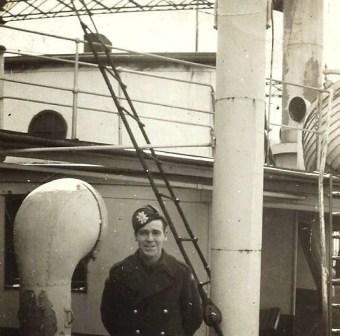
Harold ‘Hal’ Bulger aboard a ship returning to Canada from Newfoundland. (Photo courtesy of Bev Jeffery)
Hal remained in Newfoundland until February 12, 1943, when he was briefly sent to A14 Canadian Infantry Training Centre in Camp Aldershot, Nova Scotia and then on to Camp Sussex, New Brunswick.
On February 23, 1943, he sent his mother a brief letter, thanking her for “…the $5.00 you sent me…” as he was getting low “…on tobacco and money….” He explained that he didn’t know “…just when I will get home, but I will be home the first chance I get. I might have to stay here a month before I get home…” Based on Hal’s service record, he never did get leave to go home.
On March 8, 1943, Hal was no longer attached to ‘W’ Force, and remained at Camp Sussex until March 27, 1943, when he was transferred to the No. 1 Transit Camp in Debert, Nova Scotia, for final preparation and training before being sent overseas.
In a March 16, 1943 interview for his Personnel Selection Record, it was noted that Hal was a “…pleasant, smiling, sturdy, well-behaved stable lad…”
….Hal left Canada for overseas service….
On April 10, 1943, Hal left for Great Britain with the PEI Highlanders. Upon arrival on April 17, 1943, he was assigned to No. 7 Canadian Infantry Reinforcement Unit (CIRU).
On June 25, 1943, he was briefly assigned to the Princess Louise Fusiliers, before being transferred to the Algonquin Regiment on August 21, 1943. On May 28, 1944, Hal was promoted from Private to Lance Corporal.
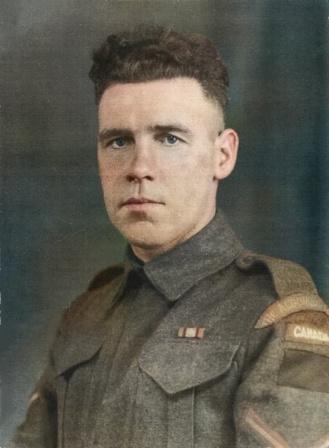
Harold ‘Hal’ Gabriel Bulger in his Algonquin Regiment uniform. (Photo courtesy of Bev Jeffery. Photo restoration and colourization by Pieter Valkenburg)
An excerpt from a research paper entitled ‘Rebuilding Trust: The Algonquin Regiment at War, July-September 1944’ by Ty Backer, noted that “…In the summer of 1944, the Algonquins received word from divisional commander, General Kitching that the 4CAD would be used after the secret invasion of Normandy….” 4CAD refers to 4th Canadian Armoured Division.
There was a delay in moving into France as although D-Day was a success, “…the failure to capture Caen on D-Day set back the division’s schedule for deployment… Formations were not able to move as far into Normandy as planners hoped, leaving 4CAD with no room to land at the beachheads until Caen and its surrounding area were captured. Consequently, they were delayed nearly a month and a half…”
….Hal survived Operation Tractable and Operation Totalize….
Hal remained in the United Kingdom until July 20, 1944, when he and his Regiment left for France, arriving in Normandy on July 25, 1944, as part of the 21st Army Group, along with “…the rest of the 10th Infantry Brigade landed in Normandy. Initially tasked with breaking through and driving south behind enemy lines, the battalion had to ensure getting armoured vehicles and infantry past the heavily entrenched areas surrounding the greater Caen area…”
This was the lead-up to Operation Totalize, an offensive to break through German defences south of Caen and then capture the high ground north of the city of Falaise. (See https://en.wikipedia.org/wiki/Operation_Totalize)
On August 2, 1944, Hal wrote to his father from France. “…Well, Pop, I suppose you are going to kill me for not writing sooner, but really it is hard to get time to write over here….This is quite the place…but I can’t talk French….” The letter ended with “…All my love. Your ever loving son. Hal…”
By the end of August 1944, the Regiment was on the move towards the liberation of Belgium. Liberating the port of Antwerp, Belgium was key. “…As the Allies progressed deeper into Europe, their supply lines needed to be augmented and strengthened…”
The Allied High Command “…tasked 4CAD with fighting preliminary skirmishes of the Scheldt battle along the northern sector of the coast. The Algonquins and the rest of the 4CAD were tasked with clearing the areas west of the Leopold Canal on the Dutch-Belgian border….”
….Hal lost his life during the Battle of Moerbrugge….

Map shows location of Oostkamp and Moerbrugge, near Bruges in Belgium. (Map source: Google maps)
The Algonquin Regiment arrived in Belgium from France on September 8, 1944. The next day, the Regiment attempted to cross a bridgehead at Moerbrugge near Oostkamp, not far from Bruges, during the Battle of Moerbrugge. (See https://www.canadiansoldiers.com/history/battlehonours/northwesteurope/moerbrugge.htm)
In ‘Warpath The Story of the Algonquin Regiment 1939-1945’, author Major G. L. Cassidy wrote that “…On the evening of the 9th, ‘D’ Company was detailed to cover the bridging operations in Oostkamp, and moved up to do the job. The remainder of the battalion moved south to the chateau area behind the bridgehead. Enemy resistance was still heavy across the canal….”
Hal was in ‘C’ Company, which was to cross the bridgehead at Moerbrugge across the Ghent-Bruges Canal the next day. The War Diary for September 10, 1944 for the Algonquin Regiment recorded that “…at 21:00 hours ‘C’ Company was ordered to cross the canal and consolidate at Eekhoute farm by passing through the Argyll and Sutherland Highlanders of Canada. The position was taken and held against continuous enemy fire. Casualties were reported to be 4 killed and 4 wounded...”
Hal was one of the fatal casualties. The other 3 soldiers who lost their lives that day were:
- Pte Gerald Bertram MCEACHERN of Galt, Ontario
- Sgt Marquis De MYERS of Wawota, Saskatchewan
- Cpl John Walter PARYSEK of Timmins, Ontario
….Hal is buried in Adegem….
Hal was initially buried in Moerbrugge, before being reburied in the Canadian War Cemetery in Adegem, Belgium, along with the other 3 Algonquin Regiment soldiers killed on September 10, 1944.
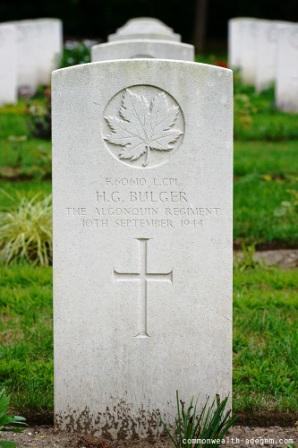
Grave of Harold Gabriel Bulger in the Canadian War Cemetery in Adegem, Belgium. (Photo courtesy of Canadian Virtual War Memorial)
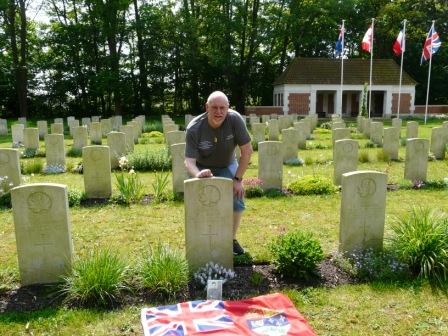
Patrick Michiels visited the grave of Harold ‘Hal’ Gabriel Bulger in Adegem in May 2024, bringing with him the Red Ensign and a photo of Hal. (Photo courtesy of Patrick Michiels)
Belgian citizen Patrick Michiels, Moderator of the Facebook group Canadian Scottish Regiment Adegem Canadian War Cemetery, visited Hal’s grave on May 11, 2024 at our request. He brought with him a photo of Hal and the Red Ensign flag that was the precursor of the Maple Leaf flag we are familiar with. (See https://en.wikipedia.org/wiki/Canadian_Red_Ensign)
Coming up in Part 2, the Bulger Brothers series continues, with Lawrence William BULGER, who lost his life six months after Hal’s death.
Thank you to Bev Jeffery for submitting photos and information on her Uncle Harold, to Edison Smith for contacting the Jeffery family, and to Patrick Michiels for visiting the Canadian War Cemetery in Adegem and taking a photo of Hal’s grave.
Do you have photos or information to share? Email Pieter at memorialtrail@gmail.com, or comment on the blog.
© Daria Valkenburg
…..Missed the stories on Smith and Boulter?….
To read about Edison Smith’s grandfather and great-uncle, please see:
- Edison Alexander SMITH: https://onthewarmemorialtrail.com/2023/03/04/on-the-war-memorial-trail-the-battle-of-bienen-part-1-the-wwii-soldier-whose-body-shielded-a-wounded-major/
- Ralph Schurman BOULTER: https://onthewarmemorialtrail.com/2023/03/07/on-the-war-memorial-trail-the-battle-of-bienen-part-2-the-wwii-battle-drill-instructor-from-oleary/
….Want to follow our research?….
If you are reading this posting, but aren’t following our research, you are welcome to do so. Our blog address: https://onthewarmemorialtrail.com/
 4 countries, 6 weeks, 7,000 km – an unforgettable war memorial journey in Europe…. Daria’s book ‘No Soldier Buried Overseas Should Ever Be Forgotten‘ is available in print and e-book formats. Net proceeds of book sales help support research costs and the cost of maintaining this blog. For more information see https://nosoldierforgotten.com/
You are also invited to subscribe to our YouTube Channel: On The War Memorial Trail With Pieter Valkenburg: https://www.youtube.com/channel/UCJ591TyjSheOR-Cb_Gs_5Kw.
Never miss a posting! Subscribe below to have each new story from the war memorial trail delivered to your inbox.
 August 24, 2022. When researchers at the Information Centre at the Canadian War Cemetery in Holten, The Netherlands honoured 27 soldiers of Ukrainian heritage that are buried in the cemetery, they didn’t have photos of 4 soldiers. Could Pieter help?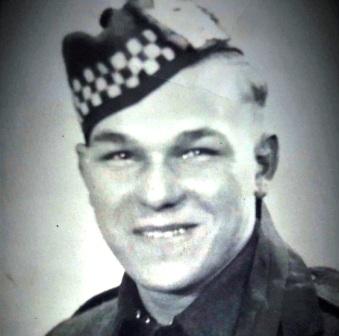





 On The War Memorial Trail Research Project........ with Pieter and Daria Valkenburg