April 18, 2026. When we were in The Netherlands last year on our 2025 European War Memorial Tour, we visited the Canadian War Cemetery in Groesbeek, where Pieter placed 120 flags at the graves of soldiers he’d done research on over the years. (See https://onthewarmemorialtrail.com/2025/06/23/on-the-war-memorial-trail-2025-faces-of-groesbeek-exhibition-part-1-flags-placed-at-120-graves/)
….There was a surprise when we visited the grave of WWII airman Arnold Freeman Hupman…
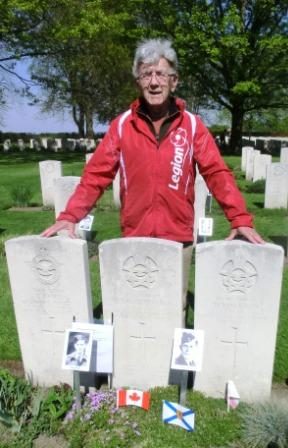
After placing flags of Canada and Nova Scotia, Pieter stands behind the grave of Arnold Freeman Hupman. (Photo credit: Daria Valkenburg)
One of the graves visited, and where Pieter placed flags of Canada and Nova Scotia, was that of WWII airman Arnold Freeman HUPMAN, of East Side of Ragged Island, Nova Scotia.
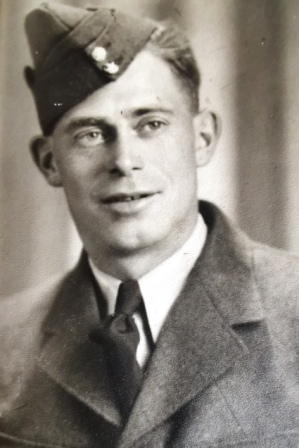
Arnold Freeman Hupman. (Photo submitted by Marilyn Hupman)
Arnold was serving with 419 Squadron of the Royal Canadian Air Force (RCAF), and lost his lost his life, at the age of 30, when the Lancaster bomber he was in crashed on the outskirts of Arnhem on the night of June 16 to 17, 1944, after being shot down by a German nightfighter. (You can read his story at https://onthewarmemorialtrail.com/2021/02/09/on-the-war-memorial-trail-atlantic-canada-remembers-part-6/)
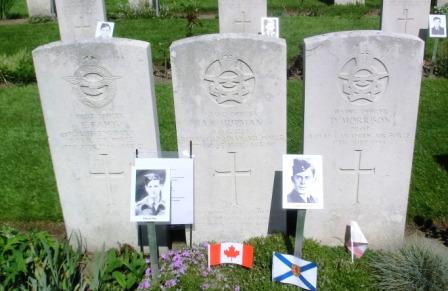
Arnold Hupman’s grave is between two of his crewmates: Donald Morissen and Edward Fahy. (Photo credit: Daria Valkenburg)
There was a surprise at his grave as we found a note from Saskia Peters, a member of the Faces To Graves Groesbeek Foundation Board, asking if whoever had been annually placing flowers at the grave to get in contact with her.
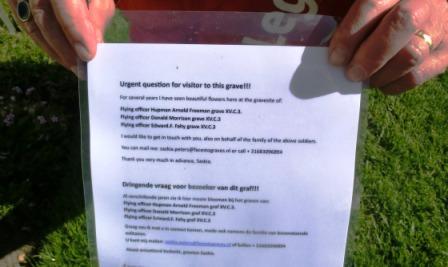
Note left by Saskia Peters beside the graves of Hupman, Morissen, and Fahy. (Photo credit: Daria Valkenburg)
….The last flight of Lancaster X KB728 …
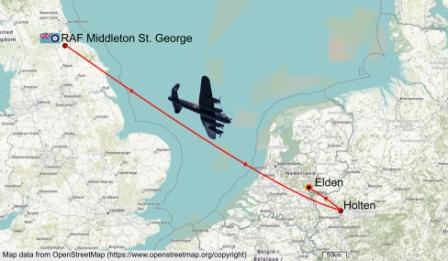
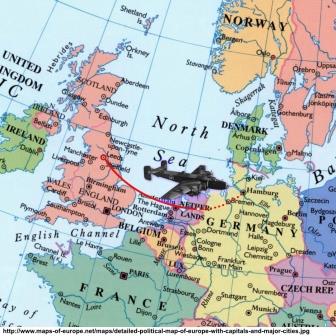
Map shows the plane’s path from Middleton St. George to Holten, Germany and then to where it crashed in Elden, The Netherlands. (Map prepared by Wendy Nattress)
On the night of June 16, 1944, at 11:08 pm, Lancaster X KB728 took off from RAF Middleton St. George, England for a bombing operation against the synthetic oil plant at Sterkrade/Holten in Germany.
On its return back to England in the early hours of June 17, 1944, the plane was attacked by a nightfighter and exploded following combat with nightfighter pilot Hans Schadowski of the 3./NJG 3 based at Vechta airfield in Germany, who was flying a Messerschmitt Bf 110 G-4.
The Lancaster crashed close to the Dutch Reformed Church at Elden in the province of Gelderland, 4 km (2.5 miles) southwest of Arnhem.
All seven crew members lost their lives. In addition to Flying Officer Arnold Hupman, the navigator on that flight, the other crew members were:
- Pilot : RCAF Pilot Officer Donald MORISSEN of Winnipeg, Manitoba
- Bomb Aimer: RCAF Pilot Officer Gerald Edgar QUINN of Montreal, Quebec
- Wireless Operator/Air Gunner: RAF Pilot Officer Harold FLETCHER of Bolton, Lancashire, England
- Air Gunner: RCAF Pilot Officer Clifford JOHNSTON of North Bay, Ontario
- Air Gunner: RAF Pilot Officer Philip Joseph MCMANUS of Herne Hill, London, England
- Flight Engineer: RAF Pilot Officer Edward FAHY of Rhyl, Flintshire, Wales
They were temporarily buried in the Netherlands Reformed Church Cemetery in Huissensedijk on June 29, and later reburied in the Canadian War Cemetery in Groesbeek. (More information can be found in this English translation of an article by the late Willem Tiemans: https://airbornearnhem.nl/WillemTiemens/Elden%20bomber%20crash.htm)
….The mystery of who placed the flowers was solved by Saskia…
Almost a month later, we met Saskia when we were honoured by the Faces To Graves Groesbeek Foundation at one of their meetings, and asked if she had received any response. (See https://onthewarmemorialtrail.com/2025/05/30/on-the-war-memorial-trail-pieter-and-daria-honoured-by-faces-to-graves-groesbeek-foundation/)
“…Yes!…” she replied and said she would follow up with a few photos and emails, which she did. “….As I told you at our Research meeting, I have indeed found the person on May 4, who put the flowers at Arnold Hupman’s place for the past few years….”
She said she’d placed the sign at Arnold’s grave in mid-April. “…I had also asked the gardeners for permission and they were eager to help me keep an eye out if they saw anyone walking by his grave….”
To Saskia’s disappointment, however, “….before we had the opening ceremony of The Faces of Groesbeek, there were still no flowers….” We attended the Opening Ceremony on May 2, 2025 and Saskia was correct – the sign was still there, but no flowers. (For our story on the Opening Ceremony, see https://onthewarmemorialtrail.com/2025/07/19/on-the-war-memorial-trailwe-attended-the-ceremony-at-the-canadian-war-cemetery-in-groesbeek/)
Then, on May 4, 2025, “….it was our National Remembrance Day. I wasn’t on duty to host The Faces of Groesbeek, but I saw that no one was scheduled so I went anyway. Around noon, my colleagues came to ‘relieve me’ as they were scheduled for the afternoon....”
Saskia should have gone home to rest at this point as she was scheduled to lay a wreath at the cemetery that evening with Alice van Bekkum, Chair of the Faces To Graves Groesbeek Foundation. “…. But my heart said, ‘Go to Hupman’s grave one more time and ask for his help’….”
Saskia explained that as she “… walked back across the wide grassy area in the middle that runs from the Stone of Remembrance to the Sacrificial Cross.…” she noticed “…a man walking into the cemetery with a bouquet of flowers in his hands….”
After asking if the man had come to visit a particular grave, he said yes, but couldn’t remember where it was located, but explained that the grave was “…. different from the others, the stones are closer together….”
Saskia immediately knew he was looking for Arnold Hupman’s grave from this description. The headstones of 3 graves were closer together than with other graves as, according to the crash reports, only 5 bodies were ever found – not the 7 that were known to be in the plane. It was surmised that the remains of 2 had burned beyond recognition in the crash.
“….Tears sprang to my eyes ….” Saskia wrote. “… I tell him that I think he is looking for the grave of the flying officer I stood by about a minute ago before, asking for help to find the person who has been putting flowers at his grave for years. We walk together up the side to Hupman’s grave, the man enthusiastically confirming that this is indeed the grave he was looking for…..”
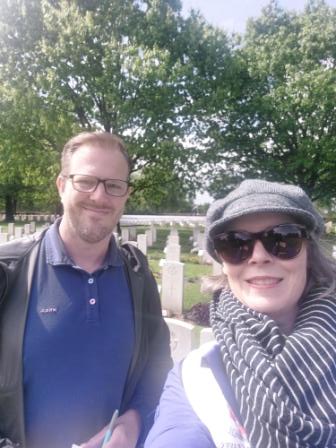
Frans Nijsen with Saskia Peters. (Photo courtesy of Saskia Peters)
The mystery was solved! The man who had brought the brought the bouquet was Frans Nijsen, a resident of Berg en Dal, which is very close to the cemetery.
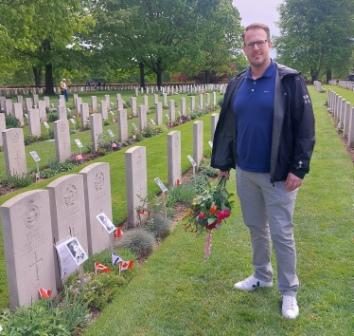
Frans Nijsen beside the grave of Arnold Hupman. The flags of Canada and Nova Scotia had been placed several days earlier by Pieter. (Photo courtesy of Saskia Peters)
….The story of why the flowers were placed spanned two continents…
We were curious to know why a Dutch guy chose Arnold Hupman’s grave to place an annual bouquet. Perhaps Frans had been in the Royal Netherlands Air Force, as Pieter had been? We wrote to him and asked. To our surprise, the answer circled back to a neighbouring Maritime province, not that far from where we live.
“….I work with a company called QPS, in the Netherlands and we have a Canadian office in Fredericton, New Brunswick…..” Frans wrote. “…. I’m a hydrographer, and I work for a software company that produces software to map the seabed and to produce maritime charts.
I used to have a colleague, Graham Nickerson, who lives in Freddy. At some point he came over to our office in the Netherlands for training in our software, and when the weekend was almost there, I asked him what his plans were. He told me that he has a relative who was killed in action, shot down over Arnhem and that he was visiting his grave in Oosterbeek…. I learned that the cemetery in Oosterbeek is a British one and that there is a Canadian cemetery close to where I live now. I started looking on internet and found his grave at the cemetery in Groesbeek, which is 5 minutes from my home town, Berg en Dal.
I invited him to come over, so I could bring him to the cemetery. In the meantime I did some more digging around and found that there is a small monument at the crash site….”
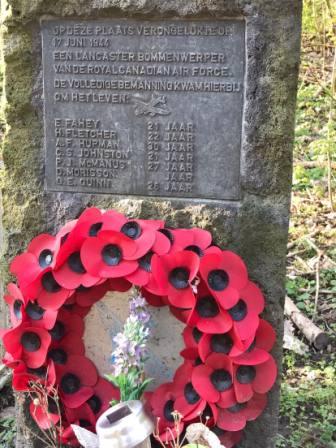
Memorial plaque for the crew of Lancaster X KB728 in Elden, The Netherlands. (Photo source: Facebook RAF Bomber Command Memorials, photo taken by Chris de Vries)
“…So, he came over, we visited the cemetery, which meant a lot to him, it was emotional for him to not have his relative buried close to home, but he was very happy how the cemetery…” cared for the graves. “...After that I told him about the monument of the crash site and that I’m going to take him there. He was very surprised and interested in it…. He was very glad that the sacrifice was not unnoticed….”
“…Since his visit I made it my personal goal to visit this grave every year around the 4th of May to bring flowers. I have two young kids that I bring with me as well, and we try to explain what happened and why it’s important to honour the men and women who are buried at the cemetery. Every year I send a picture to Graham with fresh flowers at the grave…..This year I was there as well, and I bumped into Saskia. The rest is history….”
Quite a story, in which serendipity certainly played a big part! As we near the 81st Anniversary of the Liberation of Europe, it’s a poignant reminder that those who gave their lives in war should never be forgotten.
Thank you to Saskia Peters and Frans Nijsen for unlocking the mystery behind the note, and for sharing the story about the flowers placed each May at the grave of Arnold Freeman Hupman. Thank you to Wendy Nattress, who prepared the map showing the flight path for Lancaster X KB728.
Pieter’s research efforts to find photos and families of soldiers continue. Do you have a story to tell? Email Pieter at memorialtrail@gmail.com, or comment on the blog.
© Daria Valkenburg
….Want to follow our research?…
If you are reading this posting, but aren’t following our research, you are welcome to do so. Our blog address: https://onthewarmemorialtrail.com/
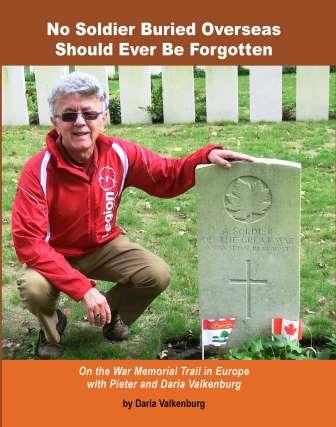 4 countries, 6 weeks, 7,000 km – an unforgettable war memorial journey in Europe…. Daria’s book ‘No Soldier Buried Overseas Should Ever Be Forgotten‘ is available in print and e-book formats. Net proceeds of book sales help support research costs and the cost of maintaining this blog. For more information see https://nosoldierforgotten.com/
Subscribe to our YouTube Channel: On The War Memorial Trail With Pieter Valkenburg: https://www.youtube.com/channel/UCJ591TyjSheOR-Cb_Gs_5Kw.
Never miss a posting! Subscribe below to have each new story from the war memorial trail delivered to your inbox.