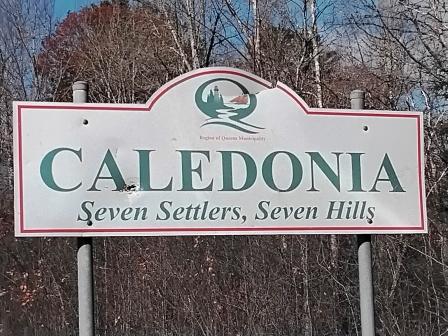
Sign for the community of Caledonia, Queen’s County, Nova Scotia. (Photo credit: Daria Valkenburg)
February 19, 2026. As Pieter works his way through the various photo wish lists he receives from the Canadian War Cemeteries in The Netherlands, he tends to be methodical. Occasionally, however, he decides to throw a ‘wild card’ and asks me to choose a soldier to research.
My process is definitely not methodical – I pick a soldier based on something that triggers a memory – either through a surname or place of residence or even because Pieter previously researched a soldier from the same Regiment who lost his life on the same day. This time around, I chose a soldier who came from Caledonia, Nova Scotia. Why? I remembered that when I was in school and we studied British history that Scotland was often referred to as Caledonia, its Latin name during the Roman period. Caledonia made me think of my late mother, who loved anything Scottish. (See https://www.britannica.com/place/Caledonia-ancient-region-Britain)
….The search for family of William Owen Seldon was successful…
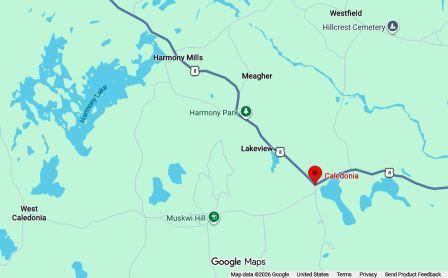
Caledonia, located in Queens County, Nova Scotia is 151 kms (94 miles) from Halifax. (Map source: Google maps)
Pieter just shook his head, but dutifully began his research into William Owen SELDON, born January 2, 1917 in Caledonia, Nova Scotia, son of Roland Chivers and Effie Bond (nee Doggett) Seldon. William had lost his life in Germany on February 19, 1945 while serving with the Lorne Scots (Peel, Dufferin and Halton Regiment).
It wasn’t long before Pieter was in contact with retired schoolteacher, Wilma Shupe, the daughter of William’s sister Rhoda Irene Forrest….and received a photo from her. Wilma explained that “…My mother always called him William. They were very close. They went to dances together as he could drive, and he used a truck with a flat bed, like was used for hauling logs, etc. They would pick up people along the way and go to dances in a neighbouring community...”
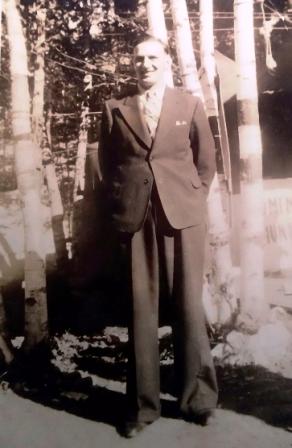
William Owen Seldon. (Photo courtesy of the Seldon Family)
In addition to his sister Rhoda, William had a brother, George Roland, and another sister, Roseanna May. “…Two nephews were named for him. Rose and George, his younger siblings, named their sons after him…” Wilma noted. “….The farm where William grew up was purchased by Dutch immigrants in the 1950s and are well known to this day as Van Dyk blueberries…” (See https://vandykblueberries.ca/)
….William enlisted in 1942…
William originally enlisted under the National Resources Mobilization Act (NRMA) at the No. 6 NRMA Clearing Depot in Halifax, Nova Scotia on July 24, 1942 and joined the 54th Heavy Anti-Aircraft Battery of the Royal Canadian Artillery (RCA) in Bedford, Nova Scotia. At the time, he stated that he’d left school at the age of 17 after completing Grade 9, and had been working ever since. (See https://en.wikipedia.org/wiki/National_Resources_Mobilization_Act)
Wilma had mentioned that “…William worked in the woods and on the family farm before he enlisted…”
His personnel file for his occupational background noted that he had been “…driving horses for 6 months. Truck driver for 3 months. Gold miner for 1 ½ years and coal mining for 3 or 4 years. …Can operate car and truck and effect minor repairs….”
His interests included “…playing softball, dancing, movies, fishing, playing cards, and recitation and dialogue…”
On November 5, 1942, William enlisted in the Active Army with the 54th Heavy Anti-Aircraft Battery of the Royal Canadian Artillery (RCA).
….William served in Newfoundland…
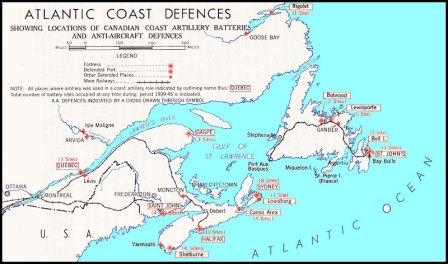
Atlantic Coast Defences during WWII. (Source: https://www.ibiblio.org/hyperwar/UN/Canada/CA/SixYears/maps/SixYears-1.jpg)
After completing his basic training, William was transferred on August 6, 1943 to the 25th Anti-Aircraft Regiment, based in St. John’s-Torbay, Newfoundland as part of Atlantic Command, and tasked with strengthening and administering home defence facilities on Canada’s Atlantic Coast and Newfoundland. (See https://en.wikipedia.org/wiki/Atlantic_Command_(Canadian_Army))
Before travelling to Newfoundland, however, he received a furlough from August 6 to 23, 1943. (NOTE: Newfoundland and Labrador became part of Canada on March 31, 1949.)
….William briefly returned to Canada before travelling overseas…
William remained in Newfoundland until April 26, 1944, when he was transferred to No. 1 Transit Camp in Windsor, Nova Scotia. Then, on May 20, 1944, he was reallocated to the No. 1 Training Battalion of the Canadian Infantry Corps (CIC) in Debert, Nova Scotia, and received further training before being transferred to the Training Brigade Group in preparation for overseas service.
….William left Canada for overseas service …
On July 19, 1944, William left Canada, arriving in the United Kingdom on July 27, 1944, where he was placed with No. 3 Canadian Infantry Reinforcement Unit (CIRU).
The following day after arrival he was interviewed and recommended for training as a Driver I/C for the Infantry. (The term ‘Driver i/c’ refers to ‘Driver, internal combustion’.) However, that training never happened, as a few weeks later he was transferred to the X4 Reinforcement List for the Royal Regiment of Canada, part of 21st Army Group, on August 10, 1944 and sent to France the following day, arriving on August 12, 1944.
In France he was transferred to the Black Watch (Royal Highland Regiment) of Canada on August 15, 1944, joining them as preparations were made for the upcoming Battle of Falaise Gap. On August 18, 1944, he was sent to HQ No. 5 Canadian Infantry Brigade (CIB).
William was wounded in his right leg by mortar fire on August 22, 1944, and taken to No. 102 Field Dressing Station (FDS). After being discharged on September 11, 1944, he was put on the X4 Reinforcement List of the 13th Battalion, where he remained until November 28, 1944, when he was transferred to No. 5 Canadian Infantry Brigade (CIB) Ground Defence Platoon (Lorne Scots Regiment), joining them in The Netherlands. (See https://en.wikipedia.org/wiki/5th_Canadian_Infantry_Brigade)
Then, on January 19, 1945, he was transferred to the 4th Infantry Brigade Ground Defence Platoon (Lorne Scots Regiment). The Lorne Scots role was to mobilize units to fulfill defence and employment requirements for the Canadian Army. This included various support roles, focusing on logistical and defensive operations rather than front-line combat.
….William was attached to the Essex Scottish Regiment for an attack on the Goch-Calcar Road …
Although officially with the Lorne Scots (Peel, Dufferin and Halton Regiment), William was attached, for all purposes, to the Essex Scottish Regiment on February 8, 1945. On February 16, 1945, the Essex Scottish Regiment left The Netherlands and crossed the border into Germany, at Kleve. The following day, the war diary reported that the battalion “…moved off to an assembly area between Kleve and Calcar….” in preparation for an attack on the Goch-Calcar Road, which was subsequently delayed until February 19, 1945. (Calcar in English is Kalkar in German)
….Heavy fighting along the Goch-Calcar Road proved deadly….
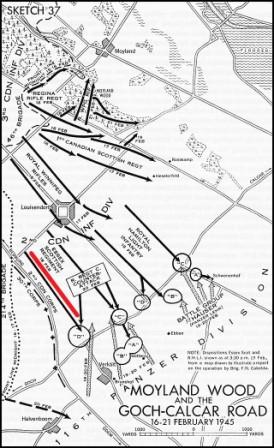
Moyland Wood and the Goch-Calcar Road, 16-21 February 1945 (Map source: HyperWar: The Victory Campaign [Chapter 18] ibiblio.org)
An account of the role played by No. 4 Canadian Infantry Brigade during the struggle for the Goch-Calcar Road on February 19-20, 1945 was provided by Brigadier Frederick Norman CABELDU on February 28, 1945. (See https://matthewkbarrett.com/2024/07/17/brig-f-n-cabeldu/)
His report began by stating that “…prior to the attack made by 4 Cdn Inf Bde on 19 Feb 1945, the enemy controlled the main Goch-Calcar road, southwest of Calcar…The enemy held a line on the outskirts of Calcar that included Moyland,…” a wooded area, “…and that continued to the southwest. The latter portion of this line ran parallel to, and about a mile north-west of, the main Goch-Calcar road…”
A description of the attack, which began just after noon, followed. “…The attack involved an advance over open country, and sufficient ‘Kangaroos’…were used….” Kangaroos are turret-less tanks with a platform for carrying troops.
Things didn’t go according to plan, as “…movement over the soft ground was difficult and ….several ‘Kangaroos’ and tanks became bogged down…” They were sitting ducks. “…It soon became evident that the enemy had a screen of anti-tank defences, including many 88 mm guns…” German positions were held by “…fresh troops of 12 Parachute Recce Regiment…” and in the rear of these positions were “…elements of Panzer Lehr Division….”
The Essex Scottish Regiment’s war diary for February 19, 1945 noted that the attack on the Goch-Calcar Road resulted in the Regiment fighting “….under a heavy hail of shrapnel and small arms fire. Casualties were fairly heavy….Communications were difficult. Vehicles became bogged in the soft mud, casualties were difficult to evacuate, and guns and ammunition could not get up where they were required. Battalion HQ moved into a group of buildings which were later surrounded and demolished by tanks…”
William, who was attached to the Essex Scottish Regiment, was one of the fatal casualties that day. Also killed in the attack on the Goch-Calcar Road, but on the following day, was Donald Roy CARTER. (See https://onthewarmemorialtrail.com/2024/06/09/on-the-war-memorial-trail-the-wwii-soldier-from-central-blissville-killed-along-the-goch-calcar-road/)
….William is buried in Groesbeek…
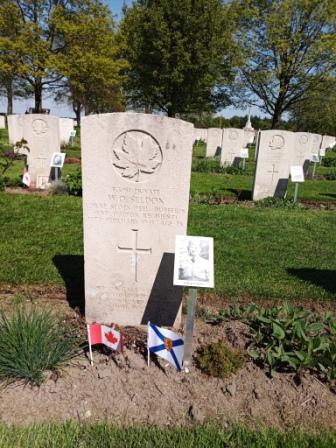
Grave of William Owen Seldon with Canadian and Nova Scotia flags placed by Pieter. (Photo credit: Pieter Valkenburg)
William was initially buried in the Canadian Military Cemetery in Bedburg, Germany, before being reburied on September 11, 1945 in the Canadian War Cemetery in Groesbeek, The Netherlands. During our 2025 European War Memorial Tour, Pieter placed flags of Canada and Nova Scotia by his grave.
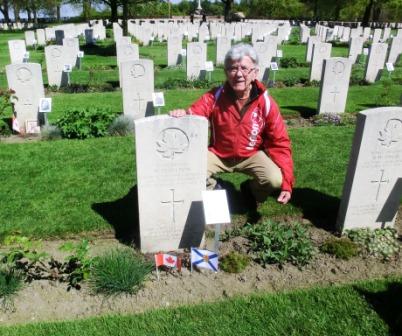
Pieter at the grave of William Owen Seldon after placing flags of Canada and Nova Scotia. (Photo credit: Daria Valkenburg)
….We met William’s family when we visited Caledonia…
We are always happy to meet family members of the soldiers that Pieter researches, and so we were delighted to have the chance to visit Caledonia and meet Wilma Shupe and her husband Tom.
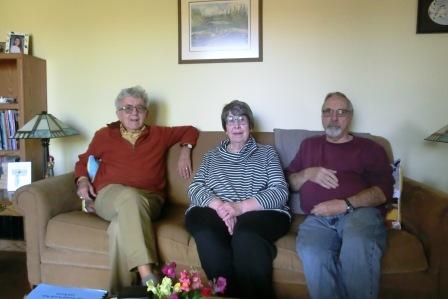
Pieter with Wilma and Tom Shupe. (Photo credit: Daria Valkenburg)
Tom and Wilma showed us the Cenotaph in Caledonia, on which William is listed on the Roll of Honour.
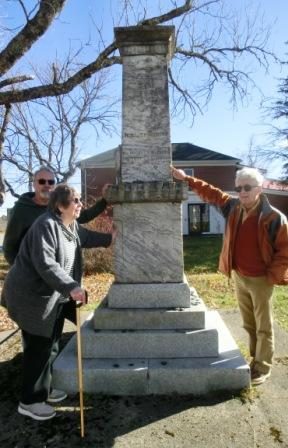
Tom and Wilma Shupe (left), with Pieter pointing to William Seldon’s name on the Roll of Honour on the Cenotaph in Caledonia. (Photo credit: Daria Valkenburg)
Thank you to Wilma and Tom Shupe for providing photos and information, and a warm welcome during our visit.
The flags that were placed by Pieter at William’s grave were donated. Our thanks go to:
- Alan Waddell, Constituent Assistant, on behalf of Heath MacDonald, MP for Malpeque, for the Canadian flag.
- Kyle Graham, Research Officer, Military Relations, Nova Scotia Intergovernmental Affairs, on behalf of Premier Tim Houston, Province of Nova Scotia, for the Nova Scotia flag.
Pieter encourages readers with photos or stories of Canadian soldiers buried in The Netherlands or Belgium to email him at memorialtrail@gmail.com or comment on the blog.
© Daria Valkenburg
….Want to follow our research?…
If you are reading this posting, but aren’t following our research, you are welcome to do so. Our blog address: https://onthewarmemorialtrail.com/
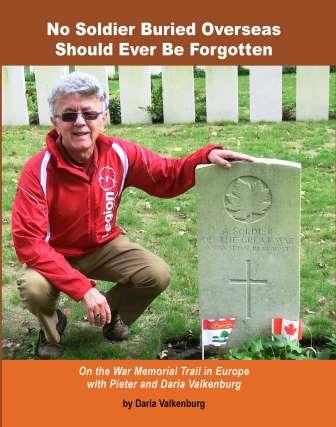 4 countries, 6 weeks, 7,000 km – an unforgettable war memorial journey in Europe…. Daria’s book ‘No Soldier Buried Overseas Should Ever Be Forgotten‘ is available in print and e-book formats. Net proceeds of book sales help support research costs and the cost of maintaining this blog. For more information see https://nosoldierforgotten.com/
Subscribe to our YouTube Channel: On The War Memorial Trail With Pieter Valkenburg: https://www.youtube.com/channel/UCJ591TyjSheOR-Cb_Gs_5Kw.
Never miss a posting! Subscribe below to have each new story from the war memorial trail delivered to your inbox.


 On The War Memorial Trail Research Project........ with Pieter and Daria Valkenburg
