On The War Memorial Trail…..The WWII Acadian Soldier Serving With Le Régiment de Maisonneuve Who Made The Ultimate Sacrifice In The Hochwald Forest

Balmoral and Shannonvale Google Maps

We travelled to Balmoral, New Brunswick, to meet the sister of a WWII soldier. (Map source: Google Maps)

November 27, 2024. After completing our tour along the Acadian Coastal Drive, visiting Acadian Memorials, we went to Balmoral, New Brunswick, to meet with Léa LeClair, the youngest sister of WWII soldier Ange Aimé LECLAIR. (See https://onthewarmemorialtrail.com/2024/11/22/on-the-war-memorial-trail-remembrance-week-2024-visiting-acadian-memorials-in-new-brunswick/)

CIMG7020 Aug 27 2024 Visit to Balmoral Romeo Le Page & Lea Le Clair

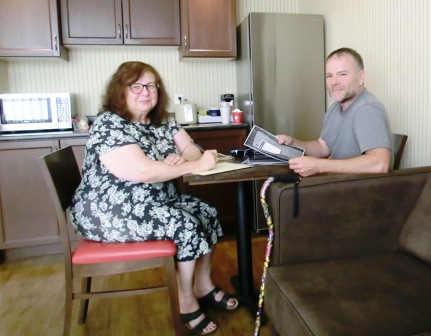
Pieter (centre) with Léa LeClair and her brother-in-law, Romeo LePage. (Photo credit: Daria Valkenburg)

When Pieter had begun his research to find family of Ange Aimé, he found an obituary for the soldier’s sister Viola, who was married to Romeo LePage.  Then he found a phone number for Mr. LePage and, with great trepidation given that he isn’t fluent in French, he dialed the number.  After a few minutes, Mr. LePage’s sister-in-law, retired teacher Léa LeClair, came on the line, and listened patiently.  “…Oui…” she had a photo of Ange Aimé, and then, happily, switched to English.  She explained that she was the youngest sister of the soldier, only 10 years old when he died on March 2, 1945.

Pieter let her know that we were planning a trip to New Brunswick, and asked if she would like to meet in person.  This was agreeable, and so, when we went to Balmoral, we were only expecting to get a photo of the soldier.  Boy, were we wrong! The family’s historian, Léa had several photos and letters written by her brother, and more.  Ange Aimé was clearly loved and remembered by his family!

Born in Shannonvale (now part of Eel River Crossing), Restigouche County, New Brunswick on March 14, 1925, Ange Aimé was the son of Thomas and Marguerite Anne (nee Basque) LeClair.  He came from a large family, and had 5 sisters, 3 brothers, 4 half-brothers, and 2 half-sisters.

…..Ange Aimé enlisted under the NRMA in 1944….

Léa recalled that “My brother Albénie was called up in the Spring. He did not pass the physical as he was sick. Ange-Aimé asked Papa if he should stay and wait for a call to join. They chose for him to go to work in the Kedgwick area. Later in the summer, the Army came looking for him in Dundee. Papa did not know exactly where he was cutting wood and said so to the Army. After a while, the Army did find him, in the Kedgwick area…. He was registered and then was sent for training…

Ange Aimé originally enlisted under the National Resources Mobilization Act (NRMA) at the No. 7 District Depot in Fredericton, New Brunswick on May 31, 1944 and underwent basic training at No. 71 Canadian Army Basic Training Centre (CABTC) in Edmundston, New Brunswick. (See https://en.wikipedia.org/wiki/National_Resources_Mobilization_Act)

ange aime le clair as a student colourized

Ange Aimé LeClair as a student.  (Photo courtesy of the LeClair family. Photo colourization by Pieter Valkenburg)

At the time of his enlistment, Ange Aimé had been working for 2 years as a woodsman for Raymond LeBlanc of Darlington, New Brunswick.  Léa recalled that he had studied at a seminary, with his family expecting him to be a priest, but he preferred working outdoors. While his Occupational History Form does not mention studying at a seminary, he most likely had his post-elementary education at a seminary. The form stated that Ange Aimé was fluent in both French and English, which was unusual for a young man who grew up in a rural area and in a French speaking household.

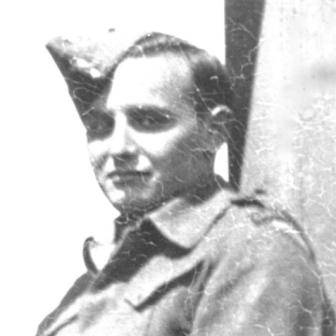
AA Leclair photo from memorial card colourized

Ange Aimé LeClair in uniform.  (Photo courtesy of the LeClair family. Photo colourization by Pieter Valkenburg)

On July 25, 1944, Ange Aimé enlisted for active duty while in Edmundston, and remained there until September 1, 1944, when he was transferred to the A-30 Canadian Infantry Training Centre (CITC) at Camp Utopia in Pennfield Ridge, New Brunswick.  On September 14, 1944, he received a promotion to Lance Corporal.

….Ange Aimé received embarkation leave….

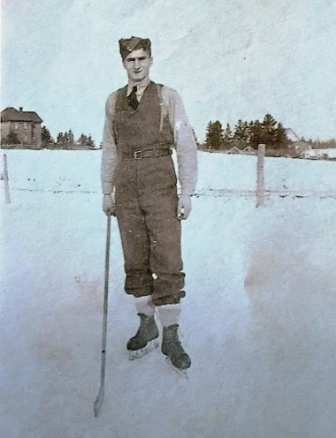
After completing his training at Camp Utopia, Ange Aimé received embarkation leave, prior to being sent overseas, from November 21 to December 7, 1944.  He returned home to the family farm in Dundee, New Brunswick, where a photo was taken of him playing hockey.

20240827_140114 AA Le Clair playing hockey in Dundee during embarkation leave

Ange Aimé LeClair on skates with a hockey stick during his embarkation leave.  (Photo courtesy of the LeClair family)

While on leave, Ange Aimé helped out at home, and spent time in the woods.  Time went by very quickly, and unfortunately he didn’t immediately return to Camp Utopia when his leave was up. Military police came to look for him, thinking he had deserted.  Léa recalled that her …father was in the garden and told them that Ange Aimé was in the woods.  After he returned, he was arrested and taken back to Camp Utopia, where he spent a night in the stockade...

The repercussions were harsh, given that he was only late returning by a few days.  On December 10, 1944, he was transferred to the No. 1 Training Brigade in Debert, Nova Scotia for final preparations and training before being posted overseas.  But, on December 17, 1944, he was demoted in rank and reverted to Private. 

 ….We had help in translating letters from French into English….

CIMG7053 Sep 10 2024 Daria & Etienne Gaudet translating AA LeClair letters in Moncton NB

Daria and Etienne Gaudet worked diligently to translate all the letters from French into English. (Photo credit: Pieter Valkenburg)

Because Léa had saved letters written by her brother, we were able to hear his thoughts during this period.  We were grateful for the help of Etienne Gaudet, who kindly translated all of the letters written by Ange Aimé from the original French into English.

In a December 20, 1944 letter to his sister Delphine, written from Debert, it’s clear that there was illness in the family. “…. Are you better after your flu? … Please give my regards to the others and please tell me if mother is better, and tell her not to worry about me.  It’s not worth it.  Nothing has happened to me yet.  There’s a higher power above us and his wishes must be respected.

I wouldn’t be worse off there (ie heaven) than here. Besides that, I’m lucky that I’m the only one in the army instead of all of us.  I’m not scared and I’m taking things as they come….

On the same day, he also wrote to his brother Ovila, mentioning his demotion.  “I thought I’d be able to have a pass for Christmas or New Year’s, but I won’t now.  I no longer have my stripe and I don’t know if I’ll have one later, or if I’m here for a long time.

….Ange Aimé left Canada for overseas service….

Ange Aimé didn’t have long to wonder how long he’d be in Debert.  On December 24, 1944 he left Canada, arriving in the United Kingdom on December 31, 1944, where he was assigned to No. 4 Canadian Infantry Training Regiment (CITR).

He shared his impressions with his brother Ovila in a January 3, 1945 letter.  “.I am now in England and it’s pretty good and a funny country. Their language is nearly impossible to understand. They do not pronounce their words like we do.

I’m anxious to get to the front and see what it’s like.  If it can be warm, I’ll be happy as here it’s humid and we’re freezing.  The humidity is going through us and we have to ration the coal.  I have had a cold since I arrived here, as have the others….

In a January 4, 1945 letter to his sister Delphine, he wrote about the climate, and shared that he saw his cousin, René LEBLANC.  “I have a cold.  It’s humid as hell here.  My nose is always running.  It takes time to get used to the climate….. René is here....” 

Then, in a January 29, 1945 letter to Delphine, he again mentions the weather, and spending Christmas while on his overseas voyage. “The climate here is humid and a bit cold.  There are 4 inches of snow…. It’s not as beautiful as I had thought and holidays on the water are not fun...

Ange Aimé was aware that he would soon be sent to Northwest Europe. In a February 8, 1945 letter to his brother Ovila, he wrote that “I am preparing for the draft. I have to face the front, see what it looks like, but I would not want to take a bullet or shrapnel….”  

….Ange Aimé was flown to Northwest Europe from the United Kingdom….

The day after he wrote to his brother Ovila, Ange Aimé was transferred to the X-4 Reinforcement List of the 10th Battalion of the Canadian Infantry Corps, and flown to Northwest Europe on February 10, 1945. 

By February 12, 1945 he was at No. 2 Canadian Base Reinforcement Group (CBRG) and wrote to his sister Delphine that he was “now in Belgium.  It’s really beautiful here.

I am not yet at the front.  Those that go come back, at least most of them.  I have as good a chance as them.  I might never go since it looks really bad for the Germans.

People are really nice to us ‘Canadians’ here.  Yesterday I went to supper with a man who brought us to his home.  He has three small children.  They were really nice to us.  I was with two of my friends.  Like he said, it reminded us of home to have a family supper and it took away some of the longing for home….

On the same day, he wrote to his parents about the dinner.  “….Yesterday I went to town with two others, and an older man invited us to his place for supper with him.  We were served like princes.  They are really nice. There were three little boys and they all shook our hands....” This was the last letter the family received from Ange Aimé. 

…. Ange Aimé’s transfer to Le Régiment de Maisonneuve was his last….

On February 15, 1945, Ange Aimé was transferred to Le Régiment de Maisonneuve, joining them near Nijmegen, The Netherlands, as the Regiment prepared to move into Germany. 

The February 18, 1945 war diary entry for the Regiment stated that “…the whole Battalion left Nijmegen at 19:30 hours to proceed via Cleve, Germany and had penetrated in Germany by 20:40 hours...

By the end of February, the Regiment was involved in the Battle of Hochwald Gap, part of Operation Blockbuster, the final push towards the Rhine River, along with several other Canadian Regiments.  This offensive began on February 28, 1945 to clear the Germans from the Reichswald, a heavily forested area between the Maas and the Rhine Rivers, driving them back over the Rhine, taking the fight well into German territory.  (For more information, see https://canadianbattlefieldtours.ca/operation-blockbuster/ and https://civilianmilitaryintelligencegroup.com/10742/the-battle-of-hochwald-gap-one-of-the-largest-armor-engagements-you-probably-have-never-heard-of)

Each day the war diary reported heavy shelling of the troops, with several casualties.  On March 1, 1945, the war diary reflected that because shelling was heavy “…the morale of the troops was quite low as nothing could be done but wait…

On March 2, 1945, the war diary recorded that “…Captain Provost is back with us.  The rifle companies are in position in the Hochwald Gap at 03:40.  ‘C’ Company sent out patrols to feel enemy’s disposition. ….Heavy shelling all day…” Sadly, one of the casualties on March 2 was Ange Aimé. 

….Letter from Captain Provost described how Ange Aimé lost his life….

On March 3, 1945, Captain Paul-Marcel Provost wrote a letter of condolence to Ange Aimé’s mother. “….I have the terrible duty to inform you of the death of your son, Pte LeClair.  He was killed in action on March 2, 1945….. He was an excellent soldier and brave, who made the ultimate sacrifice.

In the name of the commander and all his officers, I ask you, Madame, to accept our deepest condolences for the loss that has struck you. May the legitimate pride you feel for the departed ease your pain. This pride is shared by all in Le Régiment de Maisonneuve…..

This was followed by an April 6, 1945 letter, explaining how Ange Aimé lost his life.  “….Please know that you have all my sincere sympathies in the sorrow with which you have been struck.  I also have a bit of sorrow, as your son was one of ours and I was his commander…..

Your son died a few days after we finished the offensive that brought us to the side of the Rhine and decided the German defeat – two days after an attack that had been especially challenging for our company.  The Regiment was called to take up defensive positions along the Hochwald Forest – a forest situated a few miles from Kleve and Xanten.

Our first hours in these positions were quiet.  Near 6 pm, supper was brought, and Ange Aimé was designated, with a few others, to transport it from our Command Post to his platoon.  It’s when he was on his way back that the German artillery began to fire at us, and your son fell, along with a few other unlucky men.

He was killed instantly and buried the next day in one of our Canadian cemeteries. I include here memorial cards, printed in memory of our friends killed during this period of the offensive in Germany….

Ange Aimé’s cousin, Rene LeBlanc, was injured in this attack, but survived the war to return home.

As with Ange Aimé’s letters, Etienne Gaudet kindly translated the letters written by Captain Provost from the original French into English. I was especially grateful for Etienne’s help with the letters from Captain Provost as it was extremely difficult to read his handwriting.

The memorial card that Captain Provost referred to had been prepared for a March 16, 1945 prayer service at Sint-Bartholomaeuskerk, a Roman Catholic Church in Beek (now Berg en Dal), The Netherlands. The memorial card lists 37 names of those who died between February 8 and March 13, 1945. (See https://rijksmonumenten.nl/monument/35784/grote-stbartholomeus/beek/ and  https://nl.wikipedia.org/w/index.php?title=Sint-Bartholomaeuskerk_(Beek_(Berg_en_Dal))

20240827_143311 Mar 16 1945 Memorial service in Holland for Regt de Maisonneuve KIA in Germany

Memorial card sent to Ange Aimé LeClair’s mother.  (Photo of card courtesy of the LeClair family)

….Ange Aimé is buried in Groesbeek….

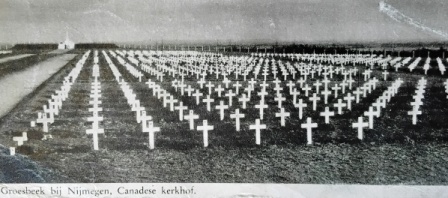
20240827_144251 Aug 27 2024 Groesbeek postcard sent by Ton in 1950

A 1950 postcard, sent by Ton Bersen to the LeClair family, shows how the Canadian War Cemetery in Groesbeek looked in that time period. (Photo courtesy of the LeClair family)

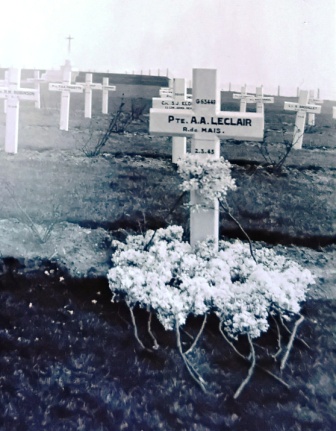
Ange Aimé was temporarily buried on land owned by a Catholic farmer named Augenendt, 3.2 km (two miles) west of Udem in Germany, before being reburied the following year in the Canadian War Cemetery in Groesbeek, The Netherlands.

20240827_144334 Aug 27 2024 Original Groesbeek grave AA Le Clair

The original gravestone for Ange Aimé LeClair in the Canadian War Cemetery in Groesbeek.  (Photo courtesy of the LeClair family)

Grave of AA LeClair from find a grave

Grave of Ange Aimé LeClair in the Canadian War Cemetery in Groesbeek, The Netherlands. (Photo courtesy of FindAGrave)

….Ange Aimé’s grave was adopted by Ton Bersen ….

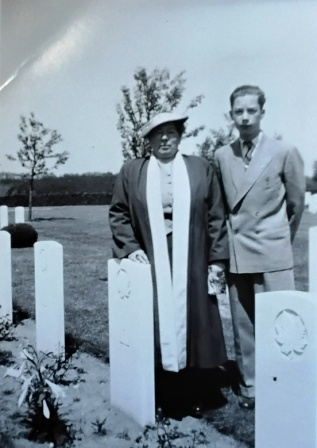
After his reburial in the Canadian War Cemetery in Groesbeek, Ange Aimé’s grave was adopted by a young scout, Ton Bersen, and his family.  Ton remained in contact with the LeClair family until his death in 2020!

20240827_140515 Ton Bersen & mother by grave of AA Le Clair

Ange Aimé LeClair’s grave was adopted by Ton Bersen, seen in this photo with his mother. (Photo courtesy of the LeClair family)

….Ange Aimé is remembered on his parents’ gravestone ….

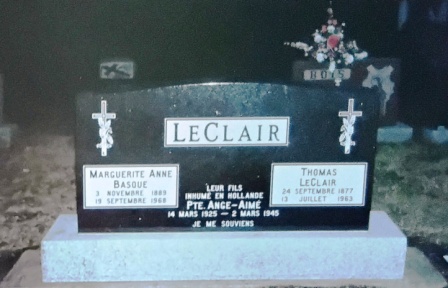
Ange Aimé’s sister Léa told us that after her parents’ original gravestone in Dundee, New Brunswick crumbled, she replaced it with a new headstone and commemorated her brother as well. 

20240827_144026 Aug 27 2024 Le Clair gravestone in Dundee

Gravestone of the LeClair family in Dundee, New Brunswick.  (Photo courtesy of the LeClair family)

Thank you to Léa LeClair for providing photos and information on her brother, and to Etienne Gaudet for help in translating letters from French into English.  Do you have photos or information to share? Email Pieter at memorialtrail@gmail.com, comment on the blog, or tweet to @researchmemori1.

© Daria Valkenburg

….Previous postings about soldiers who died during the Battle of Hochwald Gap….

….Want to follow our research?….

If you are reading this posting, but aren’t following our research, you are welcome to do so.  Our blog address: https://onthewarmemorialtrail.com/
Front cover OnTheWarMememorialTrailinEurope4 countries, 6 weeks, 7,000 km – an unforgettable war memorial journey in Europe…. Daria’s book ‘No Soldier Buried Overseas Should Ever Be Forgotten‘ is available in print and e-book formats.  Net proceeds of book sales help support research costs and the cost of maintaining this blog. For more information see https://nosoldierforgotten.com/ 

You are also invited to subscribe to our YouTube Channel: On The War Memorial Trail With Pieter Valkenburg: https://www.youtube.com/channel/UCJ591TyjSheOR-Cb_Gs_5Kw

Never miss a posting!  Subscribe below to have each new story from the war memorial trail delivered to your inbox.

On The War Memorial Trail….. Atlantic Canada Remembers – Part 10

July 11, 2021. More of the photos submitted about Atlantic Canadian soldiers buried overseas are featured in Part 10. Pieter continues to ensure that photos of soldiers buried in The Netherlands are forwarded to the appropriate cemetery for their digital archives. 

Soldier buried at the Canadian War Cemetery in Holten, The Netherlands

Armand Gionet and family from Mel

Armand Gionet, far right, and his family.  (Photo courtesy of Edmonde Lanteigne)

Armel ‘Mel’ Lanteigne, President of the Caraquet branch of the Royal Canadian Legion, submitted a photo of Armand GIONET of Middle Caraquet, New Brunswick, explaining that he had found “…a picture for Armand Gionet, taken in front of the family farm and house.  From left to right: Lazare Gionet, Nicholas Hébert, Paul-Aurèle Gionet, Hectorine Gionet, Analda Gionet and at the end Armand Gionet, no name for the dog, sorry. 

Armand was a fisherman and a farmer. I took the house’s picture and did the leg work and phone calls.  I got the family’s picture from Edmonde Lanteigne, she is the daughter of Hectorine and Nicolas.  The house is owned by Victoria and Nicole, the daughters of Paul-Aurèle Gionet, Armand’s brother...

After the photo was submitted to the researchers at the Information Centre at the Canadian War Cemetery in Holten, journalist Jan Braakman, one of the researchers at the Centre, wrote us that the photo “…has a very special meaning for me. Armand Gionet died in my town of birth (Laren, province of Gelderland) at the same place, same time and same way as my grandmother, Dina Koeslag. They were caught in flames after their hiding place had been hit by a German pantzerfaust (according to the cause of death as noted by my grandmothers’ doctor.)...” A pantzerfaust is a bazooka.

I have never had a chance to know my grandmother (nor my grandfather, who had been arrested and was killed in a concentration camp near Hamburg). But every once in a while I find pieces of her life and death. This is such a piece. Thanks very much for forwarding this photo to the Information Centre….” 

Armand was born April 26, 1924 in Middle Caraquet, New Brunswick, the son of Lazare Gionet and Laura Hebert.  One of 8 children, he worked on his parents’ farm.  He was also in the Reserve Labour Pool for the port of Halifax, and worked as a freight handler at the port on an as needed basis.

On March 25, 1944 he enlisted. After basic training he was sent to England, arriving on December 25, 1944.  By February 1945 he was in continental Europe and assigned to Le Regiment de Maisonneuve.

At the beginning of April 1945, the Regiment was in The Netherlands.  On April 4, the Regiment prepared to cross the Twente Canal near Almen for an attack from the bridgehead towards the village of Laren. The battle began at 8 pm and went throughout the night.  (See https://en.wikipedia.org/wiki/Twentekanaal)

The Regiment’s war diary for April 5, 1945 simply stated that: “…During the attack last night, we had 23 casualties and we captured 40 prisoners…” 

In a translated excerpt of a Dutch language article written by Jan Braakman, he summarized what happened. “…  Among the 23 casualties (wounded and killed) was Armand Gionet. During the fighting he ended up at a group of farms along the Zutphenseweg, just outside the church of Laren. Many civilians hid there from the violence of war. When Gionet and his mates arrived, the inhabitants were convinced that they had been liberated. They emerged from their hiding places in a euphoric mood.

Civilians and soldiers were festive on the road when suddenly fire was opened again by German soldiers. In panic everyone ran to a safe place. Armand Gionet took a position in the Klein Veldkamp farm, where many civilians… were looking for a safe place. But after a while the danger proved too great to stay there. The farm was on fire. Everyone had to go outside.

Fear reigned. In total chaos, everyone ran in one direction. Civilians were sent back by a wounded Canadian soldier as they walked towards the German fire. In the end, the neighbours found a makeshift shelter in a cowshed. Canadian soldiers sat upstairs.

The sky didn’t clear until late in the afternoon when Canadian jeeps pulled into the yard…..

In the aftermath, among the casualties were Armand Gionet and Jan Braakman’s grandmother, who both had perished at the Klein Veldkamp farm.  (To read the original Dutch article, see https://wp.janbraakman.nl/armand-gionet-kon-zijn-ambitie-niet-waarmaken/)

Armand is buried at the Canadian War Cemetery in Holten, The Netherlands.  He was 19 years old. 

Soldier buried at the Canadian War Cemetery in Groesbeek, The Netherlands

gilles lanteigne WWII

Gilles Lanteigne. (Photo courtesy of Dan Lanteigne)

Armel ‘Mel’ Lanteigne, President of the Caraquet branch of the Royal Canadian Legion, submitted a photo of Gilles LANTEIGNE, explaining that the photo came from “….Dan Lanteigne’s private collection.  He does research on the Lanteigne family…

Born March 27, 1924 in Caraquet, New Brunswick, the son of Ella and Prospère Lanteigne, Gilles was a labourer before enlisting on February 10, 1944.  On July 19, 1944 he arrived in the United Kingdom as a member of the Canadian Infantry Reserve Unit.  On August 12, 1944 he arrived in France and transferred to Le Regiment de Maisonneuve.

While serving with Le Regiment de Maisonneuve, he was severely wounded on March 8, 1945, and taken to a field hospital.  A day later, on March 9, 1945, he “…died of wounds…” received in action in Germany.  He was initially buried in Bedburg Military Cemetery before being reburied a year later in the Canadian Military Cemetery in Groesbeek, The Netherlands.

Mariner Lost At Sea

William Arnold Johnston

William ‘Bill’ Johnston.  (Image courtesy of Canadian Virtual War Memorial)

Don Coutts wrote that “…I have been enjoying your articles.  My grandmother, Annie Bagnall Muttart, came from a large family, a total of nine boys and girls.  One of her brothers was Andrew Bagnall.  Andrew and his wife, Gussie, had four children: Kay, Eleanor, Ted, and Dick.

Kay married William (Bill) Arnold JOHNSTON on June 16th, 1940. He was a Lieutenant in the Royal Canadian Navy. His ship, the HMS Itchen, was torpedoed … and he lost his life. 

The Bagnall Family encountered two deaths of young men (Elmer in October 1941, and Bill in September 1943) during WWII….”  Don’s uncle, Elmer Bagnall MUTTART, has been previously featured on this blog.  (See https://bordencarletonresearchproject.wordpress.com/2017/07/28/the-elmer-bagnall-muttart-story/ and https://www.youtube.com/watch?v=71Rzg07kPw0&list=PLaJcEVojJra-ZwR6rvb-THj8Zr2QbUXLT&index=2)

Born November 25, 1918 in Moncton, New Brunswick, Bill was the son of Frank Ariel and Eudaviela Waters Johnston, of Charlottetown, Prince Edward Island.  On May 17, 1937 he enlisted in the Militia in Charlottetown, and remained a member over the next few years, while employed as a teller at the Canadian Imperial Bank of Commerce in Charlottetown.  On June 17, 1940, a day after his marriage, he was enlisted in the Royal Canadian Naval Volunteer Reserve.

On December 13, 1941 he was appointed to serve aboard HMCS Charlottetown.  Unfortunately, the ship was torpedoed and sunk on September 11, 1942 in the St. Lawrence River along the northern shore of Gaspé Peninsula, while returning to base from convoy duty.  Bill was one of the survivors.  (See https://en.wikipedia.org/wiki/HMCS_Charlottetown_(1941)#Sinking)

After a stint of survivor’s duty at HMCS Stadacona in Halifax and short training courses, he was assigned to HMS Itchen on April 19, 1943, which was involved in anti-submarine warfare exercises off the coast of Scotland until September 1943, when it was assigned to convoy escort duty. 

While in the Atlantic Ocean, several ships in the convoy were attacked, beginning on September 19, 1943.  On September 20, HMCS St Croix was sunk.  81 survivors were picked up by HMS Itchen. 

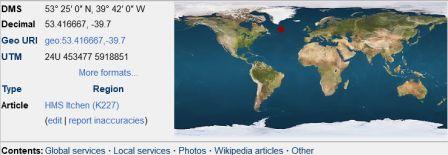
HMS Itchen (K227)

Red dot shows location of sinking of HMS Itchen.  (Image source: https://en.wikipedia.org/wiki/HMS_Itchen_(K227))

Just after 2 am on September 23, 1943, HMS Itchen was torpedoed, causing the frigate to blow up, with a loss of 230 lives, including Bill. He was 24 years old.

Two people from HMS Itchen and one from HMCS St Croix survived and were picked up by a Polish steamer. (See https://en.wikipedia.org/wiki/HMS_Itchen_(K227) and https://www.uboat.net/allies/merchants/ship/3079.html)

Don Coutts noted that “…Kay and Bill had a son Tom who was born on March 18, 1943. Tom died a number of years ago. Kay married a Bob Mills from Nova Scotia…they split their time between Port Royal, NS (late Fall/Winter/early Spring) and Stanhope, PEI (late Spring/Summer/early Fall)...”

As his body was never recovered, Bill’s name is listed on the Halifax Memorial in Point Pleasant Park in Halifax, Nova Scotia. 

To read previous stories about other mariners listed on the Halifax Memorial, please see:

Thank you to Jan Braakman, Don Coutts, Armel ‘Mel’ Lanteigne, and Edmonde Lanteigne for sharing photos and anecdotes to ensure that Atlantic Canadians who are buried overseas are not forgotten.

More photos and stories in Atlantic Canada Remembers – Part 11! To share photos or information, please email Pieter at memorialtrail@gmail.com, comment on the blog, or tweet to @researchmemori1

© Daria Valkenburg

…Previous postings in the Atlantic Canada Remembers series…

Missed the previous postings in this series? See:

…Want to follow our research?….

If you are reading this posting, but aren’t following the blog, you are welcome to do so.  Our blog address: https://onthewarmemorialtrail.com/

Front cover OnTheWarMememorialTrailinEurope4 countries, 6 weeks, 7,000 km – an unforgettable war memorial journey in Europe…. Daria’s book ‘No Soldier Buried Overseas Should Ever Be Forgotten‘ is available in print and e-book formats.  Net proceeds of book sales help support research costs and the cost of maintaining this blog. For more information see https://nosoldierforgotten.com/

Screenshot_2021-02-27 On The War Memorial Trail With Pieter Valkenburg

You are invited to subscribe to our YouTube Channel: On The War Memorial Trail With Pieter Valkenburg: https://www.youtube.com/channel/UCJ591TyjSheOR-Cb_Gs_5Kw

Never miss a posting!  Subscribe below to have each new story from the war memorial trail delivered to your inbox.