May 15, 2026. Since Pieter began receiving photo wish lists of soldiers buried in the Canadian War Cemeteries in The Netherlands, we’ve found that many of the names came from towns and villages that we were unfamiliar with. We travel quite a bit in the Maritime provinces of New Brunswick, Nova Scotia, as well as our home province of Prince Edward Island. We also occasionally drive through Quebec towards Ottawa, Ontario, where we lived for several years before Pieter’s retirement.
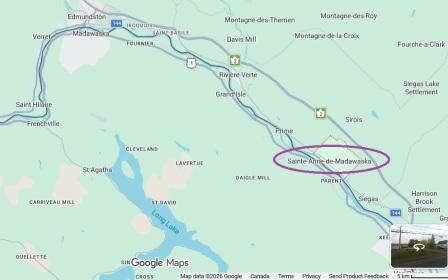
Roger Sirois was born in Sainte-Anne-de-Madawaska, New Brunswick. (Map source: Google Maps)
The hours of driving go by quickly as it seems that, over the years, we can put a soldier to every place name listed on the highway road signs. Such was the case last fall when we were on our way to Ottawa, and passed by a sign for Sainte-Anne-de-Madawaska, 30 km (18.6 miles) southeast of Edmundston, New Brunswick. Now part of the town of Vallée-des-Rivières since 2023, it was the birthplace of WWII soldier Joseph ‘Roger’ SIROIS.
Born December 16, 1922, Roger was the son of John (Jean) and Catherine (nee Pelletier) Sirois, one of 12 children. With the exception of one brother, who moved to Sarnia, Ontario, the rest of the siblings immigrated to the USA…. and that is where Pieter found a relative with a photo.
….The search for a photo of Roger was successful…
An obituary for Angeline Hounjet, wife of Roger’s brother Aurele, led Pieter to get in contact with her son Roger. “…Roger Sirois was my uncle, who died shortly before I was born in New Brunswick….” he explained. “…. I have attached a picture of my uncle – he is the tall one on the left–with his friend, Joel. There is a strong family likeness; definitely a Sirois!…”
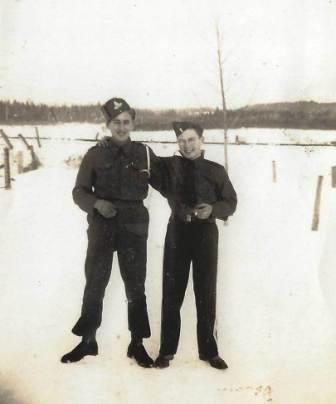
Roger Sirois (left) with his friend Joel. (Photo courtesy of the Sirois Family)
When he enlisted at the No. 7 District Depot in Fredericton, New Brunswick on August 21, 1942, he stated that he worked on the family farm, spoke English and French, but was more fluent in French, and for the past year had been employed as a boilerman for the Aluminium Company of Canada (Alcan) in Arvida, Quebec. (See https://arvida.saguenay.ca/en/the-city-of-aluminum/history-and-profile-of-arvida/the-second-world-war)
When asked about hobbies and interests, Roger noted that he hunted and fished, and could play the violin. He was described by a military interviewer as “…cheerful, sturdy, with good deportment, and appearance….”
On September 18, 1942, Roger was sent to No. 70 Canadian Army Basic Training Centre (CABTC) for basic training. He remained there until December 2, 1942, when he was transferred to A1 Canadian Artillery Corps Training Centre (CATC) in Camp Petawawa, Ontario for advanced training as a gunner.
While still at A1 CATC, he qualified as a Driver i/c Class III wheeled vehicles on January 30, 1943. (The term ‘Driver i/c’ refers to ‘Driver, internal combustion’. Class III meant he was qualified to drive heavy trucks and armoured cars, but not tanks.)
As a driver in the Royal Canadian Artillery, Roger would be responsible for operating and maintaining military vehicles to transport crews, artillery such as 25-pounder field guns, and heavy ammunition loads to the front lines, often under fire. As a trained gunner, he could also be expected to double as a gun crew member, switching between driving and firing, depending on the situation.
Roger was there at the same time as Arthur GAUDET of Prince Edward Island, taking the same training and subsequently going overseas at the same time before their paths diverged. (See https://onthewarmemorialtrail.com/2025/02/12/on-the-war-memorial-trail-the-wwii-soldier-from-prince-edward-island-who-lost-his-life-in-germany-two-days-before-his-21st-birthday/)
On February 10, 1943, he was granted embarkation leave until February 23, 1943, the last chance he would have to see his family before going overseas.
….Roger left Canada for overseas service….
On March 24, 1943, Roger left Canada for the United Kingdom. Upon arriving on March 31, 1943 he was assigned to No. 3 Canadian Artillery Reinforcement Unit (CARU), effective the following day.
On June 18, 1943, Roger was transferred to the 11th Light Anti-Aircraft (LAA) Regiment, Royal Canadian Artillery for Light Machine-Gun and Rifle training. After this Regiment disbanded in March 1944, Roger was transferred to the 3rd Light Anti-Aircraft (LAA) Regiment, Royal Canadian Artillery.
Training continued until July 4, 1944, when the Regiment moved to an area near London and boarded a ship in preparation for going to North West Europe. They arrived in Normandy on July 7, 1944, one month after D-Day, in support of the 3rd Canadian Division, part of the 21st Army Group.
The role of 3rd LAA was to provide mobile anti-aircraft protection for ground troops and positions, and help defend against German Luftwaffe night raids by implementing barrages to combat low-flying aircraft.
They were soon tested as on July 11, 1944, right after the Regiment arrived near Carpiquet Aerodrome, twelve low flying Messerschmitt 109s appeared on the horizon. The German planes banked sharply towards the coast and flew directly over the Regiment’s guns. Every gun in the battery opened up, sending seven Messerschmitts down in flames, while damaging the other five. The following day, six more appeared and three were shot down. This was just one example of what the Regiment experienced.
….Roger was transferred to the 4th Field Regiment….…
On August 2, 1944, Roger was transferred to the 4th Field Regiment, Royal Canadian Artillery, joining them in Fleury-sur-Orne, France as they prepared for Operation Totalize. This offensive, fought between August 7-11, 1944, was designed to break through the German defences south of Caen and toward Falaise, with the objective of closing the Falaise gap and cutting off the retreating Germany 7th Army. (See https://en.wikipedia.org/wiki/Operation_Totalize)
The Regiment moved through Normandy, France, and then into Belgium and The Netherlands in at the end of September and into October 1944 for the Battle of the Scheldt, which began officially on October 2 and lasted until November 8, 1944, and in which the Regiment provided crucial artillery support.
The Battle of the Scheldt’s objective was to free up the way to the Port of Antwerp in Belgium for supply purposes. From Antwerp, they went into The Netherlands, fighting along flooded fields and dikes leading toward Woensdrecht in a battle that lasted until October 21, 1944. (See https://www.veterans.gc.ca/eng/remembrance/history/second-world-war/scheldt)
The Regiment remained in The Netherlands until mid-February. On February 16, 1945, they arrived in Germany in preparation for Operation Blockbuster, which began at dawn on February 26, 1945 and ended on March 3, 1945. (See https://en.wikipedia.org/wiki/Operation_Blockbuster)
The Regiment’s war diary for March 4, 1945 noted that “…the Hochwald was cleared and the Germans began the withdrawal….so that we did very little firing…”
NOTE: For an idea of some of the places that the Regiment travelled through in Germany, see https://onthewarmemorialtrail.com/2026/02/06/on-the-war-memorial-trail-we-follow-the-route-taken-into-germany-by-canadian-troops-in-1945/
By the end of March the Regiment had returned to The Netherlands, and preparing for the upcoming Battle of Groningen, fought from April 14-16, 1945, an offensive to clear all approaches to the city and capture it. (See https://www.canadiansoldiers.com/history/battlehonours/northwesteurope/groningen.htm and https://library.mcmaster.ca/battle-groningen-april-1945)
….Roger accidentally died after falling from a vehicle…
Roger had survived several major battles up to now, but his luck ran out on the morning of April 17, 1945, the day after Groningen was liberated from Nazi occupation.
According to testimony by Bombadier J.D. FLINT at a Court of Inquiry, Roger, Flint, and Gunner E. BROWN were returning from a battery position when another military vehicle passed by. Roger “…was standing on the near side of the vehicle as it approached us. We slowed right down as the road was very narrow…” Brown, the driver, “…pulled over as far as possible to the right hand side of the road….” and asked Flint “…if everything was clear….” Flint replied that as far as he could see “…there was plenty of room for both vehicles to pass…”
However, Flint went on to say that “…just as we were passing, Gunner Sirois leaned back as if waving to us. We stopped….” and saw Roger “…lying on the road…”
Lt. E. J. MACROW, a passenger in the other vehicle, said that neither vehicle showed “…evidence of a collision… The tracks of both vehicles showed that there should have been ample room to pass …” When asked if he was aware that Roger was standing on the side of the vehicle, he replied “…No. I did not see him as he must have been standing on the fender by the rear side door…”
The medical report showed that Roger died from injuries that included a “…crushed right chest with internal injuries, and fractured right humerus…”
The Court of Inquiry ruled it an accidental death. Most likely, Roger lost his balance and fell off the vehicle, and ended up being run over by one of the two vehicles as they passed each other.
Although Roger died on April 17, 1945, his death was incorrectly recorded a day earlier in the April 16, 1945 War Diary entry for the 4th Field Regiment of the Royal Canadian Artillery! “…Gunner Sirois, 2nd Battery driver, was accidentally killed…” He was 22 years old.
….Roger is buried in Holten…
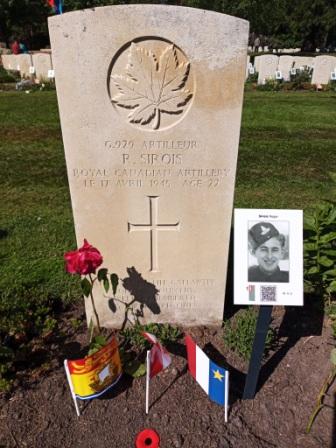
Grave of Roger Sirois with Canadian, New Brunswick, and Acadian flags placed by Pieter. (Photo credit: Pieter Valkenburg)
Roger was temporarily buried in Eelderwolde, 5 km (3 miles) south of Groningen, before being reburied on February 14, 1946 in the Canadian War Cemetery in Holten, The Netherlands. During our 2025 European War Memorial Tour, Pieter placed Canadian, New Brunswick, and Acadian flags by his grave.
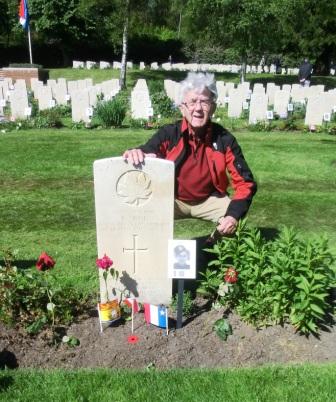
Pieter at the grave of Roger Sirois after placing Canadian, New Brunswick, and Acadian flags. (Photo credit: Daria Valkenburg)
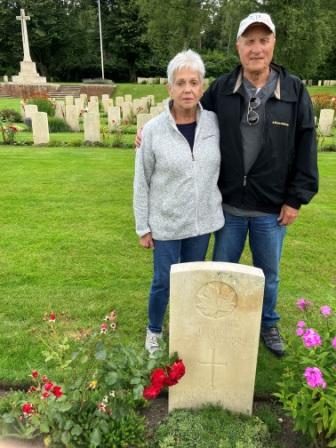
Roger Sirois and his wife Judy visited his uncle’s grave in 2024. (Photo courtesy of Roger Sirois)
Thank you to Roger Sirois for providing a photo. “…Thank you for the very worthwhile work you do….” he wrote. After visiting his uncle’s grave in 2024, and meeting Edwin van der Wolf, one of the volunteers at the Information Centre in Holten, Roger expressed his appreciation. “…Again, you folks do such great work to, among other things, provide a vehicle to allow families to piece together family histories and a means to remember soldiers who served their respective countries….”
The flags placed at Roger’s grave during our 2025 visit were donated. Our thanks go to:
- Alan Waddell, Constituent Assistant, on behalf of Heath MacDonald, MP for Malpeque, for the Canadian flag.
- Jean-Claude D’Amours, MLA (Member of the Legislative Assembly) for Edmundston-Madawaska Centre, Minister responsible for Military Affairs, with the help of Cécile LePage, Province of New Brunswick, for the New Brunswick and Acadian flags.
Pieter’s research efforts to find photos and families of soldiers continue. Do you have a story to tell? Email Pieter at memorialtrail@gmail.com, or comment on the blog.
© Daria Valkenburg
….Want to follow our research?…
If you are reading this posting, but aren’t following our research, you are welcome to do so. Our blog address: https://onthewarmemorialtrail.com/
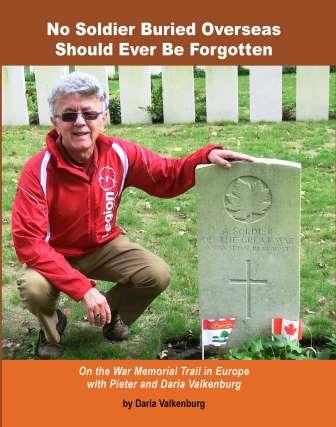 4 countries, 6 weeks, 7,000 km – an unforgettable war memorial journey in Europe…. Daria’s book ‘No Soldier Buried Overseas Should Ever Be Forgotten‘ is available in print and e-book formats. Net proceeds of book sales help support research costs and the cost of maintaining this blog. For more information see https://nosoldierforgotten.com/
Subscribe to our YouTube Channel: On The War Memorial Trail With Pieter Valkenburg: https://www.youtube.com/channel/UCJ591TyjSheOR-Cb_Gs_5Kw.
Never miss a posting! Subscribe below to have each new story from the war memorial trail delivered to your inbox.

