April 4, 2026. When Caroline Raaijmakers, Chair of Faces To Graves Bergen Op Zoom, sent a photo wish list of 15 soldiers from the Fort Garry Horse – 10th Armoured Regiment, Pieter decided this was a research project he wanted to take on.
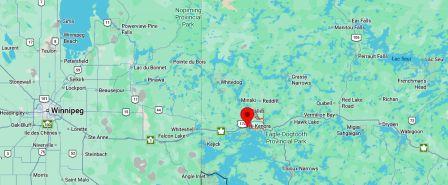
Kenora is situated on the Lake of the Woods in Ontario, near the border with Manitoba, and is about 208 km east of Winnipeg. (Map source: Google maps)
One of the soldiers was Sergeant Gerald Vincent ‘Vin’ JORGENSON, born March 22, 1921 in Kenora, Ontario, the son of Jacob and Genevieve ‘Gen’ Evelyn Jorgenson, and the husband of Marguerite Norma ‘Tiny’ nee Campbell. Both of his younger brothers, Charles Edward ‘Ted’ and James ‘Jim’ Martin, served in the Royal Canadian Navy Volunteer Reserve (RCNVR) during WWII. He also had a younger sister, Patricia ‘Patsy’ Lenore.
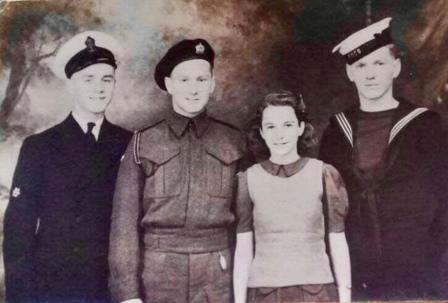
The Jorgenson siblings, left to right: Ted, Vin, Patsy, Jim. (Photo courtesy of Terry and Leni (nee Jorgenson) Ellwood)
Not long after Pieter’s research began, he received a reply from Terry Ellwood, explaining that the soldier was his wife Leni’s uncle who died on October 23, 1944, at the age of 23. “… He was a tank commander. Two months before he was killed he received a citation for bravery which was recorded in the New York Times.…” Leni is the daughter of Vin’s brother Ted.
After Vin’s parents separated in 1929, “…Gen raised the four kids on her own… living in the bush near Ignace (Osaquan) working a trapline and running a trading post until they moved to Kenora….” Terry wrote. “…. She was quite a gal. All the kids treated her like gold until she died….”
….Vin enlisted in 1940…
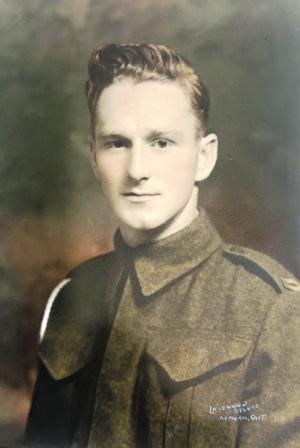
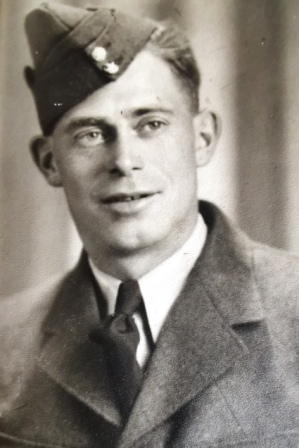
Gerald Vincent ‘Vin’ Jorgenson. (Photo courtesy of Terry and Leni (nee Jorgenson) Ellwood)
When Vin enlisted with the Fort Garry Horse in Winnipeg, Manitoba on May 22, 1940, he noted that he had served for a year in a militia unit, with the 16th Medium Battery in Kenora, Ontario, from May 1939 until the day he enlisted in the Active Army. He’d earlier enlisted in the Kenora Light Infantry on January 30, 1936.
In an interview at the time of his enlistment, he noted that he’d worked as a tractor driver at Keewatin Lumber Company, on a seasonal basis from April 1938, and was a member of the Carpenters and Joiners Union of America. He’d also attended a commercial course in shorthand and typing at night school in 1937. He also worked, on a seasonal basis, as a grocery store clerk for C.G. Bulmer in Kenora.
Vin listed several hobbies and interests. He collected sports trophies and played the harmonica. He also enjoyed boxing, skiing, skulling, and played basketball and hockey. Terry had written that “…Vin was also a great hockey player…. played for the Kenora Thistles. ….” Vin played right wing on this junior ice hockey team. “…The year he went overseas, he was selected as the most valuable player for the elite Canadian junior hockey team the Barrie Colts. As MVP for that team he certainly would have been tracked by the NHL in that era. Although he played forward when he played for the Kenora Thistles, it seems as though he moved to defence for the Barrie Colts…” (NHL refers to National Hockey League)
After completing his basic training in Winnipeg, Vin, now part of the Fort Garry Horse’s Canadian Active Service Force, was sent to the A3 Canadian Artillery Training Centre in Shilo, Manitoba for artillery training on June 8, 1940.
….Vin was a guard at a POW Camp in Red Rock…
At the end of July, 1940, Vin and his Regiment were sent to Camp R, an internment camp in Red Rock, Ontario to act as guards for German prisoners of war and internees. Operational from July 1940 to October 1941, the camp held 1,145 German prisoners, among them civilians, merchant seamen, and combatants. Many of the prisoners had been active Nazi sympathizers before the war, while others came from German ships interred in Canadian ports at the outbreak of the war.
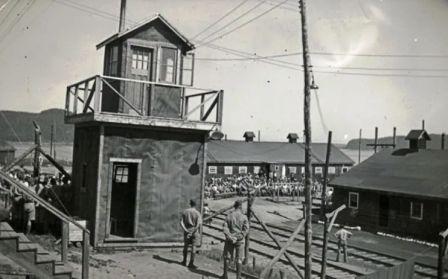
One of the guard towers at Camp R (Red Rock). LAC e006611161. (https://powsincanada.ca/pows-in-canada/internment-camps/camp-r-red-rock/#jp-carousel-3314)
Located on the grounds of a plant owned by the Lake Sulphite Pulp Co. Ltd., Camp R’s enclosure was surrounded by two layers of barbed wire fences and five guard towers – initially only elevated platforms – each with a machine gun.
Vin fell ill with a bout of influenza and was hospitalized from August 27 to 29, 1940, being discharged only a few days before his next posting.
Guard duty at Red Rock for Vin and his Regiment lasted a few months, until September 1, 1940, when the Regiment moved to the A33 Canadian Armoured Corps Training Establishment Camp at Camp Borden, Ontario to begin training as an Armoured Regiment.
After the men from the Fort Garry Horse left, they were replaced by a company of the Veterans Guard of Canada. However, poor facilities and safety concerns caused Camp R to be closed in October 1941, and the prisoners transferred elsewhere.
….Vin qualified as a Driver Mechanic…
While at the A33 Canadian Armoured Corps Training Establishment Camp at Camp Borden, Vin qualified for a Class III Certificate as Driver (i/c) Wheeled and Tracked (W&T) on February 5, 1941. (The term ‘Driver i/c’ refers to ‘Driver, internal combustion’. Receiving a Class III in both Wheeled and Tracked meant he was qualified to drive heavy trucks and armoured cars, as well as tanks.)
On February 11, 1941, the Fort Garry Horse Regiment was re-designated as the 10th Canadian Armoured Regiment.
He had a change in his personal life when he married Marguerite Norma Campbell in Barrie, Ontario on April 12, 1941.
In May 1941, the Regiment became part of the 5th Canadian Armoured Division to form the 1st Canadian Armoured Brigade, along with the Lord Strathcona’s Horse (Royal Canadians) and the 1st Hussars.
From June 15, 1941 until August 1941, Vin took a driver mechanics course in Owen Sound, Ontario, while attached to the No. 2 District Depot in Toronto, Ontario ‘On Command’. He qualified as a Driver (i/c) Class II on September 9, 1941, which meant he was authorized to drive heavier 4×4 or 6×6 vehicles (like the Canadian Military Pattern truck/CMP), specialized trailers, and possessed advanced maintenance skills. Class II drivers handled transport duties in armoured divisions, such as the one he was in, which required expertise in convoy driving and off-road operations.
Vin also qualified as a Driver Mechanic Class ‘C’ on September 25, 1941. This meant that, in addition to being a driver, he would also be responsible for minor vehicle repairs on vehicles in his unit.
….Vin left Canada for overseas service…
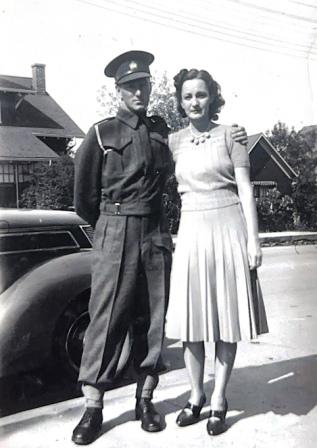
Vin with his mother Genevieve Jorgenson. (Photo courtesy of Terry and Leni (nee Jorgenson) Ellwood)
From September 29, 1941 until October 3, 1941, Vin was granted embarkation leave, for what turned out to be the last time he saw his family.
In October 1941, Vin and his Regiment moved to Debert, Nova Scotia, for final training and preparation before going overseas.
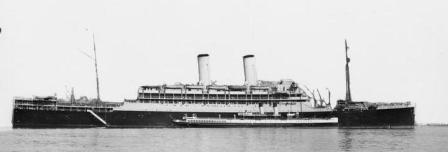
S. S. Oronsay. (Photo source: Wikipedia, photographer, Keating G (Capt))
On November 10, 1941, Vin was aboard the liner ‘S.S. Oronsay’ with the Regiment when they prepared to sail from Halifax, Nova Scotia to the United Kingdom. They finally left Halifax after several days in the harbour, along with a large flotilla of transports and Naval vessels, and arrived in Liverpool, England, on November 22, 1941.
….The Regiment continued training in the United Kingdom…
The Regiment moved first to Aldershot and later to the Headley, Hampshire area where the first of the Canadian designed Ram tanks were issued.
Vin was interviewed by Lt J. Gartside on January 27, 1942, in which it was noted that he was a proficient hockey player, and that he’d “…played baseball and basketball for the regiment…” Lt Gartside also recorded that “…this man wants action more than anything else…”
On January 31, 1942, Vin and Marguerite’s son Garry Vincent was born in Kenora, Ontario, a child that Vin would never get to meet.
Testing of the new tanks to see how they fired took place in Wales in July 1942. The Regiment moved several times within England as training continued.
Vin qualified as a Driver Mechanic Armoured Fighting Vehicles (AFV) Group ‘C’ on November 4, 1942. This meant he would have some knowledge of overhaul and repair of armed, armoured combat vehicles designed for mobility and protection, including tanks (such as the Ram tanks), armoured cars, and personnel carriers.
The Regiment, based in Hove in December 1942, left the 5th Armoured Division, and became part of the 3rd Canadian Army Tank Brigade, along with the 1st Hussars and the Sherbrooke Fusiliers. That lasted until July 1943, when it was broken up after the 2nd Canadian Army Tank Brigade arrived in England, and became the 2nd Canadian Armoured Brigade.
On May 19, 1943, Vin qualified as a Gunner Operator Group C, a specific trade qualification which meant he was qualified to operate both a tank’s weaponry and radio equipment.
….Vin also trained in American-built tanks in preparation for D-Day…
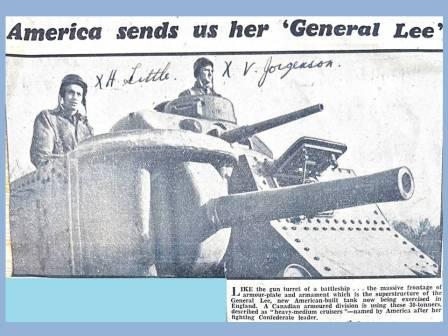
Captioned picture showing Vin Jorgenson and H. Little in an American-built tank in the United Kingdom. (Article courtesy of Terry and (nee Jorgenson) Leni Ellwood)
On October 19, 1943, Vin was promoted to Lance Corporal. That same month, the first of the new American Sherman tanks were issued and firing practice took place on ranges in Kirkudbright, Scotland, after which the Regiment moved to the South coast at Milford-on-Sea.
Training in combined operations and amphibious landings at Inverary, Northern Scotland, as well as exercises with the 8th Infantry Brigade of the 3rd Canadian Division in preparation for support during the planned invasion of Normandy kept Vin and other members of the Regiment occupied. The men also took French lessons. On February 9, 1944, Vin was promoted to Corporal.
‘B’ and ‘C’ Squadrons had special training – in great secrecy – in the use of ‘Duplex Drive’ or ‘DD’ swimming tanks. (DD tanks were Sherman tanks with twin propellers and collapsible canvas sides which provided floatation.)
Once in Normandy, the DD tanks were to be carried on LCT’s (Landing Craft Tanks) to about 6,401 metres (7,000 yards) from shore where they would be launched into the water. The tanks would then swim into shore and land with the charging infantry. The tanks were equipped with 75 mm guns, making them outgunned by German tanks, but their advantage was in being very fast and maneuverable.
….Vin survived D-Day…
In May 1944 the Regiment’s squadrons moved to concentration areas prior to loading on landing craft for the upcoming Operation Overlord (the Normandy invasion) – what we refer to as D-Day on June 6, 1944. ‘B’ and ‘C’ Squadrons moved with their DD tanks to a hiding area near Fawley on the south coast of England.
On June 2, 1944, Vin, who was in ‘C’ Squadron, boarded the ship that would take him and his Squadron to France. They disembarked on June 6, 1944 at the eastern end of Juno Beach, an area codenamed ‘Nan Red’, near Saint-Aubin-sur-Mer, in support of the North Shore (New Brunswick) Regiment.
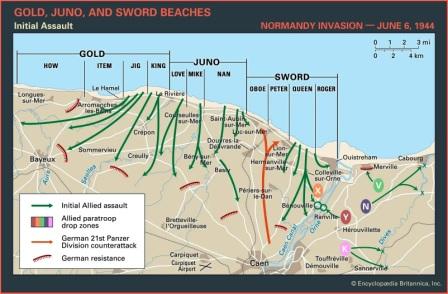
D-Day Normandy invasion map. The Canadians landed on Juno Beach in Normandy, France. (Map source: Encyclopedia Britannica)
An excerpt from the Juno Beach website noted that “..at 8:05 am the LCT’s came inshore and the order was given to launch. On their way into shore 4 tanks were knocked out in the water. One LCT was hit with the tanks still onboard and one sank in deep water. When the tanks landed they gave supporting fire in all directions from their beach positions, waiting for the AVRE’s to clear an exit through a minefield…..” (See http://www.junobeach.info/juno-04-07.htm) AVRE refers to Armoured Vehicle, Royal Engineers.
The DD tanks were supposed to land ahead of the Infantry Regiments, but heavy seas meant that they were launched close to the shore landing later than planned.
When ‘C’ Squadron landed at St. Aubin, they had lost a few tanks due to enemy fire. Then, because there was no breach in the sea wall, they had to make their way through a minefield, losing three tanks doing so. Due to a request for support from the North Shore (New Brunswick) Regiment, ‘C’ Squadron didn’t rejoin the 10th Armoured Regiment until June 7. Vin had survived D-Day! He was promoted to Acting Sergeant a few days later, on June 11.
….Vin’s heroism during Operation Totalize was noted in a New York Times article…
D-Day was only the beginning of battles in Normandy that summer. Vin’s Regiment was in the midst of Operation Totalize, fought between August 7-11, 1944, in an offensive designed to break through the German defences south of Caen and toward Falaise, with the objective of closing the Falaise gap and cutting off the retreating Germany 7th Army. (See https://en.wikipedia.org/wiki/Operation_Totalize)
On the night of August 10, 1944, Vin had an experience that was documented by journalist James MacDonald in the August 11, 1944 edition of The New York Times. It began with a description of Vin. “….On a hilltop that he helped to capture, Sgt Vincent Jorgenson, a brawny 23 year old athlete of Kenora, Ontario, was busily getting his tank ready for action today just after having rested up from as grueling an experience as one can have and live to tell about it…..he is what his superior officers call a magnificent crew commander….
Last night his and other tanks set out from the village of Les Ifs with orders to take Hill 122. Sergeant Jorgenson’s was the second tank in line, the first being one commanded by his troop officer. Enemy mortars and 88 mm shells exploded all around them as they rattled into Rocquancourt, but they did not dare to open up with their machine guns or six-pounders lest gun flashes give their positions away.
The Germans’ artillery scored a direct hit on the leading tank commanded by a lieutenant from Winnipeg. That tank went up in flames….” All the men in the tank survived.
“…Sergeant Jorgenson was so near he had to order his tank to back up and circle around the blazing wreck. He pushed on and sent out wireless signals to tanks that had been behind him but received no answer. He could not see them or anything else ….. because on top of the darkness and dust the Germans began laying a smokescreen around him.
Suddenly he heard German voices around him and he thought he might be isolated and surrounded. He asked his crew if they wanted to continue or attempt to retire. They wanted to go on.
The Germans tried to blind the tank’s driver by flashing torchlights into his eyes and make him halt and give anti-tank gunners direct aim. The tank’s co-driver drove them off with his machine gun. Then something happened to one of the tank threads that cut the machine’s speed to two miles an hour.
On and on the tank lurched, German infantrymen doggedly surrounding it. One German even climbed on the machine. Through his slightly opened hatch cover, Sergeant Jorgenson saw him and shot him with his pistol.
Presently the tank halted in a field…..” while they worked to transform “…the machine into a little fortress, using sandbags they had carried along as an extra protection….”
Meanwhile, “…Trooper George Johnson, of Dauphin, Manitoba, hearing German voices near by, hurled a hand grenade in their direction. After the grenade exploded all was quiet…” At daylight, they saw that the grenade had destroyed “… an anti-tank gun that had been trying to kill them…”
The article concluded by saying “…the night had been won and the objective attained…”
….From France the Regiment moved into Belgium…
Over the next week, there was no respite from fierce opposition and heavy losses that resulted in 3 Squadrons being consolidated into 2 Squadrons as they left France and moved into Belgium in September, as they prepared for the Battle of the Scheldt, which began officially on October 2 and lasted until November 8, 1944.
The Battle of the Scheldt’s objective was to free up the way to the Port of Antwerp in Belgium for supply purposes. From Antwerp, they went into The Netherlands, fighting along flooded fields and dikes leading toward Woensdrecht in a battle that lasted until October 21, 1944. (See https://www.veterans.gc.ca/eng/remembrance/history/second-world-war/scheldt)
Vin was promoted to Sergeant on September 11, 1944.
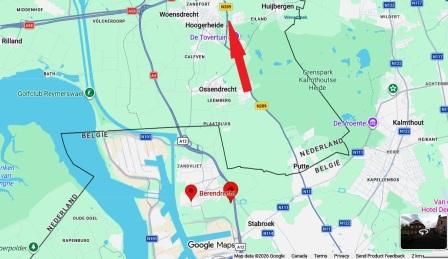
The 10th Armoured Regiment fought their way towards Woensdrecht in October 1944. Vin was killed near Hoogerheide and was temporarily buried in Berendrecht. (Map source: Google Maps)
On October 17, 1944, an exhausted Vin wrote to his mother and sister from The Netherlands, letting them know he was alive after surviving an attack on the tank he was in. “…Forgive me for not writing sooner but have been so muddled lately….”
He went on to say that he had been “…knocked out of another tank some twelve days back and since then much has happened and I’m still here with the regiment with a brand new tank ‘Canora III’….. No one in my old tank was killed and we were hit twice by an 88 mm gun which pierces roughly 10 inches of steel….”
Vin was referring to what happened on the morning of October 2, 1944 as they were in a battle above the Turnhout Canal in Belgium, as reported in the Regiment’s war diary for that day. “… ‘C’ Squadron moved out at 0630 hours in support of the Cameron Highlanders to clear the road running West of STERNHOVEN parallel to the ANTWERP-TURNHOUT CANAL, a distance of approximately 5 1/2 kilometres…First Troop, under Sgt Jorgenson, moved forward to lead. Three 88 mm guns and a considerable number of Jerries were encountered. Two of the guns were knocked out by well-placed shots by the forward troop and two large ammunition trucks were set on fire…”
The war diary entry for October 12, 1944 recorded that “… ‘C’ Squadron, relieved of operational commitments, proceeded to make merry. First a shower, then a trip to Antwerp, and a movie in harbour upon return back at 2030 hrs….”
It was a badly needed break after 4 months of fighting, as described in Vin’s letter. “…While myself and my crew were at Tank Delivery Regiment we buggered off to Antwerp for one night, our first since D-Day….” where they enjoyed an expensive steak dinner.
Responsible as ever, Vin let his mother know that he planned to assign more of his pay to her and his wife Tiny. “….Mom, since getting my confirmation as a Sgt, I signed over another $12 to Tiny and $3 to you, be sure and let me know if you get it on your next cheque…”
Vin was hoping to receive a new assignment. “…Major Bray, our old Squadron leader, is in charge of a tank school in Belgium and has sent for another Sgt and myself for head instructors. He said he wanted us badly, and besides, we deserve a rest, being two of the only D-Day Sgts left. Don’t know how long it will take the Regiment to make up their minds about sending us….I’m dying for a chance to get away from all this for a while….” Vin referred to Major William Roy BRAY.
….Vin was killed a few days after he wrote his letter…
None of Vin’s plans for a new assignment as instructor at the tank school or for sending more of his pay to his family happened, as he was killed on October 23, 1944, aged 23, near Hoogerheide, The Netherlands, less than a week after he wrote his last letter.
An entry in ‘Vanguard – The Fort Garry Horse In The Second World War’ by Eric Mackay Wilson simply stated that “… ‘C’ Squadron sweated it out in Hoogerheide, and also suffered casualties. Major Fletcher and Sgt Jorgenson were killed, to the sorrow of the whole regiment...” Major Charles Wesley FLETCHER was from McCreary, Manitoba.
….Vin is buried in Bergen Op Zoom…
Vin was temporarily buried on October 24, 1944 in the Belgium Churchyard in Berendrecht, Belgium, with the service conducted by Honorary Captain W. E. HARRISON, one of the chaplains attached to the Fort Garry Horse – 10th Armoured Regiment, before being reburied in the Canadian War Cemetery in Bergen Op Zoom on June 4, 1945.
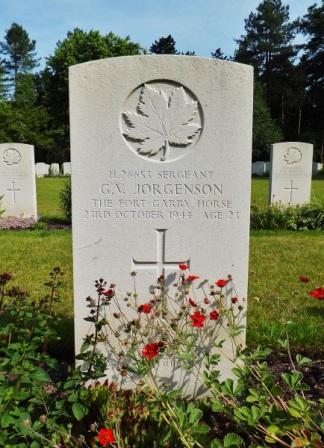
Grave of Gerald Vincent ‘Vin’ Jorgenson in the Canadian War Cemetery in Bergen Op Zoom, The Netherlands. (Photo source: Find A Grave)
Thank you to Terry and Leni Ellwood for sharing photos and information about Leni’s uncle. “….Checked out Daria’s blog … wonderful stuff….” Terry wrote, and explained that “…my dad, Keith Ellwood, was the pilot of a Lancaster bomber… his last few missions were food drops to Holland. He always felt a close connection to the Dutch people because of this….”
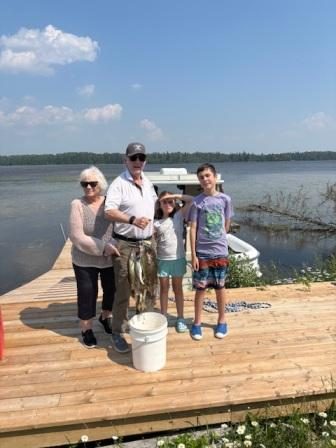
Leni and Terry Ellwood with their grandchildren. (Photo courtesy of Terry and Leni (nee Jorgenson) Ellwood)
….The research and search for photos continues…
Pieter’s research efforts to find photos and families of soldiers continue, doing his part to ensure that each individual soldier is remembered. He’s still looking for photos of two soldiers from the Fort Garry Horse – 10th Armoured Regiment from the original photo wish list:
- Lance Corporal Harry Leith HOWE, born in Winnipeg, Manitoba, son of Harry John and Minnie Christina (nee Clay) Howe, died October 1, 1944.
- Trooper Russell John KITCHEMONIA of Kamsack, Saskatchewan, son of John and Louise Kitchemonia, died October 12, 1944.
If you have photos or information to share about either of these two soldiers, please email him at memorialtrail@gmail.com, or comment on the blog.
© Daria Valkenburg
….Want to follow our research?…
If you are reading this posting, but aren’t following our research, you are welcome to do so. Our blog address: https://onthewarmemorialtrail.com/
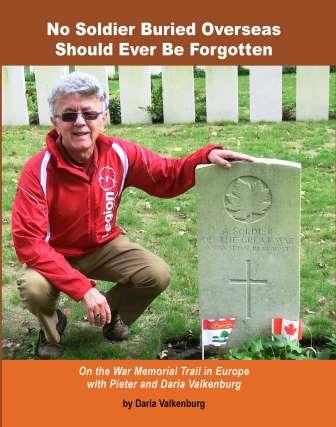 4 countries, 6 weeks, 7,000 km – an unforgettable war memorial journey in Europe…. Daria’s book ‘No Soldier Buried Overseas Should Ever Be Forgotten‘ is available in print and e-book formats. Net proceeds of book sales help support research costs and the cost of maintaining this blog. For more information see https://nosoldierforgotten.com/
Subscribe to our YouTube Channel: On The War Memorial Trail With Pieter Valkenburg: https://www.youtube.com/channel/UCJ591TyjSheOR-Cb_Gs_5Kw.
Never miss a posting! Subscribe below to have each new story from the war memorial trail delivered to your inbox.



 On The War Memorial Trail Research Project........ with Pieter and Daria Valkenburg