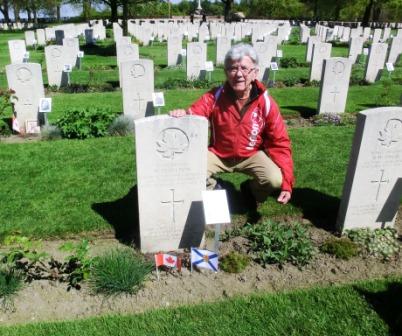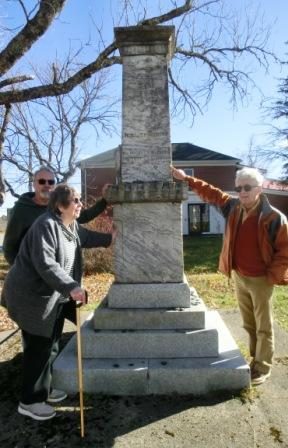
On The War Memorial Trail….. The WWII Soldier From Central Blissville Killed Along The Goch-Calcar Road

June 9, 2024. Most of the time, Pieter has good success in finding photos of soldiers named on photo wish lists from the three Canadian War Cemeteries in The Netherlands.  This past winter, however, he ran into one frustration after another.  In most cases, while family of soldiers were found, no one had photos. A few times, family members were found, but did not respond to inquiries. 

..…An old TV program inspired one photo search …..

Pieter was getting a bit discouraged.  It didn’t help that I was not well for much of the winter and spent most of the time reading and watching comedies on TV.  Since we’d been doing research on airmen who had been POWs I began watching Hogan’s Heroes, a comedy about POWs assigned to form a special operations unit in a POW camp run by the Luftwaffe to help prisoners escape and to perform acts of sabotage against the German war effort. A very funny satire and I’m sure that laughing over the antics these men got up to helped me recover more quickly. 

So, when Pieter began looking at his photo wish lists again, he asked if I had any thoughts on which soldier to research.  I didn’t until I noticed a soldier named Carter, who came from a place named Central Blissville.  That’s the guy, I told Pieter.  When he asked why, I told him there was a character on the show named Sgt Carter and who could resist a place named Blissville? Pieter shook his head, but went with my suggestion and within a day had a photo!

Before telling the story of the Canadian soldier named Carter, take a look at this excerpt from Hogan’s Heroes, featuring the fictional American soldier named Carter, portrayed by Larry Hovis, impersonating the German commandant of the POW camp… 

..…The non-fictional Private Carter enlisted in 1941…..

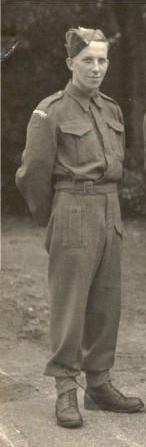
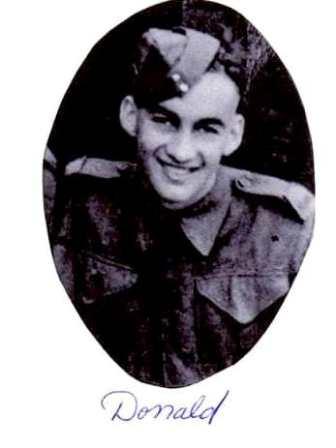
Donald Roy Carter from facebook page Jeremy Carter

Donald Roy Carter.  (Source: Jeremy Carter)

The non-fictional Donald Roy CARTER was born August 4, 1923 in Central Blissville, Sunbury County, New Brunswick, son of Roy William and Josephine ‘Ina’ Helen Carter.  However, when he enlisted at the No. 7 District Depot in Fredericton, New Brunswick, on May 3, 1941, he stated that his birthdate was May 27, 1922.  Since a soldier in active service needed to be 19 years old, Donald fudged his date of birth.

On May 22, 1941, Donald was sent to No. 70 Canadian Army (Basic) Training Camp (CABTC) in Fredericton, New Brunswick for basic training. After completing his basic training, he was transferred to the A22 Canadian Army Medical Corps Training Centre at Camp Borden in Ontario.  Here Donald received advanced training to prepare him as a stretcher bearer, with three key responsibilities when dealing with the wounded in a war zone: stop the bleeding, treat for shock, and evacuate. 

….Donald left Canada for overseas service….

On September 6, 1941, Donald was given embarkation leave of just over a week, and then he found himself on his way to the United Kingdom on October 9, 1941. Upon arrival in Greenock, Scotland on October 19, 1941, he was assigned to No. 1 General Holding Unit.

A Holding Unit was a reinforcement pool where soldiers brought over from Canada received additional training.

On December 13, 1941, Donald was transferred to the 11th Field Ambulance, Royal Canadian Army Medical Corps (RCAMC). A field ambulance was a mobile medical unit which was usually found serving with an infantry division during WWII.

….Donald survived Operation Jubilee – the Dieppe Raid….

Allied Forces had plans for an amphibious attack on the German-controlled port of Dieppe in Normandy, France in 1942, in what would become known as Operation Jubilee, also called the Dieppe Raid.  (See https://en.wikipedia.org/wiki/Dieppe_Raid)

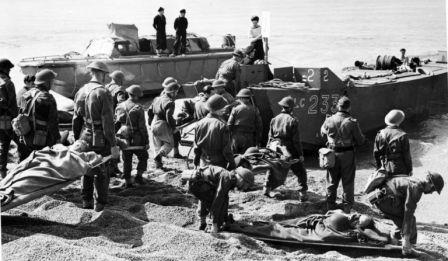
Loading-wounded-on-landing-craft.-Source-Global-News-768x447

Royal Canadian Army Medical Corps personnel treating casualties during rehearsal in England for raid on Dieppe. (Photo Source: Global News)

As part of the preparations, the 11th Field Ambulance underwent training on the Isle of Wight. An exercise on June 4, 1942 included practice in moving casualties from an assault landing craft to an advanced dressing station. They also practiced opposed and unopposed beach landings. Two final, large, exercises took place along the Dorset Coast on June 11-12, 1942 and June 22-24, 1942.

On August 18, 1942, Donald was among the members of the 11th Field Ambulance that assembled at Newhaven, with one bearer section (1 Medical Officer and 18 other ranks) detached to the Royal Regiment of Canada at Portsmouth. They all sailed toward Dieppe at about 9:30 pm. 

Unfortunately, Operation Jubilee was a disaster, particularly for the Canadian soldiers, and the medical unit attached to the Royal Regiment of Canada. 3,623 of the 6,086 Allied forces who landed were killed, wounded, or taken prisoner of war. This included 5,000 Canadians, who suffered a 68 percent casualty rate, with 3,367 killed, wounded, or taken prisoner.

Donald, however, survived and safely returned to the United Kingdom on August 19, 1942, where he remained until shortly after D-Day.

….Donald returned to Normandy in July 1944….

On July 3, 1944, Donald and the 11th Field Ambulance, now part of the 21st Army Group, returned to Normandy, France as the Battle of Normandy continued following the advances made on D-Day on June 6, 1944. 

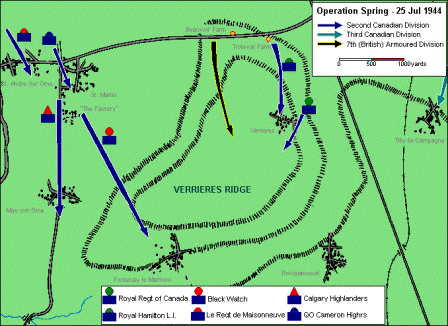
As the 2nd Canadian Corps advanced in July, the 11th Field Ambulance moved along with them, as part of the 2nd Canadian Infantry Division (along with other medical units).  11th Field Ambulance was tasked with providing support to the 4th Canadian Brigade. During battle on July 18-19, 1944 they treated casualties, before making preparations to move forward on July 20, 1944 for Operation Spring at Verrieres Ridge on July 25, 1944.

normandymapspring

Map shows troop locations for Operation Spring.  (Map source: http://www.canadiansoldiers.com)

Donald survived the fight along the Verrieres Ridge, most likely because the 11th Field Ambulance was not at the front, but was held in reserve in Caen for the 2nd Canadian Motor Ambulance Convoy. (See https://www.canadiansoldiers.com/history/battlehonours/northwesteurope/verrieresridge.htm)

Then, during Operation Totalize on August 7-11, 1944, an offensive designed to break through the German defences south of Caen and toward Falaise, the 11th Field Ambulance was under command of the 2nd Canadian Armoured Brigade.  (See https://en.wikipedia.org/wiki/Operation_Totalize)

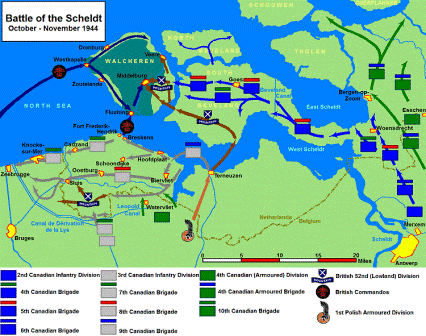
….Donald had limited participation in the Battle of the Scheldt….

scheldt2

Map shows location of South Beveland, The Netherlands.  (Map source: http://www.canadiansoldiers.com)

As the Allied forces moved from Normandy into Belgium, and then into The Netherlands for the Battle of the Scheldt,  three Field Ambulances of the 2nd Canadian Division were used in Operation Vitality, the battles for South Beveland for a month from October 2, 1944. 

Each Field Ambulance unit operated an advanced dressing station and a casualty collection post. 11th Field Ambulance evacuated casualties directly to No. 6 Canadian General Hospital in Antwerp, Belgium. (See https://en.wikipedia.org/wiki/Battle_of_the_Scheldt and https://www.oorlogzeeland.nl/index.php/slag-om-de-schelde/scheldeslag-information-in-english)

However, Donald missed much of the action as he was not on active service between October 16 and November 12, 1944.  This effectively ended his time with the 11th Field Ambulance.

….Donald was transferred into the Infantry….

On November 24, 1944 Donald was transferred to the Canadian Infantry Corps, as part of the X4 Reinforcement for the 13th Battalion.  Then, on December 4, 1944 he was assigned to the Essex Scottish Regiment, joining them in Mook, The Netherlands.

On February 16, 1945, the Essex Scottish Regiment left The Netherlands and crossed the border into Germany, at Kleve.  The following day, the war diary reported that the battalion “…moved off to an assembly area between Kleve and Calcar….” in preparation for an attack on the Goch-Calcar Road, which was subsequently delayed until February 19, 1945.

….Heavy fighting along the Goch-Calcar Road proved deadly….
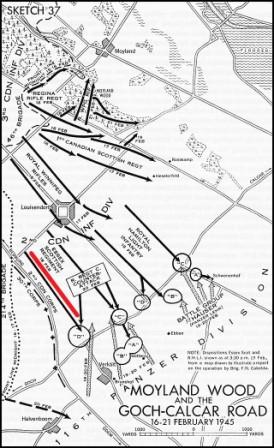
Victory-37 Map Moyland Wood and the Goch Calcar Rd

Moyland Wood and the Goch-Calcar Road, 16-21 February 1945 (Map source: HyperWar: The Victory Campaign [Chapter 18] ibiblio.org)

The war diary for February 19, 1945 noted that the attack on the Goch-Calcar Road resulted in the Regiment fighting “….under a heavy hail of shrapnel and small arms fire. Casualties were fairly heavy….Communications were difficult. Vehicles became bogged in the soft mud, casualties were difficult to evacuate, and guns and ammunition could not get up where they were required….

The battle raged on into the night and then after midnight communications were lost.  The war diary entry for February 20, 1945 continued with an account of the battle.  “… The early hours of the morning were grim ones. Isolated company groups fought on, short of ammunition, burdened with casualties which could not be easily evacuated, and lacking the support of the anti-tank weapons with which to deal with the Mark IV tanks the enemy had marshalled for his counter-attack….

The casualties for the battle numbered “…13 officers and 235 other ranks…” of which about 50 were fatalities.  Among those killed on February 20, 1945 was Private Donald Roy Carter, who lost his life at the age of 21.

 ..…Donald is buried in Groesbeek …..

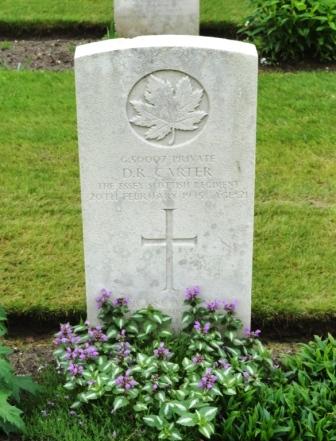
Donald was temporarily buried near Calcar, Germany, before being reburied the following year in the Canadian War Cemetery in Groesbeek, The Netherlands.

grave stone donald carter from find a grave

Grave of Donald Roy Carter in the Canadian War Cemetery in Groesbeek, The Netherlands.  (Photo source: http://www.findagrave.com)

Do you have photos or information to share? Email Pieter at memorialtrail@gmail.com, or comment on the blog.

© Daria Valkenburg

….Want to follow our research?….

If you are reading this posting, but aren’t following our research, you are welcome to do so.  Our blog address: https://onthewarmemorialtrail.com/
Front cover OnTheWarMememorialTrailinEurope4 countries, 6 weeks, 7,000 km – an unforgettable war memorial journey in Europe…. Daria’s book ‘No Soldier Buried Overseas Should Ever Be Forgotten‘ is available in print and e-book formats.  Net proceeds of book sales help support research costs and the cost of maintaining this blog. For more information see https://nosoldierforgotten.com/ 

You are also invited to subscribe to our YouTube Channel: On The War Memorial Trail With Pieter Valkenburg: https://www.youtube.com/channel/UCJ591TyjSheOR-Cb_Gs_5Kw

Never miss a posting!  Subscribe below to have each new story from the war memorial trail delivered to your inbox.
On The War Memorial Trail….. The WWII Soldier Remembered By His Daughter’s Friend

February 11, 2023.  Burnie Reynaert’s uncle, Lewis Wilkieson MARSH, of Sydney Mines, Nova Scotia, was one of 5 soldiers from the North Nova Scotia Highlanders Regiment who drowned in a tragic accident on the Leda River during the Battle of Leer in Germany on April 28, 1945. (See https://onthewarmemorialtrail.com/2021/05/18/on-the-war-memorial-trail-a-tragic-drowning-on-the-leda-river-in-germany-part-4/)

Recently, Burnie wrote to let us know that “my best friend’s father, Pte. Harold Edward Martin, served in the army with the Essex Scottish Regiment, and is buried in The Netherlands…

Burnie explained further, saying “I have known June Anne Martin most of my life – in public school, high school. I was her maid of honour when she married Jack Andrews. She was my confidant and best friend. June Anne died November 25, 2002. She was so young….

June Anne and Jack had three sons.  ….Harold’s grandchildren do not have any information on his service…” Burnie said.  Would Pieter add Harold to his research list?

Pieter’s initial investigation determined that Harold died on October 14, 1944 and is buried in the Canadian War Cemetery in Bergen op Zoom, The Netherlands.  The search was on!

The son of Herbert Edward and Harriet Jane (nee Leavesley) Martin, Harold Edward Roy MARTIN was born November 13, 1912 in Caradoc, Ontario, a rural area about 35 kms (21.75 miles) west of London, Ontario.

On April 15, 1939 he married Tilly Frances Dolney in Leamington, Ontario.  Tilly had been born in Yorkton, Saskatchewan.

…Harold enlisted in 1940….

When he enlisted on July 28, 1940 with the No. 1 District Depot in London, Ontario, he stated in his Soldiers Qualification Card that he had been employed as a truck driver with Longfield Lumber Company in Mount Bridges, Ontario, and that his family owned the Martin’s Fruit Company in Leamington, Ontario.  He expected to have his own fruit business after his military service.  He also noted that he played hockey, in the position of goalie.

On August 21, 1940 he was transferred from No. 1 District Depot to join his unit of the Royal Canadian Engineers at the Thames Valley Camp in London, Ontario.  At the beginning of 1941 he was assigned to the 9th Field Company.

On April 30, 1941 he was entitled to draw additional Trades Pay as a Carpenter Class ‘B’, and then on May 2, 1941 was transferred to #1 Canadian Base Units Construction Company (CBUCC) of the Royal Canadian Engineers in Petawawa, Ontario.

…Harold and Tilly welcome the birth of their daughter in 1941….

Tilly and Harold’s daughter June Anne was born July 3, 1941.  Burnie submitted a photo of the new family unit, explaining that June Anne’s “son Brad and his brother Jack found this amazing picture of her and her parents….

IMG-0945 Harold and Tillie with baby

Harold and Tilly Martin with new born daughter June Anne.  (Photo courtesy of the Andrews family)

 …Harold was sent overseas shortly after his daughter’s birth….

Harold didn’t have much time with his daughter, as he was on his way overseas with the No. 1 Canadian Base Units Construction Company, Royal Canadian Engineers, arriving in the United Kingdom on July 19, 1941.  He was stationed in Bramshott, as a Carpenter and Joiner Class ‘B’.

On May 1, 1942 the name of his unit was changed to 5 CCC (Canadian Construction Company), Royal Canadian Engineers.  Important work was done by units such as 5 CCC, such as building defences that included beach obstacles, pill-boxes, anti-tank ditches, and minefields. They also improved British roadways to improve the movement of military traffic, constructed military and air bases, and even built the Canadian wing of the Queen Elizabeth Hospital in East Grinstead.

On July 28, 1942, Harold was awarded a Good Conduct Badge, and then on August 21, 1942, he received a permanent grade of Sapper.

On May 1, 1944, Harold was transferred to #1 Canadian Engineer Reinforcement Unit (CERU).  Then on August 25, 1944 he was assigned to the Winnipeg Grenadiers for a few weeks, before leaving for France on September 28, 1944, and being reassigned to the Canadian Infantry Corps the next day.

…Harold’s Regiment fought in the Battle of the Scheldt….

On October 10, 1944 Harold was transferred to the Essex Scottish Regiment, which had moved steadily from Antwerp, Belgium at the beginning of October into The Netherlands.  The Regiment had positions on both sides of the border for the Battle of the Scheldt. (See https://www.thecanadianencyclopedia.ca/en/article/canada-and-the-battle-of-the-scheldt and https://www.holland.com/global/tourism/holland-stories/liberation-route/the-battle-of-the-scheldt.htm)

To have an idea of what was faced by Canadian troops, you can watch a short, but excellent, YouTube video explaining about the Battle of the Scheldt (just under 13 minutes):

According to the war diary for the Essex Scottish Regiment for October 14, 1944, the Battalion was in position at Hoogerheide. “…The enemy continued to be fairly aggressive and some of the positions reported heavy mortaring…”  At some point during the day, Harold Martin lost his life.

Harold Martin Scheldt Estuary

…Harold is buried in the Canadian War Cemetery in Bergen Op Zoom….

Harold was initially buried at the Ossendrecht Roman Catholic Civil Cemetery in Ossendrecht, before being reburied in the Canadian War Cemetery in Bergen Op Zoom in March 1946.

12724585_137285083670 Grave of Harold Martin

Grave of Harold Edward Martin at the Canadian War Cemetery in Bergen Op Zoom, The Netherlands. (Photo source http://www.findagrave.com)

Thank you to Burnie Reynaert for telling us about Harold Edward Martin and to the sons of June Anne Andrews for sharing a family photo.  If you have a story to tell, please let Pieter know. Email him at memorialtrail@gmail.com, comment on the blog, or tweet to @researchmemori1.

© Daria Valkenburg

…Want to follow our research?….

If you are reading this posting, but aren’t following the blog, you are welcome to do so. Our blog address: https://onthewarmemorialtrail.com/

Front cover OnTheWarMememorialTrailinEurope4 countries, 6 weeks, 7,000 km – an unforgettable war memorial journey in Europe…. Daria’s book ‘No Soldier Buried Overseas Should Ever Be Forgotten‘ is available in print and e-book formats.  For more information see https://nosoldierforgotten.com/

You are also invited to subscribe to our YouTube Channel: On The War Memorial Trail With Pieter Valkenburg: https://www.youtube.com/channel/UCJ591TyjSheOR-Cb_Gs_5Kw.

Never miss a posting!  Subscribe below to have each new story from the war memorial trail delivered to your inbox.
On The War Memorial Trail….. Atlantic Canada Remembers – Part 4

January 20, 2021. Responses to the news clips on CTV’s Atlantic Live At 5 on January 4 and 13 continue to come in.  As mentioned in Parts 1, 2, and 3, Pieter is ensuring that every email is acknowledged, and that the photos of soldiers buried in The Netherlands are forwarded to the appropriate cemetery for their digital archives. 

This posting features more of the photos submitted…..      

Soldiers buried at the Canadian War Cemetery in Holten, The Netherlands

Nelson DesRoches Army

Nelson Desroches. (Photo courtesy of The Desroches Family)

Leo Gaudet submitted a photo of Nelson DESROCHES, on behalf of the Desroches family, and wrote that “We have a vet buried at Holten from Tignish, whom my wife and I visited in 2014…

Born May 23, 1915 in Tignish, Prince Edward Island, the son of John Desroches and Elizabeth Doucette, Nelson followed his older brother Merrick into military service.  He was serving with the Royal Hamilton Light Infantry when he was killed in action on April 14, 1945.

Ernest Robert Haynes

Ernest Robert Haynes.  (Photo courtesy of the Haynes Family)

On behalf of the Haynes family, Teri Haynes submitted a photo of her father-in-law, Ernest Robert HAYNES, and explained that “…my Ernie visited the grave many years ago when he was in his teens with his Mother…

Ernest Robert, born March 17, 1919 in St. John, New Brunswick, was the son of James Edward and Alice Beatrice Haynes.  A dyer in a laundromat before enlisting in 1939, he was married to Opal Bailey and the father of Teri’s late husband, Ernest David.

While serving with the North Shore (New Brunswick) Regiment, he was sent overseas to the United Kingdom in July 1944, and on June 1, 1945 to North West Europe. Unfortunately, due to a fatal accident with a passing Canadian Army truck near Soestdijk, he lost his life on July 5, 1945, age 26.  He was temporarily buried in the town of Hilversum before being reburied on March 29, 1946 in Holten.

Daniel Pearo

Daniel Pearo.  (Photo courtesy of the Pearo Family)

On behalf of the Pearo family, Colleen Hartling submitted a photo of her uncle, Daniel PEARO, and wrote that “Daniel was my mother’s brother. She looked up to him as a child and loved him dearly. She said that he was full of fun and you can see the twinkle in his kind eyes. I was born in the 60s so I did not know Daniel…

Daniel Pearo, son of Samuel and Dasie Pearo, served with the Cape Breton Highlanders and lost his life on May 1, 1945.  (A tribute to him can be found here: http://faculty.uccb.ca/highlanders/DANIEL%20PEARO.htm?fbclid=IwAR1ijEE5uz9tppYwN4dPcHA24DAGhDSAtVfQJUtRAEa21ZIY-zqRZwiUG9I)

Soldiers buried at the Canadian War Cemetery in Bergen Op Zoom, The Netherlands

Gordon Brewer 2

Gordon Thomas Brewer.  (Photo submitted by Stephen and Hazel Albert)

Stephen Albert submitted a photo of Gordon Thomas BREWER on behalf of himself and his mother Hazel, explaining that his uncle “… was 17 when he enlisted to serve his country.  Killed in action on his 21st birthday on October 25, 1944.  School children at that time adopted a grave. Willamina Proost, a young girl, adopted Gordon’s grave, corresponded with his parents for many years until she married, then stopped writing, so lost contact with her. Gordon’s medals and all letters to his parents were burned in a house fire several years ago, only few photos taken before going overseas still remain. Thank you for taking time to honour the men and women who gave their lives to protect others…

Hazel Albert, Gordon’s sister, wrote that she was the “…last remaining member of Gordon’s family….”  Gordon was born in Halifax on October 25, 1923, the son of Alonzo Wallace and Mary Ellen (nee Dean) Brewer.  

Gordon served with the Essex Scottish Regiment and lost his life during the Battle of the Scheldt.  (See https://www.veterans.gc.ca/eng/remembrance/history/second-world-war/scheldt)

Soldiers buried at the Montecchio War Cemetery in Italy

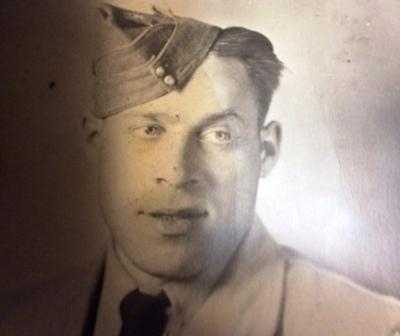
Felix Gaudet

Felix Gaudet.  (Photo submitted by Leo Gaudet)

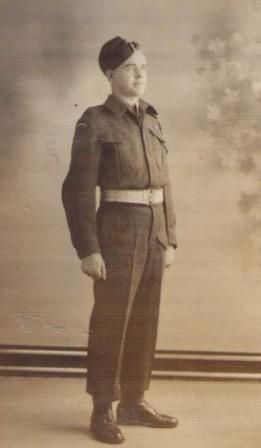
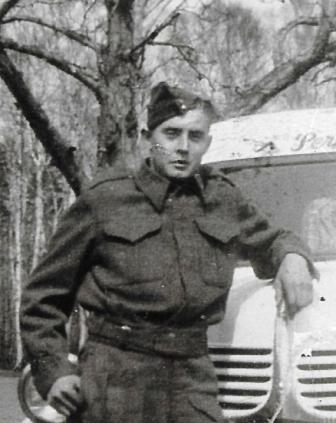
Leo Gaudet submitted a photo of his uncle, Felix GAUDET, born May 30, 1923, son of Joseph J. and Mary Gaudet of Tignish, Prince Edward Island. After enlistment, he left Halifax for the United Kingdom in July 1943 and was transferred to the Canadian Infantry Reserve Unit a few days after his arrival.  On March 26, 1944 he was sent to Italy, and on May 13 transferred to the Cape Breton Highlanders.

On August 30, 1944 he lost his life during the battle to take a knoll on the Gothic Defence Line.  Another soldier from PEI, Albert Eugene Arsenault, also with the Cape Breton Highlanders, lost his life the same day.  (See https://bordencarletonresearchproject.wordpress.com/2020/10/09/the-ww2-soldier-killed-in-action-while-crossing-the-foglia-river-in-italy/)

The Allies began the day of August 30th with an air bombardment against German positions at dawn. At 5.30 p.m., the Perth Regiment attacked the end of a ridge northeast of Montecchio, while a knoll at the west end of the town and the high ground beyond were the objectives of the Cape Breton Highlanders. Both units faced incessant fire from the heights as well as minefields along the flat lands. The Perths managed to break through the line first, reaching and passing their objective. The Cape Breton troops had the support of tanks from the 8th Princess Louise’s (New Brunswick) Hussars, which helped three of their companies make it to the base of the knoll. After each attempt, however, they were driven back to the Foglia, with casualties totalling 19 members killed and 46 wounded. The Irish Regiment, which had been in reserve, was moved through the path of the Perths. Tanks and artillery guns were not yet available here and as a result the regiment lost 19 killed and 31 wounded.” (Source: https://www.veterans.gc.ca/eng/remembrance/memorials/overseas/second-world-war/italy/montecchio)

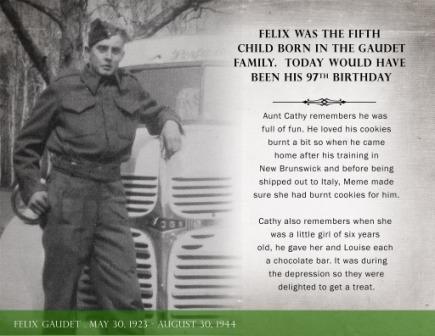
The Gaudet family made a tribute to Felix last year, on what would have been his 97th birthday.  It was so special that it’s shared here:

Felix Gaudet tribute by Aunt Cathy

Tribute to Felix Gaudet submitted by Leo Gaudet.

Thank you to Hazel Albert, Stephen Albert, Kent Caldwell, Colleen Hartling, Teri Haynes, and Leo Gaudet for sharing photos and anecdotes.  Kudos to CTV’s Atlantic Live At 5 for helping to get the word out on this quest of remembrance. Atlantic Canadians remember their loved ones who are buried overseas.

More photos and stories in Atlantic Canada Remembers – Part 5! If you have photos or information to share, please email Pieter at memorialtrail@gmail.com, or comment on the blog. 

Missed the previous postings in this series? See:

© Daria Valkenburg

….Want to follow our research?…

If you are reading this posting, but aren’t following our research, you are welcome to do so.  Our blog address: https://onthewarmemorialtrail.com/

4 countries, 6 weeks, 7,000 km – an unforgettable war memorial journey in Europe…. Daria’s book ‘No Soldier Buried Overseas Should Ever Be Forgotten‘ is available in print and e-book formats.  Net proceeds of book sales help support research costs and the cost of maintaining this blog. For more information see https://nosoldierforgotten.com/

Subscribe to our YouTube Channel: On The War Memorial Trail With Pieter Valkenburg: https://www.youtube.com/channel/UCJ591TyjSheOR-Cb_Gs_5Kw

Never miss a posting!  Subscribe below to have each new story from the war memorial trail delivered to your inbox.
On The War Memorial Trail….. Atlantic Canada Remembers – Part 2

January 13, 2021.  “No soldier buried overseas should be forgotten.” This statement by Pieter in a news clip on CTV’s Atlantic Live At 5 touched many people who watched it, and many photos and stories continue to be emailed to him.  As mentioned in Part 1, Pieter is working to ensure that every email is acknowledged, and that the photos of soldiers buried in The Netherlands are forwarded to the appropriate cemetery for their digital archives.

(See https://onthewarmemorialtrail.com/2021/01/07/on-the-war-memorial-trail-atlantic-canada-remembers-part-1/   and  https://onthewarmemorialtrail.com/2021/01/05/on-the-war-memorial-trail-the-search-for-ww2-soldiers-buried-in-the-netherlands-featured-on-ctvs-atlantic-live-at-5/)

This posting features more of the photos submitted…..

Soldiers buried at the Canadian War Cemetery in Holten, The Netherlands

Francis Ivan Dougan

Francis ‘Frank’ Ivan Dougan. (Photo courtesy of Helen O’Connell)

Helen O’Connell submitted a photo of her uncle, Francis ‘Frank’ Ivan DOUGAN.  She wrote that he “….was born in November 12, 1919 to Florence and John Dougan from Donaldson, Prince Edward Island.  He was the 2nd of 12 boys born in that family – no girls.  Frank left school at age of 15 and went to work to help his family.  He worked in Debert, Nova Scotia as a labourer and mechanic.  In 1941, he and 3 of his brothers enlisted to go to war.  He took his training in Quebec and Vancouver and went overseas June 1, 1942….

While overseas, Helen explained that Frank “…. worked as a driver in the war, mainly in the UK.  After the war Frank decided to work in peacekeeping as a Canadian soldier in Oldenburg, Germany.  On May 16, 1946, he was involved in road accident and was killed.  He was buried in Holland and was awarded the France and Germany Star 1939-1945….

Frank served as a driver with the 48 Canadian General Transport Company RCASC (Royal Canadian Army Service Corps).  The RCASC was an administrative and transport corps of the Canadian Army. (For more information, see https://en.wikipedia.org/wiki/Royal_Canadian_Army_Service_Corps)

According to his service file, Frank died in a hospital in Nijmegen following a road accident during very bad weather in Nijmegen, while he was on his way from Grave, The Netherlands to Oldenburg, Germany. Mechanical failure in the steering mechanism led to the accident.  Frank was a passenger in the rear of the vehicle along with 2 others, plus the driver.  There were two fatalities: Frank Dougan and another soldier who was also in the rear.

Frank was temporarily buried in the Canadian Cemetery in Groesbeek and later reburied, on July 16 1946, in Holten.  His grave was adopted by a family from Delden.

Helen was able to visit The Netherlands and the Canadian War Cemetery in Holten.  “…My husband and I were very fortunate to visit his grave in 2016.  I was so proud and honoured to be there.  I will not forget.  This graveyard seemed almost like a sacred place for these solders who gave their life for us and since my visit I really appreciate that….

James Murrary

John ‘James’ Murray.  (Photo submitted by Florence MacLachlan)

Florence MacLachlan submitted a photo of her uncle, John ‘James’ MURRAY, who was born in Whycocomagh, Nova Scotia and lived in West Bay Road before serving with the North Nova Scotia Highlanders.  She wrote that “Josie was my mother and was the youngest of the siblings. James was the oldest and could have stayed farming and not joined the army because he was the only one who could look after the farm. He wanted to join and help out the war movement. He didn’t tell his parents/family of his interest in joining until after he signed up…

He was killed in action in The Netherlands on April 5, 1945 during the Battle of Warnsveld, at the age of 28. His name is listed on a monument in Warnsveld (See https://www.tracesofwar.com/sights/57960/Memorial-Canadian-Soldiers.htm).

James was temporarily buried in Warnsveld, before being reburied, on January 30, 1946, at the Canadian War Cemetery in Holten. His grave was adopted after the war by a family from Holten.

Soldiers buried at the Canadian War Cemetery in Groesbeek, The Netherlands

Bobby Nickerson

Robert (Bobby) Alan Nickerson. (Photo submitted by Darlene Roberts)

Darlene Roberts submitted a photo of Robert (Bobby) Alan NICKERSON, and wrote that “…My husband’s uncle was killed in the Rhineland Forest just two months before the war ended. His name was Jeff McIntosh Robert (Bobby) Nickerson. We were stationed in Germany from 1968-1971. We were able to visit the grave in 1969. We live in Dartmouth, Nova Scotia. My husband’s family is from Halifax…” A paratrooper in the 1st Canadian Parachute Battalion, he was killed on his first jump from a plane over the Rhineland Forest.

According to his gravestone and the record at the Canadian Virtual War Memorial, his name was Robert Alan Nickerson (not Jeff McIntosh Robert), and he died on March 24, 1945, at the age of 23. (See https://www.veterans.gc.ca/eng/remembrance/memorials/canadian-virtual-war-memorial/detail/2232298?Robert%20Alan%20Nickerson)

Soldiers buried at the Canadian War Cemetery in Bergen Op Zoom, The Netherlands

Russell Soble in Bergen Op Zoom

Russell Soble. (Photo courtesy of Janet Latchford)

Jack Soble submitted a photo of his uncle, Russell Richard SOBLE, which had been provided by Russell’s sister, Janet Latchford.  Jack wrote that “…My father, Russell’s brother, was also fighting in Europe. During that time, if you had a younger brother fighting in Europe, you could claim him and he could go to where you were fighting so you could be together.  My father didn’t want to claim him as where my Dad was there was heavy fighting and he was afraid if he claimed him then he might get killed. Unfortunately he was killed.…

Born in Ameliasburg, Ontario, Russell served in the Essex Scottish Regiment after arriving in Europe, and died on October 6, 1944.  He was one of 12 members of the regiment killed in action in Putte, a town on the Dutch-Belgian border, in a fight on October 5, 1944 that marked the beginning of the Battle of the Scheldt.  (For more information see Eternal Memorial for Canadian Heroes)

All of the Canadian soldiers were initially buried in Putte’s churchyard.  Putte is south of Bergen Op Zoom, where Russell was subsequently reburied in the Canadian War Cemetery.  Putte recognized the sacrifices made by soldiers and Russell’s name is listed on a war memorial in the Dutch part of the town. (See https://www.tracesofwar.nl/sights/541/Oorlogsmonument-Putte.htm)

Soldiers Buried In Adegem Canadian War Cemetery in Belgium

Alexander Fraser MacDonald

Alexander Fraser MacDonald. (Photo submitted by Sandy Burgess)

Sandra Burgess submitted a photo of her father, Alexander Fraser MACDONALD, explaining that “he served with The Regina Rifles, and was killed on October 31, 1944 in Breskens during the Battle of the Scheldt.  He was from Trenton, Nova Scotia, the son of George and Annie MacDonald. He was married to Aileen Hoganson and they were expecting a baby (me) when he was killed. I was on a river cruise in 2012 and was blessed to be able to visit his grave at Adegem

Thank you to Sandra Burgess, Janet Latchford, Florence MacLachlan, Helen O’Connell, Darlene Roberts, and Russell Soble for sharing photos and anecdotes.  Thank you again to CTV’s Atlantic Live At 5 for helping to get the word out on this quest of remembrance. Atlantic Canadians remember their loved ones who are buried overseas.

More photos and stories in Atlantic Canada Remembers – Part 3! If you have photos or information to share, please email Pieter at memorialtrail@gmail.com, or comment on the blog.

© Daria Valkenburg

….Want to follow our research?….

If you are reading this posting, but aren’t following our research, you are welcome to do so.  Our blog address: https://onthewarmemorialtrail.com/

Front cover OnTheWarMememorialTrailinEurope4 countries, 6 weeks, 7,000 km – an unforgettable war memorial journey in Europe…. Daria’s book ‘No Soldier Buried Overseas Should Ever Be Forgotten‘ is available in print and e-book formats.  Net proceeds of book sales help support research costs and the cost of maintaining this blog. For more information see https://nosoldierforgotten.com/ 

You are also invited to subscribe to our YouTube Channel: On The War Memorial Trail With Pieter Valkenburg: https://www.youtube.com/channel/UCJ591TyjSheOR-Cb_Gs_5Kw

Never miss a posting! Subscribe below to have each new story from the war memorial trail delivered to your inbox.