December 21, 2025. Pieter’s research results are faster than I can keep up with, and so several of the graves we visited during our 2025 European War Memorial Tour were for soldiers whose stories have yet to be told. One of the cemeteries we visited was the Canadian War Cemetery in Adegem, Belgium. (See https://onthewarmemorialtrail.com/2025/12/08/on-the-war-memorial-trail-a-visit-to-the-canadian-war-cemetery-in-adegem/)
Before we left for Europe this past spring, we looked at the names of 12 soldiers from Prince Edward Island are buried in this cemetery. One surname was familiar as we had researched a soldier who was born in the same village and had the same surname, Michael Joseph ‘Joe’ MACKENNA. (See https://onthewarmemorialtrail.com/2022/09/22/on-the-war-memorial-trail-the-wwii-soldier-from-prince-edward-island-killed-during-the-battle-of-rha/) We contacted Joe MacKenna’s niece, Teresa Hennebery, and asked if there was a family connection.
….The search for a photo of Joseph began…
Teresa was certain the families were distantly related and began a search into family records. In the meantime, Pieter began his own research.
Joseph Augustine MACKENNA, born June 28, 1903 in Newton Cross, Prince Edward Island, was the son of James and Georgina (nee MacMillan) MacKenna of Newtown, Prince Edward Island, and the husband of Mary (nee Hanrahan) MacKenna, of Antigonish, Nova Scotia.
When he enlisted with the 13th Company of the Canadian Army Forestry Corps (CAFC) in Halifax, Nova Scotia on September 2, 1940, he had been a bank manager with the Royal Bank of Canada, and had over 20 years of banking experience. It was also noted that he had graduated from high school, was married, and was the father of three daughters: Mary Eileen, Alice Clare, and Enid Gertrude.
His daughter Mary Eileen later married Cliff Gorman, and it was their son Mike Gorman who first provided a photo of his grandfather. Not long afterwards, Mary McPherson, daughter of Joseph’s brother Francis, also provided photos of her uncle.

Joseph Augustine MacKenna, likely taken in the United Kingdom. (Photo courtesy of Mike Gorman)
….Joseph underwent basic training in Valcartier…
Joseph was sent to A13 Canadian Infantry Training Centre in Valcartier, Quebec for basic training, as were all members of the Canadian Army Forestry Corps, whose role was to cut down and process trees for wood and lumber in the United Kingdom.
As stated in an article on http://www.canadiansoldiers.com/corpsbranches/forestrycorps.htm “…wood was needed for living quarters, messes, and recreation facilities, as well as crates for vital supplies such as food, ammunition and even vehicles, and for the creation of explosives, stocks for weapons, the construction of ships, aircraft and factory facilities….”
Although members of the CAFC were not expected to be in combat, very rudimentary basic training in using firearms was considered essential due to the threat to the United Kingdom of invasion by German forces. As a result, members of CAFC “…received five to seven months of training…” at Valcartier.
On January 15, 1941, while still in Valcartier, Joseph was promoted to Acting Lance Corporal. A few months later, on April 10, 1941, he was confirmed as Lance Corporal, and at the same time transferred to a Royal Canadian Army Medical Corps (RCAMC) unit that was attached to the Canadian Forestry Corps Headquarters. He was a few months short of his 38th birthday, and while he likely was seen as finding active logging work a challenge, his extensive banking and administrative experience was considered a valuable asset.
Joseph remained in Valcartier, assigned temporarily to No. 12, No. 14, and No. 19 Companies as needed.
He was granted embarkation leave from May 23 to June 5, 1941, the last chance he had to see his family again.
….Joseph left Canada for overseas service….
Joseph left Canada for the United Kingdom on June 18, 1941, sailing from Halifax, Nova Scotia, disembarking in Gourock, Scotland on July 2, 1941, before moving on to Canadian Army Forestry Corps Headquarters in Beauly, Scotland.
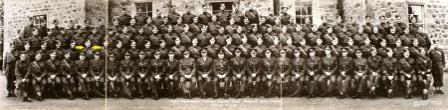
August 1941 photo of staff at CAFC HQ in Beauly, Scotland. Joseph Augustine MacKenna is identified by yellow arrows. (Photo courtesy of Mary McPherson)
While in Scotland, Joseph received a number of promotions. On September 2, 1941 he was made Acting Sergeant, and classified as a Clerk Class III, Group C. He was confirmed in the rank of Sergeant on December 2, 1941.
On July 1, 1942, Joseph was promoted to Staff Sergeant, and a month later promoted again to Acting Quarter Master Sergeant. On November 1, 1942 he was confirmed in the rank of Quarter Master Sergeant.

Part of an August 1943 photo of staff at CAFC HQ in Beauly, Scotland. Joseph Augustine MacKenna is identified by red arrow. (Photo courtesy of Mary McPherson)
Joseph was transferred to the Canadian Army Forestry Corps Headquarters in London, England on September 28, 1943, and requested a demotion to Sergeant on October 15, 1943. Over the next months, he was posted back and forth ‘On Command’ between London and Camp Whitley in Surrey, England, as Acting Staff Sergeant.
….Joseph was appointed Auxiliary Services Supervisor…
On July 18, 1944, Joseph was officially discharged from the Canadian Army and transferred to the Canadian Army Auxiliary Services (CAAS) upon receiving an appointment as Auxiliary Services Supervisor with the Canadian Military Headquarters in London.
What did Auxiliary Services do? Members organized sports and dances, provided movies and concerts, reading and writing and recreation rooms, libraries, mobile canteens, and established leave hostels and information bureaus for troops on leave.
The Auxiliary Services section included four national volunteer service organizations: Canadian Legion War Services, Knights of Columbus, Salvation Army Canadian War Services, and Canadian Young Men’s Christian Association (YMCA) Overseas. Joseph was with the Knights of Columbus.
Now a civilian employee of the government, as were all members of Auxiliary Services, Joseph was considered an officer, with equivalent rank of captain, and addressed as Supervisor. As an Auxiliary Services officer he wore a modified service uniform.
….Joseph waited for an assignment in Continental Europe…
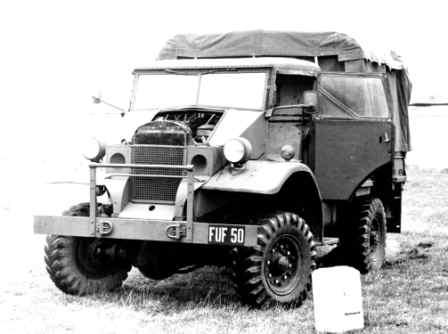
Example of a dual drive truck. (Photo courtesy of The Royal Canadian Artillery Museum)
As Allied troops moved through France following D-Day on June 6, 1944 and then into Belgium, The Netherlands, and Germany, Auxiliary Services needed to plan for the support services needed as troops advanced.
Joseph’s first task was to learn how to operate a Dual Drive truck with front wheel drive, an essential vehicle for the services that the Knights of Columbus would provide in France, Belgium, and The Netherlands, receiving his qualification in early August 1944.
On August 8, 1944, as a member of No. 11 Canadian Army Auxiliary Section (CAAS) Joseph was attached to No. 24 Canadian General Hospital in Horley, Surrey. It was a busy environment with wounded soldiers coming for treatment from the French front. He was there almost 8 months before being transferred to No. 1 Canadian General Reinforcement Unit (CGRU) on March 6, 1945, in preparation for a posting in North West Europe.
….Joseph was posted to Belgium…
On March 10, 1945, Joseph was transferred to the X4 General Reinforcement List of the 9th Battalion, leaving England and arriving in Belgium the following day. On March 13, 1945, he was assigned to the 14th Canadian Army Auxiliary Section (CAAS), which was attached to the 13th Canadian Base Reinforcement (CBR) Battalion. This Battalion was part of the 13th Canadian Infantry Training Brigade, whose main role was administration and training for infantry reinforcements rather than a combat role in the field.
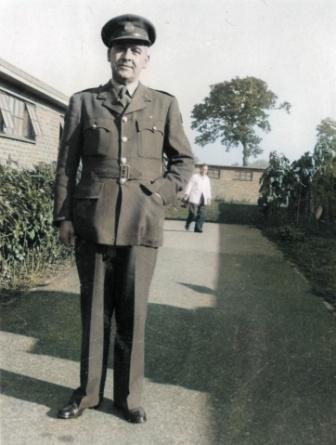
Joseph Augustine MacKenna, likely taken in Belgium. (Photo courtesy of Mary McPherson. Photo restoration and colourization by Pieter Valkenburg.)
By the time Joseph arrived in Belgium, the country had been liberated since February 4, 1945. At the time that Joseph arrived, the 14th CAAS, and 13th CBR Battalion, were based in Ghent, which had been liberated months earlier, on September 6, 1944. Among its’ other duties, the 13th CBR Battalion provided 14th CAAS with the supplies it required.
The Knights of Columbus recreation huts stated ‘Everybody Welcome, Everything Free’, providing services to soldiers regardless of race or religion. Travelling by truck to Knights of Columbus huts in Belgium and The Netherlands, Joseph transported supplies such as cigarettes, chocolates, and magazines, as well as equipment such as movie projectors and films.
One of the many items provided to soldiers was stationery to allow them to write home to their family and friends.
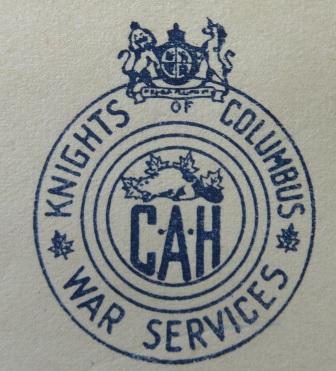
Stationery provided to soldiers by the Knights of Columbus, with the logo showing Canadian symbols of the beaver and the maple leaf and the royal coat of arms at the top. (Photos source: Tales From The Supply Depot)
 While Joseph was qualified to drive a truck, as an officer he was entitled to a driver who drove the vehicle in which they travelled to deliver supplies and equipment, before returning to Ghent for more supplies before the next journey.
….Mystery of what happened on June 12, 1945…
All went well with Joseph’s assignment with 14th CAAS until the evening of June 12, 1945, when he disappeared after arriving back in Ghent from a trip. According to testimony by his driver, Private A. J. FONTAINE, after arriving at 14th CAAS in Ghent, “…we unloaded a movie projector and cigarettes and turned them in there.…” Joseph told him that he “…had other business to do here. He told me to go and park the vehicle and to meet him at the Marguerite Café later. On the way to Marguerite Café I stopped in at the American Café for a drink…. ”
Joseph met him at the American Café and they had a drink before going on to Marguerite Café, located at 230 Groendreef, at 7:30 pm.
At the Marguerite Café Pte Fontaine stated that Joseph told the proprietor, Marguerite Cador, that “…I would occupy his room for the night there for that night and he would occupy another room across the canal he had already arranged for….”
They left the café together at 8 pm and crossed to the other side of the canal. Joseph then “…told me to return to the Marguerite Café to my room and to meet him the next morning at 14 Canadian Auxiliary Services Section at 1000 hours. I returned to the Marguerite Café, bought myself another drink and went to my room….” It was the last time he saw Joseph.
Marguerite Cador, proprietor of Marguerite Café, testified that Pte Fontaine returned to the café “…15 or 20 minutes…” after they had left. When she asked where Joseph was, he replied that “…I took him over the bridge to the other side of the canal and left him. I gave him his bag before I left…”
When Joseph didn’t report for work the following day, Pte Fontaine returned to Marguerite Café “….at different times during the day and the same for the next two days. He always asked if I had seen Mr. MacKenna…” Where had Joseph gone?
….A body was found in a canal in Ghent…
On the morning of June 21, 1945, Sgt Alexander MATTHEW, special investigator for the Canadian Provost Corps (Military Police), 3rd Canadian Base Reinforcement Group, was informed by the Ghent Civil Police that “….the body of a soldier was in the canal at Ketelplein Bridge….” Sgt Matthew proceeded to the bridge. “…I looked down from the bank of the canal and saw the body. I could see that the uniform on it bore ‘Canada’ flashes …”
The local fire department retrieved the body and transported it to No. 2 Canadian General Hospital’s morgue, and the body was turned over to Quartermaster Sgt G. H. MACMILLAN, chief ward master at the hospital. With Quartermaster Sgt MacMillan, Sgt Matthew stated that they “… searched his battle dress and obtained a wallet enclosing the identity card of Joseph Augustine MacKenna. There was also a sum of Dutch money…”
Quartermaster Sgt MacMillan noted that the body was “…badly decomposed…”
Major J. D. DUFFIN, Royal Canadian Army Medical Corps, Pathologist at No. 2 Canadian General Hospital, performed an autopsy. His report noted that “…There were no marks of injury either on the clothes or on the skin….” The lungs “…were heavy, voluminous, and filled with dirty water…” leading Major Duffin to surmise that “…death was apparently due to drowning….” The only oddity was that the drowning appeared to have occurred “…an estimated 5 to 7 weeks previously…” and not the 9 days since Joseph had last been seen.
On June 29, 1945, a Court of Inquiry concluded that Joseph died an accidental death by drowning in a canal in Ghent, Belgium. Although Joseph was last seen on the evening of June 12, 1945, his death was ‘arbitrarily determined’ to be June 20, 1945, and his death ‘confirmed’ on June 21, 1945.
….Joseph is buried in the Canadian War Cemetery in Adegem…
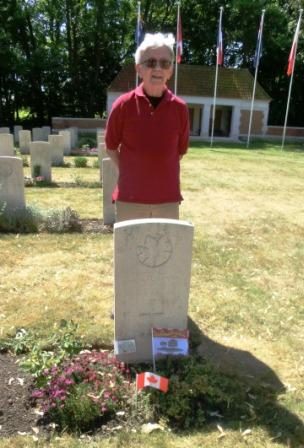
Pieter stands behind the grave of Joseph Augustine MacKenna. (Photo credit: Daria Valkenburg)
Joseph was buried at the Canadian War Cemetery in Adegem, Belgium on June 24, 1945. We visited his grave during our 2025 European War Memorial Tour, and Pieter placed flags of Canada and Prince Edward Island at his grave.
This was the second story written about a canal drowning in Ghent! New Brunswick soldier Azade BOUDREAU also drowned in a canal in Ghent in 1945. See https://onthewarmemorialtrail.com/2025/12/15/on-the-war-memorial-trail-the-wwii-soldier-from-petit-rocher-nord-who-accidentally-drowned-in-a-belgian-canal/
….A surprise encounter in the Canadian War Cemetery in Holten….

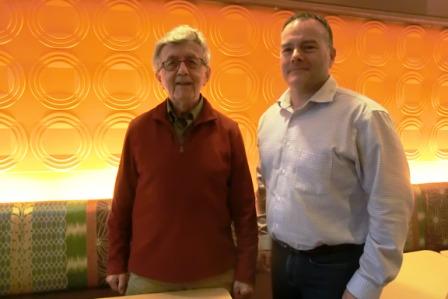
Amy Meunier (left) with Daria and Pieter at the Canadian War Cemetery in Holten. (Photo credit: Ben Miller)
When Mike Gorman had learned that we would be in Europe for the 80th Anniversary of Liberation Commemoration events, he mentioned that we might meet up with Amy Meunier, who works for Veterans Affairs. “…Amy is my 1st cousin’s (Duane Gorman) ex…”
We didn’t think anything about it, but then, when we were at the Canadian War Cemetery in Holten, The Netherlands for the grave re-dedication ceremony for WWII soldier Arthur VANANCE of Kenora, Ontario, Paul Ledwell, Deputy Minister of Veterans Affairs, was in attendance with several people from Veterans Affairs. One of them was Amy! (See https://onthewarmemorialtrail.com/2025/08/22/on-the-war-memorial-trail-the-wwii-soldier-from-kenora-who-lay-in-an-unknown-grave-for-80-years-part-2-the-grave-re-dedication-ceremony/)
Paul called Amy over and once she realized that we were the people that Mike had told her about, she said “…OMG, my son Levi will love this…” This surprise encounter helped bridge the past with the present, helping to ensure that those buried overseas will not be forgotten.
The flags placed at Joseph’s grave were donated. Our thanks go to:
- Alan Waddell, Constituent Assistant, on behalf of Heath MacDonald, MP for Malpeque, for the Canadian flag.
- Matt MacFarlane, MLA for District 19, Borden-Kinkora, for the flag from Prince Edward Island.
Thank you to Joseph’s grandson Mike Gorman and Joseph’s niece Mary McKenna MacPherson for sharing photos and information. Thank you also to Teresa Hennebery. We’ll continue to share the highlights of our adventures on the 2025 European War Memorial Tour.
The research work continues for Pieter. If you have photos or information to share about soldiers buried in The Netherlands or Belgium, please email him at memorialtrail@gmail.com, or comment on the blog.
© Daria Valkenburg
….Another Canadian Army Forestry Corps story….
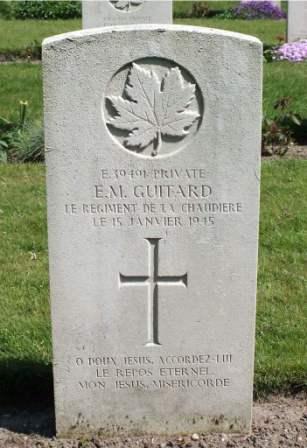
This was the second story written on this blog about the CAFC. Edgar M. GUITARD of New Brunswick also served in the Canadian Army Forestry Corps. You can read his story at https://onthewarmemorialtrail.com/2024/06/24/on-the-war-memorial-trail-the-wwii-lumberjack-from-belledune-killed-by-stray-mortar-fire-in-the-nijmegen-salient/
….Want to follow our research?…
If you are reading this posting, but aren’t following our research, you are welcome to do so. Our blog address: https://onthewarmemorialtrail.com/
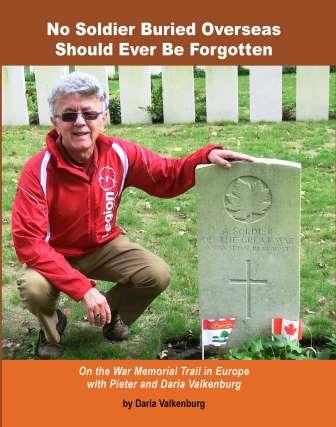 4 countries, 6 weeks, 7,000 km – an unforgettable war memorial journey in Europe…. Daria’s book ‘No Soldier Buried Overseas Should Ever Be Forgotten‘ is available in print and e-book formats. Net proceeds of book sales help support research costs and the cost of maintaining this blog. For more information see https://nosoldierforgotten.com/
Subscribe to our YouTube Channel: On The War Memorial Trail With Pieter Valkenburg: https://www.youtube.com/channel/UCJ591TyjSheOR-Cb_Gs_5Kw.
Never miss a posting! Subscribe below to have each new story from the war memorial trail delivered to your inbox.


 On The War Memorial Trail Research Project........ with Pieter and Daria Valkenburg