On The War Memorial Trail….. The WWII Soldier From St Stephen Who Was A Teacher

March 7, 2021.  Last fall, the researchers at the Canadian War Cemetery in Holten, The Netherlands sent Pieter a photo wish list of 6 soldiers from the Cape Breton Highlanders who had died in the Battle of the Delfzijl Pocket.  (For more information on the Battle of the Delfzijl Pocket, see https://www.canadiansoldiers.com/history/battlehonours/northwesteurope/delfzijlpocket.htm)

Len Boudreau of the Cape Breton Highlanders Association was able to provide photos of 3 of the men,  Pieter found one on the Canadian Virtual War Memorial website, leaving 2 to try and find:  Philip Hubert LONG of Nova Scotia, and Norman James NIXON of New Brunswick.

A radio interview with CBC’s Maritime Noon about Philip Long resulted in family contacting Pieter immediately, and a photo was soon provided.  (See https://bordencarletonresearchproject.wordpress.com/2020/11/01/on-the-war-memorial-trail-a-face-for-philip-hubert-long/)

In trying to find family of Norman Nixon, Pieter sent a letter to the editor of the St. Croix Courier newspaper.  (See https://bordencarletonresearchproject.wordpress.com/2020/10/17/on-the-war-memorial-trail-continuing-the-search-for-soldiers-killed-in-action-in-ww1-and-ww2/)  Legion member Kent Caldwell sent a photo and story from the New Brunswick Military Service Recognition booklet.

It was a rare occasion that every photo request on a list could be fulfilled, but it happened! But then, the grandson (and namesake) of Norman Nixon contacted us.  “….We have quite a bit of information…..” he said.  Did we want to meet?

CIMG4775 Oct 25 2020 Pieter sorts through material compiled by the Nixon family

Pieter goes through the information saved by the Nixon family. (Photo credit: Daria Valkenburg)

Normally that would not be a problem, but with Covid-19 restrictions, we had to think twice.  The Atlantic Bubble was still open, so Pieter said a firm YES! and we made the trip to Harvey, New Brunswick to meet Norman Nixon and his wife, Kelley Gowan.
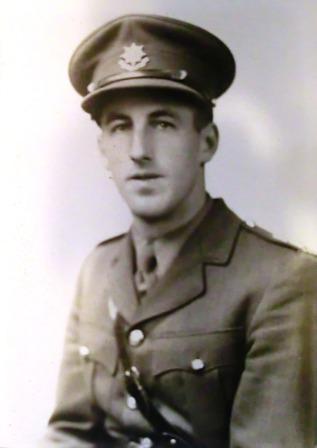
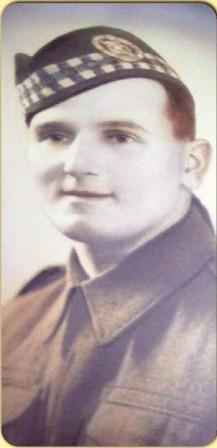
CIMG4560 Lt Norman Nixon

Norman James Nixon. (Photo courtesy of Nixon family)

Norman James Nixon was born in St. Stephen, New Brunswick, the son of Edward A. Nixon and Winnifred Trafton, and lived in nearby Mayfield.  A well-regarded schoolteacher before his enlistment, he married Berla Mae Lowery on July 29, 1940.  In 1941 they welcomed the birth of their son, Vernon James.

20201024_160813 Norman and Berla with son Vernon

Norman and Berla Mae Nixon with their son Vernon, circa 1943.  (Photo courtesy of Nixon family)

On July 20, 1940 Norman had enlisted with the Reserve Unit of the Carleton & York Regiment, but was discharged due to illness.  On February 6, 1942 he re-enlisted, this time with the Active Unit of the New Brunswick Rangers, and served with this unit in Labrador, and Canada from February 6, 1942 to July 12, 1944, and England from July 13 to August 21, 1944.

In 1944 he transferred to the Cape Breton Highlanders, and served in Italy from August 22, 1944 to February 19, 1945, and Northwest Europe in France and The Netherlands from February 20 to April 30, 1945.  He was known as ‘Nick’ by his fellow soldiers.
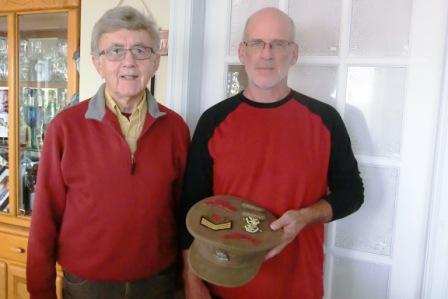
CIMG4767 Oct 25 2020 Pieter and Norman with cap and badges

Pieter and Norman Nixon.  Norman holds his grandfather’s cap and a number of the badges that Lt. Nixon had earned during his service.  (Photo credit: Daria Valkenburg)

After surviving action in Italy and France, Lt Nixon’s luck ran out near the end of WWII, when he was killed by shrapnel on April 30, 1945 during the Battle of the Delfzijl Pocket.

A May 6, 1945 letter to Bella Mae, from Norman’s Commander, Lt Colonel R B Sommerville, explained what happened.  “…Nick was killed in action at night by shell fire during a counter attack on his platoon position.  He died instantly.

At the time he was hit he was encouraging his men who were being hard pressed by fire from the part of Delfzijl on the Ems estuary….

He was initially buried in the village of Wirdum, as Lt Col Sommerville explains further in his letter.  “…his example and devotion to both his troops and duty won for him the affection and respect of officers and men alike….. At a little service in the village of Wirdum near Groningen with a brother officer and 17 of our men he was buried the next afternoon.  We will all miss him….”  The other officer mentioned as being buried was Lt B H NUNN of Halifax.

On May 10, 1945, Major P J Stephen also wrote a letter to Bella Mae, providing more details on how her husband lost his life.  “…On the evening of the 30th of April we were holding a position which we had taken the night before.  Things were quite bad as we were being heavily shelled. The men were getting jittery from loss of sleep and constant hammering.  

After each shelling Nick would jump from his trench and stroll about the platoon area as if he were in his own garden, joking with the men, caring with a smile for all their needs, setting the example to them of a first class soldier and leader.  During one of these tours Nick was fatally wounded by shrapnel from a shell which burst a few yards away. 

It was impossible to save him although we gave him medical aid immediately.  Nick passed away without regaining consciousness…

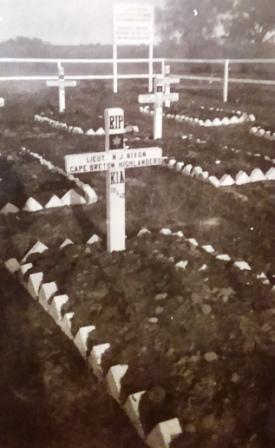
20201024_194850 Grave of Norman J Nixon in 1945

Initial burial of Norman Nixon in Wirdum. Photo sent by Lt Stackhouse.  (Photo courtesy of Nixon family)

On August 19, 1945, Lt Ron V Stackhouse wrote to Bella Mae. “…I was with ‘Nick’ on the last night about an hour before he was killed as we had both had supper together at Company Headquarters and he and I walked back to our platoons together as our platoons were right alongside of each other….”   In a postscript he mentions enclosing a photo of the grave.

After WWII ended, Lt Nixon was reburied in the Canadian War Cemetery in Holten, The Netherlands.

nixon, norman james from Holten Cemetery sent by Edwin

Grave of Norman Nixon at the Canadian War Cemetery in Holten. (Photo sent by Edwin van der Wolf.)

Visiting with Norman Nixon and Kelley Gowan and learning about Norman’s grandfather was a privilege.  But they had a surprise for us.  Norman’s father Vernon and Vernon’s wife Donna came from Grand Manan Island to meet us.
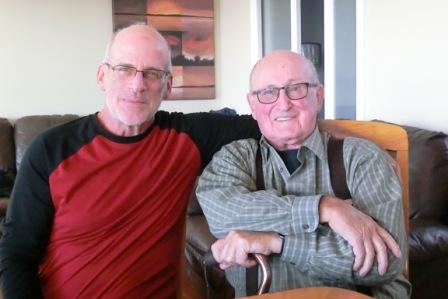
CIMG4779 Oct 25 2020 Norman and Vernon Nixon

Norman and Vernon Nixon, grandson and son of Lt Nixon. (Photo credit: Daria Valkenburg)

More memories and stories were shared, including that Vernon’s mother, Bella Mae, owned a dress shop, ‘The Hat Box’, in St. Stephen.  She was an independent woman, and never remarried after her husband’s death.

CIMG4781 Oct 25 2020 Pieter & Daria with Vernon & Donna Nixon

A final photo before we left to go back home.  Pieter and I with Vernon and Donna Nixon.  (Photo credit: Kelly Gowan)

With both the son and grandson of Lt Nixon together in one place, we asked if they wanted to share a few thoughts for a video to be sent to the Info Centre at the cemetery in Holten.  Here is the result, entitled ‘In Remembrance of Lt. Norman J. Nixon’:

It’s always an honour to meet the families of the soldiers that Pieter researches, and we hope to meet more families as travel restrictions get eased.

The 6 soldiers from the Cape Breton Highlanders on the photo wish list were:

  • Philip H. LONG, born Pictou, Nova Scotia, died April 30, 1945.
  • James Bernard MACINNIS, born Sydney, Nova Scotia, died May 1, 1945.
  • Olen B. MARSHALL, born Bridgetown, Nova Scotia, died May 1, 1945.
  • Norman James NIXON, born St. Stephen, New Brunswick, died April 30, 1945.
  • Ford Hilton SPIDLE, born Parkdale, Nova Scotia, died May 1, 1945.
  • Robert B. THOMAS, born Louisburg, Nova Scotia, died May 5, 1945.

The family of Ford Hilton SPIDLE participated in the Atlantic Canada Remembers series of postings, and you can read his story here: https://onthewarmemorialtrail.com/2021/01/07/on-the-war-memorial-trail-atlantic-canada-remembers-part-1/

Thank you to Norman Nixon and Kelley Gowan for their warm hospitality and for sharing information about Lt Nixon, and thank you to Vernon and Donna Nixon for making the trip from their home to meet with us and share memories about Vernon’s father.  It’s very clear that Lt Nixon was deeply loved and respected, and his death, so close to the end of the war, was an immeasurable loss.

Heartfelt thanks go to post-production editor Wendy Nattress, who made the YouTube tribute to Lt Nixon a reality.

20 members of the Cape Breton Highlanders lost their lives in the Battle of the Delfzijl Pocket.  If you have information or photos to share on any of these men, please email us at memorialtrail@gmail.com, or comment on the blog.

© Daria Valkenburg

…Want to follow our research?…

If you are reading this posting, but aren’t following our research, you are welcome to do so.  Our blog address: https://onthewarmemorialtrail.com/
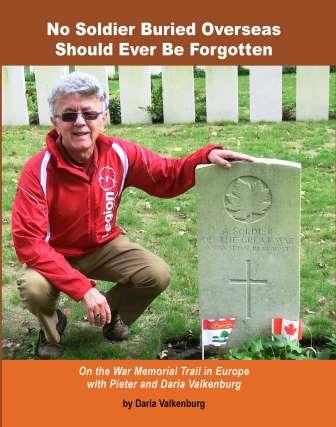
Front cover OnTheWarMememorialTrailinEurope4 countries, 6 weeks, 7,000 km – an unforgettable war memorial journey in Europe…. Daria’s book ‘No Soldier Buried Overseas Should Ever Be Forgotten‘ is available in print and e-book formats.  Net proceeds of book sales help support research costs and the cost of maintaining this blog. For more information see https://nosoldierforgotten.com/

Screenshot_2021-02-27 On The War Memorial Trail With Pieter Valkenburg

Why not subscribe to: On The War Memorial Trail With Pieter Valkenburg: https://www.youtube.com/channel/UCJ591TyjSheOR-Cb_Gs_5Kw

Never miss a posting!  Subscribe below to have each new story from the war memorial trail delivered to your inbox.

On The War Memorial Trail….. Atlantic Canada Remembers – Part 1

No soldier buried overseas should be forgotten.

January 7, 2021.  “No soldier buried overseas should be forgotten.” This statement by Pieter in a news clip on CTV’s Atlantic Live At 5 touched many people who watched it, and many photos and stories were subsequently emailed to him.   Since the broadcast, Pieter has been working to ensure every email is acknowledged, and that the photos of soldiers buried in The Netherlands are forwarded to the appropriate cemetery for their digital archives. (See https://onthewarmemorialtrail.com/2021/01/05/on-the-war-memorial-trail-the-search-for-ww2-soldiers-buried-in-the-netherlands-featured-on-ctvs-atlantic-live-at-5/)

This posting will feature some of the photos submitted. There were too many submissions for one posting so more will be featured in subsequent postings.

Soldiers buried at the Canadian War Cemetery in Holten, The Netherlands

James Grant Anningson

James Grant Anningson. (Photo submitted by Brenda Budd)

Brenda Budd submitted a photo of James Grant ANNINGSON, saying “My husband’s uncle is buried there.  His name was James Grant Anningson but the family called him Grant.  He was the only one in the family that didn’t return…”  Sgt Anningson was with the New Brunswick Rangers and lost his life on April 27, 1945, at the age of 23.

image002 John Angus Beaton

John Angus Beaton. (Photo submitted by Alexander Beaton)

Alexander Beaton submitted a photo of his uncle John Angus BEATON from Mabou Ridge, Cape Breton, Nova Scotia.  Alexander’s brother Daniel wrote that his uncle  made it through the war but due to the amount of soldiers that had to return to Canada, he and other soldiers were waiting their turn to be flown home.  While waiting one Sunday morning in January 1946, He was fatally shot by a Canadian soldier suffering from a mental illness. This soldier was later charged with his murder…

The shooting occurred in Oldenburg, Germany, where there was a large Canadian base.  Daniel continued by telling us that “…I was told that John Angus’s parents, my grandparents, were happy and waiting for John Angus to return home, but were informed later that he would never return. He was 32 years old when he died, and was the son of Mary and Alex Tailor Beaton…

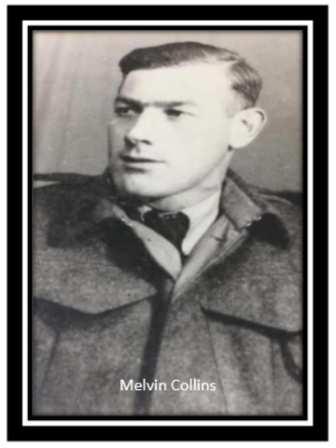
Melvin Collins

Melvin Collins.  (Photo courtesy of Phyllis Kelly)

Phyllis Kelly submitted a photo of her uncle, Melvin COLLINS, from South Kouchibouguac, New Brunswick.  He served with the New Brunswick Rangers and died on April 12, 1945 in Papenburg, Germany, age 26, when he accidentally tripped a hidden high-incendiary booby trap. 

Goldwin Marven Pollick

Goldwin Marven Pollick pushing his brother Ralph on a bike. (Photo courtesy of Gary Pollick and Family of Goldwin Pollick)

On behalf of the Goldwin Pollick family, Gary Pollick submitted a photo of his uncle, Goldwin Marven POLLICK, and explained that “We remember him as always being referred to as Goldy.  I don’t know a lot about him as I was not born yet and no one in my family spoke much about the war.  My father was in The Netherlands at the same time, and he was able to view his brother’s body before it was taken away for burial…

Goldwin Pollick was born in Minto, New Brunswick, and served with the Carleton and York Regiment.  He lost his life on April 13, 1945 in Wilp-Achterhoek. This date was familiar to us as in 2017 we visited a windmill in the nearby village of Posterenk, in which 6 members of the Carlton and York Regiment are listed as having died between April 13 and 15.  Unfortunately, this listing does not include every soldier who was killed in the area.

Ford Hilton Spidle

Ford Hilton Spidle (Photo submitted by Dawn (Spidle) Coldwell)

Dawn (Spidle) Coldwell submitted a photo of her uncle, Ford Hilton SPIDLE, explaining that “…He was a member of the Cape Breton Highlanders. I’ve been told that he was killed by a sniper bullet the day the war was declared over. He was the young age of 32.  Apparently, the information hadn’t been received that the war was over….” The war in The Netherlands ended on May 5 and Ford Hilton died on May 1, 1945 during the Battle of the Delfzijl Pocket, which lasted from April 23 to May 2.  20 soldiers from the Cape Breton Highlanders were killed in action during that battle.

Dawn went on to share a personal experience.  “…I was fortunate enough to have attended the Memorial Day Service in Holten, in 2009. While I was there the Dutch people treated me like I was royalty. I have stayed in close contact with the people over there who made my trip possible. Uncle Ford was my Dad’s only brother. I have a brother who was named after Uncle Ford.  I wasn’t even born when Uncle Ford was killed but my Dad always kept his memory alive.…

Charles Borden Tuplin

Charles Borden Tuplin. (Photo submitted by Gary Richard Perry)

Gary Richard Perry of Nova Scotia submitted a photo of Charles Borden TUPLIN of the Black Watch (Royal Highland Regiment), and explained that “…My maternal grandfather Charles Borden Tuplin of Indian River, PEI is buried at Holten. He was shot on December 7, 1944, was taken as a POW but died the next day…

Soldiers buried at the Canadian War Cemetery in Groesbeek, The Netherlands

William Francis Stewart

William Francis Stewart.  (Photo courtesy of the Stewart Family)

Phyllis Kelly submitted a photo of William Francis STEWART on behalf of the Stewart family, and explained that “…He was born in Claire Fontaine, New Brunswick (this community doesn’t exist now, it was expropriated and became part of Kouchibouguac National Park.) He was the son of John and Katherine (Butler) Stewart. He was married to Audrey Savoie and they had three daughters, Gloria, Bernetta, and Margaret. …”  He lost his life on July 8, 1945 when he fell out of a window in Amersfoort, The Netherlands in the early morning. 

Benjamin James Witherall

Benjamin James Witherall (Photo submitted by Jacqueline Inder)

Jacqueline Inder submitted a photo of Benjamin James WITHERALL of Nova Scotia, and wrote that “I would like to share with you the only picture my mother’s family had of their brother in uniform.  His name is Benjamin James Witherall who was a private with the Highland Light Infantry in WW2.  He was killed in action on December 27th, 1944 at the age of 20…

The Highland Light Infantry was based on the front line on a ridge between Nijmegen and Arnhem during that time. (See https://pipesforfreedom.com/webtxt/0502THE_HIGHLAND_LIGHT_INFANTRY_OF_CANADA.htm)

Soldiers Buried In Adegem Canadian War Cemetery in Belgium

Edison Reynolds Smith

Edison Reynolds Smith.  (Photo courtesy of Angela Leighton)

Angela Leighton submitted a photo of Edison Reynolds SMITH, explaining that “…I wish to advise that my uncle, Private Edison Reynolds Smith of the North Nova Scotia Highlanders, Service #F/57514 (date of birth May 11, 1924) was killed in action in Holland on October 16, 1944, at the age of 20…” He lost his life during the Battle of the Scheldt and was initially buried in the province of Zeeland, The Netherlands.  (See https://www.veterans.gc.ca/eng/remembrance/history/second-world-war/scheldt) Angela ended her email with the statement: “None of these heroes should ever be forgotten….”  She is correct!

Thank you to Alexander and Daniel Beaton, Brenda Budd, Dawn (Spidle) Coldwell, Jacqueline Inder, Phyllis Kelly, Angela Leighton, Gary Richard Perry, and Gary Pollick for sharing photos and anecdotes. Thank you again to CTV’s Atlantic Live At 5 for helping to get the word out on this quest of remembrance. Atlantic Canadians remember their loved ones who are buried overseas.

More photos and stories in Atlantic Canada Remembers – Part 2! If you have photos or information to share, please email Pieter at memorialtrail@gmail.com, or comment on the blog. 

© Daria Valkenburg

….Want to follow our research?….

If you are reading this posting, but aren’t following our research, you are welcome to do so.  Our blog address: https://onthewarmemorialtrail.com/

Front cover OnTheWarMememorialTrailinEurope4 countries, 6 weeks, 7,000 km – an unforgettable war memorial journey in Europe…. Daria’s book ‘No Soldier Buried Overseas Should Ever Be Forgotten‘ is available in print and e-book formats.  Net proceeds of book sales help support research costs and the cost of maintaining this blog. For more information see https://nosoldierforgotten.com/ 

You are also invited to subscribe to our YouTube Channel: On The War Memorial Trail With Pieter Valkenburg: https://www.youtube.com/channel/UCJ591TyjSheOR-Cb_Gs_5Kw

Never miss a posting!  Subscribe below to have each new story from the war memorial trail delivered to your inbox.

The WWII Soldier From Emerald Junction Who Lost His Life In Italy

March 10, 2020. Among the names listed on the Cenotaph outside of the Borden-Carleton Legion are 4 that died in Italy during WWII.  One of these men was Ernest Murray NORTON (see The Last Valentine From A WWII Soldier).  This posting is about a young man who lost his life during the Battle of Moro.

George Alfred DUNN was born February 11, 1915 in Roseville, the son of Joseph J. Dunn and Mary Ellen Jones.  Dunn didn’t have an easy life.  His mother died when he was six.  His father died when Dunn was only 9 years old, and he was brought up by his uncle, William Dunn, of Emerald Junction.

A woodsman before enlisting with the Carleton & York Regiment in St. Stephen, New Brunswick on September 8, 1939, he received training in Woodstock, New Brunswick and then went to Europe with the first Canadian contingent, sailing to England on December 8, 1939 aboard the S.S. ‘Monarch of Bermuda’, and arriving on December 17.

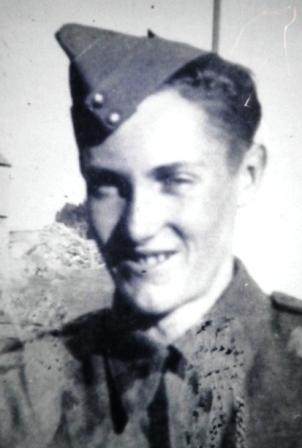
Alfred Dunn

George Alfred Dunn. (Photo source: http://www.ancestry.com. Photo colourization: Pieter Valkenburg)

On May 8, 1941, he was temporarily attached for a month to the Guards Depot while at a Drill Instructors Course. Upon completion, he was sent to No.1 AFW RCOC in Aldershot for a few weeks while he completed a PT No. 32 Course. On October 18, 1941 he was promoted to Acting Lance Corporal. (NOTE: RCOC refers to Royal Canadian Ordnance Corps, a unit provisioning troops with the means to fight, such as uniforms, weapons and equipment.  AFW refers to Army Field Workshop.)

On May 16, 1942, he was promoted to Corporal, then on November 1942 he received another promotion, to Lance Sergeant, and was sent for more training.  On June 16, 1943 he was sent to Italy, and then, on August 25, 1943, he was promoted to Sergeant.

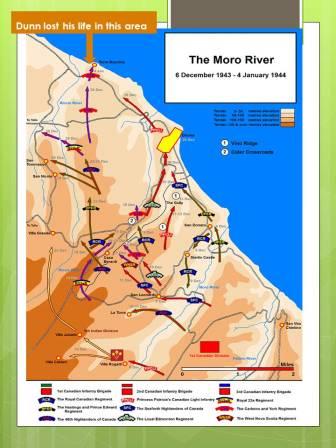
On December 6, 1943, Canadian forces, along with British, Indian, and New Zealand infantry divisions, began a series of large-scale assaults on major crossing points along the Moro River in Eastern Italy, with the objective of securing a large bridgehead along the defensive line. The intention was to breach the German Army’s Winter Line defensive system and advance to Pescara—and eventually Rome. (For more information see https://en.wikipedia.org/wiki/Moro_River_Campaign)

According to the War Diary of the Carleton & York Regiment for January 1944, the unit was in Ortona, Italy on January 1.  The weather was “dull and cloudy all day with rain during the evening” the report read, which went on to summarize what happened on December 31, 1943.  “The transport finds the going pretty heavy on account of the mud.  ‘A’ Company, who suffered the greatest during the Battle of Point 59 was brought back to a rear position where ‘B’ Company was and ‘B’ Company was placed at the front.” One of those wounded on December 31, 1943 was Sgt Dunn.  According to the casualty report, he received “shrapnel wounds to the right leg and multiple wounds to the face” while in action.

On January 2, 1944, Dunn died of injuries received in action during the Battle of Moro (Point 59). He’s buried at Moro River Canadian War Cemetery in Italy.

grave stone Sgt. G.A. Dunn (find a grave)

Grave of George Alfred Dunn at Moro River Canadian War Cemetery.  (Photo source: http://www.findagrave.com)

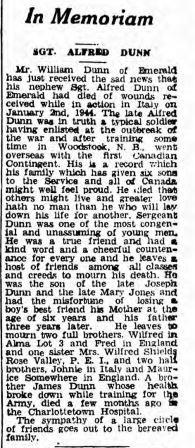
According to his obituary in the ‘Charlottetown Guardian’ of February 3, 1944, page 5, Dunn was part of a family that was in service, with a brother who had died a few months earlier.  “…He was a true friend and had a kind word and a cheerful countenance for every one…” it said.

Obituary G.A. Dunn, Charlottetown Guardian 03 february 1944 page 5

Obituary from the Charlottetown Guardian of February 3, 1944.

No family of George Alfred Dunn has been found as yet, unfortunately.  If you have information or photos to share please contact Pieter at memorialtrail@gmail.com, comment on the blog, or tweet to @researchmemori1

© Daria Valkenburg

….Want to follow our research?….

If you are reading this posting, but aren’t following our research, you are welcome to do so.  Our blog address: https://onthewarmemorialtrail.com/

Front cover OnTheWarMememorialTrailinEurope4 countries, 6 weeks, 7,000 km – an unforgettable war memorial journey in Europe…. Daria’s book ‘No Soldier Buried Overseas Should Ever Be Forgotten‘ is available in print and e-book formats.  Net proceeds of book sales help support research costs and the cost of maintaining this blog. For more information see https://nosoldierforgotten.com/ 

You are also invited to subscribe to our YouTube Channel: On The War Memorial Trail With Pieter Valkenburg: https://www.youtube.com/channel/UCJ591TyjSheOR-Cb_Gs_5Kw

Never miss a posting!  Subscribe below to have each new story from the war memorial trail delivered to your inbox.
The WW2 Soldier Who Drove On The Wrong Side Of The Road

August 28, 2019.  Many years ago, while on the North island of New Zealand, I drove to a meeting with a colleague from the South Island.  Driving in New Zealand means driving on the side of the road opposite to the way we are used to driving.  Usually I did well with remembering which side of the road to drive on, but sometimes the brain cells reverted to their default setting.  That happened one evening after we stopped at a gas station.  After pulling back out onto the road, we were listening to music and having a great conversation when all of a sudden I noticed a big truck coming towards us.  “What is he doing?” I asked my passenger.  He didn’t reply.  A quick glance showed him looking terrified and gripping the door handle.  “What’s wrong?” I asked.  Finally, he very quietly whispered, “In this country, we drive on the other side of the road.” Oops!  I quickly switched lanes and the truck safely passed us, but not without a few angry toots on the horn.  An angel was sitting on our shoulders that evening!

x-default

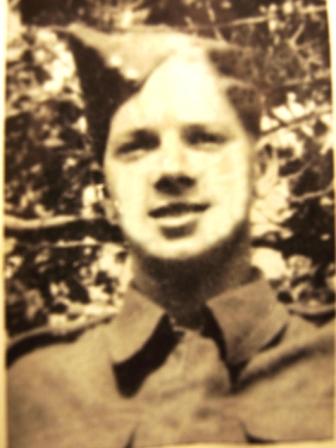
Austin Boulter. (Photo credit: Augustine Cove Women’s Institute 1800-1973 Centennial history project)

I remembered this event after learning from Pieter’s research what happened to WW2 soldier Austin Harry BOULTER, whose driving experience didn’t end as happily.  According to his attestation papers, Boulter was born on October 4, 1920 in Freetown, the son of Roy Boulter and Blanche Leard.  There is a discrepancy as the Military Service Record’s Declaration and Statement of Relatives records his date of birth as October 4, 1922 in Tryon. A check of the June 1921 census does not record him, indicating that he wasn’t yet born.  It’s pretty clear that he fudged his attestation paper during his enlistment on May 27, 1940 in Woodstock, New Brunswick to make sure he wouldn’t be rejected as being too young!  At the time of enlistment the family lived in Cape Traverse, but Boulter was working as a lumberman for J. Craig in Stanley, New Brunswick.

While Boulter enlisted with the Carleton and York Regiment, he was transferred to the Canadian Signal Training Corps on September 9, 1940.  On May 18, 1941 he was transferred to the 3rd Canadian Division Signals and sent to Debert Camp, Nova Scotia. It was with that group that he left Halifax for England, arriving in Avonmouth on July 31, 1941.  The unit was in England to train for deployment to Western Europe.  (This was the first Canadian division to fight in the Normandy Campaign, landing at Juno Beach on D-Day on June 6, 1944.)

Boulter never left England, as around 10 pm on January 14, 1943, while not on duty, he borrowed a motorcycle ‘without authority’, according to a court of inquiry into his death.  He was “carrying a civilian passenger on the back of the motorcycle”.  Unfortunately, he forgot which side of the road to drive on, and crashed into a 4X4 Ford driven by Private M J. O’Grady, between Storrington and the Royal Winnipeg Rifle Lines.

At the court of inquiry, O’Grady stated that after seeing the motorcycle in his lane, O’Grady started to pull over to the left, but Boulter “came straight on, striking his front right bumper and fender and catching on the corner of the box directly behind the cab.”  O’Grady stopped immediately and he and his passengers jumped out.  He stated that he “saw a soldier on the ground a short distance beyond the bike and saw a lady further away on the ground.” Boulter was dead, but his passenger was hurt.  O’Grady “posted a guard on the truck and told the other two men to take over while he ran into Storrington to get help.”  O’Grady testified that he was “travelling about 15 mph” and that the motorcycle “appeared to be travelling too fast”.

The finding of the court indicated that Boulter “was not wearing a crash helmet”.  The registry of death noted that he died instantly from severe head injuries incurred during the crash.

It’s unknown why Boulter was with a civilian passenger so late at night, and why he took a motorcycle without permission.  No testimony by the passenger was recorded in the court of inquiry and she was not identified. He was buried at Brookwood Military Cemetery, Sussex, England.

The Summerside Journal of January 18, 1943 recorded his obituary:

Bedeque Soldier Dies Overseas

A Prince Edward Island soldier, Sigmn. Austin Harry Boulter of Bedeque, was listed under died overseas in the 252nd Canadian (Active) Army overseas casualty list last night. His next-of-kin was given as his mother, Mrs. Blanche Boulter of Bedeque.

If anyone can provide a photo or more information on Austin Harry Boulter, please contact Pieter at dariadv@yahoo.ca or comment on the blog.

© Daria Valkenburg