On The War Memorial Trail…..The WWI Signaller From Covehead Killed During The Battle Of Vimy Ridge

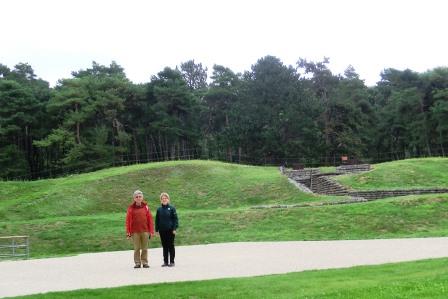
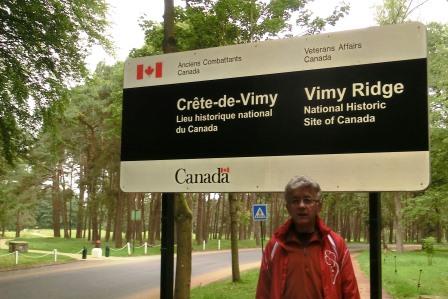
CIMG8269 Sep 5 2017 Pieter at entrance to Vimy Memorial Park

Pieter at the entrance to Vimy Ridge National Historic Site in France. We brought along a copy of the County Line Courier newspaper that publishes many of the stories about Island soldiers. (Photo credit: Daria Valkenburg)

June 14, 2023.  After visiting the Vimy National Memorial in France and having researched several soldiers who fought during the Battle of Vimy Ridge, we have an ongoing interest in learning more about those who fought in that battle on Easter Monday, April 9, 1917.

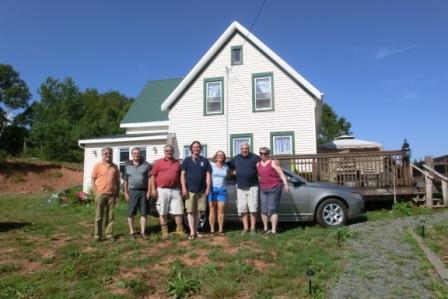
20230530_102553 Pieter and Connie

Pieter with Connie Paynter. (Photo credit: Daria Valkenburg)

…Two brothers from Covehead enlisted …

Therefore, when Connie Paynter of Summerside contacted us about a 20 year old relative who was killed in action at Vimy, we wanted to meet her. “…My grandfather and my great-uncle, who lived in Covehead, both served in WWI.  Only my grandfather, Lawrence Ivy Marshall, returned home…” she said.

Connie’s great-uncle, Merrill Augustus MARSHALL, was born on July 4, 1896 in Charlottetown, Prince Edward Island, the son of James Lawrence and Hattie Lillian (nee Carr) Marshall. 

When he enlisted with the 55th Battalion on May 1, 1915 in Charlottetown, he noted that he had served in the 82nd Regiment militia for a year, with the rank of Sergeant.  Before enlisting, he had worked on his father’s farm. 

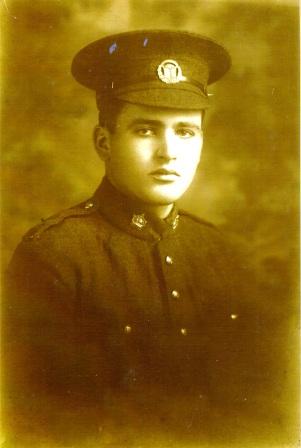
20230530_100452 Merill Marshall from Connie

Merrill Augustus Marshall while serving with the 82nd Regiment, Canadian Militia.  (Photo courtesy of Connie Birt Paynter)

While he was in the 82nd Regiment Militia, Merrill was sent to Valcartier, Quebec, where his brother Lawrence was also stationed.   In an August 22, 1914 letter that Lawrence wrote to his mother from Valcartier, he noted that “…Merrill has the job of orderly so far.  He will do alright if he keeps that job all the time…

…Merrill was too young for active service …

However, as Merrill was underage for active service, he was soon on his way back home.  In a September 9, 1914 letter from Merrill to his mother, written from 12 Battalion, 3 Brigade, Valcartier, Quebec:  “…I will be home whenever we get the pay that is coming to us here. It will be 15 dollars.  We got seven dollars and 40 cents that was coming to us from town.  I am sending you 5 dollars this time.  I won’t be here very much longer now.  Our names are in for us to go home whenever we get our money given to us…

…Merrill soon re-enlisted! …

A few months later, he re-enlisted and arrived at Camp Sussex, New Brunswick on May 10, 1915.  After completing basic training he left Canada with the 55th Battalion on October 30 1915, aboard the RMS Corsican, which sailed from Montreal, Quebec. (See http://the-weatherings.co.uk/pccship0063.htm)

Merrill arrived at Devonport, England on November 9, 1915, and was sent to Bramshott Camp in Hants.

His brother Lawrence was also in England.  In a November 29, 1915 letter to his mother, written from Bramshott Camp, Lephook Hants, 55th Battalion, No 10 Company, UK, Merrill assured her that  “…I am well and having a good time… The drill isn’t half as hard as it was in Canada.  We have good food and a good hut to stay in …. Don’t have to sleep in tents and suffer with the cold.  Now we have a stove and lots of coal to burn so we are happy.  I am getting a pass to Leicester to see Lawrence day after tomorrow….

…Merrill trained to be a Signaller …

On April 8, 1916, Merrill was transferred from the 55th Battalion to the Canadian Signals Base with the 39th Reserve Battalion in West Sandling in the United Kingdom, where he trained to be a Signaller.  He would have encountered fellow Islander, John ‘Lymon’ WOOD of North Tryon, who arrived there on April 16, 1916 for the same training as a Signaller.

Signallers were responsible for military communications, providing commanders with information on where troops were, what they were doing, and whether supplies were sufficient. Communication was done using message-carrying pigeons, flags, and human runners. Some messages could be sent using Morse code or signalling lamps.  Signalling lamps were portable and aimed a focused beam of light at a receiving signaller. Light could be transmitted over long distances much faster and more safely than a runner exposed to enemy fire.

Merrill was transferred to the 6th Reserve Battalion in Shorncliffe on January 4, 1917.  His brother Lawrence, who had been in the French trenches and was back in England, showed concern in a January 29, 1917 letter to his father, written from Canadian Convalescent Hospital, Staff Hut A1, Wood Cote Park, Epsom, Surrey, England: “…Had a letter from Merrill yesterday. He is in Shorncliffe and having a good time of it.  I hope that it will only last the rest of the war and hope and pray that he never sees the trenches, because you have a pretty slim chance of getting back alive out there, and by the talk of things there is going to be harder fighting out there this spring than there has  been.  They are putting every man that’s fit out there this spring and try to make one big drive for the last time, but I don’t think that there is much use of doing it. Germany ain’t beat yet nor won’t be for a while…

…Merrill was sent to France in advance of the Battle of Vimy Ridge …

Lawrence was right to be worried, as on February 7, 1917, Merrill was transferred to the 21st Battalion in East Sandling.  The following day, he arrived at the Canadian Base Depot at Rouelles Camp in Le Havre, France.  A few days later he joined his unit, and on February 15, 1917 he was on the front line, as a Signaller, with the 21st Battalion in Thelus, near Vimy Ridge.

In a February 11, 1917 letter to his father, written from Canadian Convalescent Hospital, Staff Hut A1, Wood Cote Park, Epsom, Surrey, England, Lawrence asked “…Have you heard from Merrill since he went to France?  I have been expecting a letter from him the last week, but did not receive any.  He will find quite a difference over there to what he had in England, but still he will get a good job as he is a signaller.  He may never have to go into the trenches at all….

Then, in an April 16, 1917 letter from Lawrence to his mother, written from Canadian Convalescent Hospital, Staff Hut A1, Wood Cote Park, Epsom, Surrey, England he wrote that “…I had a letter from Merrill. He was fine when he wrote.  He said that it wasn’t too bad out there yet.  I only hope that he will come through it all safe and sound….” 

…Merrill lost his life during the Battle of Vimy Ridge …

Unfortunately, by the time Lawrence wrote his letter, Merrill was dead.  He had lost his life on Easter Monday, April 9, 1917, during the Battle of Vimy Ridge, killed during the advance on the Ridge.

Merrill was buried near where he fell.  His grave location was registered as being in ‘Thelus, near Neuville, St. Vaast, 4 ½ miles North North-East of Arras, France’.

… Merrill’s grave couldn’t be found …

However, years later, when what we know today as the Commonwealth War Graves Commission went to move the trench burials into cemeteries, his remains could not be located.  Continuous artillery fire over the next year and a half remaining in the war likely destroyed his grave and many others.

This happened to fellow Islander George Albert CAMPBELL, who was killed during the Battle of Mount Sorrel in Belgium, and buried in Maple Copse Cemetery, east of Zillebeke.  By the time the war ended, the cemetery had been destroyed and out of 256 named burials, only  26 could still be identified.  (See https://onthewarmemorialtrail.com/2017/12/08/two-campbell-brothers-in-ww1/)

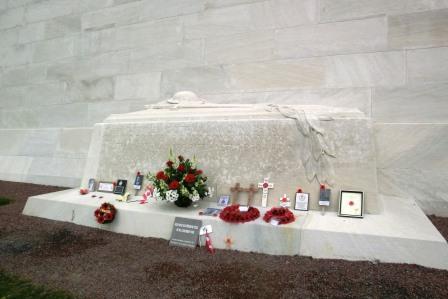
Once it was determined that Merrill’s remains could not be found, his name was commemorated on the Canadian National Vimy Memorial.

Merrill is also remembered on his parents’ grave at St. James United Presbyterian Cemetery in Covehead, Prince Edward Island.

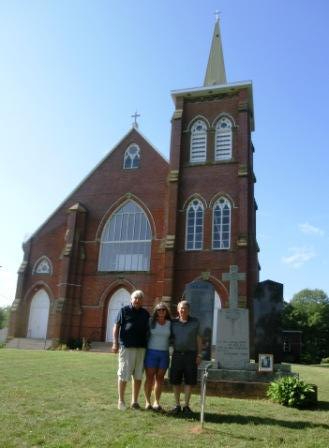
1571637_6 Memorial St James United Church PEI

Grave of Merrill Augustus Marshall’s parents at St. James United Presbyterian Cemetery in Covehead.  (Photo source: http://www.findagrave.com)

Thank you to Connie Paynter for providing a photo of Merrill, and sharing the letters written by her great-uncle and grandfather. 

If you have a story to tell, email Pieter at memorialtrail@gmail.com, comment on the blog, or tweet to @researchmemori1

© Daria Valkenburg

… Previous postings about soldiers who fought during the Battle of Vimy Ridge and our visit to the Vimy National Memorial….

…Want to follow our research?…

Follow our blog

If you are reading this posting, but aren’t following the blog, you are welcome to do so. Our blog address: https://onthewarmemorialtrail.com/.
Front cover OnTheWarMememorialTrailinEurope4 countries, 6 weeks, 7,000 km – an unforgettable war memorial journey in Europe…. Daria’s book ‘No Soldier Buried Overseas Should Ever Be Forgotten‘ is available in print and e-book formats.  Net proceeds of book sales help support research costs and the cost of maintaining this blog. For more information see https://nosoldierforgotten.com/

You are also invited to subscribe to our YouTube Channel: On The War Memorial Trail With Pieter Valkenburg: https://www.youtube.com/channel/UCJ591TyjSheOR-Cb_Gs_5Kw

Never miss a posting!  Subscribe below to have each new story from the war memorial trail delivered to your inbox.

On The War Memorial Trail….. Update On Portrait Of WWI Soldier From Barton

improved_photo(4) shortliff

Photo of WWI soldier Lloyd Shortliff.  (Photo restoration: Pieter Valkenburg)

January 7, 2023.   In a previous posting, we told the story of how a photo of WWI soldier Lloyd Clifton SHORTLIFF of Barton, Nova Scotia was rescued when veteran Mario Henry purchased the picture at an auction.

Lloyd’s body was never recovered from the French battlefields following his death on September 17, 1916, and his name is listed on the Canadian National Vimy Memorial.  (See https://onthewarmemorialtrail.com/2022/07/31/the-ww1-soldier-from-barton-whose-body-was-never-recovered/)

google maps digby NS to Barton NS

Barton is 14.9 km away from Digby.  (Map source: Google)

The Royal Canadian Legion in Weymouth, Nova Scotia expressed an interest in the picture after learning it existed from Nova Scotia Command of the Royal Canadian Legion.  On a September 2022 trip to Nova Scotia, we brought over the portrait and handed it over to Sandra Lent of the Weymouth Legion in Barton, located between Digby and Weymouth.  (See https://en.wikipedia.org/wiki/Barton,_Nova_Scotia)

Barton is very small and the war memorial is located on one side of the highway, in front of a cemetery, and set back from the road. Not being close to the road helps protect it from car exhaust and snow clearing on the very busy Hwy 101.

….The picture of Lloyd Shortliff briefly sat at the Barton War Memorial….

It seemed only fitting that before Sandra Lent took the picture of Lloyd Shortliff to the Weymouth Legion that a photo be taken of the picture on the side of the Barton War Memorial with his name.

CIMG5802 Sep 12 2022 Barton Memorial Pieter and Sandra Lent

Pieter and Sandra Lent with the picture of Lloyd Shortliff at the Barton War Memorial.  (Photo credit: Daria Valkenburg)

….An unexpected turn of events…..

A few days after we met with Sandra Lent we asked if the portrait had been hung up in the Weymouth Legion.  The reply was that it might be hung up within the day, but then came an unexpected twist.  “Apparently the Shortliff name was common in Barton, and I thought the Digby Legion might be interested in having it….” Sandra wrote. 

That was a surprise to us as when Nova Scotia Command had initially asked Legion branches in the area who might be interested in the picture, the only response came from Sandra on behalf of the Weymouth Legion.

The Zone Commander for Weymouth Legion subsequently reported to Sandra that he had taken the portrait to Digby Legion and that “….the president took the picture and informed me she would hang it on a wall …

That was in September 2022.  Up to now, Digby Legion has not responded to any inquiries about the portrait, although Pieter has left phone messages, sent emails, and even tried to contact them via their Facebook page.  We do not know what happened to the portrait, but the lack of response suggests it was never hung up.

Had we known that neither Legion branch was going to hang the portrait of Lloyd Shortliff, we would never have brought it over.  It is a disappointing ending to a story that began so positively, with the rescue of a portrait of a WWI soldier, who gave his life in France and has no known grave.  Mario Henry and Pieter only wanted to ensure that Lloyd Shortliff’s portrait had a place of honour in his home province. 

….Other names listed on the Barton Memorial…..

  • WW1 soldier Harold Pryor ALMON, born March 27, 1894, died July 31, 1917, buried in Belgian Battery Corner Cemetery in Ypres, Belgium
  • WW1 soldier Kenneth Ensley COSMAN, born February 13, 1894, died June 9, 1917, buried Glasgow Western Necropolis in Glasgow, Scotland
  • WW1 soldier Edward Wyatt HAIGHT, born September 2, 1891, died September 16, 1916, listed on the Canadian National Vimy Memorial in Vimy, France
  • WW1 soldier Harley MELANSON, born April 8, 1893, died August 11, 1917, buried in Maroc British Cemetery in Nord, France
  • WW2 Pilot officer William Dakin MULLEN (MULLIN), born June 23, 1922, died June 8, 1944, buried in Blévy Communal Cemetery in Blévy, France
  • WW1 soldier Benjamin Murray SABEAN, born May 11, 1897, died September 29, 1917, buried in Birmingham (Lodge Hill) Cemetery in Warwickshire, United Kingdom
  • WW1 soldier Roger Lent SPECHT, born August 1, 1897, died February 3, 1919, buried in Bramshott (St. Mary) Churchyard in Hampshire, United Kingdom
  • WW1 soldier Walter James URQUHART, born August 10, 1879, died October 13, 1916, buried in Regina Trench Cemetery in Somme, France

Thank you again to Mario Henry for saving the photo which gave us a chance to tell Lloyd Shortliff’s story. Perhaps one day we will have a more positive update.

Do you have a story to tell? Email Pieter at memorialtrail@gmail.com, comment on the blog, or tweet to @researchmemori1

© Daria Valkenburg

…Want to follow our research?….

If you are reading this posting, but aren’t following the blog, you are welcome to do so. Our blog address: https://onthewarmemorialtrail.com/.

Front cover OnTheWarMememorialTrailinEurope4 countries, 6 weeks, 7,000 km – an unforgettable war memorial journey in Europe…. Daria’s book ‘No Soldier Buried Overseas Should Ever Be Forgotten‘ is available in print and e-book formats.  For more information see https://nosoldierforgotten.com/

You are also invited to subscribe to our YouTube Channel: On The War Memorial Trail With Pieter Valkenburg: https://www.youtube.com/channel/UCJ591TyjSheOR-Cb_Gs_5Kw

Never miss a posting!  Subscribe below to have each new story from the war memorial trail delivered to your inbox.

The WWI Soldier From Barton Whose Body Was Never Recovered

July 31, 2022. Most of the time Pieter is involved in a search for photos and family of WWI or WWII soldiers, a task that requires a great deal of research and luck.  Sometimes, however, the opposite happens, and he’s asked to find family and a soldier for a photo that has been ‘orphaned’ for one reason or another.

For a veteran, it can be difficult to ignore a photo that has been discarded or placed for sale in an auction or secondhand shop.  That’s exactly what happened when veteran Mario Henry, Sgt At Arms at the Borden-Carleton Legion, visited a pre-auction preview recently and spotted a photo of what looked to be a WWI soldier.

….Photo of a WWI soldier placed for auction…

improved_photo(4) shortliff

Photo of WWI soldier Lloyd Shortliff.  (Photo credit and restoration: Pieter Valkenburg)

It was in an antique frame and was most likely a black and white photo that had been colourized with watercolour and framed, suggesting that at one time this was a treasured piece in someone’s home.

….The back of the photo identified the soldier and his family….

CIMG5692 Jun 28 2022 back of Shortliff photo

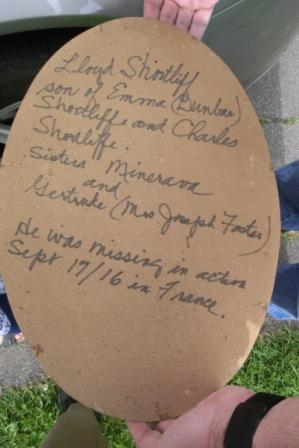
Back of photo with identifying information.  (Photo credit: Daria Valkenburg)

A quick glance at the back of the photo had identifying information, which helped to uncover a soldier’s military service.  The information on the back stated: “Lloyd Shortliff, son of Emma (Dunbar) Shortliffe and Charles Shortliffe. Sisters Minerva and Gertrude (Mrs Joseph Foster).  He was missing in action September 17, 1916 in France.

….Who was Lloyd Shortliff?….

Mario contacted Pieter, who soon determined that the photo was of Lloyd Clifton SHORTLIFF, born April 12, 1891 in Barton, Digby, Nova Scotia, son of Charles Henry and Emma (nee Dunbar) Shortliff.

A farmer before enlisting in Sussex, New Brunswick on September 20, 1915 with the 64th Battalion, Lloyd left Halifax, Nova Scotia aboard the SS Adriatic on March 31, 1916, arriving in Liverpool, England on April 9, 1916.

On June 24, 1916 he was transferred to the 12th Battalion and sent to Shornecliffe Army Camp for further training. (See https://www.saltwoodkent.co.uk/the-canadian-at-shorncliffe-during-)

…Lloyd was sent to the front…..

Screenshot 2022-07-04 at 10-28-48 Vierstraat · Ypres Belgium

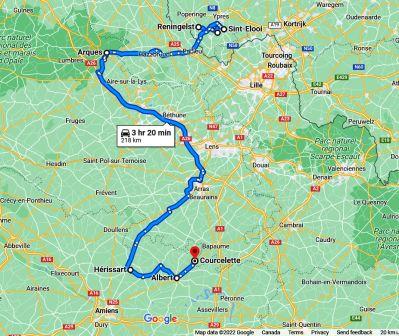
Blue line shows the route taken by the 24th Regiment as they moved from the Ypres area in Belgium towards France for the Battle of the Somme. (Map source: http://www.google.ca)

A few days later, on June 28, 1916, he was transferred to the 24th Battalion (Victoria Rifles of Canada) and sent to Belgium on July 12, 1916. The Regiment was part of the Canadian Corps manning the Western Front.

On August 28, 1916 the Regiment marched to Eperlecques, France for training on the new Lee-Enfield rifles, where they also trained in manoeuvres in preparation for what the troops would experience in the Battle of the Somme. (See map at https://en.wikipedia.org/wiki/File:Map_of_the_Battle_of_the_Somme,_1916.svg)

On September 4, 1916, the Regiment went to Argues, France, and took a train to Conteville, before moving on towards Hérissart, and then to Albert, France, where the Regiment arrived on September 10, 1916 and were set up in tents.

The Somme front was near the village of Courcelette. Training began for an attack on the Sugar Refinery near Courcelette, which began on September 15, 1916.  By the next day, Battalion Headquarters was set up in a trench by the Sugar Refinery, in preparation for further attacks against the Germans. (See https://www.warmuseum.ca/firstworldwar/history/battles-and-fighting/land-battles/courcelette/)

Lloyd lost his life on September 17, 1916.  Unfortunately his body was never recovered and he is listed on the Canadian National Vimy Memorial.

….Could the photo be saved?….

Knowing that Lloyd Shortliff was listed on the Vimy Memorial was like waving a red flag at a bull for veterans Pieter and Mario.  Pieter has a special affinity for Vimy after we’d been there in 2017 to honour two soldiers from the Island that Pieter had researched.  (See https://onthewarmemorialtrail.com/2017/09/19/visiting-the-canadian-national-vimy-memorial/)

The photo couldn’t be resigned to the dustbin of history!  The value was in the antique frame, not the photo, and both men believed someone would buy the frame and discard the photo.

Mario contacted the auctioneer and asked if the seller would pull the picture out of the auction, pending further investigation.  The seller refused.

That seemed to be that ….. until Mario contacted Pieter to say that he had attended the auction and bought the picture.  Pieter went back to his research, to learn how Lloyd lost his life and to find his family.

CIMG5689 Jun 28 2022 Pieter and Mario with photo

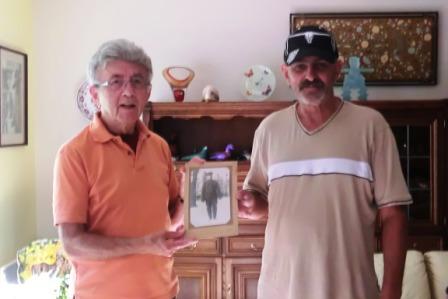
Pieter (left) and Mario Henry (right) with the picture of WW1 soldier Lloyd Shortliff. (Photo credit: Daria Valkenburg)

….How did Lloyd Shortliff lose his life?…

Pieter wanted to know how Lloyd lost his life and why he was listed on the Vimy Memorial, since he didn’t die during the Battle of Vimy Ridge, which was in April 1917.

According to the war diary for the 24th Battalion for September 17, 1916, “… at 12:30 pm, orders were received from the Brigade that the Battalion, less one Company, were to attack the German front line, with our Right resting on the Baupame Road, and our Left with the 22nd Battalion in the vicinity of the Quarries.  The attack commenced at 5 pm…..

The soldiers  of ‘D’ Company, on the extreme right, “…were unable to reach their objective, many of them killed before they got over the parapet, and the men who did advance were held up in the German wire and shot down…

‘A’ Company was in the centre, and “…obtained their objective, but after severe fighting, the enemy bombed them out, working through from his main line…

By the time the fight was over, 9 officers and 330 other ranks of the 24th Battalion were dead, wounded, or missing and presumed dead, among them Lloyd Shortliff.  As his body was never recovered it appears he was among the soldiers who were bombed.

24th battalion WW1 112

Map of the Battle of Courcelette on September 17, 1916. Red arrow shows the Sugar Refinery where Lloyd Shortliff went missing.  (Map source: The 24th Battalion, C.E.F., Victoria Rifles of Canada, 1914-1919)

…Pieter found the family of Lloyd Shortliff….

Pieter’s research next focused on Lloyd’s descendants, and led to family member Trent Whittaker, whose grandmother was Gertrude Foster, Lloyd’s sister.  After explaining about the picture that Mario had rescued, he was surprised to learn that it was Trent who had put the photo in a garage sale as part of the clear out of a 200 plus year old farmhouse.  The family had a photo of Lloyd and the one put in the garage sale was a duplicate. Several ‘pickers’ had bought the goods and that was the last he saw of the picture.

This is a story many will find familiar.  Relatives die and families are left with an accumulation of ‘stuff’ that can become overwhelming.  In the purge, photos, letters, diaries, and other memorabilia can get discarded.

…. Lloyd is remembered on the Barton War Memorial…

IMG_5558R Jul 8 2022 Barton War Memorial

Barton War Memorial.  (Photo credit: Sandra Lent)

Lloyd Shortliff was bombed to smithereens in France, his remains never recovered, but he is listed on the Vimy Memorial in France, and Pieter discovered that he is also listed on the war memorial in Barton, Nova Scotia:  https://nshdpi.ca/is/digbyco/bartonwarm.html.  The Legion in Weymouth, Nova Scotia has expressed an interest in the picture after learning of its existence.

IMG_5566R Jul 8 2022 Barton War Memorial

Lloyd Shortliff is remembered on the Barton War Memorial. (Photo credit: Sandra Lent)

Sandra Lent of the Weymouth Legion visited the memorial and explained that it was “…located in Barton, at the head of a cemetery.  There are no other markings, such as the name of the cemetery, although it is well tended, and the pillar shaped monument is helpful for identification.  It is located a short distance north of the Barton post office, on the same side of the highway...

Thank you to Mario Henry for saving the photo which gave us a chance to tell Lloyd Shortliff’s story.  Thank you as well to Sandra Lent for taking the photos of the Barton War Memorial.  If you have a story to tell, please let Pieter know. You can email him at memorialtrail@gmail.com, comment on the blog, or send a tweet to @researchmemori1.

© Daria Valkenburg

….. More stories of ‘orphan’ soldier photos and artifacts …

…Want to follow our research?….

If you are reading this posting, but aren’t following our research, you are welcome to do so.  Our blog address: https://onthewarmemorialtrail.com/

Front cover OnTheWarMememorialTrailinEurope4 countries, 6 weeks, 7,000 km – an unforgettable war memorial journey in Europe…. Daria’s book ‘No Soldier Buried Overseas Should Ever Be Forgotten‘ is available in print and e-book formats.  Net proceeds of book sales help support research costs and the cost of maintaining this blog. For more information see https://nosoldierforgotten.com/ 

Upcoming Author Talk: Thursday, August 11, 2022 – Victoria-By-The-Sea, Prince Edward Island, part of the ‘Our Island Talks’ series, and hosted by Victoria Playhouse and Victoria Historical Association. Time: 2:00 pm.

You are also invited to subscribe to our YouTube Channel: On The War Memorial Trail With Pieter Valkenburg: https://www.youtube.com/channel/UCJ591TyjSheOR-Cb_Gs_5Kw.

Never miss a posting!  Subscribe below to have each new story from the war memorial trail delivered to your inbox.
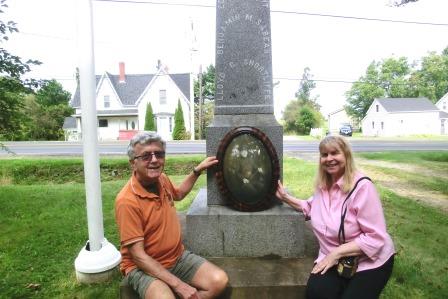
   

The Parallel WW1 Experiences of John Lymon Wood & Clifford Almon Wells

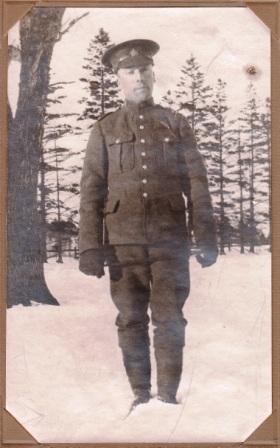
September 16, 2019.  Sometimes we learn more about a particular soldier’s experience by reading about a soldier in a similar situation.  This was the case when I read “From Montreal To Vimy Ridge and Beyond: The Correspondence of Lt Clifford Almon Wells”, edited by his step-father, Pastor G.G.S. Wallace of a Baptist Church in Montreal, and published in 1917.  Wells was not an Islander, but he enlisted in the Princess Patricia Canadian Light Infantry 4th University Company, as did John Lymon WOOD, whose story has been told previously in blog postings.  (See WWI Soldier John Lyman Wood’s Connection With Acadia University and Learning About The Two Names On The Vimy Memorial)

Wells enlisted in September 1915, Wood on October 12, 1915.  At the time of enlistment, Wells was doing graduate work towards his PhD in archeology at John Hopkins University in Baltimore, Maryland while Wood was a second year engineering student at Acadia University in Wolfville, Nova Scotia.

Photo Lyman Wood

Photo: John Lyman Wood shortly after enlistment in October 1915. (Photo courtesy of Gene Rogerson collection)

Lt Clifford Almon Wells in 1916

Clifford Almon Wells in summer 1916. (Photo courtesy of “From Montreal To Vimy Ridge and Beyond: The Correspondence of Lt Clifford Almon Wells”)

On October 19, 1915, in a letter to his brother, Wood explained that he was packing his trunk in preparation for leaving Wolfville for Montreal. Like so many university educated men, an officer’s commission had been suggested by the recruitment office. “….I wish I had gone in the heavy artillery at Charlottetown now, but I’ll get a commission as Lieutenant if I can.  A man stands a far better chance of coming back if he goes in the artillery, but I suppose that is not the right way to look at it though.  The men are needed more in the Infantry, so I suppose it is only right to go where you are the most needed and where you can do the most good….I never hated to leave a place so bad as I do Wolfville this time.  But I must be doing what is right for there seems no other way out of it.” (Excerpt of a letter on page 157 of ‘Remember Yesterday: A History of North Tryon Prince Edward Island 1769-1992 Volume 1’, published in 1993)

Both Wells and Wood were in Montreal, preparing for being sent abroad.  In a November 2, 1915 letter, Wells wrote that “… the 4th University Company, bring recruited overstrength already, has received orders to be ready to sail on the 11th. Thousands of troops sail from Montreal every month without anyone being any the wiser.  Trains come in at night, stop on the wharf alongside the transports and by daybreak the men are on the way.  So it will be with us… The city just swarms with soldiers at present, as two full battalions have been sent back from the camp at Valcartier, which is closed for the winter…

There was a delay in leaving Montreal, as in the end they didn’t leave until November 26, 1915, by train enroute to Halifax.  In a November 26, 1915 letter, Wells noted that “… We did not leave Montreal until nearly 11 o’clock, as we waited for several carloads of troops from Winnipeg to join us.”  He explained that sentries were posted at the train doors, and no one except officers and platoon sergeants were allowed to pass from car to car without special permission.

They arrived in Halifax in the afternoon of November 27, 1915, and Wells sent a brief letter to his mother, saying that “...We reached Halifax two hours ago, and came aboard the ‘Lapland’ almost immediately.

On November 28, 1915 the SS Lapland, which had arrived from New York, sailed from Halifax, arriving in Plymouth, England on December 7.  During the voyage, Wells wrote several letters.  On December 3, 1915, he made the observation that “….There are about 2,000 other troops aboard.  The 37th Battalion from the West, the 92nd Highlanders, units of the A.S.C. Cyclists, etc.”  Wells went on to explain that they had to be alert for U-boats.  “Today we are fairly in the danger zone.  Our company’s machine gun is mounted aft, while other guns are mounted forward.  The decks are lined with men armed with rifles.  So we are all ready for submarines.  Tonight every man must sleep on deck by the life-boat or raft to which he has been assigned.  All portholes are darkened at night and every precaution is taken to render the ship invisible.

Upon arrival, they were both sent to the 11th Reserve Battalion, stationed at St. Martin’s Plain in Shorncliffe, near Folkestone, for infantry training for needed reinforcements to the Canadian Corps in the field.  In a December 9, 1915 letter, Wells wrote about the culture shock he’d experienced.  “It has rained steadily, with an intermission yesterday, ever since we reached Plymouth Sunday morning until now.  The camp is one sea of mud – such mud as I never dreamed of before.  I never shine my shoes now, as the first step out of the hut buries them in 3 or 4 inches of slime.  We are quartered in huts which hold about 40 men each….

He then explained that “The streets in Shorncliffe are very dimly lighted by night on account of the danger from Zepps, and every window in every hut is covered with a blanket when the lights are switched on.  Outside it is pitch dark and one wallows in mud and water when compelled to go out at night.

Like Wood, Wells soon found out that while the British were interested in troops as ‘cannon fodder’, a system of discrimination already existed to prevent them from becoming officers, contrary to what they were told when they signed up.  He discussed this in a continuation of his December 9 letter:  “I have bad news in one respect.  An order has been passed by which no more Canadian soldiers are given commissions in the Imperial Army except when a Colonel applies to have a certain man as an officer in his command.  There is consequently a good deal of dissatisfaction in our company, as many of us were practically promised commissions when we enlisted.”  Wells began working his contacts to get a commission.

In a December 29, 1915 letter, Wells wrote that “…It is reported that a carload of Christmas mail for soldiers was accidentally burned….”  He wondered if this could be why he had not received mail.  On January 7, 1916, he wrote that he’d heard that “two carloads of mail from Canada were accidentally burned.”  One can imagine the disappointment that he and his fellow Canadians felt when no letters or parcels arrived for Christmas!

Still trying to figure out how to get a commission, in the same letter, Wells explained that if he wasn’t successful in his quest while in England “…. I may go to the front as a Corporal or even a private, as I understand that NCOs like myself, who have never seen active service, lose one or more of their stripes when they first go to the trenches.  I should expect, of course, to regain them in a short time, but I do not like the idea of making any retrogressive steps...

In January 1916, Wells did become a Lieutenant, and on January 16, wrote to his mother that “I have been wonderfully lucky in being commissioned with the Canadian and not the Imperial Army.  This is how it happened.  A sudden shortage of officers occurred in the division, and the various battalions were asked to recommend for promotion NCOs not below the rank of Sergeant. The 11th Reserve Battalion was asked to recommend four.  I was one of the four.”  Like so many other Canadian soldiers, Wood never got promoted beyond Private.

While Wells stayed healthy and went to the Canadian Military School for a Bombing Course, Wood ended up in hospital as of January 21, 1916 with appendicitis, then gastritis, and measles. In a March 4, 1916 letter, Wells mentioned the measles outbreak.  “There are a number of cases of measles in the camp, and as soon as one hut is released from quarantine, one or two more have to be quarantined.

Wood was discharged on April 15, 1916 to the 39th Battalion, where he was sent for training as a Signaller.  In August 1916, Wells was transferred to the 8th Battalion of the 1st Canadian Division and sent to France.  Wood arrived in France on December 22, 1916, as part of the Second Infantry Battalion.

Both men survived the Battle of Vimy Ridge, with Wells describing the day in an April 20, 1917 letter to his mother: “The Huns were completely surprised, and made little resistance.  Our artillery barrage was wonderful beyond description, lifting forward from objective to objective with clocklike precision, and practically obliterating the German trenches as it passed them.  The men followed the barrage steadily and fearlessly, and prisoners were streaming back five minutes after we went ‘over the top’.  Most of the prisoners were entirely cowed, and thankful to be prisoners….  I came through it without a scratch.”  Unfortunately, before his mother received the letter, she was officially notified of his death on April 28, 1917, at the age of 25.

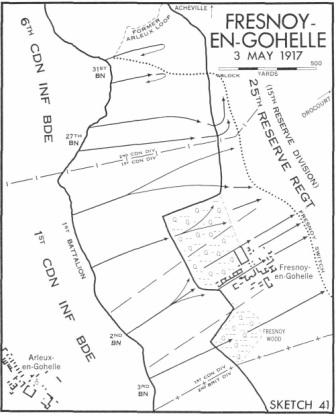
Wood’s luck ran out on May 3, 1917, when he was killed in action during the Battle of Arras, in the third battle of the Scarpe near Fresnoy, at the age of 19.  In “Hell Upon Earth: A Personal Account of Prince Edward Island Soldiers in the Great War, 1914-1918”, published in 1995, author J. Clinton Morrison, Jr. explained that Wood, a Signaller, “was killed in the Fresnoy darkness while repairing telephone communications during the pre-dawn attack.”  His body was never recovered and his name is engraved on the Vimy Memorial in France.

While it’s not known if Wells and Wood ever met each other, their military lives had many parallels and they died within 5 days of each other in France.  If anyone has more information, please contact Pieter at memorialtrail@gmail.com or comment on the blog.   Please note that we are still looking for photos of 10 names listed on the Cenotaph from WW1.  See Appeal For Relatives Of These WW1 Casualties! for more information.

 © Daria Valkenburg

Canadian War Graves Netherlands Foundation Project

August 4, 2018.  This blog concentrates on the names listed on the Cenotaph Research Project.  We provide a summary of the research results, talk about our trips to monuments and cemeteries, and the families that we meet.  We occasionally mention interaction with other archives, and the information on the names listed on our Cenotaph that we’ve shared.

For example, when we were in France, we left information and photos on WWI soldiers John Lymon WOOD and Patrick Raymond ARSENAULT with the site manager at Vimy Ridge (See  Visiting The Canadian National Vimy Memorial)  In Belgium, we left information and photos on WWI soldiers Charles Benjamin Murray BUXTON and George Albert CAMPBELL at In Flanders Field Museum in Ypres. (See Sharing Information at In Flanders Field Museum in Ypres) Information on WWI soldier Vincent CARR was sent to the Memorial Museum Passchendaele 1917 in Passchendaele.  (See On The War Memorial Trail of Passchendaele and Surrounding Area) 

In The Netherlands, we did the same for WWII soldiers William Douglas SHERREN and George Martin MCMAHON, buried in the Canadian War Cemetery in Holten (See On the War Memorial Trail ….. At Holten Canadian War Cemetery) and George Preston SMITH, buried in the Canadian War Cemetery in Groesbeek. (See On the War Memorial Trail ….. PEI Soldiers Buried In The Canadian War Cemetery in Groesbeek) In addition, we’ve shared information with various university archives and regimental archives.

In this blog entry we’d like to feature a project in The Netherlands, the Canadian War Graves Netherlands Foundation. In this project, which is of special interest to Pieter because of his Dutch roots, the foundations for the three Canadian War Cemeteries in The Netherlands have banded together to create a digital monument for ALL Canadian war graves in their country.   Almost 7,600 Canadian WWII soldiers are buried there! When Pieter was asked to help find families, stories, and photos, he didn’t hesitate.

Over the past few years, he’s put out a call for help through the various PEI legions.  Several families submitted information directly to The Netherlands, others sent information and photos to Pieter for forwarding.  The families of Carman GILLCASH and Daniel Peter MACKENZIE chose to go through Pieter, and recently the Comeau family in Nova Scotia shared information about Joseph Ambrose COMEAU.  All three are buried in Holten Canadian War Cemetery.  We’ve not met any of these family members, perhaps one day.

A few weeks ago, however, Pieter received a request from Alice van Bekkum, a member of the Royal Canadian Legion in The Netherlands, and a tireless advocate for remembering the sacrifice of Canadian soldiers in liberating The Netherlands.  Her request was to track down an article entitled ‘A Journey of the Heart’, about a pilgrimage made by the family of William ‘Willie’ Alfred CANNON of Mt. Mellick, who was killed in 1945 in Germany (the article incorrectly says The Netherlands) and is buried at Groesbeek Canadian War Cemetery.  Pieter had placed flags at his grave last fall, so the name was not unfamiliar.

CIMG9021 Sep 16 2017 Groesbeek Cemetery Pieter by grave of WA Cannon

Pieter at the grave of William Cannon at Groesbeek Canadian War Cemetery. (Photo credit: Daria Valkenburg)

IMG_20170916_125248934 Sep 16 2017 Groesbeek Cemetery grave of WA Cannon

Grave of William Cannon at Groesbeek Canadian War Cemetery. (Photo credit: Pieter Valkenburg)

With the help of Jocelyne Lloyd, news editor at The Guardian, the article, written by Mary MacKay and published on November 8, 2008, was found and a digital copy was soon on its way to The Netherlands.  (See article: Journey From The Heart Cannon article from 2008)

The real story came when Pieter got in touch with Cannon’s nephews Carl and Alfred Cannon, and niece Irene Doyle to inquire about the possibility of them donating photos for the Dutch Project.  “Did we want to come to the place where ‘Uncle Willie’ grew up and meet them?” he was asked. This soon became a story of remembrance……

Carl Cannon now owns the homestead, and we expected to meet him and his brother Alfred. But we were in for a surprise! They invited their sister, Paulette Duffy, and their brother Anthony.  Cousin Bill Cannon came over from Nova Scotia.  Cousin Irene Doyle, who was featured in The Guardian story, also arrived.  It was a full house, and a happy occasion, filled with stories of Uncle Willie that they had heard from their parents and grandparents.

CIMG1276

At the Cannon homestead. Left to right: Pieter Valkenburg, Alfred Cannon, Anthony Cannon, Carl Cannon, Paulette Duffy, Bill Cannon, Irene Doyle. (Photo credit: Daria Valkenburg)

All of the Cannon nieces and nephews had been born after his death, which made this visit remarkable.  Paulette explained that “memory was kept alive as the family always talked about Willie.”  Bill said that his father Harry, who served in the Navy during WWI, was the closest to Willie.  “They were hellions as children, so the stories were so interesting!” laughed Pauline.

Andy Cannon, Willie’s cousin who was in the North Nova Scotia Highlanders, was with Willie the night before he died” said Bill.  “Did you want to talk to his son Garry in Sarnia?”  So another Cannon shared some memories, over a cell phone.

The Cannon family shared photos, letters, and many stories, which are making their way to the digital archive set up in The Netherlands.  Our last stop before heading home was to visit the Cenotaph by St. Joachim’s Roman Catholic Church in Vernon River, where Willie Cannon is mentioned.  “Every Remembrance Day I bring a photo of Uncle Willie” Alfred explained.  And sure enough, Uncle Willie’s photo came along on this visit too.

CIMG1286

At the Cenotaph by St. Joachim’s Roman Catholic Church in Vernon River. Left to right: Bill Cannon, Paulette Duffy, Alfred Cannon. Note photo of Uncle Willie on the Cenotaph. (Photo credit: Daria Valkenburg)

If you have photos or stories to share about other WWII soldiers buried in The Netherlands, and haven’t already sent them to one of the cemeteries there, please help them build up their digital archive so that these soldiers will always be remembered.

If you would like Pieter to come and speak about the Cenotaph Research Project, or how Islanders can help with the Canadian War Graves Netherlands Foundation Project, he is open to receiving invitations.  Email him at memorialtrail@gmail.com.

Photos are still needed for many of the names on the Cenotaph outside the Borden-Carleton Legion.  Please dig out those old albums and take a look.  You can share your photos, comments, or stories by emailing us at memorialtrail@gmail.com or by commenting on this blog.

© Daria Valkenburg

…Want to follow our research?….

If you are reading this posting, but aren’t following our research, you are welcome to do so.  Our blog address: https://onthewarmemorialtrail.com/

Front cover OnTheWarMememorialTrailinEurope4 countries, 6 weeks, 7,000 km – an unforgettable war memorial journey in Europe…. Daria’s book ‘No Soldier Buried Overseas Should Ever Be Forgotten‘ is available in print and e-book formats.  Net proceeds of book sales help support research costs and the cost of maintaining this blog. For more information see https://nosoldierforgotten.com/ 

You are also invited to subscribe to our YouTube Channel: On The War Memorial Trail With Pieter Valkenburg: https://www.youtube.com/channel/UCJ591TyjSheOR-Cb_Gs_5Kw

Never miss a posting!  Subscribe below to have each new story from the war memorial trail delivered to your inbox.
On The War Memorial Trail….Visiting The Canadian National Vimy Memorial

September 18, 2017.  After the tour of the Vimy Memorial Visitors’ Centre and the tunnels, we went to visit the Canadian National Vimy Memorial. Although familiar to us from seeing it on TV, the memorial is much larger and majestic in person.

CIMG8468 Sep 6 2017 Mother Canada memorial at Vimy Ridge

Canadian National Vimy Memorial from a distance. (Photo credit: Daria Valkenburg)

CIMG8295 Sep 5 2017 Canadian National Vimy Memorial closer up with twin white pylons

Canadian National Vimy Memorial showing the twin white pylons, one bearing the maple leaves of Canada, the other the fleurs-de-lys of France, to symbolize the sacrifices of both countries. Beside one of the pylons is the statue Canada Bereft. Below the pylons is The Tomb. (Photo credit: Daria Valkenburg)

Site manager Johanne Gagné noted that “this monument is special because it focuses on values the soldiers shared and ultimately gave their lives for.”  11,285 names are inscribed on the memorial, two of them who also are on the Cenotaph outside the Borden-Carleton Legion:  John Lymon Wood and Patrick Raymond Arsenault.  Pieter immediately went to search out these two names.

IMG_20170905_114855242 Sep 5 2017 Vimy Memorial Inscription Arsenault

Patrick Raymond Arsenault inscribed on Vimy Memorial. (Photo credit: Pieter Valkenburg)

IMG_20170905_115420984 Sep 5 2017 Vimy Memorial Inscription Wood

John Lymon Wood inscribed on Vimy Memorial. (Photo credit: Pieter Valkenburg)

After finding the inscriptions, Pieter next looked for two plaques brought to the memorial in April by the students of Kinkora Regional High School and teacher Kevin Bustard.  Kevin had the plaques made after reading about Wood and Arsenault in an April 2017 article in the County Line Courier. (See CLC Apr 5 2017 p9 Two Unsung Heroes of Vimy Ridge)

To everyone’s surprise, the plaques were still at the Memorial. Arsenault’s was on The Tomb, and Wood’s was by his inscription.

CIMG8294 Sep 5 2017 tributes on The Tomb

Tributes left on The Tomb at the Vimy Canadian National Memorial. You can see the plaque for Patrick Raymond Arsenault on the far left. (Photo credit: Daria Valkenburg)

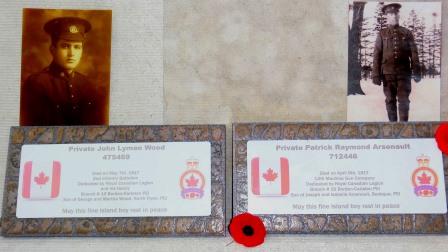
Pieter reunited both plaques with photos of the two soldiers.

CIMG8299 Sep 5 2017 Wood & Arsenault Plaques

Plaques and photos of John Lymon Wood and Patrick Raymond Arsenault. (Photo credit: Daria Valkenburg)

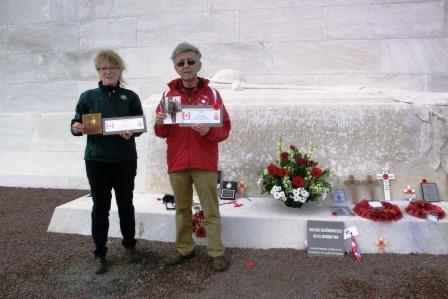
While the plaques were left at the Memorial, the photos and information about Wood and Arsenault were given to Johanne Gagné, who told us that “the French are still welcoming and grateful for the sacrifices made by Canadians and say thank you.  They are grateful to Canada for keeping the memory alive after 100 years.  It’s humbling.”

CIMG8301 Sep 5 2017 Sep 5 2017 Johanne Gagne with Wood and Pieter with Arsenault

Johanne Gagné with plaque and photo of John Lymon Wood while Pieter holds plaque and photo of Patrick Raymond Arsenault. (Photo credit: Daria Valkenburg)

This was the end of our tour of Vimy Ridge and the Memorial.  It had been a special day and we salute Johanne Gagné for the time she spent giving us a wonderful tour and patiently answering our many questions.  Merci beaucoup Johanne!

In the next blog entry we explore two of the memorials in the Thélus area.  Comments or stories?  You can share them by emailing us at memorialtrail@gmail.com or by commenting on this blog.

© Daria Valkenburg

….Want to follow our research?….

If you are reading this posting, but aren’t following our research, you are welcome to do so.  Our blog address: https://onthewarmemorialtrail.com/

Front cover OnTheWarMememorialTrailinEurope4 countries, 6 weeks, 7,000 km – an unforgettable war memorial journey in Europe…. Daria’s book ‘No Soldier Buried Overseas Should Ever Be Forgotten‘ is available in print and e-book formats.  Net proceeds of book sales help support research costs and the cost of maintaining this blog. For more information see https://nosoldierforgotten.com/ 

You are also invited to subscribe to our YouTube Channel: On The War Memorial Trail With Pieter Valkenburg: https://www.youtube.com/channel/UCJ591TyjSheOR-Cb_Gs_5Kw

Never miss a posting!  Subscribe below to have each new story from the war memorial trail delivered to your inbox.
On The War Memorial Trail….Visiting the Tunnels at Vimy Ridge

September 14, 2017.  After the tour of the Vimy Memorial Visitors’ Centre, Pieter and site manager Johanne Gagné went to explore the tunnels.  Pieter was in second heaven!  They saw two of the many tunnel systems, one used by the Black Watch, and one used by the Princess Patricia Light Infantry.

IMG_20170905_103810241 Entrance to a Vimy Tunnel used by Princess Pats

Photo: Entrance to a tunnel used by the Princess Patricia Light Infantry. (Photo credit: Pieter Valkenburg)

Some of the main tunnels at Vimy Ridge have been restored to make them safer and reinforced with concrete floors, as well as some of the walls.  All of the tunnels were named by the WWI soldiers so that they would know where they were.

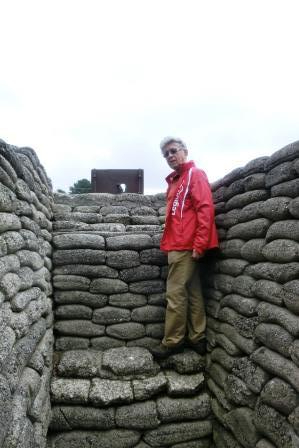
Tunnels were used for two main purposes: to safeguard troops from enemy fire, and for transportation of materials such as bombs and mines that could be used to blow up German tunnels.  A narrow gauge railway system was installed as whatever materials were dug out to make the tunnels had to be transported out and then covered so that enemy observation planes couldn’t spot mounds of earth and be aware of where digging was going on.

Using the material transported into the tunnels, Allied forces tried to undermine the trenches of the Germans by blowing them up from inside the tunnels.  This had the advantage of allowing Allied forces to safely advance without being exposed to enemy fire.

IMG_20170905_105716402

Pieter by the as yet unrestored tunnel used by the Black Watch. Note the wagon in the background. (Photo credit: Johanne Gagné)

IMG_20170905_104523941 Tunnel used by Black Watch

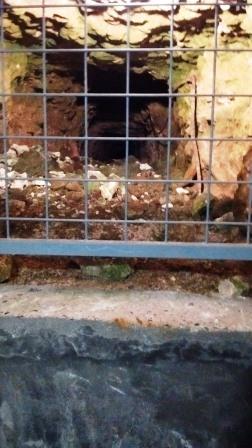
An as yet unrestored portion of the Grange tunnel. (Photo credit: Pieter Valkenburg)

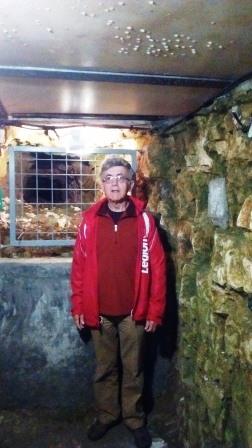
IMG_20170905_104540988 Pieter in a reinforced part of the tunnel

Pieter in a reinforced part of the Grange tunnel. (Photo credit: Johanne Gagné)

Some tunnels were designed for living quarters and as command centres.  Messages were passed along from the command centre by runners to the troops.  There were ways out of the tunnels into the trenches.

An interesting and surprising fact Pieter learned was that electricity was in the tunnels.  They had electric lights in the Vimy tunnels! As Johanne Gagné noted, “…So modern!..

Near Vimy was a tunnel called the Maison Blanche (“The White House”), so named because the outside building was white in colour.  That tunnel used candles for lighting.

In Pieter’s opinion, the unrestored tunnels gave a better picture of what had gone on at the time.  The restored tunnels give you a safer impression of what happened, but doesn’t have the impact of the dire conditions the men worked in. “…I was amazed by how many tunnels there were, going in all directions…” Pieter explained.  “It was a real maze…

From the observation post, you can still see a big crater where Allied troops blew up a trench.

CIMG8287 Sep 5 2017 Pieter & Johanne by observation post at Vimy Ridge

Pieter and Johanne Gagné by the observation post overlooking ‘no man’s land’ – territory that was not held by either the Germans or the Allies. (Photo credit: Daria Valkenburg)

We were very interested in the observation post as Gunner Harold Keith HOWATT of the 8th Siege Battery spent a lot of World War I in an observation post, and we had wondered what one looked like.  So Pieter went into one and took a look.

CIMG8289 Sep 5 2017 Pieter in observation post at Vimy Ridge

Pieter in an observation post at Vimy Ridge. (Photo credit: Daria Valkenburg)

Howatt participated in the Battle of Vimy Ridge in April 2017, and survived.  In fact, he survived the war and came back home to Augustine Cove and had a career as a teacher.

But back in February 1918, his unit was back at Vimy Ridge.   In his diary entry of Saturday, February 16, 1918, he recorded the following observations:

….In the afternoon I took a walk up to the top of Vimy Ridge.  It is some place, never yet have I seen a place so battle scarred.  There are shell holes everywhere, hardly two square yards of level ground on the ridge.  And the mine craters, they are tremendous.  Some must be from 40 to 50 feet deep and from 40 to 50 yards across. 

There is a large monument on the top to the 44th Battalion, with the names of all the officers and men, who were killed during the attack on the ridge on April 9, inscribed on it.  There is also a monument to the 78th Battalion, and one to a sergeant of the Winnipeg Grenadiers who set off an enemy mine and lost his life in the act.  The crater is called the ‘Winnipeg Grenadier’.  There is also a monument to a major and to Lieutenant Gass of the 5th Canadian Siege Battery, who was killed in an O. P. (note:  Observation Post) the day before Vimy was taken.

There was a party of English labour tourists on the top of the ridge while I was up there.  Was talking to one fellow for a few minutes, pointing out Lens, Avion, and place within our own lines, to him….

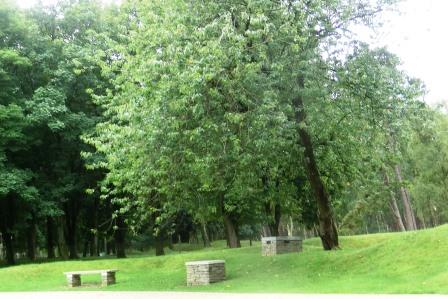
We weren’t sure if the crater referred to by Howatt is the same one to be seen from the observation post outside the Visitors Centre.  We did not see the monuments described by Howatt and guess they are no longer there.  And Vimy Ridge is now filled with trees, a barren landscape no more.

CIMG8286 Sep 5 2017 Vimy Ridge today is tree lined again

Vimy Ridge is now filled with trees. (Photo credit: Daria Valkenburg)

Johanne Gagné had given us a fantastic tour so far, but there was more.  In the next blog entry we visit the Canadian National Vimy Memorial, and bring along the photos of John Lymon Wood and Patrick Raymond Arsenault, whose names are inscribed on the memorial.

Comments or stories?  You can share them by emailing us at memorialtrail@gmail.com or by commenting on this blog.

© Daria Valkenburg

….Want to follow our research?….

If you are reading this posting, but aren’t following our research, you are welcome to do so.  Our blog address: https://onthewarmemorialtrail.com/

Front cover OnTheWarMememorialTrailinEurope4 countries, 6 weeks, 7,000 km – an unforgettable war memorial journey in Europe…. Daria’s book ‘No Soldier Buried Overseas Should Ever Be Forgotten‘ is available in print and e-book formats.  Net proceeds of book sales help support research costs and the cost of maintaining this blog. For more information see https://nosoldierforgotten.com/ 

You are also invited to subscribe to our YouTube Channel: On The War Memorial Trail With Pieter Valkenburg: https://www.youtube.com/channel/UCJ591TyjSheOR-Cb_Gs_5Kw

Never miss a posting!  Subscribe below to have each new story from the war memorial trail delivered to your inbox.

On The War Memorial Trail….A Visit To Vimy Ridge

September 12, 2017.  After a few hectic days when there was no time to do any writing as we were on the go from early morning until quite late in the evening, we now are settled for a few days in a quiet cottage in a forested area, and hopefully can catch up with all of the memorable days we’ve just experienced.

The most anticipated stop on our memorial trail of honouring the men listed on the Borden-Carleton Cenotaph was Vimy Ridge.  Two WWI soldiers are listed on the Canadian National Vimy Memorial, John ‘Lymon’ WOOD and Patrick Raymond ARSENAULT.

Our hotel was in Arras, and Vimy Ridge was a 20 minute drive from there.  Just before the turn-off to Vimy Ridge we passed through the town of Thélus.  There is one stop light in town.  To the left are signs directing you to cemeteries and memorials.  To the right are signs directing you to more memorials.

Right by the stop light is the Canadian Artillery Memorial, built to remember the sacrifice of Canadians from Artillery battalions who died in the battle for Vimy Ridge and the surrounding area.

CIMG8309 Sep 5 2017 Cdn Artillery Memorial in Thelus with sign posts

The Canadian Artillery Memorial in Thélus was built during WW1 by the Canadian Corps. (Photo credit: Daria Valkenburg)

It’s daunting to see how many reminders of war there are in France.  Everywhere you go, you see memorials and cemeteries – both civilian and military.  It’s a grim reminder of how many people lost their lives.  It’s impossible to ignore or forget.  And it’s a very big reminder of how many countries came to help in the Allied cause during World War I.  It truly became an international war.  Every one of them has at least one memorial and the war cemeteries are filled with Allied and German lives lost.

CIMG8270 Sep 2017 Pieter at entrance to Vimy Memorial Park

Pieter at the entrance to Vimy Ridge in France. (Photo credit: Daria Valkenburg)

The turn-off to the Vimy Ridge memorial and visitors centre is a tree-lined road, with jogging and walking paths, well used by citizens of the area.  It’s a public road that goes to the nearby villages of Givenchy and Vimy.

We were very lucky to have been given a guided tour of the Vimy Ridge Visitors Centre, which opened in April 2017, by site manager Johanne Gagné.

CIMG8275 Sep 5 2017 Pieter with site manager Johanne Gagne

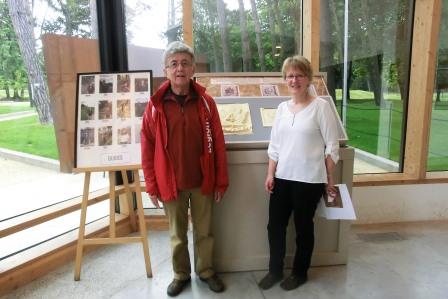
Pieter with Johanne Gagné, Senior Manager, European Operations at the Canadian National Vimy Memorial, who gave us a guided tour. (Photo credit: Daria Valkenburg)

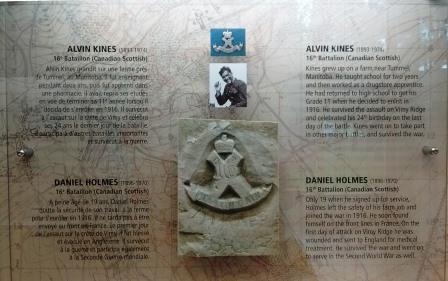
Among the many exhibits in the Visitors Centre is one that replicates the graffiti found in the tunnels of Vimy Ridge.  Using 3-D technology, exact replicas of the graffiti have been made, and researchers have tried, where possible, to provide a face and story to the men who made the graffiti.

Ms. Gagné noted that this graffiti display will be on tour in various places in Canada after leaving Vimy Ridge.  If it comes to your area, you won’t want to miss it!

We certainly had the right person to give us a tour, as Ms. Gagné worked for two years in Canada in developing the visitors centre before coming to France for two years as part of an interchange agreement with Parks Canada.  Hailing from Coteau-du-Lac, Quebec, she has a background in museology, exhibit design, and developing visitors programming.  Our interest was certainly caught, and this was from one exhibit only.

IMG_20170905_093513986 Sep 5 2017 Graffiti at Vimy Ridge by Kines & Holmes

Graffiti replicas of the 15th Battalion and a photo and short bio of two names inscribed below the insignia, that of Alvin Kines and Daniel Holmes. (Photo credit: Pieter Valkenburg)

The Visitors Centre has many interactive displays, in three languages (English, French, German), and one of the displays is very personal.  It tells the story of World War I from the perspectives of a young girl, a soldier, a nurse, etc, and all the stories are based on letters and diaries of real life people.

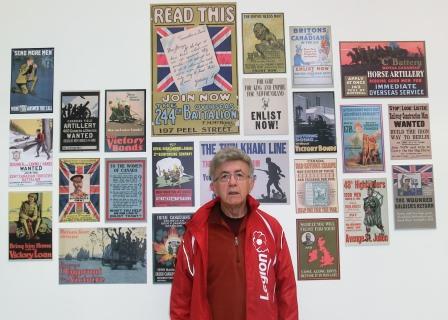
We were fascinated by a wall of patriotic signs, urging support for the war.

CIMG8277 Sep 5 2017 Vimy Ridge Visitors Centre Pieter by patriotic signs

Pieter by one of the displays of patriotic signs. (Photo credit: Daria Valkenburg)

An interactive display explained the troop movements during the Battle of Vimy Ridge on April 8, 1917.  Another interactive display gave a tour of the tunnels below Vimy Ridge. This was a marvellous solution to see the tunnels, especially if you were not physically capable of entering the tunnels yourself.

CIMG8283 Sep 5 2017 Daria by interactive displays in Vimy Ridge Visitors Centre

Daria by the interactive display of the Vimy Ridge tunnels. Behind are the displays of stories of WW1 by individuals. (Photo credit: Johanne Gagné)

We asked Ms. Gagné her perspective of the Vimy Ridge Visitors Centre and Memorial.  “Most of the time, people come and say that they came to honour the sacrifices made.  I asked myself, what does it mean to me?  Why have I spent three years on this project?  I’m giving the soldiers a voice.  I hope that through the exhibits, that we can show the public how the soldiers lived, what they saw, what they did, and close the loop by telling their stories”  The exhibits certainly do that.  They are interesting and well done.

The tour of the Visitors Centre over, it was time to see the rest of Vimy Ridge.  On Pieter’s bucket list was a tour of the tunnels, a wish that was granted, and discussed in the next blog.  While he and Ms. Gagné prepared themselves for the tunnels, I took a look at the tunnels from the comfort and safety of the Visitors Centre.

Comments or stories?  You can share them by emailing us at memorialtrail@gmail.com or by commenting on this blog.

© Daria Valkenburg

….Want to follow our research?….

If you are reading this posting, but aren’t following our research, you are welcome to do so.  Our blog address: https://onthewarmemorialtrail.com/

Front cover OnTheWarMememorialTrailinEurope4 countries, 6 weeks, 7,000 km – an unforgettable war memorial journey in Europe…. Daria’s book ‘No Soldier Buried Overseas Should Ever Be Forgotten‘ is available in print and e-book formats.  Net proceeds of book sales help support research costs and the cost of maintaining this blog. For more information see https://nosoldierforgotten.com/ 

You are also invited to subscribe to our YouTube Channel: On The War Memorial Trail With Pieter Valkenburg: https://www.youtube.com/channel/UCJ591TyjSheOR-Cb_Gs_5Kw

Never miss a posting!  Subscribe below to have each new story from the war memorial trail delivered to your inbox.

WWI Soldier Private Patrick Raymond Arsenault Uncovered

CIMG7870 Pieter Valkenburg and Paul Arsenault Great Nephew of P.R. Arsenault.JPG

Photo: Pieter with Paul Arsenault and a photo of Patrick Raymond Arsenault.  (Photo credit: Daria Valkenburg)

August 7, 2017. With the 100th anniversary of the end of WWI coming up in 2018, Pieter has been actively searching for photos of the men listed on the Cenotaph who died during WW1 as he would like to have a Wall of Remembrance in the Legion.

Private Patrick Raymond ARSENAULT, who was born in Bedeque on October 14, 1896 to Joseph Arsenault and Isabella nee Richard, is one of the two men on the Cenotaph whose names are on the Vimy Memorial in France.

In the lead-up to the centenary of the Battle of Vimy Ridge in April, his story was told in newspapers, and in a French language interview on CBC Radio-Canada given by Don Arsenault.  More coverage was given in the Journal Pioneer (see http://www.journalpioneer.com/news/local/2017/4/9/special-day-of-remembrance-for-bedeque-soldier.html ) and La Voix Acadienne following the commemoration ceremonies at the Legion in April. (See http://www.lavoixacadienne.com/index.php/patrimoine/1756-des-soldats-a-vimy-sont-honores.)  Unfortunately, up to that time, no family had been found, and no photo was available.

On Saturday, August 5, Paul Arsenault of Borden-Carleton, great-great-nephew of Arsenault, contacted Pieter to say he had a photo of his great-great-uncle after his aunt, Eileen Perry, showed him an article about Arsenault in the County Line Courier (See CLC Apr 5 2017 p9 Two Unsung Heroes of Vimy Ridge).  …I found the photo in a chest that my mother Noreen had saved from her mother…” he said.  Noreen and Eileen are the granddaughters of Private Arsenault’s sister Mary Ethel Gaudet.

Patrick Raymond Arsenault from Paul Arsenault.jpg

Photo: Patrick Raymond Arsenault in 1916 in Summerside.  (Photo courtesy of Paul Arsenault collection)

It’s wonderful when family members are willing to help in the Cenotaph Research Project! Thank you Paul!  Readers, do you have more information on Patrick Raymond Arsenault?  Let us know by commenting on this blog, or email Pieter at memorialtrail@gmail.com.

See related article published on August 9, 2017  CLC p30 Aug 9 2017 Face for Arsenault

© Daria Valkenburg

….Want to follow our research?….

If you are reading this posting, but aren’t following our research, you are welcome to do so.  Our blog address: https://onthewarmemorialtrail.com/

Front cover OnTheWarMememorialTrailinEurope4 countries, 6 weeks, 7,000 km – an unforgettable war memorial journey in Europe…. Daria’s book ‘No Soldier Buried Overseas Should Ever Be Forgotten‘ is available in print and e-book formats.  Net proceeds of book sales help support research costs and the cost of maintaining this blog. For more information see https://nosoldierforgotten.com/ 

You are also invited to subscribe to our YouTube Channel: On The War Memorial Trail With Pieter Valkenburg: https://www.youtube.com/channel/UCJ591TyjSheOR-Cb_Gs_5Kw

Never miss a posting!  Subscribe below to have each new story from the war memorial trail delivered to your inbox.

Learning About The Two Names On The Vimy Memorial

Pieter Valkenburg

Photo: Borden-Carleton Branch Service Officer Pieter Valkenburg doing research (Credit: Daria Valkenburg)

July 28, 2017.  After the first article about the Borden-Carleton Cenotaph Research Project ran in October 2016, Pieter decided to focus on the WWI soldiers listed on the cenotaph, and began intensive research over the winter.
In the meantime the first article ran in the PEI Genealogical Society Newsletter and a shorter version ran in Charlottetown’s Guardian.  The Carr descendants of Vincent CARR had said that he was single, and the military attestation paper when he signed up agreed with this.  However, we found out that sometime between enlisting on June 5, 1915 and his death on October 30, 2017, he married Bessie H. Carr of Summerside.  Sadly she died a year after her husband.  Unfortunately, we have no photo of Bessie Carr, nor were we able to find a marriage record.  Can anyone help?

In his research, Pieter found two soldiers on the monument whose names are inscribed on the Canadian National Vimy Memorial in France.  One was in the wrong place at the wrong time due to a name mix-up and died, the other survived the battle, only to perish a month later.  Their tales became the subject of the second article about the project.

Patrick Raymond ARSENAULT was the soldier who was transferred by error and ended up in the Battle of Vimy Ridge, died on April 11, 1917.

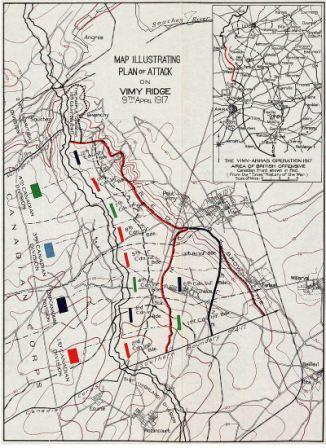
Plan_of_Attack_Vimy_Ridge where Arsenault died

Plan of Attack for Vimy Ridge where Patrick Raymond Arsenault died. The 2nd Canadian Brigade, part of the 1st Canadian Division, is in red. (Source: Library and Archives Canada/First World War map collection/e000000519_a4)

John Lyman WOOD survived the battle, but died on May 3, 1917 during the Battle of Arras.

Map of Battle of Arras near Fresnoy where Lymon Wood died

Battle of Arras near Fresnoy where John Lyman Wood died (Photo credit: Official History of the Canadian Army in the First World War: Canadian Expeditionary Force 1914-1919, G.W.I. Nicholson)

We have not been able to find any photo of Patrick Raymond Arsenault. Can you help? UPDATE: PHOTO FOUND

John Lyman Wood is well cherished in the memories of his family, and his nephew Gene Rogerson provided a photo and background information to bring his story to life.

We hope you enjoy this second article that ran in April 2017, “Two Unsung Heroes Of Vimy Ridge” in the County Line Courier.   CLC Apr 5 2017 p9 Two Unsung Heroes of Vimy Ridge A shorter version of this article also ran in Charlottetown’s Guardian.

If you have photos or documents you’d like to share, please email them to memorialtrail@gmail.com.  Comments or stories?  You can share them by email or by commenting on this blog.

© Daria Valkenburg

….Want to follow our research?….

If you are reading this posting, but aren’t following our research, you are welcome to do so.  Our blog address: https://onthewarmemorialtrail.com/

Front cover OnTheWarMememorialTrailinEurope4 countries, 6 weeks, 7,000 km – an unforgettable war memorial journey in Europe…. Daria’s book ‘No Soldier Buried Overseas Should Ever Be Forgotten‘ is available in print and e-book formats.  Net proceeds of book sales help support research costs and the cost of maintaining this blog. For more information see https://nosoldierforgotten.com/ 

You are also invited to subscribe to our YouTube Channel: On The War Memorial Trail With Pieter Valkenburg: https://www.youtube.com/channel/UCJ591TyjSheOR-Cb_Gs_5Kw

Never miss a posting!  Subscribe below to have each new story from the war memorial trail delivered to your inbox.