On The War Memorial Trail…..A Mariner Named Arsenault Who Drowned In South America

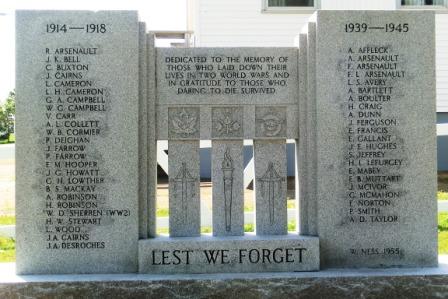
Cenotaph outside Borden Carleton Legion by Pieter Valkenburg

Cenotaph outside the Borden-Carleton Legion. (Photo credit: Pieter Valkenburg)

July 18, 2020.  When Pieter first began researching the names on the Cenotaph outside the Borden-Carleton Legion, he had a lot of slogging to do to figure out who these names represented.  There were no records, Legion minutes that might have shed light on how the names were selected were missing, and no newspaper accounts could be found that identified the names.

With a lot of hard work digging through war diaries, and reading of soldier records found at Library and Archives Canada, and the cooperation of the families of several  of these men in providing photos and letters written by them, 45 of the 46 names originally listed on the Cenotaph were identified.  Along the way, 2 more names that were inadvertently missed were added.

The one missing name, an F. Arsenault, remained a question mark.  No soldier could be identified as a possibility, so Pieter turned to records from the Canadian Merchant Navy.  There was one likely possibility…. Joseph ‘Francis’ ARSENAULT, born May 15, 1928 in Tignish.  At the time of his application for a Merchant Seaman’s Identity Certificate in Halifax on November 19, 1945, both he and his father Basil were listed as living in Albany.  His mother, Angeline Pire, had died in 1929 in Palmer Road.
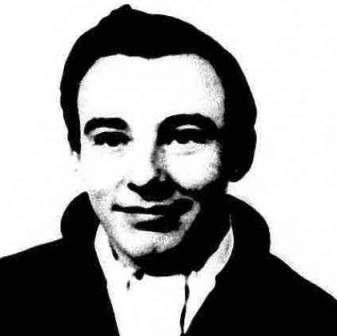
image of francis arsenault_Page_1

Image of Francis Arsenault from his Application For Merchant Seaman’s Identity Certificate

With the help of Donna Matthews of Veterans Affairs, the story was pieced together.  Francis Arsenault’s first voyage was on the ‘Asbjorn’, as a U/Boy (Utility boy), serving between November 27 and December 7, 1945.

He then was sent to the ‘Argyle Park’ as a mess boy on December 7, 1945, sailing to St John, for two voyages and leaving the ship in St John on January 17, 1946.

On January 23, 1946 he transferred to the ‘Hampstead Park’ as an m/boy (mess boy), and was discharged on May 18, 1946.

His next voyage was aboard ‘Noranda Park’, as a galley boy, sailing on May 20, 1946, arriving on July 29, 1946 in Port Alfred, South Africa.  The ship was then renamed ‘Oceanside’ and he signed on for another voyage from Port Alfred to Georgetown, Guyana.  While on ‘Oceanside’ he was promoted to second cook.

According to the website Fort Ships of WW2, “…the ‘Park’ ships were run by the Park Steamship Company and were named after well-known national, provincial or municipal parks in Canada.  The Company became a Canadian Government Crown Corporation in 1942 to own, manage and operate the ships allocated to it for the purposes of the war…. The appointed Canadian managers were responsible for the hiring of crew and officers as well as supplying the ships with fuel and supplies.  They had little control over the routing of the vessel, or the cargo as war materials took precedence… After the war the fleet was gradually disposed of…” (See http://fortships.tripod.com/Parks%20A-N.htm)

map of guyana from Pinterest

Unfortunately, ‘Oceanside’ was his last ship.  On August 12, 1946, while the ship was in Mackenzie City (now part of Linden) on the Demerara River in Guyana (in South America), he drowned after he fell out of a small boat while returning to the ship ‘under the influence of drink’, according to the Department of Transport Central Register of Seamen.

A large mining camp established by the Aluminum Company of Canada (later nationalized as the Guyana Bauxite Company) was in this area. Bauxite mined here would have been brought to Mackenzie City for processing and then loaded onto oceangoing vessels.  Most likely, this was why ‘Oceanside’ was in Guyana.

According to the Official Log of ‘Oceanside’ for August 12, 1946, the Captain wrote that “…This is to certify that the Chief Steward reported to me that at 00:30 this morning that F. Arsenault 2nd Cook, had fallen out of a boat when returning to the ship, very much under the influence of drink, and was drowned. He was not seen after he left the boat, he sank like a stone. J. Hilliard, who was with him, jumped after him to attempt to rescue him, but after swimming around for some time without finding any trace of him he gave up the attempt, but with others from the ship who saw the accident continued the search with flashlights along the beach in both up and down stream from the spot he fell in, hoping they may find him clinging to something. This search went on until 01:45, when the men returned to the ship, and the 3rd mate reported with regret that they were unsuccessful….

It was a mystery why Arsenault was considered a veteran when he died more than a year after WW2 ended.  Donna Mathews explained that “…Per the Canada Remembers Section of Veterans Affairs, Arsenault was added to the Merchant Navy Book of Remembrance and Canadian Virtual War Memorial.  The cut-off date to include those that died during the Second World War was December 30, 1947…

Thank you to Donna Mathews for her assistance in researching this merchant mariner’s story.  If anyone has more information or a photo for Francis Arsenault, please contact Pieter at dariadv@yahoo.ca or comment on the blog.

© Daria Valkenburg

The WWII Mariner From Kinkora Whose Ship Was Torpedoed In The Caribbean

February 20, 2020. On the Cenotaph outside the Borden-Carleton Legion there are 3 men who lost their lives due to being on ships that were torpedoed.  Two of these stories have already been told….

In WWI, mariner James Graham FARROW (FARRAR) lost his life when the ship he was working on was torpedoed in the English Channel on March 19, 1916.  The steamer, ‘Port Dalhousie, had been ferrying needed supplies from Britain to troops in France, while using the cover of being a fishing vessel. (See https://onthewarmemorialtrail.com/2019/01/20/the-mariner-whose-ship-was-torpedoed-in-the-english-channel/)

In WWII, Everett Samuel FRANCIS had the misfortune of being a passenger on the ferry S.S. Caribou when it was torpedoed off the coast of Newfoundland on Wednesday, October 14, 1942.  He was on his way back to his unit in Gander, and to meet his three week old daughter Greta, after being in Ontario for weapons training. Unfortunately, he was not one of the survivors. (See https://bordencarletonresearchproject.wordpress.com/2018/03/25/the-face-of-everett-samuel-francis/)

color photo Hughes, James Emmet

James Emmet Hughes. (Photo credit: courtesy “Around Kinkora Area” by G.K. Farmer.  Photo colourization by Pieter Valkenburg.)

Like James Graham FARROW (FARRAR), James Emmet HUGHES was a seaman in the Canadian Merchant Navy, not in the military.  Born in Kinkora on April 7, 1911, he was the son of Emmet Hughes and Mary Ann McKenna.

After joining the Waterman Steamship Agency of Mobile, Alabama, he was a trimmer aboard the Panamanian registered S.S. Ramapo, travelling between North America and England with badly needed supplies.  A trimmer works in the engine room on a coal-fired ship, such as the steamship Ramapo, responsible for loading of coal into the ship and delivering coal to the stoker or fireman. (See https://en.wikipedia.org/wiki/Coal_trimmer)

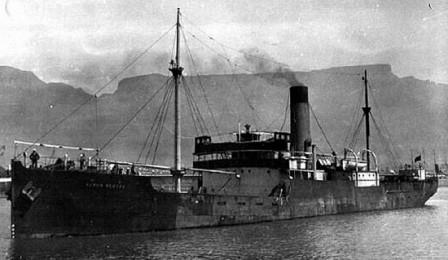
SS Ramapo under her former name Baron Wemyss.Courtesu of naviearmatori.net

S.S. Ramapo under her original name of Baron Wemyss. (Photo courtesy of http://www.naviearmatori.net)

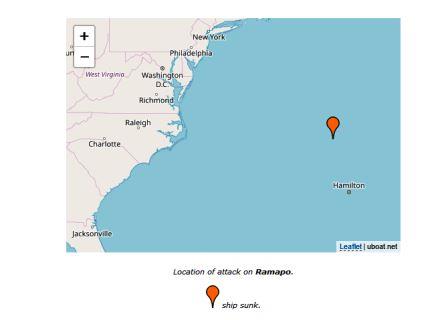
Hughes made two successful runs to England but then on a routing of London-Bermuda-Philadelphia, it was torpedoed by German U-Boat 108, captained by Klaus SCHOLTZ, 180 miles north of Bermuda. While Canadian Merchant Navy records list the event as having occurred on ‘approximately February 12, 1942’, the date it had arrived in Bermuda, German records of ships torpedoed by U-boats record the date as being February 16, 1942.

According to German records, as transcribed into English on https://www.uboat.net/allies/merchants/ship/1338.html, the ship had an international crew complement of 40, none of whom survived. “At 15.56 hours on 16 February 1942 the unescorted Ramapo (Master Johan Magnus Ørn Lorentzen) was hit on port side amidships by one G7e torpedo from U-108, broke in two after a boiler explosion and sank 11 minutes later about 180 miles north of Bermuda. The U-boat surfaced and questioned 34 men in lifeboats, but the survivors were never found. The master, 37 crew members and two gunners were lost.

Screenshot_2020-02-18 Ramapo (Panamanian Steam merchant) - Ships hit by German U-boats during WWII - uboat net

Map showing location of sinking of Ramapo.  (Map courtesy of http://www.uboat.net)

As you can imagine, in that time period, it was a long time before families learned that something had gone wrong.  On March 31, 1942, six weeks after the incident, The Guardian reported that the Hughes family had received a message from the steamship company, advising that it believed the ship had been sunk and all hands lost.

J.E. Hughes Guardian 31 march 1942 page 1

Source: Page 1 article in the March 31, 1942 edition of The Guardian.

Aboard the S.S. Ramapo on February 16, 1942 were the following crew members, per www.uboat.net:

Nationality Name Age Position
Greek Artavanis, Marios, Merchant Marine 29 Oiler
British Bailey, Mills Sandilands, Merchant Marine 44 Third Engineer
British Birch, John, Merchant Marine 50 Trimmer
Canadian Boyd, Fred, Merchant Marine 35 Messman
Canadian Boyer, Clarence, Merchant Marine 41 Fireman/Wiper
Canadian Brackenbury, Walter, Merchant Marine 22 Fireman/Wiper
Canadian Courville, Roland, Merchant Marine 18 Trimmer
Chilean Delano, Miguel, Merchant Marine 31 Second Mate
British Finch, Thomas, Merchant Marine 20 Messman
Dutch Glimmerveen, Albertus, Merchant Marine 38 Chief Cook
Canadian Green, William, Merchant Marine 29 Oiler
Norwegian Gustavsen, Karl Gustav, Merchant Marine 50 Chief Steward
Swedish Haggberg, Eric, Merchant Marine 22 Able Seaman
Norwegian Hansen, Bernhard, Merchant Marine 23 Fireman/Wiper
British Harris, William John, RN 24 Able Seaman (DEMS gunner)
Norwegian Helmers, Thorleif Gärtner, Merchant Marine 43 Chief Mate
British Hendry, Frederick William, Merchant Marine 52 First Engineer
Argentinian Hernandes, P., Merchant Marine 26 Fireman/Wiper
Canadian Hughes, James Emmet, Merchant Marine 31 Trimmer
Norwegian Kjennerud, Jul, Merchant Marine 24 Able Seaman
Canadian Knickle, Fred, Merchant Marine 39 Able Seaman
Norwegian Kristensen, Toralf, Merchant Marine 21 Able Seaman
Canadian Lalonde, Germain, Merchant Marine 20 Able Seaman
French Lawrence, Felix, Merchant Marine 30 Messman
British Leary, Vincent, Merchant Marine 35 Second Engineer
Norwegian Lie, Hans Kristian Jensen, Merchant Marine 20 Able Seamn
Canadian Lord, Ian McLean, Merchant Marine 18 Radio Operator
Norwegian Lorentzen, Johan Magnus Ørn, Merchant Marine 35 Master
Canadian Manoff, Paul, Merchant Marine 23 Ordinary Seaman
American McAdoo, John Cornelius, Merchant Marine 37 Messman
Canadian McDonald, Charlie, Merchant Marine 25 Fireman/Wiper
British Nicholson, William, Merchant Marine 36 Boatswain (Bosun)
Norwegian Olsen, Andreas, Merchant Marine 50 Chief Engineer
Irish Reynolds, William, Merchant Marine 28 Fireman/Wiper
British Sinclair, Leslie, Merchant Marine 20 Ordinary Seaman
Norwegian Vesterhus, Nils Andreas, Merchant Marine 38 Third Mate
American Vitalis, Vasilios, Merchant Marine 29 Cook
Canadian Waddell, Wesley, Merchant Marine 23 Oiler
Canadian Wilson, Edgar John, Merchant Marine 23 Ordinary Seaman
British Winder, Harry, Royal Navy 22 Able Seaman (DEMS gunner)
       

James Emmet Hughes is listed on the Halifax Memorial in Point Pleasant Park in Halifax, Nova Scotia, along with other Canadian mariners whose bodies were never recovered.

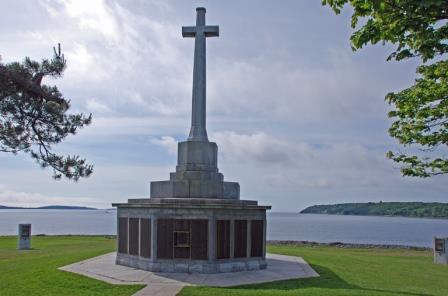
Halifax Memorial

Halifax Memorial in Point Pleasant Park in Halifax, Nova Scotia. (Photo credit: Pieter Valkenburg)

Research continues on this and other stories.  If you have information or photos to share about James Emmet Hughes, the sinking of the Ramapo, or any of the crew members, please contact Pieter at memorialtrail@gmail.com or comment on the blog.

© Daria Valkenburg
….Want to follow our research?….

If you are reading this posting, but aren’t following our research, you are welcome to do so.  Our blog address: https://onthewarmemorialtrail.com/

4 countries, 6 weeks, 7,000 km – an unforgettable war memorial journey in Europe…. Daria’s book ‘No Soldier Buried Overseas Should Ever Be Forgotten‘ is available in print and e-book formats.  Net proceeds of book sales help support research costs and the cost of maintaining this blog. For more information see https://nosoldierforgotten.com/

You are also invited to subscribe to our YouTube Channel: On The War Memorial Trail With Pieter Valkenburg: https://www.youtube.com/channel/UCJ591TyjSheOR-Cb_Gs_5Kw

Never miss a posting!  Subscribe below to have each new story from the war memorial trail delivered to your inbox.

The WWI Names On The Cenotaph Have Stories Of Their Own

February 8, 2020. Recently, Pieter and a friend went to see the British WW1 movie ‘1917’, which is nominated for several Oscars and has a Canadian connection due to a map used in the film.  (For that story see https://www.cbc.ca/news/entertainment/1917-canadian-contribution-1.5450608)  The story takes place in France on April 6, 1917, and is about two men tasked with delivering a message to another unit to warn of a German ambush.  The men go through several towns and villages in France’s Western Front.  Canadians may remember this period as being the lead up to the Battle of Vimy Ridge on April 9, 1917.

Pieter found the movie of great interest for several reasons. It was a depiction of the horrors of war… without being overly gory.  After being through the trenches and tunnels in Vimy Ridge a few years ago, he was intrigued to see the way soldiers sat on either side of a trench while waiting to go up into battle.   But the main reason he liked the movie is that it told the story of two people.

Contrary to what we learn in history books and classes, in the end all history is the cumulative stories of individuals.  A list of names on a cenotaph, such as the one outside the Borden-Carleton Legion, is meaningless without knowing who those people were and what happened to them.  This is what started Pieter on the journey to uncover the stories behind the names on the Cenotaph.

Over the years, the stories of those from WWI have been told in this blog.  24 are listed on the Cenotaph and half of them died in France…. Patrick Raymond ARSENAULT and John Lymon ‘Ly’ WOOD are listed on the Vimy Memorial as their bodies were never identified.    Also killed in France were Kenneth John Martin BELL, James CAIRNS, James Ambrose CAIRNS, Arthur Leigh COLLETT, Bazil CORMIER, Patrick Phillip DEEGAN (DEIGHAN), Joseph Arthur DESROCHES, Percy Earl FARROW (FARRAR), Ellis Moyse HOOPER, and Charles W. LOWTHER.  We were at the Vimy Memorial and visited each grave.

Five men died in Belgium. Two are listed on the Menin Gate Memorial in Ypres, as their bodies were never identified: Charles Benjamin Murray BUXTON and George Albert CAMPBELL.  We visited Menin Gate and the area where they died.  We also visited the graves of James Lymon CAMERON, Vincent Earl CARR, and Arthur Clinton ROBINSON.

Vincent Carr, who died during the Battle of Passchendaele on October 30, 1918, was initially buried in a trench with 4 others – two Canadian and two British soldiers.  Decades later, when they were reburied in a Commonwealth War Graves Commission cemetery, all three Canadians were still identifiable.  The British Army’s cardboard identity ‘tags’ had disintegrated, leaving the two British soldiers as unidentified.  Today, DNA testing can be done to help with identity, but decades ago this was impossible.

Two men died in England.  John Goodwill HOWATT was wounded in France, and died in a British hospital.  Bruce Sutherland McKAY had gotten ill during the transport from Canada to England and also died in a British hospital.

Henry Warburton STEWART survived the war, only to fall ill while in Germany as part of the occupation forces.  He’s buried in a German cemetery in Cologne, which we visited.

James Graham FARROW (FARRAR) was not a soldier, but in the Merchant Navy, transporting vital supplies between England and France, when his ship was torpedoed by a U-boat.

Three men died on Canadian soil.  Leigh Hunt CAMERON died of illness, while Harry ROBINSON died from blood poisoning.  William Galen CAMPBELL was poisoned with mustard gas on May 28, 1918, a few months before the end of the war, but was able to return home.  And yes, we’ve visited those graves as well.

We were also able to tell you parallel stories, such as that of Clifford Almon WELLS, who had many of the same experiences as John Lymon Wood, and also died in France. Another story was that of George BRUCKER, of the German Army, who was taken prisoner during the Battle of Vimy Ridge, and survived the war, never forgetting the two ‘tall’ Canadians who didn’t shoot him.  Decades later his son, now in his 80s, is still hoping to thank the families of those two unknown men.

Thanks to Pieter’s curiosity in trying to find out why one Commonwealth War Graves Commission gravestone in a cemetery in Cape Traverse was not recorded on the Cenotaph, we were able to tell you the story of Elmyr KRUGER, a soldier from Saskatchewan who died of illness while guarding German prisoners of war from a POW camp in Amherst.

We’ve told the stories of each man, and shared our visits to the various cemeteries and war memorials.  As photos and letters came in, we shared those experiences as well.

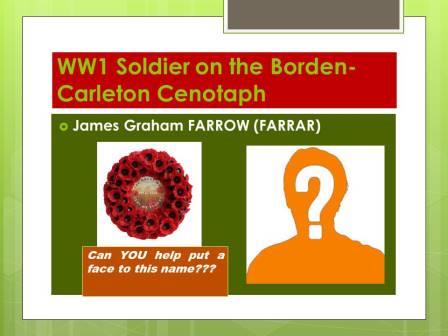
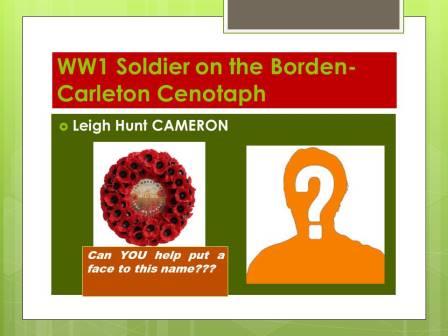
We are still missing photos of several of these soldiers, so the quest to put a face to every name and story is still ongoing.  Who are we missing?  Take a look and see if you can help:

Slide6

Slide8

Slide9

Slide10

Slide13

Slide15

Slide16

Slide20

Slide22

Slide23

UPDATE:  Photos of James Cairns, Joseph Arthur Desroches, and Harry Robinson have been found!

It’s great to watch a movie about fictional characters, but let’s not forget the stories of real life people! There won’t be any Academy Awards given out, but they will be remembered. Research continues to uncover more stories.  If you have a story or photo to share about any of the names mentioned in this posting, please contact Pieter at memorialtrail@gmail.com or comment on the blog.

© Daria Valkenburg
....Want to follow our research?…

If you are reading this posting, but aren’t following our research, you are welcome to do so.  Our blog address: https://onthewarmemorialtrail.com/

4 countries, 6 weeks, 7,000 km – an unforgettable war memorial journey in Europe…. Daria’s book ‘No Soldier Buried Overseas Should Ever Be Forgotten‘ is available in print and e-book formats.  Net proceeds of book sales help support research costs and the cost of maintaining this blog. For more information see https://nosoldierforgotten.com/
Subscribe to our YouTube Channel: On The War Memorial Trail With Pieter Valkenburg: https://www.youtube.com/channel/UCJ591TyjSheOR-Cb_Gs_5Kw

Never miss a posting!  Subscribe below to have each new story from the war memorial trail delivered to your inbox.