July 13, 2024. In the 11 part Atlantic Canada Remembers series that ran in 2021, photos submitted about Atlantic Canadian soldiers buried overseas were featured. Pieter ensured that photos of soldiers who are buried in The Netherlands were forwarded to the appropriate cemetery for their digital archives.
In Part 2 of the Atlantic Canada Remembers series, Helen O’Connell submitted a photo of her uncle, Francis ‘Frank’ Ivan DOUGAN. She wrote that he “….was born in November 12, 1919 to Florence and John Dougan from Donaldston, Prince Edward Island. He was the 2nd of 12 boys born in that family – no girls. Frank left school at age of 15 and went to work to help his family. He worked in Debert, Nova Scotia as a labourer and mechanic. In 1941, he and 3 of his brothers enlisted….” (See https://onthewarmemorialtrail.com/2021/01/13/on-the-war-memorial-trail-atlantic-canada-remembers-part-2/)

Donaldston is located in central Prince Edward Island. (Map source: Google maps)
…..Frank enlisted under the NRMA in 1941….
Frank originally enlisted under the National Resources Mobilization Act (NRMA) in Charlottetown, Prince Edward Island on October 2, 1941 and underwent basic training at No. 62 Canadian Army Basic Training Centre (CABTC). (See https://en.wikipedia.org/wiki/National_Resources_Mobilization_Act)
After completing his basic training, Frank was sent for 62 days of advanced training at No. A19 Canadian Army Service Corps Training Centre (CASCTC) at Camp Borden in Borden, Ontario.
From there, he was transferred to the 6th Division Ammunition Company of the Royal Canadian Army Service Corps (RCASC) in Valcartier, Quebec on April 7, 1942.
Frank would remain with the Royal Canadian Army Service Corps (RCASC), an administrative and transport corps of the Canadian Army. Their role was to provide support to Canadian soldiers wherever they went, moving supplies from the rear areas to the front-lines. They delivered all rations, ammunition, petroleum products, and all other essentials, using vehicles ranging from three- to ten-ton trucks, and forty-ton tank transporters. (For more information, see https://en.wikipedia.org/wiki/Royal_Canadian_Army_Service_Corps)
….Frank enlisted for active service…..
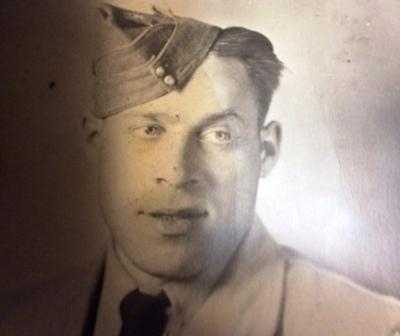
Francis ‘Frank’ Ivan Dougan. (Photo courtesy of Helen O’Connell)
On June 1, 1942, Frank transferred from the non-active militia to active service in the Canadian Army, remaining with the 6th Division Ammunition Company in Valcartier.
On July 7, 1942, Frank was sent to the Canadian Army Trades School in Hamilton, Ontario for a Motor Mechanics Course, which lasted 6 months. On January 20, 1943, Frank was attached to the Headquarters of the 6th Division Ammunition Company at Hastings Military Park in Vancouver, British Columbia.
On March 9, 1943, he was sent to the Headquarters of the 6th Division Company in Victoria, British Columbia. Then, on September 2, 1943, he was transferred to the 28th Transport Company in Duncan, British Columbia, but sent on assignment with the Royal Rifles of Canada to Wainwright, Alberta, where he remained until October 19, 1943, when he returned to Duncan.
Frank next was transferred to No. XI District Depot in Vancouver, British Columbia on February 4, 1944 for a short period before being sent, on February 16, 1944, to No. 1 Training Brigade in Debert, Nova Scotia, in preparation for overseas service.
….Frank left Canada for overseas service….
On April 11, 1944, Frank left Canada, arriving in the United Kingdom on April 19, 1944, where he was assigned to the Canadian Army Service Corps Reinforcement Unit (CASCRU).
Frank was transferred to the 12th Battalion of the Royal Canadian Army Service Corps (RCASC), part of the 10th Canadian Infantry Brigade (CIB) on May 1, 1944, qualifying as a Driver i/c on May 8, 1944. (The term ‘Driver i/c’ refers to ‘Driver, internal combustion’.)
Helen had written that while overseas Frank “… worked as a driver in the war, mainly in the UK….” This turned out to be incorrect, as Frank was in the United Kingdom for only a few short months – until July 25, 1944, when he, and the 10th Canadian Infantry Brigade (CIB), arrived in France as part of the 21st Army Group. He was with the Brigade until after WWII officially ended.
….Frank remained in Europe after the war ended….
On July 6, 1945, as a driver, Frank was assigned to the 4th Armoured Division Transport Company of the Royal Canadian Army Service Corps (RCASC), joining them in Almelo, The Netherlands. He remained with the 4th Armoured Division until November 10, 1945, when he was reassigned to the 2/9 Canadian Infantry Brigade (CIB).
On April 7, 1946, Frank was transferred to the 48th Canadian General Transport Company of the Royal Canadian Army Service Corps (RCASC), part of the Canadian Army Occupation Force (CAOF) in Germany.
….Frank lost his life in a vehicle accident….
Helen wrote that “….after the war Frank decided to work in peacekeeping as a Canadian soldier in Oldenburg, Germany. On May 16, 1946, he was involved in road accident and was killed. He was buried in Holland and was awarded the France and Germany Star 1939-1945….”
According to his service file, Frank died in a hospital in Nijmegen following a road accident during very bad weather in Nijmegen, while he was on his way from Grave, The Netherlands to Oldenburg, Germany. Mechanical failure in the steering mechanism led to the accident. Frank was a passenger in the rear of the vehicle along with 2 others, plus the driver.
There were two fatalities: Frank Dougan and another soldier who was also in the rear, Charles Ernest Edwin CRIDLAND, who had been born in England, but was from Vancouver, British Columbia.
….Frank is buried in Holten….
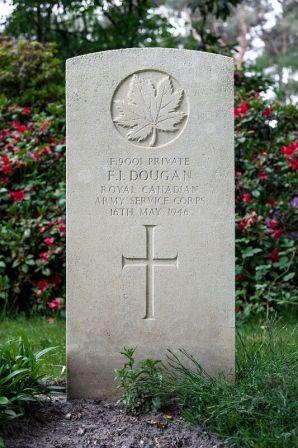
Grave of Francis ‘Frank’ Ivan Dougan in the Canadian War Cemetery in Holten, The Netherlands. (Photo courtesy of Canadian Virtual War Memorial)
Frank was initially buried in the Canadian Cemetery in Groesbeek, near Nijmegen, before being reburied, on July 16 1946, in the Canadian War Cemetery in Holten, The Netherlands.
Helen was able to visit The Netherlands and the Canadian War Cemetery in Holten. “…My husband and I were very fortunate to visit his grave in 2016. I was so proud and honoured to be there. I will not forget. This graveyard seemed almost like a sacred place for these solders who gave their life for us and since my visit I really appreciate that….”
In 1948, Frank’s grave was adopted by a family from Delden – jeweller Jan A. Zengerink and his wife Ria. An English translation of the letter that they wrote to Frank’s family informing them of the grave adoption was forwarded to Frank’s mother by the Department of Defence.
Thank you to Helen O’Connell for submitting a photo and information on her uncle. Do you have photos or information to share? Email Pieter at memorialtrail@gmail.com, or comment on the blog.
© Daria Valkenburg
…..The Atlantic Canada Remembers series….
Missed the Atlantic Canada Remembers series? See:
- https://onthewarmemorialtrail.com/2021/11/28/on-the-war-memorial-trail-atlantic-canada-remembers-part-11/
- https://onthewarmemorialtrail.com/2021/07/11/on-the-war-memorial-trail-atlantic-canada-remembers-part-10/
- https://onthewarmemorialtrail.com/2021/04/15/on-the-war-memorial-trail-atlantic-canada-remembers-part-9/
- https://onthewarmemorialtrail.com/2021/03/16/on-the-war-memorial-trail-atlantic-canada-remembers-part-8/
- https://onthewarmemorialtrail.com/2021/02/22/on-the-war-memorial-trail-atlantic-canada-remembers-part-7/
- https://onthewarmemorialtrail.com/2021/02/09/on-the-war-memorial-trail-atlantic-canada-remembers-part-6/
- https://onthewarmemorialtrail.com/2021/01/27/on-the-war-memorial-trail-atlantic-canada-remembers-part-5/
- https://onthewarmemorialtrail.com/2021/01/20/on-the-war-memorial-trail-atlantic-canada-remembers-part-4/
- https://onthewarmemorialtrail.com/2021/01/16/on-the-war-memorial-trail-atlantic-canada-remembers-part-3/
- https://onthewarmemorialtrail.com/2021/01/13/on-the-war-memorial-trail-atlantic-canada-remembers-part-2/
- https://onthewarmemorialtrail.com/2021/01/07/on-the-war-memorial-trail-atlantic-canada-remembers-part-1/
- https://onthewarmemorialtrail.com/2021/01/05/on-the-war-memorial-trail-the-search-for-ww2-soldiers-buried-in-the-netherlands-featured-on-ctvs-atlantic-live-at-5/
….Want to follow our research?….
If you are reading this posting, but aren’t following our research, you are welcome to do so. Our blog address: https://onthewarmemorialtrail.com/
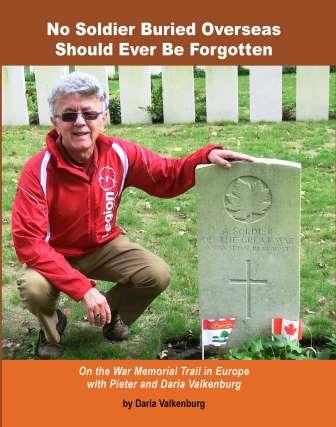 4 countries, 6 weeks, 7,000 km – an unforgettable war memorial journey in Europe…. Daria’s book ‘No Soldier Buried Overseas Should Ever Be Forgotten‘ is available in print and e-book formats. Net proceeds of book sales help support research costs and the cost of maintaining this blog. For more information see https://nosoldierforgotten.com/
You are also invited to subscribe to our YouTube Channel: On The War Memorial Trail With Pieter Valkenburg: https://www.youtube.com/channel/UCJ591TyjSheOR-Cb_Gs_5Kw.
Never miss a posting! Subscribe below to have each new story from the war memorial trail delivered to your inbox.


 On The War Memorial Trail Research Project........ with Pieter and Daria Valkenburg