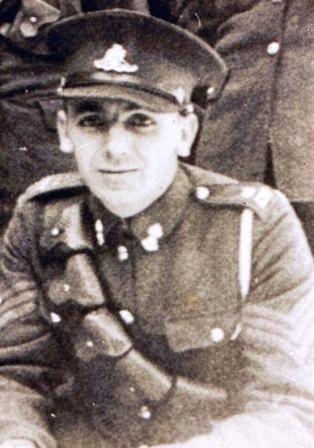
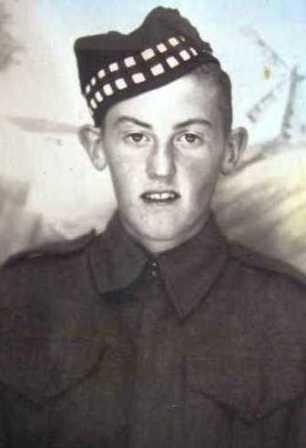
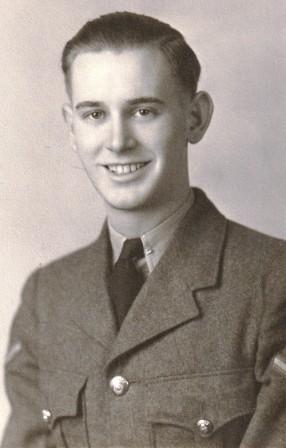
On The War Memorial Trail….. The WWII Soldier From Moncton Who Lost His Life During The Battle of Walcheren Causeway

November 20, 2023. When Pieter began his research into WWII soldier Leonard William PORTER of Moncton, New Brunswick, he discovered they had something in common, as he wrote to Leonard’s son, Peter Porter.  “…I noticed that he was born on the same day as myself but 26 years earlier, on the 25th of March 1918….” 

This was a promising start to the research, which continued after he quickly received a photo of Leonard after reaching out to Peter, and then we were able to meet Peter and his son Shane.  Asked how he felt about being approached for a photo, Peter said “…I think this is wonderful…

CIMG6567 Oct 23 2023 Shane Peter Pieter

Shane and Peter Porter with Pieter.  (Photo credit: Daria Valkenburg)

Born March 25, 1918 in Moncton, New Brunswick, Leonard was the son of Andrew and Ella Elizabeth (nee Beers) Porter. 

At the time of his marriage to Kathryn Doris Meaghan on December 6, 1941 in Moncton, Leonard listed his occupation as Sergeant in the New Brunswick Regiment (Tanks), a non-Permanent Active Militia unit.  He didn’t mention that he was also employed by the T. Eaton Company.

….Leonard was in the militia for several years….

Leonard had joined the militia on March 12, 1939, and qualified as a Sergeant on June 20, 1940.  He served in Borden, Ontario, St John, New Brunswick, and Shediac, New Brunswick. As of August 11, 1940 he had been appointed as an Instructor with A & T Staff 19th (Reserve) Army  Tank Regiment.
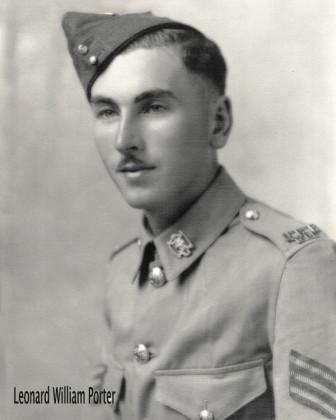
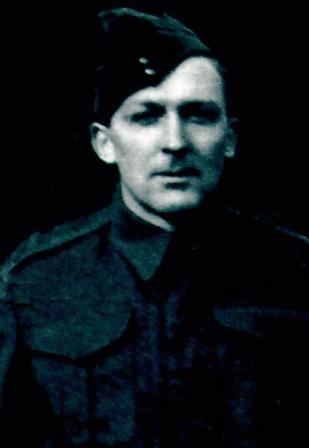
Leonard William Porter from Peter Porter

Leonard William Porter while serving with the New Brunswick Regiment (Tank) militia.  (Photo courtesy of Peter Porter)

He qualified as a Driver i/c Class III on June 4, 1942, after successfully completing a 6 week driving course at the S-5 Canadian Driving and Maintenance School (CD & M School) in Woodstock, Ontario. This meant he was qualified to drive heavy trucks and armoured cars. 

On June 10, 1942, Leonard was promoted to Squadron Sgt-Major Warrant Officer II (SSM (WOII)). 

On October 3, 1942, he was sent to the A-30 Canadian Infantry Training Centre at Camp Utopia, located northeast of St. George, New Brunswick to attend a Mortar and Grenade course.

On January 13, 1943, he was sent to Buctouche, New Brunswick.  While posted there he took a Browning Machine Gun course. 

Leonard and Kathryn’s son Peter James was born on February 19, 1943 in Moncton, New Brunswick.

From March to August 1943 Leonard served in Richibucto and Sussex, then from September until November 15, 1943 he was in Tracadie and Fredericton, all in New Brunswick. 

While he was in the Militia, with the New Brunswick Regiment (Tanks), Leonard also held a full time position for 5 years as a grocery clerk with the T. Eaton Company, a department store, in Moncton.

….Leonard enlisted for active service in the Canadian Army….

On November 16, 1943, he enlisted in the active service force at the No. 7 District Depot in Fredericton, New Brunswick.  In the interview for his Personnel Selection Record, it was noted that Leonard was “...fond of bowling. Does some hunting and fishing. Reads Esquire, Readers Digest, and fiction….”  Peter Porter mentioned that his father also “….played a piano-accordion...

Although Leonard had spent several years in the Militia, he was still sent for basic training, like any new recruit.  On December 7, 1943, he reported to No. 70 Canadian Army Basic Training Centre (CA(B)TC) in Fredericton. But, he was given a 5 day pass for Christmas leave, from December 23 to 28, the last Christmas he would spend with his family.

On February 15, 1944, Leonard returned to the A-30 Canadian Infantry Training Centre at Camp Utopia, located northeast of St. George, New Brunswick.  After his 5th week of training, his Personnel Selection Record was updated.  “….Leadership ability is apparent, exerts influence over his fellows. Quiet, steady, confident… Interested and ambitious…..Watch for promotions….

Leonard was selected for the 3 inch mortar training course, which ran from April 10 to April 29, 1944.  After receiving his qualification in this course, on May 4, 1944 he was sent to Woodstock, Ontario for a Carrier Driver Course at the S-5 Canadian Driving and Maintenance School (CD & M School).  He had been there in 1942 while with the militia.

On June 14, 1944, he received his qualification as a Driver i/c Class III (Wheeled) (3 inch Mortarman). The term ‘Driver i/c’ refers to ‘Driver, internal combustion’.  Class III meant he was qualified to drive heavy trucks and armoured cars. Wheeled refers to wheeled vehicles.  As a mortarman,  Leonard could not only drive vehicles containing bombs, but also be part of the mortar crew firing them. (See https://www.canadiansoldiers.com/weapons/lightweapons/mortars/3inchmortar.htm)

On June 24, 1944, Leonard returned to the A-30 Canadian Infantry Training Centre at Camp Utopia in preparation for overseas service.  He received two weeks of embarkation leave, from June 29 to July 12, 1944, the last time he would see his family.

… Leonard left Canada for overseas service in July 1944…

On July 20, 1944, Leonard left Canada for the United Kingdom.  Upon arriving on July 27, 1944 he was assigned to No 4 Canadian Infantry Reinforcement Unit (CIRU). 

His stay in the United Kingdom was short, as on September 1, 1944 he was sent to France with the X-L infantry reinforcement troops of the 21st Army Group.
Screenshot 2023-11-19 at 12-54-37 Loon-Plage · 59279 France

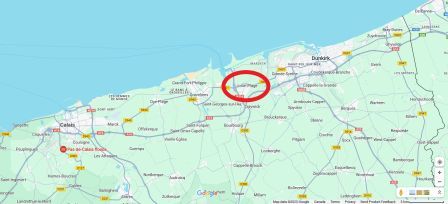
Leonard joined the Calgary Highlanders in Loon Plage, France.  (Map source: Google maps)

On September 12, 1944, he was transferred to the Calgary Highlanders, joining them in Loon Plage, France, not that far from the Belgian border.   The Regiment, part of the Canadian 5th Infantry Brigade, was engaged in patrolling operations and needed to be constantly on the alert from the heavily fortified Dunkirk (Dunkerque in French).

The War Diary entry for September 12, 1944 for the Calgary Highlanders reported that “…. during the evening, heavy bombers were heard roaring out toward German territory and heavy shelling and mortaring were heard coming from the direction of Dunkerque….” The situation intensified in the days that followed.  On September 14, 1944, the War Diary entry recorded that “…forty-four other ranks arrived as reinforcements to the Battalion...”  Leonard would have been one of these men.

… The Regiment was in the Battle of the Scheldt…

By September 18, 1944 the Calgary Highlanders had crossed into Belgium and were temporarily based in Wommelgem, just outside Antwerp, while the Regiment was engaged in the preparations for and participation in the Battle of the Scheldt, which began officially on October 2 and lasted until November 8, 1944.

The Battle of the Scheldt’s objective was to free up the way to the Port of Antwerp in Belgium for supply purposes. Canadians suffered almost 8,000 casualties (wounded and dead) in what turned out to be the battle with the most Canadian casualties in The Netherlands. (See https://www.veterans.gc.ca/eng/remembrance/history/second-world-war/scheldt)

During their stay in the Wommelgem area, several members of the Calgary Highlanders lost their lives, and were temporarily buried there, before being reburied in the Canadian War Cemetery in Bergen Op Zoom.  (See https://onthewarmemorialtrail.com/2021/02/13/on-the-war-memorial-trail-the-search-for-soldiers-who-died-in-wommelgem-belgium-in-fall-1944/)

On October 7, 1944, the Regiment left Belgium and arrived in The Netherlands in the early morning, with the War Diary recording that “…at 05:50 hours the group crossed the border into Holland…” and was based at Jansen Farm.

On October 11, 1944, the Regiment moved again, to De Geest, then on October 15, 1944 to Hinkelenrood and based at Van De Maegdenburg’s Farm.  Their task was mainly recce patrol.  On October 22, 1944 the Regiment arrived in Ossendrecht.   Then, on October 26, 1944, the Regiment arrived in Woensdrecht.

… The Regiment was involved in the Battle of Walcheren Causeway…

The stay in Woensdrecht was short, as on October 28, 1944 the Regiment made its way across the isthmus towards South Beveland.  By October 31, 1944, the Calgary Highlanders were to cross the Sloe Channel in assault boats towards the German-held Walcheren Island. 

The original plan to cross the Sloe Channel failed, as the Black Watch of Canada, the troops of the 5th Canadian Brigade that were in the lead, found that assault boats were useless in the deep mud of the channel.

The only route open was the Walcheren Causeway (known as Sloedam in Dutch), a land bridge from South Beveland to the Island. The Causeway was a dyke – 1,600 metres (1 mile) long and just 45 metres (40 yards) in width.

Walcheren2

Map showing troops at the beginning of the Battle of Walcheren Causeway.  (Map source: Wikipedia)

In what became known as the Battle of Walcheren Causeway, part of the larger Battle of the Scheldt, the struggle to cross the Causeway was hampered.  A deep crater on the causeway had been blown by German engineers as an anti-tank obstacle and the surrounding landscape was severely damaged by bombing.

After the Black Watch of Canada suffered heavy losses during the crossing on the evening of October 31, 1944, the Calgary Highlanders sent two companies over in succession, one close to midnight on the 31st and the other just before dawn on November 1. The first attack, on October 31, stalled just past the bomb crater on the Causeway.

In the November 1 early morning attack, carried out under artillery fire, Canadian troops reached the other side of the dam and opened up a bridgehead on the island. The Germans continued to fire upon troops, and it wasn’t until that evening that Canadian survivors succeeded in getting back to the Beveland side.

The November 1, 1944 War Diary entry for the Calgary Highlanders starkly summed up what happened. “…Fighting along the Causeway had been terrific for the last 40 hours and words are inadequate to express all the difficulties that had to be surmounted to make an advance along the ….narrow Causeway.  The memory of it will live long in the minds of the Calgary Highlanders….

(For more information, see https://en.m.wikipedia.org/wiki/Battle_of_Walcheren_Causeway and https://www.canadiansoldiers.com/history/battlehonours/northwesteurope/walcherencauseway.htm)

… Leonard lost his life in the Battle of Walcheren Causeway…

Location Lewedorp on google maps

Leonard was initially buried in Lewedorp.  (Map source: Google maps)

64 members of the Calgary Highlanders were either killed or wounded in this battle.  One of them was Leonard, who died on November 1, 1944, aged 26.  He was initially buried on Walcheren Island in Lewedorp, behind the Roman Catholic Church.

Lewedorp,_de_Rooms_Katholieke_kerk_in_straatzicht_foto4_2015-09-29_17.19 from Wikimedia

The Roman Catholic Church in Lewedorp.  (Photo source: Wikipedia)

The Germans surrendered the area on November 5, 1944.  Today, the Causeway that caused so many casualties no longer exists. Land on both sides of the dyke has been reclaimed and the Sloe Channel is now farmland. However, remnants of German concrete fortifications still exist both on Walcheren Island and South Beveland.

… Leonard is buried in the Canadian War Cemetery in Bergen Op Zoom…

Leonard was reburied in the Canadian War Cemetery in Bergen Op Zoom, The Netherlands in 1946.

Grave of Leonard Porter from Findagrave

Grave of Leonard William Porter at the Canadian War Cemetery in Bergen Op Zoom. (Photo source: Find A Grave)

Leonard’s widow never remarried.  Her son Peter explained that “….my mother was a hairdresser, and owned her own business.  She became president of the Ladies Auxiliary of the Royal Canadian Legion and was involved in the Poppy Campaign.  She also used to send money to people in The Netherlands who were adopting graves…

Peter reflected that being involved in the Legion was his mother’s “…way to commemorate.  Every September until November 11, she was busy….” 

Thank you to Peter Porter for providing a photo and information about his parents. Do you have a story to tell? Email Pieter at memorialtrail@gmail.com, comment on the blog, or send a tweet to @researchmemori1.  

© Daria Valkenburg

….Want to follow our research?….

If you are reading this posting, but aren’t following our research, you are welcome to do so.  Our blog address: https://onthewarmemorialtrail.com/
Front cover OnTheWarMememorialTrailinEurope4 countries, 6 weeks, 7,000 km – an unforgettable war memorial journey in Europe…. Daria’s book ‘No Soldier Buried Overseas Should Ever Be Forgotten‘ is available in print and e-book formats.  Net proceeds of book sales help support research costs and the cost of maintaining this blog. For more information see https://nosoldierforgotten.com/ 

You are also invited to subscribe to our YouTube Channel: On The War Memorial Trail With Pieter Valkenburg: https://www.youtube.com/channel/UCJ591TyjSheOR-Cb_Gs_5Kw

Never miss a posting!  Subscribe below to have each new story from the war memorial trail delivered to your inbox.
On The War Memorial Trail….. Atlantic Canada Remembers – Part 8

March 16, 2021. More of the photos submitted by Atlantic Canadians of soldiers buried overseas are featured in this posting. Pieter is ensuring that every email is acknowledged, and that the photos of soldiers buried in The Netherlands are forwarded to the appropriate cemetery for their digital archives.  Thank you to the members of Royal Canadian Legions in Nova Scotia and New Brunswick for their help.

Soldiers buried at the Canadian War Cemetery in Holten, The Netherlands

Fryday published in Toronto Newspaper

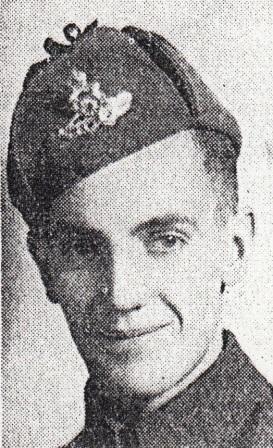
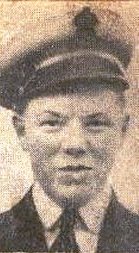
George Albert Fryday.  (Photo submitted by Marion Fryday-Cook.)

Marion Fryday-Cook, President of the Royal Canadian Legion’s Nova Scotia/Nunavat Command, submitted a photo of George Albert FRYDAY, explaining that “I am a relative of Rifleman George A. Fryday, Service Number B/136751, who is buried in Holten Canadian War Cemetery, Netherlands.  He was born in Toronto, Ontario. Thank you for honouring our fallen….” 

At the age of 15, George joined the Merchant Marine, and later the Royal Canadian Navy Volunteer Reserve.  However, once it was established that he was under age, he was discharged.  At the age of 17, he enlisted in the Canadian Army and was sent overseas in December 1944.  He was serving in the Queen’s Own Rifles Regiment when he lost his life on May 4, 1945, aged 19. 

Frederick Joseph Tait

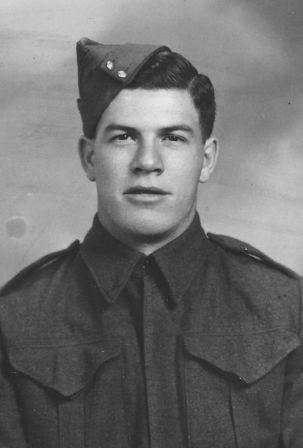
Frederick Joseph Tait. (Photo submitted by the Grand Falls branch of the Royal Canadian Legion)

Patrick Côté of the Royal Canadian Legion, Branch 21 in Grand Falls, New Brunswick, submitted a photo of Frederick Joseph TAIT, born April 26, 1921 in Grand Falls, New Brunswick, the son of Herbert Henry Tait and Louise Emeline Leclair.

Patrick referenced a book, ‘Military Heritage – The Greater Grand Falls Region’, by Jean-Guy Plourde, which explained that “…. Prior to the war, he worked in a grocery store…”  Before enlistment on February 1, 1943 in Fredericton, he served in the New Brunswick Cadet Corps, and had been an Instructor in Infantry Training with the 2nd Carleton & York Regiment since 1940.

According to the Personnel Selection Record of his service file, he was fluent in both French and English and was assessed as “…good NCO instructor material…”  (NCO refers to Non-Commissioned Officer.)  He had a “…confident bearing…” and “…stability above average….” Unfortunately, his educational background was “…not high enough for commissioned rank…” 

After being deployed overseas in December 1943 he served in Sicily, where he fell ill and was hospitalized for 8 months.  After being released from hospital, he “…went on leave to England….” Over Christmas 1944 he was able to meet his brother Clair, also with the Canadian Army.

Clair survived WWII but Frederick didn’t.  While serving with the Carleton & York Regiment as the unit advanced to the Apeldoorn Canal in The Netherlands on April 15, 1945, he lost his life and was temporarily buried in Posterenk, near Zutphen.

CIMG9297 Sep 25 2017 Edwin and Pieter with CYR list

Edwin van der Wolf and Pieter in Posterenk in 2017.  Pieter holds up a list of the 6 Carleton & York Regiment soldiers who were temporarily buried in the village.  (Photo credit: Daria Valkenburg)

In September 2017, Pieter and I visited the village of Posterenk with Edwin van der Wolf, one of the research volunteers at the Canadian War Cemetery in Holten.  Edwin explained that “… the Carleton & York Regiment came from Italy to Marseilles, and then into The Netherlands where, on April 13, 1945, the village of Posterenk was liberated.  Six soldiers from the Regiment were buried here temporarily….” 

Edwin gave us a list of the 6 soldiers from the Carleton & York Regiment who were temporarily buried in the village.  Frederick Joseph Tait was one of these men!

Posterenk list of 6 CYR members

List of 6 Carleton & York Regiment soldiers temporarily buried in Posterenk in 1945.

Soldiers buried at the Canadian War Cemetery in Groesbeek, The Netherlands

Photo Burgess Porter

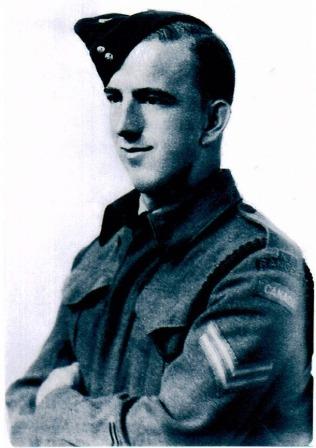
Burgess Allison Porter.  (Photo submitted by Everett Dalton)

Everett Dalton submitted a photo of Burgess Allison PORTER, writing that Burgess was “…the son of Annie ‘Laura’ (nee Porter) McCall…Born October 2, 1922 in Grafton, Nova Scotia, his mother died when he was 2 years old.  Although his biological father, Reg McCall was still alive, it was his mother’s wish that her son be raised by “…Frank Oscar and Lennie Alma (nee Pineo) Porter….”  

While not formally adopted, he was raised by them and was known by the surname Porter. His service file identifies Frank and Lennie Porter as his grandparents. 

Born October 2, 1922, Burgess was from Grafton, Nova Scotia, and a store clerk before he enlisted in Halifax on April 14, 1941.  On January 20, 1942 he arrived in the United Kingdom as part of the Artillery Holding Unit, and in April 1942 was attached to the 4th Field Regiment of the Royal Canadian Artillery as a bombardier. 

On July 7, 1944 his unit landed in France, and unfortunately Burgess was killed on February 21, 1945 in Germany and was temporarily buried in Bedburg, Germany.

Soldiers buried at the Canadian War Cemetery in Bergen Op Zoom, The Netherlands

Clayton Wilfred Shannon virtual war memorial BoZ

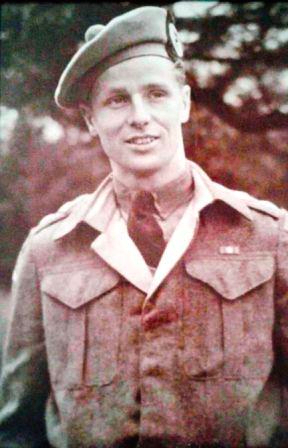
Clayton Wilfred Shannon.  (Photo from Canadian Virtual War Memorial)

Patrick Côté of the Royal Canadian Legion, Branch 21 in Grand Falls, New Brunswick sent the link to the Canadian Virtual War Memorial page for Clayton Wilfred SHANNON, who had served with the Calgary Highlanders and lost his life on September 22, 1944.

Patrick referenced a book, ‘Military Heritage – The Greater Grand Falls Region’, by Jean-Guy Plourde, which explained that Clayton, born August 2, 1920 in Grand Falls, the son of Frederick Herman Shannon and Bertha Mulherin, “…was musically inclined… playing guitar and singing.  Before his army service, he had even made a couple of records….

In 1940 “…with his cousin, Adrien Mulherin, he left home to enlist in the Carleton & York Regiment….”   After serving 4 years in Canada, he went overseas “…in July 1944, with the Calgary Highlanders…. While in combat near the border of Holland and Belgium, Clayton was killed, only a few weeks after arriving in Europe…

Clayton lost his life in Belgium during the Battle of the Scheldt, and was initially buried in Wommelgem, on the outskirts of Antwerp, one of 11 members of the Calgary Highlanders buried there before being reburied in Bergen Op Zoom. (For more information on what happened in Wommelgem, see https://onthewarmemorialtrail.com/2021/02/13/on-the-war-memorial-trail-the-search-for-soldiers-who-died-in-wommelgem-belgium-in-fall-1944/)

Gregory P. A. McCarthy (2)

Gregory Philip Anthony McCarthy.  (Photo submitted by the Grand Falls branch of the Royal Canadian Legion)

Patrick Côté of the Royal Canadian Legion, Branch 21 in Grand Falls, New Brunswick, submitted a photo of Gregory Philip Anthony MCCARTHY, born February 28, 1922 on a farm in California Settlement in Grand Falls, son of Thomas and Agnes McCarthy. 

Patrick referenced a book, ‘Military Heritage – The Greater Grand Falls Region’, by Jean-Guy Plourde, which explained that Gregory “…was the youngest of 11 children….He had …. helped on the farm for 8 years and also worked in lumbering prior to his enlistment…. On 26 March 1941 Gregory enlisted in the Canadian Army at Woodstock, NB…

After completing his basic training, he was “… transferred to the 1st Battalion New Brunswick Rangers….on 19 May 1941….”  After a promotion to Lance Corporal on December 1, 1941 he went to Labrador as a Driver Mechanic. 

On September 10, 1943 he left for the United Kingdom “… where he completed a mortar course and remained until his deployment to France with the 10th Independent Machine Gun Company, NB Rangers, arriving on 22 July 1944….

His commanding officers described him as “…dependable, reliable, and well-thought of in his unit….”  While serving in Germany and The Netherlands, he was a member of a mortar detachment responsible for engaging the enemy. On January 19, 1945, near Waalwijk in The Netherlands, their own mortar misfired and exploded, causing 3 members of the team to be seriously wounded, with fatal consequences for Gregory.  He was initially buried in Tilburg.

Thank you to Patrick Côté, Everett Dalton, and Marion Fryday-Cook for sharing photos and anecdotes.  Atlantic Canadians remember their loved ones who are buried overseas.

More photos and stories in Atlantic Canada Remembers – Part 9! To share photos or information, please email Pieter at memorialtrail@gmail.com, or comment on the blog. 

© Daria Valkenburg

…..Previous postings in the Atlantic Canada Remembers series….

Missed the previous postings in this series? See:

…..Want to follow our research?….

If you are reading this posting, but aren’t following the blog, you are welcome to do so.  Our blog address: https://onthewarmemorialtrail.com/

Front cover OnTheWarMememorialTrailinEurope4 countries, 6 weeks, 7,000 km – an unforgettable war memorial journey in Europe…. Daria’s book ‘No Soldier Buried Overseas Should Ever Be Forgotten‘ is available in print and e-book formats.  Net proceeds of book sales help support research costs and the cost of maintaining this blog. For more information see https://nosoldierforgotten.com/

Screenshot_2021-02-27 On The War Memorial Trail With Pieter Valkenburg

You are also invited to subscribe to our YouTube Channel: On The War Memorial Trail With Pieter Valkenburg: https://www.youtube.com/channel/UCJ591TyjSheOR-Cb_Gs_5Kw

Never miss a posting!  Subscribe below to have each new story from the war memorial trail delivered to your inbox.
On The War Memorial Trail….. Atlantic Canada Remembers – Part 7

February 22, 2021. We continue to feature more of the photos submitted by Atlantic Canadians of soldiers buried overseas. Pieter is ensuring that every email is acknowledged, and that the photos of soldiers buried in The Netherlands will be forwarded to the appropriate cemetery for their digital archives.  Thank you to the various members of Royal Canadian Legions in Nova Scotia and New Brunswick for their help.

The volunteers at all three Canadian War Cemeteries in Holten, Groesbeek, and Bergen Op Zoom are now active, and Pieter has received wish lists for photos from all three cemeteries.  Submissions for soldiers buried in municipal cemeteries are being held until Pieter gets the go-ahead that those volunteers are active again.

Soldiers buried at the Canadian War Cemetery in Holten, The Netherlands

Ken Dennis of Yarmouth let us know about the Wartime Heritage Association website, which features some of the soldiers from the area who served in WW2.  One of the profiles, written by Flip Jonkman, was of a soldier on the photo wish list of the Canadian War Cemetery in Holten…. Brenton Leroy RINGER. (See http://wartimeheritage.com/whaww2ns2/wwii_ringer_brenton_leroy.htm)

Born on March 22, 1925 in Northfield, Nova Scotia, the son of Ralph and Alberta Ringer of Clementsport, he was an electrician’s helper when he enlisted, at age 18, with the North Nova Scotia Highlanders in Halifax on January 17, 1944.  He later transferred to the 10th Armoured Regiment on March 27, 1945, and lost his life on April 12, 1945 during the liberation of Heino, The Netherlands, when the Sherman tank he was in was hit on the road to Zwolle. 

There were 5 men in the tank, with one survivor.  The survivor knocked on the door of a nearby farmhouse to ask for help, the home of Flip Jonkman’s parents.  Flip was not born at the time, but always remembered the story, and in 2020, was instrumental in getting a memorial stone placed near the site of the attack.  (See the article in Dutch for more information: https://www.destentor.nl/raalte/vurige-wens-in-vervulling-voor-flip-jonkman-73-uit-heino-nu-gedenksteen-is-geplaatst~a694b86d/?referrer=https%3A%2F%2Fduckduckgo.com%2F)

Another of the names on the photo wish list for the Canadian War Cemetery in Holten was found on the Wartime Heritage Association website…. that of Louis Graham RICHARD. (See http://wartimeheritage.com/whaww2ns/wwii_richard_louis_graham.htm)

Born February 13, 1918, the son of Raphael Daniel and Mary Ann Richard of Londonderry, Nova Scotia, Louis was a store clerk before enlisting with the No 2 Canadian Armed Corps in Halifax on February 17, 1943 as a trooper.  On October 14, 1944 he was sent to the United Kingdom, and then on March 31, 1945 to Western Europe with the 9th Armoured Regiment (BC Dragoons).  

Louis was killed in action in The Netherlands during the Battle of Delfzijl Pocket on April 26, 1945, at the age of 27, and was temporarily buried in Wirdum in the province of Groningen, The Netherlands before being reburied in the Canadian War Cemetery in Holten. (For more information on this battle, see https://www.canadiansoldiers.com/history/battlehonours/northwesteurope/delfzijlpocket.htm)

Soldiers buried at the Canadian War Cemetery in Groesbeek, The Netherlands

Percy Clayton Cromwell photo only

Percy Clayton Cromwell.  (Photo submitted by Ken Dennis)

Ken Dennis submitted a photo of Percy Clayton CROMWELL, explaining that “…I am a member of the Yarmouth Branch 61 Legion…” After receiving a wish list of photos from Pieter, he noticed one name from Yarmouth, Nova Scotia.  “…Having been shown this email, I decided to trace his local roots…

…He was a labourer, then for CP out of the Halifax area and upon enlisting moved his family to Yarmouth where they grew up….” CP refers to the Canadian Pacific Railway.

Percy was born in Yarmouth on February 12, 1914, the son of James Alfred and Annie May Cromwell.  He enlisted with the West Nova Scotia Regiment in Aldershot, Nova Scotia on May 14, 1940.

Percy was with the Royal Canadian Electrical and Mechanical Engineers when he drowned in The Netherlands on February 8, 1945.  He’d been on guard duty along a canal in the Dutch province of Brabant on a very dark, windy, and rainy night, and it would have been very easy to lose his bearings and accidentally fall into the canal.  His body was not found until March 12, 1945.  He left behind a wife, Lillian Beryl, and four children. 

Frank Lewis Libby photo only

Francis Lewis Libby. (Photo from the New Brunswick Military Recognition Booklet)

Kent Caldwell, a member of the Royal Canadian Legion in New Brunswick, sent an entry on Francis ‘Frank’ Lewis LIBBY from one of the annual issues of the New Brunswick Military Recognition Booklet, explaining that the photo was a copy from a newspaper clipping.  The entry stated that “…Francis served with the Calgary Highlanders in England and Northwest Europe.  He was killed in The Netherlands in 1945…” 

Francis was born February 21, 1918 in Milltown, New Brunswick, the son of Clifford and Mary Christine Libby.  Before enlisting on July 25, 1941, he worked at the Canadian Cottons Plant in Milltown.  On October 4, 1941, he married Dorothy Louise Caswell.  He and Dorothy had a son Francis Brian in 1944 while he was overseas in Europe, and where he transferred to the Calgary Highlanders in September 1944. Francis lost his life on January 5, 1945 after being killed along the Dutch-German border. He was temporarily buried in Nijmegen, before his reburial, on July 30, 1945, in Groesbeek.

Hiram Albion Lord photo only

Hiram Albion Lord. (Photo from the New Brunswick Military Recognition Booklet)

Kent Caldwell, a member of the Royal Canadian Legion in New Brunswick, also sent an entry on Hiram Albion LORD from one of the annual issues of the New Brunswick Military Recognition Booklet, explaining that the photo was a copy from a newspaper clipping.  The entry stated that “…Hiram served with the North Shore (New Brunswick) Regiment during the Second World War and was killed in action in 1945…” 

Born November 7, 1924 in Lords Cove, Deer Island, New Brunswick, the son of Minnie Smith, Hiram was a fisherman before enlisting on November 4, 1943 and served in Canada until his arrival in the United Kingdom on July 21, 1944.   On August 17, 1944 he went with his unit to Western Europe and lost his life on January 8, 1945 near Nijmegen, The Netherlands.

Stanley Spray

Stanley Spray. (Photo submitted by Royal Canadian Legion Branch #20 in Digby)

Donna Flaherty, President of Royal Canadian Legion Branch #20 in Digby, Nova Scotia, submitted a photo of Stanley SPRAY, writing “…This picture hangs on our Memorial Wall….

Born April 24, 1913 in Nottinghamshire, England, the son of Edgar and Edith Spray, Stanley immigrated to Canada, and settled in Digby, Nova Scotia, where he ran a small farm and worked for J. J. Wallis as a printer before his enlistment on July 6, 1940 with the 52nd Anti-Tank Battery.  He was married to Alda May and the father of two daughters, Jean Carolyn and Joan Carol. 

He received several promotions, and was a battery quartermaster sergeant with the Royal Canadian Artillery when WW2 ended.  Stanley lost his life in a tragic vehicle accident near Nijmegen, The Netherlands on July 23, 1945, when he was catapulted out of the back of an army truck that collided with an oncoming military vehicle.

Thank you to Kent Caldwell, Ken Dennis, and Donna Flaherty for sharing photos and anecdotes.  Atlantic Canadians remember their loved ones who are buried overseas. If you have a higher resolution photo of Percy Clayton Cromwell, Frank Lewis Libby, or Hiram Albion Lord, please send it in to us.

More photos and stories in Atlantic Canada Remembers – Part 8! To share photos or information, please email Pieter at memorialtrail@gmail.com, or comment on the blog. 

© Daria Valkenburg

…..Previous postings in the Atlantic Canada Remembers series….

Missed the previous postings in this series? See:

…..Want to follow our research?….

If you are reading this posting, but aren’t following the blog, you are welcome to do so.  Our blog address: https://onthewarmemorialtrail.com/

Front cover OnTheWarMememorialTrailinEurope4 countries, 6 weeks, 7,000 km – an unforgettable war memorial journey in Europe…. Daria’s book ‘No Soldier Buried Overseas Should Ever Be Forgotten‘ is available in print and e-book formats.  Net proceeds of book sales help support research costs and the cost of maintaining this blog. For more information see https://nosoldierforgotten.com/

You are also invited to subscribe to our YouTube Channel: On The War Memorial Trail With Pieter Valkenburg: https://www.youtube.com/channel/UCJ591TyjSheOR-Cb_Gs_5Kw

Never miss a posting!  Subscribe below to have each new story from the war memorial trail delivered to your inbox.

On The War Memorial Trail….. The Search For Soldiers Who Died In Wommelgem, Belgium In Fall 1944

February 13, 2021. After WWII soldier Arnold Ernest “Ernie” THORNTON was featured in a recent Atlantic Canada Remembers posting, we were contacted by Niko Van Kerckhoven, of Antwerp, Belgium.  (See https://onthewarmemorialtrail.com/2021/01/16/on-the-war-memorial-trail-atlantic-canada-remembers-part-3/)

Niko wrote that “…I am a member of the local historical society and I am doing some research about our Canadian liberators here in my hometown of Wommelgem, Belgium, in 1944.

Fort2, one of the Antwerp forts located here, housed the 9th Canadian Field Dressing Station, and as a consequence, about 40 Canadian casualties were buried in our civilian cemetery, but after the war reburied in Bergen Op Zoom Canadian Cemetery, just across the border in Holland. I visit them regularly with my son.

One of the soldiers buried here in Wommelgem was Arnold Ernest Thornton from Yarmouth. This Calgary Highlander died during the building of a bridgehead over the Albert Canal at Wijnegem. His body, together with several others, was transferred to Wommelgem to be buried, just 500m from where I live nowadays.

 I have been searching for a picture of this soldier for several years, but this week, thanks to the Yarmouth Library, they gave me the link to your site. Another search ended with a face to a name carved in stone. Every time very moving!….

Niko submitted a photoof the field grave of 11 Calgary Highlanders buried here in Wommelgem before their transfer to Bergen-Op-Zoom Cemetery. My research started in fact by seeing this picture, and it became a bit like an avalanche with new names and information….

molenbeekstraat

Field grave in Wommelgem, where 11 members of the Calgary Highlanders were initially buried after losing their lives on September 22, 1944.  (Photo credit: Heemkundige Kring De Kaeck Wommelgem)

The events in Wommelgem occurred in the fall of 1944 during the Battle of the Scheldt.  (See https://www.veterans.gc.ca/eng/remembrance/history/second-world-war/scheldt)

Niko noted that his goal is to find a photo of each soldier initially buried in Wommelgem, but is “…still struggling with the last 5 names on my list…

We know how Niko feels!  In the spirit of remembrance, let’s hope that this posting will help him in his quest! Here are the five names on his wish list…

  • George Scott Fraser COULSON, K/2209, Calgary Highlanders from Oak Bay, British Columbia, but born July 21, 1916 in Victoria, British Columbia. Died September 22, 1944.
  • Simon HOULE, M/101291, Royal Canadian Artillery, born June 18, 1922 in Saddle Lake, Alberta. Died October 1, 1944.
  • Michael SHERBANUIK, M/105737, Calgary Highlanders from Vegreville, Alberta, but born December 12, 1920 in Winnipeg, Manitoba. Died September 22, 1944.
  • Paul Alan SKLUT, K/51951, Calgary Highlanders, born April 15, 1924 in Vancouver, British Columbia. Died October 8, 1944.
  • Donald Charles SUTHERLAND, F/16788, Calgary Highlanders, born January 7, 1923 in Halifax, Nova Scotia. Died September 22, 1944.

If you can help with a photo or information on any of these 5 soldiers or the 9th Canadian Field Dressing Station, please let Pieter know.  You can email him at memorialtrail@gmail.com, or comment on the blog.

© Daria Valkenburg

….Want to follow our research?….

If you are reading this posting, but aren’t following our research, you are welcome to do so.  Our blog address: https://onthewarmemorialtrail.com/

Front cover OnTheWarMememorialTrailinEurope4 countries, 6 weeks, 7,000 km – an unforgettable war memorial journey in Europe…. Daria’s book ‘No Soldier Buried Overseas Should Ever Be Forgotten‘ is available in print and e-book formats.  Net proceeds of book sales help support research costs and the cost of maintaining this blog. For more information see https://nosoldierforgotten.com/ 

You are also invited to subscribe to our YouTube Channel: On The War Memorial Trail With Pieter Valkenburg: https://www.youtube.com/channel/UCJ591TyjSheOR-Cb_Gs_5Kw

Never miss a posting!  Subscribe below to have each new story from the war memorial trail delivered to your inbox.

On The War Memorial Trail….. Atlantic Canada Remembers – Part 3

‘No soldier buried overseas should be forgotten’ …. Pieter Valkenburg

January 16, 2021.  “No soldier buried overseas should be forgotten.” This statement by Pieter in a news clip on CTV’s Atlantic Live At 5 touched many people who watched it, and many photos and stories continue to be emailed to him.  As mentioned in Parts 1 and 2, Pieter has been working to ensure every email is acknowledged, and that the photos of soldiers buried in The Netherlands are forwarded to the appropriate cemetery for their digital archives.

This posting features more of the photos submitted…..

Soldiers buried at the Canadian War Cemetery in Holten, The Netherlands

William Broome restored

William Harold Broome. (Photo submitted by the Fleet Family)

On behalf of the Fleet Family, Diane Russo submitted a photo of her uncle, William Harold BROOME of Galt, Ontario, was born in 1913, the son of Simeon and Charlotte (nee Gilbert) Broome.  In 1937 he married Edith Cavel Gillies, and they had a son Billy.  A machine operator before enlisting in the war, he died of wounds received in action on April 25, 1945 during the Battle of Friesoythe in NW Germany, while serving with the Argyll and Sutherland Highlanders of Canada. He was buried there temporarily, before being reburied on March 9, 1946 in Holten.

Lt. Percy Dexter Higgins

Percy Dexter Higgins.  (Photo courtesy of the Higgins Family)

On behalf of the Higgins Family, Donald Higgins submitted a photo of his uncle, Percy Dexter HIGGINS, and wrote that “…My father’s brother, Lt. Percy Dexter Higgins, is buried in Holten Cemetery. He served with North Nova Scotia Highlanders R.C.I.C. (from N.S.)…

Lt Higgins lost his life during the Battle of Warnsveld which began late in the day on April 4, 1945. An account of the events is in Will R. Bird’s ‘No Retreating Footsteps… the story of the North Novas’: “…. April 4th was bright and sunny…The Brigadier arrived and the Novas’ next objective was the town of Warnsveld…. The troops were carried in vehicles to a debussing point in the woods…… there was a delay as a huge crater in the road had to be filled by the Sappers before the ‘Wasps’ could get over. Then the tanks had not arrived and the company could not get forward until 1730 hours. A Company started to hit snipers in concealed positions and progress was slow as each house had to be searched in turn….

Bird’s account mentions what happened next…. “….There was considerable shooting going on in various spots and B Company sent a platoon to make sure of an area between them and A Company.  Lt Higgins was in command. There was open ground to be crossed with a fence running at an angle. Three attempts to get over were driven back by machine gun fire.  Lt Higgins then tried to lead a rush up by the cover of the fence and was killed as he jumped over on the other side….

Like John James MURRAY, whose story was told in Atlantic Canada Remembers – Part 2, he is listed on a monument in Warnsveld. (See https://www.tracesofwar.com/sights/57960/Memorial-Canadian-Soldiers.htm).

An error might have been made in recording the date of his death as April 7, 1945 on the Canadian Virtual War Memorial and on his gravestone.  The family has been provided with the service file records should they wish to ask the Commonwealth War Graves Commission for a correction to be made on his gravestone, and for a correction to be made on the Canadian Virtual War Memorial.

IMG_7900 James King

James King. (Photo courtesy of Terry McCormick)

Aaron Bouma submitted a photo of James Gordon KING on behalf of Terry McCormick. Born July 3, 1910 in Woodstock, New Brunswick, the son of Harris Weston and May King, James was a salesman and radio technician in a music store before enlisting on September 1939.

While serving with the Royal Canadian Artillery, he died in a road accident on August 5, 1945, and was temporarily buried in Ostercheps (north west Germany) before being reburied on March 7, 1946 in Holten.

Pte Richard J Raney - 1

Richard Joseph Raney. (Photo courtesy of The Raney Family)

On behalf of the Raney family, Michelle Sutherland submitted a photo of Richard Joseph RANEY, explaining that “…My great uncle (my grandmother’s brother) was killed in action on April 8, 1945 and is buried at the Holten Canadian War Cemetery.  He was born April 12, 1926 in Point Michaud, Richmond County, Nova Scotia.  I was able to get a copy of his World War II Records & Service Files. As I was reading through his file, I realized that he actually lied about his age at the time of his enlistment. He enlisted in Sydney, Nova Scotia on August 31, 1942. He gave his birthday as February 8, 1924. Immediately I knew that could not be correct because my grandmother was born in September 1923. As it turns out, Richard was actually born on April 12, 1926 and was only 16 years old when he enlisted. He was killed a few days before his 19th birthday….

Following the successful liberation of Warnsveld, the North Nova Scotia Highlanders, which Richard Joseph was serving with, continued their advance. Will R. Bird’s ‘No Retreating Footsteps… the story of the North Novas’ explains that: “…. April 8th was clear and sunny and an O-group was held at noon.  The general plan was to seize a bridgehead over the Schipbeek Canal and penetrate into the village of Bathmen.  The bridgehead was to be taken quickly to allow Sappers to set up a Bailey bridge and open the road to traffic….” Richard Joseph lost his life at some point during the ensuing sortie.

Soldiers buried at the Canadian War Cemetery in Bergen Op Zoom, The Netherlands

Ernie Thornton

Arnold Ernest “Ernie” Thornton.  (Photo courtesy of Susan Hudson)

Susan Hudson submitted a photo of her uncle, Arnold Ernest “Ernie” THORNTON.  “…He was born in Amherst on September 30th, 1921 and was killed September 22, 1944, eight days before he turned 23….” she explained. “… He was the son of Edward Arnold and Doris Maude (MacDonald) Thornton.  He served with the Calgary Highlanders….

Ernie was killed in Belgium during the Battle of the Scheldt and initially buried near Wommelgem, Belgium, before being reburied in the Canadian War Cemetery in Bergen op Zoom.

Thank you to Aaron Bouma, Donald Higgins, Susan Hudson, Terry McCormick, Diane Russo, and Michelle Sutherland for sharing photos and anecdotes.  Thank you again to CTV’s Atlantic Live At 5 for helping to get the word out on this quest of remembrance. Atlantic Canadians remember their loved ones who are buried overseas.

More photos and stories in Atlantic Canada Remembers – Part 4! If you have photos or information to share, please email Pieter at memorialtrail@gmail.com, comment on the blog, or tweet to @researchmemori1.

© Daria Valkenburg

….Previous postings in the Atlantic Canada Remembers series….

Missed the previous postings in this series? See:

….Want to follow our research?….

If you are reading this posting, but aren’t following our research, you are welcome to do so.  Our blog address: https://onthewarmemorialtrail.com/

Front cover OnTheWarMememorialTrailinEurope4 countries, 6 weeks, 7,000 km – an unforgettable war memorial journey in Europe…. Daria’s book ‘No Soldier Buried Overseas Should Ever Be Forgotten‘ is available in print and e-book formats.  Net proceeds of book sales help support research costs and the cost of maintaining this blog. For more information see https://nosoldierforgotten.com/ 

You are also invited to subscribe to our YouTube Channel: On The War Memorial Trail With Pieter Valkenburg: https://www.youtube.com/channel/UCJ591TyjSheOR-Cb_Gs_5Kw

Never miss a posting!  Subscribe below to have each new story from the war memorial trail delivered to your inbox.