The Importance Of Remembrance

holidays-1-e1460375295631

November 10, 2019. On this Remembrance Sunday, we’d like to pause briefly in telling the story of the Halifax L9561 commemoration events of October 12, 2019 to acknowledge acts of remembrance made this weekend regarding unrelated stories.

Yesterday, friends Jacqueline and Graham Hocking of England visited Brookwood Military Cemetery in Surrey, England.  They’d read about two names from the Cenotaph outside the Borden-Carleton Legion that are buried there, and knew we had not yet been able to visit this cemetery in England.  In an act of kindness and remembrance, they took photos of the graves of WW1 soldier John Goodwill HOWATT (See The Archive Photo That Put A Face To A Name) and WW2 soldier Austin Harry BOULTER (See The WW2 Soldier Who Drove On The Wrong Side Of The Road).

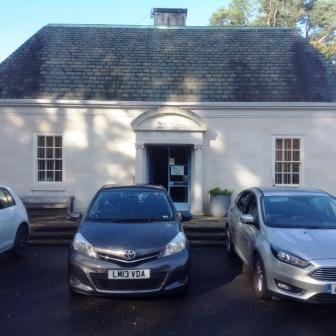
IMG_4425 Nov 9 2019 Canada House CWGC site

Canada House at Brookwood Military Cemetery. (Photo credit: Jacqueline & Graham Hocking)

IMG_4426 Nov 9 2019 Cemetery exit with row of pine trees on either side of the road

Brookwood Military Cemetery exit, with pine trees on either side of the road. (Photo credit: Jacqueline & Graham Hocking)

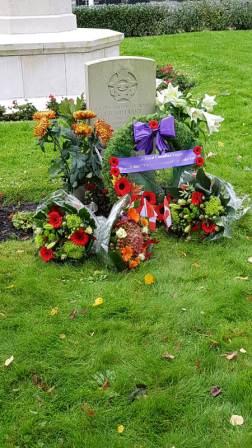
Jacqueline Hocking by grave of John Goodwill Howatt.  (Photo credit: Graham Hocking)

Graham Hocking by grave of Austin Harry Boulter.  (Photo credit: Jacqueline Hocking)

Pam Alexander, daughter of Halifax L9561 Navigator Reg ALEXANDER, who had attended the commemoration events in The Netherlands on October 12, 2019, sent the following message:  “Thinking of Elmer Muttart, his family and all the crew and their families today as we watch the Cenotaph ceremony and observe the two minute silence for all who have fallen in wars and conflicts for the UK and our Allies.”  (See On The War Memorial Trail…..The Halifax L9561 Crew)

image1 Oct 12 2019 Muttarts grave

Grave of Elmer Muttart at Harlingen General Cemetery on October 12, 2019. (Photo credit: Pam Alexander)

Robert O’Brien, who also attended the commemorative events for Halifax L9561, wrote a brief summary of the events in the November 8 & 15, 2019 issue of Rotary Voice from the Rotary Club of Toronto.  (To read his article, see voice-nov-8-2019)

Thank you to Jacqueline and Graham Hocking, and to Pam Alexander and Robert O’Brien for these moments of remembrance. If you have stories or photos to share about the names on the Cenotaph outside the Borden-Carleton Legion, please contact Pieter at dariadv@yahoo.ca or comment on the blog.

© Daria Valkenburg


The WW2 Soldier Who Drove On The Wrong Side Of The Road

August 28, 2019.  Many years ago, while on the North island of New Zealand, I drove to a meeting with a colleague from the South Island.  Driving in New Zealand means driving on the side of the road opposite to the way we are used to driving.  Usually I did well with remembering which side of the road to drive on, but sometimes the brain cells reverted to their default setting.  That happened one evening after we stopped at a gas station.  After pulling back out onto the road, we were listening to music and having a great conversation when all of a sudden I noticed a big truck coming towards us.  “What is he doing?” I asked my passenger.  He didn’t reply.  A quick glance showed him looking terrified and gripping the door handle.  “What’s wrong?” I asked.  Finally, he very quietly whispered, “In this country, we drive on the other side of the road.” Oops!  I quickly switched lanes and the truck safely passed us, but not without a few angry toots on the horn.  An angel was sitting on our shoulders that evening!

x-default

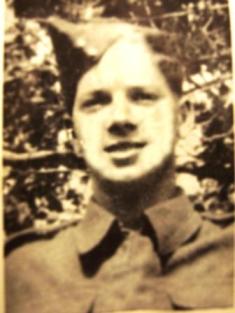
Austin Boulter. (Photo credit: Augustine Cove Women’s Institute 1800-1973 Centennial history project)

I remembered this event after learning from Pieter’s research what happened to WW2 soldier Austin Harry BOULTER, whose driving experience didn’t end as happily.  According to his attestation papers, Boulter was born on October 4, 1920 in Freetown, the son of Roy Boulter and Blanche Leard.  There is a discrepancy as the Military Service Record’s Declaration and Statement of Relatives records his date of birth as October 4, 1922 in Tryon. A check of the June 1921 census does not record him, indicating that he wasn’t yet born.  It’s pretty clear that he fudged his attestation paper during his enlistment on May 27, 1940 in Woodstock, New Brunswick to make sure he wouldn’t be rejected as being too young!  At the time of enlistment the family lived in Cape Traverse, but Boulter was working as a lumberman for J. Craig in Stanley, New Brunswick.

While Boulter enlisted with the Carleton and York Regiment, he was transferred to the Canadian Signal Training Corps on September 9, 1940.  On May 18, 1941 he was transferred to the 3rd Canadian Division Signals and sent to Debert Camp, Nova Scotia. It was with that group that he left Halifax for England, arriving in Avonmouth on July 31, 1941.  The unit was in England to train for deployment to Western Europe.  (This was the first Canadian division to fight in the Normandy Campaign, landing at Juno Beach on D-Day on June 6, 1944.)

Boulter never left England, as around 10 pm on January 14, 1943, while not on duty, he borrowed a motorcycle ‘without authority’, according to a court of inquiry into his death.  He was “carrying a civilian passenger on the back of the motorcycle”.  Unfortunately, he forgot which side of the road to drive on, and crashed into a 4X4 Ford driven by Private M J. O’Grady, between Storrington and the Royal Winnipeg Rifle Lines.

At the court of inquiry, O’Grady stated that after seeing the motorcycle in his lane, O’Grady started to pull over to the left, but Boulter “came straight on, striking his front right bumper and fender and catching on the corner of the box directly behind the cab.”  O’Grady stopped immediately and he and his passengers jumped out.  He stated that he “saw a soldier on the ground a short distance beyond the bike and saw a lady further away on the ground.” Boulter was dead, but his passenger was hurt.  O’Grady “posted a guard on the truck and told the other two men to take over while he ran into Storrington to get help.”  O’Grady testified that he was “travelling about 15 mph” and that the motorcycle “appeared to be travelling too fast”.

The finding of the court indicated that Boulter “was not wearing a crash helmet”.  The registry of death noted that he died instantly from severe head injuries incurred during the crash.

It’s unknown why Boulter was with a civilian passenger so late at night, and why he took a motorcycle without permission.  No testimony by the passenger was recorded in the court of inquiry and she was not identified. He was buried at Brookwood Military Cemetery, Sussex, England.

The Summerside Journal of January 18, 1943 recorded his obituary:

Bedeque Soldier Dies Overseas

A Prince Edward Island soldier, Sigmn. Austin Harry Boulter of Bedeque, was listed under died overseas in the 252nd Canadian (Active) Army overseas casualty list last night. His next-of-kin was given as his mother, Mrs. Blanche Boulter of Bedeque.

If anyone can provide a photo or more information on Austin Harry Boulter, please contact Pieter at dariadv@yahoo.ca or comment on the blog.

© Daria Valkenburg


On The War Memorial Trail…..The Archive Photo That Put A Face To A Name

March 15, 2019.  One of the biggest challenges in the project to uncover the stories behind the names listed on the Cenotaph outside the Borden-Carleton Legion is finding photos of the men.  Quite often family members can be found, but photos, especially for soldiers who lost their lives in WWI, were not always kept by family.  

Most of the soldiers who lost their lives were young and unmarried, and succeeding generations of nieces and nephews didn’t always want to keep what was left behind by grandparents or their parents.  Photos, particularly unidentified ones, and letters from unknown people were just not a priority for many people.

So it was a very pleasant surprise when, during a visit to the Prince Edward Island Archives in Charlottetown, Pieter struck it lucky while looking through an album of photos donated by Jean MacFayden.  Most photos were not identified, but then, to his astonishment, Pieter found a photo of WWI soldier John Goodwill HOWATT, of Augustine Cove.  Unfortunately, the other two men in the photo were unidentified, with only the remark that they were ‘two Halifax boys’. Up to now, Pieter has not been able to find anyone else who might have the same photo and be able to give more information.

P0006342 copy J.G. Howatt ordered from PEI Public Archives

Photo donated to the PEI Archives by Jean MacFayden, in which she identified John Goodwill Howatt on the left, and noted only that he was with “two Halifax boys”. (Photo credit: courtesy Public Archives and Records Office of Prince Edward Island, Acc4154)”

In this exceptional case, Pieter had a photo, which could put a face to a name, but was unable to find any family, a bit unusual given that Howatt is a well-known Island name!  Who was this mystery man?

John Goodwill HOWATT was born July 27, 1897 in Augustine Cove, the son of Edward G. Howatt and Emma May Wood, and had a younger sister, Cecilia Amanda.  After John’s father died in 1908, his mother remarried, to Don Howatt in 1909, but she herself died on August 25, 1916.

A farmer before he decided to enlist in January 1916 with the 105th Battalion, Company C, John had his medical exam in Summerside, but it wasn’t until March 4, 1916 that he received his medical clearance and was formally enlisted.  After that, things moved quickly, and he was on his way to England in June 1916, sailing from Halifax aboard the S.S. Empress of Britain.  On November 28, 1916 he was transferred to the 25th Battalion of the Canadian Infantry and sent to France, arriving there on November 29, 1916.

On August 8, 1918, the Battle of Amiens began in France, the start of the 100 Days Offensive that led to the end of WWI.  By the end the day, Allied Forces had forced their way through German lines around the Somme. There were 27,000 German casualties, 12,000 of which had surrendered.

The next day, August 9, the war diary of the 25th Battalion recorded that, “At 9:15 am, verbal orders were received for the Battalion to continue the attack in conjunction with other troops.”  After leaving Gaillacourt, where they had spent the night, “The Battalion rapidly moved to the assembly position – the heights southeast of Caix – and crossed the British front line, then held by the 4th Canadian Division, at 1 pm. As the Battalion moved over the ridge in front of Caix, they were met with a light artillery barrage, and strong enemy machine gun fire.

As they pressed on towards Vrely, the Battalion encountered “some hard fighting in a wood on the right”.  Undaunted, the Battalion continued on and the war diary gave an understated report of what happened next.  “On emerging from Vrely, ‘A’, ‘B’, and ‘C’ companies met with some opposition in the nature of an enemy Field Battery, which opened fire from a few hundred yards away.” The Battalion won this skirmish.  “Rifle and machine gun fire caused this Battery to retire, with the loss of its officers and three of its drivers, and the advance continued to Meharicourt, which was captured with little trouble by 5 pm.

It’s not certain exactly when, but at some point on the second day of the battle, John was severely wounded in his back and shoulder from gunshot, leaving him paralyzed from the waist down.  He was carried to a Casualty Clearing Station, then put on a train the next day to a field hospital. 

On August 22, he was transported back to England and operated on, but died in a London hospital on September 7, 1918. He was only 21 years old.  He’s buried at Brookwood Military Cemetery in Surrey, England, which we have not yet been able to visit.

If you have more information or photos on John Goodwill Howatt, or are able to identify the two ‘boys from Halifax’ in the photo shown above, please send an email to  memorialtrail@gmail.com or comment on this blog.

© Daria Valkenburg

….Want to follow our research?…

If you are reading this posting, but aren’t following our research, you are welcome to do so.  Our blog address: https://onthewarmemorialtrail.com/
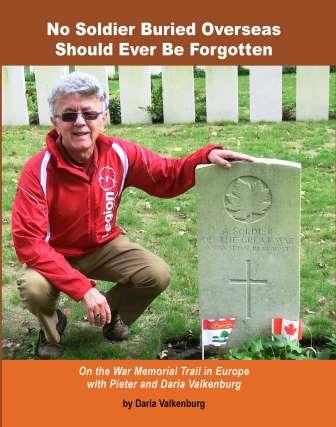
4 countries, 6 weeks, 7,000 km – an unforgettable war memorial journey in Europe…. Daria’s book ‘No Soldier Buried Overseas Should Ever Be Forgotten‘ is available in print and e-book formats.  Net proceeds of book sales help support research costs and the cost of maintaining this blog. For more information see https://nosoldierforgotten.com/

Subscribe to our YouTube Channel: On The War Memorial Trail With Pieter Valkenburg: https://www.youtube.com/channel/UCJ591TyjSheOR-Cb_Gs_5Kw

Never miss a posting!  Subscribe below to have each new story from the war memorial trail delivered to your inbox.
On The War Memorial Trail….The Last Post Ceremony At The Menin Gate Memorial In Ypres

November 23, 2017.  In the morning we’d visited the Menin Gate Memorial in Ypres and found the listings for two men whose names are on the Cenotaph outside the Borden-Carleton Legion: Charles Benjamin BUXTON and George ‘Albert’ CAMPBELL (See A Daytime Visit To Menin Gate Memorial in Ypres).

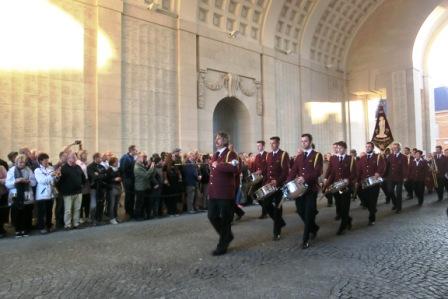
We returned in the evening for The Last Post Ceremony, which occurs at 8 pm every day at Menin Gate Memorial, rain or shine.  It began on July 2, 1928, after the Memorial opened in 1927, as a way for the citizens of Ypres to express their gratitude towards those who had died in defence of Belgium’s freedom.

The only time the ceremony was not held in Ypres was during the German occupation during World War II.  Instead, a daily ceremony was held at Brookwood Military Cemetery, in Surrey, England.  On September 6, 1944, the evening that Polish forces liberated Ypres in the Second World War, the ceremony at Menin Gate resumed, even though heavy fighting was still taking place in other parts of Ypres.

Bands and choirs from around the world apply to participate in the ceremonies. On the evening we attended the ceremony, the St. Cecilia Helden band from The Netherlands was there.  It was very apt since Pieter is from The Netherlands, and that was going to be the next country on our war memorial trail.

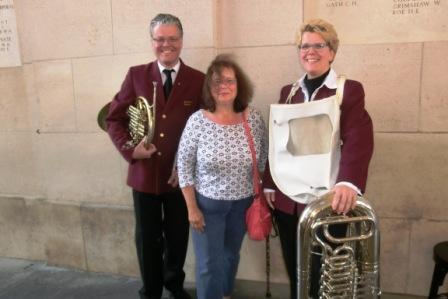
CIMG8802 Sep 9 2017 Daria with two members of St Cecilia Helden band before Last Post Ceremony at Menin Gate

Daria with two members of the St. Cecilia Helden band from The Netherlands. (Photo credit: Mieke de Bie)

We quickly saw that if we wanted to get a spot with easy visibility of the ceremony that we would have to line up at least 1 ½ hours early!  We did and so were lucky to have a front line view, and watched the band march through Menin Gate Memorial to stand on the outside of the Memorial.

CIMG8804 Sep 9 2017 Last Post Ceremony Menin Gate st Ceclia Helden Band

St. Cecilia Helden band marched through Menin Gate before the ceremony began. (Photo credit: Daria Valkenburg)

Police cars soon barricaded the road on either side of the Menin Gate Memorial so no traffic could get by.

Just before 8 pm three buglers from the local fire brigade arrived and played ‘The Last Post’. 

CIMG8815 Sep 9 2017 Last Post Ceremony Menin Gate buglers from local fire brigade play The Last Post

Buglers from the local fire brigade in Ypres play ‘The Last Post’ at 8 pm. (Photo credit: Daria Valkenburg)

‘The Last Post’ was followed by the Exhortation, where a dignitary said the words we are all familiar with from Remembrance Day ceremonies in Canada.  Taken from the 4th verse of Laurence Binyon’s poem ‘For The Fallen’, first published on September 21, 1914, he recited, in English:

“They shall grow not old, as we that are left grow old:
Age shall not weary them, nor the years condemn.
At the going down of the sun and in the morning,
We will remember them.”

This was followed by a minute of silence, and then wreaths were laid by various groups while the St. Cecelia Helden band played.  We were sorry we hadn’t thought of asking to lay a wreath as a way to further commemorate Campbell and Buxton.  Following the wreath laying the final bugle call, ‘Réveille’, was played and the ceremony was over.

We were lucky to be right at the spot where the fire brigade walked past, and they graciously posed for a photo.  Of course, we gave them Canadian flag pins, and to our surprise we received a Menin Gate Memorial pin in exchange.

CIMG8833 Sep 9 2017 Last Post Ceremony Menin Gate

Buglers from the local Fire Brigade in Ypres. (Photo credit: Daria Valkenburg)

This was a beautiful ceremony, with respectful visitors from many countries.  Behind us was a family from Poland, a poignant reminder of the Polish allies who liberated Ypres during WWII.

We returned to our hotel in a thoughtful mood, after the day of visiting memorials and cemeteries.  We still had a few places in Flanders to visit before going on to The Netherlands, but that would have to wait for another day.

Comments or stories?  You can share them by emailing us at memorialtrail@gmail.com or by commenting on this blog.

© Daria Valkenburg

….Want to follow our research?….

If you are reading this posting, but aren’t following our research, you are welcome to do so.  Our blog address: https://onthewarmemorialtrail.com/

Front cover OnTheWarMememorialTrailinEurope4 countries, 6 weeks, 7,000 km – an unforgettable war memorial journey in Europe…. Daria’s book ‘No Soldier Buried Overseas Should Ever Be Forgotten‘ is available in print and e-book formats.  Net proceeds of book sales help support research costs and the cost of maintaining this blog. For more information see https://nosoldierforgotten.com/ 

You are also invited to subscribe to our YouTube Channel: On The War Memorial Trail With Pieter Valkenburg: https://www.youtube.com/channel/UCJ591TyjSheOR-Cb_Gs_5Kw

Never miss a posting!  Subscribe below to have each new story from the war memorial trail delivered to your inbox.