May 18, 2026. Since Pieter began the On The War Memorial Trail research project in 2014, it’s been an honour for us to meet families of those who served. While much of the focus is on those who served our country and lost their lives while in service, most military service personnel in WWI and WWII returned home. We don’t often know much about their time in service, or what happened afterwards. As families come forward with information, we are trying to tell these stories.
Brenda Graves of North Tryon, Prince Edward Island shared that both of her husband Stuart’s grandfathers served in WWI and returned home with major injuries. “…Stuart’s paternal grandfather lost a leg in 1917 and his maternal grandfather was grievously injured in the nose, shoulder, and throat by an exploding grenade in 1918…”
Both men had immigrated to Canada from the United Kingdom, overcame difficult challenges as a result of their war injuries, and went on to marry and live productive lives in Winnipeg, Manitoba.
We decided to tell the story of both grandfathers, and began with Stuart’s paternal grandfather, Francis Edmund GRAVES.
….Francis immigrated to Canada when he was 15 years old…
Born November 5, 1877 in Sheffield, England, Francis was the son of Henry and Mary Ann (nee Lindley) Graves, the second youngest of 6 children, per an 1881 census.
At the young age of 15, he immigrated to Canada, arriving on May 1, 1893 in Quebec City, Quebec aboard the S.S. Sardinian, which had sailed from Liverpool, England on April 20, 1893. (See https://en.wikipedia.org/wiki/SS_Sardinian) The S.S. Sardinian was an Allan Line steamship that transported British Home Children to Canada, between 1875 and the early 20th century, part of an assisted migration scheme that sent orphaned or underprivileged children for farm work and domestic labour. Francis was listed as a domestic whose destination was Prince Albert, Saskatchewan, so it’s possible that he came to Canada under this program.
It’s unknown if Francis went to Prince Albert, but his obituary noted that he had worked on a farm in Melfort, Saskatchewan. By the time WWI broke out, he was living in Calgary, Alberta, where he enlisted with the 82nd Battalion on October 6, 1915, a month before he turned 38 years old. His military service file stated that was single, a cook by trade, and worked on the railroad.
…..Francis fell in love…..
On February 17, 1916, Francis married Elizabeth Ellen ‘Helen’ (nee Telfer) Bartram in Calgary. However, it turned out that the marriage was not legal as Helen was married to another man. She was arrested for bigamy on April 12, 1916. Helen had married Alfred Slous (aka Sloan) after being widowed with 3 children and then had 2 children with Slous. All 5 children were abandoned with the Childrens’ Aid Society in Toronto before she moved to Calgary. At a point in his life when he could have walked away, Francis directed that a portion of his pay continue to be paid to her in care of the lawyer assigned to her case. He never forgot the commitment he had made.
…..Francis left Canada for overseas service…..
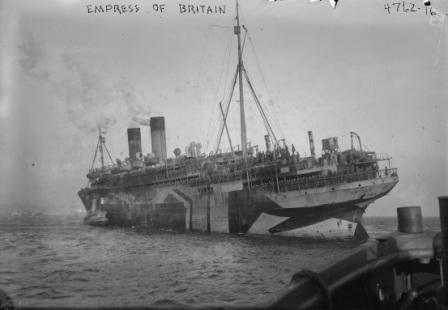
Empress of Britain in 1915 as a WWI troop ship. (Photo source: https://cdn.loc.gov/service/pnp/ggbain/27800/27873v.jpg)
After completing basic training, Francis, as a member of the 82nd Battalion, travelled to Halifax, Nova Scotia, where they went aboard the Empress of Britain on May 20, 1916, and arrived in Liverpool, England on May 29, 1916. The battalion consisted of 34 officers and 1,006 other ranks.
Designated a reserve unit, upon arrival in England, the 82nd Battalion supplied reinforcements to the Canadian Corps in the field, typical of many Canadian Expeditionary Force (CEF) battalions formed in 1915–1916 that were broken up to support front-line units rather than fighting as a distinct unit.
On July 14, 1916, Francis was transferred to the 9th Reserve Battalion, and based in Shorncliffe while training continued for fighting in France. Then, on August 27, 1916, Francis transferred to the 31st Battalion for service in France, arriving at the Canadian Base Depot (CBD) in Le Havre a day later.
…..Francis survived the Battle of the Somme and Battle of Vimy Ridge….
On September 12, 1916, Francis was assigned for a few days to the 2nd Canadian Entrenching Battalion, where he would have been tasked with being part of working parties to help with trench repairs, wiring, road making, and as carrying parties.
He was back with the 31st Battalion on September 15, 1916. As part of the 2nd Canadian Division, the 31st Battalion endured four days fighting for the Regina Trench during the during the Battle of the Somme in late September 1916. Regina Trench was the Canadian name for the longest German trench on the Western Front, and was located along the north-facing slope of a ridge running from north-west of the village of Le Sars, close to the German fortifications at Thiepval. (See https://en.wikipedia.org/wiki/Capture_of_Regina_Trench)
Francis was promoted to Lance Corporal on April 3, 1917, just before he fought ….and survived …the Battle of Vimy Ridge on April 9, 1917. (See https://en.m.wikipedia.org/wiki/Battle_of_Vimy_Ridge)
On April 13, 1917, Francis received another promotion, to be Acting Corporal.
…..Francis was seriously wounded during the Battle of Fresnoy….
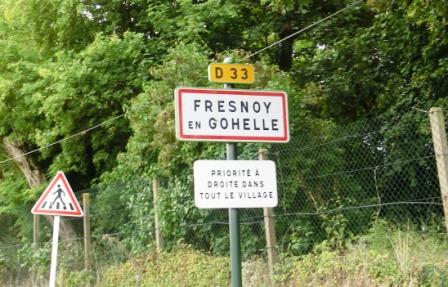
We visited Fresnoy-en-Gohelle on our 2017 European War Memorial Tour. (Photo credit: Daria Valkenburg)
After capturing Vimy Ridge, the Canadian Corps was tasked with continuing to advance through France, specifically attacking the Fresnoy area along with British forces. The Battle of Fresnoy was part of the Third Battle of the Scarpe. Fought from May 3 to 4, 1917, this was the final part of the larger Battle of Arras, which was fought from April 9 to May 16, 1917.
The objective of the Third Battle of the Scarpe was a general offensive to secure better defensive positions along the Scarpe. The focus for the Canadians was the village of Fresnoy-en-Gohelle, which we visited during our 2017 European War Memorial Tour.

Fresnoy-en-Gohelle in the distance. (Photo credit: Daria Valkenburg)
The battle for Fresnoy resulted in high casualties on all sides. It was the last military battle for Francis, whose luck ran out on May 3, 1917, when he was seriously wounded “….by machine gun bullets in 3 places, which entered his left thigh close to the trunk and fracturing his left thigh bone…”
His medical history case file, written by Captain Young, at Manitoba Medical Hospital in Winnipeg on September 22, 1919, summarized what followed. “…He lay out on the field for 2 days, then lay in the trench for 2 more days….”
By the time Francis was removed from the battlefield, not only would he have been in great pain, but infection would have set in. In the days before antibiotics, doctors had little chance of saving his leg. On May 8, 1917, the wounds on his leg were cleaned out at a Casualty Clearing Station.
….Francis spent 2 years in various hospitals after being wounded…
Francis was only at the beginning of a long medical ordeal. From the Casualty Clearing Station he was transferred to No. 8 Stationary Hospital in Wimereaux, France on May 15, 1917. The hospital was on the south side of Wimereaux, near the coast and the main road to Boulogne, and consisted of approximately 25 hutted barracks and tents. While in Wimereaux, the doctors did an “…amputation at trunk of left leg on July 6, 1917….”
He was then evacuated to England, to the 2nd Birmingham War Hospital in Birmingham on July 26, 1917. From there, he was transferred to 3rd Northern General Hospital in Sheffield on August 7, 1917. He was back in the city of his birth! His older sister Charlotte, an elementary school teacher, still lived in Sheffield and perhaps was able to visit him while in hospital.
Unfortunately, Francis developed cellulitis at the amputation spot and had a second operation on “…November 25, 1917 for disarticulation of left hip-joint….”
His ordeal was not over as in March 1918, Francis was transferred to Granville Canadian Special Hospital in Buxton for another operation as there was a continuous discharge from the wounded area.
On June 1, 1918, Francis was transferred to 5th Canadian General Hospital Kirkdale in Liverpool, his last stop in England. He was invalided to Canada from Liverpool on June 6, 1918 aboard HMHS Llandovery Castle and arrived in Halifax, Nova Scotia on June 18, 1918, just over two years from the day he left Canada for overseas service.
The next stop for Francis was Whitby Military Hospital in Whitby, Ontario, where he suffered through another operation on July 27, 1918 “….for exploration and scraping. Wound kept on discharging until November 1918 when it healed and discharged ceased….”
The medical report recorded that Francis “….wore his first artificial limb in January 1919 for one month. Got new limb in April. Then got new bucket on this limb on September 10th….”
On September 19, 1919, he was “…transferred to Tuxedo Park Manitoba Military Hospital…” in Winnipeg, Manitoba where the final report on his present condition was noted as “…Wound well healed. Bucket fits well….”
….Francis lived his post-war life in Winnipeg…
Francis was discharged from the army on December 22, 1919, and remained in Winnipeg, taking a position as a clerk with the Empire Sash and Door Co. Ltd, a position he held until his death.
On June 4, 1921, he married Elizabeth Ross (nee Wilson) Hewitt, widow of WWI soldier John William HEWITT, and mother of two children: George and Irene.
He was a member of the Fragments Amputation Club of the Great War Amputations Association (forerunner of The War Amps – see https://www.waramps.ca/about-us/history/). A photo of the Amputation Club Picnic Committee, of which Francis was a member, was published in the Winnipeg Evening Tribune on August 13, 1923.
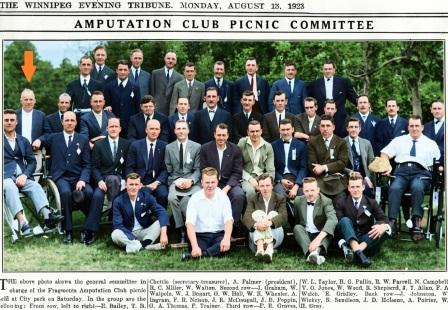
Francis (identified by orange arrow) was a member of the Fragments Amputation Club. (Photo source: August 13, 1923 edition of Winnipeg Evening Tribune. Photo restoration and colourization by Pieter Valkenburg.)
On May 8, 1924, Francis and Elizabeth became parents to twin boys – Francis ‘Frank’ Tom and Edmund ‘Ted’ George.
Brenda shared a photo in which Francis and his twin sons were included. “…. Here is the picture of Stuart’s grandfather, the man wearing the tie and missing a leg. Stuart’s dad (Francis ‘Frank’ Tom) is the young man sitting down. Frank’s twin brother Ted is sitting on Frank’s lap. They are twins but not identical.…”
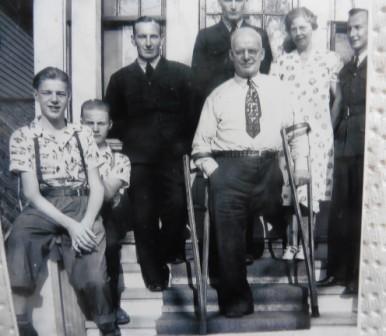
Front row, Ted Graves, Frank Graves, Francis Edmund Graves. (Photo courtesy of Brenda and Stuart Graves)
Francis saw his step-daughter married. Irene married RCAF officer Herbert Lines on September 19, 1936. His step-son George immigrated to Australia and joined the Australian Army.
When Francis passed away on November 8, 1941 in Winnipeg, aged 64, his twin sons were still teenagers, aged 17. Both enlisted in the RCAF at the age of 19.
….Francis is buried in Brookside Cemetery in Winnipeg…
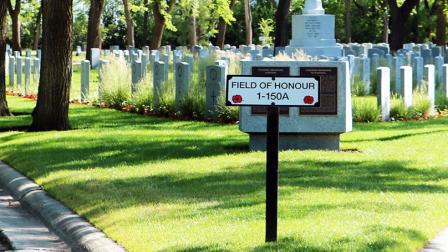
Field of Honour in Brookside Cemetery (Photo source: https://www.winnipeg.ca)
On November 10, 1941, Francis was buried in Brookside Cemetery in Winnipeg, in its Field of Honour section. He’s one of more than 10,000 veterans buried there since the section opened in 1915, originally as a burial site for Veterans returning from World War I. The Field of Honour is home to the only Commonwealth War Graves Commission ‘Stone of Remembrance’ in all of the Americas and was installed in 1960.
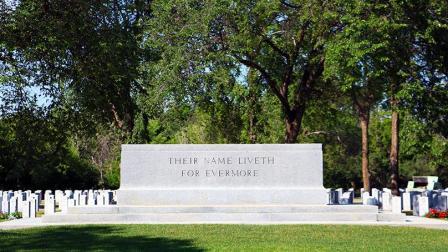
Stone of Remembrance in Brookside Cemetery (Photo source: https://www.winnipeg.ca)
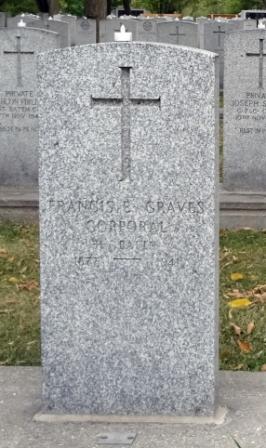
Grave of Francis Edmund Graves in Brookside Cemetery in Winnipeg. (Photo source: Find A Grave)
Elizabeth remarried, to William Stewart, and moved to Port Coquitlam, British Columbia. She died October 11, 1953, aged 60.
Coming up in Part 2, the story of WWI soldier Charles STUART, the maternal grandfather of Stuart Graves.
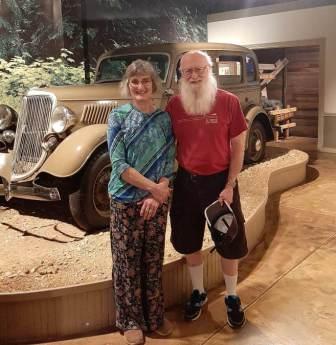
Brenda and Stuart Graves. (Photo courtesy of Brenda Graves)
Thank you to Brenda and Stuart Graves for providing information and photos, and to Shawn Rainville for extensive newspaper searches.
Shawn noticed a coincidence with his own family history, saying that Francis Graves lived directly across the street from his “…great-uncle Alexander Rainville, who had enlisted in March 1918, and was wounded in the head and knees in August 1918 in France. My great-uncle was born in 1884 and died in 1937. So both were relatively close in age and died relatively young. It’s quite conceivable that they knew each other. My great-uncle was buried in Brookside Cemetery as well …”
Living in Prince Edward Island ourselves, we were interested to learn that one of Irene Hewitt Lines’ sons, Hewitt Lines, an officer in the RCAF, married Faye Hardy of West Bloomfield in September 1968!
Pieter’s research efforts to find photos and families of soldiers continue. Do you have a story to tell? Email Pieter at memorialtrail@gmail.com, or comment on the blog.
© Daria Valkenburg
….Story about a WWI soldier who lost his life in the Battle of Fresnoy…
- John ‘Lymon’ WOOD: https://onthewarmemorialtrail.com/2019/09/16/the-parallel-ww1-experiences-of-john-lymon-wood-clifford-almon-wells/
….Want to follow our research?…
If you are reading this posting, but aren’t following our research, you are welcome to do so. Our blog address: https://onthewarmemorialtrail.com/
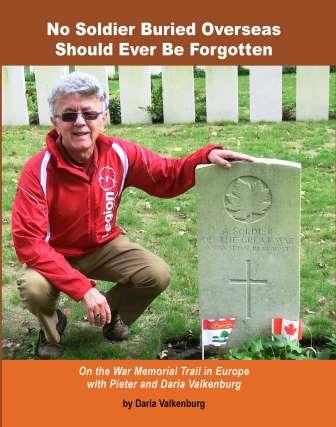 4 countries, 6 weeks, 7,000 km – an unforgettable war memorial journey in Europe…. Daria’s book ‘No Soldier Buried Overseas Should Ever Be Forgotten‘ is available in print and e-book formats. Net proceeds of book sales help support research costs and the cost of maintaining this blog. For more information see https://nosoldierforgotten.com/
Subscribe to our YouTube Channel: On The War Memorial Trail With Pieter Valkenburg: https://www.youtube.com/channel/UCJ591TyjSheOR-Cb_Gs_5Kw.
Never miss a posting! Subscribe below to have each new story from the war memorial trail delivered to your inbox.


