On The War Memorial Trail…..The WWI Soldier From Tryon Who Became A Mailman In New Brunswick

January 7, 2025.  Several months ago, Pieter received a phone call from Carmen Ross, explaining that his granddaughter Lauren was doing a school project on his great-uncle, WWI soldier John Joseph FOY, who was born in Tryon, Prince Edward Island, very near to where we live. Could Pieter help with information about his great-uncle’s military service?

In 2021, we’d written about another WWI soldier from Tryon with the same surname, Maynard FOY.  Was he a relative? Pieter asked.  It turned out that the two families were distantly related.  (See https://onthewarmemorialtrail.com/2021/04/24/on-the-war-memorial-trail-the-ww1-soldier-who-returned-to-tryon/)

CIMG7040 Sep 4 2024 Pieter with Carmen and Margaret Ross

Pieter with Carmen and Margaret Ross.  (Photo credit: Daria Valkenburg)

Like Maynard, John Foy survived the war and returned to Canada.  As one of the goals of the ‘On The War Memorial Trail’ research project is the opportunity to tell the stories of Islanders who survived their war service, Pieter not only helped provide information for Lauren’s school project, we also met with Carmen and his wife Margaret. 

…My grandfather, Alfred Foy, known as Allie, was John’s brother…  Carmen explained.  He also recalled his mother Hilda telling him that John “…was such a nice man!…

….John enlisted in 1915….

John Joseph Foy

John Joseph Foy.  (Photo courtesy of Carmen Ross)

Born on October 25, 1882, John was the son of Philip Morris Callbeck and Rachel (nee Bynon) Foy.  A farmer at the time of his enlistment on September 25, 1915 in Charlottetown, Prince Edward Island, John had served in the No. 2 Heavy Battery Depot since July 1915, when it had been first organized in Prince Edward Island under the command of Major A. G. Peake, and which became No. 2 Overseas Battery, Canadian Siege Artillery, on September 29, 1915.

….John left Canada for overseas service shortly after enlistment….
File written by Adobe Photoshop? 4.0

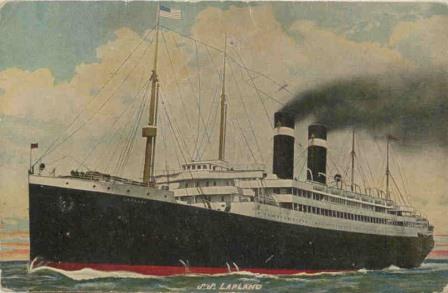
SS Lapland.  (Photo source: https://www.wikitree.com)

With his Battery, John sailed aboard the SS Lapland, leaving Halifax, Nova Scotia on November 28, 1915, and arriving at Plymouth Sound, United Kingdom on December 7, 1915. 

The Battery was housed at Raffey Camp, at Horsham Siege Artillery School, in West Sussex.  As a gunner, John and the other members of his Battery underwent four months of training there. While in England, the Battery was re-designated as No. 98 (Canadian) Siege Battery, Canadian Siege Brigade.

He remained with No. 98 (Canadian) Siege Battery Artillery until January 19, 1916, when he was transferred to the 3rd Reserve Brigade, Canadian Field Artillery, which was at Shorncliffe, for further training, and as part of reinforcement troops.

….John was sent to France for the Battle of the Somme….
DAC_Pack_Ammo_Apr17

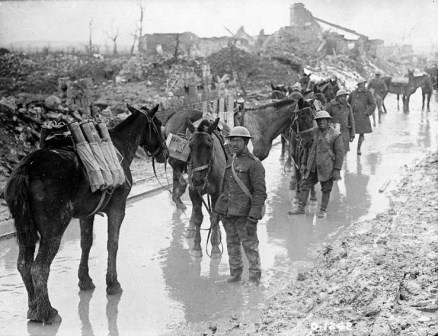
Ammunition Column Pack horses transporting ammunition to a brigade in France.  (Photo source: Library and Archives Canada, MIKAN no. 3194763)

On August 25, 1916 he left for France and was assigned to the 1st Divisional Ammunition Column (DAC), whose role was to bring ammunition forward to the gun positions of the 1st Division batteries for the Battle of the Somme. (See https://en.m.wikipedia.org/wiki/Battle_of_the_Somme)

Ammunition was moved by motor and horse drawn transport, heavy and light rail, and tramways.  From his service file, it appears that John worked in the stables and in the transport of ammunition by horses.

….John was reassigned to his artillery battery….

John remained with the 1st DAC until September 12, 1916, when he returned to the 2nd Brigade, and continued to work with horses, which were used in transporting the heavy guns and ammunition to the front lines, as the Battle of the Somme continued into the fall of 1916.  The Brigade served continuously behind the United Kingdom’s 4th Army’s front until December 1916, when troops were ordered to dig their guns out of the mud and move northward.

In January 1917, the battery became part of the Canadian Corps Heavy Artillery and was renamed No. 2 Canadian Siege Battery, Canadian Garrison Artillery (CGA).  On January 22, 1917, John was admitted to a field hospital in France with bronchitis and pneumonia, and remained there until January 27, 1917, when he rejoined his unit.

Preparations were underway for the Battle of Vimy Ridge, a three day battle from April 9 to 12, 1917, which John survived. (See https://en.m.wikipedia.org/wiki/Battle_of_Vimy_Ridge) Following Vimy Ridge, John’s unit was involved in the Battle of Hill 70, just east of Loos and north of Lens, which was fought between August 15 and 25, 1917. (See https://en.m.wikipedia.org/wiki/Battle_of_Hill_70)

On October 4, 1917, John was sent to a rest camp in Boulogne for 2 weeks, returning to his unit on October 19, 1917.  A few weeks later he was sent to England on leave for a few weeks, returning on November 30, 1917, where he and his unit were assigned to the 48th Battery, Canadian Field Artillery. 

….A handkerchief from Belgium remains in the family!….

LAC_BL_6-inch_26_cwt_Howitzer

Crew positioning a BL 6-inch howitzer. (Photo source: Library and Archives Canada MIKAN No. 3395353)

John’s battery was involved in the March 1918 German Spring Offensive in West Flanders, Belgium. (See https://en.m.wikipedia.org/wiki/German_spring_offensive) While in Belgium, he managed to buy an embroidered handkerchief, which was given to Carmen’s mother Hilda.
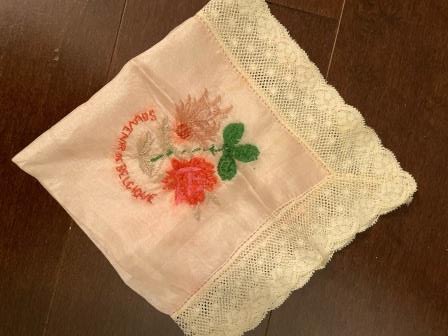
image0 Belgian hankie 2 from Jen Huber

Embroidered handkerchief from Belgium that John Foy brought back to Canada.  (Photo courtesy of Jen Huber)

As fighting continued, troops were involved in the Hundred Days Offensive, which began in August 1918 and continued until the end of the war. (See https://en.m.wikipedia.org/wiki/Hundred_Days_Offensive) They moved frequently, through the Hindenburg Line, and advancing north during the Battle of Cambrai in France, from October 8 to 10, 1918.  (See https://en.m.wikipedia.org/wiki/Hundred_Days_Offensive)

In December 1918, the battery moved briefly into Germany, positioned on the west bank of the Rhine at Cologne to protect the crossing of the 1st Canadian Division on December 13, 1918.  The battery returned to the United Kingdom, leaving France from Le Havre on March 30, 1919, and arriving in the United Kingdom at Weymouth.

….John was discharged from the army and returned to Canada….

By April 14, 1919, John was on his way back to Canada, leaving Southampton aboard the SS Olympic.  He was discharged from service on April 30, 1919 in Charlottetown, aged 36.
Screenshot 2025-01-07 at 09-48-24 Lewisville Map - Locality - Westmorland County New Brunswick Canada

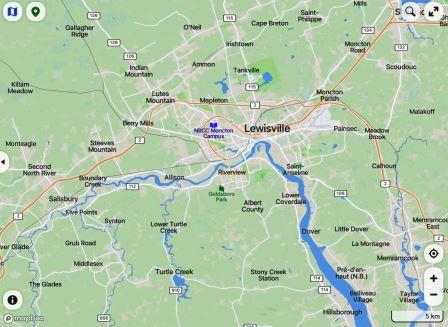
John Foy lived in Turtle Creek and was a mailman in rural Lewisville, now part of Moncton.  (Map source: http://www.mapcarta.com)

John never married and moved to New Brunswick. He was involved in harness racing as a driver and worked as a rural mailman in Lewisville (now part of Moncton), while living in nearby Turtle Creek, before he retired due to ill health.

….John is buried in St. John, New Brunswick….

He died on July 1, 1964, aged 81, at the Lancaster Department of Veterans Affairs Hospital in Lancaster, New Brunswick, following a lengthy illness, and was buried in the Field of Honour at Cedar Hill Extension Cemetery in St. John.

cemetery where he is buried Find a Grave

Grave of John Joseph Foy in Cedar Hill Extension Cemetery in St. John, New Brunswick. (Photo courtesy of FindAGrave)

Thank you to Carmen and Margaret Ross, and Jen Huber, for sharing photos and information about John Foy, and to Shawn Rainville and Etienne Gaudet for newspaper research. If you have a story or photo to share, please contact Pieter at memorialtrail@gmail.com or comment on the blog. 

© Daria Valkenburg

….Want to follow our research?….

If you are reading this posting, but aren’t following our research, you are welcome to do so.  Our blog address: https://onthewarmemorialtrail.com/
Front cover OnTheWarMememorialTrailinEurope4 countries, 6 weeks, 7,000 km – an unforgettable war memorial journey in Europe…. Daria’s book ‘No Soldier Buried Overseas Should Ever Be Forgotten‘ is available in print and e-book formats.  Net proceeds of book sales help support research costs and the cost of maintaining this blog. For more information see https://nosoldierforgotten.com/

You are also invited to subscribe to our YouTube Channel: On The War Memorial Trail With Pieter Valkenburg: https://www.youtube.com/channel/UCJ591TyjSheOR-Cb_Gs_5Kw

Never miss a posting!  Subscribe below to have each new story from the war memorial trail delivered to your inbox.

The WWI Soldier From Barton Whose Body Was Never Recovered

July 31, 2022. Most of the time Pieter is involved in a search for photos and family of WWI or WWII soldiers, a task that requires a great deal of research and luck.  Sometimes, however, the opposite happens, and he’s asked to find family and a soldier for a photo that has been ‘orphaned’ for one reason or another.

For a veteran, it can be difficult to ignore a photo that has been discarded or placed for sale in an auction or secondhand shop.  That’s exactly what happened when veteran Mario Henry, Sgt At Arms at the Borden-Carleton Legion, visited a pre-auction preview recently and spotted a photo of what looked to be a WWI soldier.

….Photo of a WWI soldier placed for auction…

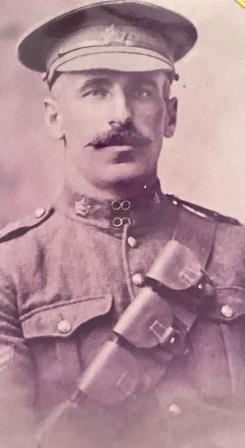
improved_photo(4) shortliff

Photo of WWI soldier Lloyd Shortliff.  (Photo credit and restoration: Pieter Valkenburg)

It was in an antique frame and was most likely a black and white photo that had been colourized with watercolour and framed, suggesting that at one time this was a treasured piece in someone’s home.

….The back of the photo identified the soldier and his family….

CIMG5692 Jun 28 2022 back of Shortliff photo

Back of photo with identifying information.  (Photo credit: Daria Valkenburg)

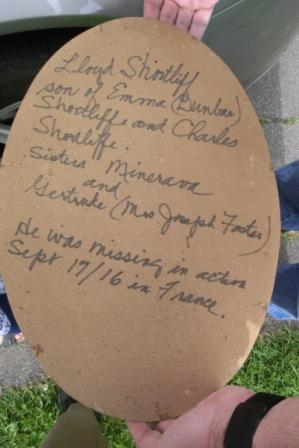
A quick glance at the back of the photo had identifying information, which helped to uncover a soldier’s military service.  The information on the back stated: “Lloyd Shortliff, son of Emma (Dunbar) Shortliffe and Charles Shortliffe. Sisters Minerva and Gertrude (Mrs Joseph Foster).  He was missing in action September 17, 1916 in France.

….Who was Lloyd Shortliff?….

Mario contacted Pieter, who soon determined that the photo was of Lloyd Clifton SHORTLIFF, born April 12, 1891 in Barton, Digby, Nova Scotia, son of Charles Henry and Emma (nee Dunbar) Shortliff.

A farmer before enlisting in Sussex, New Brunswick on September 20, 1915 with the 64th Battalion, Lloyd left Halifax, Nova Scotia aboard the SS Adriatic on March 31, 1916, arriving in Liverpool, England on April 9, 1916.

On June 24, 1916 he was transferred to the 12th Battalion and sent to Shornecliffe Army Camp for further training. (See https://www.saltwoodkent.co.uk/the-canadian-at-shorncliffe-during-)

…Lloyd was sent to the front…..

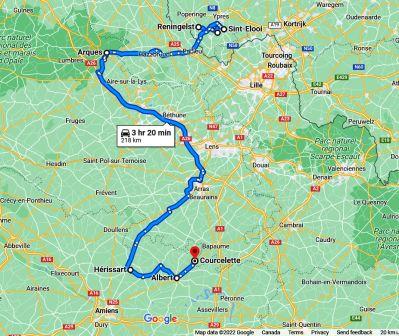
Screenshot 2022-07-04 at 10-28-48 Vierstraat · Ypres Belgium

Blue line shows the route taken by the 24th Regiment as they moved from the Ypres area in Belgium towards France for the Battle of the Somme. (Map source: http://www.google.ca)

A few days later, on June 28, 1916, he was transferred to the 24th Battalion (Victoria Rifles of Canada) and sent to Belgium on July 12, 1916. The Regiment was part of the Canadian Corps manning the Western Front.

On August 28, 1916 the Regiment marched to Eperlecques, France for training on the new Lee-Enfield rifles, where they also trained in manoeuvres in preparation for what the troops would experience in the Battle of the Somme. (See map at https://en.wikipedia.org/wiki/File:Map_of_the_Battle_of_the_Somme,_1916.svg)

On September 4, 1916, the Regiment went to Argues, France, and took a train to Conteville, before moving on towards Hérissart, and then to Albert, France, where the Regiment arrived on September 10, 1916 and were set up in tents.

The Somme front was near the village of Courcelette. Training began for an attack on the Sugar Refinery near Courcelette, which began on September 15, 1916.  By the next day, Battalion Headquarters was set up in a trench by the Sugar Refinery, in preparation for further attacks against the Germans. (See https://www.warmuseum.ca/firstworldwar/history/battles-and-fighting/land-battles/courcelette/)

Lloyd lost his life on September 17, 1916.  Unfortunately his body was never recovered and he is listed on the Canadian National Vimy Memorial.

….Could the photo be saved?….

Knowing that Lloyd Shortliff was listed on the Vimy Memorial was like waving a red flag at a bull for veterans Pieter and Mario.  Pieter has a special affinity for Vimy after we’d been there in 2017 to honour two soldiers from the Island that Pieter had researched.  (See https://onthewarmemorialtrail.com/2017/09/19/visiting-the-canadian-national-vimy-memorial/)

The photo couldn’t be resigned to the dustbin of history!  The value was in the antique frame, not the photo, and both men believed someone would buy the frame and discard the photo.

Mario contacted the auctioneer and asked if the seller would pull the picture out of the auction, pending further investigation.  The seller refused.

That seemed to be that ….. until Mario contacted Pieter to say that he had attended the auction and bought the picture.  Pieter went back to his research, to learn how Lloyd lost his life and to find his family.

CIMG5689 Jun 28 2022 Pieter and Mario with photo

Pieter (left) and Mario Henry (right) with the picture of WW1 soldier Lloyd Shortliff. (Photo credit: Daria Valkenburg)

….How did Lloyd Shortliff lose his life?…

Pieter wanted to know how Lloyd lost his life and why he was listed on the Vimy Memorial, since he didn’t die during the Battle of Vimy Ridge, which was in April 1917.

According to the war diary for the 24th Battalion for September 17, 1916, “… at 12:30 pm, orders were received from the Brigade that the Battalion, less one Company, were to attack the German front line, with our Right resting on the Baupame Road, and our Left with the 22nd Battalion in the vicinity of the Quarries.  The attack commenced at 5 pm…..

The soldiers  of ‘D’ Company, on the extreme right, “…were unable to reach their objective, many of them killed before they got over the parapet, and the men who did advance were held up in the German wire and shot down…

‘A’ Company was in the centre, and “…obtained their objective, but after severe fighting, the enemy bombed them out, working through from his main line…

By the time the fight was over, 9 officers and 330 other ranks of the 24th Battalion were dead, wounded, or missing and presumed dead, among them Lloyd Shortliff.  As his body was never recovered it appears he was among the soldiers who were bombed.

24th battalion WW1 112

Map of the Battle of Courcelette on September 17, 1916. Red arrow shows the Sugar Refinery where Lloyd Shortliff went missing.  (Map source: The 24th Battalion, C.E.F., Victoria Rifles of Canada, 1914-1919)

…Pieter found the family of Lloyd Shortliff….

Pieter’s research next focused on Lloyd’s descendants, and led to family member Trent Whittaker, whose grandmother was Gertrude Foster, Lloyd’s sister.  After explaining about the picture that Mario had rescued, he was surprised to learn that it was Trent who had put the photo in a garage sale as part of the clear out of a 200 plus year old farmhouse.  The family had a photo of Lloyd and the one put in the garage sale was a duplicate. Several ‘pickers’ had bought the goods and that was the last he saw of the picture.

This is a story many will find familiar.  Relatives die and families are left with an accumulation of ‘stuff’ that can become overwhelming.  In the purge, photos, letters, diaries, and other memorabilia can get discarded.

…. Lloyd is remembered on the Barton War Memorial…

IMG_5558R Jul 8 2022 Barton War Memorial

Barton War Memorial.  (Photo credit: Sandra Lent)

Lloyd Shortliff was bombed to smithereens in France, his remains never recovered, but he is listed on the Vimy Memorial in France, and Pieter discovered that he is also listed on the war memorial in Barton, Nova Scotia:  https://nshdpi.ca/is/digbyco/bartonwarm.html.  The Legion in Weymouth, Nova Scotia has expressed an interest in the picture after learning of its existence.

IMG_5566R Jul 8 2022 Barton War Memorial

Lloyd Shortliff is remembered on the Barton War Memorial. (Photo credit: Sandra Lent)

Sandra Lent of the Weymouth Legion visited the memorial and explained that it was “…located in Barton, at the head of a cemetery.  There are no other markings, such as the name of the cemetery, although it is well tended, and the pillar shaped monument is helpful for identification.  It is located a short distance north of the Barton post office, on the same side of the highway...

Thank you to Mario Henry for saving the photo which gave us a chance to tell Lloyd Shortliff’s story.  Thank you as well to Sandra Lent for taking the photos of the Barton War Memorial.  If you have a story to tell, please let Pieter know. You can email him at memorialtrail@gmail.com, comment on the blog, or send a tweet to @researchmemori1.

© Daria Valkenburg

….. More stories of ‘orphan’ soldier photos and artifacts …

…Want to follow our research?….

If you are reading this posting, but aren’t following our research, you are welcome to do so.  Our blog address: https://onthewarmemorialtrail.com/

Front cover OnTheWarMememorialTrailinEurope4 countries, 6 weeks, 7,000 km – an unforgettable war memorial journey in Europe…. Daria’s book ‘No Soldier Buried Overseas Should Ever Be Forgotten‘ is available in print and e-book formats.  Net proceeds of book sales help support research costs and the cost of maintaining this blog. For more information see https://nosoldierforgotten.com/ 

Upcoming Author Talk: Thursday, August 11, 2022 – Victoria-By-The-Sea, Prince Edward Island, part of the ‘Our Island Talks’ series, and hosted by Victoria Playhouse and Victoria Historical Association. Time: 2:00 pm.

You are also invited to subscribe to our YouTube Channel: On The War Memorial Trail With Pieter Valkenburg: https://www.youtube.com/channel/UCJ591TyjSheOR-Cb_Gs_5Kw.

Never miss a posting!  Subscribe below to have each new story from the war memorial trail delivered to your inbox.
   

On The War Memorial Trail….Grandcourt Road Cemetery in Farmers Fields

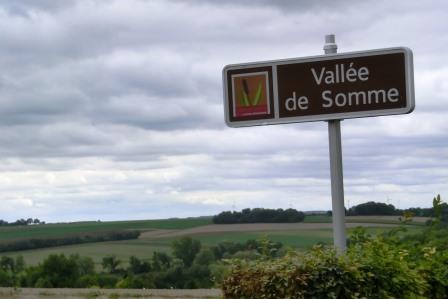
September 28, 2017.  After a few successful cemetery finds, we decided to make a second attempt at finding Grandcourt Road Cemetery, the burial place of Arthur Leigh COLLETT.  We finally found it in the afternoon on a very narrow path between farm fields, one km south of the village of Grandcourt in the spectacularly beautiful Somme Valley.

CIMG8361 Sep 5 2017 we reach the Somme Valley in France

We reach the Somme Valley in France. (Photo credit: Pieter Valkenburg)

The Commonwealth Graves Commission write up on the cemetery warned that access was difficult, saying “Please note that parking is difficult.  There is no permanent pathway to the cemetery.  Visitors must cross two fields to reach the cemetery.”  They weren’t kidding!

By “no permanent pathway” they meant you had to drive down a very narrow path which had inches to spare on either side on our small rental car.  We were dwarfed by a cornfield on one side and a potato field on the other.

CIMG8535 Sep 6 2017 corn is higher than car by Grandcourt Road Cemeter

You can see how close we were to the cornfield! (Photo credit: Daria Valkenburg)

Needless to say, there was no parking and no way to turn around except to drive backwards!  We simply stopped the car beside the sign pointing to the cemetery and crossed our fingers in the hope that no one would come along down the road or we would be in trouble before anyone saw the car.

The next challenge, now that we found the location, was getting to the cemetery.  It involved crawling up a set of steps to the first field.  One look at the steps, with no railing, and it was clear that only Pieter was attempting this journey.

CIMG8520 Sep 6 Sep 6 2017 steps going up to Grandcourt Road Cemetery

The steps leading up to the fields that one had to cross in order to reach Grandcourt Road Cemetery. The bottom step is inches away from our car! (Photo credit: Pieter Valkenburg)

From the top of the steps it was another 500 metres, across two fields, before Pieter reached the cemetery.  Poor Arthur Collett!  From Rhodes Scholar to lie buried in a field in the middle of nowhere!

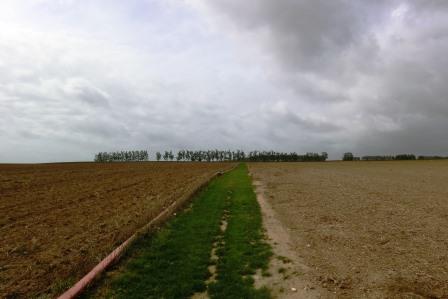
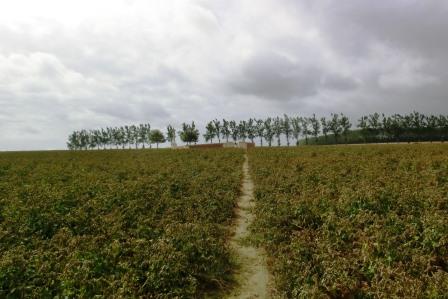
In one field, the farmer had made a grass path to walk along, in order to reach the cemetery, a thoughtful gesture that was much appreciated.

CIMG8522 Sep 6 2017 grass path leading to Grandcourt Road Cemetery

Grass path across a farmer’s field towards Grandcourt Road Cemetery. The trees in the distance indicate the cemetery location. (Photo credit: Pieter Valkenburg)

The second field wasn’t as easy to cross.  That farmer found his potatoes more important than providing access to the cemetery, and did not have a grass path.  Luckily for Pieter, it was not raining or he would have been stuck in the mud.

CIMG8523 Sep 6 2017 second field potatoes more important than access to Grandcourt Rd Cemetery

Second farmer’s field did not have a grass path towards Grandcourt Road Cemetery. The trees in the distance indicate the cemetery location. (Photo credit: Pieter Valkenburg)

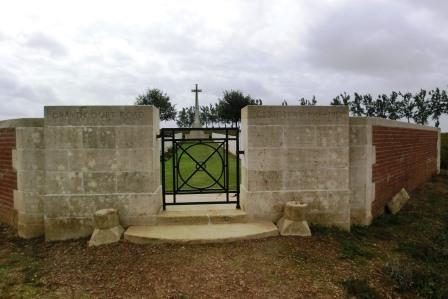
Eventually, however, Pieter reached the gates of the cemetery, and learned it was made in the spring of 1917 when the Ancre battlefield was cleared.  There are 391 WWI burials, 108 of them unidentified.  390 are British soldiers, and one, our Lt Arthur Collett, the lone Canadian burial.

CIMG8524 Sep 6 2017 gates of Grandcourt Rd Cemetery

After crossing two farmers’ fields, Pieter reached Grandcourt Road Cemetery. (Photo credit: Pieter Valkenburg)

Arthur Leigh COLLETT was born December 8, 1888 in Victoria, Prince Edward Island, the son of Ella May Simmons, and was the adopted son of William Henry Collett and Alice M.  Moore.  After receiving a Bachelor of Arts from King’s College in Halifax, Nova Scotia, he went to Oxford as a Rhodes Scholar, but shortly afterwards enlisted in the 12th Regiment in September 1914, later transferring to the 8th Battalion of The Gloucestershire Regiment.  According to the King’s College history, he “at once forsook his work at Oxford and enlisted in the Imperial Army.  He served in France with the 8th Gloucesters.

Arthur Collett 1

Arthur Collett. (Photo courtesy of Heather and Paul Moore Family Collection)

In a Pioneer newspaper article from July 15, 1916, came word of an injury, which he survived. “Mr. W. H. Collett, Victoria, has received a cablegram from London, England, notifying him that his son Lieut. A. L. Collett, was wounded on July 3rd. Lieut. Collett, who is a Rhodes scholar and also an Oxford M.A., went over to England with the First Contingent and was later transferred to the 8th Gloucester Regiment.

Unfortunately, he died in action on November 18, 1916 during the last day of the Battle of the Ancre.  The Battle of the Ancre, fought against the German 1st Army between November 13 and 18, 1916, was the final large British attack of the Battle of the Somme.

The war diary for November 18, 1916 of the 8th Battalion Gloucestershire Regiment made the following record:  “Formed up in artillery formation preparatory to attack on Western outskirts of. Grandcourt. 6:10 a.m. attack launched, first objective reached and carried. The 10th regiment was right on our right being partially held up our flank was in the air. Casualties: 12 Officers, 283 Other Ranks.

And so that’s how Arthur Collett ended up in Grandcourt Road Cemetery, sharing a grave with an unknown soldier.

CIMG8528 Sep 6 2017 grave of Arthur Collett at Grandcourt Rd Cemetery

Grave of Arthur Collett in Grandcourt Road Cemetery. (Photo credit: Pieter Valkenburg)

After placing the flags by Collett’s grave, Pieter had to retrace his steps back across two fields and down the narrow steps, then squeeze himself into the small space between the steps and the car.  Then we had to gingerly inch our way back out onto an actual road.  We were lucky.  No one came onto the path while we were there!

Grandcourt Road Cemetery is difficult to access, and requires a lot of time, determination, and a good level of physical fitness.  Consequently, it’s not well visited.  Pieter wrote in the Guest Register and noted the previous entry was dated four months earlier.

In the next blog entry we visit the Newfoundland Memorial at Beaumont-Hamel Newfoundland Battlefield Memorial Park before we continue our search for the Manitoba Cemetery. Do you have information or photos for Arthur Collett? Comments or stories?  You can share them by emailing us at memorialtrail@gmail.com or by commenting on this blog.

© Daria Valkenburg

….Want to follow our research?….

If you are reading this posting, but aren’t following our research, you are welcome to do so.  Our blog address: https://onthewarmemorialtrail.com/

Front cover OnTheWarMememorialTrailinEurope4 countries, 6 weeks, 7,000 km – an unforgettable war memorial journey in Europe…. Daria’s book ‘No Soldier Buried Overseas Should Ever Be Forgotten‘ is available in print and e-book formats.  Net proceeds of book sales help support research costs and the cost of maintaining this blog. For more information see https://nosoldierforgotten.com/ 

You are also invited to subscribe to our YouTube Channel: On The War Memorial Trail With Pieter Valkenburg: https://www.youtube.com/channel/UCJ591TyjSheOR-Cb_Gs_5Kw

Never miss a posting!  Subscribe below to have each new story from the war memorial trail delivered to your inbox.