On The War Memorial Trail….The WWII Soldier From Piusville Killed During The Battle Of The Leopold Canal

December 10, 2025. In the course of his research into WWII soldiers buried in The Netherlands, Pieter soon learned that many Canadians who lost their lives during the Battle of the Scheldt are not only buried in the Canadian War Cemetery in Bergen Op Zoom in The Netherlands, but are also buried at the Canadian War Cemetery in Adegem, Belgium.

While most of the men buried in Adegem died during the operations for the clearance of the south bank of the Scheldt, many Canadians who lost their lives elsewhere in Belgium were also brought here for burial. Out of 848 Canadians buried here, 12 are from Prince Edward Island, and this spring an appeal went out in the local media for photos and information on the soldiers.

Pieter’s research results are faster than I can keep up with, and so several of the graves we visited during our 2025 European War Memorial Tour were for soldiers whose stories have yet to be told.  One of these is the subject of this posting….

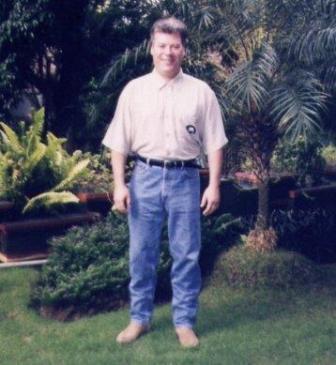
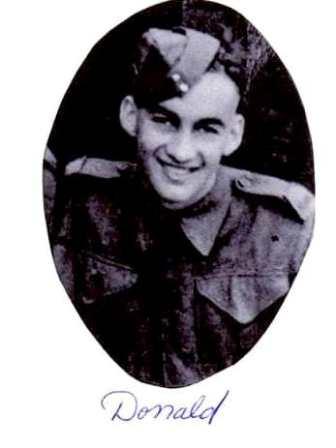
….Steve Gallant’s niece had a photo of her uncle….

After reading about the appeal for photos in the County Line Courier newspaper, Pauline Stewart of New Annan, Prince Edward Island contacted us, writing that “we follow your memorial trail column.  In the last edition my uncle was mentioned….  Her uncle was Joseph Stephen ‘Steve’ GALLANT, of Piusville, who was serving with the Royal Winnipeg Rifles when he lost his life on October 11, 1944 at the age of 29.

At the time of Pauline’s email, we were still in Europe.  We sent her a photo taken of her uncle’s grave, and explained that Pieter would give her a call once we were home again.  She replied with a surprise. By the way the Two Bulger Boys from Foxley River are my husband’s uncles…” 

Last year, a two-part series on Harold ‘Hal’ Gabriel BULGER, who is buried in Adegem, and his brother Lawrence William BULGER, who is buried in the Canadian War Cemetery in Groesbeek, was published. (You can read Lawrence’s story at https://onthewarmemorialtrail.com/2024/08/19/on-the-war-memorial-trail-the-bulger-brothers-part-2-the-wwii-stretcher-bearer-from-foxley-river-killed-during-the-battle-of-bienen/ and Hal’s at https://onthewarmemorialtrail.com/2024/08/05/on-the-war-memorial-trail-the-bulger-brothers-part-i-the-wwii-soldier-from-foxley-river-killed-during-the-battle-of-moerbrugge/)

Pauline and Charles Stewart with Pieter. (Photo credit: Daria Valkenburg)

A few months later, we had a chance to meet with Pauline and her husband Charles.  Pauline explained that her father, John P. Gallant, was Steve’s brother. Another brother, Vincent, also served during WWII, but survived. “…Steve was the groomsman at the marriage of my parents….

She recalled that “….Steve was on leave right after I was born in August 1944, and he died a few months later….

Born in Piusville, Prince Edward Island on July 31, 1915, Joseph Stephen ‘Steve’ GALLANT was the son of Archie and Jannie Gallant.  He had 5 brothers and 1 sister.

….Steve enlisted in 1942…

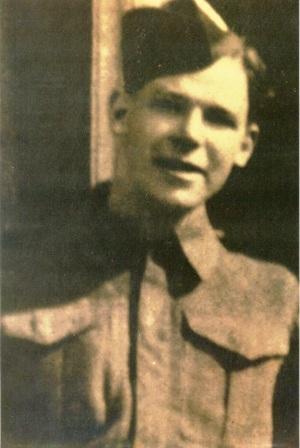
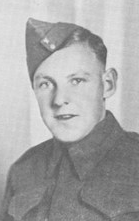
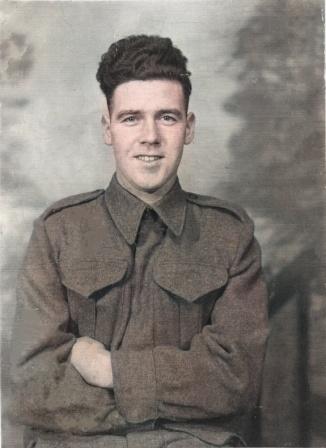
Joseph Stephen ‘Steve’ Gallant.  (Photo Courtesy of Pauline and Charles Stewart On Behalf Of The Gallant Family)

Steve originally enlisted under the National Resources Mobilization Act (NRMA) at the No. 6a NRMA Clearing Depot in Charlottetown, Prince Edward Island on May 15, 1942 and began basic training at No. 62 Canadian Army Basic Training Centre in Charlottetown. At the time, he stated that he’d left school at the age of 12 after completing Grade 5, that he was working on his father’s farm in Piusville, and that he was fluent in both French and English.   (See https://en.wikipedia.org/wiki/National_Resources_Mobilization_Act)

….Steve transferred to the 5th SMAA S/L Troop…

After completing basic training on July 11, 1942, Steve was transferred to the 5th Special Mobile Anti-Aircraft Search Light Troop (5th SMAA S/L Troop) and was stationed at various airports, beginning with Ives Point, Nova Scotia, near Halifax. As explained in a Government of Canada history of the Royal Canadian Air Force during WWII, the main task of this unit was “…to provide realistic training to aircrews – the terrifying experience of being ‘coned’ by enemy anti-Aircraft battery searchlights….” (See https://www.canada.ca/en/air-force/corporate/wings/14-wing/history.html)

On October 5, 1942, Steve enlisted in the Active Army in Halifax, Nova Scotia, and remained with the 5th SMAA S/L Troop.  A few days later, on October 8, 1942, he was attached to No. 6 Detachment, Royal Canadian Ordnance Corps (RCOC) in Debert, Nova Scotia, for a month.

He was next attached to No. 34 Operational Training Unit (OTU) of the Royal Air Force in Pennfield, New Brunswick.  An airport had been built in 1940 to train Air Observers as part of the British Commonwealth Air Training Plan (BCATP). The Operational Training Unit at the airport was used to train four crew members for World War II action: Pilot, Navigator, Wireless Air Gunner and Air Gunner. (See https://en.wikipedia.org/wiki/British_Commonwealth_Air_Training_Plan)

A month later, Steve was attached to No. 36 Operational Training Unit (OTU) of the Royal Air Force in Greenwood, Nova Scotia.  The site for RAF Station Greenwood, which opened in 1942, had been chosen by the Royal Canadian Air Force (RCAF) and Royal Air Force for an airfield as part of the British Commonwealth Air Training Plan (BCATP) due to the area having a relatively fog-free climate.

On February 2, 1943, Steve was again attached to No. 6 Detachment, Royal Canadian Ordnance Corps (RCOC) in Debert, Nova Scotia, for a few months.  Then, on May 8, 1943, he was again attached to No. 36 Operational Training Unit (OTU) in Greenwood, Nova Scotia.

A month later, he was attached again to No. 34 Operational Training Unit (OTU) in Pennfield, New Brunswick for 2 months before returning to No. 36 Operational Training Unit (OTU) in Greenwood, Nova Scotia. While in Greenwood, Steve was sent ‘On Command’ to Winnipeg, Manitoba, on October 10, 1943.

….Steve left Canada for overseas service….

On March 27, 1944, Steve was transferred to the 21st Anti-Aircraft Regiment of the Royal Canadian Artillery, and posted to 1st Anti-Aircraft Searchlight (AA S/L) Battery in Halifax, Nova Scotia, for additional training as a gunner. A few weeks later, on April 22, 1944, he was sent to No. 1 Transit Camp in Windsor, Nova Scotia in preparation for overseas duty.

Steve was granted embarkation leave from May 5 to 9, 1944. It must have been a bittersweet time as he didn’t return back until May 12, 1944, resulting in the forfeiture of 3 days pay and allowance and being confined to barracks for 4 days. 

On May 20, 1944, Steve was sent to the No. 1 Training Battalion of the Canadian Infantry Corps in Debert, Nova Scotia for final training and preparation for overseas service.  On July 21, 1944, he was transferred to the Training Brigade Group in Debert.  He was granted another leave from August 3 to 15, 1944, in what turned out to be the last time he would ever see his family again.

On August 29, 1944, Steve left Canada for the United Kingdom.  Upon arriving on September 4, 1944 he was assigned to No. 4 Canadian Infantry Reinforcement Unit (CIRU). 

He wasn’t in the United Kingdom even a month when he was transferred to the X4 Reinforcement List for the Canadian Base Reinforcement Group (CBRG), part of the 13th Battalion, 21st Army Group, on October 1, 1944 and sent to Northwest Europe, arriving a day later.

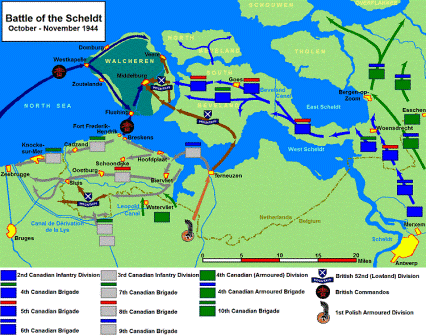
….Steve lost his life during the Battle of the Leopold Canal….

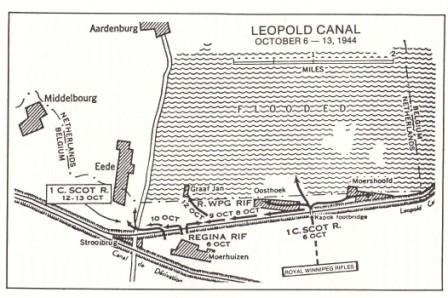
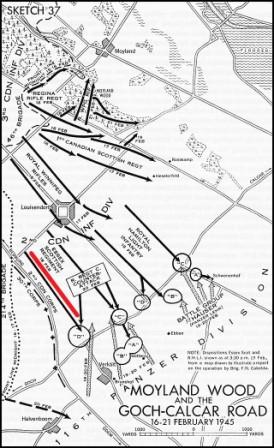
Map showing the Battle for the Leopold Canal.  (Map source: Little Black Devils: A History of the Royal Winnipeg Rifles)

On October 10, 1944, Steve was transferred to the Royal Winnipeg Rifles, joining the Regiment in the vicinity of the dike by Graaf Jan, The Netherlands, where they were engaged in fierce fighting during the Battle of the Leopold Canal on the border between The Netherlands and Belgium.   

The War Diary for October 10, 1944 for the Royal Winnipeg Rifles stated that the Commanding Officer had “… received orders to occupy the Southern approaches to the village of GRAAF JAN. With A Company giving covering fire, B Company succeeded in reaching the objectives at 1500 hrs. Superior enemy forces in the village forced the company to withdraw when ammunition was getting low….

The War Diary for October 11, 1944 noted numerous casualties.  “…Cloudy and cool with slight rain in the afternoon. Visibility poor. During the morning A Company assisted the Regina Rifles in destroying an enemy held pill box. Another C Company patrol to GRAAF JAN failed to contact the enemy…. Enemy shelling was slightly less intense than during the first three days. Small Arms fire continued to make it extremely difficult and dangerous to move about. Supplies and casualties were still ferried across the Canal. Capt H.C. Chadderton of C Company and Lt L. Mendels of B Company were among the numerous casualties for the day….” 

Unfortunately, Steve was one of the ‘numerous casualties’ referred to in the war diary.  He was 29 years old.

….Steve is buried in the Canadian War Cemetery in Adegem….

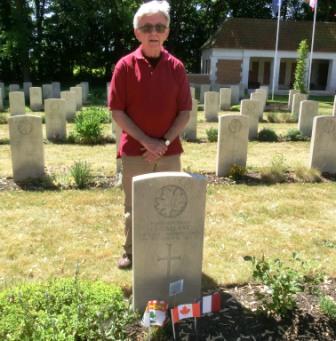
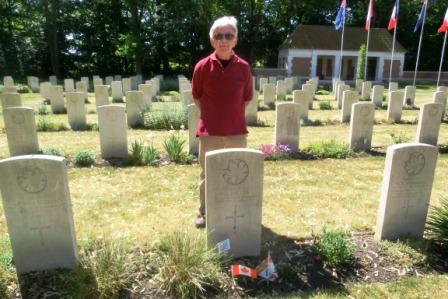
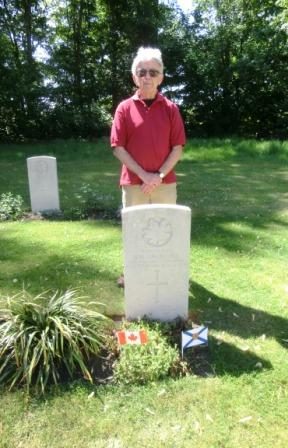
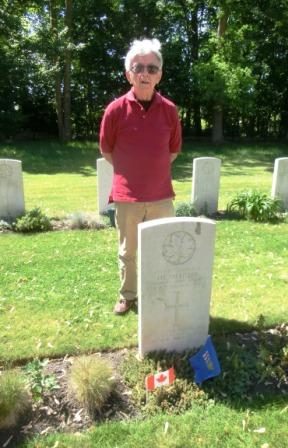
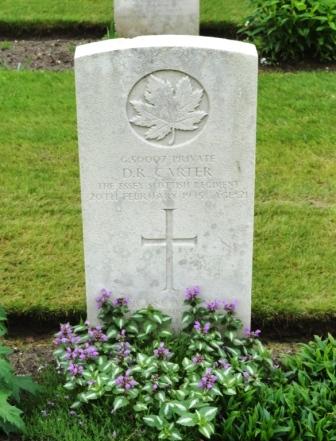
Steve is buried in the Canadian War Cemetery in Adegem, Belgium. We visited his grave on a very hot Sunday this past May, where Pieter placed Acadian, Prince Edward Island, and Canadian flags in remembrance.

Pieter by the grave of Joseph Stephen ‘Steve’ Gallant. (Photo credit: Daria Valkenburg)

….Steve’s mother wanted answers….

On November 13, 1944, a distraught and upset Jannie Gallant – Steve’s mother – wrote to the Department of National Defence, asking questions that so many mothers of soldiers must have had.  “….I received a telegram on October 20 stating that …” Steve had been killed on October 11. “…We haven’t received any more news since.  It makes a very sad house. My husband has been in ill health since 1933. It was a great shock to him and also to me...

She explained that they had received two letters from him once he left Canada.  “…We received a letter from him on the 29th of September and he was still in England, and we received one that was written on October the 7th and he was already in Belgium…” 

Then came the hard question and a query as to whether he was really dead.  “…I want to know how much training that boy had to be sent that soon to Belgium as a rifleman with no training as a rifleman.  I hope that the boy is still living as he was a great help to his father and also to myself….” 

She ended by saying that “…I want to know the particulars of him if he is dead or living….

Mrs Gallant did receive a reply from Lt Cameron, Military Secretary, on November 18, 1944, offering sympathies and explaining that Steve had “…received careful training during the period he was in England and that he would not have been permitted to proceed until he was declared trained…

The reality was that training couldn’t fully prepare a soldier for actual combat. To make things worse, Steve had been sent to the Royal Winnipeg Rifles in the midst of a battle, with not even the chance to get to know the men in the Company he was assigned to.

Thank you to Pauline and Charles Stewart for providing photos and information on Pauline’s uncle. If you have a story to tell, or can provide a photo of one of the soldiers from Prince Edward Island buried in Adegem, please email Pieter at memorialtrail@gmail.com or comment on the blog. 

© Daria Valkenburg

….The 12 soldiers from Prince Edward Island who are buried in Adegem….

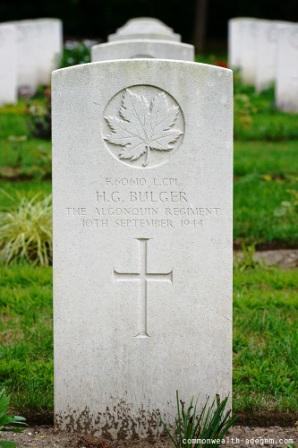
  1. Harold ‘Hal’ Gabriel BULGER of Foxley River was serving with the Algonquin Regiment when he was killed during the Battle of Moerbrugge in Belgium on September 10, 1944, at the age of 26.  
  2. Charles John ACORN of Peters Road was serving with the North Nova Scotia Highlanders when he lost his life on October 15, 1944 at the age of 22. A poor quality newspaper photo was found.
  3. William Henry DEVEAUX of Dundee was serving with the North Nova Scotia Highlanders when he lost his life on October 16, 1944 at the age of 23.
  4. Joseph Stephen GALLANT of Piusville was serving with the Royal Winnipeg Rifles when he lost his life on October 11, 1944 at the age of 29.
  5. Cecil Aneas MACDONALD of Glencoe was serving with the North Shore (New Brunswick) Regiment when he lost his life on October 15, 1944 at the age of 23. NOTE: The Belgian family that adopted his grave would like to be in contact with a family member.
  6. Joseph ‘Joe’ Augustine MACKENNA of Newton Cross was serving with Auxiliary Service as a member of the Knights of Columbus when he drowned in Belgium on June 21, 1945 at the age of 41. 
  7. Adolphus Peter MCCORMACK of New Zealand was serving with the Regina Rifle Regiment when he lost his life on October 30, 1944 at the age of 25.
  8. James Hector MUNN of New Zealand was serving with the Regina Rifle Regiment, 1st Battalion, when he lost his life on October 30, 1944 at the age of 28.
  9. Valmont PERRY of St. Louis was serving with the Stormont, Dundas and Glengarry Highlanders when he lost his life on October 21, 1944 at the age of 26. No photo has been found of him to date.
  10. Allan Rattenbury READ of Read’s Corner was serving with the Regina Rifle Regiment when he lost his life on October 27, 1944 at the age of 21. A poor quality newspaper photo was found.
  11. John James SAUNDERS of Bloomfield was serving with the South Saskatchewan Regiment when he lost his life on September 22, 1944 at the age of 27. No photo has been found of him to date.
  12. Joseph Roy SILLIPHANT of Summerside was serving with the North Nova Scotia Highlanders when he lost his life on October 27, 1944 at the age of 28. A poor quality newspaper photo was found.

….Want to follow our research?…

If you are reading this posting, but aren’t following our research, you are welcome to do so.  Our blog address: https://onthewarmemorialtrail.com/
4 countries, 6 weeks, 7,000 km – an unforgettable war memorial journey in Europe…. Daria’s book ‘No Soldier Buried Overseas Should Ever Be Forgotten‘ is available in print and e-book formats.  Net proceeds of book sales help support research costs and the cost of maintaining this blog. For more information see https://nosoldierforgotten.com/

Subscribe to our YouTube Channel: On The War Memorial Trail With Pieter Valkenburg: https://www.youtube.com/channel/UCJ591TyjSheOR-Cb_Gs_5Kw

Never miss a posting!  Subscribe below to have each new story from the war memorial trail delivered to your inbox.
On The War Memorial Trail….A Visit To The Canadian War Cemetery In Adegem

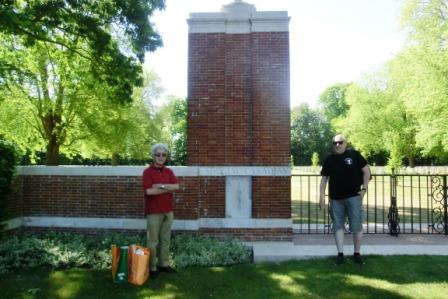
Pieter (left) with Patrick Michiels at the Canadian War Cemetery in Adegem.  The bags by Pieter’s feet contain flags!  (Photo credit: Daria Valkenburg)

December 8, 2025.  Readers of this blog are aware that Pieter has been involved in finding photos of Canadians who are buried in The Netherlands since 2014.  This past spring we were in The Netherlands and Belgium for the 80th Anniversary of Liberation Commemoration events, and placed flags at the graves of 383 soldiers in 14 cemeteries. 

….Flags placed at the graves of soldiers from 8 provinces…

After visiting a number of cemeteries in The Netherlands during our 2025 European War Memorial Tour, we made our way into Belgium. The first cemetery there that we visited was the Canadian War Cemetery in Adegem.  Many Canadians who lost their lives during the Battle of the Scheldt are not only buried in the Canadian War Cemetery in Bergen Op Zoom in The Netherlands, but are also buried at the Canadian War Cemetery in Adegem, Belgium.

While most of those buried in Adegem died during the operations for the clearance of the south bank of the Scheldt, many Canadians who lost their lives elsewhere in Belgium were also brought here for burial.  

There are 1,119 WWII Commonwealth burials, 848 of them Canadian, and one unidentified burial from WWI. There are also 33 Polish and two French burials.  Flags were placed by Pieter at 29 graves at this cemetery:

  • 3 were from Nova Scotia
  • 2 from New Brunswick
  • 12 from Prince Edward Island
  • 2 from British Columbia
  • 2 from Saskatchewan
  • 3 from Manitoba
  • 1 from Alberta
  • 4 from Ontario

4 of the graves also received an Acadian flag.  All of the graves received a Canadian flag.  Provincial flags were placed at all graves, with the exception of the soldiers from British Columbia and Saskatchewan, for which, unfortunately, we did not receive flags.

….This was our first visit to Adegem…

Our journey to the cemetery in Adegem had a few hiccups.  It started with a mistake on my part, when I left my tablet behind at the hotel in Zaltbommel, and didn’t realize it was missing until we were half an hour into our journey to Adegem and had to turn around and go back.  Luckily, it was still in the hotel room, and we were on our way again. 

Then the GPS couldn’t find the cemetery and we got lost before Pieter’s good sense of direction got us to the cemetery….1 ½ hours later than planned.

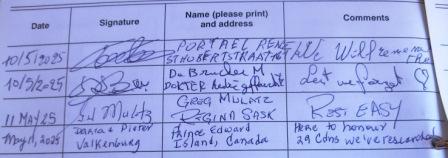
As always, when we are in a war cemetery, we write an entry in the visitors’ book.  (Photo credit: Daria Valkenburg)

We were joined by Patrick Michiels, a Belgian researcher, who had been so helpful to us over the past few years in taking photos of graves of soldiers that Pieter had researched, even going on Christmas Day last year to take photos of the Christmas Eve candles at their graves.  (See https://onthewarmemorialtrail.com/2024/12/31/2024-christmas-eve-candle-lighting-at-the-canadian-war-cemetery-in-adegem/)

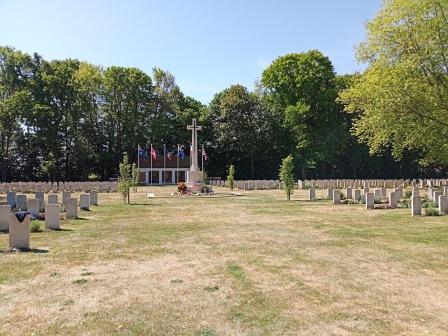
Overview of the Canadian War Cemetery in Adegem with the Cross of Sacrifice.  (Photo credit: Daria Valkenburg)

It took over 2 hours for Pieter to place the flags and to photograph each of the 29 graves, with a slight delay caused when Pieter cut his hand on a sharp knife that Patrick had lent him so he could poke a hole into the very dry soil in order to get the flags placed.  There was no real damage to his hand, but lots of blood!  It didn’t help that it was over 30oC (86oF) and the hot sun was beating down on us, making it feel hotter.

…4 soldiers whose stories were previously told are commemorated…

The graves and photos of 4 soldiers, whose stories have previously been told on this blog, are featured.

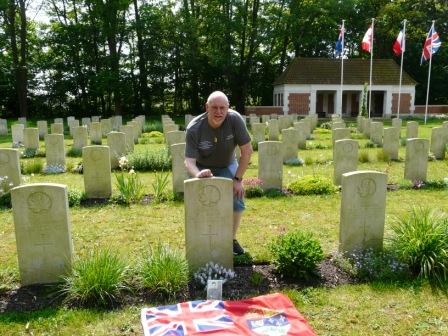
Pieter stands behind the grave of Harold ‘Hal’ Gabriel Bulger.  (Photo credit: Daria Valkenburg)

Harold ‘Hal’ Gabriel BULGER of Foxley River, Prince Edward Island, was serving with the Algonquin Regiment when he was killed during the Battle of Moerbrugge in Belgium on September 10, 1944, at the age of 26. You can read his story at https://onthewarmemorialtrail.com/2024/08/05/on-the-war-memorial-trail-the-bulger-brothers-part-i-the-wwii-soldier-from-foxley-river-killed-during-the-battle-of-moerbrugge/

Pieter stands behind the grave of Bruce Wilbur Churchill.  (Photo credit: Daria Valkenburg)

Bruce Wilbur CHURCHILL, born in Sandford, Yarmouth County, Nova Scotia, was serving with the Algonquin Regiment when was accidentally killed at the age of 23 on September 29, 1944 in The Netherlands when a bullet from a Bren Gun ricocheted and hit him.  You can read his story at https://onthewarmemorialtrail.com/2022/06/05/on-the-war-memorial-trail-the-ww2-soldier-who-lost-his-life-in-a-monastery-garden/

Pieter stands behind the grave of Joseph ‘Joe’ Hudson Pallister.  (Photo credit: Daria Valkenburg)

Joseph ‘Joe’ Hudson PALLISTER, born in Calgary, Alberta, was serving with the Canadian Scottish Regiment when he was killed during the Battle of the Leopold Canal in Belgium on October 6, 1944, aged 21.  You can read his story at https://onthewarmemorialtrail.com/2023/06/18/on-the-war-memorial-trail-1-wwii-soldier-2-families-3-countries/

After we sent photos of our visit to Joseph’s grave to his great-nephew, Thomas Mouser, he not only thanked us, but shared a letter written by Captain John ‘Jack’ Lawrence GALLAGHER to Joseph’s mother about her son…. 

….I wish to express my deepest sympathies to you on the loss of your son, Joe.  He was with the battalion for a long time, and was with me in ‘C’ Company from D-Day until the severe action in which he was killed.

During that time he became liked by everyone for his easy-going good humour and respected for his coolness in action and resourcefulness as our NCO. 

I can only say that he was killed instantly while carrying out his job, and that his conduct in that battle and all others that he participated in was an example to us all….”  

What a heartfelt letter of sympathy to a grieving mother! Captain Gallagher survived WWII, with the rank of Major and a Croix de Guerre (Bel) with Palm, and passed away in 2012. (See https://www.legacy.com/us/obituaries/legacyremembers/john-gallagher-obituary?id=44106495)

Pieter stands behind the grave of Edison Reynolds Smith.  (Photo credit: Daria Valkenburg)

Edison Reynolds SMITH, born on Port Hood Island, Cape Breton, Nova Scotia, was serving with the North Nova Scotia Highlanders when he lost his life in The Netherlands on October 16, 1944 during the Battle of the Scheldt, at the age of 20.  You can read his story at https://onthewarmemorialtrail.com/2023/12/07/on-the-war-memorial-trail-part-1-the-wwii-letters-of-edison-reynolds-smith/ and https://onthewarmemorialtrail.com/2023/12/12/on-the-war-memorial-trail-part-2-the-wwii-letters-of-edison-reynolds-smith/

….Photos of 3 soldiers from Prince Edward Island are sought…

Photos are still being sought for three soldiers from Prince Edward Island who are buried in Adegem:

  • Valmont PERRY of St. Louis was serving with the Stormont, Dundas and Glengarry Highlanders when he lost his life on October 21, 1944 at the age of 26.
  • Allan Rattenbury READ of Read’s Corner was serving with the Regina Rifle Regiment when he lost his life on October 27, 1944 at the age of 21.
  • John James SAUNDERS of Bloomfield was serving with the South Saskatchewan Regiment when he lost his life on September 22, 1944 at the age of 27.  

If you have photos or information to share about these men, please let Pieter know.

….All of the flags placed at graves were donated…

All of the flags placed at graves were donated.  Our thanks go to:

  • Alan Waddell, Constituent Assistant, on behalf of Heath MacDonald, MP for Malpeque, for the Canadian flags.
  • Matt MacFarlane, MLA for District 19, Borden-Kinkora, for the flags from Prince Edward Island.
  • Kyle Graham, Research Officer, Military Relations, Nova Scotia Intergovernmental Affairs, on behalf of Premier Tim Houston, Province of Nova Scotia, for the Nova Scotia flags.
  • Wayne Ewasko, MLA for Lac Du Bonnet, Manitoba, Interim Leader of the Official Opposition, Province of Manitoba, who donated the Manitoba flags.
  • Don Coutts on behalf of the Muttart and Coutts families in memory of Flight Sergeant Elmer Bagnall Muttart for the Ontario flags.
  • Jean-Claude D’Amours, MLA for Edmundston-Madawaska Centre, Minister responsible for Military Affairs, with the help of Cécile LePage, Province of New Brunswick, for the New Brunswick flags.
  • Marie Renaud, MLA St Albert, Alberta at the request of Roman Berezowsky, for the Alberta flag.
  • La Société acadienne de Clare at the request of Simone Comeau for the Acadian flags.

Thank you to Patrick Michiels for joining us during our visit to Adegem.  Thank you also to Thomas Mouser for sharing the letter of sympathy written by Captain Gallagher.  We’ll continue to share the highlights of our adventures on the 2025 European War Memorial Tour. 

The research work continues for Pieter.  If you have photos or information to share about soldiers buried in The Netherlands or Belgium, please email him at memorialtrail@gmail.com, or comment on the blog.    

© Daria Valkenburg

….Want to follow our research?…

If you are reading this posting, but aren’t following our research, you are welcome to do so.  Our blog address: https://onthewarmemorialtrail.com/

4 countries, 6 weeks, 7,000 km – an unforgettable war memorial journey in Europe…. Daria’s book ‘No Soldier Buried Overseas Should Ever Be Forgotten‘ is available in print and e-book formats.  Net proceeds of book sales help support research costs and the cost of maintaining this blog. For more information see https://nosoldierforgotten.com/

Subscribe to our YouTube Channel: On The War Memorial Trail With Pieter Valkenburg: https://www.youtube.com/channel/UCJ591TyjSheOR-Cb_Gs_5Kw

Never miss a posting!  Subscribe below to have each new story from the war memorial trail delivered to your inbox.
On The War Memorial Trail…..Remembrance Week 2025 – The WWII Nursing Orderly Killed When 3 Tracked Vehicles Exploded Near A Field Dressing Station On Walcheren Island

December 4, 2025.  One of the hardest searches for a photo took several years, and, in spite of dedicated help in looking for family members to contact, newspaper and archive searches, and even a November 10, 2023 article in the Winnipeg Free Press (see a Picture of compassion Winnipeg Free Press Article re John Lewis Hughes Nov 10 2023), we struck out each time.

It was difficult to understand as the soldier in question came from a large family, was married, and had worked for 12 years in a hospital in his hometown. Only one niece responded, saying she remembered that her mother, the soldier’s sister, had a photo, but after she passed away, her effects were put in the basement and were later destroyed in a flood.  We had zero luck with the family of the soldier’s wife, who had remarried.  There was also no response from the local Legion branch, nor from the hospital where he had worked.

Eventually we ran out of leads to contact, and so, although we never gave up the search, we reluctantly put John Lewis HUGHES on our Cold Case List.  (See https://onthewarmemorialtrail.com/our-cold-cases/

…. The Winnipeg Free Press article caught the interest of a local historian…...

Shortly after the Winnipeg Free Press article was published, we had been contacted by local historian Judy Gleich.   “…This project is of great interest to me...” she wrote. Her husband is from Eriksdale and “I was born at E.M. Crowe Memorial Hospital and lived most of my life in the Lundar MB area…”  She explained that, unlike many small communities, “…there was no local paper in Eriksdale at that time….” and so there was no local coverage of soldiers from the area.  Like us, she also contacted someone she knew at the local Legion but no photo was found. 

Judy also told us that “E.M. Crowe hospital is no longer run locally – but is under the umbrella of the Interlake Eastern Regional Health Authority…which covers about 1/5 of the province….” 

Judy explained why she was interested to help find a photo.  “…When I read the first article by Kevin Rollason and saw that one of the photos Pieter was looking for was of a veteran from Eriksdale– I was interested although I was not familiar with the Hughes family. I made a couple of phone calls and asked a couple of friends and came up with nothing.….”  (NOTE: A short photo appeal had initially been made in the Winnipeg Free Press in November 2022.)

….After the second article by Kevin Rollason appeared in the Winnipeg Free Press with more information about the Hughes family it piqued my interest again. I figured if someone like Pieter was putting that much effort into this project that I would try to help him….

…. The photo search led to a hockey photo 2 years after the Winnipeg Free Press article was published…...

Like us, Judy found that “…most of the older Hughes family members had passed on and we were getting nowhere with their families….” 

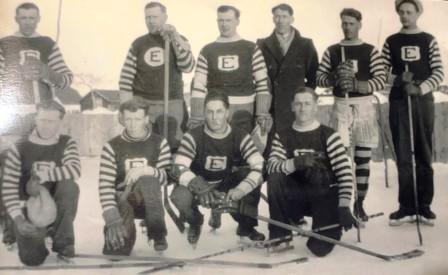
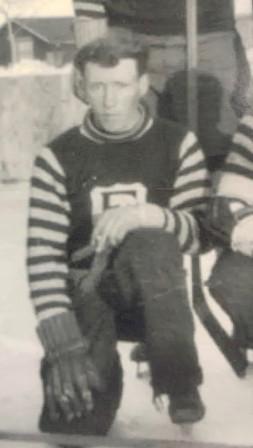
Then, two years later, Judy learned about a 1936 hockey photo.  “… Knowing several of the men on the team I was sure that some of their family members might have the photo…. A few more phone calls and BINGO – success at last….”  It was nothing short of a miracle! 

The man with the photo of the 1936 Eriksdale Hockey Team was John Forsyth, whose father Jim was a member of the team. 

Back Row L-R: Johnnie Mills, Bill Smith, Gordon Smith, Stan Mills, Johnnie Forsyth, Lawrence Whitney. Front Row L-R: Don Goodridge(?), Johnnie Hughes, Murray Cox, Jim Forsyth. (Photo courtesy of the Collection of Jim and Kay Forsyth)

We now knew what John Lewis Hughes looked like! (Photo courtesy of the Collection of Jim and Kay Forsyth)

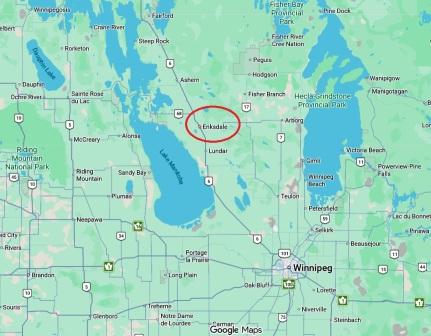
….John was from Eriksdale in Manitoba…

Eriksdale is in the Interlake Region of central Manitoba, near the eastern shore of Lake Manitoba. (Map source: Google maps)

Born January 17, 1916 in Eriksdale, Manitoba, John was the son of Ebenezer George and Ellen (nee Rogan, previously married name Johanson) Hughes.  Both parents came from the United Kingdom – his father in 1911 and his mother in 1914 with two daughters who had been born in Wales.  6 more children were added to the Hughes family, in addition to John – 3 daughters and 3 sons. 

Before enlisting with the No. 3 Field Ambulance of the Royal Canadian Army Medical Corps (RCAMC) on July 5, 1940, John had worked for 12 years as a medical orderly in the E.M. Crowe memorial hospital in Eriksdale.  On June 22, 1940, a few weeks before enlistment, he married Irene Goodwin. 

On October 5, 1940, John was transferred to No. 100 Canadian Militia Training Centre (CMTC) in Portage La Prairie, Manitoba.  He was then assigned to No. 100 Non-Permanent Active Militia (NPAM) Training Centre on November 15, 1940, while still attached to No. 100 CMTC.  (No. 100 CMTC and No. 100 NPAM were re-designated as No. 100 Canadian Army (Basic) Training Centre in February 1941.)

John remained in Portage La Prairie until April 30, 1941, when he was transferred to what the service file termed Fort Osborne Military Hospital, RCAMC, in Winnipeg, Manitoba. This was likely Deer Lodge Military Hospital, as during WWII, Winnipeg’s military hospital function was not at Fort Osborne Barracks, which had moved in 1920. Deer Lodge Military Hospital took over the former hospital facilities from Fort Osborne at that time.

….John left Canada for overseas service….

On June 8, 1941, John was transferred to No. 1 Motor Ambulance Convoy, RCAMC, Active Force, and sent to Camp Shilo, Manitoba for final training before going overseas. 

With other members of his unit, John left Canada for the United Kingdom on June 19, 1941, sailing from Halifax, Nova Scotia, disembarking in Greenock, Scotland on July 2, 1941, before moving on to Sussex, England. 

Per the ‘Official History Of The Canadian Medical Services 1939-1945’, edited by Lt Col Dr W. R. Feasby,  the RCAMC “…..order of battle included not only the medical units of the 1st, 2nd, and 3rd Divisions, and the 1st Army Tank Brigade, but also the following Corps Troops medical units: No. 18 Field Ambulance, No. 5 Field Hygiene Section, Nos. 4 and 5 Casualty Clearing Stations, No. 1 Motor Ambulance Convoy, and No. 1 Advanced Depot Medical Stores….

The function of No. 1 Motor Ambulance Convoy was to transport wounded from main dressing stations to casualty clearing stations. Transport was by vehicles of the Motor Ambulance Convoy, supplemented by trucks for walking wounded or by railroad when available. 

John and his unit were kept busy with training and in transporting wounded soldiers who arrived in the United Kingdom for treatment. 

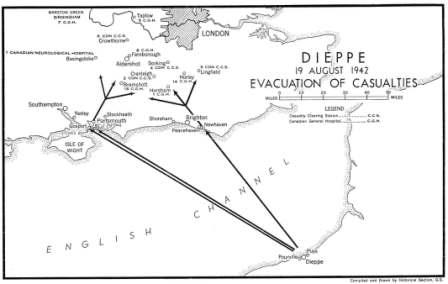
One of the largest operations came following the Dieppe Raid, known as Operation Jubilee, on August 19, 1942, a disastrous Allied amphibious attack on the German-occupied port of Dieppe in northern France, in which 505 Canadian soldiers were wounded and 916 lost their lives. (See and https://www.veterans.gc.ca/en/remembrance/military-history/second-world-war/dieppe-raid and https://thecanadianencyclopedia.ca/en/article/dieppe-raid)

Evacuation of casualties from Dieppe to England on August 19, 1942.  (Map source: ‘Official History Of The Canadian Medical Services 1939-1945’)

On the morning of August 19, 1942, the medical units under the 2nd Canadian Division were “ responsible for the reception and evacuation of casualties disembarked in the Portsmouth area, where the bulk of them was expected. Two sections of No. 1 Motor Ambulance Convoy were made available … for the transport of casualties from the Portsmouth area to No. 15 General Hospital at Bramshott, and from the Newhaven-Shoreham area to No. 1 at Horsham and No. 14 at Horley…

On January 14, 1943, No. 1 Motor Ambulance Convoy, RCAMC, became a unit of the Royal Canadian Army Service Corps (RCASC).

….John was transferred to No. 10 Canadian Field Dressing Station….

On January 21, 1944, John was transferred to No. 10 Canadian Field Dressing Station, and later sent to France, arriving on July 10, 1944, a month after D-Day. As noted in the ‘Official History Of The Canadian Medical Services 1939-1945’ “…with the formation of the 2nd Canadian Corps in France, the medical services were greatly increased. For the coming attack it was decided to constitute a massed medical centre at the Secqueville-en-Bessin area. In addition, No. 6 Canadian Casualty Clearing Station was located at Cazelle, under command of 2nd Canadian Corps, with No. 10 Canadian Field Dressing Station sited alongside….

The ‘coming attack’ referred to the Battle of the Falaise Pocket (also called Battle of the Falaise Gap), part of the Battle of Normandy, and which was fought between August 12 and 21, 1944. (see https://en.wikipedia.org/wiki/Falaise_pocket)

In addition to a large number of battle casualties from engagement with German troops, a bombing error on August 14, 1944 resulted in more casualties when “… the Royal Air Force and the Royal Canadian Air Force bombed behind our own lines, causing 200 casualties…” placing enormous strain on Casualty Clearing Stations.  “…The bombing casualties arrived in a sudden rush about four o’clock….” making it impossible to find “…shelter for all the wounded…

In addition to 537 admitted to the Casualty Clearing Stations, “….Nos. 9 and 10 Canadian Field Dressing Stations in the same area admitted 569 and were so rushed that it was necessary to open both No. 6 Canadian Casualty Clearing Station and No. 33 British Casualty Clearing Station at Cazelle where a further 694 casualties were taken for treatment….

No. 10 Canadian Field Dressing Station, along with other medical units, moved just behind troops as they advanced through France, into Belgium, and then into The Netherlands.  John was very experienced by now and on September 11, 1944, he qualified as a Nursing Orderly ‘C’, which meant he was responsible for initial treatment in the most forward battlefield areas and stretcher-bearing, while working under the direction of medical officers.

…. John’s unit was assigned to British Commandos for an attack on Walcheren Island during the Battle of the Scheldt…...

John Lewis Hughes was killed on Walcheren Island (top left), near Westkappelle, on November 2, 1944.  (Map source: ‘Official History Of The Canadian Medical Services 1939-1945’)

On October 21, 1944, a number of Canadian medical units were “…put under command of the 4th Special Service Brigade….” of the Royal Marines (United Kingdom) “…for training to support the amphibious operation of the brigade….” No. 17 Light Field Ambulance Company, Nos. 8 and 9 Canadian Field Surgical Units, No. 5 Canadian Field Transfusion Unit, and No. 10 Canadian Field Dressing Station were involved.

Operation Infatuate, part of the Battle of the Scheldt, was the codename for the attack on German batteries on Walcheren Island in The Netherlands, located at the mouth of the Scheldt River. German fortification of the island blocked Allied access to the captured port of Antwerp, Belgium. The Belgian port was crucial in order to supply advancing Allied armies as they moved towards Berlin.

…Training for the operation against Walcheren continued until the end of October when units embarked at Ostend and began to move towards their objective. At three o’clock on the morning of 1 November the flotilla of landing craft sailed out of Ostend harbour….” Ostend is in Belgium.

…Just before dawn, they met their supporting warships, turned and bore down on Westkapelle. The assault was to be made in daylight on either side of a gap blown in the Westkapelle dyke, and just before “H” hour (9.45 a.m.) the guns of Warspite, Roberts, and Erebus opened up and flights of rocket-firing Typhoon aircraft went to work on the shore batteries….

In ‘Towards Victory In Europe: The Battle For Walcheren’, J. O. Forfar, Medical Officer, 47 Marine Commando,  explained that “…Commander Pugsley and Brigadier Leicester had been informed on leaving Ostend that due to fog in England the Lancaster bombers which were to carry out a preliminary bombardment of the Walcheren defences while the assaulting craft moved in were grounded…” 

The two men decided to go ahead with the operation, which resulted in high casualties, but the Battle for Walcheren was ultimately successful.  “…The Germans had sown sea mines in the approaches to the island; the beaches were laced with barbed wire, landmines, and covered by machine guns firing from cement pill boxes. Five minutes before they were due to touch down the two landing craft which had been prepared as hospital ships were sunk by mines.  Immediately after this the assault began…” with shelling from cannons at the battery in Dishoek.

…One section of No. 17 Canadian Light Field Ambulance landed with No. 41 Commando on the left of Westkapelle gap and another section with No. 48 Commando on the right of Westkapelle gap. Of the 25 close support naval craft engaged in the operation only six were left by mid-afternoon, and 172 of those on board had been killed and 210 wounded. Casualties among those who got ashore in the face of stiff enemy resistance were heavy….”  The medical teams had to work in close proximity of the fighting.

…. No. 10 Field Dressing Station set up on the beach on the afternoon of November 1, 1944…...

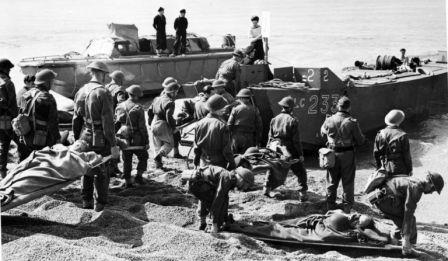
Beach dressing station of No. 10 Field Dressing Station being set up by personnel of No. 10 Field Dressing Station at Westkapelle. (Photo source: Provincial Archives of Alberta, Donald Carson fonds, PR2011.0001/14)

…Casualties on the left of the gap were given first aid and collected into a shell hole on the edge of the dyke until Westkapelle was clear, when they were moved into a house in the village. On the other side of the gap the casualty collecting post was set up on the inside of the sea wall, and casualties were held until No. 10 Canadian Field Dressing Station came ashore at 2 pm and set up a beach dressing station….

Most of those wounded on November 1, 1944 were taken off the Island during the night and returned to No. 6 Canadian Field Dressing Station at Ostend. Meanwhile the medical teams prepared for the next day.

…. John was killed in the afternoon of November 2, 1944 …...

No. 8 Canadian Field Surgical Unit, a medical operation team of around 10 people, was attached to No. 10 Field Dressing Station, and was the field hospital located behind the No. 10 Field Dressing Station. 

The November 2, 1944 War Diary entry for No. 8 Canadian Field Surgical Unit relates what happened when they came ashore with landing tracked vehicles, which the diary writer referred to as Alligators. (See https://en.wikipedia.org/wiki/Landing_Vehicle,_Tracked)  “…The morning of November 2nd dawned bright and clear….About 0900 the Alligators moved to the beach and there we met the rest of our unit.  I was relieved to find in spite of many harrowing experiences they were all quite safe. We off loaded the vehicles onto the beach….The beach head was under intermittent fire but the greatest worry we had was mines…

Tragedy struck in the early afternoon.  “…A salvo of shells hit 3 Alligators in front of the dugout and the Alligators caught on fire.  Each Alligator had 7 tons of ammunition on board and this all exploded during the next ¾ of an hour. About 20 men were killed, including the Quartermaster and one Other Rank of No. 10 FDS….”  The ‘Other Rank of No. 10 FDS’ was John Lewis Hughes.

Caroline Raaijmakers, Chair of the Faces To Graves Bergen Op Zoom Committee, told us that  ….on the same spot….” where John was killed, “…Doctor Captain Frank Sidney Manktelow was Wounded In Action on 2-11-1944 and he died on 3-11-1944…..” 

Dr. Frank Sidney MANKTELOW, of Pointe aux Trembles, Quebec, son of Frederick Sidney and Mary Jane (nee MacKay) Manktelow, and husband of Laura Francise (nee Quinn) Manktelow, was serving with the Royal Canadian Army Medical Corps when he died, at the age of 30.

Both men were initially buried in a temporary cemetery in Zoutelande on Walcheren Island.

 …. John is buried in the Canadian War Cemetery in Holten…...

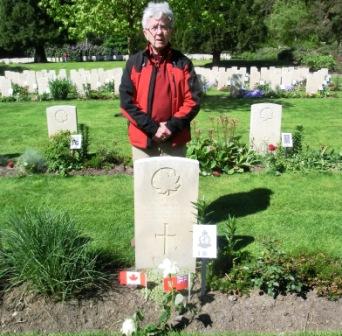
Pieter stands behind the grave of John Lewis Hughes in Holten, The Netherlands.  (Photo credit: Daria Valkenburg)

On September 9, 1946, John was reburied in the Canadian War Cemetery in Holten, The Netherlands.  We visited his grave this spring when we were in The Netherlands for our 2025 European Memorial Tour, and Pieter placed flags of Canada and Manitoba by his grave. His was one of 383 graves in 14 cemeteries that we visited on this trip.

….Hughes Hill in northern Manitoba named in John’s honour…..

Hughes Hill in northern Manitoba was named after John ‘Jack’ Lewis Hughes.  (Map source: Mapcarta)

Hughes Hill in northern Manitoba, northeast of Wither Lake, was named after him in 1995.

….A great deal of research happened before a photo was found…

Many people assume that it’s easy to find family and photos of soldiers who are buried overseas.  Unless you are lucky enough to stumble across someone else’s research, or a media appeal is seen by the right person with a photo, it can be an onerous and long drawn out process.  

The search for a photo of John Lewis Hughes took several years.  Thank you to Judie Klassen for going above and beyond to find family and reference material, to Shawn Rainville for newspaper searches, and to Judy Gleich for continually contacting people from Eriksdale.  Thank you to Robert Catsburg for sending the war diary entry for November 2, 1944 and to both Robert Catsburg and Caroline Raaijmakers for excerpts from Dutch accounts.

Thank you to John Forsyth for the hockey photo that included a photo of John.  And a big thank you to Kevin Rollason of the Winnipeg Free Press for writing the article about the photo search. 

The flags placed at John’s grave were donated.  Our thanks go to: 

  • Alan Waddell, Constituent Assistant, on behalf of Heath MacDonald, MP for Malpeque, for the Canadian flag.
  • Brad Robertson, Chief of Protocol, Government of Manitoba, on behalf of Wab Kinew, Premier of Manitoba, for the Manitoba flag. 

The work of remembrance of those who served continues as do our adventures on the next leg of our 2025 European War Memorial Tour.

If you have a story or photo to share, please contact Pieter at memorialtrail@gmail.com or comment on the blog. 

© Daria Valkenburg

….Want to follow our research?…

If you are reading this posting, but aren’t following our research, you are welcome to do so.  Our blog address: https://onthewarmemorialtrail.com/

4 countries, 6 weeks, 7,000 km – an unforgettable war memorial journey in Europe…. Daria’s book ‘No Soldier Buried Overseas Should Ever Be Forgotten‘ is available in print and e-book formats.  Net proceeds of book sales help support research costs and the cost of maintaining this blog. For more information see https://nosoldierforgotten.com/

Subscribe to our YouTube Channel: On The War Memorial Trail With Pieter Valkenburg: https://www.youtube.com/channel/UCJ591TyjSheOR-Cb_Gs_5Kw

Never miss a posting!  Subscribe below to have each new story from the war memorial trail delivered to your inbox.
On The War Memorial Trail…..The WWII Soldier From Prince Edward Island Who Lost His Life In Germany Two Days Before His 21st Birthday

February 12, 2025. Once you visit a Canadian War Cemetery and place down a flag by the grave of a soldier from the province where you live, it stays with you, and makes you wonder about the young man who is buried there. 

In 2017, when we visited the Canadian War Cemetery in Groesbeek, The Netherlands, with our friends Ad and Noor Scheepers, we had a list of soldiers from Prince Edward Island buried there, but only knew the story of one, George Preston SMITH, whose name is listed on the Cenotaph outside the Borden-Carleton Legion.  (See On the War Memorial Trail ….. At The Canadian War Cemetery in Groesbeek and On the War Memorial Trail ….. PEI Soldiers Buried In The Canadian War Cemetery in Groesbeek and https://onthewarmemorialtrail.com/2018/03/21/another-photo-for-wwii-soldier-george-preston-smith/)

Ad and Noor Scheepers with Pieter (right) by the grave of Arthur Gaudet at the Canadian War Cemetery in Groesbeek, The Netherlands.  (Photo credit: Daria Valkenburg)

Since then, Pieter has researched and we’ve told the stories of 12 more Islanders buried in that Dutch cemetery. Our 14th story is about Arthur GAUDET of Mount Carmel, Prince Edward Island.  While Arthur had been on the list of Islanders buried in Groesbeek, he was not on the cemetery’s photo wish list as they had a photo of him. 

15 Pointe is a cape not far from Mount Carmel, Prince Edward Island.  (Map source: https://www.geodata.us/canada_names_maps)

Born February 28, 1924 in 15 Pointe, near Mount Carmel, Prince Edward Island, Arthur was the son of Joseph Stanley and Mary Jacqueline Gaudet.  He was one of 10 children, 8 of them still alive at the time that he enlisted at the No. 5 District Depot in Quebec City, Quebec on July 24, 1942.  His three older brothers were also in the Canadian Army.

Arthur Gaudet. (Photo courtesy of Alice van Bekkum, Chair of the Faces To Graves Foundation Groesbeek)

According to his Personnel Selection Record, Arthur spoke English, not French, and had completed Grade 9.  He was working as a labourer for the PEI Bag Company. (See https://atlanticbusinessmagazine.ca/web-exclusives/89-years-in-the-bag-and-counting-for-p-e-i-bag-company/)

After completing his basic training, Arthur was sent to No. 22 Canadian Army Educational (Basic) Training Centre in North Bay, Ontario on September 19, 1942.

He remained there until December 2, 1942, when he was transferred to A1 Canadian Artillery Training Centre (CATC) in Camp Petawawa, Ontario, for training as a gunner.  While still at A1 CATC, he qualified as a Driver i/c Class III wheeled vehicles on January 29, 1943. (The term ‘Driver i/c’ refers to ‘Driver, internal combustion’.  Class III meant he was qualified to drive heavy trucks and armoured cars, but not tanks.)

On February 8, 1943, he was granted embarkation leave until February 21, 1943, the last chance he would have to see his family before going overseas.

….Arthur left Canada for overseas service….

On March 24, 1943, Arthur left Canada for the United Kingdom.  Upon arriving on March 31, 1943 he was assigned to No. 3 Canadian Artillery Reinforcement Unit (CARU). 

On June 18, 1943, Arthur was transferred to No. 3 Light Anti-Aircraft Regiment, Royal Canadian Artillery for Light Machine-Gun and Rifle training, and undertook various Tests of Elementary Training (TOET).

Arthur was allocated to the X-4 Reinforcement List of the Canadian Infantry Corps (CIC), part of the 10th Battalion, 21st Army Group, on June 21, 1944, in preparation for going to North West Europe.

….Arthur was transferred to Les Fusiliers Mont-Royal….

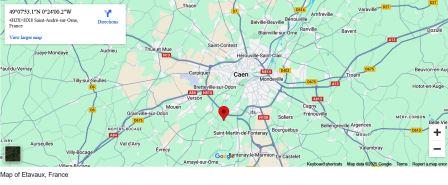
Arthur Gaudet joined Les Fusiliers Mont-Royal near Etavaux, France, indicated by the large red marker.  (Map source: Google maps)

On July 22, 1944 he left the United Kingdom for France, arriving a day later. On July 25, 1944, he was transferred to Les Fusiliers Mont-Royal, joining them in an area behind Etavaux in Normandy, France.

The Regiment remained in France until September 9, 1944 when it moved into Belgium.  Arthur received a promotion to Acting Corporal a few days later, on September 12, 1944.

.….Arthur was badly wounded during the Battle of the Scheldt ….

Map shows location of Kapellen and Brasschaat, not far from Antwerp in Belgium.  (Map source: DuckDuckGo)

On October 2, 1944, the Battle of the Scheldt began and involved Canadian forces advancing through northern Belgium, including areas like Kapellen, to clear German defenses and secure access to the port of Antwerp.

The municipality of Kapellen, in Belgium, was liberated on October 4, 1944 by Les Fusiliers Mont-Royal. The war diary entry for October 4, 1944 for Les Fusiliers Mont-Royal confirmed this.  “…Advance up to Brasschaat.  In the afternoon, advance towards Cappellan, which we taken, then sweep towards north-east of town.  Positions at night, anti-tank ditch 2 miles from Cappellan…”   Cappellan is the old spelling of Kapellen.

Arthur, who was in ‘A’ Company, was wounded by a bullet in the shoulder on October 5, 1944 and was evacuated to No. 9 Canadian General Hospital (CGH) in Horsham, England.  After a recuperation period of three months, Arthur left the United Kingdom on January 10, 1945, returning to Les Fusiliers Mont-Royal 2 days later.  He joined them in Mook, The Netherlands, which is near Nijmegen.

.….Arthur lost his life during Operation Blockbuster ….

By February 17, 1945, the Regiment was in Germany, in place for Operation Blockbuster, as part of the 6th Canadian Infantry Brigade, along with several other Canadian Regiments. The Operation was to begin at dawn on February 26, 1945. (See https://en.wikipedia.org/wiki/Operation_Blockbuster)

Arthur Gaudet lost his life during a battle near Kalkar, Germany.  (Map source: DuckDuckGo)

On February 25, 1945, the war diary for Les Fusiliers Mont-Royal recorded that during a briefing of troops for Operation Blockbuster, the brigade’s task was “to capture high ground west of Kalkar. The attack is to be made at night with troops mounted on tanks….”  Kalkar is a municipality in the district of Kleve, in North Rhine-Westphalia, Germany, and is located near the Rhine River.

The war diary for February 26, 1945 described what happened.  “….The attack commenced at 0400 hrs under cover of an artillery barrage. Camerons of Canada regiment on our right encountered mines a few hundred yards from the FDL’s which caused the Commander’s tank to be knocked out resulting in considerable confusion. South Saskatchewan regiment on our left and our Battalion reached the objective…”  FDL refers to the French acronym for Les Fusiliers Mont-Royal.

During the February 26, 1945 attack, Arthur was wounded and died later that day.  He was two days short of his 21st birthday!

Arthur lost his life about a week before another soldier in the same Regiment, Joseph ‘Albert Noel’ LAMONTAGNE, whose story was previously told, lost his on March 3, 1945. See https://onthewarmemorialtrail.com/2025/02/05/on-the-war-memorial-trail-the-wwii-soldier-from-saint-basile-who-lost-his-life-during-the-advance-towards-xanten/

.….11 other soldiers died on February 26, 1945….

Arthur was one of 12 members of Les Fusiliers Mont-Royal who lost their lives on February 26, 1945.  The other 11 were:

  • Private Rosaire BELLERIVE of Ste Flore, Quebec, aged 19
  • Private Romeo BENOIT of Montreal, Quebec, aged 41
  • Private Joseph Wilfrid Rheal GUERTIN of Moose Creek, Ontario, aged 19
  • Private Marcel LAVIGNE of Henri, Montreal, Quebec, aged 19
  • Private Maurice PAQUETTE of Sherbrooke, Quebec, aged 22
  • Lieutenant Ovide Joseph PAQUETTE of North Bay, Ontario, aged 24
  • Private Paul Eugene PARENT of St. Honore, Beauce County, Quebec, aged 24
  • Private Alphie Raymond PELTIER, born in Chatham, Ontario, aged 30
  • Private Jean Marie ST ONGE of Amqui, Quebec, aged 23
  • Lieutenant Robert TALBOT of Quebec City, Quebec, aged 25
  • Private Vincent THIBODEAU of Maria, Bonaventure County, Quebec, aged 24

.….Arthur is buried in Groesbeek….

Arthur was initially buried in the Canadian Military Cemetery in Bedburg, Germany, before being reburied in the Canadian War Cemetery in Groesbeek, The Netherlands. 

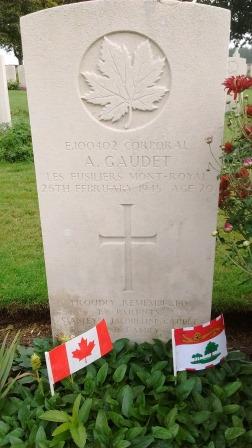
Grave of Arthur Gaudet in the Canadian War Cemetery in Groesbeek, The Netherlands.  (Photo credit: Daria Valkenburg)

Thank you to Alice van Bekkum, Chair of the Faces To Graves Foundation Groesbeek, for sending Pieter that initial list of soldiers from Prince Edward Island who are buried in the Canadian War Cemetery in Groesbeek, The Netherlands.  If you have a story or photo to share, please contact Pieter at memorialtrail@gmail.com or comment on the blog. 

© Daria Valkenburg

….Want to follow our research?….

If you are reading this posting, but aren’t following our research, you are welcome to do so.  Our blog address: https://onthewarmemorialtrail.com/

4 countries, 6 weeks, 7,000 km – an unforgettable war memorial journey in Europe…. Daria’s book ‘No Soldier Buried Overseas Should Ever Be Forgotten‘ is available in print and e-book formats.  Net proceeds of book sales help support research costs and the cost of maintaining this blog. For more information see https://nosoldierforgotten.com/

You are also invited to subscribe to our YouTube Channel: On The War Memorial Trail With Pieter Valkenburg: https://www.youtube.com/channel/UCJ591TyjSheOR-Cb_Gs_5Kw

Never miss a posting!  Subscribe below to have each new story from the war memorial trail delivered to your inbox.
On The War Memorial Trail…..The WWII Soldier From Clyde River Who Lost His Life During The Attack On Hoogerheide

CIMG6927 Jul 31 2024 Cornwall Cenotaph Pieter by WWII & WW1 memorial

The Cenotaph site in Cornwall, Prince Edward Island. The WWI cenotaph is on the right, and the WWII cenotaph on the left. (Photo credit: Daria Valkenburg)

October 12, 2024. When Pieter was asked to give a presentation on September 22, 2024 at the 105th Annual Remembrance Service in Cornwall, Prince Edward Island, one of the names on the WWII Cenotaph was that of Private William Ernest STONE, who was serving with the Black Watch of Canada, when he was killed during a fierce battle in Hoogerheide, The Netherlands on October 10, 1944, at the age of 25.  (See https://onthewarmemorialtrail.com/2024/09/26/on-the-war-memorial-trail105th-annual-remembrance-service-at-cornwall-cenotaph/)

CIMG6928 Jul 31 2024 Cornwall Cenotaph WWII memorial

William Ernest Stone was one of 4 casualties listed on the WWII Cenotaph in Cornwall, Prince Edward Island.  (Photo credit: Daria Valkenburg).

William is buried in the Canadian War Cemetery in Bergen Op Zoom, The Netherlands, located near the Belgian border.  2024 is an important anniversary for this area as 80 years ago, in October 1944, Belgium and the southern part of The Netherlands were liberated, following tremendous casualties during the Battle of the Scheldt. (See https://en.wikipedia.org/wiki/Battle_of_the_Scheldt and https://www.thecanadianencyclopedia.ca/en/article/canada-and-the-battle-of-the-scheldt)

It seems only fitting that 80 years after his death, William’s story is told.  He was born August 19, 1919, in Clyde River, Prince Edward Island, the son of Edward Earnest and Sadie Stone.  

William had two brothers and two sisters.  With the help of Brenda Graves and Arlene Roberts, a photo was soon provided by Faye MacNutt, the daughter of William’s sister Ruth.

…..William enlisted under the NRMA in 1941….

William originally enlisted under the National Resources Mobilization Act (NRMA) in Charlottetown, Prince Edward Island on April 17, 1941 and underwent basic training at No. 62 Canadian Army Basic Training Centre (CABTC) in Charlottetown. (See https://en.wikipedia.org/wiki/National_Resources_Mobilization_Act)

At the time of his enlistment he had been working for two years as a stoker at Storms Construction Company Ltd in Charlottetown. Among his tasks he also worked at Charlottetown Airport for several months in 1940, tasked with running a cement mixer and doing odd jobs, when the airport was transferred to the Royal Canadian Air Force (RCAF) and the airport and runways were enlarged in preparation for using the airport to train pilots and aircrew. 

William also noted that he also had six years of farming experience from helping on his family’s farm.  He had an interest in mechanics, played tennis, volleyball, and baseball, and enjoyed singing. 

…..William received training in both Canada and the USA….

William Ernest Stone colourized

William Ernest Stone. (Photo courtesy of Faye MacNutt.  Photo colourization by Pieter Valkenburg)

On June 6, 1941, he transferred to active service at No. 62 CABTC in Charlottetown, and was immediately sent to No. 6 District Depot in Halifax, Nova Scotia for trades training in motor mechanics and welding at the Halifax Technical School.

After successfully completing the two month course in Halifax, William was attached to No. 14 Infantry Training Centre in Aldershot, Nova Scotia as of August 2, 1941.  A few days later, he was sent ‘on command’ to Automatic Course in Motor Mechanics at the Quartermaster Motor Transport School at Fort Holabird in Baltimore, Maryland, USA.  He successfully completed the course on October 15, 1941.

Next, he was sent to the Canadian Army Trade School (CATS) in Hamilton, Ontario for more training in motor mechanics.  His time there was from October 28, 1941 until June 6, 1942, when he was transferred to the A9 Canadian Armoured Corps (Advanced) Training Centre (CACATC) at Camp Borden in Ontario for wireless training.

William received a furlough from May 20 to June 2, 1942, during which time he returned to Prince Edward Island to marry Eileen Younker in Winsloe on May 27, 1942.  The couple only had a few days together before he had to return and continue his training.

On July 26, 1942, he was assigned to the 28th Armoured Regiment in Debert, Nova Scotia for final training before going overseas.  On August 4, 1942, William received embarkation leave until August 7, the last chance he had to see his family. 

….William left Canada for overseas service….

William left Canada with the 28th Armoured Regiment on August 22, 1942, arriving in the United Kingdom on September 1, 1942. He was sent for more training, and qualified as a Driver i/c Class III (Wheeled) on December 6, 1942.  (The term ‘Driver i/c’ refers to ‘Driver, internal combustion’.  Class III meant he was qualified to drive heavy trucks and armoured cars, but not tanks.)

On May 15, 1943 he was sent to 21 Canadian Armoured Regiment (CAR) for a few weeks and then on to receive training as a Driver Mechanic (Tank) Class ‘C’.  He successfully completed this training on December 3, 1943.

William was transferred to No. 3 Canadian Armoured Corps Reinforcement Unit (CACRU) on January 29, 1944.  Then, on July 25, 1944, he was transferred again, this time to No. 1 Canadian Armoured Corps Reinforcement Unit (CACRU), and re-mustered from the Canadian Armoured Corps (CAC) to the Royal Canadian Artillery (RCA).

On August 13, 1944 William was temporarily assigned to the Canadian Fusiliers (City of London Regiment) before being placed on the X-4 Canadian Infantry Corps Reinforcement List, part of the 10th Battalion, on September 21, 1944 and sent to France.

On September 28, 1944, William was transferred to the Black Watch (Royal Highland Regiment) of Canada, and joined them in Rijkevorsel, Belgium.  The war diary for that day noted that “….in the last two days, 42 reinforcements have joined us, 11 for general duty, the remainder being for the most part signallers and drivers...

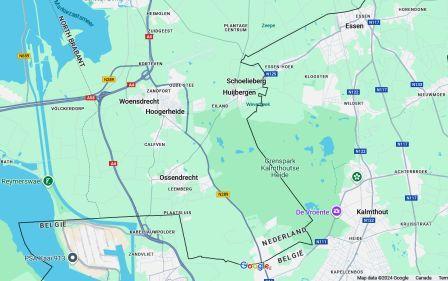
The Regiment had surged through France and into Belgium, where William joined the Regiment.  From Belgium, the Regiment made its way into The Netherlands on October 7, 1944.  While the main goal was helping to clear the Scheldt Estuary, necessary to liberate the vital port of Antwerp, their first task was to attack the town of Hoogerheide.

….Attack On Hoogerheide….

Screenshot 2024-10-11 at 10-41-57 Google Maps

Map shows location of Calfven, Hoogerheide, and Ossendrecht in The Netherlands, just over the Belgian border. (Map source: Google maps)

The War Diary for October 7, 1944 noted that the Regiment had begun their journey into The Netherlands “…at 0930 hours and shortly thereafter crossed the frontier into Holland at the town of Putte…and went on to our area at a farm….In the afternoon we moved forward again into the Calfven area….

On October 8, 1944, as the troops moved up to the attack on Hoogerheide in the early morning, they found that the Start Line hadn’t been secured.  When the attack did begin, at 10:30 am, troops came under machine gun and mortar fire.

The War Diary entry for October 8, 1944 stated that “…very heavy fighting ensued and it was over two hours before the enemy decided that he had had enough….”  The respite didn’t last.

The following day, the War Diary recorded that “…during the night, mortaring and shelling continued on a heavy scale….It is apparent that there has been heavy reinforcement of this area, and that the enemy is determined to make a stand. The troops we are now meeting are definitely the cream of the crop.  They belong to paratroop battalions, with a sprinkling of glider troops and Luftwaffe personnel…..

The war diarist noted that the German troops were young and in good physical condition, …keen to fight and with excellent morale.  All day long there was heavy fire from artillery and mortar on our positions, and his snipers are very busy.  At 1600 hours the Germans opened an artillery barrage which lasted for two hours, then came in on a counter attack…

On October 10, 1944, the War Diary continued the account of the attack.  “…Weather – Misty and rain.  The heavy mortaring and shelling to which we have been subjected continues without respite”  The attack continued for the Black Watch until 3:00 pm, when they were relieved by the Royal Hamilton Light Infantry.

The Black Watch casualties for the Hoogerheide attack were counted, and totalled 81, with 12 fatalities.  Among those who were recorded as having died on October 10, 1944 was William Ernest Stone.

….William is buried in Bergen Op Zoom….

William was initially buried in the village cemetery in Ossendrecht, before being reburied in the Canadian War Cemetery in Bergen Op Zoom, The Netherlands.

William Ernest Stone from find a grave

Grave of William Ernest Stone in the Canadian War Cemetery in Bergen Op Zoom, The Netherlands.  (Photo courtesy of the Canadian Virtual War Memorial)

Later this month, the cemetery in Bergen Op Zoom is holding its 80th Anniversary of Liberation Commemorations.  Private William Ernest Stone will be one of the 968 Canadians buried there who will be remembered.

CIMG3382 Oct 7 2019 Bergen Op Zoom Pieter at Cdn War Cemetery

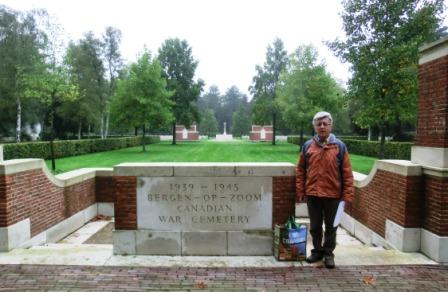
Pieter at the entrance to the Canadian War Cemetery in Bergen Op Zoom.  (Photo credit: Daria Valkenburg)

Thank you to Brenda Graves and Arlene Roberts for their help in finding a photo. Thank you to Faye MacNutt for submitting a photo of her uncle.

If you have photos or information to share, please email Pieter at memorialtrail@gmail.com, comment on the blog, or tweet to @researchmemori1.

© Daria Valkenburg

….Want to follow our research?….

If you are reading this posting, but aren’t following our research, you are welcome to do so.  Our blog address: https://onthewarmemorialtrail.com/

Front cover OnTheWarMememorialTrailinEurope4 countries, 6 weeks, 7,000 km – an unforgettable war memorial journey in Europe…. Daria’s book ‘No Soldier Buried Overseas Should Ever Be Forgotten‘ is available in print and e-book formats.  Net proceeds of book sales help support research costs and the cost of maintaining this blog. For more information see https://nosoldierforgotten.com/ 

You are also invited to subscribe to our YouTube Channel: On The War Memorial Trail With Pieter Valkenburg: https://www.youtube.com/channel/UCJ591TyjSheOR-Cb_Gs_5Kw

Never miss a posting!  Subscribe below to have each new story from the war memorial trail delivered to your inbox.
On The War Memorial Trail….. The WWII Soldier From Clermont Killed During Operation Veritable

September 30, 2024. When you visit a Canadian War Cemetery and place down a flag by a soldier’s grave, it stays with you, and makes you wonder about the person who is buried there.  Before our first war memorial tour in 2017, Pieter asked the Canadian War Cemeteries in The Netherlands for a list of soldiers from Prince Edward Island who are buried there, and we made sure to place flags at their graves.

Screenshot 2024-09-30 at 09-15-25 Clermont - Google Maps

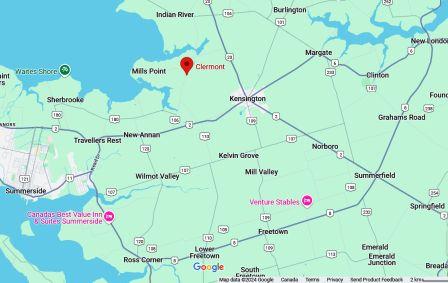
Clermont is located in Prince County, Prince Edward Island.  (Map source: Google)

Over the years, Pieter has researched many of the soldiers from Prince Edward Island who are buried in The Netherlands, and he continues to do so. One of these WWII soldiers was John ‘Weston’ CAMPBELL, born May 29, 1916 in Clermont, Prince Edward Island, the son of Archibald Joseph and Lavinia Helen (nee Brennan) Campbell.  

brant

C.G.S. Brant in Charlottetown around 1930.  (Photo source: https://sailstrait.wordpress.com)

Weston’s father was Captain of the Canadian Government Ship ‘Brant’, a buoy and lighthouse tender that operated from the Charlottetown Marine Wharf.  The family also operated a farm, and Weston worked there after leaving school upon completing Grade 10.

On June 29, 1937, Weston joined the 1st Battalion of the Prince Edward Island Highlanders Militia, before enlisting in active service with the Regiment on October 3, 1939. His basic training was taken in Charlottetown, Prince Edward Island, and Dartmouth, Nova Scotia. (See https://en.wikipedia.org/wiki/Prince_Edward_Island_Highlanders)

….Weston was transferred to the North Nova Scotia Highlanders…

Weston was promoted to Corporal and then Acting Sergeant by the time he was transferred to the North Nova Scotia Highlanders, 3rd Division, on June 20, 1940, and joined them at their headquarters in Amherst, Nova Scotia.  Training in preparation for overseas service continued.

According to his Personnel Selection Record, Weston played hockey, soccer, baseball, and softball.  His brother Vernon was a Chief Petty Officer in the Canadian Navy.  He had 4 sisters and 1 other brother.  The interviewer described Weston as…sturdy, good-looking, well-balanced, with keen pride in regiment….

CAMPBELL John Weston

John ‘Weston’ Campbell as a Sergeant.  (Photo courtesy of North Nova Scotia Highlanders Museum)

On July 5, 1941 he was promoted to Sergeant, just as the Regiment moved to Debert, Nova Scotia for final preparations before going overseas.  InNo Retreating Footsteps by Will Bird, he noted that “…the 3rd Division units were moving to Debert….Word came that the North Novas would be included in the 9th Highland Brigade along with the Highland Light Infantry and the Stormont, Dundas and Glengarry Highlanders

….Weston left Canada for England….

On July 19, 1941, Weston and his Regiment left Halifax, Nova Scotia aboard the Orion, arriving in Avonmouth, England on July 29, 1941.  Two days later, they were allowed to disembark and left by train for Aldershot, where…the North Novas arrived at Albuhera Barracks

He continued to train and take courses, and then was transferred to the No. 1 Non-Effective Transit Depot (NETD) on July 7, 1942Tweedsmuir Camp in Surrey, near the village of Thursley, was set up as Number One Transit Depot for handling thousands of medical and psychological cases during WWII.  

It was also used as a base for returning Canadian and American troops, and that appears to be why Weston was there, as shortly after his arrival he was sent back to Canada, arriving on July 29, 1942.  The following day he was assigned to No. 6 District Depot in Halifax, Nova Scotia, for a short period.

….Weston returned to Canada for officer training….

On August 14, 1942, Weston was sent to the No. 30 Officers Training Centre in Brockville, Ontario for training. After successfully completing his 12 week course on November 7, 1942, he was recommended for promotion and appointment to the rank of 2nd Lieutenant.

With his new officers’ rank, he was transferred to the A-14 Canadian Infantry Training Centre in Camp Aldershot, Nova Scotia on November 13, 1942.  He was sent for additional training to the A25 Canadian Army Small Arms Training Centre (CSATC) in Long Branch, Ontario from November 14 to December 12, 1942, after which he was promoted to Lieutenant.

On January 9, 1943, Weston was transferred to No. 61 Canadian Army (Basic) Training Centre in New Glasgow, Nova Scotia for additional training, before returning to A-14 Canadian Infantry Training Centre in Camp Aldershot on April 14, 1943.

….Weston left Canada again for overseas service….

On June 19, 1943, Weston left Canada for overseas service.  After arriving in the United Kingdom on June 24, 1943, he was assigned to No. 7 Canadian Infantry Reinforcement Unit (CIRU).   He arrived there just as a fellow Islander, Harold ‘Hal’ Gabriel BULGER, whose story was previously told, was transferred to the Princess Louise Fusiliers.  (See https://onthewarmemorialtrail.com/2024/08/05/on-the-war-memorial-trail-the-bulger-brothers-part-i-the-wwii-soldier-from-foxley-river-killed-during-the-battle-of-moerbrugge/)

On July 29, 1943, Weston returned to the North Nova Scotia Highlanders, who were still in the United Kingdom. Training and exercises continued, as extensive preparations began for Operation Overlord (the larger Normandy invasion) and Operation Neptune (the English Channel-crossing portion of Operation Overlord) on June 6, 1944 – what we know today as D-Day.

InNo Retreating Footsteps by Will Bird, he recorded that among “…the officers selected to land in France on D Day with the North Novas….” was Lt. J.W. Campbell who would be leading an anti-tank platoon.

…Weston survived D-Day….

The North Nova Scotia Highlanders left England for Normandy, France on June 6, 1944, after waiting in place in the English Channel on landing craft earlier.   The war diary for Sunday, June 4, 1944 noted that “…we are tied up with two other landing craft tank.   The Padre is on one, so he had a church service at 10:30 hours on the quarter deck of the middle craft…

On June 5, 1944 the war diary recorded that “…at 14:00 hours the flotilla moved out to the open sea and formed up with the other craft taking part in the invasion…

After landing on the beaches of Normandy on June 6, 1944, as part of the 9th Infantry Brigade, 3rd Canadian Infantry Division, 21st Army Group, the war diary noted that the Regiment had 10 casualties that day– 4 killed, 6 wounded. 

Weston had survived D-Day and received a promotion to Acting Captain on June 22, 1944. The Regiment continued to fight in North-West Europe, including the Battle of the Scheldt, which began October 2, 1944. (See https://en.wikipedia.org/wiki/Battle_of_the_Scheldt)  Weston was confirmed as Captain on October 4, 1944.

On December 19, 1944, he was promoted again.  The war diary entry for that day reported that “…Captain J. W. Campbell was made Acting Major today, and is to command ‘B’ Company…

On January 10, 1945, while on leave in the United Kingdom, he married Mary Margaret Taylor in Sheffield, Yorkshire, England. 

He returned to the Regiment on January 15, 1945 and the war diary entry for that day recorded that “…the battalion officers held a party for Major J. W. Campbell who has just returned from his privilege leave to the United Kingdom.  It appears that he was married during this leave….

….Weston lost his life during Operation Veritable…

Screenshot 2024-09-30 at 11-09-38 emmerich germany - Google Search

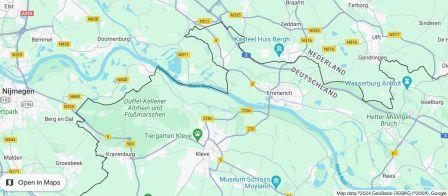
Map shows Emmerich, Germany located on the Rhine River. Allied troops had to cross the river in amphibious vehicles.  (Map source: Google maps)

The Regiment was informed that they were to take part in Operation Veritable. (See https://en.wikipedia.org/wiki/Operation_Veritable) After leaving Nijmegen in The Netherlands, they reached Kellen, Germany near Kleve, just on the other side of the border with The Netherlands, on February 12, 1945. 

On February 14, using amphibious vehicles, the North Novies made their way towards Emmerich.   The war diary for that day reported that “….we have been given the job of taking out the triangle formed by the road running southwest … and the canal running south east….

Three Companies were involved. …The attack is to be made across the river which has overflowed its banks and now forms a barrier over 200 yards wide. Buffaloes are to be used for the attack

The action began at noon, with ‘C’ Company on the left, and ‘A’ Company on the right of the road.  “… ‘B’ Company, which arrived late at the rendezvous, set out at 12:10 hours with their axis along the main road…

The war diary entry continued, explaining that “…the assault companies landed on the shore with terrific fire support from field and medium artillery, plus the machine guns of the Buffaloes…

The attack, which ended at 6:15 pm,  was ultimately successful, but “…our total number of casualties for today’s action was 3 killed and 8 wounded, including Major J. W. Campbell, commanding ‘B’ Company, who was killed…”  Both ‘B’ and ‘C’ Companies had been heavily mortared during the day.

….Weston is buried in Groesbeek…

Weston was initially buried in a churchyard in Warbeyen, Germany, located halfway between Emmerich and Kleve, before being reburied in the Canadian War Cemetery in Groesbeek, The Netherlands.  He was 28 years old and had been married just over a month.

CIMG9018 Sep 16 2017 Groesbeek Cemetery grave of JW Campbell from Daria

Grave of John ‘Weston’ Campbell in the Canadian War Cemetery in Groesbeek, The Netherlands.  (Photo credit: Daria Valkenburg)

Seven years after we placed flags at his grave, we finally know John ‘Weston’ Campbell’s story! If you have photos or information to share, please email Pieter at memorialtrail@gmail.com, comment on the blog, or tweet to @researchmemori1.

© Daria Valkenburg

….Want to follow our research?….

If you are reading this posting, but aren’t following our research, you are welcome to do so.  Our blog address: https://onthewarmemorialtrail.com/

Front cover OnTheWarMememorialTrailinEurope4 countries, 6 weeks, 7,000 km – an unforgettable war memorial journey in Europe…. Daria’s book ‘No Soldier Buried Overseas Should Ever Be Forgotten‘ is available in print and e-book formats.  Net proceeds of book sales help support research costs and the cost of maintaining this blog. For more information see https://nosoldierforgotten.com/ 

You are also invited to subscribe to our YouTube Channel: On The War Memorial Trail With Pieter Valkenburg: https://www.youtube.com/channel/UCJ591TyjSheOR-Cb_Gs_5Kw

Never miss a posting!  Subscribe below to have each new story from the war memorial trail delivered to your inbox.
On The War Memorial Trail…..The Bulger Brothers – Part 1: The WWII Soldier From Foxley River Killed During The Battle of Moerbrugge

August 5, 2024.  Can you imagine how difficult it was for parents to send their children off to conflict zones during WWII, and having to live with the uncertainty of whether they would return safely? For the Bulger family of Foxley River, Prince Edward Island, they suffered a double tragedy, losing two sons:  Harold ‘Hal’ Gabriel BULGER, who is buried in the Canadian War Cemetery in Adegem, Belgium, and Lawrence William BULGER, who is buried in the Canadian War Cemetery in Groesbeek, The Netherlands.

We were aware of Lawrence Bulger from last year’s series on soldiers from the North Nova Scotia Highlanders who lost their lives during the Battle of Bienen on March 25, 1945. As his name was not on a photo wish list, we didn’t research his story at that time. (See https://onthewarmemorialtrail.com/2022/11/29/on-the-war-memorial-trail-the-search-for-a-photo-of-austin-havelock-munroe-is-on-youtube/

This year we decided to tell the story of one more soldier killed during the Battle of Bienen, and asked Edison Smith for help in contacting a family member for Lawrence Bulger.  Edison’s grandfather, Edison Alexander SMITH, and great-uncle Ralph Schurman BOULTER, both lost their lives in the Battle of Bienen.  As they were from the same area of the Island, the families would have known each other.  Sometimes, it’s as simple as that to make contact with the family of a soldier!

We then learned that Lawrence’s brother, Harold ‘Hal’ Gabriel, also served in WWII and was killed in action on September 10, 1944 near the town of Oostkamp in Belgium during the early stages of the Battle of the Scheldt. (See https://www.veterans.gc.ca/eng/remembrance/history/second-world-war/scheldt and https://en.wikipedia.org/wiki/Battle_of_the_Scheldt)

We decided to tell the story of both brothers, and began with Hal, the first of the brothers to lose his life.

….Hal’s family was soon found….

Shortly after the request was made, Edison wrote to say “I was up to O’Leary this past week and spoke with my father and did some digging around for a relative of the Bulgers you had asked me about.  I was able to speak with Bev and Bernard Jeffery….. I briefly explained the work you … do and she was kind enough to email me some info and pictures which I have forwarded to you…

Bev also contacted us, explaining that her “mother was Harold and Lawrence’s sister Agatha….”  The family historian in the family, Bev was the keeper of the family photos and information.  Edison had found the right person!

It wasn’t long before we had a chance to meet Bev, and to learn more about the Bulger brothers.

CIMG6836 May 27 2024 Bev Jeffery & Pieter Mill River Resort

Pieter with Bev Jeffery at Mill River Resort in Mill River, Prince Edward Island.  (Photo credit: Daria Valkenburg)

Born September 9, 1918 in Portage, Prince Edward Island, Hal was the son of Gabriel and Anne ‘Annie’ Marion (nee Milligan) Bulger of Foxley River, Prince Edward Island.  One of 16 children, Hal had two brothers and thirteen sisters. 

…..Hal enlisted in 1940….

Harold Bulger colourized and restored by Pieter

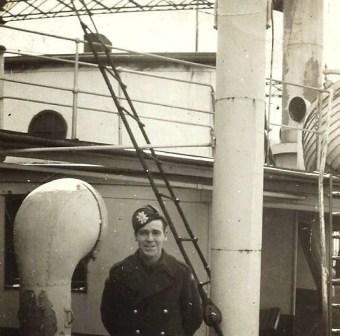
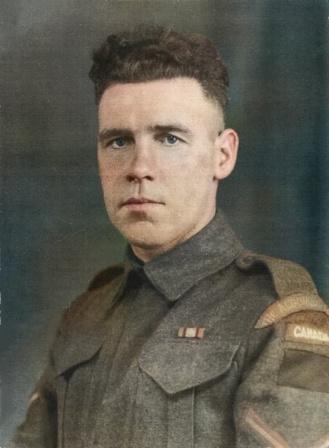
Harold ‘Hal’ Gabriel Bulger. (Photo courtesy of Bev Jeffery.  Photo restoration and colourization by Pieter Valkenburg)

After leaving school at the age of 13, Hal worked on the family farm until he enlisted with the PEI Highlanders in Charlottetown, Prince Edward Island on July 31, 1940. After completing his basic training at No. 62 Canadian Army (Basic) Training Centre in Charlottetown, Hal was sent to Dartmouth, Nova Scotia for additional training.

Leo Lynch, Leo Moran, Harold Bulger, Cecil MacKinnon

Left to right: Leo Lynch, Leo Moran, Harold ‘Hal’ Bulger, Cecil MacKinnon. (Photo courtesy of Bev Jeffery)

During a furlough in March 1941, a notice in the March 22, 1941 edition of the Summerside Journal noted that Pte. Leo Moran, Freeland, Pte. John McFayden, Freeland, Pte. Leo Lynch, Portage, Pte. Harold Bulger, Freeland, all of the P.E.I. Highlanders, returned to their unit in Nova Scotia. They were the guests of the Veterans’ Guard, Summerside….

HAROLD BULGER AND mother ANNIE BULGER 001

Harold ‘Hal’ Gabriel Bulger with his mother, Annie Bulger. (Photo courtesy of Bev Jeffery)

On June 4, 1941, Hal was transferred to A13 Canadian Infantry Training Centre in Camp Valcartier, Quebec, as preparation for guard duty in Newfoundland. 

Hal was sent to Newfoundland….

NFLD Map shows Botwood

Location of Botwood Military Base in Newfoundland. (Map source: http://postalhistorycorner.blogspot.com/2012/12/wwii-canadian-forces-in-newfoundland.html)

After France was occupied by the Germans in 1940, Newfoundland’s defensive position became more precarious. A British dominion at the time, Newfoundland did not join Canada until March 31, 1949. 

In 1940, Canada assumed responsibility for the defence of Newfoundland with the establishment of ‘W Force’, a Canadian garrison force responsible for defending Newfoundland against enemy incursions and providing security for existing and proposed defence facilities during WWII. It included infantry, artillery, and anti-aircraft units. (See https://en.wikipedia.org/wiki/Military_history_of_Newfoundland_during_World_War_II)

On July 23, 1941, as part of ‘W Force’, Hal was sent to Botwood, Newfoundland.  In addition to the PEI Highlanders, troops from the Black Watch of Canada, Royal Rifles of Canada, The Algonguin Regiment, Queens Own Rifles, also served at various times. While an RCAF base in Botwood had aircraft patrolling the east coast of the Atlantic, Canadian Army personnel based at Botwood were charged with protection of military facilities that had been installed there, as well as in Gander. (See https://www.heritage.nf.ca/articles/politics/botwood-base.php)

…..Four other soldiers were in Botwood…..

Hal was in Botwood at the same time as four other soldiers whose stories have been told on this blog:

Hal briefly returned to Canada….

Harold Bulger aboard a ship likely in 1943 from NFLD

Harold ‘Hal’ Bulger aboard a ship returning to Canada from Newfoundland. (Photo courtesy of Bev Jeffery)

Hal remained in Newfoundland until February 12, 1943, when he was briefly sent to A14 Canadian Infantry Training Centre in Camp Aldershot, Nova Scotia and then on to Camp Sussex, New Brunswick. 

On February 23, 1943, he sent his mother a brief letter, thanking her for “…the $5.00 you sent me…” as he was getting low “…on tobacco and money….”  He explained that he didn’t know “…just when I will get home, but I will be home the first chance I get.  I might have to stay here a month before I get home…”  Based on Hal’s service record, he never did get leave to go home.

On March 8, 1943, Hal was no longer attached to ‘W’ Force, and remained at Camp Sussex until March 27, 1943, when he was transferred to the No. 1 Transit Camp in Debert, Nova Scotia, for final preparation and training before being sent overseas. 

In a March 16, 1943 interview for his Personnel Selection Record, it was noted that Hal was a “…pleasant, smiling, sturdy, well-behaved stable lad…

….Hal left Canada for overseas service….

On April 10, 1943, Hal left for Great Britain with the PEI Highlanders.  Upon arrival on April 17, 1943, he was assigned to No. 7 Canadian Infantry Reinforcement Unit (CIRU).

On June 25, 1943, he was briefly assigned to the Princess Louise Fusiliers, before being transferred to the Algonquin Regiment on August 21, 1943.  On May 28, 1944, Hal was promoted from Private to Lance Corporal. 

Harold Bulger in Algonquin Regiment Harold Bulger photo restored & colourized by Pieter

Harold ‘Hal’ Gabriel Bulger in his Algonquin Regiment uniform. (Photo courtesy of Bev Jeffery. Photo restoration and colourization by Pieter Valkenburg)

An excerpt from a research paper entitled ‘Rebuilding Trust: The Algonquin Regiment at War, July-September 1944’ by Ty Backer, noted that “In the summer of 1944, the Algonquins received word from divisional commander, General Kitching that the 4CAD would be used after the secret invasion of Normandy….” 4CAD refers to 4th Canadian Armoured Division. 

There was a delay in moving into France as although D-Day was a success, “…the failure to capture Caen on D-Day set back the division’s schedule for deployment… Formations were not able to move as far into Normandy as planners hoped, leaving 4CAD with no room to land at the beachheads until Caen and its surrounding area were captured. Consequently, they were delayed nearly a month and a half…

….Hal survived Operation Tractable and Operation Totalize….

Hal remained in the United Kingdom until July 20, 1944, when he and his Regiment left for France, arriving in Normandy on July 25, 1944, as part of the 21st Army Group, along with “the rest of the 10th Infantry Brigade landed in Normandy. Initially tasked with breaking through and driving south behind enemy lines, the battalion had to ensure getting armoured vehicles and infantry past the heavily entrenched areas surrounding the greater Caen area…” 

This was the lead-up to Operation Totalize, an offensive to break through German defences south of Caen and then capture the high ground north of the city of Falaise.  (See https://en.wikipedia.org/wiki/Operation_Totalize)

On August 2, 1944, Hal wrote to his father from France.  “…Well, Pop, I suppose you are going to kill me for not writing sooner, but really it is hard to get time to write over here….This is quite the place…but I can’t talk French….”  The letter ended with “…All my love. Your ever loving son. Hal…

By the end of August 1944, the Regiment was on the move towards the liberation of Belgium. Liberating the port of Antwerp, Belgium was key.  “…As the Allies progressed deeper into Europe, their supply lines needed to be augmented and strengthened…” 

The Allied High Command “…tasked 4CAD with fighting preliminary skirmishes of the Scheldt battle along the northern sector of the coast. The Algonquins and the rest of the 4CAD were tasked with clearing the areas west of the Leopold Canal on the Dutch-Belgian border.”

….Hal lost his life during the Battle of Moerbrugge….

Screenshot 2024-08-05 at 10-44-28 Moerbrugge · 8020 Oostkamp Belgium

Map shows location of Oostkamp and Moerbrugge, near Bruges in Belgium.  (Map source: Google maps)

The Algonquin Regiment arrived in Belgium from France on September 8, 1944.  The next day, the Regiment attempted to cross a bridgehead at Moerbrugge near Oostkamp, not far from Bruges, during the Battle of Moerbrugge. (See https://www.canadiansoldiers.com/history/battlehonours/northwesteurope/moerbrugge.htm)

In ‘Warpath The Story of the Algonquin Regiment 1939-1945’, author Major G. L. Cassidy wrote that “…On the evening of the 9th, ‘D’ Company was detailed to cover the bridging operations in Oostkamp, and moved up to do the job. The remainder of the battalion moved south to the chateau area behind the bridgehead. Enemy resistance was still heavy across the canal….

Hal was in ‘C’ Company, which was to cross the bridgehead at Moerbrugge across the Ghent-Bruges Canal the next day.  The War Diary for September 10, 1944 for the Algonquin Regiment recorded that “…at 21:00 hours ‘C’ Company was ordered to cross the canal and consolidate at Eekhoute farm by passing through the Argyll and Sutherland Highlanders of Canada.  The position was taken and held against continuous enemy fire. Casualties were reported to be 4 killed and 4 wounded...

Hal was one of the fatal casualties.  The other 3 soldiers who lost their lives that day were:

  • Pte Gerald Bertram MCEACHERN of Galt, Ontario
  • Sgt Marquis De MYERS of Wawota, Saskatchewan
  • Cpl John Walter PARYSEK of Timmins, Ontario

….Hal is buried in Adegem….

Hal was initially buried in Moerbrugge, before being reburied in the Canadian War Cemetery in Adegem, Belgium, along with the other 3 Algonquin Regiment soldiers killed on September 10, 1944.

Grave of Harold Gabriel Bulger from CVWM

Grave of Harold Gabriel Bulger in the Canadian War Cemetery in Adegem, Belgium. (Photo courtesy of Canadian Virtual War Memorial)

P1450929 May 11 2024 Patrick Michaels at grave of Harold Bulger in Adegem

Patrick Michiels visited the grave of Harold ‘Hal’ Gabriel Bulger in Adegem in May 2024, bringing with him the Red Ensign and a photo of Hal.  (Photo courtesy of Patrick Michiels)

Belgian citizen Patrick Michiels, Moderator of the Facebook group Canadian Scottish Regiment Adegem Canadian War Cemetery, visited Hal’s grave on May 11, 2024 at our request.  He brought with him a photo of Hal and the Red Ensign flag that was the precursor of the Maple Leaf flag we are familiar with. (See https://en.wikipedia.org/wiki/Canadian_Red_Ensign)

Coming up in Part 2, the Bulger Brothers series continues, with Lawrence William BULGER, who lost his life six months after Hal’s death.

Thank you to Bev Jeffery for submitting photos and information on her Uncle Harold, to Edison Smith for contacting the Jeffery family, and to Patrick Michiels for visiting the Canadian War Cemetery in Adegem and taking a photo of Hal’s grave.

Do you have photos or information to share? Email Pieter at memorialtrail@gmail.com, comment on the blog, or tweet to @researchmemori1.

© Daria Valkenburg

…..Missed the stories on Smith and Boulter?….

To read about Edison Smith’s grandfather and great-uncle, please see:

….Want to follow our research?….

If you are reading this posting, but aren’t following our research, you are welcome to do so.  Our blog address: https://onthewarmemorialtrail.com/

Front cover OnTheWarMememorialTrailinEurope4 countries, 6 weeks, 7,000 km – an unforgettable war memorial journey in Europe…. Daria’s book ‘No Soldier Buried Overseas Should Ever Be Forgotten‘ is available in print and e-book formats.  Net proceeds of book sales help support research costs and the cost of maintaining this blog. For more information see https://nosoldierforgotten.com/ 

You are also invited to subscribe to our YouTube Channel: On The War Memorial Trail With Pieter Valkenburg: https://www.youtube.com/channel/UCJ591TyjSheOR-Cb_Gs_5Kw

Never miss a posting!  Subscribe below to have each new story from the war memorial trail delivered to your inbox.
On The War Memorial Trail….. The WWII Soldier From Central Blissville Killed Along The Goch-Calcar Road

June 9, 2024. Most of the time, Pieter has good success in finding photos of soldiers named on photo wish lists from the three Canadian War Cemeteries in The Netherlands.  This past winter, however, he ran into one frustration after another.  In most cases, while family of soldiers were found, no one had photos. A few times, family members were found, but did not respond to inquiries. 

..…An old TV program inspired one photo search …..

Pieter was getting a bit discouraged.  It didn’t help that I was not well for much of the winter and spent most of the time reading and watching comedies on TV.  Since we’d been doing research on airmen who had been POWs I began watching Hogan’s Heroes, a comedy about POWs assigned to form a special operations unit in a POW camp run by the Luftwaffe to help prisoners escape and to perform acts of sabotage against the German war effort. A very funny satire and I’m sure that laughing over the antics these men got up to helped me recover more quickly. 

So, when Pieter began looking at his photo wish lists again, he asked if I had any thoughts on which soldier to research.  I didn’t until I noticed a soldier named Carter, who came from a place named Central Blissville.  That’s the guy, I told Pieter.  When he asked why, I told him there was a character on the show named Sgt Carter and who could resist a place named Blissville? Pieter shook his head, but went with my suggestion and within a day had a photo!

Before telling the story of the Canadian soldier named Carter, take a look at this excerpt from Hogan’s Heroes, featuring the fictional American soldier named Carter, portrayed by Larry Hovis, impersonating the German commandant of the POW camp… 

..…The non-fictional Private Carter enlisted in 1941…..

Donald Roy Carter from facebook page Jeremy Carter

Donald Roy Carter.  (Source: Jeremy Carter)

The non-fictional Donald Roy CARTER was born August 4, 1923 in Central Blissville, Sunbury County, New Brunswick, son of Roy William and Josephine ‘Ina’ Helen Carter.  However, when he enlisted at the No. 7 District Depot in Fredericton, New Brunswick, on May 3, 1941, he stated that his birthdate was May 27, 1922.  Since a soldier in active service needed to be 19 years old, Donald fudged his date of birth.

On May 22, 1941, Donald was sent to No. 70 Canadian Army (Basic) Training Camp (CABTC) in Fredericton, New Brunswick for basic training. After completing his basic training, he was transferred to the A22 Canadian Army Medical Corps Training Centre at Camp Borden in Ontario.  Here Donald received advanced training to prepare him as a stretcher bearer, with three key responsibilities when dealing with the wounded in a war zone: stop the bleeding, treat for shock, and evacuate. 

….Donald left Canada for overseas service….

On September 6, 1941, Donald was given embarkation leave of just over a week, and then he found himself on his way to the United Kingdom on October 9, 1941. Upon arrival in Greenock, Scotland on October 19, 1941, he was assigned to No. 1 General Holding Unit.

A Holding Unit was a reinforcement pool where soldiers brought over from Canada received additional training.

On December 13, 1941, Donald was transferred to the 11th Field Ambulance, Royal Canadian Army Medical Corps (RCAMC). A field ambulance was a mobile medical unit which was usually found serving with an infantry division during WWII.

….Donald survived Operation Jubilee – the Dieppe Raid….

Allied Forces had plans for an amphibious attack on the German-controlled port of Dieppe in Normandy, France in 1942, in what would become known as Operation Jubilee, also called the Dieppe Raid.  (See https://en.wikipedia.org/wiki/Dieppe_Raid)

Loading-wounded-on-landing-craft.-Source-Global-News-768x447

Royal Canadian Army Medical Corps personnel treating casualties during rehearsal in England for raid on Dieppe. (Photo Source: Global News)

As part of the preparations, the 11th Field Ambulance underwent training on the Isle of Wight. An exercise on June 4, 1942 included practice in moving casualties from an assault landing craft to an advanced dressing station. They also practiced opposed and unopposed beach landings. Two final, large, exercises took place along the Dorset Coast on June 11-12, 1942 and June 22-24, 1942.

On August 18, 1942, Donald was among the members of the 11th Field Ambulance that assembled at Newhaven, with one bearer section (1 Medical Officer and 18 other ranks) detached to the Royal Regiment of Canada at Portsmouth. They all sailed toward Dieppe at about 9:30 pm. 

Unfortunately, Operation Jubilee was a disaster, particularly for the Canadian soldiers, and the medical unit attached to the Royal Regiment of Canada. 3,623 of the 6,086 Allied forces who landed were killed, wounded, or taken prisoner of war. This included 5,000 Canadians, who suffered a 68 percent casualty rate, with 3,367 killed, wounded, or taken prisoner.

Donald, however, survived and safely returned to the United Kingdom on August 19, 1942, where he remained until shortly after D-Day.

….Donald returned to Normandy in July 1944….

On July 3, 1944, Donald and the 11th Field Ambulance, now part of the 21st Army Group, returned to Normandy, France as the Battle of Normandy continued following the advances made on D-Day on June 6, 1944. 

As the 2nd Canadian Corps advanced in July, the 11th Field Ambulance moved along with them, as part of the 2nd Canadian Infantry Division (along with other medical units).  11th Field Ambulance was tasked with providing support to the 4th Canadian Brigade. During battle on July 18-19, 1944 they treated casualties, before making preparations to move forward on July 20, 1944 for Operation Spring at Verrieres Ridge on July 25, 1944.

normandymapspring

Map shows troop locations for Operation Spring.  (Map source: http://www.canadiansoldiers.com)

Donald survived the fight along the Verrieres Ridge, most likely because the 11th Field Ambulance was not at the front, but was held in reserve in Caen for the 2nd Canadian Motor Ambulance Convoy. (See https://www.canadiansoldiers.com/history/battlehonours/northwesteurope/verrieresridge.htm)

Then, during Operation Totalize on August 7-11, 1944, an offensive designed to break through the German defences south of Caen and toward Falaise, the 11th Field Ambulance was under command of the 2nd Canadian Armoured Brigade.  (See https://en.wikipedia.org/wiki/Operation_Totalize)

….Donald had limited participation in the Battle of the Scheldt….

scheldt2

Map shows location of South Beveland, The Netherlands.  (Map source: http://www.canadiansoldiers.com)

As the Allied forces moved from Normandy into Belgium, and then into The Netherlands for the Battle of the Scheldt,  three Field Ambulances of the 2nd Canadian Division were used in Operation Vitality, the battles for South Beveland for a month from October 2, 1944. 

Each Field Ambulance unit operated an advanced dressing station and a casualty collection post. 11th Field Ambulance evacuated casualties directly to No. 6 Canadian General Hospital in Antwerp, Belgium. (See https://en.wikipedia.org/wiki/Battle_of_the_Scheldt and https://www.oorlogzeeland.nl/index.php/slag-om-de-schelde/scheldeslag-information-in-english)

However, Donald missed much of the action as he was not on active service between October 16 and November 12, 1944.  This effectively ended his time with the 11th Field Ambulance.

….Donald was transferred into the Infantry….

On November 24, 1944 Donald was transferred to the Canadian Infantry Corps, as part of the X4 Reinforcement for the 13th Battalion.  Then, on December 4, 1944 he was assigned to the Essex Scottish Regiment, joining them in Mook, The Netherlands.

On February 16, 1945, the Essex Scottish Regiment left The Netherlands and crossed the border into Germany, at Kleve.  The following day, the war diary reported that the battalion “…moved off to an assembly area between Kleve and Calcar….” in preparation for an attack on the Goch-Calcar Road, which was subsequently delayed until February 19, 1945.

….Heavy fighting along the Goch-Calcar Road proved deadly….

Victory-37 Map Moyland Wood and the Goch Calcar Rd

Moyland Wood and the Goch-Calcar Road, 16-21 February 1945 (Map source: HyperWar: The Victory Campaign [Chapter 18] ibiblio.org)

The war diary for February 19, 1945 noted that the attack on the Goch-Calcar Road resulted in the Regiment fighting “….under a heavy hail of shrapnel and small arms fire. Casualties were fairly heavy….Communications were difficult. Vehicles became bogged in the soft mud, casualties were difficult to evacuate, and guns and ammunition could not get up where they were required….

The battle raged on into the night and then after midnight communications were lost.  The war diary entry for February 20, 1945 continued with an account of the battle.  “… The early hours of the morning were grim ones. Isolated company groups fought on, short of ammunition, burdened with casualties which could not be easily evacuated, and lacking the support of the anti-tank weapons with which to deal with the Mark IV tanks the enemy had marshalled for his counter-attack….

The casualties for the battle numbered “…13 officers and 235 other ranks…” of which about 50 were fatalities.  Among those killed on February 20, 1945 was Private Donald Roy Carter, who lost his life at the age of 21.

 ..…Donald is buried in Groesbeek …..

Donald was temporarily buried near Calcar, Germany, before being reburied the following year in the Canadian War Cemetery in Groesbeek, The Netherlands.

grave stone donald carter from find a grave

Grave of Donald Roy Carter in the Canadian War Cemetery in Groesbeek, The Netherlands.  (Photo source: http://www.findagrave.com)

Do you have photos or information to share? Email Pieter at memorialtrail@gmail.com, or comment on the blog.

© Daria Valkenburg

….Want to follow our research?….

If you are reading this posting, but aren’t following our research, you are welcome to do so.  Our blog address: https://onthewarmemorialtrail.com/

Front cover OnTheWarMememorialTrailinEurope4 countries, 6 weeks, 7,000 km – an unforgettable war memorial journey in Europe…. Daria’s book ‘No Soldier Buried Overseas Should Ever Be Forgotten‘ is available in print and e-book formats.  Net proceeds of book sales help support research costs and the cost of maintaining this blog. For more information see https://nosoldierforgotten.com/ 

You are also invited to subscribe to our YouTube Channel: On The War Memorial Trail With Pieter Valkenburg: https://www.youtube.com/channel/UCJ591TyjSheOR-Cb_Gs_5Kw

Never miss a posting!  Subscribe below to have each new story from the war memorial trail delivered to your inbox.
On The War Memorial Trail….. Part 2: The WWII Letters Of Edison Reynolds Smith

20220903_190017 Wayne and Angela Leighton in Annapolis Valley

Angela Leighton and her husband Wayne at the Lookoff (Blomidon) in Nova Scotia’s Annapolis Valley. (Photo submitted by Angela Leighton)

December 12, 2023. In Part 1 of the WWII letters of Edison Reynolds SMITH, which had been shared by his niece, Angela Leighton, Edison had enlisted and was in France.  Meanwhile, his family was dealing with the death of Edison’s younger brother Wesley – which Edison was as yet unaware of – and had received a telegram stating that Edison had been wounded.  (See https://onthewarmemorialtrail.com/2023/12/07/on-the-war-memorial-trail-part-1-the-wwii-letters-of-edison-reynolds-smith/)

The telegram had been sent to Edison’s brother, Wesley Smith in Cooks Cove, Nova Scotia, stating that Edison had been wounded on June 9, 1944, but remained on duty with his unit.  However, Wesley did not receive the telegram – he had drowned on May 27, 1944.

Now, Edison’s story continues in Part 2…..

Edison Reynolds Smith

Edison Reynolds Smith.  (Photo courtesy of Angela Leighton)

… Edison was transferred to the Canadian Scottish Regiment…

According to his service file, Edison was in the hospital until June 11, 1944, after which he was transferred to the 1st Battalion, Canadian Scottish Regiment, British Western European Forces (BWEF)In his letters, Edison didn’t mention being wounded.

His first letter from France, dated June 14, 1944 letter to his aunt, Elsie Myers, confirmed he was in the 1st Battalion, Cdn Scottish Regiment, ‘A’ Company. …I am in France now.  I’ve been here a few days.  The last letter I wrote was before I left the docks in England…. The French people are very nice to us… I am with the Canadian Scottish Regiment and with a pretty good bunch of men.  George is over here too somewhere, I suppose, but he’d be with the North Nova Scotia Highlanders...”  Sgt George MYERS was a nephew of Edison’s uncle, Roland Myers.

On June 26, 1944, Edison wrote to his brother Wesley, still unaware that his brother had died on May 27, 1944.  “…Just a line or two to let you know I am still kicking….It’s pretty noisy here at times. Most of the fellows I’m with are from British Columbia….The days seem pretty long over here longer than they did in England.  I never got any leave or anything when I was in England… There are quite a few cattle over here. They are around our trenches every day….I might be able to get in the North Nova Scotia Highlanders, the same as George is in.  My name is gone in for them anyway…” 

On July 1, 1944, Edison got his wish and was transferred back to the North Nova Scotia Highlanders. 

… Edison was heartbroken to learn that his brother Wesley had died…

In a July 2, 1944 letter to his Aunt Elsie, Edison mentions he was now in ‘C’ Company of the North Nova Scotia Highlanders.  He was shocked to learn about his brother’s death. “…I was just over to see George and Percy.  I just arrived at this unit yesterday and I went to look George up this afternoon and found him, and I also saw Percy….”  Angela believes that Percy referred to Percy LUMSDEN.

 …I was shocked when George told me about Wes.  Cold chills came over me when he handed me a piece that was cut out of the newspaper telling about the terrible thing that that happened to him. How did it happen?  I can hardly believe it.  I just trembled when I read it. I suppose you sent me the news but I haven’t received it yet because I have been moved around so much. I bet there was a large funeral. I suppose the reserve army was there too….It’s going to be hard on me for a while and all of us…Wes was a friend of everybody’s and was a smart boy too. He died a good soldier….

Edison then wrote to his sister Dorothy on July 4, 1944. “…It’s hard for me to believe that Wes has been drowned. Charlie MacKenzie was drowned too…”  

… Edison related some of what he was experiencing …

In a July 12, 1944 to his Aunt Elsie, Edison carefully mentioned troop losses. “…We are moving deeper into France all the time.  We have lost a lot of the fellows I came overseas with.…I’ll be glad when we get to Paris…

On July 15, 1944, he wrote to his cousin Abbie. “…I was down to the beach yesterday for a bath and I saw Percy there…. We are back of the lines now, having a rest after being in the front lines for over a month.  It’s a lot quieter back here and we can have a night’s sleep in peace.  My nerves were getting kind of shook up and a good rest will do a fellow good…

It was Percy Lumsden who told him that the family had been informed that he was wounded, which he addressed in the letter to Abbie. “…Percy said he got a letter from Ruth and she said it was in the paper that that I was wounded.  I haven’t got a scratch on me.  It must be a mistake I guess…I hope you can make my writing out.  My hand is shakier than it was….

It’s unclear whether Edison was simply sparing his family, as his service file clearly notes that he had been wounded and briefly hospitalized.

… Edison longed for the war to end …

Edison wondered if he’d made the right decision to enlist in his July 24, 1944 letter to his sister Dorothy. “…War is awful…and you don’t realize it until you get in the thick of it… I wish I had of stayed home and helped Uncle Rollie.  I might have been able to if I had of put in for farming leave early enough, but I was so anxious to get over here and get a crack at Jerry.  I’m not quite so anxious now though…

Around the same date, he wrote more frankly to his cousin Abbie. “…I’m right in the front line.  I’ve been in the front line since D-Day, the day I landed in Normandy….The only pleasure we get here is getting letters.  We have it pretty tough of course, you can expect that in a place like this.….

… Edison delighted in getting a care package from home …

Mail and care packages were morale boosters.  Edison’s August 2, 1944 letter to his sister Dorothy reflects this.  “…I got the box you sent me for my birthday. The oranges were rotten, but I found a couple that were fit to eat. The chocolates were in good shape though and so was the cake.  I enjoyed it very much. I gave some of the boys some chocolates and some of the cake…It was a treat for me to get those chocolates because it’s something you don’t see very often over here…

 … Edison felt the tide of war was turning …

On September 2, 1944, in a letter to his sister Dorothy, Edison noted that France was nearly liberated.  “…We have been moving so fast that I don’t get much time to write.  The weather over here is terrible, wet, raining every day, but I imagine there will be a dry spell after a while… The war looks pretty good now.  Paris has fallen and we are nearing the borders of Germany and Belgium. It makes you feel good when we go into a town and see the streets lined with cheering Frenchmen.  They are certainly glad to see us coming….

Edison related a close call in a September 7, 1944 letter to his cousin Abbie. “…I’ve had some close calls, but I’m still on the go.  I had a bullet go through my pant leg and a piece of shrapnel hit my steel helmet, so I think that’s close enough .

The last letter written by Edison was on October 6, 1944 to his uncle, Roland Myers. “…I am in Belgium now and we are having pretty good weather these last few days, nice and warm.….”   

What Edison was unable to explain was that he was in the midst of the Battle of the Scheldt, which had begun on October 2, 1944. (See https://en.wikipedia.org/wiki/Battle_of_the_Scheldt and https://www.thecanadianencyclopedia.ca/en/article/canada-and-the-battle-of-the-scheldt)

On October 6, 1944, Operation Switchback, the second main operation of the Battle of the Scheldt began, with the goal of clearing the ‘Breskens Pocket’ – the German defences around Breskens in The Netherlands. (See https://www.canadiansoldiers.com/history/battlehonours/northwesteurope/breskenspocket.htm)

….How Edison Lost His Life….

Map showing where Edison lost his life

Edison was initially buried between Hoofdplaat and Terneuzen, The Netherlands.  (Map source: ‘No Retreating Footsteps’ by Will R. Bird)

On October 16, 1944, the North Nova Scotia Regiment was in The Netherlands, tasked with attacking a heavily defended dyke.  Sadly, it was the day that Edison lost his life, as was related in a November 17, 1944 letter to his aunt from Captain L.C. Niuhold, ‘C’ Company, North Nova Scotia Highlanders:  “…As second-in-command of the company in which your nephew served, I was present on the 16th of October in the battle in which he was killed. …

It was part of the campaign in the Scheldt in Holland which eventually opened the great port of Antwerp.  On the 16th of October the company was leading the battalion in an attack along a stubbornly defended dyke.  The going was slow and difficult but owing to the courage and determination of your nephew and his pals, the position was eventually taken. 

It was after we had reached our first objective and your nephew was bringing in some prisoners, that a burst of machine-gun fire from another direction hit him and instantly killed him.  The same burst of fire killed his platoon officer and another one of his pals who were with him.

Your nephew was buried, along with the other boys who died that day, in a pretty orchard in Southern Holland, with a funeral service held by our battalion padre.

I wish to extend my heartfelt sympathy to you in the loss of your nephew.  He is missed by everyone in the company as he was one of our best soldiers…

… Edison is buried in the Canadian War Cemetery in Adegem…

Edison was initially buried between the towns of Hoofdplaat and Terneuzen, The Netherlands. After the war ended, Edison was reburied in the Canadian War Cemetery in Adegem, Belgium.  Pieter’s cousin, François Breugelmans visited Edison’s grave with his wife, Mieke de Bie, and ensured a Canadian flag was placed by his headstone.

SMITH and Francois from Mieke

François Breugelmans by the grave of Edison Reynolds Smith at the Canadian War Cemetery in Adegem.  (Photo credit: Mieke de Bie)

Thank you to Angela Leighton for providing photos, Edison’s letters, and information.  Thank you also to François Breugelmans and Mieke de Bie for visiting Edison’s grave at the cemetery in Adegem. Do you have a story to tell? Email Pieter at memorialtrail@gmail.com, or comment on the blog.  

© Daria Valkenburg

….Want to follow our research?….

If you are reading this posting, but aren’t following our research, you are welcome to do so.  Our blog address: https://onthewarmemorialtrail.com/

Front cover OnTheWarMememorialTrailinEurope4 countries, 6 weeks, 7,000 km – an unforgettable war memorial journey in Europe…. Daria’s book ‘No Soldier Buried Overseas Should Ever Be Forgotten‘ is available in print and e-book formats.  Net proceeds of book sales help support research costs and the cost of maintaining this blog. For more information see https://nosoldierforgotten.com/ 

You are also invited to subscribe to our YouTube Channel: On The War Memorial Trail With Pieter Valkenburg: https://www.youtube.com/channel/UCJ591TyjSheOR-Cb_Gs_5Kw

Never miss a posting!  Subscribe below to have each new story from the war memorial trail delivered to your inbox.
On The War Memorial Trail….. Part 1: The WWII Letters Of Edison Reynolds Smith
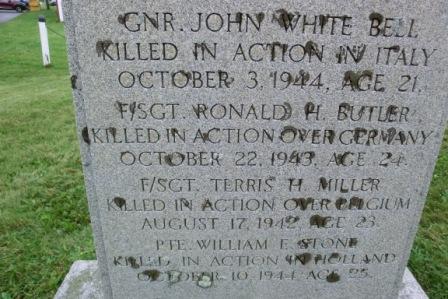
December 7, 2023. Whenever Pieter researches someone who has served in the military, we ask if there is any correspondence that the families might have. Sometimes a letter or postcard survives, which is wonderful.

In 2021, in the Atlantic Canada Remembers series, Angela Leighton submitted a photo of her uncle, Edison Reynolds SMITH, who was killed in action in The Netherlands on October 16, 1944, during the Battle of the Scheldt, while serving with the North Nova Scotia Highlanders.  He’s buried in the Canadian War Cemetery in Adegem, Belgium.  (See https://onthewarmemorialtrail.com/2021/01/07/on-the-war-memorial-trail-atlantic-canada-remembers-part-1/)

Edison Reynolds Smith

Edison Reynolds Smith.  (Photo courtesy of Angela Leighton)

After the article was posted, Angela wrote us with more information.  “Edison Reynolds Smith was born May 11, 1924 on Port Hood Island, Cape Breton, Nova Scotia to parents Guy and Grace (nee Watts) Smith.  After his parents passed, Edison and his siblings were taken in by their aunt and uncle, Elsie and Roland Myers, and lived in Cooks Cove, Guysborough County, Nova Scotia from 1929 until 1944….

Edison’s sense of duty was strong, and he enrolled in the 2nd (Reserve) Battalion of the Pictou Highlanders on August 24, 1942.  “…Edison joined the Militia in August 1942 and worked as a lumberman for his uncle until he enrolled in the Canadian Army on August 30, 1943….”  He enlisted at the No. 6 District Depot in Halifax, Nova Scotia.

20230616_085605_resized Angela Leighton

Angela Leighton, whose mother Dorothy was the younger sister of Edison Reynolds Smith, kept the letters he wrote to family.  (Photo submitted by Angela Leighton)

Angela then mentioned that she had letters that Edison had written during the time of his military service!  The letters reveal an engaging man who had suffered much tragedy in his young life, but never lost his optimistic spirit, even when he encountered more loss.  He was deeply interested in his family and friends, and kept up an active correspondence.  As time went on, he yearned to be back in Nova Scotia, surrounded by those he loved.

This was confirmed by Angela, whose mother Dorothy (Dot) was Edison’s sister.  “…His mother (my grandmother) died on January 11, 1928.  Her husband (my grandfather) died January 30, 1929. …It is no wonder Edison had such a love of family after such tragedy in those years before and really wanted to come back home….

1943 Edison Smith with Dot and Wesley

Edison (left) with his sister Dorothy and younger brother Wesley in 1943.  (Photo courtesy of Angela Leighton)

… Edison began his army training in September 1943…

After enlisting, Edison was sent to No. 60 Canadian Army Basic Training Centre (CABTC) in Yarmouth, Nova Scotia on September 17, 1943.

On November 19, 1943, he was sent to A14 Canadian Infantry Training Centre (CITC) in Aldershot, Nova Scotia for further training.  He received embarkation leave, from January 22 to February 4, 1944, the last chance he had to see his family.

After returning from leave, Edison remained in Aldershot until February 20, 1944, when he was transferred to the No.1 Training Brigade in Debert, Nova Scotia for final training and preparation for overseas service.

In a March 15, 1944 letter to his sister Dorothy, written from No 2 Temporary Transit Camp in Debert, Edison related one of the experiences and mentioned a friend from back home: “…We just got back off of our three day scheme.  We slept out in the woods two nights and we marched about 26 miles altogether.  I didn’t mind it though. It was a change from sleeping in the barracks…I saw Victor Shea up here the other day, he just came here about three or four days ago….It was terrible cold here right after I came back off of my weekend.  It was about 20 below zero one night.  But it’s a lot warmer now.  We moved today to a different part of the camp…

An April 1, 1944 letter to Dorothy, also written from Debert, noted that: “…my eyes have been paining me a little lately….I went on sick parade, but they only gave me a few tablets.…

… Edison left Canada for overseas service in April 1944…

Not mentioned in the letter was that Edison was on his way to the United Kingdom.  On April 6, 1944 he left Canada, arriving in the United Kingdom on April 12, 1944, where he was assigned to No 4 Canadian Infantry Reinforcement Unit (CIRU).

Edison’s initial impression of England was positive, as he related in an April 14, 1944 letter to his sister Dorothy, written from No 4 CIRU: “…It’s lovely weather over here except it rains once in a while…I spent Easter in the middle of the Atlantic.  It was a nice place to spend Easter, wasn’t it?….I had a good trip coming across but it was a little crowded….

Not long afterwards, Edison was sent to No 10 Battalion, Canadian Base Reinforcement Group (CBRG), but was still in England.  A poignant May 11, 1944 letter to his aunt, Elsie Myers, reflected that “…Today is my birthday. I hope I will be home my next birthday…

… Edison loved getting mail from back home…

In a May 25, 1944 letter, written from No 10 Battalion CBRG in England, Edison answered his sister Dorothy’s query about Victor Shea. “…I got two letters today and both from you. There’s nothing cheers me up any more than getting letters…..I haven’t seen Vic for a while.  He is not with me at all now.  He was with me all the time coming across on the ship from Canada and he ate and slept right where I did all the way coming across… 

Victor SHEA had joined the Canadian Parachute Battalion in 1942.  When more soldiers were needed for battle on the beaches of Normandy after D-Day, he transferred to infantry and was on the front lines, joining the North Nova Scotia Highlanders.   He received France’s Croix de Guerre (Medal of Valour) for his bravery in the liberation of France.

Before ending his letter, Edison assured his sister that he appreciated a parcel she’d sent. “…Thank you so much for the box you sent me.  We get lots to eat but it’s nice to have a change from army grub…

Dorothy wasn’t the only one to inquire about Victor Shea and other soldiers from their area.  In a May 25, 1944 letter to his cousin Abbie, daughter of his uncle Roland and aunt Elsie Myers, Edison explained that “…Vic Shea isn’t where I am at all now so there isn’t any one from home with me now….They are about the only ones anyways handy from home.  But I know a lot of the boys here by now because I went through all my training in Canada with them….If they send me a box from home, tell them to send me a few apples because I never tasted a bit of fruit of any kind since I came over here…

… Edison leaves for France and the D-Day invasion with the North Nova Scotia Highlanders…

On June 2, 1944, Edison was assigned to the North Nova Scotia Highlanders, as they prepared to leave the United Kingdom for France as part of the 21st Army Group.

The war diary for the North Nova Scotia Highlanders for June 3, 1944 noted that they … embarked from G1 Hard, Stokes Bay…..” and were “…lying out in the Southampton waters just outside Netley…” while awaiting clearance to cross the English Channel.

There was a delay in leaving due to heavy winds on June 4, so it wasn’t until June 5, 1944 that the crossing began.  “…At 1400 hours the flotilla moved out to the open sea and formed up with the other craft taking part in the invasion…”  This, of course, was to be what we know as D-Day.

On June 6, 1944, the war diary recorded that “…by 1400 hours all our troops were ashore, but as the Eighth Canadian Infantry Brigade had not found the going as easy as expected, we were unable to get through the town and were unable to assemble at ‘ELDER’, near Beny-Sur-Mer, as planned, and the Commanding Officer decided to assemble in a field….

D-Day was Edison’s first experience of fighting, but he survived.

… Tragedy strikes but Edison was not yet aware of another loss…

In early June, 1944, a telegram was sent to Edison’s brother, Wesley Smith in Cooks Cove, Nova Scotia, stating that Edison had been wounded on June 9, 1944, but remained on duty with his unit.  A notice of his being wounded is also recorded in Edison’s service file.  However, Edison later stated to his family that he was not wounded.

Edison and Wesley Smith better res

Edison (left) and Wesley Smith. (Photo courtesy of Angela Leighton)

What Edison didn’t know – and apparently neither did the military who sent the telegram – was that his younger brother Wesley, who was in the Reserves, had drowned on May 27, 1944.  He was only 16 years old.

….Coming up in Part 2…

In Part 2, Edison sees active service in France, Belgium, and The Netherlands and learns about the loss of his younger brother.   

Thank you to Angela Leighton for sharing photos and letters written by her uncle.  Do you have information to share about Canadian soldiers, please email us at memorialtrail@gmail.com, or comment on the blog.  

© Daria Valkenburg

….Want to follow our research?….

If you are reading this posting, but aren’t following our research, you are welcome to do so.  Our blog address: https://onthewarmemorialtrail.com/

Front cover OnTheWarMememorialTrailinEurope4 countries, 6 weeks, 7,000 km – an unforgettable war memorial journey in Europe…. Daria’s book ‘No Soldier Buried Overseas Should Ever Be Forgotten‘ is available in print and e-book formats.  Net proceeds of book sales help support research costs and the cost of maintaining this blog. For more information see https://nosoldierforgotten.com/ 

You are also invited to subscribe to our YouTube Channel: On The War Memorial Trail With Pieter Valkenburg: https://www.youtube.com/channel/UCJ591TyjSheOR-Cb_Gs_5Kw

Never miss a posting!  Subscribe below to have each new story from the war memorial trail delivered to your inbox.