On The War Memorial Trail…. Battlefields Tour With Joël Stoppels Part 4: From Nansum To Delfzijl And Wirdum

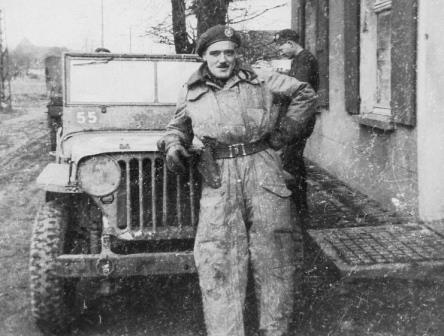
A life’s ambition realized! Daria in the driver’s seat of a jeep! Spoiler alert – our battlefield tour was in an SUV, not the jeep! (Photo credit: Joël Stoppels)

October 19, 2025.  While in Europe this spring for the 80th Anniversary of Liberation Commemoration events, we visited 14 cemeteries to place flags at the graves of 383 soldiers that Pieter has researched since 2014, with the stories of many of these soldiers previously told on this blog. 

On the wish list for our 2025 European War Memorial Tour was to tour some of the battlefields in which these soldiers lost their lives in order to have a better appreciation of what they had faced. 

Battlefields guide Joël Stoppels, of Groningen, The Netherlands, offered to spend a day showing us locations where the various battles that comprised the Battle of the Delfzijl Pocket took place.  Over the years, we’ve featured stories of many soldiers who lost their lives in the last weeks of the North-West Europe campaign during WWII, and we eagerly anticipated learning more. (See https://www.canadiansoldiers.com/history/battlehonours/northwesteurope/delfzijlpocket.htm)
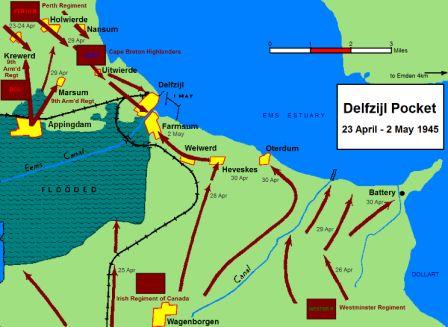
Map showing the locations during the Battle of the Delfzijl Pocket. (Map source: http://www.canadiansoldiers.com)

…. Recap…

In Part 1, our battlefield tour began at a field where 19 Canadians lost their lives during the Battle for Wagenborgen, the preliminary battle before the Battle of the Delfzijl Pocket. (See https://onthewarmemorialtrail.com/2025/10/01/on-the-war-memorial-trail-battlefields-tour-with-joel-stoppels-part-1-battle-for-wagenborgen/)

In Part 2, we travelled to Appingedam, the town where the Battle of the Delfzijl Pocket began. (See https://onthewarmemorialtrail.com/2025/10/05/on-the-war-memorial-trail-battlefields-tour-with-joel-stoppels-part-2-the-battle-of-the-delfzijl-pocket-began-in-appingedam/)

In Part 3, we left Appingedam and travelled to Holwierde, to see the plaque at Stefanuskerk that commemorated many of the Canadian soldiers who died during the Battle of the Delfzijl Pocket. (See https://onthewarmemorialtrail.com/2025/10/10/on-the-war-memorial-trail-battlefields-tour-with-joel-stoppels-part-3-visit-to-stefanuskerk-in-holwierde/)

Now, in Part 4, our battlefields tour concludes as we travel from Nansum to Delfzijl and Wirdum…..

….The Cape Breton Highlanders marched from Nansum to Delfzijl…
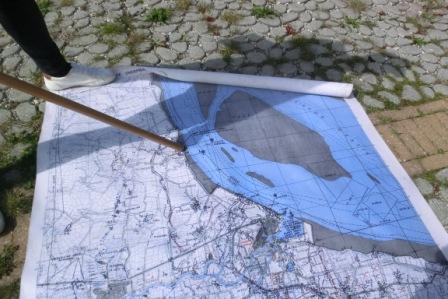
Delfzijl pointed out on Joël’s map.  (Photo credit: Daria Valkenburg)

From Nansum we followed the route taken by the Cape Breton Highlanders to Delfzijl.  Joël noted that “.…the Perth Regiment had been decimated by losses and were pulled back behind the front line, and replaced by the Cape Breton Highlanders who came from Loppersum….

The Cape Breton Highlanders “…started marching from Nansum on April 29, 1945, reaching Delfzijl on May 2, taking two routes…..” 

This was reflected in the war diary for the Cape Breton Highlanders.  The diary entry for April 28, 1945 stated that “…we received word from Brigade this morning that the Perth Regiment did not do so well last night on account of mines. We will likely relieve them tonight so we are to move to another concentration area this afternoon….” 

By late afternoon, the headquarters and ‘B’ Company were in Bierum, while the rest of the Regiment was in Spijk. While the evening itself was quiet, at 8 pm “…the Observation Post reported very dense smoke coming from the town of Delfzijl which is our objective. This could be caused by either demolitions by the enemy or our artillery which has been firing on that area….

April 29, 1945 was a cold and wet day, with the war diary reporting thatour pioneers worked with the sappers clearing mines off the road to ‘A’ Company and also repairing the road. But the night will be a busy one for all. ‘C’ and ‘D’ Companies are to relieve the two forward companies of the Perth and when that is completed ‘A’ and ‘B’ companies will pass through them and advance over a mile to their objectives….

…. ‘D’ Company travelled along the coast…

….‘D’ Company….” of the Cape Breton Highlanders “…travelled along the coast and had the most casualties as the Germans were heavily entrenched.  The other companies came via inland….” Joël said. 

The war diary for May 1, 1945 verified Joël’s account. “….The beginning of this month finds us continuing with the battle for Delfzijl…” The day was “…cold with showers throughout the day...” and “…visibility poor…” 

‘D’ Company did indeed run into difficulties. ….Flares were reported firing from the vicinity of D Company’s objective and a shoot was laid on….”  Then, as ‘D’ Company advanced they “…had to leave the carriers …as the road beyond was impassable for them. They proceeded from there without them....

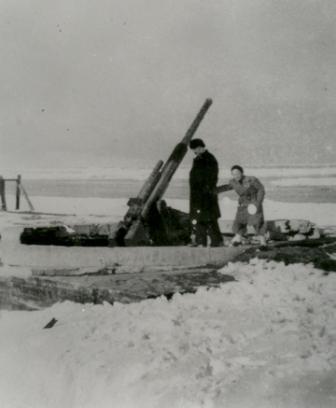
German 88 mm gun: A 10.5 cm FLAK cannon, captured by the Canadians in the Delfzijl Pocket. (Photo Courtesy of Joël Stoppels / Battlefield Tours)

The men from ‘D’ Company were now on foot, and as they advanced towards ‘C’ Company’s position, “…they were pinned down by mortars, shells and small arms fire….”  After receiving artillery support “…the advance was then continued and one platoon reached a position 100 yards short of objective where they were pinned down in a Jerry trench. D Company then reported they were running short of ammunition …

‘C’ Company was ordered totake ammunition from D Company’s carrier to their forward positions....” but they were held back by small arms and mortar fire. A second try was made, but without ammunition “…D Company at this time was in a very critical situation. The whole company was pinned down by bazookas and Spandaus. They were unable to send a guide back to bring in the party from C Company. The platoon, which had holed up in a Jerry trench, came under fire from hand-grenades from the top of the dyke, where the enemy had another trench system….

Train station in Delfzijl today.  (Photo credit: Pieter Valkenburg)

Finally the ammunition arrived, along with the other Companies.  By the early afternoon, the area around the train station in Delfzijl was cleared andone platoon was taking a firm hold along the canal, which split the town in two….

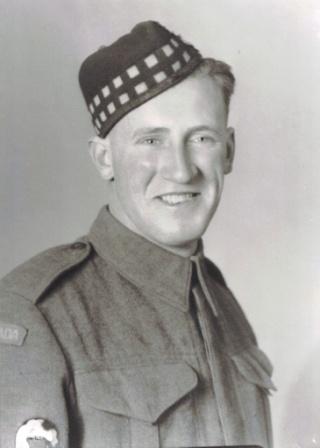
Two unidentified soldiers from the Cape Breton Highlanders Regiment in Delfzijl.  (Photo Courtesy of Joël Stoppels / Battlefield Tours.  Photo colourization by Pieter Valkenburg.)

….Retreating Germans tried to escape by boat…

A welcome report soon came from … D Company that the enemy fire had slackened …. They reported that the enemy was retreating over the dyke and pushing off in boats heading across the estuary towards Germany, Emden area. At 1106 D Company reported everything was under control and they were firm, sending contact patrols to B Company which arrived there at 1125 hours….

Not all of the Germans escaped.  “...On hearing that the enemy were leaving Delfzijl by boat, the Commanding Officer ordered the artillery to engage them. The result was that some of the boats occupied by the enemy did not reach the shores of Germany across the estuary….

Port of Delfzijl after the Canadian capture. (Photo Courtesy of Joël Stoppels / Battlefield Tours)

….The German commander surrendered on May 2, 1945…

On May 2, 1945, the war diary reported that At 0845 hours, brigade informed us that the commander of the Delfzijl pocket had surrendered to the Irish Regiment….

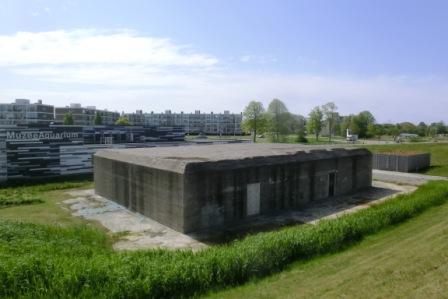
Remains of a German bunker near the Ems Estuary in Delfzijl.  (Photo credit: Daria Valkenburg)

Today, the remains of a German bunker still sits in its original location near the Ems Estuary in Delfzijl.  An aquarium sits behind it, and in front there is a hotel overlooking the Ems. 

….Our final stop was in Wirdum…

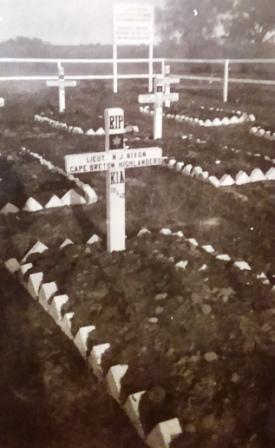
Our final stop on the Battlefields Tour was in Wirdum to look at the original field where casualties from this last battle were temporarily buried, at what was the 5th Divisional Cemetery.
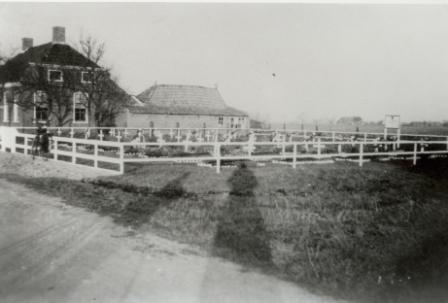
5th Divisional Cemetery in Wirdum in 1945. (Photo Courtesy of Joël Stoppels / Battlefield Tours)

The war diary for May 3, 1945 for the Cape Breton Highlanders noted that burial services were held close to noon at the 5th Divisional Cemetery in Wirdum.  Among those buried here were:

All except Louis Graham Richard, who served with the 9th Armoured Regiment (BC Dragoons), were with the Cape Breton Highlanders.  

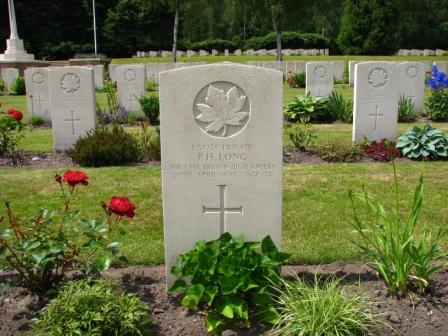
In 1946, all of these men were reburied in the Canadian War Cemetery in Holten. 

After all that the Cape Breton Highlanders had gone through in capturing Delfizjl, the war diary for May 3 expressed the Regiment’s disgust at not being given credit for what they achieved in the ‘Maple Leaf’, a newspaper for the Canadian Forces in Europe, with a 4-page format highlighting the advance of Canadian forces.

…Today there was one disgusted battalion in the Canadian Army, namely, The Cape Breton Highlanders. Today’s edition of the ‘Maple Leaf’, which up till now, was considered a fairly reliable paper, has let the battalion down horribly. The first thing which struck the eye, in fairly large print, was the capture of the town of Delfzijl by the PERTH Regt. This write up was a terrific let down to the boys who fought hard to capture the town and lost many of their comrades in killed and wounded during the struggle...

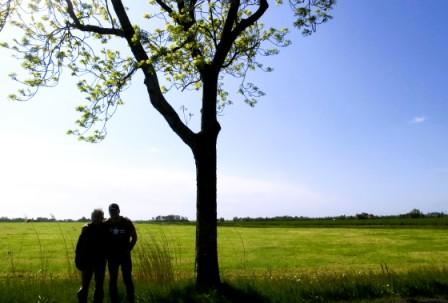
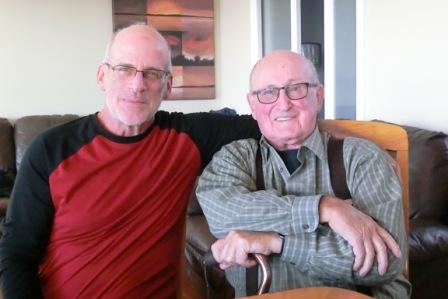
Pieter and Joël by the field in Wirdum where the 5th Divisional Cemetery once was located. (Photo credit: Daria Valkenburg)

Today, the location of the 5th Divisional Cemetery is back to being a field, with a plaque as a reminder that it was once the resting place of Canadians who lost their lives in the battle to capture Delfzijl.

Plaque in Wirdum across the field where the 5th Divisional Cemetery once was located. (Photo credit: Daria Valkenburg)

This ended our Battlefields Tour.  All that was left was to realize a life’s ambition for me….to sit in a WWII era jeep!  After a photo was taken, Pieter was invited to sit in the passenger seat for another photo. 
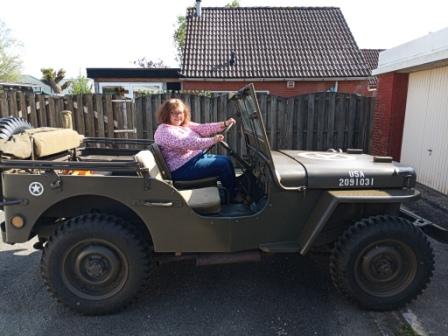
Daria in the driver’s seat of Joël’s jeep!  (Photo credit: Pieter Valkenburg)

Joël presented Pieter with a Dutch language copy of his newly published book ‘Operation Cannonshot’ which was gratefully received. 

Pieter and Joël with Joël’s book ‘Operation Cannonshot’.  (Photo credit: Daria Valkenburg)
Thank you to Joël Stoppels, guide and founder of Battlefield Tours, for a wonderful and informative tour with a friendly guide. (See www.battlefieldtours.nu) We were grateful for the chance to see the various places where the Battle of the Delfzijl Pocket was fought. We’re so glad we were able to take the tour as it’s almost impossible to imagine what the people and troops went through, until you can see it for yourself.

The Battlefield Tour ended, but our adventures continued as we went on with the next portion of our 2025 European War Memorial Tour.

If you have a story or photo to share, or are able to identify either of the two Cape Breton Highlanders in the photo taken in Delfzijl, please contact Pieter at memorialtrail@gmail.com or comment on the blog. 

© Daria Valkenburg

….Want to follow our research?…

If you are reading this posting, but aren’t following our research, you are welcome to do so.  Our blog address: https://onthewarmemorialtrail.com/
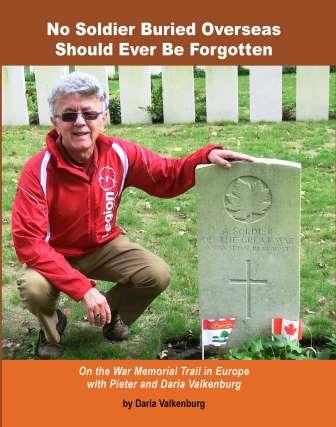
4 countries, 6 weeks, 7,000 km – an unforgettable war memorial journey in Europe…. Daria’s book ‘No Soldier Buried Overseas Should Ever Be Forgotten‘ is available in print and e-book formats.  Net proceeds of book sales help support research costs and the cost of maintaining this blog. For more information see https://nosoldierforgotten.com/

Subscribe to our YouTube Channel: On The War Memorial Trail With Pieter Valkenburg: https://www.youtube.com/channel/UCJ591TyjSheOR-Cb_Gs_5Kw

Never miss a posting!  Subscribe below to have each new story from the war memorial trail delivered to your inbox.

On The War Memorial Trail…. Battlefields Tour With Joël Stoppels Part 3: Visit To Stefanuskerk in Holwierde

A life’s ambition realized! Daria in the driver’s seat of a jeep! Spoiler alert – our battlefield tour was in an SUV, not the jeep! (Photo credit: Joël Stoppels)

October 10, 2025.  While in Europe this spring for the 80th Anniversary of Liberation Commemoration events, we visited 14 cemeteries to place flags at the graves of 383 soldiers that Pieter has researched since 2014, with the stories of many of these soldiers previously told on this blog. 

On the wish list for our 2025 European War Memorial Tour was to tour some of the battlefields in which these soldiers lost their lives in order to have a better appreciation of what they had faced. 

Battlefields guide Joël Stoppels, of Groningen, The Netherlands, offered to spend a day showing us locations where the various battles that comprised the Battle of the Delfzijl Pocket took place.  Over the years, we’ve featured stories of many soldiers who lost their lives in the last weeks of the North-West Europe campaign during WWII, and we eagerly anticipated learning more. (See https://www.canadiansoldiers.com/history/battlehonours/northwesteurope/delfzijlpocket.htm)

Map showing the locations during the Battle of the Delfzijl Pocket. (Map source: http://www.canadiansoldiers.com)

In Part 1, our battlefield tour began at a field where 19 Canadians lost their lives during the Battle for Wagenborgen, the preliminary battle before the Battle of the Delfzijl Pocket. (See https://onthewarmemorialtrail.com/2025/10/01/on-the-war-memorial-trail-battlefields-tour-with-joel-stoppels-part-1-battle-for-wagenborgen/)

In Part 2, we travelled to Appingedam, the town where the Battle of the Delfzijl Pocket began. (See https://onthewarmemorialtrail.com/2025/10/05/on-the-war-memorial-trail-battlefields-tour-with-joel-stoppels-part-2-the-battle-of-the-delfzijl-pocket-began-in-appingedam/)

Now, in Part 3, we left Appingedam and travelled to Holwierde, where our first stop was at the Canada Memorial.

…. The Canada Memorial in Holwierde…

Pieter and Joël at the Canada Memorial in Holwierde. (Photo credit: Daria Valkenburg)

Front view of the Canada Memorial in Holwierde.  (Photo credit: Daria Valkenburg)

We knew that there was a plaque at the church in Holwierde that commemorated the Canadians who lost their lives during the Battle of Delfzijl Pocket, but had no idea there was also a monument in the town itself…. with houses on either side of the main road where it’s located.

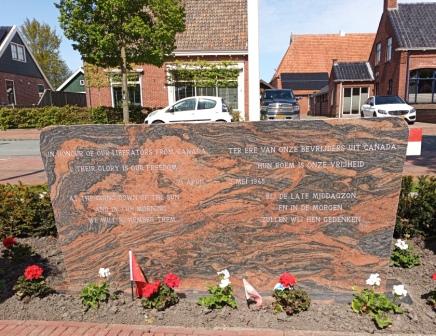
Called the Canada Memorial, with red and white flowering plants around it, the stone plaque simply states ‘In honour of our liberators from Canada. Their glory is our freedom. 21 April – 2 May 1945

Closeup of stone plaque at the Canada Memorial in Holwierde.  (Photo credit: Pieter Valkenburg)

…. Canadian soldiers called Holwierde ‘a killing ground’…

Battlefields Tour poster describing Howierde as a ‘Killing ground’.

As we walked through this quiet and picturesque town towards the Stefanuskerk, we asked Joël about his poster describing Holwierde as a ‘Killing ground’.  He explained that ….Holwierde was one of the most heavily contested villages during the Battle of the Delfzijl Pocket in April 1945. The Perth Regiment fought intense house-to-house combat here, as German paratroopers and naval infantry had fortified nearly every building.  Many Canadian soldiers referred to the village as ‘a killing ground’ due to the high casualties on both sides…..

Holwierde in April 1945, with a temporary bailey bridge, leading towards the Stefanuskerk. (Photo Courtesy of Joël Stoppels / Battlefield Tours)

Holwierde in April 1945.  A temporary bailey bridge allowed residents and troops to cross the canal.  The Stefanuskerk is on the right. (Photo Courtesy of Joël Stoppels / Battlefield Tours)

…The Stefanuskerk, although spared from destruction, stood right in the middle of the battlefield and witnessed days of shelling and close-quarters fighting….  

Holwierde in 2025, 80 years after its liberation.  The bailey bridge from 1945 is now a permanent bridge over the canal! (Photo credit: Daria Valkenburg)

 …. We found a banner for one soldier whose story was previously told…

Banner for Joseph ‘Gerald’ Fougere in Holwierde. (Photo credit: Pieter Valkenburg)

As we walked down the street towards the Stefanuskerk, the main reason for our visit to Holwierde, we saw a banner for Joseph ‘Gerald’ FOUGERE, who was serving with the Perth Regiment. He was wounded on April 24, 1945, during the Battle of the Delfzijl Pocket, and died on April 26, 1945, one month before his 29th birthday. (See https://onthewarmemorialtrail.com/2021/01/27/on-the-war-memorial-trail-atlantic-canada-remembers-part-5/)

Joseph ‘Gerald’ Fougere’s banner was by the canal in Holwierde, but this wasn’t where he died.  (Photo credit: Daria Valkenburg)

The banner was by the canal, and while I was busy snapping photos, thinking this is where he died, Joël said “…no, he actually died in nearby Nansum.  Since Nansum is such a small village, his banner was placed in Holwierde for greater visibility...” He then kindly pointed out that “…the bridge over the canal had been blown up by the Germans on April 25, 1945.

Never mind…Nansum was quickly added as our next stop after Holwierde!

…. A solemn few moments at Stefanuskerk…

Entrance to Stefanuskerk in Holwierde. (Photo credit: Pieter Valkenburg)

We continued walking down the road until we got to the Stefanuskerk.  A plaque near the door noted that the church dates to the 11th century!  In the 13th century the church was enlarged.  It was severely damaged in April 1945, but restored by 1950, to give the appearance as to how the church would have looked before 1830.

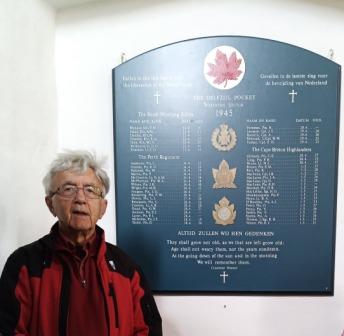
Pieter by the plaque in Stefanuskerk that commemorates Canadian soldiers who died during the Battle of the Delfzijl Pocket.  (Photo credit:  Joël Stoppels)

We wanted to visit the church in order to see the plaque that commemorates many of the Canadian soldiers who died during the Battle of the Delfzijl Pocket.  It was a very solemn few moments for us, as we looked over the names, many of them of soldiers that Pieter had researched over the past years.

From the Royal Winnipeg Rifles:

From the Perth Regiment:

From the Cape Breton Highlanders:

Not mentioned on the plaque:

From the 9th Armoured Regiment (BC Dragoons), who is commemorated on a plaque in Appingedam:

…. We couldn’t miss seeing Nansum…

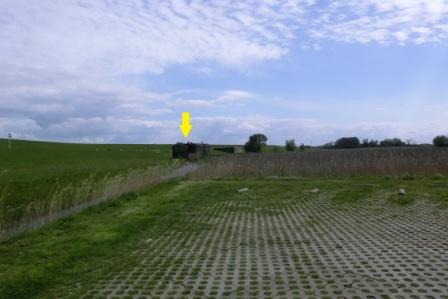
We left Stefanuskerk in a reflective mood after looking at the names on the plaque, and quietly got back in the car for the short drive to Nansum, which is indeed a tiny place, near the coast.   Joël didn’t know exactly where Joseph ‘Gerald’ FOUGERE was killed, unfortunately.  What remained of a German bunker was still visible, so he likely died of shrapnel wounds. 

Yellow arrow indicates the remains of a German bunker in Nansum.  (Photo credit: Daria Valkenburg)

Joël noted that 177 Kriegsmarine were captured here. The Kriegsmarine was Nazi Germany’s Navy from 1939-1945.  By 1945, as the war progressed, the Kriegsmarine formed infantry units from its personnel, who were re-trained as infantry to fight on land, all in an attempt to alleviate the strain on the German Army.

From Nansum we continued on the last leg of our battlefields tour, as we followed the route taken by the Cape Breton Highlanders to Delfzijl. Coming up in Battlefields Tour With Joël Stoppels Part 4: From Nansum To Delfzijl And Wirdum.

Thank you to Joël Stoppels, guide and founder of Battlefield Tours, for a wonderful and informative tour. (See www.battlefieldtours.nu)  If you have a story or photo to share, please contact Pieter at memorialtrail@gmail.com or comment on the blog. 

© Daria Valkenburg

….Want to follow our research?…

If you are reading this posting, but aren’t following our research, you are welcome to do so.  Our blog address: https://onthewarmemorialtrail.com/

4 countries, 6 weeks, 7,000 km – an unforgettable war memorial journey in Europe…. Daria’s book ‘No Soldier Buried Overseas Should Ever Be Forgotten‘ is available in print and e-book formats.  Net proceeds of book sales help support research costs and the cost of maintaining this blog. For more information see https://nosoldierforgotten.com/

Subscribe to our YouTube Channel: On The War Memorial Trail With Pieter Valkenburg: https://www.youtube.com/channel/UCJ591TyjSheOR-Cb_Gs_5Kw

Never miss a posting!  Subscribe below to have each new story from the war memorial trail delivered to your inbox.

On The War Memorial Trail…. Battlefields Tour With Joël Stoppels Part 2: The Battle of the Delfzijl Pocket Began In Appingedam

A life’s ambition realized! Daria in the driver’s seat of a jeep! Spoiler alert – our battlefield tour was in an SUV, not the jeep! (Photo credit: Joël Stoppels)

October 5, 2025.  While in Europe this spring for the 80th Anniversary of Liberation Commemoration events, we visited 14 cemeteries to place flags at the graves of 383 soldiers that Pieter has researched since 2014.  The stories of many soldiers have been told on this blog. 

On our wish list for this trip was to tour some of the battlefields in which these soldiers lost their lives in order to have a better appreciation of what they had faced. 

Battlefields guide Joël Stoppels, of Groningen, The Netherlands, offered to spend a day showing us locations where the various battles that comprised the Battle of the Delfzijl Pocket took place.  Over the years, we’ve featured stories of many soldiers who lost their lives in the last weeks of the North-West Europe campaign during WWII, and we eagerly anticipated learning more. (See https://www.canadiansoldiers.com/history/battlehonours/northwesteurope/delfzijlpocket.htm)

Map showing the locations during the Battle of the Delfzijl Pocket. (Map source: http://www.canadiansoldiers.com)

In Part 1, our battlefield tour began at a field where 19 Canadians lost their lives during the Battle for Wagenborgen, the preliminary battle before the Battle of the Delfzijl Pocket. (See https://onthewarmemorialtrail.com/2025/10/01/on-the-war-memorial-trail-battlefields-tour-with-joel-stoppels-part-1-battle-for-wagenborgen/)

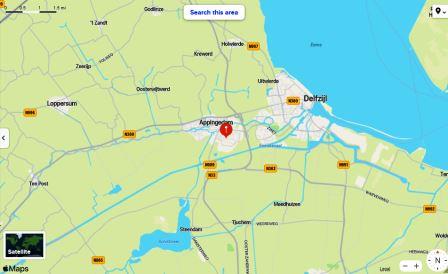
Now, in Part 2, we travelled to Appingedam, the town where the Battle of the Delfzijl Pocket began…. 

From Wagenborgen, we made our way towards Appingedam, the location of the beginning of the Battle of the Delfzijl PocketWilliam ‘Willie’ DANIELS, Donald Charles MACKENZIE, whose stories were previously told on this blog, along with William James ‘Jimmy’ Sutherland HOLE, who Pieter also researched, lost their lives here.

…. We found banners for two soldiers whose stories were previously told…

We found the banners for Daniels and MacKenzie, but no banner was made for Hole as up to now no photo has been found of him. 

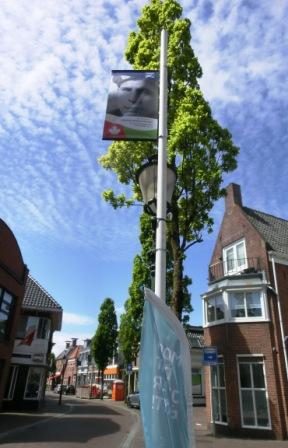
Banner for William ‘Willie’ Daniels in Appingedam. (Photo credit: Daria Valkenburg)

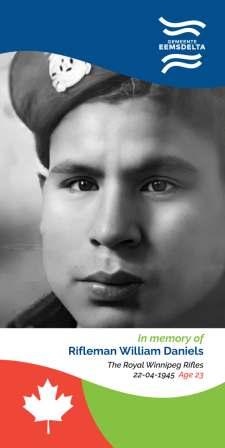
The banner for William ‘Willie’ Daniels was quite high up and it was hard for me to get a good angle, but thankfully Joël was kind enough to send us a better photo of the banner. 

Banner for William ‘Willie’ Daniels. (Photo courtesy of Joël Stoppels/ Battlefield Tours)

William ‘Willie’ DANIELS, from the Big River Reserve in Depton, Saskatchewan, was serving with the Royal Winnipeg Rifles when he was killed, aged 20, on April 22, 1945 as troops moved through Appingedam in The Netherlands at the very beginning of the Battle of the Delfzijl Pocket. You can read his story at https://onthewarmemorialtrail.com/2021/07/23/on-the-war-memorial-trail-remembering-ww2-soldier-william-willie-daniels/

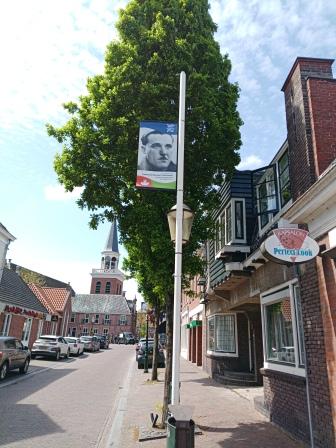
Banner for Donald Charles MacKenzie in Appingedam. (Photo credit: Pieter Valkenburg)

Donald Charles MACKENZIE of Springhill, Nova Scotia, was serving with the Royal Winnipeg Rifles when he was killed, aged 30, on Sunday, April 22, 1945. He had been wounded during heavy fighting at the railway bridge near Appingedam, and placed in a house temporarily to rest. However, he was fatally hit by shrapnel by German shelling of the house.  You can read his story at https://onthewarmemorialtrail.com/2022/01/23/on-the-war-memorial-trail-the-ww2-soldier-from-springhill-who-received-a-memorial-cross/

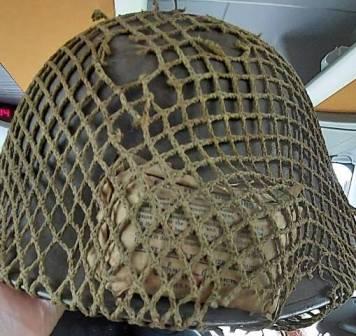
Helmet that had belonged to Donald Charles MacKenzie. (Photo Courtesy of Joël Stoppels / Battlefield Tours)

Joël told us that he has Donald Charles MacKenzie’s helmet in his private collection, and was kind enough to share a photo…a link of the past with the present! 

…. The Royal Winnipeg Rifles were in Appingedam as of April 21, 1945…

Map helped explain what happened in Appingedam in 1945.  (Photo credit: Daria Valkenburg)

In setting the scene on what unfolded in Appingedam back in 1945, Joël referred to a map that he had brought along for the battlefields tour.  “….Two roads led into Appingedam in 1945, both heavily mined by the defending Kriegsmarine…” he explained. The Kriegsmarine was Nazi Germany’s Navy from 1939-1945.  By 1945, as the war progressed, the Kriegsmarine formed infantry units from its personnel, who were re-trained as infantry to fight on land, all in an attempt to alleviate the strain on the German Army.

…The Canadians were aware of the mines…” Joël noted, and on “…April 21, 1945, the Royal Winnipeg Rifles attacked.  Heavy fighting ensued but the town was partially liberated on April 23, 1945….” allowing “….the Royal Winnipeg Rifles to move back into Wirdum….

The Regimental history, ‘Little Black Devils: a history of the Royal Winnipeg Rifles’, by Bruce Tascona and Eric Wells, describes what happened at Appingedam. “…..Beginning on April 21….the Rifles attacked with the 7th Reconnaissance Regiment, and several of the armoured cars were knocked out by anti-tank guns.  The Germans then blew up the bridge which the Rifles intended to cross…

In trying to find another plan of attack, patrols had discovered a small bridge.  …The bridge, deemed too feeble to carry motor transport, was still intact and patrols affirmed that it would carry the weight of jeeps.  With that information, the Rifles shifted position on a new start line during the night…

The plan in place, “…in the early hours of April 22, A Company….went over the bridge, followed closely by C Company.  They were met by heavy machine gun fire but the worst problem they faced were the minefields….

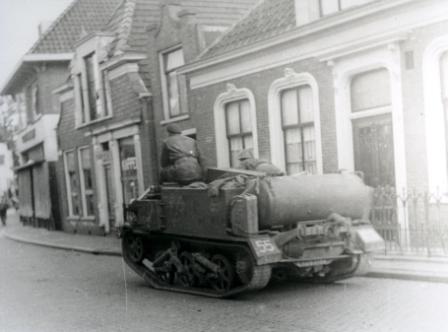
A WASP carrier with 2 soldiers from the Royal Winnipeg Rifles on a street in Appingedam in April 1945.  (Photo Courtesy of Joël Stoppels / Battlefield Tours)

In spite of the challenges, during the day “… the Battalion consolidated its position in front of the town…”  Then, a surprise attack during the night meant that…by dawn the Rifles were inside Appingedam and by mid-morning of April 23, they were mopping up. On April 24, the Rifles were replaced by the Perth Regiment….

The 9th Armoured Regiment (British Columbia Dragoons) were assigned to support the Perth Regiment.  The war diary for the BC Dragoons for April 22, 1945 explained the orders. …Lt Col Angle liaised with Commander Perth Regiment as BCD will form one portion of the 5 CAB Battle Group…” (CAB referred to Canadian Armoured Brigade)

The Situation Report for ‘A’ Squadron of the BC Dragoons noted that “…troops moved forward and positions taken over from Winnipeg Rifles before last light.  Approach to town heavily shelled by enemy heavy calibre guns…

…. Appingedam was evacuated on the night of April 23, 1945…

Per the war diary for the BC Dragoons for April 23, 1945, it was overcast and orders had been received at 2 am from HQ CAB that the Regiment was to relieve the Royal Winnipeg Rifles at 12:30 pm, and that troops from ‘A’ and ‘B’ squadrons were to be temporarily reorganized into one infantry squadron.  The tanks were parked in an area away from the town, with ….one crew member per tank to remain in the tanks and perform necessary maintenance and act as guards….”….all in preparation for the upcoming battle.

Appingedam had a population of 7,000, who were about to be in the midst of a heavy fight.  Joël told us that after “…a Dutch resistance fighter named Leugs went to Battalion HQ and offered to help, he was tasked with evacuating the town.  With the aid of Canadian trucks, this was done on the night of April 23, 1945…

On April 24, 1945, the Situation Report for ‘A’ Squadron of the BC Dragoons recorded that …the troop of tanks under Lt Gamlin, ‘C’ Squadron, took up positions at first light, spasmodic shelling throughout the day.  Underground contacted and reliable information was received concerning enemy positions….Enemy continued heavy shelling…. 

The Germans surrendered on May 2, 1945, and residents were able to return home and assess the damage to their properties.

…. Plaques to commemorate the RWR and BC Dragoons are in Appingedam…

Daria and Joël in Appingedam’s town square. The commemorative plaques are on a wall in the passageway to the right. (Photo credit: Pieter Valkenburg)

We learned about all that happened in Appingedam while standing in the town square, and next went to see two plaques placed nearby – one for the Royal Winnipeg Rifles, and the other for the British Columbia Dragoons.  We could still see shrapnel in the bricks of the buildings!

Commemorative plaque for the Royal Winnipeg Rifles.  (Photo credit: Daria Valkenburg)

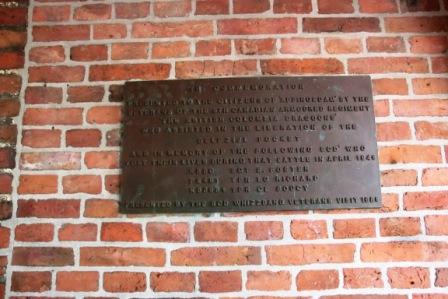
Commemorative plaque for the BC Dragoons.  (Photo credit: Daria Valkenburg)

Three soldiers from the BC Dragoons are remembered on the plaque:

  • Sgt Stanley FOSTER, aged 24, died April 30, 1945
  • Trooper Louis Graham RICHARD, aged 27, died April 26, 1945
  • Trooper Charles Ernest SOUCY, aged 30, died April 30, 1945

Sgt Foster is buried in the Canadian War Cemetery in Groesbeek.  Troopers Richard and Soucy are buried in the Canadian War Cemetery in Holten.  You can read Richard’s story at https://onthewarmemorialtrail.com/2021/02/22/on-the-war-memorial-trail-atlantic-canada-remembers-part-7/

…. ‘The best stroopwafel I ever ate!’…

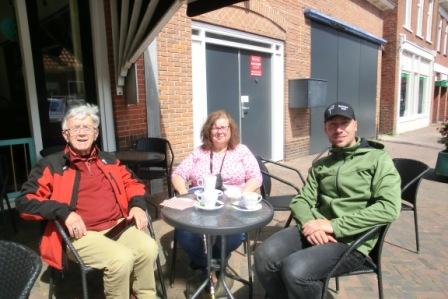
Pieter, Daria, and Joél having a much needed break in Appingedam.  (Photo courtesy of Valkenburg Family)

After digesting all the history from Wagenborgen and Appingedam, we desperately needed a break, so were very receptive to Joël’s suggestion that we go for coffee at ‘Stroopwoafeltje, Koffie & Meer’, a café in the town square.

Joël recommended the homemade stroopwafels made by the lady running the café, and both he and Pieter ordered one.  After Pieter told me “…this is the best stroopwafel I ever ate!!!!..” I tried a piece of his, and he was right.  It was much nicer than the syrupy, overly chewy ones you get commercially! 

In case you’ve never tried this treat, a stroopwafel is a traditional Dutch cookie made from two thin waffle layers sandwiched around a warm caramel filling.  I’m only sorry that I didn’t think to take a photo of Pieter’s stroopwafel before he ate it all up!

Our stay in Appingedam ended once we finished our coffee break.  It was time to move on and continue our battlefields tour as part of our 2025 European War Memorial Tour. Coming up in Battlefields Tour With Joël Stoppels Part 3: Visit To Stefanuskerk In Holwierde.

Thank you to Joël Stoppels, guide and founder of Battlefield Tours, for a wonderful and informative tour. (See www.battlefieldtours.nu)  If you have a story or photo to share, please contact Pieter at memorialtrail@gmail.com or comment on the blog. 

© Daria Valkenburg

….Want to follow our research?…

If you are reading this posting, but aren’t following our research, you are welcome to do so.  Our blog address: https://onthewarmemorialtrail.com/

4 countries, 6 weeks, 7,000 km – an unforgettable war memorial journey in Europe…. Daria’s book ‘No Soldier Buried Overseas Should Ever Be Forgotten‘ is available in print and e-book formats.  Net proceeds of book sales help support research costs and the cost of maintaining this blog. For more information see https://nosoldierforgotten.com/

Subscribe to our YouTube Channel: On The War Memorial Trail With Pieter Valkenburg: https://www.youtube.com/channel/UCJ591TyjSheOR-Cb_Gs_5Kw

Never miss a posting!  Subscribe below to have each new story from the war memorial trail delivered to your inbox.
On The War Memorial Trail….. The WWII Soldier From Springhill Who Received A Military Cross

January 23, 2022.  In the quest for a photo of Lt Donald Charles MACKENZIE of Springhill, Nova Scotia, Pieter placed a request on ‘THE SPECTATOR: A Little Good News from Springhill, NS’ Facebook page.  Pat Crowe submitted a newspaper photo and obituary shortly afterwards, explaining that “…Donald had 4 brothers and sisters but they are all gone now…

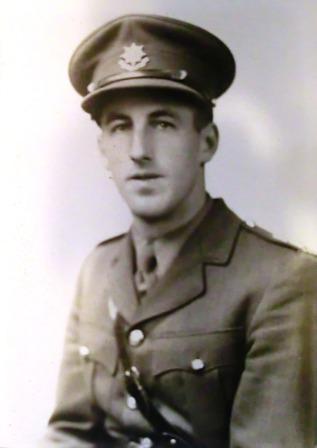
image0 Donald Charles MacKenzie

Donald Charles MacKenzie.  (Photo courtesy of Lydia Prange)

Pat then contacted Donald’s niece, Lydia Prange, who had a photo and explained that her mother, Lydia Jean Nelson, was Donald’s sister.  I was born in 1949 so never knew my uncle or grandmother….” Lydia wrote.

Born September 3, 1914 in Springhill, Nova Scotia, Donald was the son of Charles Tupper MacKenzie and Lydia MacKay.  Before enlisting for active duty with the North Nova Scotia Highlanders in Springhill on September 15, 1939, Donald was in the Cumberland Highlanders militia from June 11, 1936 until August 27, 1939.  He was employed as a road layer by Dominion Steel and Coal, a mining company.

Donald married …Mary MacSavaney on June 19, 1936.  Their son Gordon was born on March 15, 1940…

….Donald took a demotion in rank in order to serve overseas more quickly….

Upon enlistment, he was given the rank of Sergeant and sent to Halifax with the North Nova Scotia Highlanders.  However, in order to see active overseas service more quickly, he transferred to the Royal Canadian Engineers 6th Field Company on January 7, 1941, taking a demotion in rank to Private, and was transferred to Debert, Nova Scotia in preparation for going overseas.

On June 18, 1941 he was on his way to the United Kingdom.  On August 1, 1941 he was promoted to Lance Corporal, and later promoted to Corporal on July 6, 1943. On September 21, 1944 he received a further promotion, to Lieutenant, upon the successful completion of officer training at Sandhurst, in the United Kingdom.

…After receiving a promotion to Lieutenant he was transferred to the Royal Winnipeg Rifles…

He requested a transfer back to the North Nova Scotia Highlanders, but instead, in October 1944 he was sent to Belgium and assigned to the Royal Winnipeg Rifles.

image1 Donald Charles MacKenzie

Donald Charles MacKenzie.  (Photo courtesy of Lydia Prange)

On April 7, 1945 the Royal Winnipeg Rifles were in The Netherlands, and ordered to cross the Schipbeek Canal and establish a bridgehead as preparation for an assault on the city of Deventer by the 7th Canadian Brigade.  Crossing the Canal was vital to the success of the bridge operation, not an easy feat as the Bridge was strongly defended by the Germans.

…Courage and bravery led to a Military Cross recommendation…

Donald’s actions on that day resulted in a recommendation for a Military Cross.  The citation recorded that “…it was due only to the determination and boundless courage of Lt Douglas MacKenzie that a quick crossing was made possible without heavy casualties.

The enemy had a battle group dispersed around the bridge, making it impassable.  Lt MacKenzie, in command of the unit Pioneers attached to ‘D’ Company, had the responsibility of bridging the canal so that a bridgehead could be rapidly built up ready for a breakout.

The enemy fire was intense but with covering fire from ‘D’ Company, Lt MacKenzie succeeded in crawling out onto the Bridge, dragging a couple of planks. He was working well within grenade range of the enemy and at least six grenades exploded nearby, wounding him by shrapnel and blast.

With complete disregard for his own safety, he continued working until he had four planks in position, allowing the company to cross quickly and secure a solid bridgehead.

His dauntless spirit and untiring efforts inspired the men around him and resulted in the momentum of the advance being maintained…

…Appingedam was at the beginning of the Battle of the Delfzijl Pocket…

Screenshot 2022-01-21 at 10-19-20 appingedam ww2 at DuckDuckGo

Map showing Appingedam courtesy of Wikipedia.

On April 21, 1945, the Royal Winnipeg Rifles neared Appingedam, a small town of 7,000 in the northeastern corner of The Netherlands.  Along with the 7th Reconnaissance Regiment, they advanced, but the Germans blew up the bridge over the canal which the Rifles had intended to cross.

The movement of troops through Appingedam was the very beginning of the Battle of the Delfzijl Pocket.  (For more information on the Battle of the Delfzijl Pocket, see https://www.canadiansoldiers.com/history/battlehonours/northwesteurope/delfzijlpocket.htm)

A translated excerpt from a Dutch account, written by Joël Stoppels of Battlefield Tours and sent by the Informatiecentrum Canadese Begraafplaats Holten, gave an eye witness account.  “…On Sunday morning, April 22, the Royal Winnipeg Rifles travelled via the railway line at Tjamsweer to the level crossing. They came under fire from the bunkers on the south side of the rails, but these were soon defused. By six o’clock they reached the railway crossing, after which they continued along the railway towards Appingedam. They were noticed by the Germans, who started to fire on the Canadians. As a result, the entire area between Tjamsweer and Appingedam came under heavy machine-gun fire and shell fire. … 

It appears that the Germans were initially surprised as they expected troops to advance by the main road. “… There was heavy fighting at the railway bridge over the Kleine Heekt. The Germans withdrew, but not before blowing up the bridge. This was not an insurmountable problem for the Canadians. Partly to protect themselves against enemy fire, the Canadians continued dredging through the ditches. Fifteen Canadians thus reached the level crossing at Jukwerd, where they entered Mr H. Jongsma’s house, soaked and muddy, because of their platoon commander….”

The platoon commander was Lt Donald MacKenzie “…. who had suffered a gunshot wound to his right shoulder…He was placed on a bed to allow him to rest…”  In an unlucky twist of fate, this temporary resting place proved fatal.

….The Germans unleashed concentrated fire, with two shells hitting the house. When the residents later were able to check on the wounded soldier, it turned out that he had been fatally hit by shrapnel…

The Canadian soldiers who had brought him to the house … had moved to the home of Mr. P. Puisten (on the same street), and could no longer offer help. Red Cross soldiers moved his remains outside the line of fire….

Donald was 30 years old when he died in that house on April 22, 1945.  The Military Cross was awarded to him posthumously and presented to his widow.  Donald was initially buried in Loppersum General Cemetery in Groningen.  After the war he was reburied in the Canadian War Cemetery in Holten.

image2 Gravestone Donald Charles MacKenzie

Grave of Donald Charles MacKenzie in the Canadian War Cemetery in Holten.  (Photo courtesy of Informatiecentrum Canadese Begraafplaats Holten)

… A plaque commemorates Canadian soldiers who died during the Battle of the Delfzijl Pocket….

This is the second story told about a soldier with the Royal Winnipeg Rifles who lost his life near Appingedam.  William ‘Willie’ DANIELS, whose story was previously told, also lost his life on April 22, 1945.

In 1995, the Stefanus Church in Holwierde placed a plaque to commemorate Canadian soldiers who lost their lives during the Battle of the Delfzijl Pocket.  Donald MacKenzie and Willie Daniels are among those who are commemorated.

Plaque at Stefanus Church in Holwierde

Plaque at Stefanus Church in Holwierde, The Netherlands.  (Source: https://www.tracesofwar.nl/sights/40531/Herinneringsplaquette-Stefanus-Kerk.htm)

….. Other Soldiers Mentioned On The Plaque In The Church In Holwierde….

Thank you to Lydia Prange for sharing photos and information on Donald Charles MacKenzie and to Elaine Falconer, who manages the The Spectator Facebook page in Springhill, Nova Scotia.  This Canadian hero was featured in a Remembrance Week video entitled ‘In Remembrance’ on our YouTube Channel, which you can see here:

Do you have photos or stories to share?  Email Pieter at memorialtrail@gmail.com, or comment on the blog.

© Daria Valkenburg

…Want to follow our research?….

If you are reading this posting, but aren’t following the blog, you are welcome to do so. Our blog address: https://onthewarmemorialtrail.com/

Front cover OnTheWarMememorialTrailinEurope4 countries, 6 weeks, 7,000 km – an unforgettable war memorial journey in Europe…. Daria’s book ‘No Soldier Buried Overseas Should Ever Be Forgotten‘ is available in print and e-book formats.  Net proceeds of book sales help support research costs and the cost of maintaining this blog. For more information see https://nosoldierforgotten.com/

Screenshot_2021-02-27 On The War Memorial Trail With Pieter Valkenburg

You are also invited to subscribe to our YouTube Channel: On The War Memorial Trail With Pieter Valkenburg: https://www.youtube.com/channel/UCJ591TyjSheOR-Cb_Gs_5Kw.

Never miss a posting!  Subscribe below to have each new story from the war memorial trail delivered to your inbox.

On The War Memorial Trail….. The WWII Soldier From St Stephen Who Was A Teacher

March 7, 2021.  Last fall, the researchers at the Canadian War Cemetery in Holten, The Netherlands sent Pieter a photo wish list of 6 soldiers from the Cape Breton Highlanders who had died in the Battle of the Delfzijl Pocket.  (For more information on the Battle of the Delfzijl Pocket, see https://www.canadiansoldiers.com/history/battlehonours/northwesteurope/delfzijlpocket.htm)

Len Boudreau of the Cape Breton Highlanders Association was able to provide photos of 3 of the men,  Pieter found one on the Canadian Virtual War Memorial website, leaving 2 to try and find:  Philip Hubert LONG of Nova Scotia, and Norman James NIXON of New Brunswick.

A radio interview with CBC’s Maritime Noon about Philip Long resulted in family contacting Pieter immediately, and a photo was soon provided.  (See https://bordencarletonresearchproject.wordpress.com/2020/11/01/on-the-war-memorial-trail-a-face-for-philip-hubert-long/)

In trying to find family of Norman Nixon, Pieter sent a letter to the editor of the St. Croix Courier newspaper.  (See https://bordencarletonresearchproject.wordpress.com/2020/10/17/on-the-war-memorial-trail-continuing-the-search-for-soldiers-killed-in-action-in-ww1-and-ww2/)  Legion member Kent Caldwell sent a photo and story from the New Brunswick Military Service Recognition booklet.

It was a rare occasion that every photo request on a list could be fulfilled, but it happened! But then, the grandson (and namesake) of Norman Nixon contacted us.  “….We have quite a bit of information…..” he said.  Did we want to meet?

CIMG4775 Oct 25 2020 Pieter sorts through material compiled by the Nixon family

Pieter goes through the information saved by the Nixon family. (Photo credit: Daria Valkenburg)

Normally that would not be a problem, but with Covid-19 restrictions, we had to think twice.  The Atlantic Bubble was still open, so Pieter said a firm YES! and we made the trip to Harvey, New Brunswick to meet Norman Nixon and his wife, Kelley Gowan.

CIMG4560 Lt Norman Nixon

Norman James Nixon. (Photo courtesy of Nixon family)

Norman James Nixon was born in St. Stephen, New Brunswick, the son of Edward A. Nixon and Winnifred Trafton, and lived in nearby Mayfield.  A well-regarded schoolteacher before his enlistment, he married Berla Mae Lowery on July 29, 1940.  In 1941 they welcomed the birth of their son, Vernon James.

20201024_160813 Norman and Berla with son Vernon

Norman and Berla Mae Nixon with their son Vernon, circa 1943.  (Photo courtesy of Nixon family)

On July 20, 1940 Norman had enlisted with the Reserve Unit of the Carleton & York Regiment, but was discharged due to illness.  On February 6, 1942 he re-enlisted, this time with the Active Unit of the New Brunswick Rangers, and served with this unit in Labrador, and Canada from February 6, 1942 to July 12, 1944, and England from July 13 to August 21, 1944.

In 1944 he transferred to the Cape Breton Highlanders, and served in Italy from August 22, 1944 to February 19, 1945, and Northwest Europe in France and The Netherlands from February 20 to April 30, 1945.  He was known as ‘Nick’ by his fellow soldiers.

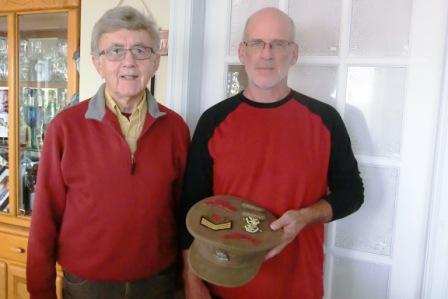
CIMG4767 Oct 25 2020 Pieter and Norman with cap and badges

Pieter and Norman Nixon.  Norman holds his grandfather’s cap and a number of the badges that Lt. Nixon had earned during his service.  (Photo credit: Daria Valkenburg)

After surviving action in Italy and France, Lt Nixon’s luck ran out near the end of WWII, when he was killed by shrapnel on April 30, 1945 during the Battle of the Delfzijl Pocket.

A May 6, 1945 letter to Bella Mae, from Norman’s Commander, Lt Colonel R B Sommerville, explained what happened.  “…Nick was killed in action at night by shell fire during a counter attack on his platoon position.  He died instantly.

At the time he was hit he was encouraging his men who were being hard pressed by fire from the part of Delfzijl on the Ems estuary….

He was initially buried in the village of Wirdum, as Lt Col Sommerville explains further in his letter.  “…his example and devotion to both his troops and duty won for him the affection and respect of officers and men alike….. At a little service in the village of Wirdum near Groningen with a brother officer and 17 of our men he was buried the next afternoon.  We will all miss him….”  The other officer mentioned as being buried was Lt B H NUNN of Halifax.

On May 10, 1945, Major P J Stephen also wrote a letter to Bella Mae, providing more details on how her husband lost his life.  “…On the evening of the 30th of April we were holding a position which we had taken the night before.  Things were quite bad as we were being heavily shelled. The men were getting jittery from loss of sleep and constant hammering.  

After each shelling Nick would jump from his trench and stroll about the platoon area as if he were in his own garden, joking with the men, caring with a smile for all their needs, setting the example to them of a first class soldier and leader.  During one of these tours Nick was fatally wounded by shrapnel from a shell which burst a few yards away. 

It was impossible to save him although we gave him medical aid immediately.  Nick passed away without regaining consciousness…

20201024_194850 Grave of Norman J Nixon in 1945

Initial burial of Norman Nixon in Wirdum. Photo sent by Lt Stackhouse.  (Photo courtesy of Nixon family)

On August 19, 1945, Lt Ron V Stackhouse wrote to Bella Mae. “…I was with ‘Nick’ on the last night about an hour before he was killed as we had both had supper together at Company Headquarters and he and I walked back to our platoons together as our platoons were right alongside of each other….”   In a postscript he mentions enclosing a photo of the grave.

After WWII ended, Lt Nixon was reburied in the Canadian War Cemetery in Holten, The Netherlands.

nixon, norman james from Holten Cemetery sent by Edwin

Grave of Norman Nixon at the Canadian War Cemetery in Holten. (Photo sent by Edwin van der Wolf.)

Visiting with Norman Nixon and Kelley Gowan and learning about Norman’s grandfather was a privilege.  But they had a surprise for us.  Norman’s father Vernon and Vernon’s wife Donna came from Grand Manan Island to meet us.

CIMG4779 Oct 25 2020 Norman and Vernon Nixon

Norman and Vernon Nixon, grandson and son of Lt Nixon. (Photo credit: Daria Valkenburg)

More memories and stories were shared, including that Vernon’s mother, Bella Mae, owned a dress shop, ‘The Hat Box’, in St. Stephen.  She was an independent woman, and never remarried after her husband’s death.

CIMG4781 Oct 25 2020 Pieter & Daria with Vernon & Donna Nixon

A final photo before we left to go back home.  Pieter and I with Vernon and Donna Nixon.  (Photo credit: Kelly Gowan)

With both the son and grandson of Lt Nixon together in one place, we asked if they wanted to share a few thoughts for a video to be sent to the Info Centre at the cemetery in Holten.  Here is the result, entitled ‘In Remembrance of Lt. Norman J. Nixon’:

It’s always an honour to meet the families of the soldiers that Pieter researches, and we hope to meet more families as travel restrictions get eased.

The 6 soldiers from the Cape Breton Highlanders on the photo wish list were:

  • Philip H. LONG, born Pictou, Nova Scotia, died April 30, 1945.
  • James Bernard MACINNIS, born Sydney, Nova Scotia, died May 1, 1945.
  • Olen B. MARSHALL, born Bridgetown, Nova Scotia, died May 1, 1945.
  • Norman James NIXON, born St. Stephen, New Brunswick, died April 30, 1945.
  • Ford Hilton SPIDLE, born Parkdale, Nova Scotia, died May 1, 1945.
  • Robert B. THOMAS, born Louisburg, Nova Scotia, died May 5, 1945.

The family of Ford Hilton SPIDLE participated in the Atlantic Canada Remembers series of postings, and you can read his story here: https://onthewarmemorialtrail.com/2021/01/07/on-the-war-memorial-trail-atlantic-canada-remembers-part-1/

Thank you to Norman Nixon and Kelley Gowan for their warm hospitality and for sharing information about Lt Nixon, and thank you to Vernon and Donna Nixon for making the trip from their home to meet with us and share memories about Vernon’s father.  It’s very clear that Lt Nixon was deeply loved and respected, and his death, so close to the end of the war, was an immeasurable loss.

Heartfelt thanks go to post-production editor Wendy Nattress, who made the YouTube tribute to Lt Nixon a reality.

20 members of the Cape Breton Highlanders lost their lives in the Battle of the Delfzijl Pocket.  If you have information or photos to share on any of these men, please email us at memorialtrail@gmail.com, or comment on the blog.

© Daria Valkenburg

…Want to follow our research?…

If you are reading this posting, but aren’t following our research, you are welcome to do so.  Our blog address: https://onthewarmemorialtrail.com/

Front cover OnTheWarMememorialTrailinEurope4 countries, 6 weeks, 7,000 km – an unforgettable war memorial journey in Europe…. Daria’s book ‘No Soldier Buried Overseas Should Ever Be Forgotten‘ is available in print and e-book formats.  Net proceeds of book sales help support research costs and the cost of maintaining this blog. For more information see https://nosoldierforgotten.com/

Screenshot_2021-02-27 On The War Memorial Trail With Pieter Valkenburg

Why not subscribe to: On The War Memorial Trail With Pieter Valkenburg: https://www.youtube.com/channel/UCJ591TyjSheOR-Cb_Gs_5Kw

Never miss a posting!  Subscribe below to have each new story from the war memorial trail delivered to your inbox.

On The War Memorial Trail….. Atlantic Canada Remembers – Part 5

January 27, 2021. Responses to the news clips on CTV’s Atlantic Live At 5 on January 4 and 13 continue to come in.  As mentioned in the previous 4 parts, Pieter is ensuring that every email is acknowledged, and that the photos of soldiers buried in The Netherlands are forwarded to the appropriate cemetery for their digital archives.

This posting features more of the photos submitted…..

Soldiers buried at the Canadian War Cemetery in Holten, The Netherlands

William Herbert Bellamy

William Herbert Bellamy.  (Photo courtesy of the Bellamy Family)

On behalf of the Bellamy Family, Linda Fury submitted a photo of her uncle, William Herbert “Billy’ BELLAMY, explaining that ….There are about 150 members of our family now.  We hold reunions often and all know the story of our Uncle Bill.  He belonged to the North Nova Scotia Highlanders and died in January 1945 while a prisoner in Germany.  Thanks so much for all you have done and are continuing to do.  Your work is very much appreciated by all of us….

William Herbert ‘Billy’ was born on May 2, 1921 in Hereford, England, the son of Percy and Frances Bellamy.  In 1927 he immigrated to Canada with his family and settled in Midgic Station (now Midgic), New Brunswick.  Following his 18th birthday, he enlisted with the West Nova Scotia Highlanders on August 2, 1940 in Aldershot, Nova Scotia. On April 30, 1941 he transferred to the North Nova Scotia Highlanders, and was on his way to England in July 1941.

The North Nova Scotia Highlanders were among the troops to land in Normandy on D-Day on June 6, 1944.  Unfortunately, on June 7, 1944 he was captured by the Germans in Normandy and became a prisoner of war (POW).  On August 13, 1944 he arrived at Stalag XII A [Limburg an der Lahn, Hessen, a POW transit camp] and then, on August 26, 1944 was transferred to Stalag Camp VIII B [Lamsdorf, Oberschlesien] near the German-Polish border.  On November 2, 1944 he was sent to the work camp E 902 Delbrückschächte Hindenburg where, along with other POWs, he worked in a nearby coal mine.

According to an account that a former POW sent after the war to Billy’s father, Billy was seriously injured on January 1, 1945 when the mine ceiling collapsed.  He was taken to hospital in Hindenburg (now Zabrze and part of Poland).  However, according to the POW record kept by his captors, he was seriously injured on November 23, 1944 and sent to a military hospital in Knurow (now Knurów, Poland). Curiously, the same injuries described as happening on January 1, 1945 were reported on the POW record as having occurred on November 23, 1944.

In January 1945 he died of his injuries. Records of the exact circumstances have not been found, likely due to advancing Russian troops.  His military service file lists his official date of death as January 28, 1945. On February 6, 1945, Billy was buried in the Municipal Cemetery of Teupitz (in the state of Brandenburg, Germany).  After the war ended he was reburied in the Heerstrasse British Cemetery in Berlin, and then in 1949 reburied for the final time in Holten.

Robert Cole

Robert Theodore Cole. (Photo courtesy of Emily Gilbert)

Ervin Ellis submitted a photo of Robert Theodore COLE, explaining that “I was told by Kent Caldwell that you were looking for a picture of Robert Cole, WWII Veteran from Coles Island. A woman that I knew had close ties to that area.  She said the whole family was deceased but her first husband was part of that family, if anyone had any pictures it would be her.  She looked through her old pictures and by some sort of miracle she had pictures…”  This was Emily Gilbert.  Robert Cole was the nephew of her husband.

Born in Coles Island, New Brunswick, the son of Fred and Maria Cole, Robert enlisted in March 1940 and served in Canada and Labrador before going overseas in September 1943. He was in France by 1944, and also was with his regiment in Belgium, The Netherlands, and Germany.  He lost his life on April 21, 1945 during the Battle of Friesoythe in Germany while serving with the Lorne Scots – Ground Defence Platoon.

Ervin’s assistance was invaluable in putting a face to this soldier’s name! He went on to write Pieter that “….This is a great project you are working on, saw you on TV a couple of times. I am the Zone Commander for the legions in this area so I know them pretty good and their Cenotaphs. If I can help you any let me know…”  Needless to say, Pieter has taken Ervin up on his offer and is grateful for the help that he and Kent Caldwell have provided.

Joseph Gerald Fougere

Joseph Gerald Fougere. (Photo submitted by Doug Landry)

Gerald Douglas ‘Doug’ Landry submitted a photo of his uncle, Joseph ‘Gerald’ FOUGERE, explaining that he was “….born in Poulamon, Nova Scotia, the only son of Felix and Josephine (Marchand) Fougere. Gerald had three sisters: Evelyn, married to Thomas Sampson; Anita, married to Val Poirier; and Theresa, married to James W. Landry….

Doug went on to write that “…Gerald was with the Perth Regiment.  He was dangerously wounded in action on April 24th, 1945 and died of wounds on April 26th, 1945 at the age of 28 years, 11 months….” He lost his life during the Battle of the Delfzijl Pocket.

Soldiers Buried In Adegem Canadian War Cemetery in Belgium

Arthur Jack Taylor

Arthur ‘Jack’ Taylor.  (Photo courtesy of the Taylor Family)

On behalf of the Taylor family, Art Taylor submitted a photo of his uncle, Arthur Brambel ‘Jack’ TAYLOR, explaining that “…My father and his four brothers, from the small town of Woodstock, New Brunswick, all served in WWII.  Three saw action.  My father (John Taylor) was in the Royal Canadian Navy and escorted convoys to Europe.  His two brothers were in the army.  Russell Taylor fought into Holland and survived.  His other brother Arthur ‘Jack’ Taylor was with the Winnipeg Rifles.  He was killed at the Leopold Canal on October 12, 1944.  He is buried at the Adegem Canadian War Cemetery in Belgium.  He was 26 years old…

Jack was a rifleman, killed during Operation Switchback, part of the Battle of the Scheldt.  A Wikipedia article explains that “….October 10, 11, and 12 were days of intense struggle while the men of the 7th Brigade with the Royal Winnipeg Rifles took, lost and then retook a group of houses known as Graaf Jan and the Regina Rifles found themselves pinned down by a group of well dug-in pillboxes that seemed to be resilient to artillery…(For more information see https://en.wikipedia.org/wiki/Battle_of_the_Scheldt#Operation_Switchback) Jack was initially buried in Madelgem before being reburied in Adegem.

Thank you to Ervin Ellis, Emily Gilbert, Doug Landy, Linda Fury, and Art Taylor for sharing photos and anecdotes.  Kudos to CTV’s Atlantic Live At 5 for helping to get the word out on this quest of remembrance. Atlantic Canadians remember their loved ones who are buried overseas.  Pieter and I extend our condolences to Ervin Ellis, who sadly lost his wife on January 20.

More photos and stories in Atlantic Canada Remembers – Part 6! If you have photos or information to share, please email Pieter at memorialtrail@gmail.com, or comment on the blog.

© Daria Valkenburg

…..Previous postings in the Atlantic Canada Remembers series….

Missed the previous postings in this series? See:

…Want to follow our research?…

If you are reading this posting, but aren’t following our research, you are welcome to do so.  Our blog address: https://onthewarmemorialtrail.com/

Front cover OnTheWarMememorialTrailinEurope4 countries, 6 weeks, 7,000 km – an unforgettable war memorial journey in Europe…. Daria’s book ‘No Soldier Buried Overseas Should Ever Be Forgotten‘ is available in print and e-book formats.  Net proceeds of book sales help support research costs and the cost of maintaining this blog. For more information see https://nosoldierforgotten.com/

You are also invited to subscribe to our YouTube Channel: On The War Memorial Trail With Pieter Valkenburg: https://www.youtube.com/channel/UCJ591TyjSheOR-Cb_Gs_5Kw.

Never miss a posting!  Subscribe below to have each new story from the war memorial trail delivered to your inbox.

On The War Memorial Trail….. A Face For Philip Hubert Long

November 1, 2020. Recently, Pieter was interviewed by David Pate on CBC Radio’s Maritime Noon, where he made an appeal for a photo of WWII soldier Philip Hubert LONG, who is buried in the Canadian War Cemetery in Holten, The Netherlands.  (You can listen to the interview here: https://drive.google.com/file/d/1R07RkSjTeshJA_-UO_W68fsY3FHCSLPB/view?usp=sharing)

Within two hours of the broadcast, Pieter received a call from a family member, and a few weeks later, a photo was provided, along with biographical information.  Permission was granted to post information, with the request that “…no reference be made to the current survivors. You are doing great work on this project and I wish you success with the follow-up you may be working on with any other veterans...”  In order to respect the wishes of family members for privacy, they are not identified.

Philip H Long I20201018

Philip Hubert Long.  (Photo courtesy of the Family of P H Long)

Family members submitted the following biography for the researchers at the Canadian War Cemetery in Holten:

…On May 29, 1921, Philip was welcomed into his family of parents Philip and Elizabeth Long, sister Jessie May, and brother Harold Chisholm in the village of Springville in Pictou County, Nova Scotia, Canada.

Following the illness and death in 1925 of his mother from tuberculosis, Philip, at three years old, went to live with his aunt Mary and uncle James MacLean on a small farm in Island East River, not too far from where Philip Sr. had moved the family to the village of Thorburn, Pictou County, to work as a coal miner.  During their childhood, Harold spent most summers with Philip at the farm and, as they grew older, helped with the chores and enjoyed the adventures offered by life in the country.  Phil liked working with the animals and, following graduation from school, stayed on at the farm where he had his dog and team of horses.

Although he was exempt from military duty due to an injury to his leg when a boy, Philip enlisted with the Cape Breton Highlanders in October 1943 at the age of twenty-two.  He was called up for duty and sailed for England in mid-December 1944.  His plan was to return to Canada when the war was over and buy a small farm of his own. 

In his first letter to Jessie after arriving in London dated January 5, 1945, Phil wrote that he had located brother Harold in London and they had just returned from an evening out to dinner and a show.  Harold had gone overseas earlier and had joined the British army as a Canloan officer.  He had been injured in action in Holland and was just completing his convalescence period in England when Phil arrived in London.  While Phil and Harold were both in the London area, they were able to get together on several occasions for some relaxation before they were both sent to Holland.

Phil wrote his last letter to Jessie on April 18, 1945, from Belgium as his unit was en route to Holland.  Shortly after, Jessie and their father were notified that Philip had been killed in action in Northern Holland on April 30, 1945.

 A tribute to Philip in the local newspaper in Pictou County read:

Philip is gone.  The lovable kindly lad who never had a viscous thought, is sleeping in Holland.  He gave his life—just as he lived—doing a little more than he was asked to do, being exempt from military duty.  But that is one thing we shall never forget about him.  No matter what he was asked to do, he always did a little more.  We have memories of his childhood:  his blond curly hair, his contagious laugh, his affectionate disposition.  He was a good student and a wide reader.

Phil was never intended to be a fighter; he loved people too much.  War to him was a job to be done, so that he and millions of other Canadian boys could lead normal lives when it was finished.  But the great tragedy of the many lads who died for us is that they never had a chance at life.  So little time to have achieved their hope of homes of their own and a future bursting with opportunities….

Edwin van der Wolf of the Canadian War Cemetery in The Netherlands explained that Philip Long was “…killed in action in Northern Holland on Monday April 30, 1945, age 23, during the battle of the Delfzijl Pocket. And he was temporarily buried then in Wirdum, Groningen and he was reburied thereafter on February 16 1946 in Holten…

long, philip hubert

Grave of Philip Hubert Long.  (Photo courtesy of the Canadian War Cemetery in Holten)

20 members of the Cape Breton Highlanders lost their lives in the Battle of the Delfzijl Pocket. Two of these were from Prince Edward Island: Carmen GILLCASH and John Archibald MACLAREN.

Thank you to the family of Philip Hubert Long and to Edwin van der Wolf from the Canadian War Cemetery in Holten for sharing information and photos.  If you have photos or information to share, please email Pieter at memorialtrail@gmail.com, or comment on the blog. 

© Daria Valkenburg

…Want to follow our research?…

If you are reading this posting, but aren’t following our research, you are welcome to do so.  Our blog address: https://onthewarmemorialtrail.com/

Front cover OnTheWarMememorialTrailinEurope4 countries, 6 weeks, 7,000 km – an unforgettable war memorial journey in Europe…. Daria’s book ‘No Soldier Buried Overseas Should Ever Be Forgotten‘ is available in print and e-book formats.  Net proceeds of book sales help support research costs and the cost of maintaining this blog. For more information see https://nosoldierforgotten.com/

You are also invited to subscribe to our YouTube Channel: On The War Memorial Trail With Pieter Valkenburg: https://www.youtube.com/channel/UCJ591TyjSheOR-Cb_Gs_5Kw

Never miss a posting!  Subscribe below to have each new story from the war memorial trail delivered to your inbox.