January 17, 2023. Edwin van der Wolf, a volunteer researcher at the Canadian War Cemetery in Holten, The Netherlands, has a particular area of interest into soldiers from the Canadian Scottish Regiment, and since 2020 has a website on the Regiment. (See https://bordencarletonresearchproject.wordpress.com/2020/05/04/new-website-on-canadian-scottish-regiment-during-ww2/)
He informed us that 38 soldiers from the Canadian Scottish Regiment are buried in the Canadian War Cemetery in Adegem, Belgium. In 2021 the Van der Wolf family participated in a grave adoption program for two of these soldiers. “…If you adopt a grave at the Adegem Canadian War Cemetery you receive a certificate of this adoption during a yearly ceremony in May…” (See https://onthewarmemorialtrail.com/2021/08/29/on-the-war-memorial-trail-adopting-a-grave-in-adegem/)
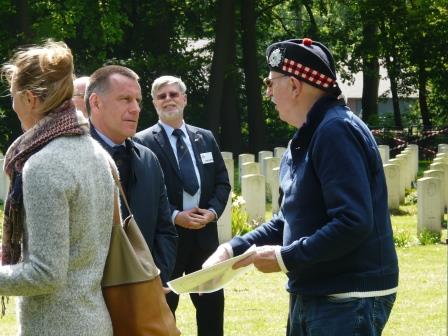
Edwin van der Wolf, far right, received grave adoption certificates from the Canadian War Cemetery in Adegem. (Photo courtesy Edwin van der Wolf)
In 2022, the family adopted the graves of Ronald ‘Ronnie’ Stuart Walter HOOLE and David ‘Dave’ Stinson HENDERSON, both from the Canadian Scottish Regiment. He then asked if we could possibly find families and photos of these two men. Of course, we agreed to investigate.
….Ronnie Hoole lost his life trying to save a friend…
Ronald ‘Ronnie’ Stuart Walter HOOLE was born October 22, 1923 in Ganges on Salt Spring Island, British Columbia, the son of Sidney Walter and Gertrude Agnes (nee Snow) Hoole.
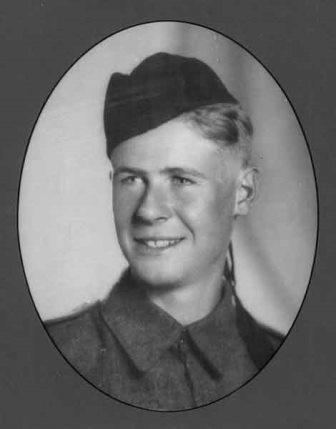
Ronald Hoole. (Photo found at https://saltspringarchives.com/Legion_Branch_92/)
A labourer before enlisting, at the age of 16, on June 26, 1940 in Victoria, British Columbia, he was sent overseas to the United Kingdom on August 23 1941. With his Regiment he arrived in Normandy for the D-Day landings on June 6, 1944 and was one of the survivors.

Map showing the Breskens Pocket. (Map source: http://www.canadiansoldiers.com)
By October 1944, the Regiment was in The Netherlands, along the Belgium border, involved in the Battle of the Breskens Pocket, an action fought south of the Scheldt Estuary as part of the Battle of the Scheldt. The Scheldt Estuary, the waterway leading from the sea into the port of Antwerp, Belgium, was not available to Allied shipping because German coastal batteries on Walcheren Island defended the approaches.
As part of the 7th Canadian Infantry Brigade, along with the Royal Winnipeg Rifles and the Regina Rifles, the Canadian Scottish worked to clear the Breskens Pocket. (See https://www.canadiansoldiers.com/history/battlehonours/northwesteurope/breskenspocket.htm and https://en.wikipedia.org/wiki/Battle_of_the_Scheldt)
On October 27, 1944, the entry in the War Diary for the Canadian Scottish noted that this was not an easy task. “…Plans were laid during the early morning for ‘A’ and ‘D’ Companies to move forward…. and to go after enemy positions…. The companies began what was to prove to be a very difficult day…. ‘A’ Company…were enduring painfully heavy shelling….”
‘A’ Company “…launched its final assault of the day with 9 Platoon leading…. All went well until suddenly 9 Platoon found itself fired on by machine guns at point-blank range. They were travelling along a road at the foot of a dyke and were met by a hail of fire from all sides. The enemy had allowed them to pass through and had then closed in….”
It was a bloody battle that ‘A’ Company could not win. “…Their ammunition was soon exhausted and their position in the open below the muzzles of the German machine guns was untenable. Only 12 men of ‘A’ Company escaped being overwhelmed in the action…”
Ronnie Hoole was one of the casualties on that day, losing his life while trying to save a friend’s life. He was temporarily buried in Hoofdplaat, The Netherlands, before being reburied in the Canadian War Cemetery in Adegem, Belgium on June 12, 1945.
Edwin explained that Ronnie Hoole’s “…grave was adopted on May 14, 2022 by my son, Keje van der Wolf…”
Unfortunately, up to now, while we have not been able to find family of Ronnie Hoole, we were fortunate to find a photo of him online.
….Dave Henderson lost his life when a German luger accidentally went off …
The search for family of David ‘Dave’ Stinson HENDERSON was successful when his great-niece, Bonnie Wilson, contacted Pieter. “…I so appreciate you reaching out. I think it is so important to keep memories of the fallen alive. What a cool thing that you and your wife are doing. Very impressive!…”
Bonnie had a photo and an account of her great-uncle from a book ‘So Young They Were – Armstrong’s Fallen Of The Second World War’ by Leonard J. Gamble.

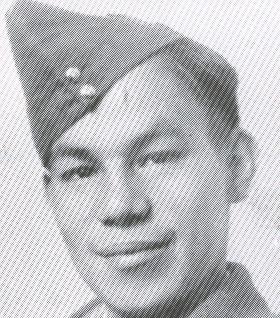
David ‘Dave’ Stinson Henderson. (Photo courtesy of Bonnie Wilson)
Dave was born on August 30, 1919 in Belfast, Northern Ireland, the son of William and Rachel (nee Stinson) Henderson. In 1926, the family immigrated to Canada and settled near Armstrong, British Columbia.
Prior to being called up in March 1941 under the National Resources Mobilization Act, he worked in the Armstrong Sawmill. After completing basic training in Vernon, British Columbia, Dave served in various positions in the province before actively enlisting on December 16, 1943 in Prince Rupert, British Columbia.
He remained in Prince Rupert until April 1944 when he took a demotion to private so that he could serve overseas. He left Canada, arriving in the United Kingdom on June 2, 1944. At the end of July he was sent to France as part of a reinforcement draft for the Regina Rifles, but transferred to the Canadian Scottish Regiment on August 5, 1944. He wanted to be in the same Regiment as his brother Alf.

Map showing the movement of troops as they crossed the Leopold Canal. (Map source: http://www.canadiansoldiers.com)
Dave survived the crossing of the Leopold Canal in Belgium on October 6, 1944. In ‘So Young They Were – Armstrong’s Fallen Of The Second World War’, the author explained that “…On October 16, the CanScots launched a further attack that captured the small town of Eede in Holland….. During the bitter fighting, Dave picked up a discarded German luger. The gun discharged, severing an artery in his groin and he bled to death before help could reach him….” His death was officially recorded as October 17, 1944.
Eede is in the Dutch province of Zeeland, near the Belgian border. He was temporarily buried in Maldegem, Belgium before being reburied in the Canadian War Cemetery in Adegem on July 17, 1945.
Edwin noted that Dave Henderson’s “…grave was adopted on May 14 by my daughter-in-law Manon van der Wolf nee Bruggeman…”
Edwin van der Wolf and Bonnie Wilson were put in contact with each other after Bonnie asked Pieter if “…there is any way to get any info on the Dutch person who has adopted his grave? My family would love any information. My Grandmother Muriel, David’s sister, did go over and see his grave with my Grandfather Henry on their travels to Europe in the 1970’. They have since passed away. I do hope to one day go and visit it myself….”
Thank you to Edwin van der Wolf for letting us know of the two additional graves at the Canadian War Cemetery in Adegem that his family adopted, and to Bonnie Wilson for sharing photos and information about her great-uncle David Henderson.
Do you have a story to tell? Email Pieter at memorialtrail@gmail.com, comment on the blog, or tweet to @researchmemori1.
© Daria Valkenburg
…Want to follow our research?….
If you are reading this posting, but aren’t following the blog, you are welcome to do so. Our blog address: https://onthewarmemorialtrail.com/.
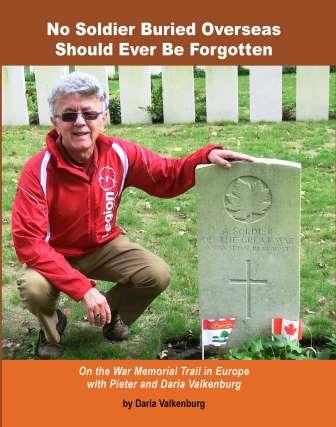 4 countries, 6 weeks, 7,000 km – an unforgettable war memorial journey in Europe…. Daria’s book ‘No Soldier Buried Overseas Should Ever Be Forgotten‘ is available in print and e-book formats. For more information see https://nosoldierforgotten.com/
You are also invited to subscribe to our YouTube Channel: On The War Memorial Trail With Pieter Valkenburg: https://www.youtube.com/channel/UCJ591TyjSheOR-Cb_Gs_5Kw.
Never miss a posting! Subscribe below to have each new story from the war memorial trail delivered to your inbox.


 On The War Memorial Trail Research Project........ with Pieter and Daria Valkenburg